






Abstract
The present study investigated relationships among work volition, perceived autonomy support from supervisors, cognitive job demands, social support from colleagues, and career adaptability. With a sample of 216 working adults, we used structural equation modeling to test a model predicting career adaptability from work volition through autonomy support, social support, and cognitive demands. Work volition directly predicted autonomy support, and autonomy support partially mediated the relationship between work volition and career adaptability. Cognitive job demands directly predicted career adaptability. Our findings provide theoretical implications for both Career Construction Theory and Psychology of Working Theory. We also discuss practical implications for career counselors.
Career adaptability refers to psychosocial resources that workers need to successfully adapt to changes in the world of work, including job transitions, developmental tasks, and disruptive events (Savickas, 1997, 2005). Since its initial proposal (Savickas, 1997) and inclusion in Career Construction Theory (CCT; Savickas, 2005), it has become a central construct in the field of vocational psychology (Johnston, 2018). Career adaptability is also included as a proposed mediator in Psychology of Working Theory, which is a recent vocational theory challenging assumptions about workers’ access to volition, privilege, and agency in their vocational experiences (PWT; Duffy et al., 2016). As the world of work has become more precarious, workers have been forced to hone and rely on their own skills and traits, such as career adaptability, rather than organizational stability or worker protections, as they navigate through increasing obstacles within the world of work (e.g., Duffy et al., 2016).
While career adaptability is widely researched, gaps remain in extant literature. Many career adaptability studies rely on student samples to the neglect of working adults, especially those with minoritized identities (Duffy, 2010; Duffy, Velez, et al., 2018). The CAAS USA-Form (Porfeli & Savickas, 2012) was developed and validated with a sample of 460 high school students that was 71% white, so it measures the career adaptability manifested by students in the privileged social location of whiteness who are preparing for their vocational futures. PWT Studies (e.g., Douglass et al., 2017; Duffy, Velez, et al., 2018) suggest that this conceptualization and operationalization of career adaptability might not be as suitable to working adults who have different vocational experiences, needs, and expectations than student populations. Additionally, CCT discourses of career adaptability make assumptions about workers’ experiences of choice, agency, and constraint within their career construction and daily experiences of their jobs. These limitations result in incomplete understandings of adult workers’ manifestations and implementations of career adaptability as well as workplace supports for career adaptability. Lastly, CCT conceptualizes career adaptability as a set of psychosocial, self-regulatory competencies, and the CAAS operationalizes these resources as individual strengths (Savickas & Porfeli, 2012). This framing of career adaptability implies that low levels of career adaptability are due to individual lacking without considering broader contexts that might support or limit workers in developing and implementing their adaptability resources.
PWT challenges the assumptions that workers can exercise agency and autonomy within their career construction and daily work. It positions marginalization and economic constraints as predictors not only of access to quality work, but also as predictors of work volition (i.e., one’s perceived freedom of work choice) and career adaptability (Duffy et al., 2016). PWT studies of career adaptability with working adults identify work volition as a predictor of career adaptability (e.g., Duffy, Velez, et al., 2018, Duffy et al., 2019; England et al., 2020). However, they neglect to consider the impacts that workplaces, supervisors, and coworkers have on workers’ abilities to enact career adaptability—important aspects of organizational context well attended to within CCT. Additionally, many PWT studies (e.g., Autin et al., 2022; Douglass et al., 2017; England et al., 2020; Williams et al., 2023) have failed to support the proposed mediational role of career adaptability in the PWT model, demonstrating need for additional clarity about the construct.
The current study applies complementary principles of CCT and PWT to present a more comprehensive understanding of career adaptability within organizational and systemic contexts. In the current study, we propose that work volition predicts career adaptability because it allows workers to choose work environments which allow for actualization of adaptive behaviors. Specifically, we test a model positioning perceived autonomy support from supervisors, social support from colleagues, and cognitive job demands as mediators in the link from work volition to career adaptability. The PWT principles we use to guide this study include the acknowledgment of workers’ varying perceptions of freedom to make work choices (i.e., work volition), impacts of work volition on vocational experiences, the established temporal relationship between work volition and career adaptability, and the inclusion of social support as a predictor of career adaptability. The CCT principles we use to guide this study include the measurement of career adaptability using the CAAS and the attention that CCT pays to impacts of organizational characteristics on career adaptability.
Career Adaptability in Career Construction Theory
Career adaptability is conceptualized as a set of four psychosocial resources that equip one to respond to current and anticipated vocational tasks (Savickas & Porfeli, 2012). These resources are concern about one’s vocational future, confidence in pursuing one’s vocational aspirations, curiosity about possible vocational selves, and control over oneself and one’s environment. Career adaptability has been positively associated with proactive personality and career optimism (Tolentino et al., 2014) and negatively associated with perceptions of limited alternative career options (Zacher et al., 2015). Career adaptability has also been significantly correlated with educational attainment, employability, career performance, goal pursuit and adjustment, response to adversity, career satisfaction, career decidedness, and perceived barriers (Johnston, 2018; Zacher, 2014). Personal characteristics predicting career adaptability include low tolerance for unpredictability, future work self, and temporal focus (Johnston, 2018). Contextual factors predicting career adaptability include learning environment, education, unemployment, internship quality, and job insecurity (Johnston, 2018). These findings demonstrate that career adaptability is predicted by and related to both within-person and environmental factors.
Critiques of CCT Perspective on Career Adaptability
CCT discourses on career adaptability have received critique. Studies (e.g., Autin et al., 2017; Wehrle et al., 2019) have criticized career adaptability research for making assumptions about agency and volition that not all workers possess. For example, Wehrle et al. (2019) investigated the career disruptions and unique obstacles that refugees experience. They found that refugees’ adaptive coping was dramatically shaped by legal and social contexts. Events that facilitated career adaptability included resolving uncertainty, gaining access to necessary resources, establishing social networks, and locating opportunities.
Much of CCT career adaptability research has perpetuated an implicit deficit-based discourse of workers by conceptualizing low levels of career adaptability as an individual-level problem while failing to consider workplace and systemic barriers that impede one’s capacity to exercise agency and adaptability. For example, CCT conceptualizes a present-time orientation as one’s failure to exhibit concern about the future; it fails to acknowledge that many marginalized populations, such as refugees and economically marginalized people, are unable to operate from a future-time orientation due to structural barriers (Wehrle et al., 2019). The dimension of control also fails to recognize that, despite self-discipline and persistence, members of minoritized groups are alienated from the social power and dominant cultural capital that enable privileged groups to exercise adaptability (American Psychological Association, 2019). Additionally, many jobs do not support, and might even punish, workers in exercising their adaptability resources. For example, from a self-determination theory and PWT perspective, the adaptability resources of control and confidence map on to the basic psychological needs of autonomy and competence. PWT research on need satisfaction demonstrates that jobs representing indecent work provide significantly less autonomy and competence need satisfaction, suggesting that there are fewer opportunities for workers in less decent jobs to exercise their control and confidence (Blustein et al., 2020).
Career Adaptability From a Psychology of Working Perspective
Psychology of Working Theory (PWT; Duffy et al., 2016) was developed to challenge assumptions of volition, agency, and privilege made in much of traditional vocational psychology. PWT proposes that marginalization and economic constraints restrict access to decent work (i.e., work that meets minimum standards for meeting basic human needs), and that this is mediated by decreased levels of career adaptability and work volition (Duffy et al., 2016).
Extant PWT research has failed to consistently support marginalization and economic constraints as predictors of career adaptability (e.g., Duffy et al., 2019; England et al., 2020; Kim et al., 2023; Williams et al., 2023). Conversely, the role of work volition as a predictor of career adaptability has been consistent (e.g., Duffy et al., 2018, 2019; England et al., 2020), and longitudinal research (Autin et al., 2017) has provided support for work volition as a predictor of career adaptability over time.
A possible explanation for PWT’s mixed findings on career adaptability is that PWT hypothesizes that marginalization and economic constraint reduce career adaptability, perpetuating an implicit deficit-based message that marginalized people are less adaptable. Strengths-based counter-narratives, such as the Community Cultural Wealth Model (Yosso, 2005) and the Critical Cultural Wealth Model of academic and career development (Garriott, 2020), argue that people from marginalized groups often demonstrate increased adaptability and use strategies, supports, and resources from non-dominant culture to respond to adversity. Additionally, unemployed workers have been found to demonstrate career adaptability at higher levels than their employed counterparts and use their adaptability resources to regain employment (Johnston, 2018), suggesting that workers demonstrate increased adaptability in response to vocational adversity. Incorporating a more strengths-based conceptualization of the construct could clarify how working adults adapt to the world of work.
Moreover, although PWT studies have made valuable contributions and amassed support for the relationship between work volition and career adaptability, few studies have explored mediating mechanisms in this relationship. Additionally, they have neglected to consider how organizational characteristics, such as job demands and work relationships, shape the contexts in which workers implement career adaptability. Integrating organizational variables into career adaptability studies can answer questions of how workplaces support or restrict their employees’ agency and capacity to enact career adaptability through providing or limiting cognitive job demands, social support, and autonomy from supervisors.
Work Volition, Organizational Variables, and Career Adaptability
Autonomy Support
Employees require autonomy at work in order to enact career adaptability. Zacher (2016) investigated daily manifestations of career adaptability and found that job autonomy positively predicted career adaptability. Autonomy support from supervisors has also been found to enhance career adaptability. For example, Furness (2020) found that autonomy support from supervisors moderated the relationship between mastery goal adoption and career adaptability. These findings support the positioning of autonomy support as a predictor of career adaptability.
Work volition has also been linked to autonomy. In a longitudinal study of working adults, work volition mediated the relationship between subjective social status and workplace autonomy (Duffy et al., 2018a). Blustein et al. (2020) constructed profiles of working conditions that differed by work need satisfaction, including the need for autonomy, and work volition was one of several predictors of profile membership. These findings support the positioning of work volition as a predictor of autonomy support.
Coworker Social Support
Forms of social support have predicted career adaptability in multiple studies of undergraduate students (e.g., Duffy, 2010; Ghosh & Fouad, 2017) and of working adults. For example, a measure of workplace social support that includes social support from colleagues has been found to positively predict career adaptability and career satisfaction (Karatepe & Olugbade, 2017). Social support operationalized as size and intimacy of one’s social network also positively predicts career adaptability (Oh et al., 2022). These findings support our positioning of social support from colleagues as a predictor of career adaptability.
Within PWT, general social support has been hypothesized as a moderator of relationships between contextual variables and career adaptability. However, supportive relationships with colleagues specifically is conceptualized as a component of psychological safety, which is a core aspect of decent work. Given these findings on general support from CCT literature and support from PWT literature, we position work volition as a predictor of social support from coworkers.
Job Demands
CCT conceptualizes career adaptability as a set of resources that workers use to respond to job demands (Savickas, 2005), and so the presence of job demands should predict the utilization of career adaptability resources. Daily job demands have been found to positively predict daily career adaptability (Zacher, 2016). Nalis et al. (2022) studied relationships among the intensification of job demands, career adaptability, and career crafting. They found that intensified demands increased career crafting behaviors and that the four CCT adaptability resources moderated this relationship. These findings indicate that job demands facilitate workers’ career adaptability, supporting our positioning of job demands as a predictor of career adaptability. Job demands exist in multiple domains (Pejtersen et al., 2010), including quantitative demands (the amount of work tasks to be completed), work pace demands (how quickly one must complete work), cognitive demands (work tasks that require high cognitive effort), emotional demands (work tasks that require high emotional labor), demands to hide emotion (work tasks that require masking of emotional expression), and physical demands (work tasks that require physical effort).
To the authors’ knowledge, no extent research has studied work volition in relation to job demands. We theorize that workers with higher work volition will choose jobs with higher cognitive demands because jobs with more cognitive demands typically provide more prestige, higher social status, more room for advancement, higher income, and other markings of a career. These types of jobs are also presumably more likely to meet workers’ basic psychological and vocational needs (Autin et al., 2019); thus, workers who are able to freely make work choices are more likely to choose these jobs. Further, our operationalization of cognitive demands (e.g., decision-making, multi-tasking, and brainstorming) aligns with Job Demands–Resources Theory’s (JD-R; Bakker & Demerouti, 2017) concept of challenging demands, which are defined as job demands that require effort, result in growth, and are perceived as beneficial or meaningful by workers. JD-R research demonstrates that personal resources such as agency and self-efficacy—both of which are related to work volition—strengthen the positive effects of challenging demands on motivational constructs such as engagement and commitment (Bakker & Demerouti, 2017), which conceptually align with the four adaptability resources of concern, control, confidence, and curiosity. For these theoretical reasons, we position work volition as a predictor of cognitive job demands.
Present Study
The current study tests a model predicting career adaptability from work volition as mediated by three organizational variables—autonomy support, coworker social support, and cognitive demands. This question fills gaps in both the CCT literature, which neglects considerations of workers’ access to freedom of vocational choice, and the PWT literature, which neglects considerations of organizational characteristics on workers’ experiences. Our hypotheses are H1–4: Work volition will positively predict perceived autonomy support (1), social support (2), cognitive job demands (3), and career adaptability (4). H5–7: Perceived autonomy support (5), social support (6), and cognitive job demands (7) will positively predict career adaptability. H8–10: Perceived autonomy support (8), social support (9), and cognitive job demands (10) will partially mediate the link from work volition to career adaptability.
See Figure 1 for our hypothesized model. Hypothesized model.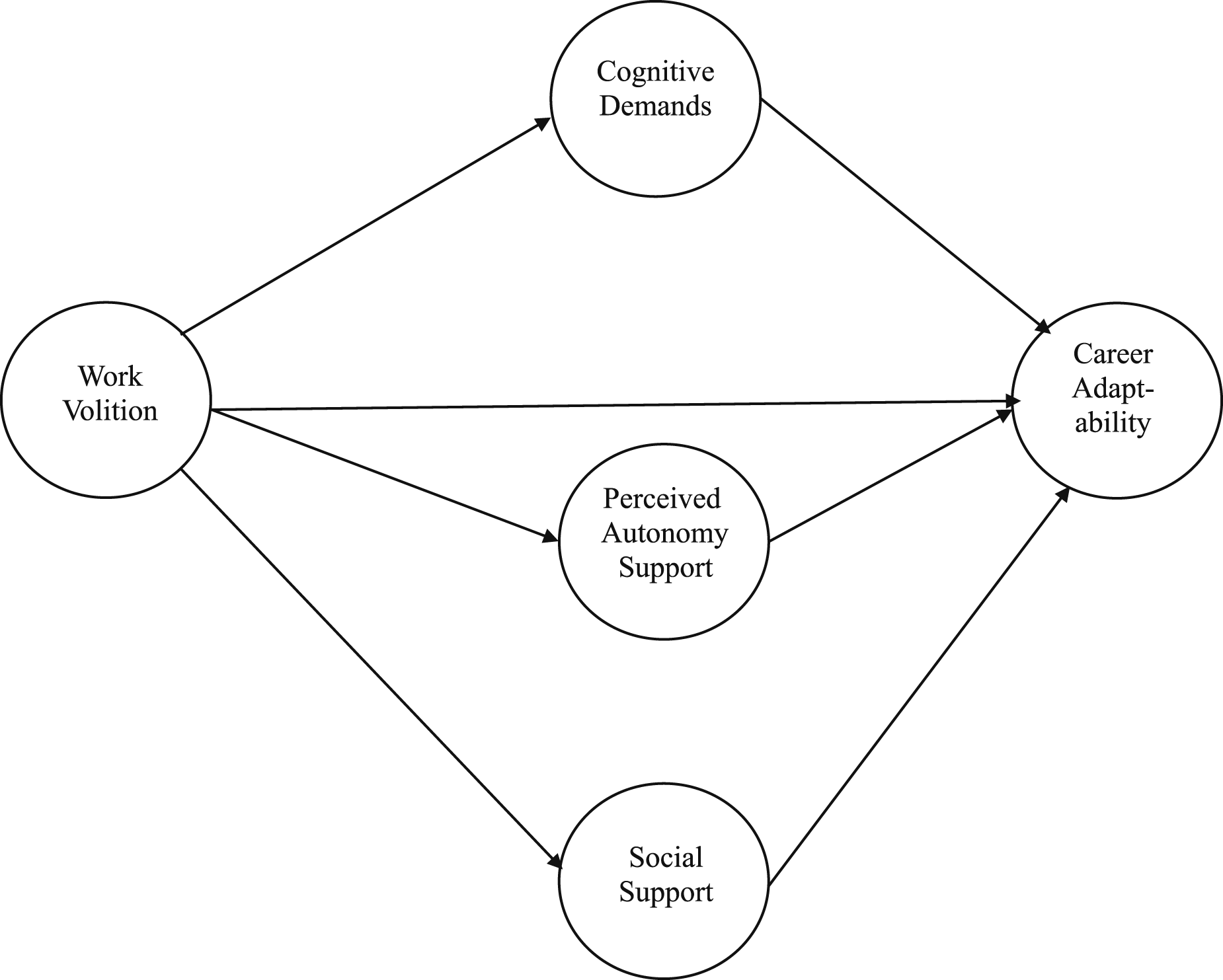
Method
Participants
The sample consisted of 216 adults residing in the United States that were employed within the past year. Participants identified as full-time employed (n = 187, 86.6%), part-time employed (n = 27, 12.5%), and not currently employed (n = 2, 0.9%). Participants ranged in age from 21 to 75 years, mean age = 39.47, SD = 10.92 years. Participants identified as female (n = 114, 52.8%) and male (n = 102, 47.2%). Participants identified as White/European American/Caucasian (n = 136, 63.0%), Black/African/African-American (n = 36, 16.7%), Hispanic/Latino/a-American (n = 15, 6.9%), Asian/Asian American (n = 29, 13.4%), American Indian/Native American/First Nation (n = 4, 1.9%), Pacific Islander (n = 1, 0.5%), and another race/ethnicity (n = 4, 1.9%). Participants reported their highest level of education: less than high school (n = 1, 0.5%), high school diploma/GED (n = 18, 8.3%), trade/vocational school (n = 2, 0.9%), some college (n = 20, 9.3%), associate’s degree (n = 16, 7.4%), bachelor’s degree (n = 92, 42.6%), master’s degree (n = 50, 23.1%), and doctoral degree (n = 16, 7.4%). Participants reported their current social class: lower class (n = 7, 3.2%), working class (n = 61, 28.2%), middle class (n = 120, 55.6%), upper middle class (n = 27, 12.5%), and upper class (n = 1, 0.5%). Participants reported their annual household income range: less than $25,000 (n = 14, 6.5%), $25,000–$50,000 (n = 40, 18.5%), $50,001–$75,000 (n = 56, 25.9%), $75,001–$100,000 (n = 44, 20.4%), $100,001–$125,000 (n = 22, 10.2), $125,001–$150,000 (n = 16, 7.4%), $150,001–$175,000 (n = 8, 3.7%), $175,001–$200,000 (n = 9, 4.2%), and over $200,000 (n = 7, 3.2%).
Measures
Work Volition
Work volition was measured using the 4-item volition subscale of the Work Volition Scale (WVS; Duffy et al., 2012). The WVS includes volition, financial constraints, and structural constraints subscales; we chose to use the volition subscale because we are interested in participants’ perceptions of their freedom to make work choices. Items are answered on a 7-point Likert scale ranging from 1 = strongly disagree to 7 = strongly agree, and a sample item reads “I feel total control over my job choices.” In the initial validation study (Duffy et al., 2012), the total scale α = 0.85, and the volition subscale α = 0.69, which the authors attributed to the shortness of the measure. In the present study, α = .85.
Perceived Autonomy Support
Perceived autonomy support was measured using the Work Climate Questionnaire Short-Form (WCQ-SF; Baard et al., 2004). Six items are answered on a 7-point Likert scale ranging from 1 = strongly disagree to 7 = strongly agree, and a sample item is “I feel that my manager provides me choices and options.” This measure has previously demonstrated high internal consistency (e.g., α = 0.96, Kim & Choo, 2022). In the present study, α = 0.95.
Social Support
Social support from colleagues was measured using a 3-item subscale of the Copenhagen Psychosocial Questionnaire II (COPSOQ II, Pejtersen et al., 2010). A sample item reads “How often are your colleagues willing to listen to your problems at work?” and items in this scale are answered on a 5-point Likert scale ranging from 1 = always to 5 = never/hardly ever with a sixth option = not relevant. Items were recoded so that 1 = never/hardly ever and 5 = always with not relevant = 0. In the initial validation study, α = 0.70, and in the present study, α = .86.
Cognitive Job Demands
Cognitive job demands were measured using a 4-item subscale from the Copenhagen Psychosocial Questionnaire II (COPSOQ II, Pejtersen et al., 2010). Items are answered on a 5-point Likert scale ranging from 1 = always to 5 = never/hardly ever, and a sample item is “Does your work require that you remember a lot of things?” Items were recoded so that 1 = never/hardly ever and 5 = always with not relevant = 0. In the initial validation study, α = 0.74, and in the present study α = 0.72.
Career Adaptability
Career adaptability was measured using the Career Adapt-Abilities Scale (CAAS; Savickas & Porfeli, 2012). This measure has 24 items broken down into 4 subscales (confidence, curiosity, concern, and control) of 6 items each. Participants are given the instructions “Different people use different strength to build their careers. No one is good at everything, each of us emphasizes some strengths more than others. Please rate how strongly you have developed each of the following abilities using the scale below.” They are asked to rate each item on a 5-point Likert scale from 1 = not strong to 5 = strongest. A sample item is “Becoming aware of the educational and vocational choices that I must make.” The CAAS demonstrates a single factor structure (Savickas & Porfeli, 2012). In the initial validation study (Savickas & Porfeli, 2012), α = 0.92 for the overall construct, and in the present study α = 0.95 for the total scale. In the initial validation study, subscales demonstrated internal consistency reliabilities of α = 0.83 for concern, α = 0.74 for control, α = 0.79 for curiosity, and α = 0.85 for confidence. In the present study, subscales demonstrated internal consistency reliabilities of α = 0.88 for concern, α = 0.87 for control, α = 0.85 for curiosity, and α = 0.88 for confidence. We used the CAAS to measure career adaptability so that our results maintain theoretical, conceptual, and operational consistency with CCT.
Procedure
After obtaining IRB approval, we used Amazon Mechanical Turk (MTurk) and Cloud Research (a companion site that offers supplementary features) to disseminate our online survey, which was generated using Qualtrics. We created two Human Intelligence Tasks (HITs) for participant recruitment. HITs contain participant demographic filters that allow researchers to specify demographic groups to access their surveys. We set one HIT to be eligible to workers who made above $50,000 and one to be eligible to workers who made below $49,999 to ensure that we had a balanced income distribution for our sample. During the process of data collection, we also set one HIT to be eligible for workers who identify as people of Color to ensure racial/ethnic diversity in our sample. We compensated participants $0.50 for completing the survey. We embedded several validity checks throughout the survey (e.g., “please choose strongly agree for this item”) to assess if participants were paying attention and removed participants who failed validity checks from our final sample. Research has demonstrated that the data quality and psychometric properties of data obtained from MTurk samples mirror the quality and psychometric properties of data gathered through traditional sampling methods (McCredie & Morey, 2019; Stritch et al., 2017). MTurk’s US worker population also allows researchers to obtain more diverse samples than traditional student samples (McCredie & Morey, 2019; Stritch et al., 2017). However, MTurk samples also have limitations. For example, MTurk workers are also younger and more educated but have lower household incomes than the general US population (Difallah et al., 2018; McCredie & Morey, 2019). Additionally, women are overrepresented on MTurk (Difallah et al., 2018).
Analytic Plan
We ran all descriptive statistics and preliminary analyses using SPSS 25. Eighteen data points were missing across 5 variables, resulting in a data set that was 98.33% complete. Because of the small amount of missing data, we used listwise deletion to handle missing data in SPSS (Parent, 2013) for our preliminary analyses. We conducted latent structural equation modeling (SEM) in MPlus 8 version 1.8.10 using full information maximum likelihood estimation to handle missing data. We followed the two-step SEM procedure described by Weston and Gore (2006) for SEM. We first ran a measurement model where all latent variables were allowed to correlate with each other, then tested a structural model including our hypothesized directional paths.
We used latent variables to represent our constructs. For work volition, we used the four volition subscale items as indicators. For social support from colleagues, we used the three subscale items as indicators. For cognitive demands, we used the four subscale items as indicators. For career adaptability, we used the four subscale scores as indicators.
We created item parcels for the six-item perceived autonomy measure. Parceling has many advantages including more precise parameter estimates, less bias in estimates, increased reliability, and reduced levels of skewness and kurtosis (e.g., Little et al., 2002). To create parcels, we ran an exploratory factor analysis on the variable, constrained the number of factors to one, and added items to parcels in countervailing order according to strength of factor loading (Little et al., 2002; Weston & Gore, 2006), resulting in three parcels with two items each.
We used four fit indices to assess the fit of our model: the chi-square test (χ2), the comparative fit index (CFI), the root mean square error of approximation (RMSEA), and the standardized root mean square residual (SRMR). Weston and Gore (2006) encourage researchers to use a range of cut-off values and multiple indices of relative and absolute fit because some fit indices are influenced by sample size and model complexity. For example, the chi-square test indicates good fit with an insignificant result, but its sensitivity to sample size often produces significant results even when other fit indices suggest good fit (Weston & Gore, 2006). Benchmarks for good fit include values ranging from 0.90 to 0.95 and above for the CFI, values ranging from 0.06 to 0.10 and below for the RMSEA, and values ranging from 0.10 to 0.08 and below for SRMR; criteria should be evaluated more stringently for larger samples and less complex models (Weston & Gore, 2006). We tested for indirect effects in MPlus using bootstrapping with 10,000 iterations and 95% confidence intervals (Muthén & Muthén, 2017). Confidence intervals that do not include zero indicate that the mediation effect is significant (Muthén & Muthén, 2017). This mediation analysis was conducted cross-sectionally, as all data was collected at the same time point.
Results
Preliminary Analyses
Latent and Observed Correlations, Means, and Standard Deviations.
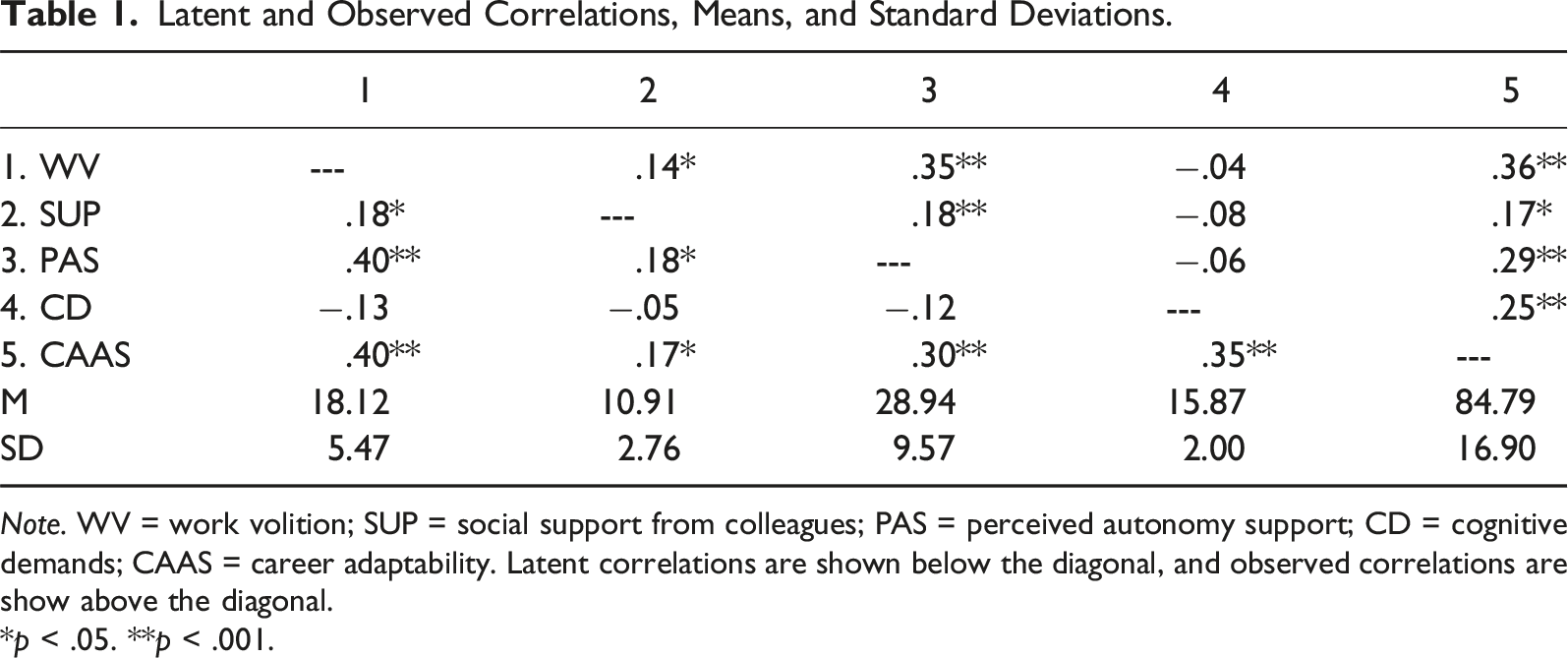
Note. WV = work volition; SUP = social support from colleagues; PAS = perceived autonomy support; CD = cognitive demands; CAAS = career adaptability. Latent correlations are shown below the diagonal, and observed correlations are show above the diagonal.
*p < .05. **p < .001.
Structural Model
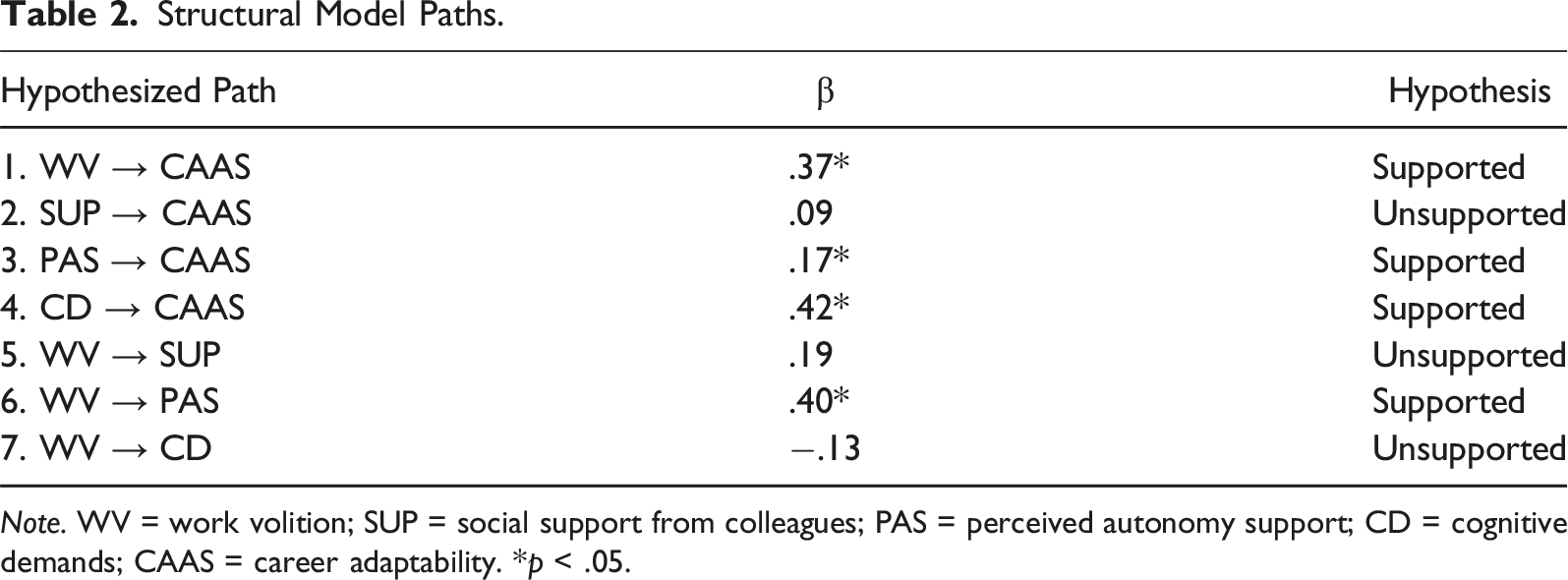
After we assessed our measurement model, we tested a structural model that predicted career adaptability from work volition, social support from colleagues, perceived autonomy support from supervisors, and cognitive job demands. The structural model demonstrated acceptable fit with the data, χ2 (128) = 292.47, p < .001, CFI = .92, RMSEA = .08, 90% CI [.07, .09], and SRMR = .06. Regarding direct effects, work volition significantly predicted perceived career adaptability ( Final structural model. Note. Significant paths are represented by solid lines; nonsignificant paths are represented by dotted lines. The number next to each path represents its standardized path coefficient (β). *p < .05. Structural Model Paths. Note. WV = work volition; SUP = social support from colleagues; PAS = perceived autonomy support; CD = cognitive demands; CAAS = career adaptability. *p < .05.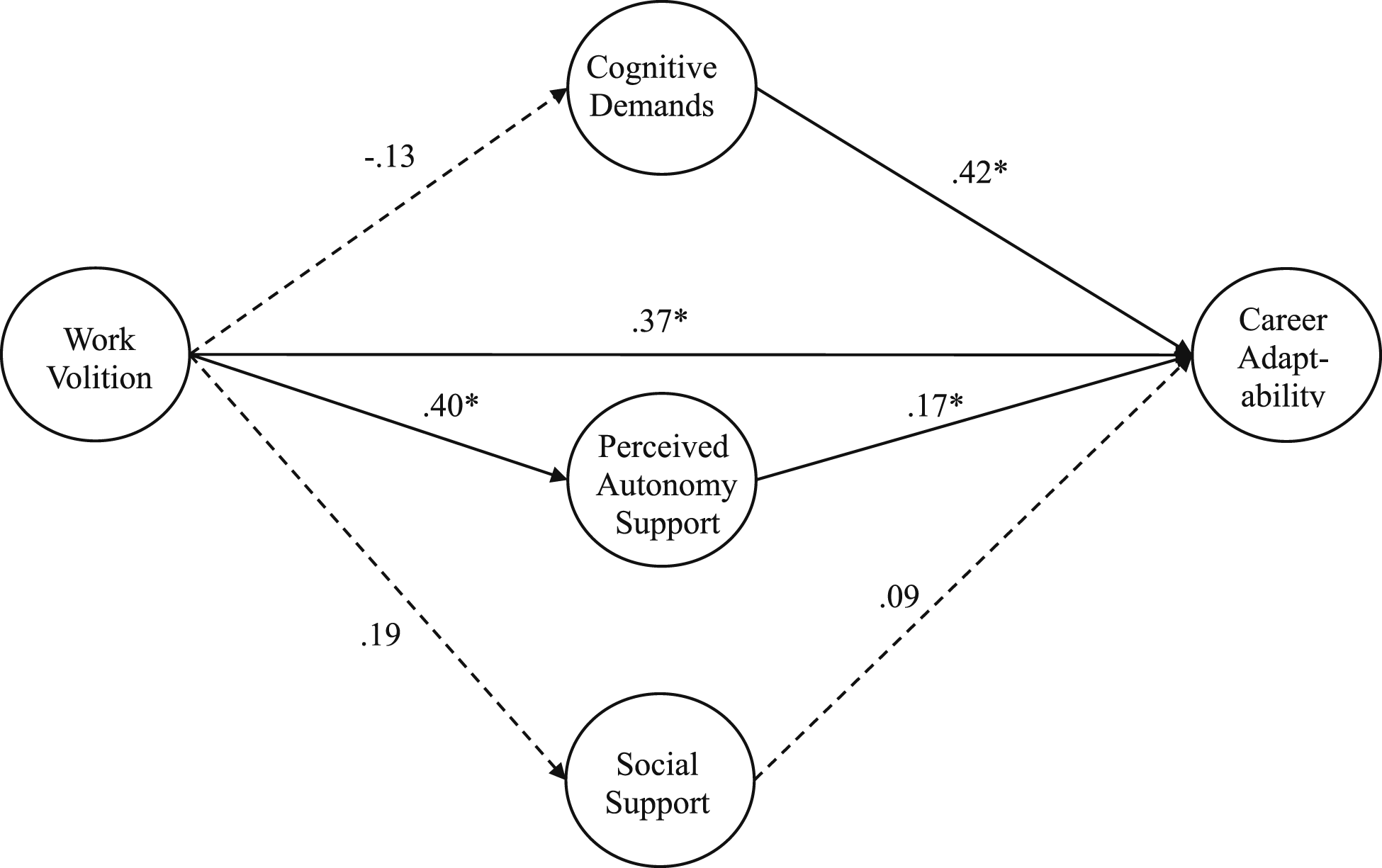
Discussion
The current study examined career adaptability from a systemic perspective that considers the level of constraint workers face in making vocational choices in light of characteristics of jobs, colleagues, and supervisors. We integrated principles of Career Construction Theory (CCT; Savickas, 1997, 2005, 2013) and Psychology of Working Theory (PWT; Duffy et al., 2016) to create this comprehensive picture of career adaptability. Most of our hypotheses were supported, demonstrating that career adaptability was predicted by work volition, perceived autonomy support, and cognitive job demands. Additionally, autonomy support partially mediated the relationship between work volition and career adaptability.
Regarding direct effects, work volition significantly, positively predicted perceived autonomy support and career adaptability, but not social support from colleagues or cognitive job demands, supporting hypotheses 1 and 4. Across PWT studies, work volition is consistently a strong, positive predictor of career adaptability (e.g., Autin et al., 2017; England et al., 2020; Kim et al., 2019) and decent work (e.g., Autin et al., 2022; England et al., 2020; Kim et al., 2023; Williams et al., 2023). It is not surprising that people with higher levels of work volition choose jobs that provide more autonomy support from supervisors, as the need for autonomy is core to self-determination needs and also more likely to be satisfied through decent work (Autin et al., 2019). Regarding the nonsignificant paths from work volition to social support from colleagues and cognitive job demands, we suggest that workers who are able to exert volition in their vocational choices might not consider social support from colleagues or cognitive job demands as meaningful priorities, especially in relation to autonomy support and structural aspects of work that support survival need satisfaction (e.g., compensation and access to healthcare). This set of findings represents novel connections among work volition and job characteristics that have not been previously considered within a PWT framework. Future research is needed to replicate and further explore the relationships among work volition, different domains of job demands, and multiple forms of social support.
Cognitive demands and perceived autonomy support both significantly, positively predicted career adaptability, but social support from colleagues did not, supporting hypotheses 5 and 7. Career adaptability refers to a set of resources—control, confidence, curiosity, and concern—that workers draw upon to respond to vocational demands and changes (Savickas, 1997, 2005, 2013). Our findings suggest that cognitive demands require workers to utilize their career adaptability resources in order to meet those demands. Additionally, literature demonstrates that having autonomy at work predicts the use of career adaptability resources (Furness, 2020; Zacher, 2016). Our findings suggest that perceiving more autonomy support from supervisors facilitates workers’ opportunities to implement their career adaptability resources, possibly because workers perceive more freedom and flexibility to respond to demands.
The lack of support for the relationship between coworker support and career adaptability contradicts extant literature (e.g., Karatepe & Olugbade, 2017; Oh et al., 2022; Wang et al., 2019). The extant literature documenting relationships between social support and career adaptability often contains varying conceptualizations and operationalizations of social support. For example, Wang et al. (2019) measured general help-seeking and connectedness in multiple domains, Kenny et al. (2022) measured support provided by teachers to high school students, and Song and Lee (2023) measured support received in one’s personal life, whereas we focused specifically on work-related social support from colleagues. It is possible that the specific form of social support that we measured is less impactful on career adaptability than other types of social support, such as academic and vocational support from mentors, supervisors, or professors that more directly targets the development of career adaptability resources. Future research is needed to clarify how specific forms of general and workplace social support impact career adaptability.
Regarding indirect effects, work volition partially mediated career adaptability through perceived autonomy support but not through social support from colleagues or cognitive demands, supporting hypothesis 8. In other words, people with high levels of work volition were more likely to demonstrate adaptability partially because their autonomy to use their adaptability resources was supported by supervisors. Workplaces create contexts that support or restrict their workers’ autonomy, thus expanding or limiting workers’ opportunities to channel their adaptability resources into actions. This finding supports the idea that career adaptability is largely influenced by organizational characteristics.
Theoretical Implications
Findings from the current study advance understandings of career adaptability across CCT and PWT literature. Systems of privilege, power, and oppression intersect to impact people’s ability to exercise their agency and utilize their adaptivity resources within the contexts of their workplaces and the world of work more broadly (Duffy et al., 2016). By investigating work volition as a predictor of career adaptability, we emphasize the roles of perceived freedom and constraint in CCT’s narrative of workers as agents and authors (Savickas, 2005, 2013). We challenge future CCT research to grapple more explicitly with systemic factors that contextualize the development and implementation of workers’ career adaptability resources.
Many PWT studies (e.g., Duffy et al., 2019; England et al., 2020; Kim et al., 2023; Williams et al., 2023) have failed to find empirical support for career adaptability as a mediator between marginalization and decent work, even as they have demonstrated significant, positive relationships between work volition and career adaptability and supported career adaptability as a direct predictor of decent work. These studies have suggested that career adaptability’s role in PWT be reconsidered. The current study contributes to this discussion by locating career adaptability at the intersection of within-person and environmental inputs. This framing contrasts with extant CCT literature that identities career adaptability as an internal trait and thus frames workers who demonstrate less control, curiosity, confidence, and concern as lacking adaptability without considering organizational factors that might restrict their enactments of adaptability. This framing also contrasts with extant PWT literature that frames marginalized workers as less adaptable rather than considering ways that systems of power and marginalization support or restrict workers’ volition and adaptability. Specifically, the current study demonstrates that both work volition and organizational characteristics significantly predict career adaptability and emphasizes workplaces as an important context in which workers are supported or inhibited as they implement their adaptability resources.
Practical Implications
Our findings have practical implications for career counselors. Our findings show that work volition, cognitive job demands, and autonomy support from supervisors predict career adaptability. Thus, career counselors should consider their clients’ levels of volition, job demands they encounter, and degrees of autonomy provided by supervisors as they work to promote their clients’ career adaptability resources. Career counselors can help their clients develop job crafting skills (Wrzesniewski & Dutton, 2001) so that workers in more flexible jobs can change their job tasks and relationships to provide them with more cognitive demands and autonomy support. While workers might not always be able to change these conditions, work volition is a malleable attitude (Duffy et al., 2016) and is also an appropriate target for career counseling interventions. Career counselors can strengthen their clients’ work volition by helping them reflect on ways that they have previously exercised their agency and internal resources to make changes in their lives, then explore how clients can take and apply aspects from those past successes in their current work (Blustein et al., 2019). Career counselors can also support their clients in responding to workplace discrimination by using their volition, agency, and cultural wealth to protect themselves, seek support, engage in self and community care, and resist oppression (Blustein et al., 2019).
Limitations and Future Directions
While these findings meaningfully contribute to the body of literature on career adaptability, the current study has several limitations that must be considered when interpreting our findings. Firstly, our findings were generated from cross-sectional data, and thus we cannot draw causal conclusions from the relationships we observed. Longitudinal or experimental studies can be conducted to confirm the causal mechanisms and directional relationships among these constructs. Secondly, our sample is highly educated, as 73.1% of participants reported having a bachelor’s degree or higher, and affluent, as 49.1% of participants reported an annual salary of $75,000+, which is notably higher than the median annual earnings of $42,542 (United States Census Bureau, 2023). Thus, future studies should replicate these findings in more socioeconomically diverse samples with more diverse educational backgrounds. Thirdly, we used Cloud Research and MTurk to recruit our sample from the US MTurk worker population, which does not represent the general US population in terms of education level, gender, or household income. Additionally, future research can clarify relationships between different forms of social support and career adaptability, as our finding of an insignificant relationship between social support and career adaptability contrasts with extant literature. Lastly, future research can more explicitly integrate strengths-based and cultural wealth perspectives to consider how workers’ career adaptability might manifest outside of the CCT resource domains representing Bourdieusian forms of cultural capital. By integrating cultural wealth frameworks (e.g., Garriott, 2020; Yosso, 2005), organizational factors, and systemic considerations, PWT researchers might be able to clarify career adaptability’s role in the PWT model.
Conclusion
Guided by the Psychology of Working Theory (PWT) and Career Construction Theory (CCT), the present study investigated career adaptability in a sample of 216 working adults. Specifically, we used structural equation modeling to test a model predicting career adaptability from work volition as mediated by autonomy support from supervisors, social support from colleagues, and cognitive job demands. Our hypotheses were partially supported, as we found that work volition directly predicted autonomy support and career adaptability, and autonomy support partially mediated the relationship between work volition and career adaptability. Cognitive job demands also directly predicted career adaptability. We discuss theoretical implications for both PWT and CCT as well as practical implications for career counselors.
Footnotes
Declaration of Conflicting Interests
The author(s) declared no potential conflicts of interest with respect to the research, authorship, and/or publication of this article.
Funding
The author(s) received no financial support for the research, authorship, and/or publication of this article.
