







Abstract
Career callings manifest when work is viewed as a vital part of one’s identity. Employees who experience a career calling tend to report beneficial outcomes (e.g., career self-efficacy, job satisfaction, and work engagement), but researchers know much less about the factors that shape the presence of a career calling. This study seeks to understand what induces women working in domestic violence services to experience the presence of a career calling. We draw upon basic psychological need theory to hypothesize that the satisfaction of the basic needs for autonomy, competence, and relatedness will promote calling presence. Two-wave survey data were collected from 207 women working in domestic violence services. Cross-lagged panel modeling results showed that satisfaction of the basic needs for competence and relatedness (but not autonomy) were positively associated with calling presence. Our findings provide key insights into the utility of basic psychological need theory for understanding the antecedents to the presence of a career calling. Limitations, directions for future research, and implications are discussed.
Keywords
For many human beings, work is a source of meaning, fulfillment, and identity (Blustein et al., 2023; Lysova et al., 2019). Scholarship into the meaning of work has taken several directions, one of which is focused on understanding work as a calling (Duffy et al., 2018). While there are varying conceptual and operational definitions of the career calling construct (Dobrow et al., 2023; Thompson & Bunderson, 2019), we rely upon Duffy et al.’s (2018) conceptualization: human beings experience the presence of a career calling when they “(a) approach their work in a way that ties it to a sense of meaning and purpose, (b) focus on prosocial contributions they can make through their work, and (c) identify an external and/or internal force guiding them to a particular career” (p. 425). Research on career calling has focused on the presence of a calling, living out one’s calling, and searching for one’s calling (Duffy et al., 2012; Duffy & Sedlacek, 2007). The focus of this paper is on the presence of a calling (calling presence) because it is arguably the foundational construct in this literature, since one cannot live out their calling if they first do not experience its presence (Duffy et al., 2018).
Although there are exceptions (e.g., Bunderson & Thompson, 2009; Keller et al., 2016; Schabram & Maitlis, 2017), individuals who experience a career calling tend to report a host of beneficial psychological and behavioral outcomes (Dobrow et al., 2023; Duffy et al., 2018; Duffy & Dik, 2013; Thompson & Bunderson, 2019). Dobrow and colleagues’ (2023) meta-analysis shows that calling presence is positively associated with career self-efficacy, job satisfaction, perceived meaningfulness of one’s work, work engagement, psychological well-being, subjective well-being, and negatively related to strain. These findings reinforce the need for researchers to investigate what factors may help to create or induce career callings, because such scholarship could be helpful to organizations seeking to benefit from meaningful work experiences for their employees (e.g., increased work engagement; Lysova et al., 2019), and for individuals who may be searching for their calling (Duffy & Sedlacek, 2007).
However, scholars know much less about the kinds of factors that shape the presence of a career calling. Indeed, reviews of the literature largely focus on understanding the outcomes of work as a calling (e.g., job satisfaction; Duffy et al., 2018; Dobrow et al., 2023). This fact was reinforced by Thompson and Bunderson (2019) who concluded that “Relatively few studies have examined calling as a dependent variable” (p. 427). Important exceptions exist, such as Buis et al. (2024) who sought to understand the relative impacts of needs-supplies fit, empowerment, and servant leadership as antecedents to career calling, but such scholarship appears to be the exception rather than the norm. A substantial gap in the scholarly literature exists on the calling construct, thereby necessitating empirical research originating from a sound theoretical basis that is designed to understand what leads to the presence of a career calling.
To that end, we draw upon basic psychological need theory to help us understand what shapes the presence of a career calling (Ryan, 1995; Vansteenkiste et al., 2020). Basic psychological need theory points to three universal psychological needs, for which their satisfaction is necessary for adequate human functioning and well-being. These include the basic psychological needs for autonomy, competence, and relatedness (Ryan, 1995; Vansteenkiste et al., 2020). Given the extensive bodies of scholarship on basic psychological need theory and career calling, one might expect that the relations among these and related constructs have been rigorously investigated in empirical research, but to the best of our knowledge, this is not the case. Some scholars have utilized broad tenets of self-determination theory and basic psychological need theory to help formulate linkages among the calling construct and other variables (e.g., Chang et al., 2020; Duffy et al., 2017; Gazica & Spector, 2015; Park et al., 2019). Others have studied conceptualizations of motivation stemming from self-determination theory in relation to living out one’s career calling (Conway et al., 2015), and connections to meaningful and decent work (Blustein et al., 2023).
Research testing empirical linkages between basic need satisfaction and calling presence is sparse. To our knowledge, only Zhang and Jin (2019) and Li et al. (2024) have done so. Zhang and Jin (2019) examined the mediating role of psychological need satisfaction in the relationship between empowering leadership and career calling, and Li et al. (2024) identified profiles of employees based on satisfaction and frustration of their psychological needs and examined whether profiles varied in their reports of different conceptualizations of career calling. While illuminating, conclusions from these studies are limited because they utilized cross-sectional data. Dobrow et al. (2023) emphasize that the use of cross-sectional data is a common limitation of career calling research, one which ultimately precludes any causal inferences. Although it is possible that need fulfillment predicts calling presence, reverse-causal effects are also possible, as Dobrow et al. (2023) theorized, but these possibilities have not been investigated by scholars.
Research is needed to disentangle the nature of the association between basic psychological need satisfaction and calling presence. We address this important gap via cross-lagged panel modeling of two-wave survey data collected from women working in domestic violence shelters and support programs. 1 Our focus on this occupational context is guided by several factors. First, domestic violence services is fundamentally important work because employees provide essential assistance to survivors and their families, which aligns well with prosocial conceptualizations of career calling, including Duffy et al.’s (2018) conceptualization which we rely upon in the present study. Indeed, individuals working in domestic violence services fulfill a critical role to society. According to the Bureau of Justice Statistics, domestic violence accounts for 21% of all violent crime, and the majority (76%) of these crimes are committed against women (Truman & Morgan, 2014). As such, investigating factors which may influence the presence of a calling within this workforce is essential, given the positive links between calling presence and myriad work attitudes and behaviors (Dobrow et al., 2023). Staff working in domestic violence services also experience difficult work (i.e., numerous clients with emotionally demanding cases, long hours) with limited pay and resources (Bemiller & Williams, 2011). By understanding the connection between basic psychological need satisfaction and calling presence among domestic violence services workers, the implications of our findings may extend to other, similar social service populations.
Our focus on women, in particular, in domestic violence services is also guided by several considerations. Women are overrepresented in domestic violence and related social services (U.S. Bureau of Labor Statistics, 2023), and more generally, women face myriad employment barriers such as pay discrimination (Penner et al., 2023), sexual harassment (Cortina & Areguin, 2021), and an imbalanced share of family responsibilities (Nisic & Trübner, 2024). Although research designed to reduce such barriers is essential, we believe that it is equally important to understand factors that promote women’s employment successes, including factors which induce the presence of a calling to work.
We are also cognizant of the possibility that gender may influence our focal variables. Gender has largely been sidelined in research on calling in careers, with the most recent meta-analysis on the topic excluding consideration of demographics, including gender (Dobrow et al., 2023). However, one qualitative study that examines calling amongst ministers underscores the importance of gender, as Sturges (2020) observed that both gender of the minister and the gendered occupational context (highly men-dominated profession) colors the experience of a career calling and its outcomes. Our study of women’s experiences of career calling in domestic violence services takes a focused examination of a women-dominated occupational context. Studies that focus on gender and basic psychological need satisfaction are limited and present mixed results. For example, in a sample of European health professionals, men and women reported similar levels of relatedness, but women reported lower scores in autonomy and competence than men (Gómez-Baya et al., 2018). In a sample of workers in Columbian food production organizations, there were no significant gender differences in basic psychological need satisfaction (Gil-Flórez et al., 2022). More generally, Van den Broeck et al. (2016) observed in their meta-analysis that women reported slightly higher relatedness need satisfaction than men, although there was no difference in autonomy or competence need satisfaction. In the present study, we help to shed light on the extent to which basic psychological need satisfaction explains calling presence among working women.
We contribute to the vocational psychology literature in at least three ways. First, and most importantly, we test associations between basic psychological need satisfaction and calling presence in a sample of women working in domestic violence services. Our primary focus in this regard is on understanding whether the satisfaction of the basic psychological needs for autonomy, competence, and/or relatedness helps to shape the presence of a career calling. Second, our use of cross-lagged panel modeling helps to resolve outstanding questions concerning the nature and direction of this association, which remains under-investigated in the extant literature. Dobrow et al. (2023) theorize that experiencing the presence of a calling will shape the satisfaction of basic psychological needs, which we acknowledge as an intriguing possibility, but we believe it is plausible for basic psychological need satisfaction to induce the presence of a calling, as we have suggested. Results from cross-lagged panel modeling will be especially informative in this regard. Finally, we investigate the satisfaction of each basic psychological need separately, taking a microscopic lens to our investigation, rather than a macroscopic lens which treats basic psychological need satisfaction as an overall construct. Doing so facilitates a test of basic psychological need theory’s universality claim, which suggests that “any person, regardless of sociodemographic or psychological characteristics, should benefit, in one way or another, from need satisfaction” (Vansteenkiste et al., 2020, p. 18). By examining each need separately, we are able to pinpoint which need(s) play a more or less prominent role in shaping calling presence. Below, we summarize our theory and the basis for our hypotheses.
Basic Psychological Need Satisfaction and Calling Presence
Basic psychological need theory asserts that all human beings have basic needs—“the nutriments or conditions that are essential to an entity’s growth and integrity” (Ryan, 1995, p. 410)—which need to be satisfied to enable effective functioning and well-being. Basic psychological need theory points to three needs, which include the needs for autonomy, competence, and relatedness. Whether employees’ basic needs are fulfilled depends on a variety of factors (Ryan, 1995), but in organizational contexts they depend on human resource and management practices (Laguerre & Barnes-Farrell, 2025), and other social factors (Ryan, 1995). In work contexts, the need for autonomy is satisfied when jobs are designed to allow workers to experience choice and a sense of authenticity within their work tasks, the need for competence is fulfilled when workers experience mastery and effectiveness in their work, and the need for relatedness is met when workers experience positive interpersonal connections while on the job (Ryan, 1995; Vansteenkiste et al., 2020).
We believe that fulfillment of these basic psychological needs will promote the presence of a calling among women working in domestic violence services. When individuals experience fulfillment of these basic needs, they are more likely to engage in behaviors for internalized (e.g., behaviors expected in a particular organizational culture are assimilated into the self) or even intrinsic (e.g., work behaviors done purely for enjoyment) reasons (Ryan, 1995), as opposed to external factors (e.g., compliance and money). They are also more likely to experience positive well-being (Martela et al., 2022; Ryan et al., 2022). Domestic violence services workers who have their autonomy needs satisfied are able to express their true, authentic selves at work, and have some choice in deciding how to best serve the survivors in need of their assistance. By having their needs for competence satisfied, domestic violence services workers experience a sense of achievement and accomplishment, which should reinforce the belief that they are in an occupation which aligns with their knowledge, skills, and abilities. Finally, experiencing the fulfillment of the basic need for relatedness suggests that domestic violence services workers have supportive and collegial relationships with their coworkers, as well as with the survivors with whom they work. Such positive interpersonal connections should lead them to believe that their work is more than just a job, it is their calling. With this scholarship and theory in mind, we test the hypothesis that the fulfillment of the basic needs for autonomy, competence, and relatedness will increase the probability that women working in domestic violence services will experience the presence of a calling.
Alternative associations between need satisfaction and calling presence are also possible, as Dobrow et al. (2023) theorized. Specifically, Dobrow et al. (2023) differentiate between internally and externally focused callings, wherein the former embodies passion and enjoyment with one’s work, whereas the latter entails an underlying sense of duty, obligation, or destiny. They speculate that career calling, whether internally or externally focused, will promote the fulfillment of basic psychological needs. In particular, they propose that autonomy and competence need satisfaction will stem from internally focused callings, while relatedness need satisfaction will arise from externally focused callings. Although our operational definition of career calling does not distinguish between the source/focus of the calling (internal or external; Dobrow et al., 2023), our methodology nonetheless provides us with an opportunity to investigate potential causal, reverse-causal, or reciprocal associations between calling presence and basic psychological need satisfaction. We explored such possibilities in the present study via the following research question.
Method
Procedure and Participants
Two waves of survey data were collected from employees of domestic violence programs in a state in the Midwestern United States, following IRB approval. There was approximately 1 month between surveys. We suspected that the 1-month lag would allow for some change in the constructs under investigation, because the career calling construct is a “generally stable yet malleable construct” (Dik et al., 2012, p. 252). A 1-month lag has also been utilized in previous two-wave data collections of calling presence (Dik et al., 2012). Recruitment of participants from 52 programs began with the program directors, who were contacted in a face-to-face meeting, mailed recruitment materials, and called to solicit their program’s participation in the two surveys.
Responses were collected from employees in 45 of 52 programs (86.5% program response rate). In the 45 participating programs, Time 1 responses were collected from 332 individuals who also provided an anonymous unique identifier (Time 1 response rate was 332/979 = 33.9%). Time 2 data were matched for 228 participants (68.7% retention rate). We screened the data for evidence of careless/insufficient effort responding because retaining careless responders may lead to biased scale means and correlations among variables (McGonagle et al., 2016). This screening was accomplished by using two instructed-response items (e.g., “Please select ‘Agree’”), and one self-report of careless responding (i.e., “I have paid no attention to this survey so far”) that was used by Huang et al. (2015). Participants were flagged from the two instructed-response questions if they did not select the requested response, and they were flagged from the self-report of careless responding (i.e., “I have paid no attention to this survey so far”) if they responded with “neutral,” “agree,” or “strongly agree.” We allowed participants to fail one of these three items, consistent with McGonagle et al.’s (2016) guidance, but two or more flags resulted in removal from the dataset. Of the 332 individuals with Time 1 responses, we screened out five individuals for careless responding using this procedure. There were 218 remaining participants with complete data at Time 1 and Time 2, 207 of whom self-identified as female.
We focused on these 207 women in our analysis. 2 Most of the participants identified as White (78.7%), while 10.1% identified as Black, and 47.4% of participants were between 25 and 42 years old. Participants could self-select from one of four job titles in response to the question, “What is your primary job title/position at your program?”, where the options included “Director (e.g., program director, executive director, chief executive officer, assistant director)”, “Supervisor (e.g., supervisor/manager/program coordinator)”, “Advocate (e.g., child, legal, community, or housing advocate; case manager)”, and “Administrative.” Of the N = 207 in our sample, 48 (23.2%) selected Director, 46 (22.2%) selected Supervisor, 92 (44.4%) selected Advocate, 13 (6.3%) selected Administrative, and 8 participants (3.9%) did not respond to this question. 3 Respondents worked 38.5 hr each week on average (SD = 8.5), and they had worked at their program for an average of 7.6 years (SD = 7.9).
Measures
Descriptive Statistics, Zero-Order Correlations, and Reliability Estimates
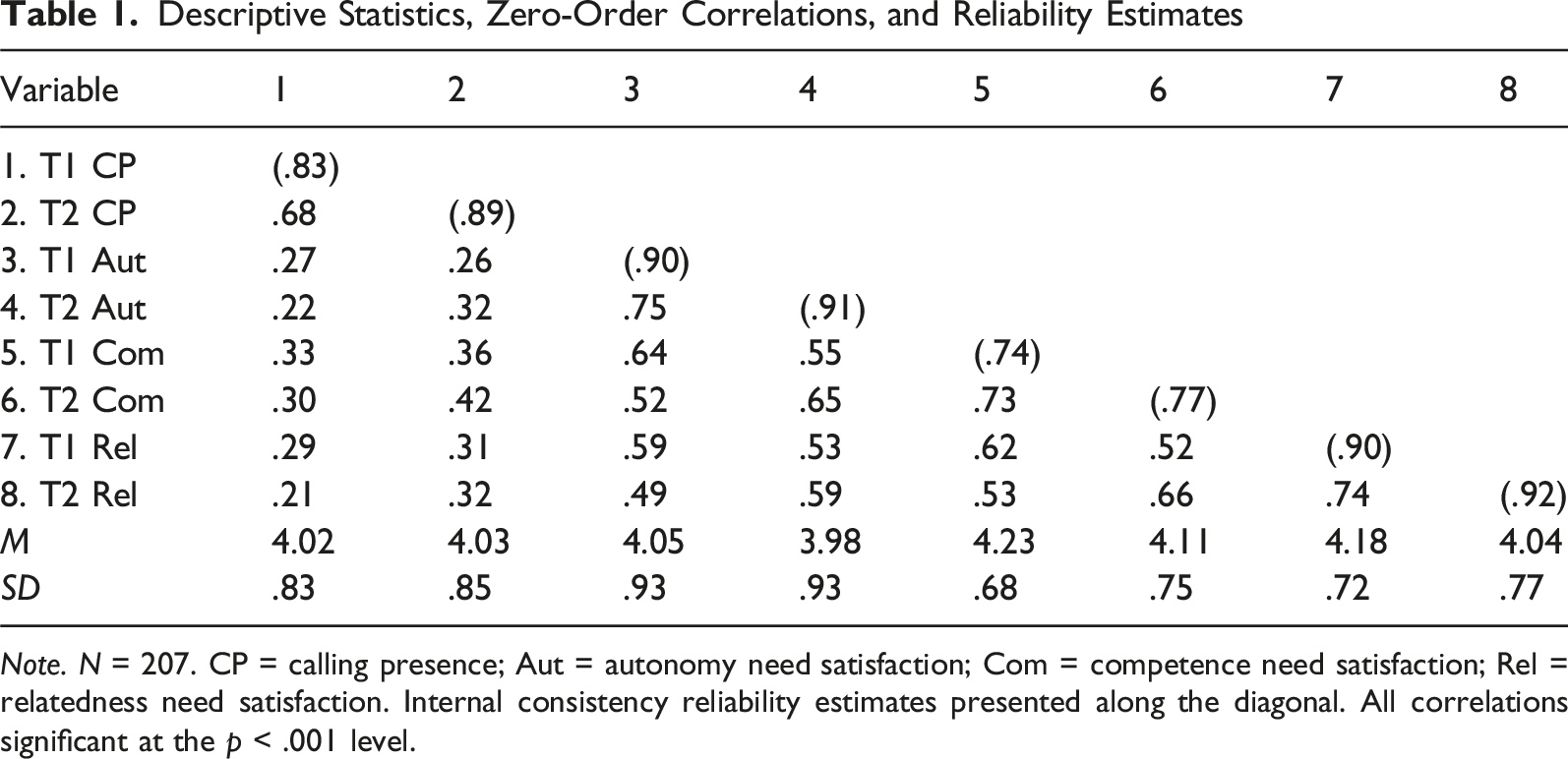
Note. N = 207. CP = calling presence; Aut = autonomy need satisfaction; Com = competence need satisfaction; Rel = relatedness need satisfaction. Internal consistency reliability estimates presented along the diagonal. All correlations significant at the p < .001 level.
Calling Presence
Calling presence was assessed with the two-item measure from the Brief Calling Scale (BCS) that was developed and validated by Dik et al. (2012). In the initial scale development article, Dik et al. (2012) provided evidence for the internal consistency reliability of the BCS-calling presence scale, with Cronbach’s alpha equal to .79. In addition, evidence of convergent validity was provided as the two-item BCS-calling presence scale correlated strongly and positively (r = .69) with the 12-item calling presence subscale of the Calling and Vocation Questionnaire.
Participants are first presented with instructions, including a definition of calling: Broadly speaking, a “calling” refers to a person’s belief that she or he is called upon by the needs of society, by a person’s own inner potential, by God, by a Higher Power, etc.) to do a particular kind of work. The following questions assess the degree to which you see this concept as relevant to your own life and career. Please respond honestly, not according to what is socially desirable or what you feel you “ought” to think. Please indicate the extent to which each of the following statements currently describe you, using the following scale.
The two items are presented after these instructions, which include “I have a calling to a particular kind of work” and “I have a good understanding of my calling as it applies to my career.” Responses were on a five-point scale ranging from “1” (not at all true of me) to “5” (totally true of me). In the present study, internal consistency reliability (Cronbach’s α) was .83 and .89 at Time 1 and Time 2, respectively.
Basic Psychological Need Satisfaction
Satisfaction of the basic needs for autonomy, competence, and relatedness was assessed with four, three, and five items, respectively, from the Basic Psychological Need Satisfaction at Work Scale (Deci et al., 2001; Ilardi et al., 1993; Kasser et al., 1992). Deci et al. (2001) provided evidence of the internal consistency reliability of the scale (Cronbach α′s = .73, .84, and .79 in the U.S. sample for competence, relatedness, and autonomy need satisfaction, respectively), and the convergent validity of the scale was supported as need satisfaction was positively associated, as expected, with engagement, and negatively associated with anxiety.
The full 21-item scale includes nine reverse-scored items. However, we excluded the reverse-scored items in our surveys because they may be better indicators of need frustration rather than need satisfaction (Olafsen et al., 2021). Excluding these items also allowed us to offer a slightly shorter survey for our participants while, in our judgment, still retaining the content validity of the measures. We verified the factor structure of our measure via separate confirmatory factor analyses of the Time 1 and Time 2 data. Results supported the three-factor structure at Time 1 (Satorra–Bentler scaled χ2 [51] = 118.05, p < .001, CFI = .94, SRMR = .05) and Time 2 (Satorra–Bentler scaled χ2 [51] = 150.23, p < .001, CFI = .93, SRMR = .06).
Example items include the following: “I feel like I can make a lot of inputs to deciding how my job gets done” (autonomy), “People at work tell me I am good at what I do” (competence), and “People at work care about me” (relatedness). Responses were on a five-point scale ranging from “1” (not at all true) to “5” (very true). Internal consistency reliabilities (Cronbach’s α) at Time 1 were .90 (autonomy), .74 (competence), and .90 (relatedness), and at Time 2 were .91 (autonomy), .77 (competence), and .92 (relatedness).
Data Analysis
Data were analyzed via path analysis, using Mplus v8.10 (Muthén & Muthén, 1998-2023), with robust maximum likelihood estimation and cluster robust standard errors to adjust for any non-independence of observations due to nesting within domestic violence programs. Confirmatory factor analyses were conducted separately with Time 1 and Time 2 data to provide evidence of the discriminant validity of our measures. We then conducted cross-lagged panel modeling via three path analyses—one for each basic psychological need and calling presence—while specifying saturated models with all possible paths to test our hypotheses and our research question. Our interest was in the cross-lagged parameters which provide information about the degree of change in Time 2 variables (e.g., Time 2 calling presence) that can be expected for a 1-unit increase in Time 1 variables (e.g., Time 1 need satisfaction), while controlling for previous levels of the criterion (e.g., Time 1 calling presence).
Results
Model Fit Statistics
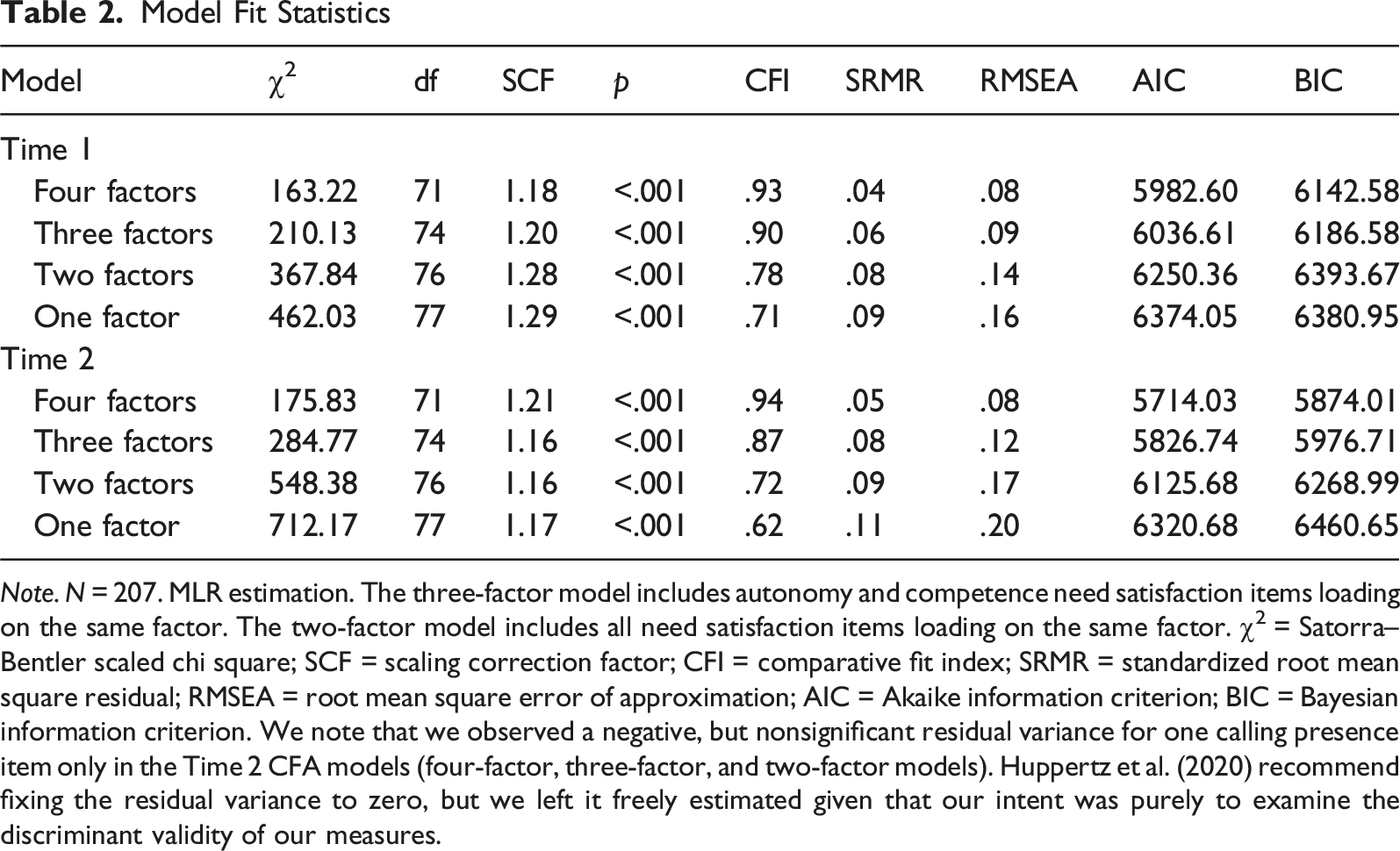
Note. N = 207. MLR estimation. The three-factor model includes autonomy and competence need satisfaction items loading on the same factor. The two-factor model includes all need satisfaction items loading on the same factor. χ2 = Satorra–Bentler scaled chi square; SCF = scaling correction factor; CFI = comparative fit index; SRMR = standardized root mean square residual; RMSEA = root mean square error of approximation; AIC = Akaike information criterion; BIC = Bayesian information criterion. We note that we observed a negative, but nonsignificant residual variance for one calling presence item only in the Time 2 CFA models (four-factor, three-factor, and two-factor models). Huppertz et al. (2020) recommend fixing the residual variance to zero, but we left it freely estimated given that our intent was purely to examine the discriminant validity of our measures.
We do not report fit statistics for our cross-lagged panel models because they are just-identified (saturated models) with df = 0, and hence, the models provide perfect fit to the data. Figures 1-3 show the unstandardized coefficients in each of these models. Hypothesis 1 was not supported as Time 1 autonomy need satisfaction was unrelated to Time 2 calling presence (b = .08, p = .132; Figure 1). However, Hypotheses 2 and 3 were supported as both Time 1 competence (b = .20, p = .001; Figure 2) and Time 1 relatedness (b = .15, p = .033; Figure 3) need satisfaction were positively associated with Time 2 calling presence. Cross-Lagged Panel Model Unstandardized Coefficients for Autonomy Need Satisfaction and Calling Presence Cross-Lagged Panel Model Unstandardized Coefficients for Competence Need Satisfaction and Calling Presence Cross-Lagged Panel Model Unstandardized Coefficients for Relatedness Need Satisfaction and Calling Presence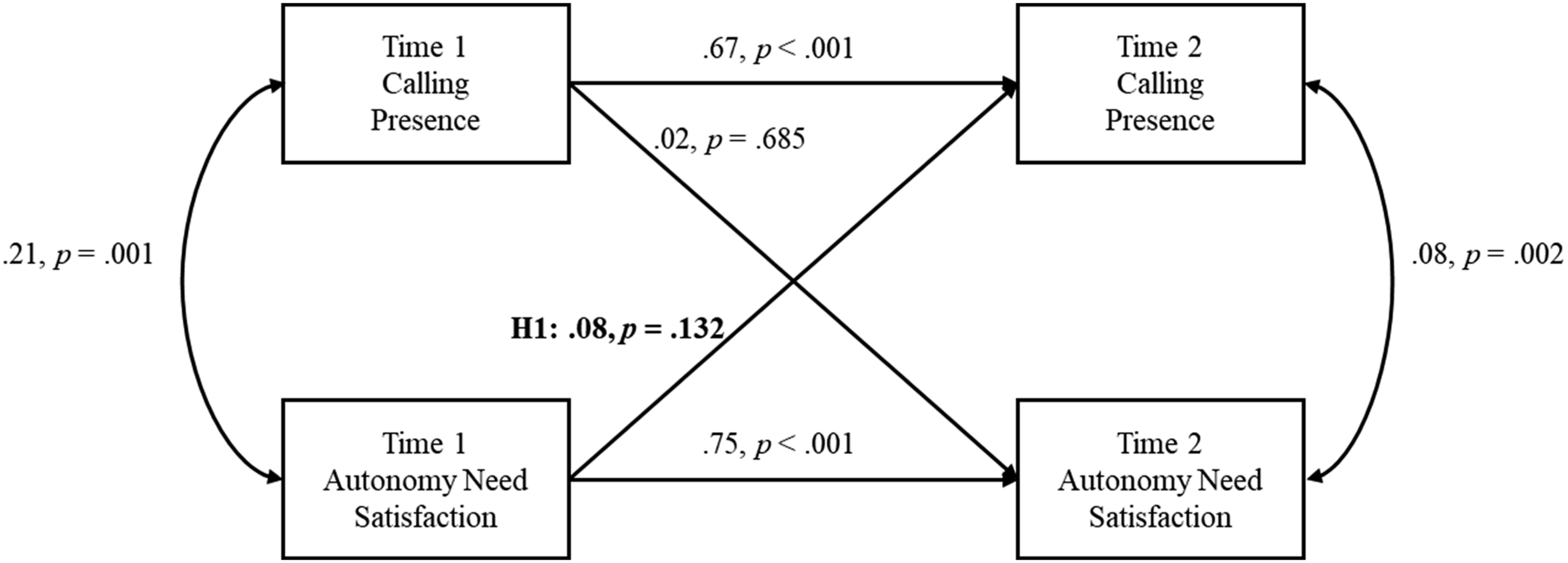
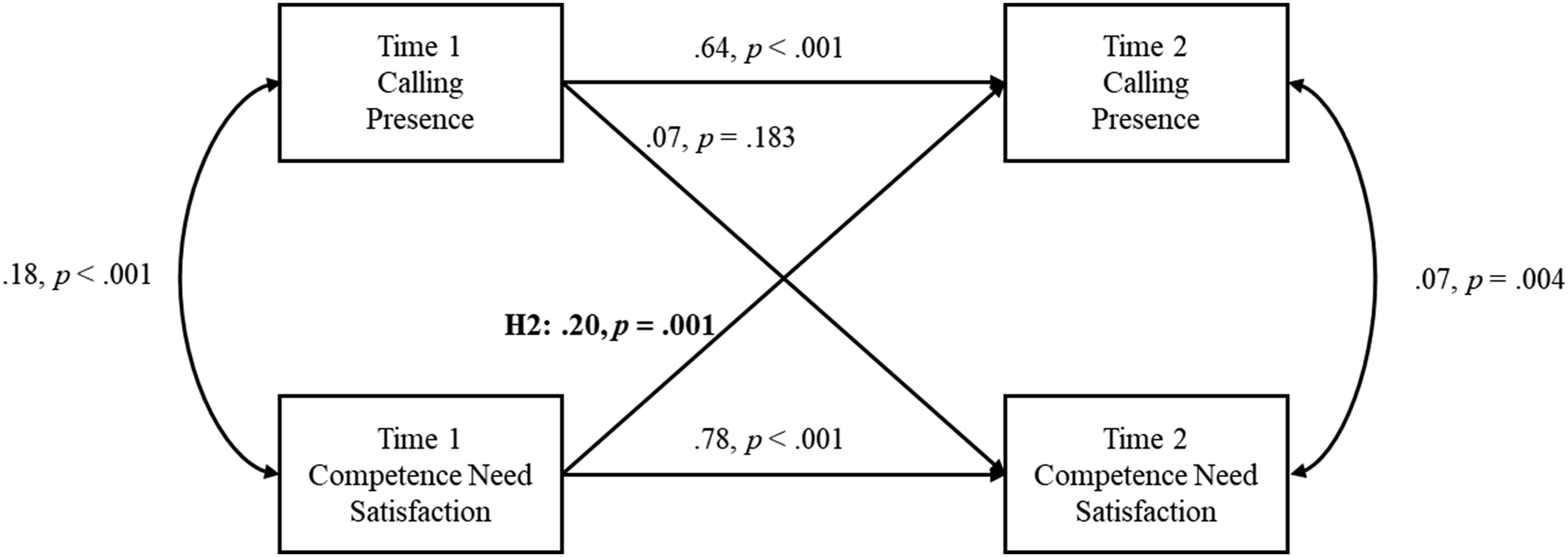
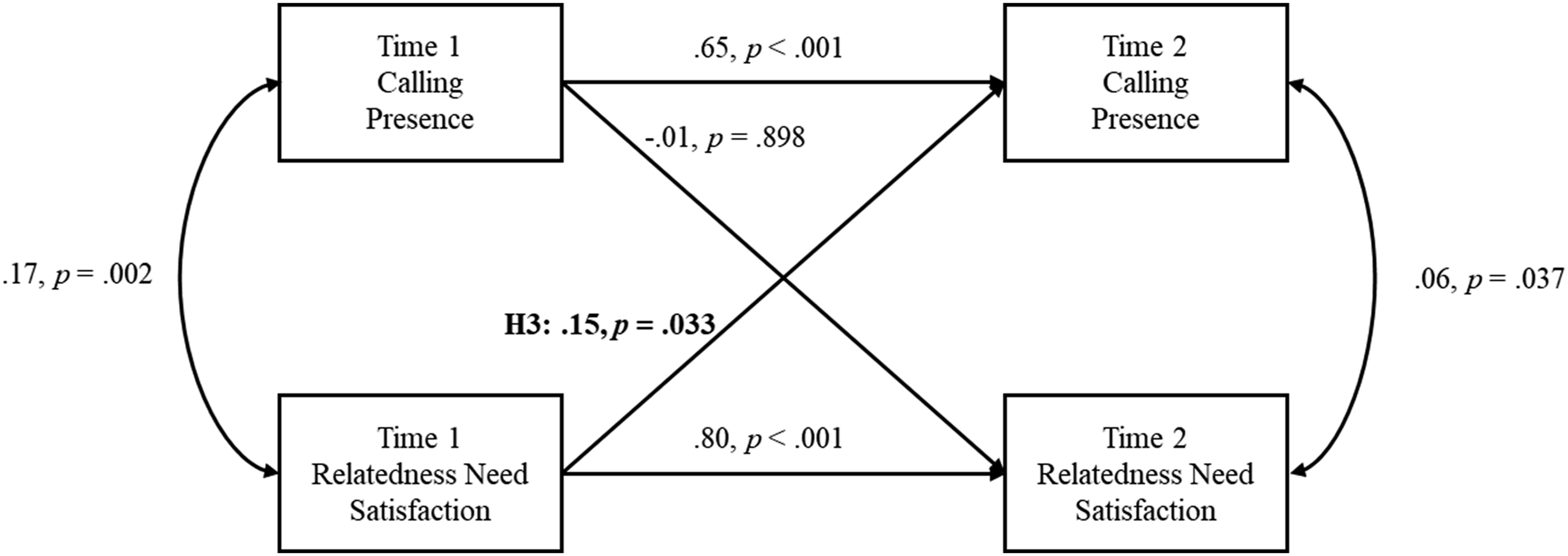
Finally, our Research Question pertained to potential reverse-causal or reciprocal effects, given that such effects have been theorized in the literature (Dobrow et al., 2023). However, we found no evidence for such associations. Time 1 calling presence was unrelated to Time 2 autonomy need satisfaction (b = .02, p = .685), competence need satisfaction (b = .07, p = .183), and relatedness need satisfaction (b = −.01, p = .898).
Discussion
Our study of the relationship between basic psychological need satisfaction and calling presence among women working in domestic violence services reveals several key findings, with important theoretical implications. Our primary focus was on testing the potential for basic psychological need satisfaction to promote the presence of a calling. In particular, we hypothesized that satisfaction of the basic needs for autonomy (Hypothesis 1), competence (Hypothesis 2), and relatedness (Hypothesis 3) would be positively associated with calling presence. We observed that satisfaction of the basic needs for competence and relatedness at Time 1 was positively associated with Time 2 reports of calling presence, thus providing support for Hypothesis 2 and Hypothesis 3. These results indicate that women working in domestic violence services were more likely to experience the presence of a calling when they felt competent and capable in their ability to perform their job (competence need satisfaction), and when they experienced satisfying interpersonal work relationships (relatedness need satisfaction). Our findings concerning the beneficial impacts of competence and relatedness need satisfaction are consistent with previous research showing that basic psychological need satisfaction is positively associated with a host of outcomes, including intrinsic motivation, positive affect, and general well-being (Van den Broeck et al., 2016). Likewise, these results help to fill the gap in scholars’ understanding of the precursors to calling presence, which is an area that is sorely in need of research (Thompson & Bunderson, 2019), and provide some evidence of the utility of basic psychological need theory for this purpose. Given our observations, we believe that basic psychological need theory offers a path forward for scholars of the calling construct. We call on researchers to conduct additional investigations into the role of basic psychological need satisfaction as a predictor of calling presence.
With that said, the lack of support for Hypothesis 1 pertaining to autonomy need satisfaction as a predictor of calling presence is worth considering further. Importantly, our observation serves as a challenge to the universality claim within basic psychological need theory. This claim suggests that “If psychological needs are inherent, they should be universally applicable and operative” (Vansteenkiste et al., 2020, p. 5). Vansteenkiste et al. (2020) further assert that it is autonomy need satisfaction that is “the most disputed need” (p. 17). Our research aligns with this observation and suggests that at least with respect to inducing the presence of a calling among women working in domestic violence services, it is competence and relatedness need satisfaction which appear to matter most. Extant research may shed some light as to why we failed to find support for effects of autonomy need satisfaction on calling presence. In particular, job autonomy has the potential to be stressful for workers (Stiglbauer & Penz, 2025), because increased autonomy may coincide with increased job demands and, ultimately, emotional exhaustion (Dettmers & Bredehöft, 2020). Related to the present study, it is possible that increases in autonomy need satisfaction at Time 1 led to increased demands, which may have been appraised by some workers as stressful (Stiglbauer & Penz, 2025), thus leading some workers to question whether work in domestic violence services was their true calling. Future research is needed to replicate these findings to determine whether it is indeed competence and relatedness need satisfaction which matter the most for inducing the presence of a calling, and to investigate our tentative explanation for the lack of support for autonomy need satisfaction.
Finally, our research question pertained to the potential for reverse-causal or reciprocal associations between basic psychological need satisfaction and calling presence, based on Dobrow et al.’s (2023) theorizing. However, we found no evidence to support Dobrow et al.’s (2023) theory that callings predict the satisfaction of basic needs. We recognize that these null results may stem from the fact that our measure of calling presence does not differentiate between internal (e.g., personal joy) or external (e.g., sense of duty) sources of calling. As a result, we were unable to test whether and how these sources of calling may differentially relate to need satisfaction. Future research with different measures of calling presence is needed to evaluate the generalizability of our findings. Nonetheless, our results suggest that basic psychological need satisfaction may induce the presence of a calling, and not the other way around.
Practical Implications
Meaningful practical implications also extend from our study. Helping to cultivate the presence of a calling among workers is important for workers’ career development. This is because when a career calling is experienced, workers are more likely to engage in career planning, to experience career self-efficacy (Hirschi & Herrmann, 2013), and to continue to pursue challenging careers despite adversity (Dobrow & Heller, 2015). Thus, any efforts by managers and organizations to cultivate the presence of a calling may help them retain workers as they navigate the challenging work inherent to careers in domestic violence prevention.
Importantly, we found evidence that managers and organizations may be able to induce the presence of a calling by satisfying women’s basic psychological needs, especially the needs for competence and relatedness. Laguerre and Barnes-Farrell (2025) point to need-supportive human resource practices as the primary levers for fulfilling employees’ needs. Accordingly, we encourage managers and organizations to engage in such need-supportive practices to facilitate career callings amongst their staff. Our findings suggest that a primary focus of managers should be on providing competence-supportive practices and relatedness-supportive practices to their workers. One competence-supportive practice involves instituting regular performance appraisals to evaluate employee performance (Laguerre & Barnes-Farrell, 2025). Consequently, we encourage domestic violence services organizations to build in a formal performance appraisal process, to ensure that advocates and other staff have a clear understanding of their performance in different domains of their job, such as in their provision of support to survivors of domestic violence. In addition, one relatedness-supportive practice suggested by Laguerre and Barnes-Farrell (2025) involves instituting reward systems which reinforce cooperation. Domestic violence services organizations could deploy such a relatedness-supportive practice by evaluating staff, at least in part, based on their collegiality and cooperation with colleagues within their organization. Our results suggest that such efforts may help promote the presence of a calling among their workers, which ultimately should benefit the development of their career in domestic violence prevention.
Limitations and Additional Future Research Directions
Theoretical and practical implications notwithstanding, there are several limitations to keep in mind as our results are interpreted. First, we only captured two waves of data, which precluded our ability to utilize more sophisticated cross-lagged panel models, such as random-intercepts cross-lagged panel modeling, which more effectively partitions trait and state variance in the constructs under study (i.e., Hamaker et al., 2015). Thus, future research should seek to replicate our findings over longer periods of time and with more data collection waves.
Second, we did not study need frustration, which may play its own unique role in work outcomes (Vansteenkiste et al., 2020). Future research may attempt to concurrently examine need satisfaction and frustration to determine which factors are most predictive of calling presence. Third, while our sample and focus on women working in domestic violence services is noteworthy, some may view this context as especially unique, which could limit the generalizability of our findings to other contexts. Although we suspect that our results will generalize to other human service occupations, future research may also seek to determine whether our results replicate in contexts other than the human services sector.
Finally, as noted earlier, the way in which gender influences basic psychological need satisfaction is undertheorized and understudied. Our findings underscore the importance of competence and relatedness need satisfaction in facilitating a career calling for women working in domestic violence services. With that said, our sample did not include enough men to warrant a potential test of gender as a moderator of the effects of need satisfaction on calling presence, so we are unable to assess if these same needs are important for men working in this field, or more broadly. Future research may seek to replicate our findings in samples with greater gender diversity, to determine whether our findings generalize to working men.
Conclusion
We aimed to contribute to scholars’ understanding of the predictors of the presence of a career calling among women working in domestic violence services, using basic psychological need theory as our guide. Results from our two-wave study provide key insights into the importance of competence and relatedness need satisfaction for helping to induce the presence of a career calling. Our findings help to provide a path forward for understanding how to promote the presence of a calling among working women, especially those working in domestic violence services, and ultimately, more meaningful work experiences.
Footnotes

Ethical Considerations
This study was approved by the Institutional Review Board at University of Illinois at Springfield (Benjamin Walsh’s previous institution) (approval no. 15-067) on April 22, 2015.
Consent to Participate
The IRB determined that this research involved minimal risk and approved a waiver for informed consent.
Funding
The authors disclosed receipt of the following financial support for the research, authorship, and/or publication of this article: Funding for the data collection was provided by University of Illinois at Springfield (Benjamin Walsh’s previous institution). Funding for this manuscript was provided by the Seidman College of Business at Grand Valley State University.
Declaration of Conflicting Interests
The authors declared no potential conflicts of interest with respect to the research, authorship, and/or publication of this article.
Data Availability Statement
The datasets generated during and/or analyzed during the current study are available from the corresponding author on reasonable request.