







Abstract
Grounded in Career Construction Theory, Heavy Work Investment Theory, and the Job Demand Resources Model, our study aims to provide a comprehensive understanding of the interplay between individual career calling, the heavy investment in work roles (work engagement and harmonious work passion), and the availability of organizational support impacting job performance and well-being (psychological distress) within the distinctive context of transitioning from a corporate career to a freelance academic role. 313 full-time senior executives who proactively opted for visiting faculty positions in reputed Indian B-schools and are presently working full-time in 12 sectors such as biotech, manufacturing, insurance, information technology (IT), and healthcare in the Indian subcontinent were a part of our multi-phased (3-wave) study. The findings of the study provide actionable insights for organizations aiming to optimize the contributions of freelance visiting professionals, enhance their well-being, and bolster their job performance.
Keywords
Introduction
In higher education, freelance visiting faculty, or pracademics, work in higher education within flexible, ad-hoc contracts. They are classified as “former and/or current practitioners who are now academics within HE” (Dickinson et al., 2022, p. 291), and they connect practice and scholarship. Their increasing importance in the development of higher educational institutions is multi-faceted, as that they act as a bridge to students be industry-specific skill-ready (Collins & Collins, 2019), enhance institute’s brand image (Amsler & Bolsmann, 2012), capture market share (Bennett & Ali-Choudhury, 2009), and thus overall contributing to the economy and broader society (Ankrah & Al-Tabbaa, 2015).
Pracademics are boundary spanners (Haas, 2017) or hybrid specialists (Vuković, 2017) who operate within both academia and the corporate world and hold hybrid positions. They enjoy the freedom that comes with being able to set their own schedules and choose their own projects. However, the need for self-marketing, contract negotiation, and workload self-management (Kubiak et al., 2015) is more concerning during the busy teaching terms. Balancing multiple roles and shifting demands while trying to establish themselves in both academic and professional spaces is no small feat (Powell et al., 2018).
However, autonomy and entrepreneurial opportunities comes with its challenges, as pracademics often face limited institutional support. Unlike permanent faculty, they may lack resources, decision-making liquidity, and appreciation (Wood et al., 2016), along with a sense of isolation from the scholarly circles (Collins & Collins, 2019; Wood et al., 2016). Freelance arrangements increase ambiguity, creating a paradox of gratification and apprehension (Petriglieri et al., 2019). Pracademics often face uncertainty about the continuity of projects and future opportunities, requiring resilience and adaptability to thrive.
Our research builds on the debate of whether pracademics develop entirely new professional identities or maintain a dual sense of self as both academics and practitioners (Wenger, 1998). We also respond to Dickinson et al.’s (2022) call for more empirical work to better understand the motivations and perceptions of pracademics. Specifically, we examine the case of freelance visiting faculty in India, a context with growing, yet under-researched, demand for educators with experience in the industry.
Theoretical Background and Hypotheses Development
Our study’s theoretical framework is built upon the insights from the Career Construction Theory (Savickas, 2005, 2013), Heavy Work Investment (Snir & Harpaz, 2012), and the Job Demand Resources Model (Bakker & Demerouti, 2007). This theoretical foundation is designed to unravel the intricate dynamics of pracademics transitioning from corporate careers to the academic field.
Pracademics
Pracademics are a distinct cohort lying at the dynamic intersection of industry and academia. Central to the career journey lies a robust concept of self, a nuanced amalgamation of practical expertise and scholarly pursuits, aligning with both the tangible impact of industry and the intellectual contributions of academia. Life themes become the narrative thread weaving through the career choices of pracademics. These individuals exhibit a profound commitment to overarching themes, such as innovation, continuous learning, and societal impact, acting as bridges between the pragmatic demands of industry and the intellectual pursuits of academia (Dickinson et al., 2022; Hollweck et al., 2021; Panda, 2014). This commitment is underpinned by a high level of career adaptability, allowing pracademics to navigate seamlessly through the evolving landscapes of both sectors. Crucially, pracademics view their career not as a mere sequence of roles but as an integrated part of their lives (Dickfos, 2019). This integration harmonizes professional and personal aspirations, reinforcing their commitment to answering their calling by seamlessly blending practical and theoretical dimensions of their work.
Career Construction Theory
Career Construction Theory (Savickas, 2005, 2013) explains how individuals build and evolve their careers through a continuous interplay occurring between their personal identities and external factors. In other words, through perpetual personal sense-making (vocational personality), individuals give meaning to their memories, experiences, and plans (life theme), which help them build future career paths (career adaptability). This results in a multiplicity of career paths, each reflecting the unique experiences and perspectives of the individual. In this context, Career Construction Theory provides a valuable lens for understanding how individuals make sense of their careers and adapt to both internal desires and external demands. It suggests that careers are not linear but rather shaped by a person’s ongoing effort to align their internal sense of self with the external world, making sense of their experiences and adapting to new opportunities and challenges as they arise.
In practice, this theory helps explain the diverse career paths of many professionals, including pracademics—those who transition from corporate to academic roles, for example. Their vocational personalities are shaped by their professional identities in the corporate world, and as they navigate their transition into academia, they create new life themes that reflect the blend of both identities. For pracademics, career adaptability is particularly relevant as they face the challenges of switching careers and adjusting to freelance, nontraditional roles with fluctuating workloads. Their ability to adapt and reflect on their experiences will influence how they construct their identity in academia and how they manage the dual demands of academia and industry. Moreover, Career Construction Theory (Savickas, 2005, 2013) highlights the importance of personal agency—the ability of individuals to shape their own career narratives based on their evolving experiences. This agency is crucial for pracademics, who must take an active role in managing their careers, making decisions about which academic projects to pursue, and how to position themselves in the marketplace. This continuous process of career construction allows pracademics to define success on their own terms.
Job Demand Resources Model
The Job Demands Resources (JD-R) model (Bakker & Demerouti, 2007) describes how job demands (such as workload and time pressure), and job resources (such as support and autonomy), influence employee well-being and performance. When demands are high and resources are low, burnout is likely; while with enough resources, engagement increases. Balancing demands and resources, thus, is the key therein.
In the context of pracademics—those who transition from corporate careers to freelance academic roles—both job demands and resources are highly relevant. Pracademics often face the challenge of balancing the demands of academia (e.g., course preparation, grading, and student interactions) with those of the industry (e.g., professional consulting and project deadlines). The combination of these demands can result in significant stress, especially when resources are limited, such as a lack of institutional support, guidance, or professional development opportunities. If a pracademic is faced with a high workload and time pressure but lacks access to resources like mentoring, training, or a stable work environment, they are more likely to experience burnout. On the other hand, if they have ample resources, such as flexible scheduling, the autonomy to shape their teaching methods, and a strong support network, they may be more resilient, engaged, and productive in their dual roles. Thus, the JD-R model provides valuable insights into the factors that contribute to pracademics well-being and performance, emphasizing the importance of balancing job demands with job resources.
Heavy Work Investment
Heavy Work Investment (HWI) captures the substantial allocation of time and effort individuals devote to their work, shaped both by intrinsic drivers such as calling and passion, and by contextual demands (Snir & Harpaz, 2012). In our study, pracademics’ heavy investment in their academic roles is less about compulsive overwork and more about channeling their vocational identities into meaningful contributions. Prior research shows that when HWI is rooted in intrinsic motivation, such as a sense of calling, it tends to foster engagement and adaptive outcomes (Choi et al., 2020; Dalla Rosa & Vianello, 2020). Our findings similarly suggest that pracademics heavily invest in academic work because they perceive it as an extension of their life themes, bridging industry expertise with pedagogical commitment. This investment, while demanding, is sustained through harmonious work passion and organizational support, which buffer against psychological distress and enable high job performance. Thus, HWI provides the mechanism through which calling is translated into active engagement and sustained contribution in hybrid academic–corporate roles.
Harmonious Work Passion (HWP) as a Mediator Between Calling and Work Engagement
Our first hypothesis suggests that harmonious work passion mediates the relationship between calling and work engagement. Drawing from Career Construction Theory (Savickas, 2005, 2013), which underscores individuals actively shaping their careers based on a sense of calling, we anticipate that this constructed identity will cultivate a harmonious passion for their work. Calling is defined as “a transcendent summons, experienced as originating beyond the self, to approach a particular life role in a manner oriented toward demonstrating or deriving a sense of purpose or meaningfulness, that holds other-oriented values and goals as primary sources of motivation” (Dik et al., 2009, p. 427). Individuals with a high sense of calling are observed to have high work engagement (Xie et al., 2016).
As per Career Construction Theory (Savickas, 2005, 2013), work engagement is one of the results of adaptation, a consequence of calling (Xie et al., 2016). This is essential because those who consider their work as a calling typically consider it to be a pivotal part of their life and have strong positive affection toward it (Choi et al., 2020). Individuals who are harmoniously passionate about their work are those who work because of their strong affinity toward it, which results in active engagement. It is a more adaptive psychological process wherein individuals willingly participate and engage in work because they love to do so. Hence, calling nurtures harmonious work passion (Dalla Rosa et al., 2020), ensuing active work engagement (Choi et al., 2020). We believe the same holds true for pracademics. Hence, we expect that.
HWP mediates the relationship between calling and work engagement.
Serial Mediation of HWP and Work Engagement in Job Performance
Expanding upon the idea of Heavy Work Investment (Snir & Harpaz, 2012) and Career Construction Theory (Savickas, 2005, 2013), our second hypothesis posits a positive link between calling and job performance, with harmonious work passion and work engagement serving as serial mediators. Considering their work as a calling, pracademics are likely to have strong positive affection toward it (Choi et al., 2020), willingly participating and engaging in their work, thus likely exhibiting harmonious work passion (Dalla Rosa et al., 2020). This is likely to result in active engagement toward their work (Choi et al., 2020; Xie et al., 2016).
Being harmoniously passionate about one’s job essentially means such individuals direct the process of adaptive achievement, leading to superior job performance (Astakhova & Porter, 2015; Qadeer et al., 2016). Given that pracademics heavily invest in their work roles, influenced by their calling, we expect this investment to cascade through harmonious work passion and engagement, ultimately contributing to superior job performance. Thus, we expect that.
Calling positively relates to job performance through serial mediation of HWP and work engagement.
Serial Mediation of HWP and Work Engagement in Psychological Distress
When an individual is highly engaged in their work, they are expected to cope with the challenges and stressors due to their ability to evaluate these hindrances in a more optimistic light (Salanova et al., 2010). However, recent studies have shed light on how highly engaged employees are also likely to be vulnerable to adverse outcomes such as psychological distress (Oshio et al., 2018; Shimazu et al., 2012). Individuals with high work engagement are naturally pulled toward their work and hence less likely to disengage from it, depleting resources, viz., energy (Quinn et al., 2012). However, even with depleting energy, they feel more enthusiastic and excited (Bennet et al., 2018; Quinn et al., 2012). Stemming from the love of their job, as it is their calling, which triggers harmonious work passion, they are likely to invest more effort and be more engaged in their work (Choi et al., 2020; Xie et al., 2016).
Thus, we anticipate that a strong sense of calling, channeled through harmonious work passion and work engagement (as supported by the Career Construction Theory (Savickas, 2005, 2013)), will act as a protective factor against psychological distress, able to counterbalance the demands and stressors associated with their roles (Hobfoll et al., 2018). Thus, given that pracademics heavily invest in their work roles, influenced by their calling, we expect this investment to cascade through harmonious work passion and work engagement, generating resources (Hobfoll et al., 2018) and thus lessening their psychological distress. Thus, we expect.
Calling negatively relates to psychological distress through serial mediation of HWP and work engagement.
Moderating the Role of Organizational Support on Work Engagement and Job Performance
Our final hypothesis introduces the moderating role of organizational support in the relationship between work engagement and job performance. Reflecting on the insights from the Job Demand Resources Model (Bakker & Demerouti, 2007), which observes that even while catering to work role demands, resources can be generated, which lessens the stress thus created, we posit that the positive impact of work engagement on job performance depends on the level of organizational support provided to the individuals. In the case of pracademics, especially those who work as freelancing visiting faculties, the support received from the institutions plays a significant role in their positive work experiences and overall well-being (Dolan, 2011), as it helps them deal with high work demands (van Woerkom et al., 2016), and at the same time caters to their basic human competence needs (Deci & Ryan, 2008).
Receiving organizational support acts as a job resource, a replenishing factor, triggering a positive motivational process and, subsequently, superior job performance, in line with the concepts of the Job Demands Resources Model (Bakker & Demerouti, 2007). Additionally, it enables individuals to better reach their work goals by focusing on their strengths (van Woerkom et al., 2016), as organizational support sends a signal to those pracademics that they are valued for their unique qualities, fulfilling the basic human need for competence (Deci & Ryan, 2008), which is a prerequisite for being intrinsically motivated (Deci & Ryan, 2000). We anticipate that organizational support will enhance the effectiveness of work engagement, especially in contexts, where support received, is high, which stands true for pracademics. Thus, we expect.
Work engagement is more likely to enhance job performance under high rather than low organizational support.
Figure 1 below depicts the conceptual model. Conceptual framework. Note: T = time. Source: Author’s own.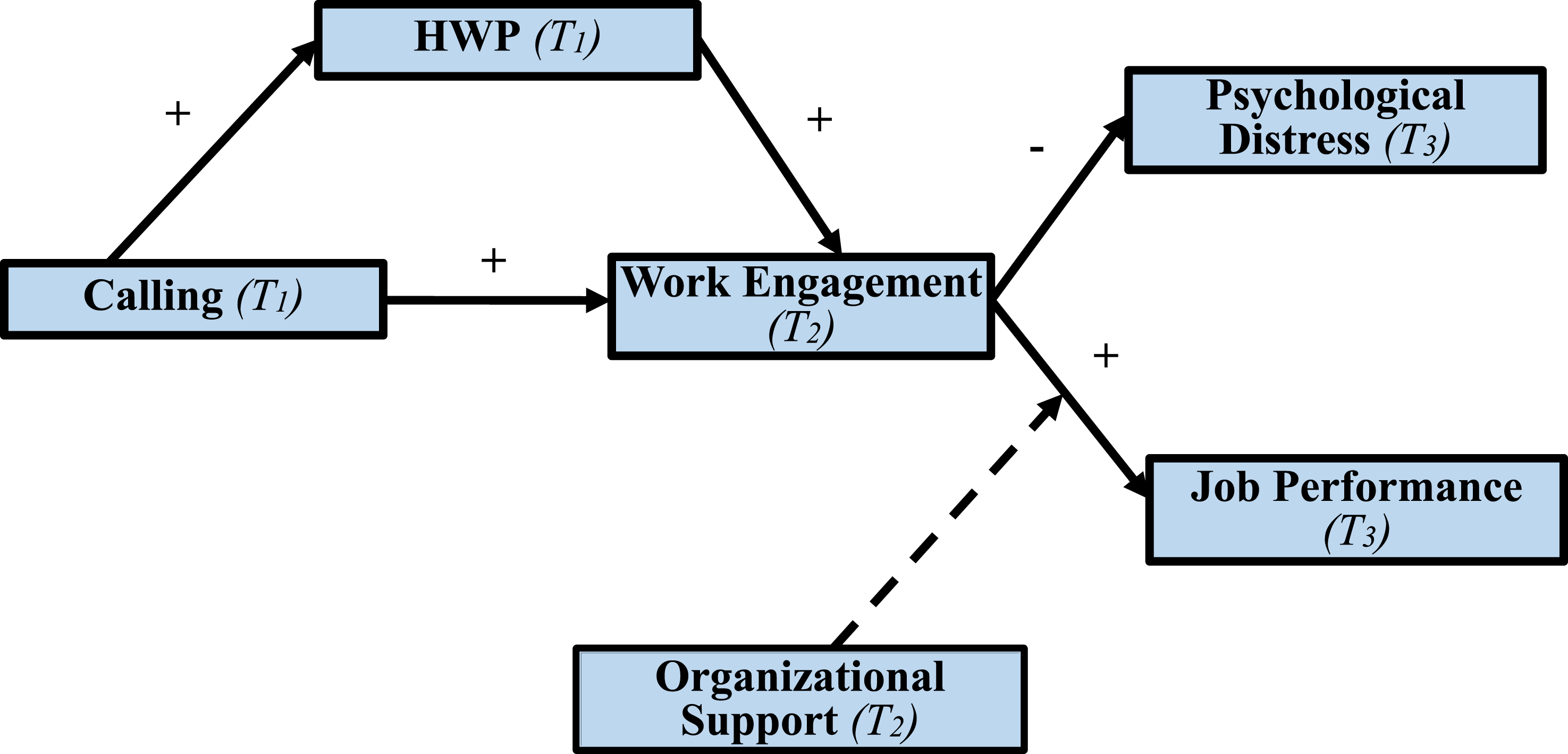
Methods
Participants and Process
Full-time senior executives who proactively opted for visiting faculty positions in reputed Indian B-schools and are presently working full-time in 12 sectors such as biotech, manufacturing, insurance, information technology (IT), and healthcare in the Indian subcontinent were a part of our survey. It is important to mention here that at the initial stage, we asked the pracademics the key reason behind their decision to become visiting faculties. The survey data was collected between Jan 2023 and Jan 2024, with a time lag of 60 days between each wave.
We had assigned three of our senior doctoral scholars to conduct the survey as they were familiar with the data collection process. The doctoral scholars employed a drop-off and pick-up approach during the entire duration of the study. We followed the process recommended by De Clercq et al. (2021) on maintaining anonymity with an instruction that there was no right or wrong answer, and the participants were given an identification code to match the responses across measurement tools in three different time lags.
We met 740 pracademics during our study and requested them to participate in our survey. Five hundred thirty-two pracademics (71.8 % rate of response) willingly participated during the first wave, 447 (60.4 % rate of response) completed in the second wave, and 339 (45.8% rate of response) completed in the third wave. After eliminating incomplete responses, 313 (42.2%) responses were used for further analysis. 41% (128) of the responses were captured from female respondents, the mean age of the respondents was 43.1 (SD = 6.43), and the mean tenure in the organization was 16.41 (SD = 3.08). A dropout analysis was conducted to examine whether the respondents from the final sample contrasted with those who had not countered during the 2nd and 3rd waves of the study. There was no significant difference due to demographic differences (Liang et al., 2018), advocating no systematic bias outcomes due to attrition, etc.
Measures
The surveys were administered in English, and all the items were secured on a 5-point Likert scale (1 = “strongly disagree,” to 5 = “strongly agree”).
Calling
We assessed calling from the twenty-four-item Calling and Vocation Questionnaire (CVQ) by Dik et al. (2012). An example of a sample item was, “I believe that I have been called to my current line of work” (Cronbach’s alpha = 0.84). This scale stands validated for Indian respondents (see Douglass et al.’s 2016 study).
Harmonious Work Passion
We used seven items corresponding to harmonious work passion from the Passion scale (Vallerand et al., 2003). A sample item was, “The new things that I discover with this activity allow me to appreciate it even more” (Cronbach’s alpha = 0.88). This scale was found validated across cultures (see Vallerand & Rahimi, 2022), including that on Indian respondents (Goswami et al., 2025).
Work Engagement
We assessed engagement through nine items from the Utrecht Work Engagement Scale-9 (Schaufeli et al., 2006). The scale consisted of three dimensions: vigor (“At my job, I am very resilient, mentally”), absorption (“It is difficult to detach myself from my job”) and dedication (“I find the work that I do full of meaning and purpose”) (Cronbach’s alpha (α) = 0.92). This scale was found validated across cultures (see Schaufeli et al., 2006), including that on Indian respondents (Pattnaki & Panda, 2022).
Organizational Support
We used 17 items from the Perceived Organizational Support scale (Eisenberger et al., 1986). Examples of items are: “The organization is willing to help me when I need a special favor” and “The organization takes pride in my accomplishments at work” (Cronbach’s alpha (α) = 0.84). This scale has been used in multiple studies using Indian respondents (see Aggarwal-Gupta et al., 2010; Sihag, 2021; Sihag & Dhoopar, 2023).
Psychological Distress
We used 10 items from the Kessler Psychological Distress scale (Kessler et al., 2002). A sample item of the scale is: “During the last 30 days, about how often did you feel so sad that nothing could cheer you up?” (Cronbach’s alpha (α) = 0.93). This scale has been used in multiple studies using Indian respondents (see Jaisoorya et al., 2017; Srivastava et al., 2021).
Job Performance
We used nine items corresponding to job performance from Rodwell et al.’s (1998) study. Examples of the items are: “I set very high standards for my work” and “I am currently working at my best performance level” (Cronbach’s alpha (α) = 0.86). This scale has been used in multiple empirical studies (for recent study, see Alghamdi et al., 2024), including academic sample (Guan et al., 2014), Additionally, this scale has been used in multiple studies using Indian respondents (see Kassahun, 2007; Giri & Pavan Kumar, 2010, Raju, 2014).
Findings
Descriptive statistics, correlation, and reliability
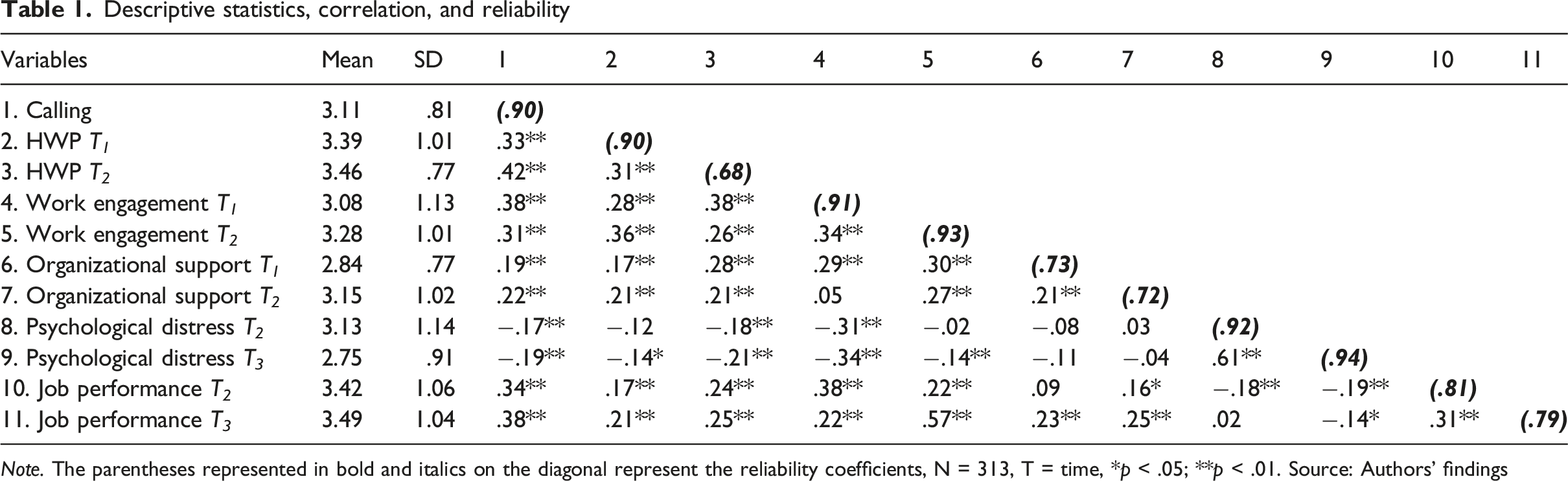
Note. The parentheses represented in bold and italics on the diagonal represent the reliability coefficients, N = 313, T = time, *p < .05; **p < .01. Source: Authors’ findings
Confirmatory factor analysis (CFA) was conducted using AMOS ver.25.0 to examine the construct validity of the measures. The measurement model fitment was examined following the process suggested by Zacher and Rudolph (2021). The findings demonstrated that the proposed 6-factor model (calling, HWP, work engagement, organizational support, psychological distress, and job performance) attained good model fit (χ2 = 253.61, df = 211, CFI = .97, GFI = .98, RMSEA = .04, and SRMR = .05) Using Δχ2 difference, we have compared the fitment of the 6-factor model with a five-factor model wherein organizational support and job performance were combined (Δχ2 = 103.82, p < .001) and HWP and work engagement were combined (Δχ2 = 492.61, p < .001) along with a one-factor model (Δχ2 = 1253.15, p < .001). The said findings provided sufficient evidence of distinction among our study variables.
To understand the scales representing the same inherent construct at each time period, we assessed longitudinal measurement invariance by employing configural invariance (Vandenberg & Lance, 2000). Similarly, to check the invariance of items across three measurement waves, we followed the process suggested by Liang et al. (2018) to measure the metric invariance. The findings indicated the fitment of data in both configural and metric models, and the analogy of invariances between configural and metric models stands insignificant (Δχ2[5] = .11 to 8.72, both being ns). The findings supported the measurement invariances of both metric and configural of the constructs.
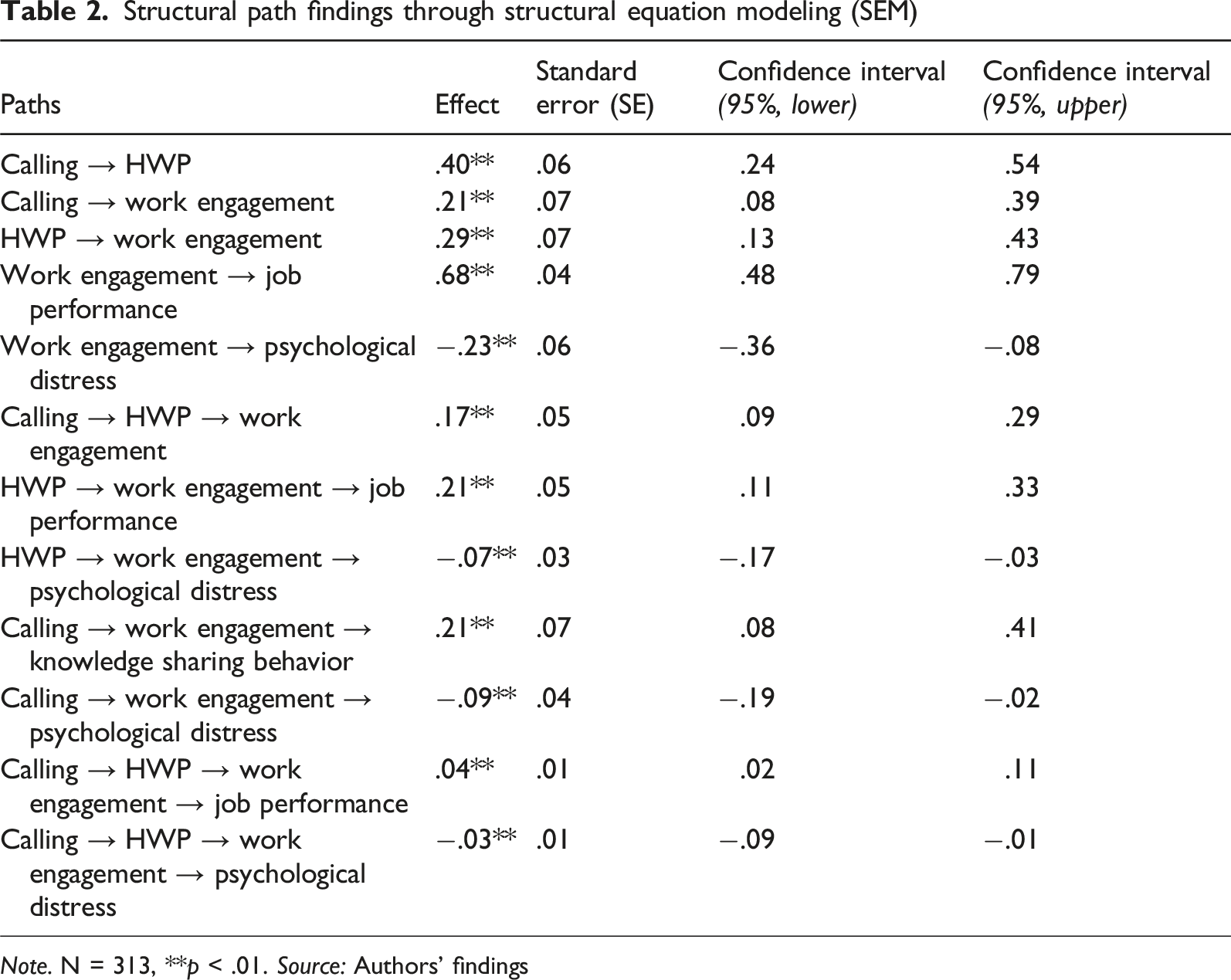
Our first hypothesis advocated that HWP mediates the association between calling and work engagement. The mediation effect is significant if the confidence interval (CI) for the indirect effect excludes zero (Zhao et al., 2010). Partial mediation occurs when the predictor-outcome link remains significant after adding the mediator. We found that HWP mediated the association between calling and work engagement (β = 0.15 at 95% CI between 0.11 and 0.29) and, hence, supported H1. There was partial mediation as the direct effect of calling during Time 1 (T1) on work engagement at Time 2 (T2) got to be significant (β = 0.21, p < .01).
Structural path findings through structural equation modeling (SEM)
Note. N = 313, **p < .01. Source: Authors’ findings
The fourth hypothesis implied that organizational support reinforces the positive association between work engagement and job performance. The findings revealed a significant positive interaction between work engagement and organizational support (β = 0.09, SE = 0.04, p < 0.05). We have followed Aiken and West (1991) to plot the relationship between work engagement and job performance at high (1 SD + mean) and low (1 SD - mean) levels of organizational identification. The simple slope test exhibited in Figure 2 revealed that the association between work engagement and job performance (β = 0.68, t = 7.36, p < 0.001) got stronger with high organizational support compared to low organizational support (β = 0.41, t = 5.11, p < 0.001). Interactive effect of work engagement on job performance. Source: Authors’ findings.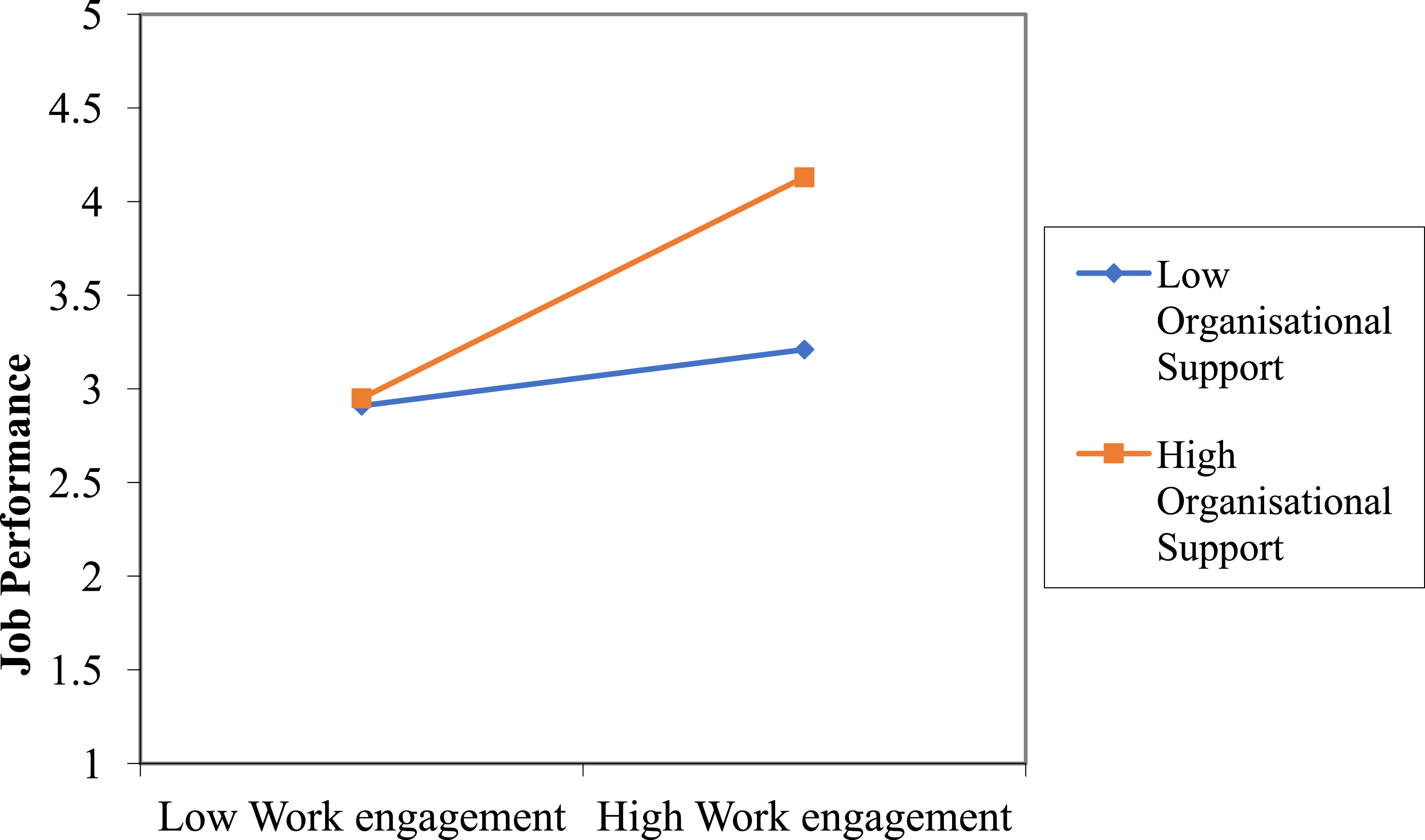
Discussion
The findings of our study have various theoretical and practical implications, throwing light on the intricate dynamics involved in nonstandard work arrangements like the freelancing visiting faculties (pracademics). This temporal interplay suggests a potential protective mechanism wherein positive work-related factors may contribute to reducing psychological distress. This finding aligns with the broader conceptualization of how positive work experiences may serve as buffers against adverse mental health outcomes. We have elaborated on the implications of the findings of our study (theoretical and practical) in further detail below.
Theoretical Implications
The findings of this study lend support to Career Construction Theory (Savickas, 2005, 2013) by showing that a sense of calling plays a pivotal role in shaping the career narratives of freelance visiting faculties and pracademics. Individuals in such nontraditional roles navigate hybrid paths that blend academic and professional identities, and our results demonstrate that career adaptability—shaped by both personal factors and external demands—is central to managing these transitions. This extends understanding of how career development unfolds in contexts where people perform multiple roles or move between domains of expertise.
The mediating role of harmonious work passion (HWP) in the link between calling and engagement underscores the importance of personal meaning in driving professional commitment. Intrinsic motivation such as calling requires supportive structures (e.g., harmonious passion) to translate into engagement and well-being at work. In our model HWP precedes engagement, as passion reflects a stable motivational orientation while engagement captures the energetic state that follows (Schaufeli et al., 2006; Vallerand et al., 2003). Prior research supports this direction (Choi et al., 2020; Dalla Rosa & Vianello, 2020), though reciprocal influences remain possible and merit future study (Quinn et al., 2012).
The principles of Heavy Work Investment are evident in the positive links between calling, harmonious work passion (HWP), engagement, and job performance. Freelance faculty with a strong sense of calling invest heavily in their roles, as shown in the serial mediation effects of HWP and engagement, and this commitment enhances performance (Choi et al., 2020). This interpretation also aligns with Career Construction Theory (Savickas, 2005, 2013), which views careers as actively constructed around a sense of calling that nurtures harmonious passion.
Our results further support the Job Demands Resources model (Bakker & Demerouti, 2007) by highlighting the role of organizational support for freelance faculty, a group often excluded from institutional resources. In nontraditional careers, institutional support functions as a vital buffer against the high demands faced by freelancers. The sequential mediation of HWP and engagement in the link between calling and performance, together with the negative association between calling and psychological distress, underscores the JD-R model’s relevance in this context.
This study also emphasizes the distinctive work commitment of pracademics, whose investment is fueled not just by extrinsic rewards but by intrinsic passion and calling. Reconceptualizing Heavy Work Investment in freelance and hybrid roles provides new insight into how individuals sustain high engagement while balancing multiple commitments. At the same time, the findings advance understanding of hybrid identity formation by showing how pracademics maintain dual identities as educators and industry experts. This extends the literature on boundary spanning by illustrating how workers in hybrid occupations negotiate the demands of both academic and professional domains. Such a perspective is especially relevant for examining occupational boundaries and identity negotiation in today’s gig economy and freelance labor markets.
Practical Implications
The results of the study carry important consequences for the pracademics, for pracademics, more so looking at them through the lens of career development and counseling. For mid-career workers, the move into a freelance academic position is often marked by the difficulty of blending old corporate identities with new academic roles and responsibilities. Institutions can support this process by helping individuals build a coherent career narrative that enables them to articulate and integrate their sense of calling. Narrative approaches within Career Construction Theory (Savickas, 2013) are particularly valuable here, as they allow pracademics to connect past experiences with future aspirations while still maintaining a sense of continuity in their professional lives.
The finding that harmonious work passion mediates the link between calling and work engagement also highlights the need for counseling that fosters more adaptive and constructive forms of passion. Pracademics need to be counseled, sustaining their enthusiasm for academic work while avoiding the risks of obsessive involvement and burnout. Encouraging reflective practices and mindfulness can strengthen boundary control and self-management, allowing them to nurture harmonious passion that endures over time. In this way, pracademics are better able to engage fully in meaningful work while also preserving balance across their life spheres.
Institutions also need to pay attention to building adaptability resources—concern, control, curiosity, and confidence—that are essential for handling the uncertainty that comes with freelance academic work. Coaching and training that strengthen these capacities can help them deal with shifting workloads and the ambiguity of balancing multiple roles. At the same time, because high engagement can sometimes add to strain, counselors to pracademics should give equal weight to psychological well-being. This can be done through stress-management strategies, resilience-building exercises, and the creation of structured peer support. Helping them connect with networks of other freelance faculty can reduce feelings of isolation and give them a stronger sense of professional community.
Equally important is the way professional and organizational identification contribute to both well-being and performance. Institutions can play a proactive role in helping pracademics build ties with academic communities while still valuing the expertise they bring from industry. Holding onto this dual identity validates their hybrid role and makes it more sustainable in the long run. Interventions that encourage belonging, expand professional networks, and highlight transferable strengths are especially helpful here.
Universities and business schools that employ freelance faculty can reinforce these positive dynamics by offering mentoring, onboarding support, recognition of hybrid contributions, and professional development opportunities. Organizational support strengthens the link between engagement and performance. At a broader level, policy makers and higher education leaders could back initiatives such as training programs, certifications, or joint industry-academia appointments, which would make such career transitions more viable and, in turn, give counselors a stronger ecosystem in which to support the pracademics.
Limitations and Future Scope
Our study brings novel insights into nonstandard work arrangements; however, it does not come without its limitations. First, our study focuses on pracademics transitioning from corporate careers to academia for B-schools only. Future research needs to explore more diverse samples to enhance external validity. Second, relying on self-report measures may introduce common method bias and social desirability effects. While we have addressed it by taking time-lagged responses, this can be honed further by including objective performance metrics or multi-source assessments to strengthen the robustness of the findings. Third, while the longitudinal design contributes valuable insights, potential attrition and changes in individual circumstances over time may impact the continuity of data collection. Strategies to mitigate attrition and address life changes could enhance study validity. Fourth, to capture individual nuances, future researchers can explore experimental or quasi-experimental designs.
Conclusion
Our study has delved into the intricate dynamics of pracademics transitioning from corporate careers to academia (pracademics), employing a theoretical framework grounded in the Career Construction Theory, Heavy Work Investment, and the Job Demand Resources Model. Through our study, we hope to shed light on the career perspective of nonstandard work arrangements increasingly prevalent in today’s changing work scenario. We hope that the findings of our study will interest future academicians and practitioners alike.
Footnotes
Acknowledgments
We would like to express our heartfelt thanks to all the pracademics (respondents) who were a part of this study.

Consent to Participate
Verbal consent taken.
Funding
The author(s) received no financial support for the research, authorship, and/or publication of this article.
Declaration of Conflicting Interests
The author(s) declared no potential conflicts of interest with respect to the research, authorship, and/or publication of this article.
Data Availability Statement
Can be provided on reasonable request.