







Abstract
The primary purpose of this study is to examine whether university students’ childhood abuse and/or neglect experiences predict university students’ career stress and career goal inconsistencies. The study group consists of 411 university students. In this study, which was conducted in a descriptive and exploratory model, data were collected online. In data analysis, simple regression analysis was performed to determine the extent to which childhood trauma scores predicted participants’ career stress and career goal inconsistency scores. It was found that the mean scores of male participants were statistically significantly higher than those of female participants. In addition, it was determined that the participants’ scores in the childhood traumas variable predicted their career stress and career goal inconsistency statistically significantly. Professionals can provide career counseling to university students who are victims of neglect and abuse by reducing their career stress and helping them determine their career goals.
Introduction
Childhood is one of the most decisive periods in the lives of individuals, and one of the negative experiences that can occur during childhood is child neglect and abuse (Lee & Kim, 2023; Madigan et al., 2023; Osborne et al., 2022). Child neglect and abuse are global public health problems, and there are many cases of child abuse in every country in the world (Massullo et al., 2023; Osborne et al., 2022; Wang, 2024). In a meta-analysis study based on the data from 206 studies conducted in 22 different countries between 1998 and 2021 to determine the prevalence of adverse childhood experience in the world, it was found that the prevalence rate is 22.4% globally, with higher rates in specific vulnerable populations such as minoritized racial/ethnic groups (Madigan et al., 2023). A meta-analysis on child abuse and neglect estimated the global prevalence of physical child abuse at 18% and psychological child abuse at 39% during the COVID-19 pandemic (Lee & Kim, 2023). The World Health Organization (WHO, 2022) reports that approximately three out of every four children aged 2–4 years—300 million children—are subjected to corporal punishment and/or psychological violence by their parents and caregivers, and that one in five girls and one in 13 boys are sexually abused between the ages of 0 and 17. Wang (2024), in his meta-analysis study, states that the global prevalence of sexual abuse in schools is 1.6%. Moreover, the prevalence of child abuse and neglect may also vary regionally. For instance, a study focusing on Iran indicated that the prevalence of emotional abuse, physical abuse, and neglect in school children was reported at 63.8%, 27%, and 90.3%, respectively (Rafaiee et al., 2021). Indeed, among the studied children, 73.8% declared at least one type of child abuse, and the low socioeconomic status of the family is significantly related to child neglect and abuse. However, it is known that these rates are much lower in countries such as Iceland (Gunnlaugsson & Einarsdóttir, 2018). In other words, the prevalence of abuse and neglect can differ significantly based on cultural and socioeconomic contexts. Additionally, some researchers argue that recall bias may lead to underestimation of abuse prevalence (Mathews et al., 2020). All these findings indicate that child neglect and abuse are widespread global public health problems, and that cultural and socioeconomic factors significantly influence their prevalence and manifestations.
Child neglect and abuse, also known as child maltreatment, is known to cause death, serious injury, and longer-term consequences that may negatively affect the physical, mental, and social development of children who are exposed to maltreatment (Carr et al., 2020; Massullo et al., 2023; WHO, 2022). For example, Carr et al.’s (2020) meta-analysis synthesis reveals that psychosocially, maltreatment affects interpersonal relationships, impulse control, and adaptation in school and work, with multiple severe forms of abuse compounding these issues. Indeed, neurologically, survivors often exhibit structural and functional changes in the brain and endocrine system, contributing to mental health challenges like depression and anxiety (Carr et al., 2020). Survivors may experience psychological disorders such as anxiety disorders, internalizing disorders, depression (Sahle et al., 2021), increased risk of obesity and high-risk sexual behavior (Lang et al., 2020), substance use disorder (Johnson & James, 2016), post-traumatic stress disorder (Thurston et al., 2023), borderline personality disorder (Buckingham & Daniolos, 2013; Dodaj & Sesar, 2020), self-harm and suicidality (Sahle et al., 2021; Thurston et al., 2023).
The effects of child neglect and abuse in adulthood are not limited to psychological symptoms but may also have repercussions on career life (Henkhaus, 2022; Raby et al., 2019). For example, using longitudinal survey data from a nationally representative sample from the United States, Henkhaus (2022) measured the adverse effects of childhood sexual abuse on educational and labor market outcomes and, found that childhood sexual abuse was associated with poorer school performance in adolescence, including dropping out of high school, poorer mental health in adolescence and adulthood, and greater likelihood of missing work in adulthood due to health or emotional disabilities. Similar findings were obtained in a study conducted at least 3 years after the forensic interview due to abuse (Koçtürk et al., 2019). According to the results of the study, approximately one-fourth of the survivors who experienced sexual abuse at school age repeated a grade, half of them dropped out of school, and about one-third changed their career choice. In addition, early childhood trauma may have lasting effects on cognitive development, potentially hindering learning capacity, analytical thinking, and independent decision-making (Bode & Goldman, 2012; Mitchell et al., 2021). These challenges can manifest as trouble following lessons, maintaining focus, and recalling information (Khine et al., 2020). On the other hand, individuals with histories of childhood abuse often experience impaired vocational relations and face difficulties maintaining stable employment (Chen & Hawke, 2025).
Career stress and career goals are interrelated concepts that significantly impact university students’ academic and professional trajectories. Career stress often arises from uncertainties regarding future career paths, which can be exacerbated by a lack of clarity in personal career goals (Arslan & Uyar, 2020; Hu et al., 2018; Zhang et al., 2022). Studies indicate that students frequently experience anxiety due to indecisiveness about their aptitudes and future directions, leading to heightened stress levels (Choi et al., 2011; Hurst et al., 2013). This stress can be compounded by external pressures, such as familial expectations, particularly in collectivist cultures (Köksal & Yam, 2023). The inconsistency between students’ personal career goals (Arslan & Uyar, 2020) and those imposed by their families can lead to increased career-related stress, as students grapple with conflicting expectations (Köksal & Yam, 2023). Moreover, aligning career goals with personal interests and values is crucial for reducing stress (Bakker & Mostert, 2024; Widyowati et al., 2024).
Theoretical Rationale
Social Cognitive Career Theory (SCCT; Lent et al., 1994) offers a comprehensive framework to understand how individuals develop career interests, make educational and occupational choices, and attain career success or experience difficulties. SCCT emphasizes the dynamic interplay between cognitive-personal variables (e.g., self-efficacy beliefs and outcome expectations), behavioral patterns, and environmental influences in shaping career-related behaviors (Lent & Brown, 2013). Within this model, self-efficacy—beliefs about one’s capability to perform specific career-related tasks—plays a critical role in career decision-making and goal-setting. Positive outcome expectations and supportive environments further reinforce the development of consistent career goals and adaptive coping strategies when facing career-related stressors.
Adverse childhood experiences (ACEs), including emotional, physical, and sexual abuse and neglect, can significantly disrupt the formation of healthy self-efficacy and outcome expectations. The evidence from multiple studies supports the notion that ACEs have profound and lasting impacts on mental health, social skills, and overall psychosocial functioning (Outlaw et al., 2021). ACEs are linked to lower self-esteem and emotional awareness, which are critical components of self-efficacy (Oliveira et al., 2018). Individuals with low self-esteem and emotional awareness due to ACEs are more likely to exhibit vindictive behavior and hurt feelings, further complicating their career trajectories (Khalid et al., 2024). Additionally, post-traumatic beliefs developed from ACEs can negatively affect core self-evaluation and job satisfaction, indicating a direct impact on career outcomes (Chen & Gu, 2025; Kim et al., 2024). These early experiences may foster internalized beliefs of incompetence, heightened vulnerability, and uncertainty about the future, which can manifest during emerging adulthood as career stress—defined as the psychological distress related to the process of developing and determining one’s career path (Jaswal & Chand, 2018; Oliveira et al., 2018). Similarly, these experiences may also contribute to career goal inconsistency, which refers to difficulties in setting clear, realistic, and coherent career goals or maintaining stability in these goals over time (Creed & Hood, 2015). From the SCCT perspective, such inconsistencies can arise when trauma-exposed individuals lack confidence in their decision-making abilities or anticipate adverse outcomes, thereby hindering their ability to persist toward specific goals. Furthermore, stress related to socioeconomic disadvantage, academic underperformance, or social isolation—often associated with early trauma—may exacerbate internal conflict and reduce clarity in career planning (Brown & Lent, 2023; Brown et al., 2019). By integrating SCCT into the conceptual foundation of this study, a theoretically grounded explanation is provided for the potential associations between childhood trauma and later career-related difficulties. This rationale underscores the importance of addressing trauma histories within career counseling and intervention frameworks, particularly by strengthening clients’ self-efficacy, reframing maladaptive beliefs, and supporting the articulation and pursuit of attainable career goals.
Context of the Study: Türkiye
The current study was conducted in Türkiye, a country characterized by its unique sociocultural structure that blends Eastern collectivist values with increasing Western influences. In Turkish society, strong familial bonds and hierarchical family dynamics are prominent, often leading to limited autonomy for children and young adults (Kağıtçıbaşı, 2017). These cultural patterns may contribute to both the prevalence and underreporting of childhood abuse and neglect, as discussing familial problems is often stigmatized. Although recent efforts have been made to strengthen child protection mechanisms, societal awareness and reporting of child maltreatment remain limited due to persistent taboos (Koçtürk et al., 2023).
Within higher education in Türkiye, university students frequently face significant academic pressure, economic instability, and high expectations from family and society regarding career outcomes (Carkit, 2025; Ögeyik, 2016). Such contextual factors can intensify the impact of earlier adverse experiences on career-related decision-making processes. The collectivist orientation may also shape students’ career development (Ulum & Küçükaydın, 2024) through family-imposed expectations and perceived obligations, which interact with personal aspirations and self-efficacy. Thus, understanding the effects of childhood trauma on career stress and goal inconsistency requires consideration of these cultural dynamics. Examining these issues in Turkish provides a culturally grounded contribution to the broader literature on career development and trauma.
The Present Study
As outlined in the preceding literature, childhood neglect and/or abuse can have enduring and profound impacts on individuals’ lives. These adverse childhood experiences compromise emotional and psychological well-being and generate broader societal and economic repercussions, such as increased judicial burdens and a diminished qualified workforce (Harris & Pratt, 2023; Pereda, 2023). Although previous research has documented numerous adverse outcomes associated with childhood maltreatment, a notable gap remains in understanding its influence on career-related difficulties, particularly among emerging adults, such as university students. While some studies have linked emotional trauma to career stress and career goal inconsistency (Widyowati et al., 2024), limited empirical evidence exists on how childhood abuse and neglect experiences specifically relate to these challenges. To address this gap, the current study investigates whether university students’ experiences of childhood abuse and/or neglect are associated with their levels of career stress and inconsistencies in career goals. The research was designed using a descriptive and exploratory model to examine existing associations by considering how present outcomes may be shaped by earlier life experiences (Çoban & Oral, 2020). Given the scarcity of literature on this specific topic, this study is preliminary and exploratory. Accordingly, the study sought to answer the following research questions: (a) Are there significant differences in childhood abuse and neglect among university students based on gender? (b) Are university students’ childhood abuse and/or neglect experiences associated with career stress? (c) Are university students’ childhood abuse and/or neglect experiences associated with career goal inconsistencies?
Method
In the study, data were collected online to increase research participation and ensure privacy. In this context, the convenience sampling method, defined by Creswell and Creswell (2017) as the sampling of people who are suitable and accessible for the research, was used as the sampling method.
Participants
The study group consists of 411 university students studying at a university in Türkiye, and their ages range between 17 and 40. Of the participants, 68.4% were female (n = 281), 31.6% were male (n = 130), and their average age was 21.44. Participants from universities in every region of Türkiye took part in the study. In addition, 24.8% of participants reported physical neglect (n = 102), 24.3% reported sexual abuse (n = 100), 28.2% reported physical abuse (n = 116), and 63.01% reported emotional abuse (n = 259). Of the participants, 65.7% reported being exposed to at least one type of abuse (n = 270). Of the participants, 15.1% (n = 63) reported experiencing school absenteeism, 13.6% (n = 57) reported changing their academic field, 13.4% reported being excluded by their peers (n = 55), 5% (n = 21) reported being excluded by their teachers, 4.1% (n = 17) repeated a grade, and 3.1% (n = 13) dropped out of school.
Measures
Demographic Information
Demographic information on participants’ gender, age, and the universities they were attending was collected using a brief form developed by the researchers. This form aimed to gather basic background characteristics to describe the study sample better.
Career Stress Scale (CSS)
CSS, developed by Choi et al. (2011), was adapted into Turkish by Özden and Sertel Berk (2017). The scale is a five-point Likert-type scale consisting of 20 items scored as “1 = Strongly Disagree, 2 = Slightly Agree, 3 = Somewhat Agree, 4 = Strongly Agree, 5 = Strongly Agree.” A high score indicates a high level of career stress. The scale consists of three sub-factors named “career uncertainty and lack of information (e.g., I feel blocked because I don’t know what is necessary for my career),” “external conflict (e.g., Negative thoughts of others about my career choice occupy my mind.)” and “employment pressure (e.g., I’m worried that I might not be able to get the job I want.).” The Cronbach Alpha internal consistency coefficient of the scale was found to be .94. Within the scope of this study, the Cronbach’s Alpha internal consistency coefficient of the scale is .93. The Cronbach’s alpha coefficients obtained from the sub-dimensions of the scale were .87 for the “career uncertainty and lack of information” sub-dimension, .69 for the “external conflict” sub-dimension and .83 for the “employment pressure” sub-dimension.
Career Goal Inconsistency Scale (CGIS)
CGIS, developed by Creed & Hood, 2015, was adapted into Turkish by Yam et al. (2020). The scale is a seven-point Likert-type scale with 12 items scored “from 1 = Very little to 7 = Very much.” Accordingly, the lowest score obtained from the scale is 12, and the highest is 84. It is interpreted that the higher the score obtained from the scale, the higher the career goal inconsistency. CGIS has a single dimension. Examples of the scale items are “The achievements I have attained so far do not give me confidence that I can reach my career goals,” and “I know what career I want to achieve, but I don’t think I have what it takes to reach it.” The Cronbach’s Alpha reliability coefficient of the scale was calculated as .92. In this study, the Cronbach’s Alpha internal consistency coefficient was .94.
Childhood Trauma Questionnaire (CTQ)
The Childhood Trauma Questionnaire was adapted into Turkish by Şar et al. (2012). There are 33 items in the Turkish version of the questionnaire. The scale is a five-point Likert-type scale scored from 1 = Never to 5 = Very often. The Cronbach’s Alpha internal consistency coefficient of the scale was calculated as .93. Also, after the factor analysis, it was determined that the scale consisted of six factors. These factors were named as “sexual abuse (e.g., Someone tried to touch me for sexual purposes or made me touch them.),” “physical abuse (e.g., A member of my family hit me so badly that I had to go to a doctor or hospital),” “emotional neglect (e.g., My mother or father used to value my opinions.),” “emotional abuse (e.g., My mother or father used to say that I wasn’t good enough for them.),” “physical neglect (e.g., I was neglected in terms of clothing and appearance),” and “overprotection-control (e.g., My family used to interfere in everything I did).” Within the scope of this study, the Cronbach’s Alpha internal consistency coefficient of the scale was .88. When the Cronbach’s Alpha coefficient for the sub-dimensions was examined, it was found .85 for the “emotional abuse” sub-dimension, .91 for the “physical abuse” sub-dimension, .91 for the “sexual abuse” sub-dimension, .81 for the “physical neglect” sub-dimension, .86 for the “emotional neglect” sub-dimension, and finally .83 for the “overprotection-control” sub-dimension.
Procedures
Before starting the data collection process, the researchers obtained ethics committee permission. Since the data collection process was conducted online, the items of the data collection tools used were first organized on “Google Forms.” Then, to reach the participants, the research was announced on social media platforms such as Facebook, where university students can take part, and the Google Forms link was shared. In this process, written informed consent could not be obtained from the participants, but before answering the scale items, general information about the research, volunteering, and leaving the research, etc. A briefing containing information about the processes was presented to the participants. Participants who declared their consent for the study by checking the consent box on Google Forms accessed the data collection tools of the study. It took approximately 10–15 minutes for the participants to respond to all items.
Data Analysis
Data were analyzed using the SPSS v26 statistical package. Data entry was reviewed for accuracy before analysis, and reverse-coded items were recoded accordingly. Missing or incorrect entries and outliers were examined and excluded from the dataset in line with standard data cleaning practices (Tabachnick & Fidell, 2019). After this process, the final sample consisted of 411 participants.
Normality of the data was assessed before conducting the primary analyses. Given that the data did not meet the assumptions of normal distribution—determined through skewness, kurtosis values, and visual inspections such as histograms and Q-Q plots (Field, 2013)—non-parametric tests were employed. Specifically, the Mann–Whitney U test was used to examine whether there were significant differences in childhood trauma scores by gender, as this test is appropriate for comparing two independent groups when normality assumptions are violated (Pallant, 2020). Pearson product-moment correlation analyses were conducted to explore the relationships between the subdimensions of childhood trauma and both career stress and career goal inconsistency. In addition, simple regression analyses were conducted to assess whether childhood trauma scores significantly predicted levels of career stress and career goal inconsistency. A significance level of p < .05 was adopted for all statistical tests.
Results
Preliminary Analyses
Descriptive Analysis Values of Scales and Sub-Dimensions
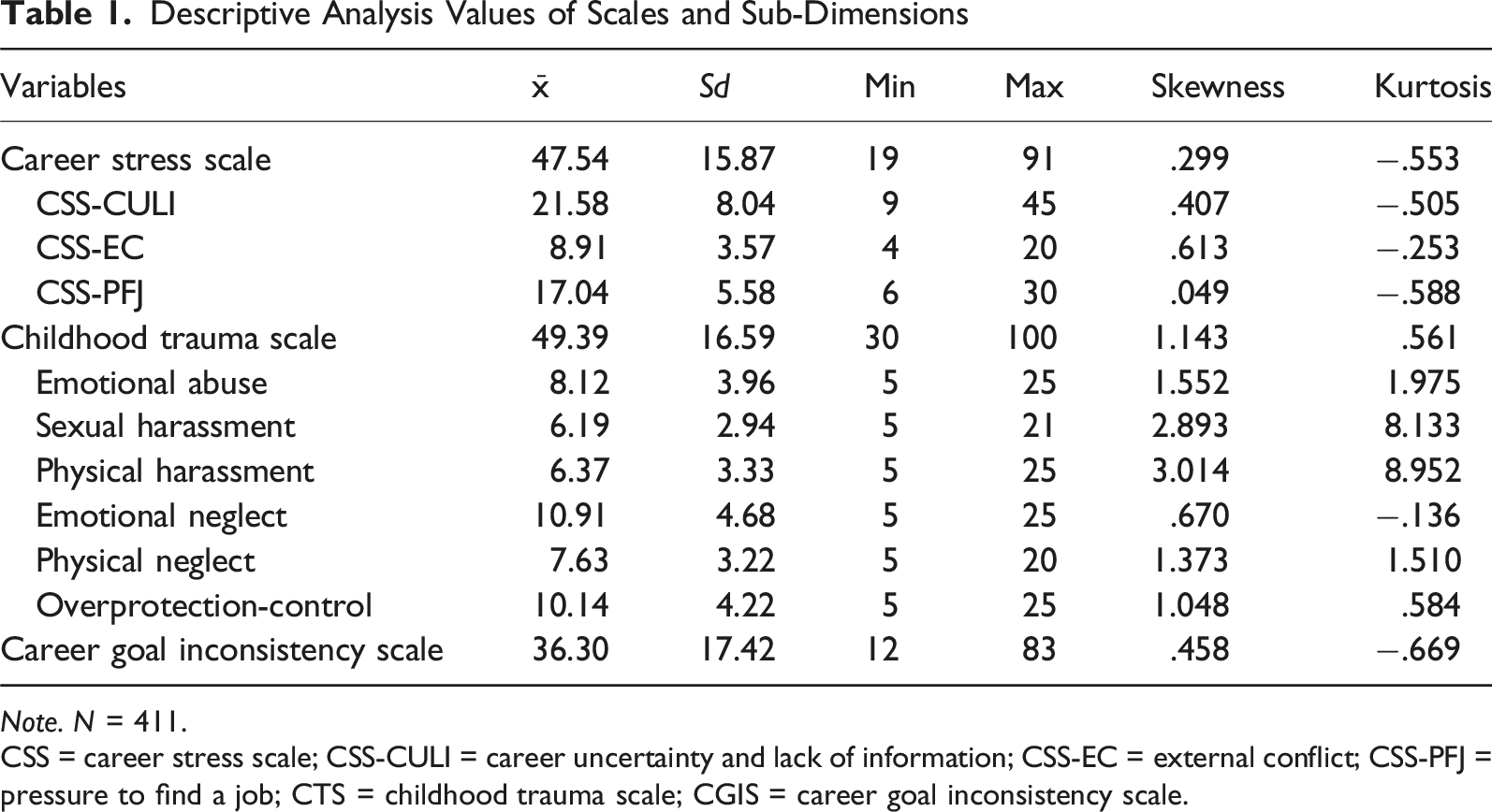
Note. N = 411.
CSS = career stress scale; CSS-CULI = career uncertainty and lack of information; CSS-EC = external conflict; CSS-PFJ = pressure to find a job; CTS = childhood trauma scale; CGIS = career goal inconsistency scale.
Given the significant difference, the effect size was calculated using the formula r = Z/√N as Field (2013) recommended. The effect size was r = .17, corresponding to a small effect based on Cohen’s (1998) criteria (r = .1 small, .3 medium, .5 large). Additionally, the coefficient of determination (r 2 ) was calculated as .0289, indicating that gender accounted for approximately 2.89% of the variance in childhood trauma scores.
Main Analyses
Before conducting the main analyses, the assumptions related to regression analysis were assessed. These included checks for missing data, normality, linearity, homoscedasticity, independence of residuals, multicollinearity, and outliers. No missing data were detected for the variables of childhood trauma, career stress, and career goal inconsistency among the 411 participants. Normality and linearity were visually evaluated using P–P plots and scatterplots of standardized residuals. These visual inspections supported the assumptions for both outcome variables.
Correlation Values Between Variables
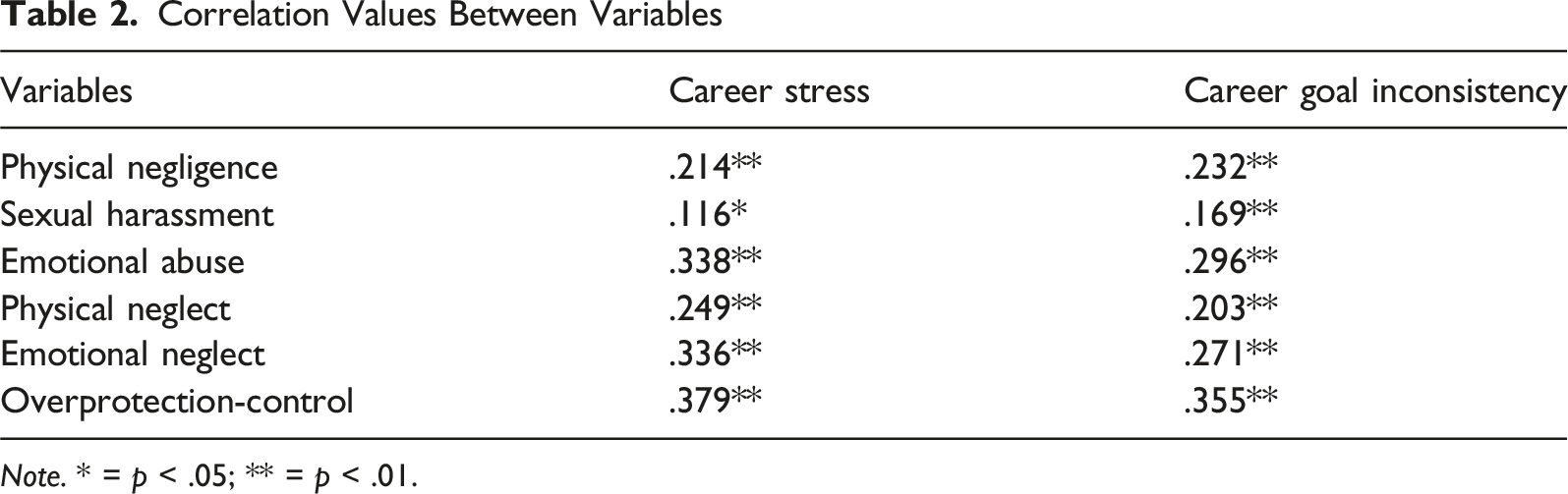
Note. * = p < .05; ** = p < .01.
Pearson product-moment correlation analyses were conducted to explore the relationships between the subdimensions of childhood trauma and both career stress and career goal inconsistency. As shown in Table 2, all subdimensions of childhood trauma were significantly and positively correlated with career stress and career goal inconsistency. Specifically, the strongest correlation was found between overprotection-control and career stress (r = .379, p < .01) and between overprotection-control and career goal inconsistency (r = .355, p < .01). Emotional abuse (r = .338, p < .01), emotional neglect (r = .336, p < .01), and physical neglect (r = .249, p < .01) also demonstrated moderate correlations with career stress. Similarly, emotional abuse (r = .296, p < .01) and emotional neglect (r = .271, p < .01) were moderately associated with career goal inconsistency. Lower but still statistically significant correlations were observed between sexual abuse and both career stress (r = .116, p < .05) and career goal inconsistency (r = .169, p < .01). These findings suggest that individuals reporting higher levels of childhood trauma—particularly emotional forms and overcontrol by caregivers—are more likely to experience increased career-related stress and inconsistency in career goals during emerging adulthood. According to Cohen et al. (2003), correlation coefficients between .10 and .29 indicate small effects, while coefficients between .30 and .49 reflect moderate effects. Thus, the observed associations in this study range from small to moderate, supporting the relevance of childhood experiences in understanding later career-related difficulties.
Finally, a simple regression analysis was conducted using SPSS to examine the association between total childhood trauma scores and career stress. The results indicated a statistically significant association between childhood trauma and career stress, R 2 = .18, F(3, 411) = 14.31, p < .01. This suggests that childhood trauma was associated with higher levels of career stress, accounting for 17.7% of the variance. Similarly, a statistically significant association was observed between childhood trauma and career goal inconsistency, R 2 = .14, F(3, 411) = 11.33, p < .01. These results suggest that higher childhood trauma scores were linked to greater inconsistency in career goals among university students.
Discussion
In this study, examining the associations between childhood trauma, career stress, and career goal inconsistency among university students, several noteworthy findings were observed. Firstly, when participants’ mean childhood trauma scores were compared by gender, male students reported significantly higher scores than female students. In addition, a statistically significant positive association was found between childhood trauma, career stress, and career goal inconsistency.
Regarding the first research question (a), the findings revealed a significant gender difference in childhood trauma scores, with male participants reporting higher levels of childhood trauma than female participants. In other words, based on the findings, male participants in this study were exposed to more abuse and/or neglect in their childhood than female participants. In the literature, there are different findings regarding score differences according to gender. For example, Gallo et al. (2018) found that women have higher rates of exposure to childhood trauma. On the other hand, in parallel with the findings in this study, some studies found that males have higher levels of childhood trauma experiences (e.g., Finkelhor et al., 2005). This may be due to various reasons. First, due to the patriarchal cultural structure, parents may expect obedience even if it is a boy and may use beating as a tool to discipline their children. Second, the participants may not remember the negative experiences they had in their childhood due to the time factor. This may be valid for both male and female participants. Third, when evaluated in terms of gender, it can be thought that female participants may have hesitated to report sexual abuse, even if they did not provide their identity information (Koçtürk & Bilginer, 2020). Finally, the fact that more than one type of neglect and abuse was evaluated together in this study may have led to differentiated results in terms of gender.
In relation to the second research question (b), the study found that childhood trauma was positively and significantly associated with career stress among university students. When the literature was examined, no study was found in which career stress and childhood traumas were addressed together. However, considering that childhood traumas negatively affect individuals’ psychological well-being levels and lead to problems such as depressive and anxiety disorders (Carr et al., 2020; Sahle et al., 2021), it can be thought that childhood abuse and/or neglect may trigger individuals to experience career stress. As a matter of fact, the university period is a period when students try to cope with concerns such as unemployment, competition, and academic anxiety (Özden & Sertel Berk, 2017). For individuals who are child neglect and abuse survivors who have experienced various difficulties due to the traumatic effects of abuse and/or neglect in childhood (e.g., low self-esteem), coping with these anxieties that develop during the university period may be more challenging. As a matter of fact, it is also stated in the literature that the university period is a period in which the problem of career stress is commonly seen and that it impacts the well-being of individuals in this period (Hu et al., 2018).
Finally, regarding the third research question (c), a significant positive association was found between childhood trauma and career goal inconsistencies. As in the case of career stress, it is seen that there is no study in the literature that addresses career goal inconsistency and childhood traumatic experiences together. However, it has been reported in previous studies that career goal inconsistency may be a cause of career stress (e.g., Arslan & Uyar, 2020; Choi et al., 2011). However, it is also known that traumas experienced in childhood negatively affect individuals’ mental health and may lead to problems that affect their thinking and judgment skills (Carr et al., 2020). From this perspective, it can be considered that victimized individuals have issues in setting realistic career goals by making an objective self-assessment. On the other hand, although victimized individuals may have set realistic career goals by creating an objective self-assessment, they may have experienced problems in achieving these goals due to their existing social conditions and opportunities. However, although a definitive assessment cannot be made since this study is not causal and longitudinal, there are studies in the literature that childhood experiences of neglect and abuse can increase the risk of socioeconomic disadvantage in adulthood (Harris & Pratt, 2023; Pereda, 2023). The relationships between child neglect and abuse and career problems can be evaluated in future studies with longitudinal studies conducted with a mixed method.
Limitations and Future Research
This study has several limitations that should be considered. First, the study group’s characteristics may limit the findings’ generalizability. The participants consisted primarily of undergraduate students, mostly women aged 17 to 40, attending universities in Türkiye. Second, the results are constrained by the measurement tools used; the findings are limited to the constructs assessed by the scales and information obtained from the demographic form. Third, due to the descriptive research design, causal relationships cannot be established between childhood trauma and career-related outcomes. Fourth, the retrospective nature of self-reported childhood neglect and abuse may have introduced recall bias, as participants might not have remembered specific experiences accurately over time. Lastly, data collection was conducted online, which excluded students without internet access, potentially limiting the sample’s representativeness.
Future research could address these limitations by including participants from more diverse demographic and socioeconomic backgrounds, including those without internet access. Additionally, longitudinal and mixed-method designs may provide deeper insights into the causal pathways linking childhood trauma with career stress and goal inconsistency. Expanding the scope to include different populations and utilizing more comprehensive measurement tools could enhance the generalizability and depth of understanding.
Implications
Despite the limitations mentioned above, the findings of this study have several practical and theoretical implications. Childhood trauma experiences were found to be associated with career stress and career goal inconsistency. Professionals can use these findings to provide targeted career counseling to university students who have experienced neglect and abuse, helping to reduce their career stress and support them in clarifying their career goals. Child neglect and abuse should be recognized as risk factors, and students affected by these experiences can be prioritized in programs aimed at reducing career stress. Furthermore, psychological counselors can organize seminars and training sessions at the university level to raise awareness about these issues. Informational materials such as brochures and posters can be distributed, and students can be taught strategies for managing career stress. Additionally, programs designed to improve coping skills for negative life experiences could be developed and evaluated for their indirect effects on reducing career stress.
More critically, career professionals can support trauma-exposed students by implementing trauma-informed career counseling approaches. These include creating a safe and non-judgmental counseling environment, using strengths-based techniques to rebuild self-efficacy, and helping students recognize how past trauma may be influencing current career-related anxiety or decision paralysis. For example, career counselors might use narrative career counseling to help students reconstruct coherent career stories despite early adversity, or provide cognitive-behavioral strategies to reframe maladaptive career beliefs. Professionals may also collaborate with mental health services when students show signs of unresolved trauma that interfere with career functioning. Career workshops could be tailored to include modules on emotional regulation, resilience-building, and vocational identity development for students with histories of neglect or abuse.
Theoretically, the results also have important implications for career development frameworks such as SCCT (Lent et al., 1994). SCCT highlights the role of self-efficacy beliefs, outcome expectations, and contextual influences in shaping career goals and behaviors. The findings of this study suggest that adverse childhood experiences may function as early contextual risk factors that hinder the development of positive career-related beliefs and expectations. Specifically, students who experienced childhood neglect and abuse may struggle with forming coherent career goals or managing career-related stress due to lowered self-efficacy and disrupted psychological functioning. This situation demonstrates the need for trauma-informed perspectives to be more fully integrated into career theories and interventions. For instance, interventions that enhance career decision-making self-efficacy or help students reframe negative beliefs about their career potential may be particularly beneficial for trauma-exposed individuals. Future research could explore how SCCT variables (e.g., self-efficacy, goal setting, and outcome expectations) are mediated or moderated by early trauma experiences. Moreover, this study focused exclusively on university students, and the sample was predominantly female. Future research should aim to include a more balanced representation of male students better to understand gender differences in these experiences and outcomes. To more comprehensively understand the long-term effects of childhood neglect and abuse, longitudinal studies following individuals beyond their university years are recommended. Finally, given that different types of abuse may have distinct impacts, large-scale studies examining career stress and goal inconsistencies according to specific types of childhood neglect and abuse are warranted.
Conclusion
This study examined the associations between childhood trauma experiences and career stress and career goal inconsistency among university students in Türkiye. The findings revealed that male students reported significantly higher levels of childhood trauma than female students. Additionally, significant positive associations were found between childhood trauma and both career stress and career goal inconsistency. These results suggest that early adverse experiences may impact students’ ability to navigate career-related challenges during emerging adulthood. By highlighting the links between trauma and career difficulties, this study contributes to a deeper understanding of how early life experiences can influence vocational development. The results emphasize the need for trauma-informed career counseling practices and greater institutional support for students who have experienced neglect and abuse. Future research should build on these findings through longitudinal and theory-driven studies exploring how childhood adversity shapes career trajectories over time.
Footnotes
Author Note
The data for this study is based on the data from Ceren Öztürk's master's thesis, which she completed under the supervision of the second author.

Ethical Considerations
This study obtained Ethical approval from the Hacettepe University Ethics Committee (No. E-51944218-300-00002295679).
Consent to Participate
Informed consent was obtained from the participants.
Author Contributions
All authors have contributed to, seen, and approved the manuscript and agreed to the order of authors as listed on the title page.
Funding
The authors received no financial support for the research, authorship, and/or publication.
Declaration of Conflicting Interests
The authors declared no potential conflicts of interest with respect to the research, authorship, and/or publication of this article.
Data Availability Statement
The data supporting this study’s findings are available on request from the corresponding author. The data are not publicly available due to privacy or ethical restrictions.