







Abstract
This article investigates how Michigan’s charter school policy influences the composition of students by race and socioeconomic status in urban traditional public schools. Using 2 years of student-level data in Michigan’s urban elementary and middle schools, the dynamic student transfers between charter schools and TPSs are analyzed through a series of hierarchical generalized linear models. The two-way transfer analysis shows that the student sorting under the charter school program tends to intensify the isolation of disadvantaged students in less effective urban schools serving a high concentration of similarly disadvantaged students. The findings imply that a challenge for the state policy makers is to help disadvantaged students who are left behind in the most disadvantaged schools, without significantly reducing the benefits to students who take advantage of school choice.
Charter schools are one of the most prominent contemporary education reforms in the United States. The charter school movement has been propelled by the belief that families should have greater freedom to choose the type of education their children receive and by concerns over the poor academic outcomes of public schools, particularly urban schools serving racially and socially disadvantaged children. It is believed when parents are provided expanded choice and school funding is tied to enrollment, educators in both charter schools and traditional public schools will have incentives to compete for students and increase their academic performance by, for example, improving teacher quality, linking instruction to assessment, and enhancing administrative effectiveness. Otherwise they will lose students and revenue to schools of higher performance. The market-based competition will eventually lead to the improvement of education for all students.
By enabling students to select among an expanded set of differentiated public schooling options, however, charter school policies inevitably create a sorting process that rearranges students by family backgrounds among schools and influences the racial and socioeconomic diversity of schools. It also has the potential to change the peer groups or classroom learning environment that students are exposed to.
The redistribution of students among schools under charter school programs has both social and economic implications. First, charter schools influence student diversity within schools, which not only is a social value that Americans hold in high esteem but also is important in fostering favorable learning environments for all students where they learn tolerance and respect for differences (Eaton, 2001; Hallinan, 1998; Pettigrew & Tropp, 2006; Wells & Crain, 1994). Second, peer environments of schools contribute to the development of students’ human capital (Cobb & Glass, 2009). By influencing the student composition in schools, charter school policies affect the access to diverse knowledge and information networks for economically and racially isolated students and therefore have an effect on their opportunities for success in academic achievement and in the labor market (Cobb & Glass, 2009). For instance, research has shown that students from low-income families tend to obtain higher levels of achievement and/or larger achievement gains over time if they attend schools with higher performing peers (Hanushek, Kain, Markman, & Rivkin, 2003; Levin, 1998; Zimmer & Toma, 2000). However, the achievement gains of students in schools with high concentrations of low-performing peers are diminished due to negative peer effects (Ladd, 2002).
How charter schools influence the distribution of students by racial and social characteristics across schools remains an unresolved question. Most past research has focused on determining whether charter schools are more or less stratified than traditional public schools (TPSs). However, with the fast expansion of charter schools, it becomes significant to study whether the choice-induced student sorting has a systemic influence on stratification in TPSs, especially in those serving high proportions of disadvantaged students.
This study examines the impact of student sorting initiated by charter schools on stratification in TPSs. Using 2 years of student-level data in Michigan’s urban elementary and middle schools, the dynamic student transfers between charter schools and TPSs are analyzed through a series of hierarchical linear models. The likelihoods of students transferring from TPSs to charter schools and from charter schools back to TPS are predicted by students’ own characteristics, the characteristics of the schools students attended, and the interaction between student and school characteristics. The two-way transfer analysis shows that the student sorting under the charter school program tends to intensify the isolation of disadvantaged students in less effective urban schools serving a high concentration of similarly disadvantaged students.
The rest of this article is organized as follows. In the next two sections, I review the relevant literature and present a framework on how choice-induced student sorting might influence student composition in TPSs. Then I specify my research questions, explain data and methods, and report the analysis results on the patterns of student flows between TPSs and charter schools. The final section concludes.
Review of Research
One of the great hopes of school choice policies generally and charter schools in particular is that they would enhance school racial and social integration (Finn, Manno, & Vanourek, 2000; Friedman, 1962; Viteritti, 1999). Instead of enrolling students based on geographical assignment zones, which largely reflect segregated residential housing markets, charter schools provide opportunities for students to attend schools outside their neighborhood without changing their residence. By allowing disadvantaged students to attend less segregated and higher quality schools, charter schools would reduce stratification across schools, not only in the new choice schools but also potentially in TPSs themselves (Viteritti, 1999). Although this outcome is possible, it is not assured given the complex adjustments of both parents and charter schools to the introduction of charter school policies.
Although the number of studies about charter schools has been growing with the expansion of charter schools, research that directly assesses the impact of charter schools on TPS student composition is very limited. Using longitudinal school-level data from Arizona and neighboring states, Dee and Fu (2004) employed a “differences-in-differences” research design that compares student composition changes within Arizona’s schools before and after the implementation of charter schools to contemporaneous changes in schools from “control” states that did not authorize the introduction of charter schools. The authors found that the introduction of charter schools in Arizona reduced the proportion of White non-Hispanic students in regular public schools by 2%. Using a similar method, Ross (2005) found that in Michigan school districts with a high proportion of students in charter schools, Black and Latino students have become more racially isolated from White students in TPSs since charter schools draw relatively higher proportions of White students in these districts. However, because both studies used school-level data, they failed to explore how the introduction of charter schools has changed student composition of individual public schools, depending on their preexisting composition.
The key methodological challenge in examining the impact of charter schools on TPS student composition is projecting what the composition of TPSs would have been in the absence of charter schools. In recent years, with the availability of student-level data, two primary strategies have emerged in the literature in addressing this question. The first uses student address data to infer choice students’ assigned TPSs and compares actual student compositions to a counterfactual world in which it is assumed that students would have attended their assigned school. Following this strategy, Koedel, Betts, Rice, and Zau (2009) evaluated the integrating effects of three school choice programs in San Diego. Based on student-level data, the authors compared the actual student composition relative to a counterfactual where the school choice programs did not result in any student movement. The results show whereas two choice programs specifically designed to promote racial integration attained some success in this regard, the district’s open-enrollment program increased segregation by race, student achievement, and language status.
Using the same strategy, Bifulco, Ladd, and Ross (2009) examined the effects of public school choice on the composition of students left behind in Durham, North Carolina, where students have several options including attending a nonassigned TPS, a magnet school, a year-round school, or a charter school. After analyzing the likelihood of individual students opting out of their assigned school, the authors found that advantaged students were more likely to opt out of assigned schools with high concentrations of disadvantaged students which left these neighborhood schools with fewer educationally advantaged students. However, the study does not separate the effect of charter schools from that of the other forms of school choice. In fact, it is difficult to create a counterfactual scenario in the absence of charter schools in this case because students might have exercised other forms of choice and thus not attended the assigned public school associated with their current address.
The second approach in projecting the composition of TPSs in the absence of charter schools uses longitudinal student data to observe where students attended school prior to entering charter schools. Using 5-year panel data that follow individual students in North Carolina, Bifulco and Ladd (2006) found that students tend to end up in charter schools that are more homogeneous in terms of race and SES than the TPSs they left. This they argue increased the racial isolation of both Black and White students and widened the achievement gap. Similarly, Booker, Zimmer, and Buddin (2005) examined sorting patterns by tracking student movements from TPSs to charter schools in California and Texas. The authors found that in both states, Black students are more likely than White or Hispanic students to choose charter schools, and that Black students tend to move to charter schools with higher percentages of Black students than the TPSs they left. Neither of the student-level studies, however, assesses the impact of the student transfers on the peer composition of TPSs.
There are two potential drawbacks in the second approach. First, students might have chosen a different TPS in the absence of charter schools than the one they are observed attending in the prior year. Second, one can only project the counterfactual for charter school students who appear at some point in a TPS, and this group might not be representative of all charter school students. In that case, the analysis could provide biased estimates of the average charter school effect. Despite its disadvantages, analysis based on switchers is nonetheless informative. As many charter schools are relatively new and their student mobility rates are usually high, most of charter school students would have attended TPSs at some point in their education. Moreover, Bifulco and Ladd (2006) found that the subset of school “switchers” is demographically representative of the full sample of charter school students. In this article, I follow the second strategy by investigating how the two-way movement of students between TPSs and charter schools influences the student composition in TPSs.
Conceptual Background
This section draws on previous research on factors affecting the choices of families and charter schools to distill some implications for how these choices influence the distribution of students across public schools by race and SES backgrounds.
How Parents Choose Schools
Parental choices among schools are shaped by their preferences regarding the desired attributes of their children’s schools to the extent that valid information is available on these attributes. As both preferences and access to reliable information may vary systematically by family and student characteristic, parental choice carries the potential of changing patterns of stratifications across schools.
Parents’ preferences regarding their children’s schooling cover a variety of factors, including school quality, curricular focus, extracurricular activities, safety, and convenience. They also relate to the racial or socioeconomic composition of schools’ students. In evaluating alternative schooling options, parents compare the characteristics of the schools their children currently attend against the charter alternatives. The greater the gap between families’ desired school attributes and the actual attributes in the schools their children attend, the greater their propensity to transfer to a charter school that comes closer to their preferences.
Although parents commonly cite school quality as a primary reason they choose a given charter school, their actual choice can be largely predicted by the student racial and SES composition (Fiske & Ladd, 2000; Holme & Richards, 2009; Kleitz, Weiher, Tedin, & Matland, 2000; Schneider, Teske, & Marschall, 2000; Weiher & Tedin, 2002). For example, research has found that when choice is available, most parents prefer to have their child attend a school where most students are similar to their child. White parents tend to avoid schools with high concentrations of students of colors, and White and non-White middle-class parents alike tend to avoid schools with high percentages of low-income students. Only after eliminating choice schools with incompatible racial and socioeconomic characteristics do parents apply other criteria such as academic quality or school safety in the decision-making process (Lacireno-Paquet & Brantley, 2008).
The availability of information on school quality is another key influence on parental choices. Parents who value school quality rely heavily on test scores to make decisions. Although test scores are not a true measure of school quality (in a value-added sense), they are usually the only official outcome measure available. Given the positive correlation between school racial and social composition and average student performance, parents tend to use school student composition as a proxy for school quality (Hamilton & Guin, 2005). Moreover, sources of information about schools tend to vary by family characteristics. Families of low socioeconomic status (SES) and families of color tend to rely on less-reliable information sources about schools (Bell, 2009).
For these reasons, unregulated school choice programs that heavily relying on families to exercise choice tend to increase stratification of students among schools by family background (Cobb & Glass, 2009). Although no conclusive evidence is available for the effect of charter school programs, several studies of voluntary interdistrict choice have consistently shown that White students and students from higher income families tend to use choice to opt out of schools with high concentration of disadvantaged students and transfer to wealthier school districts with greater percentages of White students, whereas economically disadvantaged students of color sometimes transfer from mostly White and wealthy districts to districts with greater percentages of children from their own backgrounds (Bell, 2009; Bifulco, Cobb, & Bell, 2009; Holme & Richards, 2009).
How Charter Schools Choose Students
On the supply side of the choice system, charter schools can shape their student body through strategic planning of their curricular focus and location, advertising, and student counseling. First, many charter schools, by design, are intended to serve a targeted student population. The curricula in some charter schools emphasize the cultural traditions of particular racial or ethnic groups and others focus on a particular career or academic subject. That way, many charter schools tend to attract like-minded parents who tend to be from similar racial, social, and cultural backgrounds and whose children have similar performance and ability levels (Arsen, Plank, & Sykes, 1999; Garcia, 2008).
In addition, although state laws typically prohibit charter schools from selecting students based on students’ backgrounds, charter schools can use specific marketing strategies and/or select their location with the aim of attracting students from preferred social/racial backgrounds or “cream skimming” academically talented students from district schools (Wells, Holme, Lopez, & Cooper, 2000). Moreover, charter schools may face incentives to avoid students who are more costly to educate, especially students with disabilities, if the additional costs of serving these students are not adequately adjusted through the state funding system (Arsen & Ray, 2004). Even after enrollment, students who are less desirable, such as students with special needs or with disciplinary problems, may be “counseled” away from certain charter schools (Miron & Nelson, 2002; Welner & Howe, 2005). However, many charters are established specifically to draw students who are struggling and poorly served in their TPSs.
In sum, the choices made by both families and charter schools tend to sort student across schools. Whether the sorting will increase or decrease stratification among schools depends on many factors such as specific policy designs, local contexts, and the degree of preexisting racial and social compositions of TPSs. However, it has the tendency to exacerbate the stratification given that families and charter schools alike prefer a homogeneous student body. This raises particular policy concerns about disadvantaged students because they might be further isolated if White and high-SES students tend to avoid low-income students of color when given choice. As one of the goals for charter school programs is to help these students, the answers to whether and how they influence peer composition in public schools serving disadvantaged students are particularly relevant to policy making.
Research Questions
Michigan represents an attractive setting for studying the sorting effect of charter schools on TPSs because it has a large number of charter schools with sufficient enrollment, especially in urban areas, to potentially impose significant impacts on the public school system. Enacted in 1993, Michigan’s law permitted charters to be granted by any public university, community college, K-12 local education agency, or intermediate school district. Charter schools have no geographic boundaries as do TPSs. Students are free to choose to go to any of charter schools in the state, on a space-available basis. Michigan’s charter schools developed quickly over the past decade and the state’s total charter enrollment is one of the largest in the nation. To ensure equity and social integration, the Michigan Department of Education mandates that charter schools cannot select students based on race and other characteristics:
[Charter schools] may not charge tuition, and must serve anyone who applies to attend; that is they may not screen out students based on race, religion, sex, or test scores. Students are selected randomly for admission if the number of students applying exceeds the school’s enrollment capacity. (Michigan Department of Education, 1993)
In addition to the charter school program, the Michigan legislature created a statewide interdistrict choice program in 1996. Basically, all local public school districts can determine whether they will accept nonresident students in their schools. However, they cannot prohibit students who live within their boundaries from attending public schools in another district that admit them. Acknowledging that voluntary interdistrict plans tend to exacerbate social stratifications as literature suggests, this article will separate the sorting effects of charter schools from that of the interdistrict school choice policy by focusing only on student transfers between assigned TPSs and charters. In addition, as the educational opportunities of disadvantaged students have been the persistent concern of educational policy, this study pays special attention to the effect of sorting on urban schools that serve high concentrations of low-income students of color. Specifically, two sets of questions are asked:
Among students transferring from TPSs to charter schools:
Which students are more likely to move to charter schools? How do they compare to students in their former TPS in terms of their family backgrounds? What kinds of TPSs, in terms of student composition and school effectiveness, tend to lose students to charter schools? Do schools with high concentrations of disadvantaged students tend to lose more advantaged students to charter schools?
Among students transferring from charter schools to TPSs:
Which charter school students are more likely to return to TPSs? How do they compare to students in their former charter schools in terms of their family backgrounds? What kinds of charter schools tend to have more students returning to TPSs?
Together, the answers to these questions generate a picture of the overall patterns of student flow under the charter school program and reveal whether and how student sorting associated with charter schools changes the composition of students in TPSs.
Data Sources
The study’s data come from multiple sources. The primary data come from Michigan’s Single Record Student Databases (SRSD) for 2002-2003 and 2003-2004. The SRSD is managed by the state’s Center for Educational Performance and Information (CEPI), which contains detailed information on each K-12 student in Michigan’s public schools, and can be linked to information on the schools they attend and the school districts in which they reside. The SRSD data are updated at least annually and allow researchers to track all students anonymously by their unique identifier codes as they progress through Michigan’s public school system.
Several variables from the SRSD for 2002-2003 are analyzed to detect the likelihood of students switching schools in 2003-2004. These variables include the student’s race, eligibility for receiving free/reduced priced lunch (which proxies student SES), and special education status. Information about average school achievement data on the Michigan Educational Assessment Program (MEAP) tests for 2002-2003 come from the Michigan Department of Education’s Office of School Assessment and Accountability.
The students included in the study meet several criteria. First, only students residing in Michigan’s urban districts were selected because about 12% of urban students attend charter schools and the annual mobility between urban TPSs and charter schools is high enough to detect the sorting patterns. However, it is unlikely that charter schools have had much impact on suburban and rural public schools because less than 2% of the students in these areas attend charter schools. Second, the analysis focuses on students who were in Grades K-7 in 2002-2003 and Grades 1 through 8 in the following year. High school students were excluded in the analysis because most Michigan charter schools are at the elementary level (often extending up to 8th grade) and do not offer instruction at the high school level. In addition, whereas most K-8 charter schools concentrate in academic programs, many charter high schools only offer alternative or vocational programs. As curricular foci of charter schools undoubtedly influence student-sorting behaviors and no reliable data on this are currently available in Michigan charter schools’ curricula, I excluded high schools from the analysis. Third, students who were no longer in the public school system in 2003-2004 were excluded. These include those who had moved out of the state, dropped out of school, or transferred to a private school. Finally, students participating in interdistrict choice in either year were not included as the study only examines the sorting effect of charter schools.
In sum, when modeling the transfer behaviors from TPSs to charter schools, the analysis includes all students in Grades K-7 residing in an urban district and attending a TPS within the boundary of their home district in 2002-2003 and remaining in the urban public school system (in a charter or a TPS) in 2003-2004. When modeling the transfer behaviors from charter schools to TPSs, the sample includes all Grades K-7 students who resided in an urban district but attended a charter school in 2002-2003 and remained in the public school system (in a charter or a TPS) in 2003-2004.
Method
As noted, this study tracks individual students for 2 years and examines how student switching between TPSs and charter schools has influenced TPS student compositions. The study focuses not only on the transfers from TPSs to charter schools but also on the transfers from charter schools back to TPSs. This is important since the transfer rates back to TPSs are very high in charter schools.
Hierarchical linear models (HLMs) offer two key advantages for analyzing student transfer behaviors. First, since both student and school characteristics influence students’ school choice decisions, models focusing exclusively on factors at either level would lose information and induce estimation bias and inefficiency. HLMs overcome this limitation by determining the impact of factors at both levels on individual-level outcomes (Raudenbush & Bryk, 2002). Second, HLMs also allow for slope-as-outcome models, also referred as cross-level interactions, which include interactions between student variables and school-level variables to examine whether certain organizational features of schools are differentially associated with the likelihood of transfer for different types of students (Raudenbush & Bryk, 2002). The slope-as-outcome models are particularly helpful to investigate what kinds of students were more likely to transfer out of schools with high concentrations of disadvantaged students.
Variables
Dependent variables
As the outcome variables in this study are binary, hierarchical generalized linear models (HGLMs) are employed. HGLMs are similar to HLMs except that a transformation of the outcome variable at the student-level is required. The dependent variables for the analyses of TPS-to-charter and charter-to-TPS transfers are different, although they are defined similarly. For the TPS-to-charter transfer analysis, the dependent variable at the student-level (Level 1) is expressed as the probability (P ij ) of student i attending TPS j in 2002-2003 moving to a charter school in 2003-2004 (0 < P ij < 1). In the charter-to-TPS analysis, it is defined as the probability of student i attending charter school j in 2002-2003 and returning to a TPS in 2003-2004. In both analyses, P ij is transformed into a log odds ratio η ij = log (P ij / [1 − P ij ]) and represented as a linear function of the student characteristics. For easier interpretation, a predicted log odds can be converted to an odds ratio by taking exp(P ij ) or to a predicted probability by computing 1 / (1 + exp[−η ij ]).
Student-level explanatory variables
Student-level explanatory variables describe student demographics. Race/ethnicity is measured through a series of dummy variables (Black, Asian, and Hispanic). SES is defined by the eligibility for free/reduced-priced lunch (FRL). A student is identified as from a low-income or low-SES family if he or she is eligible for FRL, or otherwise comes from a non-poverty or relatively more affluent family. The interactions of the race and SES variables are included to test whether parents from a given racial group make different choices based on their SES, as the literature suggests. A student’s special education status (1 = enrolled in special education) is included as a control variable as researchers report that special education students are less likely to take advantage of school choice. All student-level variables are centered around their grand means, so that the intercept term of the Level 1 model represents an adjusted mean log odds of student transfer for each school.
School-level explanatory variables
The Level 2 models include school demographic variables, such as the percentage of students who are low-income (FRL), Black, Hispanic, or Asian, to test whether parents transfer out of a school based on its student composition. A school effectiveness index was constructed as the difference between the actual average school MEAP score and the predicted MEAP score, adjusting for differences in student background and other characteristics that are outside a school’s control. 1 This variable helps to test whether parents care about school quality when choosing schools. School size is expressed in logarithmic form to capture possible nonlinear transfer trends in schools with large and small enrollment. In addition, a binary variable is included to control for any different transfer patterns between elementary and middle school students.
Findings
Table 1 presents summary information on the students in the analysis, basically all urban students in Grades K-7 who attended either a TPS in their host district or a charter school in 2002-2003 and remained in the system the following year. The first and fourth columns compare the demographics of the students in TPSs and charter schools. Overall, the majority of students in urban schools, both charter schools and TPSs, were Black or from low-income families.
Summary Information on Michigan Urban Students in Grades K-7, Transferring and Nontransferring
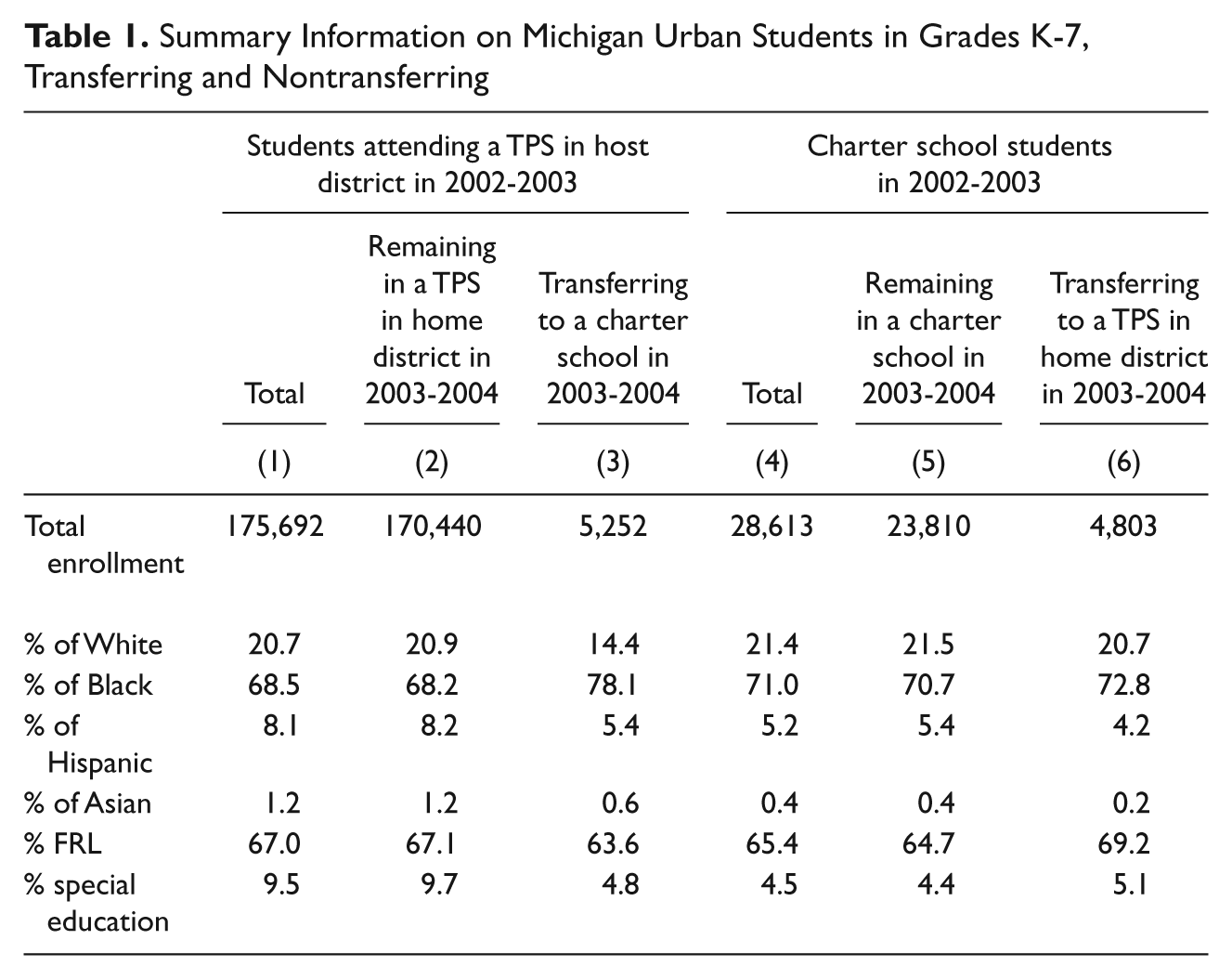
Among the students who enrolled in a TPS in their home urban district in 2002-2003, about 3% transferred to a charter school in 2003-2004. Columns 2 and 3 of Table 1 show that students who transferred from TPSs to charter schools were significantly more likely to be Black and less likely to be White, Hispanic, or Asian than students who remained in TPSs. They were also less likely to be low-income and to receive special education than students who stayed in TPSs. Columns 5 and 6 show that about 17% of students who attended charter schools in 2002-2003 returned to a TPS in their home district in 2003-2004. Compared with students who stayed in charter schools, those who returned to TPSs were slightly more likely to be Black, low-income, and with special needs.
As noted, whether an analysis of school switchers provides a reliable index of the overall effect of charter schools on TPS student composition depends on the extent to which the switchers are representative of all charter school students. Columns 3, 4, and 6 suggest some variation in the demographic characteristics of transferring students and charter school students as a whole. This may imply that students who never attended TPSs are demographically different from the switchers or it may represent the cumulative effect of the two-way sorting over the years. Insofar as the latter explanation holds, the effects of switchers can provide estimates of the average effect of charter schools. Unfortunately, I do not have the data to distinguish between these explanations.
Transferring From TPSs to Charter Schools
Since the raw comparisons in Table 1 fail to control for the characteristics of the schools they attend, they do not provide the full picture of student transfer patterns. In this and the next section, I further explore the patterns of TPS-to-charter and charter-to-TPS transfers through the HGLMs analysis, which control for both student and school characteristics.
Several models were set up to study how the likelihoods of TPS-to-charter transfers are associated with student characteristics and the characteristics of the TPSs they attended. The first model introduces only student-level demographic variables. Model 2 further includes the three interaction terms between FRL and the race variables. By allowing the influence of SES on the likelihood of transferring to differ for families from different racial backgrounds, the interactions in Model 2 will help to test whether choice decisions of families within each racial group varied by family SES. Model 3 includes the full set of controls at both the student and school levels, where school characteristics are introduced to account for the variability among student-level intercepts; that is, they are included to predict the mean likelihood of student transfer across schools. To test whether disadvantaged students are less likely to choose than other students, as previous research has found with regard to other forms of school choice, Model 4 expands Model 3 by adding a slope-as-outcome model that allows the student-level variable Black × FRL, representing students who are both Black and low-income, to interact with the school-level variables. The slope-as-outcome model aims to examine whether the differential likelihoods of transfer between disadvantaged students and their more advantaged schoolmates depend on school characteristics, such as student composition and school effectiveness. 2 Table 2 describes the summary information for the variables included in the four models.
Descriptions of Variables in TPS-to-Charter Transfer Models, 2002-2003
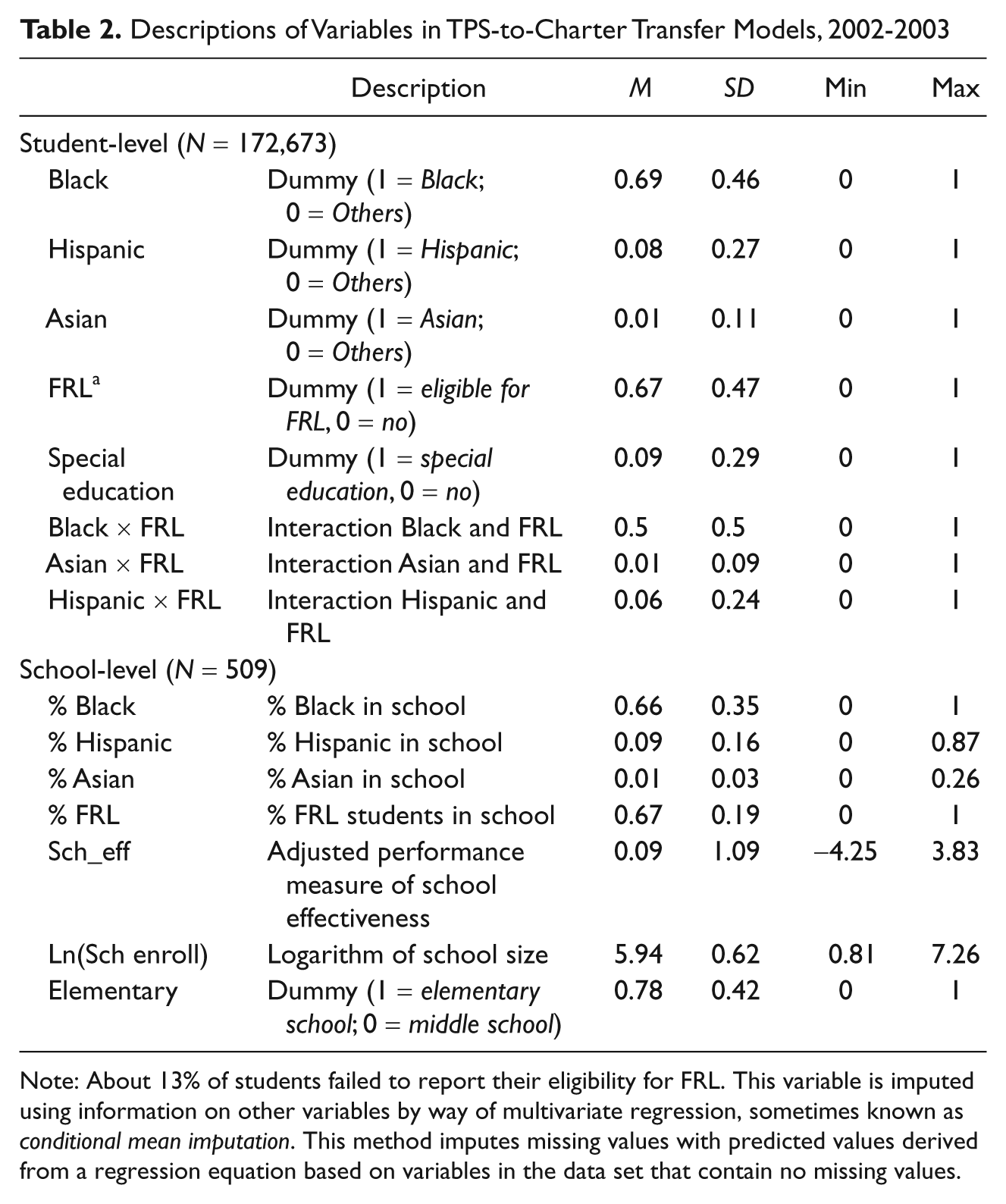
Note: About 13% of students failed to report their eligibility for FRL. This variable is imputed using information on other variables by way of multivariate regression, sometimes known as conditional mean imputation. This method imputes missing values with predicted values derived from a regression equation based on variables in the data set that contain no missing values.
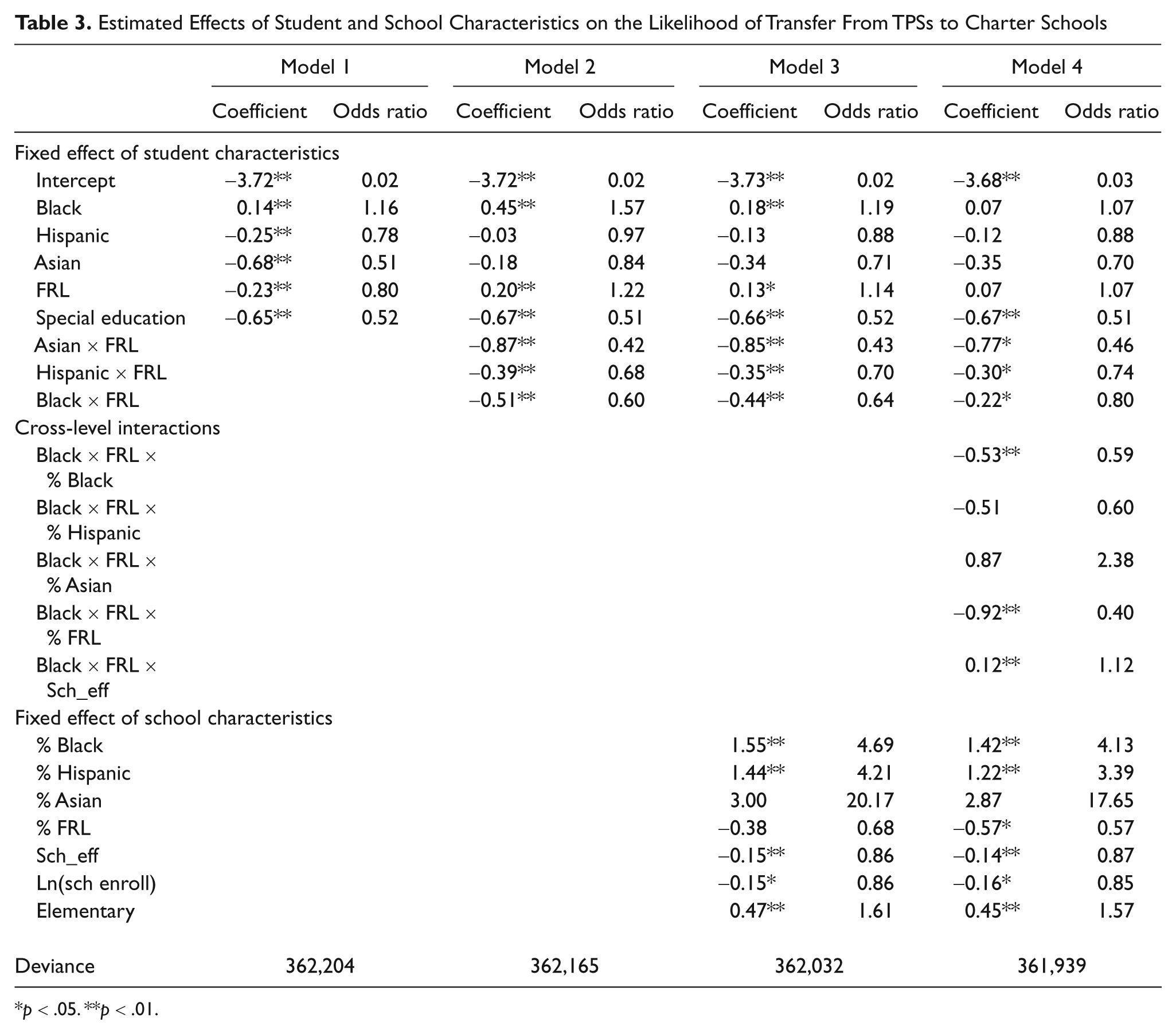
Table 3 presents the estimation results. The first column of each model shows the coefficient (or log odds ratio) of each predictor, followed by the odds ratio—the exponential values of the coefficient, for easier interpretation. Overall, the results of all four models indicate that the likelihood of student transfer is strongly related to both student and school characteristics.
Estimated Effects of Student and School Characteristics on the Likelihood of Transfer From TPSs to Charter Schools
p < .05. **p < .01.
The results of Model 1 show that the likelihood of transfer from TPSs to charter schools is significantly related to a student’s SES, race, and special education status. Without considering the characteristics of TPSs students attended, Black students were more likely to transfer to charter schools than White students, a finding consistent with Bifulco, Ladd, and Ross (2009). This may indicate that White families are more able to use other forms of school choice, so they are less likely to use charter school choice. However, the transfer odds of Hispanic and Asian students were smaller than White students. This finding suggests that the choice process might differ considerably for Hispanic and Asian students than for Black students (Bifulco, Cobb, et al., 2009).
Furthermore, low-income students were less likely to transfer to charter schools than nonpoverty students, which is consistent with the literature that higher-SES parents are more likely to take advantage of choice. In addition, students with special needs were less likely to transfer to charter schools than general education students, which supports previous research that shows in Michigan, many charter schools are unwilling or have no capacity to accommodate students with disabilities (Arsen & Ray, 2004).
When the interaction terms between FRL and the race variables are included in Model 2, some interesting patterns emerge. First, the coefficients of all three interaction terms are negative and significant while the coefficient of FRL becomes positive. This implies that the influence of SES background on the likelihood of transferring to charter schools is opposite for White students and students of color. Whereas low-income White students were more likely to transfer than nonpoverty White students, low-income students of color, including Black, Hispanic, and Asian, were less likely to transfer than nonpoverty students from these racial backgrounds. This might suggest that high-SES White families are better able to use other forms of choice so that they are less likely to use charter school options than low-SES White families, whereas low-SES families of color face racial or resource constraints such as transportation and availability of information than high-SES families of color in using the charter school choice. Second, when the interaction terms are included, the coefficient of Black becomes larger, whereas the coefficients of Hispanic and Asian dummies are not significant anymore. This further indicates that the urban students who transfer to charter schools tend to be nonpoverty Black or low-income White students, whereas students of color from low-income families tend to be left behind in their assigned schools. This pattern of charter student sorting is similar to what Bifulco, Ladd, et al. (2009) found with other forms of public school choice.
The estimates of Model 3 show that in addition to student characteristics, school characteristics are also related to the likelihood of students transferring from TPSs to charters. At the school level, the coefficients of the percentages of Black and Hispanic students are positive and significant. This indicates that students’ decisions to transfer to charter schools were strongly related to the racial makeup of the TPSs they attended. On average, students’ probability of transfer increased as the share of students of color in their school increased. Although the sign of the percentage of FRL students in a school is negative, which might suggest that students were less likely to transfer out of schools with high proportion of low-income students, it is not statistically significant.
The likelihood of student transfer also declined as school effectiveness increases, a result consistent with the claim of advocates that charter schools enable students to escape low-quality urban schools. In addition, the propensity of student transfer tends to decrease in large schools. This may indicate that larger schools offer more educational choices within school, thereby diminishing students’ motivation to seek other schooling options.
It is worth noting that the inclusion of school-level variables in the Model 3 influences the coefficients of student-level variables. For example, the magnitudes of the coefficients of Black and FRL at the student-level become smaller, indicating that the likelihood of different types of students transferring might vary in schools with different characteristics. This possibility is further examined in Model 4 by including a slope-as-outcome model to differentiate the effects of school variables between the more advantaged students and the most disadvantaged group of students, namely, the low-income Black students, represented by the variable of Black × FRL.
Because of the inclusion of the cross-level interactions in Model 4, the main effects of race and FRL at Level 1 become insignificant, whereas the three interaction terms between the race dummies and FRL remain negative and significant. This suggests that once controlling for the differential likelihoods for low-income Black students to transfer in different schools, White students and nonpoverty students of color tend to have similar odds to transfer and as a group they were more likely to transfer than low-income students of color within the same school. At Level 2, the signs of all coefficients remain the same, although the magnitudes are slightly different from the results of Model 3. This further supports the results from Model 3 that the average probability of student transfer was higher in less effective schools with high proportions of Black and Hispanic students.
The cross-level interaction terms between the student-level variable Black × FRL and several school-level variables in Model 4 indicate that, relative to White and nonpoverty students of color, the transfer odds of low-income Blacks decreases further in schools with high percentages of Black, Hispanic, and low-income students. This result supports the conclusion from previous research that advantaged students tend to leave schools serving low-income students of color. In addition, the coefficient of the interaction between Black × FRL and school effectiveness is positive and significant. This indicates that while low-income Black students are less likely to transfer than their more advantaged schoolmates in general, they are even less likely to transfer in low-quality schools. This presents an unsettling contrast to the results in Model 3 which indicate, on average, that students tend to transfer out of ineffective schools. It suggests that relative to their more advantaged peers for whatever reason (e.g., less reliable information about school quality, or transportation or time constraints) low-income families of color are least likely to choose to escape the worst schools (cf. Bell, 2009; Lacireno-Paquet & Brantley, 2008). 3
In sum, the results of Model 4 indicate that low-SES Black students were less likely to transfer than their White and more affluent schoolmates if they attended less effective urban schools with high concentrations of Black, Hispanic, and low-income students. The pattern is similar to those found in previous literature on other forms of school choice policies including interdistrict choice programs. That is, compared with disadvantaged students, advantaged students are more likely to transfer out their assigned schools through choice, especially when their assigned schools served high concentrations of disadvantaged students and had low average student performance.
Transferring From Charter Schools to TPSs
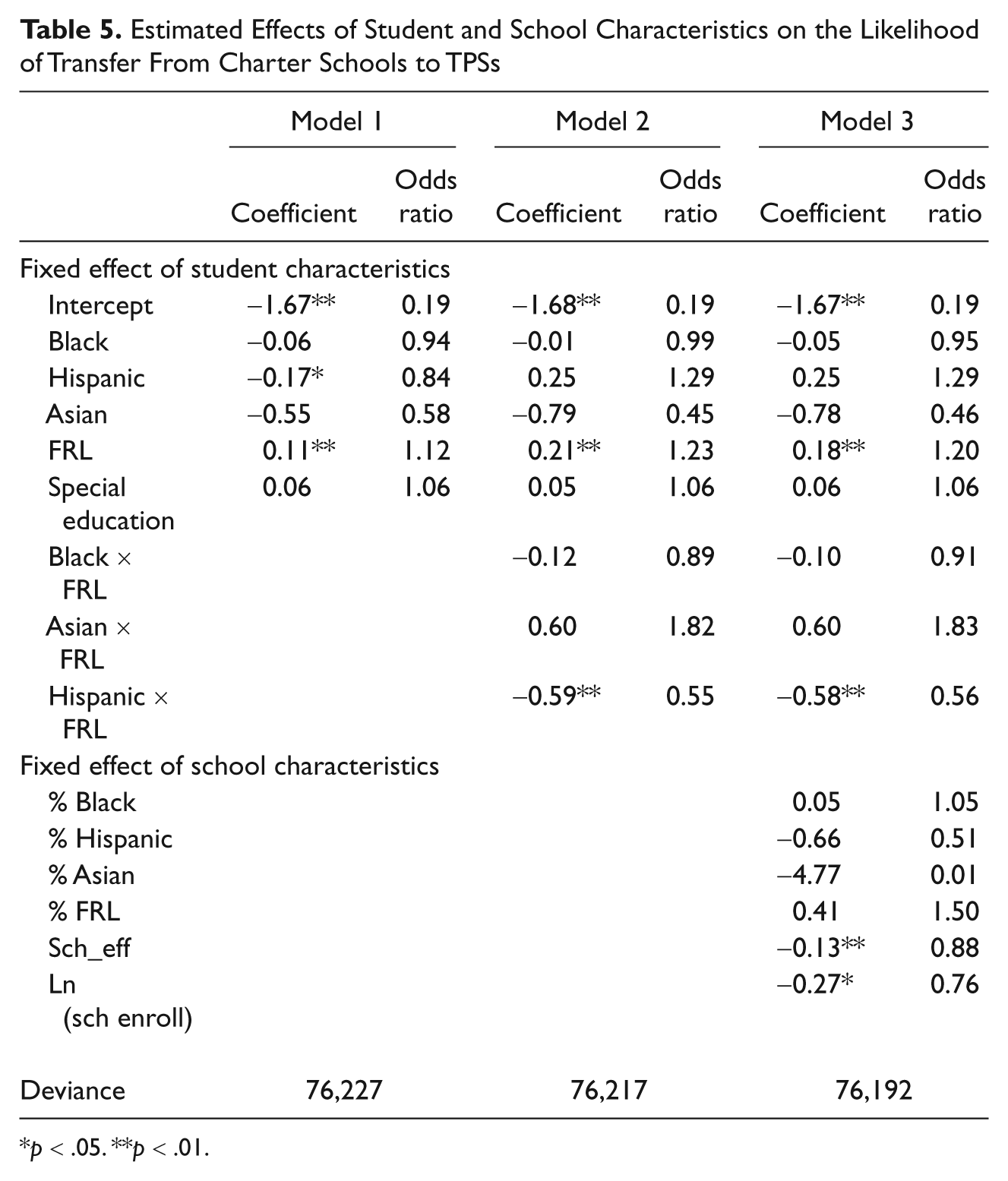
This section estimates the influence of both student and school characteristics on the likelihood of charter-to-TPS transfers. Several models similar to the TPSs-to-charter analysis were built sequentially. Descriptive statistics for the variables are presented in Table 4. Table 5 contains the estimation results for the three models, which present a somewhat less clear picture of student sorting as compared with the strong patterns observed in the analysis of the TPS-to-charter transfers.
Descriptions of Variables in Charter-to-TPS Transfer Models, 2002-2003
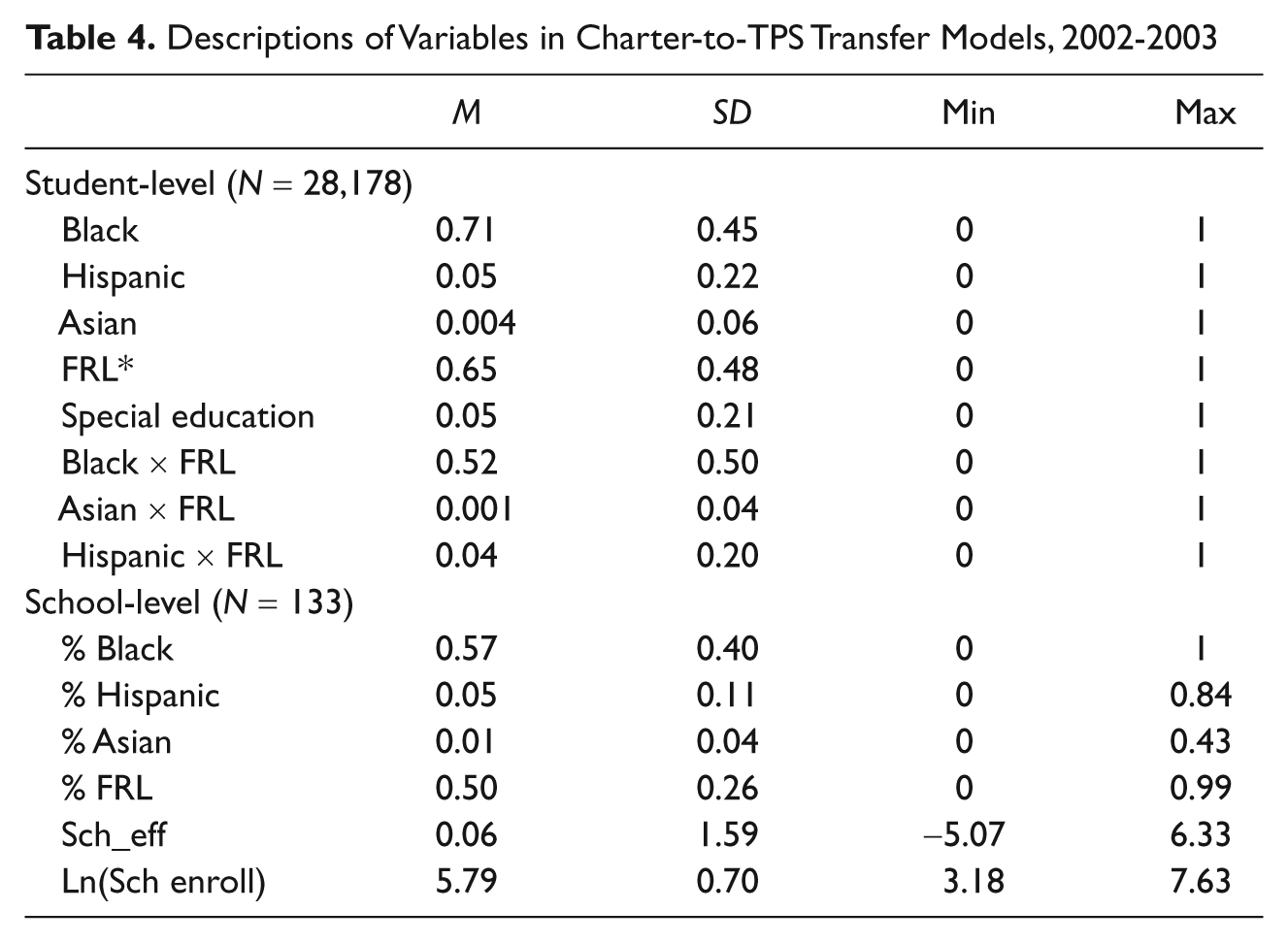
Estimated Effects of Student and School Characteristics on the Likelihood of Transfer From Charter Schools to TPSs
p < .05. **p < .01.
Model 1 in Table 5 shows that with the exception of Hispanic students, students of all other races have similar probability of transferring back to TPSs. Low-income charter students were significantly more likely to transfer back to TPSs than their more affluent schoolmates. Surprisingly, whether students have special needs does not significantly influence their probability of transferring back to TPSs, a result inconsistent with what has been documented by previous research that charter schools tend to counsel out special education students (Miron & Nelson, 2002).
The coefficients of the three interactions between the race dummies and FRL in Model 2 are mostly insignificant, implying that the influence of SES on student transfer back to TPSs does not vary by student racial background. Once more, the coefficient of the interaction terms Hispanic × FRL is significant, which might reflect different factors influencing the choice process for Hispanics students. On balance, the results in both Model 1 and Model 2 of Table 5 present a less consistent story with regard to whether and how students’ race and socioeconomic status are associated with their likelihood of transferring back to TPSs.
The estimates of school-level variables in Model 3 show that the likelihood of charter students transferring back to TPSs was not associated with charter schools’ demographic composition but associated with charter schools’ effectiveness and school size. Students were more likely to transfer back to TPSs if the charter school they attended had low effectiveness and had a small enrollment. This pattern is consistent with the influences of school size and school effectiveness in the analysis of TPS-to-charter transfers. Although not shown in the table, the slope-as-outcomes model was estimated and generated no significant results. This indicates that the effects of school characteristics on the likelihood of transfer hold for all students regardless of their racial and socioeconomic backgrounds. 4
The insignificance of most student and school demographic variables in the charter-to-TPS models might be caused by small samples. An alternative interpretation, however, is that the students are already sorted, by both their families and charter schools, into different charter schools based on their own backgrounds and the racial and SES compositions of charter schools. If students leave a charter school, they are likely to be dissatisfied with the quality of the school or with other factors such as discipline and safety issues that are not captured in the models. Further research is needed to examine why students leave charter schools for TPSs since about 20% of charter students do so annually.
The Potential Effect of Sorting on Student Composition of TPSs
In view of the two-way student flows between traditional and charter schools, how has Michigan’s charter school program influenced student composition in the state’s TPSs? The transfer of students from TPSs to charter schools was strongly related to both student and school characteristics. Compared with low-income students of color, more advantaged students, namely, White and nonpoverty students of color, were more likely to transfer to charter schools. Furthermore, these students were more likely to move to charters than their low-income schoolmates of color from less effective schools serving high proportions of low-income students of color. As a result, the concentrations of disadvantaged students in these disadvantaged schools tended to increase as the better-off students left. Meanwhile, transfers from charters back to TPSs were less uniformly associated with the characteristics of charter students, with the exception that low-SES students were more likely to return to TPSs.
As advocates of charter school predicted, school effectiveness matters in both ways of transfer. Overall, ineffective TPSs and charter schools alike tended to lose students. However, my analysis of TPS-to-charter transfer suggests that low-income Black students were less like to leave ineffective TPSs for charter schools than their White and nonpoverty schoolmates, a result contradictory to the claim that charter school policies are working to help the most disadvantaged students escape schools with the lowest quality.
Together, the two-way transfers of students between TPSs and charter schools have a clear influence on the composition of students in Michigan’s urban TPSs. As more advantaged or moderately disadvantaged students tend to go to charter schools, and more low-income students return to TPSs, the severely disadvantaged students—low-income students of color—become ever more isolated in ineffective urban schools serving high percentages of low-income students of color.
So far, Michigan’s charter school program still has had limited influence on the composition of students in the TPSs in suburban and rural areas because charter enrollment in those areas remains negligible. However, in urban areas where charter schools represent more than 12% of public school enrollment, the influence on student composition in TPSs has been more pronounced. By focusing on student transfers during a single year, the analysis in this article does not reflect the cumulative impact of student sorting in urban areas, where many urban charter schools have existed for more than 10 years.
Based on the assumptions that the analysis on switchers represents the average charter school effects and the observed sorting patterns and volume of student flows have remained the same over the last 10 years (the number of years many charter schools have existed), I made several rough computations to illustrate the cumulative effect of student sorting on TPS racial and SES composition in urban areas. Setting all other variables at their means and using the coefficient estimates of Model 3 in Table 3, the calculations suggest that in an urban elementary school with 60% Black, 60% low-income, and 50% low-income Black students, the proportion of low-income Black students would increase by 3.4 percentage points over 10 years. By comparison, the proportion would increase 4.5 percentage points in an urban school with 90% Black, 90% low-income, and 80% low-income Black students. One needs to be careful in interpreting such simulated cumulative effects, however. They may underestimate the actual impact of charter schools on TPS student composition as they neither consider the disproportionate rate at which low-income students transfer back to TPS from charter schools nor account for wider long-term impacts on TPSs as charter penetration intensifies. In Michigan cities, where charter participation rates have more than doubled since 2004, hundreds of traditional public schools have been closed.
Another way to look at the cumulative effects of charter schools is to look at the actual changes of student compositions in urban schools. Between 1995 and 2004, the share of TPSs serving high proportions of racially and scioeconomically disadvantaged students had increased dramatically in Michigan’s urban areas. In 1994, only about 8% urban TPSs served a student body of more than 80% Black and 80% low-income students, by 2004, the share increased to 23%. During the same period, the share of schools serving more than 90% Black and 90% low-income students doubled from 3% to 6%. Although there are many other potential factors, including residential and demographic shifts in urban areas, that could have caused the differences, a significant part of the differences can be attributed to student sorting initiated by the state’s charter school policy.
Conclusions
This analysis of the two-way transfer of students between urban TPSs and charter schools suggests that charter schools lead to intensified stratification by race and SES in urban areas, where the students were already least well served by TPSs. These results contrast with the hopeful prediction that the disadvantaged students benefit most from charter school policy. In Michigan cities, the students left behind in these schools experience a more racially and socially isolated learning environment. Furthermore, they remain in classrooms with less advantaged peers as the concentrations of low-performing and special needs students increase. So their academic performance may be further adversely affected by other associated features, such as lower teacher expectation and inadequate resources as the average costs of educating these students increase relative to students with high performance and students who are in general education (Ladd, 2002).
There are two caveats that should be kept in mind when we draw conclusions based on these findings. First, the effect of Michigan’s other public choice program, interdistrict choice, is not examined in the study. It is possible that the existence of the program influenced the student transfer patterns between the assigned TPSs and charter schools. Although the number of students who participated in the interdistrict choice during the time period of analysis is significantly lower than the number of students who attended charter schools, given the tendency of interdistrict choice to exacerbate social stratification as the literature suggests, the effect of the charter school program in the absence of the interdistrict choice program might be underestimated in this analysis.
Second, the results presented here are not necessarily generalizable to public school systems in other states, as the impact of charter schools on integration depends on features of choice policies as well as the local contexts in which the policies are implemented. Michigan’s urban schools were among the most racially segregated in the county even before the advent of charter schools. By comparison to many other states, a relatively high proportion of Michigan charter schools are managed by educational management organizations. Michigan’s charter school law also provides relatively strong financial incentives for schools to compete for students because all funding follows with students to choice schools. It is possible for these features to influence the Michigan sorting patterns in unique ways. Nevertheless, many other features of Michigan charter school law, including what students and schools are eligible to participate in the program, are similar to those of the policies in many other states. Also, my results of increased concentrations of disadvantaged students in ineffective urban schools serving high percentages of low-income students of color are consistent with findings of interdistrict choice policies from diverse settings. More research in other states would be useful to better understand the patterns of charter school-induced sorting, so that policy makers can design and implement policies in ways that will help disadvantaged students who are left behind in traditional schools, without significantly reducing the benefits to students who take advantage of school choice.
Footnotes
Acknowledgements
I wish to express my special thanks to David Arsen for his advice throughout the preparation of this article. I would also like to thank Ken Frank and John Kircher for their invaluable comments.
The author(s) declared no potential conflicts of interest with respect to the authorship and/or publication of this article.
The author(s) received no financial support for the research and/or authorship of this article.