







Abstract
Professionalization is an important but overlooked dimension in education politics, particularly the politics of accountability. To isolate the importance of professionalization, this article compares accountability movements in K-12 education with similar movements in higher education. I draw on three pairs of reports that have sought to impose accountability between 1983 and 2006, in each case comparing a report on K-12 with a similar report on higher education. I find that calls for accountability in both sectors have intensified over the period under study, but that higher education has been much more protected from accountability pressures by its greater degree of professionalization, its reputation, its greater share in the private sector, and its decentralized professional autonomy. In conclusion, I connect the findings to broader debates about professionalism and the future of accountability in the two sectors.
The past 30 years have seen increasing demands for educational accountability in American K-12 education (Fuhrman, 1999, 2001) at both the state and federal levels (Peterson & West, 2003). The impetus for these changes has been variously identified as a shift toward a postindustrial economy and globalization, welfare state retrenchment and fiscal pressures on government, the demands of business groups, conservative demands for accountability, liberal demands for equity, and a paradigm change in the early 1980s that incorporated many of these strands and reoriented the subsequent debate around school reform (Mehta, 2013a).
Without disputing the importance of any of these causes, one important factor in shaping reforms that has received comparatively little attention is the underprofessionalization of teaching (Etzioni, 1969; Lortie, 1975). While there has been considerable work on the consequences of external accountability for how much control teachers have over their work (Ingersoll, 2003; McNeil, 1986, 2000), there has been much less investigation of whether teachers’ incomplete professionalization is an important factor in shaping external calls for accountability. One reason for this omission is that the “semiprofessional” nature of the teaching profession is largely invariant across states and over the relevant time period, eliminating the sources of variation that would be most obviously amenable to social scientific study.
But if the professional standing of teaching is so constant that it is difficult to assess its effects within the K-12 reform movement, it is possible to isolate its impact by comparing the calls for accountability in primary and secondary education with those in a related field that differs in its level of professionalization—higher education. While there are important differences between the fields, both sectors are responsible for the education of students, both have faced pressures to improve performance without increasing costs, and both have faced calls in recent years to become more accountable for results (Burke, 2005). But while higher education similarly has been subject to many external pressures, it differs from K-12 education in a number of important ways, one of which is the greater professionalization of its labor force. This article seeks to examine whether differences in the level of professionalization across these fields are reflected in the accountability demands that external actors place on them.
To explore these questions, I compare three sets of prominent reports that have been important in the accountability movements in K-12 and higher education over the past 25 rears. A detailed reading of these reports helps us to see the ways in which the two sectors have been depicted by those who seek to reform them. This reading suggests that both movements are shaped by similar external pressures for accountability; that calls for accountability in both sectors have intensified over the period under study; that while both fields have faced similar calls for assessment and evidence of results, the degree of professional control over this process is much greater in higher education than in K-12; and that higher education has been much more protected (thus far) from state and federal accountability pressures because of its reputation, its greater degree of professionalization, its market success, and the belief among policy makers that the key to higher education’s success is its decentralized professional autonomy.
More theoretically, this article suggests that “professions” are an important and understudied lens through which to examine educational politics, and welfare state politics more generally. While the study of the politics of education has followed the major currents in political science in emphasizing the role of interest groups (Moe, 2011), institutions (Manna, 2006), regimes (McGuinn, 2006), and ideas (Mehta, 2013a), this article suggests that “professions”—specifically the ability of the profession to successfully organize itself internally and to persuade actors of its competence and legitimacy externally—should also be central to how we think about educational politics. In conclusion, I discuss the implications of these findings for the future of accountability in the two fields and connect the findings to broader debates about professionalism and “accountability politics.”
Professions and Semiprofessions in an Era of Accountability
Previous work on the politics of education has largely ignored the role of professional authority and power in favor of more conventional political science explanations such as the strategic actions of rational actors and changing regimes (McGuinn, 2006), interest group pressures (Mawhinney & Lugg, 2001), partisan cleavages (Spring, 2002), and historical institutionalism (Manna, 2006). To be sure, organizational sociologists have considered the semiprofessional status (Etzioni, 1969; Lortie, 1975) of teachers in exploring the control that teachers have over their work (Ingersoll, 2003; Locke, 2001; McNeil, 1986, 2000), but there has been much less investigation of whether teachers’ professional status has been an important factor in shaping external calls for reform.
Two developments over the past 20 years suggest greater attention should be paid to the role of professions in politics, particularly education politics. First, demands for external accountability have moved the question of control over the teaching profession to the center of the school reform debate. While in the past the primary cleavages that defined education politics were between left and right, in recent years a bipartisan accountability movement has joined legislators of both parties in calls for reform of underperforming teachers and schools. In this new politics, a consortium of external actors—legislators, business groups, some civil rights groups—seeking to assert pressure and lay control are arrayed against teachers seeking to retain professional control and autonomy (Mehta, 2013a). For example, fights over educational accountability or teaching evaluations often pit schools and teachers, who argue that testing is unfairly measuring them or narrowing the curriculum, against a range of business, political, and civil rights actors who argue that schools need to be held externally accountable. If a significant part of education politics is now a battle between frontline practitioners and external actors seeking to regulate them, there is reason to think that this contest is shaped by the professional power and authority of the profession that is subject to regulation.
Second, professions in general have come under increasing external calls for accountability since the mid 1960s, suggesting that education politics are not sui generis and are instead subject to some of the same dynamics that govern accountability politics in other fields. Trend data reveal that there has been a significant decline in the confidence accorded to all major professions since their high point in the mid-1960s. Education joins medicine, journalism, politics, religion, and the military as fields that have lost significant public trust over the past 40 years (Lipset & Schneider, 1986). Paradoxically, even as professions are expanding in number and growing in their centrality (Bell, 1973; Brint, 1994), they are also coming under increasing scrutiny, with calls for external accountability and lay control becoming ubiquitous across a range of professions and semiprofessions. Two examples are hospitals under managed care and police officers being held accountable for arrest rates. Education politics thus provide a window into these broader questions about the dynamics of “accountability politics.”
Of particular interest here is the relationship between external regulatory actors and the professional standing of different fields, which is an underexplored theme in both politics of education and in the sociology of the professions. Political scientists have mostly seen teachers as a powerful interest group (Mahwinney & Lugg, 2001; Moe, 2011) but have had some trouble accounting for the ways in which general interest accountability politics such as No Child Left Behind have triumphed over the objections of concentrated interests like teachers unions. Meanwhile, sociologists have explored the ways in which accountability policies have diminished teachers’ ability to exercise discretion on the ground (McNeil, 1986, 2000) but have not explored the opposite link—the way in which the weak professional standing of teaching inhibits its ability to advocate effectively politically.
The perspective developed here draws on some leading work in political science around reputational power (Carpenter, 2010) and sociology on moral power (Mehta & Winship, 2010) and fields (Bourdieu & Wacquant, 1992) to suggest a cultural ontology underlying political struggle. In this world, actors (and groups of actors at the level of a field) compete to define the terms of debate and to define themselves as actors who are highly credible and thus worthy of external respect. As discussed further below, when the actors in question are professional groups, the degree to which professions are able to organize themselves internally—to set standards of practice, select practitioners, and generate positive outcomes for their clients—is highly related to their ability to advocate persuasively externally (see also Glazer, 2008). From this perspective, understanding the comparative degree of regulation across fields is not only a matter of the material strength of the interest groups in these fields but it is also in part about the degree to which these fields have successfully organized themselves professionally
Sources of Sectoral Differences: Comparing the Professionalization of K-12 and Higher Education
K-12 education and higher education are two fields that have some different functions as well as some overlapping ones. At risk of belaboring the obvious, both sectors are responsible for teaching students, while higher education is also responsible for producing new knowledge, which is widely seen as the primary purpose of research universities. The analysis below focuses on their overlapping function—teaching students—and seeks to compare the way that the government has sought to hold accountable their respective efforts to do so. At the same time, central to the story is the way in which professors control over their other function (research) has carried over to protect their collective authority over their teaching.
The two fields differ greatly in their level of professional power. Differences in professional power are grounded not only in differences between the characteristics of the two professions but also in differences in the history of how they were institutionalized with respect to other actors. This distinction reflects two different approaches in the sociology of professions: an older tradition, which saw professions awarded occupational control on the basis of their ability to uniquely fulfill important societal functions (Parsons, 1939/1954; Wilensky, 1964) and more recent writing, which has emphasized the active conflicts among professions (Abbott, 1988) or between a profession and other actors, such as states, business groups, or consumers (Freidson, 2001; Krause, 1996; Larson, 1977; Light, 1995, 2000) seeking to control its sphere.
School teaching, like the similarly feminized semiprofessions of nursing and social work, never developed the characteristics that defined the more traditional professions (Etzioni, 1969; Lortie, 1975). Primary and secondary school teaching does not possess the characteristics that are common in more fully professionalized fields: lengthy training, social closure over who can enter its ranks, or a pedagogical knowledge base that is widely respected by the public. Initially a career option primarily for women before they had children, teaching in the Progressive Era was incorporated within a bureaucratic-management model in which teachers reported directly to administrators and established little professional control of their own (Tyack, 1974; Mehta, 2013b). While loose coupling (Meyer & Rowan, 1977) preserved some professional autonomy at the classroom level—teachers were rarely supervised within their own classrooms—teachers have not taken collective control of their practice and remain institutionalized within a hierarchical bureaucracy. The rapid growth in teacher union membership between 1960 and 1980 (Toch, 1991) increased the pay, working conditions, and political power of teachers, but did not fundamentally disturb the hierarchical distribution of responsibility for schooling that had been in place since the Progressive period (Kerchner, 1995).
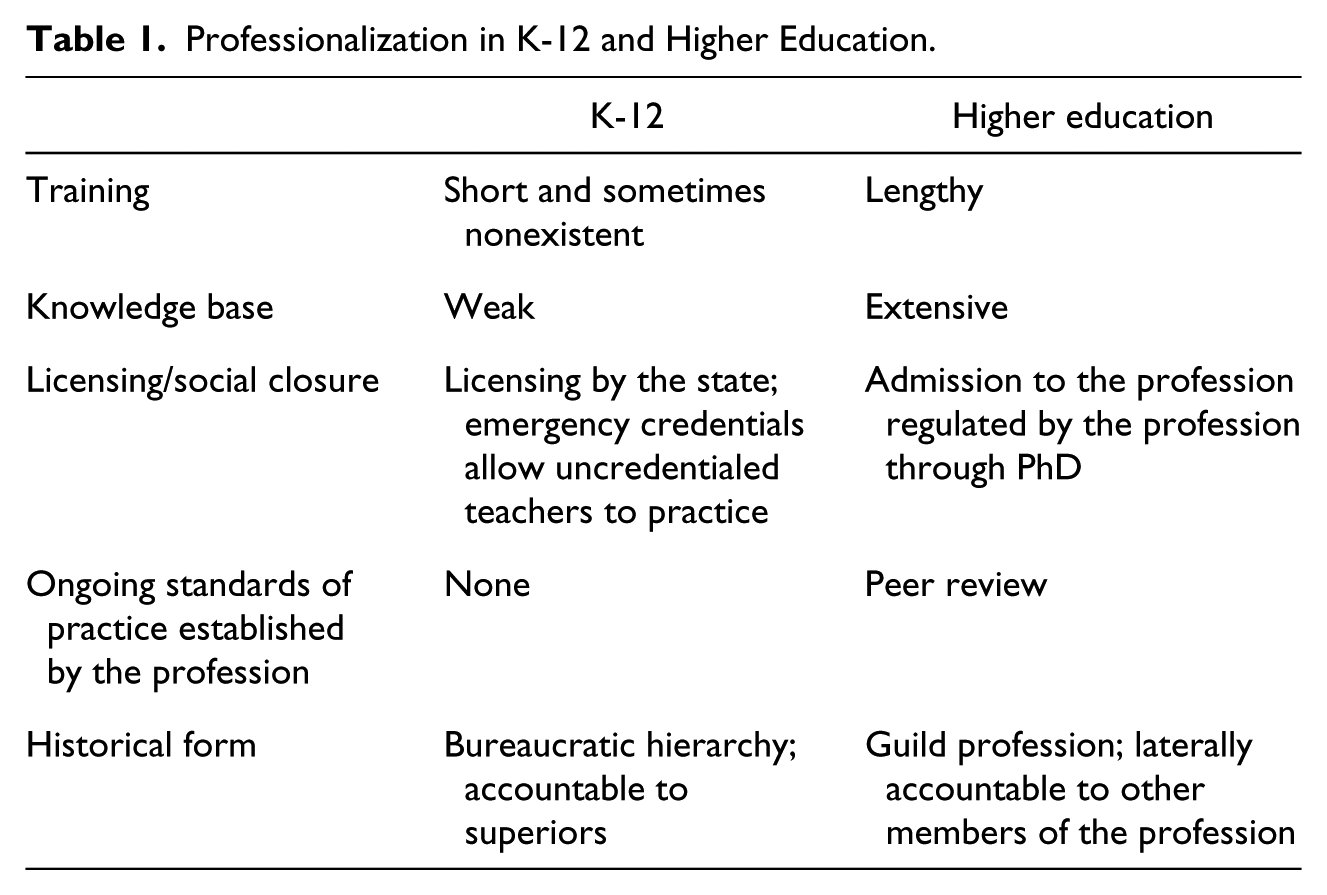
Higher education followed a different path. Operated in the 19th century under a hierarchical managerial model in which trustees and presidents made final decisions on curriculum and hiring, it evolved during the first half of the 20th century into a model that grants significant power to faculty over these substantive areas. As disciplinary associations and academic journals proliferated, higher education took the form that we see today, with scholars acting as a self-regulating profession uniquely charged with judging the work of fellow academics (Jencks & Riesman, 1968; Vescey, 1965). Higher education is professionalized in all the ways that secondary schooling is not: professors have the power to exclude unqualified practitioners; they have a lengthy training regimen and have mastered a technical or specialized body of knowledge that wins broad respect and deference. Peer review provides a standard-setting mechanism for the field, as it ensures that what counts as new knowledge is certified by other members of the profession. While none of higher educational professionalization is actually organized around the purpose of teaching, the professionalization on the research side has historically given its members organizational control over teaching as well. Table 1 summarizes the differences between the fields.
Professionalization in K-12 and Higher Education.
However, recent years have complicated the ideal types of K-12 schooling as a “semiprofession,” loosely coupled but under bureaucratic administrative control, and higher education as a fully autonomous profession, free from external constraint. Both sectors have faced increasing demands for accountability, as economic change, tighter budgets, and growing criticism have intensified the external scrutiny of practitioners at both levels. Primary and secondary education has seen a growing emphasis on quantitative results, a movement that has resulted in much tighter coupling and greater direction of practice from those external to schools, further weakening efforts for professional autonomy (Rowan, 2006). Partially in response to these external pressures, some within the teaching profession have made calls for changes that they hoped would increase the professionalization of the field (Carnegie, 1986), but overall these movements have not had the traction that their proponents desired (Rotherham & Mead, 2004). Meanwhile, higher education has also faced greater scrutiny, as states have increasingly sought to ensure that universities are meeting state needs as well as academic ones (Burke, 2005) and as federal and state legislators have expressed alarm about rising tuition. Finally, university systems are employing increasing numbers of nontenured professors as a way to reduce costs and shift power away from the tenured faculty who share in institutional governance to instructors who are largely under administrative control (Chait, 2002). This shift has eroded the more traditional faculty governance model at some universities, particularly at less prestigious institutions and at community colleges. In sum, while the differences in both the characteristics and the histories of the two professions remain, there is reason to think that each has moved somewhat away from their ideal types in recent years.
Professionalization and External Accountability: Four Scenarios
These various trends suggest that the collision between the pressure for external accountability and the assertion of professional autonomy could have at least four outcomes, one of which has two variants.
Professional deference. Under this scenario, external reformers (such as policy makers or other groups seeking to shape a field) seek to work with a profession to improve its practice, but leave core decisions about goals and professional practice in the hands of the profession or semiprofession.
Divergence. In this scenario, professions are regulated in accordance with their degree of professional power. Stronger professions continue to retain control over the governance of their practice, while weaker semiprofessions find themselves increasingly vulnerable to external demands.
Convergence. In one variant of this scenario, the power of external demands becomes so strong that professional power is weakened across the board. The stronger professions become more like the weaker ones, as external calls for accountability diminish their traditional prerogatives. I will call this downward convergence. In a second scenario, the traditional semiprofessions begin to model their practice on the more powerful professions and gain increasing power to govern their affairs. I will call this upward convergence.
The miner’s canary. In this scenario, professions and semiprofessions have not yet converged, but the increasing regulation of the semiprofessions provides the template for controlling the established professions. If the miner’s canary scenario is realized, then the professions will follow the semiprofessions in finding themselves subject to greater external accountability, but the process will come to the professions later and in somewhat weakened form.
Other Sources of Divergence Across Sectors
Differences in professional power and authority are not the only differences that might affect accountability demands. At least three other differences between the sectors might plausibly come into play. The first is the relative performance of the two sectors in comparison to international norms: a greater degree of underperformance might be expected to draw more invasive forms of external accountability. (Differences in performance could, of course, be largely due to differences in degrees of professionalization, but professionalization and performance are analytically distinct.) The second is that higher education is also more directly subject to market accountability than primary and secondary schooling, since a much larger share of higher education is private. This factor could be important in forestalling calls for state accountability. A third and related difference is that higher education is more institutionally diverse than K-12, with different types of schools—community colleges, vocational schools, liberal arts colleges, research universities—seeking to accomplish different ends. This diversity might inhibit state and federal policy makers from seeking to impose a common system of accountability from above. These additional possibilities will be considered in the analysis below.
Data and Method
Comparing accountability movements in K-12 and higher education, while theoretically important, is methodologically challenging. Movements for accountability have taken place across 50 states and in the federal government in both sectors, over a period of 25 years.
The present article is part of a larger book project on the evolving politics of accountability in K-12 and higher education. That project is informed by more than 80 interviews with key actors, extensive reading of secondary sources, and several thousands of pages of archival documents as it traces the respective accountability movements in the two spheres.
This article complements this broader historical analysis by focusing in more detail on three pairs of highly influential reports that sought to inject greater accountability into education at different points over this time span. A comparative reading of these reports allows for a more detailed investigation of the language and rhetoric of how the two fields are depicted than is possible in a more general historical analysis. These particular reports were identified by informants in this larger study as critically important documents in the history of educational accountability in the two fields.
First I compare A Nation at Risk, the famous 1983 Department of Education-initiated report that unleashed a tidal wave of reform in K-12 schooling, with Involvement in Learning, a less well-known but parallel 1984 report, also initiated by the Department of Education, which sought to have a similarly galvanizing effect on higher education. Second, I consider Time for Results, a 1986 report issued by the National Governors’ Association, which initiated a state compact to improve the quality of schooling. Rather than pairing it with another report, I consider its contrasting discussions of K-12 and higher education. Third, I compare the Bush Administration’s template for what became the No Child Left Behind Act of 2002 to the 2006 report on accountability in higher education, issued by a commission created by Bush’s Education Secretary, Margaret Spellings. More details about the reports appear in the text below. In total, this group of reports draws on both state and federal efforts for educational accountability and includes many of the key documents in the launching of accountability movements in each of the sectors. Table 2 provides summary information about the reports.
Five Documents of Education Reform.
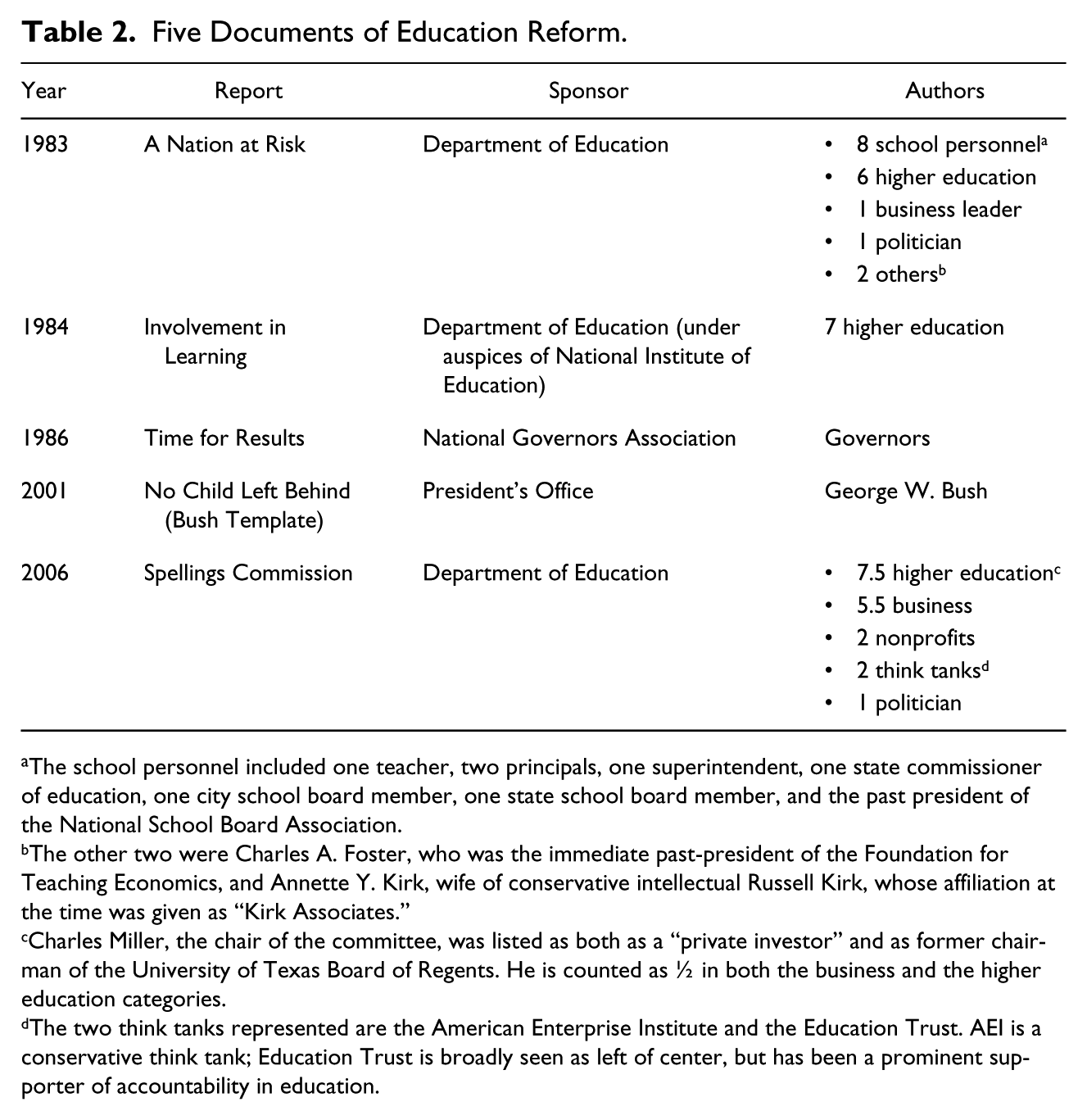
The school personnel included one teacher, two principals, one superintendent, one state commissioner of education, one city school board member, one state school board member, and the past president of the National School Board Association.
The other two were Charles A. Foster, who was the immediate past-president of the Foundation for Teaching Economics, and Annette Y. Kirk, wife of conservative intellectual Russell Kirk, whose affiliation at the time was given as “Kirk Associates.”
Charles Miller, the chair of the committee, was listed as both as a “private investor” and as former chairman of the University of Texas Board of Regents. He is counted as ½ in both the business and the higher education categories.
The two think tanks represented are the American Enterprise Institute and the Education Trust. AEI is a conservative think tank; Education Trust is broadly seen as left of center, but has been a prominent supporter of accountability in education.
As is common in all forms of discourse analysis, the analysis here focuses on the rhetoric used in the reports. I do not make any claims about how the reports came to say what they did, or what behind the scenes forces shaped the final products. Such claims would be exceedingly difficult to definitively substantiate. Rather, I focus on the rhetoric of the reports, following past scholars in suggesting that the words used in public documents matter, regardless of their origins (Skrentny, 1996). Whatever behind the scenes forces shaped the documents, they are indisputably highly public statements that reflect on the governments that issued them and thus offer a good site to explore the assumptions that underlie how the governments sought to publicly portray the two sectors.
The reports were analyzed using comparative thematic analysis (Aronson, 1994; Boyatzis, 1998; Braun & Clarke, 2006). Thematic analysis, which is a more formal version of the coding methods that are routinely used in qualitative research, is a method used in sociology, psychology, anthropology, and other related disciplines that enables the researcher to break large chunks of text into a series of thematic codes for analysis. Themes are larger units than words or phrases, capturing broader ideas that are reflected in the text. In this case, the thematic analysis was question-driven, in that I was seeking to understand how the different sectors were portrayed in the documents, and hence the codes mapped to the theories outlined above. Etic codes were derived deductively from theory; emic codes arose inductively from the text. Codes that emerged in earlier readings of the text were applied more systematically in a subsequent reading. Saturation was reached when the developed codes capture the major differences between the sectors as outlined in the reports.
The interviews in the larger project suggested several themes—the respective strengths of the professions, the greater private market share of higher education—that differed across the two sectors and would predict different treatment by external state actors. These themes were supported in the readings of the reports. However, the coding process also suggested a number of other important aspects that differed across the sectors, which are captured in the above literature review and in the analysis of the documents below. As is appropriate for comparative thematic analysis, I do not seek to isolate a particular “factor” that “drives” the differences in the portrayals of the two sectors, but rather simply report the major themes that differ in the depiction of the two fields, and how those themes evolved over time. To avoid decontextualizing these themes, in the analysis below I present a summary of the major ideas of each report and then examine how the different sectors were presented in the context of these larger arguments.
There are a number of advantages to this analytic strategy. By closely examining three sets of key documents, it allows for a detailed exploration of the assumptions about the two sectors that underlie the push for accountability. By pairing reports that are issued by the same political administration or the same authors, we can examine differences in how the same actors sought to publicly communicate about the two sectors. Choosing reports that range from the beginning of the modern accountability movement to the present allows for an exploration of how the demands of these movements are changing over time.
At the same time, focusing on the key documents of accountability reform does have some limitations, most notably its emphasis on the reformers’ goals rather than the available strategies and resources of those who would be reformed. Other factors, including the political power of each of the sectors to resist external mandates, are clearly important in explaining why higher education and K-12 have taken the policy paths they have. 1 But while this study cannot fully explain differences in policy choices, it can take a significant first step by explaining how important reformers depict the two sectors, and, correspondingly, what kinds of reforms they demand of each.
A Nation at Risk and Involvement in Learning: Similar Concerns, Different Prescriptions
Released by the Department of Education in April of 1983, A Nation at Risk may be the single most influential document in the history of American school reform (Gordon, 2003). Declaring that American education was a “rising tide of mediocrity,” the report warned that America’s international economic preeminence was in danger of being undermined by an underperforming school system in an emerging knowledge economy. More than six million copies of the report were eventually printed. It sparked 250 state commissions on education in 1984 and is widely credited with having provided the initial impetus for what became the standards and accountability movement in the decades that followed (Guthrie & Springer, 2004; Peterson & West, 2003).
Involvement in Learning was released the following year. It was also sponsored by the Department of Education, and made a similar argument about the failings of the higher education sector and the need for improvement. (A foreword to Involvement in Learning says that the report’s purpose is to extend the analysis of A Nation at Risk to higher education.) Respectful in tone and lacking in apocalyptic rhetoric, this report failed to generate much attention from the public or the educational community at large. However, within a much smaller community of scholars interested in accountability in higher education, it is credited with being a signal document in the early development of assessment in that sector (Ewell, 2005).
Similar Motivations for Reform
While the reports differed in their prescriptions and impact, they were anchored in many of the same concerns. One was a sense that their respective institutions were not faring as well as they had in the past. A Nation at Risk cited a decline in SAT scores between 1963 and 1980, 2 and quoted analyst Paul Copperman’s claim that this would be the first time in the history of the country that the educational skills of one generation would not be equal to those of their parents. 3 Involvement in Learning similarly highlighted a decline in standardized test scores, noting that student performance on 11 of the 15 major subject area tests of the Graduate Record Examinations declined between 1964 and 1982. Both sectors were also critiqued for relaxing their standards and losing sight of their most critical missions: A Nation at Risk argued that high schools had become overwhelmed with “cafeteria style” electives that had crowded out core courses, 4 while Involvement in Learning argued that colleges and universities had insufficiently rigorous academic standards that emphasized the quantity of course credits over the quality of the courses taken. 5
The proposed direction of reforms was also broadly similar. Both reports emphasized “excellence” as a key rhetorical trope, urging their respective sectors to embrace higher standards and expectations as the first precondition for reform. Both shared an emphasis on outputs over inputs, a position that would become a theme of the school reform movement. A Nation at Risk urged that students be given achievement tests at key transition points in the schooling process to provide measurable evidence of student learning.
6
Involvement in Learning explicitly condemned the input-based focus of the past, writing, None of them [inputs] tells us what students actually learn and how much they grow as a result of higher education. None of them tells us anything about educational outcomes. As a result, we have no way of knowing how academic institutions actually perform.
7
Overall, Involvement in Learning parallels the more famous A Nation at Risk in its emphasis on results, the need to clarify and focus energy around standards, and an ethos of bottom-line efficiency in achieving these ends.
Divergence: Reforming a Semiprofession; Inviting a Profession to Reform Itself
Despite these similarities in the diagnosis of the problem and the general direction of reform, the two reports differed substantially in their treatment of the highly professionalized postsecondary sector and the semiprofessionalized K-12 sector. The findings are consistent with the divergence scenario outlined above. Differences between the two fields are reflected in the tone of the two reports, the degree of autonomy treated as appropriate for the respective professions, and the overall degree of respect accorded to the academic enterprise in each of the sectors.
The most glaring set of differences between the two reports lies in the degree of urgency given to reform. From its first sentence, A Nation at Risk famously declares a crisis in schooling: Our Nation is at risk. Our once unchallenged preeminence in commerce, industry, science, and technological innovation is being overtaken by competitors throughout the world . . . [T]he educational foundations of our society are presently being eroded by a rising tide of mediocrity that threatens our very future as a Nation and a people. If an unfriendly foreign power had attempted to impose on America the mediocre educational performance that exists today, we might well have viewed it as an act of war . . . We have, in effect, been committing an act of unthinking, unilateral educational disarmament.
8
Using the language of war, A Nation at Risk asserts the need for large-scale reform as an urgent national priority.
In contrast, the measured language of Involvement in Learning challenges colleges and universities to live up to their own highest standards: The higher education system sets the tone for the whole of American education and determines the aspirations of students at all levels. Americans respect learned men and women who have mastered the highest reaches of knowledge. Thus, if American educational settles for less than the best . . . all levels of education will suffer.
9
In the view of Involvement in Learning, higher education is not a failing sector in need of radical reform, but rather a historically successful sector that needs to regain its footing. Urgency is derived not from the need to counter a “rising tide of mediocrity,” but rather from the role of higher education as a “tone setter” whose leadership is needed to improve schooling at all levels.
The reports also take very different approaches in delineating who should be responsible for reform. Both reports emphasize that more challenging standards need to be set. But A Nation at Risk recommends that states raise the graduation requirements for courses in the key “new basics” subjects of reading, math, science, and social studies, a recommendation that was subsequently widely adopted.
10
Involvement in Learning, by contrast, asserts that individual institutions should determine their own standards, as opposed to states or other outside bodies. The rationale for this decision is grounded in the presumed expertise of colleges and universities to run their own affairs: It is not our aim to dictate particular and highly detailed sets of knowledge, capacities, skills, or attitudes that students should develop in the course of their undergraduate education . . . Our reason is simple: the responsibility for defining specific standards of content and levels of student performance and college-level learning in undergraduate education must fall on academic institutions themselves, or those standards will have no credibility [emphasis added].
11
Involvement in Learning’s recommendations concerning assessment are similarly hands-off. After repeatedly stressing the importance of measurable indicators of progress, the report leaves it to individual institutions to decide whether they want to adopt systems of assessment and, if so, to design assessments that fit the values or special needs of that institution. Not only are colleges and universities to be free of state mandates for assessments but also the assessments themselves should be designed with the participation of the full faculty: “The best way to connect assessment to improvement of teaching and learning is to ensure that faculty have a proprietary interest in the assessment process.” 12 Involving professors in the design of assessments, the report continues, will help faculty to clarify the expected outcomes of their courses and to match their teaching to achievement of those ends.
These differences in the degree of autonomy granted to those within institutions are consistent with the reports’ respective views of educators in the two sectors. Involvement in Learning argues that improving conditions for faculty is the key to upgrading student learning. They write, Faculty are the core of the academic work force, and their status, morale, collegiality and commitment to their institutions are critical to student learning. When we allow support for such a critical component of the enterprise to erode to the point at which the profession itself has become less attractive to our brightest students, we are compromising the future of higher learning in America.
13
Consistent with this vision, their recommendations aim to “improve the institutional environment as a workplace for faculty, to renew their commitment to their institutions through new roles, and to restore the support necessary to keep the profession attractive.” 14 A Nation at Risk similarly sees teaching as critical to educational performance, but take a much more skeptical view of the abilities of current teachers. Its recommendations call for attracting more “academically able students” to teaching and mandating that new teachers “be required to meet high educational standards, to demonstrate an aptitude for teaching, and to demonstrate competence in an academic discipline.” 15 These judgments about the quality of the respective workforces may or may not have been fair, but they clearly show the reformers’ different degrees of faith in the educators in the two sectors.
Finally, there are significant differences between the reports in the degree of respect accorded to the academic enterprise. The rationale underlying A Nation at Risk is clearly the prospect of economic decline, and its recommendations are intended to bolster America’s economic standing. In Bourdieu’s terms, the economic field has superseded the educational field (Bourdieu & Wacquant, 1992). In contrast, the authors of Involvement in Learning take the opposite view, that an economic or preprofessional emphasis has undermined liberal education; they seek to reassert the importance of the academic enterprise.
16
Decrying the abandonment of liberal arts ideals, the report concludes, [T]he college curriculum has become excessively vocational in its orientation, and the bachelor’s degree has lost its potential to foster the shared values and knowledge that bind us together as a society. To a large extent, our recommendations seek to reverse the trends implied by these indicators and to restore liberal education to its central role in undergraduate education.
17
Higher education is treated as its own “practice,” to use the term of philosopher Alasdair MacIntyre, a sphere with its own internal standards of what constitutes excellent work. 18 While both reports acknowledge that education is becoming increasingly important to economic outcomes, Involvement in Learning counterposes those economic values with a vision of higher education as an enterprise intended to produce a liberal arts education. Lacking a similar foundation for elementary and secondary education, A Nation at Risk instead subsumes educational goals within broader economic ones.
Overall, Involvement in Learning illustrates how the dialogue around improving educational quality is conducted in a context that is much more highly professionalized. Partly out of deference to institutional and faculty power, partly out of respect for professional expertise, the report’s recommendations are largely advisory and hortatory. The prevailing ethos is one of trust that institutions are best situated to assess and direct their own improvement. The role of the state is largely to avoid interference with this self-regulating process. As the authors conclude, “The integrity and autonomy of colleges are critical to the establishment of an environment conducive to learning and growth.” 19 While the authors recognize an almost inexorable increase in the demands for external accountability for results, they argue that universities and their voluntary accrediting agencies should get out in front of the movement to protect the critical values of professional self-regulation: “If voluntary accreditation associations themselves do not insist on seeing standards realized in outcomes and assessments, external forces may eventually do so. We prize the self-regulating tradition of higher education too much to allow this to happen.” 20
Time for Results: Accommodating a Profession, Seeking to Professionalize a Semiprofession
Time for Results was released by the National Governors Association in 1986 with the intention of launching a “second wave” of school reform to follow the reforms that derived from A Nation at Risk. It is both an important document in the history of school reform (Gordon, 2003) and a particularly useful document for this study because it addresses both K-12 and higher education in a single report and so presents a clean comparison of the governors’ views of the two sectors.
Common rationales for reform
In this report, the primary rationale for educational reform in both sectors is to keep pace with a changing economy. In the introduction to the document, the report asks, “Well, what has gotten the governors’ attention?” and answers “jobs.” 21 More than anything, the governors write, “It is the threat to the jobs of the people who elect us.” Invoking comparisons to East Asian countries, the report comments that “when Japanese plants come to our states, we have to set up Saturday schools because the Japanese want their children to learn more math than we teach during the week.” To keep pace internationally and to grow states’ economies, governors need to demand more from their schools and universities.
In both sectors, economic challenges are paired with a concern that educational institutions are failing to achieve needed standards although the indictment of K-12 is much harsher than its depiction of higher education. K-12 education is characterized as having “fallen into some deep ruts” 22 that will require concerted external action for change. As in A Nation at Risk, poor international test scores are cited in support of the need for external action. Despite some efforts at reform, “The nation still faces both a quality and quantity problem in the teacher workforce,” problems that are “massive, pervasive and intertwined with the quality of our economic, civic and personal lives.” 23 In comparison, higher education is portrayed as a much more successful enterprise, if one that is in some danger of losing its exalted status. According to the governors, American higher education combines “the finest research programs with the greatest variety of educational courses and degrees available anywhere.” 24 The governors take particular pride in American universities’ international standing, noting that the percentage of students enrolled in higher education in the United States is “unmatched by any other country in the world.” With these points established, the governors continue by citing a series of reports that have criticized the performance of higher education, including both A Nation at Risk and Involvement in Learning. They write that “both objective data and subjective assessment of higher education indicate disturbing trends,” again citing declining GRE scores as well as low student evaluations of professors and employer dissatisfaction with the work readiness of college graduates. In sum, the combination of economic change and the failure to achieve to standards provides the rationale for action although the concerns in higher education are mitigated by the stronger reputation of that sector.
Higher education: External guidance, self-assessment, and internal reform
More than Involvement in Learning, Time for Results emphasizes the role that the state can play in pushing for greater quality. (This is perhaps not surprising given that governors authored the report.) Its first recommendation emphasizes that governors, state legislators, and institutional governing boards should “clearly define the mission of each public higher education institution in their states.” 25 Drawing a distinction between the needs of the universities and the needs of the people of the state, the report argues that it is the role of elected officials to ensure that “state needs are being met” by higher education. Because the predominant academic model is the research university, the report argues, creating a priority for undergraduate education requires the “encouragement of Governors, legislatures, and coordinating boards to hold undergraduate instruction in special trust and give it special attention.”
But in terms of implementing these priorities, Time for Results, like Involvement in Learning, again turns to the institutions to reform themselves. Institutions should use assessment as a means to evaluate their own performance and to identify areas that need improvement. The state role is not to require but rather to “call on” colleges and universities “to implement programs of undergraduate student assessment that are appropriate to the particular missions of those universities.” Assessment is not endorsed primarily as a way for state entities to evaluate higher education, but rather as a way for “faculty, institutions, and institutional sponsors” to set priorities and “improve teaching and learning.” 26
Four themes are evident in the report that can explain this hands-off approach to improving quality, some of which are attributable to the difference in professional power, and some of which are due to other differences between the sectors. First, the urgency for reform is much less than in primary and secondary education. While the opening of the report cites areas of concern, the language is not nearly as hyberbolic as in the discussion of K-12. Part of this is clearly attributable to the differences in the international comparative context around the two sectors, as K-12 trails many of its rivals, and higher education is still seen as a beacon of strength in international comparisons. Second, there is recognition of the complexity of the academic enterprise at the college level. “Because the nature of undergraduate education requires many important skills and cognitive abilities to be acquired and developed,” the authors write, “colleges and universities should use a number of assessment approaches and techniques.” 27 Third, the authors recognize the diversity of missions and goals in higher education, a variety that leads them to suggest that assessment be tailored to institutions’ particular missions. They write, “Assessment will vary at different institutions because the mix of programs, missions and types of students will differ. Each institution will have to determine what it wants to measure before deciding which assessment approach and techniques are appropriate.” 28
Finally, the report shows considerable respect for the collective professional power of the faculty, if not a corresponding respect for the substance of their views. In a final section titled “Overcoming Obstacles,” they write that state leaders can “expect opposition from faculty and administrators” who “fear unintended side effects from the assessment process, such as teaching to the test . . . narrowing the curriculum, and adversely affecting research activities.” 29 In response, they suggest that faculty and administrators must be “an integral part of assessment efforts” and “seated at the table at the beginning of the discussion.” When “faculty see the demonstrated benefits of assessment programs,” the report concludes, “they, too, will become standard bearers for achieving more effective college quality through assessment.” Recognizing the professional power of the faculty to subvert assessment efforts if they choose to oppose them, the report opts to stress the benefits of assessment for improved quality in the hope that higher education institutions will willingly adopt them.
K-12: Professionalizing a semiprofession while still demanding external accountability
If the discussion of higher education reflects deference to professional power, the discussion of K-12 education in Time for Results seeks to create a profession out of a semiprofession. Time for Results drew heavily on the 1986 Carnegie Foundation report, A Nation Prepared: Teachers for the 21st Century, which was the teaching profession’s blueprint for how to professionalize its practice. In response to criticism that the wave of reform coming out of A Nation at Risk was top-down, Time for Results picks up Carnegie’s call for the need for more bottom-up change. The governors write, “We have learned that real excellence can’t be imposed from a distance. Governments don’t create excellent schools; communities [emphasis in original]—local school leaders, teachers, parents, and citizens—do.” 30
In line with this prescription, the governors offer a series of recommendations that aim to enable teachers and principals to create better schools. These recommendations include listening to teachers in the creation of policy, higher salaries, more professional working conditions, the creation of career ladders, support for the creation of a national board of teachers standards (a central recommendation of A Nation Prepared), and greater autonomy for teachers to innovate at the school level. The report recognizes that teachers are often driven by intrinsic motivation, and favors building on their desire to help students as a reform strategy. In its discussion of the need for K-12 professionalization, Time for Results provides some support for the upward convergence scenario (Scenario 3).
At the same time, unlike the Carnegie report, Time for Results does not embrace the goal of teacher professionalism as an end in itself, rather seeing it as one important means to achieving its more fundamental goal of improving student performance. As the title would suggest, autonomy at the school level was linked to the production of results that would be assessed and monitored at the state level. Governors would establish “clear goals and better report cards, ways to measure what students know and can do,” 31 and would then use those to assess the progress made under a looser regulatory regime. The governors called this a “horse trade,” an exchange of reduced regulation in return for better results. This framework, which was “tight” on ends but “loose” on means, would become increasingly influential in the years to come. Time for Results was the high point of the political embrace of teacher professionalism, but even then external accountability was paramount, as teachers’ freedom was circumscribed by their ability to produce what the state considered satisfactory results. In contrast to the approach to higher education, assessments are to be used for evaluation rather than to improve practice; they are to be set by an outside body (the state) rather than by schools themselves; and they are to be common rather than institution-specific. All of these differences support the divergence scenario.
No Child Left Behind and the Spellings Commission: Increasing External Accountability, Higher Education Following the Path of K-12?
The final two reports to be considered are the 2001 Bush administration template for what became No Child Left Behind, and the 2006 report, A Test of Leadership: Charting the Future of U.S. Higher Education, issued by a commission created by Department of Education Secretary Margaret Spellings (henceforth the “Spellings Commission”). Focusing on the Bush template for No Child Left Behind rather than the bipartisan legislation itself allows comparison of approaches to K-12 and higher education in two documents that emerged from a similar ideological milieu.
Rationales for Reform: Economic Change and Accountability
The two reports once again share a similar set of rationales for reform. One theme, familiar from the earlier reports, is the necessity of improvement to keep up with the pace of global economic change. The President’s blueprint for No Child Left Behind argues on its first page: “In a constantly changing world that is demanding increasingly complex skills from its workforce, children are literally being left behind.” 32 The higher education commission takes up a similar theme in its first sentence, arguing that “In an era when intellectual capital is increasingly prized, both for individuals and for the nation, postsecondary education has never been more important.” 33 In both sectors, the paradigm that first captured public attention in A Nation at Risk continues to drive reform. A second theme, which was prominently developed in Time for Results and continues to resonate, is that improved performance is most likely to come through continuing external emphasis on producing results. The Bush blueprint for NCLB stresses as its top priority “increasing accountability for student performance” and suggests that the appropriate role for the federal government is neither developing programs nor reducing its presence, but rather holding those responsible (teachers and schools) accountable for producing results. Similarly, the Spellings Commission highlights “transparency and accountability” as one of its major areas of reform, declaring that “improved accountability is vital to ensuring the success of all the other reforms we propose.” 34 Across both educational sectors, increased accountability is now an important end in itself of the reform movements.
Tightening the Strings: Decreasing Deference to Professional Authority
In comparison to previous reports, the level of deference granted to professional authority in both of these reports is significantly diminished. In higher education, this shift is evident in its much more critical tone and its emphasis on the need for greater informational accountability; in primary and secondary education, it is revealed through a decreased emphasis on professional empowerment and an increased emphasis on state accountability.
The Spellings Commission paints a much more critical picture of higher education than had previous reports. After duly cataloguing the success of American universities in the past, the report quickly adopts an urgent tone. Despite these achievements, the authors write, “U.S. higher education needs to improve in dramatic ways.”
35
While in the past the United States had outpaced its international competitors, in more recent years “we began to take our postsecondary status for granted.” Other countries have followed our lead, and, in bold type, the authors exclaim, What we have learned over the last year makes clear that American higher education has become what, in the business world, would be called a mature enterprise: increasingly risk-averse, at times self-satisfied, and unduly expensive. It is an enterprise that has yet to address the fundamental issues of how academic programs and institutions must be transformed to serve the changing needs of a knowledge economy . . . History is littered with examples of industries that, at their peril, failed to respond to—or even notice—changes in the world around them, from railroads to steel manufacturers. Without serious self-examination and reform, institutions of higher education risk falling into the same trap, seeing their market share substantially reduced and their services increasingly characterized by obsolescence.
38
Without equivocation or qualification, the Spellings Commission applies the standards of business and industry to the academic sector, and finds academia to be widely failing by this metric.
What the academic sector needs, the report continues, is a good dose of external accountability that is focused on concrete measurable outcomes. Counterposing the logic of the market to the language of the academy, the reports argues, In this consumer-driven environment, students increasingly care little about the distinctions that sometimes preoccupy the academic establishment, from whether a college has for-profit or nonprofit status to whether its classes are offered online or in brick-and-mortar buildings. Instead, they care—as we do—about results.
39
To achieve these results, the report suggests a series of accountability measures, urging universities “to be more transparent about cost, price, and student success outcomes” to enable parents and policy makers to effectively compare institutions. Higher education institutions should improve cost management by using benchmarking to create more productive and efficient performance. States should provide incentives to institutions that effectively boost productivity and cut costs. The federal government should do its part by creating a “consumer-friendly” database that would allow students, parents, and policy makers to compare schools, and help them make more informed enrollment decisions or policy choices. In all of these recommendations, professional authority is subordinated to market authority, as the clear presumption of the authors is that the “academic establishment” needs to become more responsive to its “customers” if it is to succeed in a modern era of accountability.
If the dominant theme in the Spellings Commission report is the need for market accountability in higher education, the theme in Bush’s blueprint for K-12 is that teachers and schools need to be held accountable to the state for results. Gone is the emphasis that was so prominent in Time for Results on empowering teachers to become professionals; in its place is an emphasis on monitoring teachers to assure that they achieve the needed results. If the former report assumed intrinsic teacher motivation, the latter views teachers as people who respond to incentives. As the Bush blueprint bluntly puts it, “States, districts and schools that improve achievement will be rewarded. Failure will be sanctioned.” 40 Students will be tested annually to provide constant data on the success of children, teachers, and schools. Standards and assessments will be set by the states. Schools that fail will initially receive assistance, followed by a series of escalating consequences. In all of these provisions, the Bush blueprint (and the law that followed) embraces a view akin to Weberian rationalization, with those at the top of the hierarchy using testing to drive change throughout the system.
The one nod to teacher autonomy in the Bush blueprint is its continued embrace of the “tight-loose” management framework that first appears in Time for Results. Repeatedly throughout the report, the themes of flexibility in return for accountability, and the reduction of bureaucracy appear prominently. However, this emphasis appears more as a management principle than as a commitment to professional authority. As the blueprint reads, The priorities that follow are based on the fundamental notion that an enterprise works best when authority and responsibility are aligned, when those responsible are given greatest latitude and support, and when those responsible are held accountable for producing results.
41
It is important to note, however, that this “latitude” on the ground falls within a set of ends that have been prespecified from above. The result in practice has been that teachers, far from embracing the autonomy granted to them under a tight-loose framework, have mostly opposed a set of reforms that they perceive as shifting power away from the school level and toward state and federal policy makers and administrators.
Persisting Differences Across Sectors: Professional Status and Market Accountability
While these two reports reveal a diminishing degree of respect for professional authority in both sectors, important differences in their views of the two sectors remain. One is the degree of respect accorded to the respective academic enterprises. The Spellings Commission follows the earlier higher education reports in treading carefully in its discussion of measuring higher learning outcomes. “Faculty,” the report argues, “must be at the forefront of defining educational objectives for students and developing meaningful, evidence-based measures of their progress toward these goals.” 42 The assessments themselves should be suited to the complexity of college-level work. The report cites as an example the Collegiate Learning Assessment, which “evaluates students’ critical thinking, analytic reasoning, and written communication using performance tasks and writing prompts rather than multiple choice questions.” 43 In contrast, the NCLB blueprint has assessments set by the states, with no mention of teacher involvement in their development. The nature of the assessments is not discussed because the content of the curriculum is a state rather than a federal issue, but, in practice, the sheer volume of tests needed for annual testing has led to a greater use of commercially produced multiple choice tests (Toch, 2006). In both the nature of the assessments and who should produce them, the twin reports reflect a difference between the sectors in the degree of respect accorded to the academic enterprise and the people who practice it.
The other major difference between the reports relates to the type of accountability. As detailed above, while accountability is increasingly paramount in both sectors, K-12 education has become subject to direct state supervision and regulation, while the prescription for higher education has been more transparency to improve market accountability. These differences in prescription relate to historical differences in the ways the two sectors developed. More specifically, because most of K-12 education since the Progressive Era has been part of a publicly administered bureaucracy, it is not surprising that reformers used this institutional structure when they sought to increase accountability. Ninety percent of K-12 students are enrolled in public schools, and pushes for government aid to private schools have encountered fierce resistance; state accountability was thus a more palatable political solution than greatly expanded market accountability. Higher education, by contrast, has always had a much larger private sector, and even its state universities have had considerable separation from state governing authorities, a largely decentralized structure that lends itself well to increased market accountability. Overall, while deference to professional authority has diminished and external accountability has increased across both sectors, higher education has, thus far, largely remained free of the state and federal regulation that has enveloped K-12.
Discussion and Conclusion
Both higher education and K-12 have been subjected to increasing calls for external accountability over the past two and a half decades. Key reform documents suggest that reformers have been driven by the need to produce more skilled workers for a changing economy, combined with perceptions of underperformance in both sectors. The dialogue reflects a growing emphasis on outputs over inputs, an emphasis that was first apparent in A Nation at Risk and K-12 reform, but quickly spilled over into reform discussions of higher education.
Table 3 provides a summary of the findings with respect to the four major scenarios. Both sectors have seen an increase in the degree of accountability demanded in the period under study, suggesting that the deference to professional control view (Scenario 1) is not supported. In K-12 education, while A Nation at Risk called for some form of achievement tests to monitor student performance at major transition points (such as high school to college), this pales in comparison to the degree of accountability under No Child Left Behind, which assesses children annually and mandates escalating interventions for schools that fail to perform. In higher education, there has been a significant rhetorical shift from the perspective in Involvement in Learning, which emphasized academia’s tradition of “self-regulation,” to the Spelling Commission’s emphasis on the need for universities to embrace transparency and informational accountability if they are to succeed in a more competitive environment. The recent appearance of other reports (Business Higher Education Forum, 2004; National Center for Public Policy and Higher Education, 2006; State Higher Education Executive Officers, 2005) calling for higher education accountability also attests to this growing trend. Particularly striking is the convergence of internal critics of the university (Bok, 2005) and external critics such as the Spellings Commission, who have mounted a populist, market-oriented critique of universities, which are depicted as overly entrenched in academic values and insufficiently responsive to the needs of consumers.
Summary of Major Findings.
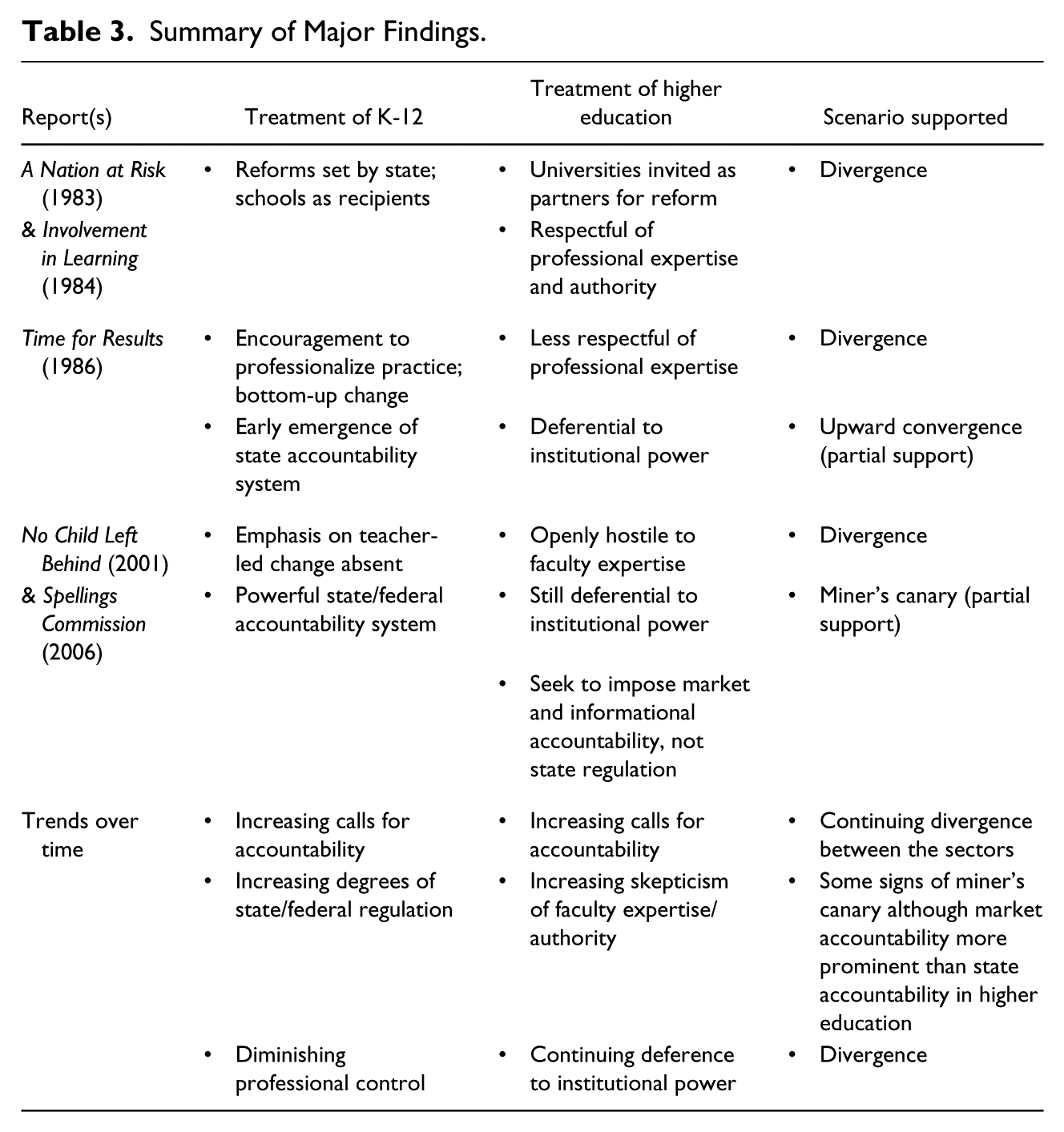
Despite the similarities of these calls for accountability, the reports reveal significant and consistent differences in the treatment of the two sectors. Reform in K-12 has tended to be fairly prescriptive, as teachers in schools are generally on the receiving end of reform policies enacted by the states or the federal government. The goals of professional autonomy were briefly embraced in Time for Results, but even then discretion was granted in return for the ability to produce external results that were satisfactory to the state. No Child Left Behind has further increased external accountability and diminished school-level control, creating unprecedented levels of tight coupling and top-down accountability (Rowan, 2006). In comparison, reform calls in higher education have been much more hands-off; there has been nothing akin to NCLB in higher education. In higher education, reformers have been much more respectful of the need for faculty input, the difficulty of creating assessments that measure learning, and the potential liabilities of state and federal regulation. These differences support the divergence view (Scenario 2) and contradict the convergence view (Scenario 3) listed above, as professional power has been an important factor in how accountability has played out in the two sectors. The divergent paths of the two sectors illuminate the importance of the semiprofessional status of teaching in shaping the K-12 reform movement, as teachers’ inability to claim control of their professional field in the way that professors have has left them vulnerable to increasingly powerful lay accountability movements. In higher education, it is instructive the way in which strong professionalization with respect to research has generated some degree of deference, which has extended to professors’ teaching.
There is some evidence for the miner’s canary view (Scenario 4), as higher education is now beginning to face the calls for informational accountability—quantitative data that would allow for comparisons between schools—that first emerged in K-12 roughly 20 years ago. In the case of primary and secondary schooling, informational accountability served as the proverbial nose under the camel’s tent, opening the way to greater state accountability in the years to follow. Some who have tracked state higher education policy suggest that a similar transformation may be beginning in higher education, particularly as higher education reformers consciously borrow from the K-12 model (Ewell & Jones, 2006). While only time will tell, the analysis here suggests the contrary—that higher education may follow a different path from K-12, as the greater level of professional power, the historical strengths of a diverse and decentralized system, and the greater share in the private sector may suggest to reformers that a strategy of greater transparency and market accountability is preferable to one of direct state regulatory intervention. If higher education reformers follow the Spellings Commission down this road, the result will be growing accountability in both spheres, but with informational accountability married to markets as the tool in higher education, and direct state accountability in K-12 education.
While professionalization has been a defining variable, other differences between the sectors have also played into their differing treatments at the hands of reformers. The degree of urgency for reform has until recently been much stronger in K-12, as higher education has been largely insulated by the perception of American research universities as the strongest in the world, while the call for reform in primary and secondary education has repeatedly been fueled by poor performance on international comparisons. It will be interesting to see whether the increasing realization that other countries are now outpacing the United States with respect to college attainment will lead to greater levels of external reform. Reformers also seem more hesitant to apply one-size-fits-all regulatory solutions to higher education both because higher education has a much larger share of its sector that is private and not subject to direct state regulation and because of the greater levels of institutional diversity among colleges and universities. It would be interesting for future research to compare accountability-oriented reforms in states that have strong private sectors and states that are almost exclusively public.
Overall, these findings suggest that both the functional attributes of a profession and the way it has institutionalized its power affect the way it is treated by external reformers. Even in a climate of growing accountability, we see that the greater professional power of higher education has created greater deference to its authority and expertise, and a much less prescriptive approach to external reform.
At the same time, there is no mistaking that academic and institutional autonomy in higher education is now on weaker footing than it was in the past. There has been a sea change in attitudes toward higher education from Involvement in Learning to the Spellings Commission: While the former fundamentally accepted the legitimacy of the academic enterprise as a standard worth aspiring to, the latter sees these same values as standing in the way of a newly ascendant market or consumerist logic (Gumport, 2000). Given that professional autonomy rests in part on public legitimacy, this erosion of academic legitimacy could portend greater changes in the years to come.
There is also the likely possibility that we will see continued acceleration of the divide between the shrinking share of tenure and tenure track faculty members and the fast growing group of adjunct professors who have few of the rights and privileges traditionally accorded to the former group. This stratification within the professoriate mirrors the stratification among higher education institutions: nearly 70% of faculty at public 4-year universities are full-time, while at community colleges a full two-third are now part-time faculty. 44 Essentially, we have seen increasing corporatization within the university, particularly in community colleges and others where the profession is weaker (Tuchman, 2009). These trends are not only problematic for the adjunct faculty, for the students, and for the institutions in which they reside, but they will likely also affect over time how the less privileged among these institutions are treated by external actors, as their internal deprofessionalization will leave them less able to credibly resist the incursions of these external actors.
The implications of this analysis for both K-12 and higher education are considerable, as it suggests that both fields are currently on trains running in the wrong direction. For K-12 education, it suggests that the root of many of its problems is the form in which the field institutionalized—as a Progressive era bureaucratic hierarchy with teachers at the bottom of an implementation chain, as opposed to a guild profession rooted in shared knowledge and expertise. As expectations for schools have increased, the consequences of this initial choice have become more apparent—in the absence of a shared knowledge base, social closure over who enters teaching, and ongoing standards to guide work—there is not the widespread level of knowledge and skill to achieve high outcomes for all students. What we have seen in recent years is an effort to evade this problem rather than address it: reformers have increased accountability for results, but they have done little to build the kind of profession that would be needed to achieve these outcomes (Mehta, 2013b). If the next century is to be different than the last, those within the field will need to organize themselves as a full-fledged profession, which would lead to better and more consistent outcomes for students, which, in turn, we might hope would create a healthier and more respectful relationship with the state.
For higher education, the initial form was professionalized and the challenge is more the way in which budget pressures and increasing consumerist sentiment have undermined the ideal-type of the university. Universities have also fallen short in important respects, particularly with respect to student learning, retention, and graduation. University administrators would be well-served to try to stay ahead of external regulators by developing their own approaches to increasing measurable student learning, improving graduation rates, and containing costs. They are much more likely to approach these challenges in ways that are commensurate with the deeper values of universities than would external agents seeking to make the same changes from outside (Bok, 2005). Universities also need to continue to make the case for their public value—if they are to be seen as more than simply economic engines subject to market criteria, than they need to make an argument for the singular value of what universities provide (Faust, 2007). With respect to adjunct faculty, universities need to think in a longer term way about when using part-time faculty is a sensible way to meet student needs, and when it is simply a cost-saving measure that undermines quality and the values of a university. In this longer run, if part-time faculty are to be a significant portion of the university teaching force, then they need to be more formally included in the university community and given many of the rights, protections, and ultimately say over governance that traditionally have been the exclusive province of tenured faculty.
To be sure, for both K-12 and higher education, the point is not that stronger professionalization is necessarily better; professions need to be counterbalanced with claims from their constituents and the state speaking for the public interest. But professions are a way of assuring consistent skill and expertise across its members, and they are organized to promote the standards of their fields (Freidson, 2001). If both primary and secondary schools and higher education are to achieve the kind of multifaceted purposes laid out by visionary leaders like Horace Mann, John Dewey, Ted Sizer, and Clark Kerr, they will need to find ways to build and maintain their respective professions and to channel this work toward the public interest.
Finally, in a more scholarly vein, this study has implications for the more general question of imposing accountability on professional fields. This work suggests that research on the politics of regulation in other fields should explicitly consider the strength of the profession as an important lens of analysis, alongside more familiar tools such as rational choice, interest groups, or state-centered theories. In the case of education politics, it is striking that reform has been much less invasive in the sector—higher education—that is comparatively much weaker in political terms than K-12, whose teachers’ unions consistently rank as among the strongest actors in the field. What is puzzling from the perspective of interest group politics is relatively easy to understand from the perspective of the sociology of professions. Professional standing, although largely invisible at a given point in time, can deeply shape both the nature of the reforms that are advocated and the relationship between the profession and other sectors seeking to control the sphere. As professions paradoxically become both more central to our social and political lives and increasingly scrutinized by a skeptical public and its legislative representatives, these conflicts over the professions will only become a more central part of our politics, and it will become ever more important to have tools at our disposal to understand them.
Footnotes
Declaration of Conflicting Interests
The author declared no potential conflicts of interest with respect to the research, authorship, and/or publication of this article.
Funding
The author received no financial support for the research, authorship, and/or publication of this article.