






Abstract
Improving minority academic achievement is a primary goal for education policy makers. Despite resource allocations, gaps in minority accomplishments persist. Emerging research suggests language variety may hinder minority students, thereby slowing academic progress. This article synthesizes suggestions from a panel composed of experts in the field of language dialect education and findings from a literature review of best practices for addressing language variation in educational instruction. Unique findings from the research were presented to the Texas legislature to be used in shaping policy and practice for students who are standard English learners.
Keywords
In Senate Bill (SB) 1, the 81st Texas Legislature modified the Student Success Initiative (SSI) to include Rider 42, section (l), which directs the Commissioner of Education to set aside funds . . . for the 2010-11 biennium to contract with an Education Research Center established under Texas Education Code § 1.005 for the purpose of conducting research to determine best practices in curriculum adjustments, instructional strategies, and professional development for teachers related to second dialects of English speakers.
The Texas Education Agency (TEA) contracted with the Texas Education Research Center (TERC) at the University of Texas at Austin to carry out this research. The study reviewed the professional literature on students who speak dialects of English. The purpose of the review was to identify best practices in curriculum, instruction, and professional development (PD). An expert panel (The Panel) 1 reviewed project reports and assisted the TERC in developing recommendations for serving “second dialects of English speakers,” a group for whom we use the term standard English learners (SELs). This article includes selected portions of the study submitted to the Texas Legislature.
Background and Basis for the Study
Because SELs have not been identified as a unique student subgroup, it is difficult to quantify the impact of being a SEL on academic achievement. Many researchers believe race/ethnicity can be used as a proxy for SEL status (see Craig, Zhang, Hensel, & Quinn, 2009; Labov & Hudley, 2009; National Research Council, 2010; Wheeler & Swords, 2010). While these researchers acknowledge that many diverse factors can influence academic achievement, they also assert that national data document persistent achievement gaps between minority students and their White peers. The impact of speaking a language variety other than standard English is especially apparent in reading and mathematics achievement data.
Long-Standing Achievement Differences
Achievement gaps between minority and White students have been well documented for more than 30 years. The National Center for Education Statistics (2010) develops an annual report called The Nation’s Report Card. Report Cards communicate the findings of the National Assessment of Educational Progress (NAEP), a series of vertically scaled achievement assessments administered to a nationally representative sample of students over time, and present long-term trends in reading and math. Results are separated by age groups (9-, 13-, and 17-year-olds), and differences in scores between racial and ethnic groups are examined. Results show that African American–White and Hispanic–White achievement gaps narrowed at the basic skills level during the 1970s and early 1980s but grew at the advanced skills level during the late 1980s and the 1990s. The overall African American–White and Hispanic–White gaps in NAEP scores have remained large, with the ranges of those gaps falling between 0.5 and 1.0 standard deviation units (Lee, 2002). Changes over time in the African American–White and Hispanic–White achievement gaps are presented in Figures 1 and 2.
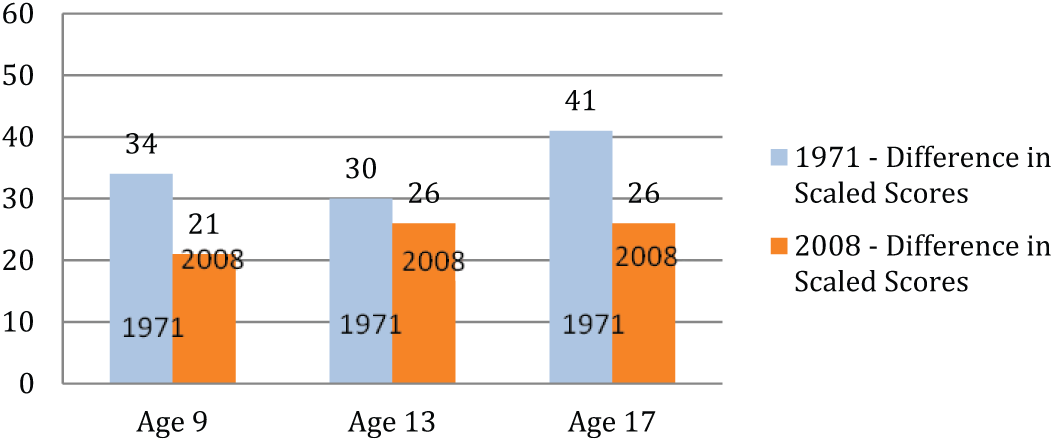
NAEP reading—Gaps in scaled score between African American and White students over time by age group.

NAEP reading—Gaps in scaled score between Hispanic and White students over time by age group.
Language Variety
One long-standing, but poorly understood, explanation for racial/ethnic and socioeconomic status (SES) differences in achievement focuses on differences between dialects used by minority and low SES students and the dialect of English used in schools. The word dialect describes “a variety of a language associated with a regionally or socially defined group of people” (Adger, Wolfram, & Christian, 2007, p. 1). Dialects are natural language phenomena, and all people speak a specific dialect. Indeed, “a person cannot speak a language without speaking a dialect of that language” (Adger et al., 2007, p. 2).
Often, however, the word dialect is used to refer exclusively to stigmatized language varieties (Adger et al., 2007). To avoid negative connotations, we use the term language varieties to refer to the differing linguistic patterns of geographical regions and/or socially defined groups. This term arises from our own discussions, as well as the specific recommendation of The Panel.
Common U.S. Language Varieties and Their Relationship to Instructional Needs
The most commonly researched language variety in American education is that associated with African American communities. Numerous terms have been used to reference this language variety, including “Black English,” “Ebonics,” “African American Vernacular English,” and “African American English” (AAE). We use the term AAE. This use is not meant to reference a singular linguistic variety used by all African Americans in the United States. We use the term fully understanding the dynamic nature of language in different sociocultural settings.
Another less-researched language variety is that associated with Hispanic communities in the United States. This language variety has been described as “Hispanic English,” “Spanglish,” or “Latino English.” We use the term Latino American English (LAE) to reference this language variety. As before, our use of this term is not meant to reference a singular linguistic variety or to imply that all individuals of Hispanic origin speak LAE.
In this study, students who speak a variety of English that differs from standard English are referred to as SELs. These students include speakers of AAE and LAE and may also include speakers of other English varieties. The term parallels the term English language learners (ELLs), which is used to refer to students who speak a primary language other than English. We (and others) make the assumption that SELs, like ELLs, require instruction that meets their linguistics needs. For SELs, such instruction teaches a variety of English, rather than English as a second language (ESL).
Multiple terms are used in the literature to reference the nonstigmatized variety of English that SELs have not yet learned. We found terms that included “mainstream English,” “standard English,” “formal English,” and “mainstream American English.” At the recommendation of The Panel, the term “standard English” is used to refer to the language variety associated with education, government, media, and enterprise. We acknowledge that standard English does not represent a clearly defined, constant entity. Following the lead of Rickford and Wolfram (2009), we assert that standard English is often defined by the absence of stigmatized features. As they explain, “If a person’s speech is free of socially disfavored grammatical constructions and socially stigmatized frequency levels of usage for pronunciation features, then it is considered standard” (Rickford & Wolfram, 2009, p. 7).
We differentiate standard English from the language of schools and classrooms. We use the term academic English to describe the variety of English that is most frequently taught and assessed in schools. Academic English is defined as “the language that is used by teachers and students for the purpose of acquiring new knowledge and skills . . . imparting new information, describing abstract ideas, and developing students’ conceptual understanding” (Chamot & O’Malley, 1994, p. 40). Academic English encompasses language that is both content and structure specific; for example, the academic English needed for math differs from the academic English needed for social studies (O’Neal & Ringler, 2010). Some students (whom we call non-SELs) command standard English at school entrance, but all students must learn academic English. Proficiency in standard English facilitates acquisition of academic English.
Educational Policies Addressing Language Variety
In the King v. Ann Arbor trial of 1979, the Michigan District court ruled that the Ann Arbor school district was failing to provide equal educational opportunity to African American students by not accommodating their unique linguistic heritage. The courts ruled that speakers of English varieties, just like students who did not yet speak English, were entitled to equal educational opportunities through school district accommodations to their language needs. However, while litigation on behalf of students who do not yet speak English ultimately resulted in federal guidelines that mandate specific programs and services for this group, no similar statutes address the education of SELs.
The debate over the education of speakers of AAE gained national attention in the late 1990s following the controversial Oakland Ebonics resolution. In 1996, the Oakland Unified School District passed a resolution stating not only that “Ebonics” was the primary language of African American students in the district but also that it was a wholly separate language, that is, more than just a variety of English. The resolution was well intentioned. It affirmed the right of students to use their first language variety, required educators to be sensitive to their students’ unique linguistic backgrounds, and attempted to allocate federal bilingual funds to an Ebonics program. However, backlash to the resolution was swift and severe. Critics viewed the resolution as an attempt to marginalize AAE by defining it as a non-English language. Baron (2000) summarizes the outcome, “Oakland quickly retracted its declaration of linguistic independence” (p. 5).
Systematic state policies which address the needs of SELs remain limited. New York’s State Education Department has adopted guidelines for that state’s speech-language pathologists and audiologists. These guidelines state that speech pathologists must be proficient “in the language(s)/dialect(s) spoken by the [student]” and have “sufficient knowledge . . . in the general linguistic and sociolinguistic issues” to “assess or treat [students]” (New York State Education Department, 2009). Guidelines for assessment state that clinicians must be aware of the “typical development in an individual’s language(s)/dialect(s), including how to determine and identify typical development based upon the norms of the individual’s speech community or communication environment.” However, these guidelines only pertain to speech pathologists and audiologists, and are only used for students with suspected communication disorders.
In 2008, the California Department of Education (CDOE), led by the California Curriculum Commission and a panel of expert linguists, adopted new criteria for evaluating K-8 reading/language arts/English language arts curriculum materials. In the introduction to the new criteria, the CDOE clearly states that the purpose of these revisions was to promote “a deeper focus on the instructional needs of English learners, students with disabilities, struggling readers, and students who use African American vernacular English [emphasis added]” (CDOE, 2007, p. 288). Throughout its report, the CDOE repeatedly makes mention of students who speak this language variety. They recommend instructional materials that provide “comprehensive guidance for teachers and effective, efficient, and explicit instruction for struggling readers (any student experiencing difficulty learning to read; may include students who use African American vernacular English, English learners, and students with disabilities)” (CDOE, 2007, p. 288) and also recommend additional instructional support “for students who use African American vernacular English” (p. 293). Thus, California has acknowledged the unique linguistic needs of speakers of English varieties other than standard English in a formal and statewide manner; however, only speakers of AAE are included at this time.
In this article, we review the research on language varieties and identify key gaps in the research literature to suggest future research. We provide a summary of the Texas Panel’s recommendations for best practice along with a description of activities that they deemed necessary to implement them. We discuss resulting policy issues that may be of importance to other states or local education agencies (LEAs) as such practices are implemented. The term State Education Agency (SEA), as used in the following sections, can refer to multiple entities. In Texas, for example, the major agency involved in K-12 education is the TEA. However, other state agencies that influence K-12 education include the Texas Legislature, State Board of Education (SBOE), and State Board for Educator Certification (SBEC). The term Local Education Agencies is used to refer to either local school districts or local school campuses.
Method
Data Sources
Literature review
The TERC research team designed a search to identify professional literature investigating best practices in curriculum and instruction for SELs. We also searched for articles that would inform best practices in PD for teachers of this population and searched SEA websites for policies that addressed the SEL population.
To identify relevant literature, we initially searched the educational databases PsychInfo and ERIC through the EBSCOHost database using the broad keyword search: dialect or language variation. We used database filters to limit results to publications reporting an empirical study in a peer-reviewed journal published in English since 2000. This search yielded 175 articles. Consistent with other reviews investigating educational practices with language minority youth (e.g., August & Shanahan, 2006; Slavin & Cheung, 2005), we limited initial inclusion to empirical studies (a) published in peer-reviewed journals, (b) that included participants described as speaking a dialect or variety of English that was not the result of speaking a different first language, and (c) that analyzed novel data (thought pieces and reviews were excluded). As in any literature review, our inclusion criteria shaped the corpus of literature available for analysis and may have excluded some relevant, informative works. For example, the decision to limit inclusion to peer-reviewed, empirical studies may have excluded chapters and position papers that might inform future research and policy agendas. We decided to limit our review in this way because we believed that any action that the state of Texas might choose to take in response to our findings was, over time, likely to become the basis for changes in educational strategies and interventions for SELs. Best practice suggests that educational decisions should be based on reliable experimental data; thus, peer-reviewed, empirical studies provided our most appropriate database.
We identified only 16 articles meeting these strict criteria, necessitating further research. We broadened our inclusion criteria to allow any article that addressed or included school-age participants described as speaking a dialect or variety of English other than standard English that was not the result of speaking a different first language. We then tracked citations from previously qualifying articles to identify articles that would address our three areas of focus: curriculum, instruction, and PD.
We systematically coded each identified article. When all articles were coded, the team met to identify emergent themes and developed an outline. As sections of the literature review were written, team members reviewed them to ensure that all relevant information was included and adequately reflected the literature base.
Expert panel
In the second phase of this research, we convened an expert panel. Given the limited body of empirical literature that addresses the needs of SELs, we believed that best practices could be accurately identified only if we added the expertise of individuals who had knowledge of and direct experience with language variety, especially language variety in schools, to the findings from the literature review.
We identified potential members of The Panel through a review of prominent literature on SELs and in consultation with scholars interested in this population. Senator Royce West (Texas Senate District 23), the sponsor of the legislative rider creating this research project, also provided a list of experts. Including his nominees, we identified 19 potential Panelists, of whom 6 comprised the final Panel.
The Panel was asked to review and critique our literature review and to assist us in developing a description of best practices for SELs. The Panel also developed recommendations regarding implementation of best practices, based on both the information we provided and their expert knowledge of their own disciplines. These activities were carried out during a 2-day face-to-face meeting.
Following the meeting, a summary of Panel decisions and recommendations was sent to each Panelist. They were asked to make comments, suggestions, or changes as they saw fit. Comments were received from all Panelists and were incorporated into final recommendations.
Results
Literature Review Findings
Scope of research
Language varieties have been the topic of a large amount of research, much of which addresses linguistics-related topics. Information is available about the language varieties that exist across the United States, their characteristics, and the characteristics of their use. Research that considers language variety in the context of instruction for students in Grades Prekindergarten through Grade 12 is more limited. Much of this research examines the relationship between the frequency of use of the features of a recognized variety of English and academic achievement within a specific content area. Few empirical studies address either instructional strategies or curricula designed for SELs, and we found no empirical studies that addressed PD for educators who serve these students.
The most important limitation of the literature that we located was the student groups addressed. Nearly all studies focused on students who speak AAE, with only two studies focusing directly on students who speak other language varieties. While our intent was to produce a literature review that encompassed all language varieties, it was not possible to do so.
We were also unable to locate a research base focused on the instruction for SELs that would meet strict evidence standards, such as those outlined by the What Works Clearinghouse (Institute for Education Sciences, 2008). However, we did find several different small intervention studies that documented increases in the number of standard English features SELs used in their writing after instruction (Wheeler & Swords, 2010). A study of one classroom (Wheeler & Swords, 2010) also documents a narrowing of the gap between scores of African American and White students on year-end No Child Left Behind (NCLB)-required testing of the Virginia Standards of Learning.
Language variety and academic achievement
Studies that have directly addressed the relationship between speaking a language variety other than standard English and academic achievement are limited and mainly focus on the literacy skills of students who speak AAE. Results are complex and suggest that the effects of speaking AAE on achievement vary by academic skill (e.g., see Kohler et al., 2007). However, several studies suggest that AAE speakers have reading difficulties that reflect their use of this language variety:
Charity, Scarborough, and Griffin (2004) found that AAE speakers’ early reading achievement significantly correlated with their familiarity with standard English, with students in kindergarten through Grade 2 who were more familiar with standard English achieving higher reading scores.
Craig et al. (2009) reported that for students in Grades 1 through 5, the rate of production of AAE features negatively correlated with scores on standardized tests of reading achievement. They also found that students who were able to shift more effectively between AAE and standard English achieved higher reading scores than their peers who were not able to shift between language varieties. Ability to shift was measured using the difference in the percentage of AAE features present in an oral versus a written narrative task.
We found only one study that directly addressed mathematics achievement (Terry, Hendrick, Evangelou, & Smith, 2010). This study examined the relationship between “density” of AAE use and scores on a standardized test, taking into account language features of each problem, problem difficulty, and overall student ability. While not all language features had an impact on math performance, those that did (possessives and verbals) were associated with lower math scores for students who spoke AAE.
Likewise, we found only one study which addressed the effects of speaking LAE (Labov & Baker, 2010). Using a group of struggling readers, the study examined the probability that a LAE-based reading error would be followed by further reading errors. The same procedure was used for a group of struggling readers who spoke AAE. Different patterns were found for the two groups, with more types of errors being significant in predicting further errors for students who spoke LAE. Labov and Hudley (2009, p. 13) discuss these results as follows: “The consequences for an intervention strategy are clear: Latino readers need more assistance than African American readers, particularly in the case of the past tense suffix.”
Overall, while it is limited, available research does suggest that use of a language variety other than standard English can exert a negative impact on reading and mathematics achievement. Recent research suggests that these achievement patterns may differ by language variety.
Instruction for SELs
Instruction for SELs as described in the literature typically addressed one of two goals. The first was to help students learn standard English; the second was to enhance academic achievement.
Acquisition of standard English
Three major approaches have been used to assist SELs in acquiring standard English: (a) eradication of the features of first language varieties, (b) no intervention (immersion), and (c) contrastive analysis/code-switching instruction (Harris-Wright, 1999; Rickford, 1999). The first two approaches are described as unsuccessful in all studies we reviewed; only contrastive analysis/code switching (discussed below) has been shown to increase SELs’ standard English proficiency.
In Contrastive Analysis, the practitioner contrasts the grammatical structure of one variety with the grammatical structure of another variety (presumably the Standard) in order to add the Standard dialect to the students’ linguistic toolbox. (Wheeler, 2006, p. 17)
Contrastive analysis is often used when teaching ESL; here, it is modified to highlight the contrasts between varieties of English rather than the contrasts between the structures of two languages. Contrastive analysis instruction is typically paired with instruction and practice in code switching, that is, changing a sentence or passage presented in one variety of English to another (MacNeil & Cran, 2005; Wheeler, 2008). The student should learn to identify language varieties (including standard English) and choose among them based on the communicative context. Wheeler and Swords (2010) summarize the “efficacy research” regarding contrastive analysis/code-switching instruction by examining studies conducted at the elementary school, middle school, and college levels. In all cases, SELs used more standard English features in their writing after such instruction than they did after traditional instruction.
Enhanced academic achievement
We found five empirical studies that examined instructional strategies designed to combine use of students’ first language varieties and the teaching of academic content. In each study, the researchers were able to increase students’ achievement.
Culturally relevant pedagogy
Descriptions of the potential affective impacts of instruction in standard English on SELs pervade the professional literature. When instruction does not recognize the importance of the student’s language variety, students may resist making changes in their language use (Baker, 2002; Hill, 2009), may increase their use of their first language variety features in response to correction (Wheeler, 2006), and may ultimately resist the entire schooling process (LeMoine, quoted in MacNeil & Cran, 2005).
The literature clearly states that it is critical that instruction in standard English or the use of students’ own language varieties in academic instruction does not marginalize their language(s) and culture(s). Instruction and its context must recognize the importance of the language varieties used at home and/or in the community in the student’s life (Delpit, 2002). Ideas about how this can be done are often described using the terms culturally relevant or culturally responsive pedagogy. “Culturally relevant pedagogy must provide a way for students to maintain their cultural integrity while succeeding academically” (Ladson-Billings, 1995, p. 476).
Curricula for SELs
Our literature review identified two curriculum packages related to language variety. The first was a bidialectal program to teach reading to speakers of AAE; the second was a program that promotes awareness of language varieties. The latter curriculum is designed for use with all students, including non-SELs.
Bridge, a Cross-cultural Reading Program, uses student texts written in three language varieties: a form of AAE, a transition between AAE and academic English, and academic English. Bridge students showed statistically significant gains in reading compared with a control group that received traditional instruction (Simpkins & Simpkins, 1981). More recently, Rickford and Rickford (1995) conducted three small-scale studies investigating the Bridge curriculum. Older students preferred the bidialectal readers more than younger students did, and boys preferred them more than girls did, but no impact on reading achievement was found.
The second curriculum is designed to improve middle school students’ awareness and understanding of the language varieties found in North Carolina (Voices of North Carolina dialect awareness curriculum, Reaser & Wolfram, 2007). The geographic specificity of the curriculum limits its potential for direct use by other states, but it may serve as a model for other curricula designed to increase awareness of language varieties. A language variety awareness curriculum might be particularly effective as a precursor to instruction that uses contrastive analysis (Wheeler, 2006).
Professional development
We did not find any research or program evaluations in the professional literature that centered specifically on the effects of PD offered to educators who serve SELs. However, we did locate descriptions of PD that accompanied some of the contrastive analysis/code-switching instruction programs that we reviewed, as well as other suggestions in the literature regarding best practices for PD for educators who serve SELs.
Overall, the literature suggests that understanding students’ linguistic and cultural characteristics is important to the teaching of standard English and that this understanding must be fostered as a part of any PD that addresses instructional strategies. Teachers need an understanding of the features of language varieties other than standard English and of how to teach students who use them (Baugh, 2001). Also, there must be a way to assure that pre-and in-service teachers understand their own feelings about students who do not speak standard English. Baugh (2001) believes that the field of education must decide to confront what should be done about those educators who cannot overcome their deficit patterns of thinking about SELs. PD should teach skills and techniques that allow teachers to understand and evaluate how they are instructing the SELs in their current classroom, along with understanding what outcomes they are achieving. Godley, Sweetland, Wheeler, Minnici, and Carpenter (2006) suggest that PD for teachers must address four major topics: (a) teacher resistance, (b) teacher beliefs, (c) issues of language, identity, and power (e.g., teachers should be prepared to think about the linkages between instruction, language, and students’ personal and cultural identities), and (d) practical strategies for addressing language varieties in the classroom.
Expert Panel Recommendations
The Panel endorsed the following as best practices for SELs and for the educators who serve them:
Recognize SELs as a group with unique linguistic and instructional needs;
Assure that teachers are able to accurately assess and effectively respond to the linguistic and instructional needs of this group;
Provide instruction to SELs that enables them to acquire standard English using contrastive analysis and code switching;
Provide instruction to develop all students’ knowledge of language varieties by explicitly addressing various regional language varieties; recognizing their value and addressing the role and importance of learning and using standard English;
Provide instruction to all students that is grounded in student interests and background knowledge;
Provide educators with the information, skills, strategies, and materials needed to offer the instruction described above; and
Provide information to parents, families, and other stakeholders regarding the nature and goals of contrastive analysis, code switching, and language variety instruction.
The Panel also formulated their description of best practice into specific recommendations, along with suggested steps for their implementation, to be presented to the Texas Legislature. These are presented in Table 1.
Five Panel Recommendations for Achieving Best Practices for SELs in Texas.

Note. SEL = standard English learner; LEA = local education agency; TEKS = Texas essential knowledge and skill; SBEC = State Board for Educator Certification; TEA = Texas Education Agency; ELL = English language learner; PD = professional development.
Currently, there are statements regarding academic and linguistics needs of ELL students at all levels (elementary, middle, and high school): Rules §110.11-§110.16, Subchapter A, Chapter 113, Part 2, Title 19, Texas Administrative Code; rules §110.18-§110.20, Subchapter B, Chapter 113, Part 2, Title 19, Texas Administrative Code; and rules §110.31-§110.34, Subchapter C, Chapter 113, Part 2, Title 19, Texas Administrative Code.
Discussion
Review of Findings
Both our literature review and The Panel presented evidence that SELs are a group whose educational needs should be addressed. The language skills with which SELs begin school differ from the language skills of students who begin school speaking standard English. However, while federal law requires that instruction for ELLs be differentiated based on language needs, this is not the case for SELs. SELs may or may not receive instruction that addresses the features of standard English they do not yet command, and the decision regarding whether this instruction is provided is currently made by individual SEAs, LEAs, and/or teachers.
The overall recommendation of The Panel was to increase teacher capacity such that teachers recognize SELs in their classrooms and offer instruction that addresses their needs. The Panel recognized that further information about the SEL population is needed, but also believed that strategies exist that can be used to offer effective, differentiated standard English instruction to SELs (i.e., contrastive analysis/code switching) and to create the atmosphere needed for that instruction to be successful (e.g., offering language variety awareness instruction to all students). Contrastive analysis/code-switching instruction has been used in a limited number of classrooms, and there is some evidence that it has achieved success in developing students’ standard English skills. Similarly, there is some evidence of the success of language variety awareness instruction. Implementing these strategies in larger contexts, however, creates the need for a number of policy decisions and would be greatly enhanced by the development of a larger research base.
Context for Success
As the Panel’s recommendations make clear, careful preparations are needed to implement best practices for SELs. These involve, at a minimum, an assessment of local needs related to language variety and the involvement of a broad array of stakeholders.
Addressing population variability
Throughout this study, we have used the term SELs to refer to a population of students that speak a variety of English that differs from standard English. The singular term SEL should not be interpreted in a way that obscures the diversity of this group, however. Linguists differ on the precise number and distribution of language varieties in the United States, but multiple language varieties clearly exist and are bounded by geography, race/ethnicity, and socio-economic status (Labov, Ash, & Boberg, 2005). A necessary first step in any educational policy to address the needs of SELs is to identify what language varieties are spoken by SELs who will be affected by any proposed policy change.
The number of specific language varieties found may depend upon the geographic specificity of the acting agency. Teachers and schools, for example, may encounter only one or only small numbers of language varieties other than standard English. LEAs and SEAs, however, are more likely to have to address larger numbers of distinct language varieties. This complicates the process, as many of the recommended strategies for instruction and high-quality PD require knowledge of standard English, of the targeted language variety, and of the overlap of the two. Areas with more than one language variety will have to create multiple, distinct PD modules that give teachers and administrators information about the features of all of the specific language varieties that they are likely to encounter.
Once these modules exist, a second, necessary decision is how to target them to the locations that contain large numbers of SELs who speak the language variety that each module addresses. This determination requires the SEA or LEA to understand not only what language varieties are spoken by the students it serves but also the distribution and prevalence of these language varieties within its boundaries. This may require that SEAs/LEAs work with linguists to determine and define the geographic, racial and ethnic, and SES characteristics in their area that influence what language varieties are spoken.
Explaining the policy
SEAs and LEAs that wish to address the educational needs of SELs will also have to consider how the new policy and resulting instructional changes will be explained to all stakeholders in a way that may mitigate potential political backlash. Past attempts to accommodate and/or incorporate language varieties that differ from standard English in schools illustrate the consequences of neglecting this step. The Oakland Ebonics program, for example, caused a national controversy and was quickly reduced to one school, before disappearing entirely. This uproar arose despite strong program support by linguists (Linguistics Society of America, 1997) and an underlying goal to improve proficiency in standard English (Wolfram, 1998). Political leaders, educators, and the general public have demonstrated a general aversion to discussions of language variety and have instead focused on “discussion of the right and wrong way to use the English language” (Wolfram, 2010, p. 131). If this type of outcome is to be potentially avoided, policy makers must carefully consider how the program will be presented to all stakeholders, including teachers, administrators, students, and the general public.
The first group of stakeholders who are likely to be involved in any proposed change is professional educators (teachers and administrators). If professional educators do not understand or accept the proposed changes, it may provoke discontent and could lead to a deficit orientation toward students identified as SELs. One way to increase teacher and administrator acceptance of policy changes to address the educational needs of SELs is “to provide scientifically-based information about linguistic diversity and the social, political, and educational consequences of differential treatment of dialects and their speakers” (Wolfram, 1998, p. 118). Scientifically based instruction can help dispel erroneous assumptions about language variety, linguistic evolution, and right versus wrong language (Rickford, 1999; Wolfram, 1998). This instruction can be included in teacher preparation programs and PD. In Texas, for example, we chose to recommend a change in current teacher and administrator preparation standards on linguistic diversity to include explicit reference to knowledge of and about language varieties. In other states, the process for fostering this knowledge may take different forms.
The Oakland Ebonics example clearly illustrates the need to be thoughtful in the way that policies which address language varieties are explained to the general public. Indeed, we feel that this consideration should be included at every stage in research and policy formation. By being proactive and thoughtful about this aspect, policy makers may successfully counter the historic criticism of language variety accommodation curricula, which accuses proponents of teaching “bad English” (W. Labov, personal communication, November 7, 2010). This long-standing predisposition against marginalized language varieties is multifaceted and persistent. The primary defense against this rejection of language variety accommodation curricula is to emphasize the ultimate goal of policy for SELs: to increase standard English proficiency. This message can be reinforced and spread through various means. Policy, curriculum, and PD titles provide further opportunity to reinforce the goal of increased standard English proficiency. Public awareness of policy goals can be further raised through targeted outreach and information sessions. In Los Angeles, for example, district administrators held multiple parent meetings at each school participating in the Academic English Mastery Program, with the goal of increasing family and community understanding of the rationale for the program (N. LeMoine, personal communication, November 8, 2010). These steps may not overcome resistance among all members of the general population. However, our survey of the literature and the conclusions of The Panel indicate that these steps are essential for the success of any program aimed at addressing the academic needs of SELs.
The understanding and acceptance of students affected by a policy to address the educational needs of SELs should be sought. A first step in this process is to recognize the importance and validity of students’ first language variety. If students feel that their first language variety is under attack, they may resist adopting features of standard English (Baker, 2002; Hill, 2009). To avoid this, teachers of SELs must reinforce the notion that learning standard English is not meant to eradicate features of their first language variety. Instead, instruction in standard English can help students respond in a linguistically appropriate manner across varied contexts.
An instructional program about language variety can also help foster recognition and respect among students (Reaser & Wolfram, 2007). Such a program can help students understand the natural origins of language varieties, as well as the inescapability of speaking a particular language variety. In Texas, we recommended adding language variety study to the eighth-grade social studies standards. For other LEAs or SEAs, the appropriate context for this instruction may differ. Building student knowledge of language varieties, however, is an important step to gain student acceptance of instructional programs to meet the linguistic needs of SELs.
Creating Effective Standard English Programs
Beyond needs assessment and stakeholder involvement, a number of specific policy and implementation decisions related to providing standard English instruction must be made. These will further define what students will be served, how programs will operate, and how outcomes will be measured.
Defining the SEL population
The first and most basic of these decisions is defining which students should be considered to be SELs. Developing such a definition is difficult, as neither existing research nor policies provide a specific description the SEL population. While ELLs are defined and identified by using their level of English proficiency, there is no exact description of what level of standard English proficiency, and/or of which features of standard English, a student must command to be successful in a general education classroom without differentiated standard English instruction. Likewise, there is no specific guidance regarding when the use of features of a language variety other than standard English becomes sufficient to consider the student a SEL. For example, is using one feature enough if the student uses that feature consistently and is never heard to use the standard English form? Is the student a SEL if he or she uses several features of a language variety other than standard English but has also been observed to use the standard English form on occasion? For the present, individual SEA and LEAs will need to develop their own specific descriptions of the language variety features and/or levels of standard English proficiency that define their SEL populations.
Configuring programs
Once the SEL population has been described, an identification process and assessments or other procedures which operationalize this description must be put into place. A key policy decision at this point is whether individual students will be identified as SELs or whether SELs will be identified in groups.
At present, individual student identification is rendered difficult by a lack of assessment instruments that can differentiate SELs from non-SELs. Individual student identification also raises the possibility of SELs becoming a group within larger accountability systems and of engendering some of the same negative impacts that have been associated with other forms of educational labeling, such as isolation of the student group, negative teacher attitudes, or lowered educator expectations. This type of deficit orientation is an inherent risk in any process to identify individual students within specific a specific subgroup. The Panel made specific recommendations to assist in avoiding negative impacts of the SEL label. These included
Encouraging implementation of a language variety awareness curriculum in LEAs,
PD which includes strategies that develop teacher knowledge of language varieties, and
Working with schools to inform parents and other stakeholders about the goals and objectives of instruction and curriculum for SELs.
Despite these difficulties, individual student identification provides the only way in which student progress can be fully tracked and program impact can be accurately evaluated.
Identifying SELs in groups, by using variables such as demographic characteristics of students within schools or classrooms, overcomes the need for finding appropriate individual assessments of either language variety features or standard English proficiency. However, when SELs are identified and served in localized groups, it becomes more difficult to gauge the impact of standard English instruction. While it is likely that many students who receive standard English instruction are, in fact, SELs, group identification does not assure that each student meets the SEL definition. Students who are outside of program schools or classrooms, but still are SELs, may be missed. Finally, simply using an educational label to describe a group rather than an individual may not dissipate any negative connotations it carries, and actions to counter this may still be needed. Overall, policy makers need to understand the following are an interacting set of program-planning concerns: (a) whether SELs will be individually identified, (b) what percentage of the SEL population policy makers believe it is desirable to identify and serve, and (c) how precisely policy makers want the outcomes of standard English instruction to be evaluated.
Whether standard English programs are first implemented at the SEA or LEA level may also be important to the ways in which these programs are configured. If standard English programs come into existence because SELs are formally recognized as a group at the state level, the SEA must be the entity that develops the definition of SEL. It is likely that this definition will need to be added to the state’s education code and that it will need to be interpreted for LEAs. SEA-level implementation not only will assure that large numbers of SELs are recognized and served but also raises questions about whether a formal process for program entry and exit, possibly similar to the process used in bilingual programs, will be needed. Whether a state-level accountability assessment for standard English should be developed and administered and whether its results should be monitored by the SEA are other potential issues. Changes to state curriculum standards might also be necessary.
Either SEAs or LEAs might choose to serve SELs by requiring that standard English instruction be provided in schools that serve students whose demographic characteristics suggest that large numbers of SELs are enrolled. The Los Angeles Unified School District’s Academic English Mastery Program uses this approach to identify the schools in which it is implemented (MacNeil & Cran, 2005). This avoids the need to identify individual students but raises the concern that SELs in other schools will be missed.
Finally, SEAs or LEAs might choose to implement standard English instruction by assuring that all teachers are able to offer it on an as-needed basis. This approach best avoids the need to individually identify SELs (other than a definition that will allow a teacher to decide that instruction is needed) and should assure that all SELs are served. However, it is also the approach that will make it most difficult to determine which students are being served and what outcomes are being achieved. Policy makers will need to carefully weigh the advantages and disadvantages of all possible configurations for implementation of standard English instruction within their individual contexts.
Coordination with ELL programs
Ideally, services for SELs will be complementary to services for ELLs, and these two sets of services will form a coordinated response by a SEA or LEA to language diversity. However, whether curriculum standards for English language proficiency that were developed for ELLs can provide the guidance needed to provide instruction to SELs is not known. If they cannot, it might become necessary to develop a second set of English proficiency standards and supporting materials.
SELs are currently served in general education; ELLs are typically served in bilingual or ESL programs. Whether standard English instruction can be considered a part of bilingual/ESL services will be determined by SEA or LEA service delivery and funding guidelines. If different programs serve SELs and ELLs, coordination of effort becomes more difficult, while choosing to serve both groups in one program may necessitate policy changes.
Measuring and documenting outcomes
Creating effective standard English programs will require efficient and accurate systems for monitoring student progress and for overall program evaluation. Given the small available research base, it will be important to evaluate both intended and unintended program outcomes. As there are not assessments specifically designed for SELs at this time, both progress monitoring and program evaluation will be challenging. These would seem to be areas in which collaboration among SEAs and LEAs should be encouraged; such collaboration has already been carried out to support instruction for ELLs. For example, the World-Class Instructional Design and Assessment (WIDA) Consortium serves 25 states. WIDA provides member states with English language proficiency standards and assessments which are based on them, offers PD, and conducts research. Part of the WIDA Consortium’s mission is to undertake efforts to improve the education of ELLs which would be difficult for a single state to carry out alone.
PD regarding language variety
The PD demands associated with offering effective standard English and language variety awareness instruction could be considerable. Most current teachers and administrators are not familiar with either contrastive analysis/code-switching techniques or language variety awareness instruction; likewise, few curricula exist in these areas, and those that do will need to be modified so that they match the language varieties present in a given state or LEA. In-service teachers and administrators will need to develop the skills needed to offer instruction and the skills needed to support programs by effectively communicating with families and other stakeholders about program goals and methods. Preservice programs will need to develop the capacity to prepare teachers, administrators, and related service personnel to address the needs of SELs.
PD efforts will need to be carefully planned in light of educator characteristics; for example, PD may need to be differentiated by role (teacher or administrator), by grade level (elementary or secondary), and/or by background knowledge (bilingual/ESL certified educators or those who do not hold these certifications). PD must explicitly address the characteristics of regional language varieties, assist teachers in recognizing their value, and address the role and importance of learning and using standard English. Because such PD may involve changing attitudes as well as instructional practice, the educators who conduct it should have skills in developing cross-cultural competence in addition to familiarity with strategies for developing standard English.
PD efforts should also include opportunities for active learning, feedback, and coaching and should be continued over time. These characteristics of PD are important to any change process (Darling-Hammond & McLaughlin, 1995; Garet, Porter, Desimone, Birman, & Yoon, 2001), but given the newness of standard English and language variety instructional strategies and the limited research about them, it would seem particularly critical to provide opportunities for educators to ask questions, discuss issues, and learn from one another’s experiences as they begin to work with SELs.
Resource allocation
Any efforts to offer standard English or language variety instruction must be considered in a context of competing priorities for limited resources. Stakeholders will need to evaluate the costs and benefits of considering and creating these programs.
Future Research
Conducting research about the SEL population requires the development of an efficient and accurate method for identifying SELs. At present, only one individual student assessment for identifying speakers of language varieties other than standard English exists (Seymour, Roeper, & de Villiers, 2003); thus, research that leads to the creation of an identification process and assessments with which it can be carried out is critical. While individual identification procedures might be considered, future research should first address whether identification of individual students is necessary or whether identification of classrooms, schools, or districts, which serve large numbers of SELs might be sufficient to allocate resources to address their needs. Likewise, future research should consider whether direct student assessment is necessary or whether classroom teachers can reliably identify SELs.
A related topic for future research concerns the validity of current assessment practices for SELs. This research is crucial, given the long-standing concerns about testing of students who are culturally and linguistically diverse. One concern that may be particularly applicable to SELs is noted in the Standards for Educational and Psychological Testing, which states that “for all test takers, any test that employs language is, in part, a measure of their language skills” (American Educational Research Association, American Psychological Association, & National Council on Measurement in Education, 1999, p. 91). In considering the assessment of students who use AAE, Hilliard (2002) asserts that constructs such as a basic word list, word difficulty, vocabulary, general information, standardized beginning and ending sounds, and standardized comprehension change radically in light of cultural-linguistic analysis. He further states that this list contains only some of the constructs incorporated in standardized assessments that may need to be reevaluated when SELs who speak AAE are assessed. Finally, he notes that while most standardized assessments favor items that have one, or at most a few, correct answers, responsiveness to language variety demands that a large number of answers all be considered correct. At present, there is great emphasis in Texas and across the nation on student performance on accountability measures, and their results have important consequences for school districts and individual students (Holme, Richards, Jimerson, & Cohen, 2010; Vasquez Heilig & Darling Hammond, 2008). The validity of these assessments for ELL students has long been questioned (for a review, see Solórzano, 2008); their validity for SELs should also be considered. In addition, assessment practices for special education eligibility should be investigated for potential bias toward SELs. The problem of disproportionate minority representation in special education is well documented (Donovan & Cross, 2002). Improved understanding of the role of language varieties in introducing test bias might provide insight into the persistent nature of this disproportionate representation.
Research regarding the similarities and differences between the SEL and ELL student populations is needed. This research should focus on what instructional strategies may be appropriate for both populations, while also elucidating how instruction for the two groups should be differentiated. As SELs are currently served by general educators, while ELLs are served by either bilingual or ESL-certified teachers, it will be important that results of this research be used to assure that both groups of educators are familiar with any instructional strategies that are appropriate for both groups and that they are also familiar with characteristics of best instructional practices that are unique to the group(s) that they serve.
Finally, future research should address the outcomes of using strategies designed for SELs, that is, contrastive analysis and code switching, with English-speaking students who have acquired standard English before school entrance (i.e., non-SELs). We were unable to find any research that addressed either achievement or affective impacts of these strategies for this group. However, Wheeler and Swords (2010) assert Code-switching helps all (emphasis in original) students understand how dialect contributes to character, voice and setting in literature . . . lessons directly affirm national standards that require students to appreciate diverse dialects and cultures. Further, the technique of contrastive analysis embodies critical thinking—skills of observation, description, hypothesis formation and hypothesis testing—skills of analysis and synthesis that enhance the abilities of all students. (p. 256)
It is critical that any future research or program evaluations address whether these outcomes are in fact achieved, so that educators have access to data-based guidance regarding which students should receive contrastive analysis/code-switching instruction.
Conclusion
Clearly, recognizing the SEL population in U.S. schools and developing the capacity of educators to begin addressing its needs is an ambitious undertaking. To do so, many important resource and policy decisions must be thoughtfully made, and an enhanced research base is needed. However, it is important to recognize that there are a number of potential benefits to be gained from these efforts. At a minimum, educators will gain an increased understanding of the students that they serve and a greater ability to assist their students in acquiring standard English. At best, all students will leave school with an understanding of language varieties and with the ability to use standard English effectively when they need and choose to do so.
Footnotes
Authors’ Note
Portions of this article were previously published (February, 2011) in a report prepared for the Texas legislature titled “Recommended Educational Practices for Standard English Learners.” The report is available online at  . The conclusions of this research do not necessarily reflect the opinions or official position of the Texas Education Agency, the Texas Higher Education Coordinating Board, or the State of Texas.
Declaration of Conflicting Interests
The author(s) declared no potential conflicts of interest with respect to the research, authorship, and/or publication of this article.
Funding
The author(s) disclosed receipt of the following financial support for the research, authorship, and/or publication of this article: This research was supported by a grant from the Texas Education Agency.