







Abstract
Reform of school zero tolerance discipline policies is complicated by a lack of systematic evidence on the prevalence and characteristics of such policies. Through document analysis, this study compares explicit zero tolerance laws/policies and mandatory expulsion laws/policies across the domains of federal law, state law, district policy, and media portrayal. Results suggest that explicit zero tolerance laws and policies are rare, appearing in less than one in seven states or districts, whereas mandatory expulsion laws/policies are more common. Districts serving high proportions of minority students as well as districts consisting only of charter schools are more likely to have mandatory expulsion policies for certain offenses. Additionally, district zero tolerance policies apply to a broader set of offenses than state laws. Finally, state and district laws/policies tend to not apply to minor offenses to the degree suggested by media coverage. Implications for policy and practice are discussed.
Introduction
School discipline policy represents an important mechanism by which schools meet their obligation to maintain a safe learning environment for all students (Cornell & Mayer, 2010). During the 2009 school year, over one in three schools utilized suspensions, expulsions, or other removals from the learning environment as a form of disciplinary action (Robers, Zhang, Morgan, & Musu-Gillette, 2015). The use of such exclusionary discipline has been described as adhering to a “zero tolerance” approach to maintaining school safety (Skiba et al., 2006). Despite widespread use, the term “zero tolerance,” however, has been used in a number of ways across different contexts, complicating efforts to measure its prevalence and characteristics.
Exclusion, in the form of suspensions and expulsions, has long been a staple of public school discipline. Seminal court cases such as Goss v. Lopez (1975) have defined processes schools must follow when removing students from school, such as due process prior to exclusion. Likewise, federal law including the Individuals With Disabilities Education Act (IDEA; 2004) impose limits and protections, especially for at-risk groups, when it comes to disciplinary exclusion. Even with such boundaries, however, the use of suspension and expulsion has increased since the 1970s (Losen et al., 2015). Such an increase has taken place despite increased emphasis on students’ rights and decreases in use of other traditional forms of discipline such as corporal punishment (Arum, 2005).
Beginning in the late 1980s and early 1990s, the term “zero tolerance” became a popular description for the fast-spreading approach to discipline which emphasized severe and uncompromising punishment (Richards, 2004). This disciplinary shift relied heavily on the use of exclusionary practices like suspension and expulsion. The term “zero tolerance” was borrowed, in part, from the field of criminal justice which was applying the term to a number of policies aimed at drug and weapon infractions (Skiba & Knesting, 2001). The concept of broken windows policing had been put forth in the early 1980s and had prompted a focus on the policing of minor infractions (Wilson & Kelling, 1982). School discipline policy began to reflect this broader policy environment and societal view toward punishment, as school districts and some states adopted the use of the term “zero tolerance” and policies that favored punitive approaches, particularly exclusion, to behavioral infractions (Skiba & Knesting, 2001).
In 1994, this exclusionary approach to discipline would be further promoted through federal law as the Gun-Free Schools Act (GFSA), which mandated a 1 year expulsion for possession of a firearm on school property (GFSA, 1994). After the passage of the GFSA, states moved to enact similar legislation to maintain federal funding, resulting in state laws that expanded the provision to weapon, drug, and assault offenses (Richards, 2004). By the late 1990s, virtually every state had legislation implementing the federal GFSA (Curran, 2016a; Richards, 2004), and nearly every school district in the country reported having a zero tolerance disciplinary policy for weapons and other serious infractions (Heaviside, Rowand, Williams, & Farris, 1998; Welch & Payne, 2012).
While zero tolerance policies arose from legislation aimed at serious infractions such as weapons, popular media and other stakeholders have applied the term to a broader range of disciplinary actions. Reporters quote teachers who state that “Any behavior that got a student sent to the principal’s office almost automatically resulted in suspension” (Stucki, 2014, para. 2). Others refer to zero tolerance policies as promoting the “school to prison pipeline” through the punishment of “minor infractions” (Kamenetz, 2014, para. 5). Scholars have applied the term to describe school environments with security measures such as security cameras or metal detectors (Skiba, 2000). The American Psychological Association’s (APA) Zero Tolerance Task Force described zero tolerance as a “philosophy or policy that mandates the application of predetermined consequences, most often severe and punitive in nature, that are intended to be applied regardless of the gravity of behavior, mitigating circumstances, or situational context” (American Psychological Association Zero Tolerance Task Force, 2008, p. 1). In one of the broadest descriptions, a recent publication by the Advancement Project, a national civil rights organization, defined zero tolerance as “shorthand for all punitive school discipline policies and practices” (Advancement Project, 2010). These descriptions contrast with the definition of zero tolerance policies provided by the U.S. Department of Education’s Office for Civil Rights (OCR) which states that “a zero tolerance policy is a policy that results in mandatory expulsion (ME) of any student who commits one or more specified offenses (for example, offenses involving guns, or other weapons, or violence, or similar factors, or combinations of these factors)” (OCR, 2014, p. 2).
Such ambiguity in the use of the term “zero tolerance” in legal codifications, school policies, and public discussion potentially complicates measurement of the prevalence and characteristics of such policies. Such a complication was recognized by the APA Task Force on Zero Tolerance when they noted that “the lack of a single definition of zero tolerance makes it difficult to estimate how prevalent such policies may be” (Skiba et al., 2006, p. 2). Given the ongoing policy focus on zero tolerance and ambiguities in its definition, there is a need for research that examines zero tolerance discipline across definitional divides and across policy contexts.
In this article, I explore the distinction between two definitions of zero tolerance, namely explicit zero tolerance (EZT) laws/policies and mandatory expulsion (ME) laws/policies. I focus on the distinction across the domains of legal statutes, district policy, and media portrayal. EZT laws and policies refer explicitly to the term “zero tolerance” regardless of the punishment mandated or the offenses covered. In contrast, ME laws/policies require expulsion for an offense even if not explicitly using the term “zero tolerance.” ME laws/policies align with the OCR definition of zero tolerance (OCR, 2014).
Pressure is mounting for policymakers to reduce the use of exclusionary discipline and to address concerns of racial inequities in school discipline (U.S. Department of Justice & U.S. Department of Education, 2014). Without information about the actual laws and policies in place, reform of school discipline policy is difficult. Consequently, measuring the prevalence and characteristics of zero tolerance discipline in the legal, policy, and public contexts has important implications for policymakers setting school discipline policy and for the students subject to such policy.
The purpose of this study is to explore the legal underpinnings of zero tolerance policies, the school district policies which implement these laws, and the media portrayals of such laws and policies. Furthermore, this study builds on prior research that finds variation in such policies by school racial composition (Payne & Welch, 2010; Welch & Payne, 2010, 2012) by exploring the degree to which these policies vary across school districts by racial makeup of the students served and other district characteristics such as the socioeconomic composition, charter status, and urbanicity of the district. Drawing on an examination of legal statutes, school district policy documents, and media articles, I address the following research questions:
How do federal laws, state laws, and school district policy documents codify zero tolerance school discipline?
How does the popular media portray school zero tolerance discipline?
To what extent do the legal and school district codifications of zero tolerance discipline align with each other and with popular media conceptions of zero tolerance discipline?
Do school district zero tolerance policies vary by district characteristics such as the racial composition, socioeconomic composition, charter status, and urbanicity of the district?
For federal/state laws and district policy, I explore these questions across both EZT policies and ME policies. Addressing these questions will provide a better understanding of the zero tolerance policies governing schools. Increased understanding of zero tolerance laws and policies has the potential to provide information to policymakers and the general public as they discuss and assess the relative merits of such laws and policies.
Theoretical Framework
I draw on the literature on policy implementation to ground the analysis and findings of this study. The last several decades have seen numerous developments in the policy implementation literature. Traditional views include the technical-rational or top-down perspective (Datnow & Park, 2009) which views deviations from the original conception of a policy as failures of implementation (Hogwood & Gunn, 1984). Working from this perspective, Pressman and Wildavsky (1973) contend that if policy implementation must proceed through multiple layers of government then near perfect cooperation between these levels of government is required to prevent implementation deficits. Another traditional implementation framework, the mutual adaptation or bottom-up perspective, views such deviations as acceptable and expected changes to policy by those implementing such policies (Datnow & Park, 2009). From this perspective, researchers have focused on the role of street-level bureaucrats as bottom-up sources of change in policy (Elmore, 1980; Hjern, 1982).
I frame this study in more recent policy implementation literature which melds the top-down and bottom-up perspectives while emphasizing the multilayered nature of policy implementation. The co-construction perspective on policy implementation views policy implementation as a mutual process negotiated between those making policy and those implementing policy that is affected by the contextual structures surrounding policy implementation (Datnow & Park, 2009). A unique component of co-construction is a focus on the embedded nature of organizations within layers of social or political structures. For instance, classroom practice is seen as embedded within school, district, state, and federal contexts (Barr, Dreeben, & Wiratchai, 1983; McLaughlin & Talbert, 1993), and these contexts shape the implementation decisions made by policymakers and street-level bureaucrats implementing policy (Datnow & Park, 2009).
As the federal and state roles in education expand, attention to the context of these higher levels of governance is increasingly important for understanding variation in the implementation of policy (Cohen-Vogel & Mclendon, 2009). Understanding the way policy is enacted across these layers provides a means to untangle the “multilayer problem” inherent in the nested nature of policy implementation (Hill & Hupe, 2003). In a commentary on the role of state and federal actors in education, Berends (2009) explicitly calls for more work in “theories that address the variation in policies at the federal, state and local levels with clear direction about how to operationalize key concepts within empirical data” (p. 851). This work addresses this need for the case of zero tolerance school discipline.
The case of zero tolerance discipline, especially operationalized as ME, can be understood as a case of policy implementation. While a handful of states had ME policies in place in the early 1990s, the passage of the federal GFSA in 1994 prompted widespread action by state governments to adopt ME laws. Those state actions, in turn, prompted districts, some of which had already begun adopting such policies (Skiba & Peterson, 1999), to adopt policies in line with the state and federal legislation.
From the co-construction policy implementation perspective, differences in zero tolerance discipline laws/policies across differing levels of government may be understood as an expected product of the policy implementation process. For instance, state legislators may implement the federal GFSA by expanding the included infractions beyond those included in the federal legislation. Similarly, actors at the school district level make decisions regarding the local implementation of state zero tolerance laws. These decisions may include expansion of the policy to include other offenses or could consist of explicit absence of the policy from district policy documents.
Policy implementation is driven in part by the particular characteristics of the local environment and by the characteristics of the higher level of governance in which the implementer is nested (Berends, 2009; Datnow & Park, 2009; Trujillo, 2013; Walker, 1969). For instance, while the federal GFSA requires expulsion for firearms, a state may implement a policy applying to weapons broadly defined. In turn, a school district might include look-a-like weapons in their policy to ensure compliance with the state policy. Such decisions may vary based on school district characteristics. For instance, districts with different student demographics may be under differential pressure to address discipline while districts consisting of only charter schools may face uniquely different oversight. In short, at each step down the governmental hierarchy, local governments exercise autonomy to modify, expand, or otherwise revise the policy they implement and are influenced to do so by the unique characteristics of their policy environment.
The co-construction policy implementation framework suggests that policies change as they move through differing levels of government. Given such changes in policy across polities, it is reasonable to assume that public perception of policies and use of the related terms will also vary. In particular, the public’s view of a policy may be shaped by the form of the policy in their local context or by the form of the policy in the level of government with which they most regularly interact. Furthermore, the public may also act as street-level bureaucrats in defining their own use of terminology around policy. In the case of zero tolerance, public discourse may utilize the term “zero tolerance” to not only refer to specific laws or policies but also as a useful catch-all for broader disciplinary approaches or as a practical linguistic tool for driving political action around issues of school discipline. Consequently, as a guiding framework for this study, the theoretical perspective of co-construction suggests the potential for differences in the operationalization of zero tolerance discipline at different levels of government and between codified laws/policies and public use of the terms.
Prior Literature
The evidence suggests that zero tolerance policies may do more harm than good, potentially contributing to lower academic achievement, dropout, and the expansion of racial discipline gaps (Balfanz, Byrnes, & Fox, 2015; Curran, 2016a, 2016b; Marchbanks et al., 2015; Shollenberger, 2015). Though noting at the time that there were few studies that directly assessed the assumptions of zero tolerance policies, the APA Task Force on Zero Tolerance compiled available evidence on exclusionary discipline, such as suspensions and expulsions, and concluded that such policies were predictive of negative student outcomes (Skiba et al., 2006). A number of ethnographic studies have demonstrated the ways in which schools with more punitive systems of discipline, including zero tolerance policies, police officers in schools, and surveillance mechanisms, contribute to students’ feelings of distrust of the school environment and increased involvement with the criminal justice system (Fuentes, 2013; Kupchik, 2010; Nolan, 2011; Shedd, 2015). Such work demonstrates the ways in which punitive school environments can create cultures of fear, drive students out of school, and perpetuate the school-to-prison pipeline (Fuentes, 2013; Kupchik, 2010; Nolan, 2011; Shedd, 2015).
Though most evidence falls short of showing a causal relationship between exclusionary discipline and student outcomes, Gregory, Skiba, and Noguera (2010) explicate potential links between racial discipline gaps and racial achievement gaps. More recent evidence that directly examines zero tolerance policies has found that they contribute to racial discipline gaps (Curran, 2016a; Hoffman, 2014). While the body of evidence on exclusionary discipline is quite developed (Skiba, Shure, & Williams, 2011) and that explicitly focused on zero tolerance is emerging (Curran, 2016a; Hoffman, 2014; Winton, 2012), little research has explored the prevalence and nature of these policies across different levels of government and in popular perception.
Accurate figures on the prevalence of zero tolerance discipline policies are hard to obtain. As noted by the APA Zero Tolerance Task Force, definitional ambiguity hinders estimates of zero tolerance prevalence (Skiba et al., 2006). At the state level, the Education Commission of the States (ECS) documents school safety related laws (ECS, 2015), and the U.S. Department of Education has recently compiled laws on a state by state basis (U.S. Department of Education, 2015). While rich resources, these compilations tend to consist of searchable listings of state laws and, in general, lack systematic coding of the nature of these laws or their relationship to other characteristics of schools. Outside of these compilations, a small body of research has systematically explored state legislation related to expulsions (e.g., Kennedy-Lewis, 2014; Skiba, Eaton, & Sotoo, 2004). For instance, Kennedy-Lewis (2014) found that state exclusionary discipline laws tend toward a “discourse of safety,” viewing students as deserving of punishments in the case of behavioral infractions, though some states do include provisions, such as continuing education for expelled students. In more detailed work, Skiba and colleagues (2004) assessed the characteristics of state suspension and discipline laws as of 2004 by examining state statutes from all states. Using definitions similar to those used in this article, they found that, at the time, 80% of states had a law mandating expulsion for firearms, 32% had such a law for other weapons, and 10% had such a law for possession of drugs (Skiba et al., 2004). At the time, only 8% of states explicitly mentioned zero tolerance in their statutes (Skiba et al., 2004). While providing some insight into the state-level prevalence, this work is now over a decade old. Furthermore, little of this prior work has examined policies at the district level.
At lower levels of school governance, much of the available evidence is also dated or limited to a single definition of zero tolerance. For instance, using data from the Principal/School Disciplinarian Survey on School Violence, Heaviside and colleagues reported that in 1996, the vast majority of schools (79% to 94%) had zero tolerance policies for serious offenses such as violence, drugs, or weapons (Heaviside et al., 1998). The study defined “zero tolerance” as a policy “mandating predetermined consequences for various student offenses” without specifying what those consequences were (Heaviside et al., 1998). Such evidence did not explore the nuances of such policies and is now two decades old. In several other studies, resaerchers have examined the use of zero tolerance policies at the school-level finding, like Heaviside, that in the late 1990s zero tolerance policies were common for weapon and drug offenses and were more prevalent in schools serving higher proportions of Black students (Payne & Welch, 2010, Welch & Payne, 2012). Such estimates, however, are now nearly two decades old. Furthermore, prior work on school or district prevalence of zero tolerance policies has generally been limited to examination of differences by racial composition, leaving differences across other characteristics (e.g., urbanicity, charter status, socioeconomic composition) unexamined. In short, evidence on the prevalence and characteristics of these policies at both the state and district level are dated or underexplored.
The present study fills this void and makes unique contributions by providing national-level estimates of the prevalence and characteristics of zero tolerance policies from more recent data, across multiple definitions of zero tolerance, across multiple levels of governance, and across multiple school district contexts. In addition, this study also examines popular media portrayals of zero tolerance.
Data
Constructs
The term “zero tolerance” has many different meanings across the academic literature and popular media (i.e., Advancement Project, 2010; Heaviside et al., 1998; Kamenetz, 2014; OCR, 2014; Skiba, 2000; Stucki, 2014). For the purpose of this study, I focus on two operationalizations of the concept. The first focuses on laws/policies explicitly called “zero tolerance” (EZT). The second includes laws/policies that mandate expulsion (ME), aligning with the OCR definition of “zero tolerance.” EZT laws/policies are those whose language utilizes the term “zero tolerance.” Consequently, EZT includes some laws/policies that require expulsion, some that require suspension, some that utilize less severe forms of discipline, and others that do not specify the disciplinary response. For instance, a district whose policy document states that the district “has zero tolerance for drugs” would be counted as EZT even if the policy document did not provide any further elaboration on the meaning of this statement.
In contrast, ME laws/policies are those that require expulsion for a given offense. ME laws/policies may be included in a state or district’s EZT policy if the law/policy includes the term “zero tolerance”; however, ME laws/policies can also stand alone. Even when not explicitly using the term, ME laws/policies are considered zero tolerance discipline insofar as they align with the U.S. Department of Education’s OCR’s definition of zero tolerance (OCR, 2014).
The choice to focus on EZT policies and ME policies as the operational definitions of zero tolerance in this study was made for several reasons. First, those policies that explicitly utilize the term “zero tolerance” are inextricably linked to the term. ME policies, while not necessarily using the term, adhere to the definition of zero tolerance utilized by the U.S. Department of Education’s OCR (OCR, 2014). The importance of a federal definition is seen both in its ability to influence the use of the term by policymakers and practitioners as well as its link to national data collection. Specifically, the OCR compiles the most extensive data on the use of school discipline. Consequently, understanding the laws, policies, and popular use of this definition is critical for contextualizing such data. It is recognized, however, that these two definitions are not exhaustive of all uses of the term “zero tolerance.”
Given these definitions, EZT and ME are not mutually exclusive. States and districts can, and do, have both EZT and ME statutes and policies. In some cases, these laws/policies are one in the same, with laws/policies that both utilize the term “zero tolerance” and mandate expulsion. In other cases, the EZT law/policy and the ME law/policy may be separate laws/policies within the same state or district.
Data Sources
Federal and state statutes
I utilized data from several sources to address the research questions. First, data for the analysis of federal and state zero tolerance laws came from a search of the Westlaw Legal Database. I searched the Westlaw Legal Database for current laws (as of 2013) that utilized the term “zero tolerance,” “expulsion,” or “expel” and then, through a reading of specific laws, identified laws that applied to the school setting. Current laws included all statutes in place during 2013, those passed that year and laws passed in previous years still in place.
District policy documents
To address the second research question, specifically how school districts codify zero tolerance policies and how these policies vary by school district, I utilized data from the National Center for Education Statistics’ Common Core of Data (CCD). I drew a stratified random sample of 300 school districts. Based on recommendations from the literature, this sample size was chosen with a goal of achieving subgroup cell sizes of at least 30 districts to maintain reasonable statistical power (VanVoorhis & Morgan, 2007). To ensure an adequate number of larger school districts, I stratified the sample by district urbanicity (urban, suburban, town, and rural). All results presented are weighted to account for the stratification in the sampling.
After pulling the random sample (n = 300) of school districts, I removed school districts that no longer existed (due to consolidation or the closing of a charter school district, n = 9), and I removed sampled districts that did not directly oversee schools (such as regional education service agencies, n = 17). I refer to the districts that remained (n = 274) as the full sample. I then conducted an online search for student handbooks, codes of conduct, or district policy manuals for each of the districts in the full sample. These district policy documents serve as the source of information on school discipline policy for each district. In the majority of cases, the documents were readily available on school websites. For those districts that did not have such documents available via their website, I contacted school district personnel and requested a copy of the student handbook, code of conduct, or district policy manual. The final analytic sample consisted of 219 policy documents, corresponding to 80% of the districts in the full sample. Of the documents collected, 84% were student handbooks or codes of conduct within handbooks while the remaining 16% came from school board policy manuals.
Table 1 provides means for characteristics of the school districts sampled, those for which policy documents were located, and those for which policy documents were not acquired. The sample for which policy documents were found differed significantly on a number of measures from those districts for which the policy documents were unavailable. As shown, districts for which policy documents were acquired tended to be larger in size (3,654 students to 1,121 students) and served fewer students eligible for free and reduced-price lunch (46% to 61%). Additionally, districts for which policy documents were found were significantly less likely to be charter-school-only districts (10% to 41%). Many of the districts missing policy documents were charter school “districts” consisting of a single charter school.
School District Characteristics by Analytic Sample Status.
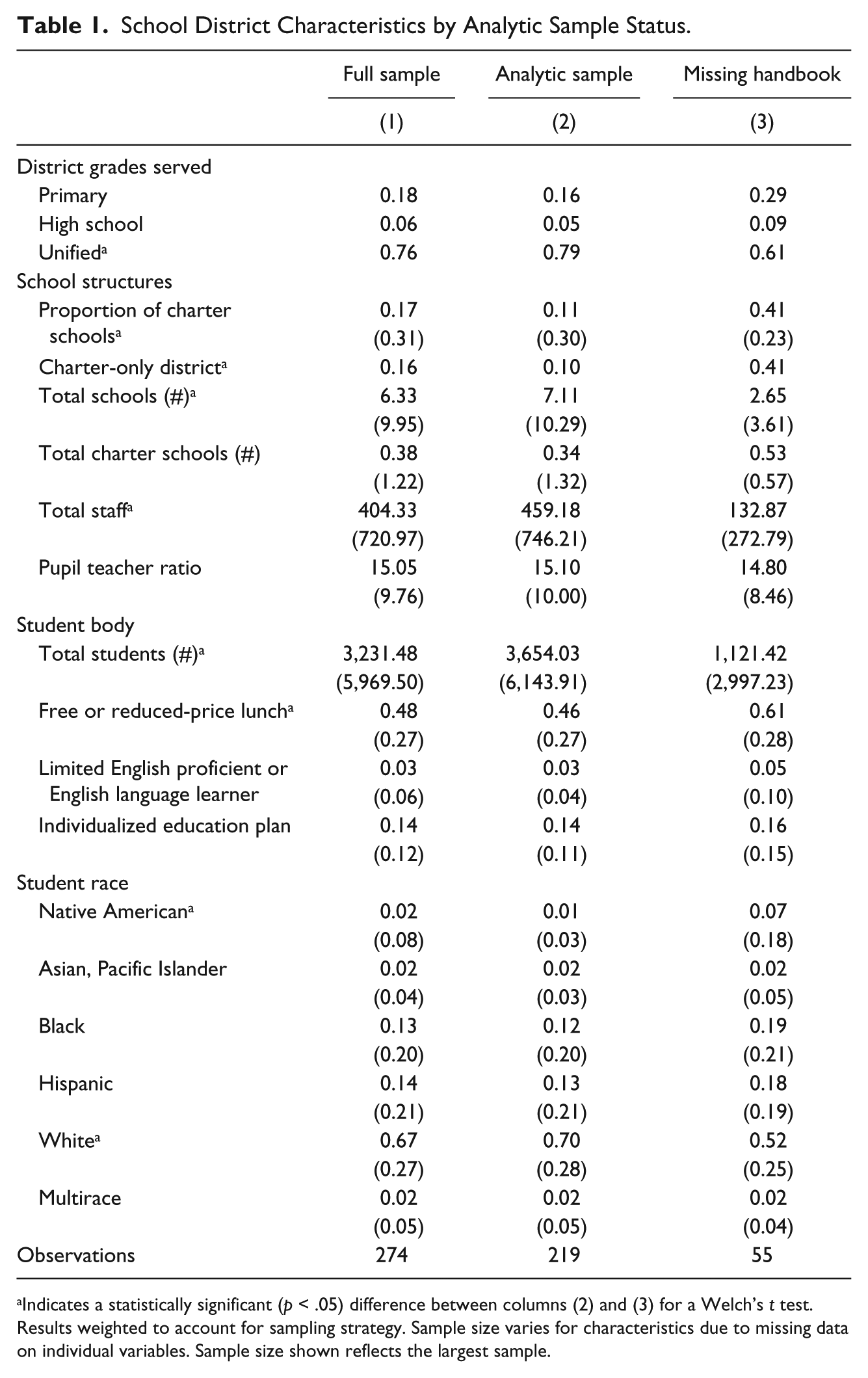
Indicates a statistically significant (p < .05) difference between columns (2) and (3) for a Welch’s t test. Results weighted to account for sampling strategy. Sample size varies for characteristics due to missing data on individual variables. Sample size shown reflects the largest sample.
Media portrayals
The third source of data consisted of popular media articles that reference school zero tolerance policies. I explored popular media portrayals as a measure of public use of the term “zero tolerance.” I selected the USA Today and New York Times newspapers as national news outlets and identified articles from these papers that referenced “school” and “zero tolerance” for the period of 1990 through 2014, representing the period prior to the federal GFSA to present. For the USA Today, the sample represented all newspaper articles referencing these terms. Given a larger number of articles referencing these terms in the New York Times, I randomly sampled 20% of the articles from the New York Times. I further limited the samples to articles about the K-12 education sector and that were topically related to school discipline. The final sample included 163 media articles.
Method
I coded federal and state EZT and ME laws as well as school district policies for whether they applied to weapons, whether they applied to drug offenses or assaults, whether they included toy or facsimile weapons, whether they included minor offenses (defiance, profanity, possession of a cell phone, etc.), and whether they had specific language allowing case-by-case discretion for school administrators to modify the punishment. The media articles referencing school zero tolerance were coded in a similar fashion.
Coding followed standard practices of discourse analysis of documents (Paltridge, 2012). In particular, I began with a series of terms related to the constructs of interest, particularly EZT and ME as well as the characteristics of these policies. The original terms of interest included terms such as “zero tolerance,” “will be expelled,” “requires expulsion,” and so forth. I read each document in its entirety identifying sections that adhered to the preliminary list of terms while also identifying additional terms that met the construct of interest. I compiled lists of relevant terms and added to these lists as new terms emerged from the analysis of the documents. For instance, for ME, the term “automatic expulsion” was found in several policy documents and subsequently added to the list of terms that adhered to the construct of ME. The use of such systematic and iterative coding (Corbin & Strauss, 2014) helped ensure the constructs of interest were properly identified. Appendix Table A1 provides the codebook of terms compiled throughout the analysis along with example excerpts of the terms in context.
In general, much of the coding of the constructs of interest was relatively unambiguous. For example, EZT policies were discipline policies that explicitly utilized the term “zero tolerance.” Likewise, ME policies utilized language that indicated that expulsion was required. Consequently, language such as “shall be,” “must be,” “is required to be,” “mandatory,” clearly accompanied such policies. This contrasted with non-ME policies which included terms like “may be,” “can be,” “up to expulsion,” and so forth.
Once coded, analysis of the documents consisted of descriptive statistical approaches. I created cross-tabulations of state laws and district policy documents for the presence of EZT and ME laws/policies. These cross-tabulations provide insight into the degree to which such policies coexist across state law and district policy. I then conducted mean comparisons across the characteristics of ME and EZT within laws, district policy documents, and popular media. Welch’s t tests were utilized to test the statistical significance of differences across characteristics of the policies and across the different domains examined. Such descriptive statistics allow for an examination of the degree to which EZT and ME vary across the legal, policy, and popular media contexts. Finally, given empirical evidence that disciplinary outcomes vary across school districts serving different populations of students (Payne & Welch, 2010; Raffaele Mendez, Knoff, & Ferron, 2002; Wallace, Goodkind, Wallace, & Bachman, 2008; Welch & Payne, 2010, 2012; Wu, Pink, Crain, & Moles, 1982) and theoretical support for the importance of context (Datnow & Park, 2009), I conducted subgroup analyses in which means were compared by urbanicity, racial composition of the school district, charter status, and percentage of students eligible for free or reduced-price lunch.
Results
Several important findings emerged from the analysis. First, at both the state and district level, there are far fewer EZT policies than ME policies. Second, lower levels of governance tend to apply EZT and ME policies to a broader range of offenses than higher levels of governance. Third, the use of ME policies varies systematically across certain district characteristics such that noncharter-only districts and districts serving higher proportions of minority students tend to utilize ME policies for a wider range of offenses. Finally, the results indicate that ME policies, and EZT policies to a lesser extent, tend to rarely apply to minor offenses despite being commonly framed as such in the media. In this section, I report, in detail, the results that support each of these key findings.
Federal Laws
No federal laws pertaining to schools were found that utilized the term “zero tolerance”; however, one ME law, namely the federal GFSA of 1994, does exist. As previously detailed, the GFSA requires expulsion for 1 year for the possession of a firearm at school. While this was the only federal law found that mandated expulsion, other aspects of federal law do have bearing on school discipline. For instance, provisions of No Child Left Behind required that schools have a policy of contacting the criminal or juvenile justice system when a student brings a firearm or weapon to school (No Child Left Behind, 2001). Additionally, federal statutes provide further requirements on discipline of students with disabilities in accordance with the IDEA (previously known as the Education for All Handicapped Children Act). The language of the GFSA makes particular mention that its provisions must be “construed in a manner consistent with” IDEA (GFSA, 1994).
State Laws
In contrast to federal laws, state laws include both EZT and ME laws. The top panel of Table 2 shows a cross-tabulation of states with EZT and ME laws. As shown, virtually every state has an ME law; however, not every state with an EZT law has an ME law. The majority of states (86%) do not refer to their school discipline laws as zero tolerance. The seven states that do (listed in Appendix Table B1) vary in the content of their policies. The laws are not solely focused on weapons. The majority of EZT laws (four of seven) do not mandate expulsion, though three do, making these three also ME laws. Interestingly, the laws that do not mandate expulsion tend not to predefine other consequences, instead leaving the decision of consequence up to local school districts. While nearly all (six of seven) of states with an EZT law include weapons within the law, only one state limits the law explicitly to weapons. Other common infractions to which the term “zero tolerance” is applied include drug offenses and physical assaults. Interestingly, the states utilizing EZT laws are somewhat geographically diverse including states from the Southeast, Northwest, and Midwest along with Hawaii.
Cross-Tabulation of State EZT and ME Laws.
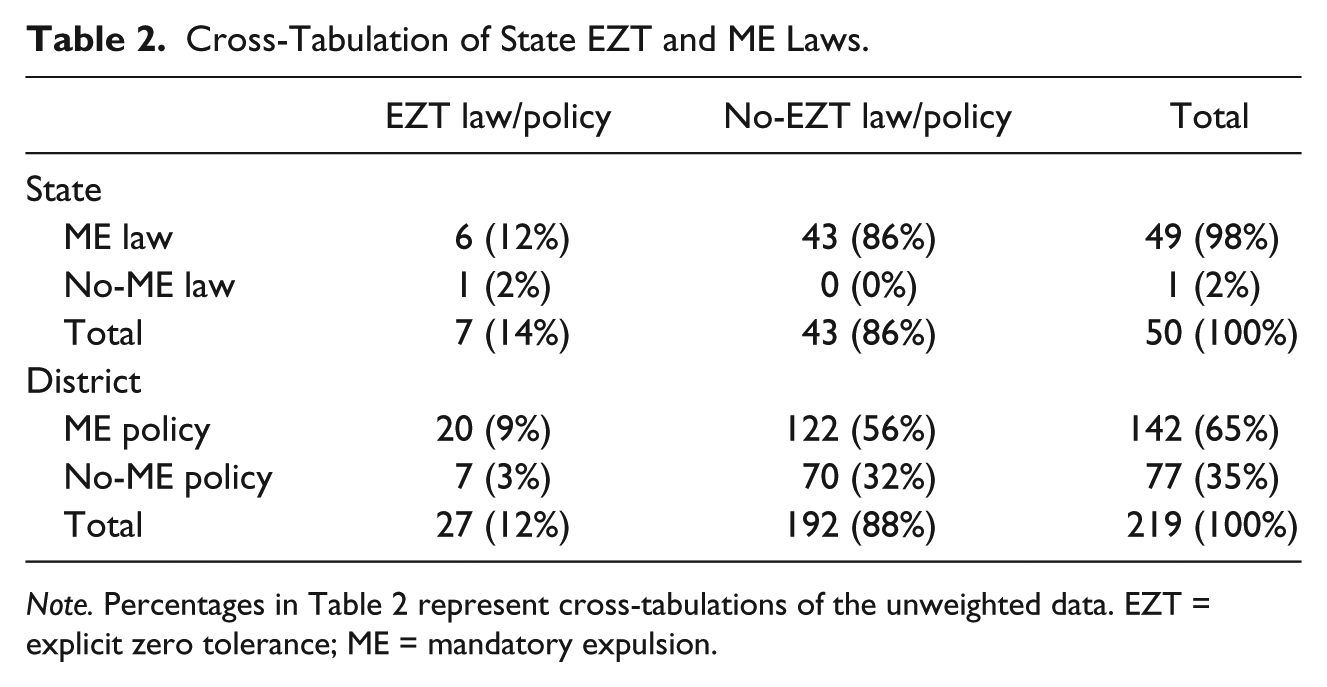
Note. Percentages in Table 2 represent cross-tabulations of the unweighted data. EZT = explicit zero tolerance; ME = mandatory expulsion.
Despite the rarity of EZT laws, nearly every state has a law that adheres to the OCR definition of zero tolerance. Specifically, I find that virtually all states (98%) have a law that mandates expulsion for some offense. The one exception is the state of Massachusetts whose law reads that possession of a weapon or controlled substance “may” result in expulsion. Though other documents from the MA department of education suggest that the intent of the GFSA is adhered to in the state, the use of such language in the state statute itself falls short of being categorized as mandatory. Another state with some ambiguity in its language is Hawaii which, while requiring removal from school for a year for a firearm offense, uses the term “exclude” rather than “expel.”
Table 3 displays consolidated results of coding of the federal law, state laws, district policies, and media portrayals. The first row shows the presence of either the EZT law/policy or the ME law/policy for the full sample. The remainder of the table displays characteristics of these laws/policies conditional on the presence of the law or policy. As shown in Table 3, all states with ME include weapons/firearm offenses under their ME law and the majority of states with such laws (71%) only apply mandated expulsion to such offenses. Outside of weapon/firearm offenses, assault (20%) and drug (18%) offenses make up the largest categories of offenses to which mandated expulsion is applied. For instance, California statutes stipulate that expulsion shall be brought forward by the superintendent or school board for “possessing, selling, or otherwise furnishing a firearm,” “brandishing a knife at another person,” “unlawfully selling a controlled substance,” “committing or attempting to commit a sexual assault,” or “possession of an explosive” (CA § 48915). Notably, very few states apply ME to look-a-like weapons or minor offenses, such as disrespect or profanity. For instance, California law explicitly notes that “possessing an imitation firearm . . . is not an offense for which suspension or expulsion is mandatory” (CA § 48915). Maine is the only state that utilizes mandatory language around minor offenses stating that a “school board shall expel any student who is deliberately disobedient or deliberately disorderly”; however, this requirement is caveated in language stating that expulsion applies only “if found necessary for the peace and usefulness of the school” (ME §1001).
State Law, District Policy, and Media Portrayal of EZT and ME.
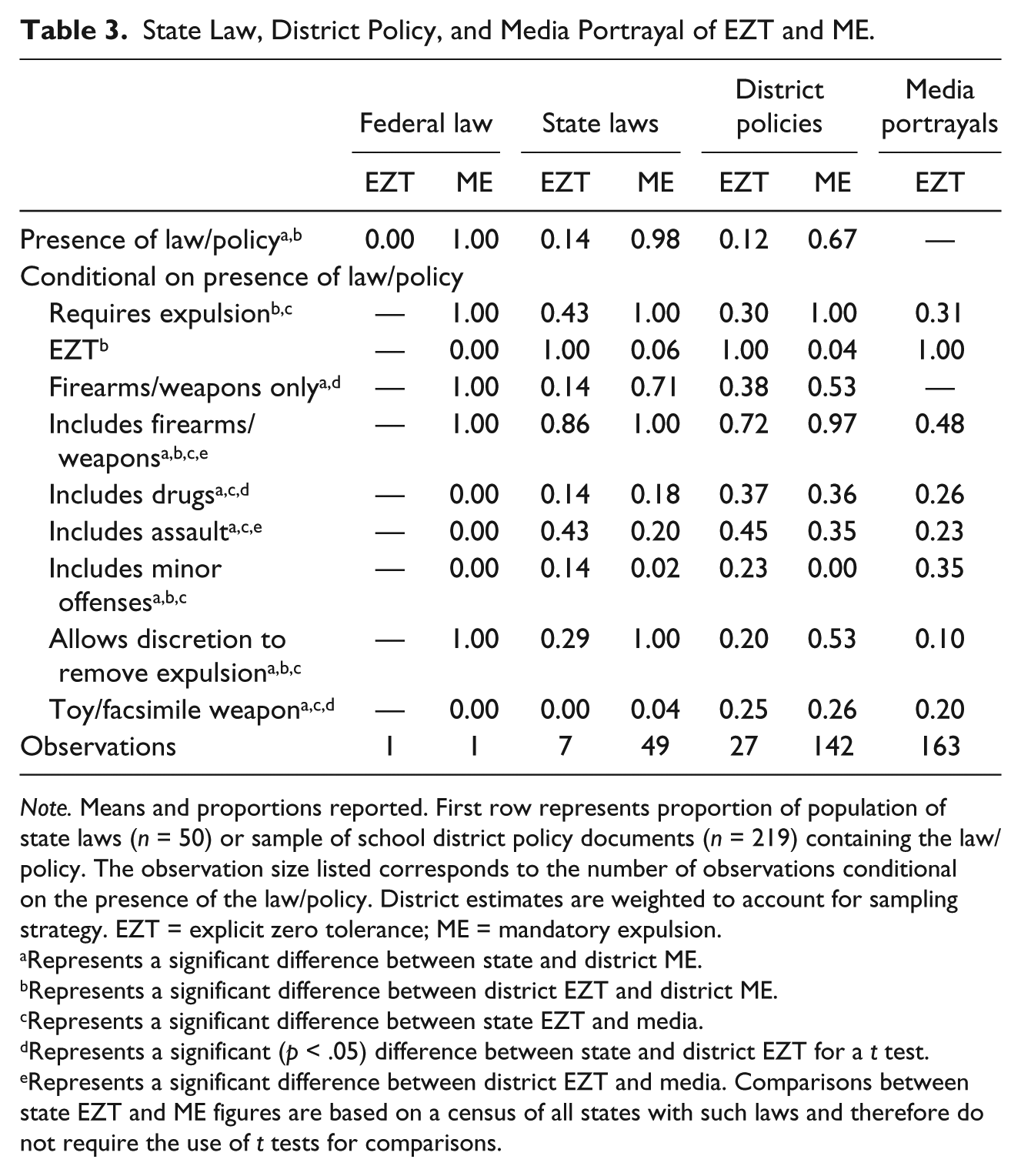
Note. Means and proportions reported. First row represents proportion of population of state laws (n = 50) or sample of school district policy documents (n = 219) containing the law/policy. The observation size listed corresponds to the number of observations conditional on the presence of the law/policy. District estimates are weighted to account for sampling strategy. EZT = explicit zero tolerance; ME = mandatory expulsion.
Represents a significant difference between state and district ME.
Represents a significant difference between district EZT and district ME.
Represents a significant difference between state EZT and media.
Represents a significant (p < .05) difference between state and district EZT for a t test.
Represents a significant difference between district EZT and media. Comparisons between state EZT and ME figures are based on a census of all states with such laws and therefore do not require the use of t tests for comparisons.
An additional feature of state ME laws that is worth noting is the degree to which such laws actually include some flexibility around the mandatory nature of the disciplinary response. The federal GFSA states that “State law shall allow the chief administering officer of a local educational agency to modify such expulsion requirement for a student on a case-by-case basis if such modification is in writing” (GFSA, 1994). In short, while the language of the law still requires expulsion, this provision allows a superintendent or other district leader to modify the punishment in response to circumstances of a particular case. As shown in Table 3, all of the state ME laws include a similar provision allowing some exceptions to the mandatory nature of these state laws.
District Policy Documents
The bottom panel of Table 2 provides a cross-tabulation of districts with EZT and ME policies. As shown, nearly two thirds of districts have an ME policy. Like state laws, very few districts (12%) explicitly utilize the term “zero tolerance” in their policy documents. As shown in Table 3, I find that among district EZT policies, over two thirds of policies do not require expulsion and approximately one quarter apply to minor offenses (defiance, language, possession of a cell phone, etc.). Of policies not directly requiring expulsion, many require suspension though some do not specify specific punishments. In over one third (38%) of districts with EZT policies, the EZT policy applied only to weapons/firearms. Like with state law, district EZT policies are more likely to include minor offenses and less likely to include a provision for administrator discretion than ME laws/policies.
Despite a low proportion of EZT policies, I find that the majority of districts (67%) have an ME policy, though this percentage is significantly smaller than would be expected given that 98% of states have an ME law. As with state laws, I find that district ME policies predominantly apply to weapons/firearms offenses (97%) and that approximately one third of district ME policies also include drugs and assaults. While no districts have such policies for minor offenses, approximately one in four district ME policies apply to toys or look-a-like weapons.
Comparing state and district laws/policies reveals that districts, in general, are more likely to include offenses such as assaults, drugs, or minor offenses under their EZT or ME policies despite being less likely to have an EZT or ME policy on the books as compared to state law. Both state law and district policy represent significant expansions over federal law which does not include an EZT law and only includes an ME law for firearms.
Media Articles
I find that the popular media’s references to school zero tolerance discipline have tended to have a large focus on minor offenses. As shown in Table 3, more than one in three media articles referencing school zero tolerance discipline referred to minor offenses in the article. In recent years, the proportion referring to minor offenses reached nearly three out of four articles. Despite the focus on minor offenses, many of the articles couple the discussion of minor offenses with references to more severe offenses such as weapons, assaults, or drugs. While being more likely to focus on minor offenses, media articles’ descriptions of zero tolerance discipline tend to align closer to those of EZT than ME.
District Policy Subgroup Analysis
Table 4 shows results of district ME policies broken out by characteristics of the district. I explore differences in the presence of mandated expulsion policies for the top and bottom quartiles of districts by proportion of students eligible for free and reduced price lunch (columns 2-3) and minority students (columns 4-5). I also explore differences across charter-only districts and traditional districts (columns 6-7) as well as by urbanicity (columns 8-11). Results of Welch’s t tests for the significance of differences between these comparisons are shown.
District Mandated Expulsion Policies by Subgroup.
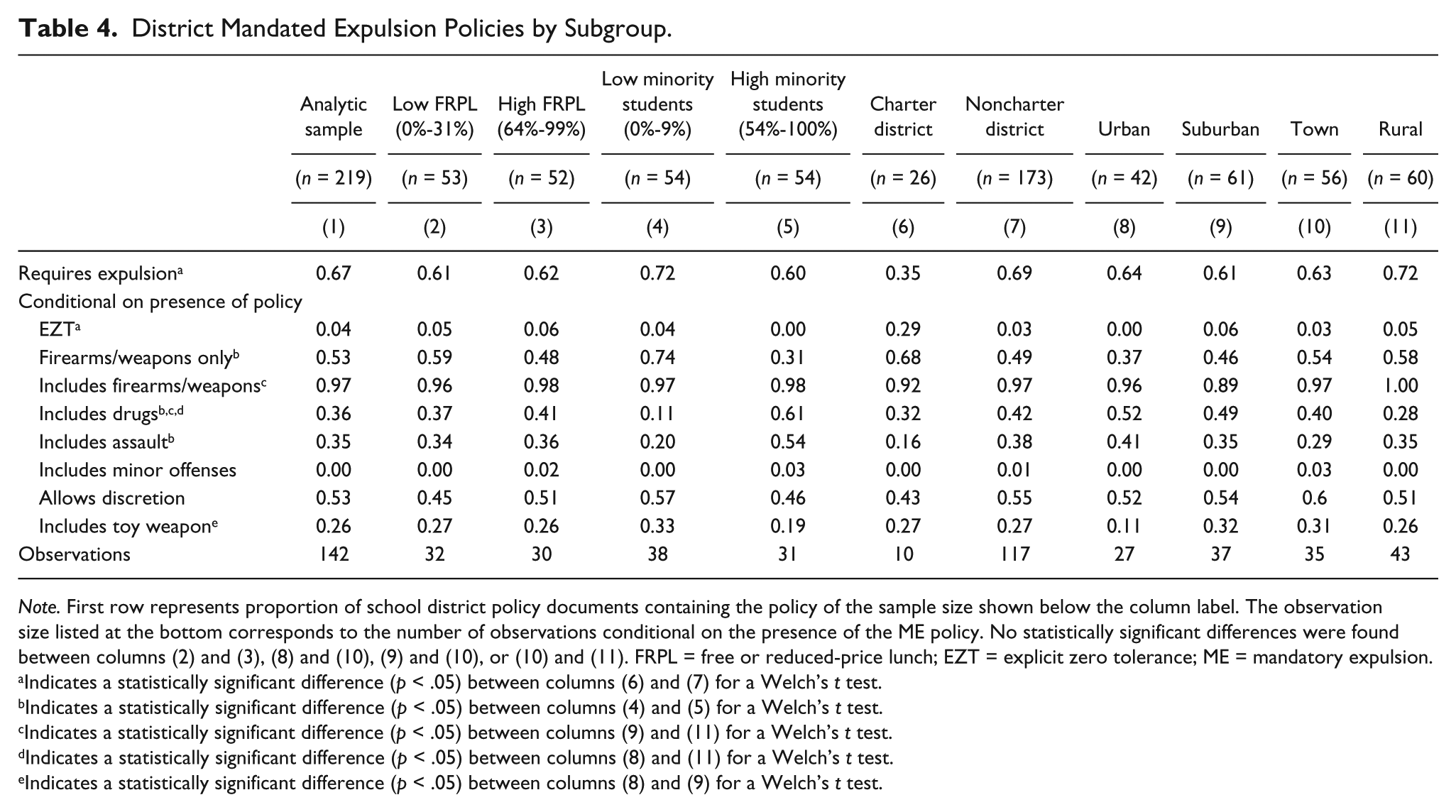
Note. First row represents proportion of school district policy documents containing the policy of the sample size shown below the column label. The observation size listed at the bottom corresponds to the number of observations conditional on the presence of the ME policy. No statistically significant differences were found between columns (2) and (3), (8) and (10), (9) and (10), or (10) and (11). FRPL = free or reduced-price lunch; EZT = explicit zero tolerance; ME = mandatory expulsion.
Indicates a statistically significant difference (p < .05) between columns (6) and (7) for a Welch’s t test.
Indicates a statistically significant difference (p < .05) between columns (4) and (5) for a Welch’s t test.
Indicates a statistically significant difference (p < .05) between columns (9) and (11) for a Welch’s t test.
Indicates a statistically significant difference (p < .05) between columns (8) and (11) for a Welch’s t test.
Indicates a statistically significant difference (p < .05) between columns (8) and (9) for a Welch’s t test.
I find no significant differences across districts serving different proportions of students eligible for free or reduced-price lunch, but I find that districts serving a large proportion of minority students are more likely to have mandated expulsion policies for nonweapon offenses such as drugs or assaults. Furthermore, the magnitude of these differences is quite large. For instance, in districts in the top quartile of minority student enrollment, namely those with enrollments of minority students ranging from 54% to 100% of the district, 61% of district ME policies included drug offenses and nearly as many included assaults (54%). In contrast, in districts in the bottom quartile of minority student enrollment, namely those with less than 10% minority enrollment, only one in 10 ME policies included drug offenses and only 20% included assaults. This stark contrast is tempered a bit by the fact that districts serving lower percentages of minority students were more likely (though not statistically so) to include an ME policy in their documents at all as compared with districts serving higher percentages of minority students (72% to 60%). Nevertheless, even after adjusting for this overall difference, students in districts serving high proportions of minorities are nevertheless more likely to be subject to ME for drug or assault offenses.
In addition to differences by district racial composition, I find that charter-only districts are significantly less likely to have a mandated expulsion policy in their policy documents. In particular, charter-only districts were about half as likely as noncharter districts to have an ME policy in their policy documents. Charter-only districts were more likely to refer to their ME policies with the term “zero tolerance” than noncharter-only districts. Interestingly, however, ME policies in charter-only districts were actually less likely to require expulsion for drug or assault offenses, though, due likely to small subgroup sample size, the difference did not rise to traditional levels of statistical significance. Finally, urban and suburban districts were more likely to have ME policies for drugs as compared with rural districts.
Discussion
This study demonstrates significant differences in the prevalence and characteristics of both EZT policies and ME policies across levels of governance, school characteristics, and media portrayals. In this section, I put the findings of this study in the context of the prior literature and discuss some of the broader implications for policy and practice.
I find a wide gap between the use of EZT policies and ME policies for both state laws and school district policy documents. In particular, few states (14%) and few school districts (12%) have EZT laws or policies while the majority of states (98%) and districts (67%) do have ME laws/policies. This suggests that, while states and districts may require zero tolerance types of discipline, they do not routinely label these laws or policies as zero tolerance. Furthermore, EZT and ME do not always represent the same disciplinary policy. Fewer than half of the state laws and district policies that are labeled zero tolerance mandate expulsion, though many of these states and districts have other policies that require expulsion.
With regard to ME laws/policies, I find that there is a relatively sizable gap between state law and stated district policy. In particular, nearly every state (98%) has a law that mandates expulsion for at least one behavioral offense. At a minimum, such laws tend to apply to firearms and/or weapon offenses. While such laws theoretically require school districts in the state to abide by the law and adopt a similar policy, only 67% of districts have an ME policy explicitly in their policy documents. Of those that do; however, districts appear to expand the application of these policies to a wider range of behavioral offenses. The finding that lower levels of governance tend to expand the list of offenses to which such policies apply is consistent with school level data from the mid-90s which found that nearly 80% of schools reported zero tolerance policies for offenses such as drugs, violence, as well as lesser offenses such as tobacco and alcohol despite the fact that, at the time, states had only just begun adopting ME policies under the GFSA and were, in general, focusing on weapons offenses (Curran, 2016a; Heaviside et al., 1998; Welch & Payne, 2012).
Furthermore, these findings are consistent with the theoretical framework of co-construction in policy implementation. In particular, the more frequent omission of written ME policies on the district level is consistent with a top-down view of policy implementation failure (Hogwood & Gunn, 1984). Under this perspective, the absence of ME policies in district policy documents represents a breakdown in the implementation of state law. In contrast, the tendency of the written policies to include a larger set of behavioral offenses is consistent with a bottom-up implementation perspective in which local actors expand upon or amend policies to suit their contexts (Elmore, 1980; Hjern, 1982). Furthermore, the expanded set of behavioral infractions may be consistent with efforts by lower levels of government to ensure compliance with higher level policies or with efforts to exert autonomy and control over the local policies adopted (Conlisk et al., 1995).
Though the presence of ME policies varies across levels of governance, the lack of an ME policy in a school district policy document does not necessarily mean that the district does not enforce such a policy or follow state law. Presumably, there are a number of state laws that districts comply with that are not explicitly stated in their policy documents but are followed in practice. It does suggest, though, that some students may be subject to disciplinary procedures codified in state law that are not clearly communicated in district materials. Consequently, implementation failure or modification of ME laws/policies may have direct implications for students.
Turning to differences across different district contexts, previous research has shown that minority students experience exclusionary discipline at higher rates than nonminority students (Rafaelle Mendez, 2003; Rocque, 2010; Rocque & Paternoster, 2011; Skiba, Michael, Nardo, & Peterson, 2002; Stevens et al., 2015). Work by Curran (2016a) and Hoffman (2014) suggests that zero tolerance policies may be a contributor to these racial gaps in the use of exclusionary discipline.
While the number of districts with EZT policies in the district policy document sample is too small to consider differences in EZT policies across district racial makeup, the results provide mixed evidence with regard to ME policies. In particular, I find that districts serving a large proportion of minority students are more likely to have ME policies for assault and drug offenses. This finding, which aligns with findings from data from the late 90s, suggests that variation in the use of ME policies across districts may contribute to racial discipline gaps (Welch & Payne, 2012).
This finding contributes to a body of research on the relationship between school district characteristics and disparities in discipline (Eitle & Eitle, 2004; Raffaele Mendez et al., 2002; Rausch & Skiba, 2004; Thornton & Trent, 1988; Wu et al., 1982). Specifically, the higher use of ME policies for assaults and drugs in districts serving a large proportion of minority students may contribute to higher rates of exclusionary discipline in these contexts (Raffaele Mendez et al., 2002; Wallace et al., 2008; Wu et al., 1982). This finding is consistent with prior literature on racial threat that has similarly found that schools serving a larger percentage of Black students are more likely to use punitive disciplinary measures and have zero tolerance policies (Payne & Welch, 2010; Welch & Payne, 2010, 2012). Similarly, across schools within the same district, research from Chicago demonstrates that schools serving larger proportions of Black students have higher suspension rates (Sartain et al., 2015).
Much of the discussion of zero tolerance school discipline has focused on severe punishment for relatively minor offenses. I find that, while the popular media emphasizes the application of zero tolerance discipline to minor offenses, minor offenses are a relatively rare inclusion across the laws and policies. While 23% of district EZT policies include minor offenses, EZT state laws and state and district ME laws/policies tend to include very little emphasis on minor offenses. Instead, these laws/policies focus on severe behavioral infractions such as weapons, drugs, or assault. Additionally, many of these laws/policies that align with the federal GFSA provide case-by-case autonomy for school districts to amend sanctions in particular cases. This result suggests that the cases of zero tolerance discipline that initiate severe responses for minor offenses, such as removal for bringing a butter knife to school, may best be addressed through alterations of districts’ EZT policies as well as a focus on the availability of case-by-case considerations. In other words, the anecdotal cases which garner considerable media attention for their overuse of severe discipline for minor infractions may be reflective of bottom-up policy initiated by individual street-level bureaucrats rather than written policy initiated by state or district actors (Lipsky, 1979; Matland, 1995).
The differences in the use of the term “zero tolerance” in the media and the language of ME and zero tolerance state laws and district policies also points to the multifaceted nature of the term. In some cases, such as the Department of Education’s OCR data collection, the term “zero tolerance” has a clearly defined meaning that refers to ME. In other contexts, however, the term’s use is less specific. Furthermore, for others, the term “zero tolerance” is used for a number of broader purposes. For instance, some have used the term as a catch-all for any punitive disciplinary practice, for the use of security tools such as metal detectors or cameras, or for policies that involve the use of law enforcement (Advancement Project, 2010; Skiba & Knesting, 2001). Furthermore, in other contexts, the term may be a useful tool for promoting political action against excessive use or systematic discrimination in the use of school discipline. Given such uses, it is not surprising that the media’s use of the term reflects a broader range of purposes than that captured in state law or district policy.
Policy Implications
The results of this study point to several policy implications. First, as policymakers and educators consider reforms of school discipline policy, it is important that each of the stakeholders have an understanding of the scope and content of these policies. By providing estimates for all states and from a national sample of school districts, the results of this study inform such an understanding of the national landscape of school discipline law and policy.
Next, the results of this study point to particular levels of governance and types of policies where policy discussions may be most suitable. The results of this study point to the importance of focusing on ME policies, even if they do not explicitly utilize the term “zero tolerance.” Additionally, that policies at the district level tend to apply to a wider range of offenses than those at higher levels of governance suggests that reform focused on changing policy at lower levels of governance may be of more importance than reform at higher levels of governance, or, at least, that reforms at higher levels should be designed to influence changes at lower levels. Likewise, the finding that EZT policies tend to apply to a wider range of offenses than ME policies suggests that EZT policies may also be an area of importance for conversation around disciplinary policy reform, despite the fact that such policies are rarer than ME policies.
In addition, the results point to the need for a focus on the way in which policies vary across district contexts. That schools serving higher proportions of minority students are more likely to have ME policies applying to drug offenses or assaults suggests that students of color may be disproportionately impacted by such policies. As such, higher levels of governance should work to encourage equitable distributions of disciplinary policies across districts.
Finally, states and districts may further consider the ground level implementation of EZT and ME policies. As shown in the findings, few of the examined laws applied to minor offenses, despite popular portrayal to the contrary. As suggested by ethnographic work in this area, much of the application of exclusionary discipline to minor offenses may be driven by discretion on the part of school personnel rather than mandates in school policy (Fuentes, 2013; Kupchik, 2010; Nolan, 2011; Shedd, 2015). Relatedly, almost all of the ME laws/policies and a good proportion of the EZT laws/policies contained provisions allowing for case-by-case discretion on the part of district officials. Such exceptions to the “mandatory” or “zero tolerance” nature of these laws and policies are an often overlooked component of the formal policy. States and school districts may look for ways to work with district personnel to further educate them on the situations that warrant and processes to pursue such exceptions to the mandatory nature of these laws/policies.
Limitations
While this study contributes to our understanding of zero tolerance discipline, limitations exist in the available data, the approach to data analysis, and, consequently, the conclusions that can be drawn. First, this study explored only EZT and ME. While ME captures the OCR definition of zero tolerance, the term “zero tolerance” may also be applied to approaches to discipline that do not require expulsion. While out of the scope of this study, the exploration of mandatory suspension laws/policies and other mandated forms of discipline, such as in-school suspension or detention, would be useful for further understanding zero tolerance type approaches to discipline. In particular, such policies that require lower forms of discipline than expulsion may be more likely to be applied to lesser offenses. Understanding such policies would allow for a better assessment of the claim that zero tolerance policies result in severe discipline of students for minor offenses.
A second limitation is that this study can only address codified/written laws/policies and only those that appear in federal/state laws and school district policy documents. Discretion by street-level bureaucrats such as teachers and principals suggests that the actual policies enacted in practice may differ from those codified in law or policy (Lipsky, 1979). Indeed, ethnographic work has demonstrated the importance of these individuals and the ways in which their actions can alter the implementation of discipline policies set at higher levels of governance (Fuentes, 2013; Kupchik, 2010; Nolan, 2011; Shedd, 2015). For instance, Nolan (2011) documents how individual teachers exercise discretion in allowing police intervention in misbehavior. Similarly, Shedd (2015) demonstrates the importance of school context when documenting how a punitive, surveillance-based culture permeates both the schooling and neighborhood environments of many disadvantaged and racial minority youth. Other recent work demonstrates gaps in discipline by gender and the importance of considering the intersection of gender and race when examining discipline (e.g., Crenshaw, Ocen, & Nanda, 2015; Morris, 2016). Such gender disparities are likely driven by within-school implementation of policy, as districts do not tend to vary in their gender composition to the extent that they do in their racial composition. The design of this study, while providing important evidence on codified laws/policies, cannot speak to these aspects of policy implementation. In short, there is an important story around ground-level implementation (in schools and classrooms) that falls out of the purview of this study, but is nevertheless an important area of inquiry. Future research that examines the alignment between codified state/district policy and educator practice will be important for understanding the degree to which the laws and policies in place relate to practice at the school and classroom level.
Finally, the available data and approaches to analysis limit the degree to which certain conclusions can be generalized. Given nonresponse by some school districts to requests for policy documents, the results of the district policy document analysis may not generalize to the population of school districts nationwide. For instance, charter-school-only districts were significantly less likely to appear in the sample. Despite these limitations, this work advances our understanding of zero tolerance school discipline and suggests directions for future research.
Conclusion
Zero tolerance school discipline policies, especially those implicitly defined, have become a ubiquitous feature of the conversation about school discipline policies over the last several decades. These policies, which mandate explicit and often severe responses for a set of misbehaviors, have garnered attention from policymakers and the public in recent years prompting many to call for their repeal (U.S. Department of Justice & U.S. Department of Education, 2014). In particular, examples of these policies being applied in excessive or unreasonable manners coupled with suggestions that these policies may contribute to racial disparities in discipline (Hoffman, 2014; Kamenetz, 2014; Stucki, 2014) have intensified the debate regarding their continued use. Their role in promoting safety versus creating negative environments that may actually be less safe continues to be discussed (Lindle, 2008). Despite the prominent position of zero tolerance discipline in conversations around school discipline, much of the empirical research on the prevalence and characteristics of these policies is either dated or limited in scope (e.g., Kennedy-Lewis, 2014; Skiba et al., 2004; Welch & Payne, 2012).
In this study, I have provided estimates from a census of federal and state laws, a national sample of school district policy documents, and a sample of media portrayals from two national news outlets. The results indicate that ME laws/policies are more common than EZT laws/policies and that lower levels of governance tend to apply EZT and ME policies to a broader range of offenses than higher levels of governance. Furthermore, students in districts serving a higher proportion of minority students appear to be more likely to be subject to ME policies for offenses such as assault or drugs. Finally, despite being fairly common in media portrayal, the results indicate that ME policies, and EZT policies to a lesser extent, tend to rarely apply to minor offenses.
Striking the balance between maintaining order and safety in schools with minimally disruptive school discipline policies remains a challenge for schools. The results of this study suggest possible directions for policy and practice; however, no single reform or policy will resolve all issues in this domain. Likewise, not every given policy will necessarily be appropriate for all school settings. This study has provided a multitiered and nuanced view of a portion of the laws and policies that influence school discipline on the ground level. In doing so, it expands on past research in the area to provide an updated and more comprehensive view of zero tolerance school discipline. As laws and policies continue to change, further work in this area will be necessary.
Supplemental Material
Supplementary_Appendices – Supplemental material for The Law, Policy, and Portrayal of Zero Tolerance School Discipline: Examining Prevalence and Characteristics Across Levels of Governance and School Districts
Supplemental material, Supplementary_Appendices for The Law, Policy, and Portrayal of Zero Tolerance School Discipline: Examining Prevalence and Characteristics Across Levels of Governance and School Districts by F. Chris Curran in Educational Policy
Footnotes
Acknowledgements
I thank Professors Mimi Engel, Dale Ballou, Jason Grissom, and Amy Claessens for invaluable feedback on earlier drafts of this manuscript.
Author’s Note
Opinions reflect those of the author and do not necessarily reflect those of the granting agencies.
Declaration of Conflicting Interests
The author(s) declared no potential conflicts of interest with respect to the research, authorship, and/or publication of this article.
Funding
The author(s) disclosed receipt of the following financial support for the research, authorship, and/or publication of this article: This research was supported by a grant from the American Educational Research Association which receives funds for its “AERA Grants Program” from the National Science Foundation under Grant #DRL-0941014.
Supplemental Material
Supplemental Material is available for this article online.

References
Supplementary Material
Please find the following supplemental material available below.
For Open Access articles published under a Creative Commons License, all supplemental material carries the same license as the article it is associated with.
For non-Open Access articles published, all supplemental material carries a non-exclusive license, and permission requests for re-use of supplemental material or any part of supplemental material shall be sent directly to the copyright owner as specified in the copyright notice associated with the article.
