







Abstract
Teacher collaboration in communities is a popular instructional improvement policy. However, not all teachers are equally integrated into communities. So, they may not have the same opportunities to learn. This exploratory study of 215 urban public school teachers indicates community integration and peer learning are associated with teachers’ social status—namely, the perceived ranking of their own and their colleagues’ expertise. High status teachers are more frequently sought out, low status teachers less so. Teachers who perceive their own status more favorably than how their colleagues perceive it associate more with members of other communities. These same teachers report practices that are more similar to their peers. If this results from misperceptions of their own and their colleagues’ expertise, then status inconsistency may not only limit access to instructionl epertise but also mask the need for expertise.
Introduction
Teacher collaboration in communities is a popular instructional improvement policy with as many as 66% of teachers nationally reporting their participation in collegial work groups (Banilower et al., 2013). When teacher collaboration involves certain activities, there is some evidence that collaboration changes teachers’ instructional practice and increases student performance (Ronfeldt, Farmer, McQueen, & Grissom, 2015). Furthermore, the relationships undergirding collaborative work have been associated with professional culture, instructional experimentation, and innovation (Bryk, Camburn, & Louis, 1999; Coburn & Russell, 2008; Vescio, Ross, & Adams, 2008). Still, teachers’ collaborative work does not necessarily always have positive payoffs. In the current work, we examine whether the payoffs relate to teachers’ social standing in their collegial communities.
Specifically, we draw on research from sociology, social psychology, and organizational behavior to argue that teachers’ integration into communities and their ability to learn from one another is associated with their social status. Status is an attribution of social position or ranking, which determines an individual’s honor, esteem, or worth in a group based on characteristics that are socially determined, culturally valued, and context dependent (Ridgeway & Erickson, 2000). Whereas previous research has established that teacher ties and community outcomes are associated with a number of important organization-, community-, and individual-level factors, existing research too often is agnostic about the “dilemmas, tensions, and challenges involved in building community” (Achinstein, 2002, p. 6). This includes a host of subtle but still substantive interpretations, attributions, judgments, and perceptions members have of one another. Such perceptions determine who has access to resources and opportunities, who information is shared with, who is more attended and listened to, and who is seen as making more legitimate contributions to the group (Bacharach, Bamberger, & Mundell, 1993; Berger, Cohen, & Zelditch, 1972; Jasso, 2001; J. C. Moore, 1968; Ridgeway, 1987).
In other words, teachers’ perceptions of their own and their colleagues’ social status may influence how teachers build community and determine who ultimately has access to community resources or social capital (e.g., Dika & Singh, 2002). To the extent that the positive payoffs of collaborative communities depends on teachers’ learning from their peers, then the payoffs will vary with teachers’ access to peers and opportunities to learn. Some teachers will have greater payoffs and some fewer. Indeed, some teachers ultimately may need additional supports in the exact areas collaborative communities are designed to address. Thus, we ask three research questions:
Teacher Communities and Social Capital
The earliest studies of teachers’ work described it as being characterized by a culture of privatized practice in which teachers rarely interacted with each other or shared their instructional practices (Lortie, 1975). In the late 1970s and 1980s, a new paradigm of education research arose, casting the teacher as “knower and thinker” who would develop practice-based theories of education not by reading scientific articles, but through dialogue and inquiry with fellow teachers (Cochran-Smith & Lytle, 1999). Over time, the nature of teaching and teacher professional development have evolved to incorporate many new forms of teacher interaction and collaboration, such as mentoring and coaching (Knight, 2004; Kohler, Crilley, Shearer, & Good, 1997; Neufeld & Roper, 2003), active professional learning communities (Louis, Marks, & Kruse, 1996; Newmann & Wehlage, 1995), and peer observations and critique (Dunne, Nave, & Lewis, 2000; Sato, Wei, & Darling-Hammond, 2008; Vandevoort, Beardsley, & Berliner, 2004).
Decades after Lortie’s seminal publication, there is now widespread evidence that teacher interaction and collaboration has positive effects on teachers’ work experiences, student outcomes, and overall school improvement. For example, early research by Bryk and colleagues (1999) demonstrated that teacher professional community, characterized in part by collaboration and sharing norms, was associated with a climate of innovation and continual learning among teachers. Research by Coburn (2001) has demonstrated that teachers’ interactions in professional communities help them make sense of instructional reforms and so shape implementation. More recent research suggests that teachers’ collegial interactions and collaboration increase their job satisfaction (Reeves, Pun, & Chung, 2017).
Teachers’ community interactions do not only matter for teacher understandings and experiences but also for student outcomes. Large-scale investigations by the National Center for Educational Achievement (2009) and the Consortium on Chicago School Research (Bryk, Sebring, Allensworth, Luppescu, & Easton, 2010), seeking to understand the factors driving significant student test score improvements, identified the importance of teachers’ active involvement in instructional decision making, a trusting and collaborative learning-focused culture, formal structures for regular communication and support, and openness to safe and constructive observation, evaluation, and advice. Leanna and Pil (2006) have demonstrated that teachers’ information sharing, shared vision, and trust, are associated with instructional quality, which in turn, affects math achievement. Similarly, Ronfeldt and colleages (2015) find that when teachers are involved in collaboration that focuses on instruction and students, this is associated with student achievement. Even in the absence of explicit collaboration, the presence of teachers with greater expertise can have so-called “spillover” effects resulting from teachers becoming influened by the instructional practices of more expert peers (Sun, Loeb, & Grissom, 2017).
The above effects of teacher interactions and relationships in communities can be understood broadly as resulting from social capital, meaning the potential and actual set of cognitive, social, and material resources made available to individuals, groups, or organizations through their direct and indirect relationships with others (Bourdieu, 1986; Coleman, 1988; Lin, 2001). More specifically, social capital refers to the information, expertise, trust, norms, obligations, and support teachers exchange in their relationships, which, in turn, can translate into material resources, such as instructional supplies. Yet, even with demonstrated links between teacher social capital, instruction, and student achievement, these effects can vary based on factors at multiple levels of analysis (Hord, 1997; Kruse, Louis, & Bryk, 1995).
At the organization level of analysis, norms, structures, and routines influence teachers’ relationships with colleagues as do factors such as leaders’ attitudes, the overall school culture, and the physical layout of the school building (Coburn, Choi, & Mata, 2010; Coburn & Russell, 2008; Hellner, 2008; Kruse et al., 1995; Levine & Marcus, 2010; Reagans, 2010; Spillane, Shirrell, & Sweet, 2017). Factors at the individual level influence teachers’ relationships by affecting how they form and maintain ties with colleagues. This includes not only factors such as teachers’ position in the organization and years of experience but also teachers’ personal demographics, such as race, gender, and age (Reagans, 2010; Spillane et al., 2012; Sun, Penuel, Frank, Gallagher, & Youngs, 2013).
Situated between individual- and organization-level factors that affect social capital are community-level factors. One example is shared community values, such as a sense of collective responsibility or commitment to deprivatized practice (Bryk et al., 1999; Kruse et al., 1995). Community factors also include network features such as size and cohesion, meaning the extent to which each teacher interacts with every other teacher (Bridwell-Mitchell & Cooc, 2016). Although shared values and network structure are certainly important, existing research on community-level moderators of social capital overlooks key factors.
Namely, these are factors related to a community’s internal group dynamics, which have been an important focus of community and group research outside of education (cf. Moreland & Levine, 2001). These dynamics include how group socialization processes generate implicit agreements about who information is shared with, who is more attended and listened to, who has access to group resources and opportunities, and who is seen as making more legitimate contributions to the group (Bacharach et al., 1993; Berger et al., 1972; Jasso, 2001; J. C. Moore, 1968; Ridgeway, 1987). Researchers in sociology, social psychology, and organizational behavior would refer to these as agreements about social status (Jasso, 2001; Ridgeway & Erickson, 2000).
Social Capital and Status
The Role and Dynamics of Social Status
Ridgeway and Erickson (2000) describe social status as a type of ranking that all social groups establish internally. That is, members of groups assign esteem to each other based on how valuable or worthwhile they perceive each member to be in comparison with other members. Status can be connoted by what researchers term ascribed characteristics, which are relatively nontransmutable features, such as age, race, gender, or place of origin (Berger et al., 1972). Such characteristics are well understood as determinants of esteem, worth, and opportunity in social contexts—so much so that issues of power, equity, and justice often arise (Ridgeway, 2014). Status can also be connoted by achieved characteristics, which can be changed with a sufficient investment of time, effort, or other resources (Berger et al., 1972). One example is status based on expertise.
It is important to emphasize that status is socially constructed. This means people are not high status because they are objectively better along some given criteria but because they are perceived as having more of the qualities a group considers valuable and so are judged to be better than individuals perceived to have fewer such qualities (Berger et al., 1972; Jasso, 2001; Ridgeway & Erickson, 2000). For example, in many social settings, women have lower status than men and introverted individuals have lower status than extroverts and this is independent of objective measures of merit (Anderson, John, Keltner, & Kring, 2001; Ridgeway & Erickson, 2000). Despite its subjective nature, social status has very real consequences for individuals’ experiences in groups.
Consider that community participation is often presumed to be a sufficient condition for peer learning. However, learning opportunities depend on integration into communities given individual-, community-, and organization-level factors, as already established in the literature (e.g., Coburn & Russell, 2008; Identifying Reference, 2017a; Levine & Marcus, 2010; Spillane et al., 2017; Sun et al., 2013). Furthermore, integration itself may be moderated by internal group dynamics, which result from fundamental psychological and social processes given the interaction of individual traits, community dynamics, and organization context (Moreland & Levine, 2001). One example, as illustrated in Figure 1, is social status. Moreover, in schools, there may be limited information about teachers’ “true” underlying qualities, such as whether a particular teacher is, in fact, an instructional expert (Harris, Ingle, & Rutledge, 2014). Thus, perceptual heuristics, such as social status, may play an especially important role in how teachers understand their communities and gain access to community social capital.
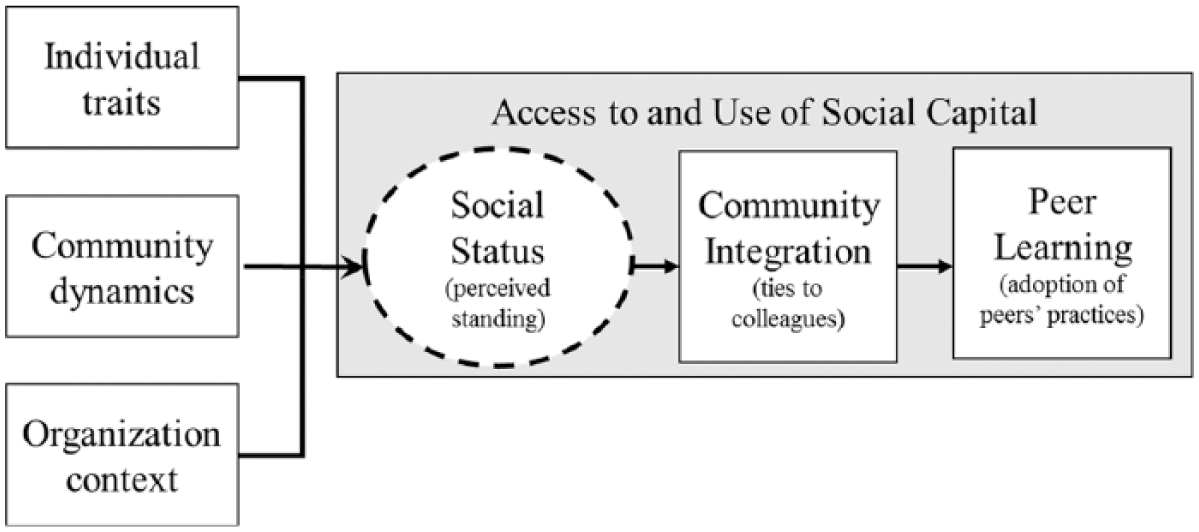
The role of social status in collegial communities and learning.
Social Status, Community Integration, and Peer Learning
Being well integrated into a community means having many strong relationships that tie an individual to the community as a whole; such relationships may result from seeking out community members or being sought out by them (Blau, 1960). Because higher status individuals are viewed as having more valuable qualities, they receive greater esteem, prestige, honor, and respect, and so may be sought out more than their lower status peers who are perceived to have fewer valued qualities, including making legitimate contributions to the group (Berger et al., 1972; Jasso, 2001; Ridgeway, 2014; Ridgeway & Erickson, 2000).
Higher status individuals also tend to receive more resources, more opportunities, have more information shared with them, and have their needs more attended to (Ridgeway, 2014; Ridgeway & Erickson, 2000). These more positive group experiences may result in higher status individuals being more likely to seek out relationships with others. In contrast, lower status colleagues would have more negative experiences, including having their opinions less valued, feeling more stressed, and being more unsure of themselves (e.g., Bacharach et al., 1993; Jasso, 2001; J. C. Moore, 1968; Ridgeway, 1987).
The respective benefits and costs of high versus low status might also spillover across community boundaries. Specifically, members of other communities may notice the high level of regard and resources received by high status individuals and so also seek them out, resulting in many cross-community ties. Alternatively, it may be the case that low status individuals have many cross-community ties because they, like many individuals, feel a strong need to belong (e.g., Baumeister & Leary, 1995). So, given limited integration in their own communities, low status may seek out more rewarding relationships in other communities.
Because status is a subjective judgment, individuals’ perceptions of their own status can be different from the perceptions others have of them. One example is individuals tending to view themselves in a more positive light than others do (e.g., Anderson, Spataro, & Thomas-Hunt, 2005). These differences in perceptions of status—sometimes termed status inconsistency (e.g., Hartman, 1974; Meyer & Hammond, 1971; Starnes & Singleton, 1977; Zhang, 2008)—can be especially problematic for community interactions. Status inconsistent individuals, who essentially misperceive their status, may not conform appropriately to status roles or sets of expected attitudes and behaviors (Zhang, 2008). Consider, for example, that a new teacher with low status might be expected to defer to veterans, and would be seen as impudent if he views his own status more favorably and so does not defer. Individuals who do not conform to status roles tend to be sanctioned with social estrangement and so have more difficult interactions with group members (Hornung, 1977; Ridgeway & Erickson, 2000). Thus, teachers with status inconsistency would be less well integrated into communities for reasons that parallel reasons for low status teachers.
Teachers with status inconsistency may not only have difficulty accessing social capital, given lower community integration, but they may also have difficulty utilizing social capital to learn instructional practices from peers. By way of definition, we use the term “learning” not to refer to specific dynamics of cognitive development but instead to the behavioral processes by which individuals in organizations adopt new knowledge, skills, or dispositions (e.g., Glynn, Lant, & Milliken, 1994). When knowledge, skills, or dispositions are adopted from peers, we view this as peer learning. Previous research suggests that this kind of peer learning depends on colleagues having shared goals, sharing knowledge, and taking appropriate risks, which, in turn, depend partly on social status (e.g., Bunderson & Reagans, 2011).
Individuals with status inconsistencies tend to have limited understandings of community identity, norms, and expected roles, which is one reason they misperceive their status (Hartman, 1974; Zhang, 2008). These same limited understandings might also undermine status inconsistent teachers’ ability to recognize the community’s shared goals, to properly weigh and integrate information needed for knowledge sharing, and to take appropriate risks to adopt new practices. So, even once exposed to colleagues’ instructional practices, status inconsistent teachers may be less likely to learn peers’ practices and so would share fewer practices in common.
Research Method
Sample
The data in this exploratory study come from all teachers working at four public elementary schools in a large, northeastern city in the United States. The small number of schools means they do not constitute a representative sample of the full population of approximately 700 elementary schools, which is a limitation of this study in terms of its generalizability. Still, schools in the study were selected from a stratified sample representing organizational archetypes so that it is possible to make observational comparisons between schools of different types (e.g., Greenwood & Hinings, 1993). Also, because the study includes teachers from different kinds of schools, we can examine and control for how teachers’ status and relationships may vary across schools.
One hundred twenty-three teachers in the study are from two schools referred to as Endeavor Elementary and Strive Elementary. These schools were in the lowest performance quintile for their 5-year average on statewide standardized tests of students’ English language arts (ELA) proficiency. These schools faced the highest accountability pressures because they were subject to reform pressures from federal, state, and city authorities. Forty-nine teachers in the study are from a school referred to as Paramount Elementary. Paramount was in the strata of schools in the highest performance quintile and facing the lowest accountability pressure because it did not receive Title I funds, received a waiver from city-mandated reforms, and was well above state operating license requirements.
The final 53 teachers in the study are from a fourth school, Everyday Elementary. This school was from the strata of schools in the middle performance quintile. It faced typical accountability pressures, meaning it was required to meet city and federal accountability requirements. Table 1 provides demographic information on the schools. Our preliminary analyses determined that an average of 18% of teachers across the four sites left their schools during the study period. This is similar to the level of attrition reported in other studies of schools in the same city and time period when we conducted our study (Rockoff, 2008). There were no significant differences across schools in the number or characteristics of teachers who left their schools.
Descriptive Summary of Student and Teacher Characteristics of Sampled Schools.
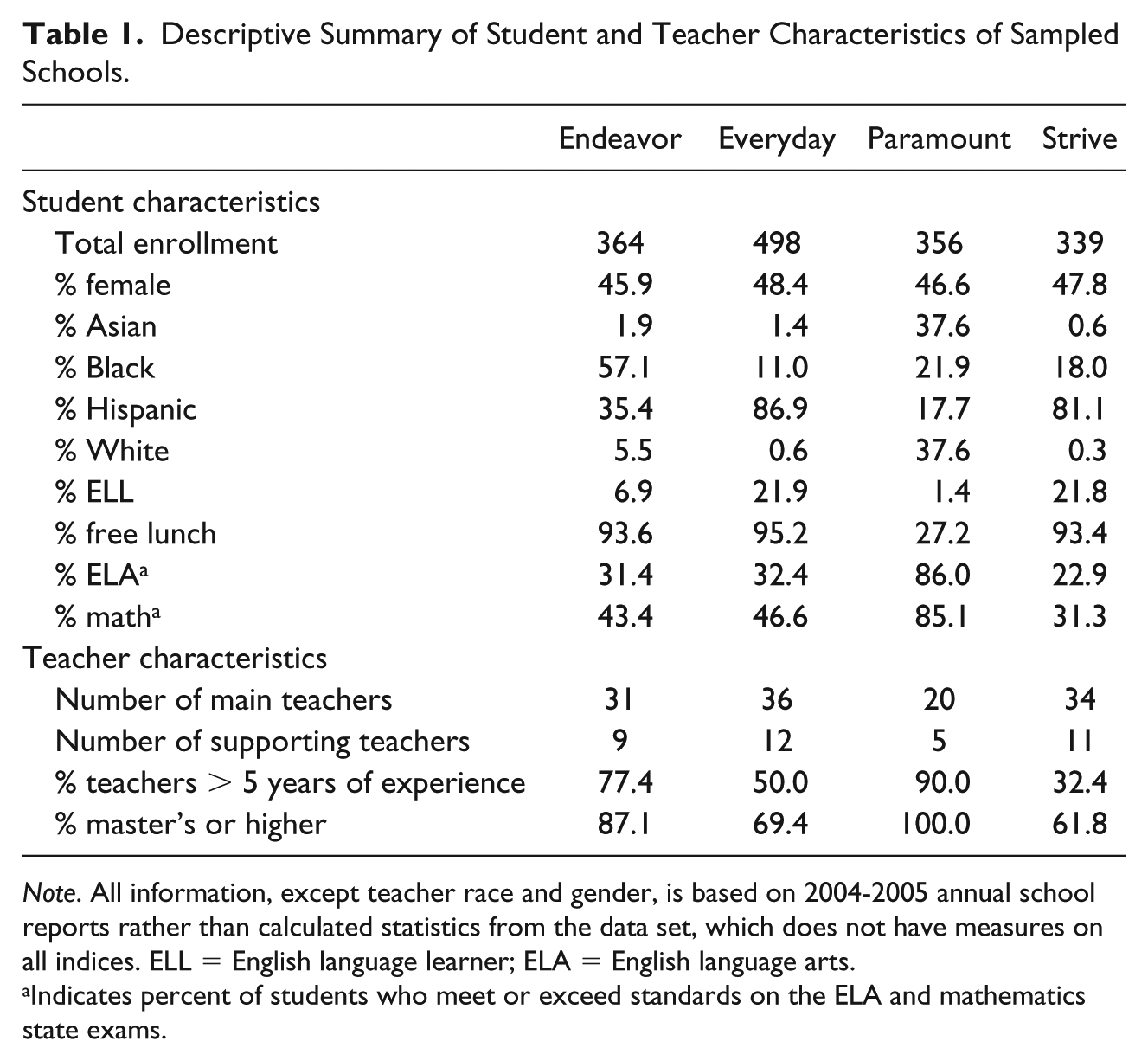
Note. All information, except teacher race and gender, is based on 2004-2005 annual school reports rather than calculated statistics from the data set, which does not have measures on all indices. ELL = English language learner; ELA = English language arts.
Indicates percent of students who meet or exceed standards on the ELA and mathematics state exams.
Data
Data collection
The data from this study come from a single survey developed and validated as part of a larger mixed-methods study about teachers’ interaction and instructional practices (Bridwell-Mitchell & Sherer, 2017; Bridwell-Mitchell, 2013; Bridwell-Mitchell & Cooc, 2016). The survey was administered to all teachers at the four schools during seven after-school meetings occurring at roughly 3-month intervals between 2005 and 2007. The survey response rate ranged from 62.75% to 86.00% across schools. Some respondents are missing data for some survey items across the seven waves; however, because data were collected at multiple time points, we are able to impute missing data observations for respondents. We do this by taking the mean of their reports across all the periods in which they responded to the survey. So, for example, if respondents were missing data for an item in Period 3 but in no other periods, then the mean for the item in Periods 1, 2, 4, 5, 6, and 7 was assigned as the value for Period 3. The result is a total of 899 repeated data observations for 215 teachers.
It is important to note that while survey data are conventional for social network and social status measures, these data are limited. It cannot be known whether teachers’ reported interactions accurately reflect their interactions though some network research suggests reports on ties do tend to capture average interaction patterns over time (Wasserman & Faust, 1994). In addition, while social status is a perceptual measure and so is especially well suited to survey data (e.g., Bunderson, 2003), social status may be associated with other nonperceptual factors such as teachers’ actual expertise.
Because we do not have data on teachers’ instructional expertise, as measured, for example, by classroom observations or value-added scores (e.g., Harris et al., 2014), our data cannot be used to determine the association between status and “actual” instructional expertise. The overlap of social status with actual expertise or “true underlying qualities” is certainly an important question (e.g., Podolny, 1993) but it is beyond the scope of the current research. So, it is important to note that respondent reports on instructional practice cannot be assumed to reflect actual practice (cf. Podsakoff, MacKenzie, Lee, & Podaskoff, 2003). Still, even with this limitation, the analyses of the data in this exploratory study provide an important first step in establishing a baseline demonstration of the role social status may play in teachers’ differential access to community social capital.
Items for background demographics and collegial interactions
The survey items asked respondents to report demographic characteristics, including age, gender, race, and years of experience as a teacher at their school, occupation as a main or supporting teacher, and grade and subject taught. Following widely used procedures for collecting whole network rather than egocentric network data on interactions, the survey provided teachers with a list of all other teachers at their school (Wasserman & Faust, 1994). Using this list and a scale of 1 (less than once per month) to 7 (multiple times per day), respondents were asked to “write in the number that indicates how frequently you communicate socially and/or professionally with the person whose name is listed.” Based on respondents’ reported frequency of interaction, we are able to construct their collegial communities, as described in greater detail below.
Items for instructional practice
Teachers’ reported instructional practices are based on responses to an item asking participants about their use of 19 instructional practices on a scale of 1 (not at all) to 7 (in every lesson). The practices were identified from 3 years of policy reports that the State Department of Education compiled after reviewing schools that were deemed to have a high need for reform. Table A1 lists the 19 practices. A series of nested confirmatory factor analyses indicated that the 19 practices were best described by a single factor model, which was the best fit for the data: root mean square error of approximation (RMSEA) = .041, probability of close fit (PCLOSE) = .530, parsimony comparative fit index (PCFI) = .734, and Tucker–Lewis index (TLI)/nonnormed fit index (NNFI) =.896. Because the state education agency promoted the practices as being best for improving schools, we consider teachers’ factor score for the practices to be a measure of teachers’ reported use of prescribed best practices.
Social status
A final set of items builds on methods in previous studies of social status (Bunderson, 2003). Specifically, we include one open-ended question, which provided respondents with the following prompt to elicit their evaluation and ranking of their peers, which is the basis of status perceptions: “In many schools teachers are nominated for ‘teacher of the year’ based on their strength, competence and talent as a teacher. Which five teachers at this school (not including yourself) would you be most likely to nominate for ‘teacher of the year?’” A multiple choice question then provided respondents with five options for answering the following question about themselves, “Based on your strength, competence and talent as a teacher, where do you think you would rank among teachers being nominated for a ‘teacher of the year’ award? (Please circle ONE): Bottom 0-19th%; Bottom 20th-39th%; Middle 40th-59th%; Top 60th-79th%; Top 80th-100th%.” As described in more detail below, we use responses to the two above questions as measures of teachers’ expertise-based status (Oldmeadow, Platow, Foddy, & Anderson, 2003).
Measures—Dependent Variables
Teacher communities
In this study, we take a social network approach to identifying teacher communities rather than simply using grade, subject, or other formal assignments to groups. For each school and time period, we construct a single-mode i by j square adjacency matrix. The rows i are respondents and the columns j are all other teachers at the school, the cells xij are values (1-7) for teacher i’s reported frequency of interaction with teacher j. Because missing data can be problematic for identifying clusters in sociometric data, missing values for xij were imputed from the average reported frequency of interaction between i and j across the time periods for which there were data on i and j interactions (Kossinets, 2006).
Using the above matrix, we identify communities, k, for school, s, at time, t, using Frank’s (1995, 1996) iterative partitioning routine, KliqueFinder (cf. Frank & Yasumoto, 1998; Plank, 2000; Spillane & Kim, 2012 for other examples employing KliqueFinder to identify communities). KliqueFinder identifies subgroups through a stochastic process that uses a goodness-of-fit index to maximize the log odds that any pair of actors is likely to interact, given that they are in the same subgroup determined by three criteria: (a) the number of ties between respondents (degree), (b) the extent to which all possible ties have been formed (density), and (c) the extent to which respondents mutually indicate interacting with one another (reciprocity).
The demographics for the 193 identified communities are illustrated in Table 2. In the table, the standard deviations and the number of communities at a particular minimum or maximum value illustrate variations across communities on key demographics. For example, while the mean proportion of non-White members in communities is 42.4%, there is considerable variation, given that the standard deviation is 34.2%. In addition, 47 of the 193 communities have 0% non-White members and 41 of the communities have 100% non-White members.
Community Demographics.
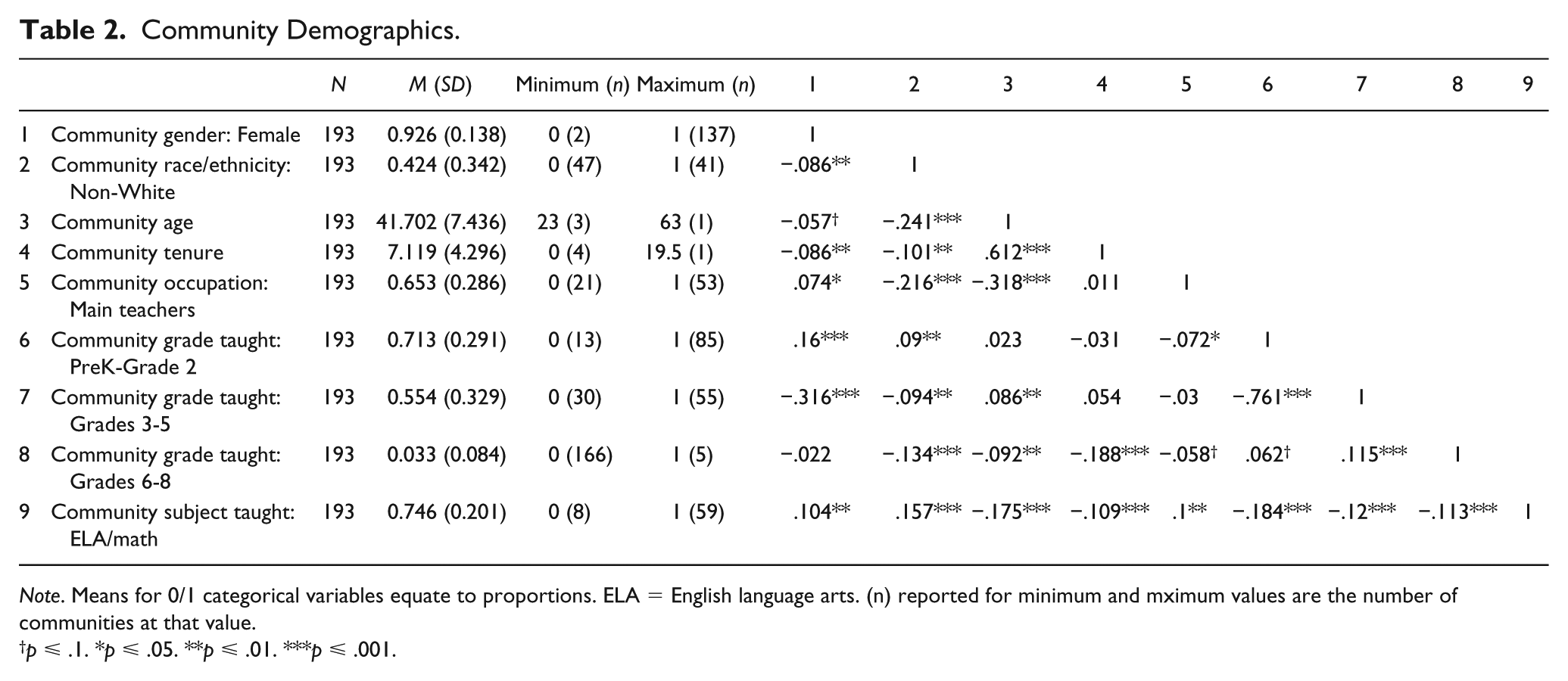
Note. Means for 0/1 categorical variables equate to proportions. ELA = English language arts. (n) reported for minimum and mximum values are the number of communities at that value.
p ⩽ .1. *p ⩽ .05. **p ⩽ .01. ***p ⩽ .001.
Community integration
We use three measures to indicate how well integrated teachers are into communities. One measure is the average frequency with which a teacher is sought out by or has colleagues report communications with him or her, which is to say, in social network parlance, the average strength of in-degree ties. The formal specification of this and all measures is available in the technical appendix. The second measure of community integration indicates the average frequency with which a teacher seeks out or reports communicating with colleagues or, in social network parlance, the average strength of out-degree ties. The third measure of community integration indicates how much teachers’ interactions span boundaries between their own community and other communities. This measure is essentially the average proportion of ties between teacher, i, and all communities, k, at school, s, at time, t, as reported by KliqueFinder (Frank, 1995). Note that when tie values are dichotomous (0/1), this measure is a straightforward percent on a 0 to 100 scale. Because the ties in our data are valued from 1 to 7, the scale is less easily interpreted. However, the relative size of the values is straightforward in that larger values indicate more associations with other communities; smaller values, fewer.
Shared instructional practice
If teachers are integrated into communities and are learning practices from peers, then we would expect teachers in the same community to have similar instructional practices. We construct the measure for how much teachers share practices by using the common approach of calculating the Euclidean distance, which essentially measures the overall difference in the reported instructional practices of respondents in the same community (Tsui, Egan, & O’Reilly, 1992). The measure is reverse scored for interpretability, so that large values indicate high levels of similarity in teachers’ practices; small values indicate little similarity. We assess the robustness of the results to alternative similarity measures using Moran’s I, which estimates similarity using deviations from the group mean rather than individual scores (Sokal, Oden, & Thomson, 1998).
Measures—Independent Variables
Expertise-based status
In this study, we are especially interested in expertisebased status because teachers likely rely on this form of status when collaborating with and learning from peers (Oldmeadow et al., 2003). It is important to recall that status is a socially constructed ranking based on perceived rather than “true” underlying qualities (Ridgeway & Erickson, 2000). Thus, the validity of the status measure in this study is not determined by whether teachers truly have a given level of expertise but whether they are perceived to have a given level of expertise. Following existing research on the criteria individuals use to assess expertise (e.g., Bunderson, 2003), we elicited teachers’ perceptions of expertise by asking them to consider “strength,” “competence,” and “talent” for receiving a teacher of the year award.
Becuase status is a relative ranking, we constructed expertise-based status using teachers’ quintile rank for their likelihood to receive the award from their peers (Ridgeway & Erickson, 2000). This means we first counted the total number of nominations received by every teacher for a given school and time period and then divided the count into quintiles. If teachers fell in the top quintile of nominations received (i.e., top 100%-80%), we assigned the value 5 to indicate the teachers’ status. If teachers were in the next quintile (i.e., 79%-60%), we assigned them a status value of 4, and so on.
Status inconsistency
Status inconsistency is the difference between an individual’s perceptions of her or his own status and the perceptions colleagues have of the individual’s status. To measure teachers’ perceptions of their own status, we use teachers’ ranking of their own likelihood to receive the teaching award. We assigned teachers a value from 1 to 5 to indicate where teachers thought they ranked among colleagues receiving the award: the top 100% to 80% (5), the next 79% to 60% (4), 59% to 40% (3), 39% to 20% (2), or 0% to 19% (1). The status inconsistency measure is the difference between the quintile values for teachers’ own perception of their likelihood to receive the award and the above-described quintile value for their colleagues’ perception the teacher would receive the award.
For example, if a teacher ranked herself 4 and colleagues ranked her as 3, this teacher’s status inconsistency is 1. Thus, positive values for status inconsistency indicate that a teacher views his expertise more favorably than colleagues view his expertise. Negative values indicate that the teacher’s colleagues have a higher view of the teacher’s expertise than he himself does. Increases in status inconsistency indicate that teachers have increasingly higher perceptions of their own status. In one of the below described models, we also include status inconsistency squared, which captures findings from past research, which indicate that status effects may differ when status is very high or very low (Phillips & Zuckerman, 2001).
Covariates
To examine the effects of expertise-based status over and above other achieved or ascribed status characteristics, we include teachers’ organizational and personal demographics as covariates in the models (Berger et al., 1972). Teachers’ gender was coded 1 for women and 0 for men. The dummy variable for race or ethnicity was coded 1 for respondents who indicated their race as Asian, Black, Latino, Native American, or “Other” and 0 for respondents who indicated their race/ethnicity as White. We code non-White respondents together because of limited analytical power resulting from the relatively small sample size for each individual group.
Teacher experience is respondents’ self-reported number of years working at their schools. We coded occupation as 1 if the respondent is a main teacher or 0 if the respondent is an assistant teacher or paraprofessional. Respondents’ subject area was coded 1 for mathematics or ELA and 0 for other subjects. Three dummy variables indicate whether teachers instructed students at (a) prekindergarten- to second-grade levels, (b) third- to fifth-grade levels, or (c) sixth- through eighth-grade levels. These grade distinctions mirror those used by the state education agency to administer standardized tests. Respondents’ schools are constructed as four dummy variables, coded as 1 for the school where the respondent works, 0 otherwise.
Because the overall pattern of teachers’ interactions may be influenced by community size, such as it being potentially easier to communicate with every member of a small community, we include the total number of individuals in each community as a covariate. In the same way that community size may affect interactions, so might community cohesion (Bridwell-Mitchell and Cooc, 2016). Thus, we include community cohesion as a covariate, which we measure as valued tie density within communities, as reported by KliqueFinder (Frank, 1995).
Analyses
Because we use our longitudinal design to examine a large number of status observations (i.e., rather than to model growth or change), our data have multiple observations of teachers who enter and exit the data across the seven periods. The result is a pooled, cross-sectional data structure where repeated observations of key measures are nested within teachers and teachers are nested within communities. Because teachers are members of multiple communities across the seven periods, teacher observations are cross-classified by community (Raudenbush & Bryk, 2002). This pattern of clustering is appropriately handled by formulating a two-level, cross-classified model using xtmixed in Stata 13.0 (Rabe-Hesketh & Skrondal, 2008). This approach also specifically addresses the nonindependence of observations in our data by allowing for separate intercept and slope coefficients for each teacher and community.
In this study, we are interested in modeling the extent to which expertise-based status is associated with teachers’ community integration and the extent to which status inconsistency is associated with teachers’ shared use of instructional practices. In the models, the Level 1 variables are unique observations for each teacher, ikst, including the status measures (X1-3), a vector of time varying teacher covariates (X1-6), such as age, and the dependent variables, in-degree tie (Y1), out-degree ties (Y2), boundary spanning ties (Y3), and practice similarity (Y4). The Level 2 variables are the unique observations for communities, kst, namely, size and cohesion (Z1-2), and also time invariant teacher covariates (Z3-5), namely, race, gender, and school. The model estimates random coefficients for teachers and communities, where teacher effects are assumed to be independent and normally distributed with a mean of zero and constant variance. We model all communities and teachers as nested within a single artificial super cluster at Level 3 and schools enter the model as fixed effects because of their small numbers (e.g., Rabe-Hesketh & Skrondal, 2008). The mixed-model specification is as follows:
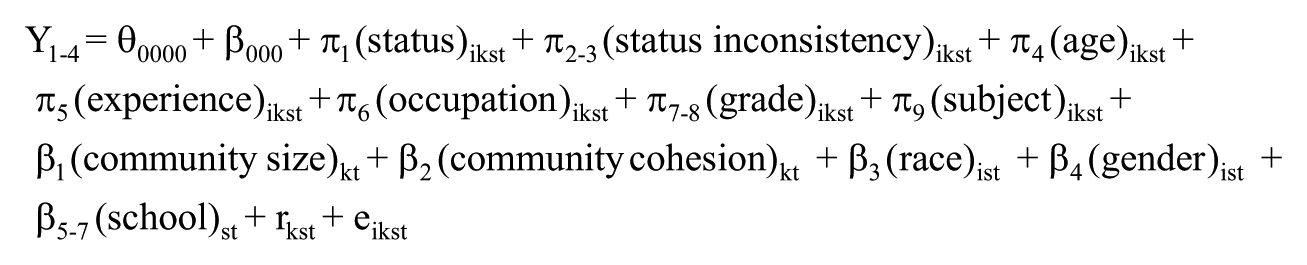
where the Level 1 components are
Y1-4, the average in-degree ties, out-degree ties, boundary spanning ties, and practice similarity for teacher, i, in community, k, at school, s, and time, t;
θ0000, the overall model intercept when all explanatory variables are set to zero;
π1-9, the effects for Xikst, the variables for the unique, time-varying observations for teacher, i, in community, k, at school, s, and time, t;
e ikst , the random variance component for the unique observations of teacher i, in community, k, at school, s, in time, t;
And, where the Level 2 components are
β000, the main effect for community;
β1-7, the effects for Zkst, the variables for the unique, time-varying observations for community, k, at school, s, and time, t, and the time invariant teacher covariates, X ist ;
rkst, the random variance components for communities, k, including cell-specific random effects for the interaction of teacher, i, and community, k.
Findings
Overall Patterns and Drivers of Status
The aim of this exploratory study is to understand how teachers’ perceptions of social status relate to social capital both in terms of community integration and peer learning. A useful starting place is examining the characteristics of teachers in our sample, including their status characteristics. As seen in Table 3, teachers are, on average, 42 years old and have worked at their schools for 6.92 years; yet there is wide variation in their experience (SD = 7.65). Most teachers are White, female, and teach students in prekindergarten through the sixth grade. As one would expect, on average, teachers fall in the middle of the status distribution (M = 2.87, SD = 1.56), meaning the top 40th to 59th percentile of teachers likely to receive a teacher of the year award based on strength, competence, and talent as a teacher. The mean for status inconsistency is positive (M = 0.96, SD = 1.70). This indicates that, on average, teachers’ judgments of their own strength, competence, and talent as a teacher tend to be more favorable than the judgments their colleagues would make of them (e.g., Anderson et al., 2005).
Descriptive Statistics.
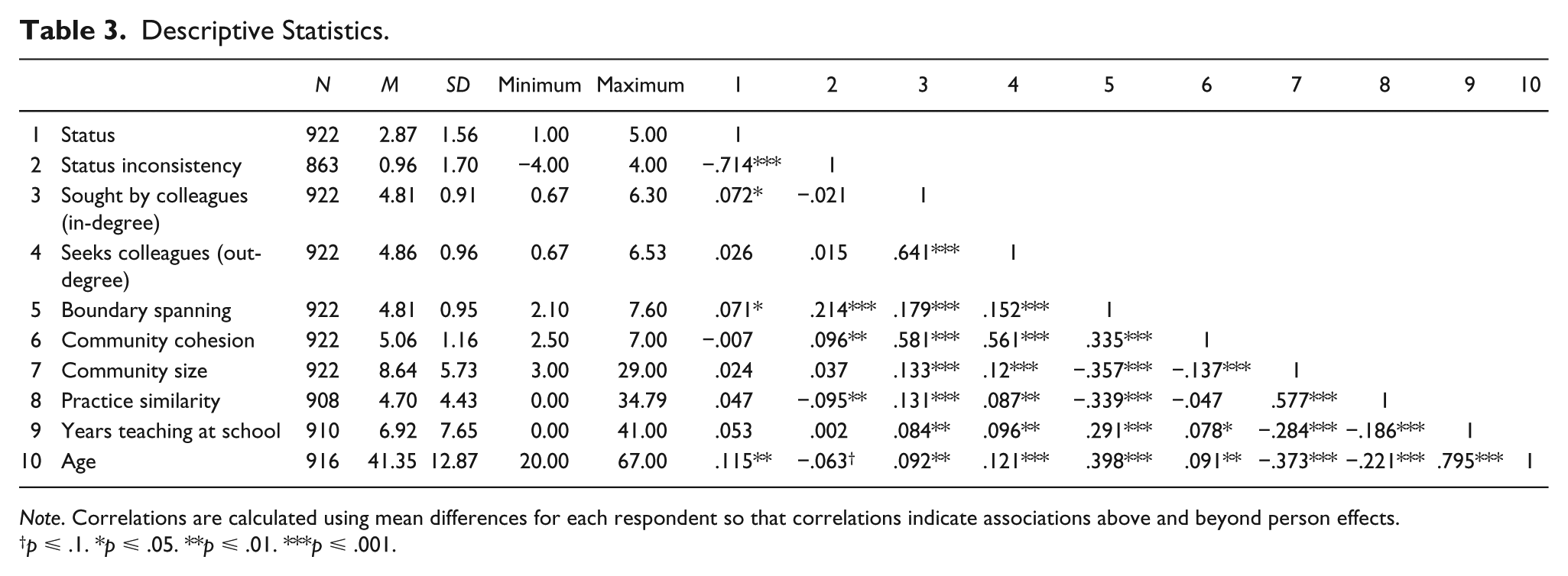
Note. Correlations are calculated using mean differences for each respondent so that correlations indicate associations above and beyond person effects.
p ⩽ .1. *p ⩽ .05. **p ⩽ .01. ***p ⩽ .001.

Note. ELA = English language arts.
The box plots in Figure 2 illustrate the relationships between race, gender, and status. In our study, non-White and White women have similar status. Non-White men tend to have lower status than White men; however, this difference may result from sampling bias as the number of White males (n = 14) and non-White males (n = 8) is small. Figure 3 plots teachers’ status according to subject and grade taught, showing that teachers who teach subjects other than ELA or mathematics tend to have lower status. This status difference seems to be driven mainly by the noticeably lower status of teachers with students in Grades PreK-2 and Grades 6 to 8 of whom there are fewer. Though not shown in the figures, preliminary analyses showed no obvious pattern between age, years of experience, and status. While these demographic patterns are helpful for understanding who has status, our central interest is in how social status relates to social capital.
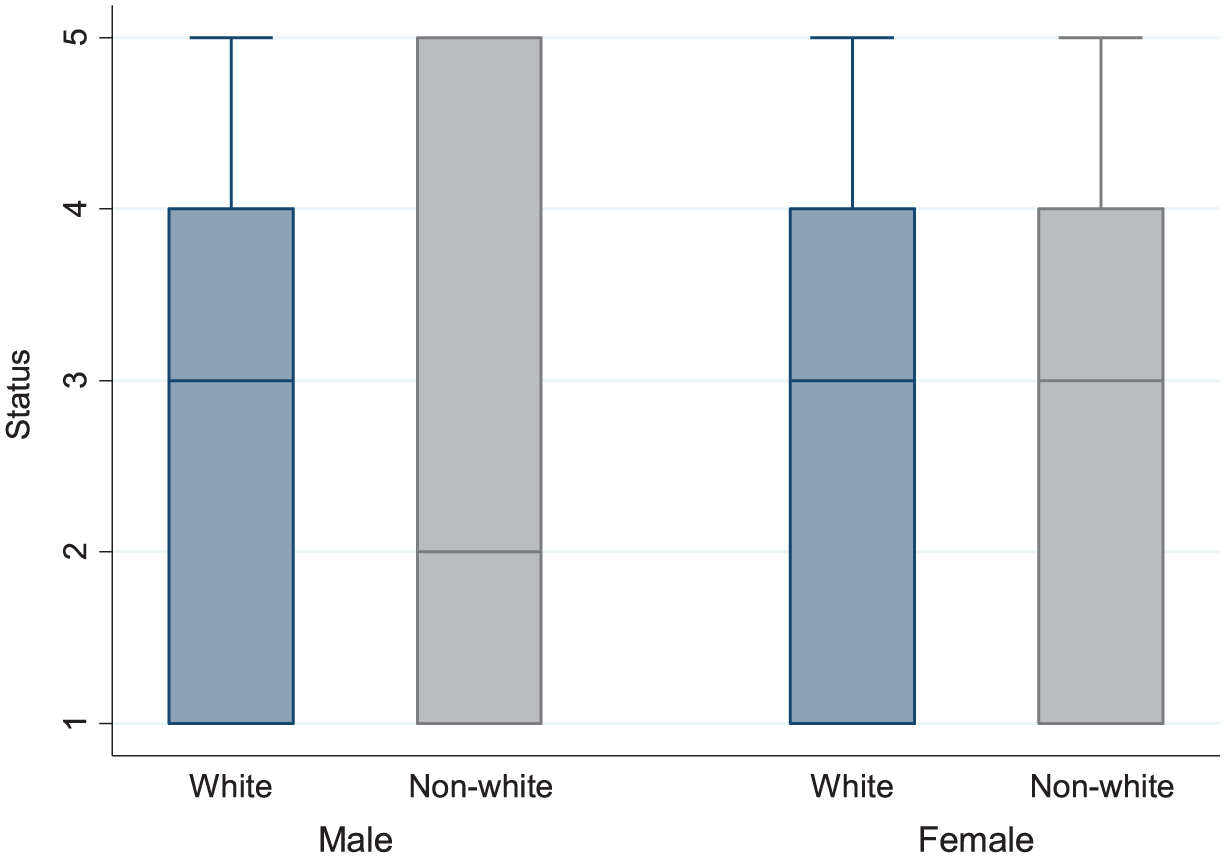
Teacher status by race and gender.
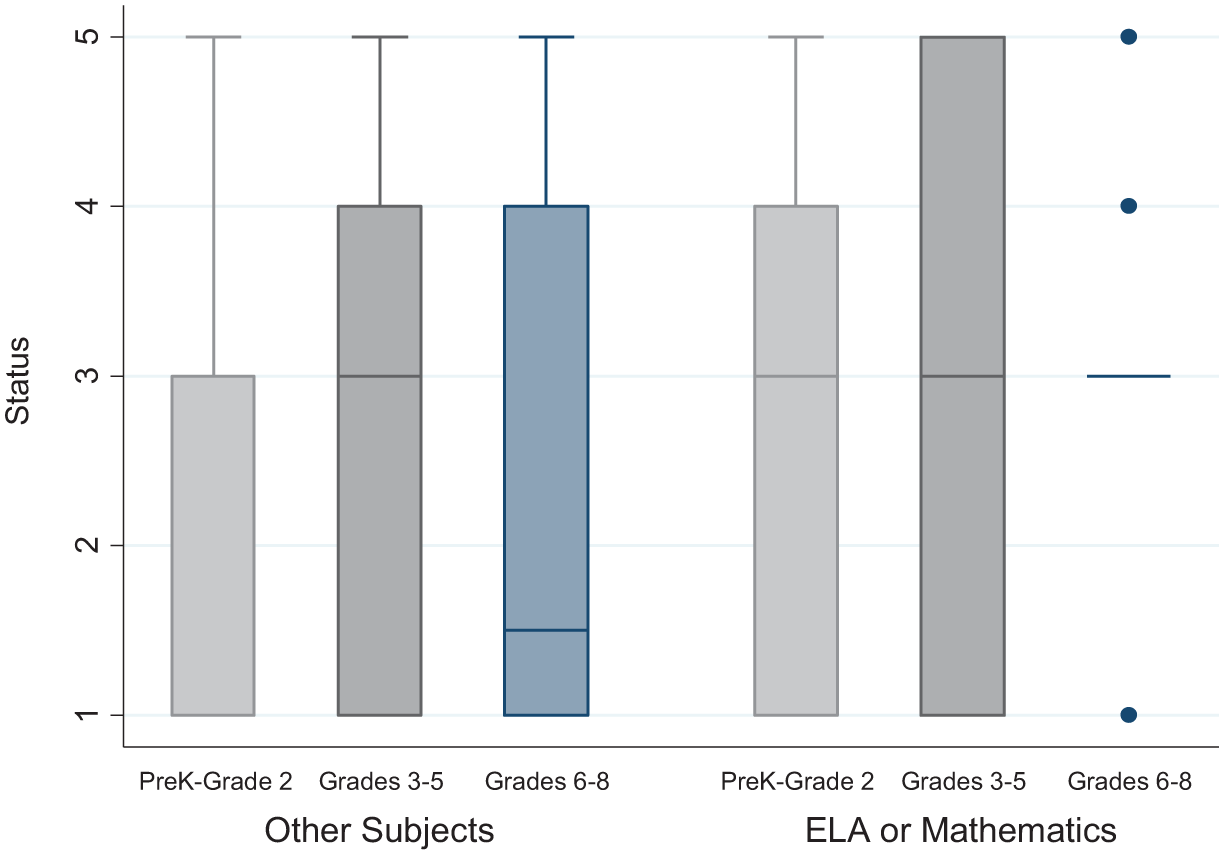
Teacher status by subject and grade.
How Teacher Status Is Associated With Community Integration (RQ1 and RQ2)
Who is sought out by colleagues?
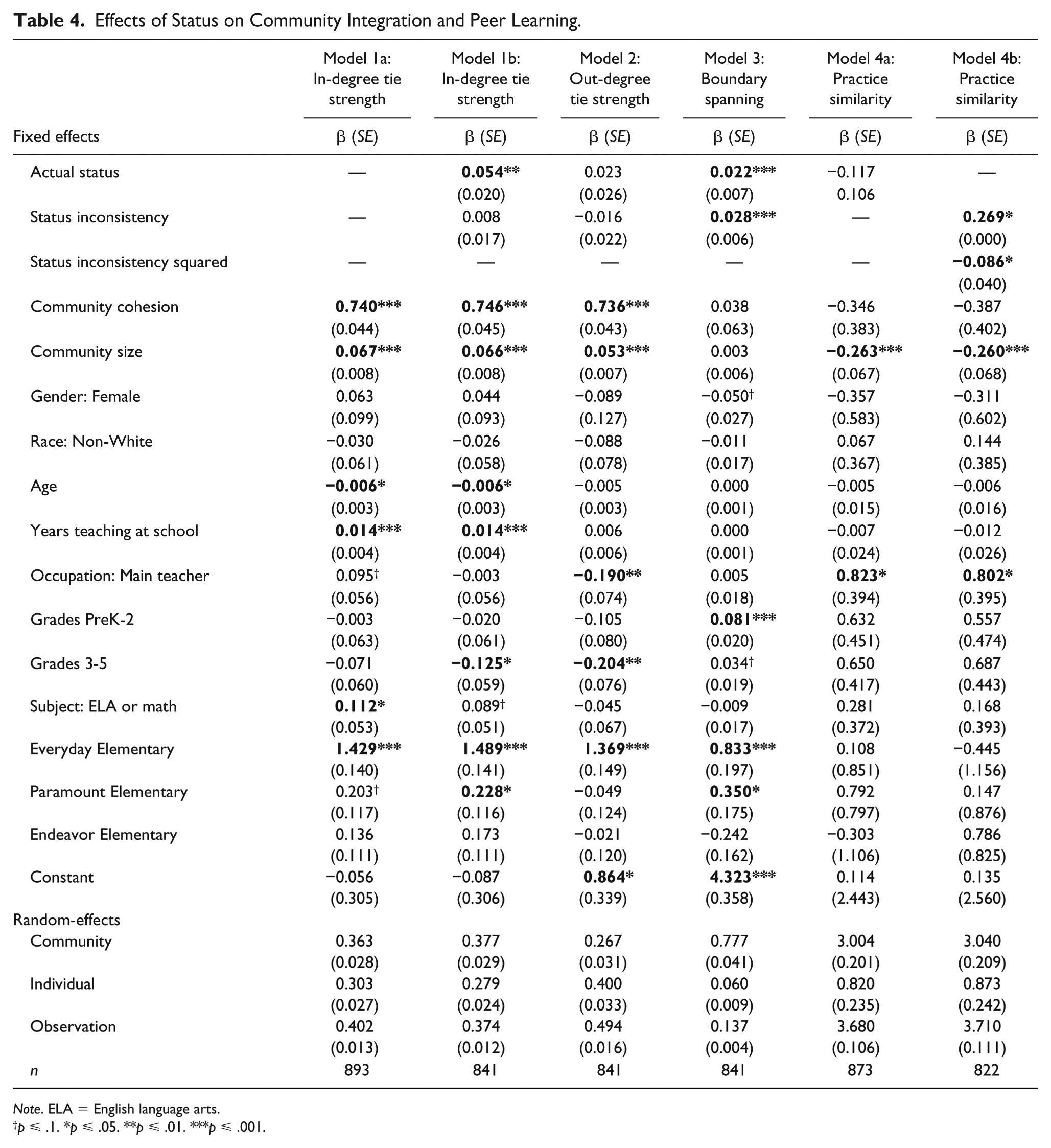
As a baseline, Model 1a in Table 4 examines demographic predictors of community integration, given how frequently teachers are sought out by colleagues. The results of the model indicate that teachers who have been working in their schools longer (
Effects of Status on Community Integration and Peer Learning.
Note. ELA = English language arts.
p ⩽ .1. *p ⩽ .05. **p ⩽ .01. ***p ⩽ .001.
Model 1b builds on Model 1a by including effects for expertise-based status and status inconsistency. In H1, we argued that high status teachers would be more sought out by community members because high status teachers are perceived to have more qualities valued by the community, in this case, “strength,” “competence,” and “talent” as a teacher. Relatedly, low status teachers would be less sought out because they are perceived to have fewer valued qualities; the same would hold for status inconsistent teachers, which we argued in H4a. The results of Model 1b indicate there is strong support for the effects of high status on being sought out and thus on low status teachers being less sought out; there is no support for the effects of status inconsistency.
Specifically, the positive effects of status in Model 1b (
The effects of status also help explain variation in community integration for teachers in different grades. Once teacher status is held constant, it becomes apparent that teachers who instruct students in Grades 3 to 5 are sought out less frequently (
Who seeks out colleagues?
Whereas being sought out by colleagues is one indicator of community integration, how much teachers seek out their colleagues and span boundaries between communities also indicate integration. We argued in H2 that high status teachers would be more likely to seek out colleagues because these interactions provided rewarding experiences. Relatedly, low status teachers would be less likely to seek out colleagues because their interactions were less rewarding; the same would hold for teachers with status inconsistencies, as argued in H4b. The results of Model 2 in Table 4 do not support either hypothesis. This is to say that while status is related to how frequently teachers are sought out by community members, the nonsignificant results in Model 2 indicate that neither status nor status inconsistency is related to how frequently teachers seek out colleagues. Recall, however, that seeking out relationships with members of one’s own community is distinct from spanning boundaries to seek out relationships with members of other communities.
Who spans boundaries?
In H3a, we argued that high status teachers would span boundaries more because members of other communities might recognize high status teachers’ worth and so seek them out; as a competing hypothesis, in H3b we argued that low status teachers might span boundaries more. Rather than being sought out by those in other communities, low status teachers would more frequently seek out members of other communities to establish relationships that were more rewarding than those in their own communities. We argued the same for status inconsistent teachers in H4c.
The results in Model 3 indicate that high status teachers rather than low status teachers have more associations with members of other communities (
Consider, for example, two Paramount Elementary PreK-2 teachers, who are both in a community with the median number of colleagues and level of cohesion but one teacher perceives her own status in the exact same way her colleagues perceive her status (i.e., status inconsistency = 0). In contrast, the second teacher gives herself the highest rating when colleagues give her the lowest (i.e., status inconsistency = 4). This second teacher would have 12.4% more associations with members of other communities. Given that status inconsistent teachers more frequently span boundaries to form relationships with other communities, one might expect these teachers to have fewer opportunities to interact with—and thus, learn from—colleagues in their own community.
How Status Inconsistency Is Associated With Learning Peers’ Practices (RQ3)
In H5, we argued that status inconsistency would make it more difficult for teachers to learn from peers. Consequently, status inconsistent teachers would share fewer practices in common with community members because even if exposed to peers’ practices they might not appropriately assess the importance of adopting them. Contrary to our expectations, the results in Model 4 indicate that increases in status inconsistency are associated with increases in practice similarity (
In other words, the more highly a teacher rates her own status relative to how colleagues rate her status, the more similar the teacher’s reported practices are to her colleagues’ reported practices. However, the significant negative effect for the squared term on status inconsistency (
Given these unexpected effects for status inconsistency, we assessed the sensitivity of the results using Moran’s I as an alternative measure of practice similarity (Sokal et al., 1998). Though the effects were marginally significant (
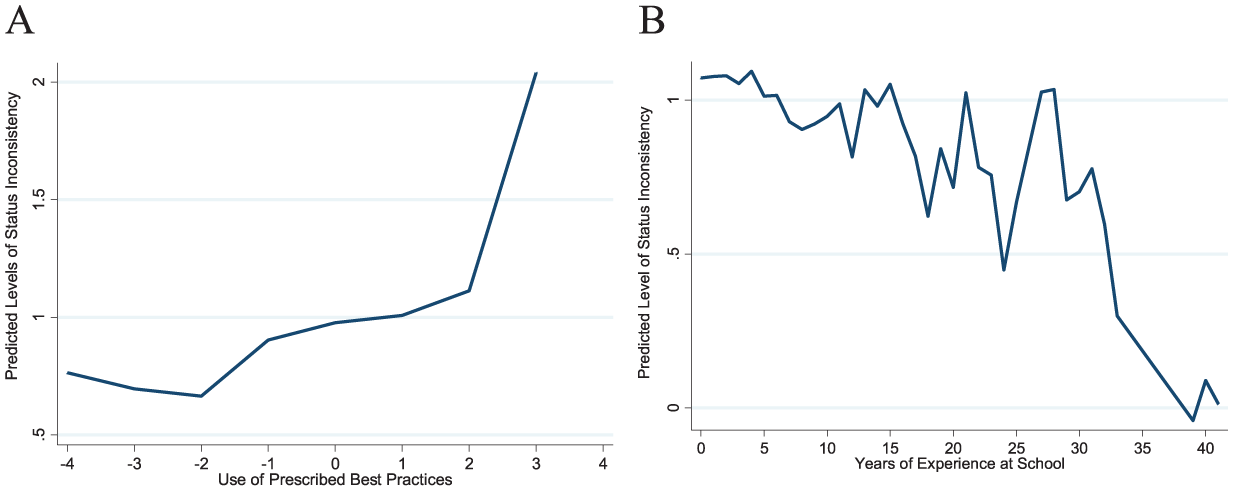
Predicted levels of status inconsistency: Panel A: Status inconsistency by use of prescribed best practices—Panel B: Status inconsistency by years of experience.
Discussion
Overall, our findings indicate that social status matters for social capital in two main ways. First, higher status teachers are sought out more often by their own community members and by members of other communities via boundary spanning; low status teachers are sought out less often. While we do find that non-White males have the lowest status of all the teachers in our study and White males have the largest status inconsistencies, we find no direct effects for teachers’ race or gender on community ties in any of the models. This contrast with findings from previous research may result from limited statistical power given the relatively small numbers of non-White and and male teachers in our study compared with other studies in which the numbers were much larger (e.g., Spillane et al., 2012).
The second way status matters for social capital is for teachers who view their own status more favorably than do their colleagues. These status inconsistent teachers have more associations with members of other communities. Status inconsistent teachers also have reported practices that are more similar to their colleagues’—at least up to a point. Having more associations with members of other communities might, as we initially reasoned, provide status inconsistent teachers with more rewarding relationships. Yet, cross-community associations might also provide teachers with more diverse information about instructional practice; this is not necessarily beneficial because it can be difficult for teachers to integrate what they learn from members of different communities (Bridwell-Mitchell, 2016).
Difficulty learning instructional practices is why we initially hypothesized that status inconsistent teachers’ practices would be less similar to their peers. Our results indicate teachers who too greatly overweight their status (i.e., reporting their status more than 30 percentiles higher than their colleagues would) do have reported practices that are less similar to their peers. However, on average, we find that teachers with status inconsistencies have reported practices that are more similar to their peers. Why might this be? Our data only allow us to speculate about any number of alternative explanations for our findings. Consider, for example, that one explanation for this apparently counterintuitive result is that it is an artifact of the limitations of the study’s self-reported data. An alternative explanation would suggest that it is exactly because the data are self-reports that the findings are consistent with existing social psychology research on self-assessments of competence.
For example, experimental research by Kruger and Dunning (1999) demonstrates that less skilled individuals tend to be unaware of their lack of expertise and so consistently overestimate how well they perform on objective tests of skill. Furthermore, less skilled individuals are less likely to correct their inaccurate self-assessments even after seeing the work of more skilled individuals. This is because the same lack of skill that impairs performance also makes it difficult to accurately gauge others’ performance and, in turn, to accurately gauge differences between their own (less skilled) performance and that of others with greater skill. In other words, these individuals don’t know what they don’t know, which includes not knowing that others know more than them. Consequently, lower skilled individuals make fewer adjustments in their self-assessments—effectively learning less from peers’ performance.
While we do not have objective data on teachers’ instructional practice against which to compare the self-reports of participants, the pattern of potentially less expert teachers—namely, the novice teachers in our study—overestimating their expertise, and thus their expertise-based status, is consistent with Kruger and Dunning’s (1999) research. Also consistent with Kruger and Dunning’s (1999) research is the conclusion that status inconsistent teachers report practices more similar to peers because they are simply unaware of how different their practices are from more expert peers. Thus, dialogue and inquiry with fellow teachers might not only enrich these teachers’ professional experiences but also improve their instruction (Cochran-Smith & Lytle, 1999; Leanna & Pil, 2006; Reeves et al., 2017).
In particular, our results suggest that establishing collaborative teacher communities may be insufficient for instructional improvements especially among teachers whose instruction may need the greatest improvement. Consider that existing research on knowledge transfer in social networks indicates that tacit, nuanced, or fine-grained knowledge sharing requires strong, close connections (Inkpen & Tsang, 2005). Similarly, research on teachers’ social networks suggests teachers are more likely to adopt new professional values through friendship ties based on positive affect, intimacy, and trust (Gibbons, 2004). This past research taken together with the results from the current exploratory study suggests teachers who need the greatest improvement might benefit from a scaffolded approach to collaborative professional development.
First, this might be developing a trusting one-on-one relationship with an expert colleague who can engage in honest conversations about instruction to help raise initial levels of expertise. After which, teachers can leverage their expertise to learn from peers in collegial communities, which provide ongoing professional development and opportunities for continuous learning. Again, however, explanations for the reported practices of status inconsistent teachers cannot be determined directly from our data nor can the efficacy of any given policy prescription. This suggests the importance of ongoing research examining exactly how status relates to teachers’ social capital, including opportunities to learn from peers and how the latter can be better supported (Dunne et al., 2000; Sato et al., 2008).
Conclusion
The importance of strong collegial relationships has been well-established in the existing literature; yet, there is also wide variation in its outcomes (Levine & Marcus, 2010; Ronfeldt et al., 2015; Vescio et al., 2008). When collaborative communities are implemented in schools, the theory of action is that teachers working together will learn from each other and thus improve their instruction. The current work suggests this theory of action may not hold for low status teachers or teachers with status inconsistencies. Indeed, even though status inconsistent teachers may be members of communities, they might not be well integrated into communities and so have fewer opportunities to learn. And, even with opportunities to learn from community members, it may be difficult for status inconsistent teachers to take advantage of the opportunities because they may not accurately assess the differences between their own expertise and that of more expert peers. So, paradoxically, teachers with status inconsistencies may not be able to learn instructional practices from peers until they learn more about instructional practices (e.g., Kruger & Dunning, 1999).
It is important to note that our study does not focus explicitly on grade- or subject-level teams but on informal communities based on teachers’ frequency of interaction. However, we do think our research has implications for the dynamics and effectiveness of formal teams. After all, schools and formal teacher professional communities share characteristics with other social groups that are well-known to establish status rankings (Achinstein, 2002; Ridgeway & Erickson, 2000). Moreover, although we studied informal teacher groups, many of the communities in our study are comprised of teachers who all teach the same grade or subject. Thus, the status dynamics we observe may also occur in grade- or subject-level teams.
Our findings extend existing research on how teachers form ties and gain access to social capital by providing preliminary evidence that teachers’ social status moderates access to and use of social capital and has effects over and above certain organizational-, community-, and individual-level factors. Our findings also extend research on teacher communities by showing that the potential for communities to be levers for improvement may depend on teachers’ social status. Because we find low status and status inconsistent teachers—the latter of whom tend to be novice teachers—may have difficulties forging community ties, our findings also have potentially important practice implications for teacher induction and professionalization (Hofman & Dijkstra, 2010).
In particular, early career teachers are engaged in many types of learning, including professional identity formation, developing a sense of their own self-efficacy, beliefs, and attitudes about teaching, and also learning the norms and micropolitics of teaching in their particular school context (Beijaard, Meijer, & Verloop, 2004; Flores & Day, 2006; Kelchtermans & Ballet, 2002). As one student teacher in Moore and Ash’s (2002, p. 4) study put it, “It’s not just how you see yourself, it’s about how you see how other people see you: how you see yourself being seen.” Thus, better understanding how teachers view one another, including their perceptions of social status, may be critical to teacher induction and professionalization and also to overall school improvement efforts, especially ones attempting to leverage teacher collaboration and communities.
Footnotes
Technical Appendix—Formal Specification of the Measures
Acknowledgements
We gratefully acknowledge the support and the help of colleagues who provided thoughtful input and support for this work, including Katherine Boles, Kara Finnegan, Richard Murnane, North Cooc Ray Reagans, Lauren Yoshizawa, Maxwell Yurkofsky, and members of the American Educational Research Association (AERA) Organization Theory Special Interest Group (SIG).
Declaration of Conflicting Interests
The author(s) declared no potential conflicts of interest with respect to the research, authorship, and/or publication of this article.
Funding
The author(s) disclosed receipt of the following financial support for the research, authorship, and/or publication of this article: This work was supported by a National Science Foundation grant for the study of human and social dynamics (SES-0433280).