







Abstract
Few scholars have engaged in close examinations of state boards of education (SBOEs), their make-up, or the broader implications of their influence over time. SBOE membership, authority, and impact differ significantly across the 50 states. This article reports findings from an exploratory study of three SBOEs and their role as policy actors. Thinking about SBOEs as policy actors focuses attention not only on the power, authority, and policy-making functions of SBOEs, but also on the individuals who serve on SBOEs, their actions, and the discourses constructed through the performance of their policy work.
State boards of education (SBOEs) are interesting, contextually dependent, policy-making entities (Manna, 2012). However, SBOEs have received relatively little attention within the education policy literature. In this article, we explore three SBOEs in an attempt to provide greater insight into these lesser known education policy actors.
“Advances in conceptualizing structures of influence in education policy making have emphasized the role of non-governmental actors working in networks to promote their agendas” (Scott et al., 2017, p. 16). These actors are ideological, proactive, goal-oriented, flexible, and work across sectors to support and garner support from other actors (Anderson, De La Cruz, & Lopez, 2017). According to Ball and Exley (2010), They act as trustees for each others’ organizations and sit on each others’ advisory councils. They write, speak and “appear on platforms” at each other’s events. Ideas gain momentum and support and are disseminated through and beyond networks by repetition, reiteration, rearticulation, quotation, cross-referencing, collaborations and co-authoring. (p. 155)
Most such network actors operate outside of the state and its democratic structures, influencing and, in many cases, even drafting policy language for their network colleagues inside the state. However, not all actors are outsiders—some are official members of the state, having either run for or been appointed to office (Wieder, 2012).
SBOEs
Although almost every state in the United States has an SBOE, these entities have received relatively little attention within the policy literature. Research has examined trends in state legislation and policy (Desimone, Smith, Hayes, & Frisvold, 2005; Fusarelli & Cooper, 2009), the increased authority of state departments of education (Anagnostopoulos, Rutledge, & Bali, 2013; Minnici & Hill, 2007; Sunderman & Orfield, 2006), and the effects of such legislation and policy on schools and students (Carnoy & Loeb, 2002; Mintrop & Trujilo, 2005).
Each SBOE is unique. All but three of the 50 states (Minnesota, New Mexico, and Wisconsin) and the District of Columbia have SBOEs, though the state constitutions and statutes outlining the legal basis for SBOEs differ significantly as do the representative nature and authority of SBOEs. Interestingly, SBOEs are described in many state constitutions as policy-making entities, but few directly engage in policy making. Rather, their efforts tend to be overshadowed by legislators, governors, and chief state school officers. Nonetheless, SBOEs do serve as a point of access to education policy making for a vast and diverse array of interests.
The first SBOEs emerged in the early 1800s for the purpose of administering public education (Kysilko, 2011). Their authority has fluctuated over the years, primarily in response to state politics, but also in response to the emergence of “education governors,” the growth of federal involvement in education, and the creation of new education policy entities with the powers and authorities previously held by SBOEs (Henig, 2012; Young & Reynolds, 2017).
The majority of published work on SBOEs consists of organizational reports from the 1990s or earlier, which included reviews of SBOE data and in some cases insight into the politics, values, and concerns of a given time period. A number of these publications provided information about the structures, authority, and make-up of SBOEs. By piecing together data from multiple sources (e.g., Badarak, 1990; Beach & Will, 1955; Council of Chief State School Officers, 1983; Deffenbaugh & Keesecker, 1940; Education Commission of the States, 2006, 2013; Harris, 1973; Howerth, 1913; McCarthy, Langdon, & Olson, 1993; National Association of State Boards of Education [NASBE], 2012, 2015), we identified changes in SBOE size over time. Between 1950 and 1990, for example, the variability in size increased significantly from four to 27, with the average number hovering around nine. In the 1990s, boards ranged in size between four and 11. Today, the average number is still around nine with a range of five to 20.
One of the more significant treatments of SBOEs examined the governance, purpose, and influence of boards in 12 states (Campbell & Mazzoni, 1974). Building on this early work, NASBE (2015) identified four roles common to SBOEs: (a) policy makers who are responsible for policies that promote educational quality, (b) advocates who are responsible for quality education for all students, (c) liaisons who seek to foster relationships and communication between education and others, and (d) consensus builders who work to find common ground between disparate interests.
How individuals become SBOE members also has been of interest over the years. Reviewing data from 12 primary and secondary sources (Badarak, 1990; Beach & Will, 1955; Council of Chief State School Officers, 1983; Deffenbaugh & Keesecker, 1940; Education Commission of the States, 2006; Fuller & Pearson, 1969; Harris, 1973; Howerth, 1913; Keesecker, 1950; McCarthy et al., 1993; NASBE, 2012, 2015), we identified how SBOE members were selected and by whom between 1913 and 2015 as well as how these patterns changed over time (Young & Reynolds, 2017). Using McCarthy and colleagues’ (1993) governance model framework shown in Table 1, we found that 39 states fall into one of these four models today. The most significant change over time (1913-2015) was the increase in gubernatorial appointments of SBOE members, increasing from 17 to 33.
State Board of Education Models.
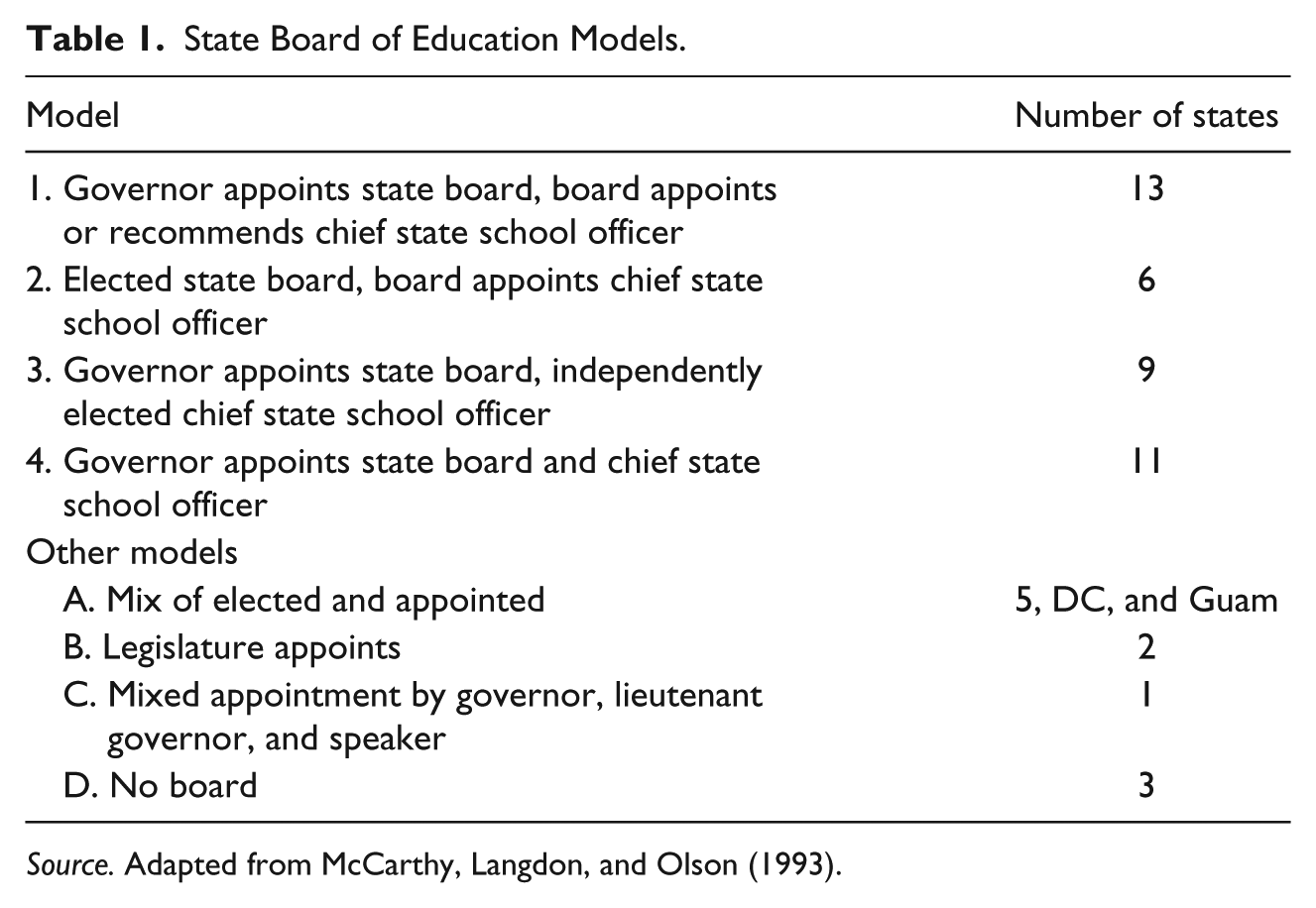
Source. Adapted from McCarthy, Langdon, and Olson (1993).
Although it is unclear how or why the four SBOE models developed as they did, why elected boards grew in popularity until the 1990s and then stagnated and declined, or why governor-appointed boards are now the most common, the latter may be related to the rise of “education governors” (Henig, 2012; Shober, 2012). Regardless, gubernatorial appointments raise questions about how well SBOEs represent the broader state population.
In contrast to the research community, reporters have taken a strong interest in the work of SBOEs, particularly their role in setting curriculum standards, and have revealed that SBOEs are involved in shaping education policy and practice across the United States. According to Young and Reynolds (2017), news stories, such as those posted on Education Week’s State EdWatch, tend to focus on three key topics: (a) SBOE approval of tests, curriculum standards, and accountability systems; (b) SBOE membership; and (c) clashes concerning state standards or who controls state departments of education.
Critical Policy Analysis
In addition to providing insight into the history, authority, make-up, and governance structures, our review of the literature revealed that studies examining SBOEs have taken their existence and purpose for granted, often just describing and categorizing SBOEs. Few studies have interrogated the role, representative function, or power of these entities. McFarlane (2009) argued that researchers should be paying much closer attention to the work of policy actors, particularly their “labour of assembling and reassembling sociomaterial practices that are diffuse, tangled and contingent” (p. 562).
A growing body of research is focusing on understanding networks and their role in governance. According to Ball and Junemann (2012), discussions of networks range from very general descriptions of governance patterns to detailed delineations of relationships. They described policy networks as “a form of governance that interweaves and interrelates markets and hierarchies—a kind of messy hinterland that supplements and sometimes subverts these other forms” (p. 9).
In previous editions of the Politics of Education Yearbook, the study of networks has taken a variety of forms. Wohlstetter, Houston, and Buck (2015) conducted an exploratory study of New York City educational networks in the implementation of the Common Core State Standards. Scott and colleagues (2017) focused on the contexts in which networks of nongovernmental actors promoted their agendas, revealing how networks are “formed, structured, and operate” and how education policy is “produced, promoted, and utilized” (p. 16). Anderson and colleagues (2017) asserted that networks represent “new forms of governance and governmentality” because think tanks and other knowledge brokers “operate largely outside the state and its democratic structures” and yet are “essentially making public policy” (p. 11). Finally, in a network ethnography of one educational “technocrat,” Ball (2017) explored how private ideas are transferred to public ideas, which he argued plays a major role in “the neoliberalization of education” (p. 29).
Network governance includes “a bewildering array of different phenomena and governmental practices” (Triantafillou, 2004, p. 2). According to Ball (2010), networks are indicative of “a new ‘architecture of regulation’ based on interlocking relationships between disparate sites in and beyond the state” (p. 135) where actors engage “in a reflexive process of dialogue and information exchange” (Newman, 2001, p. 108), exposing the policy-making process to increasingly opaque games of power and influence. In this new architecture of regulation, policy is influenced in a variety of spaces by multiple actors where it is unclear who spoke to or influenced whom, when, and for what purpose. Importantly, network goals may not be the same as those publicly and formally communicated by governmental bodies.
SBOEs are just one part of larger networks that influence the practice of education and the development of education policy. The research shared in this article, which examines SBOEs and their membership, helps lay the foundation for a line of inquiry that leverages network analysis to better understand and visualize SBOEs as network actors.
Method
In this exploratory study of SBOEs, we employed a multiple case study design to examine the Florida, Virginia, and Texas SBOEs (Yin, 2003). This design allows for insight into the particularities of each SBOE as well as comparisons across sites to explore continuities and discontinuities among and between the SBOEs and their membership.
Our selected states reflect three different SBOE models as delineated by McCarthy and colleagues (1993; see Table 1). Florida represents Model 1, wherein the governor appoints members of the SBOE and the board in turn appoints the chief state school officer. Virginia represents Model 4, wherein the governor appoints both SBOE members and the chief state school officer. Texas represents one of the “other” models, wherein board members are elected, but the governor appoints the chief state school officer. Although the three cases are not representative of all SBOE models, Models 1 (FL) and 4 (VA), which both reflect governor appointed boards, do represent the dominant configurations, and we wanted to include one model (TX) reflecting an elected board.
Critical policy scholars use a variety of data collection strategies, including observations, interviews, key informant testimonies, mass media analysis, document analysis, examination of statistical databases, and literature reviews (Diem, Young, Lee, Mansfield, & Welton, 2014; Young, 1999). For each state, we engaged in two key sets of activities: (a) extensive Internet searches focused on understanding the role and authority of each SBOE, the work it had recently undertaken, and its members; and (b) the use of search data to construct SBOE cases. For this phase of our research, our data collection intentionally included only publicly available information about SBOEs and their members. Our Internet searches focused on understanding the authority, make-up, and work of the three SBOEs as well as the backgrounds, connections, and interests of each SBOE member. Thus, we examined a variety of online resources, including state statutes and administrative codes, NASBE resources, archived meeting agendas and minutes, VoteSmart records, and news articles. In addition to Internet searches, we reviewed social media profiles, blogs, podcasts, and entries about board members in Ballotopedia.
As Massey (2005) pointed out, networks are constantly evolving, always in the process of being made and remade, and are “never finished; never closed” (p. 9). Thus, our representations of SBOEs are limited by the data collected and issues of representation. With regard to data, there are limits to both what can be known about individual board members and their connections. With regard to representation, connections can be somewhat opaque. They involve a number of informal exchanges that often and purposefully occur outside of the public eye.
Findings
Our analysis revealed a number of interesting patterns, including the significance of the state models for representation and the consolidation of power, member demographics, and the work of the boards. In the following sections, we delineate the scope and statutory authority of the three SBOEs, their membership, key policy initiatives, and beneficiaries of their efforts.
Florida’s SBOE
The statutory authority for the Florida state board (FSBOE) comes from the Florida Constitution. The FSBOE is granted authority over implementing and coordinating public education in Florida (with the exception of the State University System) and adopting rules and implementing provisions that lead to the improvement of public education. FSBOE responsibilities are fairly extensive and include, among others, supervising the Florida Department of Education, adopting a strategic plan for education in the state, approving standards, enforcing state education goals and policies, taking action on charter school application appeals, coordinating and authorizing the education budget, setting financial aid goals, and identifying priorities for fixed capital outlay projects. Although most SBOEs have authority over only PK-12 education, the Florida board also has jurisdiction over the Community College System, which is composed of 28 public colleges.
Florida represents Model 1, wherein the governor appoints the members of the SBOE and the board in turn appoints the chief state school officer (McCarthy et al., 1993). Appointments to the FSBOE are political. Florida has been led by a Republican governor since Jeb Bush’s 1998 election, meaning that all seven currently serving members of the board as well as those serving since 2003 were appointed by a Republican governor. Those members in turn appointed each of the subsequent chief state school officers, thus consolidating Republican power over public education. Governor Rick Scott extended Bush’s A+ Plan for Education, which centers on “holding schools accountable for results, setting high expectations, . . . [and] giving families real school choice” (Foundation for Excellence in Education, 2012, p. 1).
The seven members of the FSBOE are appointed by the governor to staggered 4-year terms, subject to confirmation by the Florida Senate. In addition, Florida code specifies that board members serve without compensation, but does not list any requirements for the make-up of the board. Although Florida is fairly diverse (60% White, 20% Latino, 17% Black, 2% Asian, and 1% Native American), the current members of the board include six White males and one Black female (i.e., 86% White). As Table 2 shows, current FSBOE members represent the legal, political, and business communities, and several have specific interests in alternatives to public education and traditionally prepared teachers as well as virtual schools. No educators serve on the board as of this writing. Table 2 also presents an overview of each board member’s background experience, interests, and affiliations.
Florida State Board of Education Members: Experience, Interests, and Affiliations.
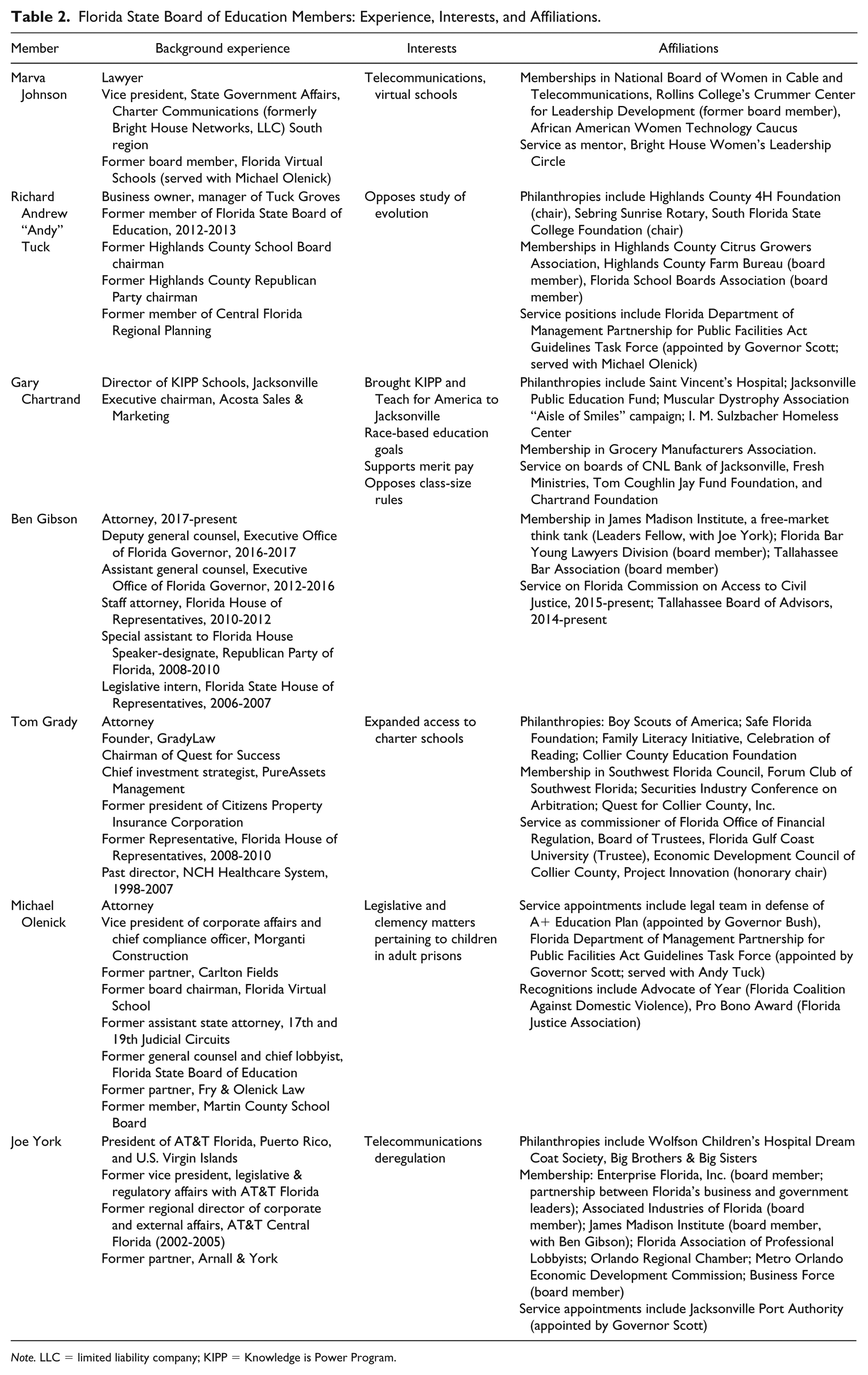
Note. LLC = limited liability company; KIPP = Knowledge is Power Program.
The FSBOE meets bimonthly, often in Tallahassee. Since 1999, the FSBOE has worked on a number of policy issues, from creating and revising the A-F school grading system to expanding school choice options. The board appears to have wide jurisdiction, and whereas the Florida Legislature has passed legislation articulating its priorities into law, the FSBOE is responsible for promulgating rules to implement those priorities via Florida Administrative Code Rule 6A (2018). This is significant because Florida districts and schools are directly affected by the board’s actions. The A-F grading system for Florida schools provides a good example. The new grading system was met with a great deal of outcry, from concerns over the validity of the metrics used to complaints of constantly shifting standards. The expansion of school choice options offers another good example. Florida has a 10-year commitment to expanding school choice options and permitting the spending of public dollars on charter schools, nonpublic schools, and religious schools.
Beneficiaries of the FSBOE’s recent work include those in favor of deregulation, school choice initiatives, and the privatization of public schools. Florida’s board has continued to tinker with rules over the past 10 years or so—altering standards and accountability cut scores, revising standardized tests, offering vouchers for students to attend nonpublic schools, changing the school grading system, and shifting potential turnaround options for districts. One news source (Schorsch, 2017) implicated FSBOE member Joe York, noting that his prior efforts to deregulate Florida’s telecommunications rules and laws may end up influencing Florida’s education rules and laws.
Virginia’s SBOE
The statutory authority for the Virginia state board (VSBOE) comes from the Virginia Constitution and gives the Virginia General Assembly the primary governing role over public schools, thus classifying the VSBOE as an administrative agency. The VSBOE is granted authority over curriculum content standards, educator licensure, summative assessments of student learning, and the authorization of charter schools. The board is responsible for the supervision of public instruction, accrediting public schools, dividing the state into school districts, certifying superintendents, establishing regulations for human subjects research, and approving textbooks and instructional materials.
The Virginia Constitution requires that the board have nine members appointed to 4-year terms by the governor and confirmed by the Virginia General Assembly. As such, Virginia represents Model 4, wherein the governor appoints both the SBOE members and the chief state school officer (McCarthy et al., 1993). Like Florida, appointments to the VSBOE are political, with Republican governors appointing Republican members and Democratic governors appointing Democrats.
Member terms are staggered so that no more than three regular appointments are made in a single year. No member may be appointed to more than two consecutive 4-year terms; however, a member can be reappointed at a later time. Board members elect their president from the membership. In addition, Virginia code specifies that at least two of the board members represent business and industry in the private sector.
Although not as dramatic as Florida, the VSBOE does not represent the diversity of its state. Current board members as of this writing include three men and six women; six members are White, two are Black, and one is Latino. Virginia’s population is 57% White, 22% Black, 13.5% Latino, 8% Asian, and less than 0.2% Native American. As Table 3 shows, current VSBOE members represent the legal, political, business, and education communities. Unlike Florida, five of the nine current members are educators. Table 3 also presents an overview of each board member’s background experience, interests, and affiliations.
Virginia State Board of Education Members: Experience, Interests, and Affiliations.
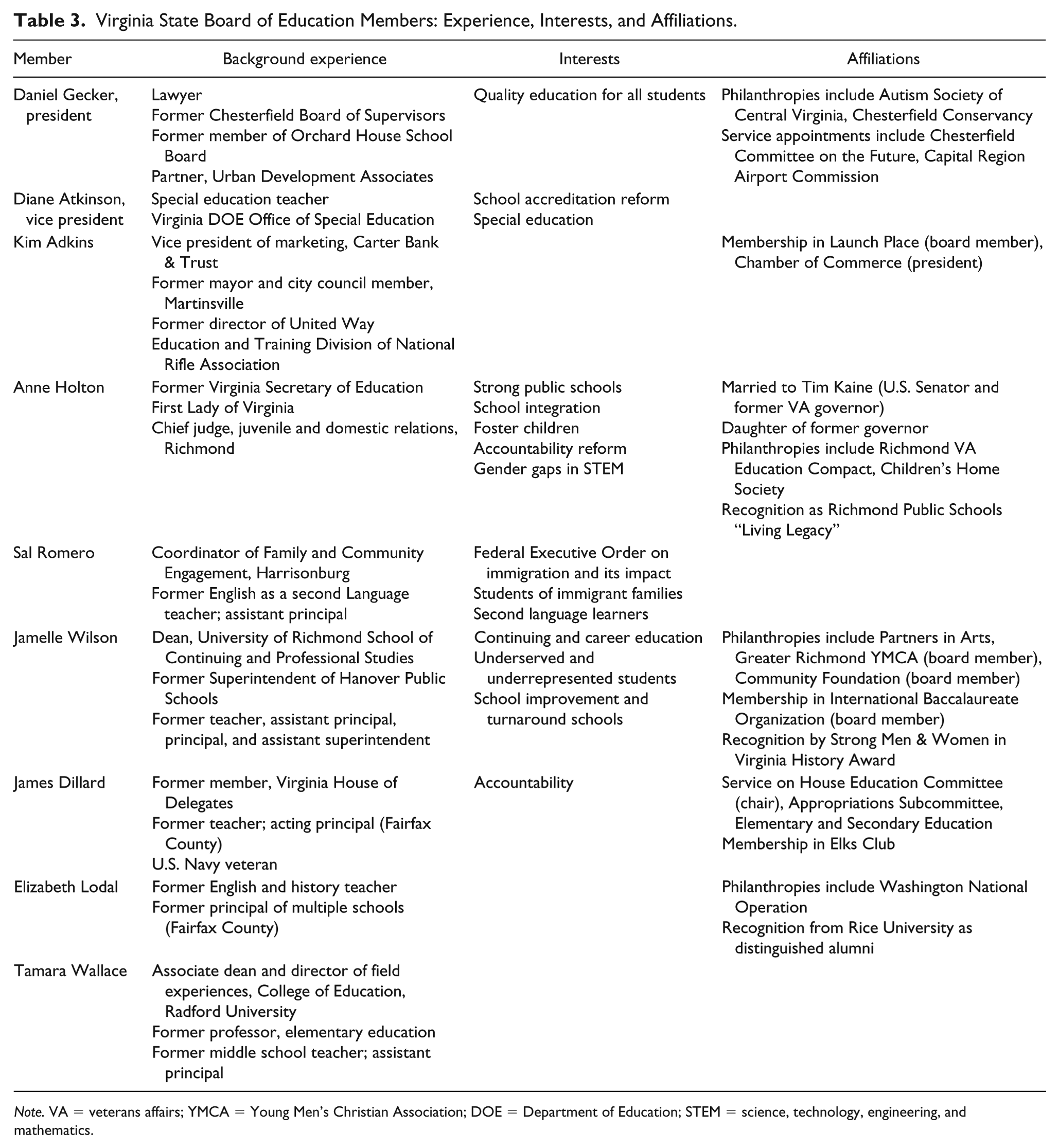
Note. VA = veterans affairs; YMCA = Young Men’s Christian Association; DOE = Department of Education; STEM = science, technology, engineering, and mathematics.
The VSBOE holds eight public meetings per year at the office of the Superintendent of Public Instruction in Richmond. Both the location and procedures for providing public comment limit public participation. The board also holds nonpublic meetings, including work sessions, which are recorded and archived online, and advisory committee and standing committee meetings.
An overwhelming amount of the board’s meeting agendas is taken up with routine reviews of required reports about the conditions of schools, the state’s comprehensive education plan, school accreditation (process and outcomes), standards of learning (reducing the number of tests students are required to take), standards of educator quality, school opening dates (countermanding the “King’s Dominion Law” by allowing schools to open prior to Labor Day), course content and assessment, and the approval of teacher education programs (continuing and new). There is some movement in other areas (e.g., school climate and culture), but their meeting time is limited. Like other bureaucratic entities, the board is shaped and constrained by formal procedure in many ways, which both intentionally and unintentionally prevents the board from addressing other more potentially controversial matters.
The VSBOE almost always acts as a unified whole. In reviewing meeting minutes for the last 2 years, motions nearly always passed unanimously or with one member abstaining (generally due to conflict of interest), but there were no instances of dissent. If there is any disagreement among members, it did not occur during public meetings. Consequently, the general public functionally has no access to the discourse of the VSBOE when it is actually malleable and only sees policy discourse after the fact via official documentation. Compared to other states, such as Florida and Texas, the VSBOE receives relatively little media attention. This is likely due to the apparent absence of conflict and the highly controlled flow of information from the VSBOE to the general public.
Beneficiaries of the VSBOE’s recent work include those in favor of reducing the number of standardized tests and revising accreditation requirements to account for student growth. Despite Virginia’s history, the board appears to avoid potentially controversial issues relating to race and social justice. For instance, meeting minutes included no mention of the KKK (Ku Klux Klan) or Unite the Right (White Supremacist) rallies held in Charlottesville in July and August of 2017 during any of the meetings following these events, despite their significant influence on parents, families, and communities as well as one of the VSBOE’s former board members, Wes Bellamy, who lives in Charlottesville.
Texas’s SBOE
The statutory authority for the Texas state board (TSBOE) comes from the Texas Constitution, and its responsibilities are delineated in Title II of the Texas Administrative Code (2018). The TSBOE oversees the Texas Education Agency and is granted authority over 34 different responsibility areas, including curriculum standards, instructional materials, graduation requirements, the Texas Permanent School Fund, appointment of board members to special school districts, review of the rules proposed by the State Board for Educator Certification (SBEC), and approval of new charter schools. Although policy decisions are made by the entire board, three standing committees conduct most of the substantive work. The Committee on Instruction focuses on curriculum and instruction, student testing, special education programs, and alternatives to social promotion. The Committee on School Finance focuses on issues concerning the Permanent School Fund and school funding. The Committee on School Initiatives focuses on appointing board members to military, reservation, and special school districts and rules proposed by the SBEC.
The Texas Administrative Code (2018) required that TSBOE have 15 members elected from single-member districts to staggered 4-year terms. If a position on the board becomes vacant, the governor fills the vacancy. The governor also appoints one member to chair the board along with appointing the chief state school officer. As such, Texas represents a mixed model, wherein the SBOE members are elected, but the governor appoints the chief state school officer (McCarthy et al., 1993). TSBOE members are elected through partisan elections, with each district consisting of around 1.8 million Texans. As of this writing, the board is made up 10 Republicans and five Democrats.
Eligibility to run for a seat on the TSBOE includes being at least 26 years of age and a resident and qualified voter of the district. Registered lobbyists are ineligible. Like Florida and Virginia, the TSBOE does not represent the diversity of the state. As of this writing, the board counts seven men and eight women; 10 are White (67%), four are Hispanic (27%), and one is Black. In comparison, 45.3% of the Texas population is non-Hispanic White, 37.6% is Hispanic, 11.8% is Black, 3.8% is Asian, and 0.7% is Native American. As Table 4 shows, the current TSBOE members represent the legal, political, business, and education communities. Of the 15 members, six are current or former education professionals. Table 4 also presents an overview of each board member’s background experience, interests, and affiliations.
Texas State Board of Education Members: Experience, Interests, and Affiliations.
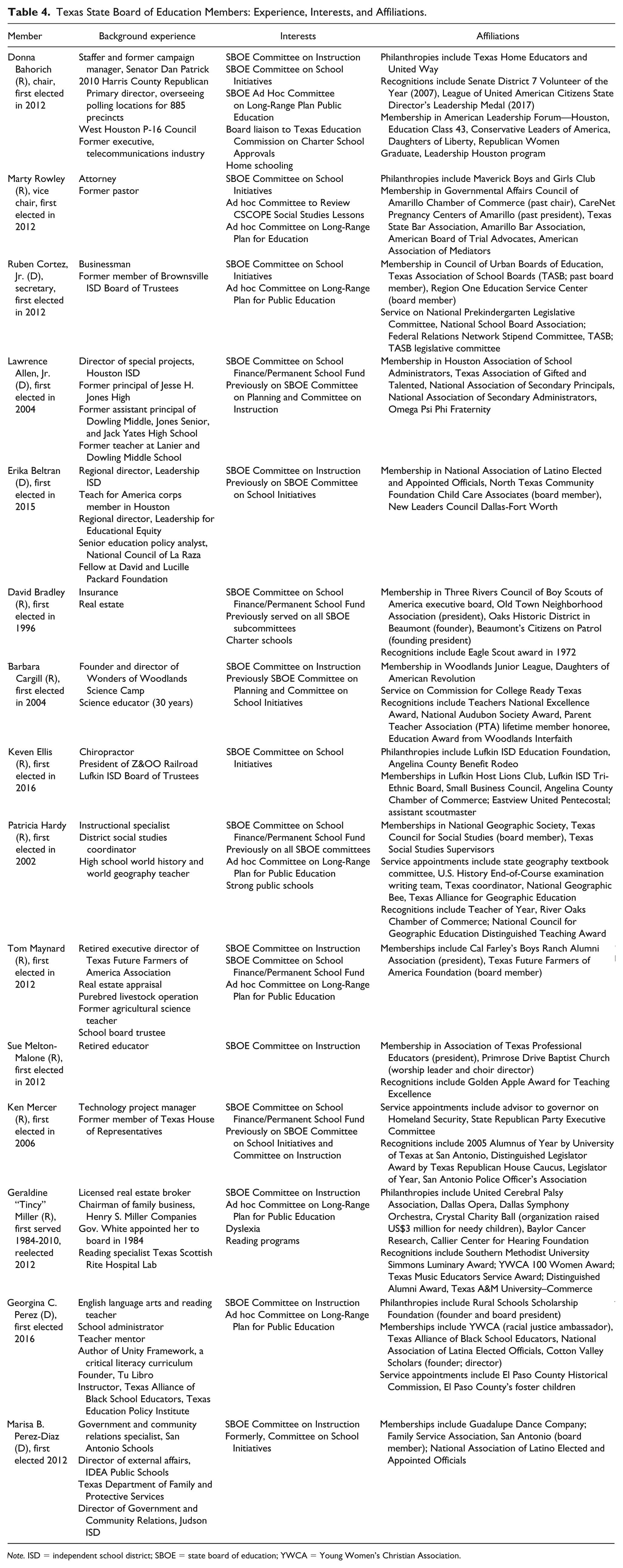
Note. ISD = independent school district; SBOE = state board of education; YWCA = Young Women’s Christian Association.
The TSBOE is required to meet at least quarterly and holds its meetings in the William B. Travis State Office Building in Austin, which also houses the Texas Education Agency. Each meeting is open to the public except for executive sessions restricted to specific topics by law, and anyone wanting to testify in front of the board may do so after submitting a public testimony registration form. The work of the TSBOE reflects its list of responsibilities delineated above, though it is best known for its controversial work on curriculum standards and the review and approval of instructional materials.
Travel to Austin from many parts of Texas is inconvenient (up to an 8.30-hr drive for some residents), which limits participation. Nonetheless, the board’s work on science and social studies standards garnered a significant amount of attention within and outside the state. In 2016, for example, the board created a panel to review the Texas Essential Knowledge and Skills for science to streamline high school biology standards. In the process, controversy erupted over four standards added by the board in 2009—despite objections from the scientific community—that reflected a creationist perspective, including Standard 7B, which involves the “sudden appearance” of life on Earth, and Standard 7G, which suggests the role of intelligent design in the “complexity of the cell” (Texas Administrative Code, 2018, §112.34[c][7]). The four additions were either proposed or supported by former SBOE member Don McLeroy, then chair of the TSBOE who had strong ties to Probe Ministries, an organization that supports the integration of the Christian faith into daily life.
The work of the TSBOE on curriculum issues tends to reflect the interest of the board members, not teachers or students. Over the last few decades, the TSBOE has been represented by a majority of social and/or religious conservatives. However, as board membership shifts, so have positions on standards and instructional materials. The development of the science standards review panel, for example, was taken up as fewer conservative Christians were elected to the board, and the board’s recent decision to create statewide standards for classes on Mexican American studies also reflected changes to the make-up of the board. The press for a statewide course on Mexican American studies began as early as 2013, but was denied until 2018 when the board voted nearly unanimously to create curriculum standards for the elective class “Ethnic Studies: An Overview of Americans of Mexican Descent.”
Beneficiaries of the TSBOE’s recent work include those in favor of more socially conservative curriculum standards. Although the TSBOE is currently experiencing increasing political equilibrium, any upcoming election could result in a “return to culture wars” (Swaby, 2018).
Discussion
In this study, we investigated the SBOEs of Florida, Virginia, and Texas and documented their authority, membership, and work. In this section, we explore the implications of our findings, focusing in particular on what they suggest about the role of SBOEs in representing the general public and influencing the public education system.
As Henig (2012) noted, who governs is “not important for its own sake. It is important because it affects who has influence over what governments do and how they do it” (p. 119). Through our research, we learned that none of the three SBOEs reflects the demographics of their states particularly well. Furthermore, only two of the SBOEs had members with professional education backgrounds; the FSBOE did not include a single individual with professional public school experience, even though the primary responsibility of these SBOEs is to support the quality of public education in their states.
According to NASBE (2015), a key SBOE role is fostering relationships and two-way communication between education and others, making SBOEs a point of access to education policy making for a vast array of interests. Who and what interests board members appeared to represent differed from state to state. In Florida, we found that board members represented the legal, political, and business communities and several had specific interests in alternatives to public education and traditionally prepared teachers. Most of the FSBOE members appeared to share a discourse combining “enterprise, strategic philanthropy, leadership, partnership, and concerns around equity and opportunity” (Ball, 2017, p. 30). In Virginia, we found that board members represented the legal, political, business, and education communities, with five of the nine current members having substantial public education experience. In Texas, the board represented the legal, political, business, and education communities, one third of whom had education experience.
Importantly, some of the boards in each state are connected to deep and powerful business and/or political networks, locally and nationally. For example, VSBOE member Ann Holton is the wife of U.S. Senator Tim Kaine, a former Virginia governor and vice presidential nominee with Hillary Clinton in the 2016 presidential election. Daniel Gecker and Kim Adkins of Virginia recently ran for election to national offices. In Texas, Donna Bahorich, Ken Mercer, and Geraldine “Tincy” Miller have strong connections with the Texas Republican Party. About two thirds of the members of the FSBOE are well connected politically, many with direct connections to Governor Scott and several serve on conservative think tank boards.
Their activities, as diffuse as they are, bring together or assemble ideas, modes of expression, and motions. Such assemblages contribute to the emergence of an infrastructure of a “shadow state” (Wolch, 1990), that can incubate, disseminate, and exchange ideas—teacher certification and training, school leadership, assessment . . . over and against the language of more traditional forms of government and support, facilitate and legitimate the activities of non-state actors. (Ball, 2017, p. 39)
In Virginia and Texas, where SBOEs show greater disparity among the degree of power and influence of members, some voices on the board likely carry more authority than others. In addition, in Texas, where there are no term limits for board members, longevity may play a role in board members’ influence. Geraldine “Tincy” Miller has served on the TSBOE for over 32 years, and David Bradley has served for over 21 years.
How much influence SBOE members have on public education in the state depends to some degree on the level of authority and responsibility granted to the board. Analyses of McCarthy and colleagues’ (1993) four SBOE governance models have suggested that some models were associated with higher SBOE influence—in particular, those SBOEs that were elected or had the authority to appoint the chief state school officer were considered to have greater power and influence. In Florida and Texas, the SBOE wields a significant source of influence over public education. The work of board members in these two states can dramatically alter the resources available to public education, what educators are authorized to teach in their classrooms, and how educator performance is measured. For example, the curriculum standards and instructional materials approved by the TSBOE determine what the 5.4 million students in the state will learn. The same cannot be said for Virginia, though, where the board’s scope of influence is less robust.
Given these differences in SBOE authority, the influence of individual board members such as Ann Holton in Virginia may not make much difference with regard to public education in Virginia; however, in states such as Florida and Texas, the voices of the more politically connected or those with greater longevity may make a significant difference on the policy work of the SBOE and its influence on public schools. What these individuals care about and what and whom they pay attention to has ramifications for states’ schools, students, and educators.
The commonalities and differences we identified across the three states provide a basis for further research. Although debate over which governance model is best has existed as long as SBOEs (Timar, 1997), the question warrants further investigation, particularly if the question is posed as, “Which governance model is best for public education?” In addition, the depth of publicly available information about board members varied. The VSBOE members, for example, were generally absent from social media in terms of public profiles and the work of the VSBOE has not attracted a great deal of media attention. In future studies, we plan to conduct interviews with board members to gain further insight into their work, interests, connections, and roles within larger networks, particularly education policy.
Conclusion
Although the work of states has been critical to U.S. K-12 education, educational research largely has overlooked SBOEs. By examining how SBOEs operate, their make-up, and degree and areas of authority, we have provided initial insights into these organizations. Furthermore, by examining the work of the SBOE and the interests of its members, we are able to provide insight into their influences on policy making.
According to Skelcher (1998), the state is becomingly increasingly congested by a fragmented array of actors, organizations, and agencies involved in governance and the service provision. Individual board members and the interests they represent, “enlarge the range of actors involved in shaping and delivering policy” (Newman, 2001, p. 125). Artifacts, schemes, propositions, and “programmatic ideas move through these network relations, gaining credibility, support and funding as they do so” (Ball, 2017, p. 39).
The role of SBOEs as policy actors raises important questions about the exposure of the policy-making process to increasingly complex and opaque games of power and influence (Ball & Junemann, 2012). Through the three state cases presented in this article, we gained an emerging sense of SBOEs and their members as policy actors and how their political rationales and subjective beliefs became both the cause and effect of transformative processes in state education policy (Ball & Junemann, 2012), and we lay a foundation for future research exploring SBOE member networks and their influence and role within the larger education policy network.
Footnotes
Declaration of Conflicting Interests
The author(s) declared no potential conflicts of interest with respect to the research, authorship, and/or publication of this article.
Funding
The author(s) received no financial support for the research, authorship, and/or publication of this article.
