







Abstract
The institutional environment of U.S. school systems has changed considerably over a quarter century as standards and test-based accountability became central ideas in policy texts and discourses about improving education. We explore how U.S. school systems are managing in this changed environment by focusing on system leaders’ sense-making about their environments as they attempt to build educational systems to improve instruction, the core technology of schooling. We identify the policy texts and discourses system leaders notice and their framings, interpretations, and uses of these cues as they build educational infrastructures to support more coherent instructional visions. We argue that school systems’ educational infrastructure building efforts were intended at coupling their systems’ formal organization with particular environmental cues in an effort to influence classroom instruction. In turn, we argue that these educational infrastructure building efforts can simultaneously be motivated by, and in pursuit of, institutional ritual and technical rationality.
Keywords
Introduction
Over three decades, the standards and accountability movement has contributed to something of a transformation of the environment in which U.S. school systems operate. Policy-makers, professional associations, school reformers, researchers, popular media, and philanthropists pressed for common learning standards and accountability based on student achievement; these ideas became commonplace in conversations about improving instruction. With its origins partially in systemic reform, the standards and accountability movement sought to do at least two things (Smith & O’Day, 1991): First, to bring more coherence to the policy environment in which U.S. public school systems operate by defining learning and performance standards for all students, creating assessments to measure student mastery of these standards, and holding school systems and schools accountable for student performance on those assessments. Second, to incentivize public school systems to build and leverage more coherent educational infrastructures to support instruction anchored in these learning standards.
Most research on the standards and accountability movement has focused on particular policies, such as No Child Left Behind (NCLB) and suggests that these policies influence, among other things, what teachers and school leaders do, including marginalizing low-stakes school subjects, diverting resources to students on the cusp of passing state tests, and spending time teaching test-taking skills (Amrien & Berliner, 2002; Booher-Jennings, 2006; Darling-Hammond, 2004; Firestone, Mayrowetz, & Fairman, 1998; Jacob, 2005; Nichols & Berliner, 2007; Smith, 1998; Spillane, Halverson, & Diamond, 2004; Valenzuela, 2005; Wilson & Floden, 2001). Some evidence suggests that high-stakes testing has increased student achievement though tremendous variation that exists between states, and little evidence suggests that the achievement gap has narrowed (Jacob, 2005; Mintrop & Sunderman, 2009; Neal & Schanzenbach, 2010). A common theme across these studies is that school systems are heeding the standards and accountability policies and ideas.
One “outcome” of the standards movement that has received less attention from researchers is its contribution to educational system building, that is, an effort to shift toward instructionally focused school systems that engage centrally with guiding and supporting the educational work of schools by defining instruction and delegating responsibility to various system actors for organizing and coordinating instruction (Cohen, Spillane, & Peurach, 2018; Peurach, Cohen, Yurkofsky, & Spillane, 2019). Some studies document how local school districts are attempting to build such educational systems by (re)designing their educational infrastructures (Austin, Grossman, Schwartz, & Suesse, 2006; Cohen & Moffitt, 2009; Cohen, Peurach, Glazer, Gates, & Goldin, 2013; Cohen, Spillane, & Peurach, 2018; Johnson, Marietta, Higgins, Mapp, & Grossman, 2014; Polikoff, 2015; Polikoff & Porter, 2014; Spillane, Hopkins, & Sweet, 2015; Spillane, Shirrell, & Hopkins, 2016; Weast, 2014). By educational infrastructure, we mean the roles, structures, and resources that school systems use to coordinate and support instruction, maintain instructional quality, and enable instructional improvement. Educational systems attempt to coordinate designing and building educational infrastructure, support the use of educational infrastructure in school and classroom practice, and manage educational infrastructure and its use in an effort to improve quality and reduce disparities in students’ educational opportunities.
Based on a comparative study of three public, one private, and two hybrid (i.e., both public and private) school systems operating in the United States, we build on and extend this research on the educational system building attempts of school systems in the standards and accountability era. Our paper is based on an analysis of data of six school systems that were engaged in educational system building. For convenience and readability, we simply refer to the six as school systems but in doing so we mean that they were engaged in educational system building, differentiating them from school systems that are not engaged in educational system building efforts (for further elaboration, see Peurach, et al., 2019). We frame school systems as open systems that rely on the environments in which they operate for legitimacy and resources essential to their survival from students to funding. Specifically, we explore the interplay between school systems’ efforts to manage their environments, organize to support instruction, in an effort to improve instructional quality. To do so, we examine how school system leaders make sense of and use materials from their environments to build and justify system-level educational infrastructures for supporting elementary English Language Arts (ELA) instruction.
Our findings are 3-fold. First, we show how system leaders use materials from their environments, especially standards and accountability related texts and discourses, when attempting to (re)design their educational infrastructures to support more coherent visions for instruction and demonstrate how their educational infrastructures supported such coherent visions. Second, although standards and accountability related texts and discourses figured prominently in all six systems, system leaders’ sense-making about their environments differed as they noticed and used other policy texts and discourses in relation to their environmental cues. These findings contribute to ongoing conversations in the “inhabited institutionalism” and sense-making traditions, by showing how system leaders make sense of and combine different policy texts and discourses in their environments in ways that address their needs and concerns. Third, we show how system leaders’ sense-making was situated in their system’s organizational identity, demonstrating that their efforts to (re)build educational infrastructures prompted fundamental questions about their system’s organizational identity. In doing so, we theorize coupling as a process by showing that school systems’ responses to changes in their environments can be both technically rational and ritualistic at the same time.
In what follows, we begin by framing our work and then describe our research approach. Next, we present our findings, developing and supporting three interrelated assertions based on our data analysis. We conclude by discussing our findings, arguing that research on relations between environments, school system organizations, and instruction must cast wider nets rather than focusing on single policy texts (e.g., Common Core State Standards) or discourses, and must attend to different school systems operating in similar environments.
Theoretical Framing
To theorize relations among school systems’ efforts to organize for instruction and manage the environment in which they operate, we use three constructs from organizational theory. First, we use the construct of coupling to motivate our study of relations among school system organization, their environments, and instruction. Second, we adopt a sense-making perspective to frame how system leaders manage and respond to their environment, attending to what policy texts and discourses they notice and how they bracket, interpret, and use these in their efforts to organize to support instruction. Third, we situate system leaders’ sense-making using the concept organizational identity, to capture how school systems’ efforts to build educational infrastructures raised fundamental questions about their systems’ identities.
Coupling: Managing Environments and Organizing for Instruction
School systems, like most organizations, must manage their environments because they depend on them for key resources—from their legitimacy to provide schooling, to clients and funding. Many school systems also depend on their environments for an array of educational resources critical to their operation including teachers and other professional staff, curricular materials, student assessments, teacher evaluation procedures, and so on. Coupling has become a key construct in scholars’ arsenal for framing relations among school organizations and their environments in relation to their core technical work—instruction. Neoinstitutional scholars use the construct of “coupling” to capture how organizations are made up of interdependent elements that are more or less responsive to, and more or less distinctive from, each other (Bidwell, 1965; J. W. Meyer & Rowan, 1977, 1978; Orton & Weick, 1990; Weick, 1976).
Although “elements” can refer to many things, in education research, much attention focuses on the loose coupling or decoupling of the core technical work of schooling with both the environment (Weick, 1976) and the organization’s formal structure (J. W. Meyer & Rowan, 1977). Research on school systems in the United States, albeit mostly public school systems, has focused on how schools and school systems tend to decouple or loosely couple instruction from their formal organization and their environment, especially government policies that attempt to guide instruction. In this way, school systems can manage external interference and threats to their legitimacy by ritualistic or ceremonial responses intended to buffer their core technical work from external surveillance (J. W. Meyer & Rowan, 1977).
At the same time, scholars allow for the possibility of tight coupling in the educational sector, recognizing that institutional sectors are not immutable (DiMaggio & Powell, 1983; Rowan, 2002; Rowan & Miskel, 1999). Some scholars hypothesized that the emergence of a more elaborate technical environment in the education sector, such as seen over the past several decades with ever-increasing government policy efforts to standardize instruction, would contribute to changing relations between the institutional environment and the school organizations as it relates to instruction (H. D. Meyer, 2002). They predicted that as the institutional environment “becomes more unitary and as rules about work in the technical core become more specific” and “get attached to outcomes or other inspection systems,” the environment would have a stronger effect on work activity in schools (Rowan & Miskel, 1999, p. 373). The standards and accountability movement, as captured in policy texts and discourses, represents the emergence of a more elaborate technical environment in the education sector (Rowan & Miskel, 1999).
Allowing for shifting institutional environments, some scholars argue for attention to coupling as a process rather than a static feature of relations between organizations and their environment: “something that organizations do, rather than merely as something they have” (Orton & Weick, 1990, p. 218; see also Burch, 2006; Coburn, 2004; Hallett & Ventresca, 2006; Sauder & Espeland, 2007). To understand coupling as a process, it is necessary to move beyond focusing on the outcomes of organizations’ interactions with their environment, that is, the practices that organizations adopt in response to their environment. Rather, attending to how organizational members make sense of their environments is essential to better understand how the environment influences, or not, organizational practice (Suddaby, 2010). To that end, we adopt a sense-making framework.
A Sense-Making Framework
Although “interpretation” and “sense-making” are often used interchangeably, sense-making encompasses interpretation. Whereas interpretation takes the object to be interpreted as given, sense-making includes not only the interpretation of cues but also noticing and bracketing them; it is as much about “authoring” as it is about “interpretation” (Weick, 1995, p. 8). Encountering situations of ambiguity, uncertainty, change, surprise, or discrepancy that interrupt ongoing flows of experience and automatic processing, organizational members extract some cues from their environment in an effort to clarify what is going and reconstruct their understandings of their situation (Weick, 1995). Inundated with stimuli from their environments, individuals tend to notice cues that are relevant to their experiences and situations, and through this process of selective attention, they are able to maintain a certain level of cognitive efficiency (Spillane, Reiser, & Reimer, 2002). Extracting, bracketing, and interpreting cues from their environment, organizational members use these cues as the basis for constructing a plausible account that orders and “makes sense” of their experiences and through which they continue to enact the environment (Brown, 2000; Maitlis, 2005; Weick, 1995; Weick, Sutcliffe, & Obstfeld, 2005). A sense-making perspective, therefore, analyzes what people notice in their environments and how they frame, interpret, and respond to these cues.
Scholars working in the inhabited institutional tradition argue for attention to how organizational members use environmental materials to negotiate meanings about their work in their everyday practice that in turn can reproduce and/or transform organizational practice (Binder, 2007; Hallett, 2010; Scully & Creed, 1997). Pressing for an “inhabited institutionalism,” these scholars argue for a reframing of the ways we conceptualize the relations between organizations and environments, which surfaces how organizational members negotiate meanings through the use of texts and discourses (Binder, 2007; Hallett & Ventresca, 2006). Inhabited institutionalism argues that institutions and individuals mutually constitute each other. Institutions “function reciprocally from the ground up and the top down, as people actively construct the meaning of legitimate action via local interactions in ways that are enabled and constrained by the structured conditions of their environments” (Everitt, 2018, p. 12). Thus, inhabited institutionalism frames individuals as actively making sense of and interpreting cues from their environments and negotiating the meanings of legitimate action through local interactions (Binder, 2007; Everitt, 2018; Hallett & Ventresca, 2006). Organizational members’ sense-making is situated in their everyday work practice in organizations.
Situating Sense-Making About the Environment in Organizational Identity
Motivated by plausibility rather than accuracy, sense-making is enactive of sensible environments, ongoing, and focused on and by extracted cues; it is also grounded in identity formation and the maintenance of a consistent positive self-conception (Weick, 1995). Although Weick (1995) attends to individual identity, in this article, we extend that notion to organizational identity arguing that system leaders’ sense-making about their environment is situated in their school system’s organizational identity. Organizational identity refers to those characteristics that organizational members believe to be central, distinctive, and enduring about their organization (Albert & Whetten, 1985). An organization’s identity differs from an organization’s image, which refers to how organizational members believe others view the organization. It also differs from organizational brand, or the image of the organization that managers present to stakeholders and the public writ large (Gioia, Schultz, & Corley, 2000). Instead, organizational identity refers to “those attributes that members feel are fundamental to (central) and uniquely descriptive of (distinctive) the organization and that persist within the organization over time (enduring)” (Albert, Ashforth, & Dutton, 2000, p. 20).
Organizational identity speaks to the essence of an organization and also draws attention to how organizational members’ sense-making about their environment is situated (Albert et al., 2000). It captures how an organization situates itself vis-à-vis the environment in which it operates and helps explain one means by which organizational members, in our case system leaders, act on behalf of their organization. Although organizational identity centers on what organizational members believe to be central, distinctive, and enduring about their organization, it is also contested and negotiated through interactions among organizational members with one another and organizational stakeholders (Scott & Lane, 2000).
Educational policies that attempt to direct and guide the core technical work of education systems are an especially important consideration in school system leaders’ situated sense-making about their environment. We frame policy as both “texts” and “discourses” (Ball, 1993, 2006), so we can distinguish between particular policies (e.g., Common Core State Standards, NCLB) and broader policy discourses (e.g., standards, accountability, equity, evidence-based decision making). The concept of policy as text attends both to policy-makers’ encoding of representations of ideas in policy documents through negotiation and how these texts are decoded and used to negotiate meaning in sense-making (Ball, 1993; Coburn, 2001b; Cohen, 1990; Cohen & Weiss, 1993; Spillane, 2004). Furthermore, policy texts such as the No Child Left Behind Act, become inscribed into a variety of other texts or technological artifacts such as curriculum, student assessments, and teacher evaluation protocols (Koyama, 2013; Pierce, 2015b; Spillane, 2004; Spillane et al., 2002). Meanings are not buried in texts for readers to find; rather readers negotiate the meanings of policy texts for their practice in interaction with one another using these texts (Coburn, 2001; Spillane, 2006).
Creating frameworks in which policy texts are situated, policy discourses refer to systems of practices, beliefs, and values outlining what is acceptable, “obvious, common sense, and ‘true’” (Ball, 2008, p. 5). Producing “frameworks of sense and obviousness with which policy is thought, talked, and written about” (Ball, 2006, p. 44), these discourses shape how policy is not only developed and worked out but also made sense of, negotiated, and disputed in schools and school systems. In this way, policy texts both reflect policy discourses and contribute to defining those discourses as they validate and reinforce some ideas and ignore others. The everyday, taken-for-granted discursive repertoires used to talk about, design, and justify approaches to improving education structure school and school system actors’ thinking about education and its improvement, excluding other ways of diagnostically and prognostically framing the work of educational improvement (Trowler, 1998). As such, a focus on policy discourses draws attention to a network of practices, beliefs, and values that undergird policy texts and reform more broadly.
Motivated and framed by our theoretical tools, our main research question is as follows: How do different school systems operating in the United States manage their environments as they organize to improve instruction in the standards and accountability era? To answer this question, we ask two other questions: How do school system leaders make sense of their environment related to their work about instruction? How, if at all, are they responding to their sense of the environment in their efforts to influence classroom instruction?
Research Approach
Our qualitative, theory building program of research used a comparative case study design involving six school systems engaged in educational system building that were sampled to maximize variation on school system type—private, public, and hybrid (both private and public)—as well as national and transnational systems. The systems are Association Montessori International (AMI), International Baccalaureate (IB; both are hybrid 1 and transnational systems), Catholic (private system), suburban, urban, and a public charter network that follows the “no excuses” model. 2 Although our initial research design involved sampling six different school systems operating in roughly the same local environment, due to access to school systems, we ended up with one school system (AMI) in another U.S. state and another school system (Urban system) in the same state but different metropolitan part of that state.
Data Collection
Initially, we reviewed the empirical literature on our six focal school systems using ERIC and other search engines, reviewing articles for relevancy and then synthesizing findings from all relevant articles (see also Peurach, Cohen, Yurkofsky, & Spillane, 2019). Next, the research team developed interview and observation protocols that focused on how systems define, design, and manage instruction and instructional improvement. We systematically reviewed organizational charts for each school system and selected initial system-level actors who could speak to the design and support of instructional practices, particularly those overseeing curriculum and instruction for elementary ELA. We then revised the participant list using snowball sampling to select nine to 19 participants per system. The numerical variance is related to the system organization, in particular of our two transnational systems (AMI and IB) that required interviews at multiple levels of their organizations, located both within the United States and internationally. 3
Data collection took place between 2016 and 2018. We conducted interviews in each of the six systems about their work related to instructional practice and improvement. Our data include 71 interviews with system-level actors as well as observational field notes of system-level events for each system and selected follow-up interviews. Participating system leaders included district superintendents and directors of special education, human resource management, teacher recruitment and development specialists, directors of curriculum and instructional development, and so on. Semistructured interviews with system leaders focused on system priorities, organizational structure and relationships, instruction, and instructional improvement.
Observations were focused on system-level professional development sessions. For example, the Catholic site visit included a three-day principal training program while the Suburban site visit included one day of district-wide, back-to-school leadership session. We identified these events and meetings in cooperation with system-level leaders, with the explicit goal of observing a routine or procedural session coordinated and facilitated by system-level leaders. Research team members recorded field notes while in attendance at the session and promptly transferred observations electronically along with personal reflections on the observed session. These field notes, as well as institutional documents collected from system-level leaders, provided triangulation for emerging themes, allowing the research team to consider not only the policy texts and discourses referenced and utilized by system leaders but also the material influence the discourses had in attempts to align instructional improvement with the system’s educational infrastructure.
Analysis
The data collection and analysis were integrated, allowing the research team to identify patterns and working hypotheses as they emerged from the data while refining data collection strategies as the study progressed (Miles & Huberman, 1994). For our primary data analysis, we used both deductive and inductive coding (Miles, Huberman, & Saldaña, 2014). First, we deductively coded our interview data using three broad codes (instruction, educational infrastructure, and managing environments) and 22 subcodes (e.g., designing and guiding, recruitment, and retention) developed from our conceptual framework (Cohen, Spillane, & Peurach, 2018). After establishing interrater reliability, the research team coded deductively, using our conceptual framework as a codebook. For the purpose of this article, we generated reports among specific environmental relationships, for example, between school systems, between the system and families/students via recruitment and retention of students, and a broad category of “other” that captured remaining environmental elements. These elements included policy discourses and texts, economic and geopolitical context, external system partnerships, and community relations in regards to funding.
Next, the three authors deductively coded the reports to identify common environmental components across the six systems as well as differences between them, and their interaction with organizational infrastructure (re)design in support of instructional coherence. In this initial round of open coding, we identified environmental factors implicated in system leaders’ work around developing educational infrastructure; this prompted a closer examination of how system leaders understood the connections between their environments and the work of developing educational infrastructure to support instructional improvement. At this stage of analysis, our initial hunches were reexamined through a subcoding process within the environment parent code. This data reduction process enabled the development of subcodes associated with particular components of infrastructure identified across systems: professional development, student assessment, staff evaluation, routines/procedures, instructional materials, recruitment, communication, and cognitive/norms. Despite various differences in policy environments across systems, emergent themes illustrated the broad reach of particular policy discourses, specifically standards and accountability. Our analysis remained closely tied to participant wording, thus this inductive approach favored a nuanced identification of policies influencing infrastructure (re)design within and across systems instead of isolating specific policies following a deductive framework.
The policy discourses identified within and across these six systems included standards, accountability, equity, evidence-based decision making, teacher work conditions, teacher development, community, market-driven, compliance, and academic excellence. As detailed in Appendix C, the standards discourse and the accountability discourse (often, though not always coded together) were prevalent across system leader interviews; however, a teacher development discourse was also prominently identified. Some system leaders utilized discourses that others did not or did so less frequently, capturing that although the six school systems operate in roughly similar policy environments and were largely influenced by standards and accountability discourses, their sense-making about their environment was situated in their particular organizations.
Findings
Based on our analysis, we develop and support three interrelated assertions about school system level efforts at managing their environment and organizing to support instruction. First, we show how standards and accountability related texts and discourses figured prominently in system leaders’ sense-making about their environment in all six systems, though they did not figure alone. Second, we show that even when using standards and accountability texts and discourses in (re)building their educational infrastructures, system leaders were also attending to other texts and discourses. In this way, system leaders’ sense-making about their environment differed depending on the school system. Arguing that school systems’ educational infrastructure building efforts were attempts at coupling environmental pressures related to the technical core with their organizational structure, and intended to influence classroom instruction, we develop our third assertion. Specifically, we argue that system leaders’ educational infrastructure building efforts could be construed as both technically rational and institutionally ritualistic by showing how system leaders’ sense-making about their institutional environments was situated in their school system’s organizational identity.
Noticing and Using Standards and Accountability Texts and Discourses: Educational Infrastructure (Re)Building
The standards and accountability movement, broadly construed, featured prominently in system leaders’ sense of their environments, although the particular standards and accountability cues that system leaders referenced differed by leader and school system. Leaders in all six school systems referenced standards and accountability texts and discourses in talking about their work (not always combined), though the number of system leaders per system who used these texts and discourses varied. Within each school system, the percentage of leaders who referenced standards policy texts or discourses are as follows: IB (64%), Charter (64%), Catholic (60%), Urban (45%), Suburban (33%), and AMI (10%). In addition, the percentage of leaders who referenced accountability texts or discourses are as follows: Charter (73%), Urban (54%), Catholic (50%), IB (36%), Suburban (33%), and AMI (0%).
Noticing and using various material from their environments, system leaders were managing their environments and responding by attempting to (re)build their educational infrastructures to support more coherent visions for instruction. Appendix Table C1 shows the percentage of leaders in each system who invoke policy discourses when discussing cues from their environments that guide their educational infrastructure building efforts. Across systems, system leaders most commonly invoked the following discourses in connection with their efforts to build their educational infrastructures: Standards (42%), Accountability (37%), Teacher Development (30%), and Academic Excellence (30%).
Not only were system leaders noticing standards and accountability texts and discourses, but they were also using these materials from their environment in (re)building their educational infrastructures to support more coherent visions for instruction and, in the case of the two hybrid systems, to justify existing educational infrastructures. These educational infrastructure building efforts were attempts at coupling aspects of their environments related to instruction with their school systems’ formal organization and instructional practice and typically focused on some combination of the following components: learning standards/goals, curriculum and instructional materials, student assessments, professional development, staff recruitment, staff evaluation procedures, organizational routines, and communication (both internal messaging and external advocacy).
Educational infrastructure building was not confined to the three public school systems. The Catholic system was also building an educational infrastructure, using standards and accountability texts and discourses, to support instruction in core school subjects. Over half of the Catholic school system leaders pointed specifically to the Common Core State Standards (CCSS) policy texts when talking about their efforts to build several components of their educational infrastructure including instructional materials, student assessments, and professional development. As noted above, over 60% of Catholic system leaders used standards-related discourses in talking about their educational infrastructure rebuilding efforts (see Appendix Table C1).
Expanding into the U.S. public school market, system leaders in both AMI and IB were also attending to standards and accountability texts and discourses to demonstrate how their elaborate educational infrastructures were consistent with elements of the standards movement, especially the CCSS. As both are transnational systems working across multiple countries with well-developed educational infrastructures anchored in coherent visions for instruction, their responses might be expected; however, it is a testament to the reach of both standards and accountability texts and discourses that leaders of global educational systems felt compelled to justify their particular visions for instruction as they entered the American public school market. Both AMI and IB system leaders worked at making the case that their existing educational infrastructures, including visions for instruction, were compatible with the standards movement, and in particular with the CCSS. For example, under the sponsorship of Association Montessori International/USA (2014) and their professional affiliate organization, the AMI Elementary Alumni Association, over 50 AMI teachers, trainers, consultants, administrators created a model AMI elementary curriculum mapped onto the CCSS. At the same time, whereas leaders in both systems were adamant about maintaining fidelity to their instructional missions, they also recognized the need to adapt their educational infrastructures in response to operating in U.S. public schools (Spillane, Peurach, and Cohen (2019)).
System leaders were not simply responding to things out there in their environment; they were using ideas, practices, and materials associated with the standards and accountability movement from their environment in negotiating meaning about instructional improvement and for (re)building and justifying their educational infrastructures to support instruction in core school subjects. For system leaders, the institutional environment was a critical source for essential raw materials for educational infrastructure (re)building.
Ideas, materials, and practices as resources for building educational infrastructures
Across systems, leaders used an array of ideas and practices related to standards and accountability texts and discourses, such as “report cards,” “rigor,” and “proficiency” in justifying and redesigning their educational infrastructures. System leaders also used materials from their environment related to the standards movement including student assessments, learning standards, lesson plans, and units in their efforts to (re)build their educational infrastructures. These materials embody ideas—particular ways of thinking about instruction and its improvement. A student assessment instrument, for example, embodies ideas about what it means to comprehend a text, what sorts of ELA skills are worth knowing, and what counts as mastery of the subject. Hence, as system leaders use these materials in (re)designing their educational infrastructures, the materials potentially discipline how and what they see and value and, in this way, may influence their work on instructional improvement. Similarly, the coherence and alignment of instructional programs, at least with respect to core school subjects, were prevalent ideas across the school systems. We use examples from four of the six school systems below to capture this pattern from our data analysis.
The Charter system—originally founded to respond to test-based accountability, firmly anchored in standards, and enabled by market-driven texts and discourses—designed an educational infrastructure using materials such as state student assessments, state standards, and state teacher evaluation instruments, as well as designing their own materials to support state standards. Moreover, responding to CCSS texts, the system redesigned its educational infrastructure using new assessments and standards. As one leader explained, the system used CCSS to define “foundational” academic content: In terms of the student foundational academic skills, I mean, we are hard core on the Common Core, right? We are always, “Is this actually meeting the standards of the Common Core, the released items from the state tests,” right? I think right now we’re using state tests as the bar. (D001)
Using CCSS and released items from state tests as a guide for what students should be able to do, Charter system leaders realized that both teacher practices and the nature of student work had to change. Yet, Charter system leaders reported being troubled by two pieces of data that came to their attention as the state shifted to the Common Core standards: their students’ scores on the new CCSS-aligned tests plummeted and their alumni were struggling to make it through college. One system leader described how the Common Core test score drop revealed their “problematic thinking” in “patting ourselves on the back and saying, ‘We’re doing great if we’re at 80 or 90 percent proficient on our state tests,’ when the state tests didn’t represent college readiness. That shoved that into our face.” She continued noting that around the same time system leaders had received enough data on alumni to confirm that 80% to 90% proficiency was a “false positive” because only around “40 percent of our kids were finishing a four-year college in six years” (D005).
For Charter system leaders, these two data points signaled a need to redesign their educational infrastructure to provide students with an education that prepares them to make it “to and through college,” a common refrain in interviews. The CCSS provided not only materials but also ideas about what students should know and be able to do at different grade levels to be college ready. As one system leader explained, redesigning their educational infrastructure to meet the demands of the Common Core “just felt right” because “our mission is for all of our students to have the skills to not just get to, but through [college]” (D009). Another system leader reported that the Common Core “forced” the system to rethink how they were preparing students to engage in higher-level thinking and do “real intellectual work . . . it really changed everything” (D005). Charter system leaders reported pulling in ideas from the Common Core about “college readiness,” a “high bar” (D004) or “pitching high” (D008). The Common Core and associated data related to student achievement and attainment triggered sense-making that prompted system leaders to (re)build their educational infrastructure.
The Charter system also used materials and practices from within both standards and accountability discourses in designing how teachers are evaluated and paid. A system leader explained how the system uses student achievement metrics based on state test scores as part of their teacher evaluation and career pathways system noting that “we’ve actually linked all of our student data specifically to the teachers who teach those children, and then we can measure the impact that that teacher had on that group of children” (D004). In this example, we see Charter system leaders using state assessment instruments to define teacher quality by building metrics to monitor the quality of instruction and design the teacher evaluation component of their educational infrastructure.
In the urban system, the Common Core had a similar influence on ideas, materials, and practices. Specifically, the test score drop associated with the Common Core signaled that We didn’t have enough rigor in elementary . . . We were feeling good. We were napping. We cared about feelings, but the rigor wasn’t there. When teachers first saw the curriculum for kindergarten and first grade they said, “They could never do that.” You talk to those teachers now. Kids do more than they ever thought kids could do. Kindergarten’s not the same kindergarten anymore. (E009)
For this system leader, the Common Core standards, as policy text, embody ideas, as policy discourse, about what instruction should look like at each grade level and signaled a shift in both teachers’ and leaders’ expectations of what students can achieve, particularly in the early grades.
The level of rigor set by the Common Core also influenced the redesign of the urban system’s educational infrastructure and expectations for teachers regarding instructional materials. For example, the urban district provides reading, writing, intervention, and enrichment materials, and a suggested cadre of supplementary resources, while discouraging the use of unvetted materials. One leader described trying to “wean people off” of using outside resources because they are usually “lower-level” and “not aligned to the Common Core.” The district purchased an online reading database that gives students a reading inventory matched to their Lexile levels, which, to this leader, means that those reading passages are “acceptable and kids can do that” (E003). Not only do urban system leaders pull on standards discourse for ideas about rigor; they also use those standards, as text, to determine what makes instructional materials “acceptable” for student use. Even the most affluent system in this study—the public suburban district—pulled in materials and practices associated with standards and accountability texts and discourses to determine what high-quality programming for students and staff entails. The suburban system leaders chose to align their instructional practice with the Teachers College Readers Writers Workshop curriculum; however, they purposefully selected this program because it has been “recently rewritten quite extensively to reflect the demands of the Common Core” and the system now offers “high quality professional development around our (Common) Core approaches” (C005). 4
In addition, urban, suburban, and Catholic system leaders use materials, ideas, and practices from the state standards and the state’s teacher evaluation policy (Annual Professional Performance Review [APPR]) when rebuilding and coordinating their educational infrastructure. As required by state law, urban and suburban system leaders used student achievement data as part of their teacher evaluation process, despite significant pushback against student testing from teacher unions and public advocacy groups. In both systems, leaders were utilizing the Charlotte Danielson framework to evaluate teachers and work to align instructional practice and student achievement. One urban system leader explained that they use APPR training sessions to not only show principals what is on the rubric but also as an opportunity to discuss what it means to give constructive feedback to teachers.
In the urban system, APPR guides materials (rubrics), practices (evaluations and professional development), and ideas about how practices outlined in the rubric fit into the larger goal of instructional improvement. For teachers, the emphasis is on the components of the rubric, such as lesson planning, that are connected to school and district goals of improving ELA and supporting students with various needs—“we have to look at it as a systems approach” (E002). In the suburban system, a leader explained that although staff members sometimes disagree with the exact numbers associated with the rating system, they generally regard the state professional development standards as “good stuff” and express the desire to “hold ourselves up against these standards to say ‘this is what we wanna be doing’” (C001). In these examples, we see public school leaders using materials and ideas from state policy in their work on teacher quality and instructional improvement.
Leaders in the private Catholic system also used the Charlotte Danielson framework for teacher evaluation because, as one system leader notes, “we found out most public schools and most Catholic schools across the country were using this model” (F007). In tandem with evaluation of teachers, the Catholic system also made use of other materials from the local public school system, including student report cards, in rebuilding their educational infrastructure. Using these materials, Catholic system leaders began designing an educational infrastructure around state standards and assessments for tested school subjects in an effort to demonstrate the system’s worth to parents in the hope of increasing student enrollment. Although this suggests that Catholic school system leaders were engaging in mimetic isomorphism, that is, imitating other Catholic school systems’—and indeed public school systems’—organizational structures in the hope that these structures would be beneficial to their operation, we will argue below that these efforts were also motivated by technical rational considerations.
By pulling in ideas, practices, and materials from their institutional environment, associated with standards and accountability texts and discourses, and using these as core resources in (re)designing their educational infrastructures, public and private system leaders were working on coupling their system-level work with aspects of their environments, especially the standards and accountability movement. These materials, ideas, and practices (e.g., student assessment instruments, student assessment data, teacher evaluation systems) pressed particular ways of thinking about instruction and its improvement. Using these raw materials from the environment, leaders from very different systems engaged in the work of building educational infrastructures in ways that shared several similarities and foci. In using these resources in an effort to build educational infrastructures, system leaders inhabit institutions that legitimate certain ideas and values and approaches to attaining these ideas and values. In this way, everyday and often taken-for-granted materials, such as standardized tests and teacher evaluation systems, cultivate particular ways of thinking about instruction and its improvement.
Differences in system leaders’ sense-making about their institutional environments
System leaders’ sense-making about their institutional environments differed across the six systems. System leaders engaged in a similar practice in response to their sense of their environments—building educational infrastructure and relying heavily on standards and accountability texts and discourses for raw materials to do so. However, their sense-making about their environments varied depending on the school system. When building educational infrastructures, system leaders in all six systems drew on standards and accountability texts and discourses as well as other discourses, albeit not as prominently. Importantly, system leaders combined these texts and discourses in ways that differed among systems (see Appendix Table C1). To understand leaders’ sense-making in these school systems, we need to move beyond the prominence of standards and accountability to explore how system leaders combined various texts and discourses often in unique ways that reflected their particular situations. Below, we show how school system leaders “inhabit” both texts and discourses from their environments in making decisions about educational infrastructures in response to their particular circumstances. Consider two of the public school systems and the private Catholic system by way of example.
As might be expected, urban system leaders noticed numerous state and federal regulations holding them accountable for student performance on state tests, framing them as regulations that required responsiveness and compliance. Urban system leaders, for example, pulled in several aspects of an accountability discourse—measurements and metrics, supplying evidence for meeting specific goals but combine it with a compliance discourse that connects policy texts and laws or statutes with the work of schools and is framed in terms of requirements or “must-do” language. In an urban system with more than 6,000 students whose first language is not English, system leaders are aware of the pressure to provide quality education to a diverse population. As one system leader explained, Based on their proficiency rate, that equates how many minutes of service they receive with an ENL teacher. We have to also ensure that we are tracking their progress. We have to ensure that teachers—I think part 154 is the only regulation that mandates that all stakeholders receive professional development around multilingual learners. We have to ensure that our administrators and gen ed teachers, but also our ENL teachers are Title III teacher assistants. I’m sorry, I think level three teacher assistants. Our school and district administrators receive training around multilingual learners. (E012)
As suggested by this system leader, multiple components of the system’s educational infrastructure are implicated in responding to the policy text, and a compliance discourse leaves no room for flexibility in implementation.
Charter system leaders also responded to standards and accountability texts and discourses; yet, for these leaders, the standards and accountability movement, coupled with market-driven discourse, equated to opportunity instead of constraint. Historically, Charter system founders saw the changing U.S. educational sector as an opportunity to build a new educational system anchored in standards and accountability texts and discourses and enabled by market related texts and discourses. Indeed, we might consider Charter system founders and leaders as engaging in “institutional entrepreneurship” (DiMaggio, 1988)—responding to the emergence of market, standards, and accountability discourses as an opportunity to build an entirely new education system. Moreover, having built an education system anchored in standards and accountability, Charter system leaders could not afford to ignore changes in state standards and student assessment if they were to remain faithful to their founding mission of closing the achievement gap for historically marginalized students.
Furthermore, although leaders in the Charter and urban systems were noticing and responding to discourses of standards, accountability, and compliance, leaders in the private Catholic system were noticing and responding to declining enrollments and using a market-driven discourse to frame these shifts in their environment. Indeed, Catholic system leaders’ use of standards and accountability texts and discourses to build an educational infrastructure was motivated in great part by declining enrollments. Confronted with declining student enrollments, which system leaders attributed in great part to competition from charter schools, system leaders used standards and accountability ideas, materials, and practices to be able compare their schools’ performances to those of charter and other public schools in their environment. Thus, both the market-driven discourse and the standards and accountability discourses offered distinct materials and ideas that Catholic system leaders noticed and combined in unique ways when faced with a crisis of organizational legitimacy due declining enrollment.
In response, Catholic system leaders defined the enrollment challenge and crafted a solution for their school system by combining market-driven and standards and accountability discourses. As one system leader explained, I don’t know how much you want to get into sort of the building of the parent experience and the marketing and the competitiveness that we feel we have to understand against the public schools and the charter schools . . . what we do know from what we’ve done with the first phase of this enrollment is that it’s our product that people are not willing to pay for. So, if you think about what the pieces of the product are, one has to be instruction and test scores. So, we clearly have to improve that. Where we improve it to is, I guess, a point of debate. But there’s no question we have to do better with that. So, emphasizing that right now is in no way, shape or form overkill or the wrong direction. (F004)
Most Catholic system leaders described their main challenge as declining student enrollment and used market-driven ideas to define this challenge and to craft a solution. Understanding that their main competition came from charters and traditional public schools that were outperforming them on state tests, system leaders drew on standards and accountability discourses when engaging in efforts to design their educational infrastructures to support improvement in tested subjects. Here, we see how multiple discourses (market-driven, standards, and accountability) intersect and guide system leaders’ sense-making and responses. System leaders attended to and bracketed cues from these three discourses in deciding how to respond (building educational infrastructure) to their main challenge (declining enrollment).
Our analysis shows how system leaders’ sense-making about their environments can differ depending on their school system, even when they are pulling in similar materials, practices, and ideas from their environment and engaging in similar efforts by way of response to their sense of the environment, such as (re)building educational infrastructures. Although system leaders used standards and accountability texts and discourses in building their educational infrastructures, for some system leaders, these infrastructure building efforts were cued by other texts and discourses in their environment. As inhabited institutionalism would suggest, system leaders were actively making sense of and constructing their responses to policy texts and discourses (standards and accountability) and localized concerns (e.g., market-driven, compliance). In that way, system leaders were engaging in what Mary Douglas (1986) referred to as “bricolage,” combining and recombining ideas, materials, and practices from their institutional environment, in their everyday practice to negotiate the meaning of problems and craft solutions for addressing these problems in practice.
The Ritual and the Rational in School Systems’ Responses to their Environments
In the previous sections, we showed how technically rational considerations promoted system leaders’ attention to their changing environments and how system leaders used standards and accountability texts and discourses to (re)build their educational infrastructures. In this section, we argue that these efforts by school system leaders to couple aspects of their environments with their organizational structure (by attempting to build educational infrastructures to coordinate and support instruction) can serve both ritual and technically rational functions simultaneously. School system actors could be (re)building educational infrastructures to give the appearance of attending to standards and accountability, while in practice, using these efforts to ritualistically buffer their schools from any substantive pressure from their environment to change instruction (J. W. Meyer & Rowan, 1977). Based on our analysis, however, we make the case that educational infrastructure building efforts were a technically rational response for the reasons outlined above and because these efforts prompted system leaders to wrestle with their system’s organizational identity. To support our argument, we focus on the Catholic system (a legacy private school system) and the Charter system (a new public education system).
The catholic system
In the Catholic system, efforts to design an educational infrastructure anchored in a centralized vision for instruction raised concerns among system leaders about the system’s organizational identity. All ten system actors interviewed spoke explicitly, without prompting, about the system’s organizational identity. Given the system’s efforts to align their educational infrastructure to state standards and assessments, system actors openly wondered, and some worried, about the Catholic system’s traditional organizational identity. One system leader remarked, “if we subscribe, and I continue to subscribe to the idea, that Catholic schools’ primary responsibility is to pass the Faith on to the next generation. That’s what we’re supposed to be doing. That’s our job” (F005). Another leader anchored the school system’s long-standing identity in forming “disciples of Christ” noting “the schools within the archdiocese are places where the faith can be lived, the faith can be witnessed ultimately, through Catholic education, we form disciples of Christ” (F009).
System leaders acknowledged that their organizational identity was a concern, and at least for some, a crisis. One system leader noted, We have to decide whether what we want to be when we grow up, and whether we want to even make sure we’re going to grow up. So, we’re at a serious crossroad and I think we have to make some strategic decisions and have a vision about what we’re going to do. (F004)
For this leader, the survival of the system was uncertain, given the imperative to compete academically with nearby charter schools while simultaneously preserving the system’s distinctiveness. Another leader noted “I’m not being melodramatic. I think that if we do not insist that our schools are consciously and intentionally ‘Catholic,’ then we are just a really good private school system” (F005). For this leader, being intentionally Catholic was essential if the system was to maintain its distinctiveness from “other private schools.” However, in adopting both standards accountability discourses, some systems leaders believed that what was enduring, central, and distinctive about a Catholic education was under threat. Another system leader underscores the importance of distinctiveness remarking: I think Catholic identity has also become really important . . . and we get this sense a lot like “we’re just turning into public schools,” we’ve got the standards-based report card, we’re doing state tests, we’re following the state curriculum, what makes us unique as a Catholic system? I think we’ve been trying to think about that. (F001)
For this leader, using materials from public schools (e.g., student tests, student report cards) to build an educational infrastructure threatened the Catholic system’s organizational identity.
Grappling with their organizational identity, some system leaders argued that their inherited identity needed to be consistent with their newfound press for a more coherent vision for instruction. As one leader explained, We are first and foremost a Catholic school system, intentionally Catholic, right, but ultimately what is the product that we’re putting out? And if it’s bad then we should not be, we should close, we should not be open. That’s the bottom line. (F002)
Although leaders expressed some trepidation in promoting an organizational identity anchored in both religion and quality academics, other leaders connected the core of Catholicism with academic excellence. For example, one leader argues that “no school can claim to be Catholic unless it is academically excellent. You can’t be Catholic and be mediocre in your academics because one and other, they go together” (F005). System leaders’ struggles with their organizational identity revolved around what was central, distinctive, and enduring about their school system in an environment where competition was commonplace, student achievement was a critical performance metric, and declining market share was a stark reality.
The charter system
The Charter school system’s organizational identity is anchored in the standards and accountability movement and a commitment serve historically marginalized students (e.g., low-income, students of color). This particular Charter system, a no-excuses model (Golann, 2015; Lack, 2009; Thernstrom & Thernstrom, 2004), was built in direct response to standards and accountability, enabled by market policy texts and discourses, and committed to preparing students to perform as well (or better) on state tests than their peers at traditional public schools and attend college. However, as discussed earlier, the shift to the Common Core State Standards (CCSS), coupled with data about college completion of alumni, threatened the system’s organizational identity to deliver these outcomes. In fact, many Charter system actors indicated a drastic shift was necessary to preserve their purpose in closing the achievement gap.
System leaders reported that prior to the CCSS, the Charter system was accustomed to achieving 80% to 90% proficiency on state tests—a success that both legitimized the system, affirmed the technical effectiveness of its educational infrastructure, and pervaded what leaders understood as central and distinctive about their system. The shift to CCSS by the state, however, resulted in the school system no longer being able to maintain high levels of proficiency on state tests. The simultaneous realization that their alumni were struggling to succeed in college reinforced this idea that they were failing students, prompting system leaders to grapple with who they were as an education system—their organizational identity. For a system predicated on the legitimacy of standards and using testing to measure success, the initial decline in test scores was seen as a “brutal reality check” (D002). As core tenets of the standards movement are taken for granted—part of the system’s founding DNA, system leaders never questioned the Common Core standards but did question their identity as a system. As one leader explained, We just had the rudest awakening and people suddenly said, “Holy shit. We are not preparing our kids for college,” and because everybody is so deeply motivated by that idea, it was like heartbreaking. I mean really; it was like, “What?” . . . It’s because that’s sort of the obsession around here, is like getting good students through college. Then when people saw the Common Core, they were like, “Yeah. Wait a minute it. That is what our kids need to be able to go through” . . . I think for us, it came from a different place. It was like it wasn’t imposed on us as much as it was like an awakening to, “Oh, my God. There is a whole different level of rigor and intellectual preparation that our kids have to do that we’re not giving them.” (D011)
This system leader, and others we interviewed, described the response to declining test scores after the CCSS as the “rudest awakening” and “heartbreaking” because it called into question what was central and distinctive about the system—their capacity to produce strong, measurable student outcomes. Instead, the decline in test scores and college persistence data from their alumni signaled that, across all grade levels, they were failing to produce college-ready students, something central (an “obsession”) to the Charter system’s identity.
Interestingly, many Charter system leaders invoked an academic excellence discourse based on academic rigor and tasks that prepare students for college with standards texts and accountability texts and discourses. Concerned about their organizational identity, system leaders engaged in an intense review process and rebuilt core components of their educational infrastructure, including professional development, curricula, and pedagogical approaches. As one leader explained, We made a lot of changes. We called it big steps. We drastically increased the amount of leader PD during the summer. We changed the school calendar to do that. We increased the amount of teacher PD during the year. We realigned the rigor of stuff. We really changed the school leader job in terms of making it a content knowledge job. (D005)
This leader recognized the challenges but also emphasized the importance of redesigning their educational infrastructure to reflect the enhanced rigor of the CCSS. A dramatic drop in student achievement due to new CCSS-aligned state tests and college persistence data provided ample evidence that questioned a central tenet of the Charter School system’s organizational identity, prompting them to review and redesign their educational infrastructure.
Whereas school systems’ educational infrastructure design efforts could serve ritualistic purposes, bolstering their legitimacy and potentially buffering instruction from any external interference, we argue that these efforts involved more than ceremonial responses because they prompted system actors to struggle with their system’s organizational identity, that is, what was central, distinctive, and enduring about their systems as it related to their core technical work of instruction. In the case of the Catholic system, we see a legacy system wondering if and how its efforts to build an educational infrastructure anchored in teaching core subjects aligns to its long-standing organizational identity to develop Catholic believers. In the case of the Charter system, we observe a system grappling with its identity and core mission to send underrepresented students to college due to declining student achievement, poor college persistence. The system’s response—redesigning core aspects of its educational infrastructure—serves to boost test scores and college persistence rates and, in effect, preserves its founding identity.
Organizational identity issues were not confined to the Charter and Catholic school systems. Struggles related to organizational identity surfaced across systems (including the traditional public districts) as they used standards and accountability texts and discourses and grappled with the turn from “access oriented schooling” to “instructional oriented schooling” (see Author, 2019; Spillane, Peurach,and Cohen (2019)). Furthermore, in addition to organizational identity, participants engaging in the work of educational system building also grappled with their individual and professional identities, issues that move beyond the scope of this article.
Discussion and Conclusion
Our analysis of six diverse school systems’ efforts, to manage an institutional environment that presses more technically rational ideas about instruction—standards and accountability texts and discourses in particular—and to engage in educational system building, contributes to the education and organizational theory literature in at least three ways.
First, we show how shifting policy texts and discourses can prime and enable school systems to change their system-level organizational practice and engage in educational system building—i.e., (re)building educational infrastructures to support more coherent visions for instruction, albeit in a few school subjects. Although various national and state policy texts embodied aspects of the standards and accountability movement (e.g., NCLB, Common Core), our account suggests that by focusing on single policy texts we can miss the cumulative and incremental effects of broader and prolonged shifts in policy texts and, importantly, policy discourses. Regardless of school system type, these six systems were managing a broad press for technical rationalization in their environments, as reflected in policy texts and discourses, by (re)building their educational infrastructures and by demonstrating how their existing educational infrastructures supported ambitions for more coherent visions for quality instruction. System leaders pulled in materials, ideas, and practices from their environments, responding by combining and using these raw materials in an effort to (re)build their educational infrastructures. In this way, the prominence of both standards and accountability texts and discourses were more than just new pressures on school systems to change how they do business related to their core technology—instruction. These discourses and their various embodied texts also influenced how system-level actors think about the work of organizing for, and supporting, instruction by virtue of using new ideas, materials, and practices gleaned from their environment.
A second contribution of our analysis is that even when education system leaders engaged in the same practice of building educational infrastructure and used similar materials from their environment to do so, system leaders’ sense-making about their environment differed depending on the school system. The institutional environment in which the six school systems functioned was not uniform for system leaders as they inhabited it differently; each system managed different combinations of texts and discourses related to education and its improvement depending on their circumstance—system leaders’ sense-making was situated. Although standards and accountability texts and discourses were prominent, they did not have a monopoly on system leaders’ sense-making. Our analysis shows how leaders in different systems noticed and were motivated by other texts and discourses, which they combined with standards and accountability texts and discourses in important ways. Although leaders in both the urban and Charter systems drew on standards and accountability discourses and texts when (re)building their educational infrastructures, Catholic system leaders’ attention to standardization was motivated in good measure by market-driven texts and discourses; defining their school system’s challenge of declining enrollment and crafting a response to it in terms of a market discourse. All three systems were engaging in educational system building in response to their sense-making about their environment, but their motivations involved different senses of their environment and different combinations of texts and discourses: specifically, for the Catholic system leaders standards and accountability texts and discourses were a means to address a challenge to their system’s survival that they understood—made sense of—in terms of competing with public charter and traditional public schools.
This finding is important for two related reasons. First, we demonstrate the importance of understanding the institutional environments of organizations as fragmented and comprising multiple texts and discourses, and we underscore the need to understand how system leaders notice, frame, and combine different texts and discourses in their practice (Lounsbury, 2007). Focusing on how organizational members respond to, or not, a single policy text or discourse runs the risk of misconstruing organizational members’ sense-making about their environments. Second, and relatedly, our account underscores the importance of not relying exclusively on organizational behavior—the outcome—to understand how environments influence organizations. For example, if we had relied on the association between the emergence of a dominant discourse in the institutional environment (i.e., standards and accountability) and school systems’ adoption of a new practice (i.e., building educational infrastructures), we could easily have concluded that the Catholic system’s educational infrastructure building efforts were entirely ritualistic—an effort to communicate to prospective students and their parents that the Catholic school system does legitimate schooling—and not intended to influence the technical core. We might have concluded that mimetic isomorphism (Boxenbaum & Jonsson, 2008; DiMaggio & Powell, 1983) was the sole or at least the primary mechanism explaining the Catholic system’s behavior, as this system sought to resemble others in its environment. However, attending to Catholic system leaders’ sense-making about their environment shows that the decision to build a systemwide educational infrastructure was prompted by technical considerations—declining enrollment and a need to demonstrate to prospective clients their competitive advantage in terms of student performance, while still foregrounding their identity as a Catholic institution. Attending to organizational members’ sense-making about their environment is essential to understand what texts and discourses they notice, respond to, and how they incorporate these different cues in their work (Suddaby, 2010).
Many education scholars draw too sharp a distinction between institutionally ritual and technically rational responses by organizations to their environments. So, a third contribution of our account centers on theorizing coupling as a process and showing how school system responses to their sense-making about their environment can be both technically rational and institutionally ritualistic. By attending to system leaders’ sense-making vis-à-vis their environment and the different texts and discourses they notice and use, our analysis shows how system leaders’ responses to their institutional environment can simultaneously serve both technically rational and institutionally ritualistic at the same. As we detailed with respect to both the Catholic and Charter systems, efforts to (re)design educational infrastructures were more than ritual attempts to demonstrate their legitimacy as school systems through conformity; they were also technically rational responses to the environment, raising fundamental questions for system leaders about their systems’ organizational identities as anchored in their core technical work. Our analysis suggests that casting ritualistic and technically rational responses as separate and mutually exclusive is problematic; after all, technical matters are embedded in institutions (Lounsbury, 2007).
More broadly, our analysis also makes the case for paying more attention to how shifts in the educational sector have implications for nonpublic systems. Indeed, the interdependencies among types of systems suggests that to understand how relations among school systems and their environments enable and constrain organizational change, it is necessary to attend to different types of school systems in environments and in interaction in environments and in particular with one another. By attending to the various discourses and texts that private, public, and hybrid system leaders report noticing, taking into account how they frame what they notice, and how they use these texts and discourses, we get a better sense of how the institutional environment can incentivize and resource, in different ways, change in organizations such as school systems. As our analysis documents, change is a constant in educational systems, and we have no reason to expect that will change any time soon.
Footnotes
Appendix A
Appendix B
Refined Coding System for Policy Discourse.
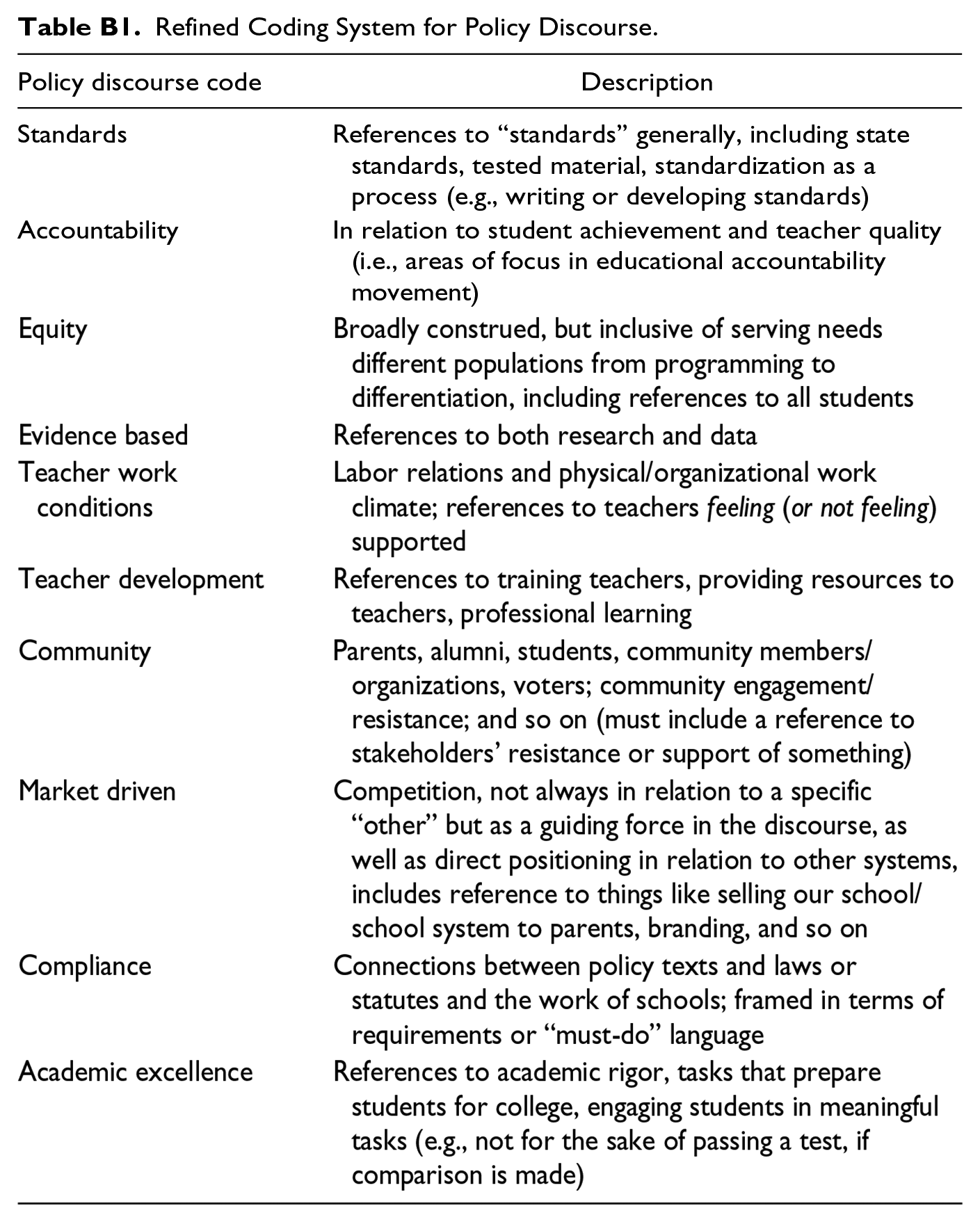
| Policy discourse code | Description |
|---|---|
| Standards | References to “standards” generally, including state standards, tested material, standardization as a process (e.g., writing or developing standards) |
| Accountability | In relation to student achievement and teacher quality (i.e., areas of focus in educational accountability movement) |
| Equity | Broadly construed, but inclusive of serving needs different populations from programming to differentiation, including references to all students |
| Evidence based | References to both research and data |
| Teacher work conditions | Labor relations and physical/organizational work climate; references to teachers feeling (or not feeling) supported |
| Teacher development | References to training teachers, providing resources to teachers, professional learning |
| Community | Parents, alumni, students, community members/organizations, voters; community engagement/resistance; and so on (must include a reference to stakeholders’ resistance or support of something) |
| Market driven | Competition, not always in relation to a specific “other” but as a guiding force in the discourse, as well as direct positioning in relation to other systems, includes reference to things like selling our school/school system to parents, branding, and so on |
| Compliance | Connections between policy texts and laws or statutes and the work of schools; framed in terms of requirements or “must-do” language |
| Academic excellence | References to academic rigor, tasks that prepare students for college, engaging students in meaningful tasks (e.g., not for the sake of passing a test, if comparison is made) |
Appendix C
Acknowledgements
The authors acknowledge members of our research team, Daniella Hall, Whitney Hegseth, Christine Neumerski, and Max Yurkofsky, Jonathan Sun, Rongzhen Zhou, Carolina Laguna, Katherine Senseman, and those who provided feedback on earlier drafts including two anonymous reviewers.
Declaration of Conflicting Interests
The author(s) declared no potential conflicts of interest with respect to the research, authorship, and/or publication of this article.
Funding
The author(s) disclosed receipt of the following financial support for the research, authorship, and/or publication of this article: Work on this essay was supported by the Spencer School Systems Study at Northwestern University and the University of Michigan, funded by a research Grant from the Spencer Foundation (SP0034639-201600066). Work on this essay was also supported by a Grant from the U.S. Department of Education, Institute of Education Sciences, Multidisciplinary Program in Education Sciences (R305B140042). Opinions and conclusions expressed in this article are those of the authors and do not necessarily reflect the views of any funding agency.
