







Abstract
The purpose of this article is to present the findings of a qualitative content analysis of historical documents related to the teaching of literature. Through a social semiotics framework, we analyzed 10 national standards documents in the field of secondary English. Our analysis details the evolution of the standards paradigm for teaching literature in a secondary English classroom, revealing a steady increase in language that attempts to show more measurable outcomes while slowly losing the language that emphasizes the aesthetic value and pleasure to be found in reading great works. These findings have important implications for how language about teaching literature has evolved and where policy makers and professional leaders have placed emphasis with regard to the purpose of teaching literature in secondary classrooms. More specifically, these findings are intended to reframe the perspective of the standards writers within the reform movement and their treatment of literature in secondary classrooms.
The development of standards for teaching works of literature, for example, fiction, creative nonfiction, poetry, and plays, in secondary classrooms has a well-documented, long, and rich history. Starting with the Report of the Committee of Ten (National Education Association Committee of Ten [NEA], 1894), the document that contributed to the establishment of the modern English class across the United States (Applebee, 1974), there have been 10 occasions in which professional organizations and/or governing bodies have attempted to set national standards for teaching literature in secondary schools. These documents, however, do not come without controversy.
For example, researchers have already criticized the Common Core Standards (CCS) in English/Language Arts (National Governors Association Center for Best Practices, Council of Chief State School Officers [NGA], 2010) for claims of college readiness (Rives & Olsen, 2015) and the pitfalls of “corporatizing” education based on some unforeseeable future employee (Burns, 2012, p. 93)—which we also argue as a “[reference to previous work here]” in a related article ((McConn & Blaine, 2018). With current controversies such as these surrounding the most recent attempt to standardize the teaching of English, it is imperative that policy makers and professional leaders examine how the standards advocate what is taught. That is, the in-depth examination of each set of standards can provide important insights into how the understanding of the teaching of literature has changed and/or stayed the same and how historical documents show the evolution of values in teaching literature.
Our qualitative content analysis (QCA) of the documents is through a social semiotics framework to show how the language of the standards potentially creates intended and unintended outcomes. 1 As researchers, we approached these documents with the awareness that each one reflects ideologies that are grounded in a social and historical milieu. As such, our foci were on the language and how that language represents the purpose of teaching literature in secondary schools, as well as contextualizes these documents within the historical context of when they were written. Therefore, the purpose of this study was to systematically analyze the language within the documents. To do so, we asked the following research question: How have nationally defined written standards for the teaching of literature in secondary schools changed as each organization attempted to improve English classrooms?
Review of Relevant Literature
The following literature review briefly outlines what Tremmel (2006) identifies as the “standards paradigm” and outlines the main “literacy movements” detailed by Myers (1996). Our description of the literacy movements is by no means an exhaustive historical account of literacy education but serves to contextualize the standards within specific movements and to situate our analysis within Tremmel’s (2006) paradigm.
The Standards Paradigm
The foundation of the standards paradigm in education starts with the Cartesian–Newtonian way of thinking based on Descartes’ dualistic worldview of the mind as a nonphysical substance separate from the body (Descartes, 1637/2000). Descartes’ attempt to make sense of his bifurcation of mind and body includes his explanation of how mental states relate to the physical world. This idea is known today as Cartesian dualism (Clarke, 2010). Descartes perceived the world outside the mind as a mechanical system with somewhat dependable outcomes.
Not too long after Descartes, Newton formulated the laws of motion, which heavily influenced the scientific view of the physical world for the next three centuries. Consequently, Newton’s mathematical, rational, and understandable laws governed the scientific community’s perspective of the world (Newton, 1687/1999). Thus, to define the Cartesian–Newtonian paradigm is to include the quantitative science of measurement, allowing us to implement mechanical and measurable outcomes to guide our view of the world.
From this Cartesian–Newtonian paradigm grew the Taylor System, the application of scientific management during the Industrial Revolution for more efficient production. Subsequently, America became heavily influenced by “business-industrial values and practices” (Callahan, 1962, p. 2). This scientific management and “business-industrial ideology” eventually found its way into education after 1911 (Callahan, 1962, p. 2). As Tremmel (2006) points out, the Taylor System “proceeded from the heartland of the Cartesian-Newtonian paradigm and is a leading example of how linear, mechanical approaches to business management, industrial efficiency, and scientific method became central to school reform in the period 1910-1930” (p. 14). Similarly, Greenman (1994) claims that the “Cartesian-Newtonian paradigm” is evident in American education’s focus on subject matter, compartmentalizing of subject areas and objectives, school structures, and emphasis on testing (p. 19).
In sum, education reformers who lean on the reasoning from scientific management continually attempt to mimic the industrial efficiency model by breaking down the educational experience into fragments that can be measured. Consequently, what is most evident in this quest for efficiency is a reflection of a paradigm that continually fails to account for the “wholeness” of what education offers. In other words, the educational experience adds up to more than the sum of its parts and when merely the parts are accounted for (i.e., acquiring skills), the wholeness of the experience, more specifically the human experience, is diminished.
Literacy Movements
The United States has always experienced periods of rapid social change, and the end of the 19th century was among the most turbulent. Rapid immigration, the dislocations of the Civil War, and the ethnic isolation resulting from the fragmentation in urban governance led many reformers to call for greater social cohesion and national culture (Myers, 1996; Tyack, 1974). During this time, society was also shifting to an industrial economy, disrupting rural traditions and family life (Myers, 1996; Tyack, 1974). At least partly in response to this background of perceived social tumult, recitation literacy, a method that required students to memorize cultural information and read aloud passages, gained greater popularity at secondary schools (Applebee, 1974; Myers, 1996).
As always, not every influential voice agreed with the mainstream trend. Long before critical literacy gave us a more nuanced perspective on the morality of literature and became fashionable among pedagogues, advocates such as Matthew Arnold argued for the use of literature in the English classroom as a moral compass to socialize students (Myers, 1996). As society continued to rapidly change, different critics of the recitation approach gained greater influence. At the close of the 1800s, the recitation approach was increasingly seen as misaligned with the needs of urban industrial laborers. By the early 1900s, recitation literacy was widely criticized for its lack of meaning making (Olson, 1986). Like Matthew Arnold, critics such as Joseph Mayer Rice argued that the ability to read great works of literature aloud did not guarantee understanding (Myers, 1996; Tuman, 1987).
At the turn of the century, a mania for factory-like efficiency proved irresistible to many social thinkers, exemplified by Fredrick Taylor’s notion of standardized work (Callahan, 1962; Tyack, 1974). Ellwood Cubberley, a pioneer at the time in educational administration who viewed students “as the products of a school factory system,” was the most ardent proponent of the standardized model for education (Myers, 1996, p. 95). During this time, with the influence of scientific management so prevalent (Myers, 1996; Tyack, 1974), the teaching of literature moved from recitation literacy to what Myers (1996) labeled decoding and analytic literacy.
Again scholars and activists were not all in agreement. Just as proponents of the decoding/analytic approach gained influence, the Deweyan ideal of democratic classrooms retained energetic supporters (Tyack, 1974; Tyack & Cuban, 1995). In the midst of this struggle between child-centered progressive education and a more traditional focus on the rigor of the classics and Great Books came the national crisis of Sputnik and a rethinking of how to organize the teaching of literature in the secondary classroom (Applebee, 1974). At the same time, new criticism theorists, such as Russian formalist Viktor Schlovsky, placed focus on form over content (Applebee, 1974; Myers, 1996). This objective view of literature was a clear break “from metaphysics and the morality of recitation literacy—indeed, more Cubberley-like, more Taylorized” (Myers, 1996, p. 92).
Throughout the years, the attempts to define different levels of reading by various standardized assessments gave way to research on how those skills transfer to the workplace (Myers, 1996). Despite growth in literacy rates during the decoding/analytic literacy era, a number of studies revealed that literal understanding was no longer adequate to navigate modern life (Myers, 1996; Stedman & Kaestle, 1987). By the time A Nation at Risk was published in 1983, English education was already seeking ways to accommodate multiple societal needs.
At the same time, technology became a driving force in the need for higher order thinking skills for all students. Mass media communication, information technologies, and computing created new kinds of jobs (Bailey, 1988; Beniger, 1986) that required, Myers (1996) argues, “new kinds of interpretation skills” (p. 112). The perceived need for new interpretive skills was a distinguishing factor in the move to critical/translation literacy, since critics claimed students during the decoding/analytic literacy era could not “interpret or criticize texts” (Myers, 1996, p. 87).
Theoretical Framework
Social semiotics, the study of language that consists of “the exchange of meanings in interpersonal contexts of one kind or another” (Halliday, 1978, p. 2), served as our lens as we conducted our nuanced examination of the intricacies of language used in the standards. Through language, individuals become part of a group, and Halliday (1978) notes that it is within the participation of the group that linguistic interchange occurs and “determines the status of the individuals and shapes them as persons” (p. 14). This exchange of meaning is functional and is formed out of socio-semiotic variables, such as the following: (a) Field of Discourse allows us to analyze and name the relationship of the person to the subject matter, (b) Tenor of Discourse analyzes the interpersonal relationships that a person has with other people and the roles that individuals have within the structure studied, and (c) Mode of Discourse refers to the genre and mode of communication within the structure (Halliday, 1978; Halliday & Hasan, 1989).
Language creates and shapes our social environment, and social semiotics argues that text is the preferred communication of culture. Our shared texts both shape and change our social system, causing and reflecting the change in society (Halliday, 1978). The exchange of meaning that a text provides is situated within a context, and the situational context determines the meaning to be exchanged from the text, with language both creating and shaping the social environment in which the text is received.
Although the context of situation is the immediate environment, there is a broader context in which the text is interpreted: the context of culture. Context of culture represents the concepts and beliefs that the participants hold in common. An exchange of meaning—such as a text document—occurs on certain occasions and attaches specific meanings and values, which ultimately represent a culture. At the same time, the exchange of meaning occurs whenever someone reads a document, leaving the context of culture to be found within the participants reading the text at the time, receiving and making the meaning at the same time.
More important is how the meaning exchange has potential for impacting the participants. Although it is through language that we become a group, it is also through the participation within this group that a person finds a sense of identity. As Halliday (1978) points out, “language is the essential element in the process, since it is largely the linguistic interchange with the group that determines the status of the individuals and shapes them as persons” (p. 14). This identity and the language used to shape this role are what the individual will use to navigate society. Through this navigation, the language used becomes the main factor in developing one’s personality, or as Halliday (1978) defines it, “role complex” (p. 15).
Building on Halliday’s model (1978), we view the standards’ documents as the text, or the mode of communication, with meaning potential. The field of English education and the relationships between its stakeholders (e.g., teachers, administrators, policy makers) constitute the role structure and the social action. The historical milieu, which includes the societal and political forces within which each standards document is situated, creates the context of culture. The documents themselves compose the context of situation.
In other words, through the text of the standards documents, members of the field of English education receive and create meaning from the documents, located within the culture of their times and the contextual situation that prompted the standards document to be written in the first place. As Myers (1996) argues, standards documents, such as the ones analyzed for this study, are part of a “movement to invent or reconceptualize a form of literacy, and new forms of literacy always have an impact on the way subjects like English get organized to meet a set of political and intellectual needs” (p. 4).
Method
Research Design
We analyzed the documents using a QCA approach. Schreier (2012) outlines a formal structure to QCA, which consists of determining a research question, selecting material, setting up the coding frame, segmentation, trial coding, modifying the coding frame, and then analysis and interpretation of findings.
It must be noted that Halliday (1985) outlines a method of discourse analysis that pairs with his social semiotic theory and we did not pursue that method of coding. The text analysis as set out by Halliday (1985) is a linguistic and grammatical approach that is on a micro level, whereas a major strength of QCA is that its systematic approach serves to look for patterns and themes. The primary reason we chose to pursue QCA is that it allowed us to code using a systematic method favorable to utilizing multiple coders and to promoting data reduction and then still allowing us to turn to social semiotics for its ability to explain what the data were showing us through the study. Ultimately, we view our QCA approach as carried out from a Hallidayan perspective.
Data Sources
The data sources for this study include 10 documents that represent, to the best of our knowledge, all existing standards from major organizations developed for teaching literature in secondary classrooms (see Table 1). The criterion for selecting a document was that it must have been an attempt to set standards for the teaching of literature in secondary schools on a national level. There are existing documents that address teaching secondary English but do not specifically address teaching literature; therefore, those documents are not included.
Documents Selected for Study.
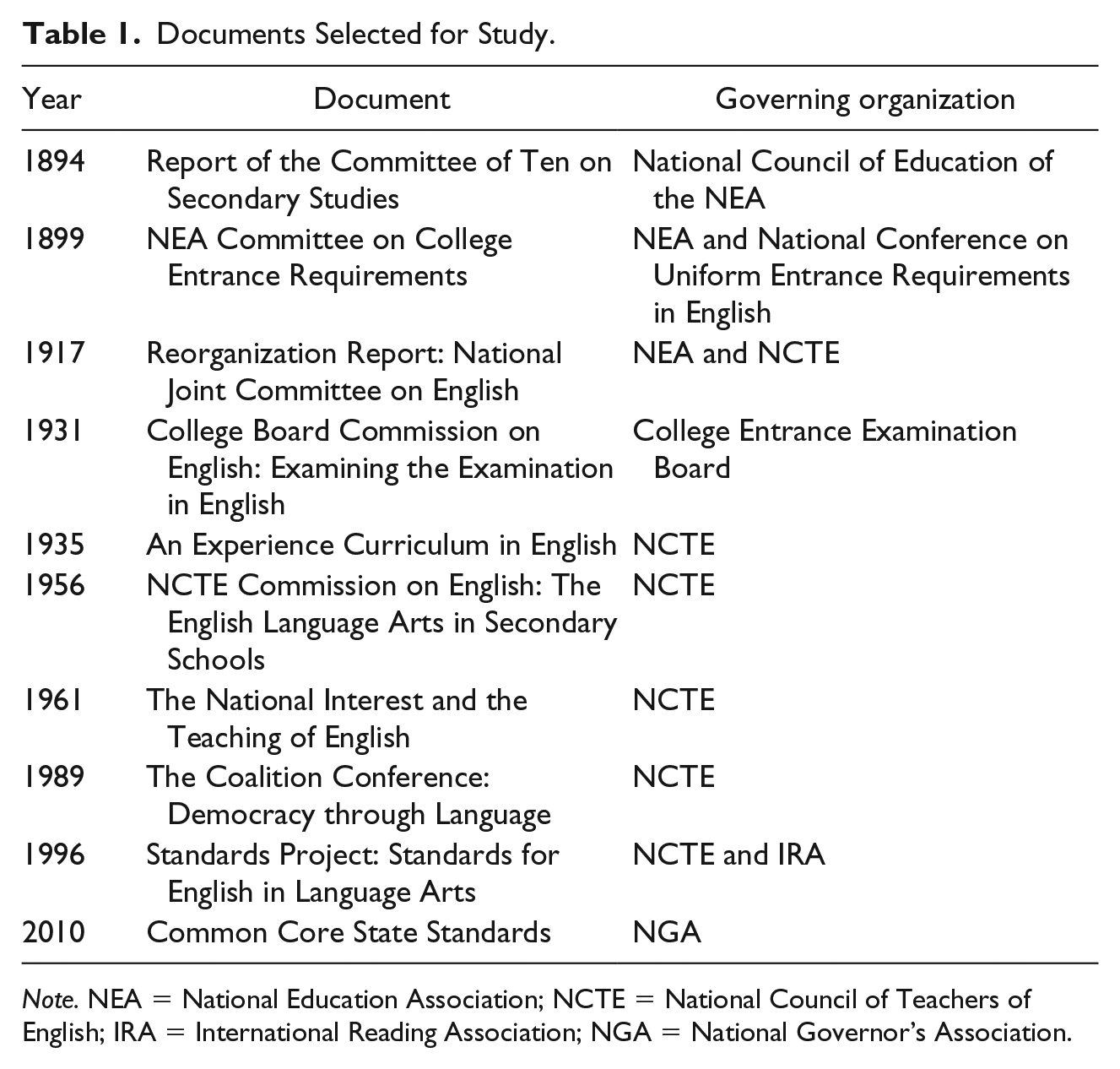
Note. NEA = National Education Association; NCTE = National Council of Teachers of English; IRA = International Reading Association; NGA = National Governor’s Association.
Data Analysis
In setting up our coding frame, we began by approaching the standards documents using an inductive open coding scheme. It is important to note that we only coded the parts of the documents that addressed the end-goal standards, not any standards that attempted to build on a previous set of standards. For example, the Common Core State Standards (CCSS) list a set of “Anchor Standards” (NGA, 2010), and have a set of standards at each grade level that build on each other. We coded the standards under “Grades 11-12 students” for “Reading Literature,” as those were the apparent end-goal objectives of the document with regard to teaching literature.
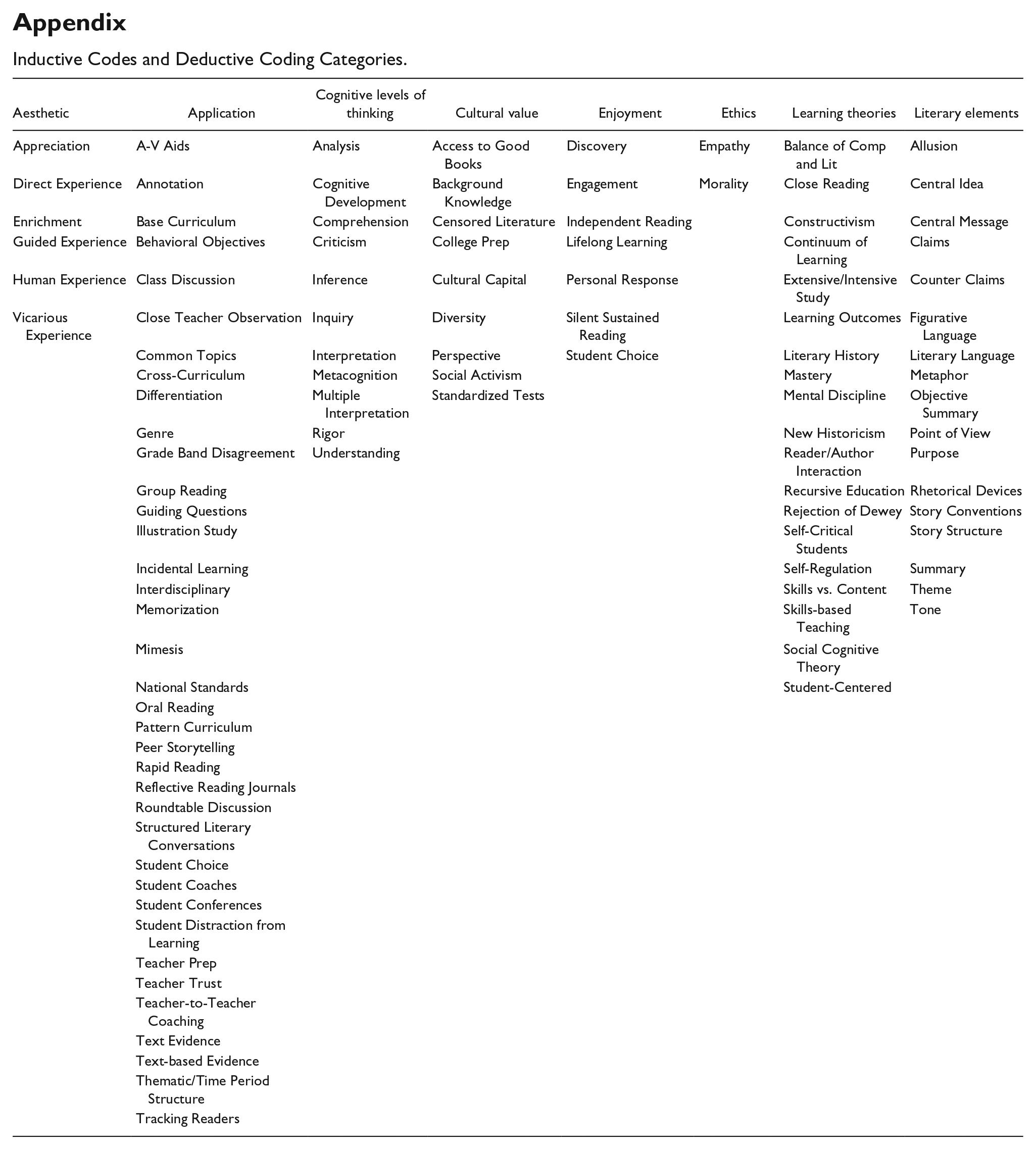
For this initial process, we coded all data separately, which resulted in 127 independent codes for all documents (see Appendix). As Schreier (2012) notes, “when it comes to classifying your material according to this coding frame, the goal of QCA is to go beyond individual understanding and interpretation” (p. 6). As the point of QCA is to interpret latent content, we analyzed the initial codes and reduced the data by collapsing the open-coded data into categories. In this analysis, we determined nine distinct categories that captured the essence and relatedness of the initial codes or idea units (Schreier, 2012). For example, codes of figurative language, literary language, and metaphor were collapsed into the broader category of Literary Elements.
In the second round of data analysis, again conducted separately, we recoded the 127 initially coded ideas into the nine categories. We established that the unit of analysis, or segment (Schreier, 2012), was one complete thought, typically but not always an independent clause, and we agreed to use only one category per unit. Next, we met and compared our recoded data. If a complete thought held language that could be coded for two different categories, we discussed the item until we agreed upon which category the unit emphasized most. If an idea continued on in multiple sentences, then the category that was assigned was only counted once. We discussed every coded idea unit until we reached total agreement for separation of the data into the following nine categories: (a) cognitive levels of thinking, (b) suggested texts, (c) literature as enjoyment, (d) literary elements, (e) aesthetic value, (f) ethics, (g) student development, (h) cultural value, and (i) pedagogy. Table 2 provides a definition and example for each of the final categories.
Coding Frame.
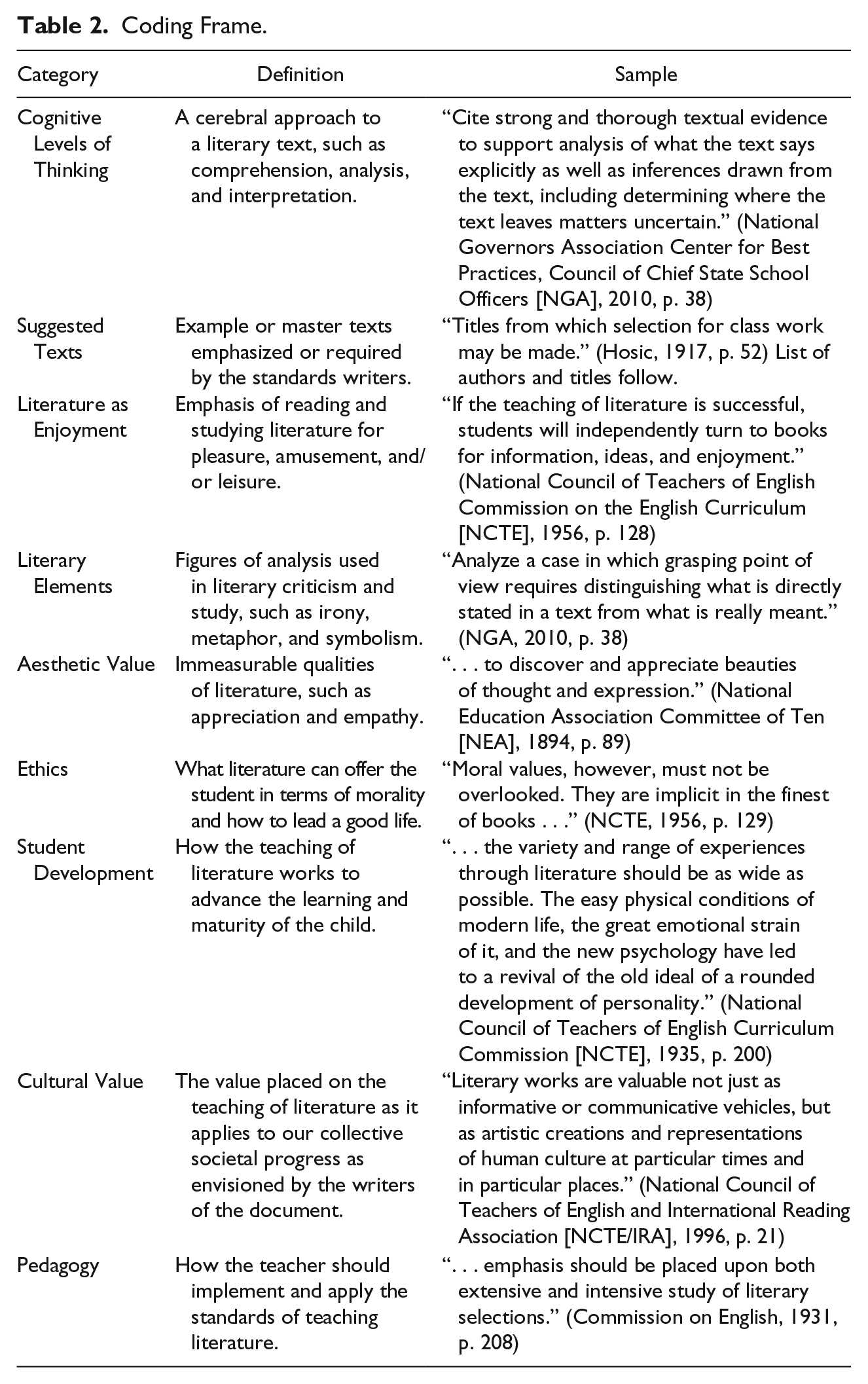
In the final stage of our QCA, we calculated the percentage of occurrence for each category across the 10 sets of standards documents. We then analyzed the fluctuations in the prominence, as well as lack of prominence, of what the language of the standards emphasized over time. Furthermore, as we sought to better understand these fluctuations, we went back to the standards to further examine the context of the language. That is, while the initial coding schemes provided insight into what was in the language, by reexamining the language in context, we gained more insight into how the language presented the information. Through these analyses, we discovered two themes, or tensions, in terms of how language represented opposing foci.
In the results of our analysis, we provide an overview of the language content in each set of standards by presenting the percentages of occurrences for each category in all 10 standards documents. Furthermore, we offer an examination of how areas of foci, as well as those areas receiving little focus, are situated in an historical context. Finally, we present the two themes or tensions (i.e., gains and losses within the language over time), emerging from our analysis: (a) literature as enjoyment versus critical thinking of literature and (b) literary style versus scientific style of the language.
Results
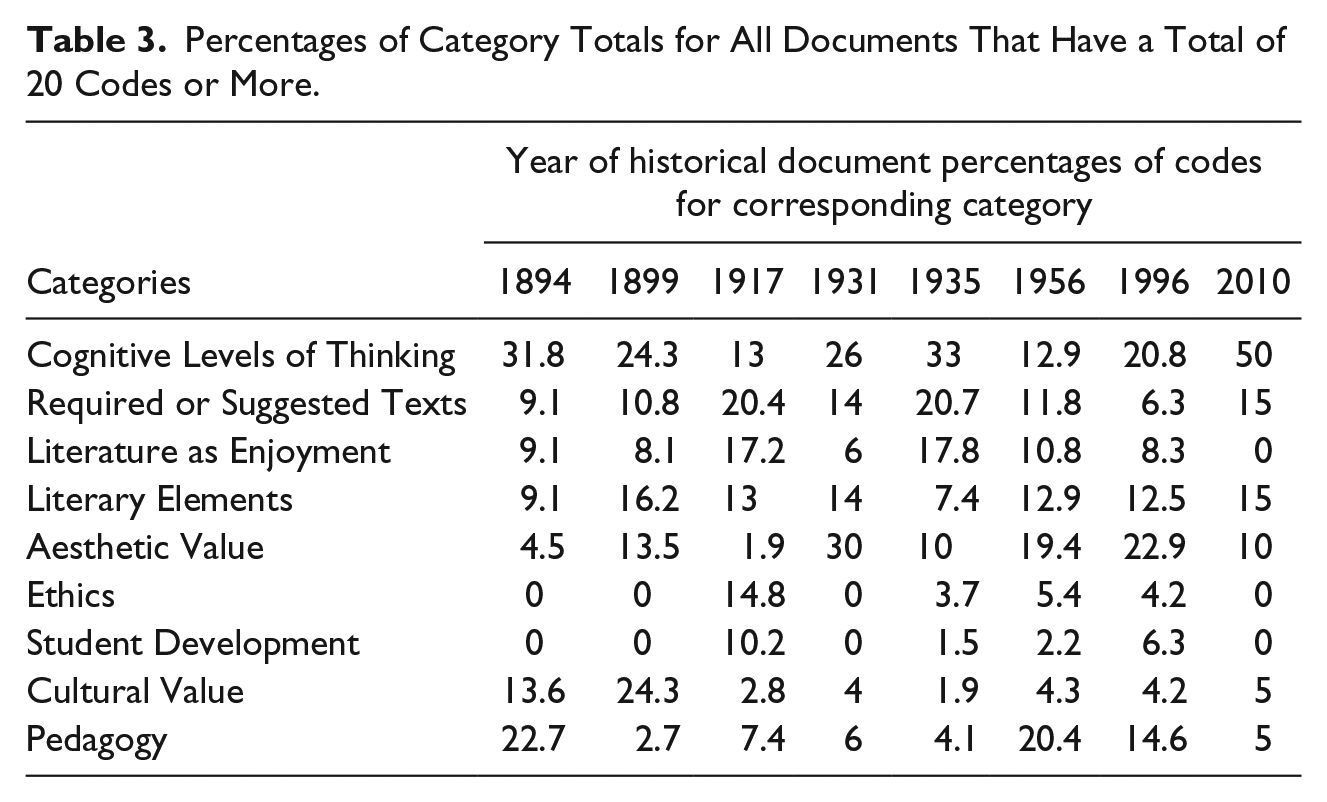
The findings from this study are reported in two sections, reflecting the multiple layers of our analyses. In the first part, “Language as a Reflection of History,” we present the findings (see Table 3) in the context in which the documents were written—the institutional, economic, social, and educational backgrounds presented in the literature review—to make sense of the ways literacy standards have shifted over the years. In the second part, “Tensions,” we present our findings in two subsections, “Enjoyment vs. Critical Thinking” and “Style of Writing.”
Percentages of Category Totals for All Documents That Have a Total of 20 Codes or More.
Language as a Reflection of History
The emphasis placed on cultural value within the first two documents, the 1894 Committee of Ten and the 1899 Committee on College Entrance Requirements, is apparent in perceived social tumult at the time. What came out of the recitation literacy was the recognition of literature as a subject worthy to be studied, and in 1894, the Committee of Ten made English studies part of the high-school curriculum. Although the language of the document presents a strong emphasis on pedagogy (22.7%), the Committee placed its emphasis on college preparation—“not education for all students” (Myers, 1996, p. 77). Nonetheless, the skill of meaning making is evident in the focus on cognitive levels of thinking taking up substantial percentages of the categories identified in the documents in 1894 and 1899 and an increased focus on aesthetic value in the 1899 document, as shown in Table 3.
During the middle decades of the 20th century, proponents of Deweyan progressivism and Cubberleyan efficiency competed for support among educators (Callahan, 1962; Tyack & Cuban, 1995). The National Council of Teachers of English (NCTE), with James Hosic at the helm, attempted to find a mid-point between these perspectives with the Reorganization Report (Applebee, 1974; Hosic, 1917; Myers, 1996). Within the 1917 document, we see a more evenly dispersed emphasis on cognitive levels of thinking and the progressive ideals of literature for enjoyment and student development than in the previous two documents.
However, the fight between the competing ideologies of progressivism and the analytical approach inherent in the efficiency model rears itself in the 1931 document by doubling the percentage of cognitive levels of thinking (from 13% in the 1917 document to 26%), as well as supporting the analytic approach further by presenting the highest percentage of aesthetic value (30%), which requires analysis of literature, both within and between the documents. Equally apparent is the decrease in literature as enjoyment (17.2% to 6%) and student development (10.2% to 0%) from the 1917 document to the 1931 document. The decade leading up to the mid-1930s, reading interests research showed students preferred to read more “popular” texts as opposed to the classics that were central to the 19th-century curriculum (Applebee, 1993). Later, NCTE pushed hard for Dewey’s ideas in the 1935 An Experience Curriculum, resulting in the increase in literature for enjoyment (back up to 17.8% from 6%); however, by the 1940s, Dewey-style progressivism was overpowered by Cubberley-style efficiency, and by 1960, Dewey’s influence in public schools had dwindled (Myers, 1996).
By the end of the 1950s, the study of literature mainly focused on its parts, such as plot, setting, and character (Myers, 1996). The publication of 1961’s The National Interest and Teaching of English and other documents around this time introduced a new focus on a tripod for the teaching of English: language, literature, and composition (Applebee, 1974). Informed by cognitive science, the new critics, rhetoric, and linguistics, the new tripod split English into its component parts again and now with a renewed emphasis toward preparing all students for college (Myers, 1994). The language in the 1956 document reflects this concern by placing more focus on pedagogy (20.4%) than any other document listed in Table 3. Many in the field of English education thought at this time that the needs of the individual student were again lost in this college preparatory tripod model. NCTE leaders believed that the efforts to organize and implement education at the local and state levels had “been unable to improve the quality of English instruction” (National Council of Teachers of English Commission on National Interest [NCTE], 1961, p. 28). Authors of the 1961 standards document believed that English teachers were ill-prepared to teach, at least in part because the subject had become too broad.
In a federal effort to create a “sufficiently complex conception of standards to make them worth achieving,” NCTE and IRA joined together to write the 1996 Standards for the English Language Arts (Mayher, 1999). The funding was pulled when early drafts did not meet the federal expectations. However, NCTE and IRA funded the project and completed the standards in “an effort to meet a national call to articulate agreed-upon principles for the content area” (Christenbury, 2010, p. 21). This intent on “achievement” is evident in the doubling of cognitive levels of thinking (from 12.9% in the previous document to 20.8%), as well as comparably high percentages in aesthetic value and pedagogy.
At the turn of the 21st century, there was once again a need for unity. However, this time it was based on the need for all states to have equally rigorous standards “to prepare students to one day compete against their peers from high-performing countries in a global marketplace, or to compete against each other when they applied to college” (Whitman, 2015, p. 3). As a result of No Child Left Behind (NCLB) incentives, states had set “pathetically low standards for student performance” (Whitman, 2015, p. 3). In the name of equity and what George W. Bush called “the soft bigotry of low expectations,” the National Governors Association (2010) published the CCSS. Reflecting the need to address low expectations, the CCSS contains the highest percentage of cognitive levels of thinking noted in all the documents analyzed, accounting for 50% of the overall categories identified in the 2010 document. The writers of the English/Language Arts CCSS emphasized critical thinking and text-based questions in an effort to “lay out a vision of what it means to be a literate person who is prepared for success in the 21st century” (NGA, 2010). This emphasis in cognitive levels of thinking was made at the expense of enjoyment (0%), student development (0%), aesthetic value (10%), and pedagogy (5%), all categories that saw a dramatic decrease in representative language.
Tensions
Enjoyment vs. critical thinking
The tension of literature as enjoyment versus critical thinking of literature is first illuminated through our analysis of the percentages of occurrence over time (see Table 3). That is, the analysis not only shows the fluctuations between the documents within the emphasis placed on literature as enjoyment, cognitive levels of thinking, and aesthetic value, it also reveals a clear tension between reading literature for enjoyment and a focus on critical thinking.
As Table 3 reveals, teaching literature as a form of enjoyment did not see an equal emphasis with cognitive levels of thinking and aesthetic value until the 1917 Reorganization Report. Moreover, compared to cognitive levels of thinking, reading literature for enjoyment is mentioned fewer times in all the documents but one, where it is given equal emphasis. Furthermore, the decline of attention to enjoyment, while the emphasis of cognitive thinking skills increases, is evident after the 1917 document, with the exception of 1956, ending with no mention of enjoyment in the CCS.
What really separates each of these documents, however, is the way each one presents the teaching of literature in terms of enjoyment. The ways in which the teaching of literature is discussed in the documents, with regard to enjoyment, reveals a more complete picture of its importance and emphasis. That is, even within an immeasurable act such as reading for pleasure, we see an attempt to become more measurable within the language.
The writers of the National Education Association Committee on College Entrance Requirements (NEA; 1899) document argue that all the principles in an English class fall “under the inspiration of the pleasurable reading of good books” (p. 13). Similarly, in The Reorganization Report, Hosic (1917) uses even stronger language by making it part of “The Aims of the English Courses,” claiming that “choice and adaptation of material” are integral “to fit individual capacities for expression and enjoyment” (p. 30). This document even has a section titled “Principles of Choice,” where one objective reads, “They must enjoy, not merely tolerate” (p. 46). Furthermore, Hosic (1917) argues, “It is the task of the teacher to discover to the pupil undreamed-of interest, and to lead him to find enjoyment in literature increasingly rich and fine” (p. 64).
Although the writers of Examining the Examination in English (Commission on English, 1931) document do not mention reading for enjoyment a great deal, they do discuss it in terms of which literature offers enjoyment: “but a pupil who is beginning his study of literature will be better advised to lay his foundations mainly upon the classics and to reserve a large part of his reading of contemporary literature for enjoyment” (p. 144). This language is interesting, as if to say that the classics do not offer enjoyment; only contemporary literature can do that. Even more so, however, is that the advice is for the “pupil who is beginning his study of literature,” suggesting that it is “better advised” that the students first find enjoyment in reading contemporary works while simultaneously building on their knowledge of classics. More accurately, this language seems to acknowledge that less experienced readers will have trouble enjoying the classics.
The writers of An Experience Curriculum (National Council of Teachers of English Curriculum Commission [NCTE], 1935) discuss enjoyment in the context of reading at home and in the context of choice more so than the other documents. More specifically, under the section, “Literature Experiences, Grades 7-12,” where there are 56 objectives listed, 26 of them have the words “to enjoy.” The wording within these objectives leaves no room for confusion, either: “Primary Objective: To enjoy hero stories” (p. 43).
Oddly, even with the number of references to enjoyment in the previous standards, the language used in the 1956 document suggests that, up to this point in English classrooms, reading literature for enjoyment had been lost: “Strangely enough, the fact that literature is a source of pleasure is a point that needs stressing” (National Council of Teachers of English Commission on the English Curriculum [NCTE], 1956, p. 129). The writers emphasize this point further by adding to the “Evaluating Outcomes” section the question, “To what extent have they used reading voluntarily for pleasure” (NCTE, 1956, p. 152).
Although the writers of the 1996 document do not discuss enjoyment extensively, they do make enjoyment “a primary goal” (National Council of Teachers of English and International Reading Association [NCTE/IRA], 1996, p. 11). Moreover, the writers stress that “Opportunities to read books for pleasure are also vital” (NCTE/IRA, 1996, p. 20). While the Reorganization Report (Hosic, 1917) and An Experience Curriculum (NCTE, 1935) both have much more progressive language in how the writers present reading literature for enjoyment, the 1996 document presents much of its approaches through a progressive lens: the context of discovery. These “opportunities” are also part of this discovery that the writers claim to be so “vital.”
Although there is a decline in the number of times enjoyment was mentioned, the language within these documents provides more insight into how the perspective of teaching literature as enjoyment evolved up to the point of the 1996 document. In the most recent document, though, the mention of reading literature for pleasure is buried in the following statement: “Students who meet the standards readily undertake the close, attentive reading that is at the heart of understanding and enjoying complex works of literature” (NGA, 2010, p. 3). However, because the focus of this statement is on the approach to “close, attentive” reading, we coded this under pedagogy.
This tension between reading for enjoyment and reading for critical skills moves through the documents as a pendulum at times, with an evident separation of the two approaches in places. In the earlier documents, there is a balance between an emphasis on enjoyment and a focus on critical thinking; however, the separation of these approaches is most evident in the newest standards. Earlier documents, such as the Reorganization Report, show a greater emphasis on the concern for the individual student’s reading interests and the importance of reading literature for enjoyment than do the most recent documents. With regard to how these documents present reading literature as enjoyment, there is a clear move from language that represents progressive approaches that are difficult to quantify to language that reveals more measurable outcomes.
Style of writing
The second, and most glaring, tension we found as we read through all the documents was in the style of writing. As the years progressed, the style became more scientific, apparently to convey more measurable objectives and clearly defined outcomes. These differences in styles are worth exploring, as an understanding of how we talk about the teaching of literature relies heavily on the style and manner in which we convey our philosophies and goals. Overall, our analysis in the following focuses on the inherent qualities of immeasurable and measurable language that is used to convey the teaching of literature.
The Committee of Ten (NEA, 1894) and the NEA College Entrance Requirements (1899) are similar in style. The writers of both documents use a more formal literary and scholarly style that places emphasis on the aesthetic experience to be gained from literature. Take, for example, the overarching goals of the English class: “to cultivate a taste for reading, to give the pupil some acquaintance with good literature, and to furnish him with the means of extending that acquaintance” (p. 86) and, under “Lessons in Literature,” the writers’ claim that the students “should be taught to comprehend the subject-matter as a whole and to grasp the significance of parts, as well as to discover and appreciate beauties of thought and expression” (p. 89). The NEA (1899) document contains similar language intended to convey a sense of prescription of those principles. For the question of the purpose of the English standards in connection with the college entrance tests, the writers of NEA (1899) suggest that a pupil completing a course in English, or any specific portion of such a course, should be able to appreciate literature that falls within the possibilities of his comprehension, and to express logically, and in good style, such thoughts as he is capable of expressing at all. This should be the test. (p. 13)
Both documents have a heightened, business-like style throughout the writing, yet rely heavily on the vague, immeasurable term “appreciate.”
In the 1917 Reorganization of English in Secondary Schools, Hosic (1917) urges, through almost ornamental language, for a separation between the high-school English project from the college programs, severing ties that the previous standards writers had made with the colleges. Yet, the intangibles of reading literature are not lost: “The aims of literature-teaching are to quicken the spirit and kindle the imagination of the pupil, open up to him the potential significance of life, and form in him the habit of turning to good books for companionship” (p. 3). The fanciful yet reverent tone found in this statement aligns with the message that instilling a love of reading outweighs a prescription of books intended to prepare one for college.
As the writers of the 1931 document included the college entrance requirements as a focus, once again, for the English classroom in secondary schools, there is a more condescending tone regarding the description of the readers: But there will still remain the great majority of readers to whom true literary appreciation lies behind a veil even skilled instruction will never completely lift. The minimum, therefore, is understanding of the communication rather than appreciation of the beauty of form and imagery, or of recognition of the final emotion and subtlety with which it is expressed. One must be endowed with a sensitive ear to hear overtones. (Commission on English, 1931, p. 146)
Furthermore, this tone continues when there is less focus on having students appreciate the beauty and aesthetics of what they are reading and more of a utilitarian approach to preparing students for college-level literature study, as if the students cannot think about literature at that level: “The subtler questions of aesthetic effect produced by prose or poetry need not concern us in our study with secondary school pupils” (Commission on English, 1931, p. 202). Although condescending at times, the writers present the intended outcomes for reading literature in immeasurable ways.
There is a major shift in style from 1931 to 1935 with An Experience Curriculum in English (NCTE, 1935). Contrast the utilitarian perspective on teaching literature in the 1931 document with the following: Tennyson’s daydreams of Arthur and his knights, suffused with an ethical glow entirely foreign to the original stories of the pagan king, he poured into the Idylls for us to dream again at our pleasure. The intrinsic worth of such experiences is the only valid reason for the reading of literature. (p. 17)
This flowery language creates a more optimistic tone that runs throughout these standards, showing through style of writing some of the purposes of the document. The writers want students and teachers to fall in love with literature and maintain that relationship for the rest of their lives. There is an emphasis on vicarious experience and lifelong learning throughout the document—students benefit from literature in their lives both in the moment of studying it in their classes and then beyond as the experience sets the foundation for lifelong learning.
The same language of “spirit” and “imagination” is seen in the 1956 document in an excerpt that intends to elicit excitement for the teaching and learning of literature: It helps junior high school students to enter into the spirit of Charles Carryl’s “Robinson Crusoe’s Story,” with its rollicking rhythms, its forced rhymes, its humorous use of surprise meanings for old words, it’s amazing concoctions in the way of food, and its new and startling accomplishments on the part of cat and goat. (NCTE, 1956, p. 144)
The writers of this document later use this poetic language when asking that students see within the literature, “changes based upon skillful development and changes based upon sudden, magical transformation” (NCTE, 1956, p. 180).
There seems a more jarring shift in tone with the NCTE/IRA (1996) document. The language is much more sterile and reserved. Although the writers of this document were influenced by reader-response theory, when discussing “students’ experiences of literary texts,” the writers claim the experiences “are made richer when they are familiar with the specialized terms and concepts of literary analysis” (p. 21). This connection to a deeper literary analysis as a product of the connection to a personal experience aligns with Rosenblatt’s (1995) argument. The use of “specialized terms” and “concepts of literary analysis” contrasts sharply with “rollicking rhythms,” “amazing concoctions,” and “magical transformation.” Although only one example, this contrast is not unique, as there is a consistent difference in style throughout the comparison of these documents.
The language becomes increasingly sterile in the CCS (NGA, 2010). Although the term “appreciate” (p. 3) is used in the introduction to the standards, the writers use the language of Bloom’s taxonomy throughout the 10 listed standards. Each of the 10 standards reads as a measurable daily teaching objective, beginning with the cognitive level of thinking. Phrases such as “Analyze multiple interpretations,” “Analyze the impact of the author’s choices,” “Determine two or more themes,” and “Determine the meaning of words,” all dictate clear directives of what is expected of the student when reading literature (p. 38). Considering the previous document was influenced by reader-response theory, the CCSS document was an increasing shift toward more cognitive-processing models of reading that moved away from a reader-response perspective.
What is most apparent in the reading of these documents is that the past standards were more idealistically written than the more recent attempts. Over the years, the language used by the writers has become more scientific, using more terms that are measurable. As the data in this study reveal, we see more use of “analyze” and “evaluate” and less use of “appreciate” and “aesthetic.” The excitable tone and lyrical language are no longer used; nor do the writers direct teachers to the aesthetic values to be found in literature and the need for students to appreciate works. Instead, the writers use verbs from Bloom’s taxonomy, allowing less flexibility for interpretation as to how the standard is achieved, considering the ways in which a reader appreciates a work varies widely compared to an analysis.
Discussion
In returning to the purpose of this study, which was to systematically analyze the language within the documents to better understand how nationally defined written standards for the teaching of literature in secondary schools have changed as each organization attempted to improve English classrooms, our findings point to the importance of considering (a) the framing of the teaching of literature within increasingly more rigid standards and (b) the drastic changes in the language of the standards over the years. These two considerations are heavily influenced by Tremmel’s (2006) argument of the standards paradigm, and we contend they are extended in understanding how the language of this paradigm has evolved over the years.
Literature and the Standards Paradigm
Central to our argument is Bohm’s (1980) criticism of the Cartesian-Newtonian paradigm by pointing to two aspects, which Tremmel (2006) connects to our education system: fragmentation and program thinking. Fragmentation refers to the separation of wholeness, making it more difficult to see how the parts make up the whole. This way of thinking correlates to the Taylor System, which, as a scientific management system, notably attempted to break down aspects of particular jobs in the name of efficiency (Callahan, 1962). This fragmentation, however, leads “to a general tendency to break things up in an irrelevant and inappropriate way according to how we think, and so it is evidently and inherently destructive” (Bohm, 1985, p. 24). Looking at the standards-based reform movement, it is easy to see how elements of fragmentation—compartmentalization of subjects, objectives, testing, etc.—play a role, whether the argument of Bohm’s destructive prediction holds true or not.
Program thinking is Bohm’s second critique that Tremmel (2006) correlates to education reform. We align ourselves with familiar ways of thinking and this program thinking becomes so integrated into our sense of self, our personal and professional identity, “that we can often imagine no other” way of being (p. 23). Paradigms in fields and program thinking “limit mind and action” (p. 23) so that we can no longer see that the program has limited the scope of the argument and the possibilities of disagreement within the program. When discussing “reform” to the standards, “proponents and opponents have been repeating themselves, jockeying for position on a narrow field of action” (Tremmel, 2006, p. 24).
Yagelski (2005) argues a similar point—one which Tremmel (2006) expands on—that this way of thinking has not only dominated but has created a paradigm that simply argues against itself in an attempt to reinterpret “certain features of American schooling that had been around a long time and that, presumably, must have actually contributed to the crisis” (Tremmel, 2006, p. 13). Through this perspective, it could be argued that the standards writers have simply reinterpreted the old way of thinking so many times that they have minimized and neglected their attention to what literature offers. This dualistic, objective, measurable way of thinking has separated readers from the experience of reading literature, and the language that shapes this paradigm has potential consequences.
However, in a “progressive case for educational standardization,” Graff and Birkenstein (2011) outline a different view on standards and fragmentation. The scholars first point out that the rejection of all standards is undemocratic and based on the “assembly line schooling” that was the product of NCLB testing, which muddies the waters on how we distinguish between good and bad standards. They posit the need to make the “ineffable” a set of attainable goals, otherwise those educational goals are “mysteriously possessed by a minority of superior talents” (p. 219). Graff and Birkenstein claim that when we refuse to create expectations of academic competence because we believe they are “just too complex and heterogenous” and our student population too diverse, then we only see the students through a deficit lens, as if he or she could not cognitively grasp the skills with which the institution has deemed necessary to master.
Their most prevalent claim, though, is that the “attacks on educational standardization simply mirror and reinforce American education’s disconnected, fragmented status quo” (Graff & Birkenstein, 2011, p. 219). This disconnection is the result of various standards that fail to align grade levels, both horizontally and vertically. While Yagelski (2005) and Tremmel (2006) point out the “inherent destructiveness” of fragmentation that has occurred in the educational system—again, referring to grades, subjects, testing, and so on—Graff and Birkenstein (2011) see standards as a way of bringing wholeness to the “impressive intellectual and disciplinary diversity” (p. 219).
Graff and Birkenstein’s (2011) claim that those who reject standards reinforce the “fragmentation” of our educational system directly contrasts the fragmentation argued by Yagelski (2005) and Tremmel (2006), which they posit is how the standards took on the language of scientific management to be more measurable. While one camp of scholars would claim our educational system and more specifically the standards writers are so entrenched in the standards way of thinking that they have only moved toward the more mechanical view of teaching even within our least mechanical subjects, such as literature, the opposing camp of scholars would view the standards paradigm as the many attempts to get standards right, each time a fresh look reemphasizing what matters across a diverse and growing intellectual field.
The Evolving Language of the Standards Paradigm
Through a social semiotics perspective, we can see how this standards paradigm, contributing as it does to our inability to perceive a reality outside of it, combines with this exchange of meaning using the language of the standards. This is a potential reason for the profession’s continued fight—or “program thinking,” as identified by Bohm—for standards since the Industrial Revolution, even though there appears to be no definitive research suggesting standards improve student learning (Hamilton, Stecher, & Yuan, 2009; Polikoff, 2017).
The possible impact of what the profession has lost or potentially gained and is currently losing or gaining as a product of this program thinking becomes evident in how the language has molded the personality of the standards writers. If the policy makers create the standards through language, which plays a role in creating the group, then, according to our theoretical framework (Halliday, 1978), it is through this same language that the personality is created. Our argument here is not about classroom personality, as we do not provide evidence to suggest that the language of the standards has impacted the teaching of literature or even classroom teachers’ perceptions of teaching literature. Instead, we believe that the personality of standards writers has evolved into either a cold and objective representation of literature or, as could also be argued, a more refined and rigorous approach. Either way, neither of these approaches represent a more inspiring characterization that we want to see in classrooms. Standards are intended to set the tone for how teachers implement lessons in the classroom; therefore, the language that standards writers use poses potential implications for the way that teachers interpret what and how they teach.
In a wide-ranging study that details the state of teaching literature in American secondary schools, which includes case studies and surveys of nationally representative English programs, Applebee (1993) concludes, The overall impression of literature instruction . . . is one less of confusion than of complacency. During the past two decades, goals for and approaches to the teaching of literature have been taken for granted rather than closely examined. (p. 192)
Although Applebee’s (1993) seminal study makes no direct correlation between a specific set of standards and teaching literature, his findings do detail the literary works that are studied and various teaching approaches, both of which are influenced by educational policy. Our standards writers should think about this “complacency” and keep in mind that how we convey our standards can inspire or stifle those whom they intend to inform.
Yet the argument still remains that maybe this “inspiring characterization” is what the standards paradigm eventually hopes to evolve toward. In her argument that it is possible to quantify and measure inspiration, Heiland (2011) defines “inspirational teaching” as “‘kindling’ students’ intellects” and characterizes “a good college experience as one that helped students to ‘catch fire’” (p. 116). Heiland argues that the “inspirational and assessable are not so much opposed as complementary” (p. 116). Furthermore, Heiland (2011) is “encouraged” by Showalter’s Teaching Literature, which outlines specific goals for the class that include a range of Bloom’s cognitive verbs. Heiland even summarizes the work of what “we want students to learn” in an English classroom: “to train our students to think, read, analyze and write like literary scholars” (Showalter, 2003, as cited by Heiland, 2011, p. 116). While she acknowledges that not all teachers share the goals outlined in Showalter’s book, Heiland notes that the mere “existence” of Showalter’s work means that English classes function under some preconceived end goals. Heiland (2011) then ends her introduction asking if “‘creating ‘catch fire’ experiences” is as “elusive” as we tend to accept.
Heiland (2011) believes the answer to this question is no and offers a reasonable and compelling perspective. Through a cognitive psychology framework on reading engagement, she is able to pragmatically outline how the “flow” experience is cognitive, even creative, and believes that if there is engagement, then this is where the inspiration, the “catch fire,” is achieved. While the concluding aspects of Heiland’s argument are centered around the ability to assess the learning, overall Heiland takes the position that the basic skills of comprehension, interpretation, and analytical reading of literature leads students, or at the very least is the only gateway to, this ability to “kindle the intellect”—to inspire—since these skills are necessary for the flow experience which ultimately leads to an “experience of the sublime” (p. 116). Therefore, the evolution of the standards through this point of view is working toward the concise wording that will achieve the cognitive experiences that enable students to be inspired.
Inspiration aside, we still come back to the idea that reading literature is, as Rosenblatt’s (1995) theory argues, an exploration. Readers interact with the words on the page to create an experience in their minds that allows them to be empathetic, critical, and challenged. They challenge themselves against the characters, the authors, and other readers, and it is all done first within the mind. The interaction is not an objective that can be manipulated and easily measured. Instead, at times, it is to be enjoyed. The pleasure comes from the experience gained, both in the moment and in the accomplishment of completing the journey. Rosenblatt (1995) would likely agree with the need for more personal connections that come with approaches to teaching literature that include aspects of enjoyment; however, it is also important to note that Rosenblatt (1995) argues that same personal connection should lead to rigorous analysis that embraces the richness of literature.
Therefore, it is possible that the writers of the standards have in mind the kinds of critical thinking and analysis that are similarly rich, not merely reductive and mechanistic. The data in this study call into question whether the writers have made that clear enough and whether they have left too much else out. But the data do not reveal that the writers of standards have lost a rich understanding of literature altogether; instead, it shows that, over time, they chose to focus on aspects other than enjoyment and aesthetics. As Heiland (2011) points out, much of the opposing debate comes from those “who fear assessment methodologies that cannot capture the fullness, the subtlety, the ‘ineffability’ of genuine learning experiences” (p. 116). This fear, as Heiland would further argue, does not support the underlying reasoning for refining our desired end goals in a way that can only serve to better prepare the student for attaining the ineffable.
Conclusion
As we collectively have experience both at the classroom and administrative level, we hope that policy makers hear the warnings of the implications of the standards paradigm (Tremmel, 2006; Yagelski, 2005). The main issue, as we see it, is that the committees chosen by our profession to create our standards have consistently debated and reformed policies around teaching literature through a paradigm that needs to be either replaced or substantially revised before we can see any real change. Yagelski (2005) makes a similar argument with regard to changing our complicity in accepting the bounded perception allowed by the standards, stating the standards “convey a Cartesian worldview, [and] are antithetical to the interconnected sense of self and world” (p. 266). Tremmel (2006) continues this plea with a more robust analysis, evoking Bohm’s (1985) “program thinking” as being the heart of the problem when looking at standards-based reform. Those who create the standards for secondary English classrooms must be aware of the potential to forget about the wonders and enjoyment that is possible with the teaching of literature in an attempt to improve English classrooms. More specifically, the profession must be aware of why this awareness may be lost due to the inherent destructiveness of how educational leaders view educational reform.
The effect that standards have on the culture of the English teaching profession cannot be overstated, especially in the age of the Common Core when many educators are not only encouraged to adopt the standards, but are judged by test results intended to measure the effectiveness of that adoption. Although the research review conducted by Hamilton et al. (2009) includes minimal studies published after NCLB, Polikoff (2017) paints a similar picture that the standards-based reform movement has had no discernible impact on student learning. Diving deeper into the nuances and the variables inherent in designing a study that attempts to measure student growth connected to CCS, Polikoff (2017) concludes, “that no analysis of which I am aware provides convincing causal evidence of the impact of the CCS on any student outcome” (p. 2). Without a clear understanding of how standards impact student learning, we contend that as the “means of exchange” (Halliday, 1978, p. 139), standards serve to create the limits and reach of our ability to define, interpret, and answer problems and issues within the field of English education.
Tremmel (2006) points out the tragedy of contemporary English educators working so hard within our ever-changing, diverse worlds on standards documents that are based on ideas from the 1920s. Ironically, Dewey (1916, 1929/1960) raised the same alarm, emphasizing experience and real-life work as the basis for educative experiences. Those ideas were largely ignored then and continue to be ignored now. Instead, the state of program thinking that we find ourselves in is insidious and pervasive. When Halliday (1978) argues that signs and symbols give status and a sense of self to individuals within the group, this explains how recapitulating new standards language within the paradigm can be a way of forming program thinking. The standards documents provide the language of status and possibility within the English teaching profession; therefore, the language of the standards has the potential to become a part of the self of the English teacher, simultaneously creating and limiting the language of thoughts, plans, and aspirations within the teaching of literature.
Applebee (1974) argues that we are being misled with the false “analogy between developments in English and a pendulum swing between student and subject, affective response and cognitive discipline” and instead offers that the teaching of English “has had a rapid and healthy evolution” (p. x). The findings from this study lead us to question, in part, what Applebee (1974) claims is a “healthy evolution” in the field of English education. We understand the healthy evolution to be evident in how the writers of the standards have attempted to adhere to certain ideologies in a way that recognizes the range of values held by teachers and communities, yet places respectable expectations on the students. However, we also see the results of this study as a small window into the evolution of teaching literature from liberal arts education that intends to offer enjoyment and open the minds of students to a skills-driven, measurable end-product intended primarily to ready students for college and career, however those are defined.
More to our argument, though, we want to remind future educational reformers that this evolution is within what we believe to be a flawed paradigm. How we talk about literature can raise the bar on how we think about literature in immeasurable ways. These immeasurable goals of teaching literature are numerous, so an attempt to quantify them all will always leave the thoughtful English teacher with too much to be desired. We want students to have a full awareness and understanding of the cultural significance, quality, and importance of a literary work. We also seek to instill an emotional and intellectual awareness and recognition of the aesthetic values and an enjoyment of all of these qualities as they read. Yet in our most recent attempt to define standards, we see a clear need to impose strict objectives, none of which discuss in much detail or with much excitement the aesthetic value and pleasure to be gained from reading great works. While the profession has gained measurable outcomes in the standards for teaching literature over the years, our losses of the immeasurable are of greater concern, as it can be argued that only within these immeasurable outcomes does literature come alive.
Footnotes
Appendix
Inductive Codes and Deductive Coding Categories.
| Aesthetic | Application | Cognitive levels of thinking | Cultural value | Enjoyment | Ethics | Learning theories | Literary elements |
|---|---|---|---|---|---|---|---|
| Appreciation | A-V Aids | Analysis | Access to Good Books | Discovery | Empathy | Balance of Comp and Lit | Allusion |
| Direct Experience | Annotation | Cognitive Development | Background Knowledge | Engagement | Morality | Close Reading | Central Idea |
| Enrichment | Base Curriculum | Comprehension | Censored Literature | Independent Reading | Constructivism | Central Message | |
| Guided Experience | Behavioral Objectives | Criticism | College Prep | Lifelong Learning | Continuum of Learning | Claims | |
| Human Experience | Class Discussion | Inference | Cultural Capital | Personal Response | Extensive/Intensive Study | Counter Claims | |
| Vicarious Experience | Close Teacher Observation | Inquiry | Diversity | Silent Sustained Reading | Learning Outcomes | Figurative Language | |
| Common Topics | Interpretation | Perspective | Student Choice | Literary History | Literary Language | ||
| Cross-Curriculum | Metacognition | Social Activism | Mastery | Metaphor | |||
| Differentiation | Multiple Interpretation | Standardized Tests | Mental Discipline | Objective Summary | |||
| Genre | Rigor | New Historicism | Point of View | ||||
| Grade Band Disagreement | Understanding | Reader/Author Interaction | Purpose | ||||
| Group Reading | Recursive Education | Rhetorical Devices | |||||
| Guiding Questions | Rejection of Dewey | Story Conventions | |||||
| Illustration Study | Self-Critical Students | Story Structure | |||||
| Incidental Learning | Self-Regulation | Summary | |||||
| Interdisciplinary | Skills vs. Content | Theme | |||||
| Memorization | Skills-based Teaching | Tone | |||||
| Mimesis | Social Cognitive Theory | ||||||
| National Standards | Student-Centered | ||||||
| Oral Reading | |||||||
| Pattern Curriculum | |||||||
| Peer Storytelling | |||||||
| Rapid Reading | |||||||
| Reflective Reading Journals | |||||||
| Roundtable Discussion | |||||||
| Structured Literary Conversations | |||||||
| Student Choice | |||||||
| Student Coaches | |||||||
| Student Conferences | |||||||
| Student Distraction from Learning | |||||||
| Teacher Prep | |||||||
| Teacher Trust | |||||||
| Teacher-to-Teacher Coaching | |||||||
| Text Evidence | |||||||
| Text-based Evidence | |||||||
| Thematic/Time Period Structure | |||||||
| Tracking Readers |
Declaration of Conflicting Interests
The author(s) declared no potential conflicts of interest with respect to the research, authorship, and/or publication of this article.
Funding
The author(s) received no financial support for the research, authorship, and/or publication of this article.
