







Abstract
I introduce the concept of parental accountability by examining how parents understand and cope with what I characterize are pressures fostered by the long-standing public-school choice market in Arizona. Parental accountability refers to the sensemaking, experiences, and consequences that are related to decision-making in a school choice environment, wherein parents’ feelings about their child’s schooling may be intense, emotionally stressful, malleable, cyclical, and ongoing—not static. I argue that parental accountability is a necessary concept for understanding these reforms. The analysis, based on data collected from a study using ethnographic methods, reveals contradictions between parents’ perceptions of their responsibilities to public institutions and pressures to make private choices. Many parents acknowledged that socioeconomic and racial inequities may be exacerbated in some market-based, public-school choice systems. I show how school choice policies and programs can place unique pressure on parents that they experience as a distinct form of accountability.
Keywords
In this article, I introduce the concept of parental accountability by examining the ways in which parents understand and cope with what I characterize are pressures fostered by the long-standing public-school choice market in Arizona. Accountability is a foundational concept for school choice reforms (Garn & Cobb, 2008; Potterton, 2018b). Parental accountability refers to the sensemaking, experiences, and consequences that are related to decision-making in a school choice environment, wherein parents’ feelings about their child’s schooling may be intense, emotionally stressful, malleable, cyclical, and ongoing—not static. I argue that parental accountability is a necessary extension and concept for understanding these reforms. This analysis, based on data collected from a study using ethnographic methods, reveals contradictions between parents’ perceptions of their responsibilities to public institutions and pressures to make private choices. Many parents acknowledged that socioeconomic and racial inequities may be exacerbated in some market-based, public-school choice systems. Yet, they had to make immediate decisions for their children which, some acknowledged, were in tension with their support for just and equitable public schooling for the common good.
Little qualitative research has specifically examined parents’ extended experiences with school choice in an increasingly complex accountability environment. Individuals perceive accountability and school choice policies in many different ways, and their interpretations are patterned by both personal and collective concerns (e.g., Ball, Bowe, & Gewirtz, 1996; Jennings, 2010). As Garn and Cobb (2008) observed, “Adam Smith’s ‘invisible hand’ dictates winners and losers in the educational marketplace while parents’ school-related goals for their children remain either tacit, undocumented or both” (p. 14). Herein, I show how school choice policies and programs can place unique pressure on parents that they experience as a distinct form of accountability.
I first examine relevant sociological literature and then under-developed and problematic theoretical assumptions related to parents’ participation in facilitating an invisible hand of the education market via school choice. I also briefly describe Garn and Cobb’s (2008) existing typology including its four models of accountability: bureaucratic, performance, market, and professional. Next, I rely on empirical findings from interviews that were a part of ethnographic research conducted over a nearly 2-year period in a metropolitan area of Arizona, a state with long-standing school choice policies and programs. I illustrate how parents in one district public school and in its surrounding community dealt with mounting social and cultural pressures that they faced as competition between both public and charter schools in their neighborhood increased.
My findings revealed an understudied phenomenon—parental accountability is an important component to school choice that often trumps other factors related to meaning- and decision-making. It is well known that parents do not always follow market logic (e.g., Lubienski & Lubienski, 2014; Schneider, Marschall, Teske, & Roch, 1998; Smith & Meier, 1995). The pressures that are placed on parents in a mature education market are laden with both faulty assumptions and contradictions related to access, individual versus public priorities, and the permanence of choice. The three research questions that guided this study are as follows:
Conceptual Framework and Literature
Market Assumptions
Advocates frame school choice policies as beneficial because they create education markets, reduce government oversight of schools, and create more efficient education systems over the longer term (Chubb & Moe, 1990; Friedman, 1955). When parents have the freedom to act as consumers, schools will improve as they compete for students (Carlson, Lavery, & Witte, 2011; Chubb & Moe, 1990). On the supply side, markets release schools from bureaucratic control, which will allow them to be nimble and competitive (Friedman, 1955). Critics argue that school choice creates winners and losers in a commodified education system because such policies tend to favor students and families with greater access to information and resources and may provide incentives for schools to exclude students who require more resources or are more difficult to teach (e.g., Lacireno-Paquet, Holyoke, Moser, & Henig, 2002).
Thus, school choice policies may further marginalize students who live in poverty (Lubienski, Gulosino, & Weitzel, 2009; Renzulli & Evans, 2005), students who have disabilities (Garcy, 2011), and students who are English-language learners (Lacireno-Paquet et al., 2002), leading to greater segregation (Orfield, Frankenberg, & Associates, 2013). Researchers have also shown how media increasingly influences a school choice reform climate that is often rooted in ideology or even political partisanship rather than on facts (Belfield & Levin, 2005; Henig, 2008; Malin, Hardy, & Lubienski, 2019; Reckhow, Grossmann, & Evans, 2015). This is important because the politics of school choice affect stakeholders on the ground and the decisions they make (Belfield & Levin, 2005; Reckhow et al., 2015).
The Invisible Hand of the Market
These often-polarized debates do not help us understand how individuals, families, and community members actually negotiate this complicated landscape, nor do they consider the ways in which communities are shaped by school choice policies. The notion of an invisible hand of the market (Smith, 1776/2003) suggests that, within a free market, individuals will likely produce goods that are beneficial for and desired by those around them. Yet Stiglitz (2006) observed that . . . the reason that the invisible hand often seems invisible is that it is often not there . . . whenever there are “externalities”—where the actions of an individual have impacts on others for which they do not pay, or for which they are not compensated—markets will not work well . . . externalities are pervasive, whenever there is imperfect information or imperfect risk markets—that is always . . . some regulation is required to make markets work. Government is needed, almost all would agree, at a minimum to enforce contracts and property rights. The real debate today is about finding the right balance between the market and government (and the “third” sector—governmental non-profit organizations). Both are needed. (para. 9-12)
For market-based school choice systems like the long-standing one in Arizona, Friedman (1955) predicted that parental choice would “. . . improve the operation of the invisible hand without substituting the dead hand of bureaucracy” (p. 144). LeGrand (2007) also recommended an alternative “other invisible hand” through carefully planned and competitive organizational (and private) structures.
However, neoliberal reforms aimed at privatizing educational services can reduce equity in the public sphere because market-based behaviors create winners and losers (e.g., Apple, 2006; Hursh, 2007). There are implications for school choice policies that promote certain school sectors over others without considering evidence related to the intended and unintended effects for students, families, teachers, schools, and communities. Important social equity and justice issues might be neglected, and risks include further segregating and isolating some students and families (Verger, Steiner-Khamsi, & Lubienski, 2017).
Parents Reponses to Market Accountability
Existing sociological studies that add to our knowledge and theoretical understanding about parents’ choice processes highlight complicated aspects of middle- and upper-class parental choice (e.g., Altenhofen, Berends, & White, 2016; Berends, 2015; Lareau, 2014). An important body of school choice research examines parents’ roles in school choice (e.g., Ball et al., 1996; Ball & Vincent, 1998; Bell, 2009; Ellison & Aloe, 2019; Holme, 2002; Horvat, 2012; Lareau, Evans, & Yee, 2016; Rhodes & DeLuca, 2014). Elsewhere, researchers have examined how parents engage (or not) in choosing schools. For example, Lareau (2014) suggested that, although middle-class parents in her study did rely on social networks to gather information about schools, in many instances they did not engage in systematic research when choosing their children’s schools, even though the decision was extremely important to them. However, Altenhofen et al. (2016) found that families in high-income, suburban neighborhoods in Denver, Colorado, did “do their research” (p. 1) when choosing schools, whether they were traditional public schools or charter schools. This research included checking test scores, visiting schools, meeting with principals, and using their social networks to make decisions (Altenhofen et al., 2016). Yet, less developed in the literature is how market mechanisms specifically influence parents and families in their choices, and how parents struggle through these processes (Billingham, 2015; Fong, 2019; Kimelberg & Billingham, 2013; Posey-Maddox, McDonough, & Cucchiara, 2014; Potterton, 2018b). 1
Parents’ Roles in Choosing
Other researchers have analyzed more localized effects of charter schools “on the ground.” Studies about school choice policies’ potential for racial exclusion and class stratification (Stambach & Becker, 2006), charter school autonomy (Finnigan, 2007), and autonomy for teachers and administrators in private versus public schools (Glass, 1997) describe a range of important factors affecting schools and, potentially, parents’ choices in a school choice system. Qualitative studies investigating parental choice processes including parents’ construction of choice sets (e.g., André-Bechely, 2005; Bell, 2009; Olson Beal & Hendry, 2012; Villavicencio, 2013) and the effects of school choice programs on parental engagement (McGinn & Ben-Porath, 2014) highlight tensions and conflicts between individuals and communities. They also illustrate the primacy of education as an equitable public good versus an individualistic private good. For example, in New York City, parents chose charter schools based on their perceived sets of choices and access to them, and Villavicencio (2013) showed how these choice sets were smaller among Black and Latino low-income parents than they were for White and Asian families.
Likewise, parents’ experiences of choosing schools in a West Coast urban school district revealed institutionalized race and class problems with school choice processes (André-Bechely, 2005). Advantaged families learned “the strategy for playing the game” (André-Bechely, 2005, p. 292) when making choices, which ultimately reproduced schooling inequalities. Similarly, while parents in New Orleans, Louisiana, used more than standardized test scores to decide where to enroll their children, parental engagement in school choice processes was oriented toward individuals’ needs for specific schools, rather than for systematic changes of public structures that might lead to decreasing district-level stratification (Olson Beal & Hendry, 2012).
Mavrogordato and Stein (2016) used mixed methods including surveys and case studies in charter schools to better understand choice processes for Latino and non-Latino parents and found that, while there were similarities, reliance on social networks and language barriers were significant points of divergence. In another study, Mavrogordato and Harris (2017) found that current English learners were less likely to enroll in schools outside of their assigned, zoned ones than students who were former or never English learners. These in-depth studies, along with others presented, uncover complexities within settings that challenge simple theories related to market rationality and the image of a mystical, invisible hand of the market that positively moves public institutions forward. Rather, they bring to the forefront deep concerns about equity and access.
Finally, Ball et al. (1996) suggested that, as competitive advantages are promoted through school choice (e.g., in the forms of open enrollment and charter schools), parents’ obligations and duties of choosing schools become increasingly weighted, both ideologically and in practice, toward the individual and “proactive consumer,” as “. . . education is subtlety repositioned as a private good” (p. 110). Ball et al. (1996) explain that Choosing a school often emerges as a confusing and complex process. In some ways the more skilled you are the more difficult it is. The more you know about schools the more apparent it is that no one school is perfect and that all schools have various strengths and weaknesses. (p. 94)
This study brings these bodies of literature together to show how the concept of parental accountability can be used to explain parents’ negotiations and complicated decision-making processes that occur in, likely, any school choice system. Furthermore, this abundant and yet separate gathering of findings has implications for thinking through how parents understand and take part in school choice in local settings, and the crucial assumption that parents, as consumers, will facilitate the invisible hand of the market. It is imperative to understand parents’ experiences and actions in a variety of contexts and school choice processes, and how the studies that have been completed might be connected by the concept of parental accountability I propose here.
A Typology of Accountability Models
Garn and Cobb (2008) developed a typology of four models of accountability and explain how they are all embedded in a school choice environment. These are bureaucratic, performance, market, and professional. Bureaucratic accountability includes rules and norms that ensure compliance and monitoring of systems, and in ways that are legal and, ideally, democratic. Performance accountability refers to the ways in which schools are ranked through various assessment measures. Market accountability refers to the aspect of choosing schools, and the resulting viability of or closure or opening of schools. Finally, professional accountability assumes that practitioners are experts in their fields and, thus, can maintain responsible and beneficial self-monitoring and decision-making for the overall success of students and schools. These four models were all indeed present and in various, overlapping ways in Arizona’s school choice market (see Potterton, 2018b). In this study, I extend their typology by documenting a fifth form of accountability, parental accountability, or the pressure that is placed on parents in school systems where one or more forms of school choice are operating simultaneously.
Data and Methodology
Site Context
This study focuses on a subset of interviews from a larger qualitative study that used ethnographic methods (e.g., Potterton, 2018a, 2018b, 2018c, 2019). Interviewees were members within the Southwest Learning Site school (hereafter SLS), 2 which is a district-run public school in the Desert Public School System (DPSS), and its surrounding community. The school’s community consists of parents with children attending the school as well as others who share deep commitments to the school and its community by maintaining active affiliations with it even after their formal connections to the school have ended. For example, members taking part in school events include some alumni, retired teachers, and, particularly relevant to this study, some parents whose children used to attend the school but have moved to competing charter schools.
Arizona’s intra- and inter-district open enrollment policies have created a situation wherein students and families may choose schools and take part in public activities both inside and/or outside of the school districts and physical neighborhoods in which they live (Arizona Revised Statutes [ARS] § 15-816). The policies have created open flows of students into and out of adjacent districts (Powers, Topper, & Potterton, 2019; Powers, Topper, & Silver, 2012), and, as such, a significant number of students from other districts attend SLS or nearby charter schools. As a result, Arizona’s open enrollment policies blur neighborhood boundaries that used to be delineated by school attendance boundaries.
The community I studied is unique because it contained a number of groups organizing around a public school that is largely, though not entirely, middle-class. Many parents were knowledgeable about local, state, and national education policies, and especially Arizona’s policies (see, as examples, ARS § 15-181; ARS § 15-816; ARS § 15-2,402; ARS § 43-1089, for policies related to charter schools, open enrollment, tax credit donation programs, and empowerment scholarship accounts). SLS had experienced an increased entrance of low-income families when the school’s administration sought to diversify the population through intentional bussing, and these students were more racially and economically diverse. The school was relatively newly designated as a Title 1 school. Its test scores and performance ranking had also declined over the past few years.
Concurrently, two high-profile and “high-performing” charter school organizations, or Education Management Organizations (EMOs), opened locations near the school. Strong Establishment and Masters Group charter schools, known for their nationally competitive academic rankings, were both situated close to the school and surrounding community. Multiple parents voiced their concerns that the opening of these high-profile charter schools was perhaps partially, if not largely, responsible for some parents’ decisions to transfer out of SLS and other nearby public schools and into the EMO charter schools. That is, some EMOs advertised themselves as providing private school educational experiences in a free public charter school setting.
During my initial time in the field, some community members were working to pass a school bond measure. Voters had rejected similar initiatives in previous years, which suggested declining support among voters for public schools. Thus, the school provided a rich setting for an analysis of school choice reforms as they were experienced in a community setting with many families who had generous levels of social, cultural, political, and economic capital. Knowing this, I conducted participant observation as a researcher who was attentive to how these forms of capital might possibly create and reproduce advantages (Ball, 1993; Bourdieu, 1977; Lareau, 2000).
Semi-Structured Interviews
As part of the larger study, I conducted and analyzed 37 interviews with 35 parent participants (see Table 1). 3 During my fieldwork, I considered individuals to be potential participants if they were parents at SLS or if they were engaged in the larger SLS and neighborhood community in another way. For example, some parents considered SLS as a potential school for their child, but ultimately chose to enroll them somewhere else. Others had once enrolled their children at SLS and subsequently moved them to a nearby charter school. One parent chose to homeschool after great deliberation. These interviews are the focus of this analysis. Interviews were transcribed “verbatim” (Maxwell, 2013, p. 126) in most cases except for some side conversations that were important for building trust and increasing interviewees’ comfort levels but were not related to the study. I employed inductive snowball sampling (Miles, Huberman, & Saldaña, 2014), as participants recommended other parents and as I met more stakeholders.
Semi-Structured Interview Participants.
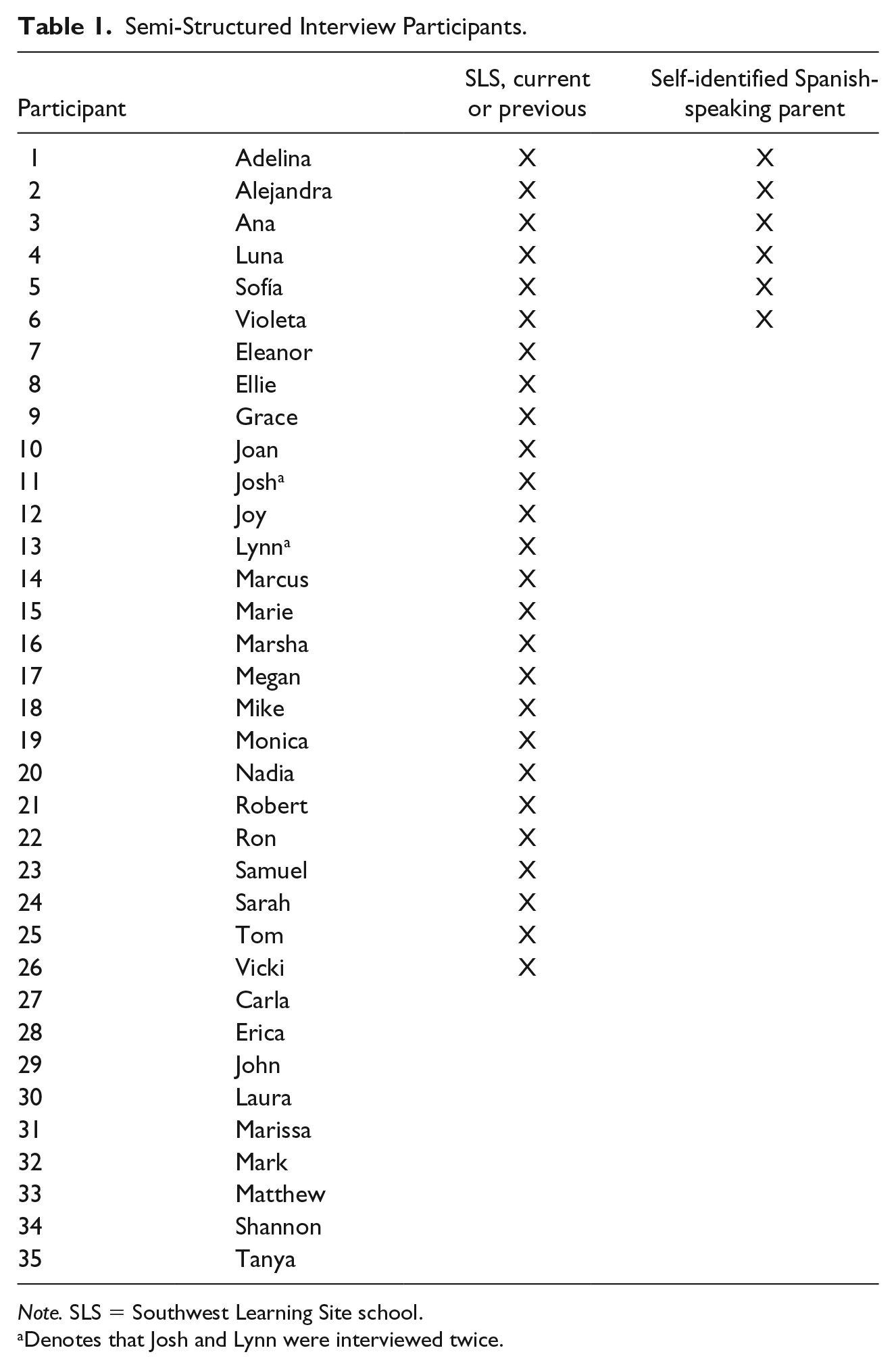
Note. SLS = Southwest Learning Site school.
Denotes that Josh and Lynn were interviewed twice.
Parents’ affiliations overlapped. I show this in Table 1 by noting if parents: (a) were affiliated with SLS, either currently or previously when their children were younger; and (b) were self-identified Spanish-speaking parents. Mark was the only interviewee who did not have children in or near the DPSS. Rather, he ran an organization for parents to help them advocate for their children’s needs based on his personal experiences advocating for his children with special needs who attended schools in another district. I interviewed Mark because a parent in the DPSS suggested that I talk with him due to his advocacy work, and because he has supported parents who were fighting for their children’s needs in some of the study’s relevant EMOs.
Interviews lasted 2 hr on average and all except for two were in person. I prepared a broad set of questions that I wanted to ask all participants (interview questions available upon request) that were guided by my research questions. Many conversations took an emotional turn when we discussed respondents’ children, friendships, and their own pasts, and the challenges they encountered when making difficult choices that affected their families. I listened and encouraged individuals to expand on their thoughts and, in many cases, to expand upon the feelings they openly expressed when talking about choosing schools for their children.
Analysis
I used a variety of tools for coding the data, including a codebook, reflexive writing in the form of jottings and memos (Emerson, Fretz, & Shaw, 2011; Lincoln & Guba, 1985), and first- and second-cycle coding (Miles et al., 2014). I did not pre-develop codes, although I do not assume that researchers are ever necessarily theory-free. My first-level codes included accountability, agency, change, community, contradictions, cultural capital, culture, emotions, exit, interaction and complexity of structure, culture, and agency, leadership, market behavior, perceptions, political, process of choosing, reasons to move schools, resistance, social capital, structure, want better or different that I had.
In later coding cycles, I followed Miles et al.’s (2014) instructions for moving from codes to patterns or themes, by inserting “individual codes associated with their respective data chunks” (p. 89) into matrices and themes after finding commonalities and conceptual links.
I also analyzed my data through a lens that assumes that policy construction results from a complicated interplay between structures, cultures, and agency (Datnow, Hubbard, & Mehan, 2002), and I used this organizing frame as an entry-point for reading and understanding my data. To more robustly understand school choice policies and practices, rather than prioritize one or another of these three areas and place the others in the background, I considered all three concepts to better engage the non-linear, messy, and multidirectional aspects of individuals’ and groups’ cultural, political, economic, and social lives (Datnow et al., 2002). These aspects of social life both transform and are transformed by market-based school choice policies and practices. Datnow et al. (2002) explain these multidirectional interactions between structure, culture, and agency as the complex, continual co-construction of policies built in the process of practice.
Sewell (1992) also wrote the following about the relationships between structures, culture, and agency. Structures are constituted by mutually sustaining cultural schemas and sets of resources that empower and constrain social action and tend to be reproduced by that action. Agents are empowered by structures, both by the knowledge of cultural schemas that enables them to mobilize resources and by the access to resources that enables them to enact schemas. . . . structure is a profoundly cultural phenomenon, and from ordinary anthropological usage because it insists that structure always derives from the character and distribution of resources in the everyday world. (p. 27)
The findings below are the result of my analysis that acknowledges the multidirectional interactions between structure, culture, and agency, and the understanding that agents’ actions are influenced by without being strictly determined by structures, but that those structures and actions are deeply dependent upon and reinforced by the inequitable flow of resources (Datnow et al., 2002; Sewell, 1992).
Findings
Parental Accountability: An Important Dimension of School Choice
Parents at SLS and in its surrounding community dealt with mounting social and cultural pressures as competition between both public and charter schools in their neighborhood increased. Many experienced what I describe as parental accountability concerns that proved to be an important component of their school choice experiences. Furthermore, these concerns, which were related to fears about making a potentially bad or wrong social and emotional choice for their children often, but not always, trumped other factors related to meaning- and decision-making such as schools’ rankings and student achievement results. The findings and examples provided here reveal an understudied phenomenon that shows how the pressures that were placed on parents in a mature education market were, at least in this setting, laden with contradictions related to access and school cultures, individual versus public priorities, and the permanence of choice. The parents’ experiences highlighted the fragility of public-school institutions and the instability of parental choice.
Parental Pressures, School Cultures, and Students’ Voice
As parents were choosing schools for their children, and as they searched for the best schools, they discussed what they perceived as pressures to choose schools with the highest rankings, highest community profiles, or to, as one parent said, choose what is currently “trendy.” According to some parents, such a decision could potentially mean that children ultimately were placed in an environment that may or may not be socially and emotionally healthy for them, or in places that might lead them to have narrowly focused learning experiences. Parents’ efforts to choose the best schools for their children had the potential, for some, to place unjustifiable stress on students in the process.
Other parents felt a deep sense of accountability and responsibility to provide their children with better opportunities than the ones they had. For example, one father’s emotional description of schools being a place where children should feel safe and free to “be themselves” was also evident in his description of his own experiences in high school. He connected his experiences to what he saw as a need to provide school spaces for young adults to feel included. In choosing schools for his daughter, he was directly affected by these experiences and he felt a great responsibility to provide a safe space for her. He even thought that a new “culture” of schooling, including charter schools like the one where his wife worked, could be helping with this, too: I mean, everyday in high school, every single day, I was either pushed around by somebody, or I was called a [derogatory name], because I pierced my ears, and dyed my hair and wore all black. . . . I’m not kidding you, it was every single day. Because I didn’t walk the line that other kids thought you were supposed to walk, I was considered this crazy freak. We would walk into stores, into a department store, and people would follow us like we were criminals. I mean, it was a different culture, but I think that, because of people like us becoming adults and seeing a need and working toward things . . . I mean I look at things like people accepting people who are covered in tattoos now and not blinking, people having dyed hair . . . a lot of times people don’t even notice, they don’t pay attention to it anymore because it is becoming engrained in culture. And I don’t wanna sound conceited about it, but I think that my generation of people who grew up like me . . . who were constantly abused, we’re like, “That’s stupid. People can just be what they wanna be,” and schools like the one my wife works at are creating a culture where the kids . . . can go somewhere where they can feel included.
For him, schools offering a safe and healthy culture was both a priority and responsibility. This was in direct tension with his strong view that charter schools should not aim to replace or compete with district public schools.
Other parents also spoke about culture. Ellie and Marcus had a child who would be attending SLS for kindergarten. In making their choice, they talked about their careful process, about including their preschooler in their decision-making process, and about where they agreed and disagreed about what was important for them as parents to their child:
I didn’t like [a nearby school] from the get-go.
Okay, can I ask why?
The culture.
The parents.
I didn’t really vibe on the cultural, “We’re great, we know we’re great,” and that kind of thing. Academics to me is probably third our fourth on the list. Diversity, class size, comfort, those are the things that really matter to me because I think we’re talking about the difference between an A school and an A- school or A+ school. We’re not talking about the difference between a school here and then one with metal detectors. Any of the choices we made would have been good, but how do we feel about the school and how [their child] felt when we ultimately had him finally look at a couple of these schools? How did he feel? [These] were things that we thought were of critical importance.
This is where we differed a little bit, because I really do want the academics and there are some resources and some extra boosts that come with going to a wealthy school, whether we like it or not. They just have some benefits and it will lead to other schools, etc., whereas going from SLS where I am, honestly, a little worried about the academics and the rigor, I do think it will be harder to go to the next step at other schools.
Ellie really liked the culture at SLS, though, and felt confident about keeping a close eye on her son’s academic progress. Ellie said, Whereas, the feeling at SLS where you can show up at any time, go help in the classroom, go meet your kid, have lunch with your kid, and the fact that there’s mixed grade classrooms, really added the component where they have to adapt to your kid. So, whereas I don’t think the classroom is going to be necessarily rigorous enough for my kid, because I’m just hard . . . I do have the option to go in there and say, “You know what, I think he’s mastered that, let’s talk about what else he can do and I’ll help you, whatever you want me to do to get him onboard.”
Overall, Ellie and Marcus appreciated that SLS was a school that was open and welcoming for parents, and they both felt like they had the resources and the invitation to work alongside teachers at the school to help their son in whatever ways were necessary. Ellie and Marcus’ choice for their son to be a part of the decision-making process also shows that it was important to them for his voice to be respected and heard. They had the ability and shared resources to change schools if they wanted to or felt a need to do so at any time.
Parental Pressures and Anxiety
Other parents faced pressures and heavy weights when choosing their children’s schools. One parent who is also a teacher and has children who are now adults talked with me about the strain she saw being placed on parents with young children as they navigated choosing schools. She said, I feel sorry for young parents, there’s so much pressure put them . . . I remember reading an article several years ago where it said if you don’t pick the right preschool, they won’t get into the right college. I hope that’s not true.
Parents with young children also talked about this emotional process of choosing schools. This anxiety and frustration was apparent in a number of comments from Tanya, a mother with a young daughter: There’s always, like, an Achilles’ heel to everything. And that’s, like, the difficulty with any choice. No matter where we go, I think I’ll have some buyer’s remorse. [There will be a lot] of struggles at the beginning and we’ll be like, “Oh, did we make the right choice?” Maybe that other one would’ve done this better. This part would’ve been better there. So there’s never a perfect thing.
This realization was also reflected in Marissa’s explanation to me that, although there were aspects of the charter school’s curriculum at her children’s school that she strongly disliked, she was faced with the understanding that, if she took them out of the charter school, she might never have a place for them again because “the waitlist on that school is impossible.”
Other parents seemed to view the stress involved with school choice as, at times, too much to handle. As Marissa suggested, waitlists were potentially powerful in influencing families’ decisions about their children’s schooling. Another parent, Joan, explained her dislike of school choice lottery systems which, according to one EMO’s website, are used to randomly place families on a waitlist when there are more applications than places available: And then I started looking into [a school in the area], but the drive was too far. And I don’t like the lottery system. The lottery system, if I ever learned that something had a lottery . . . I just didn’t want to deal with a lottery. And all my girlfriends were doing lottery so they were all totally stressed out with the lottery system. So that was one thing.
Joan spoke again later in our conversation about her friends whose children were in the lotteries at various schools in the area. She said that one friend decided to “go to Agave,” one of the nearby district public schools. She asked a friend, “Why are they going to Agave?” And she says, “Because they got so stressed out not [being] given those lotteries [not being chosen off of the waitlist at the charter school] that they just chose the school that was closest to them and they just chose Agave.” So after a while I think parents just get stressed and choose, just to get in. They’ve got to choose somewhere!
Individual Versus Public Priorities
Most parents felt that it was very important to not only choose a good school, but to provide a good social experience for their children, and some even to the point of sacrificing notions of what was good for “public” schools and the common good. For example, Shannon, a mother whose young child tried out a number of schools in the area before she finally decided to homeschool him, ironically talked about how important it was for her to provide the experience for her son that both she and her husband had growing up—which included going to public schools. Few parents explicitly mentioned how, compared with other nearby public schools, a greater number of students who lived in poverty and received free and reduced price lunches attended SLS since the school sought to diversify the population through intentional bussing. Shannon did, when she commented on how she saw a lack of school boundaries to be problematic for a “community.”
Schools, for her, were opportunities for families to build communities and might be better if they were focused only upon the children who lived within a specified border. Her thoughts about students’ access to schools via open enrollment reveals an undercurrent of socioeconomic and cultural inequity that occasionally surfaced. Shannon said, I understand the concept in the beginning of what open enrollment was supposed to do, but when you look about how [SLS] is in the [Desert] neighborhood yet it’s a Title I school . . . and you’ve got all these people from miles away bringing them up to this neighborhood because that’s supposed to benefit them, but we’ve lost our sense of community now. So everybody who goes to your school, they don’t even live in your neighborhood . . . Why can’t we keep that money in the neighborhoods where it belongs? That’s what makes [Agave, a local district public school in a high-income area near to SLS] school such a good school now, is that so much family money is still being put into that school. Why not make you move to that neighborhood for that reason? Our property taxes are higher for that reason and, therefore, keep the government money in the neighborhoods and in the schools where it belongs. And then those schools are building stronger communities around themselves as well.
Shannon’s account does not consider how schools in the different neighborhoods received different amounts of money, through government funding and individual donations. Some of the schools in the district raised a particularly large amount of money that was allocated just for their own schools and were able to provide more resources for their students. Although she had made the choice to homeschool her son, Shannon felt pressure and a desire to also create a close-knit and unstructured social environment for him, much like the more traditional neighborhood public schools that she and her husband had experienced in their own childhoods. She knew that her struggles to make connections with other families would be ongoing, were especially complicated by her choice to homeschool, and that she would be constantly re-evaluating and justifying to her husband, extended family members, and even to herself, where and how her child would attend school.
Permanence (or Impermanence) of Choice
Such impermanence and ongoing justification of choices was not uncommon among the parents. Tanya’s daughter attended five schools and she was preparing for a sixth move by the start of second grade. Tanya’s love for her only child and her desire to ensure that she would be happy and successful in school was obvious during my time with her. Tanya was visibly tearful when we talked about her concern for her daughter’s happiness and her own feelings that she had failed her daughter up to this point in her education. Quite poignantly, she said near the end of a long conversation about the choices she was making for her daughter and her schooling, “ . . . And this is it, maybe, that I will never be satisfied.” The quest for the best social and cultural school setting for her daughter had become, in some ways, an unreachable summit. Tanya was struggling with how this might affect her elementary school-aged daughter, and she even talked about her hopes for where she will attend college. She expressed a genuine fear of failing her daughter because of her immediate school choice process. Likewise, in an informal conversation during my fieldwork, one parent commented that she thought more about her child’s preschool than her parents ever thought about her college.
One mother who identified as a Spanish-speaker discussed difficulties for parents who were English learners. Alejandra spoke of the “the game of education in this country.” She felt that some parents could not take part in school choice because they did not yet know the language well enough to understand the process, nor did schools have adequate resources for translations. Such frustrations and pressures for some public-school parents who expressed strong love for their children and yet felt disconnected from the public schools where their children attended were time-consuming and at times burdensome. Beyond just choosing schools, the pressures that some parents who were English learners felt to ensure that students’ grades, and schools’ state-assigned grades, were high was also very important. Alejandra’s expectation was that it is parents’ responsibility to learn how to navigate Arizona’s public-school system and revealed how results on standardized tests were, for her, important without question for understanding parents’ choices. She said, “It is important that we have good grades in this school. If we are a C and others come from another state then they won’t want to come here!” Alejandra’s heartfelt comment reflects an assumption that everyone comes to Arizona already understanding that they have the option to enroll their children in a wide range of public schools beyond their neighborhood schools, or that they have sufficient resources to learn “the game of education.”
One mother, whose children attended SLS when they were young, acknowledged the inequities apparent in Arizona’s school choice policies and programs: But we knew about this school two years before he ever went there. We had gone and visited and talked to teachers and got to know them, watched what they did, before he ever went. Most people don’t have that luxury.
Carla, another mother with children in school, remembered how hard every decision was when moving her children multiple times and to different types of schools. Although her perspective now is that she “lamented over every decision” yet everything worked out for one of her children, she explained how difficult it was when she was struggling to find the right setting for him: So that was just a bad experience. We pulled him out in seventh grade and put him back at [a local private school]. So he did his final year, eighth grade, back at [the private school] again. So that poor kid had been in one, two, three, four schools, all within two miles of each other.
Finally, it is helpful to understand that, as parents “walked the line” between choices that were good for their families and those that were good for public schools and society, their perceptions and actions often evolved.
Most parents were not against charter schools per se. Many, though, were against unfettered free-market policies built on the assumption that these programs could lead to better schools for all. Most parents were not duped by this assumption and, in fact, struggled quite openly with the problems that they had with some school choice options in their area, especially when they were market-oriented. Still, some moved their children multiple times across traditional public, charter, and private schools. Indeed, unfettered choice, one mother claimed, was also ironically moving schools toward conformity as they fought to keep up with each other. The school choice process for parents was more complicated than theories related to “winning” and “losing.”
Discussion and Implications
Parental Accountability as a Concept
Garn and Cobb’s (2008) typology of four models of accountability in a school choice environment address bureaucratic, performance, market, and professional accountability (Garn and Cobb, 2008), and the data from this study illuminate those four models in many ways (see also Potterton, 2018b). I propose that the concept of parental accountability is an important extension to their typology that can help researchers and practitioners better understand inequities built into a neoliberal, market-based school choice system (Apple, 2006; Hursh, 2007). As can be seen above, the pressures that are placed on parents in a mature education market are laden with both faulty assumptions and contradictions related to access, individual versus public priorities, and the permanence of choice.
Also, there were clear differences in how parents with relatively more social, cultural, and economic capital and those with less participated in school choice. On one hand, parents who had a surplus of social capital and networking resources, as well as financial savings, were more likely able to take part in Arizona’s school choice programs compared with those who may not have had the same access to resources. On the other hand, some parents, as described by Alejandra, did not have adequate resources to take part in the system. In practice, parents who knew about tax credit programs and open enrollment options for district public schools and charter schools were the parents who were more likely to use them. The assumption that everyone can freely take part in a school choice market to make the best choices for their children is faulty at best and dangerous, as well. While some parents outwardly expressed their voices and choices, many were also reflexively influenced by a wide array of powerful forces within the structures and culture of their school and community.
For example, Tanya’s only child will have been enrolled in multiple different schools by second grade and, beyond the stress that Tanya disclosed about the high-stakes pressures of finding a school where she and her child could feel bonded, she also felt like she had thus far failed. Beyond how parents both internalized and externalized various notions of accountability and choosing schools, it was not, as the dominant rhetoric in the school choice literature and popular media debates suggests, as simple a process as finding the “best” fit, sending your children there, and then being a part of a system that would eventually allow the best schools to succeed and the worst to unravel via the invisible hand of the market. In this community, school choice was much more complicated, and parents’ choice processes did not necessarily have a clear beginning or end. For some, the process was ongoing.
During the 2 years while I was collecting data, I found myself thinking that there were families, children, and even larger communities being immediately and concretely affected in the present while the market-based model unfolded in a more abstract way (e.g., Potterton, 2018c). I met other parents whose feelings of sadness and fear about making a school choice mistake were in many ways similar to Tanya’s. Furthermore, the experiences of some Spanish-speaking and English-language learning mothers at SLS were encumbered with inequities and injustices as they attempted to navigate a complicated and confusing school choice environment.
Fragility of Public-School Institutions in a School Choice Market
Families’ choices in this study were ultimately driven by complex feelings of anxiety, fear of making mistakes, reasoned evaluations (Altenhofen et al., 2016), and a desire to make good choices. Parents focused on notions of community and ideas about accountability. SLS was changing, was fragile, and existed in a high-stakes school choice environment, and parents were finding themselves considering whether to stay or to leave (see Potterton, 2018c). This, of course, is a premise of market-based school choice systems, and my analysis highlights how parents experienced and felt intense notions of parental accountability in the context of competitive policies and programs.
These findings contribute to the extant literature surrounding the effects of school choice policies and programs from the perspectives of parents. The fragility of public schools in a market-based public-school choice system and a better understanding of parental accountability and the intense pressures placed upon families in a market-based public-school choice system should not be ignored as school choice policies and programs continue to expand globally. As many of the parents in this study demonstrated, unfettered choice had the potential to be discomforting and unsatisfying. It even caused at least some parents to feel like maybe no school would be good enough. Yet parents were also open to the potential for schools of choice to offer unique opportunities for students, and most also openly cared for traditional public schools.
Conclusion
My intention in this article was to introduce the concept of parental accountability as an important extension to Garn and Cobb’s (2008) framework of accountability in school choice reform contexts. Implications for using this concept expand beyond the Arizona context. Parents elsewhere or anywhere, such as those with children with autism or other learning differences, may face an even more unique set of parental accountability pressures and concerns when they make choices, whether they be for district public, charter, or private schools (e.g., Sherfinski, 2018; Sherfinski & Mathew, 2019). A limitation in this analysis is that it is a qualitative study that is set in a single local context. However, there is an important space for naturalistic generalizations based on the analysis presented here (Stake & Trumbull, 1982). In other words, the findings in this study may be relevant for understanding school choice and parental accountability pressures in other contexts. Stake and Trumbull’s (1982) position is that, although there is a dominant belief that improved educational practice can only come from formal generalizations, research may be read about, reflected upon, argued, and vicariously experienced by many.
Although Arizona is viewed as a school choice experiment in the “Wild West” (Maranto & Gresham, 1999), parents and children do not necessarily experience this as an exciting adventure, but are focused on the reality of their children’s schooling. It is important to view local contexts, or the “small,” with a “big” lens (Greene, 1995), to portray the individuals and groups in this community as humanized and significant “in their integrity and particularity” rather than as “objects of chess pieces” in a system (p. 10). Parents’ decisions needed to be immediate and could not wait for markets to work themselves out. And so, parents’ lines were sometime drawn and then re-drawn—they were fragile and yet complex.
Findings from this study in Arizona are relevant for thinking through how parents understand and take part in school choice, and they problematize our understanding of parental accountability pressures and concerns for parents in both marginalized and dominant socioeconomic and racial groups. They also provide evidence for the usefulness of the concept of parental accountability that I proposed here. It is imperative to understand parents’ experiences and actions in a variety of social class contexts, and the complicated details involved, or not involved, in school choice processes. As school choice policies and programs continue to grow, these types of findings are helpful for understanding the factors driving education markets in settings across the United States and beyond.
Footnotes
Declaration of Conflicting Interests
The author(s) declared no potential conflicts of interest with respect to the research, authorship, and/or publication of this article.
Funding
The author(s) received no financial support for the research, authorship, and/or publication of this article.
