







Abstract
This article presents the findings of research focused on schools’ responses to competitive environments. Using the Chilean education market as a case study, the article analyzes not only the responses developed by schools in different domains in the face of competitive incentives but also their diversity, as well as motivations, rationalities, and objectives behind these responses. The findings also show how different mediating factors at the school and local levels are essential to any understanding of the capacity of market-oriented policies to alter the behavior of schools and obtain the expected results in terms of equity.
Introduction
Privatization and market policies in education have been widely disseminated worldwide in the past five decades. As a result, the level of enrollment in private schools has grown on a global scale, with an increasing number of countries having adopted market-oriented mechanisms, expanding school choice and competition between schools (Verger, Fontdevila, & Zancajo, 2016). In addition to impact evaluations of the effects of these policies on effectiveness, efficiency, or equity, these privatization and marketization phenomena have also been interrogated by the sociological field in analyses of how they affect and alter the social dynamics and interaction between different educational actors. In sociological research, understanding how families and students enact school choice policies has traditionally captured the greatest interest. Diverse and valuable contributions have been made to understand how demand-side actors react to school choice reforms from different sociological approaches, such as social habitus (e.g., Gewirtz, Ball, & Bowen, 1995), bounded rationality (e.g., Ben-Porath, 2009), or rational choice theory (e.g., Wilson, 2016).
However, school choice policies are often accompanied by policy designs that explicitly or implicitly foster competition between schools to attract demand. Per capita funding schemes such as vouchers foster school competition between schools to attract demand, as well as being a means to ensure their financial viability. Moreover, schools’ responses to market incentives are an essential part of the education market theory of change (Lubienski, 2006). In this sense, it is expected that, in a competitive environment, schools will try to respond by increasing their levels of educational quality to attract demand and maintain their position in the market (Chubb & Moe, 1990). However, evidence has shown that schools do not necessarily react to competitive incentives as the theory expects, and frequently these responses are not related to the educational quality offered in school (Lubienski, 2003; Waslander, Pater, & van der Weide, 2010).
As in the case of demand behaviors, the analysis of schools’ responses needs to identify the rationalities, motivations, and objectives behind them, as well as how they are affected by contextual factors. Frequently, the analysis of education market dynamics conceptualizes schools as relatively static actors with limited reflexibility and agential capacity, which only seek to respond to families’ and students’ preferences expressed through the process of choice. However, academic literature has shown that schools have the capacity to influence these preferences and families’ process of choice (Lubienski, 2006) or to develop strategic behaviors as a response to education market incentives (Jabbar, 2016), thus conditioning the results and effects of these policies.
This article attempts to contribute to the research in the field of school responses to the education market in two different ways: on one hand, analyzing the diversity of dimensions in which schools develop responses in the face of competitive incentives; on the other hand, identifying which and how mediating factors influence these responses, as well as the objectives, motivations, and rationalities that influence schools’ responses. The research presented in this article focuses on the Chilean education market as a case study for two main reasons: first, because, historically, Chile represents the most marketized education system worldwide (Bellei & Vanni, 2015); second, after more than four decades of education market adoption, actors are comprehensively aware of the rules and how the market operates, which is a necessary condition for investigating how educational actors enact the market.
The article is structured as follows. First, the literature on different school responses to competitive environments is reviewed. Second, the analytical framework employed to analyze schools’ responses is presented. As will be seen, the framework employed is grounded in a sociological approach focused on the mechanisms of educational providers’ enactment of school choice and competition policies. Third, the main features of the Chilean education market are briefly described as well as methods of data collection and analysis. Fourth, the findings regarding the responses developed by schools depending their position in the local hierarchy are examined, as well as the objectives and rationalities underlining different domains of response. Finally, the discussion elaborates on both the sociological and policy implications of findings presented in the article.
Schools’ Responses to Competitive Environments
The literature on how schools react to market-oriented policies has identified a diverse set of possible responses and practices developed by schools in the face of competitive incentives. However, on the basis of the studies analyzing schools’ responses from a holistic perspective (e.g., Fiske & Ladd, 2001; Gewirtz et al., 1995; Jabbar, 2015; Woods, Bagley, & Glatter, 1998), it is possible to categorize different school practices into five main domains of response: (a) market scanning, (b) diversification of school policies and practices, (c) academic performance improvement, (d) student selection, and (e) marketing. Despite differences between the various contexts analyzed in previous literature, this section is dedicated to summarizing the conceptual definitions of each of these domains as well as key insights into the empirical evidence for each domain of response.
Market scanning refers to all the responses developed by schools to obtain, collect, and gather information of the demand side (i.e., families and students) and from the supply side (i.e., other schools) in the education market. The information collected through these practices may have different objectives, but it is mainly used by schools to evaluate their position in the market and thus adapt their practices (Bagley, Woods, & Glatter, 1996). At the same time, market scanning can have a systematic or informal nature. Systematic processes of market scanning entail specific and complex instruments for collecting information (e.g., surveys or secondary data analysis). In contrast, informal practices of market scanning entail informal conversations with families or occasional meetings as a means of obtaining information on the attributes valued by families and informal contacts to become aware of the investments and activities of those schools considered to be direct competitors (Bagley et al., 1996; Oplatka, 2002).
The differentiation of school policies and practices has also been identified as another possible response to education market policies. In a competitive environment, it is expected that schools will try to develop an educational offer which allows them to meet the preferences of families or students and, therefore, to attract demand (Glatter, Woods, & Bagley, 1997; Jabbar, 2015). However, Lubienski (2006) points out that schools’ differentiation processes do not necessarily involve pedagogical dimensions or imply substantive changes in their daily practices; but, frequently, schools try to differentiate their offer based on symbolic attributes valued by their targeted population.
Among other schools’ responses identified in the literature are practices aimed at improving their academic performance, particularly their results in standardized external tests, also known as “teaching to the test” practices (Woods et al., 1998). A large part of the educational reforms that introduce market mechanisms are accompanied by systems of accountability and information systems for families, largely based on the results obtained by schools in external evaluations. Numerous strategies oriented to improve the students’ performance in standardized external tests can fall under the category of teaching to the test practices (Jennings & Bearak, 2014). These types of practices include making pedagogical changes, narrowing the curriculum (to focus on those contents evaluated in standardized tests), setting objectives for each student, monitoring or increasing the diversity of programs offered to adapt to the specific needs of students (integration or language programs), and specific sessions oriented toward preparation for external exams (Jabbar, 2015; Woods et al., 1998). Other studies have even identified practices of an illegal nature, oriented toward gaming or cheating, such us providing the test in advance or changing students’ answers (Stecher, 2002).
Yet another possible response by schools involves attempts to influence their school population regarding the socioeconomic and academic ability of their students. In some cases, these responses take place in contexts where selective processes are regulated, although evidence also indicates that schools, particularly private ones, carry out selection practices in a subtle or informal way. In this sense, schools in competitive environments are particularly affected by what van Zanten (2009) refers to as first- and second-order competition. While first-order competition involves incentives that schools offer to attract large numbers of students, second-order competition takes place when schools try to attract the most academically able students because they cost less to educate.
Finally, the last dimension of responses identified in the literature is the development of marketing practices. In this sense, marketing responses developed by educational institutions go beyond specific promotional activities and involve the management of schools’ external relationships with their closest environment (Oplatka & Hemsley-Brown, 2004). In this vein, Lubienski (2006) observes that marketing has to be understood as a way to reinforce schools’ differentiation processes. To this extent, the use of pedagogic or other substantive changes for schools to differentiate their offer usually carries a significant cost, and the use of symbolic attributes, therefore, typically becomes a more cost-effective practice. In a context where symbolic attributes play an important role in how schools differentiate themselves, marketing can also play a key role by creating “impressive distinctions in consumers’ perceptions of products even where actual differences are often superficial” (Lubienski, 2003, p. 12). At the same time, Lubienski (2007) and Jennings (2010) highlight another possible objective of schools’ marketing practices, related to the capacity of schools to disseminate their offer only among their targeted population or by excluding specific profiles of students.
Schools’ Education Market Enactment: Analytical Framework
The literature on schools’ responses demonstrates that they do not necessarily react to competitive incentives in the same and homogeneous way. This also means that schools’ responses to the market are not of a dichotomous nature (responding or not responding to market incentives); rather, a diverse range of responses can be expected (Woods et al., 1998). In this context, the sociological approach of the policy enactment framework allows us to overcome the limits of most traditional policy implementation approaches, which mainly consider policy design as a factor for conditioning the outputs obtained, and to investigate how the different actors involved react to this policy by decodifying and resignifying it (Maguire, Braun, & Ball, 2014). Obviously, this approach does not necessarily mean that policy designs and regulative frameworks do not act as drivers, delimiting and restricting actors’ capacity of action. However, it is important to bear in mind that policies do not necessarily establish the specific way in which they should be interpreted but “they create circumstances in which the range of options available in deciding what to do are narrowed or changed, or particular goals or outcomes are set” (Ball, 1994, p. 19). In this sense, policy enactment also allows us to overcome the traditional sociological debate around structure and agency, in this case, regarding educational providers. As Jabbar (2016) proposes, the analysis of educational providers’ responses to the education market needs to transcend this duality by considering that schools develop strategic behaviors, while, at the same time, these behaviors are conditioned and delimited by social, economic, and political factors (including policy design).
Beyond the importance of policy design in understanding how actors respond to a specific policy, the policy enactment framework highlights the local context as one of the dimensions that significantly influence these responses. The context, understood broadly, in which the school develops its activity influences and conditions the interaction process between it and the policy analyzed. However, it is important to bear in mind that context also refers to material and cultural characteristics of the institutions that are enacting the policy. Structural proprieties of the local context in which educational providers develop their activity also determine how schools enact market policies. In this sense, Woods (2000), based on the analytic dualism theory of Archer (1995), considers that any operationalization of the local context in which schools are situated needs to consider material, cultural, and social dimensions.
Despite the importance given to contextual factors, the main contribution of the policy enactment framework, or at least the most useful to understand how schools respond to a specific policy, is the capacity to distinguish between the two main stages of policy enactment, namely, interpretation and translation. As Ball, Maguire, and Braun (2012) point out, these two stages have a heuristic nature and do not necessarily need to be understood in terms of a linear process but rather as a dynamic relationship between them. Interpretation refers to the process of decodification and analysis carried out by principals and teachers regarding the implications of the policy for their own characteristics and the dynamics of their closest environment, to establish a sort of “institutional agenda” guiding their responses to the policy. This process of interpretation is mediated by two main categories of factors. On one hand, there is the position of the school in relation to those attributes included in or considered during design of the policy, such as their performance in external standardized tests. On the other hand, there are those factors relating to schools’ material or symbolic resources, which can determine their capacity to respond to the policy in terms of, for example, the school population or status in the local education market (LEM). For its part, translation refers to the moment when schools transform their institutional agenda into specific practices, concepts, and materials as a means of responding to the policy. In an attempt to synthesize and clarify both moments of policy enactment, Ball et al. (2012) draw an analogy between interpretation and tactics on one hand, and translation and strategy on the other.
Context, Data, and Methods
Chile is one of the most emblematic cases in the adoption of promarket reforms in the education sector. During the 1980s, a universal voucher scheme was adopted for both public and private subsidized schools (Mizala, 2007). As a result of this policy reform, the number of private subsidized schools and the share of enrollment in private institutions have been increasing dramatically since the early 1980s, and nowadays this accounts for more than 60% of the total enrollment in primary and secondary education (Centro de Estudios Mineduc, 2017). Almost five decades after the adoption of promarket reforms, Chile is currently known for having one of the most unequal education systems among Organisation for Economic Co-Operation and Development (OECD) countries (OECD, 2016; Valenzuela, 2008).
Despite the Chilean education market representing an optimal case with which to analyze how schools respond to competitive environments, due to the high level of deregulation and schools’ autonomy, evidence of how and under what rationalities schools respond to market incentives is relatively scarce. Regarding student selection practices, although these have been almost completely prohibited since 2009, 1 various studies have shown that they are commonplace in Chilean schools, particularly in private subsidized ones (Carrasco, Bogolasky, Flores, Gutiérrez, & San Martin, 2014; Contreras, Bustos, & Sepúlveda, 2010). In terms of other responses explored in the literature, evidence shows that the adoption of market policies has not led to increasing diversification of school policies and practices (Gauri, 1998). In fact, detailed analysis of the pedagogical projects in Chilean schools underlines how a limited range of approaches have dominated the great majority of schools (Ministerio de Educación, 2012; Villalobos & Salazar, 2014).
The evidence presented is grounded in case studies of two urban municipalities in Chile. These two municipalities were selected because, among other characteristics such as school supply diversity and social composition, both are characterized by a low level of student mobility, particularly compared with the majority of Chilean urban municipalities. According to the Chilean household survey (CASEN-2013), the percentage of primary-age students attending a school in the municipality in which they live is relatively high (93% in Municipality A; 90.7% in Municipality B), and the percentage of students enrolled in the primary schools of the municipality which also live in the same geographical area is also high (94.8% in Municipality A; 86.9% in Municipality B). In this sense, it is possible to affirm that both geographical entities can conceptually be thought of as LEMs.
In each LEM, a sample of schools has been selected based on different observable characteristics (school fees, academic performance, prevalence of student selection and ownership). The sample consists of six public schools, nine private subsidized schools, and two private independent schools in LEM A; in LEM B, the schools analyzed were three public schools, nine private subsidized schools, and two private independent schools. In each school, an in-depth interview was carried out with the school principal, and short interviews were conducted with a sample of between five and 10 families, resulting in a final sample of 109 families. Schools were also classified according to their position in the local hierarchy, adapting the methodology of Maroy (2004), who employs student socioeconomic indicators (depending on the national case analyzed) to classify schools in relation to their position in the local hierarchy. In the case of this research, schools were classified depending on the average socioeconomic status of their school population, establishing five categories: low, lower-middle, middle, upper-middle, and high. Following a deductive approach, the research design and analysis of the interviews with school principals and families were structured according to the five domains of response identified during the literature review, as well as exogenous and endogenous contextual factors affecting these responses and influencing schools’ process of enactment.
Schools’ Responses
This section is dedicated to analyzing how and why schools develop responses in each of the domains identified in the literature review. Schools included in the sample have been grouped into three categories relating to their position in the local hierarchy: high, medium-high and high; medium-low and low. The position of schools within the local hierarchy has been considered the main explanatory factor for analysis of the process of enactment developed by schools. However, Table 1 summarizes not only the different responses developed by each type of school but also how a specific position in the local hierarchy is frequently related to the schools’ situation in relation to other mediating factors, such as the level of perceived competition (Levacic, 2004) and situation in terms of demand. The relationship between position in the local hierarchy, other contextual factors and responses for each type of school is developed later.
Schools’ Responses Depending on Their Position in the Local Hierarchy.
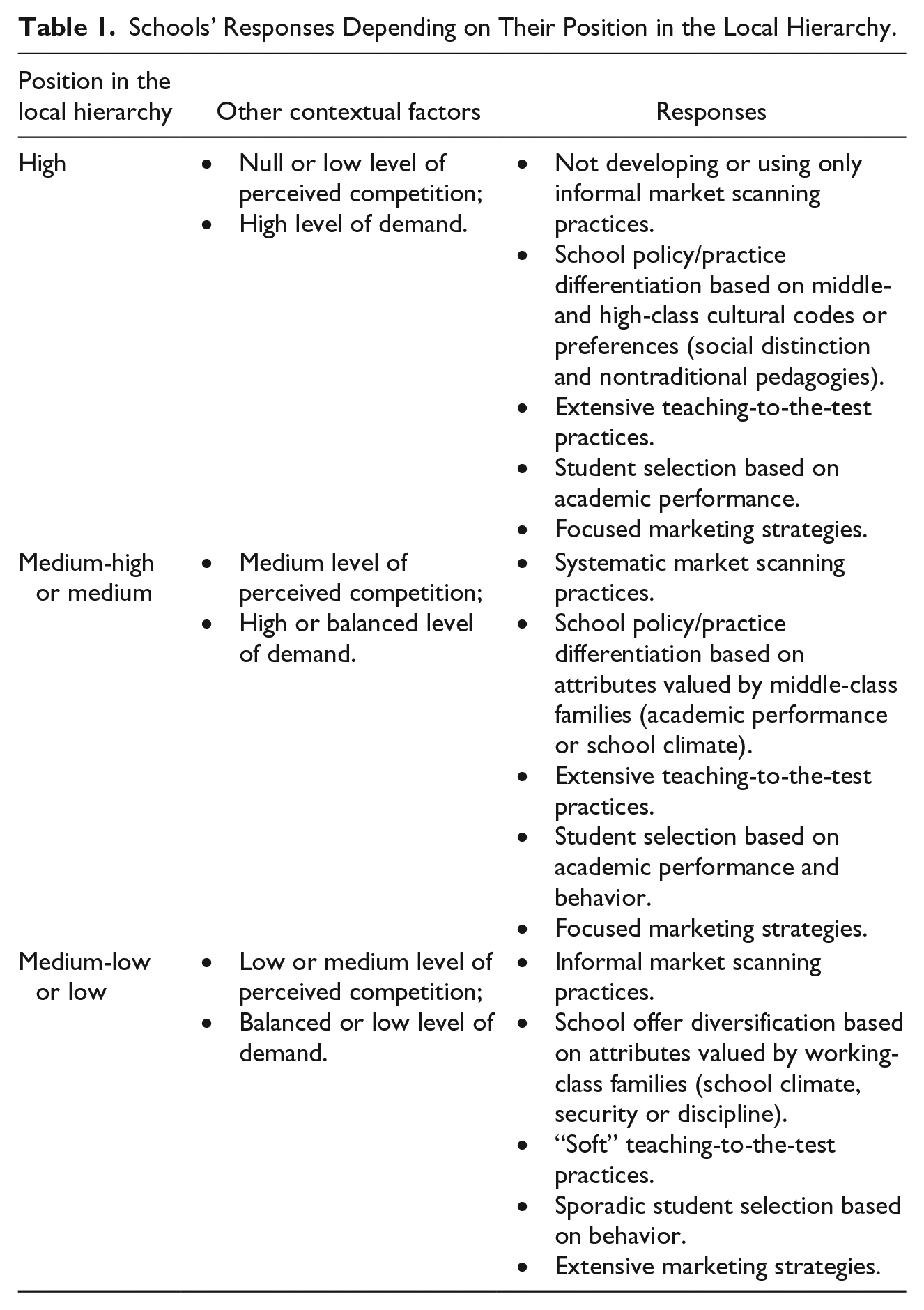
The relationship established between position in the local hierarchy and the responses developed by schools should be understood as ideal types, which means constructs that synthesize the main orientations of schools in relation to the type of responses they develop and the mediating factors that affect their process of enactment of the educational market. Although most of the schools analyzed correspond to some of the typologies presented, others may combine multiple characteristics and responses. The rest of this section is dedicated to examining the process of enactment for each type of school identified, examining the rationalities and objectives of the responses developed by schools as well as how mediating factors influence these responses.
Schools Situated in High Positions of the Local Hierarchy
Schools that are in a high position of the local hierarchy frequently enjoy a very stable situation in the LEM. Usually, for these schools, being situated in the highest positions of the local hierarchy and having a good situation in terms of enrollment means that the level of perceived competition is null or relatively low because they do not identify other direct competitors.
As a result of the privileged position of these schools in the LEM, because of the lack of perceived competition and an advantageous situation regarding demand, and the fact that they have a clear understanding of the attributes valued by their target population, these schools do not develop any explicit market scanning practices or they do sporadically and in an informal way. In some cases, school principals have reported using informal discussions or meetings with families whose children are already enrolled in (or have applied to) their school as a means of updating information about the criteria considered by families to select the school and what attributes of the school were valued when choosing the school.
The differentiation of school policies and practices is highly influenced by high- or upper-middle-class populations that attend such schools. As a result of interpretation and translation processes, differentiation practices are mainly oriented, as reported by the principals interviewed, toward reaching out and appealing to the school’s targeted population in terms of socioeconomic background, which means reflecting those attributes valued by high- and middle-class families. In the case of the two LEMs analyzed, these schools try to differentiate themselves by offering families a certain level of social closure or social distinction, which is done by highlighting the socioeconomic background of their school population and regarding this as one of its most attractive features. Even those schools offering a specific pedagogical approach, such as those based on nontraditional pedagogies, openly recognize that this process of differentiation is essentially oriented toward creating a market niche, thus attracting a specific profile of families in terms of socioeconomic, ideological, and cultural backgrounds, as summarized by one of the school principals below.
Our pedagogical project attracts an emerging middle class which was fostered by neoliberal policies and who have a critical view of reality . . . I believe that they look for a different, more innovative project in these areas, fundamentally in terms of what has to do with the authoritarianism that is very present in Chilean schools. (Principal, Private Independent School 31, LEM B)
In fact, for these schools, the process of differentiating their policies and practices not only accomplishes the role of attracting new students or families from specific socioeconomic backgrounds but also excludes others. In this sense, principals report that the use of upper-middle- and high-class cultural or educational codes allows them to attract such families while also dismissing others from lower socioeconomic backgrounds who frequently do not engage with these codes: “Those who do not share that approach are self-excluded because the educational project in action is telling them ‘This is not for you’” (Principal, Private Independent School 31, LEM B).
Development of practices aimed at improving academic performance is related to the importance that schools place on their performance in terms of their capacity to foster new demand, while official accountability devices seem to have a low impact. In this sense, the development of practices oriented toward improving academic performance in the national standardized assessment (SIMCE) 2 is mediated by schools’ perceptions of the results of these external tests in terms of how they affect their position in the LEM and their image among families. Schools placed higher up in the local hierarchy, enrolling students from middle- and high-class backgrounds, in fact report that performance in the national assessment can be an important factor influencing their capacity to attract new demand or retain students currently enrolled because families from higher socioeconomic backgrounds place a certain level of importance on performance when choosing a school.
Schools that perceive more pressure or incentives to obtain high levels of performance in the national assessment usually combine two or more instruments to improve their performance, which can be categorized as “teaching to the test.” These practices commonly include allocation of certain school days for specific workshops to train and familiarize students with the national assessment, carrying out mock exams, establishing a system of incentives for students who are going to take the exam (in terms of gifts or special study trips) or contracting out consultancies specialized in the preparation of standardized tests.
Schools situated in higher positions of the local hierarchy consider that they do not need to develop processes of selection in terms of socioeconomic background as their high level of school fees assures them of a homogeneous demand regarding their social and economic profile. However, selection processes in these schools are focused on guaranteeing a certain level of homogeneity in terms of the academic ability of their students. In line with this objective, these schools use admission exams to measure the academic performance of new applicants or even personal interviews and in-class observations of students’ behavior in the case of early years education. Homogeneity in terms of academic performance is something sought by principals from such schools because it allows them to exclude students with special educational needs or learning difficulties, thereby reducing the “cost” of their educational activity, providing them with high levels of performance in external standardized tests and reducing the need for teaching to the test practices. However, extensive use of selection processes is frequently justified by school principals as something oriented toward ensuring the well-being of the children.
We carry out selection interviews with the children to measure basic functions, ok? A sort of test . . . to detect if there is any major problem, [ . . . ] When there is an important problem, we tell the parents and we say to them: “Look, he is not within the range.” We are interested in relatively homogeneous classrooms because a child who does not achieve what his classmates achieve, who always makes mistakes, who never ends up doing things, what he brings to the school is wrong, is a child who is bitter and frustrated; and why? If there are different schools available nowadays. (Principal, Private Independent School 17, LEM A)
Despite the increasing importance of marketing, schools situated high up in the local hierarchy and with a stable level of demand focus their marketing practices on reinforcing their good reputation and enhancing the image of their school in the external environment. With this objective, these schools do not develop extensive processes of marketing but try to reinforce their status within the LEM through regular external communication.
Schools Situated in Medium-High or Medium Positions of the Local Hierarchy
Schools placed in medium-high or medium positions in the local hierarchy often consider that despite having a relatively stable position in the education market (a balanced or even high level of demand), they have the capacity and potential, in terms of resources and characteristics, to improve their situation in the LEM. This possibility of improving their position largely explains their medium-level perception of the competition, which is typically highest in the case of schools placed at the bottom or high up in the local hierarchy.
The higher levels of perceived competition of these schools compared with schools situated in higher or lower positions and the aspiration to improve their position in the LEM is reported by school principals as the reason for using systematic market scanning practices. For the principals interviewed in these schools, it is precisely their interpretation of their position in the LEM that explains the need for updated and complete information on the criteria used by families to choose a school and on what those schools considered as direct competitors are doing to attract new demand. These schools develop systematic forms of market scanning through the use of specific tools for collecting information, such as surveys among families or elaboration of comparative tables between the different schools considered to be direct competitors. Regarding the supply side of the market, the principals in these schools indicate that these processes of systematic data collection allow them to know “what things they [other schools] are investing in or are reframing to attract demand” (Principal, Private Subsidized School 27, LEM B). In the case of the demand side, school principals consider that data collected through family surveys provide them with updated information about the reasons for choosing their school and their level of satisfaction.
With regard to differentiation practices, schools situated in medium-high or medium positions in the local hierarchy try to align their school policies and practices with the preferences of middle-class families. In the case of the two LEMs analyzed, schools placed in these positions mainly develop their approaches based on academic performance or a positive school environment, attributes that are valued by lower-middle class families who try to avoid schools that are lower down in the local hierarchy (mainly public) and are characterized by low levels of school performance or behavior problems. But at the same time, the principals of these schools also expect these attributes of differentiation to appeal to families from higher socioeconomic backgrounds, allowing them to improve their position in the LEM. Likewise, for these schools in particular, differentiating their school offer is a continuous process of interpretation and translation. In this sense, differentiation practices in these schools are clearly influenced and mediated by changes in social composition and families’ school choice preferences in LEMs, with schools trying to adapt their policies and practices in relation to their evolution.
As with those schools situated in higher positions, schools placed in medium-high or medium positions also make extensive use of practices oriented toward improving their performance in the external standardized test. However, schools in medium-high or medium positions of the local hierarchy consider their academic performance to be a factor essential for maintaining their level of demand, but to improve they need to attract more affluent families and improve their position within the LEM. One of the school principals interviewed summarizes how the relationship between performance on the national assessment and the level of enrollment operates in these schools: When we obtain a good performance in the SIMCE, the next year, enrollment increases [. . . ] When, as happened some years, we go down in the SIMCE rankings, some students leave, and they tell you that is the reason. (Principal, Private Subsidized School 27, LEM B)
As with schools in higher positions, school practices oriented toward improving performance in external tests also involve specific workshops designed to consolidate students’ knowledge of test content or contracting external consultancies to advise on how to improve performance.
Schools in medium-high or medium positions of the local hierarchy use selection processes for screening new applicants based on academic ability and behavioral characteristics. For these schools, selection based on academic criteria is not necessarily a way to enroll a homogeneous population but rather a means of improving their average performance without the need for pedagogical or quality improvements, thus significantly reducing the “cost” of their educational activity. At the same time, selection based on behavioral criteria to increase schools’ prestige and status in the LEM is also reported by school principals given that, for many middle and lower-middle class families interviewed, the composition and climate of the school are essential criteria when choosing or discarding a school, as the next quote from a mother explains: In municipal schools, there are people whom maybe we do not want [ . . . ] it’s not like discriminating against them, but because of the disciplinary issue. Because in municipal schools, they accept all kinds of children and people who have behavioral problems; we did not want that for our daughter. (Mother, Private Subsidized School 13, LEM A)
It is also important to take into account that, in these schools, student selection practices are sometimes not necessarily oriented toward influencing the population of the school but also act as an attribute to attract new demand. For example, one of the school principals recognized that the current situation of the school in terms of demand does not allow him to select students; however, in the next academic year, the school intends to develop student selection processes because “[ . . . ] this is passed on by word of mouth and the families will say: ‘Not all children go there,’ have you noticed? This is a little form of marketing” (Principal, Private Independent School 16, LEM A).
Despite the use of marketing practices as a direct way of attracting demand, these schools only seek to direct their external communication toward specific groups of families, mainly in terms of socioeconomic background. These schools only advertise themselves in geographical areas of the LEM where middle- and high-class families are concentrated, or they establish partnerships for preferential admission with the kindergartens which children from these socioeconomic backgrounds attend. This type of focused marketing is oriented toward attracting only the families and students that correspond to the targeted population of the school.
Schools Situated in Medium-Low or Low Positions of the Local Hierarchy
Schools in lower-middle or low positions of the local hierarchy usually experience and reflect situations of relatively balanced or low levels of demand, depending on diverse, and sometimes contingent, factors, such as demographic trends or the establishment of new direct competitors in the local area. As a result, these schools also combine low and medium levels of perceived competition as a result of the need to maintain their position in the LEM.
These schools develop practices of market exploration informally but frequently. In this case, market scanning practices are oriented to obtain updated information on demand and supply sides without allocating specific resources or developing particular instruments for this process. The informal market scanning developed by these schools often involves interviews and informal chats with families. These informal methods usually have a twofold objective: to obtain information about the consumer domain; and to collect information about other schools situated in the LEM from families whose children were previously enrolled in them. Frequently, school principals report the use of informal chats with families as a way to obtain information.
I ask [the new families]: “What are the things that you think are good in this school?” and “What are the things that you would improve?” I always try to maintain this conversation, to obtain feedback on who our users are and to know what to do. (Principal, Public School 6, LEM A)
Due to their position in the LEM, these schools have developed a market niche oriented toward attracting demand from low socioeconomic backgrounds. These schools are completely aware of their lack of capacity, due to their position in the local hierarchy, to attract families and students from higher social classes. However, this focus on working-class families allows them to maintain a relatively stable position in terms of demand. In this sense, these schools also try to differentiate themselves in the LEM by offering security and individualized attention to attract families from low socioeconomic backgrounds, usually those living in insecure environments or facing difficulties finding schools able or willing to accept their children with specific learning needs. This means trying to highlight attributes such us the school climate, security, or discipline rather than others more related to academic or pedagogical issues.
Schools in middle-low or low positions of the local hierarchy, with students from lower socioeconomic backgrounds, do not perceive their performance in external standardized tests as having a significant effect on their capacity to attract demand, as the following quote from a school principal indicates: No, no, the SIMCE here does not influence enrollment because, if it was based on the SIMCE, families would not enroll their children. If it was based on the SIMCE, if I was a parent, I would look at this school with its SIMCE results and not enroll my children here because they are very low at this moment. (Principal, Private Subsidized School 23, LEM B)
The low impact of performance in the national assessment is not necessarily explained by information asymmetries or the fact that families from lower socioeconomic backgrounds do not care about quality issues but rather by the fact that some profiles of families place less importance on national assessment as a criterion of choice because, for them, it is not a good indicator of school educational quality, which is a trend perceived by school principals and also reported by some families when asked about the role-played by the national assessment in their choice of school: “I did not really care about the SIMCE score. I worried more about security for my son, the kind of teacher and that he was comfortable in school” (Mother, Private Subsidized School 8, LEM A). However, it is important to note that even those schools that do not establish a direct relationship between their level of performance and their capacity to attract demand engage in some indirect or subtle practices to improve their level of performance in the national assessment or at least to ensure they achieve a minimum level of performance. These schools try to adapt their pedagogical and curricular approach to the content and format of external standardized tests, as indicated by a school principal in the following quote: We do not go crazy doing mock SIMCE exams. We do not have hours dedicated to the SIMCE, but we establish its contents within the curricular framework, and we carry out evaluations similar to the types of assessment instrument used in the SIMCE, to make it more familiar to the boys. (Principal, Private Subsidized School 8, LEM A)
These schools develop practices of student selection sporadically, based on behavioral criteria, albeit only for certain applicants. As these schools already enroll students from low socioeconomic backgrounds through the use of these sporadic practices, they try to avoid the concentration of students with more learning difficulties or behavioral problems. These sporadic practices of student selection are justified because “we are already full of vulnerable students and low performance” (Principal, Private Subsidized School 23, LEM B).
Marketing practices are also common among these schools, particularly when they experience shortages in terms of demand. These schools develop extensive marketing practices, including placement of posters around the LEM, door-to-door promotional activities, newspaper ads or even the use of a van advertising the school. In this sense, the use of these types of promotional activities revolves around advertising the school among families residing the LEM. The objective of marketing practices developed by these schools is not oriented toward reaching a specific profile of families or students but rather making their presence known within an LEM that principals perceive to be characterized by plenty of different school options, making it difficult for them to achieve a good level of demand.
Discussion
The findings presented in this article demonstrate that schools enact the education market in very different ways depending on their position in the education market, producing a diverse set of responses under different rationales and with distinct objectives. In this sense, schools face competitive incentives from markedly different and unequal positions in terms of resources and in relation to the dynamics of the LEM in which they develop their activity. As the results presented have shown, the capacity of competitive incentives to significantly alter the behavior of educational institutions is constrained to a certain extent by the way in which schools interpret and translate these incentives in relation to different endogenous and exogenous contextual factors. While the responses of schools to market policies aim to reinforce or even improve their position in the local market, the objectives are not necessarily related to quality improvement, as education market theory expects. In fact, the important role of mediating or contextual factors in influencing schools’ process of enactment can explain the capacity of market policies to reproduce inequalities among schools situated in the same local context. As sociological research has shown, in the case of the demand side, schools’ responses can be analyzed in isolation, and they are also significantly affected by their own characteristics as well as the dynamics and trends of the local context in which they operate. Despite the important role of mediating factors, the findings also show that schools develop internal processes of interpretation and translation to respond to competitive pressures.
In terms of the sociological implications of the findings presented in this article, it is clear that the way in which educational providers enact market-based policies is a complex phenomenon, which is affected by several factors of a different nature. The process of schools’ education market enactment is influenced by material and socially constructed factors, such as their resources, position in the local hierarchy, or the perception of competition. However, as Jabbar (2016) points out, analysis of schools’ responses to competitive incentives needs to overcome “over-socialized” approaches and consider their agential capacity to respond to competition. In this sense, the policy enactment framework has been shown to be a suitable approach for combining both perspectives (structure and agency) and for understanding the process followed by schools. As summarized across the article, local context and school characteristics (e.g., material resources, prestige or school population) significantly condition the capacity and way in which schools react to the market. But, beyond providing insights on how structural factors affect the process of policy enactment, evidence also indicates that schools are able to develop responses to competitive incentives other than those expected by education market theory. In fact, schools are able to not only adapt their responses to the specific dynamics of the local space in which they operate but also modify them dynamically, depending on the changes that take place.
Finally, the findings presented in this article regarding schools’ responses also have certain policy implications. Frequently, the theory of change which grounds market-based reforms fails to take into account the fact that educational actors interact with the education market from very different and unequal positions. This different and unequal capacity to enact education market incentives also applies to the supply side of the market, as shown by the findings presented. In this sense, the social dimension of education market enactment, as illuminated here, can explain why these policies, as different impact evaluations have shown, often tend to reproduce or even expand social and educational inequalities in terms of both market demand and supply (OECD, 2012; Waslander et al., 2010).
Footnotes
Declaration of Conflicting Interests
The author(s) declared no potential conflicts of interest with respect to the research, authorship, and/or publication of this article.
Funding
The author(s) disclosed receipt of the following financial support for the research, authorship, and/or publication of this article: The research presented in this article has been supported by the projects ‘Public-Private Partnerships in Educational Governance: An Analysis of Its Dissemination, Implementation and Impact in a Globalizing World’ (EDUPARTNER, Ref. GA-2012-322350, EU Program ’PEOPLE’) and ‘Cuasi-mercados en educación en América Latina: Un análisis de su implementación e impacto sobre la desigualdad y la pobreza’(EDUMERCAL, Ref. CSO2011-22697, Spanish Ministry of Education).
