







Abstract
Collaborative problem-solving research approaches have the potential to support improvement in educational policy and practice beyond instruction, by facilitating the development of a shared understanding of complex problems and creating social structures where district, community, and research partners can work together to solve them. This study investigates how findings from a developmental evaluation of a district attendance initiative were incorporated into the initiation process of a networked improvement community to create a shared narrative about how members conceptualized the problem of absenteeism and how they should adapt their levers to better align to that problem. The developmental learning process created an infrastructure within which district leaders and community partners could develop a partnership culture that facilitated change in policy. This study suggests the need to revisit the assumptions that have driven non-instructional improvement efforts and highlights the potential of collaborative problem-solving to strengthen the implementation of district reforms.
Under the Every Student Succeeds Act, U.S. states are required to incorporate at least one non-academic measure of school quality or student success that is “supported by research of increased student learning” into their accountability systems (U.S. Department of Education, 2017, p. 7). Over thirty states adopted chronic absenteeism as one of their non-academic indicators, citing compelling research evidence that attendance is highly associated with future academic success (e.g., Chang & Romero, 2008; Gottfried, 2014; London et al., 2016). Responding to both the research evidence on its importance and the new requirements to measure it, districts across the country are designing or adopting new programs, roles, policies, and processes to help them better track attendance, prevent absenteeism, and intervene to support students who are chronically absent. We know from the literature on school reform implementation that intervention effectiveness is influenced by the perspectives, knowledge, and experiences of the practitioners responsible for implementing them (Bridwell-Mitchell & Sherer, 2017; Coburn, 2001; Spillane, 2004). Therefore, it is essential to understand the perspectives of school staff who are newly responsible for implementing attendance initiatives and incorporate those perspectives into the policymaking process.
This emerging practice domain—attendance management—is a useful context in which to apply collaborative research approaches. Without a significant research literature demonstrating the effectiveness of particular attendance management strategies, collaborative research can play a critical role in supporting real-time improvements to the design and implementation of interventions. As part of a research-community-practice partnership in Detroit, this study investigates how practitioner perspectives on attendance barriers and strategies align with the district reform they have been asked to implement. Additionally, the paper explores the possibility of developmental evaluation as a pedagogy for establishing a shared narrative about the problem and potential solutions for improving attendance. This study answers three questions: (1) How do school staff, district leaders, and community partners conceptualize the problem of absenteeism? (2) How is the district attendance reform designed to address the problem of absenteeism? (3) Why and how do district leaders and community partners improve an attendance reform within a collaborative problem-solving partnership?
Policy and Practice Around Attendance
Chronic absenteeism, commonly defined as missing 10% or more eligible school days, is a persistent problem in schools across the U.S. (Chang & Balfanz, 2016). Research has demonstrated a negative association between chronic absenteeism and student academic and socio-emotional outcomes (Gershenson et al., 2017; Gottfried, 2014). Gee (2018) also showcased the “distinct challenges” that result in significant disparities in chronic absenteeism rates by race, socioeconomics, and ability—many of which are most pronounced in elementary school (Gee, 2018, p. 204; Gottfried & Gee, 2017; Jacob & Lovett, 2017). In light of these disparities, many districts are employing strategies to reduce chronic absenteeism with interventions that target specific populations who are most at risk (Jacob & Lovett, 2017). Since the passage of ESSA, all states are now required to report chronic absenteeism rates to the federal government, and thirty-six states and the District of Columbia incorporated chronic absenteeism into their school accountability systems as one of their mandatory non-academic indicators (Kostyo et al., 2018). The weight of chronic absenteeism in a school’s overall accountability rating varies between states, ranging from a low of 2.5% (e.g., Massachusetts) to a high of 35% (e.g., Delaware), with most states in the 5% to 15% range (Jordan & Miller, 2017). In Michigan, the state accountability system weights chronic absenteeism as 29% of a school’s quality indicator and 4% of the overall accountability rating (Michigan Department of Education, 2017).
There is some emerging evidence that successful interventions can improve student attendance, but much of the research is limited to small pilots or in contexts with low percentages of chronically absent students (<10%). Chang and Balfanz (2016) found in a review of promising efforts to improve attendance that a collective, holistic approach had demonstrated some success. They emphasized the importance of using both quantitative and qualitative data to identify barriers and assets, equipping a cross-sector team with information and resources to take action, and creating shared accountability that recognizes the links between attendance and other school culture and climate factors. Liu and Loeb (2019) found that some teachers can have high “value-add” for secondary student attendance and that effective teachers for attendance have a stronger impact on the likelihood of graduation than do effective teachers for student achievement. Others argue that schools should address third party actors, such as parents or families, instead of directly targeting students (Rogers & Feller, 2016; Smythe-Leistico & Page, 2018). Balfanz and Byrnes (2013) find that high-quality mentors can impact student attendance. Other research has suggested that school buses (Gottfried, 2017), school-based health centers (Graves et al., 2019), suspension reduction policies (Anderson, 2019), and student engagement in transition years (Allensworth & Easton, 2007; Allensworth & Evans, 2016; Balfanz & Byrnes, 2013; Ehrlich & Johnson, 2019) can make a difference.
Organizational and programmatic efforts to reduce chronic absence exist, but there is not an extensive evidence base on how schools can reorganize to support improvement in attendance at scale, particularly in contexts where the majority of students are considered chronically absent. The national organization Attendance Works, for example, promotes a multi-tiered system of support in which schools should improve their school culture, incentivize good attendance, and identify students with poor attendance in order to target various resources, supports, and strategies. There is minimal evidence on the effect of these kinds of strategies on increasing attendance and decreasing school incompletion (Rumberger et al., 2017). There is some evidence that the Community Schools approach has had positive effects on student attendance (ICF International, 2010), including reductions in chronic absenteeism, even for students who had previously missed more than 20% of school days (Kemple et al., 2005). For instance, a study on the effectiveness of the Community Schools model in New York City found that treated schools had significant declines in chronic absenteeism rates, with larger declines among schools with stronger implementation of mental health supports (Johnston et al., 2020). The Community Schools model features integrated student supports for health and social services, expanded learning time, holistic family engagement (including learning opportunities for parents), and collaborative leadership with community members (Oakes et al., 2017). The evidence on the effectiveness of this model suggests that improving attendance through school-based interventions may require dramatic reorganization and significant investment in integrated supports for students.
Despite this emerging evidence, many schools and districts are developing or adapting their own policies, practices, and processes for managing and improving attendance, responding to the increased accountability pressures associated with the Every Student Succeeds Act. Funding full-scale Community Schools like those implemented in New York City is challenging in any context, and especially so in cities like Detroit, which have seen divestment, state takeover, and challenging labor market conditions. Districts may need to add attendance monitoring and management to existing job duties, rather than create new positions. Districts are borrowing strategies from other initiatives, like multi-tiered systems of support, and applying them in the attendance context. Some are also applying case management strategies to identify why students miss school and targeting supports appropriately. There is a critical need to document these emerging efforts, identify their components, and measure their effectiveness. Researchers have a unique opportunity to work alongside practitioners to inform the design and implementation of these initiatives based on real-time data, analysis, and reflection. This study analyzes the logic of an emerging district attendance reform and documents the dimensions of collaborative research that are incorporated into policy improvement.
Conceptual Framework: Collaborative Problem-Solving as Policymaking
While ESSA’s inclusion of non-academic indicators in school accountability is welcome to many who viewed proficiency-based measures as overly narrow markers of school quality, the new emphasis on measures not directly related to teaching and learning creates challenges for schools attempting to meet accountability demands. Some of these challenges have to do with measurement; although attendance has been collected in American schools for over a hundred years (Hutt, 2018), the new accountability systems rely on common reporting processes for ensuring that an absence means the same thing in different schools and districts. To align with the definition required in the Every Student Succeeds Act, Michigan changed the definition of an absence in 2017-18 from missing a whole day of school to missing more than 50 percent of a day, creating challenges at the local level in reporting absences and keeping track of student attendance rates. The new law also created organizational and implementation challenges for schools seeking to dramatically improve their chronic absence rates. Non-instructional support staff (e.g., attendance agents, school resource officers, counselors, social workers, health and human service officers, clerical staff, deans, etc.) may include personnel whose backgrounds vary widely and who have not had formal training in the specific roles they are expected to carry out under new reforms.
Literature on school improvement that focuses on teaching and learning has documented the importance of practitioners’ support of reforms, and the influence of institutional logics on how they interpret and implement them (Booher-Jennings, 2005; Bridwell-Mitchell & Sherer, 2017; Meyer & Rowan, 1977, 2006; Thornton & Ocasio, 2008). Street-level bureaucrats, who are responsible for carrying out the work of vast public systems, manage their work by negotiating between bureaucratic expectations, interpersonal incentives, available resources, and personal beliefs (Lipsky, 1971, 1980; Spillane, 2004; Spillane & Zeuli, 1999). Top-down education policies often face challenges in implementation, particularly when practitioners view them as unadaptable to local context (Cohen & Spillane, 1992) or disconnected from real problems of practice (Bryk et al., 2015).
At the same time, there is a notorious schism between the policy and research communities, and education research is often criticized for not addressing real problems of educational practice (Bevan, 2017; López Turley & Stevens, 2015; Polikoff & Conway, 2018; Thompson et al., 2017). Research-practice partnerships are seen as potential arrangements within which more relevant research can be produced, and scholars are beginning to articulate the dimensions of these partnerships that may lead to research-informed policymaking (Henrick et al., 2017; Penuel et al., 2020). Fruitful education research partnerships are grounded in mutual support of the project and trust across institutions that has been built over time (López Turley & Stevens, 2015); are structured to facilitate open communication, shared authority, and engagement across research-practice boundaries (Penuel et al., 2015); and produce research products that are directly relevant for district leaders’ own development and practice (Penuel et al., 2018) as well as for the broader field (Henrick et al., 2017). In addition, existing knowledge, “communication pathways within and between departments, and strategic knowledge leadership” can all moderate whether research is taken up and applied in practice by district leaders (Farrell et al., 2019, p. 984). However, closely partnering with districts is insufficient by itself in creating new pathways toward policymaking and research use (Booker et al., 2019). In order for academic research to make an impact beyond the university, researchers must develop new pedagogical tools for engaging with diverse stakeholders to create and use research in the policymaking process (Lupton & Hayes, 2018).
Collaborative problem-solving research (Penuel et al., 2017, 2020), including continuous improvement methods like improvement science and networked improvement communities, offer tools and social structures that may help researchers develop pedagogical dispositions toward partner engagement. Networked improvement communities (NICs), for instance, are collaborative structures that organize researchers and role-alike practitioners in a disciplined approach to improving practice in pursuit of a common goal, particularly through tools such as root cause analysis and plan-do-study-act cycles that include the collection of practical measures to determine whether changes to practice lead to expected improvements (Russell et al., 2017). These approaches attend to two persistent problems in educational improvement: the challenges of policy design and policy implementation in loosely-coupled systems (Elmore, 1996; Weick, 1976). Penuel et al. (2020) argue that these approaches share nine core values that unite different methods of producing research to solve real problems with practitioners, including that the research “supports the agency of participants” and “attends to context” (p. 5). To support the agency of participants, collaborative problem-solving research centers the experiences of “users” in designing educational improvements, meaning that the people closest to the problems that need solved are directly involved in constructing and testing the solutions. In addition, these methods account for and promote “adaptive integration,” (Bryk et al., 2015; Redding et al., 2017) and provide designs to systematically test and learn from variation, thereby improving policies throughout the system. Although much of the collaborative problem-solving scholarship has focused on improving instruction (Lenhoff, 2019; Lenhoff et al., 2019), the principles hold promise for designing and refining non-instructional practices, such as those related to attendance and student engagement (Childs & Grooms, 2018).
The research on how best to establish these kinds of partnerships and identify problems of practice to collaboratively work on is only just emerging. Russell et al. (2017) have developed a framework for the initiation of NICs, positing the necessity of five spheres of action for an initiation team: (1) developing a shared theory of practice improvement, (2) the use of improvement methods like those described above, (3) a measurement and analytic infrastructure to track whether changes in practice are leading to improvement, (4) a leadership and organization structure, and (5) “fostering the emergence of culture, norms, and identity consistent with network aims” (p. 14). They describe the importance of a well-resourced team that can spearhead these actions so that members of different professional spheres (at minimum, research, design, and practice) participate in the development of a coherent theory of improvement, disciplined research inquiry on collaboratively-designed changes to practice, and scale-up of promising practices within their spheres of influence. The existing NICs they describe are focused on problems of practice related to instruction, including the Building a Teaching Effectiveness Network and the Community Colleges Pathway network (Edwards et al., 2015; Hannan et al., 2015; Russell et al., 2017), and other research on collaborative problem-solving approaches like design-based implementation research have likewise focused almost exclusively on instructional improvement (Penuel et al., 2020).
Solving non-instructional problems of practice within schools is of critical importance, given the breadth of research on how school culture, discipline, socioemotional support, and attendance are all significantly associated with student outcomes. However, there is considerably less existing research evidence on effective practices and professional development in these domains, and the “system” in which these problems exist is often diffuse, stretching outside of the school walls. Collaborative structures like NICs hold promise for facilitating improvement on these problems since they will likely require practice and policy changes at multiple levels of the system, including the classroom but also the school, community, and city. Russell et al. (2017) argue that a critical component in fostering NIC culture is the development of a shared narrative about the purpose and activity of the group, developed through a multifaceted process including tools that allow the group to come to common understanding about the problem of practice, documentation of what has been learned, articulation of roles, and establishment of group norms that foster collaboration. Developing this shared narrative is critical to all dimensions of the initiation of the NIC and may be all the more important in groups coming together across different system levels, as well as different professional domains.
In this study, we expand the use of collaborative problem-solving research to attendance practice and policy, an area in which many problems have been defined but proven solutions are slim. This paper documents the first year of our collaborative research with a group of community, district, and research partners who were committed to initiating a NIC (Bryk et al., 2015; Russell et al., 2017) to reduce chronic absenteeism in Detroit to 15% by 2027. Focusing on the establishment of a shared narrative for the work of the NIC, our developmental evaluation was designed to allow members to reflect in real time on the implementation of reform initiatives and adjust coaching support, district policy, and community resources—their three primary levers of change. In starting at an early stage of policy development, we advance new knowledge about how collaborative research can contribute to the initiation of NICs working toward non-instructional improvement in schools. In particular, we provide some of the first evidence on how this kind of research can contribute to establishing a shared narrative about the problem of attendance practice and theory of practice improvement. We argue that this approach may serve to better align the goals of district improvement with practitioner belief and capability, laying a stronger foundation for implementation of future iterations of attendance and other non-instructional policies.
Methodology
Developmental Evaluation
In this study, we used collaborative problem-solving methods (Penuel et al., 2017) to facilitate learning within a developmental evaluation (DE) of attendance initiatives in the Detroit Public Schools Community District (DPSCD). Organized as a NIC initiation team (Bryk et al., 2015; Cannata et al., 2017; Russell et al., 2017), our research partnership worked to support the district’s office of culture and climate in becoming its own research and development lab, establishing systems that allowed district and community partners to learn from their own practice, problems, and adaptations (Peurach, Glazer, et al., 2016; Peurach, Lenhoff, et al., 2016; Glazer & Peurach, 2015). Specifically, our research practice involved monthly NIC meetings wherein we collectively learned about root causes of absenteeism and improvement research methods, while developing our shared theory of improvement. These meetings were also a key component of our research methods, serving as opportunities to both share analysis of data from practitioners and collect new data about how our partners were interpreting these findings and incorporating them into their own practice and policy decision-making. Our partnership determined that a continuous improvement approach would allow each partner to build on its institutional strengths, co-construct knowledge about the problems and potential solutions to absenteeism, and strengthen policies and practices that support student attendance.
Our partnership sought to support learning and improvement within the district by facilitating absorptive capacity, or the recognition and take-up of new information into organizational routines and policies (Cohen & Levinthal, 1990; Farrell et al., 2019). DE offers a productive approach to supporting schools and districts as they build and implement new educational interventions, because it “is grounded in assumptions that large-scale social innovations emerge and operate under conditions of complexity and uncertainty that challenge rational management and decision making and that require continuous learning and improvement” (Peurach, Glazer, et al., 2016, p. 615). As education leaders respond to increasing accountability demands for non-instructional improvement, they are developing new ways to organize schools to solve problems. Rather than wait many years to learn whether these reforms are creating the expected improvement, interim assessments of progress may allow districts to adapt or reconsider key strategies early on in implementation (Dozois et al., 2010; Langlois et al., 2012).
DE is an appropriate methodology for interpreting and making use of data in complex, nonlinear, and unpredictable contexts, and is particularly useful in areas where there is not a substantive evidence base with clear routes to success. DE allows researchers to be “critical friends” with program designers and implementers, providing evidence-based feedback on interpretation and implementation of reforms in real time Dozois et al., 2010; Langlois et al., 2012; Peurach, Glazer, et al., 2016). Developmental evaluations can be useful in identifying whether school improvement organizations have the structures, processes, designs, and capabilities for continuous learning that they will need to scale innovations (Peurach, Glazer, et al., 2016). We posit here that DE may also be useful at earlier stages of policy design, where organizations are just beginning to establish features for implementation and collaborative learning. By embedding continuous improvement methods into research and policy designs from the start, DE may be a useful pedagogy for the co-construction of new knowledge, integration of practitioner voices, and improvement of policies and practices in emerging educational problem areas. This study documents the learning that occurred within a DE focused on student absenteeism and provides new evidence for the features of collaborative research that support that learning.
Context
This study was conducted within a research-community-practice partnership working to reduce chronic absenteeism in Detroit from nearly 70% in 2017–18 to 15% by 2027. The main public school district in Detroit, DPSCD (approximately 50,000 students in 100 schools), works collaboratively with our research team from a local public research university, and a community-based coalition focused on increasing attendance called Every School Day Counts Detroit. The partnership has existed in its current configuration since 2017 and previously piloted a developmental evaluation process to improve an after school intervention to promote attendance among at-risk middle school students in 2018 (Lenhoff, 2019). The current study was the first partnership project focused on a districtwide initiative to improve attendance, involving the hiring of attendance agents and deans of culture for each school, central office coaching, tracking of chronic absenteeism, tiering students by their absence rates, and additional professional development and coaching from an external support agency.
Detroit has an exceptionally high rate of chronic absence, corresponding to extremely high rates of poverty, unemployment, vacancy, and other structural and environmental conditions related to attendance (Singer et al., in press). Yet, the challenges of reducing absenteeism and the strategies commonly used to do so are likely to be similar in other large cities, where chronic absence is highest and structural conditions for school attendance are most difficult. As some states move to decriminalize truancy (Thompson, 2019) and districts adopt or integrate new models of student and family support, this study provides insights into how practitioners may perceive these changes, how they may need to realign strategies with root causes, and how they may partner with researchers to inform continuous improvement of their initiatives.
Data Sources and Methods
As part of the developmental evaluation, case study methods were used to understand perceptions of attendance barriers, strategies for improving attendance, and changes in district and community strategies for improving attendance. Starting in September 2018, DPSCD partnered with an external support agency to offer professional development and coaching on attendance to 27 district schools, the majority of which had been identified as in need of turnaround by the State School Reform Office. From these 27 schools, we conducted a stratified random sample of three K-8 and three high schools to interview and observe school attendance team members, including attendance agents, who were charged with tracking student attendance data, identifying barriers to attendance, and supporting a school-based team to develop a strategy to reduce chronic absence. We collected data in Fall of the 2018 to 2019 school year to generate initial findings to inform the developmental learning process. In that phase, we conducted 15 interviews with school attendance team members, and we observed four attendance team meetings, three NIC meetings, and three professional development sessions with the external agency. In the second half of the school year, we conducted 14 interviews with school attendance team members, ten interviews with NIC participants, one interview with a professional development facilitator, five NIC observations, and observations of six professional development sessions. In total, we conducted 40 interviews and 21 observations from October 2018 to August 2019. An overview of our interview participants and observations can be found in Table 1.
Overview of Interview and Observation Data Collected.
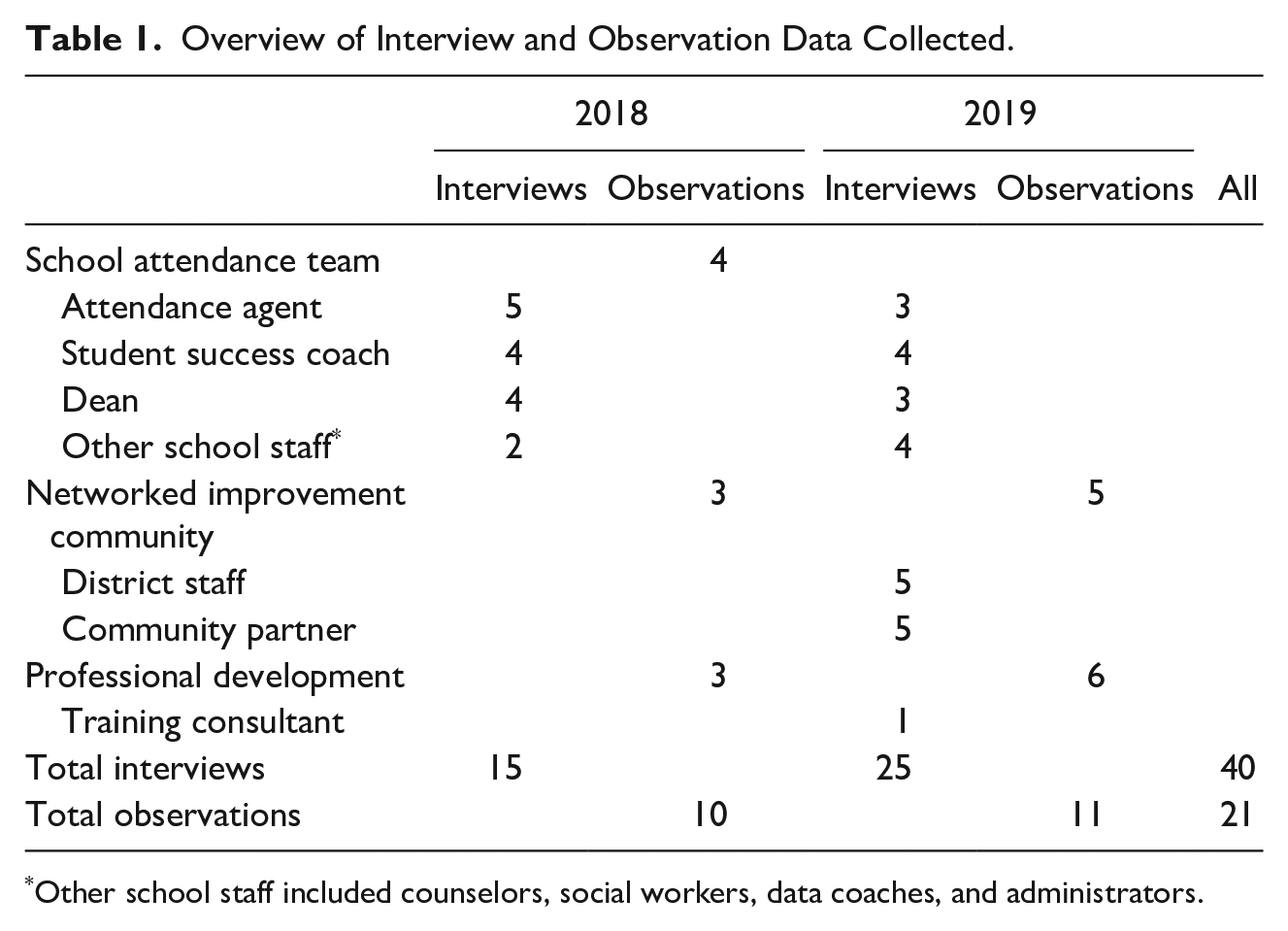
Other school staff included counselors, social workers, data coaches, and administrators.
The data corpus was analyzed through a two-round deductive coding process using Dedoose computer assisted qualitative data analysis software (Saldaña, 2012). In the first round, structural coding was used to apply a content-based representation of the data to research questions posed about the attendance barriers students face and the strategies used in the district reform initiative. The codes were then mapped to develop categories that were further refined in a second-cycle axial process. Through axial coding, categories were prioritized by those that were dominantly reflected in the data (Boeije, 2010). This work led us to find a number of in-school, community-based, and educational policy barriers that school staff perceived were contributing to students’ chronic absence and an understanding of what attendance stakeholders were doing to address them. In a third analytical step, the various stakeholders’ perceptions were compared to understand whether their respective conceptualizations and strategies were in alignment. Finally, field notes from developmental learning meetings and interviews with district and community partners were used to understand how findings from the ongoing developmental evaluation were being integrated into a shared narrative about the problems of practice related to attendance and a theory of improvement for solving them.
Findings
We summarize our findings from interviews, observations, and meetings with district and community partners in three sections. First, we describe how the collaborative research process of root cause analysis was combined with traditional data collection approaches to establish a shared understanding of the problem of absenteeism. Second, we detail the dimensions of the district reform as initially conceived by the district and how it was implemented in schools. Third, we summarize how developmental learning processes created opportunities for stakeholders to identify gaps between their conceptualization of the problem and the reform, paving the way for adapting the approach to reducing chronic absenteeism. Taken together, these findings provide new evidence on how researchers can work collaboratively with school and community partners to better understand educational problems, identify gaps in policy reform, and strategize for improvement.
How Did School Staff, District Leaders, and Community Partners Conceptualize the Problem of Absenteeism?
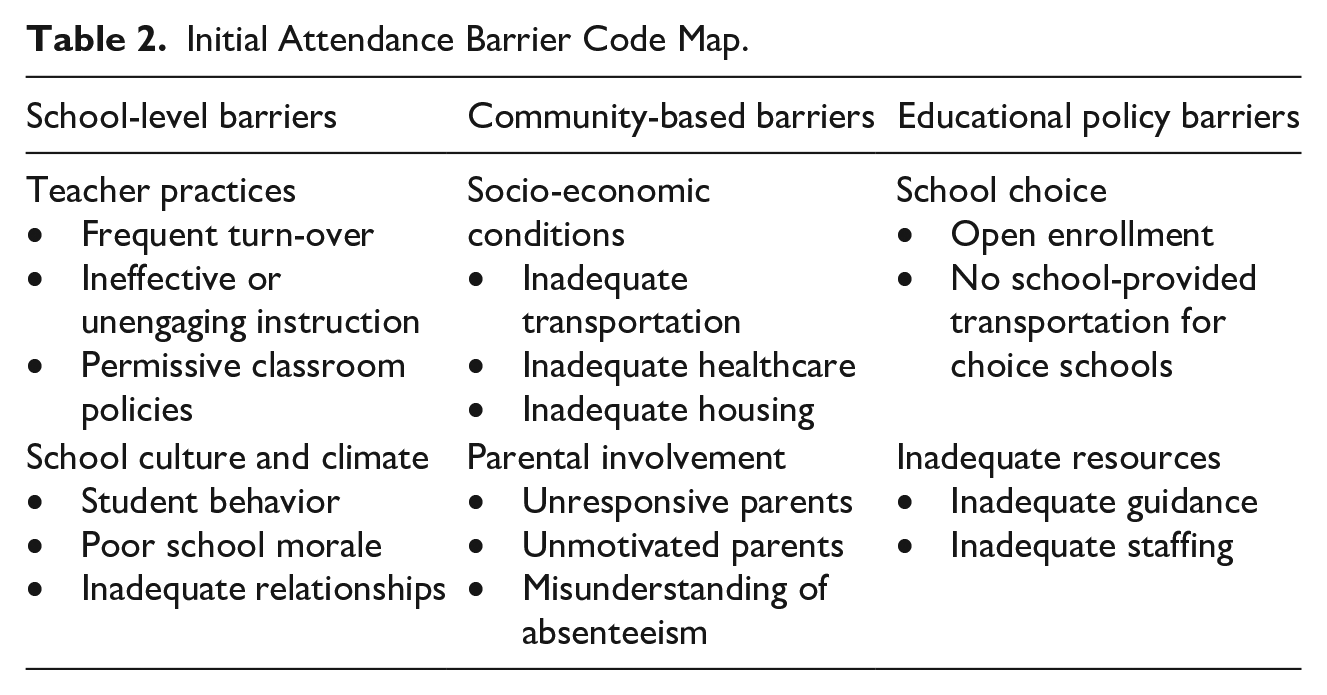
As shown in Table 2, school-level practitioners, district leaders, and community partners identified many school-level, community-based, and educational policy barriers to student attendance in DPSCD. Below, we describe how these groups conceptualized the problem of absenteeism in the initial months of the reform implementation, and how the partnership members documented and then revised this conceptualization through a root cause analysis.
Initial Attendance Barrier Code Map.
School-level barriers to attendance
The school attendance team members, central-office officials, and community-partners shared similar perceptions of attendance barriers existing within schools in the initial six months of reform implementation. Many referred to certain classroom level challenges that made school undesirable for some students. Although most respondents were clear that the reasons for students’ chronic absence were multifarious and complex, many discussed how frequent teacher turn-over, ineffective instruction, and permissive classroom policies created conditions that made it difficult for students to make meaningful connections with teachers, peers, and academic content. Take, for example, the following perspectives: Because the [chronically absent] kids ask. . .: who are you, and how long are you gonna be here? Yeah, and so they’re hesitant on building that relationship with you if you’re not gonna be here. They’re like, if you’re not gonna be here, then what’s the point in me getting to know who you are? (Attendance Team Member Interview) When you go inside the school, some of the things [you see are an]outdated curriculum that make lessons not engaging based on the fact that [it doesn’t keep] up with the times and the demographic of children we’re servicing today. [We also see] individuals that aren’t building positive, strong relationships, and not allowing kids to feel connected to the school in which they come to. (District Staff Interview) [At one school], even with staff that are in the school on a regular basis, you have kids who are skipping a lot more. Some teachers will allow kids to skip in their class. Or kids skip in [substitute teachers’] classes. Most of the schools I visit, especially in the high schools, we see that. (Community Partner Interview)
Across interviews, stakeholders referred to a sense of disconnection students may feel because of staffing instability, curricular irrelevance, and inconsistent classroom policies. They described schools that fostered student alienation through inattention to interpersonal relationship building and classroom engagement.
In addition to classroom-level factors, school attendance team members also believed that factors associated with school climate were an important source of absenteeism. An attendance agent said of students, for example: “There’s a lot of bullying in this school, I don’t want to use the word violence cause they’re still children, but behavior is a big, big concern.” While central office and community-partners also referred to these kinds of challenges (particularly with bullying), they more readily referred to poor school morale, and inadequate relationships between students and school leaders as persistent issues making schools disinviting, mistrustful, and unwelcoming to students who were chronically absent. In an attendance training, for example, the community partner tasked with equipping attendance teams to address the issue defined “negative school experiences” and “lack of engagement” as school-based factors contributing to absence. While stakeholders conceptualized the parameters of negative climate differently, they overwhelmingly agreed that certain negative elements within schools created barriers to attendance.
Community-based barriers to attendance
Community-based barriers to attendance, however, were cited as the hardest and most salient challenges to stakeholders’ task of improving chronic absence. Across groups, participants cited difficult socioeconomic challenges and struggles with parental engagement as the root causes of absenteeism. They described these issues as near-impossible obstacles for educators to adequately address. In relation to the socioeconomic challenges to chronic absenteeism, three major factors were most commonly relayed: inadequate transportation, inadequate healthcare, and inadequate housing/homelessness.
Across groups, participants discussed how difficult it was for students to travel to and from school. Open enrollment policies within the city and across metropolitan Detroit have allowed students to enroll in non-neighborhood and suburban schools. Getting to these schools in a city with inadequate mass transit and limited school busing systems made daily attendance a persistent challenge for families (Chingos & Blagg, 2017; Cowen et al., 2018; Gottfried, 2017; Sattin-Bajaj, 2018). Take, for example, the perspective of an elementary school attendance team member: That’s a big thing, too, transportation. A lot of kids are on the bus, but a lot of kids go to schools that’s not in a catchment area because they like the school. So, if transportation’s going to be an issue, they’re not going to get here if they’re not in the area. And then you can try to encourage them to go to the catchment school, their neighborhood school, but some parents really like the school so they want them to go, but we tell them, “You know, this is affecting their attendance,” but they don’t want to pull the kid out. (Attendance Team Member Interview)
This example demonstrates how open enrollment policies may ask families to choose between regular attendance and perceived school quality. Families may opt to send their children to schools farther from home fewer days per week in hopes that quality trumps quantity. Starting in 2018-19, the city of Detroit partnered with DPSCD and several charter school networks to pilot a cross-sector bus loop called the GOAL Line to connect students to their schools and after-school programming in one region of the city. An evaluation of the first year of the GOAL Line found that, although parents whose children used the bus frequently were very satisfied with it, ridership overall was low and inconsistent, and 77% of rides were from school to afterschool, rather than from home to school in the morning (Edwards et al., 2019).
Transportation challenges, however, were not solely perceived as problems with school or public transit. Getting to school was also perceived as a matter of personal safety: These are real barriers kids face, in order to get to school. This is a crime infested area. You telling a 10, 11, 12, 6 year old kid to walk to school? We got loose dogs around here. They see the police picking a body up. They big brother probably got robbed, big brother is incarcerated for shooting someone. These are real barriers, how you have that in your psyche. “I don’t even wanna walk to school, because that could be me.”. . .We don’t have too many cops, or parents standing at every corner making sure kids get here safely. It’s still dark when most students walk to school. How would you feel walking at seven in the morning to get to school on time, and you’re eight years old? (Attendance Agent Interview)
These difficult perceptions are further complicated by attendance team members’ struggles to support chronically absent students and families with their basic needs. In terms of health, asthma, access to prescription medication, doctor and dental appointments during the school day, and parental illness were cited as factors outside of attendance team members’ control: We have a lot of asthmatic students who are challenged to come to school. This is something I want to get better at addressing in the future so that mom and dad understand: that’s not a reason to be home. They still need to be here. We need to have a plan in place. They need to bring their medication, or their breathing machine, whatever needs to happen. (Attendance Agent Interview) We have a lot of our parents who pull kids out of school to help them translate, because they have a language barrier. And it gets bad when the parent has like cancer, or a chronic illness, where they have a lot of appointments, and they really need to know what’s going on. (Dean of Culture Interview)
Further, many attendance team members shared how challenging it was to meet family housing and homelessness needs. They said that frequent changes in address were a regular occurrence among chronically absent students, as rent increases forced families to move and family employment statuses changed. In a school district with only one McKinney-Vento resource coordinator (i.e., the federally funded position designed to ensure that homeless children maintain stability in their educational experience), attendance team members felt inadequately equipped to support families struggling to make it to school for reasons related to housing. Chronic absence is, thus, implicated as a by-product of a city challenged by access to quality healthcare, affordable housing, and support for homeless children and families.
Attendance team members across groups also talked frequently about chronically absent students’ parents. Several deficit perspectives were relayed by school attendance and central-office professionals, including that parents were unresponsive to school and district initiatives designed to improve attendance and unmotivated to improve their children’s rates of chronic absence. Take, for example, the perspective of a central office attendance staff member who, when asked about parents’ roles in chronic absence, said, “the [issue] that was most surprising to me . . .was we were coming into families that just did not value education,” and another who said “[parents] really don’t understand. . .what it takes to be educated.”
This perception, however, was not shared by community partners, who discussed the challenge in terms of parents’ misunderstanding of chronic absence. A community partner who volunteered to conduct parent workshops on the long-term effects of regular absences from school, for example, talked at length about the importance of shifting attitudes from one of blame to one of support when approaching parents of chronically absent students. “Because I never say, ‘Why don’t you [get your child to school]?’” she said, I’m letting them know who I am. I’m letting them know that I’m working for the school. I’m telling them what chronic absenteeism is. I’m telling them that 8 million kids. . .in this country are chronically absent. And what does that mean? And it does involve the students at home ill. And I give a suggestion, “Do you have a calendar where you track it on your refrigerator how many times your son or daughter has missed school?” I said, “If you start adding one here and one here and one here, it goes to five or six.” And they’re like, “Oh, I didn’t think of it that way.” (Community Partner Interview)
This excerpt is indicative of how community partners perceived barriers related to parental engagement and the appropriate strategies to address those barriers.
Educational policy barriers to attendance
In terms of policies and practices contributing to students’ chronic absence, school and central office attendance team members’ perceptions differed from those of community partners. On one hand, district staff saw open enrollment policies as posing the most significant challenge to reducing chronic absence. They felt that giving parents the choice to send their children to any school in the tri-county region stifled school attendance team members’ ability to meaningfully engage students and families in their immediate area. Take, for example, the perspective of this DPSCD principal: I’ve been at [this school] for 18 years…. I think [chronic absence is] worse right now just because we normally have feeder schools, and so we know the kids. We have activities where the kids can come in like we’re doing today, getting to know the kids. But the kids that go here right now, we don’t know half of these kids. They’re not neighborhood kids. So that’s a whole [other] issue, trying to figure out where they’re coming from, what their issues are. . . versus the kid who comes down the street who’s taking their sister or brother to school, walking a little bit further, [and the bus] comes running late. (Principal, Attendance Team Member Interview)
Open enrollment, in essence, made it difficult for school attendance team members to understand students’ challenges with attendance. From this perspective, school choice seemed to stratify time, knowledge, and resources as attendance teams struggled to address the community-based barriers students may face. Instead of deeply understanding particular local issues as they related to attendance, school district staff were stretched thin as they worked to address a variety of often competing issues that exist across the Detroit metropolitan area.
Community partners, on the other hand, located policy barriers within the school district. Many felt that DPSCD inadequately resourced attendance teams in terms of guidance and staffing without situating their perspectives within the broader educational policy context. At several attendance team trainings, for example, community partners shared their frustration that incoming attendance team members were hired without experience in attendance related issues, that the district did not provide comprehensive training on their job duties, and that there were inconsistencies between the school district’s philosophy of attendance improvement and that of some of the professional development staff who were contracted to support attendance teams. From the perspective of community stakeholders, inadequate attention paid to systems coordination hindered attendance team abilities to develop context-specific and data-informed approaches to reduce chronic absenteeism.
How Is the District Attendance Reform Designed to Address the Problem of Absenteeism?
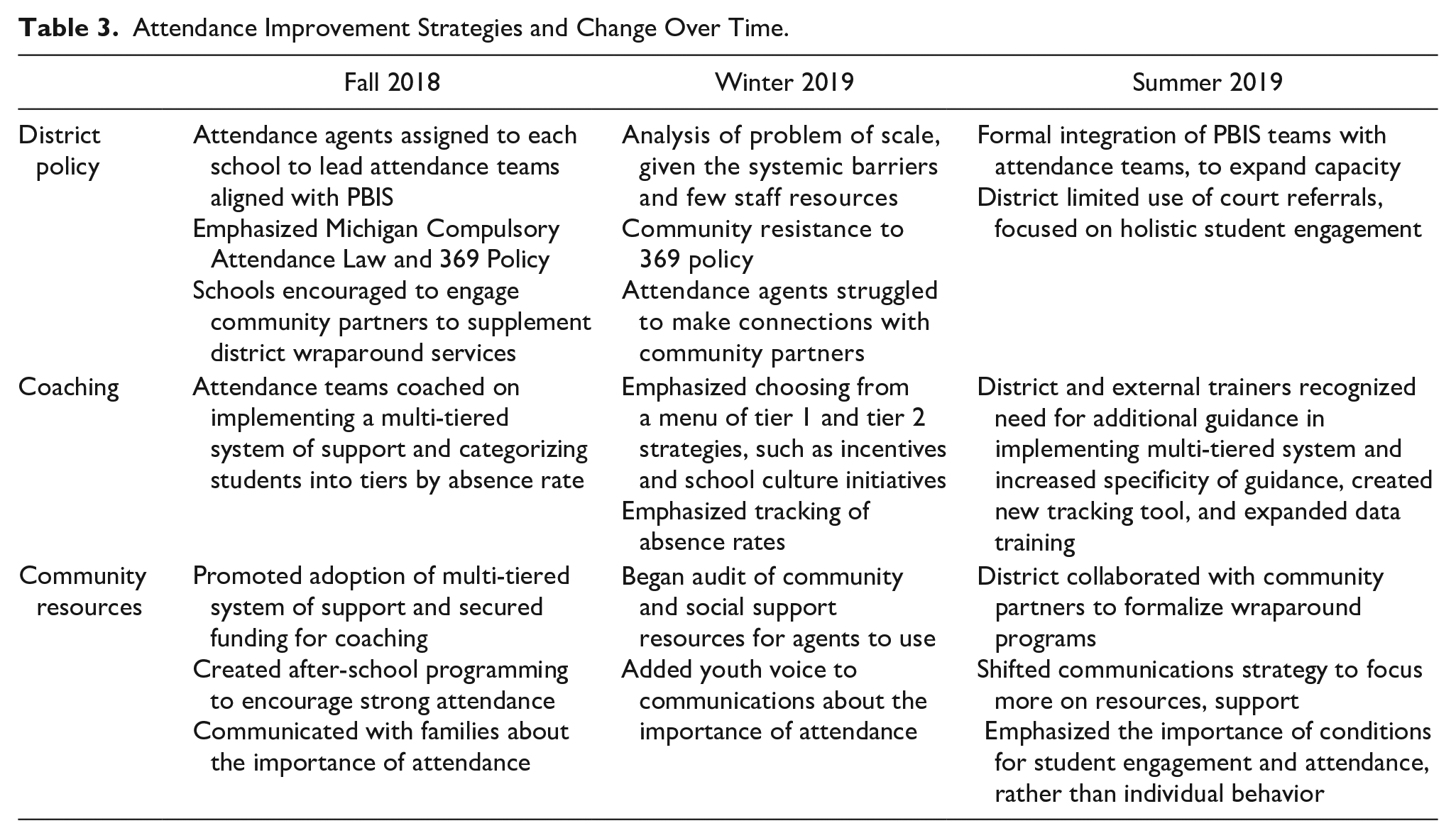
The next phase of our analysis focused on the design and implementation of the district attendance reform. The district approach was heavily influenced by the logic of a multi-tiered system of support (Sugai & Horner, 2009), which was advocated by community partners for several years before the district adopted a tiered support system for attendance and engaged with external trainers to help them implement the system. The school district and its community partners also leveraged resources to develop the infrastructure necessary to support school-level professionals’ work. Their initial improvement strategies, described in the first column of Table 3, included hiring attendance agents, organizing attendance teams to implement a multi-tiered system of support, leveraging state polices (sometimes punitively), and drawing on community resources such as after-school programming and a funded messaging campaign. In this section, we describe how the partnership initially conceived of its attendance improvement strategies and whether those strategies aligned with the shared conceptualization of the problem that the partnership developed.
Attendance Improvement Strategies and Change Over Time.
District policy
The district attendance policy in early 2018–19 focused on three levers. First, the district office of culture and climate oversaw newly hired attendance agents at each school who were charged with using data to implement a tiered attendance management strategy aligned with PBIS. The district had previously employed attendance agents who worked across school sites and focused only on students who met the state threshold for truancy. These officers were deputized, and primarily administered their work through home visits to contact truant students and through court referrals. They would represent the district in truancy court hearings, where a judge would determine the appropriate course of action and resources that should be made available to the student. With the new district policy, attendance agents were integrated into each school’s staff, and worked with a team that typically included a dean or assistant principal, a Michigan Health and Human Services worker, and one or two other staff members. The attendance teams were asked to “tier” students by their absence rate and then align strategies by tier. As one assistant principal on a high school attendance team said: So I’m over the attendance team. I work with PBIS so that we can reward the students good or bad. And so if the principal comes to me, I can pretty much tell her what kids we’ve been focusing on or what we’ve been doing, whose parents we’ve talked to, if anything has changed. (Assistant Principal, Attendance Team Member Interview)
The tiered strategies used most frequently related to all-school incentives to promote attendance, rewards for improved or good attendance, and monitoring of absences to inform parents of when their children missed too much school.
Second, the district continued to enforce a provision in Michigan’s compulsory attendance laws (Revised School Code, Michigan Stat. §§380.1147, 1976) that required district attendance officers to notify families of absences and school attendance requirements and issue a court complaint against families who did not comply. To implement this part of the law, DPSCD instituted a “369 Policy,” which indicated the number of times school officials were responsible for reaching out to parents and guardians before referring them to the courts. DPSCD set their policy to engage parents after 3 days with a written notice to return to school, after 6 days with a call to parents/guardians to attend an in-person meeting (either at school or home), and after 9 days with a referral to the court system. If the school referred the family to court, a warrant was issued. Parents or guardians found guilty of breaking compulsory attendance laws could be charged with a misdemeanor and those receiving public assistance through the Department of Health and Human Services could have their benefits (such as food stamps and other assistance) taken away (Revised School Code, Michigan Stat. §§380.1147, 1976; State of Michigan Department of Health and Human Services, 2018). This is how an attendance agent described this part of the district policy: The attendance agent is charged to monitor or take referrals. In my case, there’s so many students, it’s hard for me to monitor chronic absenteeism to the extent of a daily basis. I take a lot of referrals from teachers who tell me, ‘Such and such student has been out so many days straight.’ The teacher is supposed to call the home after three days, and then I’m supposed to call the home after six, for six consecutive days. I take a lot of those referrals where the student has been out for a week. (Attendance Agent Interview)
Therefore, although the new district policy emphasized support of students who had experienced absenteeism, it also continued to use the power of the state to motivate student attendance through the 369 Policy. Through the first three quarters of the school year, attendance team members expressed that court referrals were necessary to reduce chronic absence: I just recently sent out a good amount, I’ll say, of legal notices. So, I had two parents this morning and it’s going to continue like that. It’s unfortunate, but sometimes it takes an action like that for them to realize, as parents, ‘Hey, my students have to be there. I can’t just take this complacent and passive parent role.’ (Attendance Agent Interview)
District leaders shared that they felt it was essential that attendance agents understood the state law and the 369 Policy and that they implemented them fully, documenting their contact with families along the way. Community partners, however, encouraged attendance team members to use other strategies to avoid having to enforce the 369 Policy. Instead, they emphasized that their preventative approach should decrease the need to contact the courts. They shared in professional development meetings that invoking the law should be reserved for severe circumstances, such as when abuse, neglect, or severe poverty is suspected. In this way, the community partners sought to use their influence to circumvent the ways in which the law exacerbates risk for a population already in distress. Take, for example, a community partner’s description of how she tries to de-emphasize contact with the law: I have heard [district officials] say that the attendance agent needs to work [through the courts]. So there’s contradiction. . .But I tell the district’s attendance coaches. . .”I just heard [the district] say this. I’m telling you, this is not going to work if you don’t do it my way.” And so they go back and they [work preventatively]. We’re in contradiction all the time. (Community Partner Interview)
This excerpt demonstrates how community partners used their influence to reinforce the preventative philosophy of their approach, even as the state and district offered attendance agents the weight of the law to carry out their work.
Third, the district policy emphasized a new attendance plan that encouraged schools to leverage community partners to supplement wraparound services. With nearly 70% of students chronically absent in 2017-18, this plan implicitly acknowledged that reducing chronic absenteeism would require bringing in resources and support from outside of schools. This was the least developed of the initial strategies. It left considerable discretion to school staff to determine when it was appropriate to engage with community partners, and many newly hired attendance agents did not have knowledge about the communities where they worked, making it difficult for them to identify potential partners in the first year of implementation. As one attendance agent shared: “Since this is my first year being an agent, I really don’t know what resources it is that I’ll need.” Therefore, while the district policy called for school staff to coordinate community resources and social services, there was not clear guidance on how they should go about doing this or what resources were available.
Coaching
Before working collaboratively, DPSCD and its community partners were heavily influenced by national attendance advocacy initiatives calling for the use of multi-tiered systems of support to address chronic absence (Chang & Jordan, 2011, 2013). As their networks converged around the issue, they collaborated to bring a targeted attendance intervention to DPSCD schools. The intervention used a tiered approach to attendance improvement to train and support schools with developing attendance teams. The primary community partner responsible for this work then trained school professionals to plan for and carry-out attendance meetings, to use data to drive improvement strategies, and to work within the tiered domains of chronic absence to choose interventions to meet particular students’ needs.
For example, the community partners advocated for and trained school professionals to consider students missing less than 5% of school “satisfactory.” Students missing between 6% and 9% of days were considered “at-risk.” Recommended strategies for students in these ranges focused on sustaining regular attendance and preventing further absence through activities that are easily widespread (e.g., regularly recognizing students with high achieving and improved attendance). The second tier of risk, called the “early intervention” stage, focused on students with moderate chronic absence (missing 10%–19% days of school); and the third tier focused on supporting students with severe chronic absence (i.e., missing 20% or more days of school). As severity increased, attendance team members were trained to individualize support, moving from wide-reaching strategies to those that were customized to student and family needs. All attendance agents in the district were trained in this model, and agents at 27 of the lowest performing schools in the district participated in about quarterly training sessions with paid consultants experienced in the tiers framework. These trainings went into more detail on the use of the framework and gave agents the chance to collaborate and ask questions of the trainers.
In close alignment with this framework and the coaching they received, attendance team members shared that they regularly made use of Tier 1 and Tier 2 strategies to address chronic absence. They described creating incentives for improved attendance, building relationships with students and parents, making phone calls home, and developing messaging campaigns to raise awareness of the importance of attendance. They used these strategies for students across the tiers and particularly for students missing 9% days or fewer. They approached students in the second tier of chronic absence with greater individualized support in the form of mentoring, home visits, and referrals to social services. Their work, which attempted to reserve labor-intensive interventions for students in most need, was in alignment with DPSCD’s overall commitment to holistic child development. Given mandates for accountability in attendance within the wider educational policy-scape, the interests of community partners and the school district converged in ways that influenced attendance team members to take proactive/preventative and contextually informed approaches to reducing chronic absence.
Community resources
The district policy and coaching were supported by a community coalition that created after-school programming to promote attendance and raised funds for school-based attendance teams and the evaluation of the partnership. In addition, the community coalition carried out what they called a “messaging campaign” to educate the public about the risks of chronic absenteeism and what they could do to support students in getting to school. The campaign included a pledge that demonstrated community members’ commitment to doing their part to ensure that students made it to school regularly. A community partner said that the theory of action behind the messaging campaign was, “If people know better, they’ll do better.” He went on to explain that, based on survey data they had collected, one problem was that community members did not know what chronic absenteeism was or that it was such a problem. He said, “The idea came from our recognition, from our various communities. People didn’t know what chronic absence was. Even the professionals didn’t know because everybody was talking about average daily attendance.” The coalition recruited more than 5,000 community members to sign paper or online pledge cards, with the idea that they would follow up with these individuals to share resources and support their efforts.
The after school programs were designed to motivate regular school attendance by creating engaging enrichment activities that students could access after school only if they made it to school that day. This program was developed within the research partnership, and a series of plan-do-study-act cycles were used to refine the program elements in a pilot during the 2017-18 school year (Lenhoff, 2019). Using these collaborative problem-solving methods, the partners refined the program and expanded it to more schools during the 2018–19 school year.
Why and How Do District Leaders and Community Partners Improve an Attendance Reform Within a Collaborative Problem-Solving Partnership?
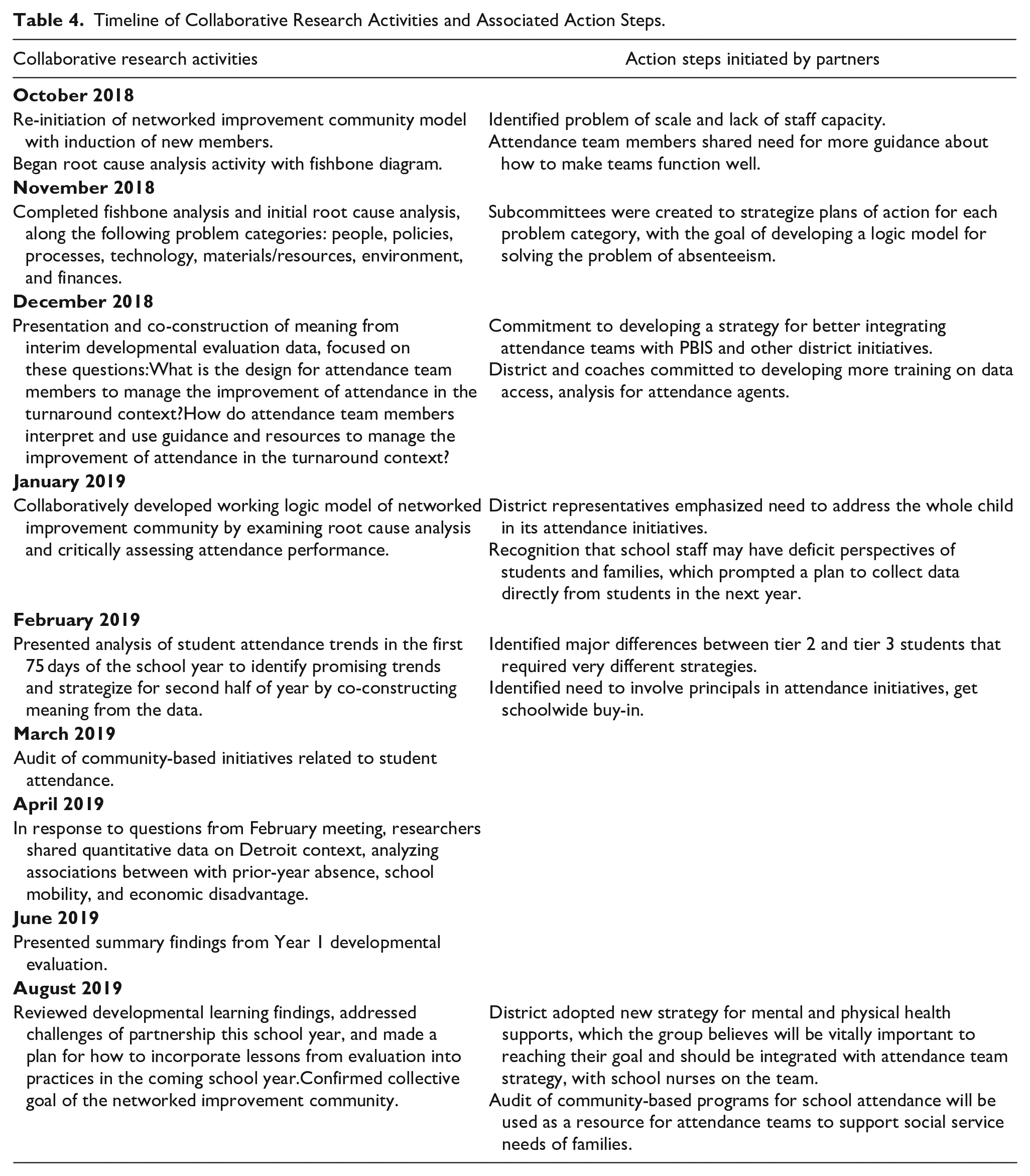
Over the first year of reform implementation, district, community, and research partners met monthly to learn about continuous improvement methods to address problems of practice, bring research to bear on the root causes of absenteeism, and develop a logic model to support their collaboration. Each of these meetings involved informal updates on the developmental evaluation findings, as well as activities aimed at fostering collaboration and continuous improvement. Two formal interim reports were presented to the group at the midpoint and end of the school year. Field notes, debrief interviews, and observations of district practice shaped our interpretation of the ways in which the collaborative problem-solving research activities supported the adaptation of district policy design and guidance and facilitated the development of action steps among district and community participants, as shown in Table 4. These action steps were critical in beginning to establish the partnership culture and narrative that members began to see themselves in when discussing the collaborative research (Russell et al., 2017). We identified important changes in the philosophy and strategies that partners believed were necessary to reduce chronic absenteeism in Detroit, which corresponded to two elements of our collaborative problem-solving practices: root cause analysis and co-construction of meaning from research data. We also documented several roadblocks to informing improvement within the partnership.
Timeline of Collaborative Research Activities and Associated Action Steps.
Root Cause Analysis
The collaborative research partnership group analyzed the data on attendance teams’ perceptions of barriers alongside their own interpretations of the problems facing families in getting their children to school. In addition, the research team presented findings from quantitative analyses of the associations between student-level characteristics and absenteeism in Detroit, an example of which is shown in Figure 1. Facilitated by a district leader familiar with continuous improvement methods, the partnership group conducted a root cause analysis exercise that involved multiple meetings in which members documented their initial understanding of the problem of absenteeism, worked in sub-committees to complete a fishbone diagram and analysis, and ultimately came to consensus around a shared conceptualization of the problem of absenteeism and the goal that they were pursuing together. Their shared conceptualization integrated what they had learned from school staff through the developmental evaluation with their evolving understanding of the problem of absenteeism as being multi-faceted. In formal partnership documents, they described the problem in this way:
Absenteeism is an ecological problem, with multiple interacting and dynamic factors that contribute to whether students are present and engaged in school. Chronic absenteeism is both a proxy indicator for youth wellness
In addition to building consensus around an ecosystemic understanding of school absenteeism, community and district partners identified problems of practice that were impeding their ability to improve absenteeism. These problems were then categorized into people, policies, processes, technology, materials/resources, environment, and finances. Members of the partnership team identified ways that they could use their power to make change in these areas. Ultimately, they formalized their collective goal as: “Community stakeholders and the school district will partner to continuously improve a systemic approach to holistically engaging students, thereby mitigating chronic absence.” This shared conceptualization of the problem and collective goal laid the groundwork for future partnership that would strengthen the district and community commitment to reducing absenteeism and motivate the engagement of additional partners to help them in those efforts. As one member of the partnership team said: I think that the real purpose of this is bringing together multiple people and stakeholders with the district and in the community to really be co-creating and co-designing solutions around chronic absence in a way that is impactful and that can really improve the way that we’re interacting with kids in their day-to-day life. (Community Partner Interview)
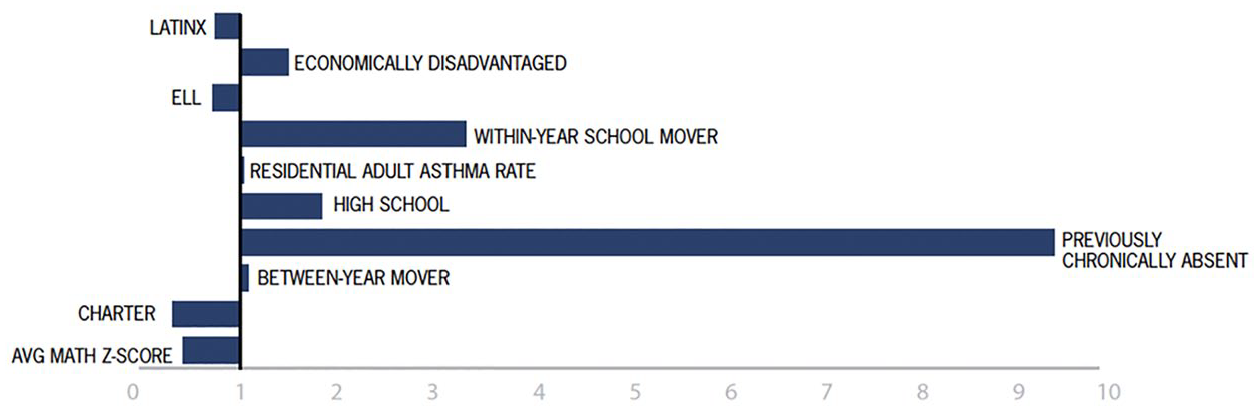
Odds ratios for chronic absenteeism presented to partnership group in April 2019.
Specifically, it contributed to two shifts in the philosophy of the attendance strategies promoted by partners: 1) partners began to see the problem of absenteeism as bigger than attendance teams could manage on their own and 2) partners began to see the problem of absenteeism as ecosystemic and requiring multiple in-school and out-of-school strategies, initiatives, and policy changes to improve.
Co-Construction of Meaning
At the end-of-year developmental learning meeting and subsequent informal meetings with district and community partners, we shared that practitioners in schools valued the opportunity to work as teams on attendance and use the tiered approach, but that many of them indicated the need for more specific guidance about how to focus their time. An illustrative example was when we shared quotes from attendance team members about whether they felt they had concrete steps to implement that would improve attendance: Sometimes, the information I get, it simply gives me cause for thought. And prayer, because I pray. What can happen next? How can I disseminate this? How can our school use this to go forward? It gives me a greater scope in which to know it’s not just this one thing I can focus on, it’s a bunch of different things. (Attendance Agent Interview) I feel like it’s definitely helped to build kind of what we were doing. It may not have completely changed something we were doing. But definitely, it’s given us new ideas of things to throw in there. (Dean of Culture Interview)
These specific examples of how practitioners were perceiving the reform created opportunities for community and district partners to reconsider the support they were providing. A structured conversation about the perceived usefulness of the support attendance agents were receiving generated ideas about how the partnership group could give more specific guidance about how to address chronic absenteeism, rather than provide a menu of options. The district determined a need for a new tool to aid attendance teams in identifying root causes of absenteeism and develop a logic for their intervention plans. District leaders shared how this tool, which provided a standard format for tracking student absence rates, reasons for absence, and the strategies that were going to be implemented, was a direct response to the misalignment between barriers and strategies identified in the developmental evaluation.
Our partnership meetings also created a unique forum for community partners and external support providers to learn about gaps in the support they were providing to attendance team members. We shared that district leaders were concerned that the professional development sessions were too abstract and focused on process, rather than building the skillsets of attendance agents, almost all of whom were new to their school-based roles. As one district leader said: You had agents not feeling comfortable facilitating an attendance team, because they were unaware of, some were unaware of the attendance plan. They saw it and heard it in September, but it left them as you started to get into the whirl of the work. They had never reached out to families of kids that were chronic, to bring them in, to find out how can we support. While it was important to have an attendance team meeting, it was not as important to have one when you didn’t have any data to bring to the team to share. (District Leader Interview)
Opportunities to discuss this disconnect between practitioner needs and professional support, just months into the implementation of a new reform, allowed for community and external support providers to reflect and make adjustments to context.
Initially, some community leaders expressed frustration that school and district staff were not taking more “ownership” of the attendance reform. They felt that it was a mistake to view the reform as a model that could be implemented with fidelity, and that district and school staff needed to design unique strategies to suit the specific needs of their communities. School and districts staff, in contrast, expressed the need for more guidance and specific recommendations about what to implement. Although these tensions persisted for several months, eventually community leaders recognized the need to provide attendance team members with more guidance about where to begin their initiatives and how to better align them with the barriers identified through the evaluation. They recommended integrating more practice-focused activities into professional development sessions and asked that the research team collect more data that would help them refine their approach in the following year.
Challenges to Learning
Although we documented several promising dimensions of collaborative problem-solving research to facilitate learning, the organizational and sociopolitical context of schooling also created obstacles to learning and policy change. Success was measured by district leaders as reducing chronic absenteeism, rather than increasing attendance, and implementation was expected to be uniform across schools, despite potential differences in school and family contexts. For instance, district guidance and training materials reflected the expectation that each school would have an attendance agent responsible for implementing the school’s attendance plan, running attendance team meetings with other school staff (deans of culture were required), and regularly analyzing student attendance data to inform the team’s efforts. As one district staff member said, “the expectation of that attendance team was to look at data, identify where kids are, tier them for support.” At the same time, they said that attendance agents should track student absenteeism, “looking at attendance, monitoring attendance, but then having the autonomy to go out and find out what’s actually going on, if we couldn’t get communication from the parents.” In that spirit, district staff wanted “to make certain that everyone follows the same protocol” and to see the same practices from one school to the next, “even if they’re the wrong practices,” as one put it. While many of the district’s standard expectations were about processes, such as how meetings should be facilitated rather than how interventions should be structured, the district’s priority on a consistent implementation of centrally-developed approaches presented a direct conflict to more responsive policies.
This rigid view is driven in part by deficit thinking about school-based staff. District staff were concerned with making attendance improvements “at scale,” and expressed doubt that they could rely on school leaders and school-based staff in every school. As one district staff member stated, the district’s attendance intervention framework “is multiplication, and our agents didn’t even know addition.” Their emphasis on a standard approach was related to the district’s concerns about “the will and skill of the individual.” They wanted to see school leaders and school-based staff demonstrate their competency with prescribed approaches before considering the particular context for that school’s work. For example, one district staff member called attention to a school where he “like[d] the leadership style” but had not seen an improvement in student attendance. In this case, he concluded that the school now needed to understand the particular community-based issues that were at the root of student absenteeism. This kind of reform logic may provide little room for the incorporation of staff perspectives in policymaking, at best deferring it until after the district has already made significant time and resource investments in the implementation of its policies.
The nature of the multi-tiered attendance intervention framework also presented barriers to fully incorporating the shared conceptualization of the problem into policy design and implementation. Such frameworks are not neutral; they come with an embedded value system and shape how school-based staff organize their work. The district and community framework for addressing absenteeism, combined with the state’s 10% absences threshold for chronic absenteeism in its accountability system, disincentivized a focus on the largest obstacles and most absentee students. One district leader explained that “when you look at the tiers of individual students,” such as students already beyond the threshold of chronic absenteeism versus students who are nearly but not quite chronically absent, “that chronic absent recovery group, recovery possible group, we have a bigger target on them.” Likewise, a community partner involved in supporting the training of attendance agents acknowledged that “the Tier 3 stuff is not something that I know. That usually means housing, homelessness, child court stuff . . . We haven’t figured that out yet. That’s a community issue.” The district maintained this narrowed focus on school-based interventions for “bubble kids” (Booher-Jennings, 2005), which was driven by the attendance intervention framework that emphasized a universal implementation approach. This approach was seen as being in conflict with the efforts required to address the myriad structural barriers identified by practitioners and suggested a gap between the extent of the problem and the reform solutions, given the high rates of chronic absence in the district, with more than 30% of students categorized as “Tier 3.”
Finally, district staff held relatively narrow views on what counted as “data,” which mediated the way that they judged the legitimacy of the developmental evaluation research. As district staff emphasized the need for data-driven decision-making, they placed a primacy on quantified or quantifiable data. Data collection was often discussed in relation to surveys with Likert scale-style questions; and being “data-driven” usually meant using student information systems to keep track of average attendance rates, or with categorizing students based on the number of days that they were absent, rather than the qualitative reasons that students were absent. In addition, district staff insisted that what school-based staff were observing as barriers to attendance needed to be bureaucratically documented to be considered legitimate. For example, at a professional development session with all attendance agents, when a large number of agents spoke about the need for better transportation, a district staff member responded, “I need the data, if you’ve witnessed that. . .Let’s stop talking about what we think the problem is and start documenting it. The conversation means nothing if there’s not documentation.” Understandably, district staff need systematically documented information so that they can make a case to the superintendent and school board to fund responsive policy initiatives. Still, the institutional rituals required to translate staff insights into legitimate “data,” along with the prioritization of quantitative data, initially created additional barriers to adopting the shared conceptualization of the problem of absenteeism and changing practice accordingly.
Discussion
Detroit is unique in its extreme conditions for student attendance, with exceptionally high rates of poverty, unemployment, segregation, crime, and vacancy, as well as colder temperatures than many cities (Singer et al., in press). Yet, structural and environmental characteristics are highly correlated with student attendance nationwide, and more than a dozen large U.S. cities have a chronic absence rate over 20% (Civil Rights Data Collection, 2016; Singer et al., in press). With more than 30 states now incorporating chronic absence into their school accountability systems, districts have incentives to improve attendance and develop approaches to address high rates of absenteeism. This study offers important lessons for districts seeking to improve attendance and for researchers interested in collaborating with districts to strengthen school improvement efforts. Although the conditions in Detroit are most similar to other large urban centers with high rates of poverty and correspondingly high rates of absence, these findings may also be relevant to districts that face different barriers to attendance (e.g., rural districts with large geographic footprints and fewer wraparound supports) but are still relying primarily on school staff to implement improvement efforts.
This study demonstrates the potential value of collaborative arrangements between practitioners and researchers to identify problems of practice early on in the implementation of reform initiatives in order to collectively determine action steps that could lead to improved implementation and outcomes. Bringing practitioner voices into the developmental evaluation early on in the reform’s design and implementation allowed district and community leaders to learn about the complex constellation of school, community, and district barriers that students face in getting to school and consider ways that the district reform could better respond to those myriad barriers. In particular, this collaborative approach highlighted the disconnect between the myriad community and family barriers that attendance team members identified among their students, and the district reform that was primarily directed at improving culture and climate and incentivizing attendance. Ultimately, collaborative problem-solving methods like root cause analysis and co-construction of meaning from research evidence were useful pedagogical tools that advanced a shared narrative among early-stage NIC members. Because members came from different fields, held different expertise, and initially had different goals for their involvement, it was critical to develop a culture of improvement grounded in a common understanding of the role of our partners and their collaborative mission (Russell et al., 2017).
Incorporating developmental evaluation methods, particularly analyses of tools, guidance, and infrastructure for learning (Peurach, Glazer, et al., 2016) with the “critical friend” researcher orientation, created opportunities for NIC members to challenge their previous assumptions, begin to use research to guide their decision-making, and acknowledge the value in adopting continuous improvement strategies into the reform efforts. They also established a partnership culture in which members felt accountable to each other and came to see themselves as part of a narrative around how to solve problems of practice related attendance. For instance, district leadership began to see the research team as “eyes and ears” on the ground in schools, who could help them understand the challenges to attendance across the district and where more centralized support might be needed. As one district leader put it, they wanted school-based staff to come to believe that “when I share things with [the university researchers], I see the district also adjusting to what our needs are and being able to address that.”
Our analysis suggests the need to revisit the assumptions that have driven school districts’ non-instructional improvement efforts. As district leaders make sense of the pressure they face to address issues that are increasingly perceived as outside a school’s locus of control, they may reflexively rely on the implicit theory of the school improvement movement that “a good school manager with a strong team of teachers will be able to create ‘effective schools’ and ‘effective classrooms’ regardless of the structural or material conditions within which they operate” (Gewirtz, 2002, p. 20; see also Slee, Weiner, & Tomlinson, 1998). Yet, as the attendance agents and other DPSCD staff at the center of this study pointed out, a host of out-of-school factors influence student attendance in Detroit. Districts and other policymaking bodies may need a more expansive conception of what “counts” as educational policy in order to produce real educational equity (Anyon, 2005), and they may need to create mechanisms for incorporating practitioner perspectives in the policymaking process as a necessary step toward this more expansive conception. Educational researchers can contribute to this by attending to power dynamics in research-practice partnerships (e.g., Penuel, 2019), adopting a more critical institutional perspective (e.g., Byrd, 2019; Hirsch & Lounsbury, 2015) on school improvement and effectiveness, and by re-humanizing school-based staff as professionals with important perspectives for policymaking rather than as units of analysis for educational research (Ellison, 2014).
Further, this study presents some considerations of developmental evaluation as a potentially transformative methodology within a collaborative-problem solving partnership, particularly in the NIC initiation phase (Russell et al., 2017). As Mertens (1999) argues, the transformative paradigm presents researchers with an opportunity to develop an inclusive and aware-of-power approach to evaluations without sacrificing validity in the name of advocacy. Thinking about “our own pedagogical dispositions and strategies towards policymaking” (Lupton & Hayes, 2018, p. 203), we are interested in the potential of DE and its embedded focus on continuous improvement as a transformative tool (Peurach, Glazer, et al., 2016). In developmental learning meetings, using the words of practitioners to highlight discrepancies between practitioner perspectives and the reform allowed for productive discussion about where practitioners may need more support. In addition, it began to illuminate the disconnect between where school practitioners were locating the problem of absenteeism (the family/community) and where the district reform located it (the school). This exchange of information led to community partner interest in designing outside-of-school supports that could complement the activities of school-based professionals. In addition, district partners noted the need for more guidance for practitioners around how to address social needs of families, including contact information for local social service agencies and training around McKinney-Vento rules and processes for students facing housing instability.
Ultimately, student absenteeism in the district significantly decreased between 2017–18 and 2018–19, both overall and among the schools that received extra support, as shown in Figure 2. Although this study was not designed to assess whether the reform strategy or our collaborative partnership was causally related to that decrease, it does suggest that there may be important dimensions of collaborative research and policy development that have the potential to contribute to improvement in school outcomes. More research is needed to better understand the ways in which collaboratively-improved attendance strategies are associated with student attendance, particularly in subsequent years when the changes envisioned by the partners could be fully enacted.
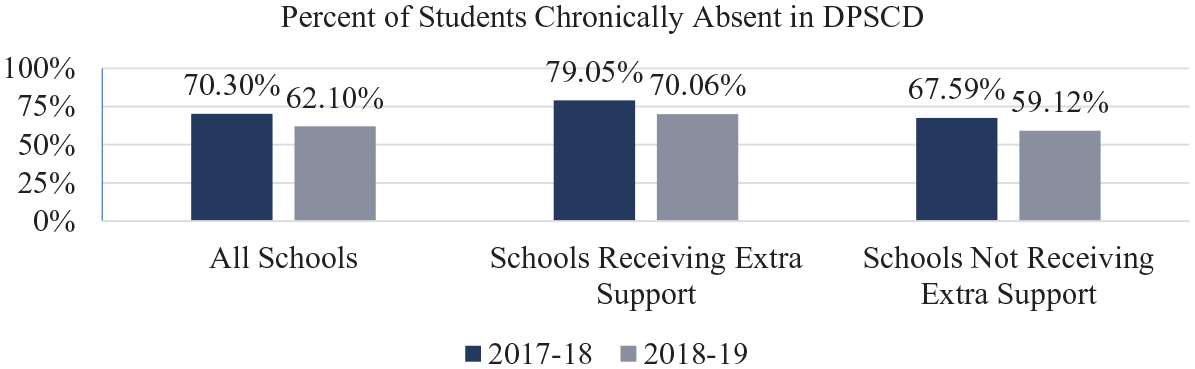
Percent of chronically absent students in DPSCD in 2017–18 and 2018–19.
We also identified ways in which embedding continuous improvement methods into a DE was insufficient in overcoming the challenges of initiating collaborative approaches to practice improvement. First, district and community partners expressed skepticism about the professional knowledge and capabilities of attendance team members, which compromised their willingness to value their perspectives as legitimate evidence. For research partners working to promote the use of evidence early on in the design of reforms, this demonstrated the need to develop pedagogies to advance the value of expertise and knowledge over supervisory authority. This skepticism challenged district and community partners to consider that the barriers identified by school practitioners were valid and needed to be more adequately addressed in the district reform, which focused primarily on improving school culture and climate and motivation to attend school.
Because DE can promote locally-responsive approaches to reform, it may be a productive methodology for centering the voices of school-based staff and addressing policymakers’ preconceptions of what “data” matters for data-driven decision-making in education. However, as was the case in our study, developmental evaluations may also reflect a more traditional evaluative approach that incorporates practitioner perspectives as necessary to most accurately evaluate a policy or initiative without fundamentally addressing issues of power, inclusion, and justice (Mertens, 1999). Future work can explore how the framework for developmental evaluations of district policies and initiatives can advance collaborative improvement work beyond the initial phase described here, as well as how developmental findings can be presented to school and district staff in order to problematize deficit mindsets and the taken-for-granted institutional logics that circumscribe district leaders’ policymaking.
Footnotes
Acknowledgements
We thank the Detroit Public Schools Community District and the Every School Day Counts Detroit coalition for their commitment to Detroit children and partnership in this research. We are grateful to the Skillman Foundation for the funding and space that made this project possible. We are thankful to three anonymous reviewers for their kind but clear feedback that helped us see how to improve this paper. All remaining errors remain with the authors.
Declaration of Conflicting Interests
The author(s) declared no potential conflicts of interest with respect to the research, authorship, and/or publication of this article.
Funding
The author(s) disclosed receipt of the following financial support for the research, authorship, and/or publication of this article: The research reported here was supported in part by the Skillman Foundation through Grant 1806-2018000357 to Wayne State University. The opinions expressed are those of the authors and do not represent views of the Skillman Foundation.
