







Abstract
Dramatic growth in the homeschool population in recent decades has coincided with an increase in the methods used to educate homeschooled children. However, researchers tend to treat homeschooled children as a uniform group without accounting for vastly different homeschooling arrangements. In this study, we examine the prevalence of four types of homeschool arrangements by pooling three cross-sectional waves of nationally representative data on American homeschool families (n = 1,468). Results indicate that most homeschool families supplement home education with cooperative instructors and private tutors, online education, and brick-and-mortar schooling. Families who do not use these resources are declining. They are also more likely to be White, less educated, and residing in the South region. Homeschool families whose children attend brick-and-mortar schools part-time are less likely to be White and more likely to reside in urban areas. Future research is needed to explore outcomes across different homeschool arrangements.
Introduction
Families in the United States are increasingly seeking to customize their children’s educational experiences (Jolly & Matthews, 2017; Morse & Bell, 2018; Riley, 2020). Private tutors, learning pods, after-school enrichment programs, personalized curricula, and online resources have contributed to the growing use of differentiated educational opportunities both inside and outside the regular school day (Horn, 2021; Park et al., 2016; Zhang et al., 2020). Schools that specialize in the arts, science, math, and career and technical education have also become commonplace in response to demands for greater customization (Gottfried & Plasman, 2018; Merrit et al., 2004). Some U.S. states have even adopted education savings account programs that direct per-pupil funds to families to use for educational services of their choosing (Burke & Bedrick, 2018).
Amid this trend toward greater customization, the practice of homeschooling has increased steadily over the span of four decades. The number of homeschooled children grew from approximately 15,000 children in the 1980s to an estimated two million children prior to the COVID-19 pandemic (McQuiggan et al., 2017; Renzulli et al., 2020). These numbers may climb further if families who experimented with homeschooling during the pandemic continue to do so beyond it (Hamlin & Peterson, 2022). Homeschooling has also come to represent one of the most diverse segments of K-12 education. Once considered a fringe practice restricted to conservative Christian households and progressive unschoolers, researchers have chronicled how homeschooling has evolved to encompass a range of educational approaches, goals, and sociodemographic groups (Hamlin, 2019; Jolly et al., 2020; Kunzman & Gaither, 2020; Mazama & Lundy, 2012; Murphy, 2012). Importantly, the modes of instructional delivery for home education have diversified considerably over the past two decades (Murphy, 2012; Wearne, 2019).
Conventional homeschooling—an approach in which parents provide all instruction at home—is reportedly becoming less common than it once was (Hamlin & Peterson, 2022). Alternative approaches that combine parent-delivered instruction with digital learning, private tutors, homeschool cooperatives, university coursework, and part-time attendance at brick-and-mortar public and private schools seem to be increasing in popularity (Kunzman & Gaither, 2020; Phillips, 2010; Saiger, 2016; Schafer & Khan, 2017; Wearne, 2016). The use of varying approaches to home education raises important questions for empirical research. For example, analyses that treat homeschool families as a uniform group may mask key heterogeneities within the homeschooling population. There may be substantive differences among children receiving conventional home education and those who receive parent instruction in tandem with other educational services and programs. Systematically describing different homeschool arrangements is needed to understand the effects of homeschooling as well as its ongoing evolution. Nevertheless, little empirical research has sought to develop a systematic understanding of varying arrangements that homeschool families use.
In this study, we pool three cross-sectional waves of nationally representative data from the US Department of Education’s National Household Education Survey [NHES] from 2012, 2016, and 2019. By pooling these three survey waves for analysis, we examine a relatively large sample of homeschool families in the United States (n = 1,468). Such a sample size is uncommon in analyses of home education. The NHES also queries families on their educational activities and approaches to homeschooling, allowing for an investigation of differing homeschool arrangements. This study thus has the potential to deepen conceptual knowledge of homeschooling by drawing on empirical evidence of current practices. Clearer conceptual distinctions of this nature may improve the methodological sophistication of homeschool research by providing guidance for testing variation in outcomes based on how families homeschool their children. Understanding these distinctions can contribute to a more nuanced discussion of state-level oversight of homeschooling as well as policies school districts might establish to engage homeschooling families.
Methodological Limitations of Existing Research on Homeschooling
Research on homeschooling presents significant challenges that has left the literature in an inchoate state (Kunzman & Gaither, 2020). Self-selection bias is a core issue that will likely remain a methodological limitation because it is difficult to disentangle the effects of homeschooling as an educational model from the characteristics of families who choose to homeschool their children (Hamlin & Cheng, 2022). Another significant barrier to scholarship about home education is that homeschooling families can be difficult to identify for analysis (Murphy, 2012). The United States is one of the least restrictive nations in the developed world when it comes to regulating homeschooling (Hamlin & Peterson, 2022). Eleven states do not require parents to notify authorities that they are homeschooling (Dwyer, 2019). A number of states that do require families to notify authorities of their intent to homeschool have few additional regulations in place (Carlson, 2020). Along with the difficulty of locating families who homeschool, researchers may struggle to elicit participation from homeschool families who feel that being observed threatens their privacy and independence from oversight (Dwyer, 2019; Kunzman & Gaither, 2020). The challenge of sampling homeschool households is evident in the literature. Many empirical studies on homeschooling rely on small analytic samples (Kunzman & Gaither, 2020). Only a small number of studies use comparatively large national samples (Hamlin, 2019; Smith & Sikkink, 1999), but this work tends to treat homeschooling arrangements uniformly without distinguishing among different modes of delivering home education. Given how approaches to homeschooling have transformed, it is plausible that heterogeneity in outcomes exists within the homeschooling population (McShane, 2021). Describing such heterogeneous patterns among homeschoolers could prove valuable for understanding the outcomes of different approaches to homeschooling.
Conceptualizing Homeschool Arrangements
Families appear to be increasingly supplementing parent-delivered home education with an array of programs, services, and online resources (Dwyer, 2019; Mann, 2021; Saiger, 2016; Wearne, 2019). Diversity in the style and delivery of home education makes it difficult to conceptualize the practice. Ray (2013) describes homeschooling as “a form of private education that is parent-led and home-based” (p. 324). The U.S. Department of Education has a more expansive view of homeschooling because it does not consider the role of parents and counts children as being homeschooled if they receive most or all of their education at home instead of at a public or private school (Cui & Hanson, 2019). Murphy (2012) builds on these definitions of homeschooling by identifying the following four conditions for homeschooling: (a) setting, (b) funding, (c) provision, and (d) control. The setting for homeschooling is centered on the child’s home as opposed to a district-run, charter, or private school (De Brey et al., 2021). Unlike children enrolled in district-run or charter schools, funding for homeschooling typically does not come from public sources but from families themselves. In addition, rather than state- or privately-funded employees, parents tend to be the primary providers of home education. Homeschooling parents are also thought to retain direct control over their children’s education, including over pedagogy and curriculum (Neumann & Guterman, 2017). Yet, contemporary homeschool arrangements challenge the sufficiency of these conceptions of homeschooling. Families who use formal curricular materials, college courses, and online coursework must partially agree to someone else’s educational methods and instructional content (Anthony, 2015; Hanna, 2012; Loveland, 2017). Similarly, homeschooling families whose children attend brick-and-mortar schools part-time or take advantage of education savings accounts are no longer the only funder of their child’s education.
Conventional notions of homeschooling, therefore, may decline as families use varying resources to supplement home education. One longstanding educational supplement is the participation of homeschool families in cooperatives where families pool expertise and resources to deliver classes to small groups of homeschooled children (Anthony, 2015; Phillips, 2010). The hiring of private tutors is another way that homeschool families attempt to complement home education with expertise from outside of the family unit. The proportion of homeschooling families in the United States who hire private tutors or belong to homeschooling groups or cooperatives has proliferated in tandem with the emergence of homeschooling in the late 1980s (Coleman & McCracken, 2020; Gaither, 2017; Murphy, 2012). Even though a growing number of affluent families with children in public and private schools hire private tutors, the use of private tutors as part of homeschooling may represent an overall approach that produces differential outcomes than those of other forms of homeschooling (Bray, 2006; Kim et al., 2021; Mori, 2014).
Furthermore, education policies have increased public funds for educational resources in some states in recent years (Jolly & Matthews, 2020). Private school choice programs, education savings accounts, charter schools, and virtual education have created opportunities for homeschool families to combine parent-delivered instruction with other traditional and non-traditional modes of instruction. In eight states, education savings accounts allow homeschooling families to withdraw their child from their assigned district-run public school and receive a portion of per-pupil funding to spend on state-approved educational services, including curricular materials, online courses, tutoring, and educational therapies (Burke & Bedrick, 2018). Scholars have reported on homeschooled children who use curricular materials provided by traditional public schools but are administered by their parents because these children are unable to attend school for medical reasons or happen to live in distant areas, such as in remote locales in Alaska, that make regularly attending school extremely difficult (Coleman & McCracken, 2020; Murphy, 2012; Wilkens & Kalenda, 2019). Other homeschooled children attend brick-and-mortar school settings on a part time basis (Wearne, 2019, 2020). These so-called hybrid homeschoolers supplement home educational activities with educational and extracurricular activities in brick-and-mortar private and charter schools (Huerta et al., 2009). A number of hybrid homeschoolers have been found to attend brick-and-mortar charter or private schools for 2 to 3 days a week and are educated at home on the other days (McShane, 2021; Wearne, 2016, 2019).
Taken together, the literature points to common homeschooling arrangements that signify variation in the way that children experience home education. Nonetheless, research has not provided a systematic breakdown of ways that children are homeschooled, and consequently, has generally not accounted for different arrangements in analyses of outcomes for homeschooled children. Examining current homeschooling arrangements will bring greater clarity to discussions about homeschool research, practice, and policy.
The Current Study
By pooling three nationally representative waves of the U.S. Department of Education’s National Household Education Survey, we explore both the prevalence of and factors associated with four types of homeschool arrangements frequently identified in the literature (Coleman & McCracken, 2020; Gaither, 2017; Mann, 2021; Wearne, 2019). Drawing from this literature, the first type of arrangement that we explore is homeschooled children who use private tutors and homeschool cooperative instructors to supplement parent-delivered instruction. The use of tutors and cooperatives represents an educational supplement in which homeschool families use financial and social resources to secure instruction for their children in subject matter that is taught by another adult (Anthony, 2015; Coleman & McCracken, 2020; Hanna, 2012; Kunzman & Gaither, 2020; Murphy 2012). The second type of homeschool arrangement occurs when families supplement their children’s home education with online learning and coursework. The third type describes children who are homeschooled but also attend brick-and-mortar private and public schools on a part-time basis (i.e., hybrid homeschoolers) (Wearne, 2016). The fourth type is what might be referred to as conventional homeschooling. Conventional homeschooling describes parents who directly provide all instruction at home without making use of supplemental services, programs, or schools. While studies have offered accounts of various approaches to home education, the actual prevalence of homeschoolers who use cooperative instructors and private tutors, online educational resources, or brick-and-mortar schools for a portion of the school week is uncertain. In the first phase of analysis, we explore the prevalence of four homeschooling arrangements by asking the following question:
After evaluating the prevalence of these homeschool arrangements, we examine correlations between each of these respective arrangements and sociodemographic factors, such as economic status, ethnic background, educational background, age of child, and place of residence. We also investigate whether a parent’s stated reasons for homeschooling are related to different homeschooling arrangements. An extensive literature documents reasons why families choose to homeschool. Commonly cited reasons are safety, the availability of religious or moral instruction, a desire to provide a culturally relevant curriculum, or support for a child with special needs (Green & Hoover-Dempsey, 2007; Kunzman & Gaither, 2020). To investigate associations among these factors, we ask the following question:
Empirical results addressing this second research question illuminate whether there is systematic sorting into specific homeschooling arrangements based on background factors.
Methods
Data
In our analysis, we begin by following the U.S. Department of Education’s approach to identifying homeschoolers, which designates homeschooled children as those who spend most of their instructional time outside of public or private schools (De Brey et al., 2021). This definition includes children whose families combine home education with online learning, cooperatives, tutors, college enrollment, and part-time attendance at brick-and-mortar schools, but it excludes children who are full-time virtual school students. To estimate the proportion of homeschooled children who (a) are taught by a private tutor or belong to a homeschooling cooperative, (b) receive online instruction, (c) attend a brick-and-mortar school, or (d) use none of the aforementioned educational supplements, we pool three of the most recent waves of data from the NHES (2012, 2016, 2019). The U.S. Department of Education administers the NHES to nationally representative samples of households with children in kindergarten through grade 12 in public, private, and homeschool settings. By combining data from three cross-sectional waves of the NHES, the total pooled sample size is 1,468 homeschool families. Pooling the three survey waves strengthens statistical power and the representativeness of the analytic sample.
For each of the three NHES waves, the survey was conducted in two phases. In the first phase, a household screener was used to select households for the survey, including the identification of current homeschool households. The U.S. Department of Education identified children as homeschooled if they do not attend public or private school for most of their education. In the second phase, eligible individuals identified from the initial screener were surveyed. Parents or guardians whose children were homeschooled were provided with a survey that queried them about aspects of homeschooling. The survey questionnaire contained items inquiring about the educational practices of homeschooling families. Respondents who homeschooled their children were asked about their decisions to homeschool, levels of parental involvement, family and extracurricular activities, amount of time spent on homeschooling, subject areas covered, resources used for homeschooling, and other schooling arrangements used in tandem with parent-delivered home education. All respondents reported background characteristics that included their ethnic background, income, family structure, household size, educational level, and reasons for choosing to homeschool.
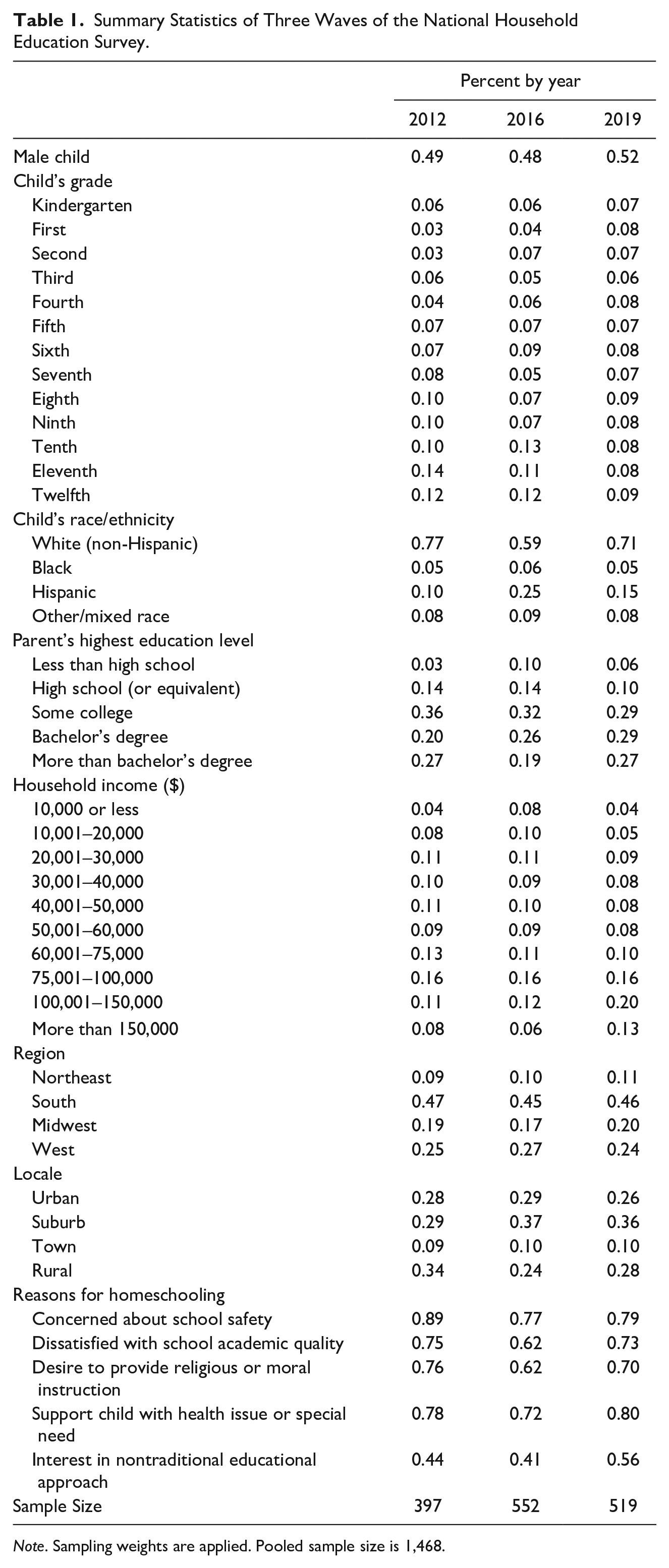
Table 1 presents summary statistics for the sample of homeschoolers in the NHES for each of the three most recent survey waves. Sampling weights are applied for all analyses. Across all three waves, nearly half of homeschooled children were male. The ethnic composition of homeschooling families is similar across waves with the exception of a considerably high proportion of Hispanic respondents in 2016 together with a relatively low proportion of non-Hispanic White respondents. The proportion of high-income homeschooling families increased from 2012 to 2019. About one-fifth of homeschooling families reported household incomes of greater than $100,000 in 2012 and 2016. The proportion of families in this income bracket is about one-third in 2019. As shown in the last rows of Table 1, most families across all three waves of the NHES choose to homeschool because they have concerns about school safety or have a child with a special need/health issue.
Summary Statistics of Three Waves of the National Household Education Survey.
Note. Sampling weights are applied. Pooled sample size is 1,468.
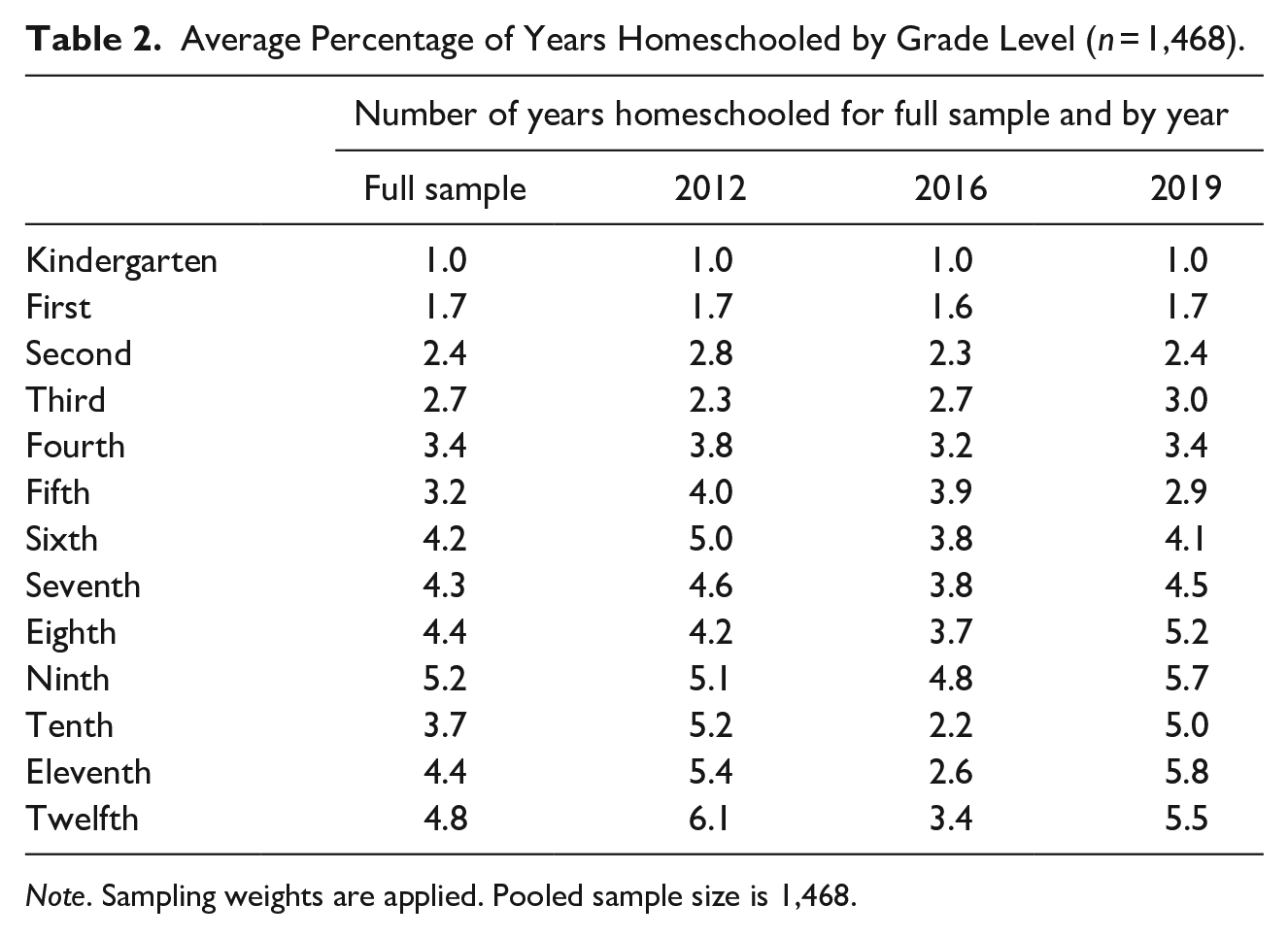
In Table 2, information about how many years a child has been homeschooled is listed by grade level. The average sixth-grade homeschooled child in the full sample has been homeschooled for 4.2 years. The average twelfth-grade homeschooled student has been homeschooled for nearly 5 years. These grade-by-grade trends are consistent with other evidence that most homeschooled children are not homeschooled for the entire duration of their K-12 education (Hamlin & Cheng, 2022). The average number of years spent being homeschooled across the three survey waves is largely stable, except for a decrease in the number of years homeschooled for the average high school student in 2016, which may be a product of random sampling variation.
Average Percentage of Years Homeschooled by Grade Level (n = 1,468).
Note. Sampling weights are applied. Pooled sample size is 1,468.
Empirical Strategy
To address the first research question, the percentage of homeschooling families who belong to the four types of homeschooling arrangements is reported. For each survey wave, items on the NHES questionnaire ask homeschooling parents about whether they use a private tutor, belong to a cooperative, use online education, or attend a brick-and-mortar school part time. The data are coded to identify respondents who report using any of these services. Data are reported for the proportion of respondents who do so for the overall sample and separately by survey wave. As a note on these homeschool arrangements, some families may fall into more than one of the categories. A homeschooling parent may, for example, use a combination of private tutoring, instruction in a cooperative, and online coursework. In the analyses, we consider these nuances by disaggregating the proportion of homeschoolers within categories. For example, we compute the proportion of homeschooling families who only use private tutors, only participate in homeschooling cooperatives, or use both. Furthermore, we disaggregate families who rely on online resources by those who additionally hire a tutor or belong to a cooperative and those who do neither.
To address the second research question, a series of logistic regression models are used to estimate associations between each of the four respective types of homeschooling arrangements and family background factors. Specifically, we estimate the following model:

where Yi is one of four respective binary variables equaling 1 if respondent i (a) uses a private tutor or belongs to a homeschooling cooperative, (b) uses online instruction, (c) enrolls their child in a brick-and-mortar school part-time, or (d) uses none of the aforementioned educational resources. The remainder of the independent variables are also binary, indicating whether the homeschooled child of the respondent is male, White, has a parent who has at least a bachelor’s degree, has a household income above the national median, and lives in an urban area. We add indicators for the region of the United States where the respondent i lives, omitting an indicator for respondents who live in the South region so that the coefficients are interpreted as differences between respondents living in a specific region relative to respondents living in the South. Reasonsi is a vector of five dummy variables indicating whether the family chose to homeschool because they (a) were concerned about safe school environment, (b) were dissatisfied with school academic quality, (c) desired to provide religious or moral instruction, (d) had a child with a health issue or special need, and (e) interested in nontraditional educational approach.
The results of these analyses are reported as odds ratios. Coefficients with values close to one indicate that the corresponding demographic characteristic is not a substantively significant predictor of whether a family belongs to a particular group of homeschoolers. By contrast, coefficients greater than one indicate that families with the corresponding demographic characteristic are more likely to adopt a homeschooling arrangement than families without that demographic characteristic.
Results
Prevalence of Four Types of Homeschooling Arrangements
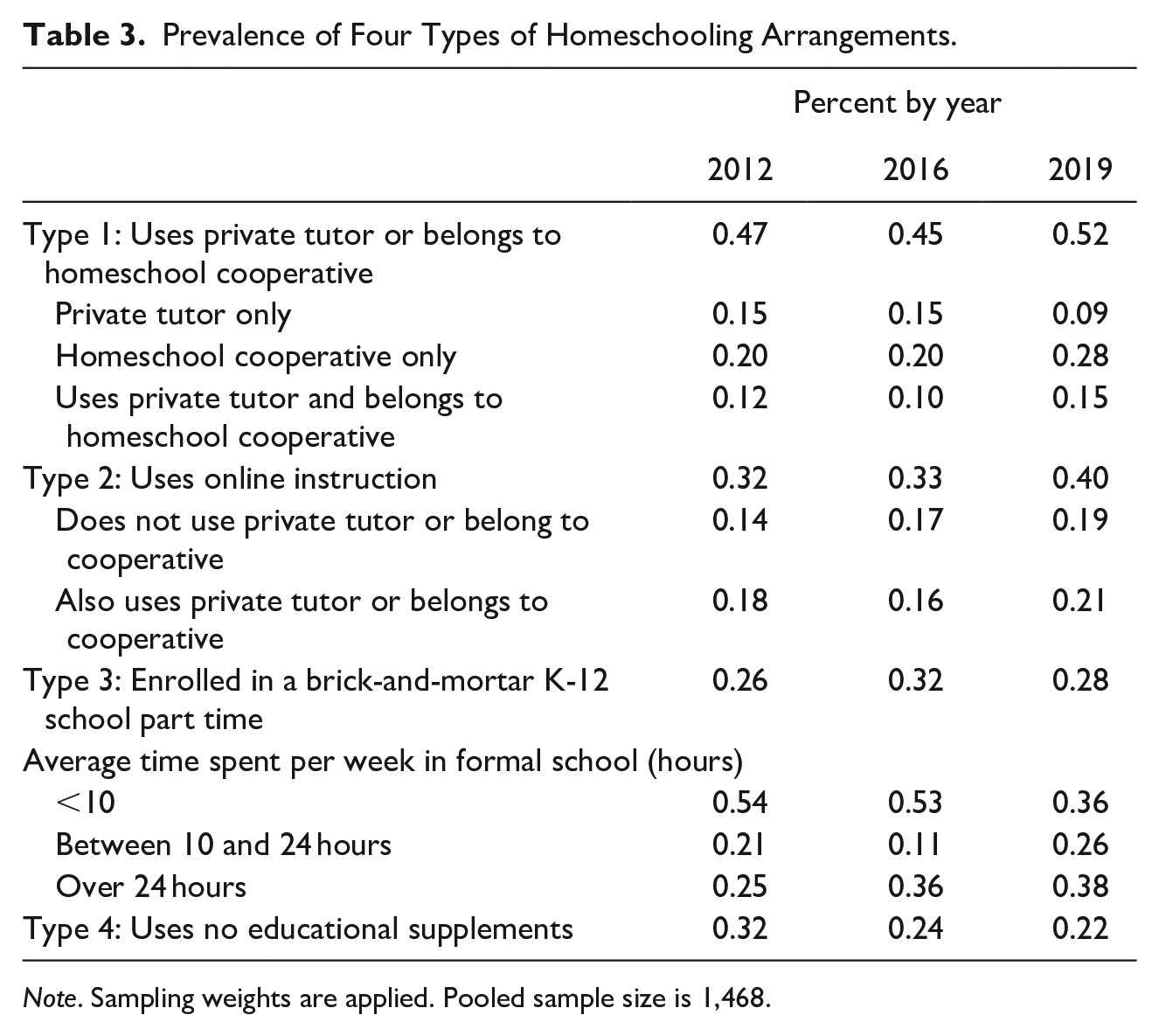
Table 3 presents the proportion of homeschooling families by survey year who (1) used a private tutor or belonged to a homeschooling cooperative, (2) used some form of online instruction, (3) enrolled their child in a brick-and-mortar school for part of the regular school week, and (4) did not use any of the aforementioned educational supplements. As shown in Table 3, nearly half of homeschool families reported using a private tutor or belonging to a cooperative in 2012. There is a slight increase in this approach to homeschooling in 2019 when 52% of homeschooled families reported using such services compared to 47% in 2012. We disaggregated this type of homeschool arrangement into those who only used a (a) private tutor, (b) only participated in a cooperative, and (c) used both a private tutor and participated in a cooperative. In 2012, 20% of families belonged to a cooperative but did not hire private tutors compared to 28% doing so in 2019. The proportion of families who used both a private tutor and belonged to a cooperative increased over the same period from 12% to 15%. Meanwhile, the proportion of families only using a private tutor decreased from 15% to 9%.
Prevalence of Four Types of Homeschooling Arrangements.
Note. Sampling weights are applied. Pooled sample size is 1,468.
The proportion of homeschool families who availed themselves of online instruction increased over the past decade, which is consistent with the rise in the availability of online educational resources (Tlili et al., 2020). In 2012 and 2016, approximately one-third of homeschool families used online educational resources. In 2019, approximately 40% of homeschool families did so. We disaggregated families who used online instruction into those who also used a private tutor or belonged to a homeschooling cooperative and those who did not. In 2012, 14% of homeschool families used online instruction but did not use a private tutor or belong to a cooperative. About 18% of families relied on online instruction as well as private tutoring or homeschool cooperatives for their child’s education. In 2019, 19% of homeschool families used online instruction and did not use a private tutor or belong to a cooperative, whereas 21% used online instruction in tandem with a private tutor or homeschool cooperative.
Among families who sent their children to brick-and-mortar schools for part of the school week, 26% did so in 2012. This type of homeschool arrangement increased to about one-third in 2016 but declined to 28% in 2019. Disaggregating these families by the number of hours their homeschooled child spent at a brick-and-mortar school indicates an upward shift in the proportion of homeschooled children spending 10 to 24 hours or over 24 hours/week in brick-and-mortar schools. In 2019, 26% of families reported sending their homeschooled child to brick-and-mortar schools for 10 to 24 hours/week. This proportion is five percentage points higher than the percentage in 2012. The proportion of families who reported sending their homeschooled children to brick-and-mortar schools for over 24 hours/week also increased from 25% to 38% between 2012 and 2019. In Table 3, the prevalence of conventional homeschooling families, or those who used none of the reported educational supplements, decreased over time. In 2012, 32% of homeschool families fell into this category. The proportion of conventional homeschoolers dropped to 24% in 2016 and to 22% in 2019.
Sociodemographic Factors Associated With Four Types of Homeschool Arrangements
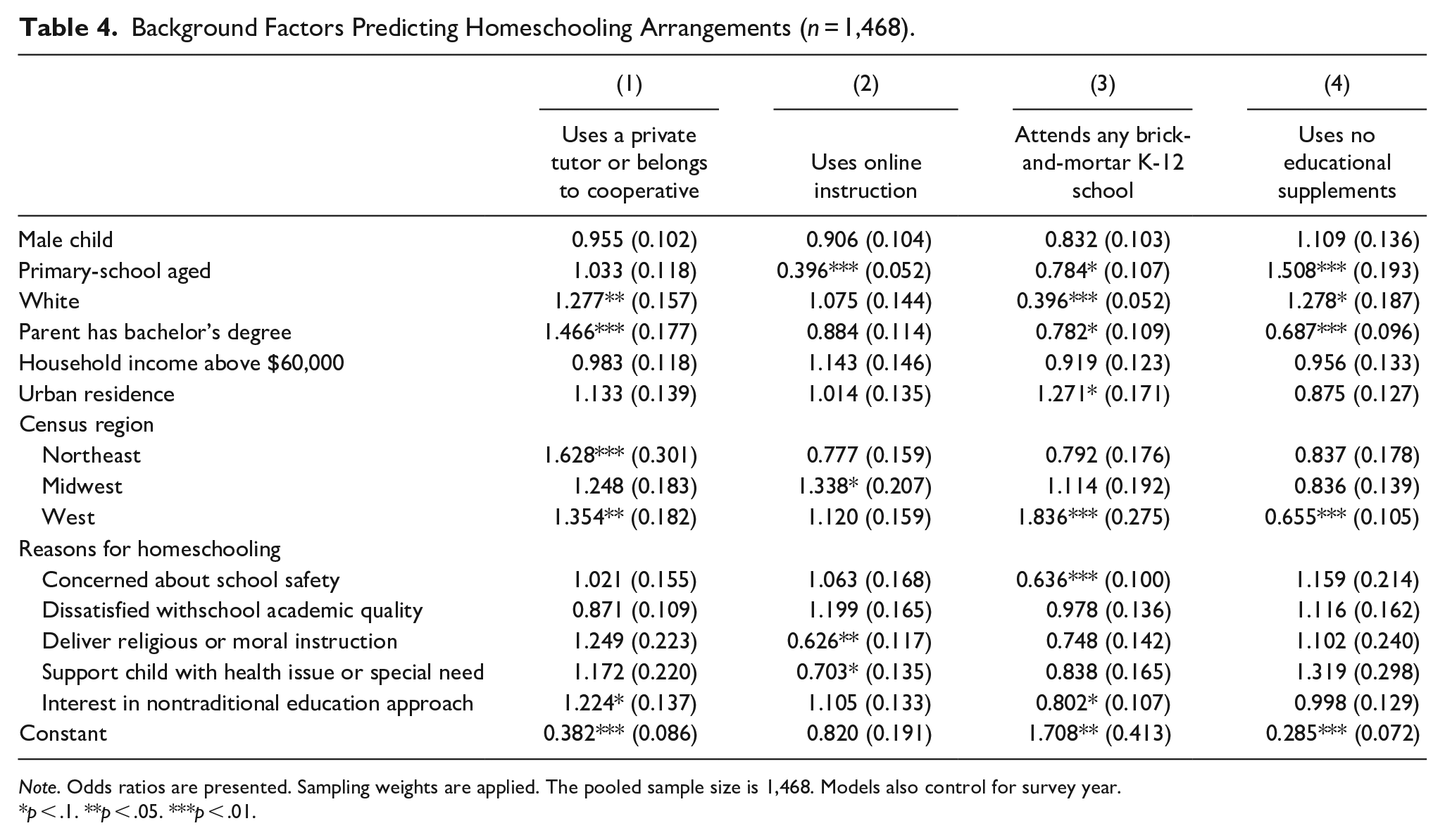
Table 4 presents logistic regression estimates exploring associations between family background factors and homeschooling arrangements. In column 1, homeschoolers who are White and who have bachelor’s degree were associated with a higher likelihood of using a private tutor or cooperative for instruction. White families were approximately 1.3 times more likely than other racial groups to use a private tutor or belong to a homeschool cooperative (p < .05). Parents with a bachelor’s degree were 1.5 times more likely to use a private tutor or belong to a homeschool cooperative compared to parents with lower levels of education (p < .01). Families in the Northeast (p < .05) and West (p < .01) regions of the U.S. exhibited a higher likelihood of using a private tutor or belonging to a homeschool cooperative relative to families from the South. Those who desired a non-traditional approach to education were 1.2 times more likely to hire a private tutor or join a cooperative (p < 0.1).
Background Factors Predicting Homeschooling Arrangements (n = 1,468).
Note. Odds ratios are presented. Sampling weights are applied. The pooled sample size is 1,468. Models also control for survey year.
p < .1. **p < .05. ***p < .01.
In the second column, parents with younger children were less likely to use online instruction. Respondents with a primary school-aged child were 2.5 times less likely to report using online instruction relative to those with secondary school children (p < .01). The use of online instruction was more prevalent in the Midwest region relative to the South region by a factor of about 1.3 (p < .1). Families who wanted to homeschool to provide religious or moral instruction were 1.6 times less likely to use online instruction (p < .05) while families who reported homeschooling because their child has a health issue or special need were 1.4 times less likely to use online instruction (p < .1).
As shown in column 3, respondents who had primary school-aged children, were White, or were bachelor’s degree holders were less likely to enroll their homeschooled child in a brick-and-mortar school for part of the school week. Respondents who reported that their children attended a brick-and-mortar school were 1.3 times less likely to have primary school-aged children (p < .1), 2.5 times less likely to be White (p < .01), and 1.3 times less likely to hold a bachelor’s degree (p < .1). They were also 1.3 more likely to be living in urban areas (p < .1) and 1.8 times more likely to be living in the West than the South (p < .01). Unsurprisingly, families who homeschooled because they were concerned about school safety were 1.6 times less likely to send their children to a brick-and-mortar school for part of the school week (p < .01). Parents who desired a non-traditional approach to educating their child were likewise 1.2 times less likely to send their child to a brick-and-mortar school (p < .1).
In column 4, conventional homeschool families that did not use the other types of educational supplements were more likely to have primary school-aged children, be White, and live in the South region. Specifically, they were 1.5 times more likely to have primary school-aged children (p < .01) and 1.3 times more likely to be White (p < .1). They were also less likely to report having a bachelor’s degree (p < .05).
Discussion
The practice of homeschooling has grown dramatically in recent decades. During this period of expansion, scholars have reported increasing diversity in the ways that families homeschool their children (Fields-Smith & Kisura, 2013; Gaither, 2017; Loveland, 2017; Wearne, 2020). However, the prevalence of varying homeschooling arrangements has largely been unclear because observations from previous research have often been derived from case studies and small samples rather than population-level or representative data. These limitations impede efforts to deepen understanding of the current practice of homeschooling (Carlson, 2020; Isenberg, 2007; Kunzman & Gaither, 2020; Murphy, 2020; Wearne, 2019). This study pooled three waves of nationally representative data to examine four types of homeschool arrangements: (1) use of a private tutor or a homeschool cooperative, (2) use of online instruction or coursework, (3) part-time enrollment in a brick-and-mortar school, and (4) fully parent-delivered home education (i.e., conventional homeschooling).
Results indicated that the four types of homeschool arrangements tested in this study are commonplace within the homeschool population. Among them, conventional homeschooling seems to be waning while home education supplemented by online education, part-time attendance at brick-and-mortar schools, and private tutors and cooperative instructors is on the rise. The prevalence of these homeschooling arrangements show that they are important features of contemporary homeschool practice, but most existing empirical research treats homeschooled children uniformly without delineating different ways of homeschooling. As a result, heterogeneous patterns within the homeschool population could be concealed (Hamlin & Cheng, 2022; Jeynes, 2016; Kunzman & Gaither, 2020). Scholars might begin investigating how academic, social, and life outcomes vary across approaches to home education. For instance, children who participate in cooperatives may gain access to a wider array of academic content than those who are only homeschooled by their parents. The social outcomes and extracurricular opportunities of those who attend brick-and-mortar schools part-time could also be different from those who rely on online instruction to supplement home education. Such potential differences open many new areas of inquiry for what is a growing segment of American education.
The results also suggested differences in family background across the four types of homeschool arrangements. Families who homeschool without using supplemental educational services and resources are more likely to be White and less educated, have elementary-aged children, and reside in the South region of the United States. By contrast, homeschool families whose children attend brick-and-mortar schools part-time are more likely to have a secondary school-aged child and live in urban areas, and they are less likely to be White. Use of virtual learning is more common at the secondary school level and is less likely to be used by those who choose to homeschool to deliver moral or religious instruction. Future research is needed to explore reasons behind these background differences and how they might be interrelated with the academic, social, and life outcomes of homeschooled children.
There are key limitations to this study that are worth noting. Although three nationally representative samples of homeschool families are analyzed, this pooled sample may be missing homeschool families who wish not to be identified. It is conceivable that these families are more likely to be those who homeschool without availing themselves of supplemental services, programs, and schools. The proportion of conventional homeschoolers could then be higher than what is estimated in this study. While NHES data were carefully gathered by the U.S. Department of Education to build a nationally representative sample of homeschool families, bias from survey nonresponse within subpopulations is a threat to the representativeness of the NHES. How our results would change if the sample were systematically missing certain types of families is uncertain, but this limitation does underscore the challenge of generating nationally representative samples from the U.S. population of homeschoolers. Moreover, while the categories of homeschooling that we explore point to distinctions in the ways that families homeschool their children, it must be reiterated that there is overlap between categories in some instances. The main categories of homeschool arrangements in our analyses are not always mutually exclusive. In addition, it is probable that other subcategories exist within homeschool arrangements. One example might be structured and unstructured homeschool families who have been documented in prior research (Neumann & Guterman, 2017). Future work might detail differences within the four categories analyzed in this work.
Despite its limitations, the results of this study advance conceptual knowledge of contemporary homeschooling practice based on analysis of a relatively large sample of homeschool families. The homeschool arrangements that we highlight cover a large portion of the homeschool population, so we encourage researchers to explore distinctions among them. What might be beneficial is formal language that differentiates homeschoolers based on the nature of their practice. Language, such as the term unschooler, exists to make these distinctions. In future work, nuanced conceptualization of homeschool practice may be important because homeschooled children who use private tutors and cooperative instructors or attend brick-and-mortar schools part time are likely to have substantively different experiences than those who homeschool without ever making use of such educational supplements.
Questions for Policy
The growth of varying forms of homeschooling arrangements raises new questions for homeschool policy. As homeschooling numbers have climbed, policy debates have centered on how states should regulate homeschooling. Some observers have proposed banning or heavily restricting homeschooling, contending that homeschooling can be socially isolating for children and harmful to society at large (Bartholet, 2020). These types of restrictive regulations tend to be dominated by concerns related to conventional forms of homeschooling. Moreover, policy proposals for monitoring the welfare of homeschooled children, such as requirements that homeschool families undergo regular visits with a physician or social worker, are largely fueled by concerns that homeschooled children may not have sufficient contact with professionals who might report abuse or neglect. Yet, the proportion of conventional homeschoolers who seem to drive policy debates on regulation has been on the decline in the past decade. The national data that we analyze demonstrate that about one-third of homeschooled children enroll part-time in brick-and-mortar schools. Half of homeschool families report belonging to cooperatives or using private tutors. It thus appears that most homeschooled children have contact in educational settings with adults outside of their immediate family who might identify cases of neglect or abuse. It is uncertain whether these types of adult contacts would necessarily lead to reports of child abuse. In public schools, classroom teachers are mandated reporters who often have training and access to resources that can facilitate reports of child maltreatment. Even so, for substantive discussions to occur, a nuanced understanding of contemporary homeschool arrangements is needed.
Along with regulatory policy, contemporary homeschooling practice raises questions for public school systems. National data demonstrate that many families homeschool to support a child with special needs. One question for traditional school districts and private schools alike is whether and how they might make school available to such families, possibly through part-time attendance or participation in school-based activities. Some schools have begun allowing homeschooled children to join school clubs, sports teams, and extracurricular activities. There is some evidence that these policies can smooth transitions from homeschooling to brick-and-mortar schools as many homeschooled children often move to brick-and-mortar schools during their K-12 education (Hamlin & Cheng, 2022). School districts have also been establishing virtual academies that might offer services to homeschooled children who have previously tended to access virtual private and charter schools. Whether such strategies are desirable or not is not the intent of this study, but having well-considered measures in place may be significant if trends in homeschooling continue in tandem with the broader movement toward customizing the educational experiences of all children.
Footnotes
Declaration of Conflicting Interests
The author(s) declared no potential conflicts of interest with respect to the research, authorship, and/or publication of this article.
Funding
The author(s) received no financial support for the research, authorship, and/or publication of this article.
Informed Consent
IRB and informed consent were not required for this study.
