







Abstract
Hispanic-Serving Institutions’ (HSIs) diversification and Title V’s anemic funding present a ripe condition for inequity. Hence, I interviewed 29 institutional actors across 17 HSIs to understand how they view their competitiveness for these grants and sources of inequity of this program. I identified four themes, demonstrating that an HSI’s institutional capacity, (in)actions, knowledge, and leadership inform its competitiveness for Title V funding. The findings show that HSIs have unequal organizational conditions and reveal ways this program may (re)produce inequity among HSIs. Without increased Title V appropriations and policy modification, HSIs will vie for funding on increasingly unequal terms, resulting in greater inequity.
Keywords
Federally recognized in 1992 with the reauthorization of the Higher Education Act of 1965 (HEA), Hispanic-Serving Institutions (HSIs) are historically underfunded institutions enrolling at least 25% Latinx and 50% Pell-eligible undergraduate students (Santiago, 2006). In the 30 years following their formal recognition, HSIs have grown drastically in number and institutionally diversified (Núñez et al., 2016; Santiago et al., 2020). Specifically, while initially, many HSIs were small, acutely under-resourced often private colleges (Solórzano, 1994, 1995), the HSI population now increasingly encompasses large public colleges and universities—comparably more resource-rich, research-bent institutions than their predecessors (Martinez & Garcia, 2020; Santiago et al., 2020). Indicative of this institutional diversity, the University of California-Irvine, a large, selective research university with a 25% Latinx undergraduate enrollment, and Arizona Western College, an open-access community college with a 76% Latinx student body, both currently classify as an HSI (Excelencia in Education, 2022).
While the HSI population has grown and institutionally diversified, funding for Title V—capacity-building, institutional grants for HSIs—has stagnated, lagging behind the number of HSIs (Anguiano & Navarro, 2020; Nellum & Valle, 2015). Given the widening gap between Title V funding and the number of HSIs, the rhetoric surrounding Title V often centers on scarcity rather than on how this group’s increasing heterogeneity prompts severe concerns about the equity of this federal grant competition. Now, an increasingly diverse set of actors—institutions with distinct systemic characteristics, resources, and overall organizational conditions—can compete for this money, as if they are all similarly positioned and resourced.
Since Title V serves as one of the principal external funding sources for many HSIs, it is necessary to examine the equity of this purportedly meritocratic public program. In response, this critical qualitative study provides a more nuanced understanding of Title V—one that moves beyond scarcity to showcase how this grant competition, grounded in the myth of meritocracy, may perpetuate inequity among the very colleges and universities this program seeks to serve. With this aim, I specifically ask:
How do institutional actors at Hispanic-Serving Institutions understand their competitiveness for Title V grants?
What sources of inequity does this reveal about Title V?
To provide context for this study, I first offer a condensed overview of Title V. I then situate this study within the scant but growing body of work on Title V.
Title V’s Enactment and Expansion
At the behest of educational advocates, including the Hispanic Higher Education Coalition and the Hispanic Association of Colleges and Universities (HACU), Congress federally recognized HSIs in 1992 (Valdez, 2015). And, in 1995, they provided these institutions access to Title III grants to recompense HSIs for their historical and continued underfunding (Salas, 2011). Then, in response to demands for more support, in 1998, Congress enacted Title V Part A, the Developing Hispanic Serving Institutions (DHSI) Program—multi-year, institutional grants explicitly for HSIs (Valdez, 2015). A decade later, in 2008, Congress expanded Title V, adding Part B or the Promoting Postbaccalaureate Opportunities for Hispanic Americans (PPOHA) Program—multi-year grants for HSIs conferring graduate or professional certificates/degrees (Aguilar-Smith, 2021b). Altogether, this two-part competitive grant program aims to (a) build HSIs’ capacity and educational quality and (b) increase Latinx and Pell-eligible students’ educational outcomes by providing awardees approximately $3.5 million over the span of five years (Higher Education Opportunity Act, 2008). Toward these aims, HSIs have received this funding to implement a range of projects. For example, in 2021, the University of Texas at El Paso received a Title V Part A grant to “develop a national model for Hispanic-Serving Institutions (HSIs) for re-engaging, re-enrolling, effectively educating, and supporting stop-out and potential stop-out students to degree completion” (Department of Education, Developing Hispanic-Serving Institutions Program-Title V, 2021, p. 14).
Despite supporting such laudable efforts and the pressing infrastructural, technological, curricular, and other resource needs many HSIs face, the ED lacks the means to provide each Title V applicant this funding—a situation slated to only worsen as the pool of possible beneficiaries increasingly outpaces congressional appropriations to this program. To further contextualize this widening gap, in 2010, Congress allocated approximately $117 million to this program; in 2019, it allocated only $124 million, although the number of HSIs grew from 293 to 539 during this period (Santiago et al., 2020). Moreover, while the tremendous growth of the HSI population concurrent with flattening levels of Title V funding likely further intensifies this program’s competitiveness, HSIs’ ongoing institutional diversification also introduces and/or exacerbates substantial equity-laden issues with this meritocratically-grounded competition as well; this precise situation represents the core of what this study explores.
Literature Review
The HSI literature has flourished over the last decade. Yet, published work on Title V remains sparse, touching on three primary areas. Initially, a couple of descriptive reports documented the usage of Title V funding. For instance, in the early-to-mid 2000s, the U.S. Government Accountability Office (GAO) released a series of reports and congressional testimonies detailing Title III and Title V grant recipients’ use of this federal funding (e.g., GAO, 2004, 2007, 2009, 2010). Later, Santiago et al. (2016) reviewed DHSI awardees’ proposal abstracts and final reports from 1995 to 2014 and reported that most recipients spent this money on capacity-building efforts aligned with the program’s purpose and aims. More precisely, Santiago et al. (2016) indicated that 33% of awardees reported investing this grant funding in faculty and curriculum development, 26% in student support services, and 11% in administrative management. Meanwhile, foregrounding the raced nature of Title V funding (i.e., how this federal funding is tied to the enrollment of a racialized group—Latinx undergraduates), Vargas and Villa-Palomino (2019) also empirically analyzed DHSI awardees’ proposal abstracts. Based on their race-conscious analysis, they found that most recipients deficiently described and/or decentered Latinx students in their pursuit of this funding.
Yielding mixed results, other research examines Title V’s effectiveness. For instance, in their respective dissertations, Piñeda (2010), Castillo (2019), and Lacagnino (2019) each assessed Title V awardee outcomes. For example, employing a difference-in-difference analysis, Piñeda (2010) compared Latinx student outcomes of Title V awardees against unsuccessful applicants from 2000 to 2007. In brief, she found that Title V grants had no visible effect on Latinx enrollment or degree attainment. More recently, in a published, peer-reviewed study, Perez (2020) tested if Title V grants and expenditures on instruction, academic support, and student services were positively associated with Latinx students’ educational attainment at 4-year HSIs from 1999 to 2012. In contrast to Piñeda, Perez uncovered a positive relationship between Title V obtainment and Latinx degree completion, finding that awardees were more likely to confer higher shares of bachelor’s degrees to Latinx students than non-recipients. Although limited to one comprehensive community college, Lacagnino (2019) likewise found preliminary support for the effectiveness of Title V in her dissertation. Specifically, using propensity score matching, she tested the effect of participating in a Title V-funded program (i.e., an accelerated development English and English as a Second Language path) on Latinx student success. In short, Lacagnino found that program participants had higher cumulative grade point averages as well as persistence and completion rates than non-participants.
Finally, other scholars consider which institutions engage in the Title V Program and the equitable allocation of these funds (e.g., Aguilar-Smith, 2021b; Perdomo, 2019; Vargas, 2018). For instance, using a multivariate analysis, Vargas (2018) examined the relationship between an institution’s student racial/ethnic demographics and DHSI grant obtainment and found that an HSI’s Latinx enrollment rate was not significantly related to its success in this competition. Moreover, he identified that HSIs that enrolled more white and fewer Black students fared better in this program, securing more Title V grants than their counterparts. Essentially, Vargas (2018) identified raced patterns in the allocation of Title V funding, which suggested that the ED favors HSIs with whiter student bodies.
Collectively, with few exceptions, the Title V scholarship exclusively relies on quantitative methods or document analysis, leaving unclear why specific HSIs participate as well as succeed in this grant competition. Consequently, in this critical qualitative study, I leaned on institutional actors at a range of HSIs to understand what conditions might explain an HSI’s competitiveness for Title V funding and, ultimately, underscore what this reveals about the equity of this public program.
Conceptual Lens
To conceptually orient this organizational-level study, in which I critically examine the equity of Title V, I borrowed from three theoretical bodies of literature. Namely, I drew on the logic of meritocracy, social equity theory, and relational inequality theory (RIT)—the latter two of which I discuss together when conceptualizing the notion of equity within this competition. As a point of clarification, meritocracy is often conceptualized and used to describe individual-level outcomes. However, in this study, I am interested in how meritocratic arrangements, specifically the Title V Program, produce new or deepen existing inequities at the organizational level among HSIs and, in turn, throughout the system of U.S. higher education. By exploring sources of inequity within an ostensibly meritocratic grant competition, this study is poised to illuminate possibilities to forward equity among this group of colleges and universities.
Conceptualizing Title V as a “Meritocratic” Grant Competition
First, considering my research question, I looked to the logic of meritocracy—an underlying value and organizing idea within U.S. society. Essentially, meritocracy describes systems that award opportunities and resources based on talent, effort, or merit, not social class or wealth (Young, 1959). Given this arrangement, meritocracy places substantial weight on people’s (and, similarly, organizations’) agency over or responsibility for their conditions and outcomes. In other words, meritocracy reifies the bootstrap ideology in which “you get out as much as you put in” (Alvarado, 2010, p. 12). Generally, “presented as a means of breaking down established hierarchies of privilege” (Littler, 2017, para.10), meritocratic arrangements appear equitable, as they suggest greater access to opportunities and rewards traditionally reserved for the social elite or, in the context of higher education, prestigious colleges and universities.
At the same time, this logic erroneously assumes that actors, including colleges and universities, have equal opportunities—similar circumstances and affordances. Subsequently, meritocracy underestimates how structural conditions bound agency or circumscribe what is readily possible for both people and organizations. Numerous critical race scholars have underlined the myth of this logic, demonstrating how structures often limit the choice sets available to communities of color (Bridges, 2018; Crenshaw et al., 1995) and by extension “racialized organizations” (Ray, 2019). In short, countless critical scholars across fields reject claims of meritocracy, recognizing that this prevailing logic neglects how structures in place disproportionately foreclose possibilities for underserved communities, conveniently blaming them for their own systemic dispossession. Nevertheless, despite substantial evidence to the contrary, meritocracy remains enticing and deeply embedded within U.S. society, perversely selling the belief that one can certainly overcome their circumstances by sheer will and work.
As previewed, these structural conditions bear down on not only individuals but also organizations, including colleges and universities, and especially upon highly racialized organizations 1 like HSIs (Aguilar-Smith, 2021a; Garcia, 2019). Specifically, competitions among postsecondary institutions, like Title V, unfold within a stratified and hierarchical system shaped by white patriarchy, colonialism, and long-standing racially patterned inequities (Griffin & Hurtado, 2011; Wilder, 2013). By consequence, particular institutional types generally operate with enduring resource limitations (e.g., community colleges and minority-serving institutions), while others enjoy legacies of investment (e.g., research universities). Relevant to this study, certain HSIs, such as the University of California-Irvine mentioned previously, benefit from resources (e.g., flush endowments, established grants offices, and generous donors) less developed at other HSIs like Central New Mexico Community College, an open-access college with a 55% undergraduate Latinx enrollment rate (Excelencia in Education, 2022). In effect, open to all HSIs, the Title V Program seemingly upholds the meritocratic belief in equal opportunity. However, in everyday practice, this meritocratically-grounded competition may represent an “equal opportunity to be unequal” (Norman, 1987, p. 103), exacerbating—rather than ameliorating—inequity among HSIs, especially given the existing and increasing heterogeneity among the HSI population. To better make sense of the implications of such a meritocratically-grounded competition, I turned to equity-oriented scholarship.
Conceptualizing Equity Within the Title V Grant Competition
Widely applied across fields, social equity theory revolves around the principles of fairness, justice, and righteousness (Nalbandian, 1989), often regarding access to opportunities and resource allocation (Svara et al., 2004). However, given this study’s focus on Title V—a federal policy—I was interested in the conceptualization of social equity as a public policy value. Hence, I relied on scholarship from the field of public administration. In this sphere, social equity theory essentially recognizes that organizations have different resources and positions in society and, thus, need varying levels or types of support to access and pursue opportunities (Guy & McCandless, 2012). Operating from such an understanding, equity-minded policymakers and researchers are attentive to power relations and remedying imbalances, not ensuring actors receive the exact same resources.
Moreover, given my research questions, I also considered higher education literature that explored equity from a policy perspective, particularly research based on or keenly relevant to the HSI context. Among such work, Felix and Trinidad (2020), for example, foreground the dilution of racial equity in even “well-intentioned,” equity-aspiring educational policy. Specifically, they critically analyzed California’s Student Equity Policy, discouragingly finding that “overtime, policymakers limited the explicit focus of improving equity for racially minoritized students” (p. 466). Although focused on state-level policy (not a federal program as in the case here), Felix and Trinidad (2020) demonstrate how policies fall short of their intentions, leaving possibilities for equity under-realized. Such a situation resonates well with Title V. Title V is similarly a well-intentioned, race-conscious program seeking to advance the educational attainment of racially/ethnically minoritized students, specifically Latinx students (Aguilar-Smith, 2021a), but one, given its meritocratic design, potentially also “continuing the legacy of policies leaving unfilled hopes” (Felix & Trinidad, 2020, p. 466).
Lastly, I complimented this broader theorization of equity with Tomaskovic-Devey and Avent-Holt’s (2019) conceptualization of relational inequality theory (RIT). In brief, RIT foregrounds how organizations, as resource-pooling devices, perpetuate inequality through several mechanisms (i.e., exploitation, social closure, and claims-making 2 ). However, key to this study, they explain that a core assumption of RIT is that people instinctively categorize people (and organizations) into distinct groups. Importantly, categorization proves problematic because individuals maximize group differences in this sorting process and hold distinct assumptions and expectations of groups. In doing so, people often overlook or discount variation within groups (e.g., differences within the HSI population). Categorization also creates further issues as people rank groups, thereby forging a hierarchical system where specific groups may more readily access and acquire resources. For example, within higher education, the Carnegie Classification epitomizes the penchant for categorization, with people often viewing it as a de facto ranking system, despite Carnegie’s explicit position on the neutrality of this schema (Thelin, 2019).
Ultimately, informed by this combination of equity-oriented theoretical scholarship, I conceptualized HSIs as organizational actors subsumed within the rigid and unevenly resourced architecture of U.S. higher education, engaged in a “meritocratic” competition over finite federal funds (i.e., Title V dollars). Furthermore, I recognized that an HSI’s conditions, including its internal and external relationships, inform which opportunities (i.e., extramural funding options) it pursues as well as its respective grant-seeking competitiveness. More specifically, this equity-laden literature pushed me to critically consider the nature and structure of this “inclusive,” meritocratic public policy—a grant competition open to all HSIs despite their increasingly unequal organizational conditions and needs. In particular, RIT drew my attention to the importance of an HSI’s position among HSIs and within the broader field to its grant-seeking competitiveness. Finally, RIT prompted me to question if/how this equity-aspiring policy equips certain types of HSIs (e.g., research universities) to exclude others (e.g., Hispanic-serving community colleges) from accessing this funding.
Research Design
To answer my research questions, I conducted a critical qualitative study. Per Denzin (2017), critical qualitative inquiry (CQI) seeks to fulfill a transformative social justice agenda by “expos[ing] and critique[ing] forms of inequality” (p. 32). More specifically, this ethically responsible, activist form of research holds five overarching goals: (a) center oppressed voices, (b) elevate opportunities for change and activism, (c) employ inquiry and activism toward helping people, (d) help shape and enact more just social policy, and (e) spur change in the researcher (Bloom & Sawin, 2009; Denzin, 2017). As such, Denzin explains that researchers should use CQI, among other ways, to examine the relationship between public policy and public institutions. In line with this understanding, I employed CQI for this study because my aim was to learn from and center the voices of eligible beneficiaries—those possibly affected and more so potentially underserved by Title V. Specifically, I interviewed 29 institutional actors at 17 HSIs and reviewed organizational documents to not just examine Title V from an equity perspective but, more crucially, to expose sources of inequity with this federal grant competition and ultimately advance justice among the increasingly diversifying HSI population.
Site Selection and Sample Description
Using data I obtained through a Freedom of Information Request on Title V applicants and recipients and data from the ED on all eligible HSIs, I grouped institutions by their participation, or lack thereof, in the DHSI Program from 2009 to 2017. Specifically, upon conducting a series of descriptive statistics, I established five exclusive categories: (a) Highly Persistent Successful Applicants (HPSAs/successful applicants, henceforth); (b) Moderately Active Successful Applicants; (c) Moderately Active Unsuccessful Applicants; (d) Highly Persistently Unsuccessful Applicants (HPUAs/unsuccessful applicants, henceforth); and (e) Non-Applicants. Table 1 describes the criteria used to construct each category and provides examples of institutions within each group, and Table 2 provides descriptive statistics for each category.
Categories of Title V Part A Applicants and Non-Applicants From 2009 to 2017.
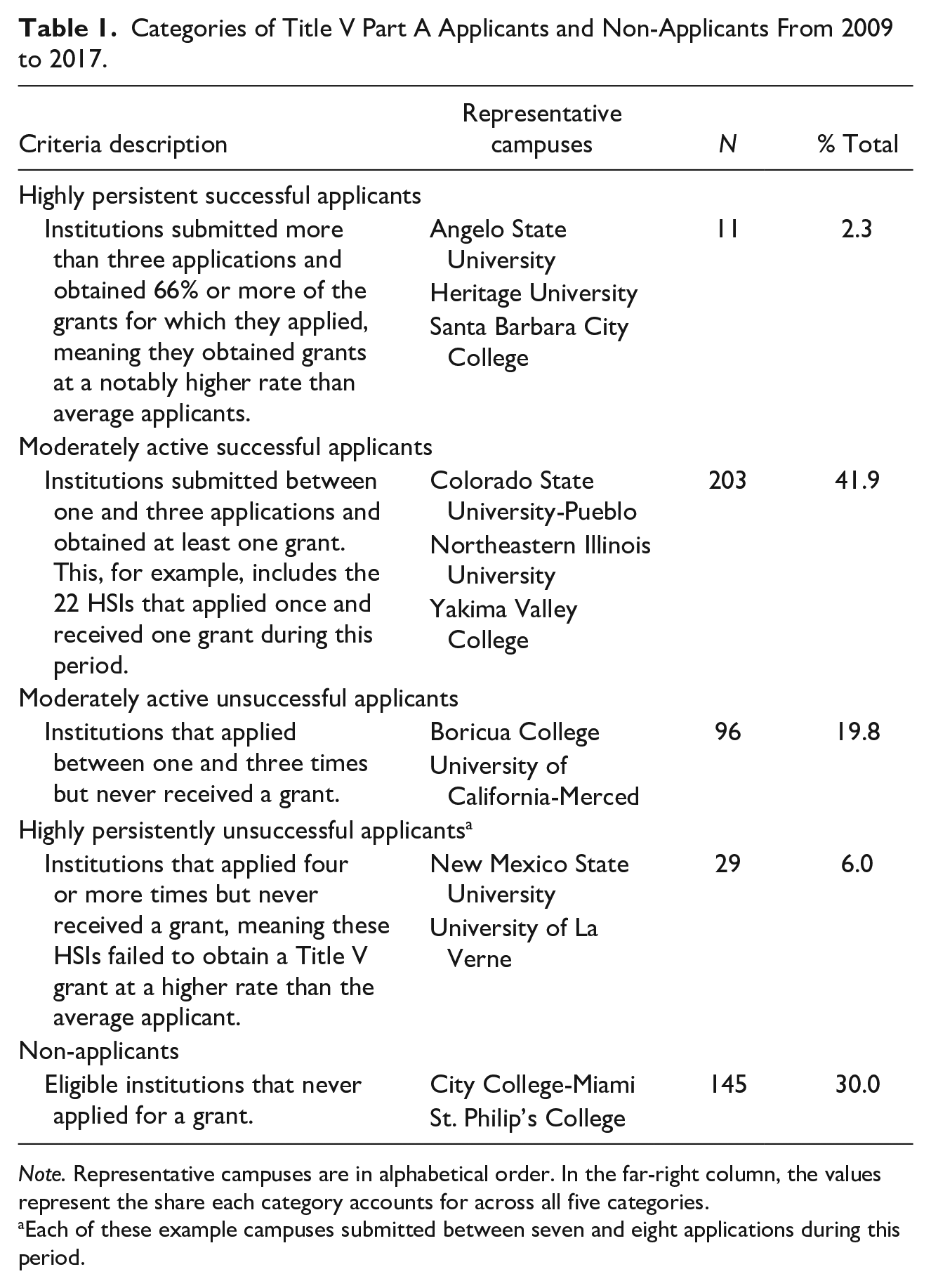
Note. Representative campuses are in alphabetical order. In the far-right column, the values represent the share each category accounts for across all five categories.
Each of these example campuses submitted between seven and eight applications during this period.
Descriptive Statistics by Category From 2009 to 2017.
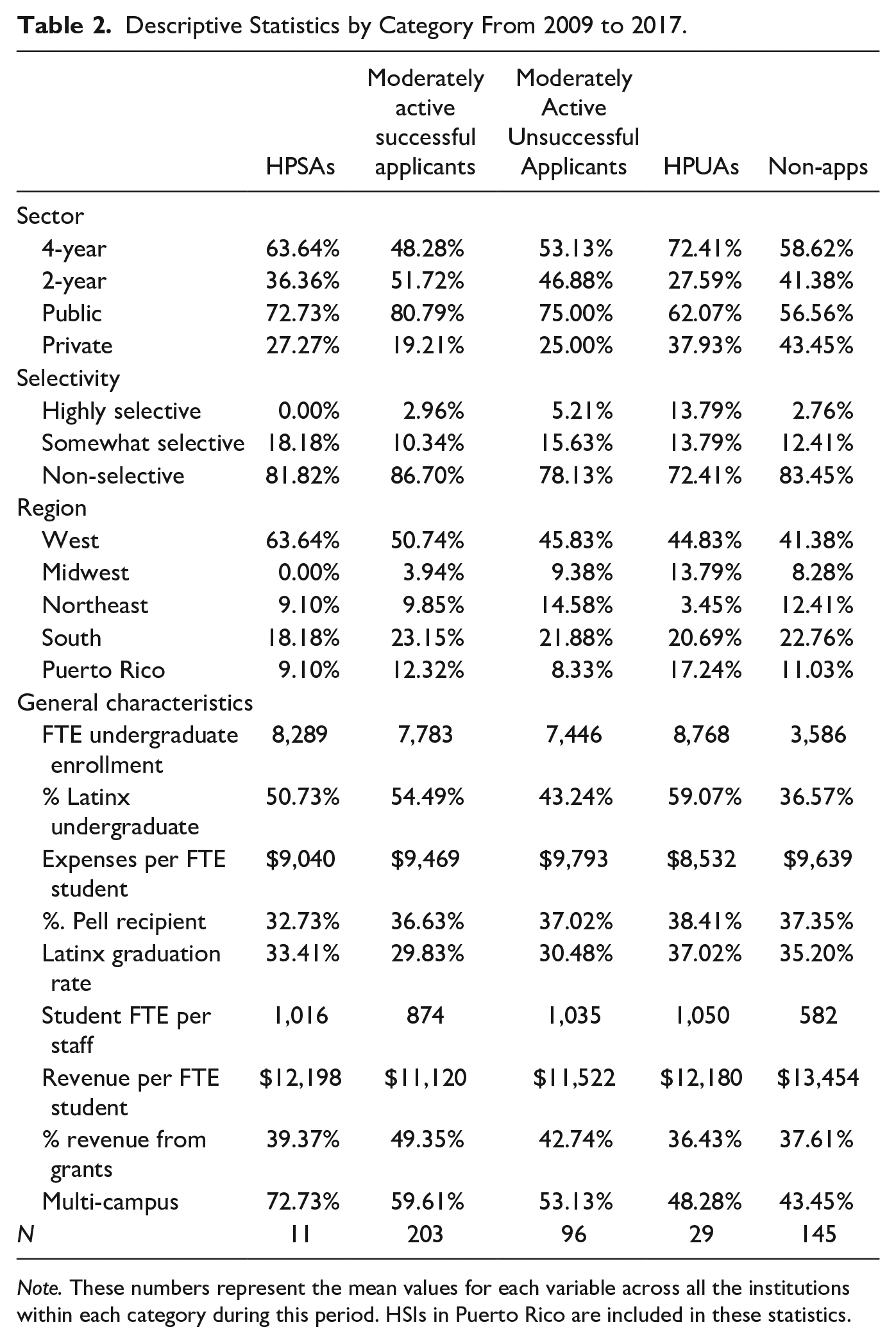
Note. These numbers represent the mean values for each variable across all the institutions within each category during this period. HSIs in Puerto Rico are included in these statistics.
That said, to identify sites for this study, I concentrated on three groups: successful applicants, unsuccessful applicants, and non-applicants. I focused on highly persistent applicants reasoning that actors at such institutions would have rich insight into their campus’s grant-seeking competitiveness. Meanwhile, I included non-applicants, curious why some institutions choose not to compete in this opportunity, although presumably eligible. Is this a calculated decision, given how they understand their competitiveness for this funding? Ultimately, seeking to learn from institutional actors a range of HSIs, specifically institutions with notably varying levels of involvement and success in the Title V grant competition, I collected data from seven successful applicants, five unsuccessful applicants, and five non-applicants (see Aguilar-Smith, 2021b for additional details on category construction and site selection).
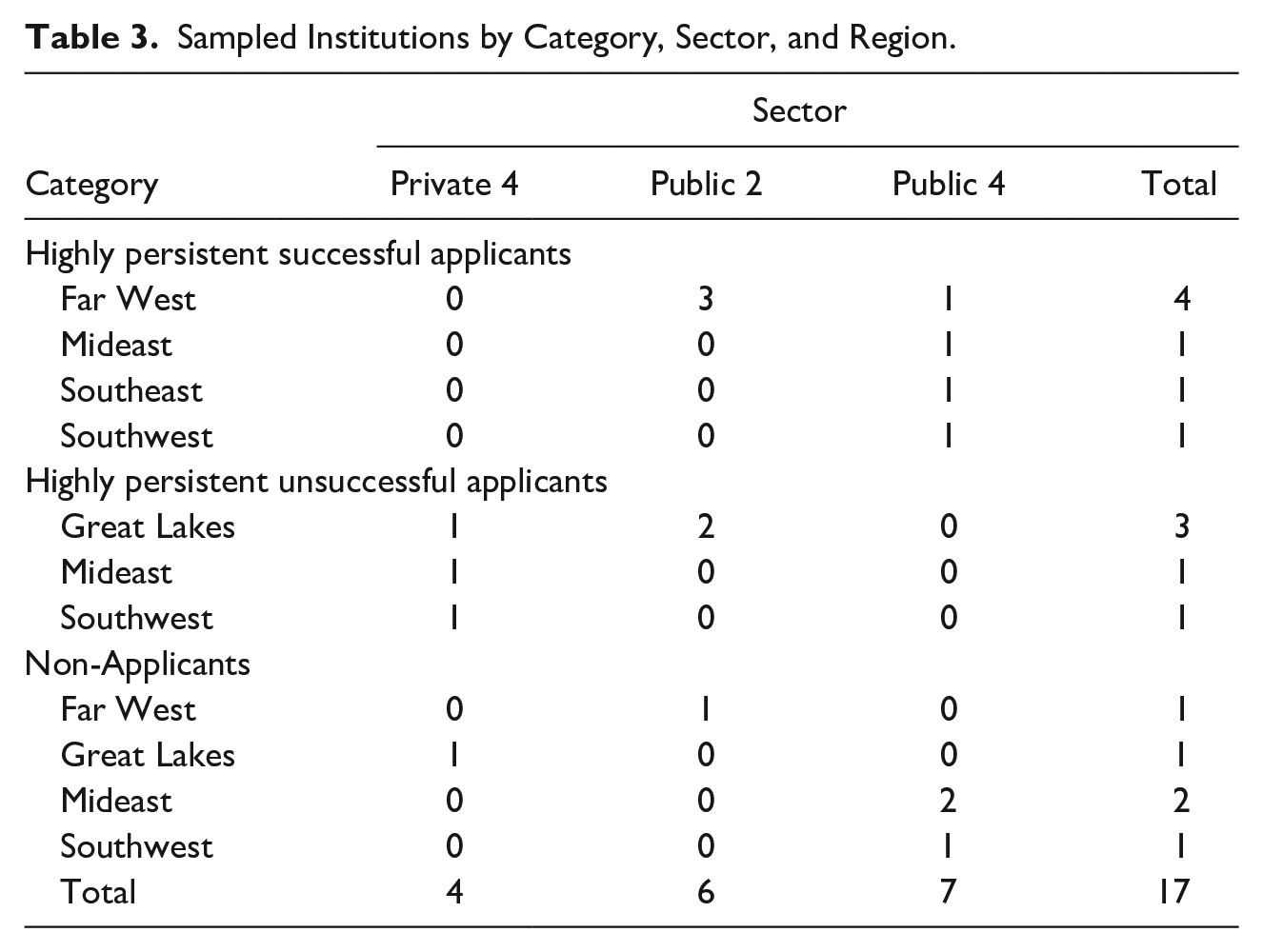
In addition, toward capturing the institutional diversity of the HSI population, I intentionally selected a mix of institutions in terms of their level of control (i.e., public and private), institutional type (i.e., 2- and 4-year), and region. As a result of these efforts, the sample included 17 HSIs across five regions of the mainland United States. Specifically, the sites spanned the Far West (n = 5); Mideast (n = 4); Southeast (n = 1); Southwest (n = 3); and Great Lakes (n = 4) regions. 3 The sample also included six public community colleges, seven public 4-year institutions, and four private 4-year institutions (see Table 3).
Sampled Institutions by Category, Sector, and Region.
Data
Throughout the spring of 2020, I collected data from two main sources: participant interviews and organizational documents. 4 For this study, participant interviews served as the primary data source, and I used the documents for context and triangulation purposes.
In terms of participant recruitment, I used purposeful sampling for two reasons. First, colleges and universities have varied organizational structures for grant-seeking. For example, some institutions have a standalone grants office, whereas others rely on one individual to identify, seek, and manage grant activity, often alongside other work responsibilities. Second, institutional actors knowledgeable of their campus’s engagement with the Title V Program hold varied roles. Therefore, via purposeful sampling, I identified individuals at each site who: (a) participated in developing a Title V proposal; (b) helped implement a Title V project; and/or (c) held deep institutional knowledge of their campus’s grant-seeking structures, practices, and priorities. Guided by these criteria, I conducted 29 semi-structured interviews, speaking with 1 to 4 institutional actors at each site somewhere between 35 and 90 minutes, for an average of approximately 60 minutes. Specifically, I interviewed 10 senior administrators, 12 grants office administrators, 5 staff members, and 2 faculty members. To note, given that Title V grants are institutional awards, not research-related grants, most of the participants understandably were administrators and staff members, rather than faculty. Table 4 presents participant demographic information for non-applicants and applicants, respectively.
Participant Demographics.
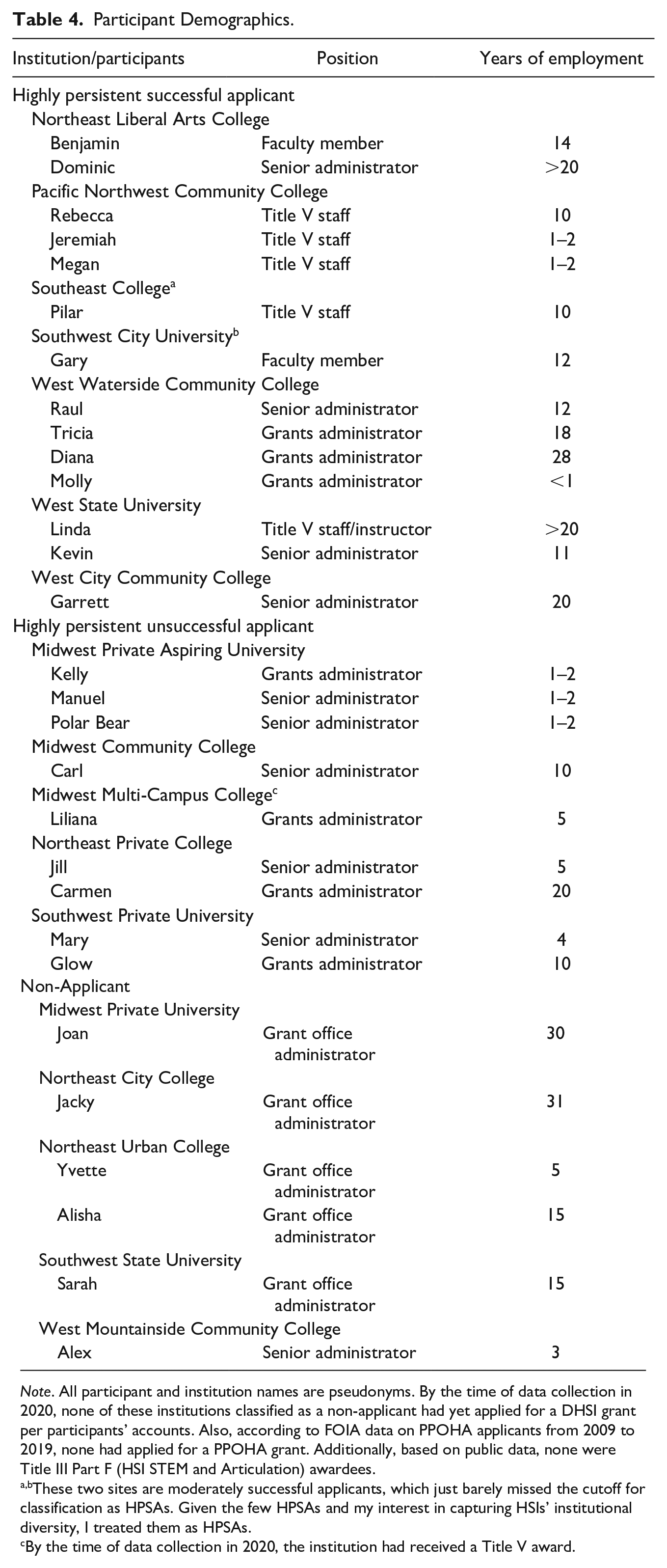
Note. All participant and institution names are pseudonyms. By the time of data collection in 2020, none of these institutions classified as a non-applicant had yet applied for a DHSI grant per participants’ accounts. Also, according to FOIA data on PPOHA applicants from 2009 to 2019, none had applied for a PPOHA grant. Additionally, based on public data, none were Title III Part F (HSI STEM and Articulation) awardees.
These two sites are moderately successful applicants, which just barely missed the cutoff for classification as HPSAs. Given the few HPSAs and my interest in capturing HSIs’ institutional diversity, I treated them as HPSAs.
By the time of data collection in 2020, the institution had received a Title V award.
Typical of semi-structured interviews, I used a general protocol to guide my conversations with each participant. First, to build rapport and better understand the institutional context, I asked basic questions about the campus and its grant-related infrastructure. I then posed questions about the campus’s priorities and reasoning for grant acquisition. My next set of questions focused on the institution’s grant-seeking practices, specifically its proposal preparation process. I concluded interviews by asking participants about the benefits and challenges of grant acquisition and their thoughts on how to improve Title V (see Aguilar-Smith, 2021b for full interview protocol).
Again, I also collected publicly available organizational documents for each site (e.g., institutional policies regarding external funding, grants office reports, and Title V-related press releases). In preparation for each interview, I reviewed the documents corresponding to the participant’s institution to better understand the overall campus context and the institution’s grant-seeking capacity and readiness. In effect, this relevant background information prepared me to ask more generative probing questions during the interviews.
Data Analysis
Shortly after each interview, I used an online form to jot my thoughts and reflections about a preset series of questions. For instance, I responded to questions like: How does the data from this interview relate to data from other campuses in this category? How did the interview reflect (or not) the campus’s organizational documents? In doing this exercise, I methodically cataloged my initial reactions and connections between participants’ insights (e.g., discrepancies between successful and unsuccessful applicants).
Although I began data analysis amid data collection, I still adhered to a multiple-step process. First, I carefully reviewed every transcript to ensure I had a solid grasp of the data. Then, I uploaded the transcripts into Dedoose and proceeded to inductively analyze the data more systematically and apply structural codes. Specifically, I highlighted and grouped similar excerpts together (Saldaña, 2013). Afterward, I contemplated how these initial structural codes corresponded to my research questions. In other words, I considered how my codes informed my understanding of an HSI’s competitiveness for Title V funding and potential sources of inequity of this program. Throughout this analytic process, I renamed and redefined my codes and shuffled their constituent excerpts. To ultimately solidify my analytical schema, I exported each code’s excerpts and systematically reviewed each output file to ensure each excerpt corresponded with its assigned code(s). In the end, I grouped codes into four distinct, but not inherently mutually exclusive, themes: Unequal Institutional Capacity, Institutional (In)Action, Unequal Institutional Knowledge, and Unequal Institutional Leadership.
Although I formed the themes based on all the data, I analyzed the output by category (i.e., successful applicant, unsuccessful applicant, or non-applicant), interested in uncovering how the data points within each category mapped onto each theme. Basically, considering the study’s purposes, I sought to understand if/how institutional actors at different HSIs (within distinct categories) understood their campus’s competitiveness for Title V funding and if/how their campus’s grant-seeking practices aligned with (or diverged from) other sites within and beyond their respective category.
To facilitate this comparison of data within and across categories, I assigned descriptors to data in Dedoose, tagging each source’s categorical assignment and its corresponding institution’s key characteristics (e.g., Carnegie classification, size, and region). In brief, by filtering the data by these descriptors, I compared participants’ insights within a site (where applicable) and across categories. Additionally, I used several of Dedoose’s visualization tools, including its code application chart, codes-by-descriptor chart, and code co-occurrence chart. These visualizations aided me in detecting patterns across the dataset as well as among and between successful applicant, unsuccessful applicant, or non-applicant
Empirical Accountability
Researchers influence inquiry from their subjective positions. Martínez-Alemán et al. (2015) addressed this precise point within the context of critical scholarship, writing: In critical inquiries, researchers must consider their own subject positions in order to take into account their own preconceptions that result from their own social positions. The decisions researchers make about the choice of topic, method, and its production are affected by their own agency, their own positions in relations of power and in disciplinary discourses. (p. 2)
And so, as a critical scholar, I recognize that my identity as a Latina immigrant undergirds my research on Title V. Specifically, this line of inquiry supports my enduring commitment to mi comunidad. By exploring equity-laden issues with the Title V Program, I see the potential to advance educational equity at the organizational and individual levels and, ultimately, serve the Latinx community.
Cognizant of my positionality to this work, I engaged in various trustworthiness strategies, including reflexive journaling, member checks, and peer debriefing (Carlson, 2010; Merriam & Tisdell, 2015). Furthermore, as mentioned earlier, I used several sources of data (e.g., multiple participant interviews at each site, whenever possible, and organizational documents) for triangulation (Denzin, 2012).
Boundaries
In terms of limitations, it was unfeasible to interview more than one person at some sites either because of employee attrition or because the institution only currently had one person on staff who could knowledgeably speak about the campus’s grant efforts, particularly regarding Title V. Second, I excluded private community colleges from this analysis, as such institutions only represented a mere 3% of the HSI population at the time of data collection (Excelencia in Education, 2020), thereby presenting concerns about participant confidentiality. Moreover, private 2-year colleges only met the criteria for classification as a Non-Applicant, meaning none classified as either an highly persistent successful or unsuccessful applicant. Third, I constrained my sample to mainland HSIs, leaving unclear how institutional actors at HSIs in Puerto Rico understand their grant-seeking competitiveness or if/how their insights differ from their mainland peers. Lastly, given my site selection process, I did not account for institutions’ previous or more recent participation and/or success in the Title V grant competition or other HSI-related grant programs (e.g., Title III-F). But the applicants in this study often discussed seeking Title V funding in general, including DHSI and PPOHA grants.
Findings
Through in-depth interviews with 29 institutional actors across 17 HSIs, this study complicates framing the issue with Title V as only one of scarcity by shedding light on equity-laden issues with this program. Specifically, based on my inductive analysis of participant interviews across all three categories (i.e., HPSAs/successful applicants, HPUAs/unsuccessful applicants, and non-applicants), I identified four main themes regarding HSIs’ competitiveness for Title V funding: Unequal Institutional Capacity, Institutional (In)action, Unequal Institutional Knowledge, and Unequal Institutional Leadership. Importantly, while the participants collectively informed each of these themes, each group offered different insights, likely given their institutions’ distinct organizational conditions and grant-seeking experiences. Ultimately, participants’ perspectives on Title V, captured in the four themes, reveal sources of inequity of this program. To follow, I pull from participant excerpts to animate each theme.
Unequal Institutional Capacity
Across interviews, participants signaled through their responses that an HSI’s institutional capacity was pivotal to its grant-seeking competitiveness. Specifically, in terms of institutional capacity, they underscored what Harris (2013) refers to as institutions’ systemic characteristics (i.e., institutional type, institutional control, and size) and their financial resources, positioning such characteristics as highly influential to an HSI’s competitiveness for Title V funding. In particular, over a third of participants suggested that large 4-year institutions with well-staffed, well-resourced grants offices are advantageously positioned for grant acquisition. Notably, however, each group emphasized different capacity-related characteristics.
Typically, unsuccessful applicants conflated competitiveness for Title V funding with an HSI’s systemic characteristics. Specifically, some institutional actors at these campuses suggested that public HSIs have a competitive advantage in this program, while others framed 4-year institutions as especially strong competitors for this federal funding. Notably, those at private HPUA institutions (e.g., Mary, Glow, Carmen, and Jill) felt that public HSIs—both 2- and 4-year publics—were more competitive for publicly sponsored funding, particularly Title V grants, than their private peers. In their view, public funding agencies (i.e., the ED) see public colleges and universities as the prime beneficiaries of public dollars, believing that these institutions are where their money may have the greatest impact. For example, Glow at Southwest Private University (an unsuccessful applicant) held this view, explaining: Public universities have more affordable price points than private schools like us. And because they’re large, public universities, they can have a big impact on the number of students they serve. The headcount is high, and the students get a 4-year degree. And so, I think that sector is almost an irresistible grantee to the Department of Ed. They want to give the money to the UT-Brownsvilles of the world, [institutions with] 50,000 students [in which] the majority. . .are low-income, first-gen Hispanic; that’s pretty irresistible.
Essentially, she surmised that the ED favors public HSIs, specifically public universities, over their private peers given such institutions’ typically larger enrollments.
In contrast, successful applicants and non-applicants generally did not equate competitiveness for Title V grants with large public institutions. Instead, institutional actors at these campuses often spoke about the importance of an HSI financially investing in two primary ways: expanding its grant-related infrastructure and hiring expertise. More specifically, they generally positioned HSIs with well-staffed grants offices able to afford specialized grant consultants as the strongest competitors. Stressing the import of such financial investments was Molly at West Waterside Community College (a successful applicant) who shared: The New York Yankees, the New England Patriots, you know, if you can spend the money, and you can get the resources, you’re going to win the games. So, those are unfortunately the ones, I believe, that will continue to get this money, and the littler ones will either need to invest, or they will not have access to the pot—the funding. . .is that great? Probably not. Do I like to win? Yes, I do
Clearly, the power of money is not lost on Molly. Rather, drawing on her more than two decades of experience in grant acquisition across multiple HSIs, Molly shrewdly observes that “unfortunately” resource-rich HSIs “win the games” (i.e., the Title V grant competition).
Ultimately, participants’ varied experiences and views across the three groups demonstrate how HSIs have distinct institutional capacities (i.e., varied systemic characteristics and financial resources) that render them unable to equally vie for Title V funding. Forwarding this point, Carmen at Northeast Private College (an unsuccessful applicant) noted: Ironically. . .the Department of Ed put this grant competition together to recognize that HSIs don’t have the same capacity and the same opportunities and funding as Title III schools, you know, the larger schools. So, they created this program to address that need, but over time now, I think that it’s kind of inched up to being back to where we started, where you have large institutions within the system competing with smaller HSIs within the same pool. So, it’s kind of taking a step back in a way from the original intent.
Carmen was not alone in her concerns. For example, Kelly at Midwest Private Aspiring University (an unsuccessful applicant) touched on this source inequity when reflecting on her campus’s proposal development process. Specifically, she posed: “But how does little Kelly and her little ragtag team compete and put together a proposal that’s just as competitive with all of the analytics. . .because that’s what I lack. Like, I don’t have a back office.” As Kelly’s remarks attest, participants across groups signaled that their campus’s institutional capacity affected their grant-seeking competitiveness. What’s more, multiple participants, primarily at unsuccessful applicant institutions, explicitly recognized their campus’s limited capacity for grant-seeking.
Institutional (In)Action
Besides an HSI’s somewhat set institutional capacity, applicants stressed the role of three specific actions on an HSI’s competitiveness for Title V funding. In brief, I described these actions as: campus connections, grant-seeking preparedness, and campus collaboration. Collectively, they proposed that well-connected HSIs that collaboratively and proactively prepare materials are especially competitive for these grants, while at the same time revealing that not all HSIs are positioned to act (or compete) in these strategic ways.
Campus connections: Cultivated versus constrained relationships
In terms of influential actions, multiple participants highlighted the importance of cultivating and maintaining meaningful connections with other HSIs and the broader HSI network, namely HACU. Indeed, almost every HPSA-affiliated participant illustrated the value of peer relationships, with several regaling their experiences partnering with nearby institutions on cooperative development Title V grants. 5 Beyond partnering on grants with other HSIs, a couple of participants recounted the peer support they had received over the years—support, which they argued enabled their campuses to prepare competitive proposals. For example, Garrett at West City College (a successful applicant) shared, “When we went after our first one, I called the college down the street. . .They shared [their grant materials], and I always share if somebody calls me. . .Everybody’s in it. I want to help everybody.” In effect, like several participants at applicant institutions, Garrett positions peer relationships as prime conduits of resource sharing and evidences how intentionally cultivated campus connections empower an HSI to competitively pursue Title V funding.
Despite their limited success in this competition, even some unsuccessful applicants (e.g., Glow and Mary) noted the value of such relationships. But a couple of participants in this group (like Kelly) admitted that collaborating with other campuses on grant development was not a priority. Even more, relatively new to the HSI space, Kelly was unfamiliar with cooperative Title V grants altogether—a point that resonates with the next theme, “Unequal Institutional Knowledge.” In short, participants illustrated that an HSI’s competitiveness for Title V funding partly depends on its campus connections or the proverbial power of “who you know.” Yet, perennial winners revealed how they benefit from cultivated connections, whereas their unsuccessful peers seemingly have more constrained ones, which come to limit their success in this competition.
Grant-seeking preparedness: Strategically prepared versus scrambling to prepare
In recounting their experiences within the grantscape, participants also made clear that an HSI’s Title V competitiveness largely rested on its level of preparedness. Specifically, they revealed the importance of proactively and strategically preparing grant materials. However, given Title V’s inconsistent application cycle, tight turnaround window, and extensive required paperwork, a set of participants felt that some HSIs, such as those without “files ready to go” (Carl), cannot realistically prepare strong materials. Moreover, successful and unsuccessful applicants’ notably divergent accounts illuminated how some HSIs lack the necessary preparedness for grant seeking, leaving them unable to vie for this funding on equal footing with their more prepared peers. Specifically, successful applicants often described planning far in advance or strategically preparing for this competition. For instance, while acknowledging that Title V’s quick turnaround cycle proves challenging, Dominic still described Northeast Liberal Arts College’s (a successful applicant) proposal development process as follows: About five or so months in advance, we start thinking about the college’s strategic goals, start talking to some stakeholders about what major priorities are. . .We start thinking about those goals and how they might fit the Title V Program. . .And then, as soon as the announcement is made, we look to see how any absolute or competitive priorities match some of the institutional priorities, and we bring those into alignment.
Dominic’s description of his campus’s process reveals “perennial winners” (Carmen) or successful applicants’ strategic preparation for this funding opportunity.
In contrast, most unsuccessful applicants described how their campuses scrambled to prepare, frantically working to finalize their materials on time. For instance, Carl at Midwest Community College stated, “We just don’t have the resources or people and all that. . .We, probably like many institutions, are scrambling to put it together from when the proposal is released to when it’s due.”
Campus collaboration: Internally collaborating versus competing
Finally, in terms of key institutional actions, reaching near consensus, participants upheld the value of collaborative campus environments to an HSI’s grant-seeking competitiveness. However, successful and unsuccessful applicants’ accounts, particularly their descriptions of the proposal development process, suggest that these two groups cannot engender the same kind of campus collaboration needed for grant acquisition. Specifically, while both groups shared examples of campus in-fighting, they typically framed these stories slightly differently.
In general, successful applicants portrayed such internal competitiveness as a distant problem, while unsuccessful applicants often insinuated that internal competition and/or limited collaboration was a lingering issue. For example, reflective of successful applicants’ position was Kevin at West State University, who recounted his campus’s approach to curbing internal competition related to grant-seeking, saying: At that time, and even now, the campus didn’t want folks stepping on one another, so if there was a Title V out, we don’t want eight people from the campus applying for that, because the competition is really fierce, and we don’t want to step on one another. So, it becomes a real what I would call shared governance process [where]. . .you have multiple people at the table. . .Once you’ve collected all of their brainstorming, there comes a time when folks have to take a backseat. . .Writing a Title V grant, or any federal grant, is a real delicate process, and you can’t have too many cooks in the kitchen.
Recognizing how internal competition can undermine the campus’s ability to successfully compete for this funding, West State University invites a slate of campus stakeholders to workshop ideas and kickstart the proposal development process. Basically, this university intentionally cultivates cross-campus collaboration—an action several successful applicants suggested facilitates their success in this competition.
While not necessarily describing contentious campuses rife with conflict, unsuccessful applicants connoted less collaborative circumstances. For instance, reflecting on Northeast Private College’s proposal development process, Jill, a former administrator there, said: People wanted a chance to get their ideas in there. . .What I found was my associates were all male, and they were super competitive about it. They really wanted to get their $3 million grant, so they would kind of hold their cards close to their chest. . .I’m a super inclusive, collaborative leader. I’d go out with the whole team, and we’d brainstorm until we came up with the best idea, whereas they would be a little more closed about it.
Despite her inclusive, collaborative efforts, Jill admits that others on her campus, specifically her male-identified colleagues, were “super competitive.” In this way, she helps illustrate unsuccessful applicants’ ongoing issues with internal competition.
Unequal Institutional Knowledge
Considering their campus’s competitiveness in securing Title V funds, participants also brought to light how institutional knowledge of this specific program is invaluable. Specifically, successful applicants attributed much of their success in this competition to their extensive institutional knowledge of this federal program, including its application process, review/selection processes, and legal stipulations. Indicative of successful applicants’ profound Title V knowledge, Garrett at West City College, for example, shared: There’s something obtuse and dysfunctional about the whole [application, review, and selection] process [for Title V grants]. I’ve learned the dos and don’ts of grants. I’ve learned with really a lot of help from our external writing partners what you say, what you don’t say, what they want to hear, and what they don’t want to hear.
Essentially, Garrett explains that given his college’s deep institutional knowledge of Title V, they can effectively overcome this competition’s “obtuse and dysfunctional” nature. Institutional actors at other similarly successful campuses echoed this idea. Indeed, as Dominic’s comments above attest, successful applicants consistently revealed the depth of their knowledge of this program, as they described strategically working to maximize their options and address all the call for proposal’s absolute and competitive preference priorities. 6
By comparison, unsuccessful applicants’ accounts exposed their more limited understanding of the Title V Program, including its processes and requirements. For instance, although successful and unsuccessful applicants both talked at length about Title V’s application cycle and process, unsuccessful applicants often portrayed this process as a maelstrom, as they labored to fully understand the intricacies of the application. For example, Kelly, mentioned earlier, baldly described this application process as “just crazy town.” Likewise, while successful applicants were largely “quite happy with the rules and regs” (Garrett), some unsuccessful applicants voiced sharp concern over the supposedly meritocratic review/selection process. Indeed, some condemned this process as draconian, teetering on insulting, citing, for example, that proposal reviewers punitively deducted points for “petty minor kinds of things” (Carl).
While some unsuccessful applicants begroaned the picky and punitive nature of Title V’s review/selection process, two administrators (i.e., Manuel and Polar Bear) at such campuses offered yet another way that a campus’s institutional knowledge of Title V shapes its competitiveness for this funding. In line with observations about the concentration of grant funding raised by others (e.g., Thelin, 2017, 2019), they insisted that funders reward organizations with demonstrated success in grant-getting, or as Garrett put it the “big kids on the block.” In particular, they explained that the ED engineers an unjust system by financially rewarding knowledgeable HSIs with specific forms of expertise (e.g., proven-track records of grant management) vis-à-vis these grants. For example, Manuel described the most competitive Title V applicants, saying: I think that the ones that have more experience in this area, meaning that they have done it before and that they [have] show[n] some success. I think those are the ones that end up getting them. And those of us that, well. . .let me put it to you this way, sometimes, we expect students to know about money management. But if they never had any money, how can you expect them to know about money management?
In posing this rhetorical question, Manuel elevates his college’s limited knowledge and expertise in formulating and balancing a $3 million project budget, rendering institutions, like his, uncompetitive for this federal funding.
Altogether, applicants’ accounts evidenced the distinct levels of knowledge among HSIs regarding this program, underscoring yet another way in which HSIs are not on an equal or equitable footing in this competition. Indeed, with their laudable institutional knowledge of Title V, successful applicants produce high-quality, winning proposals, which helps explain their perennial success in this competition. Meanwhile, despite their dogged efforts, many unsuccessful applicants’ less developed knowledge and expertise appear to undermine their competitiveness and, in turn, success in this program. Ultimately, these groups’ unequal institutional knowledge of Title V rubs against the meritocratic premise of this program.
Unequal Institutional Leadership
Lastly, relevant to institutions’ grant-seeking competitiveness, this study’s 29 participants underscored the powerful role of institutional leadership, emphasizing their influence on resource allocation and institutional priorities. Non-applicants, in particular, called attention to campus leaders’ sway on institutions’ grant activity. Representatively, Alisha at Northeast Urban College remarked, “If they feel that a grant will help bring something to the college, they will go after it. If they don’t feel that way, they won’t, so everything, it all depends on the head administration.” Notably, her colleague, Yvette, echoed, almost verbatim, Alisha’s perspective.
Additionally, as suggested by ample scholarship (e.g., Eckel & Kezar, 2016; Kezar et al., 2020), participants consistently demonstrated how a campus’s senior leadership shapes institutional priorities. Namely, they demonstrated how some HSIs, under leadership’s direction, heavily prioritize seeking research-oriented grants, whereas others devote greater attention to institutional grants, like Title V, or a combination of funding streams. Specifically, in discussing their campus’s main grant-seekers and primary extramural funding sources, multiple participants at Non-Applicant institutions (i.e., Yvette, Alisha, Jacky, and Sarah) signaled that their college or university underemphasizes institutional awards. In effect, these participants demonstrated that not all HSIs are “institutional [grant] go-getter type of school” (Yvette), making them largely uninterested in actively pursuing funding opportunities like Title V.
In sum, participants, including non-applicants, stressed that an HSI’s leadership influences which opportunities the campus pursues, basically determining whether an HSI even participates in the Title V grant competition. Indeed, the cases of Northeast City College, Northeast Urban College, and Southwest State University—all non-applicants—illustrate that an established, relatively well-staffed and -resourced grants office matters little if campus leadership de-prioritizes seeking institutional grants like Title V.
Discussion
Through this critical qualitative study, I examined the Title V Program from an equity perspective, considering what may contribute to an HSI’s competitiveness for this federal funding. Toward this, I asked: How do institutional actors at HSIs understand their competitiveness for Title V grants, and what sources of inequity does this reveal about Title V? In brief, my analysis of participant interviews revealed that four main organizational conditions collectively shape a campus’s competitiveness for this funding, but that HSIs do not universally share these conditions. To follow, I discuss the findings keeping in mind my conceptual lens, particularly the notions of meritocracy and equity. Furthermore, in line with CQI’s emancipatory aims, I cast light on sources of inequity of this program toward advancing justice among HSIs.
Unequal Grant-Seeking Competitiveness: The Making of Inequitable Policy
As discussed earlier, RIT assumes people instinctively maximize group differences, holding distinct understandings and expectations of each socially constructed group (Tomaskovic-Devey & Avent-Holt, 2019). Following this assumption, participants sorted HSIs, prescribing specific meanings and expectations to different types of HSIs, differentiating, for example, public and private HSIs as well as Hispanic-serving community colleges and Hispanic-serving research institutions in terms of their competitiveness for this funding. As a reminder, unsuccessful applicants often conflated competitiveness for Title V funding with an HSI’s systemic characteristics, generally positioning public, 4-years as the most competitive applicants. But successful applicants in this study, many of which are public Hispanic-serving community colleges, seemingly upend this understanding. That is, their success record subverts the assumption that an HSI’s competitiveness for Title V grants neatly conforms to sectorial lines.
At the same time, however, it is important to recognize that the U.S. higher education system stratifies and unequally resources colleges and universities by these very institutional characteristics (i.e., institutional type and control). Indeed, ample literature documents unequal patterns of public investment and private giving across institutional types, such that those atop of the hierarchy (i.e., research universities and selective liberal arts colleges) benefit from greater public support than those at the bottom (i.e., 2-year colleges; National Center for Education Statistics, 2021). Illustratively, The Center for American Progress indicated that community colleges “receive roughly two-fifths of the revenue that 4-year institutions receive” (Yuen, 2020, para. 12), a difference of $52 billion versus $130 billion annually. Subsequently, considering the patterned funding differences among institutional types, this study’s perennial winners (many of which again are public community colleges) might be institutions that surpassed the odds and secured this competitive funding given their deep Title V knowledge. Alternatively or concurrently, the highly successful community colleges in this study might simply be benefiting from the existing HSI landscape, namely the limited current number of Hispanic-serving research universities (Martinez & Garcia, 2020). Indeed, in line with RIT, there is reason to suspect or worry that research universities—institutions typically far more infrastructurally complex and resource-rich than the overall HSI population—could come to exclude other HSIs from this funding and hoard this opportunity.
Nevertheless, considering the makeup of successful applicants, this group’s emphasis on institutional action, specifically their campuses’ preparedness, campus connections, and collaborative environments is reasonable. As previewed earlier, the logic of meritocracy plays out such that successful actors view their rewards as rightfully earned: their success reflects their involved effort and superior merit (Liu, 2011). Importantly, however, an HSI’s institutional capacity circumscribes, to some extent, the actions it can take. Indeed, unsuccessful and successful applicants’ divergent accounts illustrate that not all HSIs can employ the same kinds of strategic grant-seeking actions because of their distinct institutional capacities. For instance, without a formal grants office, Carl at Midwest Community College cannot readily “have files ready to go,” cultivate meaningful campus connections, and facilitate collaborative cross-campus workgroups, at least not as easily as better resourced HSIs with more robust grant-related infrastructures. Ultimately, the stark differences among HSIs in terms of their institutional capacities is one that makes a difference, representing a source of inequity in the broad grant-seeking arena and within this specific “meritocratic” competition. Further, as elaborated below, the relationship between institutional capacity and action unsettles the logic of meritocracy.
Bounded Agency: The Fallacy of Meritocratically-Grounded Policy
A foundational premise of the logic of meritocracy is the equality of opportunity: all things equal, the most talented and skilled succeed. Yet, as countless scholars have discussed (e.g., Killgore, 2009; Liu, 2011) and several participants connotated, certain institutions have access to resources (e.g., well-staffed grants offices, expert grant writers) that empower them to become the most talented and skilled competitors. Similarly, in calling attention to their campuses’ structural barriers, financial limitations, and constrained campus connections, unsuccessful applicants especially demonstrated the bounded circle of agency or how “agency exists within tight constraints” (Burke, 2005, para. 6). Ultimately, much evidence, including the participants in this study, demonstrate ways in which structures (choice-limiting, patterned arrangements; Barker, 2002) confine possibilities. For instance, unsuccessful applicants frequently remarked about the difficulty of Title V’s truncated cycle and involved application process, effectively contending that this structure hinders them from preparing strong proposals and, thus, undercuts their competitiveness for this funding.
In treating HSIs as a monolith and indiscriminatingly open all HSIs, Title V overlooks that some HSIs, like West City University and Southwest State University in this study, have well-staffed teams of full-time employees dedicated to identifying and applying for external funding opportunities. In contrast, contending with structural underinvestment, other HSIs, such as Midwest Community College and Midwest Private Aspiring University in this study, do not have established grants offices or have markedly understaffed ones. By disregarding HSIs’ well-documented institutional diversity (Núñez et al., 2016) and the especially bounded agency of many HSIs, Title V risks underserving a segment of the population Congress designed this program to support. Moreover, at the core, participants highlighted unintended ill effects of “meritocratically” segregating or allocating resources among organizations, particularly among unevenly positioned and resourced ones. More precisely, this study helps illuminate how such a policy design can, in practice, magnify educational inequity among HSIs. As McLaughin (2006) explains, policymakers’ understanding of the causes of inequity affects the effectiveness of equity-aspiring policies, including ones seeking to readdress educational inequity like Title V. Thus, mindful of participants’ insights on what might explain an HSI’s grant-seeking competitiveness, I argue that the current structure of this program may undermine its equity goals (i.e., to bolster HSIs’ institutional capacity and increase the educational attainment of Latinx and Pell-eligible students). Furthermore, without any intervention or policy change in response to the changed (and still evolving) HSI landscape, the net effect is likely greater competition and stratification in terms of access to this critical federal resource, rendering Title V at least partially a potential educational policy failure.
Implications for Policy, Practice, and Research
The study’s findings suggest possibilities to advance equity among HSIs through policy, practice, and future research. In terms of policy, this study’s findings especially support the need to redesign the Title V Program. Among ways to improve the structure of the program, options include solidifying and extending the application cycle and reconfiguring the eligibility criteria. In terms of the former, mindful of unsuccessful applicants’ recurrent concern about the tight turnaround window, the ED ought to consider extending this cycle, as it will better enable HSIs, particularly more resource-constrained, overstretched institutions, to strategically prepare for this competition. In terms of the latter, Kelly’s description of her college as a “ragtag team” and others’ remarks about the limited bandwidth of their campus for grant-seeking (particularly relative to better-resourced HSIs) suggests that revisiting the eligibility criteria of this program may be warranted. For instance, the ED may consider differentiating applicants by sector or their financial portfolio toward enabling a more level playing field.
Additionally, participants’ comments about the “obtuse and dysfunctional” (Garrett) nature of the review/selection process underline the need for the ED to further clarify this process. Toward promoting greater transparency, they could, for example, consider widely communicating how reviewers are trained and how award decisions are reached (Aguilar-Smith, 2021b). In line with this suggestion, ED officials could publish a flowchart depicting their entire review/selection process for Title V awards.
Regarding practice, this study and existing literature point to concrete actions an HSI may take to garner success in grant acquisition, including investing in research and development activities (Wetherholt, 2013), adjusting employee workloads to provide more time to develop proposals (Monahan & Fortune, 1995), and serving on grant review panels (Porter, 2011). However, toward advancing the equity of this program and, ultimately among HSIs, HSI leaders and advocates should push for increased federal funding for this program as well as ways to restructure this competition with an eye on equity. At the more micro-level, participants’ comments on the importance of campus connections, particularly relationships with other HSIs, suggest that institutional actors at HSIs should encourage resource-sharing with other HSIs or host multi-campus grant-writing groups (Aguilar-Smith, 2021b).
Finally, this study lays the foundation for further research. For example, building on this study and related quantitative work (Aguilar-Smith & Yun, 2022), future scholars should more carefully examine the relationship between an HSI’s institutional capacity (e.g., systemic characteristics and financial resources) and ability to competitively seek grant funding. As suggested by RIT, what characterizes or defines in- and out-groups in this competition? Relatedly, researchers should further explore if/how certain HSIs exclude others from accessing this funding. Additionally, future research should explore the role of campus leadership in shaping institutions’ grant-seeking priorities and infrastructure and, in turn, grant acquisition. Importantly, across all such research, scholars should be attentive to HSIs’ increasing institutional diversity, as differences among this population will likely translate into different findings and implications for both policy and practice (Núñez, 2017).
Conclusion
In a context of consistent budget cuts and HSIs’ growing numbers, much of the narrative surrounding Title V attends to how the pool of possible beneficiaries increasingly outpaces the number of available grants. Yet, such a focus elides a needed examination of this program’s equity, particularly given HSIs’ ongoing institutional diversification. In response, this critical qualitative study unsettles the scarcity rhetoric surrounding Title V by exposing various sources of inequity with this program. Specifically, through their varied responses, participants illuminated HSIs’ distinct organizational conditions and, thus, unequal levels of competitiveness for Title V funding. In other words, the findings bring to bear that HSIs vie for Title V funding on unequal—and inequitable—terms. Even more troublingly, considering HSIs’ evolving institutional profile, there is strong reason to suspect that, without any change, this program will engender greater inequity among HSIs, undercutting its own aims. Most importantly, since HSIs educate the majority of Latinx college students in the United States (Excelencia in Education, 2022), this situation stands ultimately to further underserve this already long under-supported community.
Footnotes
Declaration of Conflicting Interests
The author declared no potential conflicts of interest with respect to the research, authorship, and/or publication of this article.
Funding
The author received no financial support for the research, authorship, and/or publication of this article.
