







Abstract
“Divisive Concepts” laws have sprung up around the nation as a backlash to the widespread commitments to anti-racist education that emerged in summer 2020. This critical policy analysis examines the concepts central to Florida’s “Individual Freedom Act” [HB7] of 2022, to determine its intent and impact in ameliorating or exacerbating persistent educational inequities. Through an analysis of the language of the law for what is and is not banned as well as the discrepancies between language of the legal text juxtaposed with the “Anti-Woke” political rhetoric accompanying HB7, this study reveals the law’s ideological underpinnings and political intent. The law’s concepts serve as a manufactured pretext to villainize teachers, misrepresent Critical Race Theory, cause confusion and fear, thereby chilling educator practice. The analysis also reveals how, despite the law’s intent, the concepts can be reframed to support educational equity. Implications for equity-minded practitioners within K-20 education contexts are explored.
Keywords
Educators Under Siege
For educators in Florida, the academic years 2021/2022 to 2022/2023 have unleashed a legislative assault in the form of curriculum censorship, comprising an avalanche of top-down legislative and policy efforts that restrict curriculum and teacher autonomy. The centerpiece of this censorship was HB7- The “Individual Freedom Act” also called the “Stop Woke Act” signed into law in April 2022, effective July 1, 2022. The core concepts of HB7 are excerpted verbatim from the “divisive concepts” of former President Trump’s 2020 Executive Order #13950, widely acknowledged as a backlash to the nation-wide calls for racial equity and social justice in 2020 (Golden, 2023; Matzko, 2023; Wallace-Wells, 2021). Collectively, these efforts position Florida as the national leader in curriculum censorship, both in terms of offering blueprints for legislative copycat measures in other states (Craig, 2023) as well as the sheer number of laws, policies and book bans enacted (PEN America, 2023). Although one might expect just the opposite of a state that serves a student population that is richly culturally diverse—ironically—this occurs in one of the nation’s most diverse states and impacts populous school districts. Florida is home to 5 of 10 of the largest school districts in the nation (National Center for Educational Statistics, n.d.) and in 2019 ranked third among states as a host to the nation’s immigrants (Migration Policy Institute, n.d.). In 2021/2022 the K-12 student population in Florida was 36.5% White, 21% Black, 35.5% Latino, 4% Biracial, and 2.8% Asian (Florida Department of Education, n.d.). Instead, Florida serves as a national prototype for the curriculum policy and censorship hostile to the values of diversity, equity and inclusion.
As of January 30, 2023, similar laws and/or policies centering so-called “divisive concepts” had emerged in 15 states (National Association for Music Education, 2023). PEN America documented 54 separate bills introduced by 24 legislatures in 2021, which grew to 193 gag orders in 41 legislatures in 2022 (Fansmith et al., 2022). PEN America (2022a) defines gag orders as bills “designed to chill academic and educational discussions and impose government dictates on teaching and learning” (p. 4). A year later, Friedman et al. (2023) documented a further “86 bans introduced nationwide between January 1 and February 14, 2023, with 50 restricting teaching about race across 16 states, including Florida, which is also among the states with the highest number of book bans.” 1 Although implementation of HB7 has been suspended through a legal injunction against it, its impact resonates through related laws and policies that echo its core concepts. This includes the expansive SB 266 (Higher Education, 2023) that targets higher education institutions that advocate diversity, equity and inclusion (DEI) for defunding.
While the focus of this paper is on HB7 and how it has sown confusion among educators, interrupting previously routine discussions of racism, sexism, homophobia and other forms of discrimination, the intent and impact of this legislation must be understood within the broader context of multiple legal attacks on public education as well as numerous laws that have targeted equity and human rights in the state (see Appendix). These include harsh legislation against LGBTQ+ communities, women’s/reproductive rights, voter suppression tactics and gerrymandering (Schwartz et al., 2022). Furthermore, in Florida, curriculum censorship laws such as HB7 are part of a much broader legislative assault on education that moves beyond book banning, curriculum/textbook restrictions (Atterbury, 2022) or revisionist history in civics (Ceballos, 2022), to include the policing of and by school boards (WXTL, 2022), challenges to tenure for faculty in higher education (Mulvey, 2022) accompanied by threats of funding cuts, termination, lawsuits, loss of professional licenses, revocation of tenure and general intimidation of educators for defying these laws deliberately designed to hurt public education and restrict academic freedom (American Association of University Professors [AAUP], 2023a; 2023b; Education Lawyers.com, n.d.; Najarro, 2022).
Informed by critical multicultural education (May & Sleeter, 2010), this critical policy analysis aims to uncover the purpose of the law and its impact on multicultural educator practice. The following questions guide our multilevel analysis:
(i) What is banned and what is permitted by HB7 vis-a-vis curriculum and instruction?
(ii) What is the socio-political/educational function of HB7—evident in the language of HB7 and the discourse of politicians and legislators—as it pertains to the advancement or interruption of educational equity in public schools?
Our experience working among educators in Florida has revealed that many have not read the law and have relied on media and the governor’s threatening political rhetoric to guide their decision making. This paper is intended to inform educators about the language of the law, its ideological underpinnings and intent, while contextualizing this legislation in the broader history of the struggles for educational equity among minoritized populations. We believe that knowing the provisions of HB7 may enable teachers, students, and administrators to continue engaging with topics related to race, class, and gender without fear of running afoul of the law.
Conceptual Framework
Schools as Sites of Curricular Struggle
Critical multicultural educators recognize that US education has historically been a site of curricular struggle where the state has been a complicit, often active, agent of educational inequity, through policies of education denial, cultural genocide, miseducation, stratification, segregation (Spring, 2016; Woodson, 1933), the legacies of which contemporary educators are challenged to overcome, not repeat. Scholars frame the current attacks on “critical race theory” (CRT) as (a) the latest iteration in this history that is “a part of larger efforts to disenfranchise people of color, and to divide the public who, if organized, would oppose measures that benefit a small, wealthy elite” (López & Sleeter, 2023, p. 2) and (b) “an attack on democracy itself” deliberately intended to disrupt the momentum of the 2020 movement for racial justice (“Recommitting”, 2022).
Discussing persistent anti-blackness of contemporary policy (Dumas, 2016), scholars remind us that Black history has long been “contraband” (Kaepernick et al., 2023; also Givens, 2021). Russell-Brown (2022) characterized HB7 as anti-literacy legislation ideologically linked to ante-bellum bans on educating Blacks. Similarly, the 2010 targeting of the exemplary Mexican American Studies program by the state of AZ, offered a legislative precursor for contemporary curricular attacks (Cohen, 2022; López et al., 2021). The threat of funding cuts, and false but vicious political rhetoric were used to target educators and curriculum centering Chicano perspectives, despite excellent academic performance measures (Cabrera et al., 2014; Strauss, 2017). Apple (2019) notes that in the context of current struggles over the very meaning of being educated and who should control it, “we have an ethical obligation to make public the effects of these policies, to challenge these positions and to defend a robust education that is based on human flourishing” (p. 277). Consequently, this policy analysis examines how current curriculum policy advances or impedes the democratizing potentiality of education for historically marginalized groups.
The Call for Multicultural Curriculum Versus Its Censorship
Contemporary curriculum censorship represents a direct attack on multicultural curriculum, including efforts launched in 2020 to address racial/social justice. For instance, the Florida Board of Governors (2020) issued the following call to all state universities: As a powerful and influential voice in Florida, it is time for the State University System, including students, faculty staff and alumni to actively engage in finding solutions to peacefully eliminate racism and discrimination. This will be the critical mission of our twelve state universities, as it is our duty as societal leaders to help end prejudice and to promote social justice for all.
Ironically, in 2023 they supported the antithetical position: issuing policies for defunding all DEI efforts in response to SB 266 (Alonso, 2023).
Scholars in multicultural education problematize monocultural curriculum and advocate curricular content representing divergent perspectives that serve as cultural “windows,” “mirrors,” and “sliding doors” for students, taught through equitable pedagogical practices that support students’ critical consciousness about the processes and biases of knowledge construction (Bishop, 1990; Sleeter & Carmona, 2017). Policies such as Florida’s 1994 curriculum mandates for teaching African American history or Holocaust education are foundational to inclusive representation (https://afroamfl.org/history/). Typologies in multicultural education also advocate that content integration moves beyond “additive” representations of diversity to a focus on social action and decision-making embodying justice-oriented, democratic approaches to education (Banks, 2004; Gorski, 2009; Sleeter & Grant, 2009).
It is the critical consciousness that emerges from such desired curriculum that is targeted by the “Anti-Woke” ideology of censorship constituting a “frontlash”—preemptive action to prevent the anti-racist commitments of 2020 from taking hold (Russell-Brown, 2022). The governor of Florida has used “Woke” to connote topics and ideas to which he is opposed, although he has not issued a clear definition of what he means. The Merriam-Webster Dictionary defines “woke” as “aware of and actively attentive to important facts and issues (especially issues of racial and social justice)” (https://www.merriam-webster.com/dictionary/woke). Bridges (2022) offers an instructive discussion of the cultural etymology of “woke” spanning a century of the term’s use among Blacks fighting for racial justice. Bridges notes that, like many terms originating within the Black community, “woke” also became coopted, subsequently used in a derogatory manner by those opposed to the widespread Black Lives Matter (BLM) protests.
In an amicus brief against HB7, the Southern Poverty Law Center (2022) notes that, “far from indoctrinating students into a so-called “woke agenda,” it is often difficult for educators “to teach about the history and origins of racism, resulting in a generation of high school graduates who lack basic information about the history of their country” (p. 2). Responding to nation-wide attacks on DEI efforts, the US Department of Education’s Office of Civil Rights (2023) issued a fact sheet clarifying that DEI activities “remedy potential different treatment of students, provide remedial measures to address harassing conduct, assist in remedying other forms of discrimination on the basis of race, and foster a more positive and inclusive school climate.”
Responding to Censorship
Given our professional knowledge of what should be, how might equity-minded educators respond to these challenges? For King (1947), the moral purpose of education was to “enable one to sift and weigh evidence, to discern the true from the false, the real from the unreal, and the facts from the fiction” to save us from “the morass of propaganda.” Ladson Billings (2006) underscored educators’ moral obligation to bridge the gap between “what we know is right and what we actually do” (p. 9). Givens (2021) described for contemporary practitioners, historical role models such as Tessie McGee who persisted in teaching Black students culturally relevant lessons despite her White supervisors’ sanctions against it. Woodson (1933) established the connection between what was taught in schools and what was practiced in society in stark and powerful terms: “There would be no lynching were it not taught in the schoolhouse” (p. 3). The AAUP (2023a), noting the Florida legislature’s effort to destroy programs that “serve minority communities and banish from classrooms ideas and information about race, gender and sexual identity that fail to conform to the prejudices of politicians” (p. 2), called on educators and organizations to “fight such ‘reforms’ tooth and nail” (p. 17). These critical multicultural perspectives inform our analysis as we consider the nature, function, and impact of HB7 on education as a public good.
Methodology
This study of HB7 is designed as critical policy analysis (CPA), an approach consistent with critical multicultural education, and particularly relevant in the current context of curriculum bans nation-wide. Apple (2019) notes that “critical policy analysis is grounded in the belief that it is absolutely crucial to understand the complex connections between education and the relations of dominance and subordination in the larger society” (p. 276). According to Diem and Brooks (2022), “critical policy analysis compels us to question all aspects of the policymaking process, including whose knowledge is prioritized in the shaping of policy, assumptions guiding policy implementation, and the historical, socio-political, and geographic contexts in which policies are created” (p. 3). Consistent with the observation of Diem et al. (2014), this CPA integrates multiple issues in examining the ideological underpinnings of HB7: the roots and historical context of policy development; policy rhetoric versus reality; intended “winners” and “losers” and the potential for exacerbating social inequality. Our critical interrogation of the policy is also intended as a preliminary step in counter-hegemonic praxis within an oppressive policy context in the state.
Drawing on a combination of critical textual and discourse analysis (Fairclough, 1993), this study examined both the language of HB7 as well as the political discourse surrounding it to ascertain the law’s emancipatory versus hegemonic potential for education that impacts the state’s culturally/racially diverse students and their teachers. In addition to the legal text, documents such as press releases, the governor’s speeches, textbook guidelines, legislative debates, lawsuits and the subsequent legal injunction against HB7 were included in this analysis. While HB7 amended multiple existing laws that govern employment, education and civil rights, this analysis concentrates on HB7′s amendments to the Unlawful Employment Act (760.10), the Florida Educational Equity Act (1000.05) and Required Instruction (1003.42), each of which now includes the eight specified concepts (also known as “divisive concepts”) central to the law, and the focal point of this analysis. Excerpts from the law are cited according to the line numbers in the legal text (accessible at: https://www.flsenate.gov/Session/Bill/2022/7/BillText/er/PDF), whereas we provide timestamps from the publicly accessible video archives in our reference to the excerpts from the legislative discussions.
Emergent in the initial analysis of HB7 to ascertain what was and was not banned, were disjunctions between the actual language of the law and the pervasive political rhetoric about the law (evident in documents, press releases and speeches by the governor); disparities between the language of the law and educational reality, particularly of classroom practice; as well as contradictions within different aspects of the law. The unique opportunity to integrate the house and senate legislative discussions (publicly accessible through video archive which were transcribed to facilitate analysis), allowed for juxtapositions that clarified the legislative intent about what and whose knowledge is privileged, and the underlying ideology and power dynamics of legislative text. To highlight the vague language of the law, at a secondary level of analysis, we offer our own reframing of HB7 to show that the principles of multicultural education do not contradict the wording of HB7. This reframing is offered as a counternarrative to the intent of the law, identifying spaces for equity-oriented practice. It draws attention to the “double speak” of the legislation in its efforts to frame non-discrimination policies and practices as discrimination, and anti-racist efforts as racism.
Understanding HB7: Legal Text Versus Political Rhetoric
Although dubbed the “Stop-WOKE” Act (i.e., WOKE = Wrongs to our Kids and Employees) and claiming that HB7 “Codifies the Florida Department of Education’s prohibition on the teaching of critical race theory in K-12 schools” (Office of Governor, 2021), the language of the law itself mentions neither critical race theory nor “woke” and is both limited and vague in what it bans. Despite the governor’s persistent accusations of “Woke indoctrination” (Allen, 2022), HB7 lists as required instruction the continued teaching of the state mandates for Holocaust Education (lines 332–359), the history of African Americans (lines 360–396), and the contributions of Hispanics (line 453) and Women (line 455). It is unclear how these requirements are exempt from the state’s characterization as “woke” and it is unclear if this confusion is intentional. In fact, HB7 is explicit that the eight concepts central to the law “may not be construed to prohibit discussion of the concepts listed therein as part of a larger course of training or instruction, provided such training or instruction is given in an objective manner without endorsement of the concepts” (lines 104–108; 258–262). Ironically, a different law, SB 233 (Postsecondary Education, 2021) prohibits students from being shielded from ideas and opinions that they might find uncomfortable. Despite the “anti-Woke” rhetoric claiming that HB7 is “protecting our students and teachers” (Office of Governor, 2021), no commensurate protection is offered to students and teachers, particularly of minoritized backgrounds, who experience discomfort, anguish or a hostile work environment as a consequence of HB7. What follows is an analysis of the language of the law pertaining to what is banned and permitted, a discussion of the discursive strategies employed and their implications for practice.
Legislative Ghostbusting: Banning What Does not Exist and Permitting What Already Exists
The term “legislative ghostbusting” is coined to refer to efforts made to ban ideas or activities that do not represent actual professional practice or realities. Loosely inspired by the 1984 comedy film “Ghostbusters” (https://www.imdb.com/title/tt0087332/) where a three-member squad seeks to eradicate the ghosts that haunt buildings and, in the process, leave the sites in complete disarray, the term is used here to evoke the sense of extensive damage wreaked over an intangible problem framed in terrifying terms. Unlike the film, however, Florida’s legislative ghostbusting is not a response to schools’ calls for help. Instead, the legislative efforts expend scarce energy, attention and resources to wreak significant damage on productive institutional functioning, fearmongering about CRT, “wokeness,” and indoctrination while undermining educators as professionals.
HB7 bans “indoctrination” and the “endorsement” of or compelling an individual to believe eight “specified concepts” that are the centerpiece of the law. The term “indoctrinate” is mentioned four times: “prohibiting classroom instruction and curriculum from being used to indoctrinate or persuade students in a manner inconsistent with certain principles or state academic standards” (lines 22–25; 40–44; 389–392; 533–536). Ironically, while indoctrination means “teaching (a person or group) to accept a set of beliefs uncritically” (https://www.vocabulary.com/dictionary/indoctrination), education is viewed as its antithesis (Tan, 2014). As Tan (2014) reveals, “The willingness and ability of a normally enculturated person to question one’s own beliefs, consider alternatives, and order one’s life autonomously are largely absent in an indoctrinated person” (p. 4). In this light, multicultural education offers a potent antidote to indoctrination through its embrace of diverse and alternate perspectives, critical self-reflection and a commitment to the collective good. By contrast, it appears that HB7 and other censorship laws promote rather than prevent the potential for indoctrination. Moreover, although HB7 targets indoctrination, no evidence of the problem in Florida classrooms has been offered. On the contrary, HB7 is a state law imported from a failed national mandate designed for raw political purposes to stymie widespread demands for and commitments to equity and justice in K-12, higher education and corporate professional development workshops.
HB7 also includes the 1994 state mandates for Holocaust Education and African American Education requiring that: Students shall develop an understanding of the ramifications of prejudice, racism, and stereotyping, and examine what it means to be a responsible and respectful person, for the purposes of encouraging tolerance of diversity in a pluralistic society and for nurturing and protecting democratic values and institutions (lines 336–341; 365–370).
HB7 retains the requirement that educators use the books and materials “that meet the highest standards of professionalism and historical accuracy” (lines 299–300). Given this language within the law it is unclear how the mandates are distinguished from being “woke,” particularly when the governor labeled HB7 as explicitly “anti-Woke”: “This legislation is the first of its kind in the nation to take on both corporate wokeness and Critical Race Theory in schools in one act . . . prioritizing education not indoctrination” (Florida Governor, 2022a, 2022b).
Vagueness and Confusion of the “Specified Concepts”
The eight “specified concepts” (see Table 1), derived from the “divisive concepts” listed in Trump’s Executive Order #13950, comprise the central focus of HB7. Although one might expect educational policy to offer clear guidelines for practice, the language of HB7 is vague and confusing. To illustrate this vagueness, our analysis notes that—regardless of intent—most of the concepts can be interpreted to support rather than ban multicultural education. Indeed, for several of these confusing “divisive” concepts, a parallel and clear “unifying” concept might be identified. Such interpretation is offered NOT to minimize the lethal potential of the law, but to underscore its paucity of clarity, thoughtfulness, or congruence with meaningful educator practice. Adding to this vagueness and confusion is the fact that the law specifies that educators are not prohibited from discussing the specified concepts “objectively”; rather, they are banned from endorsing them.
“Specified” Concepts in HB7.
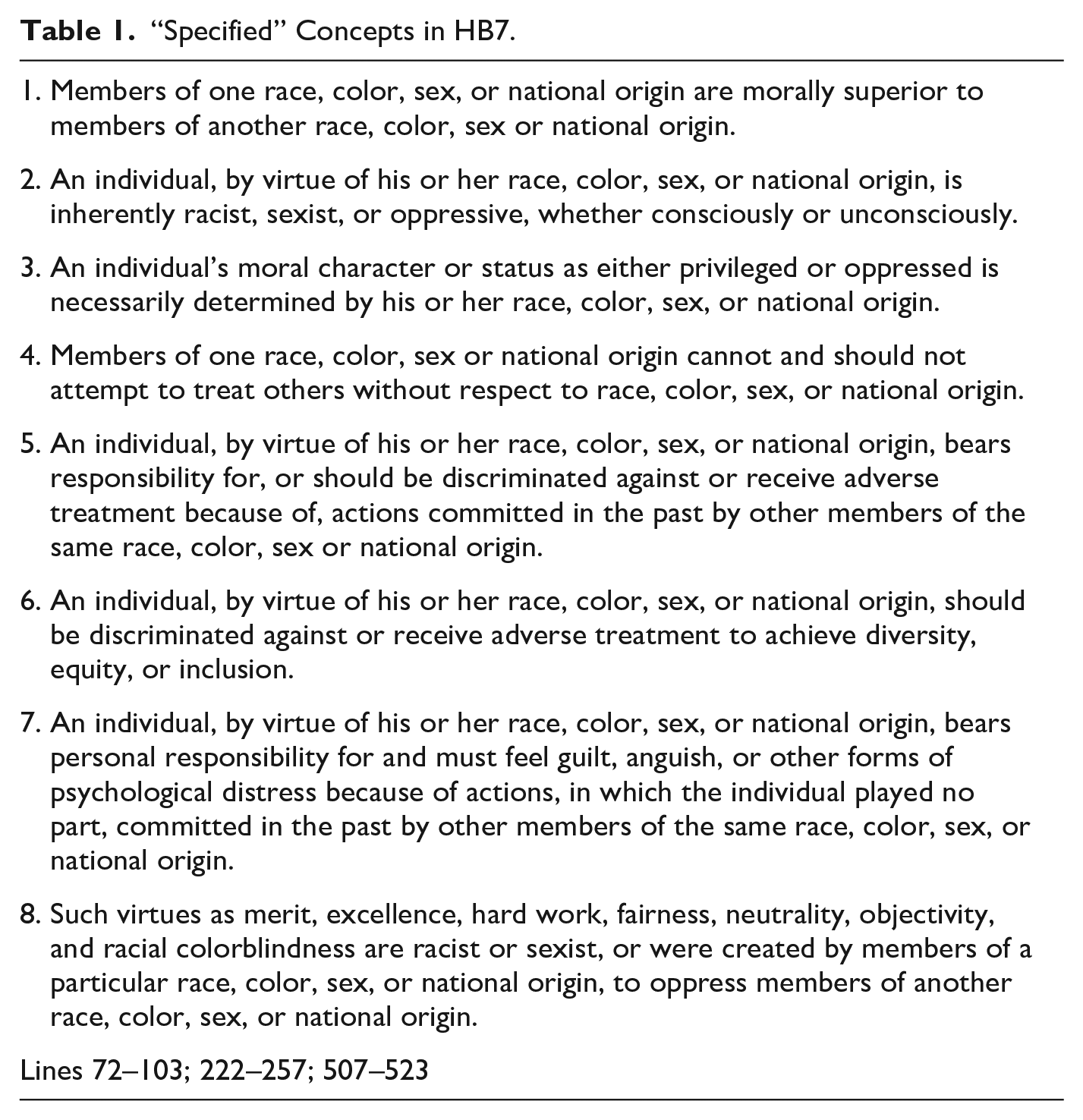
The principles of multicultural education preclude the endorsement of many of the specified concepts as written. On the contrary, one might argue that multicultural education would endorse the opposite of these concepts, particularly concepts #1 and #2. The perception of superiority and social hierarchies is rooted in US history, culture, law and policy in concepts such as “Manifest Destiny,” and in the ongoing struggle around citizenship, enfranchisement, civil/human rights and equality (Spring, 2016). It is a problematic legacy that multicultural educators confront in mainstream curriculum, in part because of the biases in curricular representation, particularly narratives that privilege the actions of men, especially those who are white (Loewen, 2008; Sleeter & Carmona, 2017). Multicultural educators do not want anyone to believe that one group of people is morally superior to another. Consequently, we recommend capturing the concept’s central idea as an aspirational unifying concept with which most will agree: we are equals across our diversity.
It is unclear if/how teachers have endorsed that one is “inherently” racist, sexist, or oppressive as specified in concept #2. Instead, multicultural educators recognize that racism and bigotry are learned, not traits with which people are born. While lessons of bigotry occur in multiple contexts, it is important that antiracism, inclusivity, open-mindedness, and humanity are explicitly taught through school curriculum, rather than censored. Such education could be foundational to the development of leaders who strive for decision- and policy-making free of racist, sexist, and bigoted consequences. This is particularly salient given the Florida Board of Governors’ (2020) commitment to anti-racist education and, by contrast, the governor’s claim that all Palestinians are anti-Semitic by definition (Lemongello, 2023).
Concept #3 bans the endorsement that one’s (a) moral character and (b) status as privileged or oppressed are determined by one’s race, color, sex, or national origin. Similar to concept #2, multicultural educators would likely endorse its antithesis since demographics do not determine moral character. HB7 is unclear on what indices determine privilege. Do the proponents of HB7 believe that privilege and oppression exist, but not necessarily along the lines of race, color, sex, or national origin? Since “objective discussion” of this concept is permitted, curriculum could explore (a) the history of how mainstream perceptions of morality were unfairly linked to demographics such as race, gender, national origin, among other social indices and (b) the contextual nature of privilege/ oppression linked to multiple intersecting indices, allowing students to draw their own conclusions. The wording of concept #4, including the use of double negatives, is confusing. It is difficult to tell what is banned from endorsement. Multicultural educators will agree that all people should be treated with respect.
Concepts #5 to #7 are distinctly ideological in orientation emanating from perspectives representative of White grievance politics. Concept #5 that an individual does not bear responsibility or should not be discriminated against for the past, represents the regressive backlash to the calls for racial equity of 2020 when individuals and institutions began to critically examine historical patterns of racism and their roles and responsibilities within such a reckoning (a phenomenon currently criminalized as being “woke”). There is no evidence of educators holding an individual responsible for actions they did not commit or endorsing discrimination. This language represents either an embarrassingly superficial understanding or a deliberate misrepresentation of what occurs in such scholarly and moral explorations. Bearing responsibility and being discriminated against are entirely different conditions. What one does in the face of unearned privilege is an individual and moral decision that is not extrinsically imposed. Nevertheless, concept #5 does not preclude institutional responsibility, despite the governor’s aversion to “woke” corporations. Consequently, objective discussion of this concept could include opportunities to study data about who has benefited from the violence and injustices of the past and how those benefits persist in patterns of privilege and marginalization today (e.g., corporate profits from plantations; redlining; segregation; disenfranchisement); or discussions of how Germany dealt with Nazi war crimes, genocide and crimes against humanity; or how South Africa developed Truth and Reconciliation Commissions as models of collective responsibility.
Similarly, #6 is a barely veiled attack against Affirmative Action. Although noting that educators cannot endorse that individuals be discriminated against to achieve DEI, it does not ban the endorsement of discrimination in historical and all-too-familiar ways to maintain and privilege a white, male dominance in institutions. HB7 does not ban the endorsement of DEI, although this task is undertaken legislatively later in 2023 through SB 266 aimed at higher education. Notably, the primary beneficiaries of Affirmative Action are white women; and, consequently, white families who were able to increase their earned income potential (Kohn, 2013; Moore, 2022).
Concept #7 is yet another indication of the contradictions among censorship laws and legislators’ superficial understanding of antiracist pedagogy. Although no credible teacher or trainer insists that someone “must feel guilt, anguish or psychological distress” in order to learn, SB 233 passed in 2021 prohibits shielding students from uncomfortable perspectives. Ironically, critical multicultural educators are committed to a pedagogy of joy and justice (Christensen, 2009) that supports academic rigor, critical consciousness and cultural affirmation (Ladson-Billings, 1995) that does not preclude the study of difficult topics. On the contrary, direct engagement with persistent historical problems offers hope, knowledge, skills, and a commitment to fostering a more inclusive democracy (Rethinking Schools, 2022). Scholars have also shown that the failure to offer personally meaningful curriculum for racially minoritized, immigrant, female, and LGBTQ+ students has already caused anguish and psychological distress (Dumas, 2014; Jones, 2020), a violation of concept #7.
Furthermore, as many legislators noted in the debate, discussions of the Holocaust or the inhumane treatment of African Americans and indigenous people in this nation could be distressing, a reasonable reaction across multiple races, sexes, national origins, and religions. If that were to occur, would such feelings be acceptable because they are not “by virtue of” the student’s “race, color, sex, or national origin,” but rather a function of students’ humanity? Transcripts of legislative debate on the law also reveal that the law’s proponents interpreted this concept as preventing teachers from “going out of their way” to “assign blame” to a particular student because of their race or because of their sex or because of their national origin. And essentially say that because you are this or you belong to this particular group, you are at least partly responsible for what occurred in that time (The Florida Channel, 2022a, 2022b, 2/2/22, time stamp: 1.45 pm.)
While such actions by teachers are rare, likely non-existent, depicting teachers as victimizers highlights a need for more intentional and nuanced diversity-oriented professional development, not less.
For most multicultural educators, concept #8 is problematic. However, while many scholars have for decades critically evaluated the operationalization of concepts of merit, excellence, hard work, fairness, neutrality, objectivity, and racial colorblindness in decision making, such critique in classrooms typically occurs through opportunities for debate and the presentation of data that allows for students to draw their own conclusions. Since endorsement or forcing someone to believe something is not what educators do when teaching students to discern among and through diverse perspectives on complex matters, teachers can and should, per HB7, continue to engage with these concepts as they are not prohibited from discussing them.
Collectively, the eight concepts are a response to a manufactured crisis, designed to undermine teachers in the public eye by implying that they teach divisive concepts, thereby warranting a law, despite the lack of any evidence. Furthermore, as Giroux (2006) points out, undermining trust in public education has long been a goal of right-wing conservatives opposed to civil rights and equal opportunity. By examining the language of the law juxtaposed against the rhetoric surrounding it we further uncover how legislators intended to shape social practice such as teaching; structure relationships between teachers and students, parents, administrators; as well as prescribe power relationships between professional educators/ educational institutions and political/legislative actors and policy making (Diem et al., 2014).
HB7: Designed for Chaos and Confusion
Although policies should offer clear guidelines for practice, HB7 is fraught with multiple sources of confusion (Acevedo, 2023; Russell-Brown, 2022). Chief is the disjunction between the widespread “anti-Woke” political rhetoric (Florida Governor, 2021) and the language of the law. Representative Avila noted, “Absolutely nothing in this bill bans the teaching of historical facts about slavery, sexism, racial oppression, racial segregation, and racial discrimination. We should be outraged if those important lessons were not taking place in our classrooms” [Emphasis added; The Florida Channel (2022a, 2022b), 2/22/22; time stamp: 1.41 pm]. However, there was no effort to explain how such “important lessons” would be distinguished from those lessons targeted by the law or interpreted vis-à-vis the “anti-Woke” rhetoric accompanying the bill. As noted in Pernell vs. Florida Board of Governors (2022a) “it is difficult, if not impossible, for instructors to determine what is, and is not, prohibited by its terms” (p. 7). Despite the lack of clarity and the anticipated confusion about what was and was not permitted,—“How do you teach slavery? The slave trade? The Holocaust? . . . How do you teach these issues without talking about the participants and the roles they played?” (Craig & Rozsa, 2022)—the law was passed anyway.
The other source of confusion is the fact that teachers are banned from endorsing but not prohibited from discussing the eight specified concepts central to the law. Transcripts of the legislators’ discussion reveal that the distinction between endorsement versus objective discussion were anticipated problems. What does objectivity mean when discussing the Holocaust or the enslavement of people as a matter of race-based governmental policy? Could a teacher condemn the internment of the Japanese? [The Florida Channel, 2022a, 2022b, 2/22/22; time stamp: 2.33 p.m.]. How might such “objective discussions” run afoul of the specified concept related to causing psychological distress when teaching about racism? Could a teacher be liable if a student felt distressed even if that was not the intent of the teacher? [The Florida Channel, 2022a, 2022b, 2/22/22; time stamp: 2.28 p.m.]. Would the discussion of structural racism as evident in laws and policies, permitted as topics in the Holocaust Education and African American history mandates, violate the Department of Education’s (DOE) ban on framing racism as structural? The ambiguity of the law coupled with the threat of penalties has had a chilling effect on curricular discussions on race. Was this the ultimate intent?
Implications of HB7 for Professional Educator Practice
Analysis and responses to HB7 must consider the intent and impact of the law. Two concerns are highlighted here: the chilling effect of the legislative effort, regardless of what is actually in the law; and the concern that this is an assault on public education and, by extension, on democracy.
The Chilling Effect
Although many recognized censorship laws as problematic at best and likely bigoted, the threats of funding cuts, lawsuits and/or termination have caused educators to succumb to self-censorship on topics related to race, gender and other social disparities in K-20 education (see Golden, 2023). The “chilling effect” (Acevedo, 2023; Gamble, 2023) is evidenced in teacher uncertainty about lessons for Black history month, (topics consistent with the multicultural mandates permitted in HB7) abandonment of much-needed teacher professional development on content and pedagogy on these topics. Equity-oriented workshops being suspected of being “anti-White” and constantly at risk of being shut down due to fear and political pressure became new realities (Schoorman et al., 2023). Teachers willing to discuss topics pertinent to African American history, or literature centering non-White characters find themselves targeted, instantly turning once safe institutional climates into contexts of suspicion and tension (Watson, 2023).
Golden (2023) reports that this was the intent of the legislative agenda: Activists such as Christopher Rufo, a senior fellow at the conservative Manhattan Institute, conceived of targeting CRT to foment a backlash against measures enacted following George Floyd’s murder in May 2020. At that time, Rufo told me in an email, “school districts across the country suddenly started adopting ‘equity statements,’ hiring ‘diversity and inclusion’ bureaucrats, and injecting heavily partisan political content into the curriculum.” Black Lives Matter and the left were riding high, said Rufo, who denies that structural racism exists in America. In our email exchange, Rufo described “the fight against critical race theory” as “the most successful counterattack against BLM as a political movement. We shifted the terrain and fought on a vector the Left could not successfully mobilize against.”
This self-admitted rationale from one of the chief perpetrators of the current legislative assault underscores several implications for educators and leaders. First, the legislation is explicitly anti-Black, politically partisan, and largely a rhetorical and messaging campaign. As the nation (and world) came together to denounce racism in 2020, Rufo acknowledges his pledge to disrupt this multi-racial coalition for purely political purposes. Second, his devotion to a messaging campaign to foment culture wars, reveals that the legislative backlash has nothing to do with problems in education; in fact, it is an attack on policies and practice known to advance educational equity and excellence for diverse populations. Such a response is typical in the face of apparent gains in civil rights or in political movements (López et al., 2021). Thus, opposition to DEI or racial justice is (and has proven to be historically) an effort to preserve narrow privilege.
Third, having recognized the “why” of Rufo’s campaign, analyzing the “how” is also crucial in framing our response. The rhetorical campaign draws on a horrific combination of raw power, threats and sound bites, impervious to facts, truth, reality, professional expertise or evidence from research. Instead, accusations of indoctrination (unfounded) lay the foundation for state indoctrination through censorship. “Critical race theory” is used as a catch phrase to—per Rufo—“toxify” concepts such diversity, inclusion and equity (Matzko, 2023; PEN America, 2022a). PEN America (2022b) underscores that deliberate vagueness of the law is the point, in order to cause maximal confusion, a tactic used in abortion-related laws as well (see Donley, 2023). An already stressed educational system is further undermined (rather than supported) by fomenting fear among teachers and administrators through threats of institutional defunding, lawsuits, harassment, doxing, and firing.
Fourth, and perhaps most pernicious, is the fact that in order to disrupt multi-group coalitions, this legislative campaign targets “others” and villainizes specific groups, a tactic well-established as a warning sign of genocide (Springer, 2006) and authoritarianism (Snyder, 2021). Especially concerning is the cruelty unleashed on students and teachers, particularly those from historically marginalized backgrounds. Consequently, racially under-represented, female, LGBTQ+ students and equity-minded students of
Attacks on Education and Educators
Attacks on education have been used throughout history as a means for engaging in race- and gender-based marginalization and intellectual colonization. Given that the censorship legislation was grounded in a political agenda to neutralize the impact of the Black Lives Matter (BLM) movement and the nation-wide calls for racial equity, these efforts constitute an attack on education itself (Joyce, 2021), and are not intended to address any credible problems in education through collaborative consultation with knowledgeable professionals. Though accused of indoctrination, no limitations in the state education standards which govern all curriculum, were identified. On the contrary, proponents of HB7 asserted that teachers should follow existing state standards and district-approved curriculum (which they do), even as additional restrictive policies were being developed to narrow district curricula and subject them to greater scrutiny.
Cynically, HB7 targets educators’ professionalism. These attacks are layered over the difficulties already encountered by teachers on the “front lines” of the pandemic despite the gross inequities in community access to technology hardware, software, and literacy, further burdened by the governor’s ban of mask mandates that placed teachers’ and students’ health at risk. Far from being appreciated for their efforts, educators are vilified as a profession by these state laws, creating inhospitable working conditions for dedicated teachers, and making teaching unattractive to promising recruits. Rather than “protecting” education, as claimed in their rhetoric, politicians are endangering education by making decisions in arenas in which they had no expertise and sought or heeded none. The combined legislative attack against relevant curricula, access to knowledge and intellectual/psychological safety of people of color and LGBTQIA+ community, and relentless opposition to multicultural books by small groups of well-organized, well-funded agitators (Watson, 2023) has caused many talented teachers to leave, creating severe teacher shortages in school districts and a brain drain from the state (Ecarma, 2023).
The impact of HB7 extends to higher education through the amendment to the Florida Educational Equity Act (irony notwithstanding). Fears of being accused of violations of an unclear law and threats of funding cuts have resulted in popular courses being canceled (Golden, 2023) raising the specter of entire fields of knowledge coming under attack, a prospect almost realized in the 2023 legislative session in HB999 that sought to eradicate minors and majors that focused on DEI. However, the successful passage of SB266 in May 2023, furthers the governor’s quest to target higher education accusing professors of “woke indoctrination” and eliminate funding for DEI which embody perspectives with which he does not agree. In its defense in a recent lawsuit filed against HB7, the state argued that “because university professors are public employees, they are simply the State’s mouthpieces in university classrooms . . . the State has unfettered authority to limit what professors may say in class even at the university level” (Pernell vs. Florida, 2022b, p. 8).
Mandatory surveys of faculty ideological viewpoints, attacks on tenure, diversity-oriented work including an executive order that requires reporting on diversity-related courses, the re-constitution of a university Board of Trustees to include Rufo, the architect of the backlash against CRT and DEI, the subsequent firing of a university President (Brown, 2023) and the Florida Speaker’s request of all communication (including emails, text messages and social media) of DEI employees, faculty and committees (Renner, 2023) constitute the arsenal of attack against higher education. Far from engaging in collaborative problem solving, these actions represent misguided authoritarianism and a “scorched earth” approach to public education. Intellectually we are at risk of the next generation being knowledgeable only about topics known to and approved by politicians in power. This is a sure-fire way to fast-track both authoritarianism and indoctrination.
Recommendations for Educators
The current policy landscape for education in Florida is gloomy, fast-moving and contradictory. We recognize that what was routine multicultural pedagogy a few years ago, might now be deemed an act of courage with costly consequences. Consequently, our recommendations offered to educators striving to navigate challenging and bigoted laws, represent our own commitments in this latest chapter of the nation’s long struggle for educational equity and equal opportunity. Given that HB7 requires that we denounce notions of racial superiority, our recommendations are grounded in the values of “e pluribus unum,” a commitment to the core principles of inclusive democracy in our richly diverse communities. Our aspiration is for schools and universities to serve as spaces of empowerment, affirmation, democracy and critical consciousness, rather than as mechanisms for state indoctrination and discrimination.
Read and Understand the Law’s Stated and Unstated Purposes
It is important that educators “read” the law on multiple levels. Given the disparities between the law and the rhetoric, knowing what is and is not stated in the law and being critically aware of the state’s “hidden” agenda to facilitate self-imposed censorship (as a consequence of confusion and fear) allows educators to address with greater confidence the implications of HB7 on their pedagogical practice. Bolstered by support at the federal level from the US Department of Education’s Office of Civil Rights (2023) that “diversity, equity and inclusion . . . are consistent with Title VI of the Civil Rights Act,” our professional response should be informed by the knowledge that the intent of HB7 is to silence educators through fear, even though the law does not prohibit discussion of certain topics and includes mandates in African American history, Holocaust education Latino and women’s contributions. Furthermore, the open acknowledgment that the curriculum bans were an intentional political backlash to the powerful message of the Black Lives Matter movement (Golden, 2023), and not based on any credible problem associated with education or curriculum, supports the claim that HB7 was “racially motivated censorship” (Pernell vs. Florida Board of Governors, 2022a, p. 3). Consequently, per Dumas (2016), HB7 could be read as an anti-Black law that, hypocritically, accuses educators of being anti-White.
For tertiary educators, the ability to cite the wording of what is permitted and prohibited prior to any lessons or courses that could be misinterpreted as violations by those less informed would be helpful. Universities and faculty unions recommend statements that could be placed in syllabi to preempt misperceptions. Although HB7 has been blocked from enforcement, its central concepts have been integrated into SB266, designed to defund the advocacy of DEI in higher education, ban activism, and the teaching about social issues, defined as polarizing topics (Donadel, 2023). Although the Board of Governors’ draft guidelines indicated that banned DEI efforts were those that promoted “differential or preferential treatment” (Florida Board of Governors, 2023, p. 1), it is unclear if curriculum that privileged Eurocentric male heteropatriarchy or is explicitly or implicitly anti-Black would be deemed a violation.
Be Intentional in Countering Indoctrination
HB7 hinges on the accusation that teachers engage in indoctrination. As we note, multicultural education is the antithesis of indoctrination, defined as teaching a person or group to accept a set of beliefs uncritically. Tan (2014) notes that indoctrination is characterized by “we versus you” binary thinking, resistance to change, hostility toward those perceived as “outsiders,” behavior that mobilizes extremist thought and destructive emotions, and that educators serve as a counterbalance to the extreme ideology that gives rise to indoctrination. Multicultural education offers a strong antidote to indoctrination promoting the integration of diverse cultural perspectives in curriculum and—through critical dialog, questioning and/or debate—facilitating students’ own deliberations on the merits of divergent perspectives on a topic, their underlying philosophical grounding, and their implications for responsible social and civic action. Ironically, efforts that counteract indoctrination have been targeted by the governor as “woke indoctrination”—an oxymoron; being woke is counter-productive to indoctrination.
The language of HB7 calls for “an understanding of the ramifications of prejudice, racism and stereotyping,” and “what it means to be a responsible and respectful person, for the purposes of encouraging tolerance of diversity in a pluralistic society and for nurturing and protecting democratic values and institutions. . .” (lines 336–341). Consequently, teachers must be well-versed in content and pedagogical knowledge, and skilled in managing classroom dialog to facilitate effective learning on these topics, which are pertinent entry points for discussions that move beyond the danger of a single, monocultural curricular perspective. Such knowledge and skills are usually fostered in educator preparation programs to support differentiated instruction and learning gains across diverse underserved groups, outcomes required by the state. Rather than issuing curricular bans on instruction and training, educational decision makers need to advocate for more sophisticated professional development to facilitate the effective implementation of the mandates which lawmakers profess to support. Our failure to offer pre-service and in-service teachers opportunities for the ongoing development of their knowledge and pedagogy will undoubtedly contribute to mis-steps and foster ongoing ignorance about race, education, and criticality in future generations of citizens, professionals and law makers.
Commit to Educational Equity for Diverse Groups of Students
Since the “Individual Freedom Act” claims to “prevent discriminatory instruction in the workplace and in public schools” and the governor advocates that “No one should be instructed to feel as if they are not equal or shamed because of their race” (Florida Governor, 2022a), it is important that educators ensure that these rights are preserved for
The state guidelines on Social Studies textbooks amplify the hostile climate by rejecting culturally relevant pedagogy (Florida Department of Education, 2022). It is unclear how one recognizes what the absence of such pedagogy would look like, since culturally “irrelevant” pedagogy would mean that no students would learn. The same holds true for the ban on DEI which hurts all students. Those of us who claim to be committed to the wellbeing of all students, need to work collectively with all stakeholders adversely impacted to interrupt the bigotry embedded in these policies. In their commitment to counter state-sponsored indoctrination fomented by these bans and policies, many educators have pledged to teach the truth about history (Zinn Education Project, 2022) through multi-perspectival investigations unfettered by scripted curriculum, availing themselves of professional development spaces created by a variety of educational and non-profit organizations that provide ongoing resources to support their commitment (e.g., Learning for Justice; Rethinking Schools). Others have supported their unions, joined lawsuits, offered research for amicus curiae briefs, convened symposia and webinars, formed book clubs or study groups and have continued to educate themselves to better nurture their individual and collective commitments to racial equity and social justice. These responses also underscore the importance of not acting alone but in solidarity with others.
Educate More Than Students
The analysis of HB7 revealed significant ignorance and/or indifference among legislators about CRT, what occurs in schools and how lessons about difference are effectively taught (Miller et al., 2022). We must demand that legislators who make decisions about education be educated by professional educators on education. While it is appalling that no consultation with a broad representation of educators occurred prior to the development of far-reaching state laws, it is important that educators continue to stay vocal about harmful and dangerous policy. The assumption of politicians that they know education better than educators contributes to the ongoing de-professionalization of educators, which must be interrupted.
It is evident that lawmakers fundamentally misunderstand or intentionally mispresent CRT (Miller et al., 2022. p. 6). Based on the Florida Department of Education’s (2022) textbook adoption guidelines for Social Studies, it appears that the eight “specified concepts” were the legislators’ best guesses as to what CRT was (see p. 24); a far cry from an accurate scholarly description. Furthermore, most of the “problems” alleged about education do not exist (indoctrination; blaming students for past history; instructing students that they must feel guilt, anguish or psychological distress.). It is unclear what the problem of “wokeness” looks like and why and to whom it is problematic. On the other hand, censorship lays the groundwork for indoctrination and narrowing the intellectual richness of education. The legislative debates revealed alarmingly discrepant levels of historical knowledge and deliberative capacity among legislators, highlighting the crucial importance of formative education in one’s future professional decision making, capacity for complex thinking, inclusivity and/or caring. Consequently, one must raise questions about how future decision makers are being educated and the implications of current censorship for future political decision making. Are we educating the leaders we need for an inclusive democracy?
Another crucial audience for education is parents. With so much emphasis on parental rights around censorship laws, it is important for us to educate the parents of culturally diverse students that their rights for a meaningful curriculum are no different from the small, well-funded, well-organized group of vocal parents calling for censorship. While it is important to hear from a wide range of parents representative of the students, we must broaden both the mechanism for such participation and for leadership listening, responsiveness and advocacy. This is particularly true in communities slipping toward re-segregation. Might we re-capture the drive for excellence through equity that we glimpsed in the communities of segregated schools described by hooks (1994)? Or could we re-ignite the joy of teaching and learning evident in the banned Mexican American Studies program where parents described students as unable to stop talking about their excitement about what they were learning (Palos, 2015)? In each of these contexts the close connections between teachers/schools and parents/community supported joyful and meaningful learning as counter-hegemonic praxis.
Summary and Conclusion
Florida’s HB7 is a “copycat” law derived verbatim from the former President Trump’s 2020 executive order, that is spreading to other states. Together with bans on “CRT,” multiple states have proposed versions of HB7, comprising an assault on public education in the form of curriculum censorship. This paper examined the central components of the legal text juxtaposed against the political rhetoric accompanying the law. The analysis of the wording in the law revealed that HB7 banned little that educators actually did, lacked conceptual clarity on what was being proposed, accompanied by a conspicuous ignorance of educational practice and reality. In contrast, the “anti-Woke” political rhetoric clearly transmitted hostility toward discussions of race, gender and sexuality, serious threats of punishment for doing so and made it abundantly clear that the law was unfriendly toward public education, championing the cause of a few against teachers, professors and culturally relevant curriculum. Analysis and recommendations highlight the disjunctions between the letter and the spirit of the law pointing out ways in which educators committed to equity could continue to teach, should there be no additional restrictions imposed.
Given that the law was not a response to local educational problems but imported from political operatives at the national level, one might conclude that the lack of clarity of the law, the confusion it would create and its chilling impact on curriculum and teacher retention were intentional. As López et al. (2021) writing for the NEPC note: It is well understood that when people lack an accurate knowledge of history, organizers find it difficult to cultivate multiracial coalitions to promote racial and economic justice. . . . This historical context indicates that yet again, the central purpose of current fearmongering legislative and executive activity is to obstruct historically accurate teaching about race and racism in K-12 education (p. 6).
As Judge Walker’s injunction in Pernell vs. Florida (2022b) noted, HB7 is “positively dystopian” (p. 2), an example of the state’s “double speak” (p. 3). The counter to such a law is for educators who agree with this characterization to exercise their professional and moral responsibility to not succumb to its malevolent political intents and actively support and implement a multiculturally inclusive curriculum. They should be joined by administrators, policy makers at local state and national levels, professional, business and cultural organizations working actively to reclaim schools and universities as inclusive spaces where students grow as intellectuals and as caring, socially responsible human beings. Censoring students’ access to the full historical record as we understand it through the ever-evolving accumulation of careful research can only reinforce ignorance and certainly cannot prepare students to be informed citizens of the US and the world.
Footnotes
Appendix
Declaration of Conflicting Interests
The author(s) declared no potential conflicts of interest with respect to the research, authorship, and/or publication of this article.
Funding
The author(s) received no financial support for the research, authorship, and/or publication of this article.
