







Abstract
This interview-based study examines how justice-oriented K-12 administrators and teachers in Iowa make sense of the recent state-level education policy, H.F. 802. Synthesizing literature on Critical Policy Analysis and epistemic justice, we introduce Critical Epistemic Policy Analysis to understand the micro-level impact of divisive education legislation on efforts to create just and inclusive schools. Findings highlight a sociopolitical terrain with ambivalent and shallow equity commitments, deteriorating support for equity work in schools, and a need to grapple with questions of divisiveness and solidarity in justice-oriented educational activism.
Keywords
Introduction
During the summer of 2021, Iowa Governor Kim Reynolds signed into law House File (H.F.) 802, legislation banning the teaching of “divisive” instruction on gender and race. After signing this legislation into law, Reynolds remarked, “Critical Race Theory is about labels and stereotypes, not education [. . .] It teaches kids that we should judge others based on race, gender, or sexual identity, rather than the content of someone’s character” (Richardson, 2021a, 2021b). While H.F. 802 does not mention Critical Race Theory (CRT) explicitly, Reynolds’ rhetoric reflects a resurgent and coordinated effort to undermine diversity, equity, and inclusion (DEI) work in schools across Iowa. Since the passage of H.F. 802, conservative state legislators have worked to pass additional laws to further undermine DEI work in public schools. These efforts have also come with polarizing rhetoric that calls into question the expertise and motives of educators in Iowa.
For example, during the first legislative session of 2022, then Iowa Senate President, Republican Jake Chapman, delivered a speech denouncing a “sinister agenda” taking place in public schools across the state. In his remarks on the Senate floor, Chapman said, “The attack on our children is no longer hidden [. . .] Those who wish to normalize sexually deviant behavior against our children, including pedophilia and incest, are pushing this movement more than ever before” (Pitt, 2022). Chapman and Reynolds’ statements about CRT and DEI, more broadly, reflect the use of education as a wedge issue to drive their conservative partisan agenda. While researchers highlight continued support for the teaching of how race and racism continue to impact American society (López et al., 2021; Polikoff et al., 2022; Safarpour et al., 2024), Republicans have “re-defined CRT to stand in for a variety of cultural and racial grievances” (Safarpour et al., 2024, p. 159). States with conservative-led legislatures and governors have worked in tandem to mischaracterize CRT and DEI to obfuscate what is happening in schools (Farley et al., 2021; Pollock et al., 2022; Welton et al., 2023).
Since 2021, 18 states have passed legislation banning and/or constraining the teaching of so-called “divisive” topics in public schools (Schwartz, 2023). As scholars begin to examine the impact of this moment in states like Arizona, Florida, and Texas (Koyama, 2024; Schoorman & Gatens, 2024; Welton et al., 2023), we bring attention to Iowa as a distinct but related social context. For example, we highlight the role that Iowa Nice or Midwest Nice plays in advancing inequality by reinforcing dominant cultural norms that counter equity and justice-based efforts in schools (Castagno, 2019; Drake & Rodriguez, 2023; Vlach et al., 2022).
To understand this current sociopolitical moment occurring in schools in Iowa, this study is guided by the following question: How do K-12 administrators and classroom teachers in Iowa make sense of H.F. 802’s impact on their justice-based efforts? To answer this question, we theoretically frame and analyze our data through what we call Critical Epistemic Policy Analysis (CEPA). In our conceptualization and deployment of CEPA, we synthesize Critical Policy Analysis (CPA) (Diem et al., 2014, 2019; Diem & Young, 2015) and literature on epistemic justice (Dotson, 2014; Fricker, 2007, 2013; Medina, 2013). The literature on epistemic justice has been underutilized in empirical educational policy research and, to our knowledge, has not been integrated into a conceptual or theoretical framework with CPA, despite being directly relevant to its democratic and educational goals. CEPA facilitates an asset and structural-based analysis of how policy supports or undermines teachers’ and school administrators’ efforts to seek, acquire, and share knowledge and understanding as it relates to their justice-based commitments. In this study, we use CEPA to center the expertise and experiences of justice-oriented educators in Iowa to understand the micro-level impact of legislation like H.F. 802 on efforts to create just and inclusive learning environments in schools.
Literature Review
This paper builds on literature that explores how factors like conservative political platforms and ideas about CRT and “divisiveness” have influenced education policy and, in turn, K-12 administrators and classroom teachers. As a result of these policy developments, scholars have described not only existing challenges but also the ongoing need for support regarding efforts toward equity and justice. Lastly, we highlight literature examining how teachers have resisted hostile school environments.
“Divisive” & Anti-CRT Education Policies
As mentioned above, many states have recently passed laws that prevent instruction on specific race-, gender-, and sex-based topics and courses within K-12 schools, including punitive measures that reduce school funding and downgrade accreditation as well as prohibit or constrain bias training aimed at reducing racial inequities in discipline (James-Gallaway & Dixson, 2023). In their survey of over 8,000 public school teachers, Woo et al. (2022), found that a third of public school teachers across 17 states have been impacted by these restrictions, a substantial number that continues to grow. While anti-CRT policies are not the sole cause of tensions within schools, they are a mitigating factor in the policing and “systematic pushout of teachers” with justice-oriented commitments (Jayakumar & Kohli, 2023, p. 97).
Scholars have noted how anti-CRT legislation has incited fear and exacerbated the influence of politicization and powerful stakeholders (Marrun et al., 2024; Scussel & Esposito Norris, 2023; Villavicencio et al., 2023). This type of legislation has been linked to white supremacy, including recentering whiteness and normalizing discourse related to white defensiveness and comfort (Henry et al., 2023; Jayakumar & Kohli, 2023; Vue et al., 2024; Welton et al., 2023). Anti-CRT and divisive education legislation are therefore intentional disruptions to ongoing efforts to implement culturally relevant and other equity-based pedagogies that strive toward racial justice (Grice, 2022; James-Gallaway & Dixson, 2023). It is important to note that these efforts are not entirely new. For example, attacks on bilingual education and ethnic studies during the 1980s, 1990s, and 2000s in states like California and Arizona serve as reminders that educating students about white hegemony and resistance have long been met with state-sanctioned bans and color-evasive policies (Cammarota, 2017; Nicol, 2013). For example, Cammarota (2017) described how state-sanctioned, color-evasive, and fear-based tactics were used to pass legislation banning Mexican American Studies in Arizona.
While hyper-politicization and tension occur in politically conservative and liberal communities, Rogers et al. (2022) reported that organized efforts and conflict within communities that are “purple” (politically divided) have resulted in more harassment for LGBTQ+ students and staff, less support for diverse curriculum, and challenges to addressing misinformation. Similarly, Villavicencio et al. (2023) noted how polarizing discourse and backlash to social movements like Black Lives Matter is “further alienating marginalized students” and reinforcing efforts toward “apolitical” education (p. 251). Rogers et al. (2017) found that the increased polarization during and after the Trump presidency increased student stress levels and hostility toward one another, increasing pressure on teachers to conform to hegemonic norms and avoid potentially polarizing topics. While there is variation in district-level implementation, support, and teacher resistance regarding anti-CRT and divisive education policies, even perceptions of limitations have led some teachers to change what and how they teach, thus decreasing the likelihood that students will discuss politically controversial topics (Woo et al., 2022).
Administrator Challenges & Support of Social Justice Efforts
How district and building-level administrators respond to this politicized context is therefore important, including their interpretation and implementation of specific policies, support of teachers, and school-wide commitments to racial equity and literacy (Brooks & Watson, 2019; Welton et al., 2023). Nevertheless, leaders may utilize evasiveness strategies to deny accountability or blame, and they are impacted by contextual factors and social pressures to maintain a sense of neutrality (Bertrand & Sampson, 2022; Diem & Welton, 2021; Flores & Gunzenhauser, 2019). Additionally, Albritton et al. (2017) described social justice-focused leaders as those who should challenge policies that marginalize students and work toward an inclusive and supportive space; however, even the rural high school principals within the study who mentioned the importance of a diverse and accepting school environment failed to follow through when it came to LGBTQ+ students, responding to resistance with reactive and avoidance behaviors, personal bias, and an emphasis on laws and policies.
Pushback from teachers, parents, school boards, and/or community members can also challenge school leaders (DeMatthews, 2016; Theoharis, 2007; Welton et al., 2019). Teachers and administrators have even been fired for attempting to address racial equity or for resisting recent anti-CRT legislation (Jayakumar & Kohli, 2023; Scussel & Esposito Norris, 2023). Further, upper administration positions, like equity directors and chief equity officers, can hold additional power within a school district’s hierarchy, but without support from other district-level administrators, these positions can become more symbolic than helpful in leading systemic anti-racist efforts (Irby et al., 2022; Ishimaru et al., 2023; M. M. Lewis et al., 2023). As Locke and Broadhurst (2019) state, “being an educational change agent can result in isolation” (p. 81).
Women of color administrators experience systemic barriers (see, e.g., Amancio, 2019; Guillory-Lacy, 2020; Ishimaru et al., 2023; Liang & Peters-Hawkins, 2017). For instance, Amancio (2019) pointed out that Latina administrators experienced a lack of support at the district level and a lack of mentors within a male-dominated environment. These race and gender intersections point to the additional challenges administrators with minoritized identities face. However, scholars have also noted that administrators with experience with systemic inequities can recognize, challenge, and strategically alter inequitable policies (Grossman, 2010; Locke & Broadhurst, 2019).
Teacher Activism in Hostile Contexts
Teachers continue to bear the brunt of policy implementation (e.g., Hara, 2017), yet they continue to be at the bottom of the “policy hierarchy” (Ellison et al., 2018). Scholars have noted the institutional barriers they face as policy makers, such as the deprofessionalization of teaching, misconceptions about teachers needing to be neutral or apolitical, and frequent overwork and isolation (Good et al., 2017; McCardle et al., 2022). Being involved in policy and activist efforts is particularly challenging within spaces that are hostile to social justice, including but not exclusive to politically conservative states (Carrillo, 2023; Grooms et al., 2021; Monreal, 2022; Rodela et al., 2020). More specifically, Monreal (2022) describes three primary factors of “‘hostile’ school spaces: (1) traditional exclusion/isolation, (2) negotiation and recreation, and (3) intentional agonism and resistance” (p. 51). This research focused on Latinx K-12 teachers in South Carolina but also demonstrated the complex, dynamic negotiation within hostile spaces for those experiencing this kind of racialized othering (Monreal, 2022).
Despite this, activist efforts from teachers are long-standing at the local, statewide, and national levels (e.g., Alridge, 2020; Matias & Liou, 2015; Picower, 2011; Swalwell, 2015). Teachers’ public rejections of these policy interventions within and beyond the classroom are a direct challenge to hostile or harmful policies (Picower, 2011). For example, along with participating in teacher strikes across the southern United States (Blanc, 2019), Latinx teachers have mobilized beyond the classroom through #RedforEd (Carrillo, 2023). While this article focused on a teacher from Arizona, the specific context resonates with experiences teaching in other conservative spaces and points to the value of critical reflexivity and developing solidarity with students through activism (Carrillo, 2023). Blanc (2019) also mentioned the importance of grassroots organizing and union engagement during the 2018 teacher and staff strikes, and Villavicencio et al. (2023) noted the need to name pushback against racial equity efforts and manage media backlash without letting it derail necessary progress. Overall, these sources have demonstrated the challenges of resisting, particularly within hostile spaces, as well as the possibility for strong grassroots or localized efforts and broader networking.
Theoretical Framing
Guided by scholarship on Critical Policy Analysis (CPA) (Diem et al., 2014, 2019; Diem & Young, 2015) and epistemic justice (Dotson, 2014; Fricker, 2007, 2013; Medina, 2013, 2019), we articulate and are guided by Critical Epistemic Policy Analysis (CEPA). This research explores important policy questions regarding how the administrators and classroom teachers of this study understood H.F. 802 and its effects on seeking, acquiring, and sharing knowledge on justice-based topics. It is worth emphasizing that “knowledge” is not meant in narrow positivistic terms (Creath, 2023). Nor is knowledge limited to propositional knowledge or “knowing-that” but also includes practical knowledge or “know-how” and experiential knowledge or “knowing what it’s like” to experience a set of phenomena (Ichikawa & Steup, 2018).
Knowledge is instead broadly constructed here to also include the ability to seek, acquire, and share genuine insights or understandings about aspects of the social and material world. These insights and understandings include (but are not limited to) competing historical interpretations, the individual and social imagining of possibilities for future action, ethical and political values such as freedom or liberation, differing epistemologies and ontologies, the lived experiences of members of social groups, and sociopolitical structures and their supporting discourses (Medina, 2013, 2019). These social and material phenomena comprise aspects of social reality that differently situated subjects can come to genuinely know or understand in different ways, from different historically situated vantage points, and that can afford a critical perspective from which current practices might be ameliorated or improved to become less oppressive and more liberatory, equitable, and just (Medina, 2013).
Critical Policy Analysis
As Young and Diem (2014) note, educational policy traditionally has taken on a quantitative focus. However, critical policy scholars have mentioned that this singular methodological focus makes it difficult to capture “the complex systems and environments in which policy is made and implemented” (Diem et al., 2014, p. 1073). Apple (2019) argues CPA “is grounded in the belief that it is absolutely crucial to understand the complex connections between education and the relations of dominance and subordination in the larger society and the movements that are trying to interrupt these relations” (p. 276). This type of approach brings a structural and contextual framing that is important not only in understanding how educational policy takes shape but how those impacted the most make sense of it. According to Diem et al. (2014), critical policy analysis entails five areas of focus that CPA scholars are interested in. The first speaks to the importance of distinguishing between “policy rhetoric” and “practiced reality” (p. 1072). The second gives attention to how a particular policy came about and its development. The third highlights an analysis concerned with who wins and loses and how power and resources are distributed. The fourth emphasizes social stratification’s impact on furthering inequities and privileges, and the fifth centers attention on how communities with minoritized identities resist oppressive policies. In this article, we take up these concerns when relevant, with a focus specifically on their impact on seeking, acquiring, and sharing knowledge and understanding in schools.
Epistemic Justice
Recent work in social epistemology and political philosophy identifies epistemic justice and injustice, respectively, with forces that support or undermine persons in their capacities as knowers (Anderson, 2012; Fricker, 2007, 2013; Hookway, 2010; Medina, 2013, 2019). The ethical centrality of knowledge-seeking, acquiring, and sharing, as these philosophers argue, makes work toward epistemic justice necessary in educational spaces for democratic freedom and politically legitimate institutions, including public schools (Anderson, 2012; Dieleman, 2015; Fricker, 2013). As Medina (2019) notes, however, due to a lack of attention to the epistemic dynamics in policymaking, “Members of oppressed groups are typically rendered invisible and inaudible – or their visibility and audibility are precarious and constrained – and their epistemic agency is diminished in practices of public deliberation” (p. 24). A key vector for ameliorating epistemic injustices through policy is what Medina (2019) calls “epistemic activism,” whereby action is taken to co-create and share the epistemic resources needed to make structural injustices visible and audible. Extending Medina’s (2019) insight, we suggest that in education policy and schooling, understanding policymakers’, administrators’, classroom teachers’, and students’ potential as epistemic activists is a critical goal.
While recent scholarship emphasizes the varieties of epistemic wrongs (Hookway, 2010) and conditions for epistemic flourishing, Fricker (2007, 2013) highlights two critical forms of epistemic injustice—“hermeneutical injustice” and “testimonial injustice” related directly to Medina’s (2019) framing of epistemic activism. Hermeneutical injustice, according to Fricker, occurs when, due to identity-based prejudice, there are gaps in the epistemic resources needed to articulate and share issues of moral importance. For example, ignorance by powerful majorities of the fact that members of differently situated groups face different structural barriers in accessing education, schooling, and the levers of democratic power due to historical, legal, and policy decisions can be interpreted as a form of hermeneutical injustice because it makes these barriers invisible to those who may be well situated to help bring about justice-oriented change. Instead of seeing individual acts as part of ongoing, historical systemic problems (e.g., racial wealth gap, intersectional sexist oppression) that affect members of groups differently, persons in positions of power who are ignorant of the concept of structural oppression may wrongly think discrimination is only a product of isolated individual actions in the present.
The second form of injustice Fricker (2007) identifies is testimonial injustice, which occurs when, due to identity-based prejudice, a speaker’s credibility as a knower is misjudged. Testimonial injustice is often caused by hermeneutical injustice and implicit or explicit biases. Hermeneutical injustice often creates testimonial injustice by making the insights and experiences of marginalized groups invisible, inaudible, or illegible to members of dominant groups, leading them to see claims about matters of moral and political injustice as more aberrant and unlikely to be true than they are. While epistemic injustices may, in principle, be due to identity prejudice that is not rooted in structural exclusion, to capture persistent structural epistemic wrongs, we define epistemic oppression, following Dotson (2014), as “persistent epistemic exclusion that hinders one’s contribution to knowledge production” (p. 115).
Critical Epistemic Policy Analysis
Using the lens of epistemic justice and activism to analyze the perspectives shared by participants allows us to make visible how systemic forms of marginalization and oppression can undermine the epistemic conditions necessary for democracy and education to flourish and how acts of resistance and activism can combat these oppressive forces. Building off the literature on CPA and epistemic justice and activism, we synthesize these two theoretical stances under the banner of Critical Epistemic Policy Analysis (CEPA).
Attending to ways H.F. 802 and other so-called “divisive concepts” laws undermine or enable epistemic justice and activism by educators deepens our understanding of crucial elements of CPA. Specifically, by attending to barriers to seeking, acquiring, and sharing knowledge, an epistemic justice and activism lens fused with CPA allows us to better understand:
The epistemic effects of policy and how they differ from policy rhetoric.
The epistemic processes through which policy is produced.
The interplay between the distribution of epistemic power, resources, and knowledge enshrined in policy and the creation of disparate outcomes between groups.
How social stratification shapes epistemic inequality, oppression, and privilege.
The ways members of minoritized groups resist processes of epistemic and material domination and oppression.
Considering these epistemic dimensions in interpreting the work and perspectives of justice-oriented educators allows us to shed light on the impact of these laws and policies in educational spaces and the ways that they support or undermine epistemic activism.
Methods
Participant Snapshot
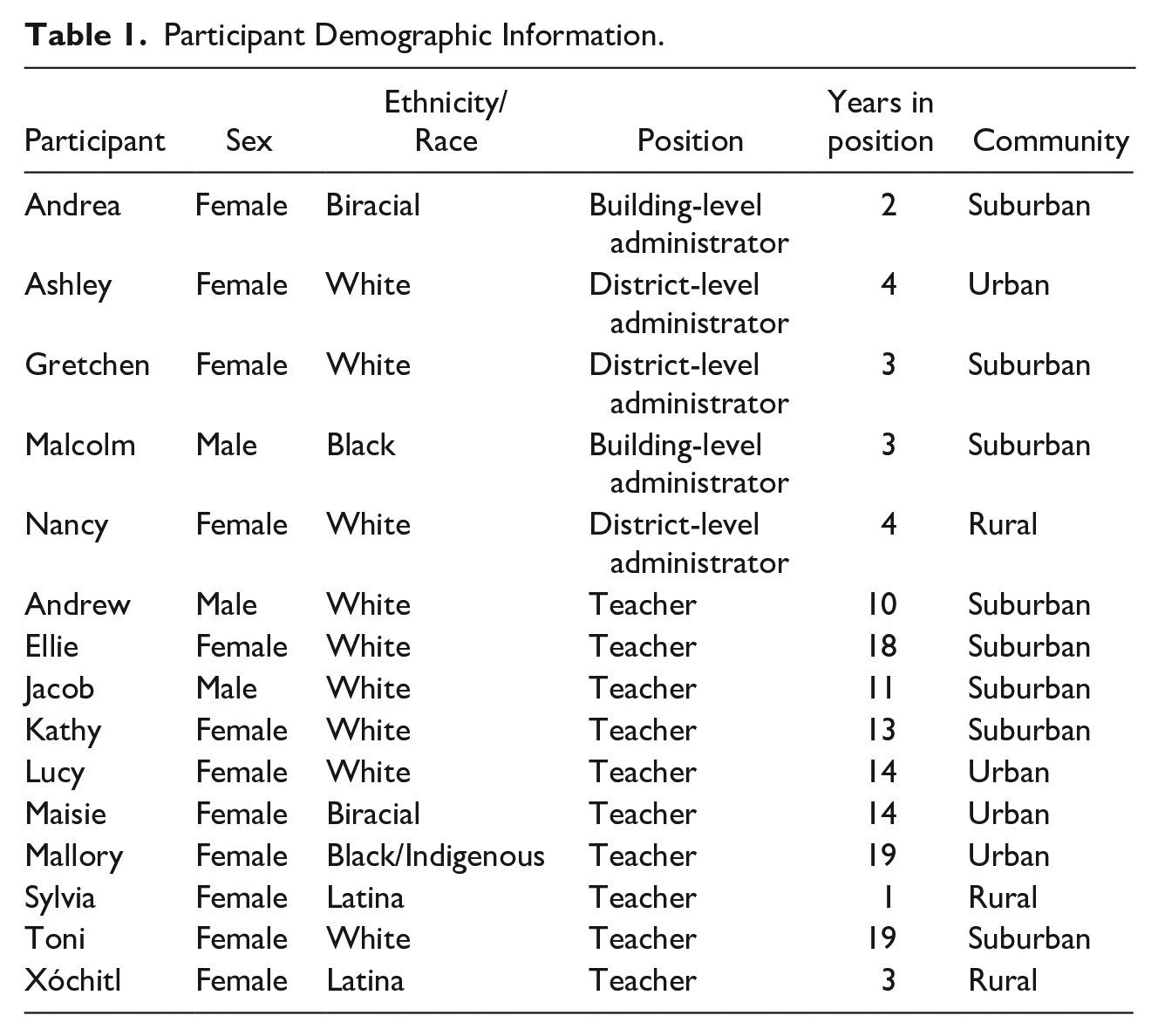
Sixteen participants were recruited through purposeful and snowball sampling (Bogdan & Biklen, 2007). The initial participants were recruited through relationships Rodriguez and Tanchuk had with administrators and teachers. In reaching out and interviewing them, they were asked if they had recommendations of other people they thought would be open to being interviewed. While the driving recruitment criteria were that participants needed to have a commitment to social justice, it was also vital for us to have participants from different parts of Iowa (rural, suburban, and urban). As seen in Table 1 below, participants spanned different identities and levels of experience in their respective positions, but most participants were white, female, and veteran educators. Participants were allowed to select a pseudonym; if they elected not to, one was assigned.
Participant Demographic Information.
Data Collection and Analysis
This interview-based study entailed 16 interviews with teachers (11) and administrators (5). Interviews took place over the Summer of 2021. Rodriguez and Tanchuk conducted semi-structured interviews in person and online via Zoom. Interviews were audio recorded and, on average, lasted 90 to 120 min. Interview questions concerned their justice-based commitments, support networks, and perceptions of H.F. 802. Interview data was transcribed using a transcription service.
The inductive coding of the data entailed three rounds of line-by-line coding (Saldaña, 2021). The final set of codes entailed: social justice orientation, social justice efforts, social justice climate, H.F. 802 criticisms, and divisive education. Analytic memos were composed after each round of coding and coupled with conversations with the research team to make sense of the data and work toward narrowing down the list of codes. Conversations facilitated our understanding of the data and allowed us to talk through disagreements whenever they occurred. In reflecting upon our analytic memos and research team conversations we put the codes in conversation with one another to craft the three findings of the study. This process also facilitated the idea of coupling CPA with epistemic justice to center participants’ experiences, identities, and expertise to examine the impact and implications of H.F. 802.
Positionality
This project is shaped by our shared and distinct experiences, identities, and commitments as critical scholars. We as researchers are not blank slates and believe that our experiences, identities, and commitments are strengths that shaped the research design and data collection process as well as how we made sense of the data. Yet as Boveda and Annamma (2023) argue, all too often positionality statements take shape as a listing of researchers’ identities with little to no consideration regarding questions of power, accountability, and relationality with research participants. Collectively, we leveraged our identities and experiences to connect and build rapport with research participants. While we see our insiderness as a strength, it is important to reflect upon the differences that existed between participants and the research team. Our insider and outsider positions reflect its fluidity in how at times they served as moments to connect and understand while at other times we were limited because of our differences.
During data collection, we sought to disrupt the researcher-participant binary by approaching interviews as a dialogic spiral (San Pedro & Kinloch, 2017). Rather than simply asking questions and extracting information from participants, our approach was to engage in interviews that worked toward conversation, where we as researchers brought in our identities and experiences to listen, connect, and build upon what participants shared with us. We tried to have participants of color be interviewed by Rodriguez, who is Mexican American, and white participants by Tanchuk, who is white. While Rodriguez and Tanchuk did interview people with different racialized identities, the idea was to create an interview environment where we as researchers could leverage our racialized identities to connect with participants. When we interviewed participants who we did not know or had different identities than ours, it was vital for us to embrace those differences and use them as points to listen and learn from participants.
During the coding and data analysis, Chase and Gebhart’s identities as white people played an important role in analyzing how participants made sense of the racial politics of Iowa and whiteness more broadly. While each member of the research team has experience conducting research and working in K-12 schools, Chase’s experiences as a former K-12 teacher in Iowa offered us insights that Rodriguez, Tanchuk, and Gebhart did not possess. Collectively, these types of commonalities and differences allowed us to grapple with how we made meaning with participants during our interviews and in the coding and data analysis process.
Findings
The analysis revolves around three sets of findings. The first examines the work environments of our participants by highlighting the shallow commitments and hostility toward educational equity and justice. The second focuses on participant criticisms of H.F. 802. We specifically emphasize how the perceived lack of clarity and guidance on this law fueled their concerns about their ability to be effective justice-oriented administrators and classroom teachers. The third finding sits with the question of divisiveness by interrogating how participants made sense of their work being framed as such and its impact on their work. We weave in the CEPA framework to help make sense of participant perspectives across the three findings.
Understanding the Role of Existing Commitments to Equity and Justice
To better understand how justice-oriented educators made sense of the impact of H.F. 802 and the larger sociopolitical climate in Iowa, it is important to understand the contexts participants navigated. In this finding, we examine how participants made sense of the existing climate and commitments toward equity and justice in their respective school contexts. Most participants worked in schools that reflected shallow commitments or hostility toward equity and justice-based efforts.
As a white, suburban school administrator, Gretchen worked in a community that was more politically liberal than other parts of the state. Given her administrative role, she provided a big-picture perspective that complicates support for equity in politically liberal contexts. She shared, “[. . .] everybody wants equity. They believe they want equity. They want the language, but they don’t want their world to be disrupted, and so I think over time, as we stay committed, they just didn’t support the work anymore.” By invoking “they,” Gretchen referred to white people with politically liberal commitments and offered a critique about how many of these individuals did not want to be inconvenienced. Gretchen’s perspective reflects the limits and shallow commitments progressive or political liberal communities across the U.S. possess when attempting to enact equity-oriented practices where people appear committed until action is required (A. E. Lewis & Diamond, 2015). Throughout her tenure as an administrator, Gretchen was aware of the limits she perceived existed regarding support for equity and social justice, which highlights the performative investment in equity, a dynamic that underscores a reality that many community members do not want change.
Jacob, a white, suburban classroom teacher, worked in a more politically conservative community with the lack of administrative support that someone like Gretchen could have provided if they had the opportunity to work together. Jacob highlights the impact of shallow investments. Jacob shared, “My alignment with the overall ideology or the leadership of the school; we’re probably pretty far off. I think they know that, and I know that. It’s not necessarily adversarial. It’s definitely you’re walking on tiptoes around the hallways.” It appears as if Jacob and his school leadership reached an unspoken detente, which also aligns with how other teachers in this study felt surveilled at school. The fact that Jacob feels the need to be careful with how he carries himself throughout the building speaks to how his work might be siloed to the spaces he operates at his school and does not speak to a potentially vibrant space for social justice work to flourish through teaching, learning, or activism.
Xóchitl, a Latina rural teacher, voiced a similar perspective. In her interview, she shared a keen understanding of her schooling context: I know I’m never going to be the favorite, and I’m not going to play that game. So, I just keep my head down, y (and) I focus on doing my job very well because that’s what I’m there to do. I’m there not to make friends con las maestras (with female teachers) because, honestly, I don’t have time for that.
Here, Xóchitl articulates a clear understanding of her politics and the boundaries she will not cross. She is not interested in navigating her school in a way she believes would compromise her justice-based commitments. Furthermore, Xóchitl’s comments, “I’m not going to play the game” and “I’m there not here to make friends con las maestras,” highlight another dimension of surveillance, the importance of navigating schools in a “nice way.”
The perspectives shared by Lucy, a white teacher in an urban community, help explain the dynamics Xóchitl had to navigate and her resistance to playing nice. Lucy spoke more about niceness or what people in the region and the state called Midwest nice or Iowa nice. Challenging the supposed value of being nice, she shared: Not understanding that when you’re nice in the way that you believe you are and its white majority middle-class nice, you’re being super not nice because you’re refusing to see the detrimental effects of that on other people. I guess a really simple answer is it can do nothing but create a barrier.
Lucy’s perspective speaks to one of the evasive responses teachers engage in, in this case, educational niceness (Castagno, 2014, 2019). This environment fosters the conditions to evade difficult but important conversations and initiatives centered on justice, which only works to miseducate and maintain status quo investments in how schools operate. In this regard, norms of niceness can undermine epistemic justice by undermining the inclusive conditions needed for seeking and sharing knowledge on issues of moral and political importance—often through difficult conversations and learning.
Kathy, a white teacher in a suburban school, spoke about the hostility she faced from colleagues. In her interview, she shared, “There were some colleagues who just would not speak or look at me or would just make comments that the district was going in the wrong direction with all of this social justice stuff.” Kathy’s experiences highlight the importance of solidarity and having colleagues one can rally around. In Kathy’s case, she did not have a supportive work environment. Similarly, Sylvia, a Latina teacher in rural Iowa, talked about the isolation and hostility she had to navigate. As Sylvia put it, “even small things here feel like it causes waves.” While participants approached their justice-based work as educators through their subjectivities and training, it was also shaped by the communities and schools they worked in. Sylvia’s perspective highlights how this climate stifles and suppresses justice-based commitments in schools that, even before H.F. 802 was signed into law, were already shallow, if not subject to overt hostility. Additionally, the lack of support Kathy, Sylvia, and other participants experienced undermines their ability to forge solidarities with other teachers in their schools. This reality speaks to the third and fourth tenets of CEPA in how power is used to marginalize justice-oriented teachers in ways that surveil and marginalize them from their colleagues. Yet, these perspectives also highlight the fifth tenet of CEPA, and the important role educator resistance plays in these hostile schooling contexts.
Mallory, a Black teacher working in an urban community, shared her difficult and lonely position. She shared, “I feel like every day I’m justifying my job [. . .] I haven’t shared a lot with my own family because I don’t want my mother worried. Because a lot of times you’re often in a space by yourself.” Sylvia, a teacher in a rural school, also experienced the isolation Kathy and Mallory felt. In talking about the Spanish language program in her school, Sylvia shared: I feel as if they might think I’m trying to indoctrinate the students, even though the entire point of the program is to speak Spanish and teach the students Spanish. But even small things like putting stuff up in the hallways. I feel like I am restricted. I feel like people - I’m going to be judged just by doing that.
Unlike Jacob’s perspective, which spoke about how he felt his work was perceived by his school’s administrators, Kathy and Sylvia’s commentary highlights teacher colleagues’ impact. Not only are some teacher participants working in schools where administrators are not supportive, but they also have colleagues who express disagreement by sharing judgments and surveillance. Additionally, Mallory and Sylvia’s perspective aligns with research highlighting the added pressures and resistance justice-oriented educators of color face (Grooms et al., 2021; Kohli, 2021). As teachers of color, Mallory and Sylvia are aware of their hostile teaching environments. Their perspectives also reflect desires for solidarity to combat the hierarchies in schools and society that work to silo and silence them.
Exacerbated Consequences & Chilling Effect of H.F. 802
As mentioned above, CEPA draws attention to how policies can exacerbate known epistemic and material inequities by excluding or marginalizing the insights of some but not others. In this case, educators of color expressed feeling further pushed out and unwelcome. In so doing revealing how policies can increase disparate educational and life outcomes, further oppression, and undermine resistance efforts in spaces ostensibly dedicated to seeking, acquiring, and sharing knowledge. Participant concerns regarding H.F. 802’s uncertain punishments and limited guidance also demonstrate how those behind the law have likely impacted its production and implementation in ways that reproduce epistemic inequality and oppression and will most likely continue to create a chilling effect on efforts to seek, acquire, and share knowledge on issues of moral and political importance.
Feeling “pushed Out” & “Targeted”: Undermining Epistemic Community
Participants of color described feeling pushed out not only because of Iowa nice encounters but also because of the discourse from H.F. 802. Maisie, an urban teacher who identified as biracial, describes how the policy wording denies the reality of systemic oppression and makes her feel “invisible”—“when people are bringing up their alternate realities, it makes me feel like I’m the insane one because I’ve experienced the world so differently.” This description of gaslighting demonstrates a dismissal of the experiences that teachers and administrators of color face and the potential for H.F. 802 to reinforce white ignorance and innocence (Scussel & Esposito Norris, 2023). As Sylvia points out, H.F. 802 “gives the impression that we are never allowed to critique the laws of the United States or the state of Iowa, even though sometimes the people who make them make the law so that they do oppress people of color.” As the second tenet of CEPA highlights, by not centering the experiences of people of color in the making of this policy, the policy process is leaving out valuable knowledge, contributing to the reproduction of inequalities in epistemic power as evidenced by tenets 3 and 4. Further, Malcolm, a Black administrator in suburban Iowa, described feeling discouraged by silencing tactics and tired from simultaneously working and fighting in the education system, pointing out that H.F. 802 is “forc[ing] people that look like me out of the state and it’s working [. . .] Who wants to live in a state where you’re not valued for who you are?” Undermining access to understanding and deliberately silencing those who are sharing insight regarding oppression constitutes epistemic violence (Dotson, 2011). This further impedes the epistemic agency and resistance efforts of participants of color, as described in the fifth tenet of CEPA.
White participants, like Kathy, also observed that Iowa struggles to retain teachers and administrators of color and that H.F. 802 will “reinforc[e] that this is an unforgiving place to be a person of color, a woman of color” by “making racism and sexism off limits, divisive topics.” Further, Gretchen mentioned that some community groups, influenced by conservative and religious values, formed because of “[H.F.] 802, and the power that they got from being heard” by some legislators. She described this as leading to legislative attacks against local school curricula and numerous filed complaints that “targeted” specific teachers and administrators within her district, particularly those who identified as a person of color and/or women.
Along with describing whom H.F. 802 seems to be targeting, participants articulated how they made sense of the discourse behind this policy. Kathy described the “continuous escalation of tactics” against social justice work as “specifically targeted to [. . .] good democratic citizens who think critically about their government and their role in society,” connecting the language used within licensure complaints to H.F. 802, media outlets, and “Trump’s executive order.” Toni also described H.F. 802 as an “amalgamation” of other Iowa proposed bills as well as “an ALEC-esque bill,” alluding to how the American Legislative Exchange Council lobbies for conservative interests and develops model bills used in multiple states to promote these interests (National Public Radio [NPR], 2019), thereby normalizing structural exclusion nationwide. Moreover, Ellie, a white, suburban teacher, and Andrea, a biracial, suburban administrator, mention the white supremacy and indoctrination of students into the ideology behind H.F. 802, which aligns with Lucy’s description of how the policy uses Iowa niceness as a barrier, “[. . .] refusing to see the detrimental effects of [. . .] white power.” Overall, these participants exemplify how CEPA tenets connect, demonstrating how the ways the policy was produced (tenet two) reinforce existing structural exclusion (tenet four) and impact the ongoing outcomes of epistemic oppression (tenet three) and efforts by educators, as epistemic activists, to resist these effects (tenet five).
Enforced Ignorance: Uncertain Punishment & Limited Guidance
Existing concerns regarding social justice investment and education inequalities have been exacerbated by a national chilling effect stemming from policies like H.F. 802 that make it difficult to teach students about these issues and facilitate change. Andrew, a white suburban teacher, along with Kathy and Gretchen named this as a “chilling effect,” respectively describing it as intentional, threatening, and prohibitive. For participants, this intentionally forced teachers and administrators to navigate choices within a culture of fear. For instance, Sylvia stated that as she was learning about H.F. 802, she was told that students were welcome to share any opinion; in response, she asked, “What if I have a student who believes that [. . .] Black people are inherently less than as a person? I don’t want to create space for that in my classroom.” Instead, she argued for the need to be able to critique perspectives and hold students accountable within the classroom without policies that encouraged avoidance of uncomfortable topics or “forced nationalism.” Similarly, Nancy, a white, rural administrator, heard from a local house representative, “You can talk about race [. . .] You just have to teach both sides,” but was concerned about “what both sides of white supremacy” would entail. However, Republican State Representative Steven Holt stated in March of 2021 that “the intent is not to stifle robust discussions on race” (Richardson, 2021a, 2021b). This gap between policy rhetoric regarding legislative intent and participant concerns regarding likely epistemic effects further demonstrates CEPA’s first tenet and highlights how the broader conversation around “divisive” policies like H.F. 802 contributes to feelings of confusion and concern.
The vague, contradictory wording and uncertain punishments for violating H.F. 802 also increased this culture of fear. For instance, Sylvia described a meeting where she learned about H.F. 802, where she was told violating it could result in “a lawsuit and losing your license.” Similarly, Ellie had concerns that H.F. 802 would “get used against teachers not because they’ve actually broken the law, but because” of unrelated student complaints using and it as an excuse. Because administrators are specifically named in H.F. 802, this potentially adds accountability pressure. Further, as Toni, a white teacher in a suburban school, pointed out, if one administrator is fired, the next person hired could support the law and the structural exclusion it reinforces.
This level of uncertainty and fear likely impacted participant interest in further guidance. Andrea, Toni, and Kathy specifically mentioned waiting for clarification from the Iowa Department of Education (2021). Two documents were later provided in 2021, one from the IDOE and a subsequent one from the Iowa Association of School Boards (IASB), Iowa State Education Association (ISEA), and School Administrators of Iowa (SAI) (2021). These two appear to be the only statewide, publicly available documents that attempt to clarify H.F. 802 for practitioner implementation, leading many educators to rely on other sources of information. For instance, Mallory referred to webinars available through ISEA, and Andrew mentioned receiving information from ISCA (Iowa School Counselor Association). However, Ellie said that they were not provided additional clarity by their district, and Mallory mentioned that no one ensuring that she understands the law—a form of imposed ignorance—could still mean she gets blamed for not knowing what it requires. Therefore, this lack of district support or inconsistent access to professional membership may create additional challenges for the interpretation and implementation of H.F. 802, with educators responding in various ways across the state based on the clarification they have as well as personal perceptions of pushback and willingness to resist.
Not only are teachers concerned about how their administrators will support them and their students, but administrators are also concerned about who will support their decisions. Toni noted that H.F. 802 targets administrators and could therefore increase the “culture of fear in our state.” Jacob stated that administrators in smaller, rural districts would become cautious and “even more conservative than the law itself” to prevent backlash. The fourth tenet of CEPA helps us understand how these observations speak to how decisions in the face of uncertainty often reinforce the status quo, impacted by a lack of epistemic resources and guidance, thereby reproducing epistemic inequality. This could then undermine epistemic resistance efforts, which align with the fifth tenet of CEPA. This draws attention to the need for additional communication for both classroom teachers and administrators to make an informed decision about their ability and willingness to embrace or resist H.F. 802. From a teacher’s perspective, Lucy requested information from her principal, reiterating that “people are going to need to know that so they can create their lines and their boundaries that allow them to be where they’re at, be in their space, but still be an effective instructor.” As school administrators, Nancy and Ashley—a white administrator in an urban community—also expressed equity commitments alongside the need to learn more to give educators an informed choice about risk.
Divisiveness & Epistemic Solidarity
Teachers and school administrators in the study also wrestled with the question of whether concepts associated with teaching for social justice were “divisive,” as the initial framing of H.F. 802 claimed. On the one hand, Andrew, Andrea, and Lucy observed that the law itself could appear divisive: it is a structural effort—through law—to expel concepts related to understanding genuine systemic injustices faced by marginalized and minoritized groups. On the other hand, as Ellie, Sylvia, and Toni noted, social justice education can also seem divisive if the knowledge and perspectives being shared threaten one’s current beliefs or status in society.
Gretchen reflected on this complexity in sharing that, based on her experience as a district leader, even defining what is “divisive” is not straightforward because what is controversial varies by community. According to Gretchen, when they examined the policy in her district around “controversial topics,” which she takes to be the same as many of those framed as “divisive,” they found themselves in “months of discussion around, ‘What is controversial?’” Based on this experience, Gretchen asked, “Does that definition match when you go community to community? So, I’d say no, it doesn’t.” The variation in interpreting what is controversial or divisive depending on one’s background and community led Gretchen to conclude that: “How those are defined is one of our problems. I get so hot when we talk about this because it is just the definition that is the problem. That is the problem.”
Here Gretchen suggests that in practice, who makes a policy or law about divisiveness is likely to shape the understanding of division that is dominantly enforced and, subsequently, the communities that it unites or divides. Exemplifying the first tenet of CEPA, Gretchen highlights the gap between policy rhetoric, which treats the definition of divisiveness as a straightforward fact, and the more nuanced epistemic reality where what is seen as divisive depends on the goals, ideals, and perspectives of different communities. Part of “the problem” in Gretchen’s perspective is that the rhetoric does not enable a nuanced definition of disagreements about what should be taught. Gretchen’s remarks also reflect the epistemic processes through which policy is produced and the interplay between the distribution of epistemic power, resources, and knowledge enshrined in policy to create disparate group outcomes. By reflecting on the sources of the definitions enshrined in law, Gretchen’s practice as a school administrator attends to the processes and sources through which the challenge of teaching “controversial” topics is defined in producing policy, the inequities in power that may further shape the process of defining “problems” to be solved, and outcomes between groups.
The challenge of defining divisiveness in the context of H.F. 802 that Gretchen called out explicitly was a theme across our interviews with participants. For some, such as Andrew and Lucy, it is not the teaching of social justice through proscribed concepts that is divisive but the law banning critical educational work that centers on a mutual understanding of a shared world. According to Andrew, “the critical race theory or different systemic structural racism is going to look at it through the lens of the systems and the structures and the roles that we play in those.” Examining our roles in systems and structures, for Andrew, is “not a personal attack” on him but part of “evaluating my role and how all those things fit.” To say that learning to understand one’s role in the world “could be a divisive topic,” Andrew reflected, seems “really interesting.” Lucy put it more bluntly: “It’s so interesting because they’re naming what they don’t want to have happen, but they’re doing it. Right?” Andrea, referring to Governor Reynolds, suggests a similar form of hypocrisy: “She doesn’t want us to indoctrinate kids, but that’s what’s happening.”
Andrew, Lucy, and Andrea, like Gretchen, all speak to the epistemic effects of policy and how they differ from policy rhetoric. Governor Reynolds’ rhetoric supporting H.F. 802 claims that the law is designed “to promote learning, not discriminatory indoctrination” (Richardson, 2021a, 2021b) by educators. Yet, as these educators and others have noted, the only meaningful contrast to indoctrination in schools is equipping students to think critically to acquire knowledge and understanding about the world they live in. For Andrew, Lucy, and Andrea, contrary to the policy rhetoric, H.F. 802 is the real divider, undermining learning about topics of social justice that might otherwise unite students or community members around common knowledge and understanding.
Despite seeing the law as a barrier to learning, Ellie, Sylvia, and Toni each noted that while they do not perceive social justice education as divisive, they can understand how learning difficult truths can lead members of dominant groups to feel internally divided. Here each of these educators attends to the interplay between inequality in the distribution of epistemic resources and the reproduction of disparate group outcomes as well as the effect of social stratification on epistemic marginalization, oppression, and privilege. Each acknowledged that teaching for equity and social justice can feel divisive simply because it is an approach to teaching that may conflict with the beliefs and self-image of some, especially, but not exclusively, of those in dominant groups. As Ellie reports, “it’s pretty easy as a white person to live your life without any real cognizance of oppressive systems, with the exception of if you really struggle financially or you have chosen a life route [. . .] that is really tagged against your gender.” In Ellie’s view, these forms of ignorance due to the structural privilege attached to dominant perspectives can lead them to encounter feelings of discomfort and division when “being confronted by social justice issues.” Toni similarly noted that social justice education can create “icky feelings for people with privilege as we’re first learning about our privileges.” Part of the challenge in overcoming these feelings, Ellie shared, lies in the moral “implications of being ignorant or being racist” and their associations with violent white supremacist groups like the Ku Klux Klan that most would not want to be associated with.
For Ellie, Toni, and Sylvia, overcoming these feelings to understand social reality is an important part of education. Ellie shared that it is “really important” to understand “that that’s the main perspective [white people’s] that we see in lawmaking bodies.” Sylvia similarly suggested that “the reason why it is being labeled as divisive” is due to power imbalances between groups. Sylvia suggested that “the people who are in charge, and a lot of older folks who are parents,” are resistant to students learning the truth about inequalities in the world they live in because the truth “does not align with their beliefs.” Ellie and Sylvia, like Gretchen, highlight the second tenet of CEPA which attends to the epistemic processes through which policy is produced, and how unequal distribution of power across the members of the groups who shape the creation of law and policy is likely to affect what knowledge is enshrined or marginalized by a lawmaking body.
In their remarks, Ellie and Sylvia imply that a lack of institutional inclusion of the perspectives of persons with marginalized identities in the legislative process reproduces forms of harmful ignorance in people with dominant identities. Where this ignorance blocks members of dominant groups’ ability to understand claims about experiences of, for example, structural racism or sexism, it constitutes what Fricker (2007) refers to as hermeneutical injustice. That is, it reduces those with dominant identities’ ability to understand and appropriately respond to claims of racism, sexism, or other injustice by limiting access to the concepts and knowledge needed to do so. In actively seeking to block these forms of understanding, legislators reproduce and enable “willful hermeneutical ignorance” (Pohlhaus, 2012)—persistent forms of ignorance in members of dominant groups—despite members of marginalized groups’ efforts to resist and educate those in positions of power. These efforts to undermine resistance and reproduce epistemic and material oppression and marginalization tie directly to CEPA tenets four and five respectively.
Ellie shared that, in her view, social justice education can also feel divisive for members of marginalized groups, who might find conversations about these topics with members of dominant groups to be challenging on top of the barriers already faced living “within a system that’s not really safe for them.” Ellie, here, echoes’ Fricker’s (2007) claim that when racially dominant groups lack the concepts needed to hear the truth in claims from members of marginalized groups, they will likely encounter testimonial injustices, that is, instances where their resistance to false narratives is wrongly discounted or ignored by members of dominant groups and agents of institutions. Ellie here highlights the necessity of attending to the efforts of marginalized and oppressed groups to resist epistemic and material domination and oppression through resistance and truth-telling. Reading Ellie’s remarks in this spirit reveals that the ignorance of dominant groups can be seen as often doubly divisive. First, it creates division within dominant groups in confronting oppressive realities. Second, ignorance in dominant groups undermines the good of mutual understanding and solidarity with members of non-dominant groups, whose perspectives are not reflected in the actions and policies formed by legislative bodies. Both forms of division serve to undermine resistance to inequity, speaking to the fifth tenet of CEPA, which highlights the importance of attending to epistemic and material resistance by members of marginalized groups, and the fourth tenet of CEPA which calls us to attend to the reproduction of epistemic and material inequalities through policy.
Sylvia and Toni most directly emphasized that while they can understand how members of dominant groups could feel divided by encountering evidence of social injustice, they do not see teaching for social justice as divisive. Instead, they see justice-oriented education as unifying, bringing members of the public into accord with reality through knowledge and understanding. In Sylvia and Toni’s remarks, justice-oriented education serves as a fundamental way of building solidarity through epistemic resistance to inequity and, thus, as a means of potential social transformation to ameliorate structural forms of injustice. Sylvia, for example, shared that “I don’t think it’s [social justice education] divisive at all. I think it’s more welcoming because it teaches students the truth about how things are.” Toni, similarly, saw social justice education “as the opposite of divisive in that, that’s where actual informed connection in our community comes from.” As Toni remarked: When we can see historically how it’s been structured and how it’s benefited some people and hurt other people, and then we have to make informed decisions like, is that hurt okay? What level of that hurt is okay? What are we going to do to remedy [. . .]? And having students wrestle with that, like what does it actually mean to be in community?
Sylvia and Toni’s emphasis on how H.F. 802 undermines efforts to create a community committed to learning difficult truths, once again calling back to the first tenet of CEPA, runs in direct tension with Governor Reynolds’ rhetoric of promoting learning through the law. Gretchen, Andrew, Lucy, Andrea, Ellie, Toni, and Sylvia, in different ways, all framed H.F. 802 as undermining efforts to seek, acquire, and share knowledge about the social world, contrary to policy rhetoric. For these participants, a key problem with H.F. 802 is that it shelters unjustified or errant beliefs from critical thinking and interrogation, precisely the sort of activity that teachers opposed to indoctrination would need to promote.
Discussion & Implications
The findings of the study highlight the past and existing terrain for justice-oriented classroom teachers and administrators across Iowa. CEPA helps in understanding how H.F. 802 structurally reproduces epistemic and material inequality. More specifically, in how legislation like H.F. 802 relied on misleading rhetoric, excluded the perspectives of justice-oriented educators from the formation of the law, undermined the sharing of knowledge about issues of social and political justice among educators and with students, and, thus, further marginalizing resistance by justice-oriented educators and the communities they serve. These structural features that CEPA highlights emerged from and in relation to participant experiences at the micro-level. More specifically, participants voiced the negative effects of these structural exclusions on their efforts to seek and share knowledge with students through feelings of being pushed out, targeted, and uncertain about the types of punishment and guidelines associated with H.F. 802. Given the precarity the participants already experienced, particularly in the case of classroom teachers, it is critical to consider the types of support they need in school contexts where there is existing hostility toward teaching, learning, and activism focused on DEI. Moreover, while school administrators need to support and work toward providing greater clarity and guidelines for their staff, it is important not to lose sight of the constraints they face and the support they, too, need.
Perhaps unsurprisingly, the already shallow and hostile environment for DEI work in the state was felt more profoundly after the passage of H.F. 802. As discussed earlier, educators across the country, particularly those with justice-based commitments, are dealing with unprecedented levels of criticism (Jayakumar & Kohli, 2023; Rogers et al., 2022; Villavicencio et al., 2023). While critiques of DEI work in schools are not new, these efforts are another reminder of the political nature of education (Yamashiro et al., 2022). As Yamashiro et al. (2022) posit, “Education, as a social enterprise, and as a reflection of the society around it, is infused with political contestations over communal identity and values, shared and finite resources, and collective policy” (p. 5). Through CEPA we have highlighted the ways these political dimensions interact with issues of knowledge creation and sharing in schools.
While justice-oriented educators in Iowa are not the only ones confronting long-standing issues that impact their daily practice (e.g., teaching shortages, inequitable funding); it is important to not lose sight of the specific particularities impeding their ability to meet the DEI-based goals they and their school districts may subscribe to. In Iowa, much like other states controlled by conservative state legislatures, educators must navigate a legislative and policy arena that curtails their abilities as professionals. We agree with other scholars that policy formation and broader educational reform efforts must include classroom teachers and school administrators (Ball et al., 2011; Datnow, 2020; Ellison et al., 2018). Given this context, the question remains: what support and leadership do justice-oriented educators require in contexts that already place them in precarious positions?
In discussing the findings of this study in relation to the aforementioned question, we want to reiterate the real constraints both sets of participants face. We want to be honest and clear that for people invested in justice-oriented outcomes in schools, the educational landscape in Iowa is indeed bleak, and much of the public in states like Iowa appears to be unaware or unresponsive to the concerns of justice-oriented educators. The educational policy environment is not going to change overnight. Yet, we believe that the perspectives shared by the participants of this study in conjunction with CEPA offer other educators, community members, policymakers, and researchers entry points toward not only understanding what it means to survive and resist in this climate, but to turn the tide back in favor of equity and justice-based inquiry, learning, and teaching in schools. While not the focus of the study, the perspectives shared by participants reflected their resistance to H.F. 802 and other similar laws. Participants’ refusal to acquiesce aligns with how other educators in similar contexts are surviving and fighting to counter efforts to demonize their work (Monreal, 2022; Wilson et al., 2019). More research in these types of contexts is needed to better understand how educator resistance can help shape everyday practices in schools and counter the current policy environment.
By centering educator resistance to epistemic inequities in research and policy, we offer the hope of closing the gap between policy rhetoric and reality, improving epistemic equity in policy development processes, and reducing epistemic and material disparities and stratification in the environments and institutions we create to share knowledge and understanding. CEPA, in short, can not only guide diagnosis of the structural inequities educators face but also help us to reconfigure law and policy development processes to be more equitable, just, and liberating.
As Medina (2019) argues, a critical part of making oppressive forces such as structural racial violence visible and audible involves reforming our affective and cognitive processes through epistemic activism—exactly the sort of work these educators were engaged in within schools and in sharing their insights in this study. These educators acted as epistemic activists in deploying many of the tenets of CEPA through their reflection on the barriers faced by administrators, teachers, students, and communities in efforts to foster knowledge of reality and mutual understanding. Contrary to allegations by Governor Reynolds and conservative commentators, these educators’ goal, in their own words, is not to “indoctrinate” or impose their will on students but to create opportunities for them to exercise critical thinking to seek, acquire, and share knowledge within the classroom. A takeaway from these insights is that policymakers and researchers need to center these perspectives from the start of the policy development process if it is to be epistemically inclusive and supportive of robust learning and knowledge sharing in schools.
While some participants worked in schools and districts where they felt supported in their work, many operated in silos. Because it can be challenging to disagree with colleagues and school leaders, new and veteran teachers can have more impact when collectively resisting. It is easy for us to suggest that teachers join existing networks or develop new ones to support one another and organize. This takes on added significance in a state like Iowa, a mainly rural state where finding supportive colleagues may be more difficult. Scholars indeed point to the reasons, strategies, and benefits of teachers doing this type of work (Kohli, 2019; Pollock et al., 2022; Pour-Khorshid, 2018; Villavicencio et al., 2023). While some justice-oriented teachers will likely seek out opportunities to learn about how to adapt and resist in this sociopolitical climate, this labor will likely be most effective if it is supported by other teachers, administrators, community members, and interested stakeholders in and beyond the state. Reforming epistemic and material structures is not an individual project. Unsurprisingly, based on participant responses, classroom teachers sought solidarity. Networking and support amongst educators, including through grassroots advocacy, unions (e.g., National Education Association), and professional organizations (e.g., Abolitionist Teacher Network, Education for Liberation Network), offer possibilities to assist teachers with systemic, epistemic activist efforts if they so choose (Karvelis, 2020).
At the time of the study, most teachers had yet to receive much, if any, information and guidance on H.F. 802. Since then, little guidance has been provided to school districts. Administrators need to create collaborative and teacher-driven spaces to learn, adapt, and resist in an H.F. 802 environment. School administrators also need to work with teachers in cultivating relationships with community members who support their justice-oriented vision. To do so may mean a re-envisioning of their role as epistemic and political actors.
For educators involved in the struggle to re-make schools into more equitable and justice-oriented places, their work has often been framed as “too political,” “divisive,” and, in this current environment, viewed as “indoctrination.” The perspectives shared by the participants of this study also underscore the important role classroom teachers and school administrators should play in education policy. The participants possess a wealth of experience and expertise that can be leveraged to enhance how policy takes shape and to deflate misleading rhetoric. The educators in this study were well situated to name barriers to learning and teaching and spoke about the links to justice-oriented commitments that guide an equity-oriented policy agenda. Therefore, rather than chastising and ostracizing educators through top-down policy impositions, they should be at the forefront of helping to shape policy from the ground up.
Footnotes
Declaration of Conflicting Interests
The author(s) declared no potential conflicts of interest with respect to the research, authorship, and/or publication of this article.
Funding
The author(s) received no financial support for the research, authorship, and/or publication of this article.
