






Abstract
Artificial intelligence (AI) has become a regular part of K-12 education, being used by students and educators. While AI has many potential benefits, there are concerns that AI may be misused—from academic dishonesty to inappropriate technology use—resulting in school disciplinary responses. This study reports the findings of a nationally representative study of school district student handbooks and their codes of conduct. The findings show that nearly two thirds of school districts do not reference AI in their student handbooks, leaving students without clear guidance on the appropriate use of and potential discipline of misuse of AI. References to AI in handbooks vary across district demographics, with more racially diverse and economically disadvantaged districts less likely to reference AI. The study concludes with a discussion of exemplar integrations of AI into handbooks and a discussion of the legal and policy impetus to integrate AI into discipline policy.
Introduction
The rapid rise of artificial intelligence (AI) is quickly reshaping the expectations and practices of organizations across fields. Education has been no exception, with AI rapidly integrating into K-12 schools across the country (Diliberti et al., 2024). In 2023–24, 83% of teachers reported using AI in the classroom or for personal use, compared to only 51% the year before (Dwyer & Laird, 2024). Just as teachers integrate AI into their work, so too have students begun to leverage AI tools to assist with homework, to complete written assignments, and to augment their learning experience (Center for Digital Thriving, 2024; Zafari et al., 2022). A 2024 survey found that seven in ten teenagers reported using generative AI, and around 40% reported doing so for school assignments (Madden et al., 2024).
The opportunities for AI to enhance and change schooling and education are immense. From providing immediate and customized feedback to students on an assignment to helping teachers prepare effective lessons (Rizvi et al., 2023), AI has many potential uses that may improve students’ learning and school experience. This is the view of AI as a collaborator. However, as is often the case with many technologies (Groff & Mouza, 2008), the integration of AI into schools also holds the potential for misuse and harm (Williamson et al., 2024).
From its initial release, generative AI tools like ChatGPT prompted immediate concern among many educators (Blose, 2023). Existing standards of academic integrity and dishonesty have been complicated by AI tools that can provide answers and explanations to complex math problems and quickly generate full drafts of written papers, leading to concerns around cheating and plagiarism (Buck, 2025; Lee et al., 2024). A recent survey found the use of AI for cheating was the top concern around AI for educators (Microsoft. 2025) and that only 28% had received guidance on how to respond to suspected misuse of generative AI (Dwyer & Laird, 2024). Viewed from this perspective, AI is an accomplice to student misconduct.
In addition to concerns about academic dishonesty, the power to generate realistic AI images and videos has resulted in new forms of bullying and harassment—from “deep fakes” to explicit content (Alexander, 2025). Even in cases where AI may be used in alignment with school or teacher expectations, emerging studies show that AI use, in some cases, can limit critical thinking, limit learning, and raise ethical concerns (Bastani et al., 2024; Gerlich, 2025; Zhai et al., 2024). Additionally, as schools implement AI to enhance learning and respond to misuse of AI through disciplinary systems, the potential for AI to exacerbate existing inequalities (e.g. discipline disparities, digital divides), whether by race, socioeconomic status, or other student characteristics, is also a concern (Akgun & Greenhow, 2022; Garcia et al., 2025; Mintz et al., 2023). For each of these reasons, it is critical that educators carefully consider how to regulate AI’s use.
Given these concerns, existing policies for regulating student behavior, namely school codes of conduct and discipline guidelines, have faced a challenge of being applied to new and quickly evolving expectations for students’ use of AI. This study documents, at a national scale, the extent to which school district codes of conduct have adapted to include specific provisions for AI, how they have done so, and how such policies vary by school district characteristics. We address the following research questions:
How do public school district codes of conduct (as represented in student handbooks or district policy), regulate the use of artificial intelligence in schools?
How does such regulation of AI in school discipline vary across school district characteristics?
This study builds on existing descriptive and small-scale, often state-specific analyses (e.g. Curran & Goo, 2025) to provide a national perspective on how school discipline policies are adapting to the AI revolution in schools. Doing so can inform state and federal efforts to support school districts in adapting to AI as well as local efforts to revise policy as well as inform a potential new contributor to disparities in school discipline. We turn now to an overview of background literature on AI and school discipline systems, before presenting our empirical approach and findings.
Background and Framework
Artificial Intelligence
Artificial intelligence, or AI, “is the science and engineering of making intelligent machines, especially intelligent computer programs” (Pothen, 2022, p.74). Artificial intelligence has roots going back nearly a century and today includes computer programs that can perform multiple tasks that previously would have required human intelligence (McCarthy, 2004, p.65). For example, a popular form of AI today, ChatGPT, is based on the concept of neural networks, which is an idealization of human brain operations (Wolfram, 2023). Programs like ChatGPT are a class of AI called large language models (LLMs) which have been described as a “powerful type of Artificial Intelligence (AI) that simulates how humans organize language and are able to interpret, predict, and generate text” (Bonner et al., 2023, p. 23). Drawing on large training sets of existing natural language, LLMs produce content through complex neural network machine learning architecture, providing users with language outputs that are increasingly accurate and similar to human work.
While definitions of AI and intelligence as well as how artificial intelligence relates to that of humans continue to be debated (Kaplan, 2016), there is a general notion that AI is characterized by being capable of behaviors that would be considered intelligent if exhibited by a human (Kaplan, 2016). Over the past decade, computer programs have arguably passed the famed “Turing test”—replicating human text-based dialogue in ways that are hard to distinguish from true humans (Jones et al., 2025; Mitchell, 2024). Generative AI—that which can create written essays to realistic images and videos—has rapidly proliferated in just the past several years, creating tools that can complete many tasks and generate products that are on par with and, in many cases, created quicker and more accurately than humans (Mittal et al., 2024). Though such programs may arguably not constitute true intelligence and may be better described as complex machine learning tools that can predict patterns and text in ways that mimic human intelligence, the influence of their novel functions on society including schools is apparent. As we discuss next, the rapid increase of both educational and general AI technologies has already been influential in K-12 schools.
AI in K-12 Education
Generative artificial intelligence has had a major impact on the field of education since the public release of ChatGPT in 2022 (Mintz et al., 2023). AI applications in schools now encompass a range of technologies: adaptive e-learning platforms, natural language models, and generative systems like ChatGPT and Gemini (Mittal et al., 2024). These tools are used by teachers for lesson planning and giving feedback and by students for editing their work, researching and learning about new topics, generating media, and completing other similar tasks (Zafari et al., 2022).
This integration of AI into K-12 education is rapidly transforming the way in which students learn and how the modern education system is structured (Diliberti et al., 2024). Many teachers and students report using AI for educational purposes (Dwyer & Laird, 2024; Madden et al., 2024). For example, a large-scale RAND survey found that, in fall of 2023, 18% of K-12 teachers reported using AI tools in their instruction and another 15% had tried to use them at some point (Diliberti et al., 2024). In another survey, which did not disaggregate school and personal use, 83% of teachers in 2023–24 reported using AI in the classroom or for personal use, compared to 51% the year prior, indicating an upward trend in AI use among educators (Dwyer & Laird, 2024).
Like their teachers, students are also using AI. In a 2024 survey, about 40% of students reported using AI for school assignments (Madden et al., 2024). Students are using AI to assist with writing, homework, and to assist in their learning in other ways (Center for Digital Thriving, 2024; Zafari et al., 2022). According to a report done by the Center for Digital Thriving, in collaboration with Harvard Graduate School and Hopelab, the most reported uses of AI among 14–22-year-olds are getting information (53%) and brainstorming (51%). While research on the effects of AI use in education is still emerging, there is some evidence that AI-enabled personalized and adaptive learning systems can improve student performance, engagement, and motivation when used ethically to complement and not replace traditional learning processes. For example, one meta-analysis found a positive effect of certain AI-use on learning performance and relatively positive effects on student perception and learning higher-order thinking (Wang & Fan, 2025).
However, it is also evident that without clear frameworks and thoughtful integration, misuse of AI can pose a threat to student learning and introduce new forms of student misconduct. For example, Doss and colleagues (2025) reported that around half of parents and students are concerned that the use of AI will harm students’ critical thinking skills while Gouseti and colleagues (2025) express concerns that AI may undermine “teacher agency, autonomy, motivation, confidence, status, and leadership” (p.329). Others point to concerns that AI will reify existing societal inequalities and systemic biases, as AI algorithms can reflect bias in the data they are trained on (Akgun & Greenhow, 2022; Mintz et al., 2023) and access to AI tools may represent a new digital divide across student subgroups (Garcia et al., 2025). Perhaps the largest immediate concern among educators has been the concern that AI may result in widespread academic dishonesty (i.e. cheating and plagiarism).
Misconduct Involving AI in Schools
While appreciating the potential benefits of AI, educators have raised many concerns around AI including cheating and plagiarism (Gouseti et al., 2025; Mintz et al., 2023) and other misuse such as creating fake or explicit content (Curran & Goo, 2025). Additionally, AI systems also generally run the risk of producing inaccurate, inappropriate, or harmful outputs (DiPaola et al., 2024). There is at least some evidence that these concerns are not unfounded. Students admit to using GenAI for school assignments, sometimes without their teacher’s permission, and teachers report having to deal with unethical use of AI by students (Madden et al., 2024; Whalen et al., 2025). For example, in a 2023 poll of more than 1,000 teenagers, around 44% of them stated they were willing to use GenAI as an assistive tool when accomplishing their assignments; however, about 60% of them viewed it as cheating (Matzinger, 2023). Similarly, 64% of teachers report having disciplined students for AI use in the 2023–24 school year (Dwyer & Laird, 2024).
In an area as emergent and rapidly changing as AI, however, navigating acceptable and unacceptable use and how to respond is challenging. A central problem has been the lack of, and ambiguity of, AI policy in K-12 education. Specifically, in what cases would using AI be considered cheating (Doss et al., 2025)? Without clearer rules and guidelines, parents largely indicated that whether using AI for schoolwork is cheating “depends” (Doss et al., 2025). This ambiguity, coupled with the nonreliability of many AI detection tools (Whalen et al., 2025), has made students uneasy: Over half of the students reported that they were concerned about being falsely accused of cheating with AI (Doss et al., 2025).
Indeed, a number of recent cases in both the P-12 and higher education contexts highlight this tension. In a 2024 case, a high school student was accused of using AI to draft a history assignment (Harris v. Adams, 2024). After an investigation, the student admitted to using AI and even demonstrated to his teachers how he had used AI to produce the assignment. However, the student challenged his punishment, arguing in a lawsuit that the existing student handbook did not cover his conduct because it did not reference the use of AI. He argued that he lacked sufficient notice or clarity around the acceptable use of AI and that his punishment was unjustified. The court, ultimately, disagreed. Instead, the court concluded that the school was likely justified in its punishment because the existing student handbook’s provisions on academic misconduct and the unauthorized use of technology were sufficiently broad to encompass the use of AI, even if they did not explicitly mention AI.
Similar situations are playing out in the higher education context. In another so far unsuccessful challenge, a student in Yale University’s MBA program challenged the decision to fail him and suspend him from classes following allegations that he used AI to draft an exam (Rignol v. Yale, 2025). While the court in that case did not reach the merits of the student’s claims, it did conclude that the suspension did not constitute an irreparable harm and that the school’s interests outweighed those of the student. Cases like these demonstrate some of the challenges surrounding AI use and policies, particularly regarding notice, definitional problems, and evidentiary issues of proving AI use. Given both the opportunities and concerns with the rapid expansion of AI in schools, educators and leaders are currently navigating several policy and practice challenges involving academic integrity and student behavior that are significantly influenced by AI.
School Discipline Systems and Inequality
Student discipline systems are a multilayered process, influenced by student behavior and teacher responses to the formal school rules and district codes of conduct that shape how administrators respond to perceived misconduct (Welsh, 2024). While there is room for discretion and classroom and school-level rules and policies, the school discipline students experience is arguably shaped in no small part by the formal policies adopted by school districts, which are often embodied in codes of conduct and communicated through student handbooks. While existing school discipline policies (e.g. plagiarism, academic dishonesty, bullying, etc.) can be applied to incidents involving AI (Harris v. Adams, 2024), research also shows the importance of clear and fair rules (Black, 2015; Gregory & Ripski, 2008; Newmark, 2023; Thornberg, 2008; Way, 2011).
Clarity in school discipline policies and rules is particularly important given the widespread documentation of disparities in exclusionary discipline. Research over the past several decades consistently shows that Black students, boys, and students with disabilities receive exclusionary discipline like suspensions at significantly higher rates (Gregory et al., 2010; Welsh & Little, 2018). For example, Black students’ likelihood of suspension is typically three times higher than White students (Gregory et al., 2010; Pearman et al., 2019). Other work shows that part of this disparity is driven by differences in policies across schools serving different demographics of students (Curran, 2019; Welch & Payne, 2010) and that it can be driven by implicit bias of educators within schools, particularly through discretion for less serious incidents (Gregory et al., 2010). As AI emerges as a disciplinary issue in schools, then, having clear policies and rules around its use may have implications for student subgroups, emphasizing the importance of clear policies and regulations.
The Theoretical Importance of Clear Guidance on AI Use
Clearly communicating to students the rules, expectations, and potential consequences is important to ensure fairness, equality, and the legitimacy of school discipline. Theoretical frameworks spanning criminology, law, and psychology support the importance of clearly defining rules and consequences. For example, criminological frameworks such as deterrence theory posit the importance of clearly communicated rules and consequences to deter undesirable behaviors, while other theories, such as social control theory, point to the importance of clearly communicated rules as a precursor to building trusting relationships and the belief in the legitimacy of behavioral control systems (Hirschi, 2015; Loughran et al., 2016). These insights align with legal concepts of due process, which require fair and transparent procedures before the imposition of punishments. In the school context, scholars have argued that fairness in school discipline requires clear notice of expectations, meaningful opportunities to understand and respond to allegations, and impartial decision-making (Black, 2015; Newmark, 2023). Student handbooks function as key notice-giving instruments within this framework, translating abstract legal and institutional expectations into accessible guidance for students. When expectations and consequences are unclear, students are more likely to perceive disciplinary decisions as arbitrary, undermining the legitimacy of school authority and weakening the connection between institutional expectations and student behavior.
Empirically, numerous studies of school discipline have found that students’ behavior is improved when they perceive rules to be clear, implementation of discipline to be fair, and have trust in their teachers (Gregory & Ripski, 2008; Thornberg, 2008; Way, 2011). Thus, the clear communication of rules around AI use and disciplinary consequences for misuse is supported by both theoretical arguments for fair and effective discipline as well as empirical evidence.
Despite the importance of clearly communicating expectations, student handbooks and the codes of conduct often included in them might be expected to lack clear guidance on emerging violations to school rules due to structural inertia and the nature of the policy process. Schools are complex institutions that are subject to deeply embedded structures and processes that can make them slow to change, what Hannan and Freeman term “structural inertia” (1984). The policy process, for its part, can be slow, marked by long periods of stasis and inaction (Baumgartner et al., 2018; McConnell, & ’t Hart, 2019). In the case of school discipline, student handbooks are generally only updated annually and often done in ways that reflect marginal changes from the prior year or required updates based on changes in broader policy. Codes of conduct are often set by school boards, making them subject to the broader policy process and procedural steps to policy change that are often not agile (e.g. committee development, multiple readings, public input, political dynamics, etc.).
Institutional and policy adoption theory then suggests that the process of updating student handbooks and codes of conduct to reflect recent developments in the prevalence of AI in education may lag behind its use in the educational setting. Furthermore, with limited federal or state requirements, policy changes related to AI use are likely to be adopted across districts on different time frames and with different substantive content.
Regulating and Disciplining AI Use
Under the Trump administration, the AI Action Plan emphasized deregulation to accelerate the development and adoption of artificial intelligence (The White House, 2025). In the absence of comprehensive federal regulations on AI in K-12 education, many states have taken the initiative to guide schools and teachers. As of October 2025, 31 states and Puerto Rico have issued frameworks or guidance for K–12 schools (AI for Education, 2025; Fitzgerald, 2025). For instance, North Carolina published “Generative AI Implementation Recommendations and Considerations for PK–13 Public Schools” in January 2024 (North Carolina Department of Public Instruction, 2024). The document outlined appropriate uses of generative AI in education, and encouraged school leaders to adopt a strategic mindset grounded in three guiding principles: “(1) Protect and Prepare—ensuring safety, privacy, and transparency while preparing students for the real world; (2) Empower, Don’t Replace—using AI to enhance human potential rather than substitute for thinking or creativity; and (3) Lead with Vision and Purpose—establishing a clear, locally informed vision for what AI-enhanced education looks like in the community” (North Carolina Department of Public Instruction, 2024). The report also provided an AI Implementation Roadmap for North Carolina’s public schools, specifying what those guidelines should include. It emphasized incorporating sections on “appropriate use of generative AI tools” (identifying which types of assignments and assessments can be AI-assisted with teacher approval and providing examples of inappropriate uses), “tracking and citing generative AI” (offering clear rules and examples for correct citation formats), and “data privacy and security” (defining personally identifiable information for students, teachers, and schools, and adding references to deepfake and cyberbullying policies) (North Carolina Department of Public Instruction, 2024).
Though some states have developed comprehensive guidance for AI use in schools, teachers nationally report limited support for addressing AI-related issues in classrooms. In a survey in 2023, only 28% indicated that they had received guidance on how to respond to suspected misuse of generative AI, while just 37% had been instructed on how to detect AI use in school assignments (Dwyer & Laird, 2024). Similarly, a recent report from Florida found that fewer than one-quarter of districts explicitly referenced AI in their student codes of conduct, typically within sections on academic integrity (Curran & Goo, 2025). All districts that mentioned AI permitted its use under certain circumstances rather than implementing outright bans (Curran & Goo, 2025). Moreover, urban districts, those with larger student populations, more racial minority students, or more English learners, were more likely to reference AI, whereas districts with smaller enrollments, higher White student enrollment, greater free or reduced lunch eligibility, and rural districts generally did not (Curran & Goo, 2025). Still, no national review has yet examined how school districts regulate student discipline related to AI use, whether disciplinary policies differ according to district characteristics, or whether they disproportionately apply to particular groups of students. This study examines the important issue of disciplinary regulation of students’ use of AI in schools by examining how school districts’ student handbooks and included codes of conduct treat AI. We turn next to a description of our data and methodology.
Data and Methods
Sampling Frame and District Selection
We constructed a nationally representative sampling frame of traditional public school districts using the National Center for Education Statistics (NCES) Common Core of Data (CCD) Local Education Agency (School District) Universe Survey, 2023–2024 (the latest available year at the time of data collection). The initial dataset contained 19,647 observations. We then applied sequential filters to retain operating, regular public school districts serving grades K-12 (some served only a portion of these grades, and others included pre-K or adult education programs alongside their K-12 grades). The final sampling frame comprised 11,558 school districts. From this frame, we drew a random sample of 400 districts using STATA.
Sample size was intended to increase representativeness and minimize the margin of error while maintaining a reasonable number of district handbooks to collect and analyze (Creswell, 2015). Our choice of 400 initial districts assumed that a certain proportion would not be found and was based on prior studies of district and school policy documents that have used samples in the 200–300 range (e.g. Welch & Payne’s 2010 study of school discipline policy examined 294 schools and Curran’s 2019 examination of district policy used 219 districts). A precision analysis using the sampling frame of 11,558 districts, a 5% margin of error, and assuming a population proportion of AI and other discipline policies similar to that in prior literature (Curran & Goo, 2025), suggests a minimum sample size of 266 districts would be sufficient. As such, our initial sample of 400 was deemed sufficient for the purpose of the study assuming some district handbooks would not be found, and our final sample of 339 was sufficient to not require further sampling.
Mixed Methods Design
We employed a mixed methods design in this study, intentionally combining both quantitative and qualitative research approaches within a single design to provide a more comprehensive understanding of AI policies from randomly selected public-school districts (Creswell, 2015; Teddlie & Tashakkori, 2009). Specifically, we adopted an embedded mixed method design, in which one methodological approach is primary and the other plays a supportive role (Creswell et al., 2003; Plano Clark, 2005). In particular, our quantitative analysis served as our primary approach with qualitative analysis embedded in a supporting role (QUAN (qual); Creswell et al., 2003; Plano Clark, 2005). Specifically, we used descriptive statistics of randomly selected traditional public-school districts as the primary mode of analysis, which allowed us to document the prevalence and distribution of district AI policy adoption across the sample. We then applied the content analysis of AI policies from the sampled districts to provide illustrative examples and add interpretive depth to show how these policies were framed in the practical settings. This approach reflects standards in embedded mixed methods research, in which one data source is prioritized and the other is used to support interpretation (Creswell, 2014; Venkatesh et al., 2023). This embedded mixed methods approach aligns with literature that documents the value of combining numeric and textual data to provide a “fuller understanding of the phenomenon under study” (Creswell & Tashakkori, 2007, p. 108).
Handbook Collection
For each sampled district, we identified and downloaded publicly available district-level student/parent handbooks from district websites. School handbooks generally included information about school policies such as the academic calendar, attendance requirements, transportation rules, academic expectations, technology usage rules, the student code of conduct and rights, disciplinary procedures, and available family support resources. When districts published separate handbooks by grade level (e.g., elementary and secondary), we collected all relevant versions but focused our analysis on the highest level (typically a high school or secondary handbook). We prioritized student handbooks when both student and parent handbooks were available; parent or family handbooks were used only if no student handbook existed. As a secondary target, if no handbook was available, we included the district-level code of conduct (which could take the form of a board policy, standalone document, or district policy manual).
Districts lacking a district-level handbook were coded as “no district handbook” unless school-level handbooks could serve as a district proxy —specifically, a single-school district (any grade level), a two-school district with one elementary and one secondary school, or a multi-school district with a single school at the highest level (e.g. a single high school). Districts with multiple schools within the highest-grade band (e.g., more than one high school) but only school-level handbooks were coded as “no district handbook.”
We collected the most current handbook available on the district website during the research period (September–October 2025); however, we did not restrict inclusion by publication year. Handbook years were recorded, with the range spanning 2014–2015 through the 2025–2026 school year. To maximize the sample, two members of the team independently searched for the presence of district-level student/parent handbooks before declaring it unavailable. In total, we successfully collected handbooks for 341 districts, representing 85.25% of the sampled 400. 5% of handbooks corresponded to the 2014–2023 school years, 6% to 2023–2024, 15% to 2024–2025, and 71% to 2025–2026. Six handbooks (2%) did not include a publication date but were included in the analysis.
District demographic characteristics were merged from multiple federal data sources. Racial composition, total enrollment, and locale data were obtained from the National Center for Education Statistics (NCES) Elementary/Secondary Information System (ELSI) district-level dataset for the 2023–2024 school year. Free and reduced-price lunch (FRPL) data were drawn from 2023–2024 ELSI school-level files and aggregated to the district level. Percentage race and FRPL variables were calculated using district total enrollment. Because aggregated school-level FRPL counts could differ slightly from district-level total enrollment within the same school year, four districts exhibited FRPL rates slightly exceeding 1.0. To retain these districts in the analytic sample and avoid the loss of associated AI policy information, FRPL rates for these districts were top-coded at 1.0 and included in the analyses. One additional district was excluded from rate-based analyses due to reported zero enrollment, which precluded calculation of percentage measures.
English learner (EL) enrollment, disability enrollment (IDEA and Section 504), and discipline outcomes were obtained from school-level Civil Rights Data Collection (CRDC) data for the 2021–2022 school year, the most recent year available at the time of analysis. School-level data were aggregated to the district level. Separate enrollment totals were generated for CRDC-based analyses to account for the differing reference year. Although these data do not align exactly with the 2023–2024 demographic data or the handbooks as collected in 2025, we assume that district-level patterns in student composition and disciplinary practices remain relatively stable over the short time period. Two districts in the handbook sample were not included in the CRDC data and are therefore excluded from the final sample. Percentages of EL students, students with disabilities, and students receiving one or more out-of-school suspensions were calculated using CRDC-based enrollment totals.
As shown in Table 1, our final analytic sample consisted of 339 school districts whose characteristics reflected those of school districts nationwide. We note that, as our unit of analysis was the school district, these descriptive statistics reflect average characteristics of school districts rather than average characteristics of students nationally. In particular, the average school district was relatively small—including just less than 7 schools and serving around 3,936 students. Districts, on average, served student bodies that were 64% White, 10% Black, and 17% Hispanic. These demographics reflect that, while the proportion of non-White students nationally is now greater than 50%, the average school district still serves a predominantly White student body, insofar as there are many smaller rural districts whose students are predominantly White (which was expected and in line with the unit of analysis of our study being school districts rather than students). Relatedly, 58% of our sampled districts were rural with the lowest percentage of districts being in cities. About 50% of students in each district received free or reduced-price lunch; 18% were identified as having a disability, and around 5% were suspended out-of-school in a given year.
Descriptive Statistics for School District Characteristics (N = 339).
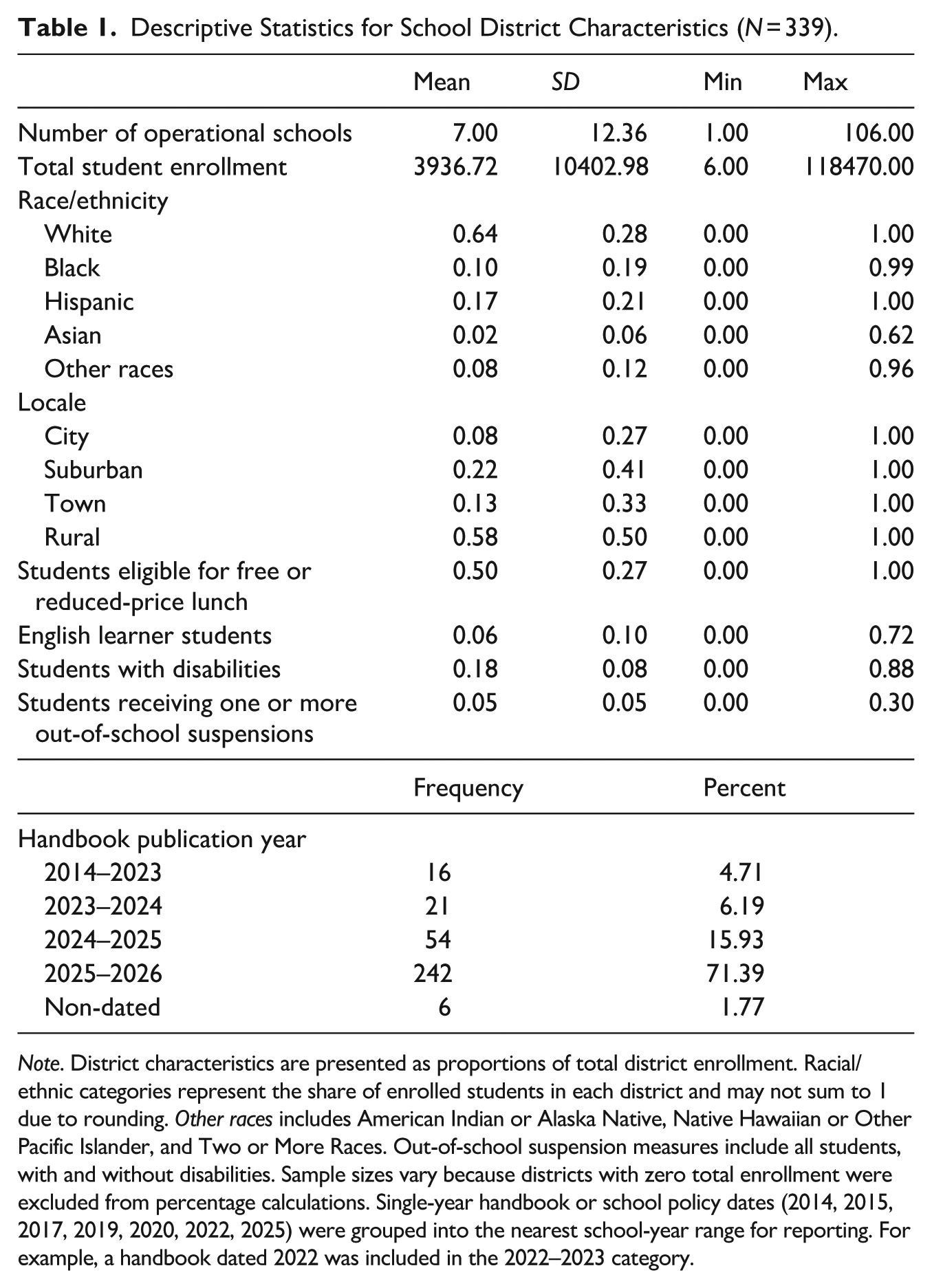
Note. District characteristics are presented as proportions of total district enrollment. Racial/ethnic categories represent the share of enrolled students in each district and may not sum to 1 due to rounding. Other races includes American Indian or Alaska Native, Native Hawaiian or Other Pacific Islander, and Two or More Races. Out-of-school suspension measures include all students, with and without disabilities. Sample sizes vary because districts with zero total enrollment were excluded from percentage calculations. Single-year handbook or school policy dates (2014, 2015, 2017, 2019, 2020, 2022, 2025) were grouped into the nearest school-year range for reporting. For example, a handbook dated 2022 was included in the 2022–2023 category.
Analytic Approach
Consistent with the approach used in a prior state-level analysis (Curran & Goo, 2025), we systematically reviewed district handbooks using a series of key terms related to artificial intelligence, academic integrity, and technology misuse (see Appendix A for the complete list of terms). Each handbook was then coded using binary indicators to identify: (1) explicit or implicit mentions of AI (use of the terms “artificial intelligence,” “AI,” or mentions of AI tools such as ChatGPT), (2) the presence of academic integrity policies, (3) the presence of technology misuse policies, and (4) the specific policy sections in which AI-related content appeared, distinguishing between academic dishonesty, technology misuse, or other sections outside these categories. Districts were further classified based on whether they specified appropriate AI use and disciplinary guidelines. NVivo software was used to identify text segments related to each of these topics and to examine the degree of overlap between AI-related language and terminology associated with academic integrity and technology misuse.
For reliability, two coders independently coded each handbook and compared and reconciled discrepancies through adjudication. Consistent with Creswell’s (2014) discussion of qualitative reliability and Miles et al. (2014)’s qualitative guidance, the team created a code book and discussed coding in regular team meetings. In particular, six researchers each coded approximately 50–100 districts, with each handbook being independently re-coded by another researcher in such a way that each researcher overlapped with two other researchers. Across 3,200 dichotomous cells, the initial percent agreement was 92.16%. Discrepancies were resolved through coder-to-coder consensus meetings via Zoom or in-person. When disagreements reflected ambiguity, cases were brought to weekly full-team meetings for final decisions. These discussions were used to refine decision rules, update the codebook as needed, and finalize the quantitative dataset. Qualitatively, all six researchers reviewed handbooks and extracted relevant excerpts aligned with the quantitative codes. Four members of the research team conducted an additional round of focused analysis, selecting illustrative excerpts that exemplified key findings and were used to substantiate the quantitative findings. This approach allowed for a grounding of findings in specific policy examples (Creswell, 2014; Venkatesh et al., 2023).
We report descriptive statistics for the proportion of districts that reference AI and the distribution of AI-related language across academic dishonesty, technology misuse, and other sections. We also present the proportion of districts mentioning appropriate AI use and specifying disciplinary consequences, including qualitative excerpts as illustrative examples. To examine heterogeneity by district characteristics, we linked district-level demographic and enrollment data, including total enrollment, racial and ethnic composition, English Learner status, students with disabilities, free or reduced-price lunch eligibility, and urbanicity/locale code. For each variable, districts were ranked and partitioned into quartiles, with quartile 1 indicating the lowest share and quartile 4 the highest. We then estimated conditional means of the AI-related indicators within quartiles and urbanicity categories and summarized differences across groups. Additionally, we estimated logistic regression models predicting the odds that district policies mentioned AI from the district characteristics, providing additional insight into the relationship between district characteristics and AI in discipline policy, both for individual district characteristics as well as a fully specified model including all observable district characteristics. Because our analysis of the relationship between district characteristics and the presence of AI-related policy language is descriptive, it documents how the inclusion of such language varies across district contexts and is not intended to suggest causal relationships between district characteristics and AI policy adoption.
Results
Artificial intelligence is now a daily component of many K-12 educational settings with implications for the discipline of students. In this section, we present the findings of our study, which generally show that, as of 2025, the majority of school districts nationwide have yet to adopt disciplinary policies in their student handbooks and codes of conduct on AI’s use. Furthermore, we show that, where such policies do exist, they are often vague and lacking in detail and are frequently limited to only a subset of AI’s potential misuse, being more likely to apply to academic dishonesty than other misconduct. Finally, our results demonstrate that the presence of these policies varies across some district characteristics, potentially contributing to differential discipline for AI use across student subgroups.
AI in School District Handbooks and Codes of Conduct
Our findings show that, despite the growing use of AI among educators and students, the majority of school districts nationwide have not adapted their discipline policies as codified in student handbooks and codes of conduct to explicitly consider AI. As shown in Table 2, our analysis found that only 37% of sampled districts included a reference to AI in their handbooks. This contrasted with general policies around academic dishonesty (e.g. plagiarism) and technology misuse, each of which appeared in around 82% and 84% of handbooks analyzed respectively.
National School District Handbook/Codes of Conduct Referencing AI, Academic Dishonesty, and Digital Misuse.
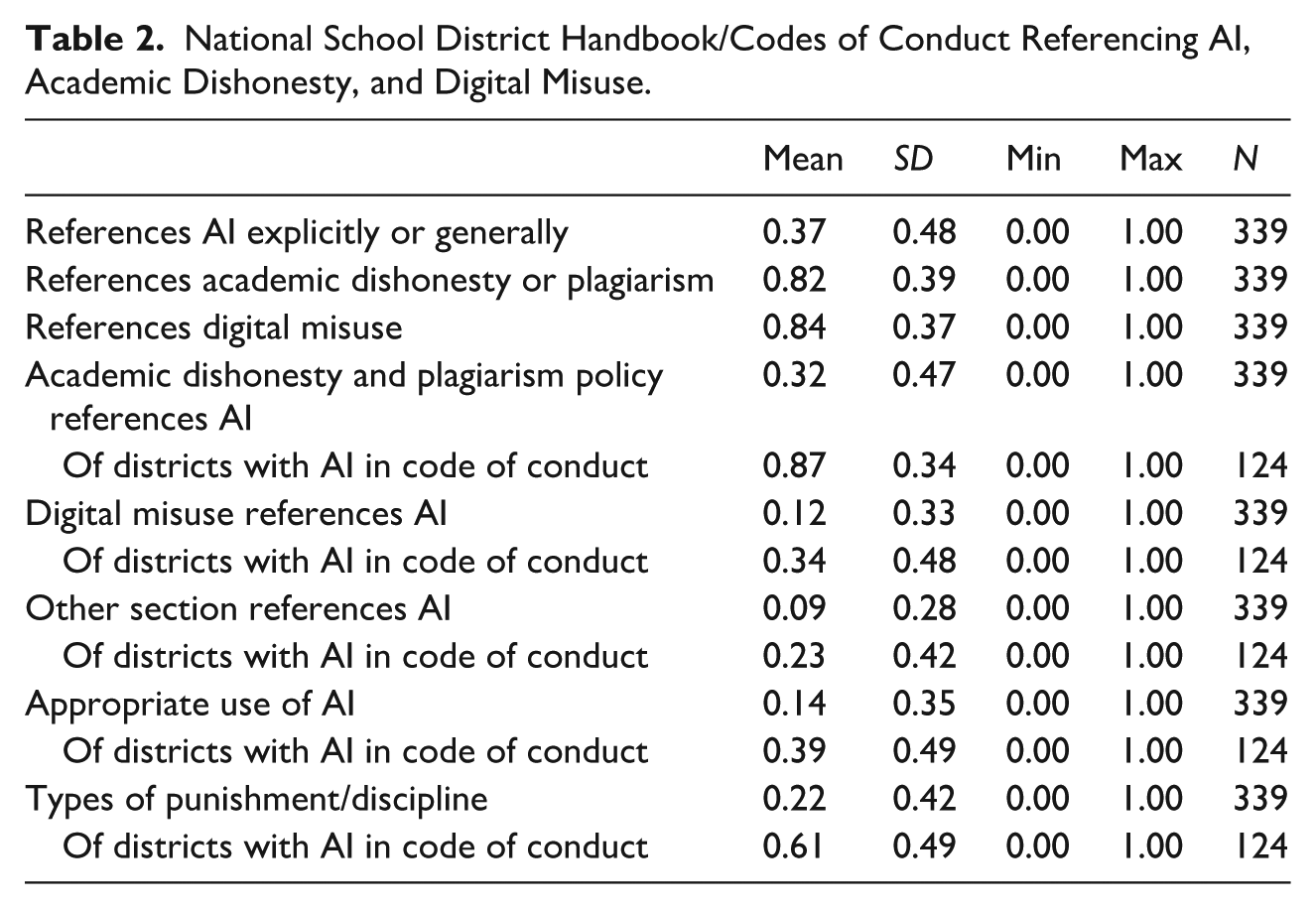
Where AI was mentioned in handbooks or codes of conduct, it was most often mentioned as a part of academic dishonesty. In particular, we found that, of districts with AI mentioned in their handbook, 87% did so in the context of academic dishonesty or plagiarism. For example, one district handbook included the behavioral offense of “Cheating/Generative use of artificial intelligence.” Others commonly included AI use as an example of academic dishonesty or cheating such as “academic dishonesty, including cheating or copying the work of another student, plagiarism (including the unauthorized use of artificial intelligence (AI) such as ChatGPT), and unauthorized communication between students during an examination.”
Another 34% of handbooks with AI mentioned the topic in the context of broader rules around technology/digital misuse. For example, one district’s handbook stated: “Using Artificial Intelligence (A.I.) in any way that harms other students, disrupts school operations, or otherwise violates provisions of this code of conduct or the District’s Acceptable Use Policy. Using AI tools to produce misleading or false information, imagery, or any form of false outputs about themselves, other students, or staff members. Students should report any inappropriate content or security concerns encountered while using AI tools to a teacher or administrator.” Interestingly, however, there were some cases in which the use of AI was acknowledged as a now expected part of school technology use: “given our requirement and obligation as a school district to teach technology standards and digital citizenship, the use of modern educational resources such as computers, Chromebooks, iPads, and the Internet, including the use of AI sites and applications and Google Workspace for Education applications, is an acknowledged condition of enrollment at CPCSC.”
While the majority of AI references in handbooks referred to academic dishonesty or technology misuse, we also documented some cases in which AI was referenced in regard to actions like cyberbullying and sexual harassment. For example, one read “Material that is sexually-oriented, pornographic, obscene, or reveals a person’s private body parts, including material created by A.I.” and another stated the “district will educate students about appropriate online behavior, including cyberbullying awareness and response; interacting on social media; appropriate use of artificial intelligence, and other forms of direct electronic communications.” Many of these could be interpreted as cases of technology misuse but were linked specifically to other infractions such as sexual harassment or bullying.
As the preceding examples illustrate, mentions of AI generally lacked significant detail or guidance on appropriate use, with most mentions of AI consisting of brief mentions of AI as an example of a broader infraction. We found that, of districts that mentioned AI, only 39% defined what appropriate use of AI looked like and even among those that did, the description was often brief (e.g. appropriate AI use is when AI is allowed by the teacher). Furthermore, only 61% of districts’ handbooks linked AI infractions with specific punishments or consequences, leaving ambiguity in what punishments students could face and how teachers should respond to perceived AI misconduct.
A Small Handful of Districts are Leading the Way on AI and Discipline
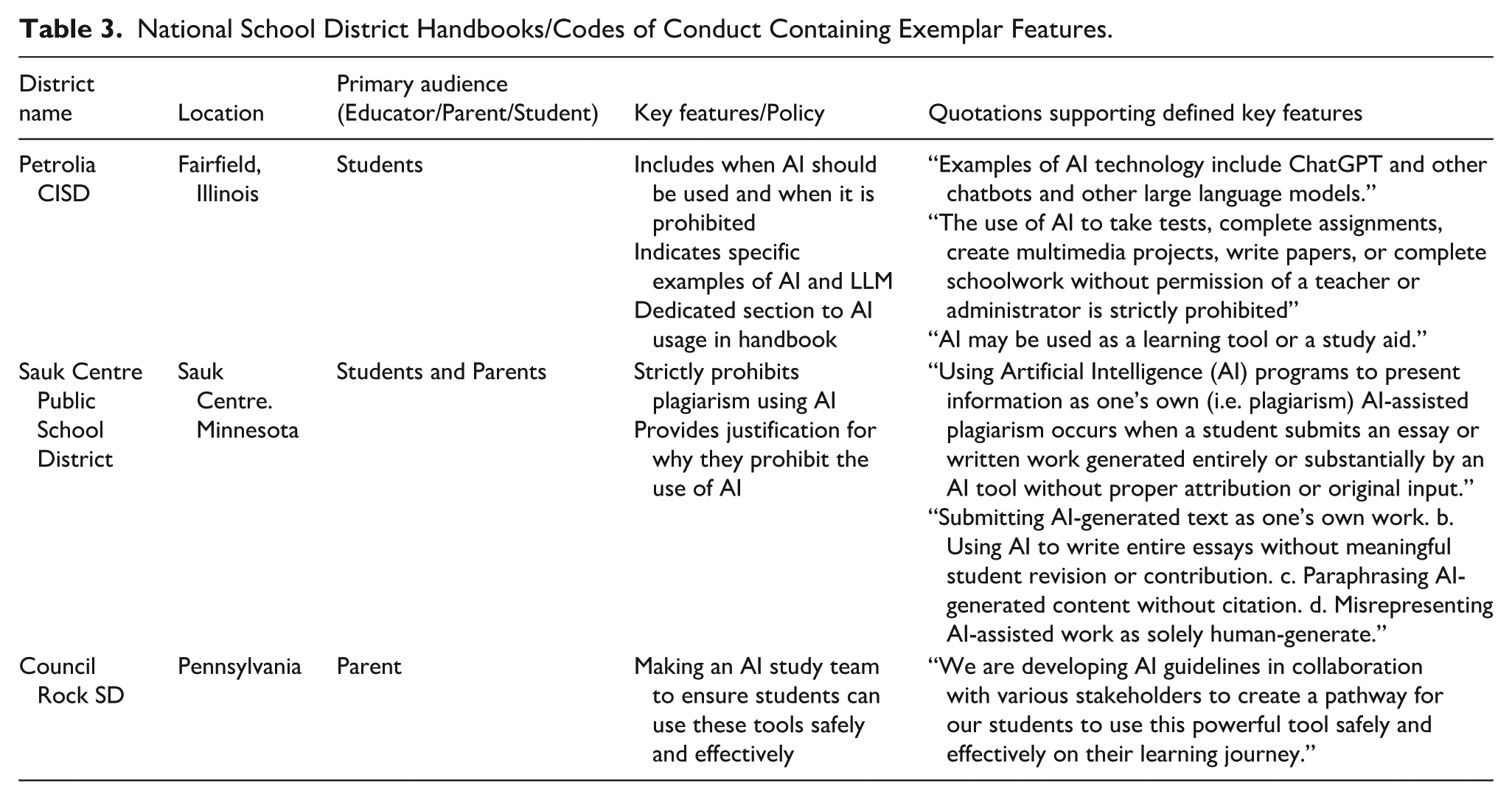
While AI was generally mentioned in passing, if at all, in district handbooks, there were a handful of districts that included more robust descriptions of AI in the context of discipline (see Table 3). For example, a number of districts included specific lists of allowable and unallowable uses of AI as the following excerpt illustrates:
National School District Handbooks/Codes of Conduct Containing Exemplar Features.
Artificial Intelligence (AI) Use Policy AI tools (like ChatGPT, Grammarly, and other programs that can generate writing or answer questions) are becoming more common in schoolwork. While these tools can be helpful, students must use them responsibly, honestly, and only when allowed.
When It’s Okay to Use AI
If your teacher gives permission to use AI for an assignment (such as brainstorming or checking grammar).
If your teacher give permission and you’re using AI to help understand a topic, organize ideas, or review writing—but not to do the entire assignment for you.
If you clearly explain or cite when and how you used an AI tool (your teacher will tell you how to do this).
When It’s Not Okay
Copying answers, essays, or code from AI tools and turning them in as your own work.
Using AI on tests, quizzes, or in-class assignments, unless your teacher says it’s okay.
Using AI to make or share inappropriate or harmful content. (Lyle School District, Washington State)
In contrast to the numerous districts that impose outright bans on AI tools, this district’s approach reflects a more nuanced understanding of AI as a potential educational resource rather than solely a disciplinary concern. This distinction outlines an emerging policy divergence in how school districts conceptualize AI as a tool that, when used appropriately, can support learning outcomes rather than threatening them.
Others offered conceptual frameworks and guiding principles for understanding the ethics behind AI use. For example, one district included the following language: AI Literacy and Guidelines What is Artificial Intelligence (AI)? Artificial Intelligence (AI) refers to computer systems designed to mimic human cognitive abilities. This means AI can learn from data, identify patterns, solve problems, and make decisions. In our school, AI might appear in various tools to help with research, writing, or creative projects. It’s important to understand that while AI can be a powerful tool, it’s still a computer program. Using AI responsibly and ethically, understanding its capabilities and limitations, and always submitting your own original work are key expectations. The following are guidelines for using AI in the school. How can students use AI in school? AI’s purpose in the learning environment is to enhance, not replace the effort put into teaching and learning. AI can assist in learning tasks, but it is not intended to complete the task for students. AI can offer support to meet diverse learning needs, by breaking down complex concepts, or summarizing information, which will enhance their educational experience (Treynor Community School District).
This conceptual treatment of AI use was then followed with concrete examples of proper and improper use of AI, including disciplinary consequences.
And still others indicated that resources were being allocated to develop pathways to appropriate AI use, such as one district that noted the presence of an “Artificial Intelligence Study Team" that was “developing AI guidelines in collaboration with various stakeholders to create a pathway for our students to use this powerful tool safely and effectively on their learning journey.”
While we recognize that many districts may provide such guidance in documents or settings outside of student handbooks or codes of conduct (e.g. classroom instruction on ethical AI use), such examples in handbooks were the exception. That said, these more robust treatments of AI in school discipline policy do provide models for how AI could be more systematically treated in disciplinary policy.
Discipline Policy on AI Varies Across District Demographics
Just as prior research has shown that discipline policies like zero tolerance and restorative practices vary across districts (Davison et al., 2022; González, 2015, 2016), the presence or lack of presence of AI policies in school discipline policies may also disproportionately impact certain students if such policies vary across school districts serving different groups of students. Table 4 shows findings disaggregated by district characteristics including race/ethnicity, English learner status, special education status, free and reduced-price lunch, enrollment, urbanicity, and suspension rates. Table 5 reports logistic regression results estimating subgroup differences in the odds that district discipline policies reference AI.
Distribution of AI References and Related Academic and Digital Misconduct Policies by District Demographics.
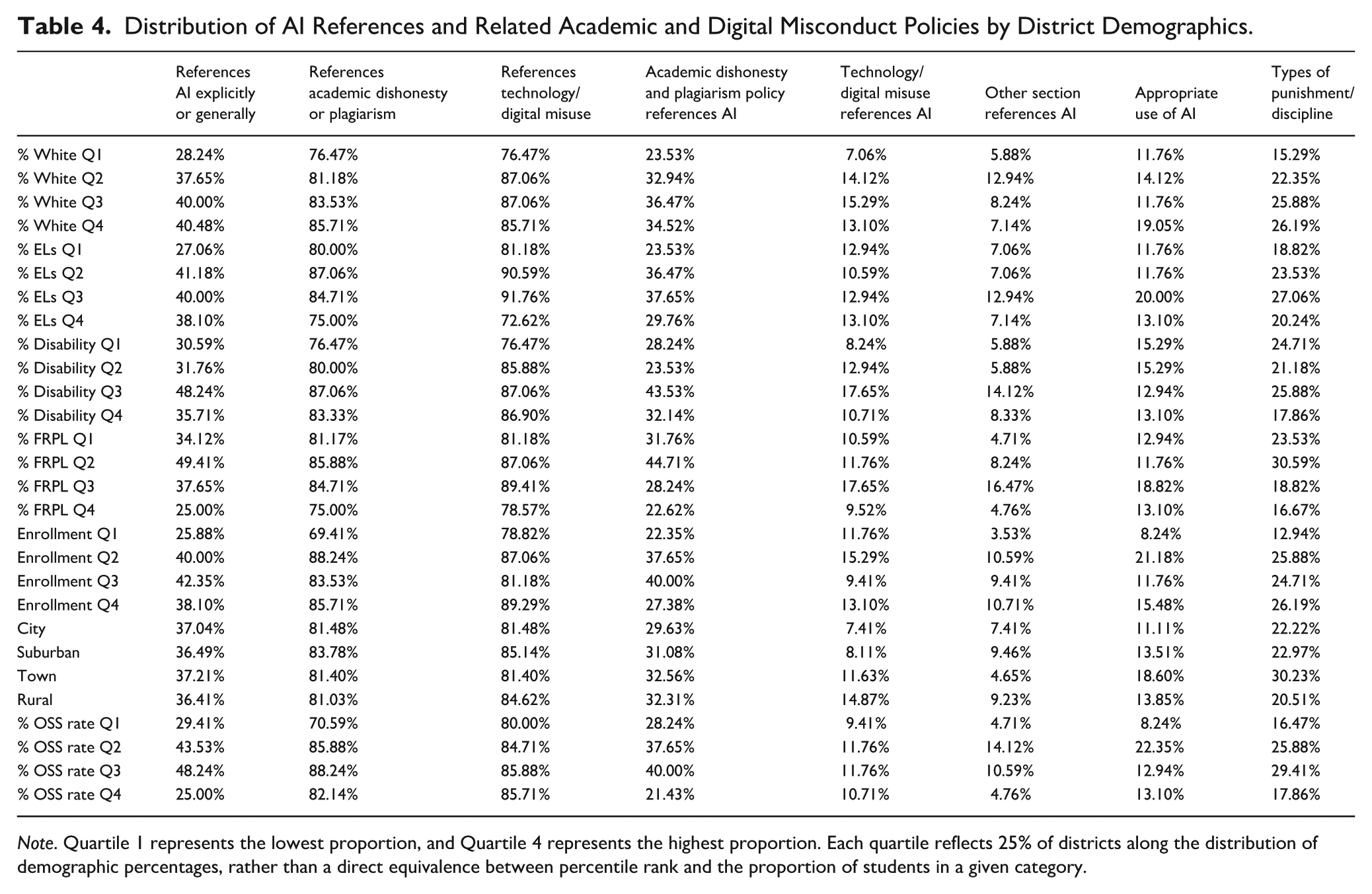
Note. Quartile 1 represents the lowest proportion, and Quartile 4 represents the highest proportion. Each quartile reflects 25% of districts along the distribution of demographic percentages, rather than a direct equivalence between percentile rank and the proportion of students in a given category.
Logistic Regression (Odds ratio) (N = 339).
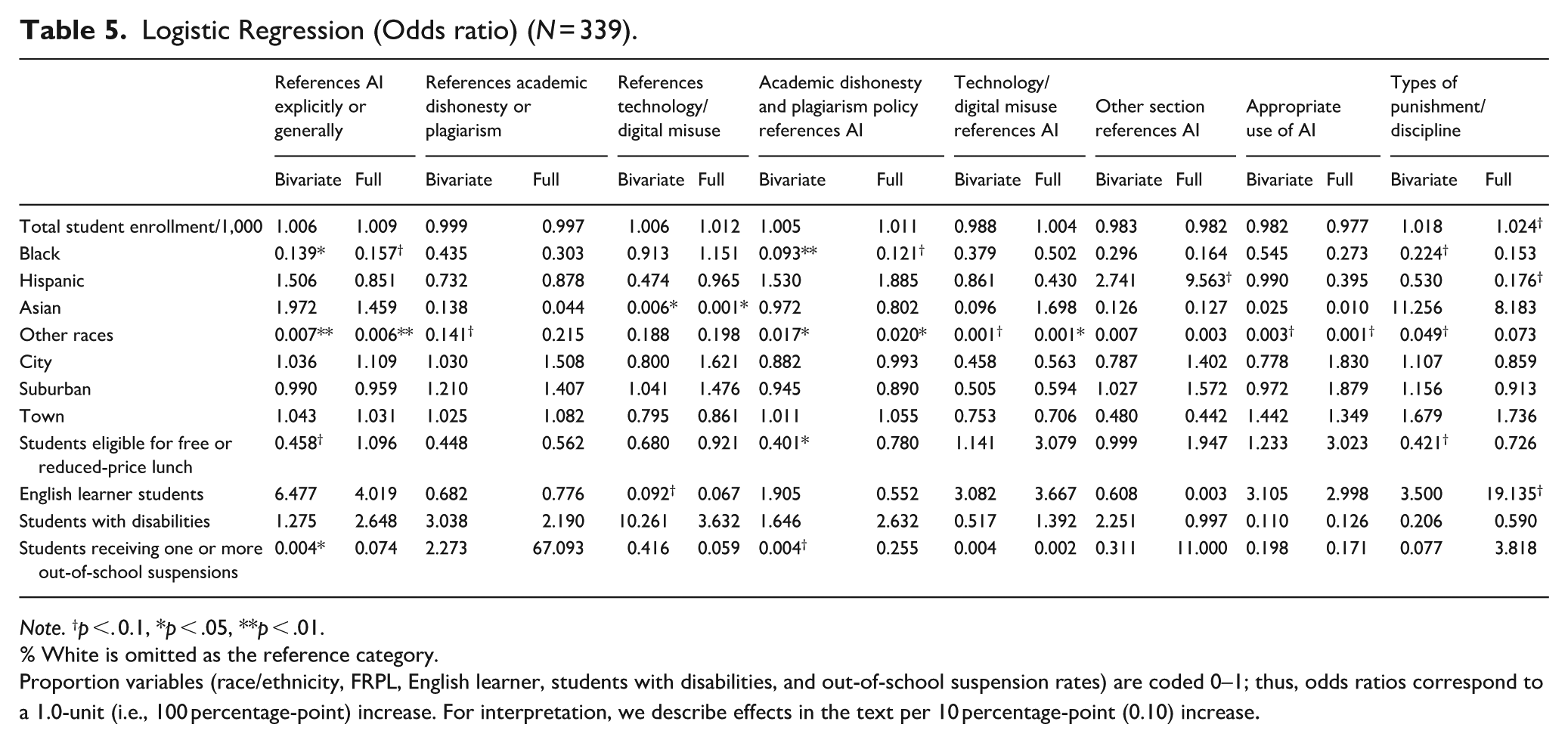
Note.†p <. 0.1, *p < .05, **p < .01.
% White is omitted as the reference category.
Proportion variables (race/ethnicity, FRPL, English learner, students with disabilities, and out-of-school suspension rates) are coded 0–1; thus, odds ratios correspond to a 1.0-unit (i.e., 100 percentage-point) increase. For interpretation, we describe effects in the text per 10 percentage-point (0.10) increase.
Our findings show that districts serving greater proportions of minority students were less likely to mention AI in their discipline policies. As shown in Table 4, 40.5% of districts in the upper quartile of White student enrollment mentioned AI in their discipline policies compared to only 28.2% of districts in the bottom quartile of White enrollment. Consistent with this pattern, the logistic regression results in Table 5 suggest that these differences are largely driven by variation in districts’ Black enrollment and the share of students categorized as other races. Specifically, a ten-percentage-point increase in the share of Black students in a district is associated with about an 18% decrease in the odds that the district’s discipline policy references AI (note that the odds ratio shown in Table 5 reflects a 100% change given the coding of race variables as proportions). This association remains marginally significant after controlling for other observable district characteristics. In addition, a ten-percentage-point increase in the other races’ share is associated with approximately 40% lower odds that a district discipline policy references AI.
A similar relationship was observed with regard to poverty as measured by greater proportions of students eligible for free or reduced-price lunch. Specifically, districts in the upper quartile of students eligible for FRPL were about 9–24 percentage points less likely than other quartiles to include AI in their discipline policies, though this relationship was statistically insignificant in the fully controlled logistic regression model.
Finally, we found that school districts with higher out-of-school suspension rates tended to have a lower likelihood of mentioning AI in their handbooks. As shown in Table 5, the odds ratio of 0.004 indicated a strong negative relationship between OSS rates and AI mentions in the handbook (p < .05), although this relationship is not statistically significant in the fully adjusted model. Consistent with Table 4, examination of quartiles revealed some non-linearity in the relationship with districts with the lowest and highest rates of OSS being less likely than those in the middle two quartiles to mention AI.
Beyond these district characteristics, there was some evidence that smaller districts and those with fewer EL students were less likely to mention AI. Specifically, the bottom quartile in enrollment mentioned AI 25.8% of the time while larger quartiles of enrollment mentioned AI around 40% of the time. Similarly, districts with the lowest quartile of EL students mentioned AI about 27% of the time while others mentioned it around 40% of the time. However, these relationships were not significant in the logistic regression models. Interestingly, while prior research (Curran & Goo, 2025) has suggested some differences by urbanicity, we observed no significant differences in AI mentions across urban, suburban, and rural/town environments.
In the fully adjusted models, district characteristics were generally not significantly associated with whether AI appeared within the academic dishonesty/plagiarism section, the technology/digital misuse section, or other handbook sections (p < .05), with one exception: the share of students in the “other races” category remained a significant predictor. A 10 percentage-point increase in the “other races” share was associated with approximately 33% lower odds that AI was referenced in the academic dishonesty/plagiarism section and about 50% lower odds that AI was referenced in the technology/digital misuse section. Similarly, no district characteristics significantly predicted whether policies specified appropriate AI use or outlined types of punishment/discipline (p < .05).
Summary of Findings
Overall, our findings show that most school districts nationally have yet to explicitly integrate provisions for AI misconduct into their handbooks and codes of conduct. This is particularly true for districts serving more Black students and more students experiencing poverty. While several districts provide examples of what more robust treatment of AI in discipline policy could look like, as we discuss next, many districts have considerable work to consider to clearly communicate the behavioral expectations and disciplinary processes and consequences for AI use.
Discussion
School district student handbooks and their included codes of conduct have lagged behind the rising use of AI in schools. Even when handbooks do include AI, they often do so in superficial ways, lack clear definitions and positive expectations, and confine AI use to issues of academic integrity and technology misuse with limited reference to other potential challenges. This raises important questions about notice, fairness, and schools’ ability to navigate this emerging technology effectively. Because the use of AI in schools is likely to continue accelerating (Dwyer & Laird, 2024), it is incumbent on districts to proactively address these issues. We conclude this study with guidance on AI school discipline policy development for districts, a discussion of the legal and policy value of including AI in discipline policy, and a discussion of limitations and implications.
Integrating AI into Discipline Policy
Recognizing the value of proactively communicating clear expectations (Hirschi, 2015; Loughran et al., 2016) and the growing significance of AI, we suggest that districts should consider including AI in standalone sections that address a range of potential uses. For example, in a section titled “Artificial Intelligence,” several Illinois district handbooks defined AI, provided examples of its use, outlined prohibited and allowable AI use, and connected AI to other school rules and policies: Artificial intelligence” or “AI” is intelligence demonstrated by computers, as opposed to human intelligence. "Intelligence" encompasses the ability to learn, reason, generalize, and infer meaning. Examples of AI technology include ChatGPT and other chatbots and large language models. AI is not a substitute for schoolwork that requires original thought. Students may not claim AI generated content as their own work. The use of AI to take tests, complete assignments, create multimedia projects, write papers, or complete schoolwork without permission of a teacher or administrator is strictly prohibited. The use of AI for these purposes constitutes cheating or plagiarism. In certain situations, AI may be used as a learning tool or a study aid. Students who wish to use AI for legitimate educational purposes must have permission from a teacher or an administrator. Students may use AI as authorized in their Individualized Education Program (IEP). Students may not use AI, including AI image or voice generator technology, to violate school rules or school district policies. In order to ensure academic integrity, tests, assignments, projects, papers, and other schoolwork may be checked by AI content detectors and/or plagiarism recognition software (Policy shared by numerous Illinois districts).
This handbook was an exemplar in (1) including AI, (2) providing clear definitions, (3) outlining appropriate and inappropriate uses of AI, and (4) addressing AI beyond the academic integrity context by saying that “Students may not use AI, including AI image or voice generator technology, to violate school rules or school district policies,” which would encompass concerns related to deepfakes and bullying and harassment. However, one aspect missing from this handbook’s section on AI is a clear link to potential consequences, though these may be explicitly covered in the referenced sections. This example also clearly highlighted AI rather than including AI as a passing reference in another section.
The Value of Including AI in Discipline Policy
Clearly and conspicuously communicating expectations for AI use encourages fairness and transparency (Black, 2015; Newmark, 2023). Yet many handbooks did not include references to AI, and those that did often did not outline how students could use AI appropriately. This may be a function of the institutional constraints of updating handbooks, such as the “structural inertia” of school policies (Hannan & Freeman, 1984) given the limited time, attention, and resources school leaders can dedicate to more-than-marginal policy changes, and could evidence drift between district practice and formal policy. It could also reflect punitive frames in student handbooks and school discipline more generally (Hirschfield, 2008; Mallett, 2016). School discipline is often focused on what not to do, though trends in recent decades have emphasized proactively communicating appropriate conduct, such as Positive Behavioral Interventions and Supports (PBIS) (González, 2012).
While many handbooks did not mention AI, at least from a legal liability perspective, this may not be determinative of whether the school could punish unwanted AI use. Courts are often highly deferential to school disciplinary decisions unless they implicate clear statutory or constitutional rights. Because of this, courts have held that not only are school rules not held to the same vagueness standards as other laws (Bethel v. Fraser, 1986, p. 686), but established rules may not be required at all before imposing discipline. As the court in Harris v. Adams explained, “a school administration. . . may punish a student offender without a prior rule specifically forbidding the offending conduct” (2024, pp. 137–138). Thus, the absence of a reference to AI in a handbook or code of conduct may not limit schools’ ability to address AI, but it can lead to uncertainty or arbitrary and inconsistent enforcement.
Even if courts provide substantial deference to schools in enforcing appropriate behavior, clear expectations do have substantial benefits. Clear rules improve student behavior by engendering trust, promoting fairness and consistency, and ensuring predictability (Gregory & Ripski, 2008; Thornberg, 2008; Way, 2011). Additionally, clear rules with clear consequences also mediate against arbitrary enforcement, which is of particular concern given disproportionate school discipline patterns and our finding that greater proportions of minority students are correlated with a reduced likelihood of referencing AI in student handbooks.
Limitations
While this study provides the first national examination of AI in school discipline, it has several imitations. First, because our focus was on school discipline and student handbooks, we did not capture broader ways schools may be addressing AI. Schools are likely engaging with these topics in other ways (e.g. AI-specific board policies, lessons on ethical AI use, etc.), but if that engagement does not translate into formal discipline policy, uncertainty and inconsistencies will persist when it comes to the rules and discipline around AI. Next, we also recognize that school policy around AI is rapidly changing (Dwyer & Laird, 2024). Even in our own sample, we observed higher rates (45%) of AI references in handbooks from 2025–2026 relative to prior years. Thus, the findings of this study, while important for understanding AI policy at this critical juncture of rapid change, are likely to evolve as districts grow in their use of AI and update their policies.
Conclusion
Policy around AI is working to catch up to practice. Given the significant concerns around AI and its prevalence (Blose, 2023), there seems to be a disconnect between student handbooks and the needs of students and teachers (Dwyer & Laird, 2024). Some districts have acted more quickly than others in adopting AI policies in their student handbooks, but those policies vary significantly in how they address AI and vary across school district characteristics. While additional research is needed on how schools are navigating AI and how AI policies are being implemented in practice, this study’s systematic review of handbooks offers the first nationally representative evidence on AI in school discipline policy. In doing so, it provides insight into whether schools are viewing AI as a contributor to student learning or an accomplice to student misconduct.
Footnotes
Appendix A: Search Terms
Query: “Artificial intelligence” OR “AI” OR “ChatGPT” OR “CoPilot” OR “Gemini” OR “Large language model” OR “LLM” OR “Generative AI” OR “AI generated” OR “AI-generated” OR “A.I. ” OR “GenAI” OR “OpenAI”
Query: “Academic integrity” OR “Academic dishonesty” OR “Cheating” OR “Cheat” Or “Plagiarism” OR “Cheated” OR “Plagiarized” OR “Plagiarize”
Query: “Technology misuse” OR “Technology” OR “Computer” OR “Digital” OR “Internet” OR “Device” OR “Devices” OR “Deep fake” OR “Deep fakes” OR “Deepfake” OR “Data privacy”

Funding
The authors received no financial support for the research, authorship, and/or publication of this article.
Declaration of Conflicting Interests
The authors declared no potential conflicts of interest with respect to the research, authorship, and/or publication of this article.