







Abstract

Editor:
Malnutrition is widely prevalent in dialysis (1,2). Malnourished patients show a decrease in lean body mass (LBM) that reflects a depletion of somatic protein stores. LBM measurements are not routinely performed in dialysis patients due to the lack of simple and precise techniques for its determination. Recently, we compared lean mass measurements performed by densitometry and by creatinine kinetics in a group of stable peritoneal dialysis patients (5 females, 1 male; mean age 59 ± 11 years; mean time on peritoneal dialysis 22.5 ± 10.1 months). We also correlated lean mass measurements with laboratory determinations that estimate nutritional status. Densitometry was performed with a Norland XR 26 densitometer (Norland XR26, Madison, WI, U.S.A.) using dynamic filtration (3). To determine LBM by creatinine kinetics, we measured the creatinine production of each patient, estimated from excretion and metabolic degradation (4). Then, on the basis of the relationship that exists between creatinine production and LBM (5), we calculated the LBM that corresponded to the creatinine production of each patient.
We found that lean mass determined by densitometry was 37.86 ± 2.17 kg in the females and 46.8 kg in the male. Lean mass by this method represents 49.52% of body weight in the females and 72.04% in the male. Lean mass determined by creatinine kinetics was 38.44 ± 1.46 kg in the females and 44.15 kg in the male, representing 50.50% of body weight in the females and the 68.5% in the male.
We found no significant difference and a very good correlation in mean lean mass values between techniques (r = 0.95; p = 0.004) (Figure 1). Lean mass determined by both methods correlated significantly with the height but not with the weight of the patients. No correlations were found between lean mass determinations by both methods and laboratory determinations that estimate nutritional status, such as serum albumin, transferrin, whole lymphocyte count, and serum creatinine. Other studies (6), however, have found that, although the correlation between these techniques is good, lean mass determined by creatinine kinetics is significantly lower than that obtained by densitometry. Limitations of densitometry have been attributed to the inclusion of extracellular water excess in lean mass. Abrahamsen et al. (7) found that, when measuring subjects pre- and postdialysis, lean mass determined by densitometry correlated very significantly with the ultrafiltrate, determined by the gravimetric reduction of weight.
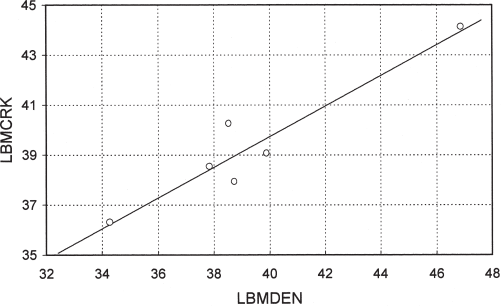
Correlation between lean body mass determined by creatinine kinetics (LBMCRK) and by densitometry (LBMDEN) is shown.
Our observation is limited by the small number of patients studied and the preponderance of females. For these reasons, the similarity in the estimation of LBM by both techniques should be interpreted with caution and must be corroborated in a larger study population.