






Abstract
Background
Hypoalbuminemia is common in peritoneal dialysis (PD) patients; but the reduction in serum albumin levels (SAlb) that should be expected in stable PD patients is less clear.
Objectives
To determine prospectively, in a group of stable PD patients without comorbid conditions, the changes in SAlb concentration and in the concentrations of the other serum protein fractions. To investigate the best determinants of a significant decrease in SAlb levels.
Design
Prospective observational study.
Methods
Seventeen PD patients in stable clinical condition, with no signs of systemic inflammatory response, were included in the study. SAlb and the electrophoretic pattern of serum proteins were determined immediately before PD start, and after 6, 9, 12, 15, 18, 21, and 24 months on PD. In each study period, clinical characteristics, adequacy parameters, protein catabolic rate (PNPNA: protein equivalent of non protein nitrogen appearance), and protein losses were determined. Patients were divided into two subgroups according to whether SAlb decreased less than 10%, or 10% or more, from baseline values after 24 months on PD. The main differences between the subgroups were investigated.
Results
Mean SAlb did not decrease significantly after 24 months on PD (from baseline 3.99 ± 0.46 g/dL to 3.80 ± 0.54 g/dL), though percentage SAlb values did (58.36% ± 5.58% vs 55.15% ± 5.42%, p < 0.01). A weak increase in α2-globulin was observed after 18 months on PD (from 10.62% ± 2.53% to 12.96% ± 2.51%, p = 0.001). α1-Globulin showed a sustained increase from a mean baseline value of 3.51% ± 1.09% to 6.83% ± 2.13% after 24 months (p < 0.0001). Seven patients had a reduction in SAlb greater than 10% after 24 months on PD. Kt/V urea and residual renal function tended to be lower in patients whose SAlb decreased. Mean PNPNA was significantly lower in patients who had a reduction in SAlb (0.76 ± 0.12 g/kg/day vs 0.96 ± 0.12 g/kg/day, p < 0.0001). However, total protein loss was even greater in patients who had no SAlb reduction.
Conclusions
After 24 months on PD, a mean reduction in SAlb of 10% – 15% from baseline values should be expected only in those stable patients whose PNPNA is low.
Keywords
Because most studies that address serum albumin levels in PD patients have used a cross-sectional design that includes patients with comorbid conditions spanning a wide range of severity, the reduction that should be attributed to the peritoneal dialysis procedure per se is difficult to substantiate.
The present study attempts to address this question for PD patients without significant comorbid conditions or initial evidence of systemic inflammatory response.
Patients and Methods
Patient Characteristics
The study group consisted of 17 patients (8 females, 9 males) on peritoneal dialysis. Mean age was 56 ± 19 years (range: 17 – 79 years). The etiology of renal failure included primary glomerulonephritis (5 cases), chronic interstitial nephropathy (8 cases), nephroangiosclerosis (2 cases), and unknown origin (2 cases).
The criteria for being included in the study were: a stable clinical course from the beginning of peritoneal dialysis treatment, no comorbid conditions (no inflammatory, infectious, tumoral, diabetic, or ischemic disease), and a C-reactive protein concentration consistently less than 5 mg/L throughout the study period. No patient had nephrotic proteinuria at the time of inclusion in the study.
Patients were dialyzed with standard peritoneal fluids containing 35 mmol/L lactate. The total dose of dialysis (peritoneal dialysis plus residual renal function) was checked and adjusted quarterly to maintain adequate values. To provide an adequate dialysis dose, two patients had to switch from continuous ambulatory peritoneal dialysis (CAPD) to automated peritoneal dialysis (APD) with diurnal exchanges. Despite these measures, some patients (mainly those with a larger body mass) barely reached a Kt/V urea greater than 2.0. Amino-acid or glucose-polymer peritoneal solutions were not used in any of the patients during the study period.
Clinical and Biochemical Determinations
Adequacy parameters (urinary and peritoneal creatinine clearance and Kt/V urea, both calculated by conventional formulas) were estimated quarterly using peritoneal dialysate and urine collected for the preceding 24 hours. Urea distribution volume (V) was calculated using the formula of Watson et al (4). Using total urea nitrogen excretion, daily urea nitrogen appearance was estimated and was, in turn, used to calculate the protein equivalent of non protein nitrogen appearance (PNPNA) according to the formula described by Bergström et al (5), in which actual protein losses were not included. Biochemical parameters were routinely determined (Hitachi: Boehringer Mannheim Corp., Mannheim, Germany). Venous bicarbonate was also determined (IL1306 gas analyzer: Instrumentation Laboratory, Milan, Italy).
Total serum protein concentration was determined by the biuret method (Boehringer Mannheim Corp.). Plasma protein fractions were determined by capillary electrophoresis. Serum albumin and transferrin were determined by nephelometry. All studies were undertaken in a peritonitis-free period (at least one month since the last episode). To confirm the absence of systemic inflammatory response, serum C-reactive protein (CRP) was determined by nephelometry in each study period.
Study Design
Patients were studied prospectively. The absolute and percentage values of serum albumin and other serum protein fractions—obtained 10 – 15 days before the initiation of peritoneal dialysis, when the peritoneal catheter was inserted (baseline determination)—were compared pairwise with those obtained at 6, 9, 12, 15, 18, 21, and 24 months on peritoneal dialysis.
The best determinants for a significant decrease in serum albumin concentration were investigated.
Statistical Analysis
Data are presented as mean ± standard deviation (SD) or (in figures) as mean ± standard error of mean (SEM), with p < 0.05 taken to indicate statistical significance. The differences between the means of paired continuous variables were analyzed by two-tailed t-test. When the variables lacked normal distribution, the Wilcoxon test was used. Correlations were performed by linear regression analysis.
Results
The only infectious episodes experienced by these patients during the study period were 11 episodes of peritonitis (0.32 episodes per patient-year) and 3 catheter exit-site infections (0.08 episodes per patient-year). Nine of the episodes of peritonitis were caused by coagulase-negative staphylococci. One patient had a peritonitis caused by proteus with concomitant exit-site infection, and another patient had a peritonitis caused by Escherichia coli. With appropriate antibiotic treatment, the courses of all episodes of peritonitis were uneventful.
Figures 1 and 2 present the percentage and absolute concentrations of albumin and of the other plasma protein fractions determined throughout the study period. The mean baseline percent albumin was 58.36% ± 5.58%. After 12 months on PD, percent albumin decreased significantly (55.13% ± 5.85%), and the reduction remained statistically significant after 24 months (55.15% ± 5.42%). In step with this percentage reduction in serum albumin, a significant increase in percent α2-globulin was seen after 12 months on PD (from a baseline mean value of 10.62% ± 2.53% to 12.73% ± 2.35%). Maximal value was reached after 18 months (12.96% ± 2.51%), and percent α2-globulin decreased thereafter to statistically nonsignificant values. α1-Globulin showed a sustained increase from a mean baseline value of 3.51% ± 1.09% to 6.83% ± 2.13% after 24 months (p < 0.0001).
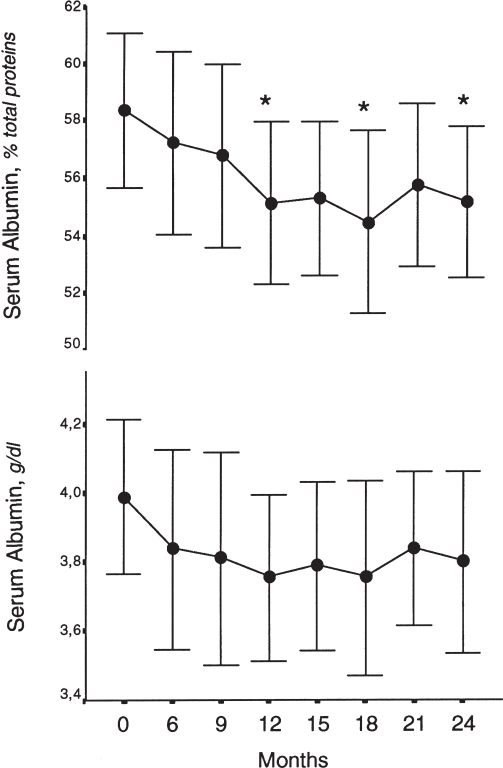
Serum albumin levels, expressed as a percentage of total serum proteins and as an absolute concentration [± standard error of mean (SEM)], throughout the study.
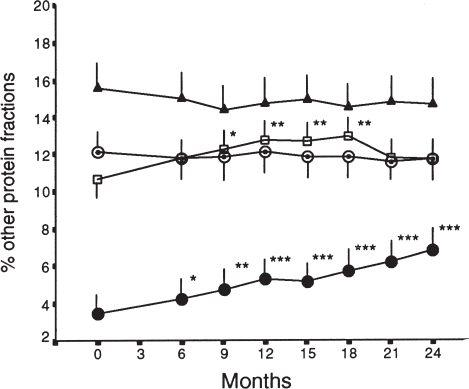
Other serum protein fractions, expressed as a percentage of total serum proteins, throughout the study. Closed circles = α1-globulin; open circles = α2 -globulin; open squares = β-globulin; closed triangles = γ-globulin;
Total serum protein concentration did not vary significantly during the study period (from a mean baseline concentration of 6.85 ± 0.53 g/dL to 6.88 ± 0.54 g/dL after 24 months). Despite a significant decrease in the mean percentage value of albumin, the reduction in the mean absolute concentration of serum albumin failed to reach statistical significance (Figure 1). From a mean baseline plasma albumin concentration of 3.99 ± 0.46 g/dL, a maximal reduction was observed after 12 and 18 months on PD (3.75 ± 0.58 g/dL), with concentrations increasing to 3.80 ± 0.54 g/dL after 24 months. In parallel with these changes in serum albumin, a significant reduction in serum transferrin was observed after 18 months on PD (from 241 ± 47 mg/dL to 203 ± 68 mg/dL, p = 0.032), increasing slightly thereafter to statistically nonsignificant values (209 ± 46 mg/dL after 24 months on PD).
At baseline, 10 patients had serum albumin concentrations above 4 g/dL. The number of these patients diminished progressively to 3 after 24 months on PD.
Patients were divided into two subgroups according to whether they showed a significant decrease in their percentage value of albumin after 24 months. A reduction ≥ 10% from baseline albumin values (approximately one standard deviation) was the dividing line between the groups.
Values from 7 patients met this criterion for significance. The mean decrease in serum albumin in this subgroup, expressed as percent albumin, was 13.34% ± 2.80%. The other 10 patients had an increase of 0.82% ± 8.9%. The mean change in absolute serum albumin concentration in the two subgroups was –0.44 ± 0.37 g/dL and –0.006 ± 0.46 g/dL, respectively.
Table 1 shows the main differences between the subgroups. Patients who had a significant decrease in percent albumin were older, although the difference with respect to the other patient subgroup was statistically nonsignificant. The renal and total Kt/V urea of the patients with a significant decrease in percent albumin tended to be lower. Unexpectedly, mean total protein loss was greater in patients whose serum albumin did not change. The rate of peritonitis was not significant.
Differences Between Patients With and Without Significant Reduction in Serum Albumin After 24 Months on Peritoneal Dialysis
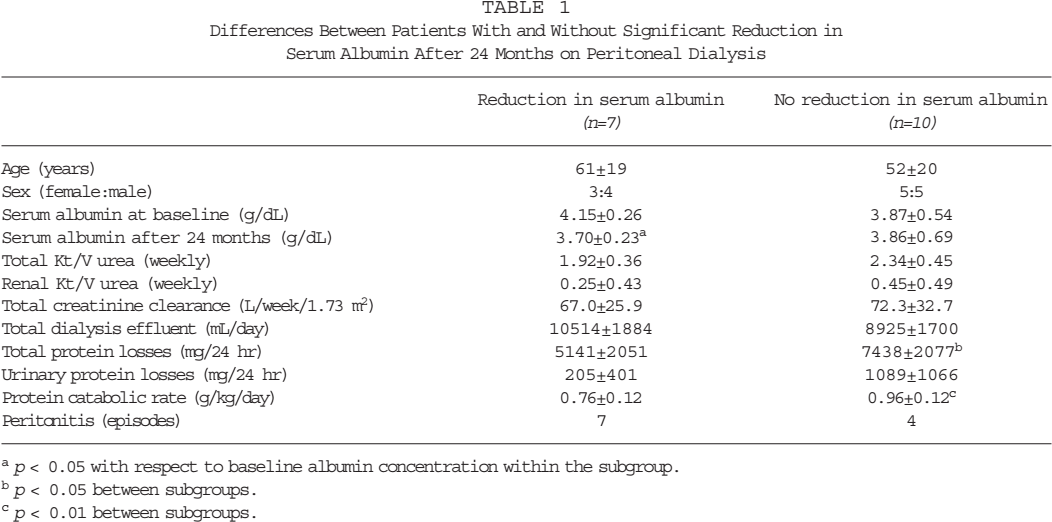
p < 0.05 with respect to baseline albumin concentration within the subgroup.
p < 0.05 between subgroups.
p < 0.01 between subgroups.
When absolute serum albumin concentrations were correlated cross-sectionally with total protein loss in each period of the study, significant negative correlations were inconsistently found at 12, 18, and 21 months (r = 0.64, p = 0.005). Total protein loss also correlated with total serum proteins (r = 0.58), but not with percentage values of albumin. Total protein loss correlated significantly with D/P creatinine (r = 0.66)
The most important difference between the subgroups was that the PNPNA values were greater in patients who had no reduction in serum albumin (0.76 ± 0.12 g/kg/day vs. 0.96 ± 0.12 g/kg/day, p < 0.007).
Figures 3 - 5 show the changes in total Kt/V urea, PNPNA, and total protein loss in the subgroups throughout the study.
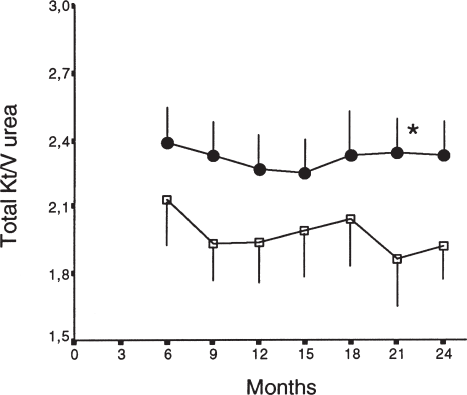
Total Kt/V urea in the subgroups throughout the study. Open squares = group with reduction in serum albumin after 24 months on peritoneal dialysis; closed circles = group without reduction in serum albumin after 24 months on peritoneal dialysis.
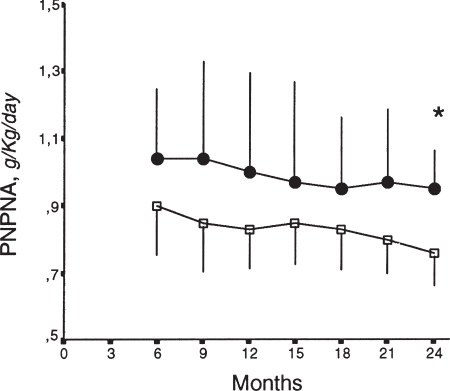
Protein catabolic rate (PNPNA: protein equivalent of non protein nitrogen appearance) in the subgroups throughout the study. Open squares = group with reduction in serum albumin after 24 months on peritoneal dialysis; closed circles = group without reduction in serum albumin after 24 months on peritoneal dialysis.
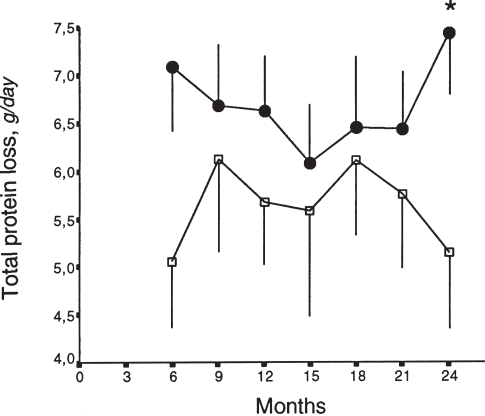
Total protein losses (urinary plus peritoneal) in the subgroups throughout the study. Open squares = group with reduction in serum albumin after 24 months on peritoneal dialysis; closed circles = group without reduction in serum albumin after 24 months on peritoneal dialysis.
Discussion
The results from the present study confirm that hypoalbuminemia (SAlb < 4 g/dL) is the rule in patients on PD, even in patients without comorbid conditions. However, after 24 months on PD, the decrease in the mean concentration of serum albumin was slight and nonsignificant over the entire group. In patients who had a serum albumin concentration reduction of ≥ 10% after 24 months on PD, a lower PNPNA was the most important characteristic differentiating them from patients who had no reduction in SAlb. In contrast, total protein loss (peritoneal plus urinary) did not appear to be a major determinant, being even greater in patients with no reduction in serum albumin.
Paralleling the changes in serum albumin was a strong increase in α1-globulin, and a more modest increase in α2-globulin. The β and γ fractions did not vary, however.
These changes in serum protein fractions are consistent with a reduction in albumin synthesis. Because these patients had no comorbid conditions and no evidence of systemic inflammatory response, the origin of these serum protein changes are far from clear. Based on the difference observed in the mean PNPNA between the subgroups, speculation that the changes in serum protein fractions may be related to a poor protein intake is not unreasonable.
In experimental animals, a restriction in protein intake leads to a specific decrease in the nuclear transcripts of albumin and transthyretin in the liver, but not in the other proteins normally synthesized by the hepatocyte (6). Moreover, severe malnutrition per se has been proposed as a cause of systemic inflammatory response, mediated by the reduction in the concentration of antioxidants, which would induce tissue damage by free radicals (7). Indeed, the concentrations of interleukin 6 and soluble receptors of tumor necrosis factor α have been shown to be significantly increased in malnourished children irrespective of the presence of infection (7). These inflammatory mediators would further contribute to the inhibition of albumin synthesis and to the increase of other serum protein fractions.
The loss of proteins into the peritoneal effluent has been implicated as a main cause of hypoalbuminemia in PD patients (1-3,8). However, it is hard to believe that a daily loss of 6 – 8 g of proteins—the usual average protein loss in PD patients—is per se capable of provoking hypoalbuminemia.
Albumin loss into urine is the main mechanism of hypoalbuminemia in patients with nephrotic syndrome. However, proteinuria at a similar degree of severity does not always cause nephrotic syndrome in determined glomerulonephritis (9). An increased fractional catabolic rate of albumin seems crucial for the development of hypoalbuminemia in patients with nephrotic syndrome (10). This increased fractional catabolic rate of albumin has not been demonstrated in PD patients (11).
In the present study, patients with no reduction in serum albumin showed larger proteins losses than did patients who had a reduction in serum albumin. Thus, something other than the loss of proteins into urine and peritoneal effluent seems necessary to reduce serum albumin concentrations in PD patients. The results of the present study suggest that, in the absence of a systemic inflammatory response, this additional factor may be related to a lower protein catabolic rate, which may be the expression of a lower dietary protein intake.
In conclusion, a mean reduction in SAlb of 10% – 15% from baseline value should be expected only in those stable PD patients whose PNPNA is low. This datum provides a reference for a better interpretation of serum albumin concentration in PD patients.