





Abstract

The reactivity of D-glucose, which contributes to its qualities, can be determined from its particular structure (Figure 1). The aldehyde group is the most reactive part of the molecule. It is prone to the attack of many nucleophilic agents (Nu|) such as alcohols, amines, or carbanions. Furthermore, the aldehyde function activates deprotonation in α position, so that the resulting enolate can be attacked by electrophilic agents (E+) such as carbenium ions. Finally, the hydroxyl groups in the neighborhood of the aldehyde promote a host of different reactions that are detailed later in this paper.

The chemical reactivity of glucose.
In aqueous solution, glucose is found mainly in a cyclic structure formed by an intramolecular hemiacetal. The reaction forms two stereoisomers, called α-d-glucose and β-d-glucose. Although the reactive aldehyde group is blocked in the cyclic forms, the small percentage of D-glucose that remains in open-chain form is enough to maintain the typical reactivity of aldehydes.
The reactivity of D-glucose is responsible for its benefits in metabolic pathways and its abundance in vivo. On the other hand, owing to its reactivity, D-glucose is not a stable compound in solution. It can undergo a variety of spontaneous degradation reactions resulting in the formation of a variety of reaction products. Glucose degradation can take place in vivo and in vitro-for example, during heat sterilization of peritoneal dialysis solution-and is dependent on the reaction conditions, such as temperature and reaction time. Some of the reaction products can have significant biological relevance; the reaction mechanisms and the pathways that are involved must be considered.
Generally two pathways for glucose degradation can be distinguished:
Degradation in the absence of reaction partners.
Degradation in the presence of amines or proteins (called the Maillard reaction or glycation of proteins).
Both pathways are detailed below.
Glucose Degradation in the Absence of Reaction Partners: Formation of Glucose Degradation Products
Primary Rearrangement Products
In aqueous solution, keto-enol-tautomerism can take place, and several rearrangement products are formed. Isomerization gives rise to d-fructose, the ketose, which is analogous to D-glucose. Dehydration in addition to tautomerization leads to the formation of deoxyglucosones. To date, three deoxyglucosones have been identified (Figure 2): 1-deoxy-2,3-hexodiulose or 1-deoxyglucosone (1-DG), 3-deoxy-1,2-hexodiulose or 3-deoxyglucosone (3-DG), and 4-deoxy-2,3-hexodiulose or 4-deoxyglucosone (4-DG).

Early glucose degradation products.
The rearrangement products can be detected in heat-treated aqueous D-glucose solutions. Thus 172 μmol/L 3-DG has been detected in a heat-sterilized peritoneal dialysis (PD) fluid containing 1.5% D-glucose (pH 5.5). The rearrangement product formation is highly dependant on the heating conditions, such as temperature, reaction time, D-glucose concentration, and pH value. For example, when D-glucose concentration is raised to 4.25%, 324 μmol/L 3-DG is formed under the same sterilization conditions applied to the 1.5% solution (pH 5.5). On the other hand, when heat sterilization of PD fluids is carried out at pH 3, which can be achieved in a two-chamber bag, 3-DG concentration is reduced to 42 μmol/L (1).
Secondary Reactions
Deoxyglucosones are not stable end-products; during prolonged heating, they can undergo a variety of further reactions, such as cyclization or dehydration. Numerous reaction products of D-glucose have been identified (2), of which 5-hydroxymethylfurfural (HMF; Figure 3) should be mentioned here. HMF is formed from 3-DG and is often used as a marker compound for heat treatment of sugar-containing products.
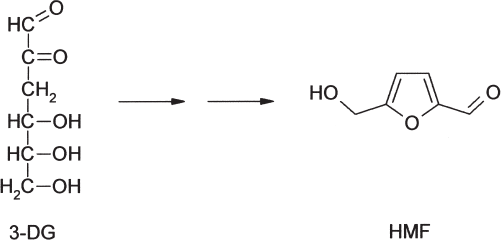
Formation of 5-hydroxymethylfurfural (HMF), a secondary glucose degradation product.
Cleavage Reactions
The 3-hydroxy-carbonyl compounds, such as sugars and deoxyglucosones, are prone to cleavage reactions, called the retro-aldol reaction. As a consequence, short-chain products are formed. The short-chain products can then undergo all of the above-mentioned reactions, producing a variety of small molecules. For example, methylglyoxal (MG), glyoxal (GA), and formaldehyde (FA) have all been identified in heat-sterilized PD solutions (Figure 4).
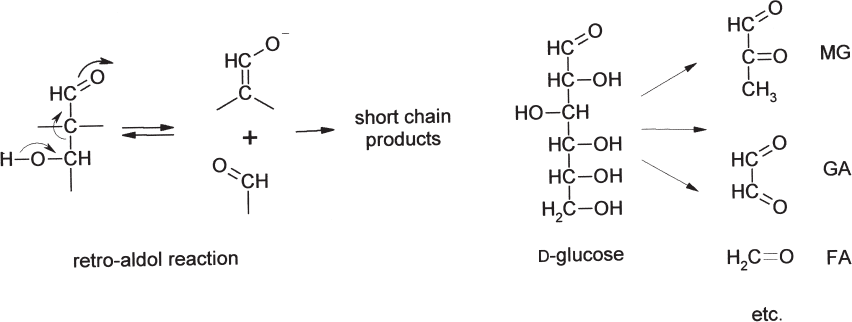
Cleaving reactions leading to secondary glucose degradation products.
As with the formation of 3-DG, the formation of short-chain products depends on the reaction conditions. In conventional PD fluids (pH 5.0 – 5.5), formaldehyde was detected in concentrations of 13 μmol/L (4.25% glucose) and 7 μmol/L (1.5% glucose), and methylglyoxal in concentrations of 10 μmol/L (4.25% glucose) and 6 μmol/L (1.5% glucose). Both of these products were below detection limit when heat sterilization was performed at pH 3 in a two-chamber system (1).
Biological Implications of Glucose Degradation Products (GDPs)
The biological activities of glucose degradation products are not yet fully understood, but the formation of GDPs has been related to cytotoxicity (3). For example, it was found that FA, GA, and MG can suppress cell proliferation and interleukin-6 (IL-6) release (4). This subject is detailed elsewhere.
A second pathway for the harmful effects of GDPs indirectly results from the formation of advanced glycation end-products (AGEs), which formation is promoted in the presence of GDPs (5). This type of reaction is addressed in the next part of this paper.
Glucose Degradation in the Presence of Amines or Proteins: Formation of Glycated Proteins or Advanced Glycation End-Products
Primary Reactions—Formation of Amadori Product or of Glycated Proteins
Glucose degradation is strongly enhanced in the presence of amines or proteins. Even after short-term heating of sugar-and-protein solutions, a brown color and fluorescence develops, accompanied by structural and functional changes in the proteins, such as cross-linking. These changes result from the covalent binding of D- glucose to the amino-acid side chains, mainly lysine or arginine, or to the N-terminal amino group of the proteins. This process is called the Maillard reaction or protein glycation.
In the first step, the aldehyde group of D-glucose condenses with the amine function to give a Schiff base, which is readily rearranged to 1-amino-1-deoxyfructose, called the Amadori product (Figure 5). Proteins that are modified by Amadori products are often called glycated proteins; they can be determined, for example, by affinity chromatography.
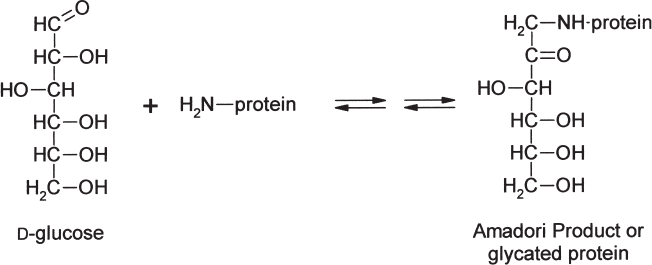
Formation of the Amadori product, an early glycation product.
Advanced Reactions—Formation of AGEs
Amadori products are not stable end-products; they can undergo many other degradation reactions. Furthermore, glucose and its degradation products can also react with amino-acid side chains other than lysine— for example, arginine or tryptophan—to form protein-bound degradation products. These compounds, which can be detected particularly on long-living proteins in vivo, are summarized independently on their structure as AGEs.
To date, very few AGE structures have been detected in vivo. The most prominent are Nε-(carboxymethyl)lysine (CML), Nε-(d-carboxyethyl)lysine (CEL), pentosidine, and pyrraline (6). However, from model reactions, it is known that many other structures can be formed that have not as yet been detected in vivo, possibly owing to their labile structure. Thus, it can be expected that most AGEs in vivo have not yet been identified. The known structures may turn out to be markers rather than the main compounds.
More recently, immunochemical and other sensitive methods have been developed to detect the more labile compounds in vivo. Among others, oxalic acid monolysinylamide (OMA) (7) and imidazolone derivatives (6) have been identified in several tissues (Figure 6).
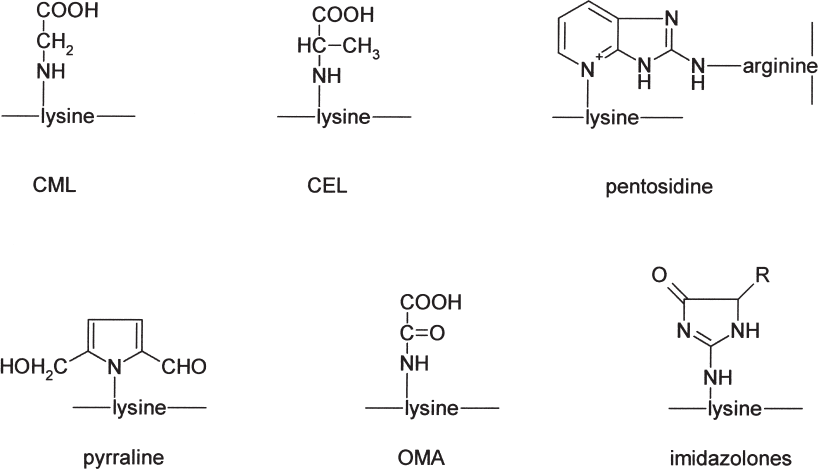
Structures of several advanced glycation end-products (AGEs).
In vivo, AGEs accumulate slowly on long-living macromolecules during aging. Furthermore, increased AGE levels have been measured in certain pathological situations, such as diabetes, uremia, and osteoarthritis. AGE formation drastically changes the physical and physiological properties of proteins (for example by cross-linking) and evokes cellular reactions after binding to AGE-specific receptors (8). In uremia, AGEs accumulate mainly owing to diminished clearance. As a consequence, they accelerate vascular diseases (9).
Specific AGE structures, such as CML or pentosidine, can be analyzed by immunochemical methods (ELISA), gas chromatography/mass spectrography, or high-performance liquid chromatography with fluorescence detection. Sometimes less-specific methods are used to determine AGE formation, such as measurement of browning or fluorescence. These methods can only estimate the progress of glycation and should be applied with caution, because browning and fluorescence can also originate from sources other than glycation.
The Role of Glucose Degradation Products in Glycation
Aside from their own physiological activity, GDPs can also largely influence glycation reactions (Figure 7). For example, 3-DG significantly enhances glycation when compared to equimolar quantities of glucose (10). Similarly, MG and GA have been identified as potent precursors for the formation of AGEs. It has even been speculated that in vivo GDPs are a larger source of AGEs than is glucose itself (11,12).

Formation of advanced glycation end-products (AGEs) from glucose or glucose degradation products.
The products that result from the reaction of GDPs with proteins are very similar to those that are formed from the reaction with glucose. Among others, CML, CEL, OMA, imidazolones, and pyrraline have been detected as reaction products formed in particularly high yields from 3-DG, MG, or GA. Thus, GDPs are not only harmful owing to their own cytotoxic activity, but also owing to the formation of AGEs, which can impair physiological processes as previously explained.
Summary
Glucose degradation, yielding GDPs, can take place in vivo or during heat treatment of glucose solutions. AGEs are formed from the interaction of d-glucose with reactive amino-acid side chains of proteins. Both GDPs and AGEs have been shown to impair cellular function. GDPs have additional damaging effects because they strongly promote AGE formation (as compared to d-glucose).