







Abstract

Although the decline in the prevalence of PD patients occurred at the same time as the growth of multicenter dialysis providers, these observations are “true, true, and unrelated” or, to put it in scientific words, they are “associated but not causative.” Our hypothesis is that the decrease in the number of home dialysis patients is simply a reflection of the diminished enthusiasm for prescribing home therapies by nephrologists (2) and lack of a process to educate patients (and renal fellows) about the advantages of home therapies (3-6). The growth of in-center dialysis rather than home dialysis is a response to such demands. More recently, changes to the documentation and monthly capitation payments to nephrologists may have exacerbated this problem.
Nevertheless, it is also true that the availability of capital to the privately owned companies has allowed them to build facilities in rural areas that may have not been seen as opportunities for new patients or smaller fragmented providers. Subsequently, these facilities provided easier access to in-center dialysis for patients who might otherwise have selected a home modality instead of a long drive three times weekly, or moving their homes to be closer to a previously existing facility. The impact of the increase in dialysis facilities on the number of home patients has not been quantified, but the common result, as is widely acknowledged in Canada, is a decrease in the number of home patients when a new in-center facility is opened in an area that previously had none. It remains extremely important that patients and their families experience the least disruption of their lifestyle and that they continue to have choice. Thus, while the increased availability of in-center HD facilities in more remote or rural areas may have affected PD growth, it has also, in fact, allowed patients to have free choice, provided that the patients are well-informed about their treatment options (3,4).
The authors, who represent the medical leadership of FMCNA and RCG, do not share the misconception that the growth of privately owned freestanding dialysis facilities was the major cause of PD decline, and do not believe there are data to validate that opinion. Figure 4.14 in the USRDS 2005 Annual Data Report (1) reflects the population increase in peritoneal and HD patients since 1990. Note that, relative to the total patient numbers, the increase in the number of PD patients closely mirrors the increase in HD patients of the privately owned freestanding providers, and accounts for the majority of the patients who were placed on PD. Figure 4.15 in the USRDS 2005 Annual Data Report (1) illustrates the percentage of patients cared for by the major provider categories. In 2003 (the time period from which this study was taken), 56.5% of PD patients were cared for in privately owned freestanding facilities. Although the percentage of PD patients is slightly less than the percentage of HD patients in such companies (59.1%), the shift out of the freestanding for-profit chains is not great enough to account for the low percentage of PD patients. When examined from the viewpoint of the percentage of PD patients cared for by each provider (Figure 10.18 and Table 10.18 in the USRDS 2005 Annual Data Report) (1), there are minor differences in the percentages of PD patients in each provider chain, but they are essentially the same as the non-chain and hospital-based providers. This supports our contention that the freestanding for-profit chains have experienced the same shifts in physician attitudes that all other providers have experienced.
There are other considerations in the differences in the prevalence of PD patients cared for by different providers. There are clearly geographic differences in the percent of both incident and prevalent patients receiving PD that existed prior to provider consolidation. Comparing the 1992 USRDS Report to the 2005 USRDS Report (1) reveals significant differences in the percentage of PD patients in various regions of the country. Since large dialysis organizations have a significant presence throughout the United States, if there were an undue focus only on in-center HD, the observed geographic variations in the distribution of PD patients would be expected to decrease in a uniform manner, and would not demonstrate continued relatively wide geographic variations.
The growth of dialysis chain organizations has been accomplished through a combination of de novo facility development and purchase of independent facilities and small chains. The presence of a robust home program is viewed as a positive element during the pre-purchase evaluation, but not all, or even most, acquisitions had strong home programs. As those with small or nonexistent home programs joined the larger entity, an effective dilution of the percentage of home patients occurred. Small home programs typically lack the nursing and/or facility infrastructure that is essential to the continued growth of home therapies. Most importantly, some programs lacked physicians who were familiar with and supportive of home therapies. Indeed, without at least one physician actively engaged, supportive of and referring patients to home therapies (Physician Champion), the likelihood of a successful sustainable home program is very small. Provision of health care occurs under the direction of local physicians, and if there is no established practice pattern that supports home therapies or a commitment to championing home dialysis, it is unlikely that local dialysis management of the acquiring chain, despite interest and encouragement of senior management to grow home programs, will be able to provide momentum to overcome a lack of familiarity or physician advocacy of home therapies.
Despite the increased number of facilities, many of which are actually not at full capacity, there remain strong incentives by large chains to develop and maintain home therapy programs. The highest levels of management in both FMCNA and RCG strongly support PD and will continue to do so after the merger of these two companies by continuing to support ongoing physician and staff education regarding home therapies. Management and medical teams in both companies recognize the vital importance of treatment option education that provides patients the opportunity to choose the dialysis modality that best fits their specific circumstances (7).
Table 1 summarizes the authors’ opinions of several initiatives that should be taken to increase the recognition of the advantage of home therapies. First and foremost, this requires knowledge and familiarity about these therapies in the “teaching programs” of academic institutions. Such programs have limited educational opportunities in outpatient dialysis, and those are mostly concentrated at the in-center level. Thus, we propose that part of the solution is to ask the American Society of Nephrology, the National Kidney Foundation, and the national bodies in charge of nephrology curricula to promote the training and familiarity of renal fellows in home therapies, as well as devote considerable educational efforts at national meetings for new nephrologists. As major providers of home therapies programs, we would be pleased to play a role in such activities.
Suggested Home Therapy Initiatives
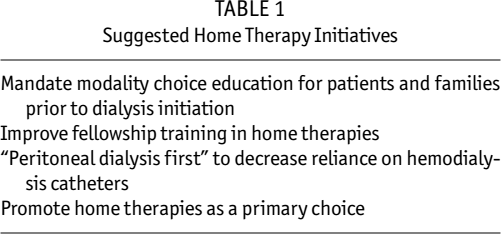
Another initiative that we believe vital is the implementation of an options education program to help patients and their families know about all available modalities, including home therapies, transplantation, and in-center dialysis. Indeed, both companies strongly believe that demonstration of the availability of a treatment option program is an important quality measure. Both companies also understand that home therapies provide a win–win for the patient and the company (7). Internal and external data reflect lower 2-year mortality and hospitalization rates for PD patients. Additionally, strong home therapy programs offer the potential for reducing staffing requirements. This has become extremely important in recent years due to the severe nursing shortage. The perception that dialysis facilities must fill all of their dialysis stations and thus abandon home dialysis actually does not make financial sense. An overall larger dialysis program with a large percentage of patients on home therapy and its associated lower costs ultimately creates a more financially stable program. Patient independence, lower mortality, reduced hospitalizations, higher overall satisfaction by PD patients (8), and lower costs are clear benefits to the dialysis provider. Providing patients with the option to choose is clearly the right path, and exactly what we would want as patients.
Finally, it is possible that the higher monthly rate paid to nephrologists for in-center patients who receive “four visits,” compared to the monthly payment for the oversight of a home patient (resulting from the new Medicare regulations regarding monthly capitated payment) may have played a role in the decreased focus on home therapies in the past year. The concept of home therapies as a primary choice rather than as an alternative only for select patients needs to be driven through a focused education program directed at all nephrology health care providers. More than 60% of patients begin dialysis with a HD catheter for access (1) and often unknowingly accept a very high risk of sepsis. Placement of a peritoneal catheter and the option of PD would virtually eliminate the high risk of mortality and morbidity related to sepsis.
A number of nephrologists have indicated that PD is burdensome because of coverage demands for technical and nonmedical issues that occur with home PD patients. Handling of such problems is perceived to be more difficult than similar problems in the HD center, where there is staff to manage them. This led us to providing nursing coverage for “first call” problems of home therapy patients. The nurse obviously would call a physician should major medical problems be encountered. The issue of nursing coverage requires a reasonable patient:nurse ratio, which is felt to be approximately 20:1. The problem in many communities is that there are several small home programs, each of which has 3 or 4 patients and none of which are viable from an operational or financial perspective. A reasonable approach to this problem is to bundle these small programs into one cluster or bundle of facilities that can attain the acceptable patient:nurse ratio. In the future, this concept will be promoted by Fresenius Medical Services but requires the cooperation of physicians who are willing to share nurses and home facilities to make a cost-effective program. There are sufficient numbers of facilities within our company that physicians in selected areas could join together to form such regional home programs. We believe sharing valuable resources is an important step in halting the decline in the PD population.
In summary, Fresenius Medical Care and Renal Care Group, as we merge, will continue to strongly support home therapies with treatment option education of patients that emphasizes patient choice. This, combined with the support and education of our staff and physicians, will result in ultimately experiencing improved outcomes derived from home therapies.