







Abstract
Keywords
In Japan, two types of new peritoneal dialysis fluid (PDF) are now available: icodextrin PDF, and two-chambered PDF. The present paper discusses the various aspects and the usefulness of two-chambered PDF with a significantly lower concentration of GDPs as compared with standard PDF.
Discussion
Biocompatibility Of Two-Chambered Pdf
Two-chambered PDF has several characteristics that differentiate it from single-chambered PDF: low GDPs, and a more physiologic pH as compared with standard PDF. A more biocompatible and beneficial effect for the patient's peritoneum and system is expected with the use of two-chambered PDF, as is better preservation of peritoneal membrane function.
In experiments, the viability, as measured by production of MTT [3-(4,5-dimethylthiazol-2-yl)-2,5-diphenyltetrazolium bromide], of human peritoneal mesothelial cells (HPMCs) exposed to two-chambered PDF was comparable to that of cells in control conditions. However, the viability of HPMCs exposed to standard PDF was very low (Figure 1). Moreover, the viability (by MTT production) of cultured HPMCs under three different pH conditions (pH 7, pH 6, pH 5) were observed to be comparable (data not shown). Acidity alone therefore does not affect cell viability. Hence, GDPs were suggested to be an important contributor to the cytotoxicity of standard PDF.
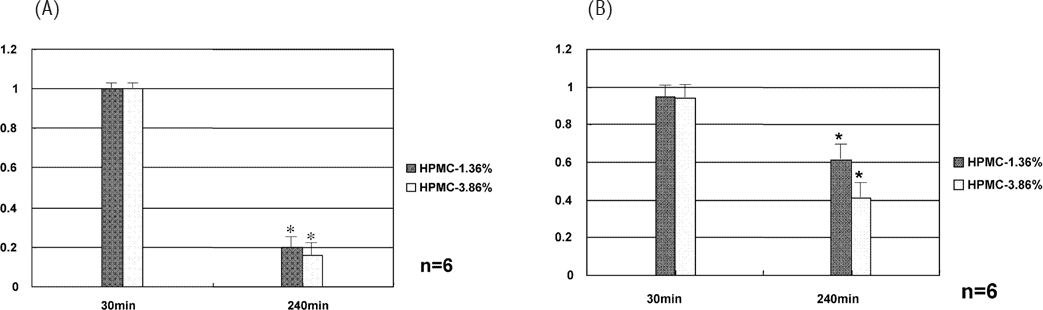
(A) Cell viability, as measured by percentage MTT [3-(4,5-dimethylthiazol-2-yl)-2,5-diphenyltetrazolium bromide] production compared with controls, of human peritoneal mesothelial cells (HPMCs) exposed to peritoneal dialysis fluid (PDF) from standard single-chambered bags (n = 6) at two glucose concentrations. The percentages of MTT for cells exposed to these PDFs for 30 minutes were 100.1% ± 1.2% (1.36% glucose concentration) and 96.5% ± 9.1% (3.86% glucose concentration); for cells exposed for 240 minutes, the respective percentages were 20.0% ± 5.7% and 16.1% ± 6.3%. (B) Cell viability, as measured by percentage MTT production compared with controls, of HPMCs exposed to PDFs from dual-chambered bags (n = 6) at two glucose concentrations. The percentages of MTT for cells exposed to these PDFs for 30 minutes were 95.2% ± 3.8% (1.36% glucose concentration) and 93.8% ± 6.8% (3.86% glucose concentration); for cells exposed for 240 minutes, the respective percentages were 61.8% ± 6.9% and 41.0% ± 8.4%. * p < 0.01 compared with control.
Impact Of 3,4-Dge On Cytotoxicity Of Standard Pdf
The concentrations of various GDPs—3,4-di-deoxyglucosone-3-ene (3,4-DGE), glyoxal (GO), methylglyoxal (MGO), 3-deoxyglucosone (3-DG), formaldehyde (FA), acetaldehyde (AA), and 2-furfural (FF), but not 5-hydroxymethylfurfural (5-HMF)—are markedly lower in two-chambered PDF than in standard PDF (Table 1). Among the various GDPs in PDF, the novel GDP 3,4-DGE was recently reported by Linden et al. to have potent cytotoxicity at low concentrations (8).
Glucose Degradation Products a in Four Kinds of Peritoneal Dialysis Fluid
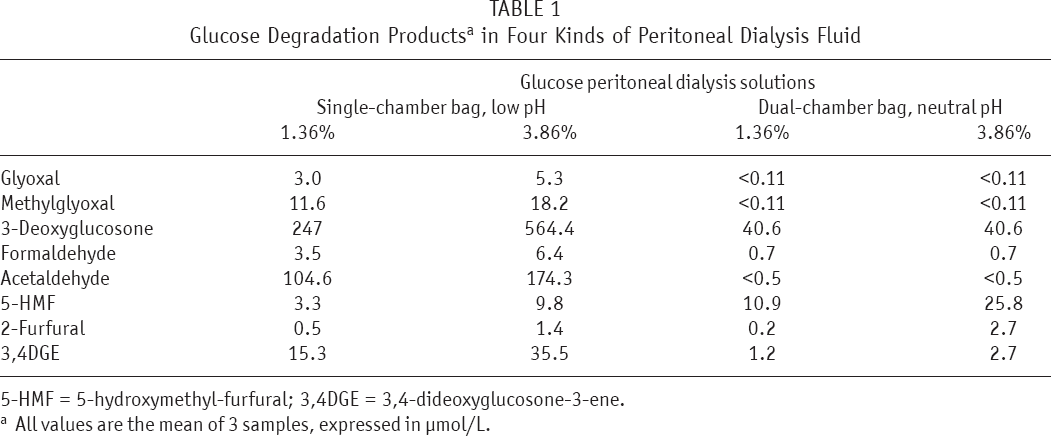
5-HMF = 5-hydroxymethyl-furfural; 3,4DGE = 3,4-dideoxyglucosone-3-ene.
All values are the mean of 3 samples, expressed in μmol/L.
My group investigated the influence of 3,4-DGE on the cytotoxicity of standard PDF in the following experiment. We first prepared acidified filtration-sterilized dialysis fluid (pH 5.5, 3.86% glucose) containing 7 GDPs (GO, MGO, 3-DG, FA, AA, 5-HMF, FF). We then prepared acidified filtration-sterilized dialysis fluid (pH 5.5, 3.86% glucose) containing 8 GDPs (3,4-DGE, GO, MGO, 3-DG, FA, AA, 5-HMF, FF). We added the GDPs at a concentration equivalent to their respective concentrations in standard 3.86% glucose PDF. We then exposed HPMCs to these two solution types and to standard PDF (3.86% glucose) for 4 hours and afterwards determined cell viability by MTT assay.
When HPMCs were treated with the acidified filtration-sterilized dialysis fluid containing 7 GDPs (excluding 3,4-DGE), MTT viability was assessed as 73.7% ± 10.1%. In contrast, MTT viability was assessed at 36.2% ± 21.3% with acidified filtration-sterilized dialysis fluid containing 8 GDPs (including 3,4-DGE), a result that was comparable to that for HPMCs treated with standard PDF (32.8% ± 5.9%; Figure 2). Two-chambered PDF that has a low concentration of GDPs would therefore be expected to be more biocompatible for HPMCs than would standard PDF. Among the various GDPs in PDF, 3,4-DGE is suggested to more markedly affect the cytotoxicity of standard PDF (9).
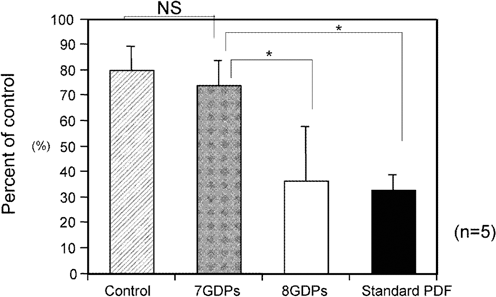
Cell viability, as measured by percentage MTT [3-(4,5-dimethylthiazol-2-yl)-2,5-diphenyltetrazolium bromide] production compared with controls, of human peritoneal mesothelial cells (HPMCs) exposed to acidified filtration-sterilized dialysis fluid (3.86% glucose concentration) containing 7 or 8 glucose degradation products (GDPs). For HPMCs exposed to 7 GDPs for 240 minutes (n = 5), the MTT percentage was 73.7% ± 10.1%; for HPMCs exposed to 8 GDPs for 240 minutes (n = 5), it was 36.2% ± 21.3%. For HPMCs exposed to standard PDFs (control, 3.86% glucose concentration) for 240 minutes, the MTT percentage was 32.8% ± 5.9%. Statistical analyses used the Mann–Whitney U-test or Tukey–Kramer test, and differences with a probability of 1% (p < 0.01) were considered statistically significant.
Systemic Benefits Of Pdf Low In Gdps
In the peritoneal cavity, the preceding study suggests substantial local toxicity resulting from the GDPs in standard PDF. But the GDPs in PDF may exert important systemic effects, too. Some GDPs in standard PDF are converted into advanced glycation end-products (AGEs) through reactions with lysine or other amino bases in the peritoneal cavity. The AGEs thus synthesized may enter the systemic circulation and result in an increase of the AGE concentrations in blood.
Some studies have reported beneficial effects for plasma AGE reduction with the use of PDF low in GDPs. In adults, use of low-GDP PDF resulted in a significant reduction in circulating AGE levels (10). Schmitt et al. (11) also reported a reduction in systemic AGEs in children receiving peritoneal dialysis (PD) with low-GDPs PDF. In that study, switching the patients to the low-GDP solution resulted in 17% and 23% reductions in levels of plasma AGEs and Nε-carboxymethyllysine respectively. The authors suggested that the observed improvement in AGE plasma profile may be the result of the markedly reduced exposure of the patients to GDPs. And reductions in systemic AGEs may subsequently reduce the complications of atherosclerosis and dialysis-related amyloidosis (12,13).
Outcome In Pd Patients Using Low-Gdp Pdf
A few reports have evaluated outcomes in PD patients using low-GDP PDF as compared with patients using standard PDF. In Korea, Lee et al. (14) noted the marked good prognosis of PD patients using PDF low in GDPs as compared the progress of patients using standard PDF. The survival percentage of the patients using low-GDP PDF was 64.2% as compared with 43.4% in patients using standard PDF. Those authors also suggested that the improved outcome in PD patients using low-GDP PDF might be attributable to a reduction in plasma AGE levels. Patients who switch to low-GDP PDF from standard PDF may experience improved outcomes. Regrettably, this study by Lee and colleagues was not a randomized controlled study (RCT). Studies of the outcomes of PD patients using low-GDP PDF in RCTs is desirable.
Probable Benefit Of Low-Gdp Pdf In Combination Therapy
Combination therapy using both PD and hemodialysis (HD) is becoming common in Japan. Alvaro et al. reported that 4 weeks of peritoneal rest helped to reduce increases in peritoneal permeability and thus improved ultrafiltration (15). Those results suggest that peritoneal rest may be an effective technique for ameliorating the deterioration of peritoneal function.
In Japan, HD treatment performed once weekly is used to compensate for insufficient dialysis from PD alone (16-19). In this combined therapy, PD is not performed on the HD day. In addition, depending on the patient's condition, PD may not be performed the day after HD and is thus omitted 1 or 2 days each week. If the peritoneal rest proposed by Alvaro et al. is considered continuous, the combination therapy with a 1- or 2-day break in PD might be considered intermittent short-term peritoneal rest.
My group used the cultured HPMC model to investigate the effects of peritoneal rest for 24 hours during combined PD and HD therapy. We investigated cell activity by MTT assay after exposing HPMCs to PDFs at various pH levels. Cells were exposed to the experimental fluids (50 μL/well) for durations of 30 or 240 minutes. The PDFs used were acidic heat-sterilized PDF (standard PDF, pH 5.5) and neutral heat-sterilized PDFs (low-GDP PDF, pH 6.7). Control wells were exposed to M199 Hanks medium containing 20% fetal bovine serum (FBS) for 30 or 240 minutes. Supernatants were then aspirated from each well and M199 culture medium containing 20% FBS (50 μL) was then added to each well so that the HPMCs could “rest” for 24 hours before MTT activity was investigated.
The activity of HPMCs exposed to standard PDF at glucose concentrations of 1.36% and 3.86% for 240 minutes decreased to approximately 20% and 15% respectively as compared with controls (p < 0.01, Tukey–Kramer test), and the activity of cells exposed to low-GDP PDF at glucose concentrations of 1.36% and 3.86% for 240 minutes decreased to approximately 60% and 40% respectively (p < 0.01). The activity of HPMCs exposed to standard PDF at glucose concentrations of 1.36% and 3.86% for 240 minutes, followed by a “rest,” was approximately 20% and 4% as compared with controls (p < 0.01); in control HPMCs exposed to low-GDP PDF at glucose concentrations of 1.36% and 3.86% for 240 minutes, followed by “rest,” the equivalent activities were 93% and 96% (Figure 3). These findings suggest that rest for 24 hours after exposure to low-GDP PDF improves the activity of HPMCs (20). Therefore, the peritoneal rest in combination PD and HD therapy in which low-GDP PDF is used may preserve peritoneal function better than does combination therapy in which standard PDF is used.
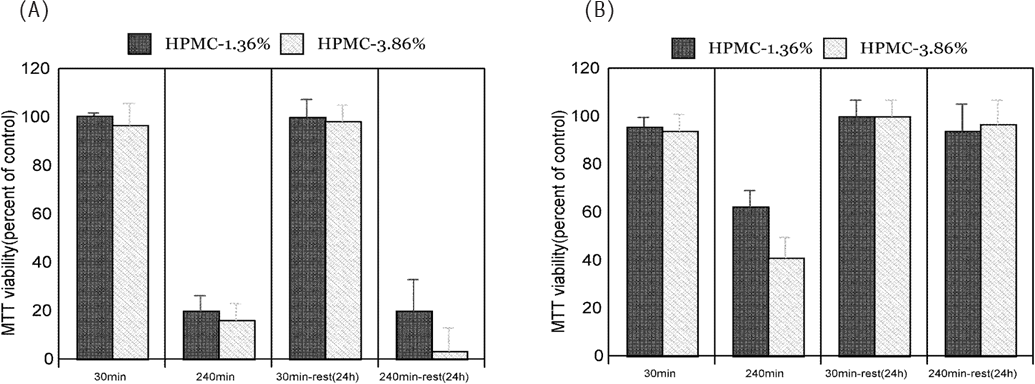
(A) Cell viability, as measured by percentage MTT [3-(4,5-dimethylthiazol-2-yl)-2,5-diphenyltetrazolium bromide] production compared with controls, of human peritoneal mesothelial cells (HPMCs) exposed to standard low-pH, heat-sterilized peritoneal dialysis fluids [PDFs (n = 6)] or to neutral-pH heat-sterilized fluids low in glucose degradation products (GDPs), and of HPMCs rested for 24 hours after such exposures (n = 6). (A) The percentages of MTT for cells exposed to standard PDFs for 30 minutes were 100.1% ± 1.2% (1.36% glucose concentration) and 96.5% ± 9.1% (3.86% glucose concentration); for cells exposed for 240 minutes, the respective percentages were 20.0% ± 5.7% and 16.1% ± 6.3%. The percentages of MTT for cells exposed to these PDFs for 30 minutes and then rested for 24 hours were 100.0% ± 7.0% (1.36% glucose concentration) and 97.9% ± 7.0% (3.86% glucose concentration); for HPMCs exposed for 240 minutes and then rested for 24 hours, the respective percentages were 20.0% ± 12.4% and 3% ± 9.6%. (B) The MTT production percentages for cells exposed to low-GDP PDFs for 30 minutes (n = 6) were 95.2% ± 3.8% (1.36% glucose concentration) and 93.8% ± 6.8% (3.86% glucose concentration); for HPMCs exposed for 240 minutes and then rested for 24 hours, the respective percentages were 61.8% ± 6.9% and 41.0% ± 8.4%. The percentages of MTT for cells exposed to low-GDP PDFs for 30 minutes and then rested for 24 hours were 100.0% ± 6.6% (1.36% glucose concentration) and 99.8% ± 6.7% (3.86% glucose concentration); for HPMCs exposed for 240 minutes and then rested for 24 hours, the respective percentages were 93.8% ± 11.1% and 96.6% ± 9.7%.
Conclusions
One of the biocompatible characteristics of two-chambered PDF is low GDPs. Of the several GDPs in PDF, 3,4-DGE is thought to be strongly associated with the cytotoxicity of standard PDF. Reduction of peritoneal exposure to 3,4-DGE will help to preserve peritoneal function in PD patients.
The use of low-GDP PDF may reduce plasma levels of AGEs in PD patients. That change may help to preserve vascular function in PD patients.
Peritoneal rest for 24 hours after exposure to low-GDP PDF improves the activity of HPMCs. The use of low-GDP PDF in combination PD and HD therapy may be more effective for the preservation of peritoneal function than is the use of standard PDF in such combination therapy.
The new low-GDP PDF has biocompatible characteristics for the patient's peritoneum and system that may help to preserve peritoneal function and to reduce complications such as atherosclerosis and dialysis-related amyloidosis in dialysis patients.