






Abstract
Hypercalcemia due to excess parathyroid hormone (PTH) production is a common condition among patients with end-stage renal disease (ESRD), often referred to as tertiary hyperparathyroidism. There are limited effective medical treatment options currently available for such patients. Denosumab is a monoclonal antibody that inhibits osteoclast activation, thereby reducing calcium release from bones. Denosumab has been used to treat medically-refractory hypercalcemia in non-ESRD patients with hyperparathyroidism. Denosumab has also been used to treat non-PTH-mediated hypercalcemia in patients with advanced chronic kidney disease and ESRD. In this case report, we describe the use of denosumab to successfully treat a case of medically refractory hypercalcemia due to immobilization in a patient on peritoneal dialysis with severe underlying tertiary hyperparathyroidism. In spite of persistently elevated PTH, hypercalcemia quickly resolved after a single dose of denosumab. The patient subsequently developed temporary hypocalcemia requiring medical intervention. Our case report, which is the first described use of denosumab for treatment of hypercalcemia in the setting of tertiary hyperparathyroidism in a peritoneal dialysis patient, adds to the body of literature suggesting denosumab is a useful therapeutic agent in patients with ESRD. Issues with post-treatment electrolyte management and other therapeutic considerations are also discussed.
Introduction
Several disorders of calcium homeostasis are seen in patients with end-stage renal disease (ESRD), including secondary and tertiary hyperparathyroidism (reviewed in Fraser 1 ). Tertiary hyperparathyroidism results when the parathyroid glands lose their normal feedback inhibition by calcium and secrete parathyroid hormone (PTH) autonomously resulting in hypercalcemia. The management of hypercalcemia in patients with ESRD is particularly challenging, and certain interventions, such as bisphosphonates or diuresis with IV fluids, are not well-studied or ineffective in these patients. Treatment of medically refractory tertiary hyperparathyroidism is usually with parathyroidectomy, which may not be feasible in certain ESRD patients depending on their particular comorbidities. Denosumab is a monoclonal antibody that interferes with receptor activator of nuclear factor kappa-β ligand (RANKL)-mediated osteoclast maturation and activation, inhibiting calcium release from bone. 2 Case reports indicate that denosumab may be used to treat PTH-mediated hypercalcemia in non-ESRD patients. 3 –7 Furthermore, denosumab was reported to treat refractory non-PTH-mediated hypercalcemia in patients with advanced chronic kidney disease (CKD) or ESRD. 8 –10 However, to the best of our knowledge, there are no reports of using denosumab to treat hypercalcemia in ESRD patients with underlying hyperparathyroidism. We describe a case of a peritoneal dialysis (PD) patient with medically refractory tertiary hyperparathyroidism. This patient developed progressive hypercalcemia secondary to immobilization, which was successfully treated with denosumab.
Case report
The patient provided informed consent for his information to be published. The patient was a 71-year-old Caucasian male with CKD secondary to presumed lithium-induced and diabetic nephropathy, who started continuous ambulatory PD in April 2015 for progressive renal failure. He developed worsening hyperparathyroidism, with intact PTH rising from 57 pmol/L at the time of PD initiation to 176 pmol/L 28 months later. Total alkaline phosphatase (ALP) steadily increased from 73 IU/L to 271 IU/L, while calcium increased from 2.70 mmol/L to 3.05 mmol/L over this time, consistent with increased bone turnover. Hypercalcemia did not resolve with discontinuation of calcium-based phosphate binders and vitamin D supplements, nor after two doses of pamidronate. The patient was prescribed cinacalcet for management of presumed tertiary hyperparathyroidism, but developed substantial gastrointestinal side effects requiring discontinuation. Parathyroid ultrasonography revealed two nodules posterior to the inferior lobe of the left thyroid gland, with significant uptake of technetium-99 on a parathyroid scan, consistent with parathyroid hyperplasia.
His medical history was complex and included coronary artery disease (quadruple coronary artery bypass graft surgery in 1994 with two occluded grafts on cardiac catheterization in 2003), bipolar disorder, hypothyroidism, type 2 diabetes mellitus, and hypertension. He also was diagnosed with asymptomatic stable multiple myeloma following bone marrow biopsy and skeletal survey. His initial monoclonal protein level was 12.8 g/L (immunoglobulin G (IgG) lambda) with a kappa/lambda ratio of 0.71. Relevant clinical findings during outpatient assessments included symptoms of generalized fatigue and diffuse bony pain predominantly in the lower extremities. There was no history of constipation, renal colic, or confusion.
While awaiting pre-parathyroidectomy cardiac investigations, the patient suffered an ST-elevation myocardial infarction and was admitted to hospital in December 2017 for percutaneous coronary intervention. As a result, he was no longer considered fit for parathyroidectomy. He subsequently developed multiple infections and his mobility markedly declined. Intact serum PTH on admission was 177.6 pmol/L with a corrected serum calcium of 2.92 mmol/L. 11 There was no clear correlation between ALP and calcium levels during the patient’s hospitalization (220 IU/L and 2.92 mmol/L, respectively, on admission, and 163 IU/L and 3.55 mmol/L 6 months later). More specific markers of bone turnover were not available and urinary calcium measurements could not be performed as the patient was almost completely anuric. Due to significant hypoalbuminemia, ionized calcium was used to follow his hypercalcemia (see Figure 1). Three months after admission, his ionized calcium remained elevated at 1.47 mmol/L and intact PTH was 126.5 pmol/L. Cinacalcet (30 mg daily) was therefore reintroduced at this time and escalated over 6 weeks to 120 mg daily. However, there was no appreciable change in his intact PTH levels, and ionized calcium levels continued to climb to 1.73 mmol/L. The patient did not receive any calcium nor vitamin D-containing supplements, his hypothyroidism was well-controlled (thyroid stimulating hormone 0.71 mIU/L), and there was no evidence of progression of his plasma cell dyscrasia (IgG lambda 13.2 g/L and kappa/lambda ratio 0.52 when remeasured in hospital). A diagnosis of superimposed immobility hypercalcemia with severe underlying tertiary hyperparathyroidism was therefore made.
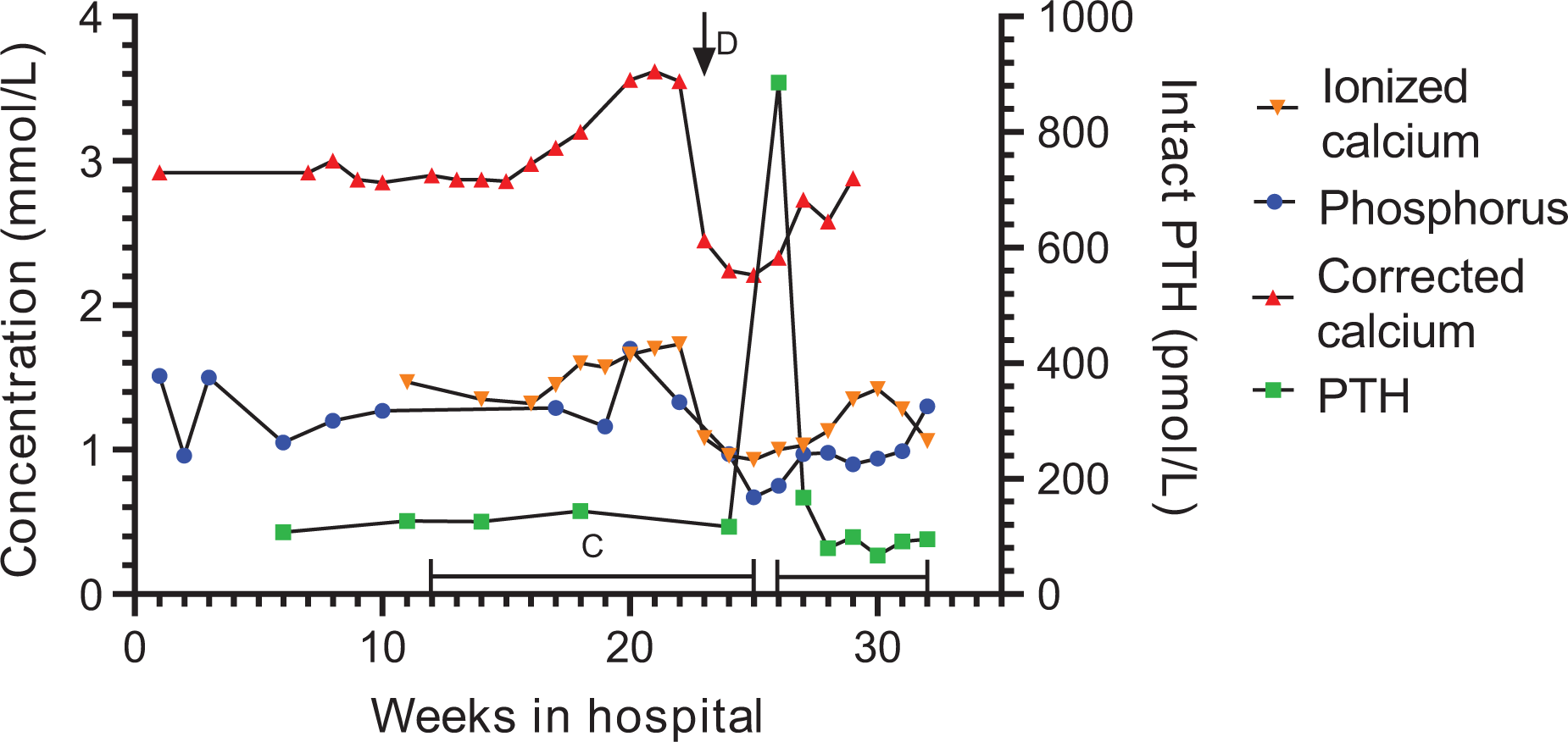
Intact PTH, ionized calcium, corrected calcium, and phosphorus levels in this patient while hospitalized from December 2017 (week 1) to July 2018 (week 32). Treatment with cinacalcet is denoted by the interval marked C, while treatment with cinacalcet, calcium carbonate, and one-alphacalcidiol is denoted by the second (unmarked) interval. Treatment with denosumab 120 mg subcutaneous is denoted by the arrow marked D.
In May 2018, the patient was prescribed a single dose of denosumab 120 mg subcutaneously. The hypercalcemia resolved (ionized calcium 1.09 mmol/L) 1 day after receiving denosumab. His intact PTH level remained elevated at 116.8 pmol/L. The patient reported a nearly immediate improvement in energy level and bony pain. Eight days later, he developed asymptomatic hypocalcemia with an ionized calcium of 0.96 mmol/L. Cinacalcet was held, and the patient was started on calcium carbonate 500 mg twice a day (bid). His intact PTH level increased dramatically, to a peak of 885.6 pmol/L 3 weeks after denosumab. Cinacalcet was resumed at 60 mg daily, along with calcium carbonate 1500 mg bid and one-alphacalcidiol 1 µg daily. One month after receiving denosumab, ionized calcium was 1.13 mmol/L with an intact PTH of 79.4 pmol/L, the lowest level achieved in the last 2 years. He remained on cinacalcet 60 mg daily and calcium carbonate 1500 mg twice daily, and one-alphacalcidiol was stopped. Unfortunately, while he had improvements in serum calcium and PTH levels, the patient died in July 2018 from complications related to infection.
Discussion
Among other indications, denosumab is approved to treat bisphosphonate-refractory hypercalcemia in malignancy (reviewed in Malberti 12 ). However, its use to treat non-malignant etiologies of hypercalcemia remains off-label. Boikos and Hammers 13 described a patient with refractory hypercalcemia secondary to PTH-related peptide, which corrected after a single dose of denosumab. Subsequent case reports described hypercalcemia related to varying degrees of hyperparathyroidism from parathyroid carcinoma. 3 –6 In all of these cases, hypercalcemia was refractory to usual treatment, whereas administration of one or more doses of denosumab resulted in normalization or near-normalization of calcium levels, despite elevated or even rising PTH levels.
De Beus and Boer 8 described a case of PTH-independent hypercalcemia caused by immobilization in a patient with stage 4 CKD. Treatment with denosumab led to a dramatic reduction in calcium levels. Booth and Hays 9 described a similar case of immobility hypercalcemia, which quickly responded to treatment with denosumab. Uehara et al. 10 described a case of immobility hypercalcemia in a hemodialysis patient. Similar to the other cases, this patient had hypercalcemia with low PTH levels. Hypercalcemia, which persisted despite usual medical treatment, resolved within 1 week after a single dose of denosumab.
A number of small studies have used denosumab in patients with ESRD for the treatment of osteoporosis or low bone mass. 14 –17 Chen et al. 14 reported a pilot study in which 12 dialysis patients with hyperparathyroidism (PTH >106 pmol/L) were treated with denosumab for low bone mass. Interestingly, two of these patients likely had tertiary hyperparathyroidism on the basis of pretreatment hypercalcemia. Similar to our report and a report by Torregosa, there was an initial rise in serum PTH levels corresponding to a hypocalcemic phase following treatment with denosumab. 18 Post-denosumab hypocalcemia appears to be more profound in patients who are not taking a vitamin D supplement. 17 – 20 Based on these results, one could surmise that it would be reasonable to begin vitamin D and calcium supplementation in patients with ESRD who are treated with denosumab once calcium levels have nearly normalized. It is essential that the risk of severe hypocalcemia and its attendant complications, including seizures, hemodynamic instability, and arrhythmias, are taken into account even when denosumab is prescribed for hypercalcemia, as the present case illustrates. The maintenance of normocalcemia in patients with pre-existing hyperparathyroidism treated with denosumab suggests suppression of osteoclast activity mediated by RANKL inhibition cannot be overcome even at extremely high PTH levels. 3,5,6 Therefore, denosumab may warrant further study as a treatment option for ESRD patients with medically refractory hypercalcemia, including those with hyperparathyroidism.
Footnotes
Declaration of conflicting interests
The author(s) declared no potential conflicts of interest with respect to the research, authorship, and/or publication of this article.
Funding
The author(s) received no financial support for the research, authorship, and/or publication of this article.