







Abstract
The 2018 Bipartisan Budget Act in the United States extended telehealth access to Medicare beneficiaries who receive home dialysis in which two of three monthly visits in a quarter may be performed by telehealth after three initial face-to-face monthly visits. The originating site (where the patient is located) can be a dialysis unit or the patient’s home and without geographic restriction. Patient awareness and interest in this new telehealth benefit in urban patients has not been well characterized. Patients receiving peritoneal dialysis (PD) treatment located in an urban facility completed a survey to ascertain knowledge of telehealth and readiness and willingness to participate in telehealth for their monthly visit. A total of 30 patients participated: 37% who completed the survey had heard of telehealth and 40% were able to define telehealth in words and correctly identify an example of telehealth. None of the patients were aware of the 2018 US Bipartisan Budget Act which extended telehealth assess to Medicare beneficiaries. Almost everyone had a mobile phone (83%), owned a computer (50%), and had access to Internet services (90%). The majority of patients (73%) were willing to use telehealth services for their monthly visit with the physician. PD patients living in an urban setting appear to be ready and interested in using telehealth to perform their monthly visit with the physician.
Keywords
The 2018 United States (US) Bipartisan Budget Act extended telehealth access to home dialysis patients in which two of three monthly visits in a quarter may be performed by telehealth after three initial face-to-face monthly visits and allows the originating sites (where the patient is located) to be a dialysis unit or patient’s home and without geographic restriction. 1
We queried patients receiving peritoneal dialysis (PD) from an urban facility using an institutional review board approved survey to ascertain knowledge of telehealth and readiness and willingness to use telehealth for a monthly visit with their physician. Thirty patients completed the survey anonymously in August 2018, and the results are depicted in Table 1.
Telehealth awareness in an urban pertioneal dialysis clinic.
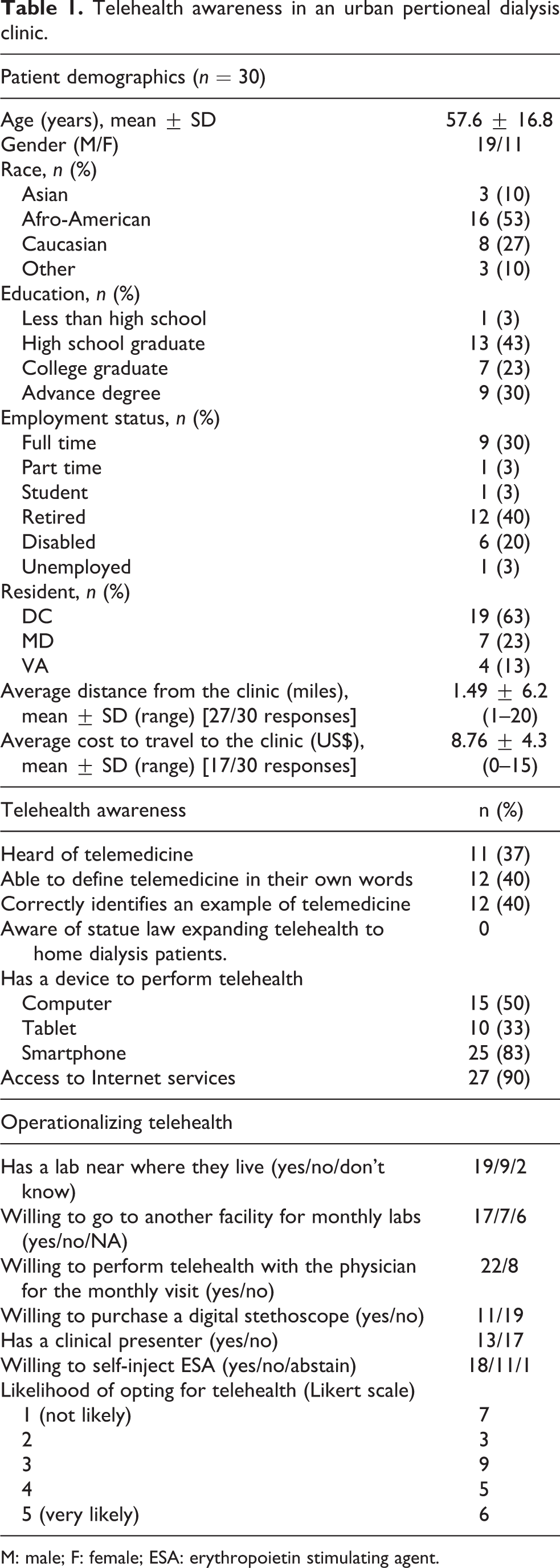
M: male; F: female; ESA: erythropoietin stimulating agent.
Telehealth saves the patient the commute to the dialysis unit. Patients receiving PD residing in an urban setting have easy access to dialysis units. The patients from our dialysis unit have a short commute and spend an average of US$8.76
Telehealth offers patients a reduction in transportation cost as well as time away from work, home, or school. The estimated annual cost of dialysis transportation in the United States approximates US$3.0 billion, about 6–7% of total dialysis patient costs. 2 Ambulance services account for 46% of all costs. 2 Approximately 5% of cost represent private vehicle or public transportation use, and the remainder for ambulettes, wheelchair vans, and taxis. 2 The US Bipartisan Budget Act of 2018 reduced funding for non-emergency ambulance transportation services by 13%. 1 Advocating home dialysis and using telehealth to conduct two of three monthly visits will aid in reducing non-emergency dialysis transportation cost.
Telehealth offers patients living in remote areas or those with poor access to health care and practitioners an opportunity to improve quality of care. 3 Remote (living more than 100 miles from the closest hemodialysis unit) but not rural residence has been associated with increased mortality among patients initiating chronic hemodialysis treatment in the United States. 4 Patients receiving PD treatment living in micropolitan (population less than 50,000) and rural residences experience a higher risk for long-term mortality than urban PD patients. 5
Patients receiving PD have interest and willingness to use telehealth. 6 In a previous study, patients showed an interest in adopting the remote monitoring aspect of telehealth. 7 Moreover, patients showed improvement in satisfaction and outcome with telehealth usage. 8
Poor patient health literacy, engagement, and activation challenges the dispersion of innovative care models and health technologies. 9 Patients do not embrace new regulations designed to reduce health cost and improve patient care. Published information often appear at inappropriate levels of health literacy. 10 Dialysis patients typically represent high engagement in their care but have relatively low health literacy. 11 Since kidney patient advocacy organizations often announce events and changes in the nephrology/dialysis environment, we endorse patient participation. We also encourage practitioners to inform their patients of regulatory changes pertaining to end-stage renal disease (ESRD).
Before telehealth encounters can occur, the practitioner and the dialysis unit must operationalize the process. 12,13 Practitioners will need to obtain a license for the state in which the patient is located (originating site) and may require credentials and privileges from the facility where the patient is located. This would not apply if the originating site is the home. Both the practitioner and the patient will need to have Health Insurance Portability and Accountability Act (HIPAA) compliant technology and devices as well as appropriate policy and procedures in place to conduct telehealth.
Although a majority of the patients (73%) show high enthusiasm in trying telehealth services for their monthly visit with the physician, as of August 2019, none of the PD patients at the surveyed dialysis unit asked to have their monthly visits conducted by telehealth. Perhaps the requirement for monthly blood work and equipment and services to conduct a video conferencing encounter capable of performing a physical examination act to dampen their enthusiasm for telehealth encounters. This suggests that clinicians and dialysis facilities may need to assist patients to raise awareness regarding telehealth options as well as in obtaining the necessary devices, services, and pathways to complete a telehealth visit.
Telehealth offers a new treatment option for home dialysis patients in the United States. 14 We hope that practitioners and home dialysis patients embrace telehealth. 15 Additional studies will need to be performed to understand the impact of residence in a rural versus urban locale on practicing telehealth by home dialysis patients.
Footnotes
Declaration of conflicting interests
The author(s) declared no potential conflicts of interest with respect to the research, authorship, and/or publication of this article.
Funding
The author(s) received no financial support for the research, authorship, and/or publication of this article.
