






Abstract
Background:
Peritoneal dialysis (PD) patients with impaired hand–eye function require helper assistance. Our centre developed a connection device that assists patients with impaired hand–eye function to perform PD exchange themselves, but the clinical outcomes in these patients have not been investigated.
Methods:
We retrospectively reviewed patients who had device-assisted continuous ambulatory peritoneal dialysis (CAPD) during 2007–2016 and compared their clinical outcomes with age- and sex-matched patients receiving helper-assisted CAPD.
Results:
One hundred seventy-two patients (86 each in the device- and helper-assisted CAPD groups) were followed for 29.9 (19.4–43.3) months. The device- and helper-assisted groups had comparable peritonitis rates (0.489 and 0.504 episode per patient-year, respectively, p = 0.814), with no difference in the distribution of causative organisms and the organism-specific peritonitis rates. The device-assisted group showed similar peritonitis-free survival compared with the helper-assisted group (2.58 (1.85–3.31) vs. 1.78 (0.68–2.88) years, p = 0.363) and time-to-PD discontinuation (6.27 (3.65–8.90) vs. 4.35 (3.48–5.22) years, p = 0.677). The median patient survival was similar between the two groups (3.89 (2.22–5.55) vs. 3.81 (3.27–4.36) years in the device- and helper-assisted groups, respectively, p = 0.505).
Conclusion:
Device-assisted CAPD confers comparable outcomes as helper-assisted CAPD and is a viable option in PD patients with impaired hand–eye function.
Keywords
Introduction
Peritoneal dialysis (PD) is one of the main modalities of kidney replacement therapy (KRT). 1 Consequent to a PD-first policy since 1985, the proportion of incident and prevalent dialysis patients receiving PD are up to 86% and 76%, respectively, in Hong Kong. 2 Good hand–eye function is a prerequisite for proper and sterile PD exchange. Patients with challenged vision, dexterity or cognition have difficulty in PD exchange by themselves and are at increased risk of PD-associated peritonitis, which is a significant cause of PD discontinuation and mortality in PD patients. 3 While automated PD may have the advantage of fewer PD exchange procedures per day over continuous ambulatory peritoneal dialysis (CAPD), its demand for a better cognitive function and associated extra financial costs present a challenge for many of these patients. Patients with impaired hand–eye or cognitive functions often require helpers to assist their PD exchange. Helper-assisted PD was first reported in France in 1977 4 and has since been practised worldwide. 5 –8 Previous studies demonstrated that the hospitalisation rates, patient survival and quality-of-life measures of helper-assisted PD were comparable to in-centre haemodialysis (HD). 7,9 Notwithstanding, the reported peritonitis rates were variable, being similar or inferior to self-performed PD in different series. 5,6,10 –16 In Hong Kong, the role of PD helper is usually taken up by a dedicated family member; when such a family member cannot be identified, domestic helpers under the supervision of trained family members or staff of nursing homes may be engaged. 16 Unfortunately, appropriate helpers are not always available, and the engagement of PD helpers often confers considerable burden to the patients and their families in terms of carer stress, time and finances to different extent. The loss of independence in PD exchange may further compromise the patients’ self-esteem and quality of life. To circumvent these issues, our dialysis unit developed a connection device to assist patients who have impaired vision, dexterity or problems with eye–hand coordination to safely perform CAPD exchanges by themselves in 2006. Here we report the single-centre experience of patients who have used this device for CAPD exchanges.
Methods
Patients
This retrospective cohort study was approved by our local Research Ethics Committee (approval number: KC/KE-19-0006/ER-2). All patients who received CAPD (as their first modality of KRT and continued for not less than 90 days) and follow-up at the Division of Nephrology, United Christian Hospital, Hong Kong during the period of 2007 to 2016 were reviewed. Patients who received device-assisted PD were included for analysis. We excluded patients who were initiated on PD in 2006, as the use of the connection device had not yet matured at that time. We also excluded patients who were previously on other modes of PD or had completed training in other centres to avoid the confounding effect of retraining. 17 Patients who were previously on long-term HD or had a history of kidney transplantation were also excluded as evidence suggested elevated risks of early PD failure in these groups. 18 The patient selection process was shown in Figure 1. Age- and sex-matched patients who received helper-assisted CAPD were selected in 1:1 ratio as controls.
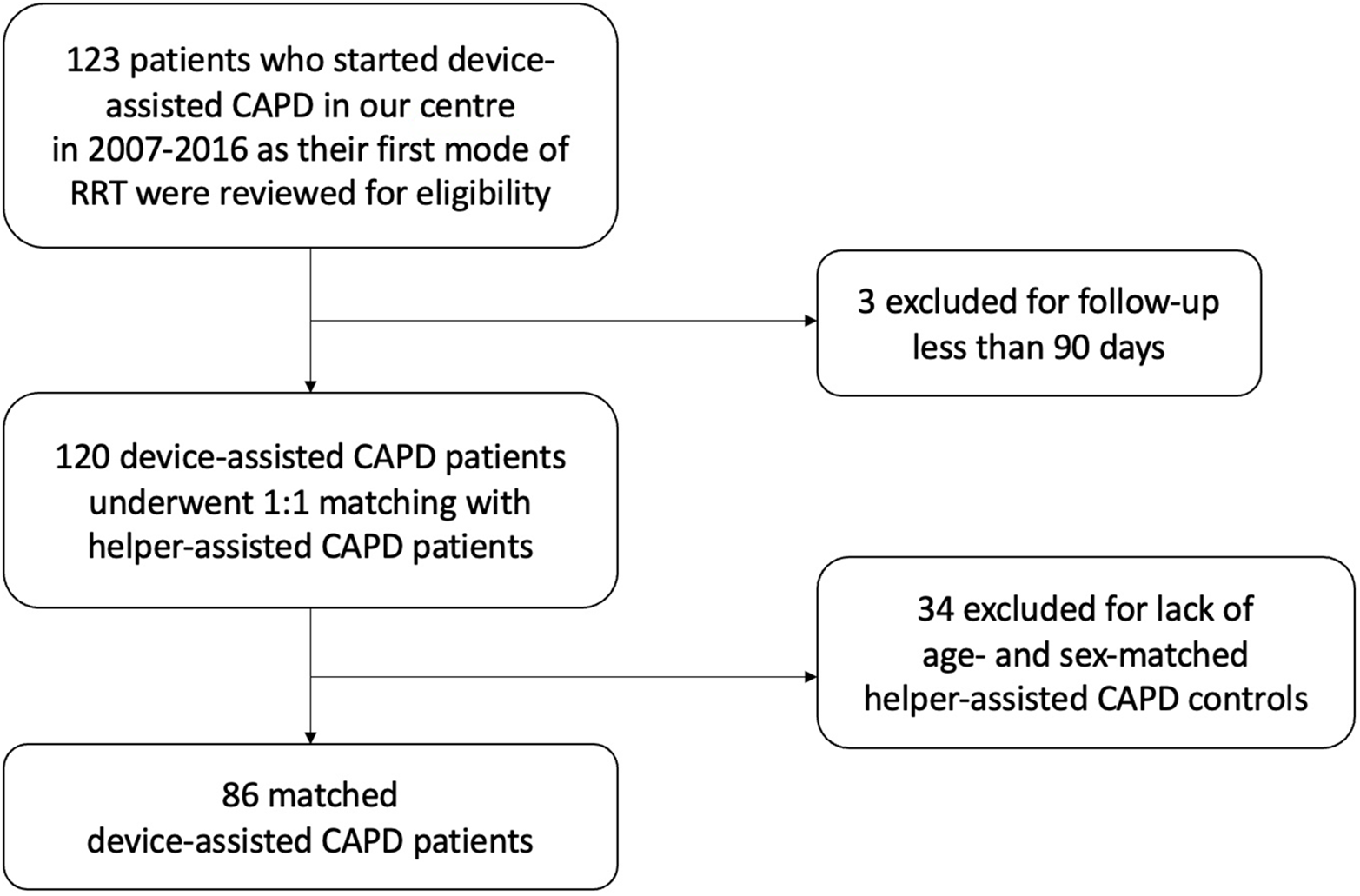
CONSORT diagram.
Connection device to assist CAPD
Our dialysis unit developed a connection device, specifically compatible with the Baxter Ultrabag system, to assist CAPD in 2006. This connection device has since been routinely used to assist patients with impaired hand–eye function to perform CAPD. This device consists of two components. The first component comprises two spoon-like plastic models (Figure 2(a)), fitted to the transfer set of the PD catheter and the tubing of the PD fluid set, which provide mechanical guidance during the connection of the transfer set and the tubing to protect the sterile parts from contamination (Figure 2(b)). The second component is a metallic rail with plastic holders (Figure 2(c)), fitted to the transfer set of the PD catheter and sterile caps, which ensures accurate reapplication of a new sterile cap after disconnecting the PD fluid set (Figure 2(d)). No other device serving the same purpose was available in our unit during the study period.
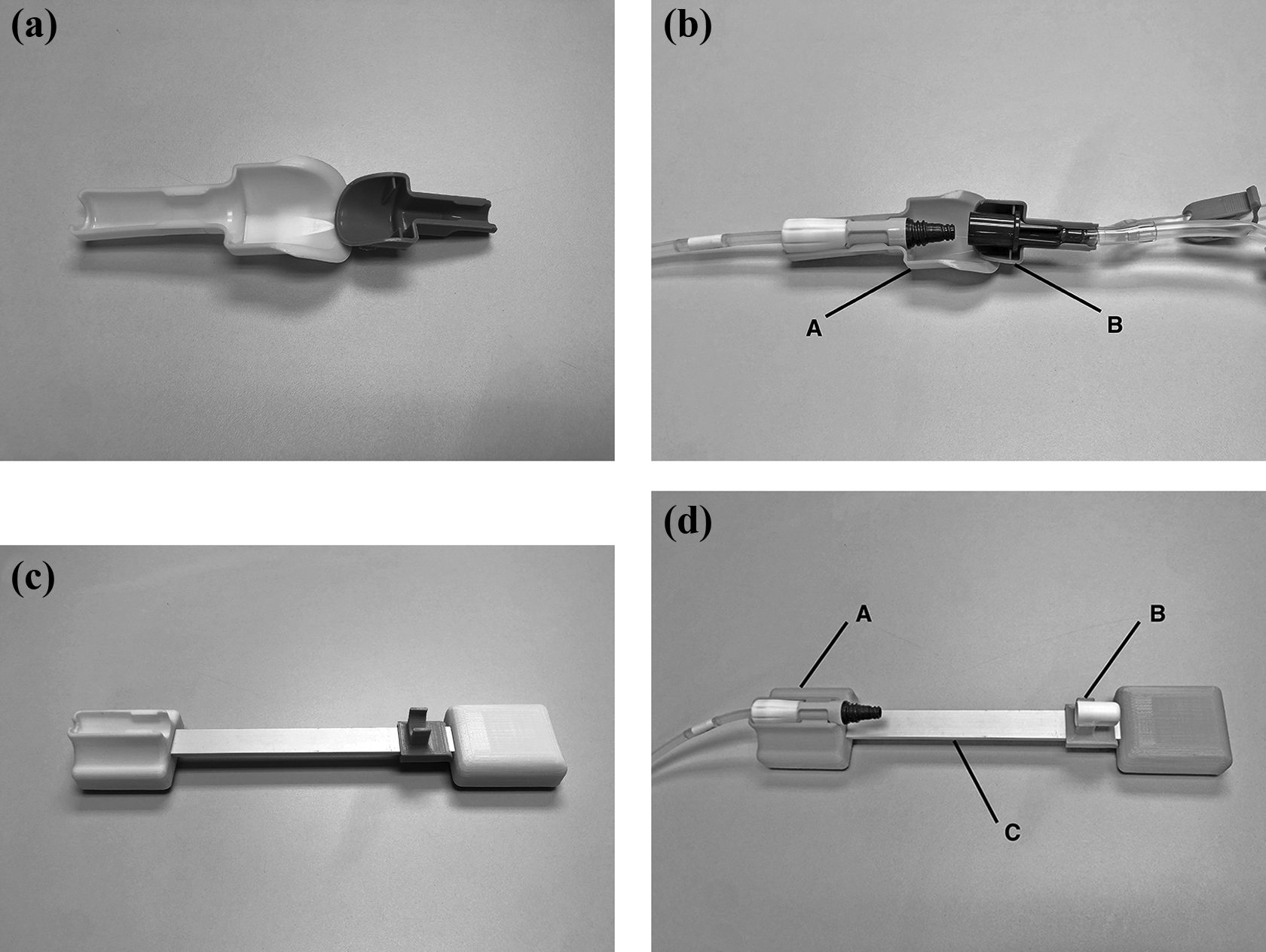
(a) Photograph of the first component of the device. (b) Two spoon-like plastic models, fitted to the transfer set of the PD catheter (A) and the tubing of the PD fluid set (B), provide mechanical guidance during connection. (c) Photograph of the second component of the device. (d) Two plastic holders, fitted to the transfer set of the PD catheter (A) and a new sterile cap (B), attached to a metallic rail (C), provide mechanical guidance for the application of sterile cap after disconnection. PD: peritoneal dialysis.
Pre-dialysis assessment, CAPD training and follow-up
All patients who were planning to start PD underwent pre-dialysis assessment by renal nurses, during which those with impaired hand–eye function were identified via simulated PD trials with special focus on the critical connection step. These patients were further evaluated by occupational therapists, and those who became able to manage the connection step after using the connection device were prescribed device-assisted CAPD. Those who still failed to manage the connection step with the device were arranged to undergo assessment for helper-assisted PD. PD training was then proceeded with formally adapted materials and instructions. All patients received an initial CAPD prescription of 2 L of PD dialysate with three exchanges per day. After the completion of PD training, they received home visits, follow-up consultations and a 24-h telephone hotline support in the same manner and frequency as that for other CAPD patients who do not require assistance. Weekly total Kt/V was monitored regularly for all patients; those with weekly total Kt/V below 1.7 were advised to increase their total daily PD exchange volume and were offered long-term HD if PD exchanges were already maximised.
Collection of data
Clinical data were retrieved from electronic patient records and chart reviews. Retrieved data included age, sex, primary kidney disease, serum albumin levels, haemoglobin levels, residual kidney function, age-adjusted Charlson comorbidity index (ACCI), pre-existing diabetes mellitus (DM), dementia, malignancies which were active or within 5 years of curative treatment, history of cardiovascular diseases and the use of immunosuppressants. Subsequent progress including the development of peritonitis, the interruption, resumption and termination of PD, and mortality were recorded. PD-related peritonitis, peritonitis rate and peritonitis-related deaths were defined and reported in accordance with International Society for Peritoneal Dialysis (ISPD) guideline issued in 2016. 3 PD discontinuation, formerly termed technique failure, was defined as the permanent cessation of PD due to any PD-related complications, including peritonitis-related deaths. 1 For the purpose of this study, it is a composite outcome comprising a permanent transfer to HD and peritonitis-related death.
Study outcomes and statistical analysis
The primary outcome was the peritonitis rates of patients who underwent device-assisted CAPD and helper-assisted CAPD. In cases where the mode of KRT was switched to in-centre intermittent PD or HD for more than 30 days, or where the mode of PD assistance was changed, the involved period of time and the peritonitis episodes occurring therein were excluded in the computation of the peritonitis rates. Secondary outcomes included the distribution of peritonitis causative organisms, organism-specific peritonitis rates, time on PD therapy and patient survival. Kidney transplantation, transfer to other centres and termination of KRT were censored events in analysing time on PD therapy and patient survival; permanent switches from the original mode of PD assistance to either other modes of PD or to long-term HD were additional censored events in analysing peritonitis-free survival.
Categorical variables were compared by the Pearson chi-square test or Fisher’s exact tests, while non-parametric continuous variables were compared by the Mann–Whitney U test. Counts data and incidence rate ratio were tested by Poisson regression or negative binomial regression. Survival analyses were performed by log-rank test, Kaplan–Meier curve and the Cox proportional hazards model. A p value of less than 0.05 was considered statistically significant. All statistical analyses were done with IBM SPSS Statistics 23.
Results
Baseline characteristics
A total of 172 patients were included for analysis. Eighty-six patients were in the device-assisted group and 86 patients had helper-assisted CAPD (controls) (Figure 1; Table 1). The median duration of follow-up was 910 (609–1299) and 884 (525–1340) days in the device-assisted and helper-assisted groups, respectively. There were no missing data. The two groups showed comparable baseline clinical characteristics except for serum albumin level (35.6 ± 5.5 g/dL vs. 37.9 ± 4.4 g/dL, in device-assisted and helper-assisted groups respectively, p = 0.004).
The baseline clinical characteristics of patients who received device-assisted or helper-assisted CAPD.

RKF: residual kidney function; ACCI: age-adjusted Charlson comorbidity index; DM: diabetes mellitus; PKD: polycystic kidney disease; CVD: cardiovascular disease; FU: follow-up; CAPD: continuous ambulatory peritoneal dialysis.
a Results are expressed as mean ± standard deviation.
b Results are expressed as number (%).
c Results are expressed as median (interquartile range).
Peritonitis
During the follow-up period, 104 and 114 episodes of peritonitis episodes occurred in the device- and helper-assisted groups, respectively. There was no significant difference in the peritonitis rates between the two groups (0.489 and 0.504 episode per patient-year in the device- and helper-assisted groups, respectively, p = 0.814). There was also no difference in the overall distribution of causative organisms and organism-specific peritonitis rates (Table 2). The device-assisted group showed numerically longer peritonitis-free survival than the helper-assisted group though not reaching statistical significance (2.58 (1.85–3.31) vs. 1.78 (0.68–2.88) years, p = 0.363) (Figure 3(a)). The rates of peritonitis-free survival were 69%, 41% and 17% at 1, 3 and 5 years in the device-assisted group, and were 60%, 42% and 18% in the helper-assisted groups.
Incidence of peritonitis and organisms involved in patients who received device-assisted or helper-assisted CAPD.

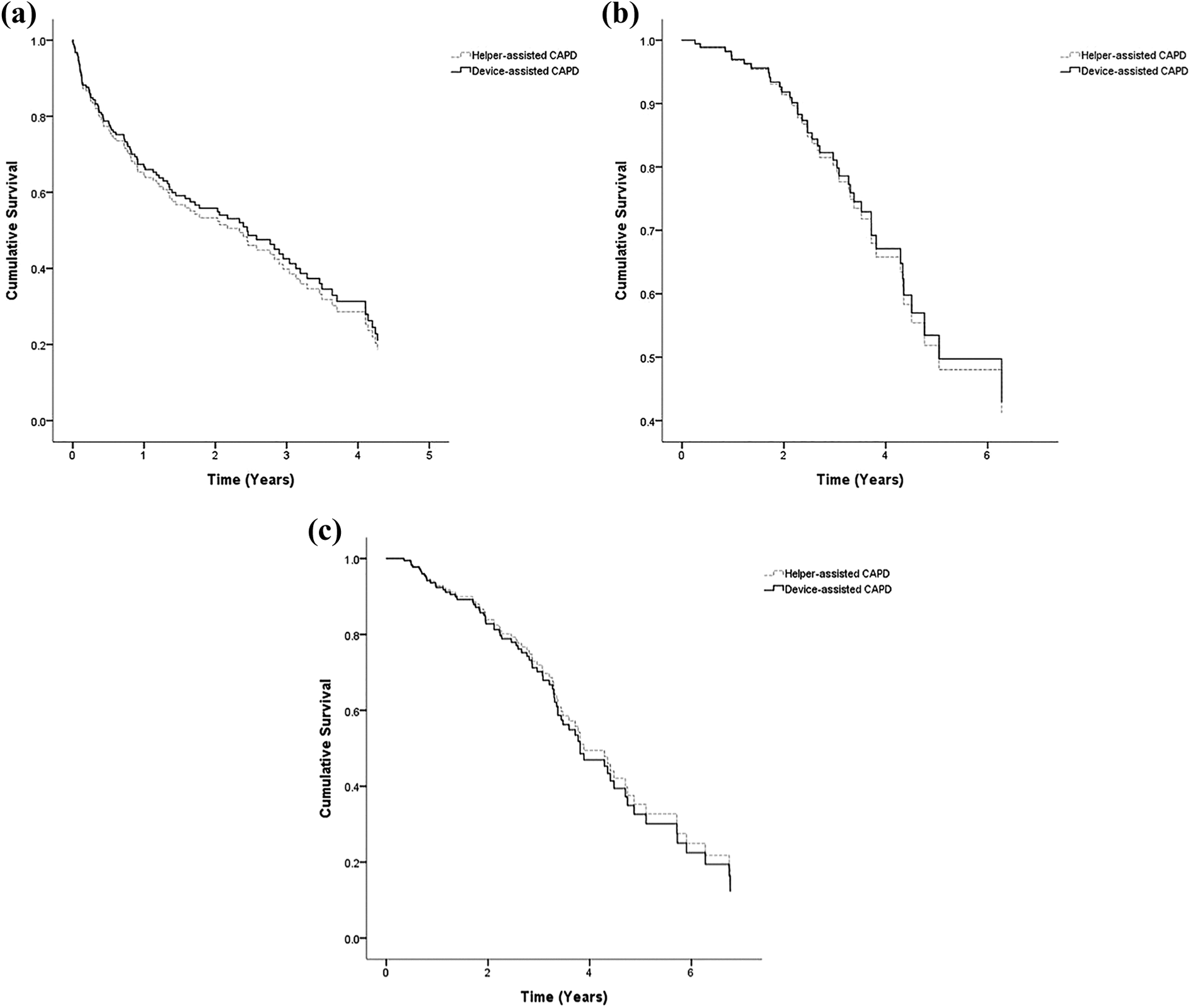
Peritonitis-free survival (panel (a)), time on PD therapy (panel (b)) and patient survival (panel (c)) in patients receiving device-assisted and helper-assisted CAPD. CAPD: continuous ambulatory peritoneal dialysis.
PD discontinuation
Eighteen (20.9%) and 21 patients (24.4%) developed PD discontinuation in the device-assisted group and the helper-assisted group, respectively. The device-assisted group showed a numerically longer time-to-PD discontinuation than the helper-assisted group though not reaching statistical significance (6.27 (3.65–8.90) vs. 4.35 (3.48–5.23) years, p = 0.677) (Figure 3(b)). The rates of PD discontinuation-free survival were 97%, 76% and 60% at 1, 3 and 5 years in the device-assisted group, and were 96%, 86% and 47% in the helper-assisted groups. Peritonitis was the leading cause of PD discontinuation in both the device-assisted group (17 patients, 94.4%) and the helper-assisted group (20 patients, 95.2%); the other cause in both groups was ultrafiltration failure.
Patient outcomes and survival
A summary of the outcomes at 1 year and at 3 years is shown in Supplementary Table 1. At 1 year, 68 (79.1%) and 75 (87.2%) of the patients in the device- and helper-assisted groups remained on the original mode of PD assistance. The number of patients who remained on the same assisted mode of PD decreased to 31 (36%) and 38 (44.2%) in the device-assisted group and the helper-assisted group, respectively, after 5 years of follow-up. The device-assisted group showed higher incidence of conversion to long-term HD (10.5% vs. 7.0%) and kidney transplantation (4.7% vs. 0%), but lower rates of termination of KRT (0% vs. 1.2%) and death (30.2% vs. 46.5%) compared with the helper-assisted group. Eleven patients (12.8%) switched from device-assisted CAPD to helper-assisted CAPD during the follow-up period– six because of cognitive decline, three because of deterioration in mobility and two because of worsening vision. The median patient survival was comparable between the two groups (3.89 (2.22–5.55) years vs. 3.81 (3.27–4.36) years in the device- and helper-assisted groups, respectively, p = 0.505) (Figure 3(c)). The rates of patient survival were 93%, 71% and 45% at 1, 3 and 5 years in the device-assisted group, and were 92%, 70% and 27% in the helper-assisted groups. PD-related deaths were less common among peritonitis episodes in the device-assisted group, with 7 episodes (6.7%) in the device-assisted group vs. 15 episodes (13.2%) in the helper-assisted group, p = 0.116.
Discussion
Our current data suggested that device-assisted CAPD is a viable alternative to helper-assisted CAPD for some patients who were unable to perform CAPD by themselves due to impaired hand–eye functions. This study demonstrated that device-assisted CAPD has similar peritonitis rates, peritonitis-free survival, time on PD therapy and patient survival when compared to helper-assisted CAPD.
For patients with impaired hand–eye functions, the most important concern in self-performing CAPD is the risk of PD-related peritonitis. Indeed, our present findings showed that these patients, when assisted by the device developed by our unit, can achieve comparable peritonitis rates as helper-assisted CAPD. Furthermore, device- and helper-assisted CAPD showed no significant differences in the distribution of peritonitis causative organisms and organism-specific peritonitis rates. While the device-assisted group showed a non-significant higher numerical fungal peritonitis rate, fungal peritonitis is not classically associated with the PD connection procedure. The device-assisted group showed a numerically longer peritonitis-free survival than the helper-assisted group; this difference did not reach statistical significance possibly due to a relatively small sample size. While both groups demonstrated a higher peritonitis rate than our overall centre average of 0.272–0.422 episodes per patient-year during the study period, in line with their inherent disadvantage compared to those with normal hand–eye function, the peritonitis rate in the device-assisted group was 0.489 episode per patient-year, fulfilling the ISPD standard of <0.5 episode per patient-year. 3 Such encouraging results may be related to the design of the device, which targets specifically at patients with impaired hand–eye function to avoid contamination during PD exchange. Our experience also suggests that successful implementation of device-assisted CAPD requires careful evaluation of patients during pre-dialysis assessment and proper training by allied healthcare professionals such as renal nurses and occupational therapists. Other connection devices to assist PD have recently been developed by other groups and are received with positive feedback from patients 19,20 ; long-term outcomes with their use have not been reported. Compared to them, our device has the additional advantages of being fully functional without the need of power supply, as well as being fully reusable without the need for disposable or battery. We also observed no difference in time on PD therapy and patient survival between the two groups, which are both important long-term clinical outcomes in PD patients. The device-assisted group tended to show numerically longer time-to-PD discontinuation, but again the results did not reach statistical significance, possibly related to the small sample size of patients. While the majority of patients could remain on device-assisted CAPD at 1 year, the number reduced substantially to only 36% at 5 years. This suggests that many patients exhibit rapid decline in hand–eye and cognitive functions and could not perform CAPD even with the assistance of the connection device. In this context, accelerated deterioration in cognition and high prevalence of hand–eye functions have been observed in dialysis patients. 21 –23
PD is an effective modality of KRT that is associated with low treatment costs and better preservation of residual kidney function. Indeed, PD is growing steadily in different countries, particularly in the Asia-Pacific regions. 1 With ageing population, one would expect a rising number of elderly patients with kidney failure who have impaired hand–eye functions or dexterity. Our present data substantiate the use of device-assisted CAPD in patients who have difficulty in engaging helpers for PD. Other advantages of device-assisted PD include empowerment and freedom for the patients, the relief from helper duties for the family members with employment and quality of life implications, as well as the avoidance of the costs of domestic helpers or nursing homes. While a connection device may facilitate PD exchange, telecare by means of video-dialysis may also be an emerging strategy to aid unfit patients to perform PD. 24
Our study has several limitations. It is retrospective in nature and its sample size is relatively small. There was no quantitative assessment for functional status or hand–eye function to compare the two groups at baseline, while occupational statuses and user-based outcomes were not collected. Nevertheless, our study was the largest series by far, reporting on the long-term outcomes of device-assisted CAPD in a locality where PD is the predominant modality of KRT. Future prospective study is worthwhile to compare the short- and long-term outcomes of PD assisted by this connection device or helpers.
Conclusions
Device-assisted CAPD shows comparable outcomes to helper-assisted CAPD and is a viable option in patients with impaired hand–eye functions.
Supplemental material
Supplemental Material, sj-docx-1-ptd-10.1177_08968608221085430 - Device-assisted continuous ambulatory peritoneal dialysis: A single-centre experience
Supplemental Material, sj-docx-1-ptd-10.1177_08968608221085430 for Device-assisted continuous ambulatory peritoneal dialysis: A single-centre experience by Wai Lun Will Pak, Ka Lok Chan, Zi Chan, Yick Hei Wong, Wai Ping Law, Chi Kwan Lam and Sze Ho Sunny Wong in Peritoneal Dialysis International
Footnotes
Acknowledgements
We thank the Occupational Therapy Department of United Christian Hospital for co-developing the connection device.
Author contributions
Dr. Wai Lun Will Pak drafted the article; Dr. Sze Ho Sunny Wong approved the version to be published; all named authors were involved in the acquisition and interpretation of data.
Declaration of conflicting interests
The author(s) declared no potential conflicts of interest with respect to the research, authorship, and/or publication of this article.
Ethical approval
Ethical approval for this study was obtained from Research Ethics Committee (Kowloon Central/Kowloon East), reference number: KC/KE-19-0006/ER-2.
Funding
The author(s) received no financial support for the research, authorship, and/or publication of this article.

Informed consent
Not applicable.
Trial registration
Not applicable.
Supplemental material
Supplemental material for this article is available online.
References
Supplementary Material
Please find the following supplemental material available below.
For Open Access articles published under a Creative Commons License, all supplemental material carries the same license as the article it is associated with.
For non-Open Access articles published, all supplemental material carries a non-exclusive license, and permission requests for re-use of supplemental material or any part of supplemental material shall be sent directly to the copyright owner as specified in the copyright notice associated with the article.
