







Abstract
Life participation has been identified as a critically important core outcome to be reported in all trials in people receiving peritoneal dialysis (PD). Life participation is defined as the ability to participate in meaningful activities such as work (e.g. employment, housework, study), family, social (e.g. time with friends) and leisure (travel, hobbies, exercise) activities. However, life participation is rarely and inconsistently reported in trials in PD. The standardised outcomes in nephrology-life participation (SONG-LP) instrument was validated in adult kidney transplant recipients and demonstrated internal consistency and test–retest reliability. In this article, we outline the rationale and process for validating the SONG-LP instrument in people receiving PD.
Keywords
Introduction
People receiving peritoneal dialysis (PD) require multiple daily or overnight fluid exchanges and can often experience complications (e.g. infection) and debilitating symptoms (e.g. pain, cramping, fatigue and abdominal fullness). 1 These challenges can impair quality of life and limit patients’ ability to engage in daily life activities. Through a consensus workshop and surveys involving 999 people receiving PD, their caregivers and health professionals across 70 countries, life participation was identified as a critically important core patient-reported outcome to be included in the core outcome set established through the global standardised outcomes in nephrology-peritoneal dialysis (SONG-PD) initiative.2–4 As a result, achieving person-centred care that is respectful and responsive to an individual's life goals and values is a highly prioritised area for kidney disease researchers internationally.
In this context, life participation is defined as the ability to participate in activities that are meaningful to patients, such as work (employment, housework, study), family, social (time with friends) and leisure (travel, hobbies, exercise) activities. 3 Of note, the International Society for Peritoneal Dialysis guideline recommends that the prescription of PD should be goal-directed with the aim of maximising quality of life and satisfaction of the individual, 5 which are critically important for delivering person-centred care. 6 However, despite the importance of life participation to patients and healthcare providers, it is infrequently and inconsistently reported in trials in PD. There are 42 measures used to capture aspects of life participation, but all of these were designed to measure life participation as a construct of health-related quality of life, and not specifically validated for PD. 7 There is, therefore, a need to validate a brief, generalisable and broadly implementable instrument that is specific to life participation and captures what is meaningful to people receiving PD. In this article, we provide the justification and process for validating the standardised outcomes in nephrology-life participation (SONG-LP) instrument in people receiving PD.
Existing measures of life participation: The need for a specific validated patient-reported outcome measure for life participation in people receiving PD
A systematic review of life participation measures in people receiving PD identified 89 trials and 212 observational studies where life participation was assessed. A total of 42 different measures were used to assess life participation, with most including life participation as an item or sub-scale within a broader quality of life instrument rather than being a dedicated life participation measure. 7 Results showed wide diversity in both the measurement tools and content. Fifteen (36%) measures were designed with components assessing participation in life activities, whilst the other 27 (64%) assessed quality of life, health status or psychological well-being. The most frequently used instruments included the 36-item short-form health survey (SF-36; 122 studies), the Kidney Disease Quality of Life-Short Form (KDQOL-SF; 86 studies) and the European Quality of Life 5-Dimension scale (EQ-5D; 27 studies). None of the instruments were specifically developed nor validated in the PD population. A comparison of these measures to the SONG-LP is outlined in Table 1.
Suggestions for life participation measure design from the SONG-PD life participation core outcome measure workshop. 3
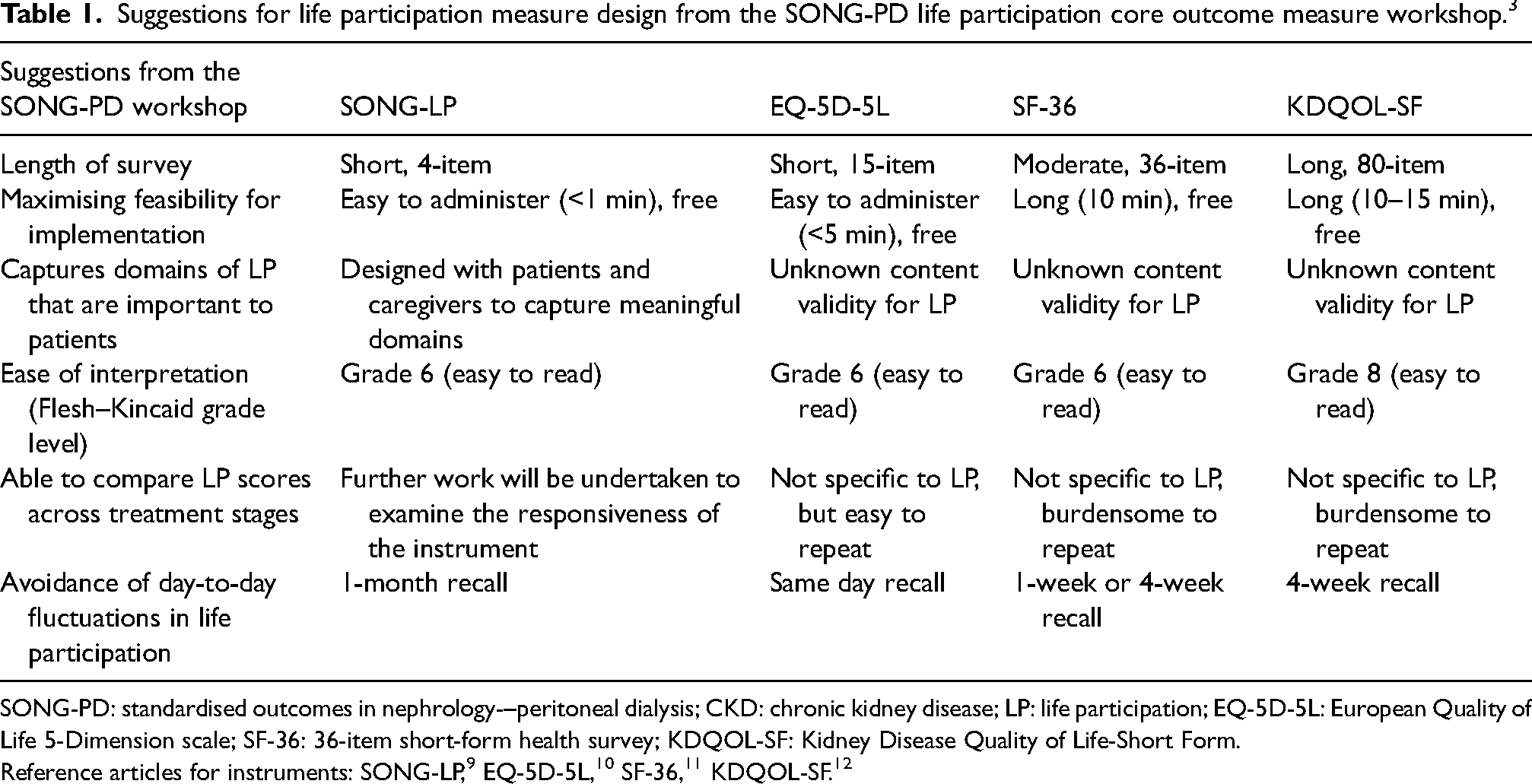
SONG-PD: standardised outcomes in nephrology-–peritoneal dialysis; CKD: chronic kidney disease; LP: life participation; EQ-5D-5L: European Quality of Life 5-Dimension scale; SF-36: 36-item short-form health survey; KDQOL-SF: Kidney Disease Quality of Life-Short Form.
The SF-36 is a widely used 36-item questionnaire that assesses health-related quality of life. It evaluates physical functioning, role limitations due to physical and emotional health, pain, general health perception, energy, social function and emotional well-being. Although it has demonstrated good construct and content validity, 8 it takes about 10 min to complete. The KDQOL-SF is an 80-item questionnaire that assesses the effect of kidney disease treatment and symptoms on emotional well-being, activities of daily living, social engagement, family activities, ability to work, sex and sleep. It also assesses general health perception and satisfaction with care. Whilst it is validated in people receiving PD, it takes 15 min to complete. The SF-36 and KDQOL-SF are not dedicated life participation measures, and their longer completion time could be an obstacle to widespread uptake if they were recommended for use in all PD trials and fell short of the expectations of participants in the SONG-PD life participation workshop. 2 The EQ-5D-5L is a 16-item questionnaire (<5-min completion time) covering five domains: mobility, self-care, usual activities (work, study, family), pain/discomfort and anxiety/depression. The item is brief and easy to complete and therefore broadly implementable. Whilst the EQ-5D-5L is validated in the kidney disease population, life participation is only assessed within the broader context of the instrument. The EQ-5D-5L content validity for assessing life participation is unclear as it does not specifically assess the domains of life participation that are now recognised to be meaningful in people with kidney diseases. 13 Other measures that assessed life participation varied in terms of cost, content, availability of psychometric data and time to completion, and did not measure life participation as its own construct. The content of these measures was heterogenous, and uncertainty exists regarding the content validity for assessing person-important life participation domains for people on PD. Only eight (19%) of the 42 measures contained some validation data for the PD population. These results demonstrate the need to validate a measure that has low respondent burden (i.e. short (<5 items), easy to complete), and that assesses relevant and important content with regards to life participation that reflects the priorities of patients.
Justification for the SONG-LP instrument
A SONG-PD life participation consensus workshop was convened to inform the selection of a core patient-reported outcome measure (PROM) for life participation for people receiving PD. This online workshop involved 56 participants (including 17 people receiving PD and caregivers) from 15 countries and was held on the 8th of September 2020. Six online breakout groups were given the task of identifying content, validity and feasibility characteristics of a potential measure of life participation. Participants emphasised the importance of ensuring that the life participation measure was brief, reflected flexibility and freedom, was broadly applicable to a range of cross-cultural patient groups, incorporated the capacity to capture changes across treatment modalities (understanding patient journey rather than defining patients by their treatment) and focused on feasibility to ensure maximal implementation. 13
The SONG-LP measure is a specific life participation assessment tool that was created through adaptation of the Patient-Reported Outcomes Measurement Information System (PROMIS) ‘Ability to Participate in Social Roles and Activities-Short Form 4a’ (PROMIS-APS) in consultation with people with kidney transplants and their caregivers. 14 The SONG-LP measure has since been validated in people with kidney transplants, demonstrating psychometric robustness in this population.9,14 The instrument includes four items relating to work, family activities, leisure activities and social activities, and is easy to complete (Figure 1). The instrument aligns with the SONG-PD life participation consensus workshop recommendations for the design of life participation measurement (Table 1). Firstly, participants suggested that the life participation measure be short, consistent and easy to complete. The SONG-LP measure takes less than a minute to complete, thereby improving feasibility and likelihood of broad implementation as a core outcome measure (i.e. to be used in all PD trials). Secondly, the SONG-LP instrument is specific to this construct, having been co-developed with patients and caregivers to assess and capture meaningful domains of life participation compared with other available quality of life measures. 3 Thirdly, the tool was designed at a Flesh–Kincaid readability grade of 6, which is categorised as easy to read. 9 Finally, using the same core PROM for life participation across CKD treatment stages and modalities will facilitate comparisons and evaluation of longitudinal changes over time.
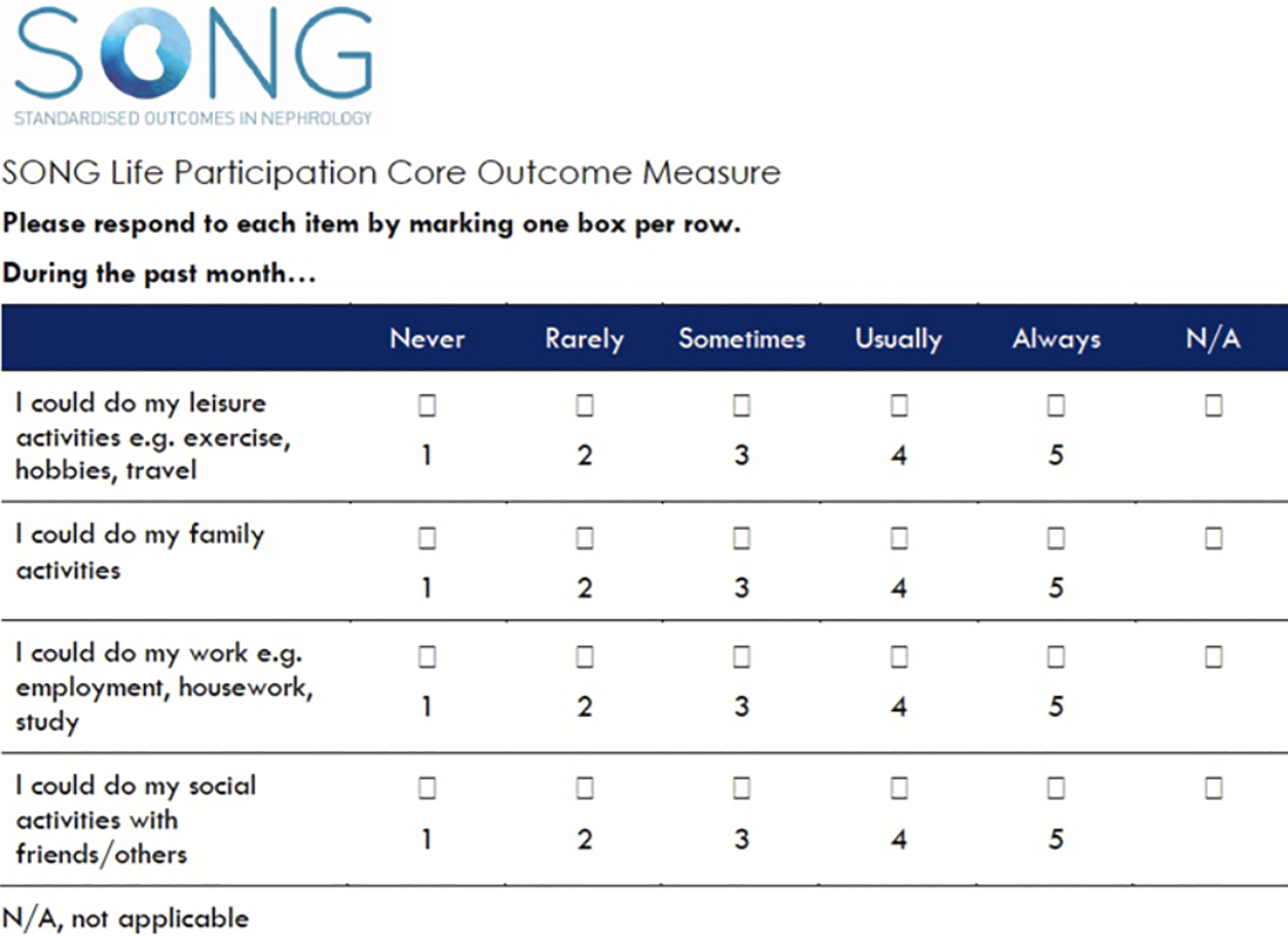
SONG life participation measure instrument.
Validation framework for the SONG-LP measure
The SONG-LP measure's performance will be assessed using a similar psychometric framework and criteria to those outlined by the SONG-LP transplant validation study. 9 The SONG-LP selection and validation are being undertaken using the Consensus-based Standards for the selection of health Measurement Instruments (COSMIN) and the Core Outcome Measure in Effectiveness Trials (COMET) initiative guidelines. 15 The COSMIN/COMET checklists include general recommendations (i.e. aim, target population, feasibility for implementation) and nine measurement criteria – content validity, construct validity, internal consistency, cross-cultural validity, reliability, measurement error, criterion validity, hypothesis testing (for construct validity) and responsiveness. 16 An overview of the process of selecting and validating the SONG-LP measure in people on PD is outlined in Figure 2.
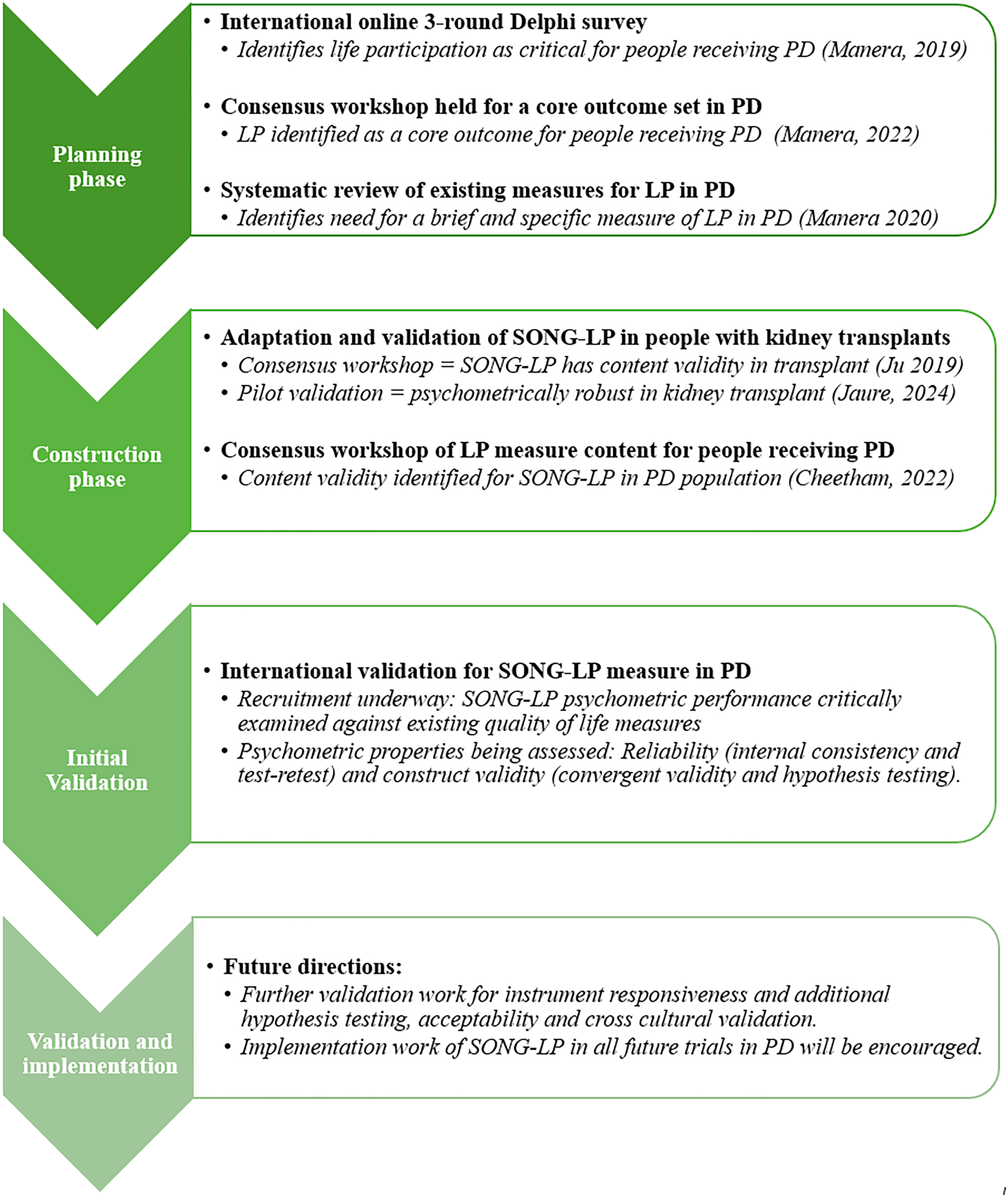
Process for selection and validation of the SONG-LP measure in PD. SONG: standardised outcomes in nephrology; PD: peritoneal dialysis; LP: life participation.
Content validity, or face validity, in this context refers to the extent to which each of the SONG-LP question items assesses content that is important and relevant for life participation in people receiving PD. This work has already been completed for people receiving PD, is outlined in Table 1 and has been published elsewhere. 3 Construct validity refers to the extent to which a test accurately assesses the theoretical construct it is designed to measure. 17 Construct validity of the SONG-LP will be established primarily through statistical assessment of convergent validity and hypothesis testing. Convergent validity here refers to the extent to which the SONG-LP scores for each domain of life participation correlate with the question item scores of similar, different instruments (i.e. PROMIS-APS, EQ-5D) for each participant during the validation process. 18 Hypothesis testing will then be undertaken to demonstrate that changes in the SONG-LP instrument score correlate with expected outcomes in the PD population, that is, those who started PD recently (<3 months) may be anticipated to have lower life participation scores than those who have been on PD longer. Both convergent validity and hypothesis testing will help to ensure that each of the SONG-LP item questions are useful and measure what the instrument is designed to capture. The survey will be repeated at 1 week to determine the test–retest reliability. Robust test–retest reliability of the SONG-LP measure will support the precision of its measurement of life participation. However, further work will be needed longitudinally to strengthen evidence of the SONG-LP instruments responsiveness to life participation changes across treatment stages and transitions, which was prioritised as a key characteristic of any life participation measure during the SONG-PD life participation core outcome workshop. 13 Initial validation work of the SONG-LP measure in people receiving PD is currently underway via a global online survey through the REDCap platform, a secure web-based application for survey and database management. English-speaking people receiving PD, who are over 18 years of age and able to complete online surveys are being recruited internationally via broad dissemination (mail lists, support groups, social media, SONG working groups, support foundations). Based on the outcomes of this initial validation, subsequent efforts will focus on assessing the instrument's responsiveness to different treatment modalities and life changes. This will include further hypothesis testing and establishing cross-cultural validity through both forward and backward translation and validation in non-English speaking populations.
Future directions
The initial validation of the SONG-LP instrument as a core outcome measure for people receiving PD has commenced and will be completing in 2025. The validation is being undertaken via an online international questionnaire. Central ethics approval has been obtained by the University of Sydney with ratification from the University of Queensland. Identifying a core PROM for people receiving PD can help to ensure that trials consistently report life participation and strengthen the evidence base for decision-making around this critically important outcome. 5 If the SONG-LP measure is validated for use, we will aim to apply implementation tools such as the acceptability of intervention measure to ensure its acceptability and adherence to the needs of people receiving PD.
Footnotes
Acknowledgements
We acknowledge the contribution of patients, families, caregivers and health professionals involved in previous surveys and workshops that have contributed to the work referenced in this report.
Author contributions
CTB drafted the manuscript. All authors reviewed and accepted the final revision of the manuscript.
Declaration of conflicting interests
The authors declared no potential conflicts of interest with respect to the research, authorship, and/or publication of this article.
Funding
The authors disclosed receipt of the following financial support for the research, authorship and/or publication of this article: YC (APP2009309), RLM (APP1194703) and KM (APP2008774) are recipients of the Australian National Health and Medical Research Council (NHMRC) Emerging Leadership Investigator Grant. AJ (APP1106716) and DWJ (APP1194485) are recipients of NHMRC Leadership Investigator Grants. MC and YC are current recipients of a Queensland Advancing Clinical Research Fellowship. The funding organisation had no role in the design, conduct, interpretation, preparation, review or approval of the article.
Informed consent to publish
All authors have reviewed the manuscript and consent to the publication of this manuscript.
