







Abstract
Despite the defunding and shuttering of many language courses and departments in public American universities, offerings deemed ‘critical’ to security and military interests have seen a dramatic rise since 11 September 2001. These courses are largely populated by Reserve Officers’ Training Corps (ROTC) learners interested in career advancement and payment through military stipends for course enrollment and ‘heritage’ learners interested in deepening their familial connections and cultural identities as expressed through language. Drawing on nine months of participant-observation and interviews in one such course, the author identifies three locally constructed symbolic boundaries (us/them; soldier/civilian; white/non-white) used by students to reflect unequal identities and classroom experiences. Findings suggest that the federally-funded American critical language classroom can serve as a domestic stage upon which ROTC students may informally ‘try on’ militarized identities vis-à-vis classmates who are sartorially, spatially, culturally, and racially cast as native-civilian others.
Introduction
As part of a larger project of asymmetrical, disproportionate austerity measures across public life in the USA, divestment in public education and the specific targeting of ethnic studies and humanities departments have constrained existing coursework opportunities for heritage learners of varied backgrounds (e.g. French, German, Japanese, and Russian-speaking) in university settings (Foderaro, 2010). Concurrently and in accordance with the gross expansion of militarization and security directly following September 2001, opportunities for other heritage language learners – those of Arab, Chinese, and Persian descent – have increased dramatically through ‘critical language’ courses funded by Title VI monies from the Department of State (Cincotta, 2009). Research on the phenomena of heritage language learning (Feuerverger, 1994; Lee, 2002) and military expansion into the university (Armitage, 2005; Giroux, 2008; Golden, 2002; Lutz, 2002; Newfield, 2006; Oppenheimer, 1973) have been examined separately; no scholarly or critical work has yet to analyze the points at which these two phenomena collide. Using theories of narrative identity and symbolic boundaries, I advance a micro-analysis of present-day university ‘critical language’ classrooms as a timely, significant, and instructive quasi-political arena in which unequal identities among college undergraduates find stark relief. This analysis contributes both to a growing body of literature on militarized social institutions in an era otherwise characterized by state divestment from public life, and emergent research on how macro-level social inequalities are perpetuated through micro-interactional exchange.
I first offer a brief history of how critical language course offerings – pervasive since the Cold War and dramatically expanded in the post-9/11 era – have grown in a time of fiscal retrenchment in higher education, highlighting the longstanding relationships between language and area studies and the Department of State (US Office of Postsecondary Education, 2011). This relationship lays the groundwork for the expansion of certain language course offerings across a variety of institutions in higher education, such as the fieldsite for this research: a medium-sized publicly-funded American university which offers six successive semesters of Persian language instruction. I follow with a brief summary of scholarship on heritage language learning and the acquisition of heritage language as a wide-reaching, robust phenomenon that drives processes of political subjectivity and identity among second- and third-generation minority youths (Mazzocco, 1996).
I then describe and analyze a range of observed micro-level interactions among 30 students across one academic year (~150 hours) in a university Persian classroom. I specifically address interactions between heritage learners (that is, students with culturally-based familial ties to the Persian-speaking world) and non-heritage learners, such as ROTC students on military stipends and linguistics and area studies majors, while paying special attention to dynamics of space, place, and power between the mostly white, European-American military learners and racially ambiguous (Farnia, 2011; Tehranian, 2008) Iranian-American heritage learners. These groups are by and large distinct and non-overlapping populations in the critical language classroom. 1 I additionally draw upon extended, one-on-one retrospective interviews with a cross-section (10) of enrolled students, all of whom completed the course for academic credit (and, in some cases, military stipend) for additional insight into how these observed interactions are experienced and interpreted by the participants themselves. Findings from the case reveal a significant symbolic boundary (us/them) which separate ROTC learners from heritage learners. The boundary of us/them is reinforced and maintained by two additional locally-constructed binaries (solider/civilian and white/non-white) which structure unequal identities and educational experiences. 2 Forged through micro-interaction but reflective of broader societal tensions, the binaries fix and cement what are in fact liminal identities (‘soldier’ for not-yet-deployed ROTC students and ‘non-white’ for racially ambiguous Iranian students), consecrating them into legible and inflexible categories in real time and on the ground.
From Humanities to Defense: ROTC and the Rise of the ‘Critical Language’ University Classroom
Military research and the propagation of military-friendly values at public universities have bloomed in the wake of 9/11 (Armitage, 2005; Giroux, 2008; Golden, 2002; Lutz, 2002; Newfield, 2006). Campus programming earmarked for military personnel includes the Reserve Officers’ Training Corps (ROTC) which has seen a 27 percent increase in participation between 2007 and 2011, and attendant ‘Peace and Security Studies’ programs housed in departments of International Relations, Global Studies, and Social Science. As part of this larger trend, new ‘critical language’ departments and course offerings have also expanded (Capriccioso, 2006). Whether in the service of global economic interests (e.g. Chinese, contemporarily, and Japanese less recently) or strategic military and border-policing interest (e.g. Arabic, Korean, Pashtu, Persian, and Spanish), programs and departments in these areas have experienced a decade of increased federal and institutional support (Graham, 2006). With the exception of Spanish and the Spanish-speaking world – which I include here due to the militarized and paramilitarized border Mexico shares with the US – these languages map neatly onto contemporary military agendas and geo-political spheres of perceived terror. As the Critical Languages program at the University of Maryland describes their mandate, ‘the countries where these things [sic] are spoken are enormously different from the US and the most “critical” ones do not have very good (or anyway very stable) relationships with the US’ (Branner, 2005).
The necessary resources for such large-scale ‘critical’ language programming have long been tied to federal funding structures. Title VI, a primary vehicle for funneling federal monies into domestic-based critical language and area training, was first introduced in 1958 as part of the National Defense Education Act (NDEA) with the post-Cold War goal of creating expertise in Russian language and cultures. As summarized by the US Office of Postsecondary Education, ‘NDEA aimed to ensure trained manpower of sufficient quality and quantity to meet the national defense needs of the United States’ (2011: 1). In the years following, ‘Cold War relationships have given way to new alignments and priorities [and] Title VI has changed and expanded in response’ (UC Berkeley International and Area Studies, 2009). After the 9/11 Commission reported that only six graduates of any American universities earned Arabic language degrees in 2002, federal funding was immediately redirected into university programs in ‘Arabic, Farsi [Persian], and other languages considered critical to counterterrorism investigations’ (Smith, 2004). In the specific case of Persian language courses, in the four years directly following 11 September 2001, Persian course enrollment in US universities increased by more than 90 percent to almost 2300 enrollees, in line with enrollment growth in Arabic (127%) and Chinese (51%) from 2002 to 2006 (Cincotta, 2009). 3
With the rise in military and critical language programming, significant efforts have launched to increase critical language learning among the ranks of the ROTC. The US Army, Air Force, and Navy initiated Project GO (‘The ROTC Language & Culture Project’) in 2007. A collaborative initiative with a significant social media presence that directs funds to university campuses and enrolled military personnel, Project GO promotes critical language education, study abroad, and ‘intercultural dialogue opportunities’ for ROTC students. As with other critical language programs, Project GO programs focus exclusively on the ‘critical’ languages and countries of the Middle East, Asia, Central Asia, and Africa. As in this fieldsite, Project GO is also an instrument through which stipends for the study of critical languages (ranging from US$100–$200 per month) are distributed to ROTC students through the ‘Culture and Language Incentive Pay-Bonus’ known as CLIP-B. Though critical language training is not a requirement of the ROTC program, stipend aside, the language commitment and expertise increases a candidate’s competitiveness for military scholarships, appointments, and mobility within the organization (Army News Service, 2008). Yet despite the instrumental, defense-minded allocation of resources which enable these course offerings to exist, heritage language learners – that is, non-ROTC minority and/or immigrant students with an interest in language acquisition, ethnic identity, and cultural heritage – also populate these classrooms, albeit without monetary stipends and with very different goals from their military-sponsored classmates.
Heritage Language Learning in Contested, Militarized Space
The acquisition, proficiency, and preservation of minority languages remains a cornerstone of political and cultural emancipation struggles in global and local contexts (Henze and Davis, 1999; Markert, 2010; Robinson, 1992). For minority/immigrant youth, learning a ‘heritage’ language in formal and informal settings can engender experiences of intellectual, social, and spiritual empowerment (Kondo-Brown, 2006). The typical definition of a ‘heritage language learner’ (HLL) in linguistics and education hinges on proficiency-based versus identity-based logics. Historically, HLL status is ascribed to an individual when there exists: 1) previous partial or incomplete acquisition of the heritage language in the home; and/or 2) previous exposure to the ‘culture of inheritance’ (Spiro, 1951). Thus, ‘heritage learners’ are categorically distinct from bilinguals or native speakers. For the purposes of this article, I use Carriera’s (2004) definition: [heritage language learners] have identity and/or linguistic needs that relate to their family background. [They are] studying the language to feel connected to their roots, or, to participate more fully in the life of their HL community and contribute to the preservation of its beliefs and practices … to communicate with family members, travel to their country of origin, or overcome feelings of being an outsider. (2004: 18)
In contrast to heritage learners, second-language learners are defined by their lack of previously sustained contact with the language and culture under study. This creates what some linguists have termed the ‘intimidation gap’ where second-language, non-heritage learners are intimidated by heritage learners’ previous exposure to the language or culture under study. My micro-analysis parts ways with linguists by addressing the identity-based strategies that second-language learners sometimes use to bridge this intimidation gap, which are consistent with decades of critical sociological work on racialization (see Byng, 2012; Omi and Winant 1994) and microaggression (Bonilla-Silva, 2002; Feagin, 1992, on ‘cumulative discrimination’; Solórzano, 1998).
Micro-interactional Perspectives on Identity and Difference: Narrative Identity and Symbolic Boundaries
To analyze these data I rely on critical, micro-interactional perspectives on identity and difference. Micro-interactional theories of identity suggest that identities are most generally composites forged between internal self-understandings and socially ascribed external labels. While work on identity may sometimes risk reifying categories of difference while seeking to explain their socially constructed and structured nature (Brubaker and Cooper, 2000), the concept of identity remains significant to the micro-level study of social inequality. 4 Despite limited disciplinary consensus in the literature, narrative identity (Somers, 1994) represents one particularly advantageous theory for analyzing micro-interactional evidence like the data presented in this article. Narrative theory links the previously described social scientific approaches to identity formation with increased epistemological and ontological attention to the narratives that everyday people employ to make sense of their social worlds (Somers, 1994: 606). Narrative theory recalibrates research on identity by turning researchers’ analysis toward 1) relationality of parts, 2) causal emplotment, 3) selective appropriation, and 4) temporality, sequence, and place (Somers, 1994: 616). In other words, a narrative approach suggests that identities are consecrated both through social interaction and on a selective, agentic basis; contingent on time and place; and always embedded within dynamic power relations. In this way, narrative theory is a particularly useful tool for this study, as it accounts for place-based, micro-level observations of the critical language setting as well as analysis of different students’ varied recollections of the episodes that took place therein.
A micro-analysis of identity in this case is strengthened by new understandings of locally-constructed symbolic and social boundaries. Symbolic boundaries demarcate identities from one another and structure the experiences of individuals within group-level processes (Lamont and Molnár, 2002). Symbolic boundary theory is harnessed in this article to provide insight into group-level accomplishments of similarity and difference which are hierarchically organized (Nagel, 1994). Crucially, symbolic boundaries are not only nuanced indicators of preexisting social inequalities, but micro-interactional boundary work can itself create and perpetuate inequalities around categories of social difference like class, gender, and race (Lamont and Molnár, 2002). A narrative analysis of boundary work in everyday settings offers a theoretical bridge between sociological work on micro-interactions and critical approaches to race, culture, and socialization. Thus, by situating concerns about militarization and ethno-racial inequality in a novel context and setting, this article offers new evidence for how large-scale projects like globally-oriented critical language courses contribute to the social construction and perpetuation of unequal identities ‘at home’.
Data and Methods
Data pertaining to this article were collected over one academic year (~150 hours) of participant observation research in a Persian language classroom at a medium-sized public university in the USA. My role in the field was consistent with the active member-researcher stance outlined in Adler and Adler (1987). The course met for 50 minutes a day, five days a week, across 30 weeks in 2009 and 2010; fieldnotes were jotted on a small notepad during class and recorded more comprehensively as full-length memos each evening. Twelve semi-structured follow-up interviews, averaging 90 minutes in length, were held one-on-one with 10 student participants between January and June 2011 (all names are replaced with pseudonyms). Participants were recruited through purposive non-probability sampling, with attention to recruiting a representative cross-section of the overall enrolled population.
An equal proportion of undergraduate freshmen, sophomores, juniors, and seniors were enrolled in the course. Though overall enrollment declined from over 30 to about 20 students through the three successively more advanced semesters of instruction, ‘heritage’ learners outnumbered ‘non-heritage’ learners by a ratio of 2:1 at the start of the year. This ratio declined to 1:1 by the end of the year. 5 By the final semester of Beginning Persian, the following students remained: 10 Iranian ‘heritage’ learners, six ROTC students receiving military-sponsored stipends, and four students who qualify neither as heritage learner undergraduates nor as ROTC members: two linguistics majors, Martín and Caroline, who identify as Mexican-American and mixed-race, respectively; Hamid, a Political Science major of Afghani background; and the researcher, an advanced-level Persian speaker.
At time of report, the university has been a Department of Education-designated ‘National Resource Center for Middle East Studies’ since 2001. Among enrollees in critical language courses at this university and peer institutions are students with interests in political office, international business and trade, foreign service, NGO work, religious conversion, linguistic research, military leadership, and ‘heritage’ learning. It is these last two student groups (military-sponsored enrollees and heritage learners) who overwhelmingly populate the course described in this article. 6 Due to limitations of space and a theoretically-driven interest in peer-to-peer interactions, I do not focus on instructor pedagogy or comportment in this article.
Findings
A Primary Symbolic boundary: ‘Us’ versus ‘Them’
Clear boundaries between us and them were quickly established and reproduced among ROTC and heritage students within the first weeks of the initial semester. I first present early evidence of the primary symbolic boundary us/them as it relates to students’ emergent concerns over asynchronic motivations for enrolling in the course. From there, I focus on two supporting and mutually reinforcing locally-constructed binaries – soldiers/civilians and white/non-white – that reinforce the master-level us/them symbolic boundary. Of key note, the largely symbolic identities of ROTC members as soldiers and Iranian heritage learners as non-white accomplish significant boundary work to transform and consecrate what are at best liminal, ascribed identities. While ROTC students have yet to be deployed into military action and Iranian-Americans are in fact white by legal definition, these identities are fixed into clear and immutable local understandings as soldiers/white and civilians/non-white, respectively.
In advance of their arrival, students possessed and expressed an array of motivations for enrolling in the course. Martín, a Mexican-American sophomore and linguistics major and thus neither a heritage nor ROTC learner, describes his own motivations, which involve a growing connection to Iranian people in the USA: Okay, so I remember I had a friend in middle school that spoke Arabic. Then in high school when I got involved with activist work and anti-war efforts I met someone who was Iranian. I got a ride home from her and heard her speaking on the phone in Persian with her mom … it was one of the coolest things I’d ever heard. When I found there was Persian [at university] I was so stoked. Because even though the syntax threw me off completely, the language is beautiful and I enjoyed the class so much. It didn’t matter that I didn’t come from an Iranian household. I felt like I was accepted as part of the class.
Here, Martín connects his linguistic interest in Persian to his anti-war activist engagements and relationships with Iranians from his home community. He describes feeling accepted in a majority-Iranian classroom despite arriving at the university with little background in Persian language and culture. Martín counterpoises his scholarly and political commitment to learning Persian in contrast to what he later describes as instrumental, career-minded reasons for ROTC enrollment. In the following passage, he relays a sense of nervous excitement in anticipation of meeting Iranian-heritaged classmates, whose presence he expected, and his first encounter with ROTC students, whose enrollment he hadn’t expected: I was really nervous and really scared to see how I would fit into the classroom because I assumed the majority of students were Iranian. [O]nce I showed up, it took me by surprise to see the ROTC students and to learn they were taking it for ‘requirement’ reasons. I just felt that I was taking [it] for different reasons than they were.
Martín, one of the few non-heritage, non-ROTC students in the course, describes an early anxiety about ‘fitting in’, imagining the major divide to be between heritage learners and second-language learners like himself. Though he did not initially anticipate the presence of ROTC students in the course, after first encounter, he is careful to distinguish their motivations from his own (‘I just felt that I was taking [it] for different reasons than they were’), implying that they were enrolled as a ‘requirement’ of military service and monetary compensation. In this way, the us/them boundary began to take shape even in the earliest days of class.
This was also the first formal Persian class for the 20 ‘heritage’ enrollees. All were, however, experienced in ‘Pinglish’,
7
such that they could deliver terse responses to the directives of their first-generation immigrant parents: ‘set the table’, ‘say hello to your grandfather’, ‘be careful!’. Despite these students’ ability to pronounce the more guttural Persian consonants and vowels – a mimeograph of what they had overheard in their childhood homes – their ‘heritage’ reasons for enrollment proved far less uniform. Two were using Persian to fulfill a foreign language requirement for majors like Global Studies and Political Science. Five others were chemistry and biology majors who enrolled for the assumed GPA bump it would add to their otherwise challenging ‘hard science’ transcripts. The other 13 Iranian heritage learners were, plainly put, motivated to enroll by the braided second-generation logics of shame, desire, and responsibility (Kibria, 1997). For them, the Persian classroom offered a promising way out of moments when the right word seemed to rest just outside one’s mouth, and a place where phonetics could finally be brought into grammatically-correct relief. As Pedram, an Iranian-American junior, explained: ‘it just gets embarrassing when you have to interrupt yourself all the time to ask your parents for the right word’. Some heritage learners also felt like they were ‘getting away with something’ by enrolling in the course. Sina, an Iranian-heritaged freshman, articulated two goals for his enrollment in Persian class, which he framed as ‘probably typical for most of the Iranian kids in our class: I took it not only to improve my skills … but I have to be honest here, I thought this might be easy since I grew up hearing Farsi [Persian] around the house.’ Given that Sina had described his motivations for enrollment as ‘typical’ of the other Iranian students in the course, I asked him to describe what he perceived, then, as the ROTC students’ motivations for enrollment in Persian. After a long pause, he said: I know they get paid and all but … is it supposed to improve their standing in the military? Because, and I don’t mean this in a mean way, but … they did not seem like they were actually trying to learn the language.
Sina’s perception that the ROTC students were enrolled in Persian for reasons different than his own is intriguing because while he ‘admits’ to taking Persian for the expected grade boost to his transcript, he also does not take seriously that the ROTC students were there to ‘actually learn the language’. Instead, Sina frames their enrollment as driven by monetary stipend and career advancement while admitting that his own reasons are complicated, too.
ROTC students were somewhat less forthcoming in explaining their motivations for enrollment. When I asked Justin about his reasons for taking Persian, he responded briskly that ‘it’s either this or Arabic to get ahead’. Other ROTC members demurred when asked, citing ‘personal choice’, making it possible that they were ‘reluctant respondents’ (Adler and Adler, 2001) given their positionality in the classroom (non-heritage, male, ‘soldier’, student) versus my own (heritage, female, ‘civilian’, researcher). However, in the participant observational component of the fieldwork, the ROTC learners made fairly consistent reference to their future careers as military officers, suggesting career advancement as a likely causal factor for enrollment. Furthermore, and as discussed below, the military learners demonstrated disproportionately infrequent attendance and tardiness despite sustained enrollment through all three semesters of the Beginning Persian sequence, whereas heritage learner enrollment decreased by half over the course of the year. Students’ competing motivations for enrollment proved an important and early building block in the construction of an us/them symbolic boundary. Two complementary, secondary binaries, soldiers/civilians and white/non-white, further retrenched the boundaries between ROTC and heritage learners over the course sequence.
‘Soldiers vs. Civilians’: A Secondary Binary
The locally-constructed binary between soldiers and civilians was evident across three main sources of data: styles of dress among students, the spatial arrangement of students and deference to soldiers’ space, and the ‘telling case’ (Mitchell, 1984) of Hamid, a non-ROTC, non-heritage student who initially identified with ROTC students and courted their friendship, only to eventually develop an affinity for his fellow civilian classmates.
All students arrived on the first day of class wearing a mix of visibly branded and non-branded casual clothing. In contrast to most students’ casual dress which, when infrequently branded featured logos of popular mall chain stores (e.g. Abercrombie & Fitch, Old Navy), five of six ROTC students were immediately identifiable by their military-branded casual garb: t-shirts, sweatshirts, and baseball caps emblazoned with ‘Army’ or ‘Marines’ logos. As such, from the first day of class and throughout the year, military and non-military students experienced one another as visibly marked, separate populations. The use of readily identifiable clothing to mark this difference was a significant choice leveraged by ROTC students, as most of their military garb (with the exception of Class C uniforms, as discussed below) was neither issued by the ROTC program nor required to be worn during class or leisure hours.
Though casual military apparel is readily available for purchase in retail stores and seen around campus generally, ROTC students’ garb was initially confusing to non-ROTC classmates in the Persian course. Some of the confusion might be attributed to their initial lack of awareness about the course being offered through Title VI federal funds as a ‘critical language’ in service of military interests. However, the ROTC learners’ continual presentations of self in military branded shirts, sweatshirts, and hats offered a visible reminder of soldier/civilian distinction throughout the year. These distinctions were sharpened when ROTC students occasionally attended class in their ‘Class C Uniforms’ (Figure 1). Whereas casual-military garb hinted at a distinction between would-be soldiers and ascribed civilians, the wearing of official ROTC-issued uniforms cemented the binary. Once again, most non-ROTC students found this hastening of the soldier identity among ROTC students confusing or troubling, although Hamid, a non-ROTC, non-heritage student who initially identified with the ROTC learners, at first loudly exclaimed his opinion that the Class C Uniforms were ‘badass!’
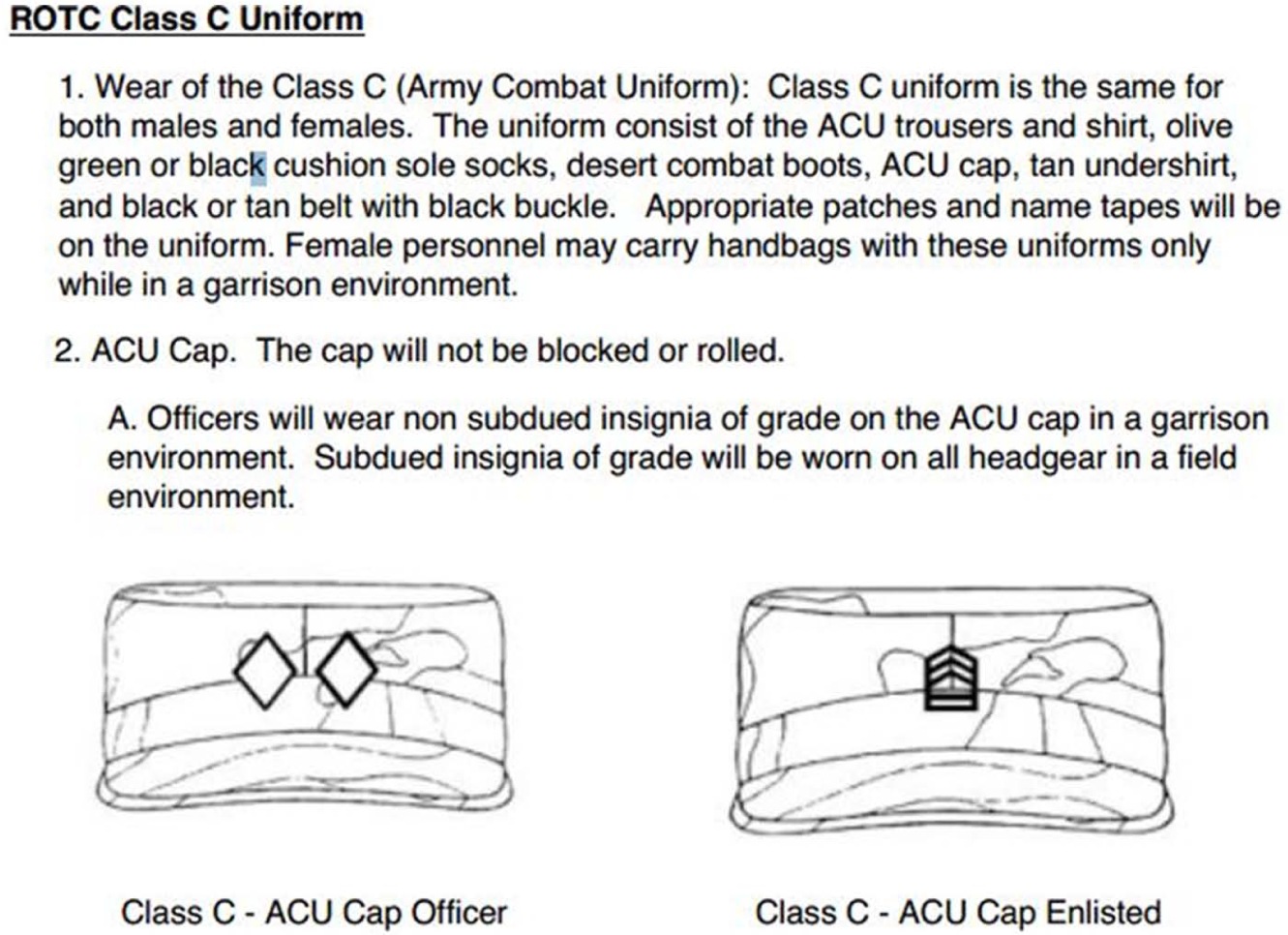
ROTC Class C Uniform and ACU Cap.
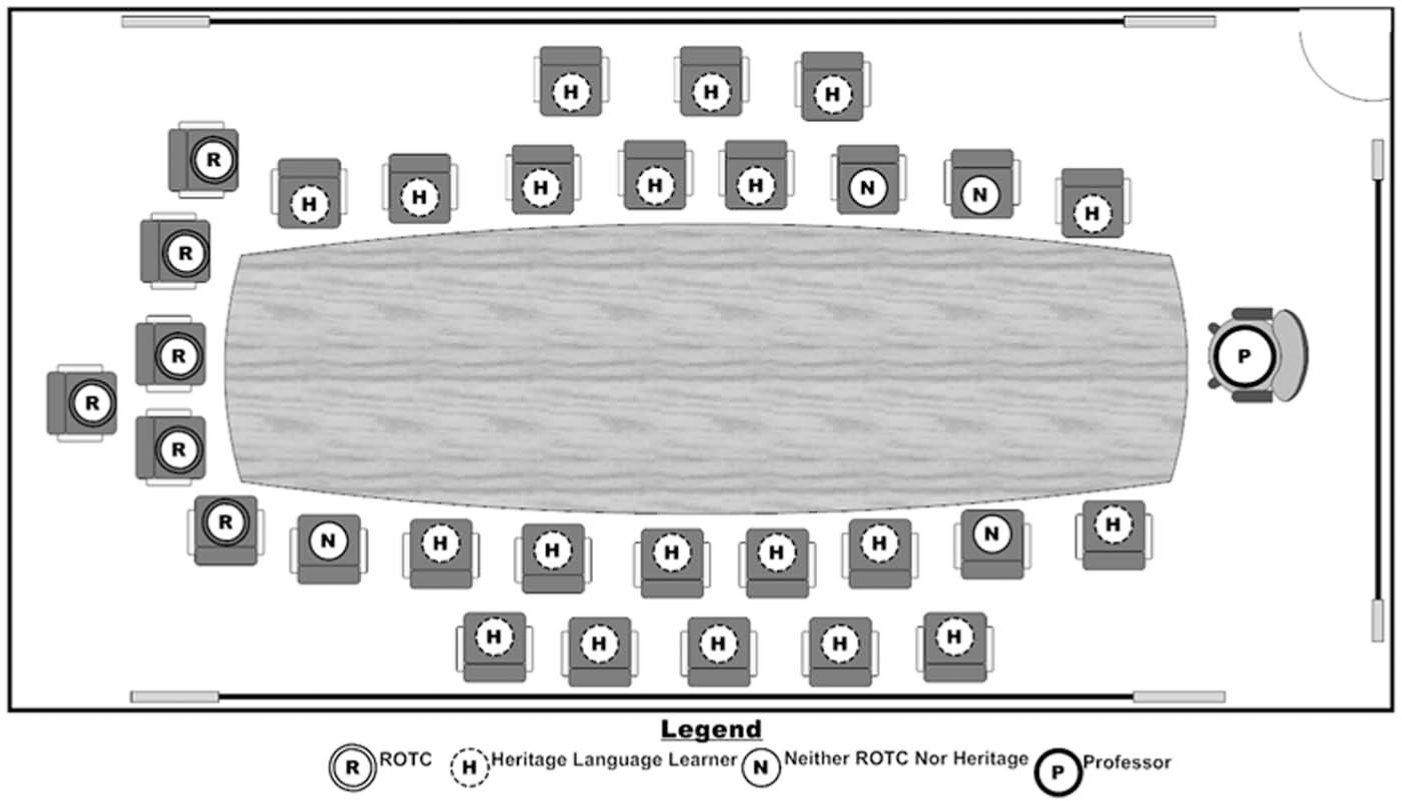
Spatial Map of the Classroom.
The spatial arrangements of the classroom further clarified the locally constructed soldier/civilian binary. Spatial dynamics, and specifically the placement of instructors and learners within a classroom, fundamentally shape the social interactions that follow (Johnson, 1982). Here, daily instruction took place around a ‘distance-reinforcing’ (Hall, 1969) oblong seminar table that held 20 conference room-style chairs in an ‘inner’ circle, with 10 additional chairs arranged in a concentric ‘outer’ circle. Large chalkboards lined three of the four classroom walls and were used often throughout the course of instruction. The seminar table was positioned squarely within the center of the classroom, such that its longest sides were parallel with two of the chalkboards and its shorter ends were parallel to a wall of windows (the ‘back’ of the classroom) and the wall that held the third chalkboard and the entrance to the room (the ‘front’ of the classroom)
Beginning with the first day of class, the instructor sat at the ‘front’, which placed her at one of the shorter ends of the seminar table, closest to the classroom door and the third chalkboard. Accordingly, students arranged themselves around the remaining three sides of the table; those who did not arrive in time to secure one of the 20 chairs at the seminar table were forced to sit in the outer circle and balance their notes and books upon their laps. Just as the instructor always sat at the ‘front’ of the class, a consistent seating pattern quickly materialized among the students: Iranian heritage learners and the few non-heritage, non-ROTC students would sit at the longest sides of the seminar tables and in the outer circle while ROTC learners would sit closest to the windows at the ‘back’ of the classroom, at the end of the table that directly faced the instructor. The effect was such that the soldiers were at once positioned in the farthest possible place from the instructor yet enjoyed the most direct sightlines to her, the classroom door, and the three chalkboards. In contrast, the ascribed civilians, while physically closer to the instructor, found their attention pivoting back and forth between chatting ROTC students at one end of the seminar table and course instruction delivered at the other. As such, the spatial relations within the room took on a tiered hierarchy, with Tier 1 soldier seats providing both table access for workbooks and clear sightlines to the instructor and all three regularly used chalkboards, Tier 2 civilian seats providing table access but only clear sightlines to two of the three chalkboards, and Tier 3 less desirable civilian seats providing neither table access nor clear sightlines to all three chalkboards.
While initial seating arrangements may have emerged out of random chance and continued through new friendships or habits, any later variation to the seating order only occurred within the abovementioned two types of civilian seats. That is, civilian students (seated in Tier 2 and 3 areas) sometimes switched seats with one another but never encroached onto Tier 1 soldier territory. This spatial boundary became particularly clear on occasions in which civilians who sat in the least desirable Tier 3 ‘outer’ seats – forced to balance workbooks on their knees as they wrote out exercises – used other civilian classmates’ tardiness to move into the more desirable Tier 2 seats. These same students, despite ROTC tardiness, did not ever move into Tier 1 seats. Across the totality of the year, the relationship of civilian students to chairs in the Tier 2 and Tier 3 spaces was flexible from day-to-day and shifted regularly. This permeability did not extend, however, into the most desirable Tier 1 soldier seats. This suggests the boundary was between ROTC students (soldiers) and all other students (civilians), regardless of heritage status.
Although ROTC students established an early, informal de facto reservation of what were arguably the most desirable seats in the room, civilian students treated the boundary between these Tier 1 seats and all others as impregnable, even when Tier 1 table seats were left vacant due to ROTC absence or tardiness throughout the session. It became clear that soldier seats were considered off-limits by civilian students who found more comfort in balancing notebooks on their knees than in borrowing a seat within soldiers’ space. Much like the self-selected sartorial distinctions between soldiers and civilians, this tiered and locally immutable binary was reinscribed in the social partitioning of space within the room. Hamid, a non-ROTC, non-HL student who initially expressed affinity with ROTC students, was the closest civilian student to transgress this boundary, without ever fully doing so.
An Afghan-American sophomore, Hamid sat flush against the boundary between soldiers and civilians. Given his initial interest and allegiance with ROTC students, he was the most likely boundary-spanner between the two groups. Jasmine, an Iranian-heritage sophomore who usually sat at the opposite end of the seminar table, took notice of Hamid’s immediate connection to the ROTC students. When I later asked Jasmine if she considered Hamid ‘someone who was good at straddling different groups’, she addressed the initial moment of encounter in her answer: ‘Hamid found commonalities … with the kids who were fully Persian and, well you know, [Persians are] closely related to Afghans and Middle Easterners. But he’s also really interested in ROTC so he bonded with those guys as soon as he saw them on the first day.’ Importantly, as Jasmine describes Hamid’s role in the class, she defines the major cleavage Hamid bridged as the one between ‘fully Persian’ heritage learners and ROTC students.
Hamid also recalls the moment when he first realized the presence of ROTC students in the course: It was right away. And yeah, at the time, I was kinda surprised. But I think that was because I was young, I guess? Like, after taking more and more political science classes, looking back it makes much more sense. And I was intrigued. When I first found out they were ROTC, I figured, ok, cool people I can relate to. Then when I found out that they were getting paid to take the class, I was still surprised.
Initially unaware of the funding structure for critical language instruction, Hamid was surprised to see ROTC students enrolled, and particularly surprised to see ROTC students who visually signified their allegiance to the military through their sartorial choices on the first day of class. Due to his personal background, interest in geopolitical relations, and curiosity about the military, he first felt a sense of kinship or similarity with the ROTC students. He described the American military to the ROTC students in the moments before the instructor arrived one morning as ‘the people who saved my family from a hellhole’. Continually disappointed that each successive military branch he attempted to join excluded him from service due to health-related conditions, Hamid was ‘intrigued’ by the presence of the ROTC students.
Knowing that Hamid had expressed an interest in working in the counter-terrorism field, I asked if he had enrolled in the course to improve his Persian skills for professional reasons. I was surprised when he replied, ‘Nah … I enrolled because I wanted to speak [Dari] better so I could understand my parents better … I want to be able to speak it fluently and not have any hang ups or anything.’ 8 Despite his stated career goals, Hamid describes wanting to forge a more rich connection with the native Dari speakers in his own family, consistent with the same motivations that animated the majority of heritage learners to join the course. Hamid presents an intriguing, liminal case as he identifies with the ROTC students for personal and political reasons while still experiencing dissimilarity from them due to his status as an unpaid student in the course and an aspiring soldier who cannot gain admission to the military for health reasons. In turn, he shares likeness with the heritage learners as he enrolls and remains in the course to forge a deeper cultural connection with his family. Importantly, nowhere in his self-conceptualization as a learner of Persian or Dari does Hamid articulate a connection between his critical language coursework and his goal to work in the defense or counter-terrorism fields.
As an enrollee in all three semesters of the course, Hamid remained the only student to attempt a transgressive position in the soldier/civilian binary within the classroom. Yet according to Hamid, the chasm between these two populations only widened outside of class. Though he hoped to be accepted by the ROTC students as at least a favored civilian ally, this was ultimately not the case. He raised this issue when I had asked if he learned more about the process of becoming an officer following his new connections with the ROTC students: Oh yeah, especially from Justin. We kinda hung out outside of class, but not very much. I try and keep in contact with the guys from time to time, I’ll see them on campus and say ‘hi,’ stop and chat, I respect the dudes but we didn’t hang out too much outside of the class. I ended up not having as much of a connection [with them]. There are other people [heritage learners] I met through the class that I ended up staying in better touch with. That surprised me.
Hamid expresses surprise and disappointment that his contact with Justin and the other ROTC students faded away in the following academic year. Though he initially experienced a sense of kinship and similarity with the ROTC students, the discrepancy between Hamid’s identity as an aspiring soldier and his identification with his Afghan heritage grows more profound following his experience of acceptance and bonding with the Iranian heritage learners. Despite sharing certain core personal and political interests with the military learners, differences based on phenotype, ethnicity, positionality, and most importantly, consecration of the boundaries between soldier/civilian would go on to define Hamid’s experience of estrangement from the ROTC students both inside and outside the classroom.
As evidenced in the section below, a complementary symbolic boundary of white/non-white may have also played a role in Hamid’s ultimate rejection by ROTC students. Despite the federal, state, and university classification of Afghan and Iranian persons as white, Hamid’s Afghan heritage and sincere engagement with Iranian cultural customs and practices enforce his local categorization as non-white in the critical language classroom. Hamid, occupying a liminal space between these groups due to his perceived identity markers and affiliations, offers a particularly instructive case for the impermeability of symbolic boundaries in the critical language classroom.
‘White vs. Non-white’: Another Secondary Binary
Another secondary-level binary, complementary to soldiers/civilians, was also locally constructed and reinforced in the critical language classroom. This second binary, white/non-white, maps neatly onto the major symbolic cleavage in the room, with ROTC students – irrespective of their ethno-racial backgrounds – locally constructed as white and all other students locally constructed as non-white, contradicting the ‘white’ legal classification of Iranians in the USA. I rely on three sites of evidence for the white/non-white binary. The first example involves a tense moment in which an ROTC student actually verbalized this localized racial coding structure to the support (and embarrassment) of ROTC students and the concern and discomfort of others. Following that, I offer additional illustrative examples of the classroom white/non-white binary in which racialized ‘disrespect’ is felt by non-white students. Significantly, this highly localized racial construction – like the clear construction of a solider/civilian binary out of what is at best a liminal ‘soldier’ identity for ROTC students – is again a particular facet of ascribed student identities in the critical language classroom. Just as ROTC learners are ‘liminal’ soldiers, Iranian heritage learners are ‘liminal’ racial others. Within the nested levels of university, state, and federal classification, Iranians and other Middle Easterners are classified as white (Jamal, 2008) though their immigration histories, profile among law enforcement, and self-understandings suggest a more complicated non-white racial identity (Blake, 2010; Farnia, 2011; Tehranian, 2008, Zia-Ebrahimi, 2011).
The most explicit instance in which a locally constructed racial binary between white and non-white students was verbalized occurred during the second semester of the course. In honor of the approaching spring season, students were asked to write prose for the first time: two paragraphs summarizing the major activities and traditions surrounding Nowruz (New Year), the annual Persian celebration of the Spring Equinox. From the far end of the table where ROTC students sat in their Class C uniforms, anxiety was expressed:
‘This isn’t fair to us white kids!’
‘Yeah!’
‘We didn’t grow up with it! So not fair!’
Following this exchange, nearly all of the ‘civilians’ stared downward at the table while the ROTC students’ facial expressions ranged from indignant to sheepish. Under this newly articulated racial logic, Martin – a Mexican-American linguistics major with no special advantage in summarizing two paragraphs from Wikipedia – was cast as non-white while Brandon, a Mexican-American ROTC member, was instead cast as white. This was the most clearly articulated expression of the racial binary particular to this classroom, in which an otherwise ‘non-white’ student is classified as white and a technically ‘white’ majority of Iranian students are classified as non-white. To that end, I asked Ryan, who was involved in the Nowruz exchange, to describe what he recalled about the incident: The first thing I remember is the surprise, the shock I felt that Justin went there, you know … into a racial thing… but then my next reaction was like, yeah, hey, he has a good point! So I blurted out that I agreed with him. I don’t know if it was because people were pissed we were complaining, or if it was awkward to be talking about it so openly, but the classroom got really quiet.
The ensuing discomfort in the room, expressed verbally by Ryan and other students in later private conversation, did not come merely from the ROTC students’ implicit racial classification structure of the space, but from its having been expressed so overtly. Other instances reinforced the locally constructed white/non-white binary, as ROTC students asserted their white identities by overtly performing for other students a disinterest in non-white Persian culture and language; as demonstrated in other fieldsites, whites at times actualize their ‘whiteness’ through the assertion of the cultural heritages and customs of ‘non-whites’ as inferior (Bonilla-Silva, 2002). In accordance with a micro-interactional approach, the local construction of all ROTC students as white is reinforced when ROTC students overtly perform dismissal of Iranian heritage and language. The symbolic boundary between us/white/soldiers and them/non-white/civilians is thusly cemented.
Martín, who grew interested in Persian when hearing his friend speak the language, recalled an instance in which students were asked to work in pairs to construct and speak sentences aloud: The ROTC guys would laugh at a lot. They made a joke of it, didn’t take it as seriously. I remember when we’d build sentences with new vocabulary words, they’d make bizarre sentences and laugh among themselves and it didn’t make sense to us. If I could be absolutely blunt with you, from the beginning, they didn’t seem to be interested in learning the language. They were there for their ROTC stuff and it seemed like it was a burden to them. That they had to not only learn a new language but research another culture or another people that they didn’t want to learn about in the first place …
Rather than assert that the ROTC students were reacting to the assignment from their subject-positions as ‘non-heritage’ students, Martín attributes their negative reaction to the fact that they’d been asked for the first time to ‘research another culture that they didn’t want to learn about in the first place’. Martín’s memory of the incident indicates the existence of subtle and overt disrespect such as the performance of boredom or mockery of the language deployed with regularity across the academic year. As a result, the class was bifurcated between white soldiers performing disinterest in the culture and language of locally-constructed civilian non-whites, while enrolled in a course centered on their language and culture. This cultural dismissal was most troubling to heritage learners as it rejects out of hand the component of heritage learning most valuable to them.
Several months after class ended, I asked Nina, an Iranian-heritaged sophomore enrolled in all three semesters of the Persian course, if she recalled any disruptions in class: The first person I think of was Ryan [an ROTC student] for some reason. There were moments when he or the other ROTC students were being disrespectful. Talking during the lessons. We felt a tension over it, a power struggle. And you have to couple this with the fact that sometimes they would come late and I think, you know, it was like 10 minutes late into class, a few days in a row. It was noticeable. I don’t remember anyone except the ROTC kids being disruptive.
Nina, more than any of the other students with whom I spoke, stressed that she did not ‘mind’ the presence of the military learners. She even mentioned finding Ryan particularly funny and engaging as a classmate. Yet she frames the ‘disrespect’ that the habitually tardy ROTC students showed as a form of ‘tension’ and a ‘power struggle’ that affected others in the class.
In a separate conversation with Hamid, I asked him what he would chat about with the ROTC students he had befriended from Persian class: Oh, just random stuff. Stuff about the military, training, hitting the gym. Making fun of the class. But not the people in the class, just like certain aspects of it [laughing]. One thing we would always do, the word for twenty [bist], sounds like the English word ‘beast,’ right? So we would always say that to each other and yell it, like ‘BEAAAAAAAST!’
Echoing Martín’s comments regarding the ‘mocking’ of Persian which he noted amongst ROTC students, Hamid recalls with pleasure moments of bonding that ‘making fun’ of Persian vocabulary words engendered. Recalling Sina’s comment about who was really in the class to ‘learn’, the sincerity with which ROTC students came to class each morning was under suspicion by some classmates.
Another regular feature of instruction in which asymmetrical dynamics surfaced was a daily exercise in which the instructor would ask a handful of students to write in Persian on one of three chalkboards in plain view of their classmates. This was done to help students practice handwriting, gain experience using vocabulary words, build complex sentences, and execute grammar drills. In these moments, the racialized public performance of ‘bad handwriting’ found its widest audience. Ali, an Iranian-American junior, recalls: The ROTC [students] would write on the board and you couldn’t at all tell what they were trying to write, which make me think they weren’t trying or maybe they wanted it to really be obvious that they weren’t trying. They would bust out laughing during the Friday [culture] labs.
Ali recalls these incidents in vivid detail, though he doesn’t attribute the acts to any student in particular. Instead, Ali remembers ‘all’ the ROTC students reacted to the lessons about Iranian culture with laughter. Just as the ROTC students most explicitly expressed their white identities in relation to the cultural Nowruz assignment, Persian vocabulary words and written script were ‘mocked’ too. Matters of Iranian culture and tradition elicited direct and dismissive responses.
I asked Derek why he and some of the other ROTC students would laugh during the culture lessons. Derek assured me that ‘we were definitely not making fun of the Persian kids in the class, or making fun of Iranian culture … we were just trying to be jokesters, you know? Maybe it was shitty of us? We didn’t mean anything by it.’ Derek and the ROTC students with whom I spoke described their presence in class as one of good intentions, though as in the above quote, they exhibited a degree of ambivalence about what else their laughter might ‘mean’. And though Derek perhaps would not frame his performance of ‘bad handwriting’ or his broad reaction to the Friday culture lessons as dismissive, in the critical language classroom, it was perceived as such by others. 9 I would suggest that Derek’s own recounting of being a ‘jokester’ holds out the possibility that he was cognizant of the work it did in the class (‘maybe it was shitty of us? We didn’t mean anything by it’). In the least, it seems to have registered in Derek’s recollection that these interactions reinscribed the primary symbolic boundary us/them between those in the ROTC program and all others who were not.
In sum, the fieldsite presents significant evidence of a locally constructed white/non-white binary which contradicts ‘official’ racial classifications: the overt verbal expression of this binary and the lines along which it was delineated; the repeated performance of white racial identity via the expression of racist dismissals of non-white language and writing, and most expressly, white resistance to non-white culture and customs. As discussed below, the two mutually reinforcing binaries of soldier/civilian and white/non-white create an impregnable symbolic boundary between us and them in the critical language classroom – a space at ‘home’ in which ROTC students may intentionally or unintentionally practice militarized soldier-identities for war.
Discussion
In the process of bringing disparate student populations together to learn a new language, the critical language classroom may serve a latent function within the American university by offering a domestic space for ROTC students to perform militarized identities against civilian, spatially separated, culturally distinct, and ‘non-white’ classmates. Due to the primarily participant-observational research design, a conclusive statement on the intentionality of such performances is outside the scope of this article. It is clear, however, that ROTC learners are offered stipends and opportunities for career advancement to encourage enrollment in critical language courses while heritage students largely enroll to deepen their experience with cultural identities and heritage-based traditions. Heritage and second-language learners alike respond by criticizing military learners’ motivations and comportment in the course, or by opting-out of the experience altogether through official withdrawal. In this way, all students contribute to a learning environment in which group and individual identities are structured against one primary symbolic boundary (us/them) and two mutually reinforcing secondary binaries: soldier/civilian and white/non-white.
While heritage students in particular admit to a variety of motivations for enrollment, including the perceived ‘easy A’, civilian students express concern over military-sponsored classmates who enroll in the class for the ‘wrong reasons’. Second-language learners like Martín are careful to distinguish their reasons for enrollment from those of ROTC learners, including respect for Middle Eastern cultures and anti-war social movement participation. Both heritage and second-language learners describe a classroom environment in which their motivations and engagements are undermined by symbolic boundaries between us and them.
To better establish their liminal identities as soldiers in contradistinction to civilians, both on campus and in the critical language classroom, ROTC learners dress in military-branded casual clothing. Their tardiness suggests to classmates a lack of attention or commitment to the course and, as such, the ROTC learners themselves contribute to the construction of the soldier/civilian binary. But heritage and second-language learners contribute to the soldier/civilian binary in their own way. Spatial configurations within the classroom adhere to this boundary, as the instructor and ROTC students faced each other at the farthest ends of the table while heritage and second-language learners – in more liminal relationships to ‘white American’ national and ethno-racial identities – sat along the sides of the table, and avoided occupying empty soldiers’ space, even to the detriment of their comfort.
The third and final binary which structures the experiences of students within the critical language classroom, white/non-white, reveals itself most profoundly in the verbal and nonverbal disrespect that emerges in real time. ROTC learners’ comments about the relative fairness of the curriculum for white students like ‘them’ bring issues of race into relief. Iranians’ precarious status as ‘white’ in the USA is refuted within such interactions, while the mixed Latino-white heritage of one ROTC student is entirely erased. Iranian and other minority students in the class are relegated to a generalized, non-white ‘other’ status, with issues of racial difference and inequality elided by claims to ‘reverse racism’ by white ROTC students, who perhaps for the first time in their educational worlds are immersed in a non-dominant cultural setting.
Despite pernicious symbolic boundaries, the Persian critical language classroom offers opportunities and challenges that are especially important in a time of cultural misunderstanding and war frenzy between Iran and the USA. Mainstream media and political narratives about Iranians as oppressed religious-political subjects needing emancipation or American intervention (Chan-Malik, 2011) might be reappraised amidst culturally significant learning experiences for students. And yet, such deeper connections remain unforged; the data presented in this article signal the broader structural problems of national identity, myths of belonging, and military enculturation which have yet to be resolved. Thus, the critical language classroom is illuminating terrain for scholars who seek to explain how white, masculinist hegemony maintains micro-interactional control despite gains in multicultural education since the Second World War. The discussion offered in this article is one empirical entry point into what might become an emerging site of interest for researchers of education and the military-industrial complex, and to scholars of critical race, ethnicity, and culture more generally.
Conclusion
During the slow withdrawal from Afghanistan (America’s longest foreign war) and increased economic sanctions and military posturing against Iran, it is vital to remember that the American military/security state and its organizing logics and life-and-death consequences shape lived realities in profoundly raced and gendered ways – not just abroad, but also ‘at home’. During times of war, a mandate exists for research that attends to the heightened vulnerability of non-dominant persons in asymmetrical power relations across all social fields and institutions. Recalling Angela Davis’ admonition regarding the treatment of women and children during the Vietnam War – that atrocious acts of violence committed against ‘foreign’ women by our soldiers would in due time reproduce increasingly dangerous relations between men and women ‘at home’ – it is crucial to take seriously the domestic ramifications of our contemporary ‘war frenzy’ abroad (Davis quoted in Thobani, 2001).
In the spirit of these previous works, this article theorizes the critical language classroom as a domestic space that simulates in small, mundane, and often inelegant ways the cultural, linguistic, and social worlds that trained ROTC soldiers might encounter in their later deployment. Yet rather than focus on the moment of ‘return’ from war, I focus on civilians and soldiers occupying culturally-charged classrooms that predate soldiers’ decampment, which may in effect provide domestic space for soldiers to intentionally or unintentionally practice militarized identities against civilian others. As heritage learners seek alternatives to cultural erasure by pursuing formal instruction in language and culture within defense-funded courses, symbolic boundaries between students consecrate new social distance. From this, a defining and lasting paradox of the ‘critical language’ phenomenon emerges: the very programs through which heritage learners can build emotional and intellectual bridges to their imagined or real homelands exist through a funding mandate designed to alter, absorb, or annihilate these lands through military action. The theater of war, though never directly addressed in the curriculum of the Persian language classroom described, suffuses throughout; the classroom is but one venue for the militarization and racialization of student identities.
Footnotes
Acknowledgements
The author would like to thank George Lipsitz, Clayton Childress, and Janine Chi for their feedback on earlier versions of this article.
Funding
This research received no specific grant from any funding agency in the public, commercial, or not-for-profit sectors.