







Abstract
This paper investigates the labor-controlling orientation of the Japanese developmental state and its consequences today. Developmental state studies has given us a robust epistemological grid whereby we can make non-Western state formation intelligible. Yet, mainstream authors have tended to treat the working class as a mere appendage to state–business relations, relegating labor politics at the analysis of state–society relations. By using democratic Japan—a prime example of this sort of obfuscation—in combination with Marxian state theory, this paper outlines the difficulties, addresses them, and extends the scope of developmental state studies to labor. After identifying main tenets of the literature, the author constructs a theory of labor control as a stabilizer of relative state autonomy. The author applies this to Japanese labor movements since 1945 and interprets events and processes of labor oppression/regulation through which Japanese capitalism subsumed the working class under the aegis of the developmental state. Labor control, emerging out of an “exceptional state” (Poulantzas, 1974), evolved into a refined socio-relational system that insulated developmental goals from labor movements. This Japanese trajectory keenly mobilized big business and elite labor, which transformed labor control into a bilateral and then a tripartite league in defense of industrial policy and its deskilling/reskilling intervention. By the 1970s, this achieved the famous docility of Japanese labor. The historically constructed character of docile labor force was exploited once again when Japan made a neoliberal turn in its post-development phase.
Introduction
Japan has been at the heart of international debates about developmental states. Under the influence of Chalmers Johnson’s seminal work, scholars have found a “prototype” (Evans, 1995: 53) of developmental states in this country, which succeeded in achieving late democratic industrialization. This democracy is an ambiguous one, as Johnson sometimes calls it “soft authoritarianism” (Johnson, 1987: 143): Japan used the democratic system as a “safety valve” for obscuring the state’s strong command over society (Johnson, 1982: 316). Haggard’s (2018: 44) recent volume is aware of this ambiguity when he says: “Japan was a democracy, but one in which bureaucratic discretion was high as Johnson repeatedly emphasized” (for similar remarks on Japan, see Wade, 2004: 27). Nonetheless, soft authoritarianism was “soft democracy.” Positive assessments have multiplied: that “the Japanese public places greater trust in the honesty of state officials” (Johnson, 1982: 68); that “high growth policies of the bureaucracy raised the economic level of all citizens and may thereby have served their diverse interests” (1982: 49); and that bureaucrats had the special capacity “to speak only for the national interest” (1982: 52). This side surprises Chibber (2014: 48): “throughout the ‘high growth period’ stretching from the 1950s to the 1970s, and beyond, Japan maintained the institutions of formal democracy.”
All in all, to quote from a recent review, “Johnson has made a nuanced observation that authoritarianism is not a necessary condition for the developmental state” (Williams, 2014: 12). With all the drawbacks and flaws, that is to say, Japan can be considered as one of the best examples of the democratic developmental state, which, to an extent, actually “extend[ed] beyond relations with capital and embed[ed] the state in civil society” (2014: 13). It was after Johnson’s intervention, after the mid-1980s or thereabout, that this line of research started to be relocated to new soil. Developmental state researchers “migrated away from Japan to the newly industrializing countries” (Haggard, 2018: 48). These new countries had ample histories of authoritarian statism and, unlike Japan, had just experienced (or been experiencing) an authoritarianism–democracy transition in terms of statecraft and state–society relations. In making this journey, scholars brought with them Japan—Johnson’s Japan—as a leading source of inspiration when exploring non-Japans. Johnson’s work thus flourished in settings outside of Japan (for useful reviews on this point, see Woo-Cumings, 1999; Carroll and Jarvis, 2017; Chu, 2016).
This paper explores the labor-controlling nature of these developmental states by examining this literature and using it in combination with Marxian vocabulary. In this venture, the Japanese case offers profound insights. These angles can uncover problems inherent in developmental state studies and contribute to the scholarship through a unique lens. In what follows, I delineate the problems that I find in developmental state studies and define Japanese history as a strategically vital case to improve existing understanding. I then construct my conceptual framework by elaborating upon the two concepts in combination: state autonomy and labor control. Period-specific analyses of Japan between the 1950s and 1970s, as well as an analysis of contemporary circumstances, are provided toward the end of the paper.
The Location of Problems
The canonical work of Johnson facilitated developmental state studies outside of Japan. His influence among scholars on Asia led to their clinging on to Johnson’s Japan—the idea of Japan as painted by Johnson (for informative reviews, see Woo-Cummings, 1999; Haggard, 2018; Williams, 2015; Carroll and Jarvis, 2017). Beginning in the 1980s, developmental state studies proliferated influential analyses and monographs on state–business relations for non-Japanese countries. These “new” countries, according to key monographs (e.g., Wade, 2004; Kim, 1997; Amsden, 1989; Evans, 1995), had histories of authoritarianism of their own, experienced authoritarianism–democracy transitions, and were propagating new industries under state policy akin to that of Japan. Around the 1980s, Marxian theorists on the state—a relatively new “industrial sector” in Marxism—were seemingly preoccupied with highly abstract theory and its mobilization for the Euro-American world (e.g., Holloway and Picciotto, 1979b; Jessop, 1982; Clarke, 1991; Poulantzas, 1978). In this context, the tradition of developmental state studies growing in and after the 1980s offered scholars a robust epistemological grid whereby academia made non-Western state formation intelligible.
At the same time, the reliance on Johnson and various Johnsonian notions seem to have reproduced his ambiguity with developmental states. Most importantly for my purpose, there emerged a paucity of valid views on labor movements, working-class politics, class antagonism, and their impacts on state policy (Chang 2009). Omissions are suggested by Haggard (2018: 61), who thinks that scholars can learn from Japan regarding the “relatively weak role that labor occupied in the Japanese political system, and the link between labor weakness and the broader functioning of the country’s political economy.” The recommendation is that well-functioning states such as Japan can tame working-class politics because this class naturally has only a muted, uninfluential voice in the face of the state’s acts of patronization, guidance, and acceptance. Indeed, many contributors show a preoccupation with state–business relations when it comes to state–society relations. When they address the working class, this class is often painted in such terms as social equity, human capital, human rights, civil rights, income level(ing), labor demand, etc. (e.g., Robinson and White, 1998: Wade, 1992; Riain, 2014; Williams, 2015; Haggard, 2018; Chu, 2016; Pempel, 1999; Herring, 1999).
On Johnson’s part, he glances (or, is forced to glance) at strong labor movements in Japan. The thing is that these references, minor and ambiguous as they are, contradict his class-denialist core; he is inspired to fortify the core by obscuring labor. At best, the working class is shown as a mere appendage to state–business relations. He murmurs that “admirers of the tranquility of Japanese society during the 1970s forget the strikes, riots, demonstrations, and sabotage that marked the period 1949–61” (Johnson, 1982: 197). That is very well said (though I am tempted to add that the period of strikes extends between 1945 and the early 1970s with a break). Nonetheless, it is Johnson who bolsters Japanese tranquility by quickly adding: “the role of the state was never questioned” (1982: 197). This is among the key “social conditions,” he thinks, that gave “considerable advantage to Japan in competing with countries such as the United States, but obviously they would be very difficult to transplant” (1982: 314). In a 1987 essay, he even admires Japan by finding [a] virtual absence of economically significant strikes . . . a labor force that does not object to technological changes even of a labor-saving type (for example, robotics), and federations of unions devoid of all but token political power [which] are real competitive advantages in international economic competition . . . South Korea and Taiwan resemble Japan in their tranquil relations, but they have achieved this goal through more directly authoritarian means. (Johnson, 1987: 149–150)
When this level of mystification and obscurity underlie the “most influential political science study of Japan ever published in English” (Dower, 1998: 8, quoted in Woo-Cummings, 1999: 25; see also Pempel, 2011), it easily educes the famous class-denialist generalization about state–society corporation and “state autonomy” that key Johnsonian scholars hold for Japan and other states (see the next section). If this “problem” underpins the epistemological basis of developmental state studies, it should be clearly elucidated. Otherwise, the scholarship will struggle to delineate its central objective, i.e. state–society relationships. Because this pitfall lies at the heart of the literature, state studies—developmentalist or “post”—can advance only by recognizing, revisiting, and rectifying it. In the absence of this effort, our new corpus “after developmentalism” (Carroll and Jarvis, 2017) might harbor the same difficulty (see also Stubbs, 2009).
I emphasize that there are critical thinkers who recognize logical circularity in the tranquility thesis and break it by finding the right place for labor in Asian states. Apparently, such scholars are not many, but their work would justify my position. Deyo (1989: 1–2) insists that “a preoccupation with the sources of this growth diverted attention from a dark underside of the East Asian ‘miracle’: the extreme political subordination and exclusion of workers. . . . East Asian workers constitute the cheap, disciplined labor that has fired Asian growth.” Dae-oup Chang (2009) explains the Korean developmental state as a historical regime of labor regulation against labor militancy by using the German state derivation approach, which offers him general Marxian perspective on developmental state studies (for labor suppression under the Korean developmental state, see also Kim, 1997). Chibber (2003) suggests that the Indian developmental state decreased autonomy when it renewed its ties to the business class by rejecting a labor movement from holding a position in the state. This paper relocates this low-key interest in labor control to Japan. The tracing back of labor control to Japanese soil is fruitful. Japan showed a fully-fledged pattern of democratic development. Due to this character, the Japanification of the topic can powerfully disclose the nature and types of labor control that prosper in developmental states.
In the late phase of development, in fact, a docile labor force that “vindicates” the frictionless thesis became palpable in Japan. The point is that the state and society co-evolved to achieve this labor docility. As Avenul (2010) writing on Japanese civic activism shows, activists branding themselves as “citizens” (shimin) not only outcompeted “laborers” and their class-conscious collectives but also relegated them to the margins of emerging democratic arenas. Anti-labor-movement societalization was maximized by a refined set of labor-controlling fields, not just coercive but socio-relational, which mirrored the organizing logics and “strategic selectivity” (Jessop, 1990: 9) of democratic developmental states. In general, late developers need to control labor to insulate developmental goals because developmental (industrial) policy means waves of deskilling and rationalization for laborers with little compensation, which politicize the workplace. In the case of (would-be) democracies, moreover, this insulation cannot abandon democratic parameters; labor control must activate socio-relational fields, which should conceal coercive thrusts and maintain the state’s benign outlook. Japanese labor was far from docile until the 1960s, while the repertoire of labor-control methods was constrained by the democratic-state building. This double-bind situation—threats from labor and limits to coercion—spurred the vast evolution of labor control in Japan. Consequently, the initial outbreak of militant laborers, as well as their descendants and elite reformers, were fragmented, quieted, othered, and made docile or else acutely localized and “rescaled” (Brenner, 2004, 2019).
Once a significant part of this evolution was over, commentators on Japan started referring to it only in a backhanded way: by forgetting it and by plugging the gap with ahistorical histories. Johnson promulgated the view that Japanese labor is defined by its remarkable tranquility and the absence of path-shaping strikes. Less conspicuous but comparable statements are found in the thesis of “corporatism without labor” (Pempel and Tsunekawa, 1979) and in the work of notable economists who understand that Japanese labor spontaneously opted into the hyper-subjection to productivity, flexibility, and industrial efficiency (Aoki, 1988; Koike, 1976, 2013). These depictions contain similar ex post facto explanation (reification). I ask alternatively: How did labor control make labor so docile and compliant in Japan? It is said that South Korea belongs to a very politicized group compared with silent Japan (Silver, 2003: 32). For me, this Korea–Japan divergence suggests to what extent Japanese democracy is complicit with the vast evolution of labor control to achieve this reticence, within the otherwise similar contexts of state-led development in East Asia. In turn, researchers on Japanese labor history provide useful insights for this article (e.g., Clump, 2003; Gordon, 1985; Gottfried, 2015; for Japanese works, see the empirical sections). This paper locates their interpretations in my state-centered framework—a radicalized one oriented to class analysis—so that they can be dovetailed into the contradictory dynamics of Japanese developmentalism since 1945.
Whither “Relative” State Autonomy?
It is fruitful to call on Marxian state theory to understand labor movements and control during democratic development. Central to my interest is the concept of relative state autonomy, which means that under capitalism, the state seeks to maintain its appearance as relatively autonomous (politically neutral) to all the classes and class fractions in society. The concept of relative state autonomy allows us to investigate the efforts and processes through which the state is “seen by so many as neutral instance acting for the good of society” (Holloway and Picciotto, 1979a: 2). While theorists have much diversified in method and theory, they similarly think that state autonomy remains relative—not absolute—because state autonomy has had structural limits imposed by the anarchic character of commodity exchange (Pashukanis, 2001); by the state–business connections that can be found empirically and theoretically (Miliband, 2009; Poulantzas, 1975); and by the form of production that become predominant under capitalism (Holloway and Picciotto, 1979b). These authors generally emphasize class antagonism, conflict, and struggle as a constraint of state autonomy as well as a driver of its management (autonomization). State theorists have engaged in heated disputes but, more recently, the emphasis has been placed on complementary relations between different strands (Levine, 2002; Panitch, 2002).
Mainstream researchers on developmental states have invoked this Marxian concept. As Chang (2009: 15–24, 32–33) elucidates, early adopters of Johnson’s thesis—such as Peter Evans—analyzed state capacity in the non-Western world by borrowing the notion of state autonomy from Poulantzas (Evans et al., 1985: 5, 33, 353; Evans, 1996: 36). In so doing, however, fundamental revisions occurred. Evans understood (1) that the absolute (not relative) autonomy of the state from the classes and society is likely to happen in successful cases of developmentalism; and (2) that Japan (as depicted by Johnson) offers a representative case of absolute autonomy. By remolding the Marxian concept, that is, Evans embellished the Johnsonian notion that the best scenarios of the developmental state can form harmonious, balanced relationships with society, guiding all classes into prosperity without deteriorating (even hinting) class antagonism. This revision is misleading. This type of state-autonomy analysis concerns only one side of civil society—the business class—when assessing state autonomy and its insulation of developmental goals. The view should be counterbalanced with a broader perspective, a Marxian one, which also examines the other side of society, the working class. Seen from this perspective, state autonomy and developmental goals are things that experience tendencies for crisis when/where labor activism increases—autonomy is relative, not absolute.
Therefore, my retheorization anticipates this general (hypothetical) situation: when laborers perceive the anti-labor behavior of the developmental state and condemn it, the state experiences autonomy crisis, which labor control can perhaps quash or moderate (Chang 2009). Moreover, in the case of democratic developmentalism, this demand for labor control pushes the state into a messy (socio-relational) course of evolution because this state is a democratic polity by definition, which must use the active participation of all the classes for labor control with lesser use of coercion, violence, and authoritarianism. Let us unpack this point further.
To begin with, a (would-be) democratic polity cannot deny democratic parameters so easily after conceding—even imperfectly—the people’s sovereignty. As this state gives ground to labor democracy, democratization nurtures people’s fondness for political rights. In this context, the state’s recourse to oppression can easily provoke the non-autonomous outlook of the state toward the working class; democratic developmentalism is highly susceptible to crises of autonomy in its own way. If this polity still wants to prosper, it must establish its appearance of impartiality, not only toward business, but also toward labor. Anti-labor oppression still happens, but its authoritarian subtext must be dispersed, tempered, and counterbalanced by sophisticated measures that can insulate state-defined developmental goals more socially, organizationally, and relationally—indeed, “democratically.” The motto of this state formation is “Let’s abolish labor militancy with lesser use of coercion and violence (though they are necessary)!” By transforming primitive labor control into a refined socio-relational system, this state must reestablish the hiddenness of the “hidden abode of production” against the politicizing effects of late industrialization. The bar was high in Japan, but Japan’s labor control finally multiplied state–society partnerships (or, more accurately, state–business–labor partnerships—a tripartite relationship), which insulated state-defined developmental goals from the working class within the parameters of democracy.
Concepts and notions can be borrowed from Marxian state theory to analyze this evolutionary course. First, I will use the concept of the “exceptional [capitalist] state” (Poulantzas, 1979) to designate the starting point and transitional phases of labor control in (would-be) democratic developmentalism. In these phases, the state must prepare and sustain its democratic parameters while keeping intact the elitist space of state-building and policymaking. Democratization does not happen in a political vacuum, as it must cast off politicized individuals, sustain the elitist space of the state, and steer itself into the narrow way of “passive revolution.” The exceptional state might achieve this feat because it is, by definition, a form of dictatorship that is congruent only with the “extreme ‘limit’ of the capitalist State” (1979: 54). This exceptional state can possibly navigate its democratic state building along the track of passive revolution—democracy building without popular participation—by controlling labor movements.
Second, this exceptional resolution fades. Charismatic leaders abdicate from the throne. International circumstances change. Laborers get politicized. At such moments, the polity can step off the path of a democracy and embark on an everyday (prosaic) form of authoritarianism, threatening democratic state autonomy (which must keep the neutral outlook also to labor). To carry democratic development through to a long-term success, beyond lurking authoritarian drives, labor control must moralize, disperse, and absorb labor. This is a socio-relational course of evolution that mobilizes all the classes and their participation. This paper analyses it by using Poulantzas’s (1975) notion of a “power bloc” and Miliband’s (2009) argument on the “national interest.”
Labor Control
Up until now, I have used the key notion rather vaguely—what is labor control? The concept refers to the regulation of working-class resistance around the production point, where the business class must organize workforce into value-valorizing process. The notion is inherent in classical texts (e.g., Capital’s first volume on absolute surplus value). The understanding would be that the business class can lead the painstaking efforts to form sound capital–labor relations for value extraction at the site of “means of production”—factories, workshops, office floors, retail stores, etc.—which sets up productive instruments and materials in a “workable” form. That is, as Marx (1976) says, the primary space where working-class resistance repeatedly appears and is subdued by the business class under modern capitalism. U.S. sociologists until the 1980s consciously reworked this classical understanding by foregrounding the idea of labor control, which for them means the locational techniques, sectoral strategies, and regulatory backgrounds that are mobilized by the business class when they quash and moderate class conflicts and appease labor–management relations against labor resistance (Burawoy, 1985; Edward, 1979; Gordon et al., 1982).
In particular, Burawoy (1985) thinks that “advanced capitalist” (read: Euro-American) societies have embellished labor control with a “hegemonic regime,” which persuades (not merely coerces) labor into compliance with the business class and managers (see also Degiuli and Kollmeyer, 2007; Gottfried, 1991). When Gramscian notions are invoked thus, the emphasis is once more placed on shop-floor relations as being led by the business class. The state does generate background contexts and effects by deploying labor-friendly policy on behalf of welfare provision and minimum wages (Burawoy, 1985: 125–126), and does intervene in shop-floor disputes from above when class struggle overwhelms businessmen (Brenner et al., 2010; Moody, 1988). Seemingly, however, the somewhat tacit idea is discernible: the state does not reside at the heart of labor-control analysis as the state is absolved from everyday efforts of working-class regulation at ground level; the business class and managers mainly perform these functions. This picture would be suited to the liberal experience of U.S. Fordism. However, more “corporatist” experiences of European Fordism, what Schmitter (1979) calls “social corporatism,” gave the two classes and their society considerable leeway from national policy and “strong states” when creating profit-making industrial relations (see also Panitch, 1977; Jessop, 1979).
This picture needs specification on behalf of developmental states, in which labor control acquires a special role: to offset the tendencies of late industrialization that make state autonomy very unstable at/around the production point. For this reason, labor control under developmentalism is driven to be tightly constructed around national economic goals, and to be enmeshed with concerted nationwide efforts, which—being supported by political/social leaderships—can depoliticize a range of workers’ initiatives for achieving “economic nationalism” (Johnson, 1982). For this to succeed, workplaces should be apolitical spaces, in which state–society coalitions (including the state, business, and elite labor) can repeatedly reinstall new technology, fragment workers’ independent skill base, and reskill part of them under the supervision of the management, in order to catch up frontrunners as efficiently as possible. The history of deskilling is inherent in capitalism (Braverman, 1974), it is true, but this history is amassed and intensive in developmental states, and so is the history of labor control. Developmentalism steps in labor control. Locational techniques, sectoral strategies, and regulatory backgrounds come to form high internal consistency as a national paradigm of labor control, and in turn gain external consistency with economic goals and “industrial policy.” This consistency, which labor control crystalizes on the national horizon in process, can be distinctive to the type(s) of labor control suggested for the Euro-American world.
As Euro-American contexts are internally diverse, so are developmentalist contexts. In these conditions, labor control diverges into the two major types: authoritarian and (semi)democratic. The first type more easily tips into coercion when quashing labor resistance for rehabilitating state autonomy. I am not implying that ideology and consensus lose their roles in authoritarian developers, but they—when generating consensus—can be more heavily reliant on coercive regulation to control labor (Chang, 2009; Deyo, 1987, 1989; Koo, 1993). Once more, (would-be) democratic developers are more circumspect. These states are prompted to realize labor control with lesser use of coercion; otherwise, state autonomy dwindles (see the previous section). This results in some unique trajectory of labor-control evolution, which is somewhat akin to a “hegemonic regime,” but which is distinctive to the theoretical form of hegemony. (Semi)democratic labor control aligns macro-/micro-institutions of “consensus plus coercion” around developmental goals, fully utilizes socio-relational and organizational fields to that end, and lines up these regulatory mechanisms with the working class on the national scale. In so doing, (would-be) democracies can possibly navigate the entire nation toward a tractable pathway, while state building, technological enhancement, and labor deskilling destabilize it.
Based on this broad theoretical perspective on developmental states and their labor-controlling nature and types, the following sections generate a theory-driven historical analysis of democratic Japan. It divides postwar Japan into the three periods: postsurrender (1945–1949), early postwar (1950–1964), and late postwar (1965–1979). Each of the three periods has its paradigmatic questions about labor control, state autonomy, and crisis formation under democratic development which justify the periodization.
Postsurrender, 1945–1949
Crisis Tendencies of 1945–1949
In this period immediately after WWII, Japan did not shape democratic labor control, which came into being only in the 1950s. Central dynamism in this period arose from the efforts of the occupation to construct democratic frameworks while rejecting working-class participation. Until 1947, the occupation tried to achieve this feat of passive revolution in an “exceptional” way by using the charismatic popularity of MacArthur. It was hoped that his aura—his standing-above-all-classes outlook—could maintain relative state autonomy vis-à-vis the working class by deflecting (but not including) their initiatives. This exceptional resolution for state autonomy failed when many laborers openly accused MacArthur of inability to manage inflation, unemployment, and food shortage, to which he responded with physical threats and violence. However, Japan was nearer to a crisis of state autonomy after 1947 when this exceptional state mutated into a more prosaic form of authoritarianism. MacArthur abdicated from the throne, Japanese politicians appeared in front of laborers, and the state retaliated by criminalizing labor movements in strategic sectors. Without their charismatic arbiter, autonomy crisis loomed large at the end of the 1940s.
Labor Movements and Control in 1945–1949
While the occupation was building a new Japanese state, labor militants tried again to escalate the democratization, starting as passive revolution, into people’s (active) revolution. All across Japan, shop-floor activism adopted the strategy of production control (sēsan kanri), which aimed at the management of factories by laborers themselves. Self-management was thought to be a more appropriate strategy than strikes because the managers of factories were stopping production owing to high inflation (Taniguchi, 1987: 3). As many laborers adopted production control, whose class-antagonistic character intensified. Laborers, while organizing the production process themselves, were also short-cutting the market to conquer the private-property system (Sato, 1976: 48; Yamamoto, 1977: 191); they vocally denied the capitalist order and tried to change it from the production point (Yamamoto, 1977: 144–145). At the beginning, these practices had a local character. Yet, the national solidarity of laborers soon intensified in support of these local movements.
In spring 1946, more than 50,000 laborers ran into the prime minister’s official residence and claimed the legitimacy of the production-control movements. The police and U.S. forces dispersed them using warning shots (Yamamoto, 1977: 178–179). In winter 1946, 10,000 laborers gathered at the national gardens of Tokyo Imperial Palace and clamored for livable wages and employment. To halt this radicalizing trend, as early as 1946, ministers in the cabinet publicly condemned the production control struggle, denouncing it as an act of “violence, threatening, and property-right violation” (Taniguchi, 1987: 4; Japan Productivity Center, 1969: 127–129). During the winter of 1947, influential movement leaders promulgated a plan for a nationwide general strike. To prohibit this strike plan, SCAP (Supreme Commander of the Allied Powers) denounced laborers in the name of MacArthur (Rodo Undohhi Kenkyukai, 1972: 27, 29), who defined the radicalization of labor movements as the enemy of parliament, business, the nation, and public welfare (Rodo Undoshi Kenkyukai, 1972: 53; Takemae, 1970: 175). This occupied state, in defense of bourgeois order, thus sharply opposed the working class around the production point.
Furthermore, popular struggle also erupted in relation to consumption-oriented issues. In 1945, people suffering starvation started mass demonstrations in the major public spaces of Tokyo and Osaka as well as at public emergency warehouses in these and other cities, where public food storages for emergency purposes were being confiscated by elites (Yamamoto, 1977: 178–179). Hungry people claimed popular control of emergency food storage, and they expressed their plight to the state and the emperor. By 1946, people’s movements for emergency food supplies had fused into a national coalition, largely under the same leadership as was leading the production-control struggle nationally. On 19 May 1946, the event of “Food Mayday” took place at the national gardens of Tokyo Imperial Palace, attracting 25,000 laborers and citizens (Yamamoto, 1977: 186). The leaders demanded a meeting with the prime minister, which provoked MacArthur’s official statement accusing the thronging people of disturbing the public order, and led to the disarmament of the movement by SCAP and the occupied state.
Thus, waves of working-class militancy erupted as early as 1945. Before democratization even got started, that is, the occupation had to quash the working class to open up the elitist space of state-building. In 1947, the single most important event for state-building took place: SCAP promulgated the democratic Constitution. Linked to it was the enactment of key labor-friendly laws between 1945 and 1947, which legalized labor unionism and guaranteed laborers’ rights in factories and plants. Thus, at the very moment when SCAP was violently handling the eruption of class struggle from below, the occupation was committing to a series of legal democratizations for the working class. Moreover, the contents of the laws became labor friendly as SCAP responded positively to the working class, at least within the legal arena. Although SCAP handled working-class politics as it appeared in the emerging public sphere violently, SCAP’s legal frameworks between 1945 and 1947 harbored very progressive ideas of citizenship and rights in response to their demands put from a distance (Suzuki, 1977).
The state–labor battles were constant, and, in theory, this state battling the working class could have incurred state-autonomy crisis. The strategy of SCAP was to escape it by forming an “exceptional state” (Poulantzas, 1979). And, indeed, the popularity of MacArthur garnered a range of social expectation, hope, prestige, and utopian vision from various spectrums of Japanese society, almost becoming a living symbol of social cohesion beyond antagonism (Dower, 2000; Sodei, 2015; Takemae, 1970). Even progressives in labor movements had the belief that only MacArthur could advance democratization beyond the upheavals (Rekishi Kyoikusha Kyogikai, 1997). His fusion of pro- and anti-labor policy, a contradictory amalgam, was a promising way to combat the autonomy crisis. For MacArthur had a Janus-faced appearance to the Japanese.
MacArthur was at once a “reformer” and a guardian of order. Many Japanese deplored the cancellation of a general strike in December 1947 as a miscarriage of people’s revolution in Japan. I believe, however, that an equally large number of Japanese were relieved, thinking that the cancellation “saved Japan from a national disaster.” At any rate, the [canceled] general strike in 1947 made it clear that any initiatives to transform Japan were strongly circumscribed by MacArthur, the general commander of SCAP. (Sodei, 2015: 249)
Never did the Japanese state become free from the crisis of autonomy by crowning this personality who tried to stand above classes. Starving laborers burst into the emerging arena of democracy in pursuit of ulterior goals and, each time, SCAP rejected them from the ongoing process of democratic state building, which told the Japanese that this occupied state was not politically autonomous but keen to reestablish capitalist order at this edge of the Pacific under the guidance of the United States (Takemae, 1970). Germain to this argument, however, is that the occupied state functioned comparatively well to escape from an exploding state-autonomy crisis when MacArthur—the reformer and defender of order—was standing directly in front of laborers and promising to absorb their hope, prestige, and utopian vision into his democratization process.
Nonetheless, when the Asian waves of socialism loomed, the possibility of a people’s revolution seemed realistic. Around 1948, SCAP betrayed the working class. Legal democratization ended in 1947. From 1948, there was a series of authoritarian reactions, known as the reverse course (gyaku kōsu). In this trend of neo-authoritarianism, SCAP and Japanese political elites increasingly embarked on anti-labor legislation and harsh oppression. In 1948, in acceptance of SCAP’s intention, the government banned civil servants’ right to unionization (Ogino, 1999). In 1949, the government revised two laws that were favorable to labor movements—the Labor Union Act of 1945 and the Labor Relations Adjustment Act of 1946—to restrict labor movements at private firms financially and organizationally (Japan Productivity Center, 1969). Above all, SCAP, the government, and the business class began moving toward forceful removals of communist/socialist laborers from private and public companies. I will explain the effects of these “red purges” in the next section as they continued in the early 1950s; the point is that violent oppressions escalated after 1947. As nationwide strikes became difficult, some fought fierce anti-dismissal battles at big corporations such as Toshiba, Hitachi, and the Japan Railway. Others started an “All-Locality Struggle” (chiiki gurumi tōsō), which tried to radicalize a broader spectrum of citizens at the local level (Shima, 1955).
For my purpose, it is important to note that an embryonic form of democratic development policy—the policy of Priority Production (1948)—appeared at this intersection of democratization, labor militancy, and an authoritarian turn. Priority Production is what Johnson (1982: 179) identifies as the harbinger of democratic development. Johnson rightly says that this plan harbored the democratic idea that Japan’s economic reconstruction could purposefully absorb the active sections of the working class to make a good start on Japan’s postwar capitalism. What Johnson omitted is that this plan breathed the final—thinning—air of postsurrender democratization. In 1947, the Economic Reconstruction Conference—the formal advisory board of the government—came to the cabinet with an idea: to get some peaceful sections of the working class engaged in national development plans (Satō, 1976: 171; Yamamoto, 1977: 281). In 1948, the government announced Priority Production, and its basic orientation reflected the Conference’s advocacy for labor inclusion (Yamamoto, 1977).
Reprise and Reexplanation
In the postsurrender years, domestic populations were largely relegated at the process of democratization. In order that democratic development could be kickstarted, new state apparatus had to be installed by SCAP quickly, without democratic participation. Having a “charismatic authority” (Weber, 1978) at the top, a Poulantzian exceptional state was launched. Beginning in 1948, then, the red purges betrayed an authoritarian turn. U.S.-led democratization stopped, and reversed, to prevent a people’s revolution, to keep passive revolution passive. Fearing the Asian waves of socialism, SCAP choose to tighten labor control, a “reasonable” choice under the emerging cold-war context (for the Japanese experience, see Cumings, 1999; Panitch and Gindin, 2012). Throughout this period, there was no such thing as the “tranquility of Japanese society” beloved of mainstream scholars. Laborers harbored ulterior goals. Labor control crushed working-class collectives. MacArthur combined suppression and democratization before 1948. Yet, the end of this exceptional–charismatic resolution brought the Japanese state to a point nearer to prosaic authoritarianism and autonomy crisis.
Early High Growth, 1950–1964
Crisis Tendencies of 1950–1964
The last period—democracy building and an authoritarian turn—is absent from orthodox literature. This new period attracts attention; it is considered as a time marked by a surging generosity of the Japanese state which steered all classes toward prosperity. State-organized cartels, forming strategic industries, made everyone happy. Social harmony gave rise to a single risk-community in which the “role of the state was never questioned” (Johnson, 1982: 197). Instead, I define this period by its three characteristic features: first, a deepening of the authoritarian turn against labor movements, which precipitated a major crisis of state autonomy; second, waves of technological enhancement and labor deskilling, which fueled labor radicalism in this period; and, third, the state’s new partnerships with business and elite labor to enhance democratic labor control, which rehabilitated state autonomy. By the 1960s, new coalitions materialized around the state with the help of business and elite labor, which transformed labor control into a bilateral and then a tripartite league around developmental goals in defense of industrial policy. Labor’s tractability emerges; developmental goals are insulated.
Labor Movements and Control in 1950–1964
In the first place, the neo-authoritarian trend that started in 1948 escalated. The “red purges,” the removal of radical laborers, lasted until 1950. 1 Efforts to curtail the lawful space of labor democracy followed. First, the Labor Relations Adjustment Act of 1947, originally among SCAP’s democratic enactments, was significantly revised in 1952, virtually removing the risk of nationwide (general) strikes. Second, a new law—the Act on the Regulation of Ways and Means of Conducting Labor Strikes in the Electric Utilities and Coal Mining Industries—was enacted in 1953. This law was intended to protect the energy industry, the material foundation of development, from being disrupted by laborers (Ogino, 1999). Third, other legal and institutional efforts, including the promulgation of the Public Security Intelligence Agency in 1952 and the Piece Preservation Act of 1952, also heightened the security of bourgeois order. All in all, at the point where orthodox literature finds “genuine public–private cooperation” (Johnson, 1982: 196) in the state–business relation, I find genuine public–private antagonism in the state–labor relation.
Above all, the 1950s was not just a continuation of the 1940s. This period had its own reason to be authoritarian: new industrial technologies were not just outdating worker’s independent skill base, not just retraining part of them, but also politicizing the workplace. In the first place, the nature of Japanese development is to “concentrate scarce capital on key developmental projects” (Johnson, 1982: 206), in order to nurture cartels and monopolistic firms into national strategic industries. Such industrial policy created multiple waves of technological enhancement and industrial rationalization, which for laborers meant a loss of their autonomous skill basis and shop-floor solidarity. In response, laborers waged fierce strikes against shop-floor rationalization (Yamamoto, 1967). A general strike event in April 1952 mobilized more than one hundred million laborers all over Japan (Sato, 1976: 194). This nationwide strike coincided with fierce strikes at multiple industries, the energy and car industries undergoing the most severe disruptions. In sum, Johnson’s industrial policy was politicizing the shop floor, and that was driving the neo-authoritarian reactions of the state to save the capitalist order of the production point.
After the 1950s, Japan’s democratic outlook was rehabilitated by the state’s new partnerships with business and labor, which evolved labor control in socio-relational and organizational directions. To begin with, everyday practice of labor control was increasingly placed on the shoulders of the business class. This pluralization and “socialization” of the locus of responsibility absolved the state of heavy burdens. As a result, the Japanese developmental state became more capable to sustain its democratic (autonomous) guise vis-à-vis the working class, which was on the verge of destruction during the red purges. Clump’s (2003) memorable work on Nikkeiren—a major national business federation—can be read in this context. During this period, Nikkeiren became a major body of organizational and ideological efforts to eliminate radical voices from the shop floor. Nikkeiren promulgated new guidelines to firms, in order to show them “legitimate” ways to dismiss politically active laborers (see also Sato, 1976: 206). Ideologically, Nikkeiren appealed to businessmen and laborers alike, saying that the Japanese industries were faced with global competition and with demands for new technologies and wage squeeze (Nikkeiren, 1957: 125, passim). Responding to Nikkeiren’s campaigns, individual firms themselves started to advance the dissolution of labor movements through dismissals, policing, and the promotion of business-friendly unions (Sato, 1976).
Thus, as we approach the 1960s, we find a “remote” collaboration emerging between the state and business, which curbed laborers’ will to revolt, without further escalation of the state’s authoritarian reactions. Even under this labor control, several “legendary” disputes emerged from the working class. In 1954, laborers at the Japan Steel Works in the Hokkaido area conducted well-known lockouts in protest against a plan of dismissals (Kamata and Kamata, 1993). A bigger dispute took place between 1959 and 1960 at the Mitsui Miike coal mines in the Kyushu region. The miners made a stubborn claim against the owner’s plan to rationalize the labor process, and their voice gained national resonance, attracting activists from all over Japan. Ten thousand police officers also gathered, and business-friendly unions soon started cooperating with the managers, defeating the movement (Hirai, 2000; Ota, 1978; Shimizu, 1963, 1982).
Through containing these final nationwide uprisings of labor, the state found yet another pillar of labor-control in society: moderate laborers friendly to businessmen. In 1955, there already existed a major framework of moderate laborers—shuntō (the Spring Offensive)—which consciously distanced itself from radical sections of the working class. The Spring Offensive framework organized enterprise-level unions, a dominant form of Japanese unionism, at the core of Japan’s strategic industries tightly connected to developmentalism. While avoiding extremist disputes and ideological struggles, the Spring Offensive concentrated its power in well-organized strikes. The appeal of the Spring Offensive strikes lay in that they would take place every spring, over a short duration with prior announcements, to bargain with firms only over “acceptable” wage growth without walkout (Kojima, 1975; Ota, 1975). The Spring Offensive strikes became a hegemonic collective-bargaining paradigm at strategic industries and public companies. Even this self-restricted form of strike can appear radical in our eyes, but it was characteristically modest compared to the 1940s and 1950s. Moreover, the hegemony of the Spring Offensive completed the removal of radical activists from strategic industries and public companies, forcing the radicals to accept the pejorative and uninfluential position of the “new left” (Sato, 1977: 115; Totsuka, 1976a, 1976b).
By these means, Japan’s labor control added yet another new partner in the form of elite labor. This sophisticated Japan’s labor control from the bilateral (state–business) mechanism into a tripartite (state–business–labor) one. As a result, this developmental state became able to insulate developmental goals from the working class more peacefully and harmoniously, with no more recourse to authoritarianism, which had previously endangered Japan’s state autonomy in the 1950s. Of course, this would not mean that everything took place under the “general will” of developmentalism. When welcoming elite labor movements into its labor-control paradigm, this developmental state internalized a strong drive to wage-growth politics. Indeed, after the late 1960s, acute wage growth would soon endanger the profitability of strategic industries and state-led development. At this stage of Japanese capitalism, however, the tripartite coalition was needed to reduce authoritarianism, to rehabilitate democratic autonomy, and to marginalize radicalism.
Reprise and Reexplanation
The red purges and legal revisions angered laborers and reduced state autonomy; labor control evolved to solve the crisis. First, it welcomed new supporters from the business class that began their own practice of labor control. Second, labor control also added another partner; this time in the guise of laborers working at strategic industries. Core workers in big firms started their own anti-radical campaigns and policed coworkers, subordinates, and subcontractors. By the mid-1960s, the state thus forged facilitating relationships of a “power bloc” (Poulantzas, 1975) with big business and elite labor. A power bloc is a “long-term organic relation that extends across the economic, political and ideological fields” (Jessop, 1985: 66). Labor control was recast as a tripartite power bloc at the summit of developmentalism, which insulated developmental goals with less authoritarianism. The net effect was the enhancement of the state’s relative autonomy vis-à-vis all spectrums of civil society (i.e. business plus labor), which is essential to the democratic developmental state. In comparison to the original notion of a power bloc, which deemphasizes the rationality of the planner and rulers (Jessop, 1990), in the Japanese case, the streams of social relations were more rationally organized into a “sturdy structure of civil society” (Thomas, 2011: 50) around developmental goals.
Late High Growth and Its Aftermath, 1965–1979
Crisis Tendencies of 1965–1979
By this time, labor control had created a higher level of labor tractability. State–society coalitions had subdued radicals, relegated survivors to the margins of national democratic arenas, and remolded offshoots into local, sectarian, and relatively uninfluential forms (Yamamoto, 1967). This tendency continued in this new period especially for non-elite laborers. The skill base of non-elite laborers suffered massively from technological enhancements, and so did their political basis (Otsuki Shoten Henshubu, 1978). In this context, influential (path-shaping) movements arose from elite workers in strategic industries. The Spring Offensive framework, already coalesced with the developmental state, became politicized and gave strong (counter-systemic) impetus to wage growth, challenging industrial profits. Labor control had now to appease, without reducing state autonomy, this internalized (elite) part of labor that promoted higher wages. While orthodox literature for this period describes new trends, it fails to provide a good account and merely reports a successful continuity of the past (Johnson, 1982: 297–298, 303), and, while it assumes without scrutiny the safe continuity of labor docility, I explain how labor control evolved against period-specific crisis tendencies “democratically,” i.e. without sacrificing the autonomous outlook of the state to labor.
Labor Movements and Control in 1965–1979
During this period, Japan was losing the condition fundamental to late industrialization: restricted wage increases that would lag behind productivity increases. This loss, which was promoted by labor movements at strategic industries from the mid-1960s onward, generated a new crisis tendency in Japanese developmentalism and spurred a new evolution of labor control for industrial profits. Generally speaking, developmentalism in East Asia accompanied a relative weakness of wage growth compared to the sheer strength of productivity growth (Deyo, 1987). This trend, which should support the expanded reproduction of industries for developmental states, differs from that of Western countries, especially those in which real wage growth surpassed productivity growth under Fordism (for a classical account, see Aglietta, 1979). In this light, an initial assumption could be made that this trend became unimportant to Japan insofar as it is said to have promoted overall income growth for all citizens under democratic development (Johnson, 1982: 49). Let us look at the evidence.
Figure 1 shows that even Japanese industries enjoyed a wage–productivity gap until the mid-1960s, that this gap was closed by the stagnation of productivity and the soaring of wages around the early 1970s, and that this critical situation for profits was quickly followed by overlapping declines of wage growth and productivity growth (see also Itoh, 1990). The first moment, the wage–productivity gap until the mid-1960s, can be explained partly by the history of labor-control evolution, which removed labor militancy from the shop floor (discussed in the previous section). Now, the second moment, the wage increases that endangered the wage–productivity gap, can be understood as an outcome of this evolution. The Japanese developmental state had internalized elite sections of the working class in a national paradigm of labor control, which formed a tripartite (state–business–labor) league around developmental goals. This internalization precipitated crisis and a new evolution of labor control dialectically opposed.
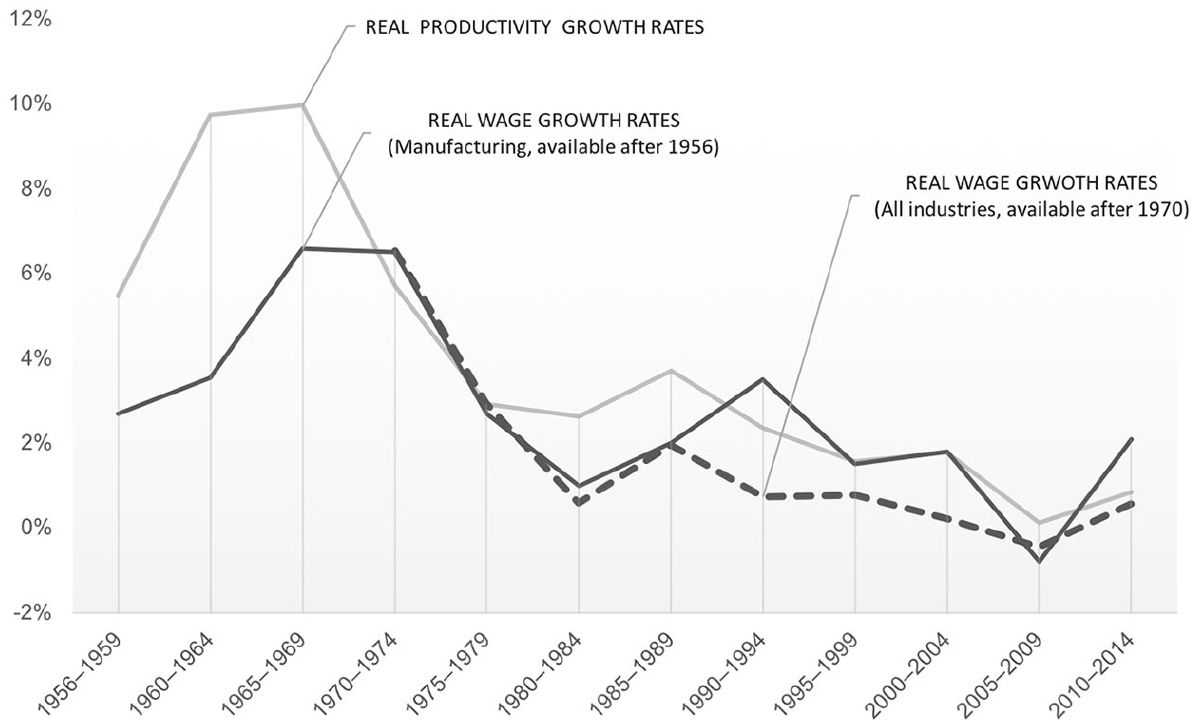
Wage growth and productivity growth in postwar Japan.
More accurately, by the end of the previous period, the internalization of elite laborers created this byproduct: a voice for wage growth from within the system. The very use of the Spring Offensive paradigm to expel labor militancy promoted their stronger voice vis-à-vis individual firms and the business class. Their strikes, though self-restrained, sustained the wage-growth trend, which seemed impermissible to business. The lowering rate of productivity and the new trend of international competition could not be solved without controlling the “wage problem,” they thought. Let us see how much strikes soared in number between 1967 and 1974 (Figure 2). This increase is largely explained by the Spring Offensive strikes led by elite laborers at big firms. The Spring Offensive gathered multiple industry-level unions in the strategic industrial sectors of national development, as well as laborers in public sectors. Rejecting hardline disputes and lockouts, the Spring Offensive engaged in sophisticated, well-planned strikes every spring and clamored for annual wage growth while rejecting ulterior aims (Kojima, 1975). It was this coalition—its “realism”—which drove the rise of strikes until the early 1970s (Hanami, 1982; Hyodo, 1978). These laborers understood that strikes should not disturb the “profit margins.” Yet, the Spring Offensive drove the momentum of wage growth beyond expectation.
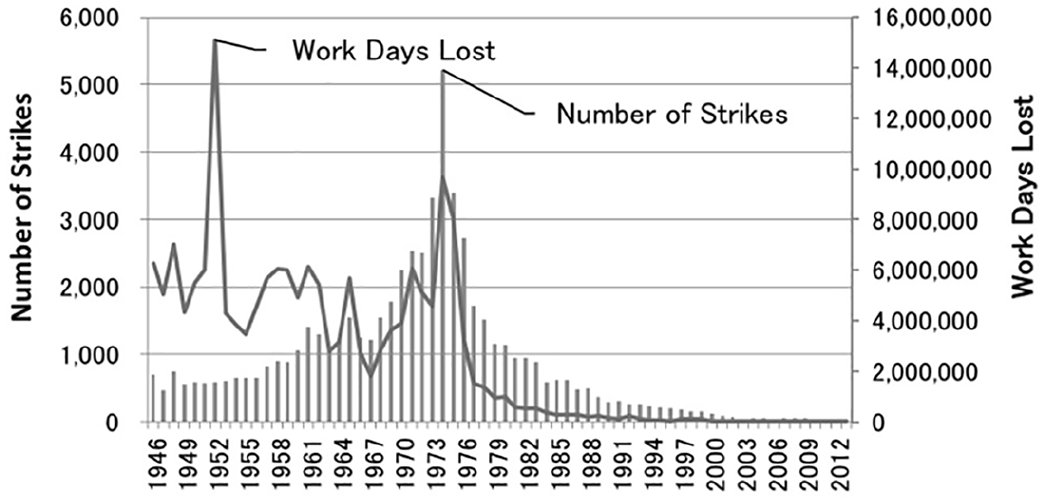
Yearly number of strikes (longer than half a day) and work days lost.
Industries were alarmed when faced by wage-growth demands from the Spring Offensive: Participants in the Spring Offensive increased from 70 million (in 1955) to 852 million (in 1970), and the “core” [target] is the wage decisions of the representative 200 firms . . . Because we expect that this year will be a year of considerable profit reduction and performance redundancy . . . we should abandon our easy-going moods of the past years and resolve wage problems with firmer attitudes. (Nikkeiren, 1971: 18)
This awareness of Nikkeiren—that the strikes of the Spring Offensive were dangerous—was especially keen in the early 1970s. When a new global economic crisis damaged the Japanese economy, business intensified recent efforts to make the working class subservient to the supremacy of profits, and to prepare them for upcoming wage squeeze. To this end, the Spring Offensive framework, which had strong influence over enterprise-level and industry-level mobilization was cunningly utilized by managers to tame laborers. Now, the strategic industries used the Spring Offensive framework as a tool to promote the “understanding” of laborers regarding upcoming wage squeeze and rationalization (Hasegawa, 1981: 115–116). When Japan entered a major phase of crisis after 1973, the preexisting relationship between elite businessmen and laborers thus played a vital role in reassuring the politically submissive character of the working class.
The Japanese state was also called to this new round of labor control. Only the state could effectively dub the 1970s crisis a “national” crisis, whose containment was for “the nation as a whole.” In 1974, Prime Minister Tanaka publicly announced a new state-led campaign against wage growth, and the handling of this campaign was largely decided by the Economic Planning Agency (Shimoyama, 1982). In the same year, Labor Minister Hasegawa claimed to laborers that: “To avoid a national bankruptcy, I expect that labor and capital will much discuss future wage problems from the perspective of the national economy” (quoted in Hyodo, 1978: 9, emphasis added).
It was with this ideological support of the state that businessmen were enabled to cover up their class action—its attack on wages—without outflanking elite laborers. Thus, when Nikkeiren (1980: 29) could not conceal its economic purpose, the state’s supporting role was important for laborers’ acceptance of wage-cost reduction. And, in reality, the trend of soaring strikes on the part of the Spring Offensive dwindled after 1974. A famous leader of the Spring Offensive admitted that its main strategy—annual strikes for annual wage growth—had become obsolete (Ota, 1978). Self-proclaimed “pro-business” unions, which organized elite-led labor politics with the strategic industries (such as IMF-JC and Dōmē), further pacified labor relations. The new tide of labor movements beginning in the late 1960s was contained very quickly during the 1970s crisis. This was when the depoliticized feature of labor was generalized; the “high fusion of labor representation with employers at the enterprise level deprived labor of a strong political lever” (Gottfried, 2015: 10). Looking back, the concession of wage politics until the early 1970s was a reward reluctantly granted to elite laborers, who had been coopted by developmentalism. When it began to gnaw away at strategic industries in the profit-squeezing, critical phase of development, the reward was retracted without endangering state autonomy—through the new evolution of labor control along ideological lines.
Reprise and Reexplanation
By describing this period as a national crisis, the state and business called on laborers to exercise self-restraint. Quickly, the Spring Offensive morphed into a national body of self-control. Strikes “harmoniously” nosedived. The productivity loss during the crisis of the 1970s was compensated for by wage squeeze. This postponed the real crisis of the developmental state into the 1990s, the era of “post babble” crisis, which Japan would seek to overcome by means of a neoliberal approach to wage squeeze. I can borrow key notions from Miliband (2009: 52), who says that the “national interest” must be shown “as above the battles of civil society, as classless, as concerned above all to serve the whole nation.” He continues: Policies adopted are proclaimed to be essential to the national interest, the health of the economy, the defense of the currency, the good of the workers, and so on. And there are always trade union leaders who can be found to endorse both the claims and the policies. (Miliband, 2009: 59)
In short, the “national interest” is a method for labor control and state autonomization. In the 1970s, big business’s own interests were narrated as such a national interest, and, moreover, this nationalized discourse for the “health of the economy” drew together politicians, managers, and union leaders. It elicited the loyalty of the most influential unions in this period, those of strategic industries. The question still remains: Why did all laborers accept it? This is worth asking because wage reduction in many countries has caused labor militancy to balloon, provoking out-migrations of capital and upsetting the economy (for a world-system explanation, see Silver, 2003). I suggest that, by the mid-1970s, the evolution of labor control and shop-floor rationalization had much fragmented and localized the political collectives of non-elite laborers, i.e. those who had been fragmented the most by technological enhancements. Influential forms of labor movements in this period were now concentrated in the hands of elite laborers whose status was more secure and whose voices were more readily heard. Yet, these prestigious rewards were soon delegitimated by the new narration of “crisis narratives” (Hay, 2001), which evolved labor control along the ideological lines.
Aftermaths of Labor Control
This labor control under democratic development—its depoliticizing effects since 1945—allowed Japan in the (post)1990s years to forge a Japanese path to neoliberalism: a path that treats labor as a special scapegoat. While Japan’s neoliberalization tarried in other major areas, such as banking and finance (Amix, 2004), it quickly penetrated labor relations (Gottfried, 2015). Wage growth crawled, keeping the total “wage costs” as low as possible (Tachibanaki, 2005). “Lifetime employment” and associated provision for elite laborers shrank (Ishida and Slater, 2010; Tachibanaki, 2006). Seniority wages were fragmented and partly replaced by performance wages (Ishida and Slater, 2010; Takeuchi, 2008). Behind the anti-labor assaults lay business. Labor-market deregulation advanced, very much in line with Nikkeiren’s (1995) advice to downsize the “costs” of regular workers and to replace them with nonregulars. Added to the newly emerging type of casual workers—dispatched laborers—was a growth in conventional-type laborers. Because in Japan the wage of nonregular workers lags behind regulars more significantly than in other advanced economies (Nomura, 1998: 109), the increased number of nonregulars depreciated the general wage level. Why this neoliberalization in Japan? A good explanation should refer to the prehistory. Japan’s neoliberalism sacrificed laborers especially because democratic development since 1945 had made them highly docile through labor control. It was this labor force, a historically depoliticized one, that became the prime target of neoliberal adjustments in post-development Japan (for Japan in this phase, see Pekkanen, 2004; Hayashi, 2010; Hirata, 2002; Yoshimatsu, 1998; Walter, 2006).
Conclusions
George Orwell, in The Lion and the Unicorn (1946), mocked the “familiar arguments to the effect that democracy is ‘just the same as’ or ‘just as bad as’ totalitarianism.” This applies to Japan. Escaping totalitarianism, postwar Japan established democratic legal frameworks, which many citizens appreciated, observed, and cultivated into viable democracy. No one denies this side of Japan. Beneath its success, however, lurked the unmentioned undercurrent: the long-term evolution of labor control and its construction of an “anti-labor-movement” society. The point is that Japan’s democratic development required a vast evolution of labor control in order to insulate developmental goals from workplace politicization. At best, labor movements were an unwelcome guest to democracy. At worst, their radical—even progressive—voices were remolded, quieted, fragmented, othered, and made docile or else acutely localized and “rescaled” (Brenner, 2004, 2019). I have shown how the Japanese developmental state developed the national paradigm of labor control, from its initial exceptional pattern into a refined socio-relational system with big business and elite labor. As soon as SCAP kickstarted democratization, the postwar history of labor control started violently, but it soon steered labor control in an intricate socio-relational direction, i.e. toward a bilateral (state–business) and a tripartite (state–business–labor) league at the summit of developmentalism in defense of industrial policy. It kept the passive revolution passive. It soothed the autonomy crisis of the developmental state. It managed the “harmonious” path of democratic development.
My contribution to Marxian state theory is clear. I have extracted several notions from the tightly bound matrix of theoretical debates and constructed a theory of labor control as the stabilizer of relative state autonomy. This conceptual reworking has linked Marxian theory and the Japanese case in a way which can avoid Eurocentrism while also averting excessive historicism. To developmental state studies, I offer another line of contribution: the repositioning of labor within the orthodox theory for non-Western states. I am tempted to say that developmental state studies have made the most of the strong and weak points of Chalmers Johnson’s classical accounts. For one thing, the literature rightly underscores the state’s capacity to promote late industrialization through state policy. For another, developmental state studies holds the dubious assumption that the labor question can trace a natural path of withering away because the state can be seen as benevolent. By using Japan, the “prototypical” case of this benevolence, I have shown that even democratic developmental states constantly face threats posed by working-class movements, and that the state tries to insulate developmental goals, and state autonomy, by producing a refined socio-relational system of labor control. In Japan, national civil society relegated active labor movements to the margins of democratic arenas. This did not prevent elite-labor-led strikes from becoming a hegemonic collective-bargaining paradigm; yet, even it was quashed by business and coopted by the state, who acted in this way to overcome the signal crisis of the Japanese developmental state, which finally contrived the docility of Japanese labor in the 1970s. This docility was effectively reused in the (post)1990s years when Japan made a neoliberal turn.
Footnotes
Acknowledgements
I would like to thank David Fasenfest and Heidi Gottfried for their informative comments. An earlier version of this paper was benefited from comments from Kei Takata (Nakagawa). All the usual disclaimers apply.
Funding
This research received no specific grant from any funding agency in the public, commercial, or not-for-profit sectors.
