







Abstract
This paper aims to expand critical urban theory and spatialized political economy through developing a new, broad-based theoretical explanation of homelessness and the informal housing of the deprived in public spaces. After reviewing an important debate in geography, it systematicallyreasserts the relevance of class-related concepts in urban studies and, mobilizing post-determinist notions, it shows how a class-driven theory can inform the emergence of appropriating/differentiating/reconciliating agency from the material bedrock of urban metabolism and its society-integrating effect (societalization). The author weaves an urban diagnostic web of concepts by situating city-dwellers—classes with(out) housing—at the material level of metabolism and then in the sociopolitical dynamic of regulation, finding in the two realms urban class relations (enlisted within societalization) and agency formation (for reregulation, subaltern strategies, and potential rapprochement). The housing classes are retheorized as a composite category of hegemonic dwellers who enjoy housing consumption and whose metabolism thus appears as the normative consumption of public/private spaces. Homeless people are understood as a subaltern class who lacks housing consumption and whose metabolism can produce “housing” out of public spaces, in opposition to a hegemonic urban form practiced by the housing classes. These urban class relations breed homeless–housed divides and homeless regulation, and yet allow for agency’s creative appropriation/differentiation/reconciliation. This paper avoids crude dichotomy, but it argues that critical urban theory can productively use this way of theorization for examining post-determinist urban lifeworlds in relation to the relative fixity of urban form, metabolic circuits, and class relations.
Keywords
Societalization, Metabolism, Housing Classes, and a Subaltern Class
This article aims to construct a theoretical slant that can unpack homelessness and homeless people’s informal housing in public spaces from the angles of critical urban theory and spatialized political economy. This section gives the reader an overall understanding of the key issues. Homelessness in public spaces—a form of poverty that demonstrates acute deprivation and struggles against it directly to the public—is more often studied from situational or contextual angles. This approach is important as the life of homeless people differs from most of “ours.” Homeless people’s rich textures, contextualities, and outward appearances might have obscured other kinds of effort, however. Homelessness still needs sustained, deep-seated theoretical exploration. I risk this polemical form of question, as I wish to highlight the need for substantial critical theorizations for homelessness. I do not belittle sociocultural perspectives on the rich social worlds of/around homelessness. Rather, this article’s theory is intended to form mutually informative linkages with sociocultural (ethnographic) viewpoints via post-determinist engagement in the abstraction–concretization method (for this approach, see Hayashi, forthcoming). Against this methodological backdrop, I hope that the theory presented here can establish an urban-regulationist entry point into the influential understandings of urban informality that are highly beneficial to the question of housing (Roy, 2005; Roy and AlSayyard, 2004; for the subaltern character of homeless people in a context of informality, see Sparks, 2017).
This article’s main concepts originate in multiple strands of spatialized political economy and critical urban theory. In what follows, I select three of them—social cohesion (societalization), metabolism, and the housing classes—and arrange my core arguments around these notions, in order to give the reader a sense of what I will discuss in this article. By using these concepts, this article will explain the subaltern and informal character of homeless people as something that partly derives from their urban relations to the hegemonic classes of housed people – their materialities, imaginaries, and politics. First, the question of how different national/subnational histories of capitalist development have nurtured an internally cohesive society in support of the overall economy has been a relevant topic for European continental regulationist thinkers. Aglietta (1979), who laid the foundations for the Paris school of regulation theory, argued that 20th-century capitalism in the West achieved a high level of social cohesion that “unif[ied] the wage-earning class by the universal extension of the wage relation” (p. 19). This cohesion, based on the generalized wage relation, was mediated by a “new mode of consumption” (p. 81) that remolded the working class into mass consumers. Aglietta however assumed (without unpacking) the “cohesion of social relations under the rule of the wage relation” (p. 22). Likewise, he was unclear as to why this cohesion accompanies an allegedly monolithic layer of social consumption norms on the national scale (pp. 18, 22, 69).
If more recent Parisian work has not keenly explored the dynamism of social cohesion and its “failure,” Jessop and his coauthors (Jessop, 2002; Jessop and Sum, 2006c), have made significant inroads into this topic. They have developed intriguing ideas about “society-wide” spaces and milieus of regulation that are contingent, contextual and even emergent and experimental, full of trial-and-error dynamics, delays, and disruptions. Jessop (2002: 22) claims: None of this [the centrality of profits and accumulation] requires that social relations have been subsumed under the commodity form and entirely subordinated to market forces. . . . This raises questions about the conditions under which accumulation can become the dominant principle of social organization (or societalization). For there are always interstitial, residual, marginal, irrelevant, recalcitrant and plain contradictory elements that escape subordination to any given principle of societalization and, indeed, serve as reservoirs of flexibility for innovation as well as actual or potential sources of disorder.
Jessop suggests that social cohesion can be rooted in different principles and logics, different spaces and temporalities, of societalization. Moreover, equal importance is given to disruptive forces/groups that elude societalization. Decades after Aglietta’s (1979: 12) call for understanding social cohesion “in movement,” Jessop allows us to frame the issue as the open dynamics of societalization by paying equal attention to the two sides: systemic and counter-systemic. I situate homelessness within these understandings. Aglietta expounded that the realization of consumption norms is key to an internally cohesive society that can sustain the reproduction of social relations in support of capital accumulation. Jessop reframed the question as societalization, implying that the societalizing norms have diverse appearances and consequences and that they face disrupting forces/groups in various spaces and temporalities of capitalist development/non-development. My view is that homeless people can form such a group—a category of people who (partially) escape the societalizing power of consumption norms and even (potentially) disrupt these norms.
Second, why do I claim that homeless people can signify the significant outsiders of societalization (as I do)? This question leads me to the concept of metabolism. By elaborating upon Marx (1973, 1976) and Marxian thinkers (e.g. Burkett, 2014; Foster, 2000; Swyngedouw, 2006; Heynen et al., 2006), I define metabolism as the material processes of production and consumption that people develop with nature that sustain their organic compositions, physical bodies, and semiotic milieus. In cities, there is a decisive metabolic actor—in the form of housed citizens—who form majoritarian metabolic relations with public/private spaces qua urban nature. I find that this idea—public/private spaces (“habitat”) as a metabolizing and societalizing matrix of urban nature—is inherent in Henri Lefebvre ( 1991, 2003). The homeless are people who are deprived of private spaces and, due to this lack, are driven to develop a unique (subaltern) kind of metabolism different from many city-dwellers. Homeless people can sustain their organic compositions, physical bodies, and semiotic milieus by producing “housing” out of public spaces. This minoritarian, subaltern metabolism with public spaces has a disruptive impact on housed citizens’ consumptive metabolism because the homeless’ productive action creates “private” in “public,” which runs counter to the majoritarian, hegemonic form of consumptive metabolism and its public/private matrix. At the bottom, this metabolic Otherness hastens “homeless regulation,” which mobilizes state/social regulators who strive to contain, deform, and (if possible) exclude the homeless’ (re)housing metabolism in public spaces.
Third, the long-term context of societalization and metabolism has fundamentally transformed the appearance of class relations in many cities. That is, cities have moderated classical class antagonism (i.e. the worker–employer relations) by overlapping it with urban-wide relations of the “housing classes” (Rex and Moore, 1967; Harvey, 1976). This group’s quality of living associated with housing consumption is diverse and situational; its common semiosis, highly local—hence, housing classes (plural). Yet, people in this category can still be “similarly” inserted in urban nature guided by the public/private matrix. This insertion can push the housing classes into powerful societalizing processes around public spaces, where their affinity—real/imagined housing class-ness—are affirmed through their open consumption in public. This self-affirmation of the housing classes in public is a widespread phenomenon and in turn is an indicator of more or less normative metabolism and societalization on the urban scale. The homeless are people who form a subaltern class in relation to this self-affirmation of the housing classes. Class vocabulary suggests that existing forms of homeless regulation cannot easily be differentiated, still less displaced, because the regulation is the appearance of urban class relations and relative fixities of metabolism under the grid of habitat (on this reading of Lefebvre for housing, see also Hayashi, 2014, 2018, forthcoming). If we see any differentiating agency arising from these urban class relations, including the agency-like capacity that homeless people show during their metabolic–productive process, this agency is a feat, the result of intensive reworkings of urban class relations, not the popping up of unmediated experiences.
A Debate in Geography
By beginning with Aglietta and Jessop, and by relating their understandings to broader questions, I have shown the reader the way in which this article theorizes homelessness. This framework is more clearly articulated later in this article. This section, a prequel to the main sections, addresses some preexisting discussions about homelessness in the discipline of geography. This article’s core theoretical attempt amounts to a new—but by no means the first—round of urban-critical theorizations of homelessness (for comparable trends in sociology, see Marcuse, 1996; Wagner, 1993), which is informed by what earlier authors have (and have not) said.
Marxian geographers made vital contributions to our understanding of homelessness and its urban-spatial regulation until the early 2000s. More recent geographers swiftly relativized these Marxian interpretations. This shift reminds us of the inherent difficulties and possibilities of a new round of critical theorizations of homelessness. To begin with, Smith (1996) and Mitchell (1997, 2003) innovatively developed Marxian notions, which had already been cultivated by David Harvey and others in geography, in forms useful for deciphering homelessness as it took shape in US public spaces under intensive gentrification. By using eloquent phrases such as “class struggle on avenue B” (Smith, 1996) and the “annihilation of space by law” (Mitchell, 1997), these geographers revealed how public spaces animate structural contradictions of neoliberalization in the form of homelessness and anti-homeless urban regulation. They understood that major US cities epitomized generic—almost theoretical—moments of neoliberalization when anti-homeless regulation sought to reinstate homeless-free public spaces for “the footless middle class” (Mitchell, 1997: 305) so that these spaces regained substantial roles in conspicuous consumption and gentrification.
More recent geographers have challenged these explanations. DeVerteuil et al. (2009) argued that US cities leave a lot of indeterminate areas in regulation that allow homeless people to develop innovative actions to overcome anti-homeless regulation. DeVerteuil (2006) showed that homeless shelters, in addition to the streets, can be a livable site for homelessness in which the homeless and non-homeless agencies can increase and utilize the regulatory inconsistencies on ground level in more homeless-friendly ways (see also DeVerteuil et al., 2002). Furthermore, UK geographers Cloke et al. (2010) criticized Marxian interpretations from outside the US. They found more flexible, undetermined, and ambiguous spaces of homelessness in UK cities, which they counterposed to US cities (as depicted by Mitchell). Relatively modest experiences of homelessness in the UK accompanied the homeless–housed divides, they maintained. Yet, they aspired to show these rifts as something that can significantly decrease with the street-based actions of charitable organizations, sympathetic individuals, and homeless people. Methodologically speaking, these UK geographers eagerly used the benevolent terrains of the “homeless city” in the UK as a weapon to push back the explanatory space of Marxian theory to North America, thereby making their UK geographies immune to Marxian urban theory in the Smith–Mitchell version (see also Cloke et al., 2002).
These discussions in geography are definitive. To clarify, post-Marxian geographers deny or relativize preexisting Marxian understandings based on the following three grounds.
Multidimensionality: According to the more recent work of geographers, many emergent agencies and their spaces/processes are missed by Marxian geographers, who have strategically selected only a few of them that support their “strong” theory. This selective approach is unwarranted, the recent geographers think, because homelessness has “messy” (Cloke et al., 2010; DeVerteuil, 2015) middle grounds in which various agencies and their processes/spaces can have resilient reconstructive power. Homeless people themselves are agency; housed citizens can overcome the homeless–housed divides; regulating powers can be compassionate beyond the “draconian” conception by Marxists.
Contingency: According to the more recent work of geographers, the structural logics of neoliberal urbanization and its regulatory mediums cannot determine issues surrounding homelessness. The reason is that the spaces/processes of homelessness are by far more accidental and contingent than Marxian urbanists imagined. It is not just that a lot of new spaces/processes emerge around homelessness. What is more, these spaces/processes are full of uncertainties that can be exploited by various types of urban agency. This contingent character cannot be grasped or sensitized by citing the “logics” of urbanization that Marxian geographers favor. Simply put, we cannot explain homelessness—neither its pathological nor non-pathological aspects—as if it were a mere corollary of neoliberal (capitalist) urbanization.
Geographical diversity: According to the more recent work of geographers, the Marxian paradigm inherently subdued diverse geographies of homelessness in terms of how (and to what degree) its spaces/processes emerge and are (mis)treated. This geographical diversity of homelessness escaped the Marxian paradigm owing to the authors’ motivation to construct “strong” theory, an aspiration that gave rise to their blindness to the uneven character of the spaces/processes of homelessness. In response, the recent work of geographers recommends constructing a new line of theoretical interpretation outside of the Marxian corpus so that the theory can respond to geographical diversity.
I find that these three points make up a useful critique of Marxian homeless studies. Smith and Mitchell effectively mobilize Marxian notions, but they in turn tendentiously subdue the multidimensionality, contingency, and geographical diversity of homelessness. All in all, a new round of urban-critical theorizations of homelessness should embrace these three points of criticism. The next two sections mainly seek to resolve the problems of multidimensionality and contingency. I hope that these arguments can maintain (what I consider to be) several Marxian parameters that are still useful for homeless studies: (a) that the material level of production–consumption (metabolism) spawns significant effects of class reorganization with repercussions for the non-material (sociopolitical) processes of societalization and regulation; (b) that this “class effect” of metabolic materiality is reinforced or differentiated through ongoing struggles between/within the housing classes (and their guardians) and homeless people (and their supporters); and (c) that the dynamics of these urban-rooted struggles and their outcomes require perpetual renewal, not just of situational interpretations but also of synthetic accounts.
The geographical-diversity question raised above needs comment before the rest of this article diverges from it due to the constraints of space. My belief is that the theoretical apparatus in this article can be meaningfully used for diverse geographies of modern capitalist urbanization beyond its early domains and hotspots insofar as the public/private matrix of city-space construction is re-practiced, though revised and restructured, in the inherently emergent geographies of planetary urbanization (Brenner 2014, 2019; Merrifield, 2019). Up to a point, this public/private matrix would be able to promote the normalization of urban metabolism and the societalization of city-dwellers (into the housing classes) internationally due to the high mobility of the public/private matrix in urban-policy discourses and practices. At no point do I say that this theory is “universal.” Yet, the broad pertinence of this critical theoretical apparatus needs not be underestimated. Its applicability can be further enhanced by refining the method of abstraction–concretization and by using the method jointly with rich ethnographies (Hayashi, forthcoming).
Theory I: Urban Class Relations at the Level of Metabolism and Its Societalization Effect
Urbanists and political economists have uncovered the material undercurrent of capitalist development and urbanization by using the metaphor of “metabolism.” Marx’s conception of human–nature relations can be understood under this rubric (Burkett, 2014; Foster, 2000; Schneider and McMichael, 2010). Burkett says, “In Marx’s view, nature always contributes to wealth or use values, and labor is itself a metabolic relationship between people and nature” (Burkett, 2014: xvi). For Foster (2000: 158), this Marxian perspective gives foundational understandings of long-term, large-scale capitalist development that led to the formation of “general social metabolism,” as well as the “metabolic rift” that serves human–nature relations on the altar of capital accumulation. Urban ecologists who use the notion of metabolism adopt somewhat skeptical attitudes to worldly meta-narratives of metabolism (e.g. Gandy, 2004), but when theorizing the metabolic undercurrent of urbanization, emphasis is still placed on Marx’s own ideas (Brenner, 2019; Heynen et al., 2006; Mitchell, 1996; Swyngedouw, 2006; Wachsmuth, 2012), suggesting that there is room in critical urban theory to elaborate upon the metabolism concept put forward by Marx.
My first theorization taps into this crucial notion of metabolism. 1 As Marx himself clearly stated, metabolism can be grasped primarily as the process of production and labor (Marx, 1976). Heynen et al. (2006: 8) explain this critical aspect of metabolism by saying, “labor constitutes the universal premise for human metabolic interaction with nature.” In so doing, Heynen et al. effectively link the Marxian argument of metabolism to Lefebvre’s notion of urban nature, as summarized in this quotation from Lefebvre.
Nature, destroyed as such, has already had to be reconstructed at another level, the level of “second nature,” i.e., the town and the urban. The town, anti-nature or non-nature and yet second nature, heralds the future world, the world of the generalized urban. (Lefebvre, 1976, quoted in Heynen et al., 2006: 5)
Urbanization can be considered partly as the labor-mediated production of this urban nature, in which, to invoke another key Lefebvrean urbanist, the “second nature is increasingly wrenched from the first” and so “experiences continuous internal differentiation” (Smith, 2008: 72). For Lefebvre, in point of fact, this internal complication of urban nature is what he considered under the banner of “habitat,” which is the matrix of public and private spaces that set the landscape of urban settlement for housed citizens, and which construct their urban encounter in more or less “programmed” fashions (Lefebvre, 1991, 2003).
Questions arise: Is it true that many urban dwellers experience the main part of metabolism as material production? Don’t they largely consume? That is, indeed, the awareness that drove Castells’s (1977) thesis of collective consumption. Lefebvre (1991, 2003) himself understood that contemporary urban (second) nature has turned into a domain of consumption—mass consumption, even—meaning that urban settlement comprising multifarious consumptive spaces has become the central site (habitat) for laborers’ reproductory consumption in capitalism insofar as “the social control of space weighs heavy . . . upon all those consumers who fail to reject the familiarity of everyday life” (1991, p. 233). In this historical lineage of urban theory, Harvey’s 1976 article fundamentally radicalized the Weberian concept of housing classes (Rex and Moore, 1967), by arguing that the housing classes (plural) are the shape into which the working class becomes fragmented, rearticulated, and—up to a point—depoliticized through the (Keynesian) expansion of public/private spaces. Harvey later introduced another notion of “displaced class struggle” (Harvey, 1989: 85) in order to denote the unique form of popular struggle that can still arise from the housing classes when they fight for better urban consumption.
On this basis, I assert that the housing classes are the main pattern of agency formation in residential neighborhoods and that the housing classes represent an internally uneven yet distinctive category of city-dwellers who similarly enjoy the key use value, housing, though its quality varies. Further, this use value of housing allows them to construct their distinctive metabolic relations with urban nature in normative ways. The housing classes, by owning houses/rooms and by enclosing their private life within housing (privacy preservation), enjoy the class power to consume public spaces according to normative consumption rules, thus urbanizing the regulationist notion of consumption norms (Aglietta, 1979; Boyer, 1990; Boyer and Saillard, 2002). This releases the vast societalizing process of social integration in cities. The norms of consumption are performed by the housing classes especially when they use urban amenities less with differentiation/appropriation (cf., Lefebvre, 1991). This regimented mode of consumption inserts the housing classes in similar ways into public spaces, in which city-dwellers can mutually recognize each other as the normal consumers in public. Living in the city is possible for residents by “purchas[ing] . . . a particular distance – distance from the purchaser’s dwelling-place to other places,” says Lefebvre (1991: 339). I add to Lefebvre that it is only through consuming this distancing use value (housing) that various kinds of city-dwellers can similarly enter such normative (societalized) urban encounter, which Lefebvre is eager to talk about, in public spaces. Through this, the housing classes’ metabolic relations with urban nature become (more or less) normalized relations of hegemonic consumption—“normalized lifestyle[s]” (p. 338)—that have profound repercussions for social integration and societalization on the urban scale.
In fact, the topic of homelessness demands we are not satisfied with this “systemic” discussion that might sound somewhat deterministic. So, later on I will introduce elements of crisis and crisis-driven reformation to this picture. At this stage, however, the systemic viewpoint gives the crucial understanding about the bedrock processes against which “agency” should be located. This section goes so far as to note that consumption is only one side of metabolism, which should be grasped also as a process of production. Production and consumption form a circuit of metabolism—“a mediating movement tak[ing] place between the two” (Marx, 1973: 91). In this respect, keeping the housing classes in a consumption-oriented form of metabolism is a significant feat of “the urbanization of capital” (Harvey, 1989). By leaving the production part of urban metabolism to the capital-occupied domain of built-environment production, cities vastly emancipated people’s metabolic relations with nature from the constraints of production and depoliticized urban everydayness—away from accumulation. Normative consumption in cities has thus become an urban-societalizing locus in which the housing classes might “fail to reject the familiarity of everyday life,” if I can use Lefebvre’s eloquent statement once again (1991: 233).
At no point do I deny that this societalizing effect of consumption-oriented metabolism can be destabilized, from within, when the housing classes advance their own work of production, which can produce non-capitalist economies in urban nature (Gibson-Graham, 1997; Roelvink et al., 2015). However, in the main, the metabolism of the housing classes can refrain from fundamentally challenging the urban form and matrix insofar as these classes can enjoy the class power of privacy preservation and, based on this power, can use public spaces as spaces of normative consumption. Nowhere do I claim that this normative consumption is unchallenged by consumption itself. The housing classes can develop progressive (even radical) politics in situ, for example, in defense of everyday consumption vis-a-vis capital (Castells, 1983; Harvey, 2012; Logan and Molotch, 1987). Differentiating and reappropriating efforts fuel new urban struggles (Goonewardena et al., 2008; Merrifield, 2013; Nicholls et al., 2013; Valentine, 2008). However, the housing classes’ metabolism can still be patterned by the public/private matrix of consumption even after the housing classes have developed appropriating struggles (Lefebvre, 1991). The matrix can still embrace the housing classes by guiding everyday consumption, rendering these classes a self-societalizing body of city-dwellers who consume various public spaces relatively normatively (Lefebvre, 2003)—the streets, alleys, avenues, sidewalks, parks, community fields, public gardens, railway stations, public transport etc.
It is here that homelessness matters. The systemic (societalized) nature of the housing classes is most clearly recognizable when the housing classes encounter those who lack the use value of housing: homeless people. Their character as a subaltern class grows in relation to the housing classes especially when homeless people try to overcome their lack of housing through production and laboring. To compensate for the lack of housing consumption, homeless people can continually produce, and immediately consume, the use value of housing—informal housing—out of public spaces, despite the fact that many housed citizens keenly use public spaces as popular (commonly used) urban amenities by following established consumption norms. The homeless by definition lack the use value of housing and, owing to this structural deficiency, are driven to produce, and appropriate for consumption, the use value of informal housing. To employ Lefebvre’s notion, homeless people pose new, emergent forms of “habitat” vis-a-vis its normalized forms. This housing metabolism by homeless people, when conducted in public spaces, has a significant impact on the extant urban form, its public/private matrix, and its societalizing capacity because homeless people come to occupy the special position of being a minority in the urban worlds of the housing classes. This metabolic contradiction in public spaces structurally divide homeless people and the housing classes at the material level, leading to open dynamics of re-societalization.
I do not have to alienate this materialist theory for housing informality, which defines homeless people as a subaltern class having the sheer metabolizing capacity (agency), from specialists on homelessness. A fertile area of agreement exists between notable specialists and this theorization. Scholars in geography, sociology, and urban studies have shown that public spaces can incubate major conflicts between homeless people and housed citizens. One term scholars draw on to express this tension has been the notion of “divides”—such as homeless–housed divides—that are said to emerge and proliferate in public spaces when these spaces are dwelled by homeless people (e.g. Cloke et al., 2010; Gowan, 2010). To articulate the gulf between homeless people and the housing classes, some scholars have emphasized their completely different purposes of public-space usage that throw homeless people and housed citizens into irreconcilable antagonism. For example, the major sociological work of Snow and Anderson (1993: 332) explains the public/private dichotomy in the following way.
The public/private dichotomy is the more conventional way of categorizing urban space. Private spaces are those areas to which access is legally restricted to owners, renters, and invited guests. Public spaces, exemplified by parks, malls, streets, and sidewalks, are legally accessible to all citizens . . . Such a distinction may be of some utility to the ordinary domiciled citizen, but it is of little value to the homeless, for, by definition, private spaces are almost always closed to them. Nor does the concept of public space address their needs. After all, are parks fully public if a city ordinance prohibits the homeless from sleeping in them? Are sidewalks public if the police mobilizes on behalf of business interests to drive the homeless from the streets, as was attempted along the Drag and Six Street?
Overall, these authors have rightly pointed out the contradiction in public spaces by using these “dichotomous” expressions. These dualistic discourses might be said as unrecommended by theorists of space, place, and political economies (Cresswell, 2015; Gibson-Graham, 2006; Massey, 2005; Thrift, 2007; Urry, 2007). I would suggest however that critical urban theory can still productively use this vocabulary, though in post-determinist ways, when it unpacks urban lifeworlds in relation to pregiven urban form, class relations, and their relative fixity. Therefore, very rightly Snow and Anderson in this quotation went so far as to imply that the public/private matrix is a rudimentary source of homeless–housed opposition that feeds into socio-discursive antagonism, which profoundly derails the “concept of public space” as we know it. In response to these prior understandings of the homeless–housed divide, my theorization further elaborates the conception of this tension between the housed and the homeless by drawing on the underlying conception of metabolism. On this ground, homeless people produce the private space of housing out of existing public spaces, and consume this “housing” in public, while the housing classes predominantly consume the public space as such. In the same urban system of habitat, there thus emerges the material-level (metabolic) divide between homeless people and housed citizens. Table 1 shows schematically the multidimensionality of these divides.
Homeless–Housed Divides at the Level of Metabolism.
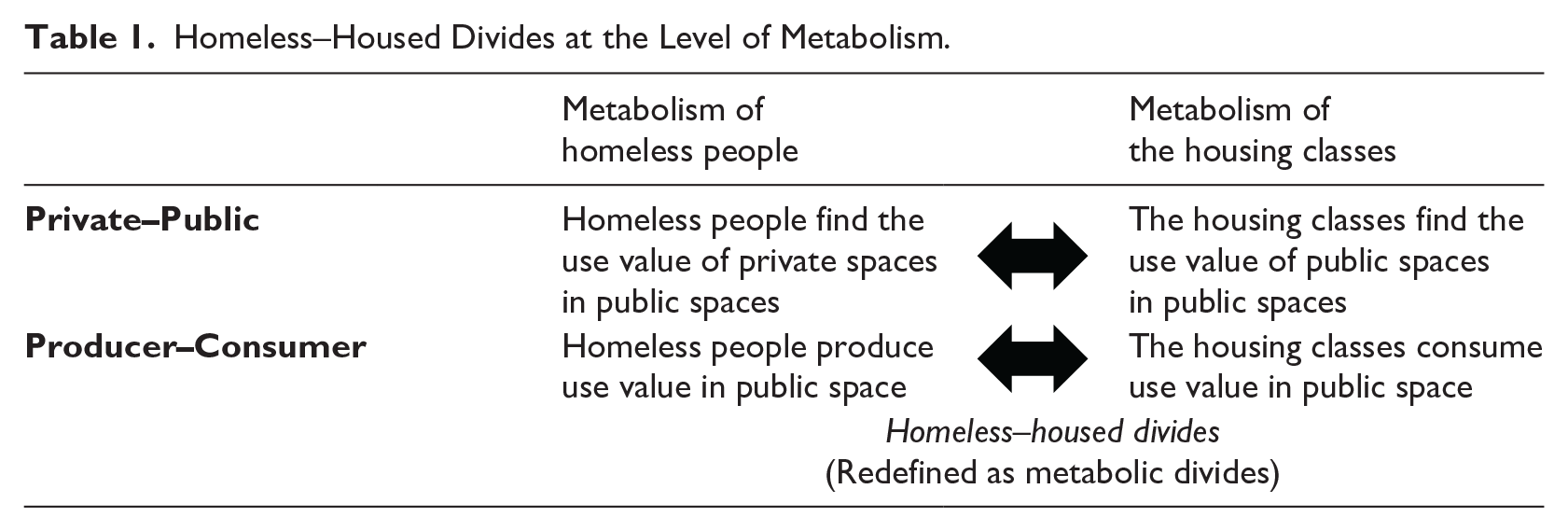
This table in my view can embraces post-Marxian concerns about the “messy” (Colke et al., 2010; DeVerteuil, 2015) realms of homelessness at the level of materiality. That is, multiple divides between homeless people and the housed are rooted in two different logics of agency formation deriving from the two distinct patterns of metabolism. In short, homeless people and the housing classes become different urban agencies because their metabolisms are different. At the material level of metabolism, cities thus can generate significant society-dividing effects that are sometimes hard for the involved agencies to overcome. This paper would not hesitate to conceptualize these divides more as a source of structural mistreatment that will not simply evaporate. If any dissipating events emerge from everyday encounters in public spaces, these “reconciliations” should garner special attention. In this respect, the theory can shed new light on deformations of the homeless–housed divides, emphasized by some authors.
Theory II: Re-Societalization Through Homeless Regulation
Lefebvre (2003: 164) asks: What is urbanism? A superstructure of neocapitalist society, a form of “organizational capitalism,” which is not the same as “organized capital” – in other words, a bureaucratic society of controlled consumption. Urbanism organizes a sector that appears to be free and accessible, open to rational activity: inhabited space. It controls the consumption of space and the habitat. (emphasis added)
The next task of this article is to refine this controlling thesis of Lefebvre—that urbanization operates housed citizens by regulating spaces of consumption—into a post-determinist theory of regulation-in-city while maintaining Marxian theoretical parameters that are useful. This elaboration can hopefully address the questions of multidimensionality and contingency at the sociopolitical levels of urban encounter. As I have shown, Lefebvre (1991, 2003) laid down foundational arguments about regulation-in-city and societalization-in-city by showing that the everyday spaces and encounters of housed citizens (which he generally called habitat) become an existential basis for urban-scale regulation. Yet, there is room to elaborate Lefebvre’s argument by employing a different (Gramscian) set of vocabulary so that we can construct a specific (regional) theory of homeless regulation as being linked to, but relatively independent of, the homeless–housed divides at the level of metabolism.
With regard to homeless regulation, the particular ideas I take from Lefebvre and further develop into are that (a) urbanization generates powerful political and sociocultural milieus of regulation-in-city when/where housed citizens can be molded into the “consumers” of pregiven public and private spaces; (b) even in that case, the existential milieus of housed citizens are not “determined” by the metabolic (material) conditions; and (c) the re-societalization of urban encounters and class relations into the (more) regulated form of habitat involves ongoing, strategic, experimental repositioning of the housing classes with respect to their Other (“the homeless”) through “homeless regulation” (for recent arguments about homeless regulation in public space, see Johnson and Fitzpatrick, 2010; Stuart, 2014).
The question is urgent because the urban form of habitat—comprising various public and private spaces—must contrive the feat of societalization on behalf of modern urbanization at large. It is true that Aglietta (1979), one of the most classical authors in regulationism, presented a crude assumption that an integrated form of mass-consumption society rather automatically (re)emerges around the accumulation regime (1979: 18); we need to overcome this deterministic conception of societalization. But we do not need to downplay existing insights as well. In the case of Aglietta, he suggested that housing and urban settlement facilitate the “formation of a social consumption norm” (1979: 82) and that the production of housing and urban settlement—including slums and suburbs—can form a layer of social cohesion around capital accumulation amidst the crisis of neo-Fordism (1979: 79–80, 84–85, 159–160, 174). As early as the 1970s, Aglietta thought that “consumption is a material process, it is located in space; it has a specific geography and object-network” (1979: 156) and that the “socialization of consumption becomes a decisive terrain and battle-ground of the class struggle” (1979: 165). This class struggle, in turn, can be re-regulated through the “canalization of the class struggle [that] involves the totality of social relations at any given time” (1979: 67) into a systemic form of “capitalist urbanization” (1979: 173) so that cities might reestablish the “socialization of consumption” (1979: 81) against the deepening crisis of Fordism.
We find comparable, but more sophisticated, arguments from contemporary authors who excavate scales and geographies of socioeconomic regulatory affairs in cities (Amin, 1994; Brenner, 2004, 2019; Brenner and Theodore, 2002; Jessop, 2002; Soja, 1989). My emphasis is that we can further improve this strand of spatialized urban-regulation theory in a way that has not been much attempted. This paper has already prepared theoretical discussions to that end by focusing on the urban matrix of habitat—the object-network of public and private spaces—and how this matrix can (not) continually societalize the housing classes. I have shown that this societalization via public/private spaces once powerfully entangled marginalized social groups and the poor; the housing classes formed somewhat perpetual appearances of urban hegemony. I have also argued that in more recent years, this high societalization meets ever large populations of homeless people—i.e. the metabolic outsiders of the housing classes and their public/private spaces (habitat). The homeless mode of metabolic relations with urban nature disrupts (or seems to disrupt) the consumption-oriented metabolism of the housing classes and calls for the re-societalization of urban class relations through homeless regulation. The capitalist form of urbanization thus faces an “obstacle” at its center—at the “consumption of space and the habitat” (Lefebvre, 2003: 164)—which might be re-regulated in process.
Previous Marxian geographers on homelessness sometimes rather skewedly focused on the coercive and punitive side when they talked about homeless regulation. In response to the post-Marxian criticisms, we can remold the theory of homeless regulation into a more multifaceted and contingent shape. To this end, I reconsider the insightful yet still crude assumptions about urban regulation made by Lefebvre and Aglietta in light of Gramsci on regulation (regularization of a civilization), which Jessop (1997, 2002) influentially discussed. On this basis, I conceptualize homeless regulation as state–society relations and collaborations (the “integral state”). A combination of the state and society can possibly reconstruct a viable integral-state form in relation to the new “disruptive” urban encounters with homelessness (Hayashi, 2018), but without “determining” the trajectories. To invoke Althusser’s (2006) metaphor of “swerve,” which reworked Althusser’s previous mechanical notion of overdetermination, urban projects of re-societalization through homeless regulation move fluidly around and swerve from the “strong” parameters of the metabolic (material) divides and contradictions. Gramsci is helpful in unpacking this contingent character of late-Althusserian aleatory encounter (Thomas, 2011), and I further consider the multidimensional and contingent notion of Gramscian regulation as swerving collaborations between state and social powers for the re-societalization of urban class relations against the de-societalizing effects of homelessness.
Jessop’s (2002) reading of Gramsci lets us conceive societalization as fundamentally crisis-prone, as something that must be repeatedly reasserted, in the face of destructive tendencies and counter forces, by mobilizing various state and social regulators. I interpret homeless regulation as experimental processes that are eager to find viable regulatory agencies in state and social realms, which possibly rehabilitate urban regulation not just at the pole of coercion but also across the broad spectrum between coercion and consensus; this regulatory complexity drives the differentiated trajectories of the “penal state” (Peck, 2003; Wacquant, 2009). Though some regulators fervently hope to entangle the “disruptive” bodies in the homeless metabolism forcefully and punitively, at no point does this deny the emergence of a more consensual outlook of homeless regulation through the contingent, aleatory, non-ordained trajectories of experimentation.
The need to theorize this experimental character of homeless regulation recalls an essential discussion of Peck and Tickell (1995), who mobilize the “chance discovery” notion for rescuing spatialized regulation theory from the dangers of determinism. Their work allows us to understand how cities and localities can achieve the “chance discovery” of homeless regulation by activating forces in the state sector (e.g. the municipality, the police) and the social sector (e.g. housed citizens, volunteer organizations), and how the two sectors and their mutual relations drive the rescaling production of homeless (poverty) regulation into more flexible urban regimes beyond consolidated regulatory fixities (Brenner, 1998, 2004)—in this case, the nationally coordinated fixities of citizenship and “the welfare state” (Hayashi, 2013a). Peck and Tickell (1995: 17) say, The preponderance of . . . failed, and failing, regulatory experiments does not undermine the regulationist project. . . . If the headlong charge into premature, metahistorical theorizing about the character of the emergent regime has taught us anything, it is that reality is more complex, more conditional.
This chance discovery of regulation-in-city and societalization-in-city cannot be fully understood if one merely focuses on “cities” themselves, because the post-determinist dynamics in question are also about multiscalar rescaling processes, which entail the political construction of tolerable “homeless politics” outside (and at the margins) of the consolidated politics of rights and citizenship. In this context, the chance discovery of homeless regulation might be achieved when multiple spatial scales co-constitute and rescale homeless-regulating regimes into more localized and (semi-)autonomized forms attuned to local contradictions and tensions, so that exceptional—“beyond citizenship”—spaces of regulation can open up on the urban scale. The bodies in the homeless metabolism “disruptive” to societalization might be moderated, subdued, or expelled from the view of the housing classes. In this way, by displacing immediate sites of regulation from the national to the urban scale, the urban project of homeless regulation might reinstate “hegemony [that is] protected by the armor of coercion” (Gramsci, 1971: 263) on behalf of societalization and its class base.
And yet, a post-determinist understanding of rescaling regulation can provide scope for the homeless’ own material and sociopolitical relations. Homeless people’s sociopolitical struggles exploit regulatory uncertainties that open up on the urban scale. The metabolic struggles of homeless people, which we have already explored, are thus overdetermined by their sociopolitical struggles through which to give the homeless metabolism “hegemonic” appearances. Indeed, homeless people are eager to present themselves not as the outsiders of extant sociopolitical rules and consumption norms but as insiders—as groups/individuals who can maintain and adhere to these rules and norms of societalization (see Gowan, 2010; Snow and Anderson, 1993). Such self-adjustments of homeless people can (partially) overcome the anti-homeless societalization of NIMBYism (DeVerteuil, 2013; Takahashi, 1997; Wagner, 1993), thereby managing spaces of the homeless metabolism as well as its partial sociocultural autonomy (Sparks, 2017). That is the chance-discovering action of homeless people and, by extension, their supporters (Hayashi, 2018). Ongoing creations of new “maps” of urban space in search of better homeless sites—in and beyond prime areas—are among this kind of action (Cloke et al., 2010). Social movements for homeless people can assist and advance these sociopolitical adjustments, even under rescaling, beyond the homeless–housed divides (Hayashi, 2015, 2018).
Mitchell (1997), while in the main emphasizing state powers as a regulating force, also hinted that these powers are assisted by the social power of “the footless middle class” (p. 305). More recent geographers are correct in pointing out that a narrow focus on the “punitive” regulating powers can make the whole domain of homeless studies simplistic. Learning from this dialogue in geography, this section’s Gramscian framework has incorporated the messy dimensions of rescaling regulation in which state/social agencies can jointly or separately react against homeless people on the urban scale, away from the fixity of “the welfare state.” The urban scale becomes a useful domain not just for systemic societalization/regulation but also for (partial) autonomies of homeless people and their supporters. Around the “consumption of space and the habitat” (Lefebvre, 2003: 164), that is to say, we can recognize the ongoing situations in which urban encounters—between the housing classes (and their guardians) and homeless people (and their supporters)—can move around, and even swerve from, the “strong” (material) parameters of the homeless–housed divides to be found at the level of metabolism (for this urban-scale swerving of homeless regulation, see Blau, 1992; Cress and Snow, 2000).
Coda: Urban Extensions of Marxian Ideas
Neil Smith and Don Mitchell once developed a “strong” theory for urban critique that used homelessness in impressive ways, but their theorizations soon met with well-informed criticism from geographers who were concerned about deterministic assumptions. After reviewing this dialogue, this article has embarked on a new round of critical theorization by targeting public spaces that form a structural coupling with private spaces. In this context, significant cracks can emerge between homeless people and the housing classes when the two are driven to struggle for the different meanings of public spaces: the former seeking the production of the use value of informal housing; the latter, normative consumption based on the possession of the conventional housing use value. I have interpreted the homeless–housed divides as metabolic divides that result from their differential insertions into the public/private matrix, which is a central framework of urban societalization. These divides drive homeless regulation qua re-societalization. The municipality, police, security services, residents, shop keepers, and so on, as well as their collaborative relations might achieve the “chance discovery” of homeless regulation on the urban scale through accelerating rescaling dynamics. Yet, the same dynamics can also become the field for the homeless’ creative actions to produce, sustain, and consume the new, emergent forms of habitat within (and out of) public spaces. Hopefully, this theory can offer an urban-regulationist view to the understandings of urban informality (Roy, 2005; Roy and AlSayyard, 2004) for further unpacking the housing informality without obscuring its underlying class relations, housing metabolisms, and their societal impacts. Any seemingly “dichotomous” theorizations might be said as unrecommended by scholars of space, place, and political economies (Cresswell, 2015; Gibson-Graham, 2006; Massey, 2005; Thrift, 2007; Urry, 2007). I have suggested, however, that critical urban theory can still productively use the perspective presented in this article when the theory examines post-determinist urban lifeworlds in relation to the relative fixities of urban form, metabolic circuits, and class relations. These urban-scale fixities make homeless people’s spatial strategies emergent and subaltern.
To advance homelessness research in this way, Marx’s unhelpful attitude to the poor can be reconsidered and overcome. The dull compulsion of “accumulation for accumulation’s sake,” which cyclically relegates the working class to “enforced idleness” (Marx, 1976: 789), prevented him from examining what he sees as the idlest group—the “lumpenproletariat”—beyond this pejorative labeling. Perhaps, this project finds levers to debunk the myth of idleness in other classical texts, Engels (1954, 2009), for instance, who addressed the question of how the “redundant surplus population” became homeless under an early pattern of capitalist urbanization while developing milieus of minimal existence against policing. But even Engels provides only the starting point. For what gives homeless people the appearance of “the homeless” in cities—the matrix of public and private spaces and the reshaping of the working class into the housing classes under this matrix—was a context that barely existed in the nineteenth century. Therefore, this article has learned from more recent classics, for instance, Lefebvre, who urges critical urbanists to decipher urban abstraction in process—not merely its systemic aspects but also its emergent opportunities for appropriation/differentiation (Brenner et al., 2012 Goonewardena et al., 2008; Merrifield, 2013; Smith, 2008). Also helpful have been the contemporary reworkings of Marx’s notion of metabolism, a salient focus of today’s critical authors. Other sources of inspiration have included Aglietta’s and Jessop’s understandings of social regulation and Harvey’s reformulation of the Weberian concept of the housing-classes.
Using these literatures, this article has reworked the existing Marxian corpus in a way more beneficial to a topic that has long remained unaddressed by main theoretical authors in the (near-)Marxian literatures. I believe that this has made existing theoretical understandings “resilient” to the concrete, contingent, and worldly situations of urban poverty (Mingione, 1996; Roy and AlSayyad, 2004). A number of still new grand assertions have emerged from different traditions of Marxism over the past few decades, but that is perhaps not enough. 2 Also needed is a performative kind of social research that can reconstruct the utility of categories and concepts within the everyday sort of concrete/empirical situations—the open-air aspect of urban studies—in which the categories suffer a decrease in explanatory power and face criticism. Especially for the topics that are marginal to traditional strands of Marxism, such as the urban politics of housing that Lefebvre problematized decades ago, the (expected) power of categories and concepts has dwindled. The reintroduction of homelessness into this picture can help to rebuild the extant categories. It has allowed this article to rearticulate the path paved by the previous scholars’ efforts to urbanize Marxian ideas (for this intellectual history, see Katznelson, 1992; Merrifield, 2002; Tabb and Sawers, 1984).
Footnotes
Acknowledgements
At Critical Sociology, the author had insightful suggestions from its reviewers and editor David Fasenfest. All the usual disclaimers apply.
Funding
The author(s) disclosed receipt of the following financial support for the research, authorship, and/or publication of this article: This work was supported by the Japan Society for the Promotion of Science [JSPS KAKENHI grant number JP21K01931]
