







Abstract
By examining the demands of labor strikes in the private sector, this article claims that Chilean trade unions have experienced a politization process from the transition to democracy to our days (1990–2019). Assuming a Marxist perspective on the labor process, we propose operationalizing politization into three levels based on the nature of demands: (1) remunerative, (2) related to work conditions, and (3) related to the organization of the labor process. The study regards these three levels as a latent variable ranging from less to more control over the productive process, but, also, as a continuum ranging from more legal demands to more illegal demands according to Chilean labor regulation. The results show an increase of politized demands (i.e. more control and less legality) through the years. This case study sheds light on the consequences of a rigid and ineffective regulation and on the necessity to rethink politics in the workplace.
Introduction
In 2019, Chile witnessed an outbreak of social protests during the so-called October’s ‘outburst’ or revolt. In this context, unions played a key central role, calling one of the largest general strikes recorded since the return of democracy in 1990 (Osorio and Velásquez, 2021; Pérez and Osorio, 2021). Nonetheless, this disruptive power displayed by unions was not spontaneous. On the contrary, labor conflicts have been growing since the mid 2000s and growing even stronger since 2010. This development featured an increasing use of non-legal strikes (Observatorio de Huelgas Laborales (OHL), 2018), an empowerment of unions from the primary-exporting sector, a consolidation of alliances with other social movements (Julián, 2012; Medel, 2021) and a spreading discourse critical of neoliberalism (Gaudichaud, 2015). Despite this lively debate, to date, researchers of Chilean unionism have not conducted a systematic measurement on the relation between this growth in labor conflict and possible politization processes. From a more general perspective, literature on workers’ politization in capitalist workplaces has not developed a deep theoretical framework or suggestions for measurement in the context of both critical and non-critical social science.
Has this revitalization of labor conflict been matched by a politization of workers? How does the disputed content of labor strikes in Chile varied from the transition to democracy to these days? In order to address these issues, this research presents a quantitative description of the evolution of demands in Chilean strikes from 1990 to 2019, claiming that thematic variation in conflict can and must be considered as a reflection of politization processes within trade unions. The study uses the database by Observatorio de Huelgas Laborales (Labor Strikes Observatory, OHL), which is the most systematic database on these conflicts in the country and includes more than 40 organizational, social, and economic associated variables.
We developed this research based on one of the epicenters of the materialist debate on exploitation. Within both Marxist and neo-Marxist theory, there is a prolific inquiry on the nature, tendencies, and historical development of capital’s control over workforce, which is becoming more and more complete. This increasing control involves developing from formal subsumption (contractual aspects linked to salaries and certain physical workplace conditions) to real subsumption (controlling the organization or even the social division of labor; Dussel, 1988; Poulantzas, 1973; Wright, 1978). Nevertheless, the contradictions of capitalism open cycles of social unrest where workers’ strikes grow in quantity and quality, thus modifying the political course of class struggle by gradually questioning the locks of labor control (Luxemburgo, 2003 [1906]; Mandel, 1969). We propose connecting this discussion with the notions of ‘politics’, ‘the political’, and ‘politization’ (Mouffe, 2011). Our argument is that, in the domain of exploitation, ‘politics’ can be thought of as the field of institutional power governing industrial relationships. However, ‘the political’ can be understood as the claim to dispute and to move the limits of this political-institutional framework. As a consequence, ‘politization’ would be the process used by a social sector to disrupt the field of politics.
In this paper, we propose to apply these concepts to the Chilean labor context. Chile is a country that constitutionally adopted a neoliberal model with a minimal subsidiary state and weak social rights (Gajardo, 2015). Accordingly, the labor strike institutional framework – inherited from the military dictatorship (1973–1990) and continued with minor modifications in the following democratic governments – is minimal and allows processing only the more formal levels of disputes, especially those related to salary agreements or formal subsumption (Gamonal, 2020). Beyond this level, it becomes very restrictive regarding aspects of real subsumption and completely restrictive concerning the social division of labor. Therefore, this is a case that allows us to connect the labor strike demands to different levels of politization. Specifically, we propose an operationalization for the Chilean case, organized in the following hierarchy: (1) remunerative, (2) related to work conditions, and (3) related to the organization of the labor process. Using regression analysis, the results show that workers in Chile have expressed a growing politization of demands, seeking an increasingly direct control of the labor process.
The article is organized as follows. In the theoretical framework section, we address the notion of politization in the workplace, explain the Marxist hypothesis and adjust the approach to the neoliberal Chilean case. In the “Data and Methods” section, the article presents the OHL database, the description of variables and the technique ordinal logistical regression. We then present and analyze the results. Finally, we discuss the impact of re-orienting the study of politics toward the workplace.
Politization, Labor, and Strikes
From Aristotle, then Arendt, to current Political Philosophy, the scope of ‘politics’ and its difference with ‘the political’ have been subject of long discussions. In this context, the main tension has been understanding ‘the political’ whether as an extension of ‘politics’ or, conversely, as an element disrupting it. In this article, we adopt this second notion. Following Mouffe, we understand ‘politics’ as the domain of decisions and institutional frameworks related to collective affairs, with limits established by regulation. However, regarding ‘the political’, such limits are in dispute and conflict (Mouffe, 2011: 9). For the philosopher Jaques Rancière, behind ‘the political’ there are claims of equality, which are faced with a government or the police (also understood as ‘politics’ according to Mouffe) in a confrontation, with the aim of reshaping a shared space (Rancière, 2006: 6). Although we think that the claims of equality are not always a defining feature of politization processes, both Mouffe and Rancière agree in a core element for this proposal; politization involves a growth of a collective actor’s ability for and interest in opening ‘politics’. This opening implies having the capacity to move a problem from its reclusion within the sphere of private discomfort to the disputed public field. Therefore, a successful politization process is one capable of making collective binding decisions on a certain matter, which would lead to a reshaping of politics.
Despite a variety of paradigms in social science showing the power relations in the sphere of labor and economic production – from structuralists to post-structuralists, from classics to Marxists – the existence of ‘politics’ in labor relations has not been completely clear. Are politics, the political and politization present in the workplace?
In this regard, political science has focused its attention on the study of the state in its interaction with the market and lobbying groups, while private spaces (such as the company or home) have been out of the traditional mainstream study of politics (Landemore and Ferreras, 2016). At the opposite end, critical theory has supported the notion that public and social issues arose from labor relations and private property. Still, this theory also claims that, in the context of capitalist exploitation, there is an invisibilization of political structure (Pérez, 2019).
While this calls for a multidisciplinary discussion, the authors of the Labor Process Theory can be referred to as the protagonists of an intellectual pursuit of theorizing the political nature of productive centers. This pursuit is explored based on a key issue faced by every capitalist; the necessity for controlling the workforce after hiring it (Braverman, 1975). Upon the latter, there is a permanent dispute for the control of the labor process in the capital-labor relation, thus emerging a relationship where labor conflict is structural – therefore, it cannot be completely suppressed, but just managed (Cató, 2007; Edwards, 1990; Thompson, 1983). Consequently, capitalists deploy different resources for making worker politization unlikely. This relationship forms an essentially political space since, while the institutional structure related to labor relations (i.e. politics) tends to favor capitalists, no agent in this antagonism has the ultimate resources for seizing complete control. Hence, ‘the political’ appears as a permanent threat for capitalists.
In this setting, labor strike stands out as a privileged informational lens on politics at the workplace. Strikes can be an expression of what politics allows to be negotiated when it is channeled by institutional means, but they can also express politization periods that seek to move the limits of what can be disputed through the established institutional framework. Given that they represent the workers’ specific and objective force (Womack, 2007), their occurrence can force an opening of the company’s underlying structures (Pérez, 2019), exposing it to a collective discussion. As proposed in the Marxist tradition, the very experience of the conflict develops class consciousness (Wright, 1997), therefore, strikes can express politization moments seeking to move the limits of the existing labor relations. In the following section, we develop an analytical framework for estimating the politization of workers at the workplace based on the study of labor strike demands.
Marxist Theory and Hypothesis
Workers politization tends to break agreed or imposed limits on what is feasible to be disputed within the capitalist enterprise. At the second half of the 20th century, most of liberal democracies, especially those who signed the ILO Convention No 87 (Gernigon et al., 1998), opened aspects of the productive process to the strike institutions. The specific matters allowed to be treated by strike institutional framework (i.e. politics) vary among countries. Still, it is possible to note a tendency to legalize certain levels of conflict while excluding others (Van der Velden, 2007).
What are the existing ‘levels’ of conflict in this relation? A variety of sources of Marxist and neo-Marxist discussion converge in a key debate on power within the labor relation: moving from formal to real subsumption of capital over labor, which finds its expression in historical trends of the capitalist productive process. The works of Nicos Poulantzas (1973), Erik Olin Wright (1978), and Enrique Dussel (1988), with analyses based on Marx’s Capital and Manuscripts of 1861–1863, enable the following synthesis – Capitalist production is formed by at least three core processes, which are the following, from less to more complexity and lower to higher hierarchy:
Control over produced resources.
Control over the physical instruments for production.
Control over the organization of labor.
Some authors mention a fourth level, deeper than the former, which questions the very existence of the capitalist enterprise and differs from the other levels in its specific contents. This last level can be understood as control over the workforce of others (Wright, 1978: 66), over the production process in terms of its relationship with the economic sphere as a whole (Poulantzas, 1973: 96–99), or in terms of the productive unit and its relationship with society (Dussel, 1988: 100).
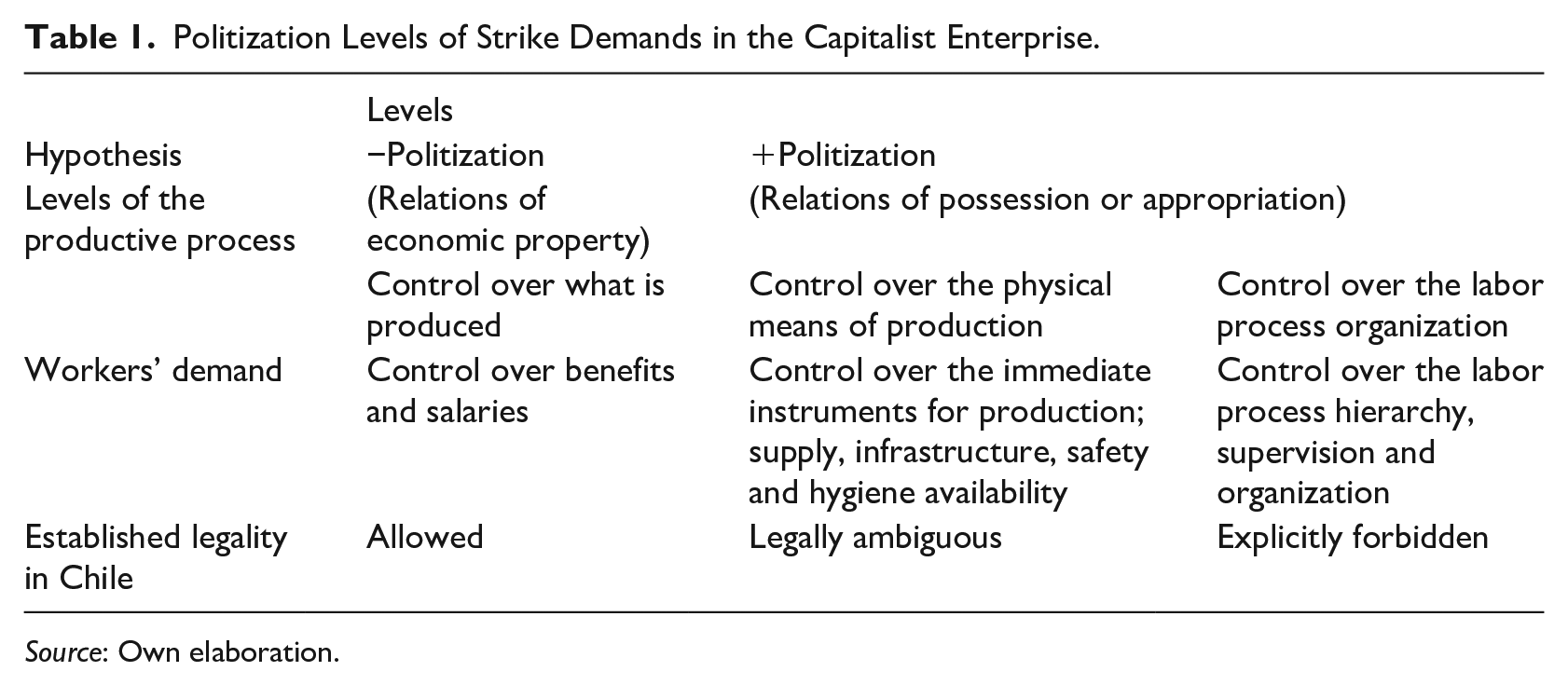
If we limit the discussion to the context of a company, the levels of strike demands can be linked to the growth of the organized workers’ practical interest in participating in the collective decisions of the productive process. Specifically, an analysis of strike demands allows to identify at least three levels of dispute, forming a continuum that ranges from less to more control of the productive process. This proposal is summarized in Table 1.
Politization Levels of Strike Demands in the Capitalist Enterprise.
Source: Own elaboration.
The first level includes the relations of economic property, and it refers to the control over the allocation of what is produced. In this first level, workers often demand higher salaries (i.e. the terms of interchange in the capital-labor relation) as an immediate response to relative or absolute impoverishment under capitalism. While salary is a fundamental fetishism, workers claim for something already produced or for payment of unpaid hours (Marx, 1976 (1865)).
The second and third levels of the productive process are related to possession or appropriation, since they are oriented toward controlling how is production organized. The second level involves controlling the physical means of production and the demands are related to the social–technical environment of production, aimed at protecting the workers’ physical integrity and health. Hence, the demand is about something given: the predetermined nature of physical means of production. The practical importance of these demands cannot be ignored. Precisely, every year, 2.78 million workers die in occupational accidents and due to occupational diseases, while another 374 million workers suffer non-fatal occupational accidents (International Labour Organization, 2020). As a consequence, strikers, especially those in heavy-duty areas, claim for conditions of infrastructure, safety, and hygiene, working tools, and compliance with employment contracts.
Finally, demands related to the organization of the labor process express the pursuit for a part in the decisions of the company’s politics, seeking to intervene in workforce administration, social division of labor, and the company’s core power. It is not a pursuit for modifying just formal subsumption, but also the management assets (Roemer, 1982) in real subsumption. What is claimed, thus, is the company’s local cause that determines the previous levels. They are, for example, demands related to dismissals, requests of hiring, schedule structure, allocations, work pace and loads, monitoring and evaluation policies, relations with the union and general productive orientations.
A general glance at collective rights at an international level reveal that the confrontation for the first dimension, that is, modifying formal subsumption, tends to be totally or partially allowed by the labor institutional framework in Western countries (Van der Velden, 2007). Conversely, the authority relations in real subsumption tend to be closed. Still, in case these are included in the existing regulation, then a politization process against the established institution would not be necessary. In the context of welfare states, co-determination – that is, joint decisions between workers and the management – has been part of a set of commonly implemented policies, with Germany as its most admired and cited case. Nevertheless, the reality of most capitalist countries, especially Latin American countries, is that workers must push the limits of politics if they want to dispute the second or third level of productive control. Such is the case of Chile, a country where the struggle for higher levels of control of the productive process has necessarily implied a politization in strikes.
Case Study: Strike Demands and Politization in Chile
Our analysis on politization levels is empirically based on Chile. This country is an example of institution-based labor control models, which allows us to establish links between levels of the productive process, strike demands and politization processes.
From a legal perspective, Chile is a typical case of a democracy with an institutionalization of neoliberal policies (Madariaga, 2020). The labor regulations received from the dictatorship imposes multiple legal constraints to the strike and political activity of union organizations (Rojas, 2007). Some of the most important constraints to labor strikes are that they are limited to specific jobs, excessively bureaucratize the regulated procedures, and cannot take place within the capitalist private property (Pérez et al., 2017; Ugarte, 2008). In addition, and more broadly, the participation of union leaders in the political-institutional domain is forbidden (Ugarte, 2008).
But the most important aspect is that the Chilean labor regulation system limits the right to strike to a mere unidimensional perspective (Gamonal, 2020), as only demands on produced profit and material benefits are allowed. Conversely, demands related to work conditions (second level in Table 1) fit in an ambiguous space within labor regulation – they are not allowed or explicitly forbidden – thus corresponding to a higher level of politization compared to demands completely focused on salary. Finally, demands on management assets are placed in the highest level of politization to be reached in labor contexts in Chile, since these are domains explicitly prohibited by the Labor Code (Rojas, 2007; Ugarte, 2008).
Consequently, the Chilean case displays an almost perfect match between demands of workers’ control over the productive process and labor institutions, as higher level demands imply transgressing the existing regulation. The question, then, is – as labor conflict grew, has there been a politization process in labor strikes in Chile, or, conversely, they have remained within the limits of politics (formal subsumption)?
Different studies show that there has been a relative revitalization of Chilean unions since the mid of the decade of 2000, both in contents and organizational capacities. This was a slow transition in terms of their contents. After suffering a dictatorship that persecuted leaders and forbid labor unions (Ponce, 2017), workers’ organizations began a new trajectory in the 1990s in a context of restructuring, after the creation of the Central Unitaria de Trabajadores (Unitary Central of Workers, CUT) in 1988 (Osorio, 2017). During such process, the unions have displayed a strategy close to the ‘Concertación’, the center-left political parties coalition that governed Chile from 1990 to 2010. This ‘Concertacionist strategy’ was based on a policy of agreements, implemented through the social dialogue with the government parties, avoiding demonstrations for fear of an authoritarian restoration. Later, at the beginning of the 2000s, the CUT made a sociopolitical turn, re-orienting its strategy toward greater social movement with the aim of increasing its autonomy from the political parties in the Concertación and presenting their claims publicly (Medel, 2021; Osorio, 2017). In this context, it is important to mention the emergence of a subcontracted workers’ union movement (Aravena and Núñez, 2009), the creation of new union federations in the tertiary sector (Campusano et al., 2017); the relative growth in union membership (CIPER Chile, 2020), and the unionist alliances since 2010, which resulted in a certain leading role during the social outburst of October 2019 (Osorio and Velásquez, 2021).
Research has described this recent trajectory as a growing process of politization in union organizations. Qualitative studies show that its promoters have frequently criticized the neoliberal labor legal framework, as well as frequently performing protest actions beyond what is established by law (Osorio and Campusano, 2020). Has this unionist revitalization been expressed in a politization of conflicts? Have strike demands also evolved, alongside the turn from a ‘Concertacionist’ unionism to a sociopolitical one?
The kind of transgression of institutional framework involved in this politization processes suggests a prominence of non-legal strikes, where workers dispose of their legal constrictions in order to stop production regardless the cost of protesting without the protection provided by legal strikes (Pérez et al., 2017). Consequently, we claim that politization has been conditioned by the institutional framework, thus emerging a correlation between non-legal strike and politization.
We derive, then, the first two hypotheses of this study are as follows:
H1. From the transition to democracy until the last years of this study (1990–2019), there has been an increasing process of politization in labor strikes in Chile, expressed in a decrease in remunerative demands and an increase in demands related to labor conditions and organization.
H2. The growth in labor strike politization is mediated by their legality, and this is expressed especially as an increase in non-legal strikes.
Despite what we have explained, the politization process developed through non-legal strikes suggested by the hypotheses was not necessarily experienced by all unions in a homogeneous manner. As shown by research, the organization of strikes outside the collective bargaining process requires certain conditions in terms of union’s power, which is held only by certain economic sectors (Medel and Pérez, 2017). Therefore, it is necessary to analyze what groups of workers have experienced this politization.
In this regard, a variety of studies have described the specific role played by subcontracted workers’ unions in the mining, forest, and salmon industries in this politization process in 2006-2007. Indeed, a subcontracted workers movement arose, deeply impacting the national political scenario after years of unionist passiveness (Aravena and Núñez, 2009; Campusano et al., 2017). A posteriori, 2006 became a milestone, with the number of strikes and protesting workers tended to grow in the following years, and a high peak in 2008 and then in 2013. Studies have described this as a new cycle of strikes (OHL, 2018; Pérez et al., 2017).
In addition, there has been a significant upturn in the transport sector, which has witnessed an increase in strikes and organization during the last years in Chile, even though the majority of the workers have weak contractual relations (Gaudichaud, 2017).
What all these revitalized union movements have in common is that they are related to primary-export activities, which, for some authors, correspond precisely to the Chilean strategic economic areas (Medel and Pérez, 2017; Soto et al., 2017). Unlike other areas of economy, unions from strategic areas have an attached advantage regarding structural power – when these areas stop, they create major impacts on the country’s productivity (Wright, 2000). However, we know that unions from these areas are those who have conducted the main non-legal strikes in the country (OHL, 2018).
Given the growth in union organization and the increase in non-legal strike use by primary-export sectors, research states that the trend toward politization is driven by primary-export sectors, especially by the subcontracted and transport workers movement (Pérez, 2019).
Because of what we have described, we derived a third and last hypothesis, which is as follows:
H3. The politization of labor strikes demands in Chile has occurred mainly in the primary-export sectors of economy.
In order to test these three research hypotheses applied to the Chilean case, the next step is translating our theoretical proposal – which links levels of the productive process with politization and strike demands – into a quantitative measure, feasible to be empirically investigated.
Data and Methods
This study used the database by Observatorio de Huelgas Laborales (Labor Strikes Observatory, OHL), which is the most systematic database on these conflicts in Chile. This database allows us to cover a period of 30 years, from 1990 to 2019, and to incorporate different variables (such as frequency, duration, location, demands, size, targets, among others) associated to the features of labor strikes.
Methodologically, OHL database is built upon a combination between the Protest Event Analysis method (Rucht et al., 1998) and official government sources. Accordingly, the primary information sources of the database are (1) the data from the labor regulation agency, Dirección del Trabajo (Labor Direction, DT), which quantifies the strikes started under the regulated collective bargaining process and (2) a sample from 18 national and international press media, used for eliciting the data of the strikes organized beyond regulation. 1 OHL data reliability is based on the quality of the sources of observation, a constant re-sampling and studying the same media throughout the years.
We only included the strikes in the private sector in our analysis. Consequently, we created a database excluding public sector and general strikes, thus totaling 5624 strikes during the last 30 years in Chile. This selection is due to our interest in studying the effect of labor institutional framework, which is only possible in the private sector, since the Chilean Labor Code excludes public sector strikes. In addition, including only the private sector enables the incorporation of a scenario where workers can opt for legal and non-legal ways to build pressure for their claims.
Description of Variables
The database includes 30 different coded demands for the strikes between 1990 and 2019. Although a strike, as any protest event, can have more than one related claim, this study only considers the main demand, since we are interested in studying the main motivation driving the strikes. To distinguish the main demand from the secondary demands, the database construction method considered press as its main source of observation.
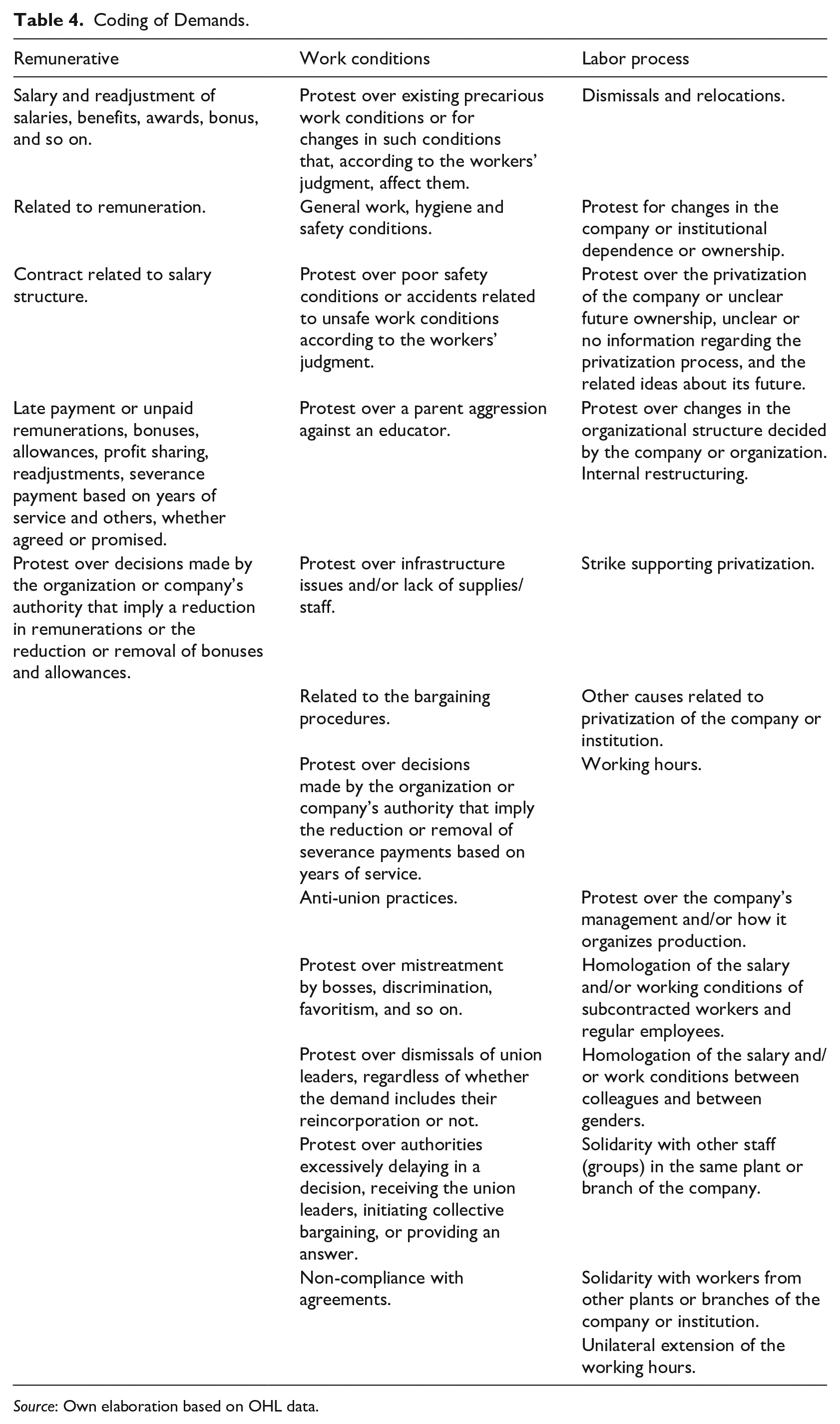
The most delicate stage in the construction of our dependent variable was allocating each of the 30 demands into a category from the dependent variable. This process was conducted in three steps. First, each author analyzed the 30 demands in the database by himself, reviewing samples of news related to each one. Then, the authors assigned each demand to one of the following three categories: Remunerative, Work Conditions, and Organization of the Labor Process. In a second step, we compared the categories assigned to the demands by each researcher. We discussed discrepancies to settle differences and make a collective decision. Finally, as a way of validating the construct, three experts in labor issues reviewed the measurement, making the last adjustments to the operationalization.
The resulting dependent variable is politization of strike demands, that is, a categorical and ordinal variable – each of the three previously described levels has a place in the hierarchy of the latent variable politization. The first level includes strikes claiming only for remunerative issues; the second comprises those related to work condition demands; while the third level includes claims related to labor organization issues. To revise the specific demands included in each category, see Appendix 1.
The first independent variable is the year of strike, which will allow us to test hypothesis 1, related to a politization of demands throughout time. This variable is included as a numeric one, ranging from 1990 to 2019, totaling 30 years.
The second independent variable is the legality of the strike, which will enable testing hypothesis 2 regarding a possible correlation between higher levels of politization and greater transgression of established regulation, with a growth in non-legal politicized strikes. This variable is included as dichotomic, with legal strikes as the referential category.
While legal strikes will condition the claims, since some demands are not allowed by law, this does not mean that de facto politization cannot occur in their context. Since the main demand is coded based on press, the leading information is what labor unions publicly state as their main claim, not what is indicated by the DT. Non-legal strikes, in turn, are not necessarily more politicized in terms of their demands – there are other motives for considering launching strikes beyond legality more convenient, such us controlling the strike’s time, for instance. This means that there may be non-legal strikes with low levels of politization, as well as highly politicized legal strikes, which provides enough variation for this variable.
The third key independent variable is the economic sector of the strike, which will permit testing hypothesis 3, related to greater politization in the primary-export sectors of the Chilean economy. For this category, we considered the 11 private sector areas defined by the International Standard Industrial Classification, second version (ISIC 2).
The first control variable is the logarithm for the quantity of workers involved in strikes. This transformation was made in order to avoid a variable bias due to its biased distribution to the right. In other words, most strikes involve a low number of strikers, while just a few of them involve great numbers of workers.
Second, we controlled for the days effectively lost through strikes, that is, deducting weekends and holidays. The literature suggests that strikes with the most radical demands tend to be longer compared to strikes based on remunerative demands, since they face greater resistance from employers (Campolieti et al., 2005).
Table 2 displays the descriptive statistics of the variables to be considered.
Descriptive Statistics.
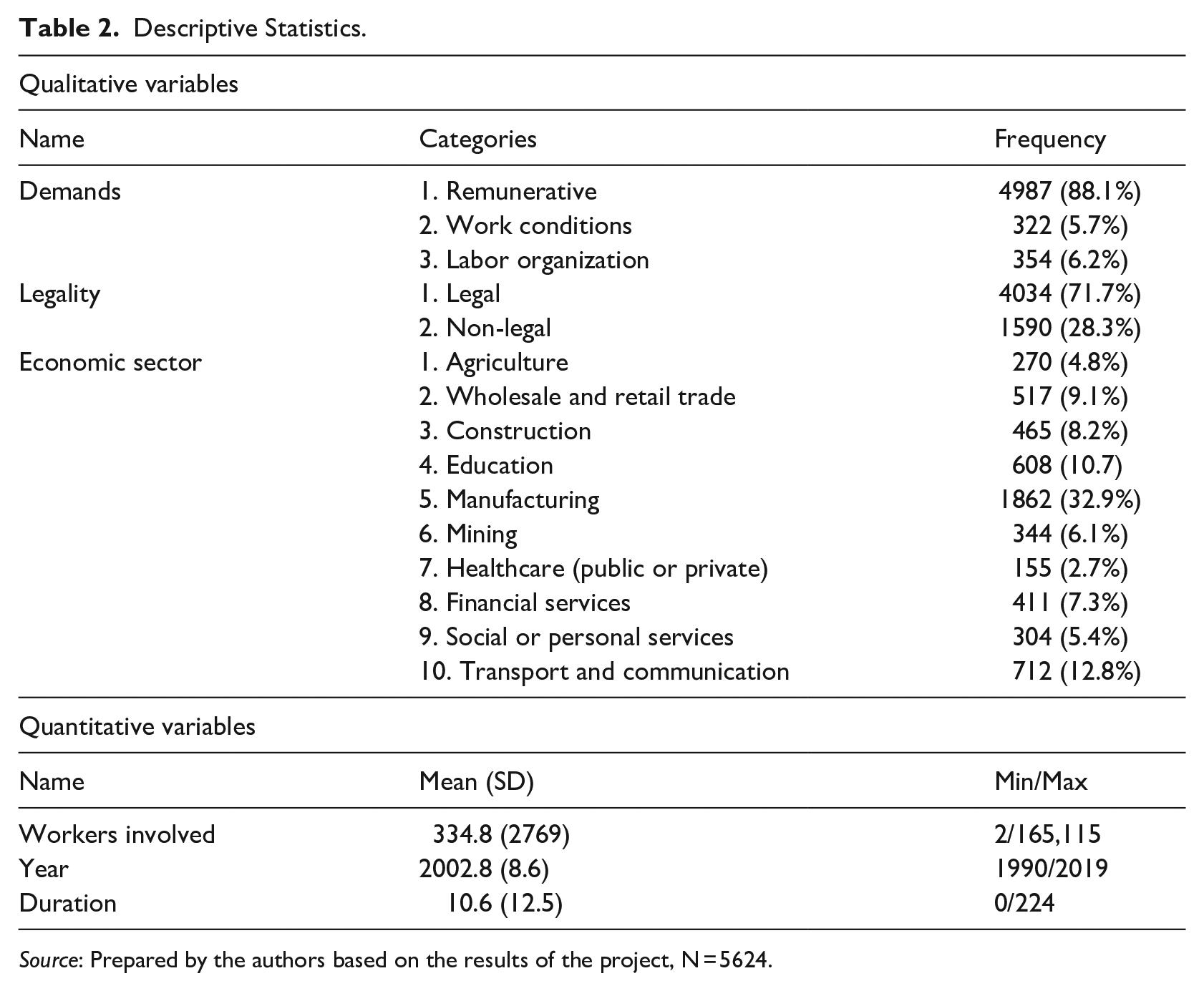
Source: Prepared by the authors based on the results of the project, N = 5624.
Given the nature of the dependent variable, the appropriate analysis method is an ordinal logistic regression, a technique that allows us to estimate the chances of mobilizing demands based on the different levels of politization through a set of covariates (Long, 1997).
Results
Figure 1 displays the evolution of each demand in the private sector strikes, in terms of absolute frequency and relative relevance. It can be noted that there is a trend toward a diminishing of remunerative strikes since 1996. This trend continues to the end of the period, considering the cyclic nature of strike activity. However, there is a subtle but constant trend toward a growth in politicized claims (i.e. beyond remunerative issues), especially in the 10 final years of the studied period.
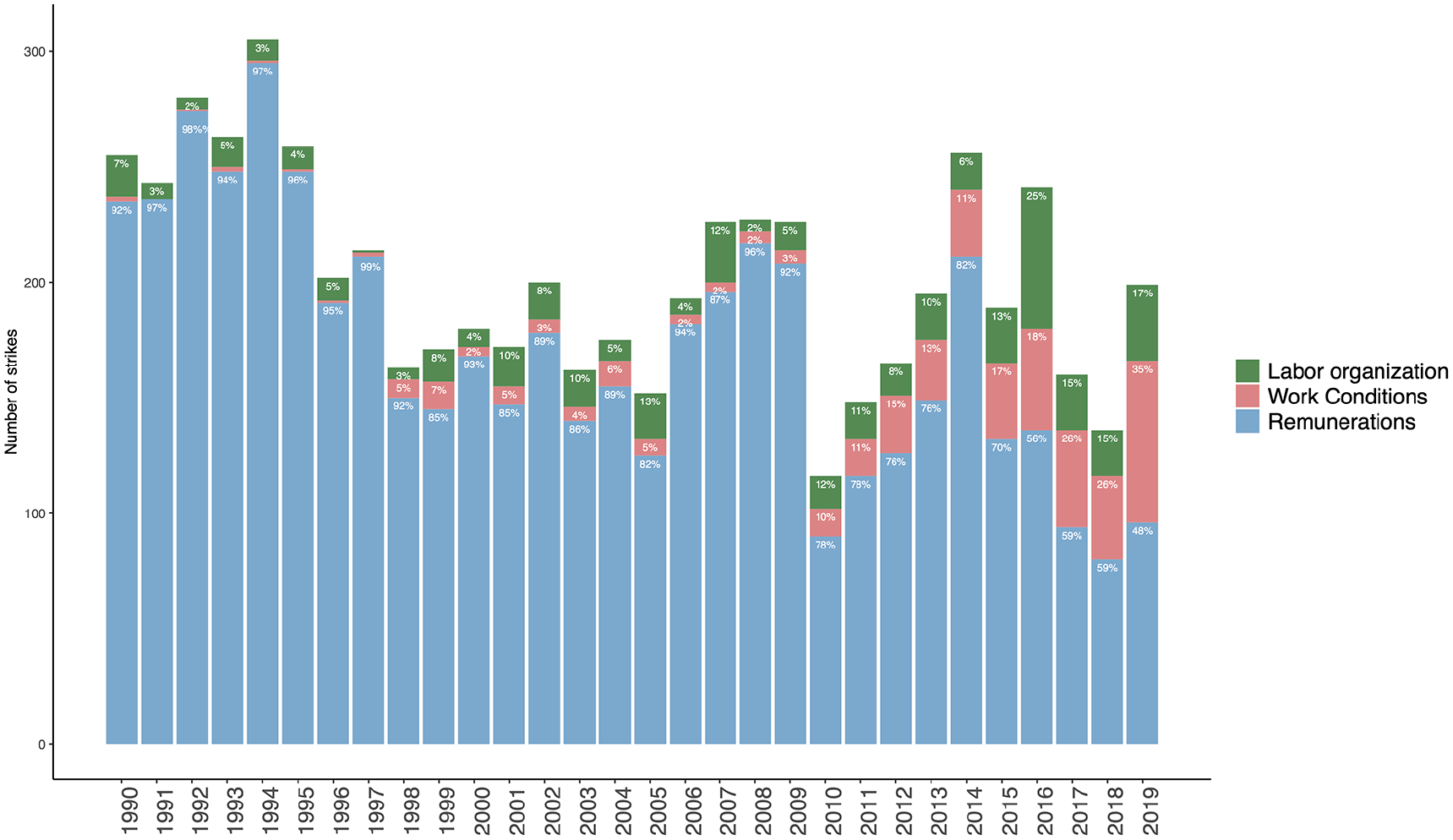
Absolute Frequency and Relative Relevance of Demands in Private Sector Strikes (1990–2019).
To observe the evolution of strike categories in relative terms, Figure 1 also displays the proportional evolution of each strike demand in the private sector. This figure makes clearer the increasing politization of strike demands during the last three decades, with the annual proportion of politicized demands steadily growing in relative terms during the whole political period. Specifically, remunerative claims are predominant (always beyond 90%, except for the year 1999) during the first two democratic governments (1990–2000), matching the years of stronger hegemony of ‘Concertacionist’ unionism. In the decade of 2000, a greater presence of work conditions demands can be noted, as well as a growth in claims related to the labor process. This coincides with important movements, such as the contractors protest in the mining industry in 2006 (Manky, 2018). A last upturn in remunerative demands can be seen from 2006 to 2009, after which the trend toward politicized strikes starts growing again up to the present. The highest politization is displayed at the beginning of the decade of 2010, after consolidating the aforementioned sociopolitical turn in unions (Osorio, 2017).
With the decrease in remunerative strikes, strikes with demands related to labor organization have remained relatively stable since the first decade of democracy (1990–2000). Then, this kind of strikes displays a growing trend, with an important upturn in the final years of the last decade (2010–2019). Work conditions demands are the sharpest growing category since 2010, reaching figures close to 30% in the final years. Precisely, the 10 final years have witnessed a steady increase in non-remunerative demands. Consequently, we can say that there is a cycle of growing politization in Chilean unions.
The trend toward greater politization through time can be nuanced by including variables related to the morphology of strikes, such as the number of workers involved or their duration. Furthermore, we need to observe the relevance of other key variables in this study; the legality and the economic sector, both in terms of their individual effect as well as in their evolution through time. In order to address this, the following section present multivariable evidence.
Multivariate Analysis
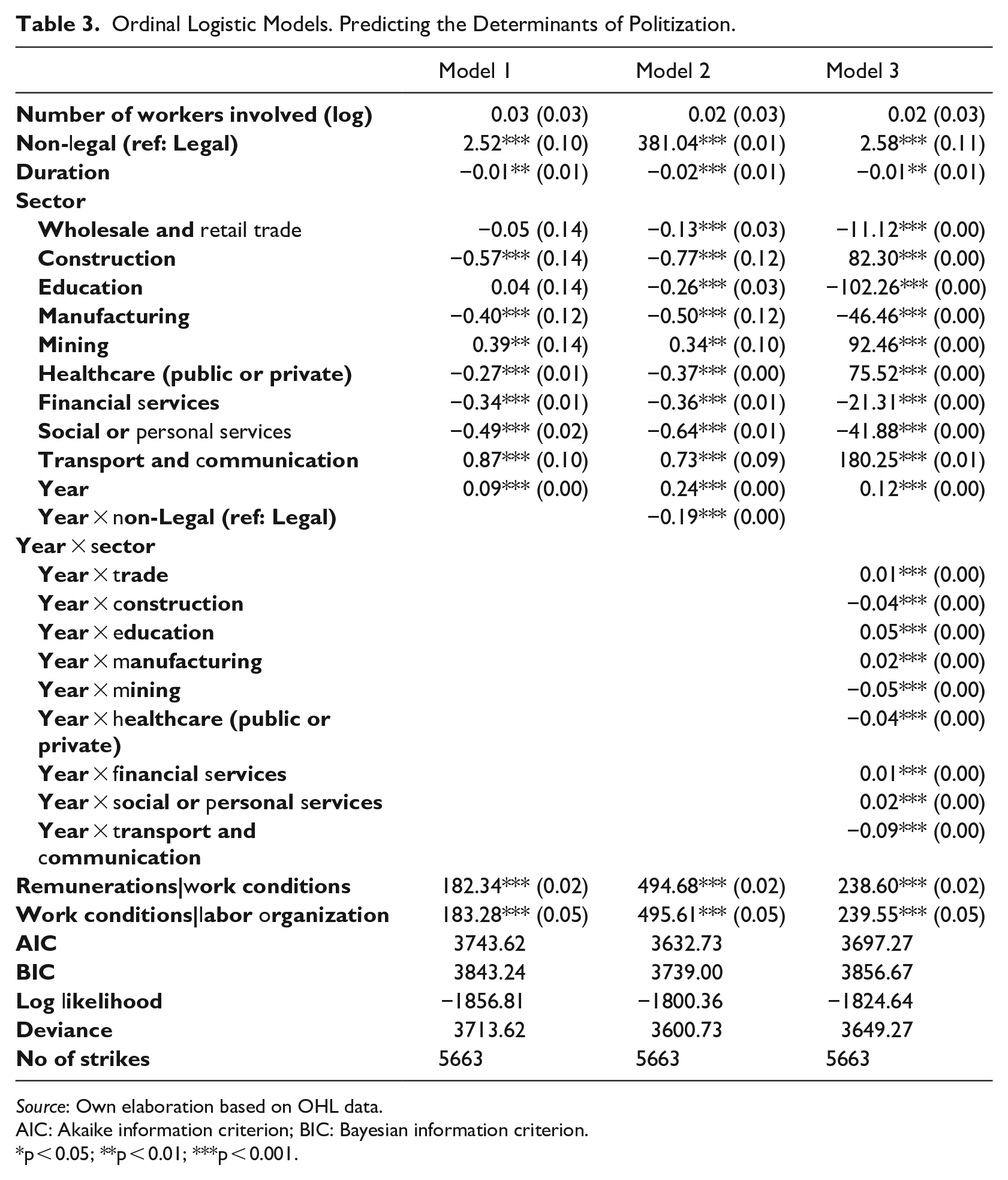
To test the research hypotheses, we developed three ordinal logistic regression models for the dependent variable, strike politization, which categories range from less politization (remunerative demands) to the maximum level of politization (labor organization demands). In all models, we controlled for number of workers involved and for duration of strike, while the remaining covariates were introduced one by one. Model 1 includes the legality of the strike, economic sector, and year. Model 2 includes, in addition to the previous variables, an interaction between year and legality. Finally, Model 3, in addition to the previous variables, also includes an interaction between year and economic sector. The tables for the three models are presented in Table 3.
Ordinal Logistic Models. Predicting the Determinants of Politization.
Source: Own elaboration based on OHL data.
AIC: Akaike information criterion; BIC: Bayesian information criterion.
p < 0.05; **p < 0.01; ***p < 0.001.
First, as it can be anticipated through the descriptive data, the regression models allowed us to confirm hypothesis 1, regarding time; in every model, time had a positive effect and remained statistically significant (p < 0.001), regardless the included control variables. That is to say, time displays a statistically independent effect over the politization of strikes.
As for hypothesis 2, all models show the effect of the variable legality, which proves that non-legality is strongly correlated with higher levels of politization. Hence, the legality of a strike limits it to the remunerative level. To observe how legality correlates with the specific levels of politization through time, we conducted an interaction between legality and year in Model 2, which was statistically significant (p < 0.001). To discuss these results in depth, we present the findings through predicted probabilities. Figure 2 displays the predicted probabilities for the interaction between politization categories and years, according to the strike’s legality. The main finding is an important difference in the percentage of politization of non-legal strikes with respect to legal strikes, with non-legal strikes reaching only 47% of remunerative demands, compared to 73% of this kind of demands in legal strikes. Moreover, the figure displays a second interesting difference: both kind of strikes (legal and non-legal) have experienced politization processes in the studied period; but, while legal strikes have a moderate, linear, but steady growth in politicized demands, non-legal strikes display an exponential growth, especially in the last decade. This is largely explained by the possibilities, established in the Chilean collective bargaining regulations, for channeling remunerative demands and, to a lesser extent, working conditions demands through legal channels. Conversely, such process is totally closed for processing demands related to labor organization. The latter allows us to prove that pressing for different demands in strike processes is still conditioned by the possibilities of channeling such claims through institutional means. Thus, the institutional framework is another resource in the context of a conflict, which is strategically used when it is rewarding.
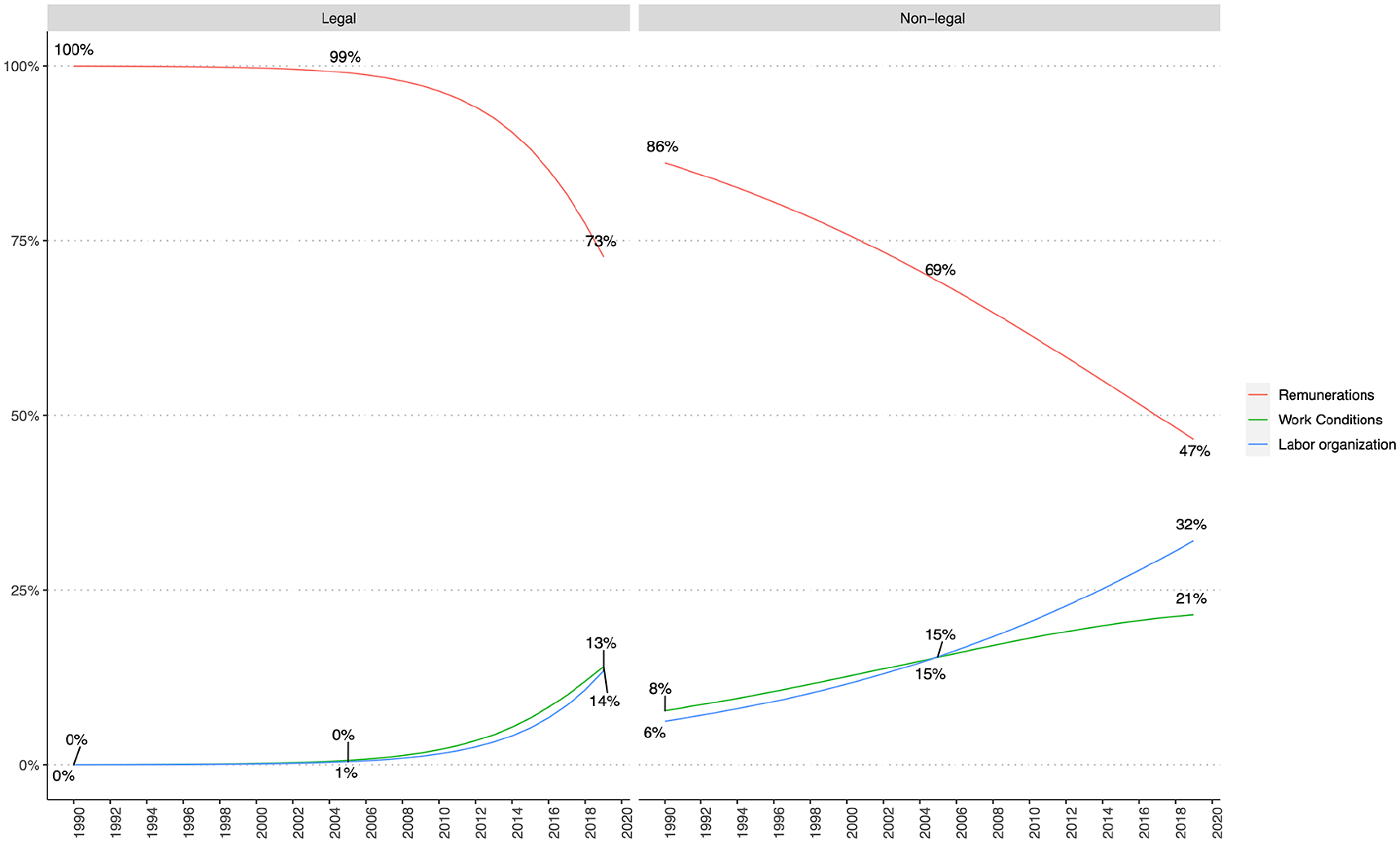
Effect of the interaction between year and legality.
Finally, to test hypothesis 3 related to a greater politization in primary-export sectors of economy, model 3 included an interaction between year and economic sector, which is represented with predicted probabilities in Figure 3 below. The first relation we can note is that politization of demands is highly dependent on the economic sector; higher level demands have not grown equally in all the economic sectors. There are even some industries where there has not been any relevant politization, especially in the construction sector. Just as strike activity is importantly unbalanced (Pérez et al., 2017), the same is true for the strike motivations. Specifically, there are certain sectors with less politization compared to the others, such as healthcare and construction.
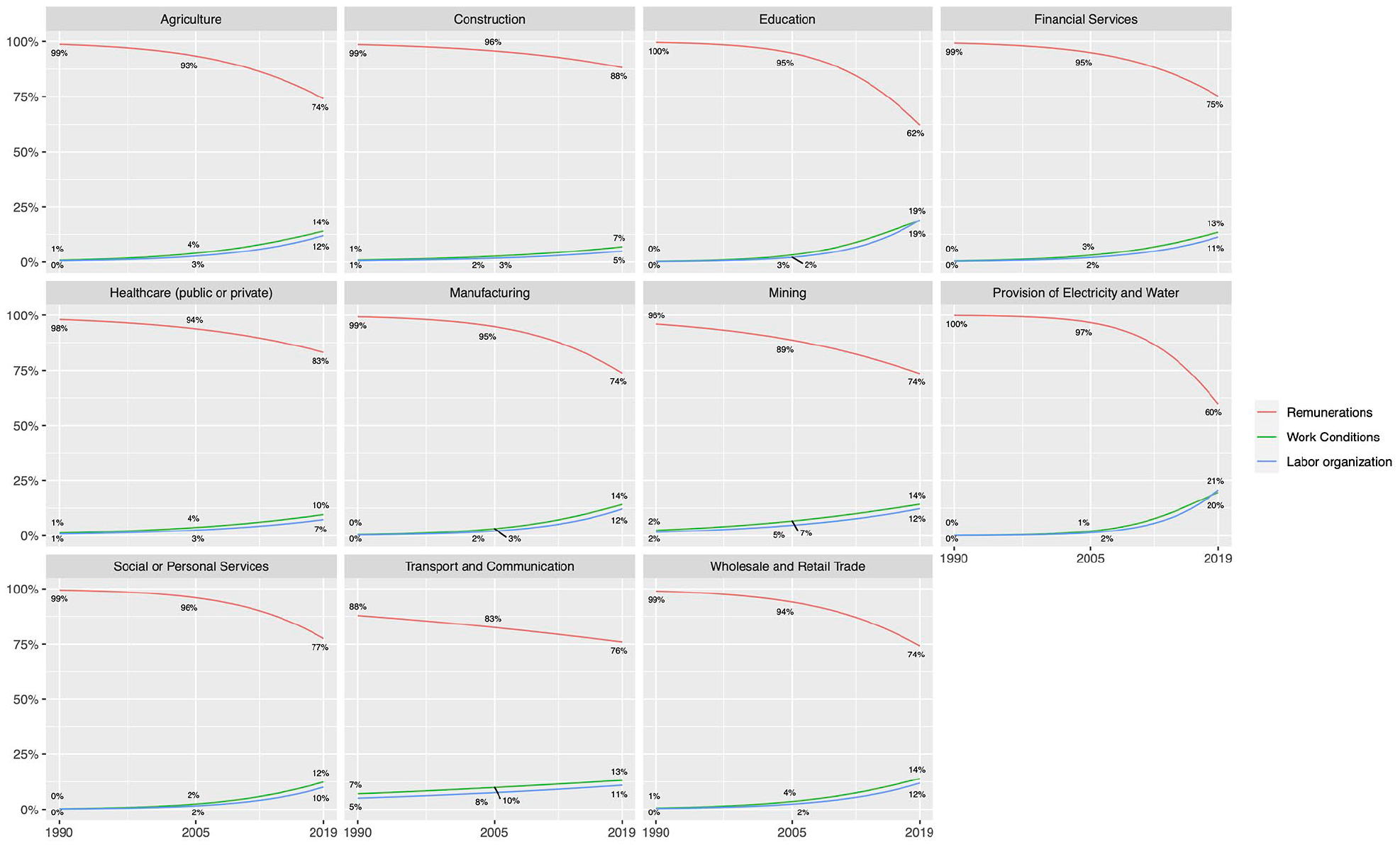
Predicted probabilities for evolution of demands according to different economic sectors.
Nevertheless, in the opposite direction of our hypothesis, the politization of strikes has not occurred exclusively in the strategic areas of Chilean economy, where unions possess more resources in terms of structural power (Wright, 2000). While politization had a strong growth in transport, agriculture, and mining, there is no relevant difference with the growth in other sectors, such as manufacturing, education, or financial services. This suggest that structural power may not be as central as other more dynamic resources for unions such as associative resources, and that there are new sectors becoming transcendental in the context of the new chains of globalized economy (Fox-Hodess and Santibáñez, 2020).
Control variables complement the aforementioned hypotheses. All the models reveal the importance of the workers involved in strikes for explaining higher levels of politization. Given that the organizations’ capacity of mobilizing workers is a central resource for them and fundamental for the strike’s ability to apply pressure, we can observe that greater associative resources promote politized strikes. The second model, in turn, displays the negative effect of days lost due to strikes. Upon this model, it follows that strikes presenting the most politicized demands tend to be shorter. This may be due to the need for greater union strength in order to mobilize politicized demands, which could be related to more successful and, therefore, shorter strikes (Velásquez et al., 2021).
Finally, our analysis also provides new evidence – although it is not conclusive in all the models – on the notion that is more probable for a politicized strike to be short than to be long in terms of duration. In other words, remunerative claims (most of which involve institutional processes as part of collective bargaining) use to extend strikes, while politicized strikes tend to be shorter in time.
Conclusion
This research has systematized a Marxist and neo-Marxist approach – through a continuity between both traditions – to analyzing labor politization quantitatively, based on the claims motivating the strikes. The study identified three levels in the workplace forming a continuum that ranges from less to more control over the productive process: (1) remunerative demands, (2) demands related to work conditions, and (3) those related to labor organization. In addition, these three levels of control often fall under an institutional framework in capitalist societies, which, while opening strike institutional regulation for the first levels, rarely allows the highest level.
In the Chilean case, the institutional legacy of the dictatorship in the labor world (Gamonal, 2020; Sehnbruch, 2006; Winn, 2004) has led the country to become an emblematic case of coincidence between higher levels of demands and an institutional closure. Based on the distinction between ‘politics’ and ‘the political’, we claimed that the aforementioned three levels of demands can be conceptualized, in the Chilean case, as three levels of politization, since they range from complete institutional opening to full institutional closure. Only the first level fits within ‘politics’ – even though it also modifies the limits of power – while the following levels require moving the limits of what the institutional framework allows to be disputed in the context of labor conflicts.
The descriptive results and multivariate models permit proving that, between 1990 and 2019, Chilean strikes experienced a politization process, where remunerative demands have decreased while work conditions and labor organization demands have grown. These results imply three fundamental effects for the study of unionism in Chile and for a global analysis.
First, they highlight the centrality of strikes organized outside the law. We have proved that, in Chile, non-legal strikes defy institutional regulation not only in terms of wage raises, but also as they pursue a greater degree of control over the productive process. Although politization has occurred both in non-legal and legal strikes, the former has experienced this process in a sharper and relatively constant manner since the return of democracy, and the latter have experienced such politization since the decade of 2010. This evidence is relevant, as, until now, there was not previous literature enabling the comparison of both types of strikes based on a common political dimension. This allows us to complement previous research that claimed that Chile has witnessed a growth in labor conflict alongside with a growth in non-legal strikes (Armstrong and Águila, 2011; OHL, 2018; Pérez et al., 2017), now considering the content of such conflictivity.
Second, the presented findings suggest that private sector unions display relevant variety in terms of politization processes. Their strikes have evolved in contents, demands, and interest for controlling the productive process in different ways per economic industry. With this, we provide evidence on politization processes occurring not only in the public sector, which hosts the main union macro-organizations of the country (Campusano et al., 2017; Medel, 2021), but also in grassroot unions from the private sector. Likewise, we observed that politization has been focused not only in primary-export sectors of economy, but beyond them, including the service industry. This manifests a change in the general morphology of Chilean unionism. In the private sector, union membership has grown fast, going from 16.1% in 2008 to 21% in 2019 (Consejo Superior Laboral, 2019). Learning about the capacity of different trade unions to transform demands into effective, successful strikes is still pending. In this regard, the structural and associative strength of primary-export sectors may be creating more significant differences indeed.
As for its theoretical implications, this article provides empirical ground on the relationship between subsumption of work and resistance strategies as a response to labor control based on a case study. Thanks to the development of a quantitative categorization of strike demands, we can conclude that, for the Chilean case, formal subsumption are in the lowest level of the politization continuum, while claims directed toward aspects of real subsumption are in the highest level. Hence, remunerative demands dispute formal aspects – that is – the value of having the workforce at the capitalist’ disposal – but without explicitly questioning the social relations of production in terms of power and control over the productive process.
Regarding more generalizable consequences of this study, Chile can be thought of as a typical neoliberal case where labor conflicts overflow the institutional framework due to its inability to adapt itself to the changes experienced by labor, and a type of politics that gradually fell behind a stronger and more organized unionism. Consequently, in light of the general strike that took place in 2019 in Chile – as part of a global wave of protests – it would be interesting to further study the political reality of the working class in the workplace in different countries. This requires abandoning the notion of the workplace as a mere private issue, recovering the Marxist tradition.
Countries with modernizing labor institutions are not seeking to be containment dikes for transformations in labor unionism, but to adapt them. A global overlook to union rights shows that the countries representing the strongest examples of the opposite are concentrated in Europe: demands that can aim at higher levels of workers control, without needing politization at an institutional level. In Chile, while the unionist movement is still caught in an overwhelmed institutional frameworks, antagonism and discomfort at the workplace has gained momentum years ago and it is a key precedent for understanding the organizational lessons of this movement in the context of the social upheaval that burst in 2019 (Somma et al., 2021). The collapse of neoliberalism in that year was not caused by a mere ‘social outburst’ – a notion minimizing the agency of the involved actors – but primarily by a social unrest strongly extended over space and time that aggravated the national political crisis (Pérez and Osorio, 2021). In this regard, then, it is necessary to rethink politics in the workplace and broaden the research agenda in this field in order to better understand the current transformations of the capitalist world.
Footnotes
Appendix 1
Coding of Demands.
| Remunerative | Work conditions | Labor process |
|---|---|---|
| Salary and readjustment of salaries, benefits, awards, bonus, and so on. | Protest over existing precarious work conditions or for changes in such conditions that, according to the workers’ judgment, affect them. | Dismissals and relocations. |
| Related to remuneration. | General work, hygiene and safety conditions. | Protest for changes in the company or institutional dependence or ownership. |
| Contract related to salary structure. | Protest over poor safety conditions or accidents related to unsafe work conditions according to the workers’ judgment. | Protest over the privatization of the company or unclear future ownership, unclear or no information regarding the privatization process, and the related ideas about its future. |
| Late payment or unpaid remunerations, bonuses, allowances, profit sharing, readjustments, severance payment based on years of service and others, whether agreed or promised. | Protest over a parent aggression against an educator. | Protest over changes in the organizational structure decided by the company or organization. Internal restructuring. |
| Protest over decisions made by the organization or company’s authority that imply a reduction in remunerations or the reduction or removal of bonuses and allowances. | Protest over infrastructure issues and/or lack of supplies/staff. | Strike supporting privatization. |
| Related to the bargaining procedures. | Other causes related to privatization of the company or institution. | |
| Protest over decisions made by the organization or company’s authority that imply the reduction or removal of severance payments based on years of service. | Working hours. | |
| Anti-union practices. | Protest over the company’s management and/or how it organizes production. | |
| Protest over mistreatment by bosses, discrimination, favoritism, and so on. | Homologation of the salary and/or working conditions of subcontracted workers and regular employees. | |
| Protest over dismissals of union leaders, regardless of whether the demand includes their reincorporation or not. | Homologation of the salary and/or work conditions between colleagues and between genders. | |
| Protest over authorities excessively delaying in a decision, receiving the union leaders, initiating collective bargaining, or providing an answer. | Solidarity with other staff (groups) in the same plant or branch of the company. | |
| Non-compliance with agreements. | Solidarity with workers from other plants or branches of the company or institution. | |
| Unilateral extension of the working hours. |
Source: Own elaboration based on OHL data.
Funding
The author(s) disclosed receipt of the following financial support for the research, authorship, and/or publication of this article: This research was partially funded by the Centre for Social Conflict and Cohesion Studies (COES; ANID/FONDAP/15130009), by the Alberto Hurtado University and by the FONDECYT Project #1200190. Two co-authors also received support from the ANID Fellowship for Doctoral studies (# 21181350 and #21181069).
