







Abstract
Japan has a standard framework for local communities, neighborhood associations, which request all households in the same residential district to belong to one community unit that plays a local management role through closely working with authorities. By framing a concept of ‘societalization’ in Bob Jessop’s state theory using Neil Brenner’s ‘scaled’ political economy project, we decipher Japanese neighborhood associations as a scaled strategy for community-oriented societalization. This strategy formally presents itself as ‘voluntary’ but asks all households to participate, and this ‘compulsory’ community norm was strong until the 1970s and 1980s. The renaissance of neighborhood associations after World War II gave Japanese developmental capitalism – a statist but democratic capitalism – a scaled and sociological platform for generating community-based social cohesion and upscaling this effect from the local to the national. After considering a sociological debate in Japan in the ambit of Gramscian and Lefebvrian regulationism, we argue that neighborhood associations became administratively versatile as they were standardized, functionalized, and nationalized until 1945; this past helped the Japanese developmental state – an integral state project – societalize state space from a micro unit of locality and propel statist development with grassroots consent; and progressive/radical voices advanced the democratization of the associations through local activism.
Keywords
Local communities in Japan rely on a unique framework for organization, the neighborhood association, also called chōnaikai, jichikai, or burakukai – all refer to the same entity. In this framework, each residential district and its residents – ideally all residents – must be organized into one representative unit, one neighborhood association, which plays major administrative and management roles for the neighborhood through mediating residents, administrators, and third parties. According to an Anglophone scholar writing in the mid-2000s, ‘There are about 300,000 such groups in Japan’, and ‘these neighborhood associations often serve as a core about which other groups, such as groups for the elderly or children, are formed’ (Pekkanen, 2006: 29). This common form of Japanese local community has a history dating to the pre–World War II years, when many of them were cultivated by established local families who were well connected to authorities. During the war, the fascist state usurped the associations to use them as a micro framework for wartime mobilization. In light of this ‘nondemocratic’ past, the US-led occupation outlawed neighborhood associations in the name of democratization, but this prohibition was short-lived. Neighborhood associations became legal again once the occupation policy ended in 1952.
In the post–World War II period, neighborhood associations regained a central position in municipal policy, providing administrators viable ways to engage with residents and to navigate Japan’s legally democratic, but in practice statist and elitist, strategy for national/urban spatial development. Participation in neighborhood associations was no longer mandatory in legal terms after the war, but neither did it become voluntary. Until the 1970s and 1980s, there remained strong obligatory norms that any resident must take part in the local association and its everyday work – safety patrols, street cleaning, garbage collection, sewage management, seasonal festivals, and so on. Moreover, residents’ participation in the local association was confirmed on a household basis. Household members had no individual right to decide their participation status. These actually compulsory and collectivist characteristics would hardly be recognized as ‘liberal’, and the fact that these characteristics reemerged in ‘liberal’ Japan after the war has stimulated discussions in academia, both Japanese and Anglophone.
In this paper, we develop a sociological and scaled political economy of neighborhood associations by cultivating concepts that are sensitive to social and scalar aspects of territorial capitalist development, its underlying contradiction, and the management of contradiction. Our central argument about ‘societalization’ is based on Bob Jessop’s state theory (Jessop, 1990, 2002; Jessop and Sum, 2006; Sum and Jessop, 2013). In Jessop’s oeuvre, the term ‘societalization’ represents his effort to stretch the second part in the axiom about the regulation approach, which states that capitalist development is achieved by an ‘accumulation regime + its mode of regulation’ (Jessop, 2002: 5), to wider sociological layers facilitative to state formation in the Gramscian integral state (meaning ‘state’ as the political and the social). Sum and Jessop (2013) more recently develop this understanding into what they call cultural political economy, emphasizing the cultural aspect of capitalist regulation/societalization. The nutshell is that by advancing societalization, capitalist development may be able to manage both political and social wings of regulation, as well as their vast middle grounds, which may be capable of reproducing classes, social subgroups, and their relations as less contradictory relations of ‘citizens’ and insert the working class into the labor process through strategic commodification and decommodification.
Building upon Neil Brenner’s (2019: 109) call for a ‘scaled political economy’, and his spatial scalar understanding of state space (Brenner, 2004), we argue that neighborhood associations augmented a scaled platform for the societalization of Japanese state space. This cultivated the social sides of Japanese state space by providing it with normalized community units in the city as a local basis of social regulation/cohesion. This reveals that the Japanese developmental state, which has been influentially discussed as a singly scaled national economic project (Johnson, 1982), actually was a dually scaled national–local project with key social milieus for community normalization – neighborhood associations – being augmented at the local scale.
Japanese capitalism after 1945 faced serious uncertainties at the national scale – from popular radical movements (from 1945 onward) and legal democratization that invigorated those movements (from 1947 onward) to neodisciplinary reactions in order to suppress radicals (from 1948 onward). As these overlapping contexts caused uncertainties for leaders, who by the 1950s were trying to create a ‘miracle’ (Johnson, 1982) of Japanese development, neighborhood associations gave the political elites and administrators community-focused tools to achieve this goal with people’s grassroots consent. The associations, indeed, were a scaled and sociological platform for the Japanese developmental state to fill its state space – an ‘integral state space’ (Hayashi, 2023) – with expansive social cohesion that, beginning in the micro unit of locality, extended to the national scale and seamlessly covered the national territory.
It seems that this case is distinct from community formation in the Anglo-American world. David Fasenfest (1993b) suggests that in the United States and United Kingdom community has historically developed within multiscalar political-economic parameters, or ‘restructuring from above by corporations and the national state, and from below by the activities of households and communities’, in which ‘the organizational form of the national state creates capacities, but its need to build support among social actors imposes constraints’ (pp. 7–8). Located on this multiscalar platform of community development, it is widely reported that community in the Anglo-American world has been able to develop in plural, contentious, and radically democratic ways, beyond the pregiven political thresholds (Castells, 1983; Cox and Mair, 1988; DeFilippis et al., 2010; Hogget, 1997; Logan and Molotch, 1987). Nor is the Japanese trajectory akin to non-Western authoritarianism, under which a community could suffer straightforward oppression by the state (see Koo, 1993). We will tease out this interesting specificity of Japan by navigating it to a sociological and multiscalar perspective.
Finally, we intensively use Japanese-language works to find out how the theories in the Euro-American literature can take concrete shape in the Japanese case. In one of the authors’ work, an ethnography methodology has been developed under the banner of ‘regulationist ethnography’ (Hayashi, 2023). The idea is that political economy theory in Anglophone sociology and urban studies can decrease explanatory power when directly applied to contexts outside of the Western settings. To address this potential question, which may reduce the power of political-economic approaches, and to give the approaches more international ‘mobility’ beyond the Euro-American settings, we propose that users of political economy theory (in this case, those studying community) can relativize theory’s direct application (‘applicationism’) by emphatically reembedding theory in contextual (regulatory) complexities that spread across the globe. For this purpose, we extensively use social science literature written in Japanese, in addition to that in English, to explore a theory–complexity fit in Japanese community studies.
Neighborhood Associations in Anglophone Scholarship: Moore and Pekkanen
In Social Origins of Dictatorship and Democracy, Barrington Moore Jr., illuminates an authoritarian root of Japan’s neighborhood associations: ‘After 1930, neighborhood groups were organized by the government, each with its own head’. Building on a monograph written by Ronald Dore, Moore continues, ‘The system, together with the official administration above it, provided a method for the central government to reach every household through a descending face-to-face hierarchy of command’. Moore strongly emphasizes that these associations persisted after the banning by the occupation allies:
Though the American occupation authorities abolished the system of downward communication, the local organizations continued to exist because they had local functions to perform. Since they did remain, and provided a more efficient means of disseminating information than notice boards that the villagers might disregard, they soon resumed this function. (Moore, 1966: 312)
This reemergence of neighborhood associations in post–World War II Japan is important for Moore because they reveal the underlying context that after the war Japan only tweaked (rather than transformed) its previous peasantry social form when starting a new phase of capitalist prosperity. ‘Unlike the English landlord of the eighteenth century, the Prussian Junker in the sixteenth, or Russian Communists in the twentieth, the Japanese ruling classes found that they could get their way without destroying the prevailing present society’. This persistent character vindicates ‘the adaptability of Japanese political and social institutions to capitalist principles’, which ‘enabled Japan to avoid the costs of a revolutionary entrance onto the stage of modern history’ (pp. 312–313, emphasis added).
Moore thus uses neighborhood associations in post–World War II Japan as evidence for its avoidance of a large-scale change (a ‘revolutionary entrance’ into capitalist modernity) by reusing old peasantry institutions for new purposes. In this context, previous social frameworks received only a minor change: ‘the substitution of tenancy relations to pseudokinship’ (p. 313). This argument helps our comparative understanding of Japanese communities. At the same time, a moot point and an ambiguity exist in Moore. That is, Japan after the war did undertake a large-scale change in the law. After 1945, Japan gained a new constitution, which is highly liberal democratic in words. In this new context of liberal democracy, can we think of the reemergence of neighborhood associations as a remnant of peasant society? How should we understand the renewed life of neighborhood associations in Japan after the war?
Fifty years after Moore, Japan specialist Robert Pekkanen (2006) provided informative analyses of neighborhood associations in the post–World War II era, characterizing them as ‘true civil society organizations’ (p. 102) and as ‘social capital’ (p. 109) that supports people’s lives in bottom-up ways. Even from his voluntarist perspective, however, these roles are depicted to be based on a delicate balance between politics and nonpolitics. Thus, hybrid notions such as ‘state-fostered civil society’ and ‘state-sponsored social capital’ are useful to understanding how ‘the state promotes social capital both by fostering an organizational form and by utilizing that organizational form for its own (administrative) purposes’ (p. 125). Pekkanen thinks that the Japanese case shows ‘the importance of the state structuring of civil society in a positive case’ (p. 116).
In fact, this praise for neighborhood associations is somewhat uneasily attached to his more critical recognition that ‘the Japanese state’s continuing (and arguably sometimes successful) attempts to co-opt NHAs [neighborhood associations] reveal its uneasiness with truly independent civil society organizations’. Neighborhood associations are the ‘appendages of government’ and ‘do not challenge the state’ (pp. 109–110). Their social capital performance itself hinges upon ‘the close relationship between government and NHAs’ (p. 122), and ‘the state’s preferential treatment of NHAs is explained by the NHAs’ cooperative nature’ (p. 109). Pekkanen, who prefers to conceptualize neighborhood associations by using the theory of social capital, therefore still recognizes that neighborhood associations internalize something that could derail a liberalist conception.
Even though he uses the strong verb ‘co-opt’, which suggests the usurpation of neighborhood associations by the state, Pekkanen does not come so close to our political economy approach in intention. Although he says these associations are ‘co-opted’, he still wishes to deny the view that neighborhood associations are ‘creatures of the government with no autonomy and simply provide low-cost services as the lowest layer of local government’ (p. 93). In his thesis, ‘social compulsion is not coercion’ (p. 92), for neighborhood associations are ‘state-sponsored social capital’ (p. 125). Pekkanen clearly recognizes that he is dealing with a difficult borderline case. He seeks to resolve the difficulty by arguing, ‘The all-inclusive and local membership of NHAs bolsters their contributions to social capital’ (p. 86).
This extension of social capital theory is potentially contradictory to Pekkanen’s other line of argument, which we have just seen, that neighborhood associations were co-opted by the state. In this line of discussion, once more, he says that neighborhood associations were the ‘appendages of government’ (p. 110). Even further, they were ‘a branch of government’ and ‘part of the local administration, wholly swallowed up into government’ (p. 107). We shall argue that this potential contradiction in Pekkanen reflects an actual contradiction in post–World War II Japan, which not just oscillated between liberalism and discipline but really managed the two’s partial amalgam (hybrid) through the oscillation.
Neighborhood Associations in Japanese Scholarship: The Chōnakai Debate
Moore and Pekkanen provide interesting perspectives on neighborhood associations, one taking a neo-Marxist angle, another employing a voluntarist view. Let us now see how Japanese scholars have framed neighborhood associations. In Japan after World War II, influential social discourse on neighborhood associations argued that they were remnants of feudalism and thus must be abandoned (for related debates, see Isomura, 1953; Okui, 1953; Suzuki, 1953; Takata, 1953). This line of interpretation was continually updated into newer arguments that neighborhood associations were the hotbed of conservative, feudalistic, and patriarchal local politics rooted in the premodern middle class of landowners (Matsushita, 1959, 1962; Okuda, 1964, 1983).
Against these negative views, Hachirō Nakamura (1962, 1964) developed a new line of descriptions and analyses that revealed, as it were, their non-administrative and non-conservative aspects. As we have seen, the modernist theses that criticized the associations were deeply concerned with their easy absorption by administrators based on the compulsory, presumably conservative norms of participation. However, Nakamura’s research into Tokyo’s new towns emphasized how the same compulsory norms were not just reproduced but also autonomously used by residents, in a rather progressive spirit. Nakamura (1973, 1990) notes that the compulsory participation principle of neighborhood associations, which was reproduced by these new residents, is a ‘culture type’ (bunka no kata) of Japanese local society that dates back to the decades before World War II. Since then, neighborhood associations have been open to both democratic and nondemocratic, autonomous and nonautonomous, purposes of residents.
In response to Nakamura’s voluntarism thesis, Ritsurō Akimoto (1971) developed a major criticism. Taking a neo-Marxist structural perspective, Akimoto interpreted neighborhood associations as being deeply integrated into the local power structure and powerfully supporting capitalist development in each city and locality.
Everyday lives of local residents in the prewar period received detailed interventions by the neighborhood district. Voluntary public actions [jihatsu teki na kōkyō katsudō] of local residents were also under guidance of the chiefs of the neighborhood districts. These circumstances have been pointed out as a troublesome issue that should not be ignored. They mean that as a tradition, neighborhood associations have served as a foundation of local rule that deeply encroaches on the everyday lives of residents. These, at the same time, owing to the fact that the idea of self-government [jichi] cited in the early stages of the municipal system delegated locally characteristic enterprises – i.e., the so-called specific work [koyū jimu], except for tax gathering – to the ‘self-help’ and ‘mutual aid’ approaches of local groups, letting the local representative (district chief) be the de facto head of the lowest administrative section. It is for this reason that the ‘districts’ [ku] that trace back to the Meiji era, and the ‘neighborhood association’ as the constituent unit of each district, developed into an organization mediating between power and the lives of residents, and in the context of local administration, as an apparatus mediating between the municipality and its residents. (162, original emphasis)
Here Akimoto develops two discussions. First, neighborhood associations, in his estimation, are tightly integrated into local administrative structure and become a unit of administration to monitor residents’ lives and canalize them into ‘public’ practices with administrative utility. In this system, a powerful local figure serves as the chief of each association and virtually plays the ultimate roles of the municipality. In this context, what we may see as ‘voluntary’ actions of residents become something that is molded into the functions of local administration. Second, Akimoto traces this character – neighborhood associations as a locus of administrative power – back to the Meiji era, when an early type of Japanese municipal system was established and developed municipal categories that still have lingering effects. In addition, as their roles and units were fundamentally standardized and became functional during the war, neighborhood associations were able to survive after 1945 and were officially resurrected in 1952, after the end of occupation rule.
Moreover, Akimoto interprets these administratively burdened and historically entrenched patterns of neighborhood associations by linking them to local industrial programs and local developmentalism. Looking at a new industrial zone being developed by Toyota Motor Corporation, Akimoto explains how a quick local industrialization in the 1950s and 1960s simplified for the company the previous contexts of local society formation by concentrating local power in the hands of a few local leaders. Led by these new leaders connected to industrial firms, neighborhood associations were reconstructed in favor of the automobile company. For example, the local neighborhood associations helped the company defeat antidevelopment movements in the locality. Akimoto thus responded to Nakamura’s voluntarism by emphasizing a ‘structure’ of administrative and corporate power at the local scale, which powerfully reformed neighborhood associations into a stabilizer of the locality.
In turn, Nakamura’s cultural perspective, seeing neighborhood associations as a site of people’s creativity and voluntarism, drove a series of intricate case studies (Iwasaki et al., 1989). Based on US sociologist Robert M. MacIver, Iwasaki et al. defined neighborhood associations broadly as ‘housing-mediated associations’ (jyūen asoshiēsyon), a concept intended to highlight the autonomous social functions of neighborhood associations – their creation of ‘social gathering and friendship’ in the locality – which is possible because of their unique location, standing between ‘the family and the state’ (p. 10). Their work took a long-term perspective from which to excavate various prosperous cases in neighborhood associations in the 20th century.
By contrast, Shigeyoshi Tanaka (1990) re-explained Nakamura’s voluntarism, which saw neighborhood associations as a panhistorical culture of Japanese people’s self-organization, by locating it in the history of the Japanese local administration system. Tanaka revealed the ways in which the Japanese state and local administrators in the late 1910s and the early 1920s prompted the production of compulsory participatory norms around preexisting neighborhood associations, which had been produced in a more bottom-up manner in Japanese localities. Tanaka recognized that in some cases the compulsory norms were developed by the residents themselves, but even in these cases, the production of these norms typically was advanced by those residents who keenly followed the will of local administrators.
Kazushi Tamano (1993) started to intervene in this debate by showing agreement with Nakamura’s voluntarism (pp. 31, 39–42). These associations were not the ‘remnants of feudalism’ [hōken isē] (8, 19) – or, to use Moore’s words, they were not a holdover from Japan’s ‘peasant society’ (Moore, 1966: 312) – because neighborhood associations entailed the construction of local society by self-governing residents who tried to create local collectivities with and against overwhelming administrative power. In this regard, neighborhood associations represent a modern framework of residential community that is not feudalistic in by any means. It was also on this ground that Tamano criticized the ‘remnants of feudalism’ thesis, and by insinuation Akimoto’s neo-Marxist structural analysis, as an oversimplification.
Nonetheless, Tamano based his approach on the Kōza-ha school in Japanese capitalism studies, whose core argument is that Japan has not overcome the elements and limits of feudal society because Japan has not undergone a civil revolution and bourgeois society formation in the European mode. 1 This Kōza-Ha argument about the specificity of Japanese capitalism is relevant to Tamano because it explains the landowner’s enduring dominance over the peasantry, which made significant delays and incompleteness in the so-called ‘class differentiation of the peasantry’ in pre–World War II Japan. This led to the formation of significant numbers of the self-employed (not wage earners) whose economic processes were only inconclusively ‘differentiated’ from the agrarian economy. According to Tamano, it was these self-employed coming from the agrarian economy that became the main leaders of neighborhood associations. They were males who could have become members of the working class if Japanese capitalism had fully undergone a civil revolution in the European type. For this reason, Tamano said, neighborhood associations in Japan were able to represent some progressive and even ‘democratic’ power of the populace that should not be ignored.
Therefore, in the Japanese case, people who joined the modern trends of ‘popular democratization’ during the transition from feudalism to capitalism were not necessarily limited to the working class and their movements. Along with the working class, there were the self-employed as ‘urban petite bourgeoisies’ [in the popular democratization movement]. (p. 280, emphasis added)
In this way, Tamano reexplained the self-governing process in neighborhood associations, and the self-employed as their main participants, processes that Nakamura had applauded from a cultural perspective, by using the historical parameters of Japanese capitalism that distinguishes Japanese capitalism from the Western settings. Nakamura’s justification of the compulsory norms of neighborhood associations as a key contributor to people’s self-governance was extensively reevaluated in this context. The compulsory norms for local inclusion, far from being feudalistic, allowed ‘new and old residents’ to ‘equally confront state administrative organs’ (Tamano, 1993: 227).
In fact, Tamano also develops an ambiguous discussion that is characteristically different from the above-noted thesis of the progressivism of the self-employed, namely, that neighborhood associations – although their formation process was uneven – nonetheless finally became ‘agents’ of state officials propagating their authoritarian initiatives in local communities (p. 148). This ‘agents’ discussion implies that the compulsory participation norms of the associations actually functioned as a tool of the Japanese wartime mobilization, helping it activate quasi-kinship relations for mutual surveillance in the locality. To what degree these relations were (not) akin to feudalism, and if, even in this context, we can consider local residents’ progressive ethos as a character of neighborhood associations, remained unclear.
In this section, we have reviewed key works that formed the chōnaikai debate (chōnaikai ronsō) in Japanese sociology. Anglophone authors portrayed neighborhood associations in arguably category-driven ways, explaining them as remnants of feudalism (in the case of Moore) or understanding them in the ambit of the social capital concept (in the case of Pekkanen). While these discussions are informative, and although similar arguments do exist in the Japanese literature, Japanese scholars in the chōnaikai debate have discussed neighborhood associations in more historically and contextually nuanced ways.
Comparisons to Anglo-American Communities
To further tease out the Japanese specificity, we now compare the Japanese case to Anglo-American patterns by using as a guiding thread the work of James DeFilippis and his coauthors. James DeFilippis (2001) is an opponent of liberal versions of social capital theory adapted to community issues and has theorized the structural parameters of community development as they appear in Anglo-American settings. Even in his work, Anglo-American communities are shown to have gained decentralized characteristics in which residents, detached by ‘good’ policy, have been forced to develop, as it were, ‘voluntarist’ approaches to local community formation.
According to DeFilippis et al. (2010: 46–48), dire community issues in the United States have been addressed through local voluntarist participation at the margins of public policy. In the early 20th century, industrial slums and immigrant communities were addressed in many charity-based ways. The New Deal could not change this characteristic, because the basic assumption was that ‘communities, left to their own devices, would voluntarily create plans that would represent the interests of the poor’ (O’Connor, 2012: 20), and the neoliberal context further increased the voluntarist and decentralized approach in policy (DeFilippis et al., 2010; DeFilippis and Saegert, 2012). In more moderate fashion, Canadian and UK communities historically assumed voluntarist and decentralized characters, and more recently, they have increased these traits (DeFilippis et al., 2010: 46; DeFilippis and Saegert, 2012).
Such communities, located in the weakness of community policy, could easily be captured by ‘businesses [that] are turning to communities because they have discovered that these sorts of [community-oriented] strategies are profitable’ (Fasenfest, 1993b: 11). Yet while this tendency may have been maximized in the United States, as Fasenfest suggests, the same local autonomy also prompted people’s progressive and radical politics, intended to change the outcome of structural conditions at the local scale, in opposition to political elites and private firms (Cox and Mair, 1988; Logan and Molotch, 1987). This contentious assertion is also important because it attests that the local community, often understood as the ‘ordinary’ site of ‘reproduction’, can grow people’s cumulative and transformative politics beyond the thresholds of everydayness (Castells, 1983; Lefebvre, 2003 [1970]). In the 1970s, similar interests drove critical urbanists in the United Kingdom to the study of ‘the class struggle as manifest in the community’ (Cowley et al., 1977: 1; for more recent periods, see Hoggett, 1997). Community organizations, according to these theorists, can (should) direct their contentious voices to the state and to policymakers because, theoretically, policy can be a moderator of the structural tension between the dire needs for reproduction and the capitalist logics of exploitation.
These arguments in Anglophone works, which depict residents and communities capable of filling local margins of policy with progressive wills against power, do not seem to be a prevalent community form across the globe (Weil, 2013). Yet the Anglo-American cases can powerfully illuminate the uniqueness of the Japanese case as its theoretical antipode; these cases point out how a community formation process can take different trajectories even under similar legal contexts of democracy. The US-led occupation in post–World War II Japan planned and sponsored a highly liberal democratic constitution, and the Japanese state enacted it in 1947, but even in this course, Japanese community policy centrally used neighborhood associations as an organizing framework with regimented compulsory norms.
Key Japanese works argue that the compulsory norms safeguarded ‘democracy’ and ‘inclusiveness’ of neighborhood associations by making membership affiliation open to all (Tamano, 1993; Tanaka, 1980). But from the historical vantage point, it is apparent that this compulsory participation tendentiously formed Japanese neighborhoods in rather singular and standardized ways, without much interest in operating local society with diversity, multiplicity, or alterity in the communities (hooks, 1990).
Why and How Neighborhood Associations Reemerged After the War
Discussion I: The Chōnaikai Debate Revisited
We now develop some explanatory and theoretical statements about why and how neighborhood associations reemerged in post–World War II Japan. This section is divided into two parts: the initial half (‘Discussion I’) develops arguments that schematically capture the Japanese model in the ambit of the Japanese literature, and the second half (‘Discussion II’) advances more concept-driven considerations in conjunction with Anglophone political economy theory.
First, neighborhood associations historically formed a culturally driven system of local society formation that assigned – and still tries to assign, by revitalizing participatory norms – a single representative unit of community to each residential district in Japan (Nakamura, 1990). At the same time, their trajectory was more than cultural and local. During the war, the fascist state remolded neighborhood associations into a nationalized system for wartime mobilization. The state promulgated the Guidelines for Neighborhood Associations Development (chōnaikai burakukai sēbi yōryō) in 1940 and defined neighborhood associations as ‘a unit for the local control of national economy life that is supposed to play the functions to operate a state-controlled economy and stabilize national life’ (chapter 1, section 4). The 1940 guidelines nationalized the compulsory participation norm by saying ‘neighborhood associations shall organize all households within the residential district’ and subjected the associations to administrators by redefining them as ‘the supplementary lower organizations (hojyoteki kabu soshiki) of the city, town, or village’ (chapter 2, section 1).
This wartime experience powerfully standardized and functionalized neighborhood associations at the national scale while previously they had more diverse and flux lives at the local scale. Coming out of this wartime experience, the associations immediately recovered their administrative orientation after 1952, when the abolition by the occupation allies expired. The functional and administrative character that the associations increased until 1945 looked charming for new administrators when they tried to fashion social stability in the post-1945 ‘democratic’ era. Case studies from the 1950s reveal that local residents who took part in radical labor movements were purged from neighborhood associations and asked to change their electoral preferences in accordance with the will of conservative local leaders (Nihon Jinbun Kagaku Kai, 1956: 286–307). Similar uses of neighborhood associations to restrain progressive/radical political voices in a locality, to promote local agreement with industrial projects, or to increase support for conservative political candidates have been widely recorded (Akimoto, 1971; Matsubara and Nitagai, 1976; Tosē Chōsa Kai, 1960; for English work, see Curtis, 1971).
Second, in addition to this stabilizing role, which supported regional capitalist development, local administrators used neighborhood associations for the sake of service provision and policy implementation. Neighborhood associations were especially useful for policy implementation when these associations, on behalf of administrators, provided information without cost, facilitated residents’ participation in local events, and provided signs of legitimation for administrative programs (Iwasaki et al., 1989: 439–456), and by working within this process the leaders of neighborhood associations were able to ‘heighten their social position and status’ (p. 441). There also was a host of more ‘shadowy’ work done by neighborhood associations in the realm of much-needed services, such as street cleaning, garbage collection, local festivals, and mutual welfare support, many of which addressed the weakness of the Japanese welfare state.
Third, this does not mean that any associations were politically subdued. Local efforts existed to use neighborhood associations more ‘democratically’, in the sense that residents wished to see them as a potential site of claim-making vis-à-vis the municipality. Japanese authorities often treated residents as submissive, expecting their automatic subjugation to municipal policy and the political status quo. After the war, landowners’ local presence weakened, and it was the self-employed who took the lead in many neighborhood associations. This group was abundant in society due to the tentative and delayed approach of Japanese capitalism to the ‘peasant differentiation’ process. While the attitude of the self-employed was largely supportive of the political status quo, these leaders sometimes developed more-than-conservative discourses (Tamano, 1993). The democratic capacity may have been stronger where neighborhood associations were operated by the residents of ‘new towns’ in the metropolises (Iwasaki et al., 1989: 442).
Finally, many of these authors do not mention the larger social and political contexts of Japan after 1945. Immediately after the war, people’s democratic actions filled public spaces and workplaces, and they became more widespread after the US-sponsored constitution of 1947 established the liberal clauses ensuring people’s sovereignty and rights. In response to this law-driven democratic movement, leaders rallied around neodisciplinary causes in and after 1948, made legal changes against labor movements, and advanced ‘Red purge’ programs that ousted three million ‘Communist’ workers from the workplace (Myojin, 2013: 68). This neodisciplinary turn, generally called the ‘reverse course’ (gyaku kōsu) in Japan (for this trajectory, see Dower, 1999), was a series of desperate attempts to produce a state regulatory dominance over nascent popular democracy, and on this basis, to start Japan’s post–World War II capitalism in state-led ways but within the given legal parameters of liberal democracy (Hayashi, 2021). The quick reemergence of neighborhood associations had administrative merits in this post–World War II context.
Discussion II: Anglophone Political Economy Adapted
Japan’s neighborhood associations in the post–World War II era can be understood as a unique approach to amplifying – at the local scale and in residential neighborhoods – the effect of ‘societalization’, which gives a class-divided society a certain level of cohesion, needed for social reproduction and the strategic (de)commodification of social members. Societalization can be defined as ‘a pattern of institutional integration and social cohesion that complements the dominant accumulation regime and its mode of economic regulation, thereby securing the conditions for its dominance in the wider society’ (Jessop, 2002: 56). This theory of societalization rests on the idea that capitalist subsumption can utilize a variety of extramarket elements rooted in the autonomy of social fields (Jessop, 1990; Jessop and Sum, 2006; Sum and Jessop, 2013).
Jessop sees capital accumulation becoming possible through commodification: ‘The self-valorization of capital can occur where most of the key inputs into capitalist production take the form of (real or fictitious) commodities’. But he also emphasizes:
None of this requires that all social relations have been subsumed under the commodity form and entirely subordinated to market forces. Indeed, capitalism would be impossible if this were so. On the contrary, there is wide variation in how far capitalist market forces (and the associated logic of profit-seeking) come to dominate the overall organization and dynamics of social formations. This raises questions about the conditions under which accumulation can become the dominant principle of social organization (or societalization). (Jessop, 2002: 22)
Jessop thus defines societalization as a matter of contingency that results in ‘wide variation in how far capitalist market forces . . . come to dominate the overall organization and dynamics of social formations’. Moreover, in Jessop’s original theorization, the commodification–decommodification symbiosis is constructed upon success in societalization that is driven by plurality, instability, contestation, and ‘social movements’ (p. 31, 50, 151) – not their negation – and that can creatively destabilize pregiven (inadequate) forms of civil society for renewal. He succinctly summarizes this dynamic theory of societalization, apparently with Anglo-American social dynamics in mind:
There are always interstitial, residual, marginal, irrelevant, recalcitrant and plain contradictory elements that escape subordination to any given principle of societalization and, indeed, serve as reservoirs of flexibility and innovation as well as actual or potential sources of disorder. This implies in turn that there is ample scope for conflict over societal projects that privilege radically different organizational principles as well as for conflict over rival projects based on the same principle. (p. 22)
This statement comes down to Jessop’s theoretical argument on ‘metagovernance’. That is, the sustenance of a dynamic society, which Jessop thinks is a cornerstone for a capitalist state to be an integral state, cannot (and should not) abolish the plurality, instability, and contesting power of social forces in order to deploy resilient society-wide milieus around an ‘accumulation regime + its mode of regulation’ (p. 5). In Jessop’s dynamic theory, this plurality, instability, and contesting power of various social forces may be dovetailed into societalization, revitalize it, and provide society-renewing moments that are necessary for territorial capitalist development. We shall further advance these arguments by Jessop into a scalar consideration of societalization, in conjunction with Lefebvrean state theory.
Finding inspirations in Lefebvre’s (2009) concepts of ‘state space’ and the ‘state mode of production’, and jointly using them with a neo-Lefebvrian conception of scale, Neil Brenner has developed a scale-attuned theory of capitalist state space. Brenner has argued that state space is repeatedly remolded into a form of ‘structured coherence’ (Harvey, 1989) that emerges at multiple scales (such as the local, the national, and the global), forms vertical relations (‘interscalar relations’), and gives a provisional geographical stability to capitalist development. Brenner thought that this verticality in scale continually changes. Hence his idea about ‘rescaling’. Scales, each gaining their own operative agencies and logics in relation to capital accumulation and urbanization, are layered (and relayered) into a relatively coherent vertical order that is projected in and around national state space, providing viable spatial scaffolding for territorial capitalist development.
Jessop’s concept of societalization, which is part of his effort to reframe Gramsci’s (1971) ‘integral state’ (with political and social sectors) in contemporary forms, can add a new theoretical perspective to Brenner’s (2019) scaled approach to Lefebvrian state theory and his call for a ‘scaled political economy’. In turn, the Lefebvrian state space theory developed by Brenner can benefit from the Gramscian state integrality elaborated by Jessop. The joint use of Jessop and Brenner helps us consider state space as having both political and social sectors, as well as their vast middle grounds, and crystalizing regulatory strategies among multiple scales.
Also learning from key community researchers (Cox and Mair, 1988; DeFilippis et al., 2010; Fasenfest, 1993a; Hoggett, 1997; Logan and Molotch, 1987; Silverman, 2005), we now can argue that ‘community’ possibly becomes a major focus of scaled strategies for social regulation and societalization, which in turn can incite people’s own political strategies in/from communities. While the Anglo-American cases suggest the historical dominance of decentralized strategies to nurture communities, cities, and a local scale as a site of societalization, the Japanese developmental state mobilized a distinct type of community-oriented approach to state space societalization, which was able to manage grassroots consent to state policy even within the state’s well-known ‘democratic’ parameters.
By using this theoretical apparatus, let us reinterpret the Japanese case of neighborhood associations with a focus on their post–World War II trajectory. After 1945 and into the 1950s, the power of Japanese social movements soared, upscaling the locally emerged sites of contestation to the national scale. This was a new era of social and political uncertainties. The US-sponsored constitution of 1947 and individual laws gave the Japanese state a needed legal tool to achieve the ‘metagovernance’ of a dynamic (liberal) society.
2
At the national scale, however, Japan after the late 1940s did not heed this caveat of liberalism. Rather, the neodisciplinary turn (gyaku kōsu) starting in 1948 stopped Japan’s liberal democratization. A historian summarizes the transition:
The early occupation policy had underlying interests in ‘democratization’ and ‘demilitarization’, and it prioritized the demolition of the prewar security regime. This demolition, however, finished halfway due to the ‘anticommunist’ attitude inherent in the occupation allies, as well as oppositions and slowdowns by the Japanese government willing to sustain the security regime. This left [its] systems and decrees much room for regeneration, leading to a new security framework that called for the removal of obstacles on behalf of occupation policy. When the security policy of the occupation allies strengthened its ‘anticommunist’ attitude, which reflected a shift in the occupation policy surfacing in 1948, the ‘anticommunist’ policy of the Japanese government and its oppressive policing principles vis-à-vis social movements became apparent. (Ogino, 1999: 7)
The result was that under the Treaty of Peace with Japan signed in 1951, which made Japan independent from the occupation, ‘the rise of social movements and the disorder of social circumstances’ powerfully reminded Japanese leaders that ‘the maintenance of security’ was ‘a number one priority’ (pp. 7–8). Through this reverse course between 1948 and the early 1950s, the leaders (either the occupation allies or the Japanese government) implemented many laws and legal changes directed against Japan’s unfolding and quickly politicizing labor movements, with the colossal ‘Red purges’ addressing the most radical.
Other key policies in the reverse course included the banning of civil servants’ right to unionize (1948); the restrictive revisions of two laws originally aimed at the promotion of labor unionism (1949); the antilabor revision of the Labor Relations Adjustment Act of 1947 (1952); and the enactment of a new law – the Act on the Regulation of Ways and Means of Conducting Labor Strikes in the Electric Utilities and Coal Mining Industries – to protect the energy industry from labor militancy (1953). These legal efforts were further augmented by the promulgation of the Public Security Intelligence Agency (1952) and the enactment of the Peace Preservation Act (1952), which increased the power of the Japanese state to surveil social movement actors.
This neodisciplinary turn after 1948 and into the early 1950s endangered the integral (political and social) character of the Japanese state because it increasingly subordinated the social to the political. Indeed, this move was intended to flatten out the ‘interstitial, residual, marginal, irrelevant, recalcitrant and plain contradictory elements that escape subordination’ (Jessop, 2002: 22) in civil society and to significantly reduce the social complexity of Japan’s nascent liberal democracy.
This unfolding disciplinary regulation on the national scale was a territorial context that spurred the quick rebuilding of local neighborhood associations. It is revealing that the self-employed (not wage earners) took leadership in neighborhood associations’ relation to administrators. It suggests that administrators saw the self-employed as good allies when they were keen to reconstruct Japan’s war-damaged neighborhoods, outside the purview of wage earners’ class consciousness and radicalism. By using the normative locus of neighborhoods, administrators became able to remotely disperse what they considered ‘excessive’ political aspirations among the Japanese working class without relying on too much coercion and violence.
The framework of neighborhood associations could guide the actual outcomes of Japan’s nascent liberal democracy, such that the ‘liberal’ and ‘democratic’ elements would not diverge too radically from the everyday operation of the locality. What neighborhood associations constructed on the local scale was a distinctively local mode of popular subjectivity that, based on a less liberal and less individualistic idea of community organization, redefined people’s obligations (not rights) as a condition for livelihood, assuming households (not individuals) as the unit of participation. As a result, neighborhoods were rather preoccupied with locally defined and collectively heeded obligatory norms rather than the abstract universal rights of ‘citizens’. This trajectory, functionally speaking, supplemented Japan’s weak welfare state (Esping-Andersen, 1997; Estevez-Abe, 2008) by arousing residents’ collective will toward self-help.
By permeating the local scale with these standardized community–administrator relations and by imbricating them with national policy, Japan saturated its state space, at the local scale, with people’s bottom-up but administration-oriented subjectivity. This grassroots but regulated subjectivity provided a cornerstone for Japan’s developmentalist hegemony – what Chalmers Johnson (1982) called ‘a popular consensus favoring economic priorities’ (p. 239), and a conceptualization of state policy as being ‘in the interest of the nation as a whole’ (p. 27) – created out of disorder without adopting the Fordist high-wage policy or Keynesian welfare state initiatives (Hayashi, 2021), the presence of which is assumed in Jessop’s and Brenner’s original theory.
The period between 1945 and the early 1950s was thus a critical juncture. During this period, the reemergence of neighborhood associations was a major part of Japan’s multiscalar strategy toward societalization that, while applauding individualism and liberal democracy, also delimited people’s local capacity to pluralize, destabilize, and contest. When Japanese developmentalism was launched, ‘community’ was (re)joined with Japan’s overall societalization strategy, making it into a scale-sensitive mandate to societalize Japanese state space and augment a normative sphere of communitarian relations in the city. For a multiscalar overview of this critical juncture and the roles that neighborhood associations played in this picture, see Table 1.
Scaled Social Regulation of Working-Class Politics in Japan, 1945–1950s.
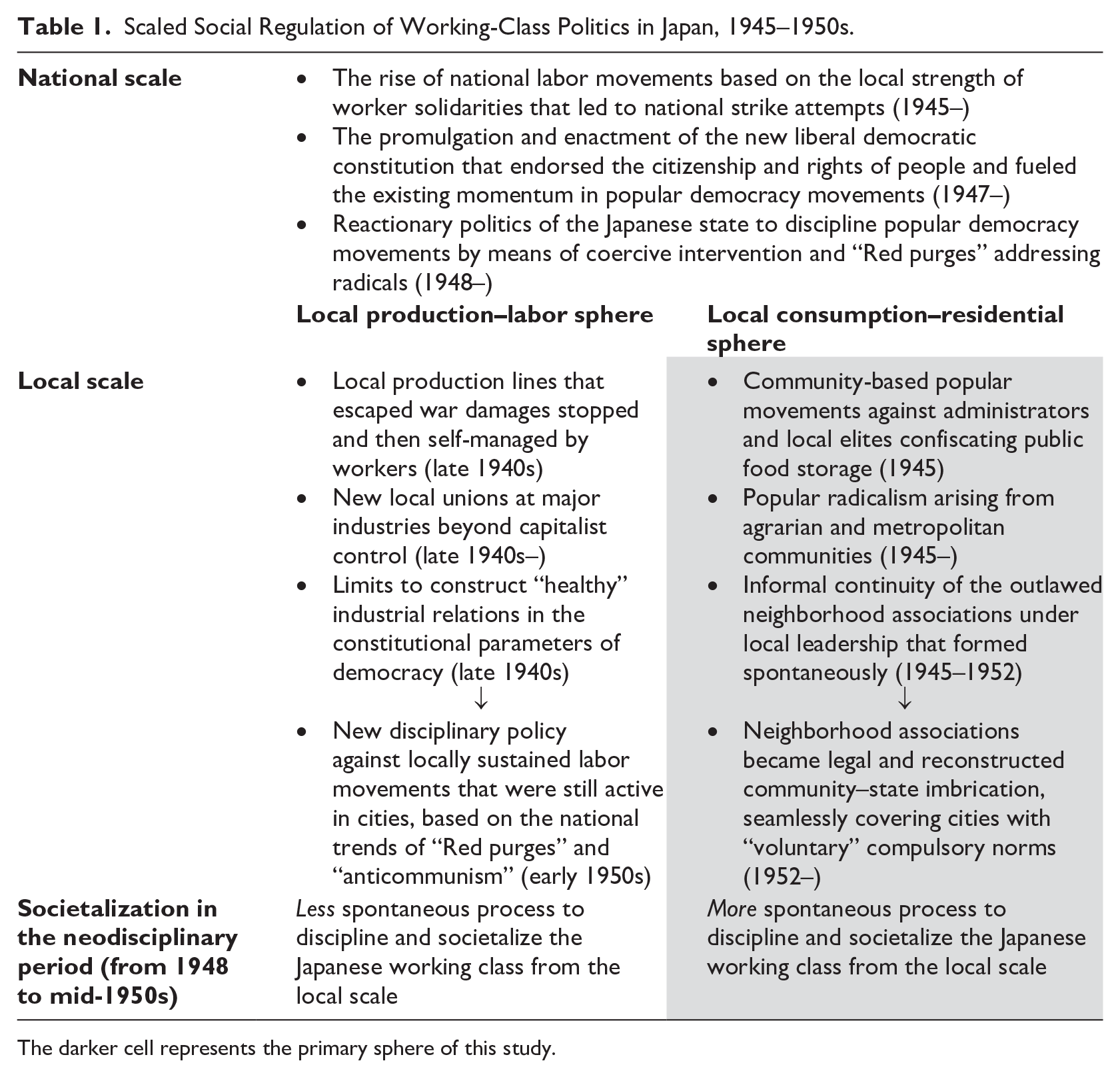
The darker cell represents the primary sphere of this study.
Through this course, Japanese local communities became characteristically more normative compared to the Anglo-American community (Castells, 1983; Cox and Mair, 1988; DeFilippis et al., 2010; Hoggett, 1997; Logan and Molotch, 1987) but less authoritarian compared to some Asian cases (Koo, 1993). A multiscalar strategy societalized US state space by using liberal forms of community (Fasenfest, 1993b), but the Japanese case has taken a different course, being oriented to unification and standardization in relation to administrators. To provide Japan with ‘societalizing possibilities for the national state’ (Jessop, 2002: 72), and to give it a community form fitting Japan’s ‘statism with democracy’ approach to industrial development, it was useful to redeploy neighborhood associations at the local (and national) scale. They revitalized bottom-up social leaderships around the self-employed and landowners who were more supportive of the political status quo.
By laying these uniform social units all over national territorial space without any gaps, Japan thus materialized its uniquely exhaustive, ‘all-inclusive’ approach to state space societalization, with a major national effect of strengthening a uniform type of national social cohesion for developmentalism. This national cohesion, in fact, was intricately ‘meshed’ with the local grids of neighborhood associations and their bottom-up compulsory mobilization. The Japanese archipelago thus became entirely covered by the national-scale continuum of locally ‘reliable’ units of community to which all households were requested to belong. Through the medium of these micro units, all constituent households were linked to municipal and ultimately national administrative guidance.
Development, Discontents, Decline
Developmentalism and Urbanization
Toward the 1960s, the Japanese state promulgated various new programs of territorial development intended to give a spatial framework to Japan’s industrial development, which powerfully directed the economic power of large corporations to certain areas and networks in the middle of the Japanese archipelago. Table 2 summarizes some of the most important spatial frameworks of development in this vein.
Spaces of Urban Development Planned by the Japanese State, 1950s–1960s.
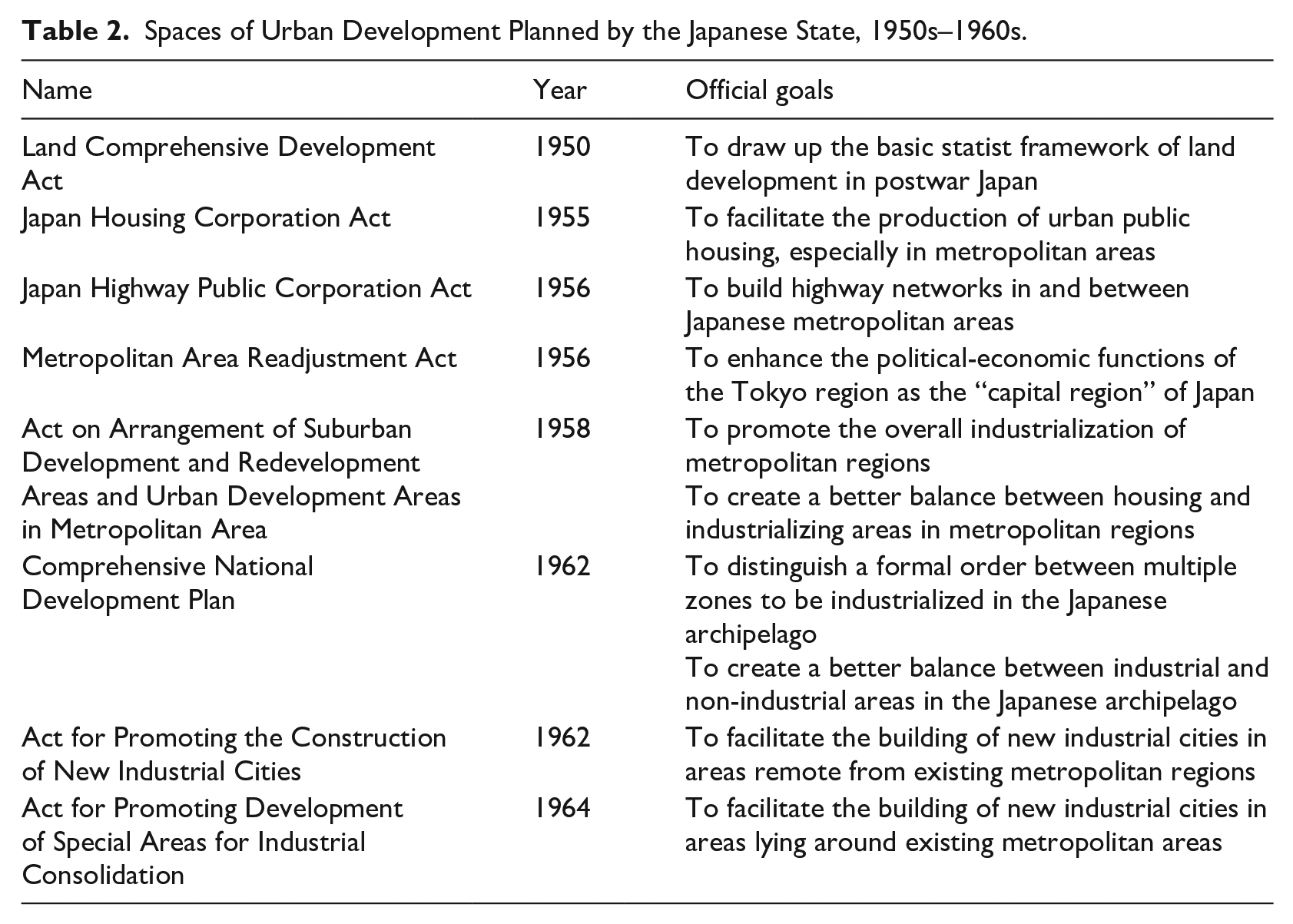
While earlier spatial frameworks overtly aimed at concentrating wealth in selective areas in Japan, those in later years – such as the 1958 and 1962 acts described in Table 2 – officially claimed to alleviate the uneven spatial development of Japanese capitalism and its urbanization. Actually, however, none of these spatial frameworks could stop the intensification of uneven spatial development in Japan’s capitalist urbanization. Ken’ichi Miyamoto, in a well-regarded critique of Japanese capitalism and its community consequences in this period, sums up the story:
Since the late 1950s, there occurred the concentration of population in the urban areas with a strength rarely observed in modern Japanese history. Between 1960 and 1965, the number of people living in the Tokyo, Nagoya, and Osaka metropolitan areas increased by 5.5 million. The reason for this population concentration was due to the spatial agglomeration of capital to an abnormal degree. To utilize the merits of agglomeration maximally, capital in Japan concentrated on the metropolitan areas and its surroundings, where private capital, public facilities, and the workforce accumulated. The unprecedented population concentration thus resulted. As these populations grew, capital in the financial, commercial, cultural, and entertainment realms and administrative organs also grew, and the growth of population accelerated. (Miyamoto, 1971: 56)
Miyamoto (1967, 1971, 1975) was concerned that Japan’s massive urbanization in the 1960s had created deep contradiction and tension in society and in space. For one thing, the urban populations accumulating in the metropolitan areas were impoverished, and their housing and urban amenities were meager, increasing the unmet social demands of migrant residents in the city. For another, the spatial concentration of capital in the metropolitan and industrializing areas promoted the massive pollution of neighborhood environments, exposing immobile and/or unwealthy people to environmental degradation. Finally, the rural areas that spread outside of the metropolitan or industrializing domains experienced huge depopulation and impoverishment trends (see Shoji and Miyamoto, 1964).
Miyamoto’s list of contradictions – the paucity of housing and amenities, widespread pollution, rural depopulation, and so on – is informative to understanding how localities and cities under developmentalism suffered under the massive urbanization trends. Further, the societalizing role of neighborhood associations gained new importance under the contradictory dynamics of developmental urbanization. In the 1960s, neighborhood associations increased their role in sustaining normative consensus on development programs and the political status quo as Japanese capitalist urbanization became highly stressful for ordinary residents. The use of neighborhood associations to sustain Japan’s political quietism, the characteristic of Japanese society applauded by Johnson (1982), became a critical condition of Japanese developmental capitalism in this era.
Discontents and Social Movements
As contradictions of developmentalism deepened, radical initiatives for change grew. Dissident voices and practices appeared, particularly in the strategic geographical areas of developmentalism, where new industrial investments could lead – and actually did lead – to a huge amount of environmental pollution and deterioration of community lives.
After reviewing these local social movements, sociologists Matsubara and Nitagai (1976: 214) concluded that antidevelopment movements in the community could ‘approach the existing local groups (chōnaikai and jichikai (neighborhood associations)) and local political intermediaries (local power holders) independently from, and sometimes in relation to, their partisanship and ideologies’. These movements could forge their local basis through ‘expressing wills that are unrepresented in the existing routes’ by creating new groups other than the ‘chōnaikai and jichikai, which are the routes that have been used by the administrative sections of the municipality and the prefecture’ (p. 329).
A monograph on a local social movement in one industrial city – the city of Yokkaichi in Mie Prefecture – reveals that the real process of mobilization needed to achieve the difficult feat of outgrowing the local dominance of neighborhood associations:
Let us mention the ways in which neighborhood associations operated. It was neighborhood associations that initially took up the demands of residents. Yet in the case of the Shiohama district, there was no fierce action such as thronging to the factories with mushiro bata [flags made of woven mambo mats, which were used in peasant revolts in Japanese history]. One reason was that neighborhood associations are intrinsically not organizations for social movements but apparatus that is integral to the local administration at its endpoint, and so the role [of neighborhood associations] was to make petitioners unwilling to protest. Furthermore, in the case of the Shiohama district, what mutually connected the internal affairs of the associations was not the consciousness about rights but traditional local ties [chien] inherited from the old period when the district was called Shiohama village. (Ono, 1971: 25)
As this quotation reveals, in this city of Yokkaichi, where the initial moment of local initiatives against development started as early as in 1960 and 1961, the neighborhood associations could not officially support a local mobilization due to their limited capacity to nurture progressive voices against the dominance of local administrators.
In other cases, however, effort was made to overcome this difficulty through movements that practiced creative ways to avoid antagonizing neighborhood associations and their leaders (Miyazaki, 1975). Furthermore, ways to mobilize neighborhood associations for the sake of radical politics also appeared. In the city of Numazu, Shizuoka Prefecture, a leader of multiple neighborhood associations forged this transformative move in the associations in 1964. A study meeting held by the residents, where they were scrutinizing a local plan of a petrochemical complex facility, noted:
[The] leader of the combined neighborhood associations, Shōtarō Yagi, showed up though ill. Yagi agreed that he would help these study meetings be more active and determine the attitude of the Shimokanuki neighborhood association [about the development plan] based on the will of all members. Yagi is from a landowning family that dates back to the former Yanagihara village. He is a member of the Liberal Democratic Party [the leading national party] and he is a shareholder of the Tokyo Electric Power Company. Such a figure led the movement from beginning to end, in opposition to the government, the municipality, private firms, and the Party, hinting at his withdrawal from the Party membership and at throwing away his family business. This fact affected civil social movements not just in the Shimokanuki district but also in the city of Numazu. In addition to Yagi, there were many such people in the social movements in Numazu. (Hoshino, Nishioka, and Nakajima, 1993: 43–44)
What these cases show is that after the early 1960s into the 1970s the societalization capacity of neighborhood associations was severely tested, redefined, and remolded in the process of local social movements arising from within local communities. The success of these movements in using neighborhood associations for radical politics hinged upon their cutting the associations’ traditional ties to administrators and developmental projects. In the most successful cases, neighborhood associations were transformed into local centers of antidevelopment mobilization at the local scale.
Decline
By the early 1990s, Japanese specialists were already talking about a significant decline in neighborhood associations, which ‘have undergone transformation during the process of high economic growth’. The difficulties were apparent: ‘The importance of the residential district has lowered for each resident because of the advancement of work–living separation. . . . The mobility of residents has heightened, and the heterogeneity of life consciousness has increased’ (Tanaka, 1990: 56–57). Today, a similar gloomy perception about the future of neighborhood associations is more widespread among scholars and practitioners. A scholar describes the most contemporary context of this crisis: ‘The burdens of the roles of the district chief and the neighborhood association leader are relatively heavier in rural areas, making it very difficult to find successors’ for the current leaders (Nakagawa, 2011).
Moreover, contemporary Japan is experiencing seemingly unstoppable trends of decreasing birthrates and local population reduction, and local Japanese communities show major unsustainability in this regard overall (Figure 1). All of these circumstances have compelled policymakers to produce critical analyses of Japanese localities and to construct new plans to reconcentrate available community resources, including neighborhood associations, around urgent social needs in order to make Japanese localities sustainable in the future.
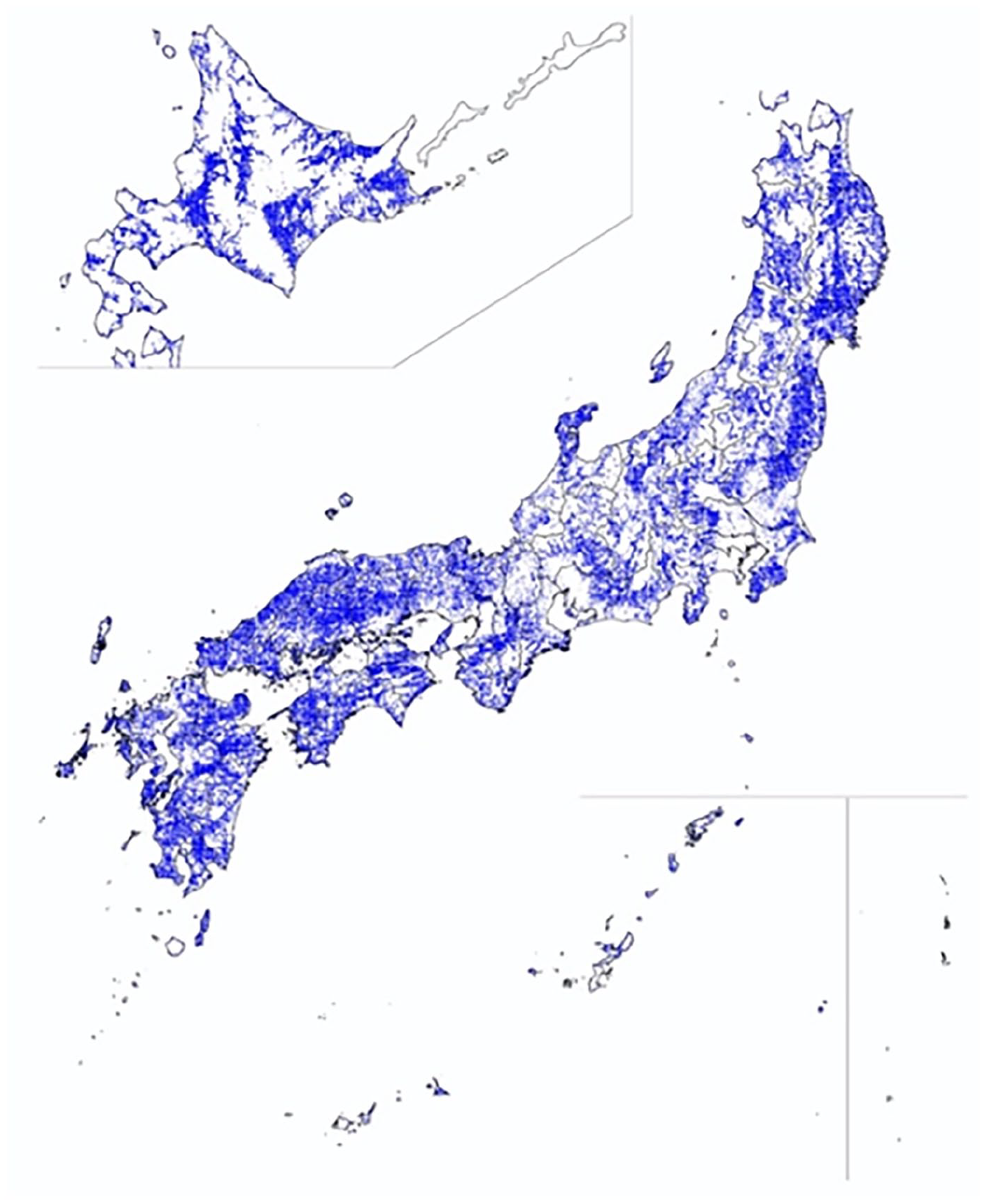
Areas expected to lose sustainable local neighborhoods by the Year 2050.
How can we understand this contemporary crisis of Japanese local communities, using the conceptual and historical vocabulary mobilized in this paper? From our perspective, the revival of neighborhood associations augmented societalization in relation to Japanese developmentalism. While the inherited developmental policy patterns have already become largely inactive, the gap left by the associations is huge. Japanese local communities, in their golden years, were organized, standardized, and functionalized by this administratively oriented framework in relation to the municipality and the state. Localities now struggle to re-inspire this community tradition with new practices that can openly accommodate the plurality, autonomy, and creativity of residents and newcomers, beyond the administrative subjectivity of the community.
Conclusion
By employing Jessop’s (2002) concept of societalization in conjunction with Brenner’s (2004, 2019) call for a scaled political economy, we have developed a historical and contemporary study of Japanese communities from a sociological and scaled perspective. Seen from this angle, neighborhood associations have been a scaled and sociological platform for Japan to generate expansive social cohesion that, beginning in the community unit, can upscale its social effect from the local to the national. Our joint use of Jessop’s integral state theory (Gramscian) and Brenner’s scale-mediated state space theory (Lefebvrian) helps to explore how the societalization of integral state space can use ‘community’ as a focal point of societalization that is inherently a scaled project (for scalar implications in community politics/policy in the Anglo-American settings, see Cox and Mair, 1988; Fasenfest, 1993b; Logan and Molotch, 1987).
Further, these discussions help us think about a ‘developmental state’ as an integral state project mediated by scale (Hayashi, 2023). That is, state space in support of non-Western developmental trajectories can be thought of as having not just political regulatory mechanisms intended to enhance corporate power (Amsden, 1992; Evans, 1995; Johnson, 1982; Wade, 2004 (1990) Woo-Cumings, 1999). In addition, wider sociological institutional auspices – including communities and neighborhoods – furnish state-mediated industrialization and its spatial frameworks with supportive sociological milieus for advanced social cohesion. These grassroots sociological aspects can be central to a scalar strategy of integral statism in non-Western settings.
The Japanese case of neighborhood associations suggests this possibility. It should be emphasized that these associations were not a direct remnant of Japan’s feudal or peasant society but a product of more modern-day reforms based on obligatory mutuality and quasi kinships. After World War II, Japan underwent real political uncertainty, from rising popular struggles (1945 onward) to constitutional liberal democracy (1947 onward) to the neodisciplinary trend (1948 onward). After becoming part of the fascist regime and then being abolished in 1945, neighborhood associations were formally resurrected in 1952. Afterward, neighborhood associations became integrated with Japanese developmental capitalism, playing a key role in societalizing its state space from the micro unit of locality.
Neighborhood associations after the war facilitated Japan’s multiscalar strategy of societalization, in which Japan sought to permeate the entire state space with normative community units by seamlessly laying neighborhood associations all over the local scale, without gaps. This strategy grew the administrative subjectivity of citizens in the locality, who could conceive of their individual rights to citizenship as a favor conditional upon their participation in the singular, standardized unit of community. This ‘culturally’ obligatory participation was facilitated by administrators who wished to reconstruct expansive social cohesion around politically ‘reliable’ leadership in the locality. In this context, progressive/radical voices repeatedly tried to renew and democratize this community form for the sake of marginalized local people.
While this societalizing strategy augmented an integral state form of developmentalism by providing it with sociological scaffolding at the local scale, this specific role of neighborhood associations has now waned with the decline of Japanese developmentalist policy in more recent years. The reduced power of neighborhood associations, it seems, is reverberating with a crisis of local societalization today.
