







Abstract
Drawing on 26 semi-structured interviews with white mothers and mothers of color in New York City, this paper examines how racialized neoliberalism codifies the structure and operationalization of parent organizations like the parent association (PA) and the parent–teacher association (PTA) across varying public schools at the nexus of race, class, and gender. Deploying racialized neoliberalism as a theoretical framework, this paper argues parent organizations are an inherent mechanism of the racialized neoliberal landscape of schooling that enables the continued capital accumulation and decision-making power of white middle-class mothers while relationally disempowering and economically dispossessing working-class mothers and mothers of color.
Keywords
Introduction
The Racialized Neoliberal Birth and Development of Parent Organizations
It is a very material reality that public schools in the United States remain woefully underfunded. Increasing neoliberal cries for fiscal austerity has resulted in the privatization of schooling in the United States, with increasing funding disparities between schools and districts and fiscal responsibility for schooling shifting from the public sector to the private sector with adverse consequences for parents of color and/or economically dispossessed families (Fabricant and Fine, 2012; Kozol, 1992 [1991]; Picower and Mayorga, 2015).
Within this landscape, parent and parent–teacher organizations have become professionalized with middle-class and upper-middle-class parents addressing budgetary gaps through grant-writing, fundraising, 1 and volunteerism (Murray, 2019; Posey-Maddox, 2013; Toch, 2022). In concrete terms, these parents are raising funds for teacher salaries, classroom and curriculum materials, school foundations, clubs, facility renovations, and supplemental academic and social- and cultural-enrichment programs (Murray, 2019; Posey-Maddox, 2013). Fundraising 2 efforts often include things like online donor campaigns, marketing, and silent auctions, and these parents are leveraging their middle-class cultural, social, and economic capital to bolster their efforts (Posey-Maddox, 2013). The funds generated from these organizations are largely unregulated by schools and districts and exacerbate existing funding disparities between districts and between schools (Murray, 2019).
To that end, this paper asks two questions to understand the role of parent organizations within a racialized neoliberal educational landscape: (1) How do parent organizations in New York City (re)produce the decision-making power and capital accumulation of white middle-class mothers? (2) How do parent organizations in New York City (re)produce the disempowerment, economic dispossession, and exclusion of mothers of color? This paper offers insight into how racial neoliberalism is an inherent part of the constitution of parent organizations and explores how this influences parents’ attitudes and actions in relation to PTA/PA participation in ways that yield benefits for white mothers 3 and relationally sustain complex disadvantages for mothers of color. 4
To date, there is little research that explores the codification of parent organizations through racialized neoliberalism or situates parents as active agents in the (re)production of racialized neoliberalism through parent organizations. However, research suggests hegemonic parenting norms are located within a broader project of racial neoliberalism that benefits white parents while sanctioning Black parents and that parents across race, class, and location are consistently enacting action within what scholars like Rubin et al. (2019) call ‘neoliberal education regimes’ (Manning, 2021). To that end, this study shows how racialized neoliberalism is endemic to the nature of parent organizations and subsequently influences parents’ actions and attitudes in relation to the PTA/PA in ways that (re)produce and maintain inequalities like disparate school funding and inequitable distribution of resources.
The White Economic and Political Design of School Funding and School Districts: Socio-Historical and Political Context
To understand the role of parent organizations within a larger racialized neoliberal regime of education, it is important to briefly trace the historical and socio-political genealogy 5 of school districts to disparate school funding within a broader racialized political economy. Research suggests parent organizations like the PTA/PA, the School Leadership Team (SLT), 6 and the Community Education Council (CEC) can reinforce and perpetuate inequitable distribution of resources in urban schools and districts at the nexus of class and race (Lyons, 2022; Murray, 2019; Perez, 2023). This context has engendered parent organizations as individual entities working to address systemically engineered inequitable distribution of resources between schools and across districts. Parent organizations like the PA and PTA illuminate dynamics and questions of power, exclusivity, access, and privilege at the nexus of race, class, and gender to highlight how racially and socio-economically privileged parents (re)produce their material and immaterial resources at the expense of marginalized parents (Posey-Maddox, 2013).
In the United States, school funding is intimately tied to the racialized neoliberal creation and maintenance of school districts. As a case in point, school districts in New York City were not established until the late 1960s (Bonastia, 2022; Feagin, 2009; Rothstein, 2018 [2017]). This strategically coincided with Black Americans moving North in search of better occupational, housing, and educational opportunities as rampant anti-blackness facilitated Northern white flight, with whites moving out of the cities and into the surrounding suburbs (Anderson, 2016; Farley, 2022; Feagin, 2009; Massey and Denton, 1993; Rothstein, 2018 [2017]). The establishment of school districts also coalesced with discriminatory housing policies and practices, as many white neighborhoods had restrictive residential covenants that prohibited white homeowners from selling their properties to non-whites and Jews (Feagin, 2006). The discriminatory housing policies that constitute, solidify, and perpetuate residential segregation have a direct impact on school segregation, and northern school districts commonly used covert and overt practices such as racial gerrymandering of school district lines and discrimination in student assignments by officials to maintain public school segregation through school zoning (Bonastia, 2022; Feagin, 2009). The creation and maintenance of school districts was and remains a means for both white political and economic elites and rank-and-file whites to maintain both residential and school-based segregation and to centralize power and resources in white schools and white communities following the 1954 Brown V. BOE decision. In the 1970s, there was a 975% disparity in school funding between white and minoritized schools in Texas alone (Anderson, 2016). Today, more than 50% of school children in the United States attend school in racially segregated districts (Bonastia, 2022; Daniels, 2021).
Residential segregation is linked to the geographic carving of local school districts and resulting school-based segregation in the Northeast. 7 Basically, local children attend schools in their local neighborhoods. The mutually sustaining duality of school-based segregation and residential segregation is then connected to the racialized neoliberal funding structure of schooling in the United States. By white political design, the funding of traditional public schools (TPS) is outsourced to local municipalities—local property taxes fund local schools. Effectively, this means that economically dispossessed people and/or BIPOC communities are held financially responsible for primarily funding their local public schools. The state’s expectation of individualized and localized fiscal responsibility is apparent when considering federal and state budgetary expenditures on public education: the federal government allocates only 7.8% of its budget annually to fund K-12 public education, while New York State allocates 34% of its budget to schooling.
In New York State, parent organizations like the PTA and PA occupy a prominent role in school funding. New York City public schools are required by the New York State Department of Education (DOE) to have a parent association 8 (PA) or a parent–teacher association (PTA), and these organizations generally support schools in four critical ways: (1) hosting parent workshops; (2) organizing academic and social activities for families; (3) raising funds; and (4) running volunteer events. While the PTA/PA can fundraise for supplemental social, cultural, and educational enrichment programs, those programs must be complementary to school, district, or borough programs. Moreover, while the PTA/PA cannot overtly spend on political causes, they can raise funds for humanitarian causes with the approval of the chancellor. By using donations, PTAs/PAs can use their funds to help hire supplemental support staff such as cluster teachers during school hours or to hire weekend or after-school staff. When it comes to directly hiring school staff, they can only fund weekend or after-school staff and cannot hire school staff to work during school hours nor can they fund political contributions, but they can donate to humanitarian causes approved by the principal (Regulation of the Chancellor, A-660, 2021).
The white state’s expectation that BIPOC communities should fund their own schools is guided by states’ rights racialized neoliberal ideology that emphasizes individualism and responsibility. This actualized expectation informs the political and economic structure of school funding and is linked to inequitable funding across school districts that is maintained through the concentration of resources in white communities at the expense of the unjust impoverishment of BIPOC communities. 9 Material wealth has historically and contemporarily been disproportionately concentrated in white communities and subsequently in white schools (Robles, 2006). This disproportionate wealth, or what Feagin (2006) would call unjust enrichment, is interpreted as deserved due to whites’ superior neoliberal values and morals, individualism, sense of responsibility, and work ethic. Relationally, unjust impoverishment is mapped onto Blackness as deserved because of their immorality and lack of work ethic. Deliberately underfunded schools for BIPOC students are then facetiously rationalized as the individual problem (and fault) of BIPOC communities, and they should be held responsible for remedying it. This logic ensures a continuity of centralized material resources in predominantly white schools and communities (Anderson, 2016). Within this racialized neoliberal socio-historical and political context, the creation of school districts function as demarcated boundaries of inequitable immaterial and material resource distribution, and these are the circumstances that both create space and intent for the functionality of contemporary parent organizations.
Racialized Neoliberalism
Neoliberal scholars such as Milton Friedman (1962) and Noam Chomsky (1999) speak to how neoliberal practices codify varying institutions throughout society. In both theory and practice, neoliberalism supports laissez-faire governance, deregulation and free-market policies, and increasing privatization of the public sector. These neoliberal practices are conterminously fortified by a neoliberal ideology that endorses, supports, and rewards consumer choice, individualism, personal responsibility, and entrepreneurial initiative and meritocracy (Chomsky, 1999; Picower and Mayorga, 2015). While understanding what neoliberalism is important, it is equally significant to understand what neoliberalism does: (re)produce exacerbating social and economic inequalities (Chomsky, 1999; Giroux, 2014).
Drawing from the rich intellectual work of scholars like Cedric Robinson (1983) and Arun Kundnani (2021), this paper examines how racialized neoliberalism structures the operationalization of parent organizations like the PA and PTA in public schools in New York City at the nexus of race, class, and gender. Racialized neoliberalism is a paradigmatic critique of neoliberalism that ignores or relegates racism to the sidelines of the discourse of political economy. Racialized neoliberalism has been used as a framework to understand varying dimensions of schools and schooling including but not limited to the regime of high-stakes testing; the rise and concretization of mayoral control; philanthrocapitalism as a complex site of power, spectacle, whiteness, and financing for education; and state abandonment and accumulation by dispossession (Au et al., 2016; Brown, 2015; Lipman, 2015; Picower and Mayorga, 2015; Stovall, 2015). 10 Ultimately, racialized neoliberalism results in educational reforms that increase privatization, reduce the existence of public services and public expenditures on those services, increase competition, and hold individuals accountable for both failure and success instead of systems (Picower and Mayorga, 2015). And because race and racism are the endemic codifying principles of hegemony in the United States and globally, neoliberalism is positioned within racism. Perhaps more accurately, there is an inherently racial constitution of neoliberalism and the institutions within (Bonilla-Silva, 2014; Delgado et al., 2017; Kundnani, 2021; Picower and Mayorga, 2015). Within the hierarchy and hegemony, white people hold and hoard power and resources at the top and maintain this through both implicit and explicit processes (Picower and Mayorga, 2015).
For this reason, this paper deploys ‘racialized neoliberalism’ to understand how seemingly well-intentioned parent organizations are characterized by racialized neoliberalism. Existing fiscal disparities between schools and districts are the byproduct of racialized neoliberal policies and practices that reduce state expenditures on public education and shift the responsibility for funding public education from the state and onto the private sector, which benefits white middle-class parents and schools while disadvantaging BIPOC parents and schools. In this case, the state shifts the responsibility from the public and onto individual parents and families who function as the private sector. As a result of the racialized neoliberal policies and practices within the education regime that structurally codify and maintain racialized and class-based disparate funding, parent organizations function as private investors in public education whose attitudes and actions are guided by values of consumer choice, individualism, personal responsibility, and entrepreneurial initiative. In white and wealthy schools, white liberal and progressive parents deploy ‘nice racism’ and espouse principles of collective care for public education and racialized and class-based inequalities in the school system while engaging in actions that maintain and exacerbate white middle-class resource and power accumulation (Beeman, 2022; Daniels, 2021; DiAngelo, 2021; DiTomaso, 2013). BIPOC parents and economically dispossessed parents often work outside of formal parent organization to address their needs within schools and when they do participate in parent organizations, often experience alienation, mistrust, and belonging (Banaji et al., 2021; Fox-Williams, 2020; Hill, 2018; Yeager et al., 2017). Racialized neoliberalism allows for an understanding, and perhaps an interrogation, of how white middle-class parents protect and concentrate their material and immaterial advantages and relationally maintain the economic dispossession and alienation of parents of color and working-class parents (Feagin, 2006, 2009)
Research Design and Methodologies
To explore how racialized neoliberalism characterizes parent organizations across public schools, the researcher conducted semi-structured virtual 1-hour interviews on the Zoom platform with 26 parents from varying elementary and middle schools during the 2022 academic school year in New York City. With over one million students, New York City remains the largest and most racially and socio-economically segregated school system in the United States and thus is a critical site to examine how racialized neoliberalism characterizes parent organizations and informs the behaviors and actions of parents within them (Bonastia, 2022).
Parent participants ranged in age between 33 and 45 years, with almost 81% of parents between the ages of 36 and 47 years, and 19.2% between the ages of 30 and 35 years. Of the 26 parents, 73.1% of parents had children in TPS, 15.4% had children in charter schools, and 11.5% had children in private 11 school. Of the participating parents, 57.7% were BIPOC, with 11.5% Black/Haitian-American/African-American, 26.9% Hispanic/Latina/Puerto Rican/Spanish, 11.5% South East Asian, and 3.8% West Indian Guyanese. Comparatively, 42.3% of parents identified as white/Caucasian (see Note 11), and 3.8% of parents identified as Colombian/Puerto Rican/Irish. With regards to gender, almost all the parents identified as cisgender females. More specifically, 92.3% of parents identified as cisgender female/woman, 3.8% identified as male, 12 and 3.8% identified as genderqueer/gender non-conforming/butch. Using educational attainment as an (albeit troubled) proxy for socio-economic status, almost half of the parents had bachelor’s degrees (42.3%), while 23.1% had a master’s degree, 15.4% had a professional degree, and 15.4% had an associate’s degree. This study does not include many parents without a post-secondary education—only 3.8% had a high school diploma. Table 1 describes in detail the parent participants who contributed to this study.
Socio-demographic characteristics of parents.
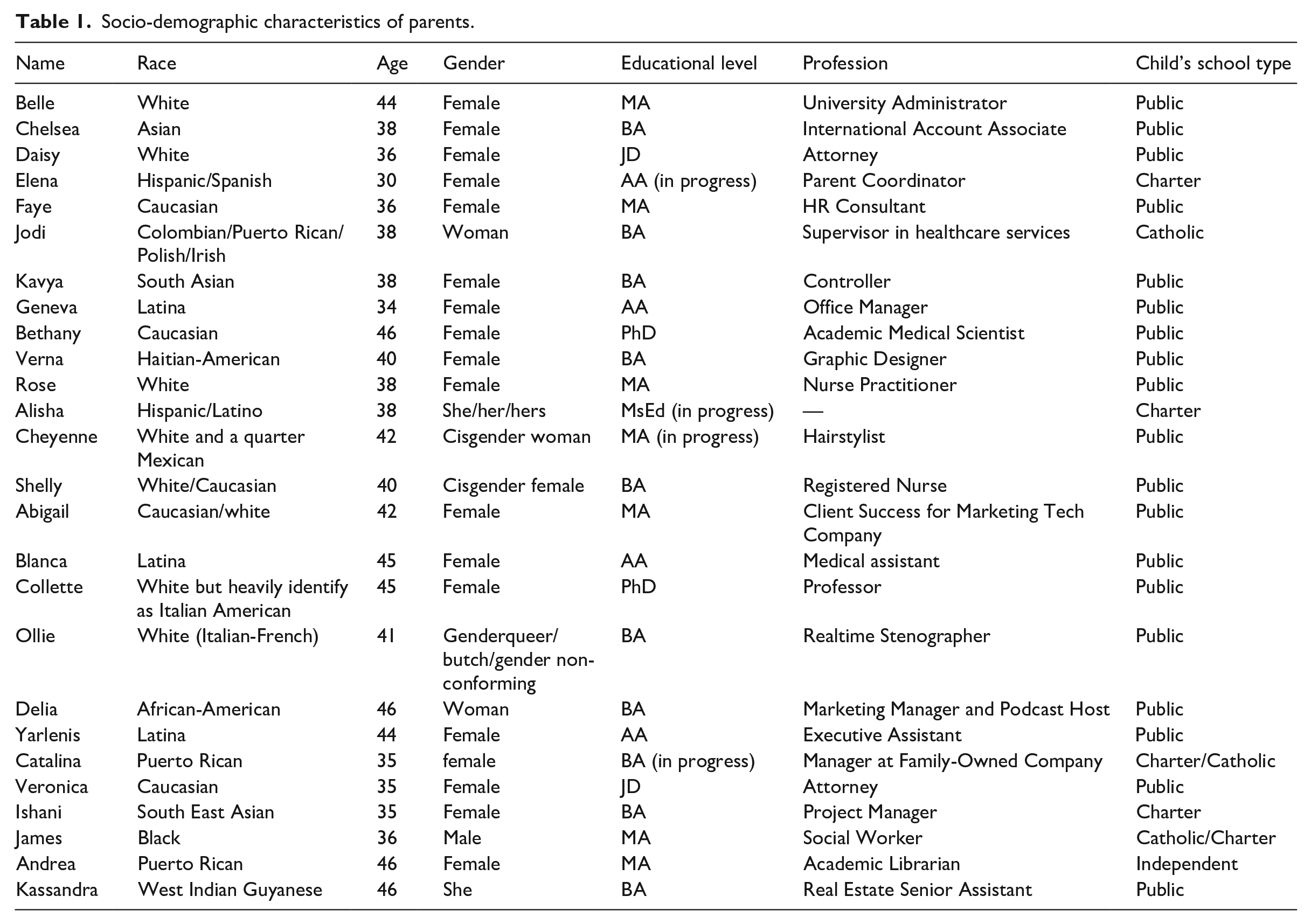
The researcher obtained ethics approval prior to participant recruitment. Participant recruitment was conducted through two methods. The primary method included advertising the study through social media posts on Facebook to varying parent groups. Parents of elementary and middle school children were invited to participate. Participants were self-selected and received no compensation for participation in this study. A secondary method of recruitment included snowball sampling. All participants signed an informed consent prior to participating in the study.
During the course of the interviews, parents were asked questions on how they defined parental engagement within and in relation to schools, as well as what parental engagement meant to them and what it looked like in the broader context of gender, class, and race. The interviews were recorded using the record feature on the video-conferencing Zoom platform. Interviews were then transcribed by the Otter Ti Software, and the researcher manually checked each transcript for accuracy. Participant names were anonymized to maintain privacy and protect confidentiality, and each participant was given a researcher-generated pseudonym.
Interviews were coded in two rounds using the Dedoose software. The first round of coding was loose open coding. The researcher then conducted a thematic analysis for the second round. Interestingly, while parents were not asked about the role of parent organizations directly, 17 out of 26 parents explicitly mentioned parent organizations like the PTA and the PA while we spoke about parental engagement. Out of those 17 parents, three white mothers and 1 Latina mother mentioned the SLT while two white mothers mentioned the CEC. Furthermore, 12 of the 17 parents who mentioned parent organizations were actively involved as either general members or occupants of elected leadership positions like the president, vice president, or secretary. Again, while parents were not explicitly asked about parent organizations directly, the majority of them mentioned the PTA/PA, the SLT, and the CEC in the context of parental engagement as it related to advocacy, decision-making power, involvement, politics, and funding at the school level, thus making parent organizations a salient and emergent theme that parents associated with parental engagement in schools. This process catalyzed the creation of new codes that included parent organizations, PTA/PA, SLT, and CEC in relation to parental engagement in New York City schools.
Mothers on the Margins: Collective Power, Visibility, and Unbelonging
Rather than channel their efforts through direct participation in institutionalized parent organizations, mothers of color would often collaboratively mobilize outside of schools to generate collective exert external pressure on schools to change within (Epstein, 2001; Fine, 1993; Furumoto, 2003; Lightfoot, 2004). Mothers of color secured power through organizing and mobilization during times of collective need or crisis, and power was often deployed as an institutional intervention such as when the school was not acting in the best interests of the parents or their children. Parental organizing for mothers of color at the school level often entailed mobilization around a common cause or interest. In such cases, parents galvanized to influence or alter decisions within the school that had already been made—for instance, to change curriculum or challenge administrative hires.
Kassandra, a West Indian Guyanese Senior Real Estate Agent, mobilized with other parents in her child’s public school because the parents within the school felt children were not being academically challenged during COVID. Kassandra and the other parents with her son’s school used an online communication app to share their concerns with one another before presenting those concerns to the school administration.
You know, we’re kind of saying, hey, listen, you know, we’re more focused. And of course, this was third grade, fourth grade. And of course, this is where the academics are now starting, this is where we need to focus for them to transition into middle school, and it was, you know, statewide tests and all of these different things that they need to, to focus on. And we’re like, hey, we don’t care about dancing classroom, we want to focus more on the things that they need to progress. Because we started to speak more with, you know, the teachers and we started to, you know, talk to the principal, it brought about a lot of different changes, because they started to listen to us. They weren’t just saying, okay, we’re just gonna, you know, listen to what the Board of Ed is saying. It was more of we’re gonna listen to what the community wants, what the community has to say, what these parents are asking for. And, you know, in all honesty, we’re a bunch of fighters. You know, the parents in our groups, we’re not, we don’t just sit back and it’s kind of like, alright, we’re just gonna let them walk all over. It’s kind of like, we walk into school. The emails are going, the phone calls are going, you know, and if one calls the other and texts the other. It’s kind of like, okay, we’re going to get the ball rolling.
Kassandra suggests the power of the parental ‘community’ enabled them to challenge the Board of Education and the school administration and make them ‘listen to the community’. For Kassandra, this advocacy was collective, focused, and included parents who organized outside of conventional parent organizations within the school to call attention to their children’s academic needs. Kassandra and the other parents drew from the power of the collective and built a community based on collective needs and desires (Collins, 1990). Calling herself and the other parents ‘a bunch of fighters’, Kassandra belongs to a community of parents who organize outside of school-based parent organizations to challenge the school. The collective approach and care Kassandra and her community of parents adopt is nested in larger genealogy of BIPOC parents who have mobilized and fought collectively against the racial and economic inequalities that characterize and pervade schools (Anderson, 2016; Bonastia, 2011; Lyons, 2022). While parent organizations within schools often function in congruence with the school, Kassandra and the other parents are putting pressure on the school as an outside grassroots collective. Rather than fighting for individual power and material resources, these parents mobilized as a community to change the curriculum to increase academic rigor based on the needs and wants of the parents.
When mothers of color did participate in parent organizations at the school level, PA/PTA participation was strategically deployed as a strategy to increase visibility for themselves and their children. Geneva, a Latina Office Manager whose child attended a public school, joined the PTA to increase the visibility of herself and her son:
So [the parent coordinator] was like, if you are part of this [the PTA], they’re going to pay attention to you. And I was like, if this is what I have to do for my child to get better treatment from other teachers. I was like, I’ll do that and I did it. I guess what inspired me was trying to get a better not education, but I don’t know if I am better or not. It’s like better treatment for my child.
Geneva was ‘inspired’ to become a part of the PTA to ‘get better treatment’ for her child from teachers and the school. For her, becoming a member of the PTA would allow her and her son to be seen by school administration and instructional staff, and this visibility could be leveraged for ‘better treatment’ on an individual level. Instructed by the parent coordinator, Geneva was told the school would ‘pay attention’ to her if she was a parent on the PTA. In this way, being a parent on the PTA meant being a parent who was rendered visible in an institution that might otherwise render her invisible, and many parents of color become members of parent organizations for reasons similar to Geneva (Huguley et al., 2021).
And yet still for others, parent organizations at the school level functioned as sites of unbelonging for parents of color, especially Black mothers. Delia, an African-American mother, a marketing manager, and a podcast host whose child attended a public school in Harlem suggests as much:
I see those parents and some of them are my friends. And I love that for them. But I’m like, that’s not my personality—the ways that we are kind of not invited to be there, does that make sense?
Delia did not feel welcome when it came to parent organization participation suggesting that ‘we’ are ‘not invited to be there’. School-based parent organizations can function as sites of exclusion and unbelonging for Black mothers across class lines. Black parents, and their children, are more likely to have distrust/mistrust of schools as the result of institutional systemic oppression that characterizes them through an antagonistic anti-black lens of inferiority, criminalization, and objectification, and they are more likely to experience unbelonging and exclusion in schools and subsequently parent organizations that are engendered within this context (Banaji et al., 2021; Fox-Williams, 2020; Hill, 2018; Yeager et al., 2017).
Later, Delia noted that because she worked full time, she was too exhausted to engage in the school through parent organization participation, and that the PTA did not take into consideration the ability of working parents. For Delia, parent organization participation was additional labor that did not accommodate working parents. Moreover, after reading an article with a headline that linked children’s academic success to parental engagement, Delia questioned whether she was ‘doing enough’ and whether she ‘should be doing more’ despite frequently volunteering at her child’s school and attending virtual PTA meetings to catch up on school affairs. Mentioning that she and her partner did not occupy ‘any sort of leadership positions in the school’, Delia described herself as ‘not super engaged’ as she linked active and ideal parental engagement to occupying leadership positions within parent organizations. Within racialized neoliberalism, Black mothers and families are regarded as sites of pathology, deviance, and deficit in relation to white mothers who are positioned as moral, good, and ideal(ized) (Collins, 1990; Daniels, 1997, 2021; Lyons, 2022; Moynihan, 1965). Within parent organizations, white mothers can and do leverage the symbolic racial and material capital associated with their white womanhood for even more benefit, while conversely, Black mothers are constructed as less valuable through misogynoir because Black womanhood and Black mothers are devalued in a racialized neoliberal society that values white mothers (Bailey and Trudy, 2018).
Economic Dispossession and Labor Exploitation
When parents of color did participate in parent organizations at the school level, the organizations often functioned as a form of labor exploitation in economically dispossessed schools that were underfunded and understaffed. These parent organizations would rely heavily on mothers of color to provide free labor. Elena, a Hispanic mother and parent coordinator, explained her previous role as the PTA president within a charter school:
I was just like, whatever you need, I’m here. So, if children had a dirty uniform shirt, we had a bunch of them brand new in the storage room. I’ll replace your shirt because you know, you we want them to represent the school there. They come home they come to school, sometimes dirty, it’s you know, sometimes the parents couldn’t do the laundry. So it’s okay. You don’t have to feel bad. We’ll give you a new shirt. If they were short staffed . . . I’ll step in the classroom for the teacher like [if they] had to use the restroom or something. I’ll stay there for a little bit. When we had like coat drives, I would be facilitating that. Basically, literally like anything they needed.
As the PTA president, Elena would give the school ‘anything they needed’ and functioned as an endless resource on behalf of the school. Occupying a variety of uncompensated roles, Elena would offer her labor as a resource for the school and substitute for teachers if they needed to use the bathroom, participate in coat drives, and help the children in the halls. While none of these actions directly generate capital on behalf of the school, Elena herself is treated as an exploitable resource that can be used on behalf of the school. Instead of the PTA functioning as a parent organization that primarily focuses on capital accumulation, in economically dispossessed schools, the PTA members would often support the school in the form of direct and unpaid labor.
In addition to donating their labor, mothers of color would also donate items to the school directly as a form of contribution. Alisha, a Latina pursuing her master’s degree in education and a member of the PTA, spoke about parents contributing to her son’s charter school through solicited donations like juices and snacks for events.
White Middle-Class Mothers: The Power With(in) Parent Organizations
‘When white women are tasked with deciding what’s best for their white children, whatever the consequences for Black and Brown children, they are protecting and handing down unearned advantages through white families’. Nice White Ladies, Jessie Daniels (2021)
White middle-class mothers often used membership in parent organizations to accumulate power as a resource at the school level. This power could be leveraged to secure educational opportunities like developing and implementing events that could benefit the student population or effecting pedagogical or curricular change in the classroom. For instance, such was the case of Cheyenne, a hairstylist and white
13
mother at a predominantly Black and Latinx public school, who expected unregulated power as a PTA president:
And what I learned because the first year I was like very, very timid and meek and very listened to everything the principal and the parent coordinator told me and then I learned from the other PTA presidents that like I am my own, the PTA is its own entity and we can do whatever we want basically, but obviously if it’s on campus, and I’m at the whims of the principal or the like rules or the district so that’s kind of like what also happens that also gets me frustrated because I’m like, Oh, I have these ideas to do. And then they have to run it by the district and then that takes, you know, by the time they get back to me, then it’s a different season or whatever is sometimes what it feels like.
Cheyenne inherited the belief that the PTA is its own ‘entity’ and can do ‘whatever we want’. Within that belief is a racialized neoliberal expectation of power that allows for unregulated and individual PTA operational autonomy and freedom independent of the school despite parent organization regulations that mandate organizations function in alignment and in service of the school they are nested within. Upset at her relational power within this hierarchy, Cheyenne professes frustration at having to ‘run’ her ‘ideas’ by the ‘district’ as this functions as a limitation on her power as a PTA president. However, she maintains her role in the PTA as the president in hopes of effecting change. Cheyenne’s case is not unique. When desiring change, white liberal parents often adhere to ‘standard procedures’ by operating within the structure of parent organizations, not outside of them, in order to secure more power and authority within those channels. As white liberal parents work within the structure of parent organizations, this often results in the maintenance of the racialized neoliberal structure of parent organizations that (re)produce racialized resource disparities between schools. In other words, white liberals want to become a part of the (white) power structure, and they do not seek to dismantle it even when frustrated with its limitations (Beeman, 2022).
While the power was leveraged to secure additional opportunities, power also functioned in ways that further excluded existing BIPOC parents and families from feeling welcome in PTA-sponsored events, thus excluding their input, contribution, and potential benefit from PTA resources. Cheyenne’s school was experiencing gentrification during the time of our interview, and while ‘90% of the school was Black and Latinx’, there was a small and growing population of wealthier, and disproportionately, white parents. While we spoke, Cheyenne was navigating a scarcity of PTA funds and the school’s shifting demographic, which became more apparent when she organized a fundraiser:
I hosted a fundraiser for the PTA-we’re in a fairly low-income area. When I started the PTA it had no money in its coffers, there was like, you know, a lot of just like me asking the parents I knew for money to help do fun stuff or taking it out of my PTA stipend. I decided to host a fundraiser slash parent fun like parent night . . . one of the parents of a three-year-old owns a bar in Brooklyn. And he was gracious enough to offer us the rooftop free DJ. And we would just have it be like if you can put some cash in the jar, put some cash in a jar but no pressure to just come have some cheap drinks and music hangout. So, I had two parents show up. That’s it . . . But it was really, really disappointing and frustrating.
When she first began serving as the PTA president, Cheyenne would tap into her own social network to raise money to fund events or take the money out of her own stipend. To do this, Cheyenne had accessed both social and financial capital with ‘whites exchanging favors with whites to provide an inside edge within segregated [or here, gentrifying] communities . . . and schools’ to the benefit of her school (DiTomaso, 2013: 7). However, her access to capital (i.e. her friends and the bar owner) and subsequent investment did not yield the desired material outcome because other BIPOC parents in the school did not have comparable reserves. Importantly, the evening fundraiser she organized intended to solicit funds from economically dispossessed parents:
And then as far as the fundraiser, I was definitely disappointed. Some of the parents just said it was too late at night. Some of them said they couldn’t get childcare, and some of them just ignored me about it.
While parents were invited to purchase drinks and dance, and if they chose, donate ‘cash in a jar’, Cheyenne’s fundraiser intended to raise money from a community that did not have access to a lot of it. While Cheyenne descriptively acknowledged the racialized economic inequality within the school and within the neighborhood (like many white liberals and progressives do), she did not take this racialized economic inequality into practical or empathetic consideration (Beeman, 2022; Daniels, 2021), and she personally identified working-class parents of color as ‘disappointing and frustrating’ for non-attendance and non-donations. Cheyenne’s experience as the PTA president is particularly interesting because her school and its racial and socio-economic demographics were in a state of transition. While working-class BIPOC parents contended with the systemic challenges wrought by racialized neoliberalism that resulted in their inability to participate in a PTA activity due to the lack of access to childcare and low-paying jobs that limited disposable income and scheduling flexibility, Cheyenne simply expressed personal disappointment that they did not show up to this ‘fun’ event she organized. Within contemporary racialized neoliberal education regimes, white liberals and progressives like Cheyenne often do the most harm to BIPOC peoples because they are in closer proximity in gentrifying schools and neighborhoods (DiAngelo, 2021).
Racialized neoliberal notions of individualism influence the beliefs and actions of white middle-class mothers on parent organizations with the school functioning as insular and self-contained institutions that function in the interest of the individual with the families that belong to them. Political power is accumulated through the operationalization of racialized neoliberal family values like individualism and educational opportunity and equality (Beeman, 2022; Daniels, 2021; DiAngelo, 2021) with power functioning as a resource. Power can be used to effect change in schools and in classrooms, or it can be used to accumulate more material capital or exclude and alienate BIPOC parents from PTA/PA participation in PTA/PA, thus denying them and their children some of the power, opportunities, and resources of the PTA/PA. Cheyenne’s position as the PTA president and status as ‘good white mother’ can be leveraged for power (Collins, 1990; Daniels, 2021).
Like Cheyenne, Colette, an upper-middle-class white mother, college professor, and parent representative on the SLT at her son’s predominantly white public school, sought to have power at the school level:
Like, you know, this isn’t me on the SLT, because I’m really concerned about my kid only, I’m actually concerned about public education. Um, so you know, I do things like that, like, you know, his teacher marks him wrong on something. And I’m like, Hi, I’m a college writing professor, can we talk about how the strategy that you’re using to teach writing is deeply problematic? Because it doesn’t actually help students, right? And if your goal is career and college readiness, you’re not doing it?
Collette leverages both her membership on the SLT and her status as a ‘college writing professor’ for power. While cloaking her desire for power as a universal maternal race-neutral ‘concern’ about the state of ‘public education’, Collette functions as a ‘mama grizzly’ who uses her symbolic racial capital of white womanhood for the individual benefit and protection of her son by operationalizing her socio-economic status, educational attainment, and membership in a parent organization (Daniels, 2021; DuBois, 1935; Harris, 1993). Ultimately, Collette leverages her racial capital as power through parent organizations for individual gain, benefit, and protection of her family and to influence decisions in the classroom (Feagin, 2006, 2009).
As a white progressive, Collette sees herself as concerned, well-intentioned, and nice as demonstrated through her concern about public education (DiAngelo, 2021). However, her work on the SLT only benefits the children in her child’s school to become ‘career and college’ ready as she offers her professional expertise as a resource to her child’s school. In other words, only her individual child and the children in that school benefit from the resources Collette offers despite her vocal concerns about collective public education. Like many other white liberals and progressives, Collette readily identifies racism in others and systemic oppression but generally does not identify herself as part of the problem (DiAngelo, 2021; DiTomaso, 2013). By deploying this form of aversive racism, white liberal and progressive parents maintain a positive self-image while maintaining systems of racism that have material consequences (DiAngelo, 2021; DiTomaso, 2013).
Power obtained through parent organizations is often leveraged to ‘opportunity hoard’ (DiTomaso, 2013; Lewis-McCoy, 2014). Racialized neoliberalism constitutes the collective individualism that frames the ideological approach of white middle-class mothers and their desire for power through parent organizations. For Cheyenne and Colette, power is connected to racialized neoliberal tenets of white individualism and white motherhood as valuable property that could be leveraged within a racialized neoliberal political economy (DiAngelo, 2021; Harris, 1993). In this instance, both Cheyenne and Colette leverage their whiteness, womanhood, and membership in a parent organization for power at the school level. White women are crucial to resource-hoarding for their families, and educational opportunities and access are valuable resources (Daniels, 2021). Power within parent organizations is weaponized to accumulate educational resources on behalf of white families under the ‘my family first’ mantra that white mothers espouse in service of (re)creating, maintaining, and protecting white advantages (Daniels, 2021). This reduces the family to an individual and insular entity that is the property of white parents, and in this context, white mothers. With whiteness as property, white families become assets to invest in. The PTA is a way to use political power to invest in white families.
Capital Concentration and Accumulation
White middle-class mothers often used their membership in parent organizations to hoard and (re)produce material resources through fundraising.
14
Colette, the white mother and college professor mentioned earlier, describes the fundraised capital targeted toward the third grade as a ‘windfall’:
Interestingly, the PTA president, the PTA, Vice President, the SLT members, everyone has, everyone has a third grader. And so, third grade is getting like a windfall. 3rd graders are literally living their best lives predominantly because one mom is the PTA president, one’s mom is the PTA vice president. Two moms are on the SLT. So like, every time they do something, they’re targeting it to the grades that our kids are in, which is completely unfair, but also part of why I’m involved in the school, right? Like I’m involved in the school, because I know that that’s how my kids are going to get a better education. And I know that my ability to do that is like a shit ton of privilege, right?
In this mostly white public school, most of the PTA parents had children in the third grade—including Collette—and so the third grade became the primary recipient of the funds. The third grade disproportionately benefited from a centralization of funding because they had disproportionate parental representation on the PTA. Resources were centralized and invested not only at the school level but also at the grade level that the parents were most individually invested in. Calling the PTA’s inequitable distribution of resources within her school ‘unfair’, Collette distances herself from the practice that is (re)producing inequality and links her individual ability (or choice) to individual privilege despite her son (and other white children in the school) benefiting from the cash flow. However, Collette’s individual privilege is not just individual—it is systemic and anchored in whiteness where white people, particularly white women in parent organizations, can use their racial and gender positionality within racialized neoliberalism to build material advantages (McMillan, 2024). Upper-middle-class white women at Colette’s school used their position on the PTA/PA to accumulate, hoard, and centralize resources (Daniels, 2021; DiTomaso, 2013).
While this is alarming, what is more appalling in Collette’s case is that her PTA raises between $70,000 and $100,0000 monthly. Collette herself acknowledges this disparity, noting that some PTAs have an annual operating budget of $2000 while her school has between 70,000 and 100,000 comparatively. Sharing an anecdote, Collette mentions that her friend’s PTA hired teaching assistants for every class in the school. Mentioning that ‘equitability is really tough’, Collette says, ‘if you’re in a community where families can’t afford, you know, to give their kid $2 for pretzel sale, then you’ve disadvantaged those children even further’. With this assessment, Colette ideologically positions herself as nice, good, and moral and protects her own family’s white advantage by intellectualizing disadvantage as something abstract and outside of her family, her school, and herself while maintaining the material advantages and benefits of whiteness for her family through generations of accumulation by dispossession (Beeman, 2022; Daniels, 2021; DiAngelo, 2021).
This niceness also makes it challenging to discern and identify the racism within because it functions as a protective shield that displaces responsibility for racism from the white individual to the collective or structural system removed of the white architects who design and maintain it (DiAngelo, 2021). While acknowledging fiscal disparities between schools, Collette does not mention what role, if any, her choice(s) to live in a predominantly white neighborhood and to send her child to a majority-white school play in both (re)producing and sustaining those fiscal inequalities. She also neglects to mention that membership in the parent organization at her son’s school (re)produces inequitable distribution of resources both within and outside the school. Colette’s abstract race-neutral language obscures the processes of capital accumulation that allow her school to continue to amass resources. White liberals and progressives, especially white women, will often publicly support equitable distribution of resources and/or school desegregation and yet not send their children to integrated schools naturalizing white segregation as happenstance (Beeman, 2022; Daniels, 2021; DiAngelo, 2018). Like the freedom of choice plan in the late 1960s that allowed white parents to relocate their children from any school that was integrated, racialized neoliberal tenets of school choice allow white parents to divest resources from public schools with BIPOC children (Anderson, 2016).
When white middle-class mothers were not members of the PTA/PA, they still contributed to both concentration and accumulation of resources by participating in PTA/PA events and activities like silent auctions, benefits, and galas, making them PTA adjacent. Daisy, a PTA-adjacent upper-middle-class white attorney whose child attended a public school, donated her services to help her children’s school raise additional money:
So, I just volunteered to donate like an estate plan, right? So, if a couple comes, they want to do their wills and that kind of stuff for their kids, right, to protect their kids. I volunteer to give a donation to like, do that for free for somebody, so that it could raise money. So hopefully people will bid on it. And then all the donations that they bid will be all the money that comes in will go back to the school. Okay, so if the MSRP on that is 2200 bucks, and they bid $1,000 That $1,000 is, you know, money for the school.
While Daisy was not a member of the PTA directly, her involvement in PTA fundraising activities contributed directly to the opportunity and resource-hoarding of the PTA/PA in her child’s school (DiTomaso, 2013). Daisy donated an estate plan to the PTA’s silent auction at her child’s school. As a white middle-class attorney, Daisy leveraged her symbolic and material capital and property of white womanhood and socio-economic status to support the PTA in accumulating capital for her school (Harris, 1993; Ventura and Chan, 2023). Explaining, Daisy mentioned that a ‘couple’ might come and ‘want to do their wills’ to ‘protect their kid’. By donating, and then auctioning, her services at a reduced fee, Daisy helped middle-class families in her school ‘protect their children’ through intergenerational asset and resource transmission. Daisy’s position as a white middle-class mother not only benefits her child and her child’s school directly, but they also benefit other middle-class families within the school who can afford to make a bid on her services, have assets, and have an interest in protecting their children through material inheritance. Most importantly, Daisy’s contribution is rationalized as helping to support public schools broadly because, as she puts it, ‘we all know they need the money’ despite her donation only materially benefiting her child’s school and the families within it.
Silent auctions, benefits, and galas were common features of fundraising in middle-class and upper-middle-class schools and offered a promising opportunity to yield capital for the school. However, these events often required parents within the school having something to donate that is considered to be worth monetary value (an item or a service), having enough financial capital within the parental community to bid in the auctions themselves, having a social network that had access to capital and could be invited to said events, and having the acumen to organize and execute the events themselves. Events like silent auctions were advantageous for disproportionately white middle-class and upper-middle-class schools because they allowed the parents within those schools to continue to centralize material resources within those schools. In these schools, upper-middle-class white parents would donate expensive vacations at their timeshares and Broadway tickets through silent auctions.
Sociologist Joe Feagin (2006, 2009) discusses this phenomenon in relation to the maintenance of white on black oppression and suggests that white actors make decisions within public and private organization that (re)produce white privilege and power resulting in resource accumulation over the course of time—and this accumulation is one that is relational and comes at the economic dispossession of people of color. Power and capital accumulation are interdependent within the political economic or racialized neoliberalism, and this relationship is actualized by white middle-class mothers in parent organizations, leading to greater educational dividends for white families, white schools, and white children. In this way, parent organizations can be leveraged to aid in white familial intergenerational resource accumulation and transmission through resource concentration and capital accumulation (McMillan, 2024). White parents, and in this case, white mothers, engage in ‘nice racism’ in ways that sustain and (re)produce disparate funding between schools through parent organizations. While white mothers often suggest they participate or contribute to parent organizations because of a general concern for the welfare of public education, in practice, they use parent organizations to accumulate and centralize resources (i.e. power, money, or opportunities) in white schools at the expense of BIPOC parents and schools.
Limitations
This paper offers insight into how the racialized neoliberal political structuring of parent organizations makes racial neoliberalism an inherent part of the constitution of parent organizations and how this influences parents’ actions and attitudes in relation to PTA/PA participation in ways that yield benefits for white mothers and complex disadvantages for mothers of color. Future directions of study might pursue a stratified design to study how parent organizations operate in schools across school typology for a more robust and systematic approach. While interview data offer perspectives on parents’ perceptions on their thoughts and behaviors regarding PTA/PA organizations, future research might examine how parent organizations operate by drawing from field observations of meetings, analysis of documentation of specific organizations’ practices, interviews with school administrators, or interviews with parents in the school who do not belong to or participate in parent organizations. In addition, future research might explore how inequality is reproduced not only between schools but within schools, through racialized class elitism creating a sense of ‘unbelonging’ for working-class and/or BIPOC parents. Because this study interviewed parents across varying public schools, the within-school sample size is too small to investigate this line of inquiry.
Discussion
‘When whiteness is seen as property and investment, the symbolic material effects of white supremacy are not only evident but they are also more tangibly linked to the changing movements of capital’. What’s Race Got to Do with It, Picower and Mayorga (2015).
With 88% of interviewed parents having children enrolled in either TPS or charter schools, there were few differences that emerged with regards to how parent organizations like the PTA/PA operated across public schools or the interactions parents within the organizations had with each other (though some of the mothers made note of fathers’ minimal participation or altogether absence). Perhaps this reveals that there was not enough typological variation to uncover underlying differences between schools.
In majority-white schools, the actions and beliefs of white parents suggested that the role of PTA/PA was to maximize and centralize resource accumulation for their children and their children’s school as a form of parental engagement. In other words, parent organizations like the PTA and the PA are an example of how white mothers reproduce inequalities through their parenting and family decisions. When these white mothers make individual-level school and residential choices, they are choosing which schools they will invest in both metaphorically and, here, materially. Both residential choice and school choice contribute to the resource and opportunity hoarding of parent organizations in ways that generate and sustain capital for white parents, children, and schools (DiTomaso, 2013). Mothers who serve on the PTA/PA or are PTA adjacent position themselves as generally concerned about the state of public education and use that concern to individually invest in their schools, relationally sustaining the economic dispossession of majority-BIPOC schools. In these majority-white schools, the PTA/PA functioned as a site of unbelonging and exclusion for Black mothers and other minoritized parents. In majority-BIPOC schools, parents used parent organizations to become visible to school administration and staff and to advocate for their children through collective mobilization.
However, what did become evident was how racialized neoliberalism of parent organizations within schools enables white mothers to leverage both the symbolic racial capital of white womanhood and material capital to accumulate power and resources. While white women have organized inside and outside of parent organizations to sustain racial and economic inequality (McRae, 2017), they are also just as likely to use parent organizations to concentrate both immaterial and material resources. Middle-class mothers are not new agents in the centralizing and hoarding of resources inside and outside of education (Daniels, 2021). Research suggests that white families interact with school district personnel and educational policymakers to effect changes for the benefit of their families, and parent organizations are just one channel that white middle-class mothers use to centralize and generate capital for their own benefit (Feagin, 2006, 2009; Lewis-McCoy, 2014). Through parent organizations, white mothers are topping off already resource-rich schools through racialized neoliberal ideology and practices. Parent organization membership yields far greater material gains for white mothers because of the disproportionate concentration and hoarding of capital in white communities.
Relationally, mothers of color serving in parent organizations are tasked with the impossible responsibility of addressing structural funding gaps through labor donation and are kept in a state of unjust impoverishment through economic dispossession. The racialized neoliberal structure and functionality of parent organizations divert attention away from strategic white state underfunding, abandonment, neglect, and divestment of BIPOC schools and allow white schools to continue to hoard resources through the work of parent organizations by individualizing fiscal responsibility for school funding and shifting fiscal responsibility onto parents.
The very structure, design, and operationalization of parent organization is contoured and (re)produced by racialized neoliberalism. Parent organizations belong to the schools that they serve, and they do not redistribute their funds to outside schools and students. In this way, even public schools become the private property for parents who use PAs as development organizations to invest in the school independent of the government. Racialized neoliberalism uses market-based ideology and practices to concentrate power and material resources in white schools, families, and students while relationally stripping resources and power from marginalized schools, families, and students. The ‘race-neutral’ market-based practice and ideology of the PTA/PA allows parent organizations to appear benevolent and neutral while functioning as elite and exclusionary parental vanguards that reward white mothers and sanction mothers of color. Ultimately, racialized neoliberalism characterizes the operationalization of parent organizations, and it also sustains and (re)produces inequitable distribution of resources between schools and districts through the work of parent organizations.
