







Abstract
This article examines the restructuring of capitalist reproduction in neoliberal Turkey through two interlinked dynamics: the transformation of self-employment into pseudo-entrepreneurial outsourced labor and the increasing integration of wage earners into financial markets as a survival mechanism. Rather than democratizing opportunity, these processes represent new modalities of accumulation in which survival strategies are subsumed into capital. Drawing on post-2018 data, we argue that wage earners are increasingly positioned as both exploited labor and subordinate participants in rent-based regimes. We introduce “share-commodifying” to capture how stable wage relations are dismantled and reframed as entrepreneurial risk-bearing, and “compensation-driven financialization” to describe workers’ reliance on financial markets, not for wealth creation but to offset stagnant wages and insecurity. Together, these generate a “survival strategy trap”: adaptive responses to precarity that ultimately deepen market dependence and capitalist control, reorganizing social reproduction by turning coping strategies into vehicles of valorization.
Keywords
Introduction
Contemporary capitalism is undergoing a structural recomposition in which the numerical expansion of wage earners coincides with the systematic dismantling of welfare infrastructures that temporarily secured their social reproduction in certain developed regions during the mid-twentieth century. While global trends indicate that wage earners now comprise over half of the global labor force, with a peak of 52.8% in 2019 (World Bank, 2024a), real wages have declined across many countries—a trend accelerated by neoliberal restructuring since the late 1970s and intensified during the pandemic (ILO, 2023). Rather than representing a contradiction, this recomposition operates through mechanisms that maintain wage dependency while fundamentally altering its material foundations through individualized forms of labor and financialized arrangements, deepening wage earners’ subjection to market-dependent logics and reflecting capitalism’s return to more typical patterns of reproduction following the historically exceptional welfare state arrangements. Although these trends resonate with broader developments in global capitalism (Streeck, 2014), this transformation has reached particularly pronounced proportions in Turkey, where the labor market has undergone profound change since abandoning import substitution industrialization policies for comprehensive market liberalization beginning in the 1980s. The country’s persistent informality, volatile labor market, and uneven economic development create conditions particularly conducive to examining how these processes reshape social reproduction under capitalism.
To unpack these processes, this study focuses on three core questions:
(1) What roles do bogus self-employment arrangements play within contemporary capitalist reproduction?
(2) How does the growing incorporation of wage earners into financial markets function as a compensation mechanism that ultimately reinforces rather than challenges capitalist reproduction?
(3) What do these parallel developments reveal about the emergence of new modalities of capitalist reproduction in Turkey’s neoliberal context?
Analyzing these questions exposes an ideological inversion: autonomy and financial empowerment are promised, yet both pseudo-entrepreneurial labor arrangements and worker financialization serve primarily as disciplinary mechanisms that intensify capitalist extraction and displace systemic risks onto individual workers.
The analysis is laid out as follows. After outlining the theoretical foundations alongside the methodological framework, the article examines the deterioration of wage-earning conditions—particularly within the context of Turkey’s neoliberal transformation—as a backdrop for subsequent changes in the labor market as well as capitalist reproduction. The second section analyzes how the evolving dynamics of bogus self-employment in Turkey function within a neoliberal context to externalize risk onto workers, while sustaining capital accumulation and expanded reproduction. The final section explores the growing participation of wage earners in financial markets, particularly the stock exchange, as a defensive yet adaptive response to persistent wage stagnation. Taken together, these developments illuminate the strategic reconstitution of capitalist social relations through the fragmentation of collective labor power and the individualization of economic survival. Under contemporary capitalism, both capital and labor are reproduced through the transformation of survival strategies into mechanisms of accumulation, revealing how even precarious life-making becomes subsumed within the logic of capital.
Literature review: Changing modalities of capitalist reproduction
Theorizing capitalist reproduction has long centered on the interdependence between the material reproduction of capital and the social reproduction of labor. Marx’s formulation in Capital Volume II establishes that reproduction under capitalism “produces and reproduces the capital relation itself; on the one hand the capitalist, on the other the wage laborer” (Marx, [1976] 1994: 525). However, twentieth-century developments—persistent crises, structural transformations, and uneven development—revealed that capitalism’s continuity could not be explained solely through accumulation dynamics, demanding deeper analysis of how labor, institutions, and life itself are continually restructured to sustain capital.
This recognition spurred multiple theoretical developments within reproduction theory. Althusser (1971) relocated the problem of reproduction to the terrain of ideology, emphasizing the role of ideological state apparatuses in reproducing labor power and class relations. The French regulation school, particularly Aglietta (1979) and Boyer (1979), advanced the concepts of “regimes of accumulation” and “modes of regulation” to account for the institutional stabilization of capitalist relations across historically specific periods. Building on these insights, Jessop (2002) theorized the strategic-relational state as a dynamic actor in shaping accumulation strategies, mediating social contradictions, and securing reproduction. Although Castel (1995) does not explicitly theorize the reproduction of capitalism, his analysis of the transformation of the “social question” sheds light on the social foundations of labor reproduction. He illustrates how welfare infrastructures and employment protections—particularly those institutionalized in the post–Second World War era—historically fostered social integration, with the reproduction of both labor and capital emerging as central outcomes.
However, these interrogations of capitalist reproduction have primarily emphasized the role of institutions in integrating wage earners into the reproduction of the capitalist system, while paying insufficient attention to how the workforce is biologically, socially, and effectively reproduced. Feminist scholarship has long revealed the systematic exclusions in both Marxist and institutionalist frameworks by demonstrating how domestic labor—often unwaged and gendered—remains invisible within conventional analyses of labor and value (Dalla Costa and James, 1972; Federici, 2004; Vogel, [1979] 2013). Contemporary Social Reproduction Theory has deepened these insights by “remapping class” and “recentering oppression,” showing how capitalist reproduction fundamentally depends on gendered, racialized, and unpaid labor (Bhattacharya, 2017). In parallel, theorists of racial capitalism have shown how capitalism differentiates and hierarchizes labor through racialized logics rooted in colonial histories and global asymmetries (Robinson, 1983).
Nevertheless, existing approaches have remained divided—focusing either on production relations or social reproduction in isolation—failing to capture how contemporary capitalism transforms survival into new sites of accumulation. Rey-Araújo’s (2024) intervention offers insights into the co-constitutive relationship between life reproduction and capital’s abstract forms, though his analysis remains primarily ontological rather than examining concrete mechanisms.
Both the “conceptual ‘domestication’ of social reproduction” (Fine et al., 2024:10) and ontological abstraction risk losing sight of concrete processes through which capitalist reproduction unfolds. Economic reproduction is “contained within social reproduction,” (Fine et al., 2024) where “exploitation emerges as a process taking place across spaces of work and life” (Mezzadri, 2023: 66). This reveals that reproduction activities themselves constitute sites of surplus value creation rather than merely supporting production processes.
While theoretical frameworks theorize this integration, empirical analysis remains limited regarding concrete mechanisms through which survival strategies become integrated into capital accumulation circuits. Mezzadri (2023) identifies key mechanisms including migrant housing arrangements, rural-urban migration cycles, and platform work where production and reproduction merge completely.
Building on this framework, we examine through Turkey’s case the nascent forms of capitalist reproduction—the mechanisms through which capitalism develops differentiated reproductive strategies amid shifting conditions. This article focuses on two concrete mechanisms as representative examples.
First, the new modality of self-employment—contrary to its historical association with autonomy and artisanal independence—has emerged as a consequence of the outsourcing logic embedded in contemporary capitalist production. This phenomenon, commonly defined in the literature as bogus self-employment—and also referred to as false, sham, or dependent self-employment—has been extensively examined within labor studies, particularly regarding its implications for worker vulnerability, regulatory evasion, and the erosion of labor protections (Behling and Harvey, 2015; Dvouletý and Nikulin, 2023; Kösters and Smits, 2021; Thörnquist, 2015). While this literature has significantly deepened our understanding of labor market precarization, it generally treats bogus self-employment as a legal or regulatory anomaly rather than situating it within the structural transformations of contemporary capitalism—especially the shift toward supply chain-based production models.
As Weil (2014) observes, firms at the top of supply chains have increasingly fissured their employment structures—outsourcing labor-intensive functions to focus on high-margin, revenue-generating activities. This reorganization enables lead firms to bypass internal norms of wage equity once characteristic of vertically integrated enterprises. As a result, employment relations are displaced to the periphery, while profitability remains centralized at the core. In parallel, Milberg and Winkler (2013) argue that outsourcing has become a central feature of global value chain governance, allowing lead firms to externalize production while retaining strategic control over higher-value segments. This disaggregation not only enhances cost efficiency and operational flexibility but also entrenches asymmetries in value capture, often constraining the functional upgrading of suppliers. The rise of new forms of solo self-employment—including independent contractors and platform workers—must be understood within this broader fissured production regime.
Second, the financialization—contrary to conventional narratives of financial empowerment and wealth democratization (Campbell, 2006; Lusardi and Mitchell, 2014; Shiller, 2003) has emerged as a historically specific mechanism of capitalist reproduction that structurally transforms investment behavior into compelled economic practice. This shift reflects broader changes in how contemporary capitalism reorganizes the relationship between wage labor and financial markets, particularly through the state’s retreat from welfare provision via the generalization of labor flexibilization policies and the gradual privatization of social security (Ertürk et al., 2007). Under this regime, citizens increasingly engage with financial services to secure services previously provided by the state (Davis and Walsh, 2016), fundamentally altering economic behavior and paving the way for a new regime of risk-taking-driven growth. The result is that contemporary capitalism creates new modalities of extraction that operate across the traditional boundaries of production and reproduction.
Studies on everyday financialization (Martin, 2002; Pellandini-Simányi, 2020; Van der Zwan, 2014) demonstrate how capitalism penetrates everyday life via what Krippner (2005) terms “inclusive subordination”—a dynamic wherein financial logics comprehensively reshape daily experiences of value, temporality, and economic security. Such changes drive escalating credit dependency for essential reproductive needs including housing and education (Aalbers, 2016; Eaton et al., 2016; Hunter and Murray, 2019; Soederberg, 2014). Research examining the intersection of debt, speculation, and labor reproduction (Adkins, 2018; Adkins et al., 2020; Lapavitsas, 2014; Lazzarato, 2012) reveals how fictitious capital and derivative mechanisms (Bryan and Rafferty, 2006; Durand, 2017; Haiven, 2014; Li Puma, 2017) become structurally intertwined with material existence under contemporary capitalism. This restructuring manifests in how financial capitalism reconfigures domestic spaces as “privileged sites for making payments” (Adkins, 2019). Policy changes and discourses have constructed norms of asset accumulation and reinforced the power relationships embodied in capital-labor relationships (Agunsoye, 2024) through comprehensive integration that operates via deliberate assetization mechanisms, converting anticipated future income streams into present capital values using financial instruments (Langley, 2020; Palludeto and Rossi, 2022).
Building on this theoretical and empirical framework, we can examine how these structural transformations manifest in concrete material dynamics. As wage stagnation intensifies across developed and developing economies, workers are increasingly compelled to seek supplementary income sources (Christophers, 2020, 2021; Goldstein and Tian, 2020) beyond employment relationships. This shift reconfigures economic survival strategies from dependence on stable employment income or collective welfare provisions toward reliance on market speculation (Hein, 2011; Wolff, 2021). Such structural compulsion is ideologically facilitated via financial democratization discourse, critically defined as “the broadening and deepening of access to capital markets for ordinary, moderate-income individuals and households” (Ertürk et al., 2007: 554). Rather than genuine empowerment, however, this development creates new subjectivities rooted in financial self-responsibilization (Bernards, 2025; Langley and Leyshon, 2012) while maintaining existing class hierarchies by means of differential access to financial knowledge and market instruments (Bryan et al., 2009; Langley, 2020).
The culmination of these financialization processes—from welfare state retreat to everyday credit dependency—has fundamentally reshaped individuals as investors while disciplining them using the management mechanisms of financial capitalism, or biofinancialization (Lilley and Papadopoulos, 2014; Papadopoulos, 2018). Such developments lead to the erosion of labor protections and strengthen biopolitical mechanisms that internalize risk, rendering workers risk-bearing subjects (Christophers et al., 2017: 27). The result represents what scholars term a fundamental restructuring of social protection, where collective safety nets are structurally replaced by asset-based models (Bobek et al., 2023; Ossandón et al., 2022).
These developments have created unexpected networks and dependencies as financial capitalism expanded deeper into the social fabric (Marazzi, 2011). The shift exemplifies what Bryan et al. (2009) identify as the “financialization of reproduction,” illustrating how these dynamics reconfigure capitalist reproduction via the deepening interdependence between financial extraction mechanisms and everyday reproductive practices (Ferguson, 2019; Katz, 2001). However, while this literature has significantly deepened our understanding of financialization’s penetration into everyday life, empirical analysis remains limited in several key areas.
First, existing studies on everyday financialization focus primarily on developed countries’ experiences with homeownership, savings, and pensions, while the debt-led consumption and over-indebtedness patterns characteristic of emerging economies require distinct analytical frameworks that current literature has yet to fully develop. This is particularly relevant where everyday financialization has been promoted as a developmental policy using financial inclusion initiatives (Aitken, 2013). Given this gap, we argue that examining securities markets becomes particularly important as they represent a distinct mechanism of everyday financialization beyond traditional credit relations. Second, given our conceptualization of financialization as a layered and context-dependent dynamic (Mader et al., 2020), it becomes crucial to examine how crisis-driven conditions fundamentally reshape securities market engagement from discretionary investment into compulsory survival strategy within capitalist reproduction in emerging economies.
These intertwined processes of self-employment transformation and everyday financialization expose a critical analytical gap: existing literature has not fully recognized how self-employment and securities market participation constitute integral elements of capitalist reproduction. The nascent forms of self-employment and household financialization examined in this article reveal a fundamental transformation in the modalities of capitalist reproduction.
The traditional framework of labor reproduction has undergone profound transformation in contemporary capitalism. Once secured through stable wages, robust social benefits, and collective bargaining mechanisms, labor reproduction now evolves into a complex articulation between wage labor and rentier strategies that shifts the burden of economic security onto workers themselves (Vercellone, 2008). Contemporary capitalist reproduction increasingly relies on individualized, asset-mediated survival strategies that blur the foundational distinctions between production and reproduction, autonomy and subordination, labor and life.
By conceptualizing share-commodifying and compensation-driven financialization as central mechanisms of this transformation, the analysis reveals how capitalism creates a “survival strategy trap”—a dialectical process where workers’ adaptive responses to economic precarity become integral mechanisms of their own subordination. This trap operates through the structural collapse of social reproduction into capitalist reproduction, forcing workers to survive either through the self-exploitation of their bodies in novel self-employment arrangements, through the financialization of wage-earners, or through the simultaneous pursuit of both.
These survival necessities simultaneously ensure workers’ reproduction while deepening capital accumulation, reconfiguring the terrain of everyday life into sites of systematic value extraction. These conceptual insights provide the analytical foundation for an empirical investigation into pseudo-entrepreneurs and compensation-driven investors in Turkey, where the interplay between precarious labor regimes and household-level financial strategies offers a concrete illustration of how capitalist reproduction is being restructured amid economic volatility and the erosion of institutional protections.
Research architecture and data sources
We employ descriptive longitudinal methodology using cross-tabulations and summary statistics to examine distributional patterns and trends in wage dynamics and securities market engagement. Our approach combines time-series visualization with cross-sectional demographic analysis, examining temporal patterns in wage dynamics (2009–2023) and tracking structural shifts including the 2018 currency crisis impact. Our analysis utilizes two distinct timeframes:
(1) For employment analysis, we utilize Turkish Statistical Institute (TurkStat) Labor Force Statistics (2024), TurkStat Income and Living Conditions Survey (ILCS) (2008–2025), Ministry of Labor statistics on union membership and collective bargaining coverage, alongside OECD and World Bank comparative data (OECD, 2017). The analysis employs longitudinal income data analysis, comparative statistical methods across employment categories (regular employees, self-employed, employers), and percentage change calculations to track income share transformations over the 2006–2025 period.
We examine two illustrative cases—self-employed motorcycle couriers and self-employed physicians in private hospitals—to explore the contours and mechanisms of bogus self-employment within the broader context of capitalist reproduction in Turkey. Drawing on data from relevant professional associations and media coverage, we analyze how these labor arrangements sustain precarious working conditions while formally maintaining the guise of autonomy.
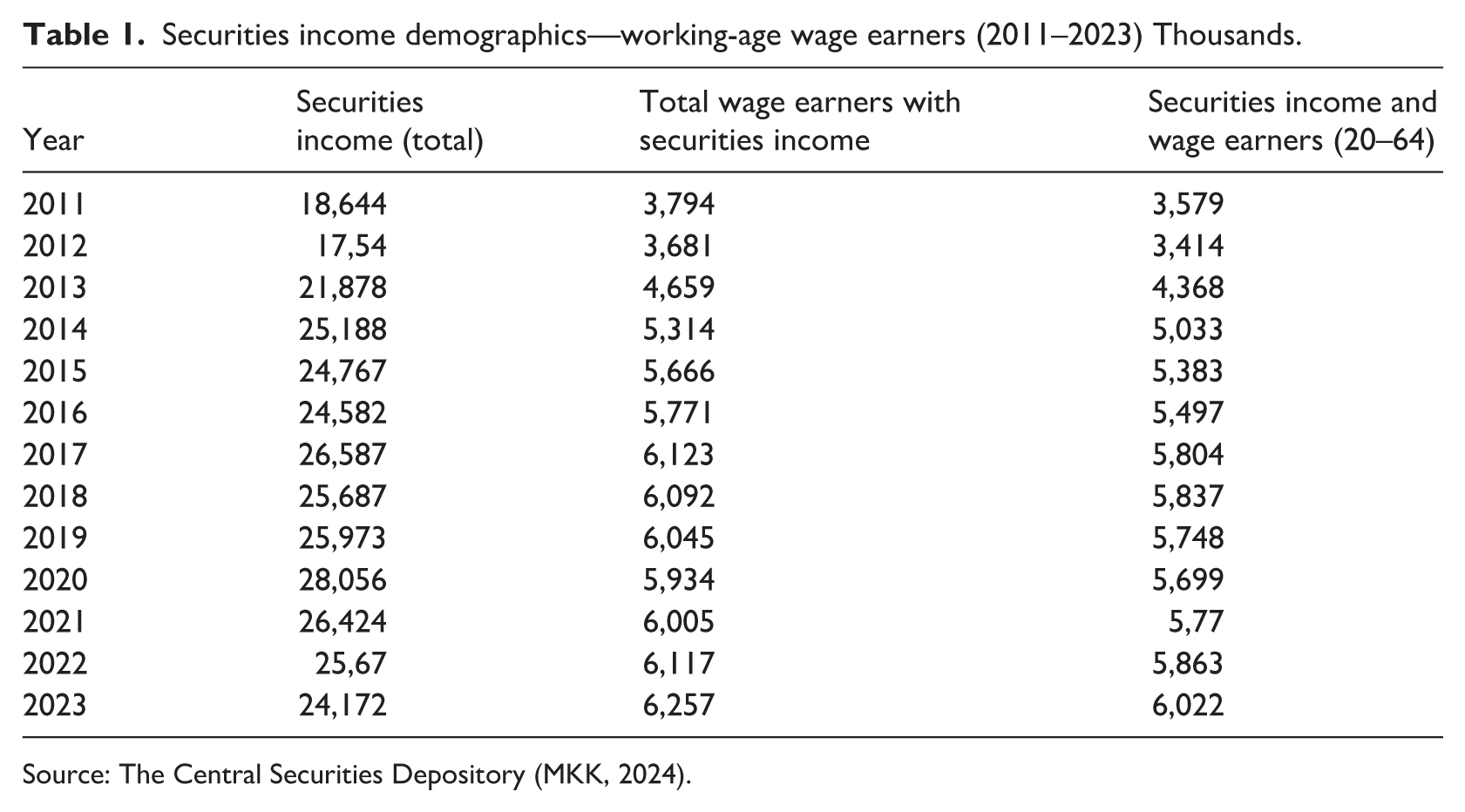
(2) For financial market participation, data on investor numbers and portfolio sizes (2005–2024) derived from the Central Securities Depository of Turkey (MKK), the official institution responsible for the dematerialization, registration, and safekeeping of capital market instruments in Turkey. We apply trend analysis to examine absolute growth patterns, compositional changes, and distributional characteristics of securities income among wage earners, using micro-level data from the TurkStat ICLS (2008–2024). While MKK online data categorizes age groups as 20–65, our analysis from TurkStat ILCS focuses on the 20–64 age cohort to maintain consistency with MKK data. This age selection is methodologically justified: as wage and salaried workers constitute approximately 70% of Turkey’s total employed population (World Bank, 2024a; TurkStat ILCS, 2024a: 69.2%), and 85.4% of these wage earners fall within the 20–64 age range (TurkStat ILCS, 2024a). This cohort is therefore highly representative of Turkey’s formal employment structure. A methodological distinction should be made between the scope of analysis: Figure 5 focuses exclusively on stock market participation (stock investors aged 20–64) and portfolio sizes, whereas Table 1 and Figures 6–8 analyze securities income comprehensively, including income from stocks, bonds, derivatives, and investment funds.
Securities income demographics—working-age wage earners (2011–2023) Thousands.
Source: The Central Securities Depository (MKK, 2024).
Several limitations of the available data must be acknowledged. While there is clear evidence of a relative increase in urban own-account (self-employed) workers and in their share of national income, the internal stratification within this group cannot be examined due to data unavailability. Securities income reporting is also prone to survivorship bias, disproportionately reflecting successful investors while underrepresenting losses and failed investment attempts. Moreover, official statistics systematically underreport informal sector earnings, likely understating the extent of compensation-driven market participation among precarious workers.
This analysis also does not account for regional disparities in employment structures and access to financial markets, which may obscure significant geographical variations in both wage patterns and investment behavior. Methodologically, the reliance on descriptive analysis limits our ability to establish causal linkages between wage adequacy and engagement in securities markets. Lastly, although demographic disaggregations by gender, age, and education are present in the dataset, the focus here remains on aggregate patterns to preserve analytical coherence around structural, class-based transformations rather than identity-based differentiations.
Most critically, this quantitative approach cannot capture the lived experiences, motivations, and decision-making processes underlying these statistical patterns. While our findings strongly suggest compensation-driven behavior—evidenced by concentration among working-age demographics, predominantly modest returns, and real income erosion—definitive claims about individual motivations require qualitative investigation of how wage earners actually experience financial pressures, navigate investment decisions under economic constraints, and perceive securities markets as survival strategies versus wealth-building opportunities. A similar ambiguity applies to transitions from wage employment to self-employment, where shifts may likewise be driven less by entrepreneurial aspiration and more by economic necessity, precarization, or perceived lack of viable alternatives—dynamics that warrant further qualitative inquiry. Ethnographic research examining household decision-making processes, in-depth interviews exploring the subjective experience of financial precarity, and longitudinal case studies tracking individual investment journeys would be essential to validate our theoretical framework of “compensation-driven financialization.” Equally, such qualitative methods are crucial to understanding transitions from wage employment to self-employment as instances of “share-commodifying self-reproduction”—where individuals, in the face of eroding labor security, seek to reconfigure their livelihoods not through capital accumulation per se, but via strategic self-enterprise under constrained conditions. Nevertheless, this quantitative analysis provides a crucial foundation for understanding the evolving forms of capitalist reproduction in Turkey, revealing structural patterns and trends that warrant further qualitative investigation.
As the wage-earning society hollowed out: The de-socialization of labor reproduction
In Castel’s (1995) terms, the wage-earning society (société salariale) is not simply a society in which wage labor predominates. Rather, it denotes a historically specific institutional configuration in which salaried employment serves as the principal mechanism of economic integration, social protection, and identity formation. Consolidated during the Trente Glorieuses (1945–1975) in Western capitalist societies, this model rested on the stabilization of wage labor through legal contracts, welfare institutions, and labor rights, which collectively transformed employment into a key vehicle for citizenship-like inclusion. Access to health care, pensions, unemployment insurance, and other social rights became increasingly tied to formal employment, marking a shift from subsistence labor to what Castel terms “salarial integration.” In this regard, the wage-earning society signifies a historically contingent formation of capitalist reproduction, wherein the labor-capital relation is embedded within a framework of social guarantees. Today this institutional configuration is undergoing erosion on a global scale, as market-driven neoliberal rationalities dismantle the protective infrastructures of the wage-earning society. In their place emerges a regime in which individuals are increasingly compelled to rely on fragmented, informal, and individualized strategies of self-reproduction.
On the other hand, in many peripheric countries—such as Turkey—where the institutional foundations of the wage-earning society have remained partial, fragmented and exclusionary (Mahon, 2018; Seekings, 2010), the neoliberal dismantling of labor protections and welfare infrastructures has produced structurally distinct and often more destabilizing consequences, particularly concerning the reproduction of labor power and the long-term sustainability of capitalist accumulation. Against this backdrop, it becomes analytically necessary to take a bird’s-eye view of Turkey’s capitalist reproduction in relation to labor market transformation, tracing the historical contours and political-economic conditions that have shaped its incomplete and uneven incorporation into the institutions of the wage-earning society.
In Turkey, although the number of wage earners expanded significantly over the course of the 20th century—particularly during the post–World War II period of import-substitution industrialization and large-scale rural-to-urban migration—this expansion remained embedded within a dual social structure, characterized by the persistent prevalence of rural self-employment, small-scale agricultural labor, and informal work. Until the 1980s, approximately 56% of the population resided in rural areas, and the majority of family members engaged in agriculture were unpaid contributors, laboring outside the formal employment system and excluded from the institutional mechanisms of the welfare regime. In contrast, by the 1970s, urban areas had begun to exhibit the incipient contours of a wage-earning society, particularly among industrial workers and public sector employees—though this process remained partial, uneven, and socially segmented.
This dual structure gave rise to two coexisting modalities of capitalist reproduction: in rural areas, household-based survival strategies, partially sustained through state subsidies and agricultural support policies; and in urban centers, a nascent wage-earning society increasingly integrated into formal labor markets and social protection systems modeled on Western capitalist welfare regimes. Over time, this duality laid the groundwork for the normalization of individualized survival strategies, particularly following the massive wave of rural outmigration in the 1980s. As millions resettled in urban peripheries—often without secure access to formal employment or welfare entitlements—the shift from collective to individualized and informal modes of labor reproduction accelerated, paving the way for the precarization patterns that characterize contemporary neoliberal labor regimes and giving rise to new modalities of capitalist reproduction anchored in fragmented, risk-bearing, and self-managed labor (Özatalay, 2014).
Weighted by the historical legacy of Turkey’s dual social structure, the fact that wage and salary earners made up around 70% of the active labor force by the early 2000s (World Bank, 2024b) signaled not the full institutionalization of a wage-earning society, but rather the uneven and fragile consolidation of wage-based employment .
Two interrelated trends have defined this transition: the expansion of urban informal employment and the growing predominance of the service sector. Urban informal labor, initially concentrated in industrial employment, comprised nearly 60% of non-agricultural jobs during the 1990s, before declining to just over 40% by the mid-2000s (Kaya, 2008; TurkStat, 2024a). Concurrently, employment in the service sector expanded significantly, increasing from 26% in 1980 to 46% in 2005, and reaching approximately 57.6% by 2023 (TurkStat ILCS, 2024b). These developments are closely linked, as informality has increasingly permeated the service sector, where flexible and precarious employment arrangements—such as bogus self-employment, part-time work, and short-term contracts—have become widespread. This has resulted in a distinctive condition: although wage earners have come to represent the majority of the active labor force for the first time in Turkey’s history, the broader contours of a wage-earning society—characterized by the social integration and welfare protections of workers—have simultaneously deteriorated and continue to worsen.
The erosion of wage earners’ welfare protections is clearly reflected in the sharp decline in the proportion of workers covered by collective bargaining agreements—a foundational pillar of labor security and class-based solidarity. Although official union membership increased from 1 million in 2013 to 1.62 million in 2017, and to 2.42 million in 2023 (Ministry of Labor and Social Security Trade Union Statistics, 2024), this numerical growth obscures a deeper erosion of labor union power. 1 A substantial share of union members remain excluded from collective bargaining coverage: in the public sector, due to legal restrictions on civil servant unions’ bargaining rights; and in the private sector, due to high representational thresholds and procedural barriers that prevent many unions from securing the legal authority to negotiate. As a result, large segments of unionized workers lack meaningful protections in terms of wages, job security, and working conditions—revealing a growing disjuncture between formal union affiliation and effective labor representation. This trend places Turkey among the lowest-ranking countries in Europe with regard to collective agreement coverage, with estimates as low as 7.4% of the total workforce. When informal workers are included in the calculation, the effective coverage rate declines even further. Furthermore, this institutional weakness is reflected in the marked decline in collective action among Turkey’s major but also the increasingly state-aligned union confederations which, despite representing the bulk of unionized workers, have shown noticeably reduced strike activity and protest mobilization in recent decades (Emek Çalışmaları Topluluğu [ECT], 2023). In sum, the overwhelming majority of Turkey’s labor force operates outside the scope of collectively negotiated labor standards, underscoring the structural marginalization of organized labor and the profound weakening of social rights in the neoliberal era (DİSK-AR, 2024).
In addition to declining welfare protections, wage levels have fallen significantly, particularly following the 2018 currency crisis triggered by diplomatic tensions and monetary policy concerns, where the Turkish Lira sharply depreciated and vulnerability to capital flight increased (Orhangazi, 2019), fostering financialized outcomes including sustained unemployment and increased debt reliance (Yücel and Kabalay, 2023). While wage earners have continued to rise steadily—reaching over 16 million by early 2025 (TurkStat ILCS, 2024b)—real wages have exhibited a contrasting trajectory, with analysis of 2008–2023 data revealing a marked decline in purchasing power since 2020 among both full-time and part-time workers (Figure 1) though official inflation data may underestimate the actual severity of this decline (Bianet English, 2025). This reflects the deepening disconnect between employment expansion and wage-based well-being, illustrating the broader economic challenges workers have faced in recent years.
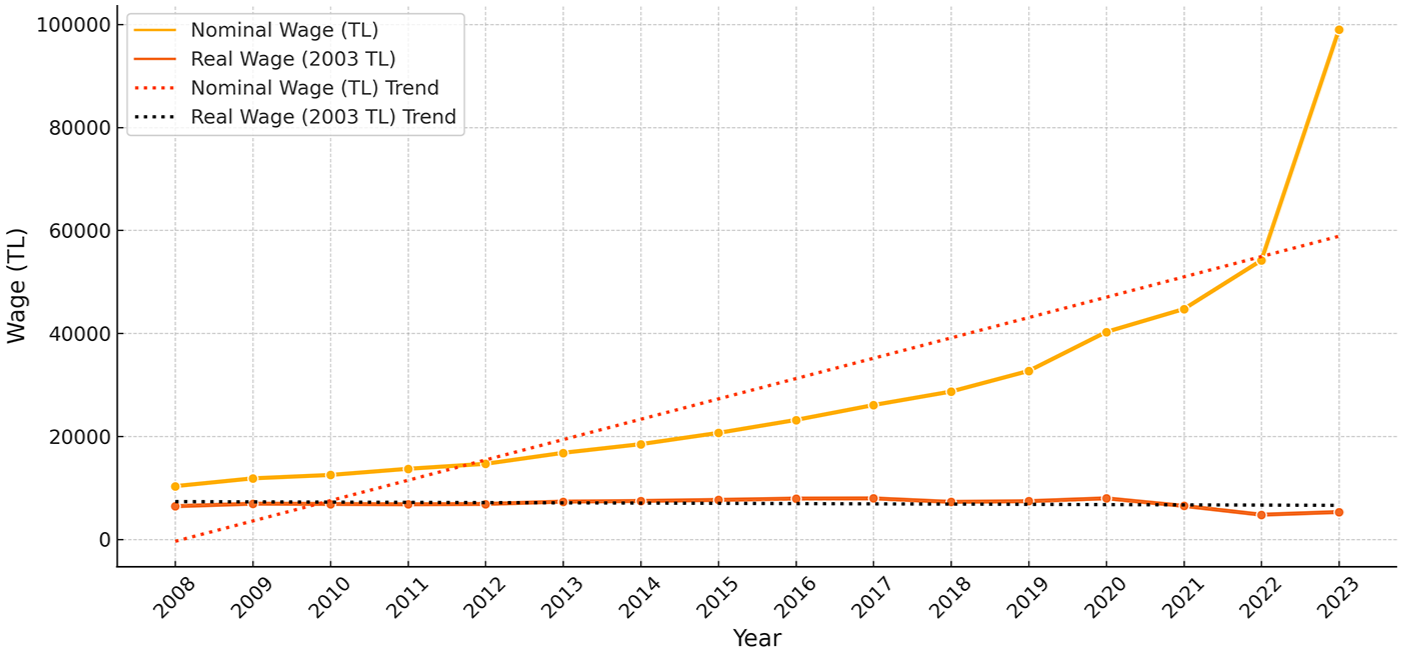
Change trends in real wages (2008–2023) inflated using CPI index (2003 = 100).
While this decline in real wages represents an absolute deterioration in worker welfare, an equally troubling structural shift has unfolded in the national wage hierarchy. Since the early 2000s—and with particular intensity following the 2008 global financial crisis and Turkey’s domestic currency crisis in 2018—a pronounced convergence between the median wage and the minimum wage has emerged (Figure 2). This convergence has contributed to a compression of the wage distribution which, while initially improving earnings for low-wage workers, has more significantly reduced income differentials within the working population—between skilled and unskilled labor, and between white-collar and blue-collar labor, and more broadly the educated and less educated wage earners. At first glance, this may appear to signal a reduction in income inequality; however, it is a development that must be interpreted alongside the broader decline in real wage levels. Rather than indicating upward convergence, the narrowing of the wage distribution reflects a downward leveling, in which equality is achieved not through generalized prosperity but through the erosion of mid-level incomes. The long-term consequence has been the flattening of the wage hierarchy, with mid-tier earners facing persistent wage stagnation and diminishing prospects for upward mobility. That over 54.8% of workers now earn at or near the minimum wage (DİSK-AR, 2024: 108–109) is less a sign of equity than an indicator of deepening structural precariousness within Turkey’s labor market.
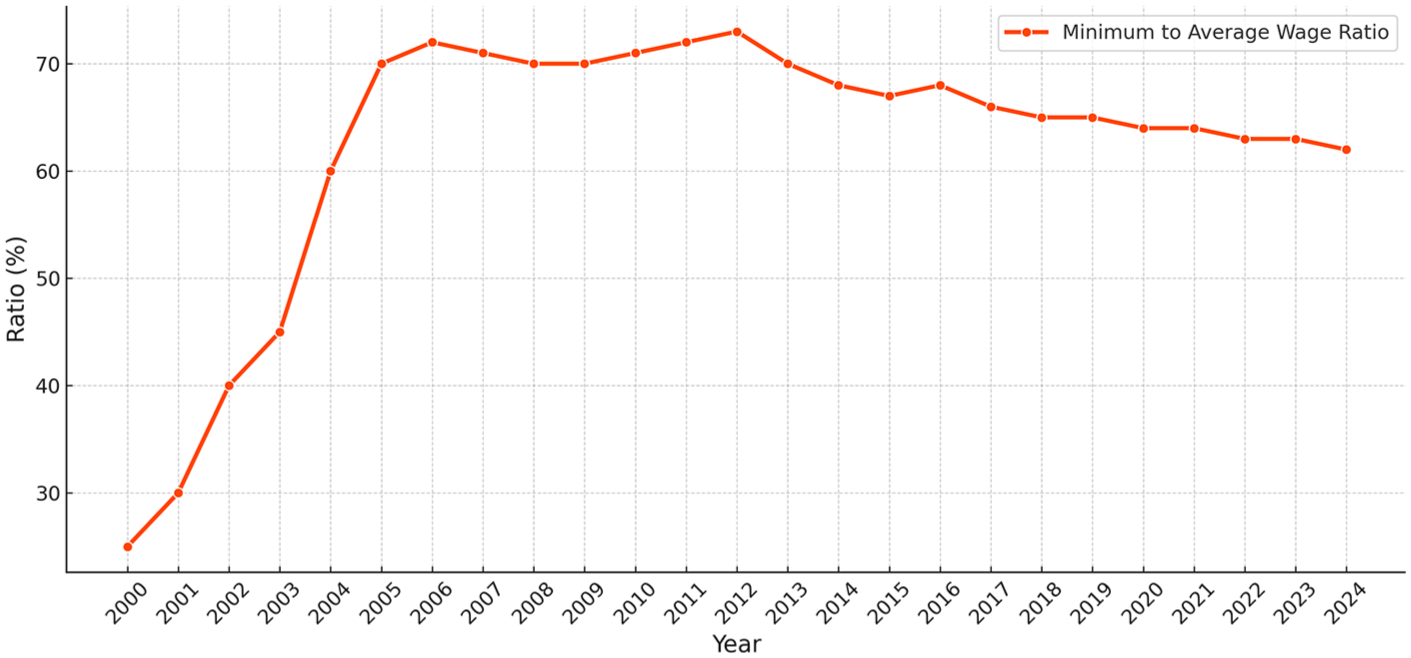
Minimum wage relative to average wage of full-time workers in Turkey (2000–2024).
In sum, the institutional consolidation of a wage-earning society and its attendant structures of social reproduction has remained uneven and contested in Turkey, reflecting the enduring fragmentation and precarization of labor relations. 2 Academic research documents how this shift has altered the character of labor struggles, which now focus less on redistributive claims and more on defending basic workplace rights and dignity (Bahçe and Köse, 2017; Erbil and Özbilgin, 2023). Even as unionization becomes both a mechanism of authoritarian consolidation and a site of democratic contestation (Aydın Bergfalk and Çiftçi, 2024), workers maintain significant protest activity outside formal structures (Birelma et al., 2023). Simultaneously, a growing segment of the working population has turned to individualized survival strategies—further fragmenting collective capacities. In the following section, we analyze how this fractured wage-earning condition has reshaped Turkey’s employment structure and its implications for capitalist reproduction.
Recasting self-employment as share-commodifying
The structural groundwork for the emergence of a hollowed-out wage-earning society in Turkey was laid through a labor market transformation in which wage earners became numerically dominant but increasingly detached from institutional protections and collective social rights. However, for this transformation to fully take shape, two additional and significant shifts were necessary: (1) the reorganization of the production of goods and services—while still largely reliant on wage labor—toward new sector-specific models in which capital increasingly appropriates labor through modalities outside the standard employment relationship, particularly those framed as self-employment, which offer greater flexibility and reduced obligations for employers; and (2) the expansion of compensatory strategies within wage labor, such as engaging in secondary employment or financial investment, to supplement insufficient income. To closely examine the impact of this process in Turkey, this section focuses on the reconfiguration of self-employment as an emerging mechanism through which neoliberal restructuring has transformed labor relations and reshaped the modalities of social reproduction.
Self-employment has often been studied in the social sciences either as a potential driver of economic growth or as a symptom of economic hardship and underdevelopment. These two interpretations are typically framed as “opportunity entrepreneurship” and “necessity entrepreneurship,” respectively (Acs, 2006). While the former focuses on autonomy and innovation, the latter is more relevant to the sociological literature on the informal economy and survival strategies shaped by exclusionary development dynamics. Within this literature, self-employment appears as both an escape from unemployment and a mechanism of exploitation. 3 In this sense, self-employment in the informal economy has become a structurally embedded feature of capitalist reproduction since the onset of neoliberalization (Castells and Portes, 1989; Chen, 2012; Sanyal, 2007). Indeed, the literature on the informal economy highlights self-employment as both a survival strategy for marginalized workers and a mechanism of exploitation within broader structures of accumulation. Informal petty bourgeois actors often rely on and exploit informal labor, thereby reinforcing capital accumulation while obscuring the underlying conditions of precarity (Mezzadri, 2017).
In Turkey, too, self-employment—which traditionally developed in rural areas—has expanded into metropolitan regions in response to structural vulnerabilities and the ongoing deregulation of the labor market following the neoliberalization process. Despite policy discourses that celebrate entrepreneurialism and individual initiative, the majority of self-employed workers face constrained upward mobility, limited access to formal credit mechanisms, and minimal social protection. Most are concentrated in low-productivity, informal sectors characterized by precarious working conditions and unstable incomes (Filiztekin and Levent, 2021). Özar (2007), in her turn, offers a structural critique, framing small-scale self-employment as embedded in subcontracting chains governed by accumulation by dispossession. Producers face price pressures, risk externalization, and must rely on unpaid family labor or self-exploitation. This configuration diffuses capitalist control into informal labor circuits.
While the analyses by Filiztekin and Levent, and Özar offer valuable insight into pre-2019 patterns of self-employment, more recent labor force data suggests that a partial transformation has taken place since 2020. In particular, the post-pandemic period has witnessed an uptick in self-employment within urban, non-agricultural sectors—including platform-based and service-oriented activities—indicating a subtle shift in the composition and functional role of own-account labor in Turkey’s evolving labor regime.
According to TurkStat Labor Force Statistics, between 2020 and 2024, total employment in Turkey increased by approximately 22%, rising from 26.7 to 32.6 million. This expansion was mirrored across both regular/casual wage employment and own-account (self-)employment, each growing by 23.8%. However, a closer sectoral breakdown reveals important structural shifts. In non-agricultural sectors, the number of own-account workers rose from 2.31 to 3.19 million, marking a robust 37.8% growth—far outpacing the modest 6.9% increase in agricultural own-account work (from 1.97 to 2.11 million). Meanwhile, regular/casual wage employment in non-agricultural sectors grew from 18.1 to 22.5 million—a 24.2% increase. While standard wage employment remains the dominant form of labor, the disproportionate rise in urban non-agricultural own-account work signals a nascent reconfiguration of labor relations.
The still modest, yet steadily increasing, prevalence of self-employment in non-agricultural sectors may be understood in light of the massive rural exodus that has unfolded over recent decades, alongside the progressive deterioration of working conditions experienced by the new urban proletariat.
Birelma (2019) documents a pattern of working-class disidentification from wage labor, encapsulated in the colloquial expression el işi (“stranger’s business”), which conveys a sense of alienation from subordinated employment. The term crystallizes a broader cultural rejection of wage earning and a valorization of autonomy—even when self-employment entails intensified self-exploitation and heightened economic insecurity. Moreover, Birelma shows that entrepreneurial aspirations among working-class men are not merely individual ambitions but are embedded in a popular moral economy shaped by memories of rural self-sufficiency, resentment toward the discipline of factory work, and the visible success stories of peers who have transitioned from wage labor into petty entrepreneurship.
In this broader context, the expansion of own-account work—particularly in non-agricultural sectors—appears to have accelerated in Turkey during periods of rising unemployment and the deterioration of wage labor conditions. Such dynamics are reinforced by subjectivities shaped by aspirations for rural or residual autonomy, intersecting with the structural pressures of neoliberal labor market flexibilization.
The COVID-19 pandemic has further intensified this process by both exacerbating unemployment and normalizing fragmented, individualized forms of work—such as platform-based delivery—thereby strengthening the appeal and prevalence of own-account labor, especially among younger workers. The shift in relative average income by employment status (Figure 3) reflects this change.
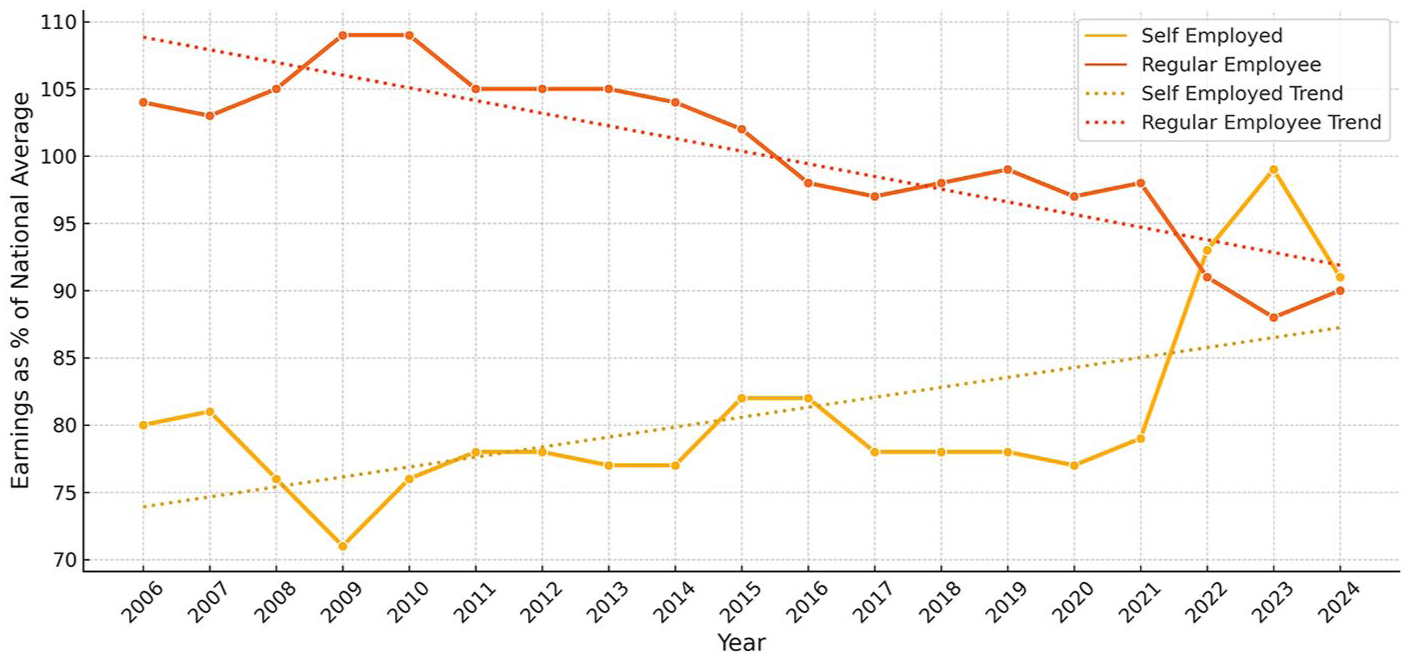
Average annual income of regular employees and self-employed workers relative to the national average, Turkey, 2006–2024.
Between 2006 and 2024, the average income of regular employees declined from 104% to 88% of the national average. In contrast, the average income of the self-employed—after hitting a historic low of 71% in 2010—rebounded sharply, reaching 99% by 2023. Over the same period, the income level of employers increased significantly, rising from 233% to 351% of the national average (see Figure 4). Taken together, these trends reflect not merely a quantitative redistribution of income, but a qualitative transformation in the dynamics of capitalist reproduction. Crucially, the simultaneous decline in average labor income and rise in employer income indicates that this shift does not represent a redistribution in favor of labor—neither vertically nor horizontally. On the contrary, the rising average income level of the self-employed suggests that capitalist profit extraction is not being eroded but rechanneled, with self-employment increasingly operating as a relay mechanism rather than a structural counterweight within the logic of capital accumulation. Within this context, the socially protected wage-labor contract is losing its centrality as the dominant mode of labor-capital mediation. In its place, precarious atypical employment arrangements and forms of bogus self-employment are increasingly functioning as both buffer zones—absorbing surplus labor under precarious conditions—and launchpads for selective upward mobility, within a class structure that is becoming ever more fragmented and polarized.
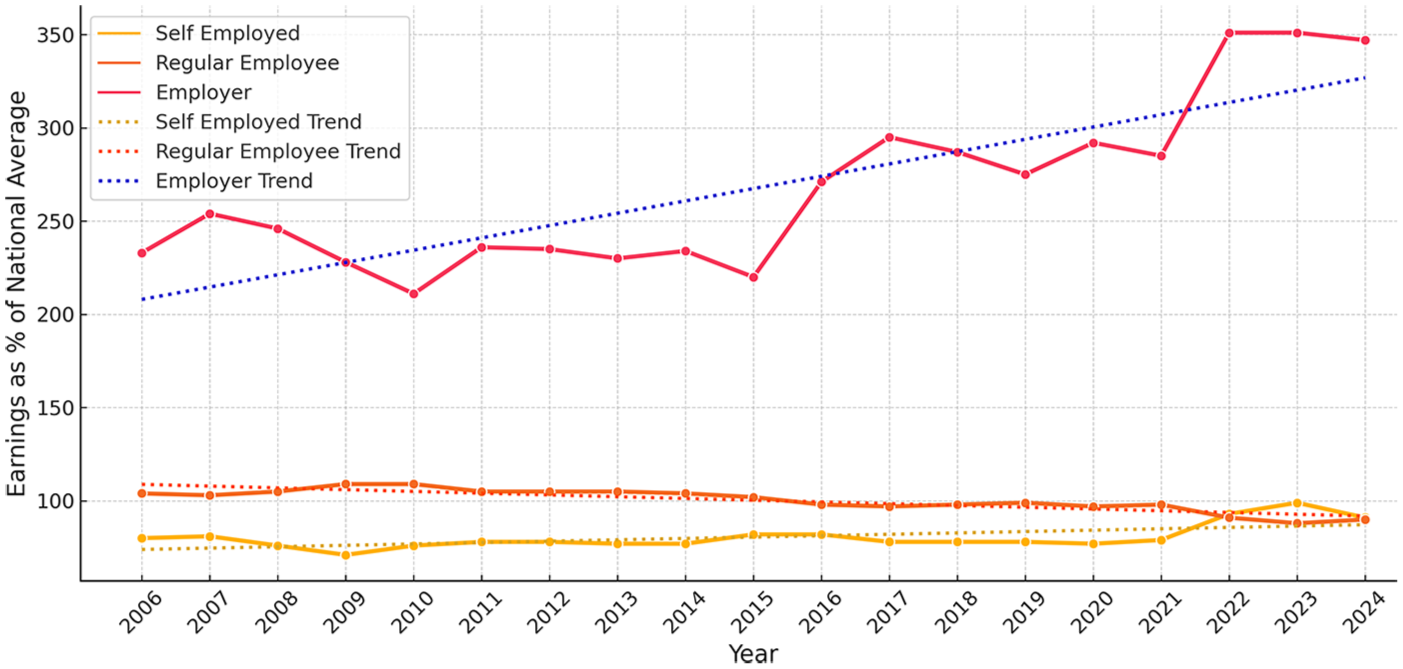
Average annual income by employment status relative to the national average, Turkey, 2006–2024.
The relative increase in the average income level of the self-employed—at the expense of that of employees—reflects a pattern of downward mobility for displaced wage earners, alongside selective upward mobility for a privileged few. This shift not only shows the income distribution but also serves to diffuse class tensions and enable new modes of surplus extraction. Valorized as “resilience” or “autonomy,” self-employment often deepens exposure to market volatility and competition, integrating workers as individualized, risk-bearing labor units.
Platform-based labor—most notably exemplified by moto-courier delivery workers—epitomizes the ongoing transformation of employment structures in Turkey. Although the moto-courier sector has existed for more than two decades, it has undergone a rapid and expansive transformation since the mid-2010s, driven primarily by the proliferation of digital food delivery platforms and the broader shift toward home-based consumption, especially during the COVID-19 pandemic. This shift has resulted in an unprecedented surge in the number of couriers, reaching hundreds of thousands—the highest level in the country’s history. 4 However, this quantitative growth has been accompanied by a qualitative reconfiguration of employment relations. Increasingly, couriers are not employed under standard labor contracts but are instead engaged through the “tradesman-courier” (esnaf kurye) model—a form of contractual detachment that classifies them as independent service providers rather than wage-earning employees. This model exemplifies the rise of dependent self-employment, in which workers assume the risks and responsibilities of self-employment while remaining structurally subordinate to the platforms or firms that control their labor processes. Firms like Trendyol, Yemeksepeti, and Armut.com classify workers as “independent contractors” while retaining algorithmic governance over performance evaluation, pay, and scheduling, a legal reclassification from employee (4A) to contractor (4B) status that transfers risks to workers while maintaining capital’s infrastructural control (Standing, 2011; Uysal, 2023; Yeşilbağ, 2022).
According to a 2022 survey conducted by a Istanbul Economics Research on behalf of an e-commerce company, involving 1505 employee and self-employed couriers, eight out of ten self-employed couriers reported that their earnings increased under the tradesman-courier (esnaf kurye) model. However, seven out of ten self-employed couriers also indicated that their daily working hours had risen sharply alongside their earnings. This bogus self-employment model enables the platform company to bypass formal employment obligations, allowing it to engage couriers for long and flexible working hours without paying social security contributions, severance pay, or other labor protections—thereby significantly reducing labor costs. At the same time, it incentivizes workers to super-exploit themselves, pushing their physical and temporal limits in pursuit of higher earnings, while shouldering the full risks and costs of labor. 5 Framed as a form of entrepreneurial autonomy, this arrangement not only obscures underlying precarity but also undermines work-life balance, embedding intensified labor extraction within individualized, self-regulating routines. An interview published on the online platform Fikir Gazetesi (Sarıkaya, 2024) adds qualitative depth to these findings. When asked about the challenges of the job, one moto-courier remarked: “Many people love it. You can choose your working hours from 2.5 to 14 hours. Among us couriers, we can extend the hours to 16 by leaving a half-hour gap. But I am generally satisfied.” He further explained how he “takes advantage of the system’s gaps” by extending shifts and maximizing income, reportedly earning 60–70 thousand TL per month—approximately four times the minimum wage. While this model may offer higher income, it does so by intensifying working time and workload, reinforcing a broader trend of individualized overwork and the responsibilization of risk under platform capitalism. Crucially, this intensification should not be understood merely as a shift in employment conditions, but as part of a more fundamental reconfiguration of capitalist reproduction. Through the outsourcing of employment risks, the extension of the working day, and the promotion of entrepreneurial subjectivities, the tradesman-courier model as a bogus self-employment enables platforms to externalize costs while deepening labor exploitation. In this sense, self-employment operates as a mechanism for surplus value extraction without the institutional obligations of wage labor, thereby sustaining a leaner, more flexible, and more exploitative regime of capital accumulation.
Another instance of own-account labor, the “tradesman-physician” (esnaf hekim) model similarly exemplifies the structural reconfiguration trend of capitalist reproduction under the contemporary economy.
Post-2003 health sector reforms in Turkey, along with the 2015 legal amendment to Article 10 of Law No. 5510, enabled private hospitals to reclassify salaried physicians (under social insurance category 4A) as independent contractors (category 4B), thereby shifting them outside the standard employment and social security framework (Oğan, 2022). The Health Statistics Yearbook—2023 published by the Ministry of Health (2025) underscores the rapid privatization of Turkey’s healthcare system. Between 2002 and 2023, the number of public hospitals affiliated with the Ministry increased from 774 to 933, while the number of private hospitals more than doubled from 271 to 565. A similar trend is visible in the distribution of physicians: the number of physicians employed in the public sector rose from 57,406 to 131,762, whereas those working in private hospitals increased from 14,444 to 36,751 over the same period. Although precise employment figures are not publicly available, the Turkish Medical Association (TTB) estimates that approximately two-thirds of physicians in private hospitals are employed under 4B status, meaning they are classified as independent contractors. As such, the “tradesman-physician” model represents a medical counterpart to the tradesman-courier, reinforcing individualized precarity under neoliberal restructuring. This pseudo-entrepreneurial status imposes costs, risks, and liability on physicians, while hospitals retain control and tax advantages (Bayrak et al., 2021). Contracts may appear autonomous but functionally preserve subordination—akin to gig economy logic.
Similarly, just as a form of stratification emerges among “tradesman-couriers” based on variations in working hours, a comparable stratification also takes shape among physicians employed in private hospitals through external contracting, shaped by differences in professional experience and reputational capital. For example, in the private healthcare sector elite physicians with patient-pulling power may negotiate revenue-sharing deals without income guarantees, bearing full financial risks.
This model resembles modern sharecropping, 6 or what we may call share-commodifying in which labor is commodified not through fixed wages, but via contingent shares of revenue. Unlike standard wage labor, share-commodifying arrangements link income directly to individual output or performance, without any guarantee of minimum compensation. These arrangements blur the lines between labor and entrepreneurship, embedding capitalist subordination within legal forms of autonomy, and transferring market risks, costs, and income fluctuations onto the worker. In this sense, share-commodifying functions as a nascent mechanism of surplus value extraction that circumvents the institutional protections historically associated with formal employment.
In this sense, share-commodifying diverges from traditional sharecropping in one critical aspect: it lacks the paternalistic protective relations that historically mediated vulnerability—such as illness, disability, or old age. While classic sharecropping often entailed a degree of material or symbolic support from landowners (however asymmetrical), share-commodifying shifts the burden of social reproduction entirely onto the individual worker. It thus constitutes a regime of self-reproduction under intensified conditions of precarity.
Thus, the concept of pseudo-entrepreneurship becomes analytically crucial. Physicians, like moto-couriers, are often compelled to establish shell companies, issue invoices, and negotiate performance-based pay schemes—practices that simulate entrepreneurial autonomy but, in practice, serve as mechanisms for risk transfer and cost externalization (Bayrak et al., 2021; Oğan, 2022). In this process, private hospital owners increasingly assume the role of rentiers, rather than capitalist entrepreneurs, accumulating capital primarily through control over infrastructural assets and revenue streams.
This configuration resonates with Marx’s theorization of formal subsumption—a transitional stage in which capital subsumes labor without yet revolutionizing the labor process itself (Marx, [1976] 1994). Under such conditions, workers may appear autonomous or self-directed, yet their activity is subjected to capitalist valorization through market coercion, contractual dependence, and institutional oversight. Joyce (2020), writing on platform work, similarly identifies many contemporary forms of digitally mediated labor as transitional sub-forms of subsumption: workers retain a veneer of independence while their labor is subordinated to capital through the cash nexus and the infrastructural power of platforms. In this sense, formal subsumption has re-emerged as a central mechanism of surplus appropriation, particularly in sectors where outsourcing is digitally mediated and where rentiership can be sustained.
In the Turkish context, physicians working under 4B contracts continue to perform the same clinical tasks as their salaried 4A counterparts. However, their legal classification as subcontractors or service providers deprives them of job security, severance pay, social protections, and collective representation—subordinating them to capital while preserving the illusion of independence. This dynamic not only intensifies economic precarity but also obscures physicians’ class position by naturalizing their role as “self-employed” rather than workers.
The emergence of these new forms of employment must be situated within a broader structural transformation of Turkish capitalism—specifically, the rising income share of the self-employed relative to wage earners, alongside a significant expansion in the share captured by employers. As in many other economies, contemporary Turkish capitalism seeks to stabilize capital accumulation by externalizing the costs of social reproduction onto labor, thereby deepening precarity for the majority. Workers’ adaptive turn to self-employment or financialized income strategies under such conditions forms part of a broader “survival strategy trap,” whereby responses to economic insecurity become mechanisms of intensified subordination. At the same time, a minority of self-employed individuals—particularly those with access to marketable skills, reputational capital, or professional niches—are able to assume greater economic risks and achieve upward mobility. This dual dynamic simultaneously masks the erosion of wage protections and legitimizes precarious labor regimes through the ideological allure of entrepreneurial success. In doing so, it contributes to the fragmentation of working-class solidarity, fostering individualized competition and reinforcing the illusion of meritocratic mobility under conditions of structural inequality.
The proliferation of bogus self-employment is but one manifestation of the broader transformation in capitalist reproduction explored in this article. Equally significant is the increasing tendency among workers to respond to stagnant or declining wages by investing their limited savings in financial markets—an adaptive strategy that has become normalized within the emerging contours of a hollowed-out wage-earning society. This dynamic not only signals the financialization of everyday life but also reflects a deeper shift in subject formation: workers are increasingly interpellated as speculative agents, tasked with managing individualized risks rather than mobilizing for collective protections.
Financial inclusion without accumulation: The rise of compensation-driven financialization in Turkey
In Turkey, the financialization of everyday life has unfolded through diverse mechanisms—including household indebtedness (Karaçimen, 2014a, 2014b; Tellalbaşı, 2014) and the expansion of pension funds (Sarıtaş, 2019). Despite the extensive body of scholarship on the topic, the recent rise in stock market participation and the corresponding dynamics of equity market engagement as asset-based income sources for households have garnered relatively little academic focus. The first main reason for this is the persistent low participation rates that characterize most developing economies, with Turkey exemplifying this pattern at approximately 7%–8% household participation despite having 6–7 million individual investors (Central Registry Board of Turkey [MKK], 2024) among its 85 million population—a rate that aligns with other emerging markets such as Kenya (below 10%) rather than developed economies like the United States, where over 50% of adults participate (Otinga et al., 2024). The second, as recent studies demonstrate (Ceritoğlu et al., 2023), is that equity investments remain relatively negligible within household portfolio allocations. However, this is precisely the point that the present section seeks to problematize. Additionally, while existing scholarship has predominantly focused on explaining the “non-participation puzzle” 7 —why households fail to engage with equity markets despite theoretical predictions (Otinga et al., 2024)—relatively less attention has been devoted to examining the quality and meaningfulness of participation among those households that do engage with securities.
Conversely, household units in Turkey are predominantly composed of wage earners (70%, World Bank, 2024a) who have experienced significant deterioration in wage adequacy, where traditional wage employment no longer provides sufficient means for household survival, thus compelling wage earners to seek supplementary income sources and to develop individualized financial strategies through asset ownership and market participation.
However, this transformation did not emerge in isolation but resulted from specific institutional changes that created the structural conditions for financial market participation and income generation. To understand this transformation, we must first trace the institutional evolution that facilitated this process. As Akçay and Güngen (2022) outline, Turkey’s trajectory of dependent financialization, characterized by structurally higher interest rates and high dollarisation rate and economic activity increasingly dependent on capital inflows. This pattern aligns with Powell’s (2013) conceptualization of “subordinate financialisation” in peripheral economies where, as Bonizzi (2014) shows, financialisation becomes embedded in everyday life as household lending becomes a key mechanism in social reproduction. In Turkey, this process evolved through four interrelated phases shaped by global capital dynamics and domestic institutional realignments.
The first phase was defined by state-centered financialization in the 1990s, where high interest rates and government debt securities dominated financial markets while capital markets remained underdeveloped. Despite this constrained architecture, this phase laid the institutional groundwork for deeper financial integration. The second phase began after the 2001 financial crisis, shifting from sovereign debt management to mass-based financialization through expanded consumer credit markets and declining interest rates on government securities, incentivizing private borrowing and household indebtedness through a “debt-led consumption boom” driven by capital inflows and domestic credit expansion (Bahçe et al., 2016).
The third phase emerged after the 2008 global financial crisis, oriented around securitization and non-bank finance promotion (Akçay and Güngen, 2022). Financial inclusion through strategy, literacy, and microcredit was institutionalized in 2011 through the Financial Stability Committee and the Strategy for Financial Access, Financial Education, and Protection of Financial Consumers, embedding financial rationalities into everyday behavior and framing financial participation as civic responsibility (Güngen, 2017). The 2009 Istanbul International Financial Center strategy positioned Borsa Istanbul (Turkey’s main stock exchange) as a globally integrated hub, while the Capital Markets Law (2012) restructured the institutional landscape to facilitate public offerings. Concurrently, AKP-led privatization campaigns after 2002 accelerated public asset commodification in energy, telecommunications, and infrastructure, introducing these shares through initial public offerings (IPOs) to extend financial market exposure. Between 2008 and 2015, 110 companies went public, declining 2016–2020 before reversing with 52 IPOs in 2021 and 40 in 2022 (Armağan, 2023), continuing upward in 2024 (İstanbul Sanayi Odası, 2024) though transaction values declined due to post-April 2023 interest rate increases (Statista, 2025).
During the fourth phase after 2013, characterized by intensified dependency and deepening economic instability, the 2018 currency crisis exposed the structural fragilities of Turkey’s economy. The COVID-19 pandemic in 2020 further exacerbated these tensions, amplifying financial insecurity for households. As Gabor and Brooks (2016) argue, financial crises often serve as catalysts for expanding financial inclusion. In Turkey’s case, this manifested as a post-2018 policy agenda centered on broadening participation in the securities market through multiple channels: public campaigns, digital trading platforms, and state-backed narratives of broadening capital ownership. 8
During this period, the stock market has been reframed as a key component of Turkey’s financial inclusion agenda—positioned at the intersection of macroeconomic management, and the financialization of everyday life. While microcredit has been the primary tool in this process (Güngen, 2017), the state has also promoted stock market participation to diversify household engagement with financial markets and expand access to wealth-building opportunities beyond basic banking. Thus, this institutional push redefined assetization from a growth strategy into a mechanism for managing social reproduction under austerity (Soederberg, 2013), while simultaneously concealing the heightened speculative risks faced by ordinary households newly positioned as financial subjects in a volatile economic landscape.
These institutional developments culminated in dramatic shifts in household financial behavior, most visibly in stock market participation patterns. Figure 5 indicates that the total number of stock investors aged 20–64 experienced exponential growth, increasing from approximately 1.0 million in 2018 to over 7.0 million in 2023—representing a nearly sevenfold increase. This exponential growth demonstrates how wage earners’ savings were systematically channeled into capital markets, effectively integrating them into broader mechanisms of capital accumulation and contributing to the formation of what Froud et al. (2002) term a “coupon pool” that disciplines both firms and investors, especially when considering the technological developments facilitating market access, the institutional push through financial literacy initiatives contributing to individualizing economic decision-making (Ayhan, 2018), and the concurrent expansion of IPO activity since 2008.
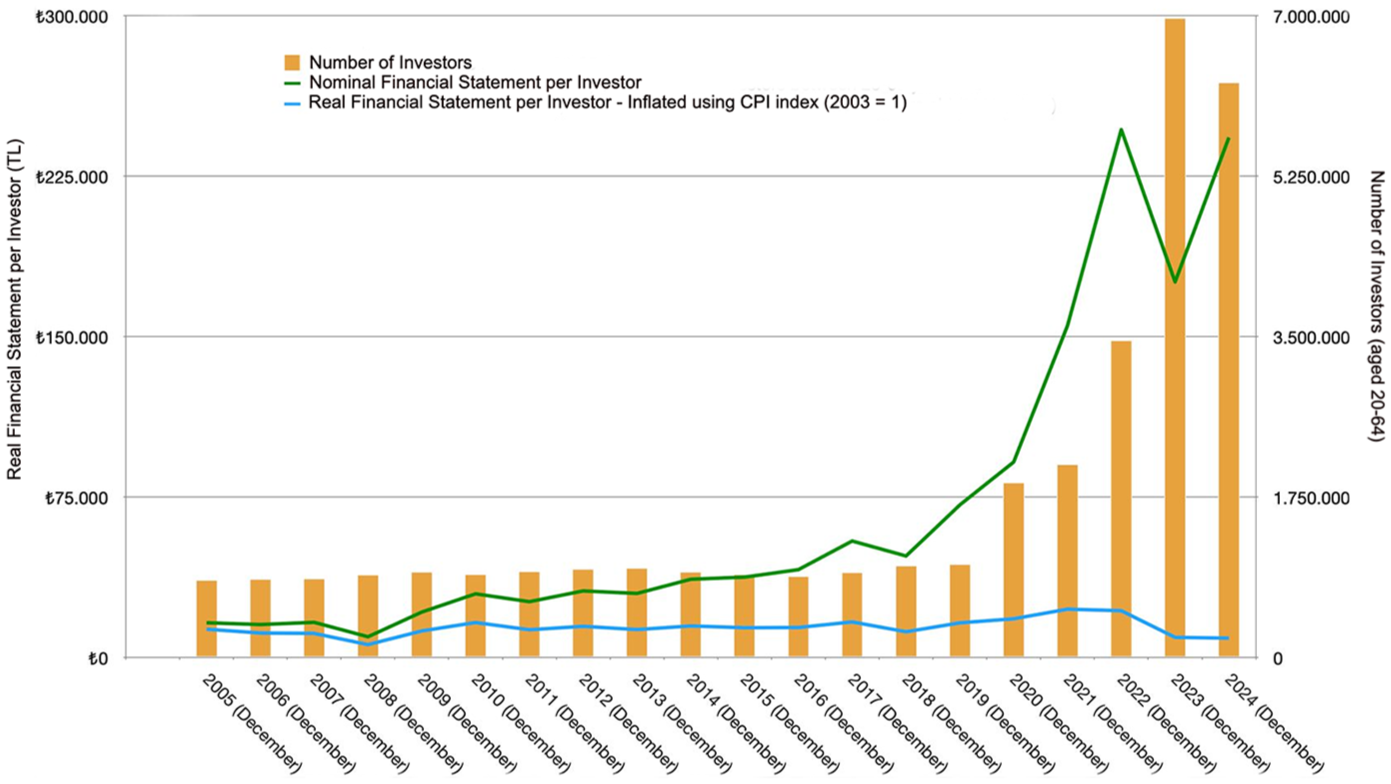
Financial statement per investors and total numbers of investors in Turkey (2005–2024).
More importantly, the low interest rate environment that facilitated this transformation created conditions where wage earners could turn to securities markets as alternative income sources. This dynamic is evident from the changes after 2023. When policy reversed after the 2023 elections, marked by significant and gradual interest rate increases, this dynamic fundamentally changed, with participation declining to 6.3 million by December 2024.
The same data reveals a further troubling disconnect between superficial growth metrics and actual investor welfare. While policymakers may celebrate the sevenfold increase in stock investor participation since 2005, individual stock investors are demonstrably worse off in terms of real average portfolio value. The trajectory reveals a dramatic boom-bust cycle that masks the underlying deterioration in real investor welfare. During the low interest rate period (2017–2022), nominal investment returns per investor surged from 54,449 TL to 246,753 TL, appearing to show massive gains. However, when adjusted for inflation, real returns increased only modestly from 16,630 TL to 21,867 TL, reaching their absolute peak at 22,588 TL in 2021—revealing how inflation systematically eroded genuine asset gains. The apparent prosperity was followed by a catastrophic collapse, with real returns plummeting to 9056 TL in 2024—representing a devastating 59% decline from the 2022 peak and falling below 2005 levels (13,246 TL), despite the massive expansion in market participation.
This nominal-real divergence exposes the illusory nature of financialized wealth accumulation under inflationary conditions. The data reveals a two-phase dynamic shaped by monetary policy shifts: first, low interest rates (2018–2023) enabled expanding participation despite declining real individual investment capacity, as investors were drawn by nominal gains while their actual purchasing power deteriorated. Then rising interest rates (December 2023–2024) triggered simultaneous contraction in both participation and portfolio values, stripping away even the nominal illusion of prosperity. This sequence exposes how survival-oriented market engagement creates monetary policy-dependent foundations—the low interest rate environment that facilitated mass entry with limited real capital also created structural vulnerabilities that amplified collapse when policy reversed, as modest real investments and precarious motivations proved highly sensitive to changing monetary conditions and inflationary pressures.
This empirical evidence suggests that Turkish households turned to stock markets as compensation strategies against currency depreciation and increasing inflation in a low interest rate environment. This pattern recalls Kaldor’s (2022) observation that securities valuations depend on expected returns and prevailing interest rates rather than material worth. The result is a market that has become a vehicle for diluting individual prosperity rather than building it, raising serious questions about whether current capital market policies serve investors’ interests or merely create an illusion of prosperity through inflated participation numbers.
This contradictory pattern—increasing numbers of investors but decreasing individual portfolio values—characterizes overall market dynamics. The following analysis examines specifically how wage earners specifically participate in this trend by analyzing their securities market engagement and income distribution among those who actually earn securities income.
Given that employees aged 20–64 years constitute 85% of total wage-earning demographics in 2023, 96.2% of wage earners with securities income fall within this age group. Table 1 reveals two complementary patterns: wage earners represent 25.9% of all securities income holders (6257 out of 24,172), while conversely, 32.3% of all wage earners aged 20–64 have securities income—indicating that approximately one in three wage earners participate in securities markets.
Beyond these demographic patterns, the temporal evolution of wage earners participation (Figure 6) requires a further examination. Wage earners (20–64 aged) with securities income grew from 3579 in 2011 to 6022 in 2023—a 68.3% increase. Following rapid expansion in 2012–2015 and stabilization around 5400–5800 participants through 2020, the breakthrough to 6000+ likely reflects wage earners’ response to Turkey’s post-2018 inflationary environment, where securities markets became a necessary hedge against currency devaluation and eroding purchasing power. The acceleration of this trend has likely been enabled by several structural, regulatory, technological changes in financial market access. Nevertheless, the current reality that one in three wage earners possesses securities income—a ratio that has increased over time and stabilized at this level—suggests a form of institutionalization of captive wage earner participation in securities markets.
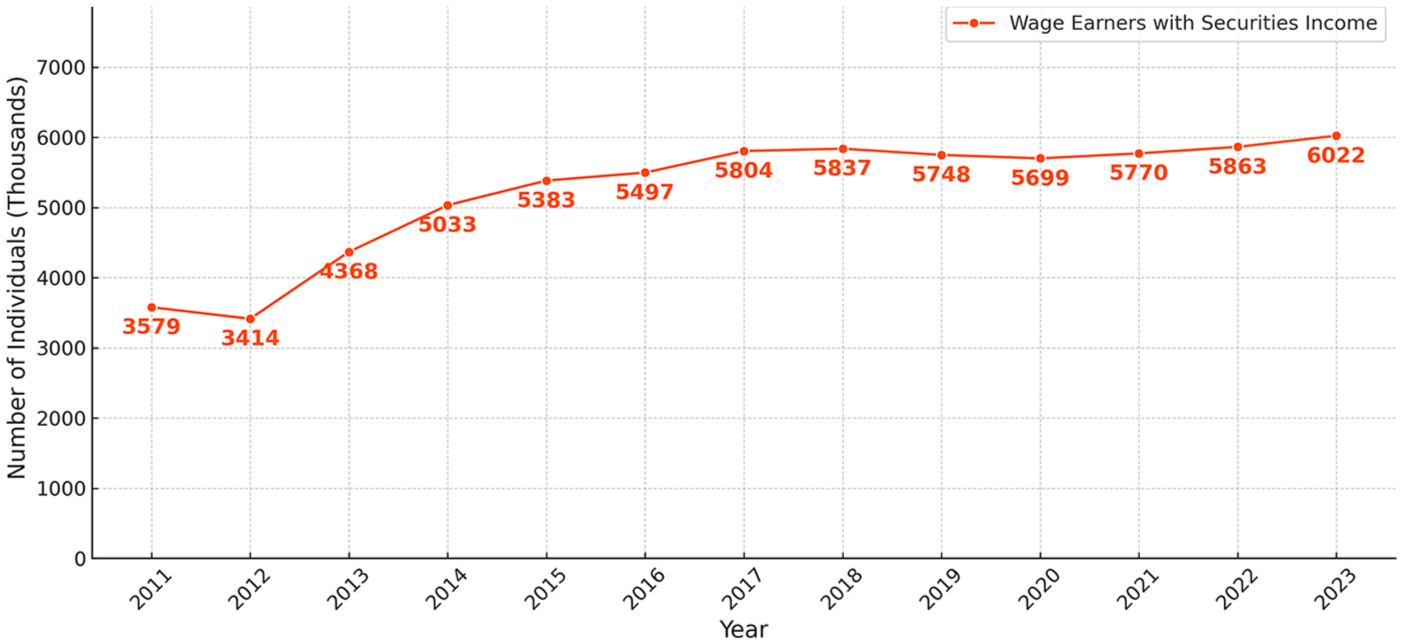
Annual change in wage earners with securities income (20–64 years).
While these aggregate patterns reveal the increasingly institutionalized nature of financial engagement, examining the distribution of securities income among individual wage earners exposes the stark inequalities that characterize this process. Figure 7 demonstrates pronounced concentration at lower income levels: in 2023, 78.9% of wage earners with securities income remained in the two lowest brackets (below 10K TL), with 52.1% concentrated in the bottom tier (0–5K TL). This persistent concentration at the lower end reveals that securities markets function less as pathways to economic advancement than as mechanisms for capital extraction from wage earners. The pattern suggests a form of extractive financialization where expanding participation serves primarily to broaden the base of capital accumulation rather than enabling meaningful wealth mobility for most of the wage earners.
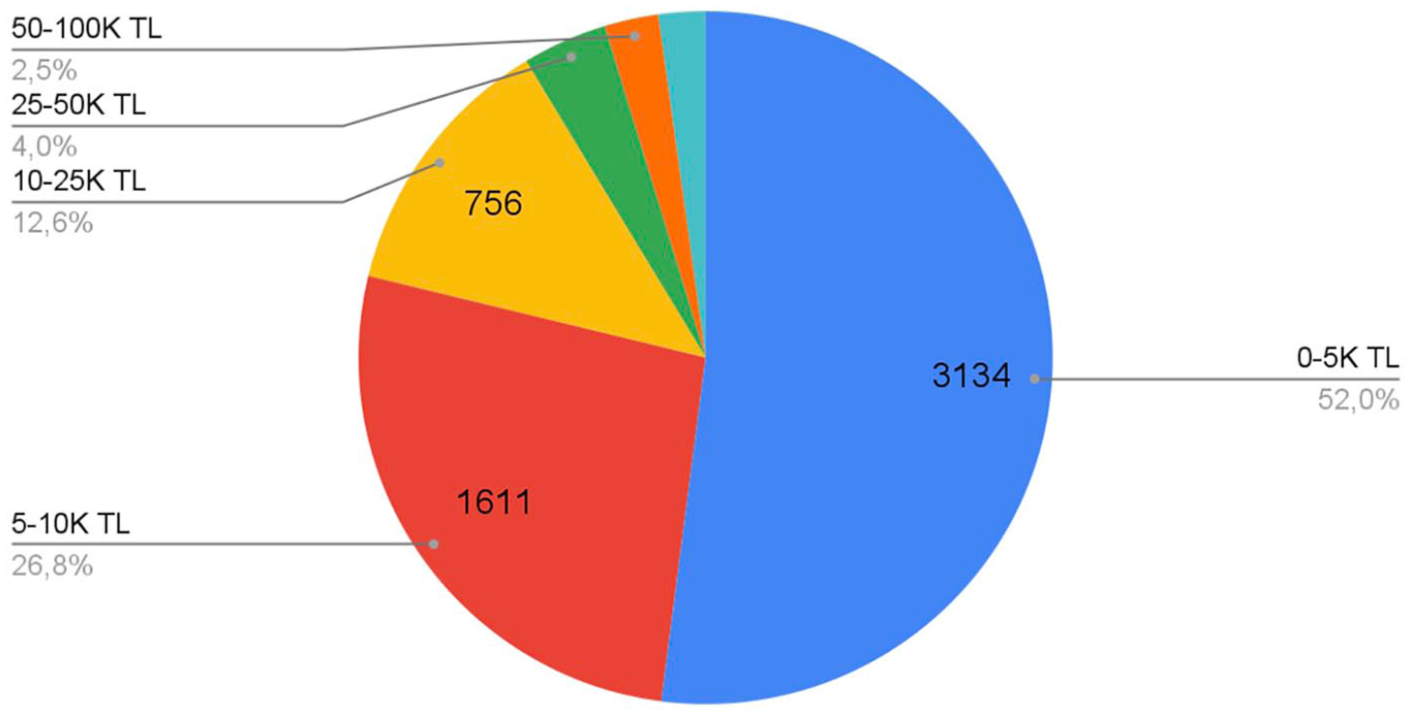
Distribution of securities income categories among wage earners aged 20–64 (2023).
The temporal evolution exposes how financial markets amplify pre-existing inequalities in securities income. While the bottom tier (0–5K TL) declined from 88.8% in 2011 to 52.1% in 2023, this redistribution primarily reflects those with higher baseline incomes accessing greater investment capital, not upward mobility for lower-income participants. The emergence of the 100K+ category (2.2% by 2023) and growth in middle-income categories (25–100K TL from 0.3% to 6.5%) largely represents wage earners who already possessed higher incomes and savings capacity.
This pattern reveals that securities markets function as a mechanism of inequality reproduction rather than wealth democratization. The 2019 structural break coincided with broader economic pressures that forced lower-income wage earners into markets for survival while enabling higher-income participants to leverage their existing advantages. The persistence of 78.9% below 10K TL demonstrates that for the majority, securities investment represents subsistence-level income generation with severely constrained investment capacity, preventing meaningful wealth accumulation while higher earners use the same markets to compound their existing economic advantages.
This skewed distribution in Figure 7 suggests how investment income inequality among wage-earners transforms into investment inequality, creating a reinforcing cycle where high earners accumulate greater capital and access larger investment opportunities, while the majority remains constrained to modest investments. Considering occupational, sectoral, and positional fragmentation within the wage-earning population, this inequality likely reflects differential market access across hierarchical employment positions. More interestingly, this pattern reveals a structural dynamic that transcends the traditional developed/emerging economy divide, as similar mechanisms have been documented across different economic contexts—from advanced economies like the U.S. (Favilukis, 2013; Melcangi and Sterk, 2020) to emerging markets such as Lithuania, where wealth disparities create dramatic participation gaps with only 0.7% of lowest wealth households versus 23.1% of highest wealth households investing in stocks (Mauricas et al., 2017)—suggesting that income inequality systematically drives differential stock market participation regardless of developmental stage.
To understand whether these modest income levels provide meaningful economic value, it is essential to examine how securities income performs against inflation over time among wage earners. While Figure 5 has already evidenced the paradoxical combination of sevenfold investor participation growth alongside dramatic divergence between nominal wealth illusion and real asset gain collapse among total stock market investors (aged 20–65) from 2018–2024, Figure 8 demonstrates a compelling narrative of inflation’s devastating impact on average securities income during Turkey’s period of economic instability, with a specific focus on wage earners (aged 20–64).
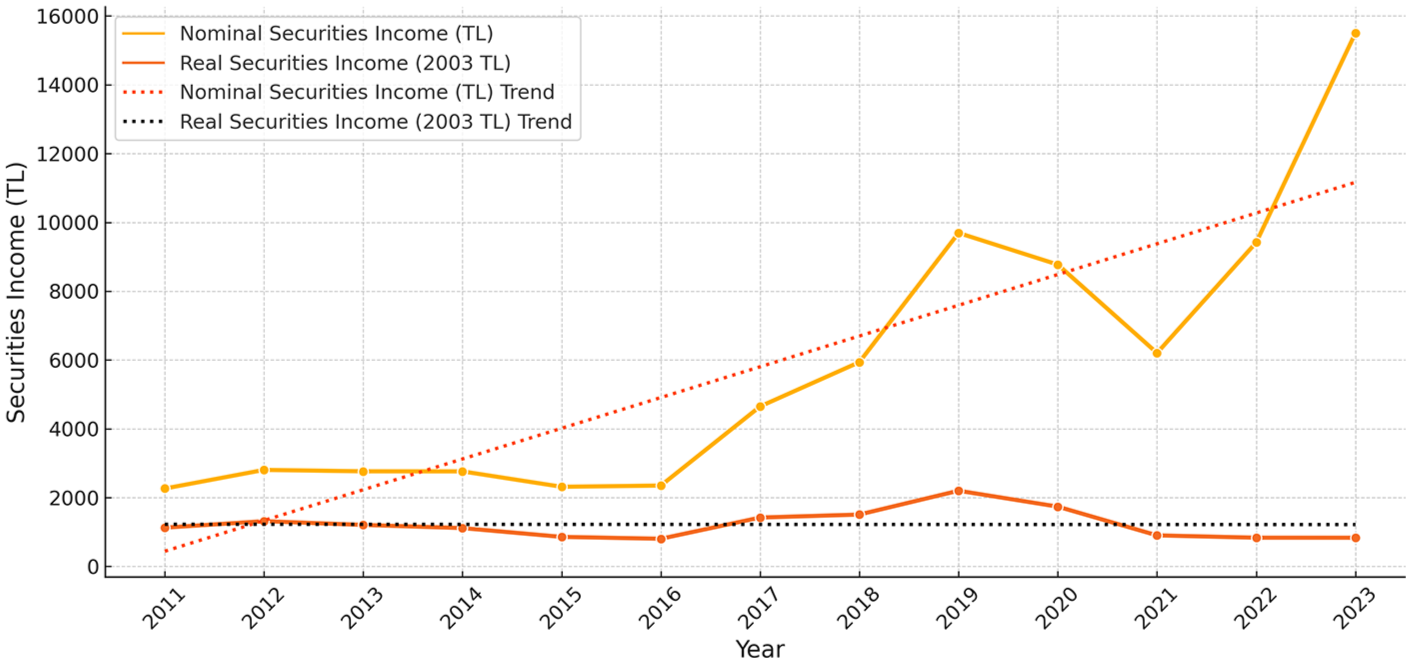
Average real securities income of wage earners aged 20–64, deflated using CPI (2003 = 100).
Figure 8 illustrates how the average nominal securities income of wage earners shows steady growth from 2011 to 2023, reaching 15,509 TL. However, when adjusted for inflation, the real average securities income tells a fundamentally different story: after reaching a peak of 2201 TL in 2019, real purchasing power systematically declined, collapsing to just 834 TL by 2023—a 62% drop from the peak and even lower than 2011 levels (1127 TL). This stark divergence between nominal growth and real stagnation demonstrates that securities investments functioned as an inadequate defensive mechanism against Turkey’s hyperinflation.
While wage earners increased their market participation and nominal returns appeared substantial, their real wealth declined by 26% over the entire period (from 1127 TL in 2011 to 834 TL in 2023), revealing that even active financial market engagement could only relatively protect against the macroeconomic forces eroding purchasing power. This pattern reveals again how survival-driven financial participation establishes monetary policy-contingent survival mechanisms, making household reproduction increasingly vulnerable to macroeconomic volatility. Rather than asset accumulation, securities investment most likely functioned primarily as a means to minimize losses compared to holding cash assets.
The empirical analysis reveals a systematic logical contradiction that exposes the true dynamics of wage earner financialization. Limited portfolio values (Figure 5) combined with overwhelming concentration among working-age wage earners (Table 1) create conditions where those most in need of wealth accumulation possess the least capacity for successful market participation. This systematic disadvantage is reinforced through sustained institutionalized participation patterns (Figure 6) that lock participants into low-value income categories (Figure 7), while average real securities income systematically declined by 62% from peak levels despite nominal growth, demonstrating securities’ inadequacy as protection against Turkey’s hyperinflationary environment (Figure 8).
If securities markets functioned as genuine asset accumulating and wealth-building mechanisms, expanding participation should correlate positively with individual welfare outcomes. However, the evidence demonstrates the inverse: participation expansion coincides with declining real returns, indicating that the underlying logic operates through compensation for wage inadequacy rather than opportunity maximization. This exposes the fundamental deception behind financial inclusion rhetoric: markets that ostensibly offer democratization and equal opportunity function in practice as extraction mechanisms that systematically drain wage earners’ modest savings while reinforcing existing inequalities (Langley, 2020). This contradiction cannot be explained by market efficiency or financial inclusion as a developmental strategy, but requires understanding financialization of everyday life as a response to structural economic pressure.
The mass incorporation of wage earners seeking income supplementation creates systematic opportunities for value transfer through what Durand (2017), Kaldor (2022), and Bobek et al. (2023) identify as fictitious capital redistribution, but with specific structural directionality: the compensatory imperative systematically channels value from capital-scarce wage earners to surplus-capital holders through asymmetric market participation. This dynamic operates as “compensation-driven financialization”—a systematic process where structural wage inadequacy drives securities market participation as compensatory income mechanisms (Hein, 2011; Wolff, 2021) against deteriorating purchasing power, transforming financial markets into survival infrastructure rather than wealth-building venues. The logic is self-reinforcing because compensation needs prevent exit despite poor performance, while structural wage inadequacy ensures continuous re-entry regardless of previous outcomes, creating a captive participant base for capital extraction.
This positioning of wage earners as financial market participants embodies the principle of maximizing shareholder value at the heart of financial capitalism (Cushen, 2013; Thompson, 2003, 2013). Paradoxically, while wage earners become nominal shareholders through their compensatory participation, the shareholder value maximization principle continues to systematically disadvantage them as wage earners. This mechanism operates through what Ertürk et al. (2007), Ossandón et al. (2022) conceptualize as individualized risk transfer, but with enhanced analytical precision: the compensatory character ensures that risk-bearing becomes structurally required rather than voluntary, transforming financial markets into mechanisms of survival management rather than wealth optimization.
This creates “financialization without accumulation” despite institutional push mechanisms, where state interventions and dominant discourses have institutionalized asset accumulation norms under the rhetoric of capital democratization. This form of compensation-driven financialization reveals the disjunction between financial services’ promises and the economic reality of ordinary people (Ertürk et al., 2007). The structural nature of compensation transforms what appears as individual choice into a mechanism that reproduces capitalist relations by channeling wage earners’ modest savings into capital accumulation processes while maintaining their economic dependency.
Central to these dynamics is the survival strategy trap. Financial market engagement has evolved from individual choice to survival necessity, where apparent choice masks structural compulsion, and financial inclusion functions as a mechanism of deeper subordination rather than empowerment. The compensation-driven mechanism reveals a fundamental aspect of capitalist reproduction: while failing to enhance labor reproduction—as evidenced by declining real returns and persistent economic vulnerability—it systematically serves capital reproduction by expanding liquidity pools, distributing market risks across a broader base, and generating consistent revenue streams for financial intermediaries.
Discussion and conclusion
This article has examined how contemporary capitalism is reshaping its reproduction mechanisms through two interconnected developments unfolding in Turkey: a nascent and relative shift away from wage-based reproduction toward share-commodifying self-reproduction, and toward strategic incorporation of wage earners into financial markets through compensation-driven financialization. While it may be premature to define these tendencies as a fully consolidated structural transformation, both are undeniably gaining traction. Taken together, they reflect a deliberate reconfiguration of capitalist reproduction, whereby the system increasingly manages its internal contradictions through diffuse and sophisticated mechanisms of value extraction. What initially appears as a paradox—the coexistence of entrepreneurial autonomy with intensified exploitation—actually reflects the systematic logic of contemporary capitalist restructuring rather than representing a genuine contradiction within the system.
Empirical evidence from Turkey reveals a sharp decline in real wages following the 2018 currency crisis, the compression of the wage hierarchy with over 54.8% of workers earning at or near the minimum wage, and the weakening of labor protections despite nominal increases in union membership. Although recent years have seen a rise in collective labor mobilization—particularly led by contesting unions focused on occupational health and safety—wage-related grievances are more commonly addressed through individualized survival strategies. This situation has compelled workers to adopt adaptive, individualized tactics that, while seemingly offering alternatives to traditional wage dependency, in fact deepen their subordination to capital through more fragmented, precarious, and depoliticized forms of labor reproduction.
Central to these individualized survival strategies is the proliferation of share-commodifying self-reproduction has emerged as a sophisticated mechanism of risk externalization and labor control in service of capitalist reproduction. When platform workers, physicians, or service providers are compelled to adopt entrepreneurial subjectivities while remaining structurally dependent on capital’s infrastructural control, they do not gain autonomy but encounter intensified exploitation—remunerated through contingent shares of capitalized service outputs rather than fixed wages. This arrangement refines exploitation by compelling workers to internalize market discipline and assume full responsibility for their economic survival, thereby enabling capital to extract surplus value without the regulatory and material obligations of standard employment relations.
Simultaneously, the dramatic surge in compensation-driven financialization—where investor numbers expanded exponentially while real wealth per investor declined catastrophically—represents not financial democratization but a shift toward financially-mediated survival strategies in response to structural wage inadequacy. As wage earners channel their modest savings into financial markets for income supplementation, their participation likely provides essential liquidity that serves capital accumulation while normalizing economic compulsion as routine financial behavior, transforming collective labor reproduction into individualized financial risk-bearing. This institutionalization of survival-oriented participation fundamentally redefines financial inclusion from a mechanism of empowerment into a disciplinary apparatus that channels wage earners’ savings into capital accumulation while maintaining their dependency. Rather than challenging inequalities, this process disguises systematic value extraction as individual investment opportunity.
Our analysis of Turkey’s trajectory towards market-driven financialization exposes not simply an extension of capitalist accumulation into new spheres, but a strategic reconstitution of capitalist reproduction through the deliberate fragmentation of collective labor power and individualization of economic survival. From this perspective, neither asset ownership nor entrepreneurial activity offers true security, as both serve as tools for capital to externalize risk while maintaining control over valorization processes. Far from empowering individuals, these processes strengthen the subjugation of everyday life to the demands of capital circulation and accumulation. Share-commodifying and compensation-driven financialization operate as complementary mechanisms that fundamentally reconfigure the terrain of class struggle by dissolving the material foundations of worker solidarity while maintaining and intensifying surplus extraction through increasingly disguised mechanisms. This transformation illustrates how capitalist reproduction adapts to contemporary conditions by turning survival strategies into avenues for capital accumulation.
This dynamic illustrates what we term the “survival strategy trap.” Economic insecurity compels workers to adopt entrepreneurial identities and financial market participation as compensatory strategies. While these activities appear as autonomous choices, they actually deepen market dependency by requiring workers to internalize market discipline and bear individual responsibility for economic outcomes. These seemingly independent activities generate surplus value for capital while fragmenting collective labor power, creating a condition where workers cannot survive without engaging in activities that strengthen the very system exploiting them. Such mechanisms manifest concretely as workers being compelled to participate in their own subordination through market mechanisms that appear as autonomous choices—whether by selling their labor in fragmented platform markets or investing their savings in volatile financial securities to compensate for wage inadequacy—while capital maintains control over essential infrastructures and resources.
These developments demand not just a reconsideration but a radical reimagining of counter-hegemonic political strategies capable of addressing the paradoxical condition where wage earners remain quantitatively dominant yet qualitatively transformed through financialized and entrepreneurialized survival mechanisms. By fragmenting the collective experience of workers into individualized economic strategies, contemporary capitalism neutralizes traditional forms of class-based resistance while imposing market discipline through seemingly autonomous choices. Workers increasingly navigate capitalism not as a collective class with shared interests but as atomized economic agents competing in multiple markets. This may reflect “petty bourgeoisification”—a concept we developed to describe an ideological process that transforms class consciousness while leaving material relations largely intact, projecting entrepreneurial values onto subjects who remain fundamentally dependent on selling their labor power. 9 This process strategically obscures deepening exploitation by projecting entrepreneurial and compensatory self-responsibility values onto fundamentally dependent workers, potentially absorbing or neutralizing the conflicting interests of working-class people.
Understanding how share-commodifying and compensation-driven financialization operate as new forms of capitalist reproduction opens crucial questions for future investigation: How do workers negotiate these contradictory positions, simultaneously exploited yet identifying as entrepreneurs, financially precarious yet participating in wealth markets? How might collective organizing adapt to conditions where traditional employment categories are fragmented across multiple survival strategies? How can progressive politics address the material needs that drive workers toward these survival strategies while building alternative forms of economic security?
Our findings decisively answer our central research question: While superficially appearing to democratize economic opportunity through entrepreneurial autonomy and financial participation, changing dynamics in self-employment income patterns and expanding asset ownership actually perfect capitalist control by converting apparent alternatives into integral components of accumulation. The answers to these broader questions will prove crucial for developing alternative politics capable of challenging capitalism’s strategic reconfiguration of social reproduction in the twenty-first century.
Footnotes
Acknowledgements
We would like to thank Sezgin Polat, Serkan Eryılmaz and the anonymous reviewers of this article for their valuable contributions.

Funding
The authors disclosed receipt of the following financial support for the research, authorship, and/or publication of this article: The part of this research titled “Recasting Self-Employment as Share-Commodifying” was supported by the Scientific Research Projects of Galatasaray University under grant number FBA-2020-1022.
Declaration of conflicting interests
The authors declared no potential conflicts of interest with respect to the research, authorship, and/or publication of this article.