







Abstract
This paper analyzes the ideological function of Islamophobia in contemporary structures of genocidal violence, focusing on Israel’s attack on Gaza that began in October 2023. Drawing on scholarship framing Islamophobia as a structural feature of Western imperial formations, the article argues that Islamophobic discourse serves as the discursive apparatus through which Israel’s genocide is rendered legible. Analyzing political speeches and official statements by Israeli and U.S. political leaders, as well as major media narratives, the paper demonstrates how three central Islamophobic tropes—depicting Muslims as licentious, inherently barbaric, and pathologically anti-Semitic—are mobilized to rationalize Palestinian dispossession and mass killing. Overall, the paper argues that Islamophobia operates as part of a broader ideological strategy that not only enables genocide but also forecloses political legibility of Palestinian violence as an anti-colonial struggle by reframing it as a pathological expression of fanatical religious anti-Jewish hatred. In this way, scrutiny of Israeli actions is cast as morally suspect, narrowing the scope of legitimate critique, while also enabling the territorial objectives of Israel’s settler-colonial project.
Introduction
Israel’s ongoing occupation of Palestine and its cyclical practice of “mowing the lawn” (Rouhana, 2025) have received consistent backing from most Western nations, 1 particularly the United States (U.S.) (Bazian, 2016; Pappé, 2024a). This support has persisted even as Israel engages in what experts, Holocaust and Genocide scholars and human rights organizations recognize as an ongoing genocide in Gaza,2,3 and a broader campaign of ethnic cleansing throughout Palestine. 4 Following the October 7, 2023 attack by Katāʾib ʿIzz al-Dīn al-Qassām (al-Qassām), the military wing of Hamās, in which approximately 1,200 people were killed (including at least 36 children) and 250 taken hostage (Amnesty International, 2024), Israel launched its assault on Gaza. As of September 22, 2025, Israel’s attack has resulted in the killing of at least 65,344 Palestinians, at least 30 percent of whom—19,424—are children (AJLabs, 2025). 5
The extensive evidence presented by scholars and human rights organizations that Israel is perpetrating a genocide (see endnote 2) underscores the urgent need to critically examine not only the military and logistical enablers of such an atrocity but also the ideological and discursive frameworks—the “language of transgression” (Moses, 2021: 49)—that shape public perception and render the violence legible. Drawing on Kumar (2012) and Wolfe (2006, 2012), I argue that in addition to American and German weapons (SIPRI, 2024) and British intelligence (Kennard, 2024), this genocide is enabled by a discursive apparatus that mobilizes enduring Islamophobic tropes. Specifically, the analysis shows how Israel and its principal Western allies, particularly the U.S., systematically deploy Islamophobic narratives—such as portrayals of Muslims as licentious, barbaric, and inherently anti-Semitic—to dehumanize Palestinians and cast them as an existential threat. In doing so, this process not only justifies the violence Israel enacts, which advances the elimination of the Indigenous Palestinian population—an objective that Wolfe (2006) identifies as central to settler-colonial projects—but also provides ideological cover for Israel’s further territorial expansion. At the same time, the discourse forecloses the political legibility of Palestinians’ claims to liberation and self-determination by framing them as morally suspect, thereby limiting the scope for meaningful critique of Israeli actions.
This paper is organized into four main sections. The first situates the study within key theoretical debates on Islamophobia, emphasizing its function as a tool of Western imperialism and foreign policy, and on settler colonialism, which frames Israel as a settler-colonial project. The second section outlines the methodological approach.The third analyzes sixteen political speeches, official statements, and media narratives to demonstrate how three central and enduring Islamophobic tropes are mobilized to constitute the discursive scaffolding that justifies the genocide of Palestinians on the global stage. The analysis centers on Israel and its principal backer, the U.S., which—along with the United Kingdom—has long served as key enabler of Palestinian oppression through their military, economic, and political support for the Zionist settler-colonial project (Bazian, 2016). Finally, the paper concludes with a discussion of the broader function of the discursive apparatus beyond its immediate role in legitimizing genocide, arguing that it also operates to foreclose Palestinian political legibility by suppressing discourse on Palestinian colonization, suffering, resistance, and self-determination, framing any attempt to contextualize the events of October 7th as an expression of anti-Semitism. At the same time, this discursive apparatus provides cover for advancing the territorial objectives of Israel’s settler-colonial project—goals that the genocide materially facilitates through land dispossession and demographic engineering.
Theory
Islamophobia is a complex and multi-layered phenomenon that has been theorized through various intersecting lenses. A dominant body of scholarly work frames it as a form of racism in which Muslims are racialized through cultural and religious markers in addition to biological traits (Modood, 2020; see also Rana, 2007; Selod et al., 2024). Although dominant sociological accounts frame Islamophobia primarily as a form of racism, recent scholarship has called for greater attention to its anti-Islam qua Islam dimension (Sweida-Metwally, 2025). Others, like Grosfoguel (2012), have emphasized its epistemic dimension, showing how Islamophobia upholds Western claims to intellectual and civilizational superiority by marginalizing Islamic knowledge systems. Meanwhile, Massoumi et al.’s (2017) “movement-centered approach” highlights the role of organized political actors, pro-Israel groups, and individual agents in disseminating Islamophobic narratives in what Lean (2017) calls the “Islamophobia Industry”. Collectively, this body of work shows how Islamophobia “constructs Islam itself as an inherently malevolent ideology (. . .) [and] as an existential threat, thereby legitimizing hostility toward the religion and toward Muslims—as well as those perceived to be Muslim—as a racialized group” (Sweida-Metwally, 2025: 691). In doing so, these perspectives offer a nuanced understanding of Islamophobia as a historically rooted and structurally embedded system of power.
One particularly significant expression of this embeddedness is Kumar’s (2012) framing of Islamophobia as an instrument of foreign policy. She argues that American political elites exploit this prejudice to depict Muslims as inherently violent and antithetical to “Western democratic values” to justify military interventions and policies that reinforce American hegemony. By casting Muslim populations as inherently backward, violent, or prone to extremism, state actors justify military occupation, drone warfare, and repressive security measures. Kumar (2012) explains that the narrative of “keeping Americans safe” from Muslim “evildoers” (p. 113) is normalized in mainstream institutions and discourse, and adopted across the political spectrum, from neoconservatives to liberals, albeit framed through differing ideological lenses. Cesari (2012) reminds us that the narrative of an “Islamic threat” from abroad in American and European societies operates alongside domestic securitization frameworks, rendering Muslims both the “enemy within” and the “enemy without.” Islamophobia, however, operates not only through state structures but also within national contexts via non-state actors and through the interaction between the two (Lean, 2017; Massoumi et al., 2017). In Europe, this dynamic is evident in the reconfiguration of political solidarities through the far right’s recent alignment with Israel, rooted in a shared hostility toward Islam and Muslims as a perceived civilizational threat (for a recent example, see Quinn, 2025)
While the post-9/11 focus on “Islamic terrorism” appears recent, it is rooted in colonial-era orientalist discourses. These older representations were later adapted in Israel, where figures such as Netanyahu, beginning in the 1970s, pioneered the modern discourse of “Islamic terrorism” as a grave threat to the West (Kumar, 2012). In tracing this trajectory, Kumar (2012) demonstrates that Islamophobia is not simply a matter of individual prejudice but a deliberate, state-centered strategy. Finkelstein (2000) observes that this state strategy—through which Israel positions itself as a defender of “Western civilization” against “Islamic barbarism”—crystallized after the 1967 war, when the United States began to view Israel as a “strategic asset” (p. 20). Yilmaz and Morieson’s (2023) analysis explains how Netanyahu has perpetuated this discourse—one that resonates deeply with Western publics long socialized into Orientalist understandings of Islam (Daniel, 1960; Said, 1979, 1981; Rodinson, 1987)—to secure continued Western military and diplomatic support.
To be fully understood, this narrative must be situated within Wolfe’s (2006, 2012) characterization of Israel as a settler-colonial project. Wolfe (2006) conceptualizes settler colonialism as a “structure not an event,” driven by a “logic of elimination” (p. 388) that targets the Indigenous population. Violence is therefore intrinsic to settler-colonial rule. From this perspective, Israel’s violence toward Palestinians is neither random nor exceptional but a constitutive feature of the settler-colonial order on which it is built, unfolding progressively through lethal force, land dispossession, demographic engineering, legalized discrimination, and cultural erasure (Bazian, 2016; Finkelstein, 2018; Pappé, 2017). While Wolfe (2006) cautions that “settler colonialism is not invariably genocidal” (p. 387), he also emphasizes that “settler colonialism is an indicator [of genocide]” (p. 403) and warned, in 2006, that Palestinians were becoming increasingly at risk of genocide, particularly as “Gaza and the West Bank become less and less like Bantustans and more and more like reservations (or, for that matter, like the Warsaw Ghetto)” (p. 404).
Drawing on Wolfe’s (2006, 2012) analysis of Israel as a settler colonial project, and building on the understanding of Islamophobia as a state strategy for advancing imperial ambitions (Kumar, 2012), this paper analyzes how Israel constructs a civilizational narrative that mobilizes Islamophobic tropes to make its violence in Gaza appear both legible and justifiable to Western audiences. This discursive apparatus relies on portraying Palestinians as sexually deviant, inherently violent, and pathologically anti-Semitic—representations that recycle long-standing Islamophobic and orientalist logics (Daniel, 1960; Said, 1979, 1981). Through these frames, genocide, indiscriminate bombing, famine as a weapon of war, and ethnic cleansing are not only rationalized but framed as necessary. In this context, Islamophobia is not ancillary to genocide; it is constitutive of it. It functions as a form of discursive violence that makes mass atrocities necessary and morally acceptable within Israel’s broader settler-colonial logic.
Methodology
This study analyzes the deployment of Islamophobic tropes in political and media discourse during Israel’s bombing campaign in Gaza following the October 7, 2023, attacks, to understand how key actors construct narratives that legitimize Israel’s genocide and shape international perceptions.
Texts were selected according to two key criteria: (1) the discursive authority of the source, meaning the actor or institution’s capacity to shape dominant international narratives, and (2) the salience of the moment, reflecting symbolical and/or strategic important timeframes such as the immediate aftermath of October 7, Holocaust Remembrance Day, and key United Nations convenings. Based on these criteria, the primary corpus comprises 15 political speeches and statements delivered between October 2023 and May 2025 by senior Israeli and U.S. officials—most notably Prime Minister Benjamin Netanyahu, Israel’s former United Nations Ambassador Gilad Erdan, President Joe Biden, and Secretary of State Antony Blinken—each of whom plays a central role in shaping and disseminating official narratives on the international stage. One additional media text—The New York Times article “Screams Without Words” (Gettleman et al., 2023)—is included due to the institution’s discursive authority, its broad circulation, and its formative role in shaping early moral interpretations of Hamās’ actions.
The time frame is divided into two periods. The first, October to December 2023, captures the immediate response to the October 7 attacks and the early construction of moral and strategic justifications for Israel’s military actions. The second, January 2024 to May 2025, enables analysis of how these narratives were sustained and institutionalized over time. Given the project’s focus on examining the discursive apparatus that was mobilized to justify the genocide, particular emphasis is placed on the earlier period when narratives were first being shaped to legitimize and normalize the violence against Palestinians. As such, 10 of the 16 texts analyzed are drawn from the first 3 months (see Table 1).
Corpus of texts analyzed.
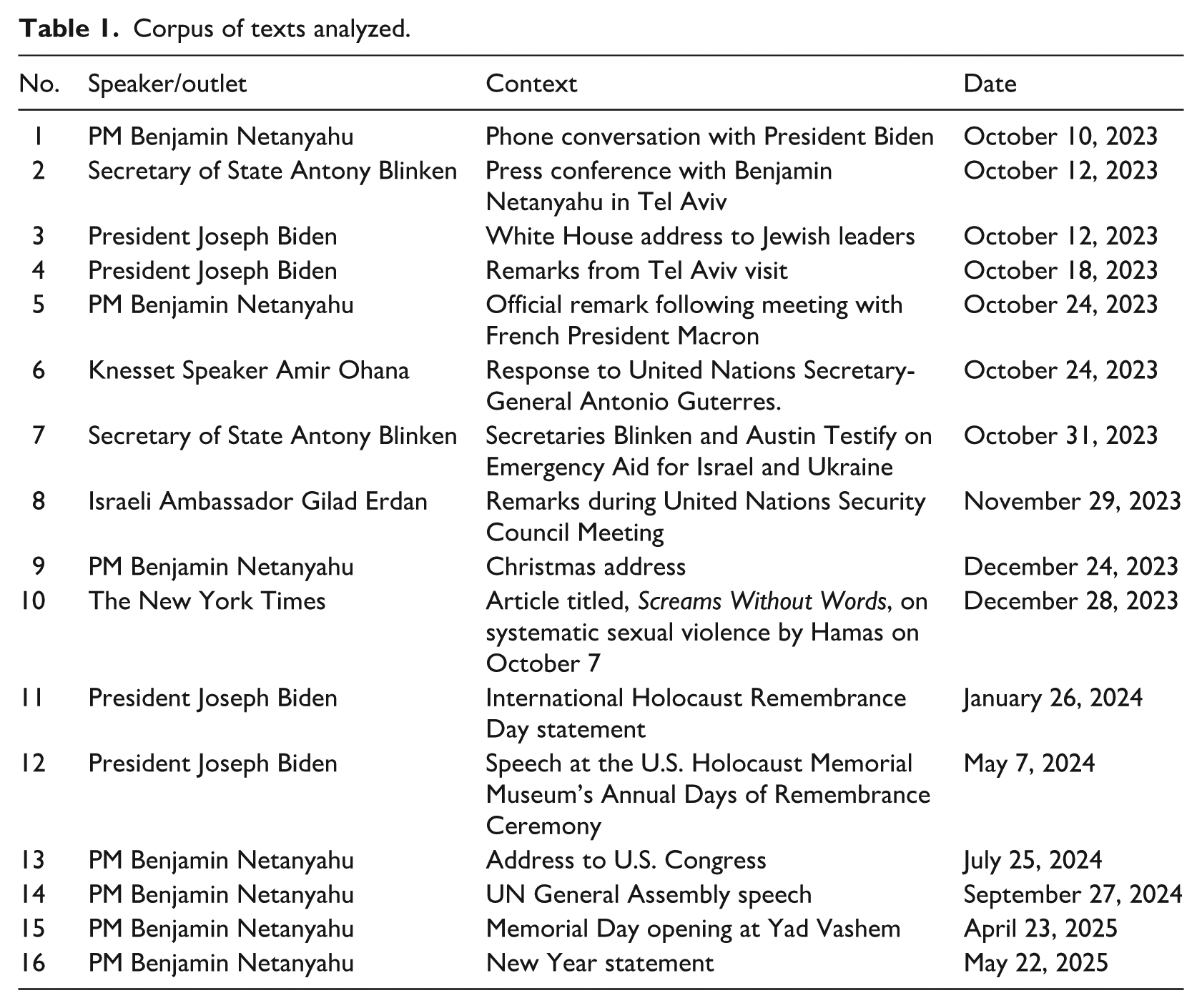
The analysis employs a deductive coding strategy informed by scholarship on Islamophobia. Specifically, the texts were examined for evidence of Islamophobic tropes underpinning portrayals of Hamās—and, by extension, Palestinians—as: (1) licentious, (2) inherently barbaric, and (3) pathologically anti-Semitic.
Mobilizing Islamophobia
Constructing licentiousness
Narratives of sexual depravity have been central to the discursive construction of Palestinian violence as barbaric and subhuman in the context of Israel’s genocidal campaign in Gaza, which began in October 2023. A prominent example of this discursive strategy is the unsubstantiated claim that al-Qassām systematically employed rape as a weapon of war—a narrative that gained considerable traction in Western media and political discourse despite the absence of verifiable evidence (Sanders and Al Jazeera Investigative Unit, 2024). Major Western corporate media outlets, such as The New York Times, played a central role in circulating these claims. In an article titled “Screams Without Words” (Gettleman et al., 2023), The Times quotes Israeli officials stating that “everywhere Hamas terrorists struck — the rave, the military bases along the Gaza border and the kibbutzim — they brutalized women.” The piece also cites Mirit Ben Mayor, a police chief superintendent, who described the alleged sexual violence as driven by “two ferocious forces, ‘the hatred for Jews and the hatred for women.’” 6 Importantly, The Times article does not present these as isolated acts of violence; rather, it communicates the existence of a coordinated campaign of mass sexual violence—claims made in the absence of independently verified evidence.
The trope of inherent Islamic anti-Semitism, alluded to in the quote above, is addressed in a subsequent section. However, it is important to underscore here that Islamophobic tropes do not operate in isolation. Rather, they function interdependently, often reinforcing one another in ways that activate deeply embedded orientalist and Islamophobic associations within Western publics. For instance, the trope of licentiousness is frequently paired with depictions of extreme barbarity (examined in the next section), which together produce a visceral emotional charge. This interplay is evident in official Israeli discourse; for example, Prime Minister Benjamin Netanyahu claimed in a United Nations address that “[t]hey [al-Qassām] raped and mutilated women” (Netanyahu, 2024). It also appears in The New York Times article cited above, where a witness is quoted describing graphic scenes: Another penetrated her, Sapir said, and every time she flinched, he plunged a knife into her back. She said she then watched another woman “shredded into pieces.” While one terrorist raped her, she said, another pulled out a box cutter and sliced off her breast.
While such accounts are clearly intended to evoke a strong emotional response, the claim a breast was “sliced off with a box cutter” (emphasis added) raises questions regarding anatomical plausibility.
In fact, subsequent investigations have revealed inconsistencies in key witness accounts and raised concerns about the journalistic standards employed in the reporting of The Times piece, with over 60 journalism professors publicly calling for an independent review of the coverage (Democracy Now, 2024a). Meanwhile, the sister of one of the victims the Times piece centers around—and who is described in the article as “a symbol of the horrors visited upon Israeli women and girls during the Oct. 7 attacks”—rejected that the victim was raped before she was killed (Scahill et al., 2024). The article also includes the account of: [a] paramedic in an Israeli commando unit [who] said that he had found the bodies of two teenage girls in a room in [Kibbutz] Be’eri. One was lying on her side, he said, boxer shorts ripped, bruises by her groin. The other was sprawled on the floor face down, he said, pajama pants pulled to her knees, bottom exposed, semen smeared on her back.
This claim was refuted by Michal Paikin, spokesperson for Kibbutz Be’eri, who confirmed that while two teenage sisters were killed on October 7th, they were not subjected to sexual violence (Scahill and Grim, 2024).
These issues are particularly relevant given that the article’s broader framing of mass sexual violence rests primarily on witness testimonies where allegations of rape are sometimes derived from interpretations of body positioning rather than forensic evidence. This is significant because an investigation by the Independent International Commission of Inquiry on the Occupied Palestinian Territory, including East Jerusalem, and Israel (2024) noted that although testimonies regarding rape were collected from journalists and the Israeli police, the Commission was unable to independently verify these allegations due to restricted access to victims, witnesses, and crime scenes, as well as interference from Israeli authorities. They stated that “the Commission was also unable to verify reports of sexualized torture and genital mutilation” (p. 6).
A United Nations (UN) report by the Office of the Special Representative of the Secretary-General on Sexual Violence in Conflict (Office of the SRSG-SVC, 2024) was also widely circulated in the media as offering “‘convincing information’ that Hamas raped and tortured Israeli hostages” (Borger, 2024). However, Pramila Patten—the UN Special Representative on Sexual Violence in Conflict and lead author of the report—explicitly stated that no investigation had been conducted, and thus, that the report could not determine whether rape occurred systematically during the October 7 attacks or whether Hamās was responsible for such acts of sexual violence (Press Conference: Pramila Patten, SRSG on Sexual Violence in Conflict & Chloe Marnay-Baszanger, Team Leader of the Team of Experts on the Rule of Law and Sexual Violence in Conflict on Ms. Patten recent visit to Israel and the occupied West Bank, 2024 see 56:40 minutes).
It is essential to clarify that this discussion is not concerned with proving or disproving the occurrence of sexual violence which, evidence suggests, is generally prevalent in armed conflicts (Gaggioli, 2014). 7 Rather, the focus lies on the deliberate instrumentalization of unsubstantiated claims that portray sexual violence as a widespread modus operandi—that is, a systematic and defining method of operation—of al-Qassām fighters in order justify and normalize genocidal violence and ethnic cleansing as warranted responses. The evidentiary void surrounding these allegations in The Times’ article is often masked by emotionally affective storytelling, which, when intertwined with these familiar stereotypes, helps mobilize narratives of mass sexual violence in the service of broader imperial and genocidal rationales. The persuasive power of these claims cannot be separated from the ideological terrain into which they are inserted. They resonate so powerfully because they are anchored in long-standing Orientalist and Islamophobic tropes that depict Muslim men as hypersexual, violent, and misogynistic (Daniel, 1960; Said, 1979, 1981; Rodinson, 1987). Within this preexisting discursive framework, even the most extreme and unverified accounts are rendered plausible—if not inevitable—contributing to discursive conditions in which Muslim—and by extension Palestinian—men are more easily excluded from moral and legal protection.
Meanwhile, videos and photographs posted by Israeli male soldiers on social media displaying the underwear of Palestinian women they had either displaced or killed during the ongoing genocide (Shirbon and Grzanka, 2024), reflect the same misogynistic and sexually violent attitudes often projected onto Palestinians through Islamophobic tropes. The Independent International Commission of Inquiry on the Occupied Palestinian Territory, including East Jerusalem, and Israel (2025b) also documented multiple cases of sexual violence against Palestinian detainees, including the rape of male prisoners (see also Independent International Commission of Inquiry on the Occupied Palestinian Territory, including East Jerusalem, and Israel, 2025a). These cases include “the use of an electrical probe to cause burns to the anus, and the insertion of objects, such as fingers, sticks, broomsticks and vegetables, into the anus and rectum” (Independent International Commission of Inquiry on the Occupied Palestinian Territory, including East Jerusalem, and Israel, 2025b: 27). In at least two documented instances, the victims required medical treatment or surgery due to the “injuries caused by rape” (Independent International Commission of Inquiry on the Occupied Palestinian Territory, including East Jerusalem, and Israel, 2025b). One victim’s rectum was reportedly ruptured after being stabbed with a sharp object. In some cases, sexual violence preceded death such as in the case of Dr. Adnan al-Bursh, the head of the orthopaedic department at al-Shifa Hospital in Gaza City, who died in Israeli custody and whose body remains withheld by the Israeli state. Leaked CCTV videotapes (see for example Ali, 2024) depicting Israeli soldiers allegedly gang-raping a Palestinian man at the Sde Teiman detention center—an institution linked to numerous allegations of sexual violence by whistleblowers (Anon, 2025) and former detainees (Valdez, 2024)—further corroborates findings in the UN report. In this instance, the victim was described, by the doctor who treated him, as having suffered “a ruptured bowel, a severe injury to his anus, lung damage, and broken ribs” (Ali, 2024).
Still, despite the severity and documentation of these incidents, they have received little sustained attention in Western media and political discourse. These verified acts of sexual violence—unlike the unverified claims of mass sexual violence attributed to Palestinian fighters discussed above—have not resulted in parallel narratives attributing systemic sexual violence to Israeli or Jewish men in the same essentializing manner. This contrast is instructive. While uncorroborated allegations against Palestinians have been invoked to essentialize them as sexually predatory, some of the gravest substantiated incidents of sexual violence committed by Israeli soldiers are presented as isolated cases rather than as systemic or pathological. This asymmetry reflects the broader discursive logic through which Islamophobic narratives are mobilized to justify state violence: dominant or allied groups (e.g., Israel) are discursively exempt from the pathologizing and securitizing logics applied to Palestinians.
Constructing barbarity
As with the trope of licentiousness, depictions of Palestinians as inherently savage and subhuman are central to the discursive framework that renders extreme violence not only permissible but necessary. These tropes frequently operate in tandem—as in the Times article where the rape of a woman is described alongside her being “shredded into pieces”—conjuring images of uncontrolled brutality and cruelty that align with long-standing Islamophobic imaginaries.
This framing is particularly visible in the rhetoric of Israeli political leaders. Benjamin Netanyahu, in a UN address, claimed that “[t]hey [al-Qassām] beheaded men. They burned babies alive. They burned entire families alive—babies, children, parents, grandparents” and referred to hostages being “dragg[ed] into the dungeons of Gaza” (Netanyahu, 2024). Former Defense Minister Yoav Gallant described Palestinians as “human animals” (South Africa, 2023: 142), 8 evoking a biologically dehumanizing language that casts them outside the category of humanity. Netanyahu has repeatedly characterized the conflict as a war between “civilization and barbarism,” describing Israel as confronting “monsters. . . who murdered children in front of their parents, who raped and beheaded women, who burned babies alive, who took babies hostage,” (Netanyahu, 2023a) and declaring it a struggle “between the children of light and the children of darkness, between humanity and the law of the jungle” (South Africa, 2023: 140). In his 2024 address to the U.S. Congress, he extended this civilizational logic by asserting that Israel’s military actions function as the West’s first line of defense, declaring, “we’re not only protecting ourselves. We’re protecting you” (for full speech see, Haaretz, 2024).
Netanyahu’s invocation of the Biblical Amalek narrative to describe Palestinians (South Africa, 2023: 142) extends his civilizational rhetoric by intertwining it with religious discourse. This fusion of civilizational and religious justifications echoes a central aspect of Islamophobic tropes of Islam as the perpetual enemy of the West, and mirrors the logic of Christian Zionism which regards the erasure of Palestinians as necessary “in the eschatological vision of a restored Israel” (Shehadeh, 2025). It suggests that the ethnic cleansing of Palestinians is not only a political or military necessity but also an existential religious imperative. Bazian (2016) explains that appealing to religious authority to legitimize extreme violence and occupation has been central to the settler-colonial project in Palestine, dating back to British rule. This reflects the broader European use of Christianity to justify colonial expansion.
Such civilizational language also exemplifies what Said (1979, 1981) identifies as the Orientalist binary: a persistent framework in which the West is constructed as rational, civilized, and moral, while Muslim-majority societies are imagined as irrational, violent, and primitive. The trope of Muslim barbarism, in this sense, is not a new invention but a contemporary iteration of colonial discourse. It renders Palestinians unintelligible as political actors and positions Israeli violence as a civilizational necessity. Within this logic, acts of occupation, bombardment, and ethnic cleansing are framed as defensive acts against a subhuman enemy posing an existential threat. This was reinforced through repeated portrayals of Hamās not only as equivalent to, but worse than, ISIS. Netanyahu and Gallant made this claim explicitly (Reuters, 2023), and it was echoed across the Israeli political spectrum, including by rival figures to Netanyahu (Yosef and Liebermann, 2025). Leading U.S. politicians reinforced this framing. President Joe Biden declared, “Hamas committed atrocities that recall the worst ravages of ISIS, unleashing pure, unadulterated evil upon the world” (Biden, 2023), while Secretary of State Antony Blinken described Hamās’ “litany of brutality and inhumanity” as reminiscent of “the worst of ISIS” (Hansler, 2023). As Said (1979) reminds us, these representations are not just symbolic but have material consequences by shaping the horizon of political possibility. Within this discursive framework, they can function to render genocide intelligible as a defensible act of self-preservation.
It is worth noting that such rhetoric continues a longstanding Zionist tradition of contrasting “civilized Israel” with a supposedly “barbaric other”—a practice evident in Theodore Herzl’s (the Austro-Hungarian founding father of political Zionism) vision of the Jewish state as “the portion of the rampart of Europe against Asia, an outpost of civilization as opposed to barbarism” (Herzl, 1917 [1896]: 12). Chaim Weizmann, the Russian Zionist leader who later became first president of Israel, articulated a similar vision, framing the Zionist project as a struggle between “the forces of destruction, the forces of the desert” and “the forces of civilization and building” (quoted in Massad, 2005: 6).
The portrayal of Palestinians as barbaric and inherently violent facilitated the dissemination of numerous unsubstantiated claims. These include allegations that babies were burned alive in an oven at Kfar Aza kibbutz, and that a baby was extracted from its mother’s womb and subsequently stabbed in front of its family (Heren, 2023; Netanyahu, 2024). A story that garnered significant media attention, that also allegedly took place in Kfar Aza, was that al-Qassām fighters beheaded 40 babies on October 7th. Despite a lack of evidence (Maad et al., 2024; Yusuf, 2024), this story dominated the front pages of major UK newspapers, including The Times, 9 Daily Mail, 10 Metro, 11 The Telegraph, 12 and The Daily Express. 13 President Joe Biden also asserted that he had seen images of decapitated babies (Scahill, 2023). Subsequent investigations, however, revealed that these claims were fabricated: although two babies died on October 7th, neither was burned or beheaded, and none was killed in Kfar Aza (Sanders and Al Jazeera Investigative Unit, 2024). Nevertheless, Netanyahu continued to repeat the unsubstantiated claim that al-Qassām “burnt babies alive” in his address to the U.S. Congress months later (for full speech see, Haaretz, 2024). Separately, Secretary of State Blinken relayed an account to Congress alleging that a family of four had been brutally mutilated—reportedly, the father’s eyes were gouged out in front of his children, the mother’s breasts were cut off, a girl’s foot was amputated, and a boy’s fingers were severed—before they were killed (Blinken, 2023). This account had been relayed by Yossi Landau, a volunteer with ZAKA, an ultra-Orthodox Jewish emergency response organization, who claimed to have witnessed the atrocities at Kibutz Be’eri (CNN, 2023), but the claims could not be verified (Gupta, 2024).
These narratives—despite being unverified—spread rapidly, revealing how Western media and political discourse turned almost reflexively to pre-existing stereotypes to “make sense” of the events. Such fabrications drew on a deep-seated cultural archive of Muslim savagery, serving not only to shock but also to justify the violence that followed. In doing so, these accounts foreclosed alternative interpretations of the events, such as those rooted in political context, historical grievance, or anti-colonial resistance. 14 This discursive strategy reflects a longstanding, institutionalized pattern within Israeli state practice, beginning in the education system, where curricula are shaped to delegitimize Palestinian claims to self-determination and to legitimize state violence against them (Peled-Elhanan, 2013). This dynamic was reflected in corporate media coverage, which often reproduced a temporal framing in which the history of the conflict appeared to begin on October 7th, effectively erasing the longer colonial context of Palestinian dispossession.
The rapid mobilization of these narratives thus illustrates how deeply embedded cultural and cognitive scripts—rooted in Islamophobic tropes—were activated to shape public perception, collapsing a historically situated struggle into a simplified moral binary. The widespread circulation of these unsubstantiated narratives underscores the enduring power of entrenched cultural stereotypes, wherein references to beheadings and the torture of infants—the quintessential symbol of innocence—serve as dog whistles, activating deeply ingrained associations of Muslim savagery.
In contrast, it is notable that despite evidence that Israel has killed at least 19,424 Palestinian children (AJLabs, 2025), along with reports from volunteer medics that Israeli snipers deliberately target children with single headshots (Oral evidence: Humanitarian situation in Gaza, 2024) and, in some cases, shoot at their testicles “almost like a game of target practice” (Dr Nick Maynard quoted in Sky News, 2025), and statements like that made by Israeli Minister May Golan about being proud of “what the Jews did” (Golan, 2024), there have been no repeated narratives in mainstream media insinuating that savagery is inherent to Judaism. This asymmetry is further underscored by the fact that fictitious reports of decapitated Israeli babies elicited more outrage in the West than actual documented footage of decapitated Palestinian babies from Israel’s white phosphorous-laden bombs (HRW, 2023). This bias suggests that public perceptions of violence are informed not only by its brutality and outcomes but also by social constructs: violence committed by Muslims is framed as an expression of inherent barbarism, while violence against Muslims is framed as tragic but necessary. This asymmetry reflects how deeply ingrained Islamophobic imaginaries in Western consciousness continue to structure Western political responses to violence perpetrated by and against Muslims.
The rhetoric of “Islamic anti-semitism”
The third Islamophobic trope mobilized to legitimize genocidal violence against Palestinians is the claim that Islam harbors an inherent and timeless anti-Semitism. While this trope has long featured in Israeli narratives toward Palestinians (Said, 1979), it was intensified in the aftermath of October 7th.
At a Holocaust memorial ceremony in May 2024, U.S. President Joe Biden claimed the October 7th attacks stemmed from “an ancient hatred of Jews,” thereby framing the violence as the latest expression of a transhistorical anti-Semitism (Biden, 2024a). This statement continued a discursive framing he had adopted in the immediate aftermath of October 7th, when he described the attacks as a “campaign of pure cruelty against the Jewish people” (The Guardian, 2023). Echoing Benjamin Netanyahu, Biden also characterized the attack as the worst atrocity committed against the Jewish people since the Holocaust (Biden, 2024b; Netanyahu, 2023b, 2023c). This framing was further reinforced by Secretary of State Antony Blinken, who described the attacks as having “harrowing echoes” of the Holocaust (Wintour, 2023).
This discursive alignment between Palestinian violence and Nazi violence by the Biden administration was echoing Israeli official rhetoric. Netanyahu described the events of October 7th as “reminiscent of the Nazi Holocaust” (Netanyahu, 2024), and likened the killing at the Nova music festival to the Babi Yar massacre committed by Nazi forces in 1941 (Netanyahu, 2023c). In an address to French President Emmanuel Macron, he invoked the figure of Anne Frank, claiming that Jewish children were found hiding in attics and subsequently “butchered”, drawing a direct symbolic parallel between Nazi anti-Semitism and the actions of al-Qassām fighters (Netanyahu, 2023b). In a Holocaust Remembrance Day speech in 2025, Netanyahu expanded on this comparison, citing German Chancellor Olaf Scholz as having remarked that “the Hamas murderers are exactly like the Nazis,” and affirming the analogy himself: “Indeed, they [Hamās] are exactly like the Nazis. Like Hitler, like Haman, they want to kill and destroy all of the Jews.” (Netanyahu, 2025a, translated; see also The Jerusalem Post, 2025). In a separate statement, he further asserted that “‘Free Palestine’ is just today’s version of ‘Heil Hitler’” (Netanyahu, 2025b). Meanwhile, Speaker of The Knesset, Amir Ohana described the October 7th attack as a “modern Holocaust”, while Former Prime Minister Naftali Bennett described Hamās as “the Nazi enemy” (Lebovic, 2023). Israel’s UN ambassador Gilad Erdan wore a yellow Star of David at a Security Council session, equating Hamās with the Nazis. 15 In a speech before the UN General Assembly on October 26, 2023, Erdan described Hamās as “modern-day Nazis” (United Nations, 2023). In a subsequent Security Council speech, Erdan stated: “This deep-seeded hatred of Israel and Jews (. . .) stems from the very same genocidal ideology that drives Hamas. This is not a political conflict, or about partitioning land. It is solely about the destruction of Israel and the murder of Jews” (Erdan, 2023).
Importantly, the portrayal of Palestinians who engage in armed struggle for self-determination as equivalent to Nazis is neither recent nor incidental. This rhetoric can be traced back to the mid-1970s, when Benzion Netanyahu—father of Benjamin Netanyahu—delivered the opening remarks at a conference of the Jonathan Institute, which his son headed at the time. In his speech, he claimed that Palestinian armed resistance was “an offshoot of Nazi philosophy” (quoted in Kumar, 2012: 120). This narrative is also sustained through the portrayal of Haj Amin al-Husseini (Mufti of Jerusalem) as an architect of the Holocaust, a claim rejected by scholars (see Finkelstein, 2000: 62). This discourse reached a political extreme in 2015, when Benjamin Netanyahu asserted that it was al-Husseini who inspired Hitler’s decision to kill the Jews, a claim widely dismissed by historians (Beaumont, 2015).
Such framings have permeated not only political speech but also mainstream media narratives. For example, The New York Times article “Screams Without Words”—cited earlier—includes the statement by Israeli police superintendent Mirit Ben Mayor that the brutality of October 7th was driven by “the hatred for Jews and the hatred for women.” By attributing the violence to an irrational and intersectional hatred—both misogynistic and anti-Semitic—the article pathologizes Palestinian violence, presenting it not as politically or historically situated, but as an expression of intrinsic “Jew-hatred” and lust for violence. It is notable that the article does not engage, even in a cursory manner, with the socio-political conditions in Gaza prior to October 7th, nor does it situate the events within the historical context of the Israeli occupation.
The narrative of inherent Islamic anti-Semitism is also sustained through selective interpretations of Hamās’ charters by Israeli officials, Western politicians, and corporate media. These actors frequently cite the 1988 Hamās Charter, 16 which does include anti-Semitic references such as an allusion to “The Protocols of the Elders of Zion,” as proof that Hamās’ aim is the eradication of the Jewish people. 17 However, these actors often omit mentioning Hamās’ “A Document of General Principles and Policies”, widely regarded as Hamas’s revised 2017 charter, which explicitly disavows anti-Semitism (for such an example, see TalkTV, 2025). Article 16 of the updated charter states: “Hamas affirms that its conflict is with the Zionist project, not with the Jews because of their religion. Hamas does not wage a struggle against the Jews because they are Jewish but wages a struggle against the Zionists who occupy Palestine.” 18 This emphasis on a political struggle rather than one driven by a hatred of Jews was not new in 2017; it echoed public statements made by Hamās leaders over a decade prior. In a television interview, Hamās’ co-founder Sheikh Ahmed Yassin emphasized that Hamās’ resistance was not against Jews as Jews, but against the occupation, even expressing “love” for Jews as “People of the Book.” 19 In 2006, Khalid Mish’al, then head of Hamās’ political bureau, wrote in the Guardian that “[w]e have no problem with Jews who have not attacked us - our problem is with those who came to our land, imposed themselves on us by force, destroyed our society and banished our people” (Mish’al, 2006). Similarly, in 2005, Isma’il Haniyyah—Chairman of Hamās’ Political Bureau, assassinated during the current genocide—declared that Hamās’ struggle was “restricted to the Zionist enemy, and not against the Jews in general” (quoted in Abu Sway, 2017: 124).
In contrast, the first article of the 1977 Likud charter—which predates the 1988 Hamās charter and has not been rewritten—asserts that “between the Sea and the Jordan there will only be Israeli sovereignty,” thereby explicitly denying Palestinian self-determination. 20 Yet, this categorical rejection of Palestinian nationhood is rarely discussed in Western mainstream media, and when it is, it is not interpreted as a manifestation of deep-seated Islamophobia within the Jewish tradition. This discursive asymmetry exposes a broader double standard: Palestinian resistance is pathologized through recurrent references to Hamās’ original 1988 charter—since superseded—whereas comparable ideological commitments in Zionist doctrine that continue to be articulated today—exemplified by The Knesset’s 18 July 2024 resolution rejecting, by a large margin, the establishment of a Palestinian state—are normalized or overlooked. In other words, as with the tropes of licentiousness and barbarity, the discourse around anti-Semitism reflects how Islamophobic logics selectively essentialize Muslim political identity while exempting Israeli and Jewish actors from the same interpretive scrutiny.
Discussion
Islamophobic tropes of sexual depravity, barbarity, and anti-Semitism, as mobilized by Israel and its key allies, perform distinct ideological and affective functions that work to legitimize genocidal violence.
At the discursive level, the mobilization of Islamophobic tropes—especially that of inherent anti-Semitism through the invocation of Holocaust memory—reframes a settler-colonial conflict as a metaphysical struggle between civilization and barbarism. The Holocaust, long established in modern Western consciousness as “modernity’s icon of evil” (Moses, 2021: 482), has been constructed as uniquely incomparable, often eclipsing other historical experiences of mass violence. 21 The intent here is not to minimize the horror of the Holocaust or to propose a hierarchy of suffering, quite the opposite. Rather, it is to highlight that the exceptionalization of the Holocaust as uniquely evil produces a moral framework in which almost any violence becomes justifiable when narrated as a defense against “another Holocaust”. This logic helps explain why, in Western mainstream discourse, nothing can justify October 7th, yet Israeli genocidal acts are justified by October 7th. This logic depends on an existential framing: if Jews are once again facing annihilation, then Israeli actions, no matter how brutal, are necessary. Within such a framework, Palestinians become legible only as perpetrators, never as victims.
This framing does more than moralize violence: it obscures the historical and political foundations of the Palestinian struggle (Bazian, 2016; Pappé, 2017, 2024a) and shields Israel from accountability for, and its Western allies from complicity in, policies that the International Court of Justice has effectively determined constitute a system of apartheid (ICJ, 2024: 64–65). 22 In so doing, it reverses the roles: casting the settler-colonial force as the vulnerable party and its actions as necessary acts of self-preservation. The mass killing of Palestinians is no longer understood as a crime of empire or colonization, but rather as a necessary act of civilizational self-defense. That such framing persists despite the overwhelming asymmetry of power—where Palestinians live under apartheid (HRW, 2021; Amnesty International, 2022; ICJ, 2024) and military occupation without an army, navy, or air force, and operate with rudimentary weaponry, while Israel commands one of the world’s most advanced armies, backed unconditionally by the leading global superpower and supported by a powerful transatlantic lobbying network (Pappé, 2024b)—speaks to the enduring power of this narrative.
By recasting Palestinians not as a colonized people resisting displacement and occupation, but as barbaric religious fanatics driven by an irrational hatred of Jews and women, Islamophobic tropes serve to depoliticize their struggle. More than a century of settler-colonial occupation and land dispossession (Bazian, 2016); cyclical and catastrophic military “operations” carried out under Israel’s “mowing the lawn” strategy (for a detailed examination of a Gaza case, see Finkelstein, 2018); an 18-year blockade on Gaza, which has precipitated severe humanitarian crises—including widespread water and electricity shortages, chronic food insecurity, and crises in the health and education systems (OCHA, 2018, 2022; OHCHR, 2019); a policy of limiting food entry into Gaza to subsistence levels through calorie-counting (Gisha, 2012); the routine use of arbitrary detention and lethal force, including against peaceful protesters and children (Amnesty International, 2012; OCHA, 2019; Save the Children, 2023); the institutionalization of apartheid (HRW, 2021; Amnesty International, 2022; ICJ, 2024); the persistent, institutionally sanctioned denial of Palestinian self-determination (see for example, The Knesset, 2024a, 2024b); and failed diplomatic efforts such as the Oslo II Accord, which entrenched Israel’s occupation while consolidating the Palestinian Authority’s grip on power, an entity that has been described as an extension of Israel’s occupation apparatus, thereby further undermining prospects for a two-state solution (Pappé, 2024a)—are rendered invisible or treated as irrelevant. In this way, Palestinians are denied “permission to narrate” (Said, 1984). Within the dominant narrative, the invocation of Islamophobic tropes not only licenses otherwise indefensible violence but also forecloses efforts to situate Palestinian violence within its socio-political context. Palestinians are thus stripped of political legibility and reduced to contemporary manifestations of an existential threat. Put differently, the mobilization of an Islamophobic framing erases the political meaning of Palestinian violence as an act of anti-colonial resistance and a struggle for liberation and self-determination, recasting it instead as a pathological expression of fanatical religious anti-Jewish hatred.
In doing so, the boundaries of legitimate critique are narrowed. Any criticism of Israel is thus recoded as morally suspect, and to challenge the dominant discourse is to risk being accused of anti-Semitism. 23 This dynamic has played out repeatedly during the genocide, most visibly in the response to UN Secretary-General António Guterres’ statement that the events of October 7th “did not happen in a vacuum” (Guterres, 2023), a statement that was accompanied by his unequivocal condemnation of the October 7th attacks. Knesset Speaker Amir Ohana described Guterres’ remarks as “vile antisemitic speech”, 24 while Israel’s ambassador to the UN, Gilad Erdan, accused the Secretary-General of invoking the anti-Semitic trope of “blood libel” and called for his resignation (Wintour and Pilkington, 2023). 25 These reactions exemplify how attempts to situate Palestinian violence within its historical and socio-political context is rendered illegitimate, and how Holocaust memory is increasingly mobilized to discipline dissent. This is also evident in how Jewish individuals, including Holocaust survivors and their descendants, who have publicly condemned the genocide in Gaza have been subjected to arrest and police interrogation in several Western countries (Democracy Now, 2024b; Jackson, 2024; Middle East Eye, 2024; Kapos, 2025).
At the material level, these same Islamophobic tropes have enabled the continuing colonization of Palestine and successive territorial annexations (both in Gaza and the West Bank) under the guise of a civilizational and protective mission. While Wolfe (2006) explains that genocide is not a necessary outcome of settler colonialism, the Israeli state—as a settler-colonial formation (Wolfe, 2012)—is, as he notes, nonetheless organized around the imperative to eliminate the Indigenous population. To paraphrase Wolfe (2012), this genocide is thus accelerating “albeit very radically, the ‘slow-motion’ means to Native dispossession.” This genocidal settler logic is not confined to state institutions; it is also reflected in public sentiment. A recent survey by the Accord Center found that 76 percent of Jewish Israelis agree with the statement that “there are no innocent people in Gaza” (i24NEWS, 2025). Another poll, commissioned by Pennsylvania State University, found that 82 percent of Jewish Israelis support the expulsion of Palestinians from Gaza; two decades prior to October 7th, almost half expressed support for such a policy (Hazkani and Sorek, 2025). Genocidal violence and ethnic cleansing, in this context, thus operates not as a rupture in Israel’s settler-colonial order but as one of its constitutive mechanisms, enabling territorial consolidation and demographic engineering. Islamophobia functions as a key ideological apparatus in this process, serving as the discursive logic through which the expropriation of Palestinian land and the demolition of Palestinian homes (HRW, 2011) are narrated as necessary acts of civilizational self-preservation, and as part of a broader existential struggle between the West and a purported “Islamic threat.” Islamophobia here must therefore be understood not as an incidental byproduct of violence, but as a central mechanism of Israel’s settler-colonial order, functioning as an ideological tool through which its project of elimination and expansion is advanced.
Concurrently, the narrative of Islamic anti-Semitism enables Western states to displace their own histories of violent anti-Semitism (among other “isms” in a larger repertoire of Western violence), encompassing centuries of persecution, such as Jewish expulsions from England, France, Spain, Germany, Portugal, Russia, Hungary, and Italy, repeated pogroms and the Holocaust. As Jewish historian Shlaim (2024) explains, anti-Semitism is a European malady, it’s from Europe that anti-Semitism was transplanted to the Middle East, and it’s interesting to note that there was no anti-Semitic literature in Arabic really. So, with the spread of anti-Semitism from Europe to the Middle East, anti-Semitic literature had to be translated from European languages into Arabic (. . .) the Middle East did not have a ‘Jewish problem’, in inverted commas, Europe had a ‘Jewish problem’.
Yet by repeating narratives that cast anti-Semitism as a Muslim pathology, Western governments and corporate media absolve themselves of historical responsibility and instead depict Jews as locked in perpetual conflict with an inherently hostile “Islamic world.” The effect is twofold: it consolidates the West’s self-image as inherently civilizational and reimagines European Christian anti-Semitism not as a constitutive element of Western modernity, but as a historical aberration. At the same time, it reinscribes Muslims as irrational carriers of an ancient and implacable hatred. Within this logic, statements like that of German Chancellor Friedrich Merz—that anti-Semitism has been “imported” into Germany by migrants (read Muslims) (Hairsine et al., 2025)—can be made without apparent irony in a country that, within living memory, engineered the extermination of millions of Jews, Roma and people with disabilities (Friedlander, 1995).
The mobilization of Islamophobic tropes to justify violence against an oppressed population must be situated within a broader historical and ideological framework of racialized violence in the Western imaginary. One in which unsubstantiated allegations of sexual violence have long been weaponized to justify racial terror against Black communities (Davis, 1981), as exemplified by the Atlanta Massacre and the Rosewood Massacre; and where representations of Black and Brown people as barbaric and uncivilized have functioned to legitimize slavery, colonial domination and other forms of systemic brutality. These historical racial projects illuminate the ideological mechanisms at work in the present. Just as racialized stereotypes were once mobilized to sanction the lynching of Black people in the U.S. and the massacres of colonized peoples abroad, they are now deployed to render Palestinian men, women and children killable in Palestine.
Conclusion
This paper has examined how enduring Islamophobic tropes are strategically mobilized to provide the ideological scaffolding for Israel’s genocide in Gaza. These tropes do not operate in isolation; they form a discursive apparatus in which Muslims are portrayed as licentious, inherently barbaric, and pathologically anti-Semitic. This apparatus collapses a long history of colonization, dispossession, and resistance into a binary moral frame in which Palestinians are cast as existential threats and Israel is positioned as perpetually under threat. Within this framework, Palestinian suffering is rendered illegible, resistance is depoliticized, political claims are delegitimized, Western anti-Semitism is displaced, and settler-colonial violence is reframed as a civilizational and existential imperative. This narrative not only legitimizes extreme violence but also narrows the bounds of legitimate critique in the West, suppressing dissent and obstructing the conditions for a just peace—one in which Palestinians, recognized by the ICJ (2024) as an occupied people, can exercise their legal and internationally recognized right to self-determination, the latter also reaffirmed by the ICJ (2004).
Footnotes
Acknowledgements
I am grateful to Hanine Shehadeh and John O’Brien for their constructive feedback on an earlier draft of this paper. I also thank John O’Brien and Zaynab El Bernoussi for their separate invitations to present this work.

Funding
The author received no financial support for the research, authorship, and/or publication of this article.
Declaration of conflicting interests
The author declared no potential conflicts of interest with respect to the research, authorship, and/or publication of this article.
Data availability statement
The data analyzed in this study are publicly available and fully referenced in the manuscript.