







Abstract
This article examines how graphic designers in Turkey position their work within the ambiguous boundary between art and market-oriented production. Drawing on 41 in-depth interviews, it argues that this ambiguity is not a neutral structural condition but is unevenly lived across gendered subject positions under neoliberal labor regimes. Building on Katja Praznik’s framework of the “paradox of art,” whereby artistic labor is symbolically elevated as autonomous while being economically disavowed and severed from wage relations, the study demonstrates that this disavowal is actively reproduced through gendered processes. While male designers sustain artistic identities alongside market participation, women increasingly distance themselves from artistic subjectivity as a survival strategy. Even among urban women relatively exempt from domestic labor, its underlying logics—affective investment, flexibility, and systematic undervaluation—re-emerge within creative work. Non-binary designers experience precarity in its most intensified form, facing both economic insecurity and the absence of stable recognition.
Introduction
In the 2023 exhibition Hatasının Şekli (The Shape of the Mistake), Melih Aydemir’s installation confronts visitors with a familiar yet deeply ideological statement: “If you do what you love, you will never work a day in your life” (Öztürk, 2023). By exposing how this seemingly benign claim legitimizes unpaid labor, invisibility, and self-exploitation within creative work in Turkey, the exhibition reveals a central paradox of artistic labor, one that this article takes as its point of departure. This article begins from a seemingly simple yet analytically unresolved question: how should we understand graphic design-as art, as labor, or as something in between? While graphic designers occupy a central position within contemporary capitalist production, particularly in advertising and media industries, their work continues to be framed through a persistent ambiguity that resists stable categorization. Existing literature has long pointed to the blurred boundaries between artistic creativity and market-oriented production (Bridgstock, 2013; Lawson, 2006; McRobbie, 2016; Suchman, 2002), yet this ambiguity is often treated as a descriptive condition rather than a problem that requires deeper analytical unpacking. This raises a broader research puzzle: if graphic design is both economically productive and aesthetically grounded, why does its status as labor remain persistently unstable?
In this study, my central research question asks: How do graphic designers consider their work-as a form of artistic labor, purely market-driven production, or something in between? Building on this question, I further ask: does this in-betweenness operate uniformly across different social positions, or might it be experienced differently along gendered lines? More specifically, can the ambiguity surrounding artistic labor be understood as a gendered phenomenon, where the capacity to sustain or abandon artistic identity varies across women, men, and non-binary designers?
Finally, why is the Turkish case particularly revealing for this discussion? Because of the historically layered experience of women’s urban modernity and its contradictions. Over time, women’s increasing visibility in public space and their expanded participation in professional life have been widely narrated as markers of emancipation from domestic and traditionally prescribed gender roles (Güney, 2014; Kocabıçak, 2023; Özyegin, 2004). Yet, as this study demonstrates, such transformations do not necessarily dismantle the underlying logics of gendered labor. Rather, in the field of artistic production, these shifts often coexist with and even reproduce conditions that closely resemble domestic labor: precarious, undervalued, affectively charged, and frequently naturalized. In this sense, artistic or art labor in Turkey carries a distinct resonance with domestic labor, revealing how the ostensibly modern and urban incorporation of women into creative industries may, paradoxically, reinscribe rather than resolve the enduring structures of gendered inequality.
These questions are particularly significant in the case of graphic design, a field that has been repeatedly identified as occupying a liminal position between art and functionality. As Bridgstock (2013) suggests, the figure of the designer reflects an opportunity-driven subject shaped by labor market demands, while Lawson (2006) demonstrates how design practices historically blur the boundaries between aesthetic creativity and problem-solving. Similarly, Suchman (2002) conceptualizes design as emerging within a negotiated space between artistic and technical epistemologies. Graphic design is not merely a hybrid field but a structurally ambiguous one, where the distinction between art and labor is continuously reworked—and where that reworking, as this study shows, is never socially neutral.
This article contributes to this gap by arguing that the ambiguity of artistic labor is not only structurally produced but also differentially lived across gendered subject positions, with women’s experiences at the center of this analysis. The devaluation of graphic design labor stems from a structural condition shared across genders—being positioned as neither fully artist nor fully worker within capitalist patriarchy—while gendered, masculinized, feminized, and queer norms shape how this shared contradiction is experienced, navigated, and internalized. While the literature on artistic labor has examined precarity, invisibility, and the economic disavowal of artistic labor as labor—its severance from the wage relation, labor rights, and social protections, enabled by historically sedimented bourgeois aesthetic concepts (Abbing, 2008; Praznik, 2018, 2021; Sholette, 2004)—it has paid less attention to how these processes are lived differently across gendered subject positions. I demonstrate that women graphic designers tend to distance themselves from artistic subjectivity over time as a survival strategy shaped by feminized labor norms, while male designers are more able to retain an artistic identity alongside market participation due to the social legibility conferred by breadwinner expectations, and non-binary designers encounter more profound forms of exclusion rooted in the denial of stable gender recognition. In this sense, the capacity to claim, maintain, or abandon the identity of the artist is modulated by gendered norms operating within a shared structural condition, offering an empirical contribution to the gendered analysis of artistic labor.
To develop this argument, I apply and extend the theoretical framework developed in Praznik (2018, 2021) as the organizing analytical model of the article. This framework identifies what Praznik calls the paradox of art: the structural contradiction through which artistic labor is symbolically elevated as autonomous and exceptional while being simultaneously disavowed as labor—stripped of economic recognition, labor protections, and stable occupational identity. Three interconnected elements of this framework are central to the analysis that follows: first, the critique of bourgeois aesthetics as an ideological mechanism that severs artistic production from its material and social conditions; second, a feminist epistemological intervention—combined with the labor theory of value—that theorizes the structural invisibilization of artistic labor, processes of essentialization, and the separation of art from subsistence and the wage relation, drawing a structural analogy between artistic and domestic labor at the level of labor’s historical devaluation rather than at the level of gendered identity; and third, the concept of economic disavowal as a material and political-economic condition—the active severance of artistic labor from the wage relation and labor protections, enabled by bourgeois aesthetic ideology but not reducible to it—rather than a passive structural feature. I extend this framework by demonstrating that this economic disavowal is not only structurally produced but is differentially lived across gendered subject positions and within the specific socio-political context of Turkey.
The question of precarity is central to this discussion. Rather than limiting it to low wages or lack of contracts, I build on Lorey’s (2015) definition of precarity as a mode of subject formation—operating not only as a material condition but through the denial of stable forms of belonging. This condition, as my findings show, is gendered, shaping how different subjects experience inclusion, exclusion, and recognition within the labor market.
In what follows, I first situate artistic labor within broader theoretical debates on bourgeois ethics, feminist epistemology, and precarity. I then turn to the Turkish context to examine how these dynamics are historically embedded. Finally, drawing on semi-structured interviews with graphic designers, I analyze how artistic labor is negotiated, contested, and differentially experienced from below.
Is an art worker a “worker”? Tracing the ethics of the bourgeoisie
While engaged in forms of production that generate value-both economic and cultural-art workers also often find themselves outside the conventional frameworks of labor organization and protection (Abbing, 2008; Kester, 1995; Praznik, 2020). Sholette (2004: 1) describes the vast majority of artists as “dark matter”—invisible to institutional gatekeepers yet essential to the system’s functioning. What makes this invisibility durable is not simply marginality but a structural condition: artists navigate what Abbing (2008: 3) calls an exceptional economy, in which work is framed as a calling rather than a job, making the severance of artistic labor from wages and protections appear natural rather than produced. This is the paradox of art that Praznik’s framework sets out to theorize—and it is the starting point for this article.
This structural ambiguity is reinforced by the ways in which art labor is both over-romanticized and undervalued. Garrett and Jackson (2016: 283) trace the cultural trope of the suffering artist, which glamorizes precarity and renders it a marketable aesthetic; Cuenca (2012: 8) shows how capitalism integrates artistic production into market structures while preserving its myth of autonomy. The result is an art worker who is neither fully autonomous creator nor conventional worker—an uneasy hybrid whose liminality is structurally necessary: it justifies exclusion from labor protections while ensuring continued productivity. These ideological mechanisms are traceable in any creative field. What requires closer analytical attention is the material process they enable—the active severance of artistic labor from the wage relation—and the feminist epistemological tools needed to make that severance visible.
To understand contemporary cultural and creative labor, it is necessary to trace its historical framing and the emergence of precarity within a longer genealogy of bourgeois ethics that continues to shape neoliberal markets. Early critical insights can be found in Adorno and Bernstein’s (2020) The Culture Industry: Selected Essays on Mass Culture, where artistic production is subsumed under capitalist logics of commodification. Rather than remaining autonomous, art is evaluated through market criteria, reducing artistic labor to commodity production and undermining its autonomy. This process both devalues and obscures artistic labor, while the romanticization of art as passion-driven further normalizes precarious working conditions. The same logic that obscures artistic labor—framing it as passion rather than production—operates, as Federici’s work makes clear, in a structurally analogous domain.
A complementary perspective emerges from Silvia Federici’s seminal essay Wages Against Housework, which examines the invisibility of domestic labor within the framework of bourgeois ethics. Federici (1975) argues that housework is “not recognized as work” because capitalism has transformed it into a “natural attribute” of women, thereby rendering its economic value invisible (p. 76). Through this ideological transformation, domestic labor remains unwaged and socially devalued, reinforcing the assumption that it is merely a voluntary or affective activity rather than a necessary form of labor (Federici, 1975: 78). The structural analogy with artistic labor is direct: in both cases, work is rendered invisible through its naturalization—as feminine attribute or as creative calling—and in both cases that naturalization is the condition of possibility for its economic disavowal.
Contemporary scholarship on precarity further expands this critique. Lorey (2015) conceptualizes precarity not simply as an unfortunate condition of labor but as a governing logic within neoliberal societies—one that encompasses not only irregular income and absent social rights but also forms of workplace exclusion, including not being recognized as part of a desired group or community. Gill and Pratt (2008) demonstrate how the discourse of passion in artistic labor masks exploitative conditions, where individuals willingly accept long hours and instability under the assumption that creativity justifies such sacrifice.
Similarly, Banks (2017) argues that the labor markets structured around creative industries tend to equate creativity primarily with productivity, thereby reinforcing competitive market logics that further intensify precarious work conditions. McRobbie’s (2016) research on young fashion designers illustrates how even individuals at the beginning of their careers quickly internalize these rules of the game. Through the rhetoric of talent and appreciation, precarity becomes normalized and repositioned as an inevitable—even desirable—part of creative professional life. What remains undertheorized in this literature is the mechanism through which this normalization is reproduced at the level of subject formation, and how it operates differently depending on one’s position within gendered labor regimes. This is precisely the gap that Praznik’s framework addresses, and that this study takes into the field.
Praznik (2018, 2021) draws these threads together. In her work on artistic labor, she argues that understanding the supposed autonomy of art requires an analytical framework that combines the labor theory of value with feminist epistemology—not as parallel tools but as mutually constitutive ones, since the economic disavowal of artistic labor and the historical invisibilization of domestic labor are produced through the same bourgeois logic of naturalization. In this framework, feminist epistemology functions as a methodological intervention to theorize the structural invisibilization of labor, processes of essentialization through which artistic work is naturalized as vocation or calling, and the historical separation of artistic production from subsistence and the wage relation—not to analyze gender as an empirical attribute of individual workers or as a variable explaining differential outcomes. It is through this structural and historical lens that Praznik demonstrates how the ideology of artistic autonomy obscures the labor relations underlying cultural production. Crucially, the analogy between domestic and artistic labor is not drawn directly from Federici but is developed as a theoretical synthesis in Praznik’s own framework, where it operates as part of a broader political-economic critique of artistic labor rather than as a claim about gendered identity.
By adapting Praznik’s model to my empirical material, I situate graphic designers’ experiences within broader debates on gender, labor, and the political economy of art in Turkey. I focus on how women’s increasing visibility in urban space—as subjects who appear to challenge traditional gender roles and distance themselves from domestic labor—paradoxically gives way to a reconfiguration of these very logics within professional life. In this sense, the structural devaluation of artistic labor—produced by capitalist patriarchy—is given a particular form by feminized labor norms: the affective, undervalued, and often invisible qualities historically associated with domestic labor re-emerge within creative work not because women perform it, but because the norms governing feminized labor shape how that shared structural condition is lived and reproduced. Turkey is a particularly revealing case precisely because this dynamic is historically embedded and analytically visible.
Turkish case
Urbanization, particularly from the late 20th century onward, has enabled women’s increased visibility in public space and their participation in professional life (Cinar and Ugur-Cinar, 2018; Tuncer, 2018). Yet this transformation has not constituted a definitive rupture. Women’s incorporation into public and economic life has unfolded alongside persistent socio-cultural expectations that continue to reinscribe their responsibility for domestic and reproductive labor (Coşar and Özkan-Kerestecioğlu, 2017; Yuval-Davis, 1997).
These tensions become particularly pronounced under the AKP period, where neoliberal restructuring has operated in tandem with the reassertion of conservative gender norms (Durmaz, 2016: 145; Mimoun, 2024: 3). The AKP era does not simply represent a retreat from modernity but a contradictory reorganization: women are both incorporated into and constrained within neoliberal labor regimes, where economic growth increasingly depends on alliances between political authority and business elites (Buğra and Savaşkan, 2014; Çavdar and Yaşar, 2019). As Tansel (2018) argues, this form of authoritarian neoliberalism restructures labor markets around flexibility and insecurity, producing conditions in which precarity is internalized as normal.
Bozkurt-Güngen (2018) argues that, in the post-2001 period, state-led neoliberal restructuring in Turkey has increasingly blurred the boundaries between formal and informal employment by promoting external flexibilization and reducing non-wage labor costs. Building on this analysis, İlyas (2022) suggests that one of the most significant manifestations of this neoliberal transformation within the field of artistic labor has been the widespread shift toward freelance work. In this context, even receiving payment becomes contingent upon prior negotiation and access to networks, beyond the mere production of labor and surplus. Crucially, this process does not require the preservation of an artistic identity; rather, participation in such networks and the ability to remain employable often take precedence over sustaining oneself as an artist.
Within this broader context, the expansion of creative industries such as graphic design becomes particularly significant. As sectors shaped by post-Fordist transformations, these fields rely heavily on affective, cognitive, and communicative forms of labor, where creativity and subjectivity themselves become central to value production (Akay, 2022). As existing research on Turkey’s cultural industries demonstrates, these sectors are characterized by project-based work, unstable employment, and the normalization of self-exploitation under the rhetoric of passion and creativity (Akten, 2023; Artun, 2014; Ay and Canlı, 2023; Enlil et al., 2011). The field remains structurally dependent on imported professional models and lacks a locally grounded discourse on labor conditions (Akdenizli, 2006: 5). As Karaca (2011: 181) argues, the boundaries of art are continuously negotiated and policed, with artistic expression simultaneously framed as autonomous and subject to financial, political, and legal intervention. The centrality of affective and cognitive labor does not eliminate exploitation but reorganizes it through new forms of internalization and self-management—conditions that closely resonate with feminist analyses of domestic work and that my findings document from within.
In this sense, artistic labor in Turkey emerges as a critical site where the promises of urban modernity are not simply limited but actively undone. Rather than constituting a clear break from domesticity, women’s incorporation into creative industries reveals how the devaluation historically associated with domestic labor is displaced and rearticulated within professional contexts. The Turkish case is therefore revealing not because it represents an exception, but because it exposes how gendered labor hierarchies persist—and are newly reproduced—within forms of work that are otherwise framed as modern, autonomous, and emancipatory.
Methodology
I recruited participants through snowball sampling, initially drawing on my personal network and subsequently expanding through participant referrals. As noted in the literature, snowball sampling may introduce bias when initiated within existing social networks (Parker et al., 2019), and I acknowledge this as a limitation. All participants were located in three major metropolitan cities—Istanbul, Ankara, and Izmir—which reflects the urban concentration of graphic design labor but also limits generalizability beyond these urban contexts.
During the recruitment process, I also contacted the Association of Graphic Designers (Grafik Tasarımcılar Meslek Kuruluşu—GMK), the main professional association in the field in Turkey. Although this interaction did not result in participant recruitment, the deadlock that emerged from this engagement proved analytically significant; I discuss this process and its implications in detail in a later section of the article.
In total, I worked with 41 graphic designers. Although the study primarily focuses on women graphic designers (n = 33), I also included male (n = 5) and non-binary participants (n = 3) in order to capture how artistic labor is experienced across different gendered subject positions. I collected data through semi-structured interviews conducted between January and April 2025. Interviews were carried out either online (typically lasting 60–70 minutes) or via telephone (approximately 30–40 minutes). Prior to each interview, I informed participants about the scope of the study and obtained their verbal consent. Online interviews were audio-recorded, while telephone interviews I documented through detailed note-taking and later transcribed (online ones) with the assistance of transcription software (Otter.ai).
I chose semi-structured interviews in order to allow participants to articulate their experiences in their own terms and to make space for themes that could not be fully anticipated in advance. This was particularly important for capturing the situated and relational dimensions of creative labor, including how participants negotiate artistic identity, labor conditions, and belonging (Mahon et al., 2018). In line with Liinamaa’s (2026) discussion on the differentiated evaluation of creative labor, this flexible format enabled me to explore not only economic conditions but also the subjective and experiential dimensions of artistic work, which would have been difficult to access through fully structured interviews or surveys.
The interviews were guided by open-ended questions covering educational backgrounds, transition into the labor market, and how participants define their work in relation to art and labor. For those with fine arts training, I explored how artistic identity evolved after entering the job market; for those without, I focused on whether and how they accessed or rejected an “artist” identity. I also asked about workplace dynamics, recognition, and how their labor was perceived by colleagues and employers.
I frequently asked follow-up questions in response to participants’ narratives, probing themes such as the relationship between artistic and domestic labor, perceptions of surplus value, and experiences of precarity. These follow-ups were used to refine participants’ accounts rather than direct them toward predetermined conclusions.
I analyzed the data using thematic analysis. After transcribing the interviews, I read the material multiple times and manually coded the data to identify recurring patterns and themes. Rather than applying a predefined coding scheme, I developed themes inductively from the data, with particular emphasis on the gendered differentiation of artistic labor. Accordingly, the analysis primarily focused on how artistic identity, labor conditions, and experiences of precarity were differently articulated across women, male, and non-binary participants, while the GMK section was treated as a separate institutional analysis (Table 1). All participant names were anonymized to ensure confidentiality.
Demographic and Professional Characteristics of Participants.
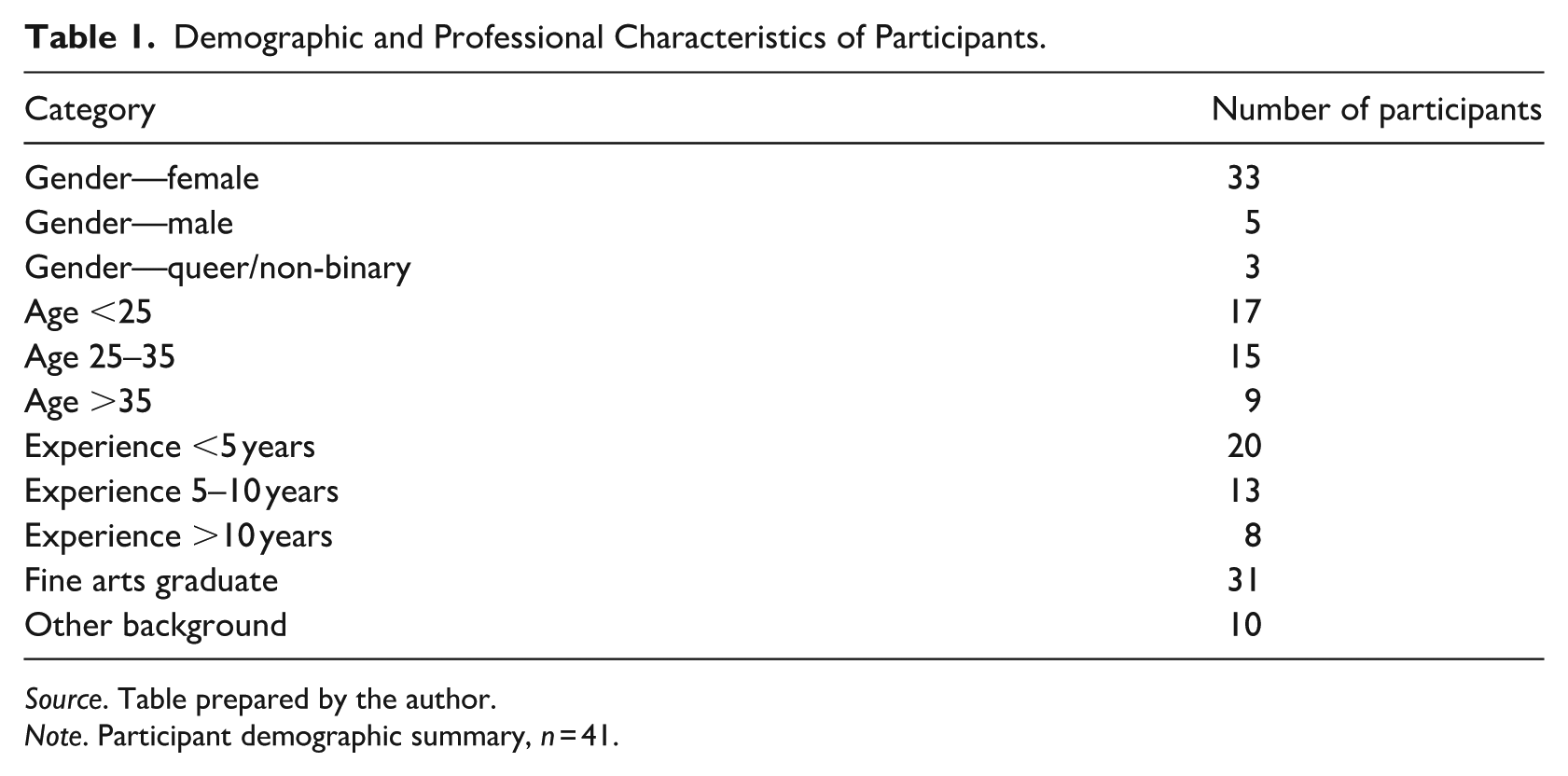
Source. Table prepared by the author.
Note. Participant demographic summary, n = 41.
Professionalization without protection: GMK and the institutional boundaries of art labor
Before turning to participants’ individual narratives regarding their everyday working conditions, it is necessary to examine the institutional landscape within which graphic designers operate in Turkey. One of the most striking observations that emerged during the recruitment process for this research was the absence of a collective labor organization capable of representing graphic designers as workers. Unlike many other occupational groups, graphic designers in Turkey are neither organized under a trade union nor institutionally connected to a broader cultural labor movement. The material dimensions of this absence were consistently reflected across participants’ accounts. All 41 designers reported having worked without formal contracts or with severely limited social protection at some point in their careers-often for extended periods. Freelance arrangements, rarely converting into permanent positions despite repeated assurances, constituted a structural norm rather than a transitional phase. Several participants described being pressured to resign rather than being formally dismissed, a practice that strips workers of severance entitlements and renders labor precarity legally invisible. Access to social insurance, where it existed at all, was frequently partial or contingent on informal negotiation. Alongside these contractual conditions, participants consistently recalled receiving feedback on their creative work from managers and clients without artistic backgrounds, experiences they described not merely as frustrating but as symptomatic of a broader devaluation of artistic labor within market-oriented production structures. Taken together, these conditions point to a field in which precarity is not exceptional but constitutive: graphic designers operate within a labor regime defined by the systematic absence of the protections that formal employment is otherwise expected to provide.
The closest institutional structure within the field is the Association of Graphic Designers (Grafik Tasarımcılar Meslek Kuruluşu—GMK), a legally established professional association that functions primarily as a platform for networking, exhibitions, and professional visibility. GMK organizes competitions, promotes design standards, and circulates job opportunities within its internal network. However, despite its institutional presence, GMK does not function as a labor organization advocating for designers’ rights, wages, or working conditions.
This institutional positioning became particularly visible during the early stages of this research. While searching for participants, I initially contacted GMK and shared my call for interviewees. In their response, the association requested that I remove the term “art worker” from my announcement. According to their explanation, graphic design should not be framed within the conceptual category of artistic labor. Instead, they emphasized that contemporary graphic design is firmly embedded in white-collar professional structures and operates entirely within the logic of market production. In their view, associating graphic designers with “art workers” would inaccurately represent the profession and its relationship to the market.
Although I revised the announcement in line with their request—responding to the email sent on February 19, 2025—I did not receive any further feedback from the association. Similarly, my request to conduct an interview with one of the board members remained unanswered. This lack of engagement itself proved revealing. Rather than serving as a mediating institution between designers and the structural challenges of the labor market, GMK appeared to position itself primarily as a professional network that reinforces the market-oriented identity of the field.
From the perspective of this study, the rejection of the term “art worker” is analytically significant. It illustrates how institutional actors reproduce the economic disavowal of artistic labor—not by elevating art as autonomous, as bourgeois ethics traditionally does, but through a distinctive reversal: actively distancing the profession from artistic labor altogether, while leaving questions of labor protection unaddressed.
The responses of participants suggest that this institutional positioning does not necessarily resonate with designers’ everyday experiences. Among the 41 participants interviewed in this study, only four were familiar with GMK by name, and none of them described the organization as a structure capable of addressing labor problems.
Zeynep, a 27-year-old woman working in Istanbul with 4 years of experience in the design sector, described her perception of GMK in the following way: I know the name, of course. You see their competitions or events sometimes. But I have never thought of them as an organization that could help with workplace issues. It feels more like a community for showcasing good design rather than a place where designers could talk about salaries, contracts, or working conditions.
For Zeynep, the association appeared to function primarily as a symbolic professional space rather than a structure of collective representation. Her description reflects a broader pattern within the field, where institutional visibility often coexists with the absence of mechanisms addressing labor precarity.
A similar sentiment was expressed by Mert, a 31-year-old male graphic designer based in Ankara who has worked in the industry for 7 years: To be honest, when we talk about GMK among colleagues, it usually comes up in relation to design competitions or exhibitions. But nobody expects them to intervene if there is a problem with working conditions or wages. In that sense, it doesn’t operate like a professional union.
In Ankara, several participants instead mentioned the Ankara Advertisers Association (AKD), another professional network within the broader advertising sector. Yet their evaluations of this organization echoed similar concerns. Participants did not perceive AKD as an institution advocating for designers’ rights but rather as a platform that primarily serves the interests of advertising agencies and market actors.
Ece, a 24-year-old woman who recently entered the profession after graduating from a fine arts faculty, explained this perception clearly: When people mention AKD, it is usually in relation to employers or agencies. It feels like a network where companies communicate with each other rather than a place where designers could organize collectively. So, from the perspective of employees, it doesn’t really represent us.
Taken together, these narratives point to a broader structural condition: the absence of institutional protection for graphic designers as workers. In contrast to many other professional sectors where trade unions or professional chambers mediate labor relations, graphic designers remain largely unrepresented in Turkey’s labor landscape.
This absence is particularly striking when read through Praznik’s framework. Graphic design in Turkey is positioned in a doubly disavowed space: bourgeois cultural ideology historically romanticized artistic production as detached from economic necessity, while institutional discourse here moves in the opposite direction—stripping the profession of its artistic dimension while simultaneously failing to recognize it as labor deserving collective protection. Designers are expected to function as white-collar professionals, yet the institutional frameworks associated with professional labor—unions, collective bargaining, regulatory bodies—remain largely absent (Federici, 1975; Gill and Pratt, 2008; Praznik, 2021).
Becoming market subjects through seniority: Experiences of women
One of the most striking patterns that emerged from the interviews with women graphic designers concerns the relationship between seniority and the gradual redefinition of the self-from an artistic subject toward a market-oriented worker. What the interviews reveal is not a gradual maturation into professional realism, but something more structurally precise: the moments of strongest artistic identification coincide with the most precarious conditions, and the moments of relative stability coincide with the fading of that identity. Artistic subjectivity and economic security appear, from within these narratives, as mutually exclusive—which is itself a live illustration of the paradox of art that Praznik’s framework describes. The economic disavowal of artistic labor does not arrive as an external imposition; it is reproduced from within, through the accumulated adjustments workers make in order to survive.
Ayşe, a graphic designer in her mid-30s with 12 years of professional experience across seven different companies, provides a particularly clear illustration of this process. Having graduated from a Faculty of Fine Arts through a competitive talent examination, she recalls that during her university years and early career, she strongly identified as an artist, as her work was evaluated primarily on the basis of creativity rather than marketability. However, as she moved through different workplaces over time, she began to observe a recurring pattern: the moments in which she felt most like an artist coincided with periods of heightened precarity, marked by unstable income, freelance dependency, and limited access to social protection. Conversely, periods of relative stability—such as securing a fixed salary and benefits—were accompanied by the fading of her artistic self-perception. Under these conditions, she came to understand her labor as increasingly indistinguishable from other forms of white-collar work, reduced to “polishing” what is already deemed valuable by the market.
What Ayşe describes is the economic disavowal of artistic labor from the inside: the wage relation and labor protections are absent not through formal exclusion but through the slow normalization of their absence, legitimized by the very language of artistic autonomy she once inhabited. Crucially, she does not experience this autonomy as a desirable ideal—she experiences its material consequences as unsustainable. The abandonment of artistic subjectivity, in her case, does not represent a voluntary alignment with market logic but rather a necessary adjustment to precarious labor conditions. Seniority, therefore, does not lead to professional empowerment but instead entails a gradual accommodation to the constraints of neoliberal labor regimes.
Ayşe, a married woman without children, lives with a partner who, in her own words, works significantly longer hours than she does. When asked about the distribution of domestic labor through open-ended questions, she emphasized that she does not assume sole responsibility for household tasks; instead, these are shared with her partner as a joint responsibility. She also noted that, in her family home, a cleaning woman had been employed regularly since her childhood, suggesting that domestic labor had long been externalized rather than internalized as her own obligation.
At home, we share everything. I don’t take on the housework alone—it’s something we both see as our responsibility. Even growing up, there was always a cleaning woman at home, so I was never really in a position where those tasks were fully mine.
In this sense, Ayşe’s experience aligns with the trajectory often associated with urban, educated women, where domestic labor is partially outsourced or redistributed, allowing for a degree of distance from traditionally gendered household responsibilities. However, her professional trajectory reveals a striking reversal of this narrative. Over time, as her work in graphic design became increasingly reduced to what she describes as “polishing” and subject to precarious conditions, sustaining an artistic identity became materially untenable. As a result, Ayşe gradually distanced herself from artistic subjectivity and repositioned herself as what she terms a “real worker.”
Her account thus demonstrates that while domestic labor may be partially escaped in the private sphere, processes of devaluation and precarization re-emerge within the sphere of creative labor. In other words, the relative absence of domestic responsibility does not eliminate gendered forms of labor inequality but instead displaces them into new domains, where creative work becomes subject to similar logics of undervaluation and insecurity.
A similar dynamic emerges in the narrative of Neriman, a woman in her late 30s with over a decade of experience, whose trajectory also includes a period of employment in Berlin. Reflecting on her earlier career in advertising agencies, she emphasizes that forms of recognition and security were largely informal and never institutionally guaranteed. Even during her time working in a corporate setting in Berlin, she did not fully identify as an artist; however, she recalls that job security there was comparatively stronger. In Turkey, by contrast, she describes a labor regime in which artistic work is systematically treated as expendable, with layoffs often beginning in art departments precisely because their labor is perceived as replaceable.
This comparison points to the relative absence of stable employment structures within Turkey’s creative industries. As Lorey (2015) suggests, precarity is not only a material condition but also a mode of subject formation, in which individuals are systematically denied stable belonging—particularly to the social groups they aspire to be part of.
What is also significant in Neriman’s account is her explicit comparison between artistic labor and domestic labor. When prompted, she immediately recognizes the parallel, describing a situation in which labor is simultaneously “expected” and “devalued”: it is constantly evaluated and criticized, yet rarely acknowledged as requiring “skill” or “effort.” The description—expected but not recognized as skilled, evaluated but not acknowledged as labor—is structurally identical to Federici’s account of domestic work: rendered invisible through naturalization, its economic disavowal enabled precisely by the assumption that it requires no particular effort. Graphic design labor, in Neriman’s account, occupies this same position: simultaneously necessary and structurally devalued, its indispensability the very condition of its expendability.
It is also important to note that Neriman explicitly identifies as a feminist and positions herself at a clear distance from domestic labor. She emphasizes that she does not take on household responsibilities and that the condition of her home is not something open to external scrutiny. Having graduated from a well-known French lycée in Ankara, her account reflects a form of urban, educated subjectivity in which traditional expectations around domestic labor are actively rejected.
However, her privileged positioning does not translate into greater stability within the field of creative labor. On the contrary, her experiences and observations point to a broader dynamic within Turkey’s creative industries, where artistic labor is increasingly constructed as replaceable and based on the assumption that “anyone can do it.” In this sense, the precarization of artistic work does not simply stem from individual conditions but is rooted in a wider devaluation of creative labor, where skill, expertise, and artistic authorship are systematically undermined.
Bade, a 31-year-old graphic designer and mother of one child, presents a narrative shaped by “fatigue, pragmatism, and strategic accommodation.” Having initially imagined a career that would allow her to function as an artist, she now describes her work as something she performs primarily for financial reasons and relative stability. Her decision to remain in graphic design “rather than pursue interior architecture reflects a calculated evaluation of labor conditions: while both professions would constrain her creative autonomy, graphic design offers a clearer and more predictable alignment with market expectations.”
However, Bade’s account also reveals a crucial asymmetry between workers and employers: While designers may experience the transition from artistic subject to market-oriented worker as a clear rupture, employers do not recognize this shift in the same way. Instead, they continue to position graphic design labor within an ambiguous space between art and market production. During periods of stability, designers are expected to act as rational, market-oriented employees; yet during moments of crisis-such as layoffs-our labor is suddenly reclassified as “artistic,” and therefore easily disposable.
The ambiguity Bade describes is not a classificatory confusion but a structural resource: the neither-artist-nor-worker positioning that Praznik identifies as the paradox of art is here mobilized instrumentally, invoked or suspended depending on what the labor regime requires at a given moment.
Birsen, a 26-year-old graphic designer who transitioned into the field from an unrelated discipline after studying at a well-regarded Faculty of Arts and Sciences in Istanbul, makes this dynamic even more explicit. Although she initially turned to graphic design out of a desire to engage in creative production, her account reveals “a growing disillusionment with the economic realities of the profession.” Her comparison between her own wages and domestic labor is particularly striking: while graphic design is formally recognized as waged labor, she describes her income as only “symbolically higher” than that of unpaid household work—a formulation that directly maps onto Federici’s analysis of how the wage relation is withheld from feminized labor.
Nil, a 22-year-old recent graduate with only 3 months of professional experience, shows that these dynamics begin at the very start of a career. Despite her enthusiasm for creative work, she immediately encounters “low wages, limited social protection, and high living costs.” Her reflections on the possibility of remaining at home as a “daughter” blur the boundary between artistic and domestic labor, suggesting that both are governed by similar logics of flexibility, disposability, and undervaluation.
Nil, who shares a flat with four female friends, explicitly positions herself against domestic labor and maintains a minimal level of household responsibility. Despite this distance, she reflects critically on her labor market position: given her low income and absence of job security, she notes that returning to her family home as a “daughter” could, in some respects, offer a more comfortable arrangement. As she describes it, the surplus she produces through her labor returns to her only in a “symbolic” sense.
At the same time, she emphasizes how easily her artistic perspective can be overridden in professional settings. Recalling a moment when her employer told her, “you will do this job according to the client’s taste,” she describes how her own artistic gaze becomes readily ignorable—something that can be set aside or abandoned without resistance. Yet, despite these conditions, Nil continues to insist on her artistic identity and defines her work through this lens.
A similar tension emerges in the account of Gülse, who is of the same age as Nil. Unlike Nil, Gülse lives with her family and has never taken on domestic labor responsibilities. She notes that, had she performed housework within the family home, it would at least have been appreciated, particularly by her mother. In contrast, she experiences a profound lack of appreciation for her artistic labor. She also works under highly precarious conditions: her contract is renewed every 6 months, and she does not have formal social security coverage. She recounts how, in a WhatsApp group, her manager, who is not an artist, responded to her work with a simple “clapping” emoji when unable to offer substantive feedback. More broadly, she frequently hears, both in professional and social settings, that her work could easily be replaced by “anyone,” positioning her not as an artist but as an interchangeable worker.
Gülse’s account points to the same contradiction: her labor generates surplus value, yet this is not reflected in her wages, rights, or position. Creative labor is rendered visible in output but invisible in recognition and protection.
Across the narratives, seniority emerges as a key axis through which artistic subjectivity is reconfigured in tandem with the rearticulation of domestic labor logics among urban women. While early career stages are marked by a stronger identification with artistic creativity and a relative distance from domestic responsibilities, the accumulation of experience within precarious labor markets produces a different alignment: stability becomes tied to market conformity, while artistic autonomy is increasingly associated with insecurity. In this process, the logics historically associated with domestic labor—such as invisibility, affective investment, and systematic undervaluation—re-emerge within professional life, despite women’s relative exemption from domestic work in the private sphere. Seniority, in this sense, does not simply reflect professional maturation but marks what Lorey (2015) calls precarity as a mode of subject formation: the gradual denial of stable belonging—to the category of artist, to labor protections, to recognized professional identity—reproduced not through a single rupture but through the accumulated weight of small adjustments, each of which feels like survival.
However, this trajectory does not unfold uniformly across gendered subject positions. While urban women’s experiences reveal how artistic subjectivity is reshaped through the reconfiguration of labor and the displacement of domestic logics into creative work, the narratives of male graphic designers point to a different configuration—one in which artistic identity is not necessarily relinquished, but negotiated in relation to the economic and social expectations of masculinity.
Holding on to being an artist? Story of male gaze
Although this study primarily foregrounds the experiences of women graphic designers in order to trace how artistic labor is devalued and reconfigured under neoliberal conditions, it is analytically necessary to also consider how male graphic designers position themselves within the same field. The structural condition is the same—the economic disavowal of artistic labor, the neither-artist-nor-worker positioning—but the gendered norms through which it is lived diverge sharply. In Turkey, where gendered expectations of labor and subjectivity have been shaped through both state-led modernization and patriarchal norms, this divergence has a particular historical texture. As Sirman (1989) argues, the project of state feminism not only incorporated women into public life but regulated the boundaries of acceptable femininity, producing a gendered order in which women’s professional visibility remained tightly conditioned. More recent work by Ozbay and Soybakis (2020) demonstrates how this legacy has been rearticulated under contemporary conditions, where neoliberal restructuring intersects with Islamist hegemony and patriarchy, reshaping both gender relations and labor regimes.
Within this broader framework, masculinity cannot be understood as a neutral or unmarked category. As Connell (1990) conceptualizes, hegemonic masculinity operates in close alignment with both neoliberal and patriarchal structures, privileging economic productivity, independence, and the capacity to provide. As Keskin (2018: 10) notes, masculinity must be examined in relation to its “inadequate representation of women”—that is, through the ways in which gendered hierarchies are reproduced across different domains of life.
As discussed in the previous section, women graphic designers often respond to the structural devaluation of artistic labor by gradually distancing themselves from the identity of the artist. This distancing operates as a strategy of endurance within a labor market that systematically undervalues their work in ways that closely resemble the historical devaluation of domestic labor. The structural devaluation of artistic labor—its association with passion, flexibility, and disposability—is a condition shared across genders; however, feminized labor norms shape how this condition is lived by women, intensifying the pressure to abandon artistic subjectivity as a strategy of survival within the labor market.
Male narratives, however, reveal a different configuration. While male graphic designers are similarly exposed to low wages, instability, and precarious working conditions, their relationship to artistic identity appears less susceptible to complete abandonment. Instead, what emerges is a tension between masculinity, income, and artistic self-identification, rather than a full detachment from the latter.
Veli, a 25-year-old graphic designer with 3 years of experience, articulates this tension explicitly. Reflecting on his position, he states: I am a straight man. I am not in a conventional relationship, nor am I actively seeking one. But I cannot ignore the echoes from my social interactions. . . suggesting that if I ever wanted a more traditional life-such as marriage or having a baby-I would not be able to sustain it as a male graphic designer.
For Veli, the issue is not only economic but also deeply tied to the social expectations of masculinity. When asked to elaborate on what he meant by a “traditional life,” he clarified: What I mean is the kind of respectable masculinity our society expects from men. And here money becomes a very big stage. . . In the eyes of many people close to me, I am basically like a “house husband.”
Veli’s comparison of himself to a “house husband” reflects a perceived failure to meet the economic expectations of masculinity. The devaluation of artistic labor does not erase his artistic identity but destabilizes his masculine subjectivity—a dynamic structurally distinct from women’s accounts, where the same association accelerates the abandonment of artistic identity altogether.
Importantly, however, this destabilization does not lead to a complete abandonment of the artist identity. As Veli continues: I also see myself as an artist, and I hold onto that identity. . . In job interviews I often avoid referring to my artistic identity and instead frame it explicitly as work. . . Of course it is work-but it is artistic work. And because it pays so little, apparently it is not suitable for a Turkish man.
Here, artistic identity is not relinquished but strategically concealed and rearticulated depending on context. This contrasts sharply with the trajectories observed among many senior women designers, for whom distancing from the artist identity becomes a more permanent adaptation to market conditions.
A similar tension is visible in Serkan’s account, a 34-year-old designer and father, who emphasizes the gap between creative fulfillment and economic expectations: My work carries traces of my creativity. . . but when I compare my salary with those of other men my age. . . the income disparity is crazy.
In both cases, lack of income is the central axis through which masculinity is negotiated. Yet artistic identity is not abandoned—men sustain it alongside a sense of inadequacy, because their social legibility as workers is not equally dependent on relinquishing the category of art.
This dynamic becomes even more explicit in Mustafa’s account, a 48-year-old art director and company founder: If you are a male graphic designer, you start out as an artist. As you learn the market, the identity of “worker” is added next to the artist identity. And if you stay long enough, you can distribute those identities however you want.
Mustafa’s formulation names what women’s narratives consistently show is unavailable to them: the capacity to hold both identities simultaneously and distribute them at will.
Taken together, these accounts suggest that the devaluation of artistic labor is a shared structural condition rooted in capitalist patriarchy, while gendered norms shape how this condition is differentially lived. For women, feminized labor norms—flexibility, affective investment, and disposability—intensify the erosion of artistic identity and reinforce alignment with undervalued forms of labor. For men, breadwinner expectations generate a tension between artistic identity and economic demands without fully dissolving the former, because masculine social legibility as a worker does not require the same degree of identity relinquishment.
In this sense, male narratives do not contradict the argument developed in this study but rather complete it. They reveal that the devaluation of artistic labor cannot be understood solely through its material conditions but must also be situated within gendered regimes of recognition. While women are compelled to relinquish artistic subjectivity in order to remain in the labor market, men are able to retain it—even under precarious conditions—because their social legibility as workers is not equally dependent on abandoning the category of art.
For non-binary designers, the negotiation of artistic labor unfolds not only through precarity and market pressures, but also through the persistent denial of stable belonging—both within the labor market and within socially recognized gender categories. The fragile balance that male designers maintain becomes significantly more unstable when one moves beyond binary gender positions.
Beyond binary
Among my non-binary participants, precarity did not simply appear as an intensified version of the conditions described by women and men; rather, it emerged as a structurally different mode of existence within the field of artistic labor. None of the three non-binary designers I interviewed were employed through formal contracts. Instead, they navigated a fragmented labor landscape composed of multiple uninsured, short-term, and project-based jobs. Work circulated not through institutionalized professional platforms such as LinkedIn or portfolio sites like Behance, but through informal and often opaque networks—most notably WhatsApp groups, where opportunities were redistributed among peers.
The labor form Praznik identifies—structurally invisible, severed from the wage relation, circulating outside institutionalized channels—is here not a theoretical construct but a description of daily working life. What the non-binary accounts add is that this invisibility is compounded by a second axis of non-recognition: non-binary designers are positioned outside stable labor relations and outside socially legible gender categories simultaneously. Their experience of precarity therefore extends beyond economic insecurity into what Lorey (2015) calls the denial of stable belonging—not only as workers, but as subjects.
Deniz, a 21-year-old non-binary graphic designer, articulates this condition with striking clarity: There is no fixed income, no insurance, no clear job description, no defined working hours. Precarity is basically the freelance side of this profession. And if you are a young person like us trying to do many different jobs at the same time just to survive, it becomes even more intense.
Here, precarity is not described as a temporary or exceptional state but as the defining characteristic of the profession itself—particularly for those positioned at its margins. Deniz’s account resonates strongly with Lorey’s (2015) conceptualization of precarity as a mode of governing subjectivity, in which individuals are systematically denied stable forms of belonging. In this case, the absence of contractual security is inseparable from the absence of social and institutional recognition, producing a condition in which the subject is compelled to continuously navigate unstable and overlapping forms of labor without the possibility of consolidation.
This condition is further intensified by the broader political and cultural environment in Turkey, as Deniz continues: For me it’s clear that I absolutely have to move to Europe. Staying here—where people who carry reactionary ideas and hatred toward certain groups are normalized despite a supposedly European legal framework—is not good for me, neither professionally nor in everyday life.
Deniz’s account shows that precarity is not only produced within the labor market but shaped by the broader political and cultural environment. Their desire to leave Turkey reflects not simply an economic calculation but a response to a context in which both professional sustainability and everyday life are structured by hostility and exclusion. Precarity here operates simultaneously across labor, identity, and space—shaping not only how individuals work but where they imagine their lives to be livable.
The experiences of non-binary designers expose the structural limits of artistic labor most sharply—where economic precarity, gender non-recognition, and institutional absence converge. Their narratives do not merely extend this article’s argument but also reveal its limits, pointing to the need for an analytical framework that accounts for how precarity is distributed across intersecting axes of gender, labor, and belonging.
Conclusion
This article has argued that the ambiguity of artistic labor is not a neutral or inherent feature of creative work, but a socially produced condition that is unevenly lived across gendered subject positions within neoliberal labor regimes. Building on Praznik’s framework, it shows that the devaluation of artistic labor stems from a structural condition shared across genders—being positioned as neither fully artist nor fully worker within capitalist patriarchy—while gendered, masculinized, feminized, and queer norms modulate how this shared contradiction is experienced, navigated, and reproduced. In doing so, the article contributes to the literature on artistic labor and precarity by shifting the focus from structural descriptions of ambiguity to how that structural condition is differentially lived. Drawing on the experiences of graphic designers in Turkey, the findings demonstrate that while artistic labor is framed as creative and autonomous, it is structured by precarity, invisibility, and unstable regimes of recognition characteristic of neoliberal restructuring.
By centering women’s narratives, the analysis reveals that artistic identity becomes increasingly difficult to sustain over time, as seniority deepens exposure to precarious conditions. Even among urban women relatively distanced from domestic labor, its underlying logics—affective investment, flexibility, and systematic undervaluation—re-emerge within creative work in reconfigured forms. In contrast, male designers are more able to retain artistic identity, while non-binary designers experience precarity in its most intensified form. Taken together, these findings extend feminist analyses of labor by demonstrating that artistic labor is a key site of gendered value production under neoliberalism, where ambiguity operates as a mechanism through which precarity is unevenly distributed.
These findings also invite reflection on the ambiguous status of graphic design itself, whether it should be understood as a form of art or as a type of creativity more closely tied to advertising and market-oriented production. As the empirical material demonstrates, this question is not merely definitional but carries significant material consequences. Graphic design occupies a structurally liminal position: it draws on artistic training, aesthetic judgment, and creative subjectivity, yet it is primarily organized around the demands of clients, brands, and commercial logics. This dual character is not incidental but constitutive of the field, and it shapes the conditions under which designers can claim, sustain, or relinquish an artistic identity. The institutional distancing from artistic labor observed in the GMK case, combined with participants’ own ambivalent self-positioning, suggests that graphic design is best understood neither as straightforwardly artistic nor as purely market-driven, but as a site where these categories are continuously contested and renegotiated. Crucially, as this study has shown, the outcome of that contestation is not socially neutral—it is gendered, and it is consequential for how labor is valued, recognized, and protected.
Footnotes
Acknowledgements
Endless thanks to Katja Praznik, whose comments and encouragement while this article was still only a draft motivated me to transform it into a full paper.

Funding
The author received no financial support for the research, authorship, and/or publication of this article.
Declaration of conflicting interests
The author declared no potential conflicts of interest with respect to the research, authorship, and/or publication of this article.