






Abstract
This paper analyzes how contemporary art museum workers in the U.S. are advancing intersectional social justice through their labor organizing and demands for a living wage. The mixed-methods study uses social reproduction theory to situate museum work as exploited labor and to examine how this contemporary unionization wave is fighting for a reconfigured museum field that is simultaneously pro-worker, anti-racist, and feminist. The analysis focuses on considerations of pay equity, as a site of convergence for the movement’s transformational aims and material achievements.
Introduction
Art museum workers in the United States are driving the most active period of labor organizing in the sector in decades. They are, furthermore, enacting a liberatory unionism in which the issues at stake are not simply higher pay and better working conditions. Instead, they are actively situating their labor fights within larger struggles for social justice and equity in and beyond the workplace. In this study, I use social reproduction theory to situate museum work as exploited labor and to examine how this contemporary unionization wave is fighting for a reconfigured museum field that is simultaneously pro-worker, anti-racist, and feminist. This analysis focuses on considerations of pay equity as a site of convergence for the movement’s transformational aims and material achievements.
What one interview participant termed the “abysmally low pay” at their museum is not a new phenomenon. Art museums have long relied on volunteer and underpaid labor to subsidize their operations, thereby restricting access to museum careers primarily to wealthy and elite groups. Yet it is the external operations and (neo-)colonial functions of museums – particularly encyclopedic/universal museums and contemporary art collections – that have been the focus of the bulk of critical museum analysis (e.g., Azoulay, 2019; Bennett, 1995; Duncan, 1995; Karp and Levine, 1991; Lonetree, 2012; Shaked, 2022; Vergès, 2024). The “consequences of museum work for the worker” are less studied in comparison (Südkamp, 2021: 73). Discourses of passion and love obfuscate the labor that is required to sustain cultural production. Additionally, cultural work has been particularly vulnerable to late-stage capitalism and the destabilization of traditional workplace protections, which hinge on the idea of the entrepreneurial artist as the ideal archetype of precarious work to further depress wages in the sector (Banks et al., 2013; Chung, 2022; McRobbie, 2016; Praznik et al., 2022). Social reproduction theory therefore provides an essential lens for understanding the material and affective circumstances of museum work and its consequences for who can afford to access and thrive in these careers. I turn here to Praznik’s (2021: 40) framework of social reproduction as applied to artistic labor, where: Because it is done out of love and allows self-fulfillment irrespective of economic concerns, unpaid artistic work resonates with feminist findings about the assumed nature of housework, which women presumably do out of motherly love and/or their natural calling. To echo the feminist slogan “They say it is love. We say it is unwaged work,” we could say that for the love involved in producing art, art workers have to relinquish payment for their efforts or accept modest and retroactive fees.
It is not only artists, but cultural workers writ large, who make financial sacrifices out of love for the job (Child et al., 2017). The historical circumstances around the development of the museum profession further entrench structures of sub-standard and untenable wages. As a result, as one participant notes, museum workers may love their jobs, “But the pay was horrible.”
Yet art museum workers are responding to these increasingly unstable and exploitative working conditions with “a new and angry optimism” about the conditions and possibilities of museum work (Roelofs and Scott, 2023: 7). Since 2019, there has been a 179% increase in new organizing at private, not-for-profit art museums in the U.S. (Levine and Ripley, 2024; as of May 24, 2026). New Museum workers in New York City launched the current “unionization wave” (Paparella, 2020) when they organized the New Museum Union with the United Auto Workers Local 2110 in 2019. Philadelphia Museum of Art workers quickly followed suit when they organized with the American Federation of State, County, and Municipal Employees District Council 47 Local 397, leading in the rise of “wall-to-wall” unions that encompass workers from all eligible departments. Though these unions organized in response to working conditions that long predate the COVID-19 pandemic, institutional responses to COVID-19 exposed and exacerbated the rampant exploitation of museum workers, leading to a boom in organizing. Widespread layoffs and furloughs predominantly affected front-of-house workers, who tend to be more racially diverse and queer (Levine et al., 2025), further spurring organizing efforts across the sector.
Notably, these museum unions are enacting an intersectional agenda – a “liberatory unionism” (Livingston, 2021) that situates labor concerns within interconnected struggles for racial, environmental, gender, and disability justice. Museum workers are joining a “new labor activism moment” (Cornfield, 2023: 2) in pursuit of not only a more just cultural sector, but to “Imagine a strike not only against this or that museum but against the very logic of the capital embodied in museums” (Azoulay, 2019: 159). Museum workers’ labor actions envision a radically restructured society, one that starts with the simple demand for pay equity. My central research question, therefore, asks how the U.S. art museum unionization movement conceives of and discusses the interconnections of labor and class with racism and gender oppression, and how workers position union struggles to instigate material change.
Methodology
In approaching this project, which I position as a praxis of “resistant research on cultural work” (De Peuter and Cohen, 2015: 305), I apply feminist social reproduction theory to attempt an ethical research towards social change (Ripley, 2025). I used a mixed-methods approach (Leavy, 2017) to craft an overarching and multi-pronged investigation into the art museum labor movement and its external and internal representations, discussions, debates, and manifestations of social justice unionism. I examined social media posts from a selection of art museum unions to analyze the visual and verbal rhetoric of social justice used in these public-facing campaigns. I then conducted 48 interviews with museum workers, organizers, and activists and asked participants to complete a demographic survey. 33 out of 48 participants completed the survey, a response rate of 69% (see Supplemental Appendix for detailed participant demographic data). I conducted purposeful sampling (Leavy, 2017) to reach individuals actively engaged in museum unionization campaigns, including relying on snowball sampling. I also draw from limited field research conducted in the spring of 2023 and my own autoethnographic reflections from my participation in the organizing of a union at my former place of employment from 2020 to 2021.
I analyzed these data sources in NVivo using a flexible coding process (Deterding and Waters, 2021) that first indexes content based on interview questions and then further analyzes the data based on emergent themes. Drawing from the results of a pilot study (Ripley, 2023), I developed interview protocols that asked participants to reflect on: their work and unionization experiences; their perceptions of management-directed diversity, equity, accessibility, and inclusion (DEAI) initiatives; understandings of bargaining for the common good principles; and whether and how they see their organizing in relation to other social justice struggles. Interviews typically evolved according to each participants’ interests and experiences; as such, participants acted more as conversation partners than interviewees, actively participating in and shaping the inquiry (Rubin and Rubin, 2024). The 20 index codes deriving from interview questions included: Bargaining goals, bargaining for the common good, common purposes (i.e., between the union and institutional goals), current role (at the museum), former role (at the museum), future of the union, leaving the union, museum organizing versus organizing other sectors, defining solidarity, expressing solidarity, managing union staff, (personal) organizing history, organizing museums, other social justice organizing, parent union goals, personal history with unions, scope of union work, social justice unionism, unions and institutional DEAI, and union social media. My initial round of emergent coding produced an additional 218 codes. I then revisited the transcripts and codes, consolidating similar codes and creating 18 total parent (to use NVivo’s terminology) codes. 1
In my outreach to potential participants, I did not prescribe a definition of an “art museum worker,” opting instead to allow for participant self-identification as such. In situating the results, however, I turn to the framework used by the not-for-profit Museums Moving Forward, a limited life organization that uses data and discourse to work towards a more just museum sector. In their research on working conditions in art museums, Museums Moving Forward classifies contemporary museum professions into five basic functions: administration (42% of workers), building operations (24% of workers), collections (33% of workers), communications (15% of workers), and public engagement (27% of workers) (Benoit-Bryan et al., 2023). The most prestigious roles in museums tend to be those involved in “intellectual leadership” of the institution, which Sweeney et al. (2022: 11) classify as administrative leaders (directors, chief executives, chief financial officers, chief technology officers), curators, conservators, and educators. Traditional hierarchies often situate curators above other non-administrative roles (Cachia, 2014; Matthai, 1974), however, and front-of-house roles rank among the lowest in these hierarchies (Crooke and Farrell-Banks, 2024; Museums Association, 2022). Workers across all these professional functions have been active and engaged in contemporary organizing. Figure 1 represents participants’ reported departmental affiliations, and Figure 2 compares this study’s data to Museums Moving Forward’s functional distribution. Like Museums Moving Forward, I limited my study to art museums alone, though there has been a wave of organizing across other kinds of museums in recent years as well, with many overlapping concerns and aims (see Cummins and Bryant, 2026; Ripley et al., 2025a; Urban, 2021).
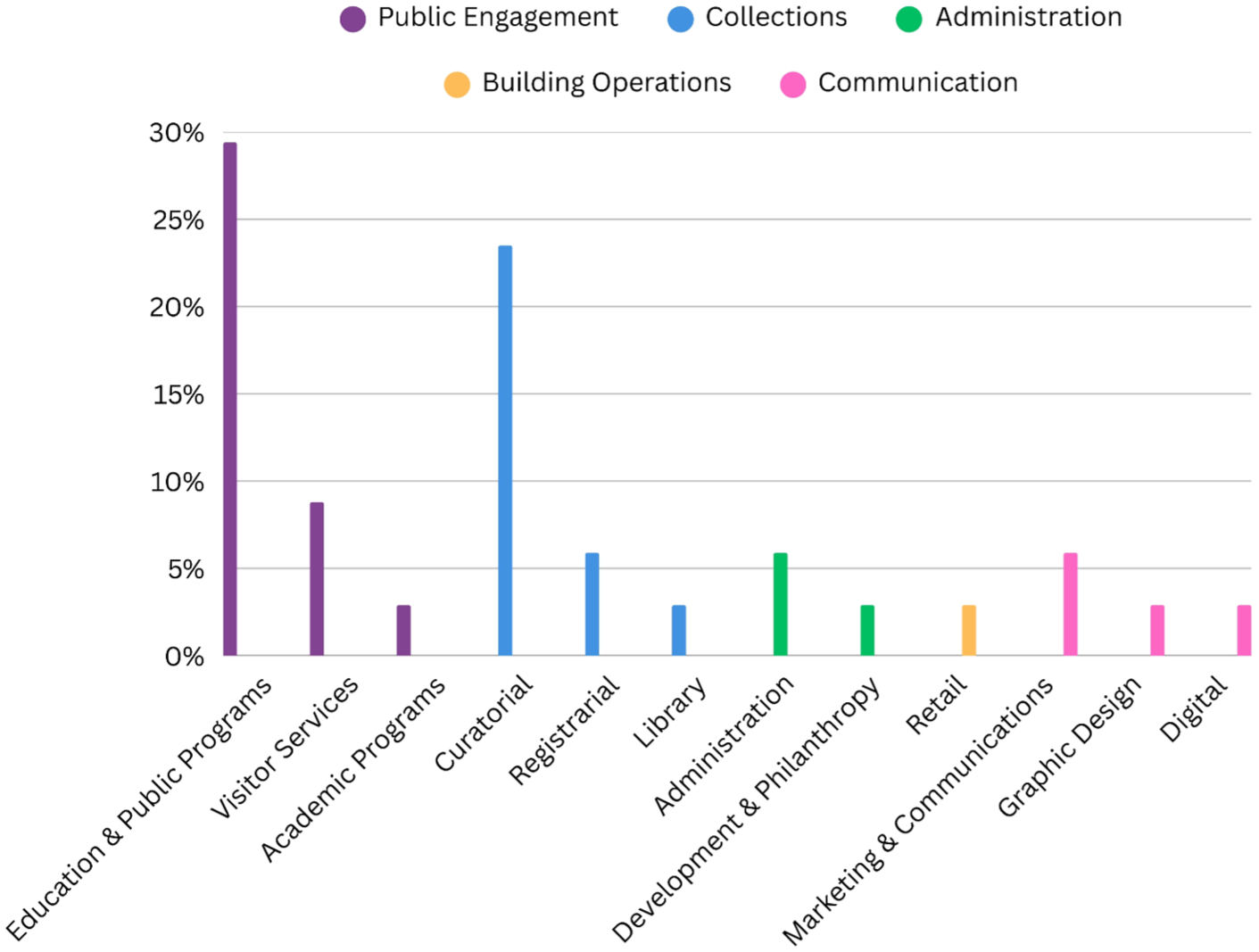
Departmental distribution.
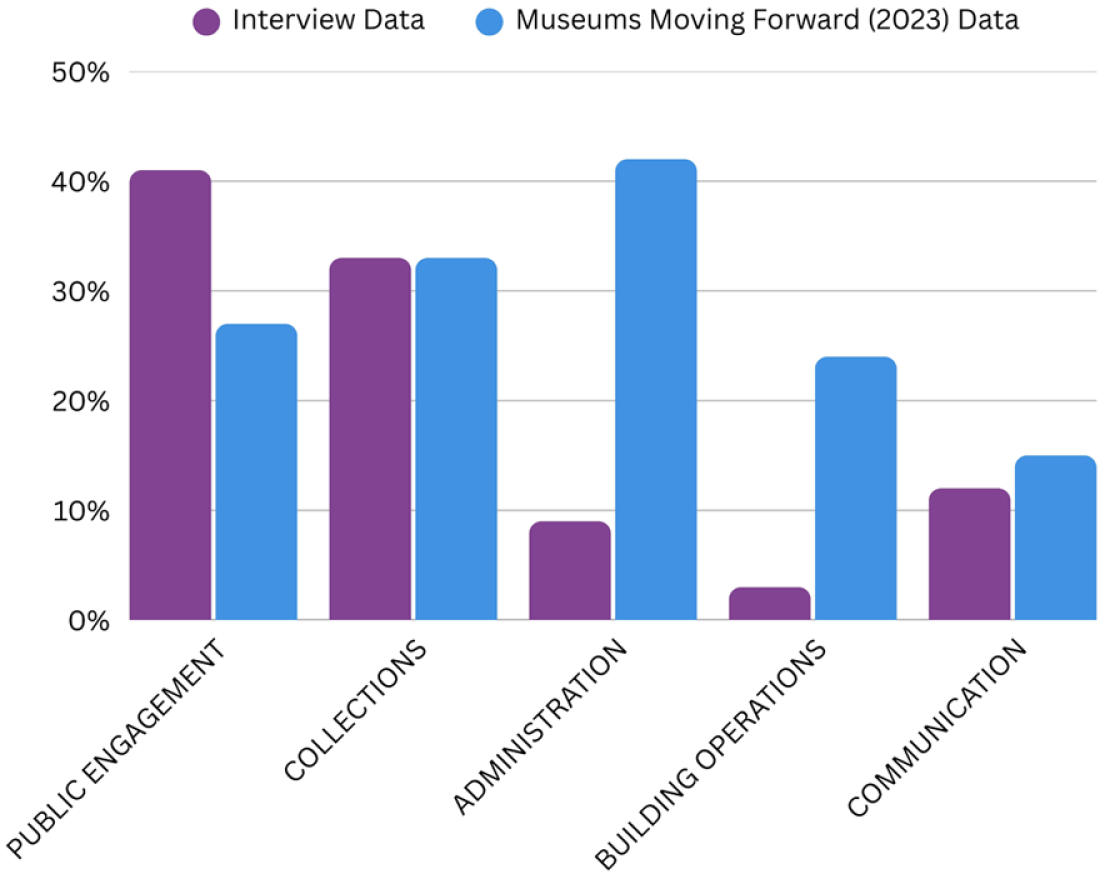
Professional functions.
Pay equity in organizing campaigns
A common denominator among several repeated motivations for establishing labor unions that emerged in this study is the pursuit of higher wages, distributed more transparently and without bias. This central issue runs through both traditional “bread-and-butter” labor issues (pay, benefits, and working conditions) as well as more expansive “bargaining for the common good” provisions that are tied to a greater decision-making power and broad social justice campaigns. As I will demonstrate, however, most museum workers do not see these as mutually exclusive concerns, but rather situate “the economic as a social relation” (Bhattacharya, 2017: 70), positioning pay equity as a means towards greater racial, socioeconomic, and gender equity in the workplace.
Much of the contemporary organizing wave occurred as a direct result of the revelations of the grassroots Art + Museum Salary Transparency campaign, which went viral in 2019. Art + Museum Salary Transparency was a crowdsourced platform for workers to share data about compensation with each other, amassing over 3,300 entries before its moderators closed submissions (Art + Museum Salary Transparency, 2019; Südkamp and Dempsey, 2021). The Art + Museum Salary Transparency spreadsheet and the conversations it sparked both on- and offline broke long-standing taboos about discussing pay at work and contributed to a growing class consciousness among museum workers across the country. As an illustrative example, Südkamp and Dempsey (2021: 349) cite one of the collective’s Tweets from 2019, in which they post: “But if proximity to wealth *did* pay our rent, boy, we museum workers would be set! We’re surrounded by extreme wealth all the time. The disparity between our pay and the amounts expended daily on our buildings, our collections, is eye popping.” Readers were galvanized by these frank discussions and by the revelations of the spreadsheet, acting on the newfound “recognition of a shared class interest” (Südkamp and Dempsey, 2021: 354) to jump-start unionization drives. Workers at the Philadelphia Museum of Art (PMA) cite the revelations of the Art + Museum Salary Transparency as directly inspiring their organizing (see, for example, Hethmon, 2023). In turn, the PMA Union campaign inspired other museum workers across the country, demonstrating that unionization was, in the words of one interview participant, “in the realm of possibility.” With each new art museum unionization campaign, workers at other museums acted on the realization that “if they can do it, so can we.”
Art + Museum Salary Transparency’s revelations about pay equity connect to many workers’ desire for greater institutional transparency and accountability around budgetary decision-making. One interview participant described her experience of trying to understand the discrepancies between executive salaries and front-of-house worker compensation as feeling like a living embodiment of the meme with “equations flying around.” She continues her discussion with a plea to: Make it make sense to me. Like, if you, big boss, wanted to sit me down and walk me through the calculations. If [director] makes $600,000, and whatever other benefits or bonus, and a gallery attendant makes $15, $16 an hour – what is the calculus that’s going in there that makes it such that her labor is worth that much more? . . . Like, make it make sense. Sit me down and like, really walk me through the numbers if you want to make other concessions elsewhere that lead to me not being paid more for my labor.
Through unionizing, museum workers are demanding access – and amendments – to these calculations.
A full 73% of interview participants cited pay as their top reason for organizing. Like workers in other sectors, they have experienced a decline in real wages amidst rising inflation, a student debt crisis, and a decades-long retrenchment of the social welfare system. Museum workers also work in direct proximity with some of the nation’s wealthiest individuals, who often serve on museum boards, leading to increased anger and friction, as demonstrated in the Art + Museum Salary Transparency tweet cited above. When I posed the question “What was the most important thing for you in working with your union to improve working conditions at your museum, and why?” several interview participants responded immediately with the single word: “Pay.” These responses were often offered without hesitation, and usually with strong emotional undertones of anger and resentment. As one participant attests: “It materially just comes down to, like, ‘Pay me more.’” This individual went on to describe the discrepancies between what museum directors and front-of-house workers earn – what Lessing (2025: 7) describes as “the most egregious pay gap in US art museums” – as a fundamental injustice.
Because of most museums’ status as a not-for-profit organization, information about the highest salaries on payroll is publicly available data through the organizations’ Forms 990, which several unions use to their advantage in cultivating public support for their cause. The Art Institute of Chicago Workers United, for example, posted a series of Instagram posts in 2021 under the caption “The Art Institute of Chicago Finances . . . REVEALED,” which not only presented basic salary information but also creatively used calculations and data visualizations to emphasize the scale of these discrepancies. These data reveal that their director earned $37,500 – the equivalent to many workers’ annual salary – in only 10 days. They further share that it would take nearly two decades for an employee earning $45,000 annually and receiving regular raises to earn what the director makes in a single year, emphasizing this data using a graphic featuring money bag emojis to illustrate these differences to scale (AICWU, 2021).
But what is the origin of such widespread pay discrepancies and deflated salaries? The following sections situate these contemporary concerns within the history of museum work and Marxist feminist analyses of invisible labor in order to situate pay as the material center of larger discussions of diversity and access in museum work.
The origins of low pay: Understanding museum work
Museum work has been intimately connected to social constructions of class, race, and gender from its beginnings, with lasting consequences on the contemporary career landscape, patterns of exploitation, and the demographics of the current workforce. As Whitaker (2021: 257) succinctly describes: “The roots of systemic low pay of art museum workers lie in the history of arts workers who did not need to work” (emphasis added). From the emergence of museums to today’s working environment, museum careers have largely been accessible only to those who are financially independent, whether through their access to intergenerational wealth or spousal support.
Museums as institutions emerged at the end of the 18th century, with a marked proliferation over the course of the 19th century in the United States as its preeminent political and economic players attempted to forge a cultural identity distinct from Europe (see Bennett, 1995; Low, 1942; Steffensen-Bruce, 1998). The institutionalization of the museum coincided with the emergence of an elite, philanthropic class with increasingly consolidated power and a shared identity, forged in part through contributions to institutions like museums (Beckert, 2003; Zunz, 2014). Indeed, many American art museums are synonymous with the Gilded Age robber barons whose wealth contributed to their founding. To name just a few examples: the eponymous Carnegie Museums in Pittsburgh, Pennsylvania (founded by steel magnate Andrew Carnegie), the Morgan Library in New York City, New York (former home of banker J. Pierpont Morgan), Frick Collection in New York City (home of steel magnate Henry Clay Frick), as well as institutions intimately connected through board relations, such as the Museum of Modern Art (MoMA) in New York City, founded by Abby Aldrich Rockefeller, wife of John D. Rockefeller, Jr., whose father John D. Rockefeller, Sr., co-founded the Standard Oil Company. Sharp (2025) recounts the deeply intertwined history of philanthropy and art museums in the U.S., citing Hilker’s (2024) research on the role art museums played in the development of tax codes (written to their benefit) and describing how foundations such as the Rockefeller Foundation and Ford Foundation continue exercise enormous power on the cultural and intellectual landscape of the nation, in the absence of the public funding models more common in Europe. Indeed, critics of philanthrocapitalism have likened the system to a “shadow state,” simultaneously displacing political struggle from the realm of class war to that of institutional mediation (Gilmore, 2020), while also wielding outsized control over the American political, economic, and social ecosystem via tax incentives that allow elites to hoard public money and channel it into personal pet projects that reinforce their private interests and political agendas (Arnove, 1980; Saunders-Hastings, 2017; Shaked, 2022).
Whitaker’s (2021) analysis of systemic low pay in art museums notes that these philanthropic practices were not exclusive to the wealthiest founders and board members, but included staff members as well. She cites records of workers donating their entire salaries back to the museum at the end of the year and etiquette guides on navigating how to bid against your employer at an art auction, demonstrating the elite status of early museum professionals. That such professional norms excluded broad swathes of the working public from the possibility of a career in the museum is self-evident. The consequences of such practices persist in contemporary conditions, in which 28% of museum workers are unable to meet basic living requirements on their museum income alone (Levine et al., 2025). This statistic is even more extreme at the entry-level, where 69% of full-time museum workers cannot make ends meet on their museum compensation. Such extreme wage deflation effectively sorts out potential museum workers without secondary income sources.
Alongside the twentieth-century professionalization of the museum, in which volunteer amateurs made way for salaried workers, came a crystallization of increasingly circumscribed (and expensive) requirements to entry (Zolberg, 1981). Such requirements expanded to include specialized advanced degrees, membership in professional organizations, and the maintenance of a field-wide code of ethics and standards – as well as the implicit behavioral and social requirements of a distinct community of practice, which Hakamies (2017) terms “museum people.” Critical to the development of the American “museum person” was the Museum Course at the Fogg Museum at Harvard University, taught by Paul J. Sachs from 1921 to 1948. The course had an enormous impact on the development of professional standards around connoisseurship, relationships with donors and collectors, and exhibition design (Duncan, 2002). Its graduates would go on to lead museums across the country, codifying the ideal of a museum professional as someone for whom “museum work [is] a calling rather than an ordinary occupation” (p. 14, emphasis added). The elite class (re)formation that Harvard enacted extended out to the institutions that employed its graduates: Sachs’s tenure at Harvard overlapped with the elite university’s admission quotas on Jewish and Catholic students (Synnott, 2017) and women were excluded from Harvard College admissions until the 1970s. The financial burden of entering into museum work does not end with a diploma or two, however, but continues in the field’s professional associations. Lessing (2025: 7), for example, likens the “flagship” professional organization for the field, the Association of Art Museum Directors (AAMD) – founded in 1916 and incorporated in 1969 – to an elite social club whose enduring exclusive and opaque practices reinforce class hierarchies by perpetuating a professionalization process “just wide enough to let the right people in.”
Recent decades have brought increasing financial pressures even among privileged museum workers. Ross (2013) describes the structural causes that constitute a source of downward mobility and exponential financial pressures on arts workers from all class backgrounds: namely, widespread unpaid internships and increasing student debt, particularly in a field that requires multiple advanced degrees. (Notably, 100% of interview participants have at least a bachelor’s degree, and 62% have a master’s or PhD; see Supplemental Appendix.) Such burdens fall disproportionately on women and people of color (Benoit-Bryan et al., 2023; Ross, 2013). The unionization wave demonstrates the growing class consciousness and rejection of professional norms that presume the sacrifice of financial security and sustainability for the sake of museum work. Rather, museum workers from both working-class and upper-class backgrounds are collectively demanding fairer compensation and better conditions.
Social reproduction in the museum
Compounding these economic factors is the fact that museum work has long been gendered feminine (Callihan and Feldman, 2018; Glaser and Zenetou, 1994; Kletchka, 2007, 2010). Kletchka’s (2007) analysis of the emergence of museum education as a profession notes its foundational ties to the Victorian-era cult of domesticity, in which wealthy women who would otherwise be confined to the home found meaningful outlets in their philanthropic activities, notably including their museum work. The field of museums and art history was more open to women than most spheres in the 19th and early 20th centuries (Bennett, 1995; Sherman and Holcomb, 1981), and, as in classroom teaching, women were seen as natural caretakers and a source of cheap labor (Spring, 2018), leading to an enduring predominance of women in museum employ. For Lessing (2025), the “pink collar” attribution regarding museum work is often misused in a way that blames women for wage compression. She argues that it is not the increasing number of women who work in museums that keeps wages down, but gender bias – including the narrative of pink collar labor – which enables exploitation. Conor et al. (2015), meanwhile, explore how the feminization of museum labor has sustained an uneven distribution of precarity in the creative sector, where women experience more job insecurity and face greater repercussions for behavior that could be classified as “trouble-making,” such as advocating for better working conditions.
Here is where we can turn to social reproduction theory to illuminate the institutional logics of museum work and the consequences for its workers. The interconnections among the legacy of volunteer amateurs donating their time and surplus funds to museums, interdependence on philanthrocapital, and widespread professional norms that encourage a sacrificial devotion to the field combine to obscure the fact that museum work is actually work. Art critic Lucy Lippard, writing during the second wave feminist movement, argued that curators and registrars constitute “art housekeepers” (as cited in Bryan-Wilson, 2010: 164). Within social reproduction, women’s unwaged labor in the home (re)produces the life of the laborer, and includes affective, domestic, service, and sexual labor. As a political theory, social reproduction draws attention to both the role of women’s unpaid domestic labor and the subsumption of life to work in the maintenance of capitalist modes of relation. Social reproduction demonstrates how domestic work became essentialized as female nature, obscuring the labor and exploitation therein. Likewise, the actual labor of caring for art becomes invisibilized through discourses of love, meaning, and devotion. Creative labor is similarly “excluded from the economy but is nevertheless a site of both value-creation and social and economic exploitation” (Praznik, 2025: 399). The art worker’s love for their practice, and the museum worker’s love for the art, therefore become naturalized in a similar way to a woman’s love for her family; in each case, this innate care supersedes material concerns such as wages to “function as a compensatory move within conditions of generalized precarity” (Südkamp and Dempsey, 2021: 343).
Museum labor is therefore subject to what Praznik (2021) terms “the paradox of art.” Praznik explains how social reproduction logics operate through this paradox such that “The labour of art is neither seen nor defined as work let alone appropriately remunerated” (p. 4). Praznik delineates how notions of autonomy, love, and prestige have contributed to the exploitative working conditions of artistic and cultural labor. The museum worker’s unpaid devotion to the artists and works on view and ensuring public access to these works is naturalized to obscure their exploitation.
I return here to Harvard’s Museum Course, where Duncan (2002) reports that Sachs encouraged his students to cultivate an extreme commitment to the work through, for example, developing a habit of reading exhibition catalogues in bed. Within this scheme work, particularly passionate or mission-driven work, is reframed as a leisure activity that one should pursue through every waking moment of the day. In contrast, through labor organizing, contemporary art museum workers are exposing what Praznik (2021: 44) describes as “one of the biggest ruses of capitalism [. . .:] the cultural perception that doing the work of art in exchange for money is suspect.” In other words, while museum workers do not deny the pleasures of their labor, they strive instead to explicitly acknowledge it as labor. Their labor produces value (ideally for the public; often for the financial portfolios of board members), and their demands for equitable compensation reflect this analysis. Social reproduction thus enacts a revolutionary framework to acknowledge and access “the power of those whose paid and unpaid work sustains the world” (Arruzza et al., 2019: np; emphasis in the original). It is through explicit attention to unwaged labor, in and beyond the home, that social reproduction can become “a realm of political struggle against unjust exploitation of labour” more broadly (Praznik, 2021:37).
Pay equity as social justice
The political struggle against exploitation of museum labor includes an agenda of broader social justice aims, which takes a concrete form in the fight for pay equity. Unionizing museum workers refuse a binary distinction between the issue of wages and larger feminist, decolonial, and anti-racist organizing goals. As one worker notes: “We’ve always seen the link between diversity and inclusion and unionizing as being intertwined. You know, it’s not a surprise that most of the part-time, lowest-paid workers in the museum are also people of color. And that most of the people on the board are mostly White.” Multiple interview participants explicitly connected the campaign to improve pay to the anti-racist agenda of diversifying museum workforces. As one participant stated, “the place where there’s the most turnover is in junior roles, where those are the most diverse roles. And if they could provide a system, job security for folks, and a pathway to promotion and annual raises, and improve the pay in general, like they might actually be able to retain those people who are already coming in the door, but then are just leaving.” Another participant, even in the process of explaining that “It all comes down to bread-and-butter issues,” demonstrates the interconnections between pay equity and “the whole DEI perspective,” stating that: “The easiest thing to make a place more diverse and more inclusive is to pay people enough.”
In new collective bargaining agreements (contracts), museum unions have secured life-changing improvements to compensation. Specific provisions include: immediate equity raises of as much as 20%–25%; new and protected minimum wage rates more in keeping with cost-of-living expenses; guaranteed annual pay raises; “temporary assignment pay” to compensate workers who take on additional workloads after a colleague’s departure; overtime pay; uniform stipends; transportation reimbursements; compensation for translation work; and more (Ripley, 2026; Ripley et al., 2025b). Such contract gains reveal the fallacies of the rhetoric and aspirations of museum practice, in which: We talk a big game about wanting to have a diverse group of people working at our institution, you know, be that economic diversity or racial diversity or what have you. And it’s really hard to attract people who are not from affluent backgrounds or have family money or married rich or whatever to work at the museum . . . It was just like, “Oh, yeah, so we all know that we made this sacrifice to work in a nonprofit, but, you know, it’s fine because I have family money, or my husband’s a doctor, or you know . . .”And we realized that, like, we’re not going to see a real shift in the demographics of our staff unless we do something about salary.
Unionization is how contemporary workers are actively “doing something about salary.” Critically, workers situate these achievements as a means of broadening access to museum careers and holding their institutions accountable to stated promises around anti-racism, decolonization, and equity.
Practicing solidarity through and beyond pay equity
Liberatory unionism requires workers to actively cultivate solidarity within and across workplaces, identities, communities, sectors, and borders. During contract campaigns, museum workers must identify priorities and, often, make compromises as these nascent unions grow their power. At several museums, this has manifested in higher-paid museum workers sacrificing larger pay raises so that the lowest-paid workers can access the most significant gains. Museum workers’ newfound solidarity with one another means that they often choose to leverage their collective power on behalf of the most vulnerable among them, by prioritizing the raising of minimum wages first. As I have documented elsewhere (Ripley, 2026), workers demonstrated incredible solidarity during a 3-week strike at the Massachusetts Museum of Contemporary Art (MASS MoCA) in 2023, where they unanimously rejected an offer of one-time payments distributed across the workforce and continued their strike to raise the floor, even though minimum wages affected only some union members. A worker at another institution recalls navigating competing needs during contract negotiations, saying: While we were in bargaining, there were certainly proposals I could have put forward where I would have gotten a higher raise or somebody that’s higher on the salary grade would have gotten a higher raise. We had somebody who wanted more out of bargaining, and we had to tell them like, “Unfortunately, you are the highest paid person in the union already. We have to focus and put our efforts into negotiating for the folks that are at the bottom, and we can’t have both right now. We will talk about bringing everyone’s salaries up over time.” But, you know, you have to make really hard decisions about who to prioritize and who is the most marginalized, so to speak.
For Hunt-Hendrix and Taylor (2024: xvi), solidarity “is not a given but must be generated; made, not found.” Similarly, Johnson (2019: para. 64) describes solidarity as an intentional, and at times messy, practice: Working-class solidarity . . . like all other forms of alliance and common cause, is forged through politics, an imperfect and unwieldy process of discovering and advancing common interests through debate, conflict, bonding, experimentation, sustained work, failures and victories. Such solidarity is not given, nor permanent. Its value is not intrinsic, but rather its worth should be measured by the degree to which anti-capitalist solidarity alters the balance of class forces in a progressive way, and imposes more just, non-alienated, non-exploitative modes of working and living.
As evidenced in the fight for higher minimum wages, museum unions are actively forging solidarity in their organizing, across pay grades, departmental divides, and beyond single workplaces.
Building connections across departments is essential not only in navigating priorities during contract negotiations, but also helps to dismantle entrenched social divisions. As scholar and museum organizer Kopel (2021: para. 7) writes: . . . [T]here is no art world separate from the rest of the world, and the changes being pushed for in art institutions – equitable compensation, an end to white supremacy, giving all workers a say in the conditions of their labor – are intrinsically connected to larger processes and global injustices. If we focus too narrowly on changing the art world, our wins will be partial, temporary, and coopted by institutions that continue to cause harm.
In interviews, workers attest to how they are engaging with and supporting other community initiatives, sometimes through connections made on picket lines or via the union’s political campaigns. As one worker describes: The concept of solidarity has really carried over in my life. Seeing solidarity in action has made me a better activist. I’m more thoughtful about how I engage with others when talking about Palestine and Gaza right now, you know, thinking about staying on message and making sure that you’re aligning yourself with the most marginalized and building solidarity for them.
Another worker shared that her days on the picket line during their strike introduced her to several community organizations, who had come out to support the striking museum workers. Relatively new to her position and the city, this worker was able to identify an anti-gentrification community organization where she now volunteers in her spare time. As these workers show and several interview participants assert, solidarity must extend beyond the individual workplace and the museum sector. In the words of one participant: “It feels really important to keep pushing and not just have the kind of cool, trendy moment of museum unionism, or an ongoing thing of museum worker organizing that is solely to better the conditions of museum workers. I think that’s not adequate. And it’s not just. It’s important, but it’s not enough.”
Beyond contract gains, museum unions have cultivated broader solidarity in support of a free Palestine and against ICE via parallel organizing efforts (as with Met Workers 4 Palestine and Noguchi Museum Rights), through forging new community coalitions (SAM VSO Union and National Nordic Museum Workers United, 2026), and by lending their weight to existing mobilizations (AFSCME DC 47, AFSCME 2186 and Philly CWU, 2026; SAM VSO Union, 2025). Museum unions have organized political education initiatives (AICWU, 2022; MOCA Union, 2023), coordinated support at the picket lines of other striking workers (Art Workers Union, 2020; MOCA Union, 2020), initiated volunteer campaigns (Walker Worker Union, 2022), and launched mutual aid drives (MFA Union, 2021; Philly CWU, 2020). In short, museum workers aim to use their legal status as unions as tools of transformation. In the words of one interview participant, As I’ve gotten involved more in unions, I see it as a tool for political and social change . . . Work is where you spend the majority of your life. It envelops all these other things, too, that are outside of work. Yeah, I see [the union] as an avenue to address those things. Because I think it’s very easy to fall into the trap of thinking about all of these things, of political and social change as their own sort of isolated buckets that you need to keep balanced or fill, and it’s not, I mean, it’s all interwoven.
By envisioning social change efforts as interwoven, rather than as “isolated buckets,” museum workers are enacting social reproduction theory in their organizing.
Another museum is possible
Unionization is forever transforming the art museum sector, laying the foundation for more equitable living wages and more equitable working conditions. Labor unions are no panacea, however, as many research participants noted, identifying the shortcomings of labor law, union bureaucracy, and legacies of racism and sexism in the labor movement. Yet the process of unionization constitutes, in the words of Art Institute of Chicago organizer Brown (2024: 52) “the practice of identifying a future that you would like to have for yourself, for a community, for a global situation, and beginning the process of building an alliance with others towards that future.” Liberatory unionism represents and requires an alternative to the prevailing order, both in museums and in the dominant economic system, where artistic and cultural labor are naturalized as passion projects independent of the wage system. By calling attention to internal pay discrepancies, insisting on living wages for workers across internal hierarchies, and articulating the fight for better wages as a fight for anti-racist and feminist museum practices, museum workers are fundamentally disrupting the material and discursive mechanisms of exploitation in the sector.
Furthermore, as abolitionist and scholar Gilmore (2022: 17) notes: “[P]ractice makes different.” The ongoing practice of organizing – which does not stop once a contract is won – offers opportunities to realize different ways of working and relating. Art museum unions are insisting that “Another world is possible,” as declared in a picket sign held by a Milwaukee Art Museum worker (IAM MAM Union, 2020). In pursuit of this other world, these unions are weaving together the fundamentally democratic and collective work of union organizing with the “consciousness of possibility” that arises from engagement with the arts, or the ability to think of things “as if they could be otherwise” (Greene, 2001: 116–117). I repeat Autry’s (2024: 147) citation of hooks (2000) here: “To be truly visionary we have to root our imaginations in our concrete reality while simultaneously imagining possibilities beyond that reality.” The art museum labor movement is particularly well-positioned to enact this radical imagination, joining the materialism of labor struggles that enact concrete changes with the feminism of visionary collective unmaking and creation of the changes that are needed. Indeed, in Azoulay’s (2019: 156, 161) call to museum and cultural workers to “care for the shared world” is the directive to “imagine a strike like this” (emphasis added), a strike that withholds labor not only to protest oppressive conditions but also to create new ways of being. Museum labor unions introduce the mechanisms for a strike like this, and simultaneously craft and rehearse a different kind of story for a different kind of future.
Supplemental Material
sj-docx-1-crs-10.1177_08969205261460294 – Supplemental material for “But the pay was horrible:” Advancing equity in the museum and the fight for a living wage
Supplemental material, sj-docx-1-crs-10.1177_08969205261460294 for “But the pay was horrible:” Advancing equity in the museum and the fight for a living wage by Amanda Tobin Ripley in Critical Sociology
Footnotes

Ethical considerations
This study (#2023B0316) was approved by the Internal Review Board at The Ohio State University.
Consent to participate
Participants involved provided their informed consent as determined under conditions approved by the Internal Review Board at The Ohio State University.
Funding
The author disclosed receipt of the following financial support for the research, authorship, and/or publication of this article: This work was supported by the American Association of University Women under the American Dissertation Fellowship; and P.E.O. International under the P.E.O. Scholarship.
Declaration of conflicting interests
The author declared no potential conflicts of interest with respect to the research, authorship, and/or publication of this article.
Data availability statement
De-identified demographic survey results are available upon request.
Supplemental material
Supplemental material for this article is available online.
Notes
References
Supplementary Material
Please find the following supplemental material available below.
For Open Access articles published under a Creative Commons License, all supplemental material carries the same license as the article it is associated with.
For non-Open Access articles published, all supplemental material carries a non-exclusive license, and permission requests for re-use of supplemental material or any part of supplemental material shall be sent directly to the copyright owner as specified in the copyright notice associated with the article.
