






Abstract
This article conceptualizes the rise of artificial intelligence (AI) as a new phase in the historical evolution of capitalist world-ecology, termed the AI world-system. Drawing on world-systems analysis and world-ecology, it argues that AI-driven capitalism reconfigures longstanding dynamics of uneven development, ecological appropriation, monopoly power, and the global division of labor. The article identifies data, computational capacity, advanced semiconductors, cloud infrastructures, and intellectual property as strategic assets that underpin contemporary AI accumulation and remain concentrated in core regions of the world-economy. Peripheral and semi-peripheral regions are incorporated through resource extraction, data generation, digital labor, and infrastructural dependency. The analysis examines the intermediary role of the semi-periphery and explores emergent forms of anti-systemic resistance across labor, ecological, and epistemic domains. By situating AI within the longue durée of capitalism, the article demonstrates how technological innovation, geopolitical hierarchy, and socio-ecological relations are reorganized through the contemporary AI world-system.
Keywords
Introduction
The rapid expansion of artificial intelligence (AI) has generated growing scholarly interest in its economic, political, and social consequences. Across political economy, sociology, and science and technology studies, researchers increasingly argue that AI is not merely a technological innovation but a transformative force reshaping contemporary capitalism (Crawford, 2021; Srnicek, 2017; Zuboff, 2019). The emergence of large-scale machine learning systems, generative AI, platform ecosystems, and global cloud infrastructures has intensified processes of digital accumulation organized around data extraction, algorithmic governance, and computational power. As a result, contemporary capitalism has frequently been analyzed through concepts such as platform capitalism, surveillance capitalism, and data capitalism.
These approaches have generated important insights into technological innovation, platform monopolies, and the growing influence of digital corporations. Yet much of the existing literature remains focused on firms, technologies, sectors, or national economies. While such analyses illuminate important dimensions of digital transformation, they often pay insufficient attention to the broader historical and geopolitical structures within which AI-driven accumulation unfolds. In particular, relatively little research has examined how AI reorganizes the global hierarchies, labor relations, and resource flows that have long structured the capitalist world-economy.
This article argues that contemporary AI-driven capitalism is best understood as an AI world-system: a historically specific configuration of capitalist development through which technological innovation, ecological appropriation, and geopolitical hierarchy are articulated within a single world-historical structure. Rather than representing a technologically autonomous revolution, AI constitutes a new phase in the historical evolution of capitalist accumulation organized through globally interconnected infrastructures, labor regimes, resource flows, and relations of power.
To develop this argument, the article integrates insights from world-systems analysis and world-ecology. World-systems analysis conceptualizes capitalism as a historically evolving world-economy structured through hierarchical relations among core, semi-peripheral, and peripheral zones (Wallerstein, 1974), while world-ecology emphasizes the socio-ecological foundations of accumulation (Moore, 2015). Together, these approaches provide a framework for understanding AI as a historically embedded configuration of global social, ecological, and geopolitical relations.
Within this framework, the AI world-system is understood as a contemporary manifestation of capitalist world-ecology. Its expansion depends upon the appropriation and mobilization of labor, energy, minerals, water, data, and computational resources. Far from being immaterial, AI infrastructures—from semiconductor supply chains and cloud computing networks to hyperscale data centers—are deeply embedded in socio-ecological processes involving extraction, environmental transformation, and uneven distributions of cost and benefit.
A defining feature of the AI world-system is the concentration of control over strategic technological assets, including data, computational capacity, advanced semiconductors, cloud infrastructures, and intellectual property regimes. Ownership of these assets remains highly concentrated among a limited number of corporations and states located primarily within core regions of the world-economy. Such concentration enables dominant actors not only to capture disproportionate shares of value but also to shape technological standards, governance arrangements, and developmental trajectories across the global digital economy.
The AI world-system also reorganizes the spatial division of labor and nature. Core regions concentrate technological innovation, algorithmic development, advanced computational infrastructures, and platform ownership. Semi-peripheral regions increasingly occupy intermediary positions that combine technological upgrading with continued dependence upon core-controlled infrastructures and standards. Peripheral regions remain incorporated through the extraction of minerals, energy, water, labor, and increasingly data that sustain AI production. Consequently, AI-driven accumulation simultaneously reproduces and reconfigures longstanding patterns of uneven development while extending processes of socio-ecological appropriation across the world-economy.
At the same time, the expansion of the AI world-system has generated new forms of resistance. Across different regions of the world-economy, labor organizations, environmental movements, digital rights activists, and advocates of technological sovereignty increasingly contest the social, ecological, and epistemic inequalities embedded within AI-driven accumulation. These mobilizations may represent emergent forms of anti-systemic resistance directed against the unequal relations of power and appropriation that sustain the contemporary AI world-system.
This article makes three principal theoretical contributions. First, it conceptualizes the AI world-system as a new regime of accumulation within capitalist world-ecology, situating contemporary AI development within the longue durée of historical capitalism. Second, it identifies data, computational capacity, semiconductors, cloud infrastructures, and intellectual property as strategic assets whose unequal control structures accumulation and power in the AI era. Third, it advances the concept of emergent anti-systemic resistance to analyze the diverse forms of labor, ecological, and technological contestation arising in response to the expansion of AI-driven capitalism.
The remainder of the article proceeds as follows. The next section develops the theoretical framework by integrating world-systems analysis with world-ecology and examining the relationship between monopoly, competition, and uneven development. The subsequent section conceptualizes the AI world-system as a contemporary configuration of capitalist world-ecology and analyzes its strategic technological foundations and global hierarchies. The following section examines the intermediary role of semi-peripheral regions within emerging digital production networks. The article then explores emergent forms of anti-systemic resistance. The conclusion reflects on the implications of the AI world-system for understanding the ongoing evolution of historical capitalism and identifies directions for future empirical research.
Theoretical framework
Capitalist world-ecology and the AI world-system
This study approaches digital and AI-based capitalism through the broader framework of capitalist world-ecology. Following Moore (2015), capitalism is understood not merely as an economic system but as a historically specific organization of relations between human and extra-human nature. Capital accumulation depends upon the continual reorganization and appropriation of labor, energy, food, raw materials, and ecological capacities that sustain production across the web of life. From this perspective, technological development cannot be analyzed independently of the socio-ecological relations that make it possible.
World-ecology extends and deepens world-systems analysis by emphasizing that the unequal relations constituting the capitalist world-economy are simultaneously socio-ecological relations. While world-systems analysis identifies the geopolitical and economic structures through which surplus is transferred and uneven development is reproduced, world-ecology examines the ecological conditions that make these processes possible. Rather than representing competing explanations, the two approaches operate at different analytical levels. World-systems analysis explains how accumulation is spatially organized through hierarchical relations among core, semi-peripheral, and peripheral regions, whereas world-ecology situates these relations within the broader organization and appropriation of nature. In this sense, Moore’s (2003a, 2003b) framework does not reject Wallerstein’s analysis of the capitalist world-economy but seeks to extend it by incorporating the ecological foundations upon which world-systemic accumulation depends.
This ontological perspective provides the foundation for conceptualizing the AI world-system. Rather than constituting a separate or autonomous system, the AI world-system is understood here as a historically specific configuration of capitalist world-ecology organized around artificial intelligence, digital infrastructures, and data-intensive forms of accumulation. The rapid expansion of machine learning, cloud computing, platform economies, and large-scale data processing therefore represents a contemporary reorganization of capitalist accumulation rather than a departure from its historical logic.
The AI world-system is sustained through the global circulation of data, labor, energy, minerals, capital, and computational infrastructures. Semiconductor production depends upon extensive mineral extraction and highly specialized industrial networks; data centers consume vast quantities of electricity and water; and machine-learning systems rely upon large volumes of human labor devoted to data generation, annotation, moderation, and platform maintenance. These processes demonstrate that contemporary digital capitalism is deeply embedded in socio-ecological relations rather than existing as an immaterial or purely informational economy.
Within a world-ecological perspective, such processes can be understood through Moore’s (2015) concept of “Cheap Nature.” Capitalist expansion historically proceeds through the incorporation of new frontiers of labor, energy, food, and raw materials that can be appropriated at relatively low cost. Building on this argument, Patel and Moore (2017) describe capitalism as a system organized around the continual “cheapening” of life and nature. Through this process, specific regions, populations, and environments are incorporated into accumulation as low-cost inputs, enabling the continued expansion of capital while externalizing social and ecological costs.
This perspective helps illuminate the uneven geographical distribution of the environmental burdens associated with digitalization and artificial intelligence. While core regions benefit disproportionately from technological innovation and high-value digital industries, the material and ecological costs of AI production are concentrated largely in peripheral and semi-peripheral regions. The extraction of cobalt, lithium, and rare-earth minerals required for AI hardware, the energy-intensive operation of hyperscale data centers, and the disposal of electronic waste are disproportionately located across Africa, Asia, and Latin America. These processes generate toxic pollution, water depletion, and ecological degradation in regions that frequently occupy subordinate positions within the world-economy (Regilme, 2024). Peripheral regions thus function simultaneously as resource frontiers, labor reservoirs, and waste sinks for digital accumulation.
Viewed through this combined world-ecological and world-systems perspective, the AI world-system emerges as a socio-ecological regime of accumulation that reproduces core–periphery hierarchies through the continual appropriation of labor, data, energy, minerals, and environmental capacity. The unequal exchanges identified by world-systems analysis are therefore inseparable from the ecological relations emphasized by world-ecology. Consequently, the AI world-system should be understood not merely as a technological order but as a historically specific ecological configuration of capitalism through which uneven development, ecological appropriation, and geopolitical power are simultaneously reproduced and reorganized in the age of artificial intelligence.
World-systems analysis and the spatial organization of digital capitalism
This study employs world-systems analysis as the primary framework for examining the spatial and geopolitical organization of the AI world-system. While capitalist world-ecology provides the broader ontological foundation of the analysis, world-systems analysis offers a powerful account of how accumulation is organized through hierarchical relations among core, semi-peripheral, and peripheral zones (Wallerstein, 2004). It is particularly useful for explaining how technological innovation, monopolistic control, and uneven development become embedded within global structures of power.
World-systems analysis is useful for examining digital and AI-based capitalism because it highlights the structural mechanisms through which technological innovation becomes embedded within hierarchical global relations. A small number of technology corporations—primarily located in the Global North (or core regions)—currently dominate the development and deployment of AI systems (Conyon et al., 2022; Coveri et al., 2022). These firms control critical technological infrastructures, including large-scale computational systems and the datasets necessary for training machine-learning models (Verdegem, 2024: 727–728). At the same time, key nodes of the AI hardware supply chain are concentrated among a limited set of firms, such as NVIDIA in chip design, TSMC in semiconductor manufacturing, and ASML in lithography equipment. As a result, many countries in the Global South (or peripheral or semi-peripheral regions) remain dependent on external suppliers for access to advanced computational technologies (Hawkins et al., 2025: 5). 1 This concentration has produced highly oligopolistic market structures (Bailey et al., 2022; Dyer-Witheford et al., 2019; Montes and Goertzel, 2019), echoing earlier patterns of capitalist concentration described by Braudel (1982) and Marx ([1867] 1976).
By foregrounding the spatial organization of global production, world-systems analysis provides several analytical advantages for examining contemporary digital capitalism. First, it highlights the global value chains embedded in data-driven production and digital infrastructures. Second, it clarifies the geopolitical and institutional conditions through which dominant technology firms and core states consolidate their structural power. Third, it provides a framework for analyzing the evolving relations among core, semi-peripheral, and peripheral regions within AI-driven accumulation processes, including dynamics of extraction, dependency, and resistance. Finally, it offers a transnational perspective for examining how digital transformation restructures social inequality and political-economic conflict across the world-economy.
While alternative approaches such as rentier capitalism (Christophers, 2020; Standing, 2016), digital capitalism (Schiller, 2000), information capitalism (Fuchs, 2010), platform capitalism (Srnicek, 2018), data capitalism (Sadowski, 2019; West, 2019), and AI capitalism (Dyer-Witheford et al., 2019) have generated important insights into the contemporary digital economy, these perspectives often focus on specific institutional mechanisms or technological forms of accumulation. As a result, they sometimes overlook the longer historical and structural dynamics through which global inequality is produced and reproduced. In contrast, world-systems analysis situates digital and AI-based accumulation within the broader historical trajectory of the capitalist world-economy.
When world-systems analysis is employed, a theoretical question arises as to which particular world ‘system’ should serve as the analytical framework. The question of how to conceptualize ‘system’ itself has long been debated within the world-systems tradition. Immanuel Wallerstein conceptualized the modern world-system as a historically specific capitalist formation that emerged in sixteenth-century Europe and expanded through successive processes of incorporation, producing a structured hierarchy of core, semi-peripheral, and peripheral regions (Wallerstein, 2004). Andre Gunder Frank and Barry K. Gills, by contrast, emphasized the longer continuity of global trade networks and accumulation processes extending over several millennia (Frank and Gills, 1993). While these perspectives differ in their historical scope, both highlight the persistence of relational inequality within global economic structures.
This study adopts Wallerstein’s historically specific conception of the capitalist world-system while also recognizing Frank’s emphasis on the longue durée of global inequality. From this perspective, digital and AI-based capitalism is interpreted not as the emergence of an entirely new system but as a historically specific phase within the modern capitalist world-system characterized by new technological infrastructures and mechanisms of accumulation. This approach also allows the integration of world-systems analysis with broader debates on global inequality by interpreting contemporary patterns of digital development through the hierarchical structure of the world-economy. In this framework, many regions incorporated into digital production networks occupy peripheral or semi-peripheral positions within the global division of labor, while technological leadership and institutional power remain concentrated in core regions. At the same time, these regions constitute important sites of political contestation, technological adaptation, and epistemic critique within the evolving structures of digital capitalism.
Monopoly, competition, and the core–periphery relation in digital and AI capitalism
Within the AI world-system, one of the principal mechanisms through which core–periphery hierarchies are reproduced is the uneven distribution of monopoly and competition. There is little doubt that a central mechanism structuring the core–periphery hierarchy in the capitalist world-economy is the uneven distribution of monopoly and competition. As world-systems scholars have long argued, core productive processes are characterized by relatively low levels of competition and high degrees of monopolization, while peripheral processes are marked by intense competition and persistent price pressures in global markets. In this framework, core industries typically emerge in phases of technological innovation in which firms benefit from organizational, technological, and political advantages that enable them to capture temporary monopoly profits and influence price formation in the world market (Silver, 2003: 169–170).
These dynamics are consistent with Vernon’s (1966) product-cycle logic and subsequent research on global commodity chains (Gereffi, 1994), which show how technologically advanced sectors retain monopoly advantages while lower-value activities become increasingly exposed to competitive pressures.
These structural dynamics remain crucial for understanding the organization of contemporary digital and AI-based capitalism. Core processes in the digital economy—most prominently represented by large technology corporations such as Google, Amazon, Meta, Microsoft, and Tencent—display an extraordinary concentration of monopoly power. These firms control proprietary digital platforms, cloud infrastructures, artificial intelligence models, and large-scale data-processing architectures that operate as critical chokepoints within the global accumulation process. Their dominance is reinforced through powerful network effects, extensive intellectual property regimes, massive capital requirements for entry, and close alignment with major state institutions. In this respect, digital core industries exemplify the monopolistic high-profit sectors identified by world-systems analysis.
Paradoxically, these highly monopolized core sectors depend on one of the most competitive and weakly protected inputs in the global economy: data and digital labor. Activities such as user-generated data production, content moderation, data annotation, and various forms of platform-mediated clickwork are frequently carried out under conditions of intense competition, low wages, and minimal labor protections, often in peripheral and semi-peripheral regions of the world-economy. Unlike the infrastructures and algorithms controlled by dominant technology firms, data are treated as abundant and easily substitutable resources that can be extracted at relatively low cost. This asymmetry reproduces a familiar world-systems pattern in which monopolistic core sectors derive surplus from highly competitive peripheral production processes, now reconfigured in digital form.
The resulting structure can be understood as a digital regime of unequal exchange (Hickel et al., 2022). Core firms define the technological standards and institutional rules governing global data markets, while workers and firms in peripheral regions compete to supply cheap digital labor, raw data, and the ecological resources necessary for large-scale AI training and platform expansion. High-value predictive products, proprietary machine-learning models, and algorithmic services remain concentrated within the core, whereas the social and environmental costs associated with digital extraction—including precarious labor conditions, energy consumption, and ecological degradation—are disproportionately externalized to peripheral and semi-peripheral regions. Under these conditions, monopoly power is increasingly grounded not in industrial machinery or territorial control alone but in the ownership of data infrastructures and large-scale computational capacity.
The semi-periphery occupies a particularly contradictory position within this emerging configuration. Countries such as India, Brazil, and South Africa simultaneously function as sites of data extraction and as growing centers for digital services, platform markets, and AI-related development. While these economies host data centers and provide large pools of digital labor, they remain structurally dependent on technologies, standards, and capital largely controlled by firms located in the core. This intermediate position reflects Arrighi and Drangel’s (1986) observation that semi-peripheral zones combine highly competitive labor processes with partial access to monopolistic rents, thereby serving both as buffers and as potential zones of mobility within the world-system.
By foregrounding the relationship between monopoly and competition, digital and AI-based capitalism can therefore be interpreted not as a rupture with world-systems dynamics but as their contemporary reconfiguration through data, platforms, and algorithmic infrastructures. Large technology corporations represent a new monopolistic core, while data labor and digital extraction reproduce peripheral conditions of intense competition. In this sense, the global digital economy intensifies the historical logic of unequal exchange and reorganizes core–periphery relations around informational infrastructures rather than purely industrial commodities.
What is the AI world-system?
The rapid expansion of artificial intelligence, large-scale data infrastructures, and platform-based forms of accumulation has generated a historically specific configuration of capitalist development that can be conceptualized as an AI world-system. From the perspective developed in this article, the AI world-system does not constitute a separate economic order. Rather, it represents a contemporary configuration of capitalist world-ecology through which accumulation is increasingly organized around data extraction, computational infrastructures, algorithmic governance, and artificial intelligence. The rise of AI capitalism therefore signifies not a rupture with historical capitalism but a technological reorganization of its enduring socio-ecological and geopolitical dynamics (Fuchs, 2020; Nayak and Walton, 2024).
What distinguishes the current phase from earlier forms of digital capitalism is the strategic centrality of machine-learning systems, foundation models, computational capacity, and predictive analytics as organizing principles of accumulation, geopolitical competition, and social governance. While earlier phases of digital capitalism were primarily organized around communication networks, platform intermediation, and data extraction, AI capitalism increasingly revolves around the capacity to develop, train, and control large-scale artificial intelligence systems. Consequently, access to advanced semiconductors, computational infrastructures, proprietary models, and massive datasets has become a key source of economic and geopolitical power.
From a macrohistorical perspective, contemporary data infrastructures, algorithmic systems, and digital platforms operate within the longue durée of capitalist expansion and reproduce longstanding patterns of uneven development across core, semi-peripheral, and peripheral zones. Just as earlier phases of capitalist development were organized around strategic sectors such as maritime trade, industrial manufacturing, or fossil-fuel energy systems, the current phase is increasingly organized around computational capacity, semiconductor production, cloud infrastructures, data resources, and machine-learning systems. These technological infrastructures constitute the material foundations of a new regime of accumulation while remaining embedded within the broader historical dynamics of uneven development, ecological appropriation, and interstate competition.
The AI world-system can therefore be understood as a socio-ecological regime of accumulation structured through the interaction of technological infrastructures, geopolitical hierarchies, and global divisions of labor and nature. Its expansion depends upon the continuous circulation and appropriation of data, labor, energy, minerals, capital, and computational resources across the world-economy. As a result, the development of artificial intelligence simultaneously reproduces and reorganizes longstanding relations between core, semi-peripheral, and peripheral regions while generating new forms of dependency, concentration, and contestation.
Historical phases of the capitalist world-system and the emergence of the AI world-system
From a world-systems perspective, capitalism has evolved through successive regimes of accumulation characterized by changing configurations of production, technology, labor organization, and geopolitical power. Rather than representing a radical rupture with previous historical forms, the AI world-system constitutes the latest phase in a long process of capitalist transformation.
Across these historical phases, three interconnected dynamics have remained central to capitalist expansion: the concentration of control over strategic assets, the reorganization of labor processes, and the incorporation of new frontiers of accumulation. Mercantile capitalism relied upon colonial trade networks, chartered monopolies, and forms of primitive accumulation (Marx [1867] 1976: 873; Wallerstein, 1979). Industrial capitalism reorganized production through mechanization, factory labor, and the extraction of relative surplus value (Marx [1867] 1976: 437, 646; Smith, 1976), while monopoly and Fordist capitalism intensified capital concentration, corporate organization, and imperial expansion (Chandler, 1984; Hilferding, 1981; Lenin, 1999). The crisis of Fordism subsequently generated neoliberal restructuring characterized by deregulation, financialization, and the globalization of production networks (Glyn, 2006; Harvey, 2005). Although these transformations created opportunities for selective upgrading, they largely reproduced hierarchical differentiation within the capitalist world-economy (Bair, 2014; Castells, 1996: 130–147).
The rise of digital capitalism reconfigured these historical dynamics around information, communication infrastructures, and data extraction (Fuchs, 2021; Schiller, 2000). Platform corporations increasingly accumulated value through the control of digital infrastructures, network effects, and behavioral data (Srnicek, 2017: 30–32; Zuboff, 2019), while forms of digital labor and data extraction became globally dispersed (Couldry and Mejias, 2019; Milan and Treré, 2019: 326). Unlike earlier regimes centered primarily on industrial production, digital capitalism increasingly depended upon the commodification and monetization of information. Everyday social activity became a source of economic value, generating new forms of accumulation grounded in data extraction, algorithmic governance, and platform-mediated coordination.
The emergence of the AI world-system represents a qualitative intensification of these tendencies rather than a complete break with digital capitalism. Whereas digital capitalism primarily focused on the collection, circulation, and monetization of information, the AI world-system is increasingly organized around the capacity to transform data into predictive, generative, and decision-making systems through advanced machine learning models (Sadowski, 2019). This transformation has elevated a new set of strategic assets—including data, computational capacity, advanced semiconductors, cloud infrastructure, and intellectual property—to unprecedented importance. Control over these assets has become a key source of economic power, geopolitical influence, and technological leadership within the contemporary world-system.
AI production depends upon globally distributed labor, including data annotation and platform work, as well as extensive material infrastructures involving energy, minerals, and computational resources (Cini, 2023; Gray and Suri, 2019: ix–xxxi; Mezzadra and Neilson, 2019). Consequently, AI accumulation remains embedded within broader social and ecological relations.
The AI world-system has also intensified existing patterns of uneven development. The immense infrastructural requirements of contemporary AI systems have concentrated power among a relatively small number of states and corporations capable of controlling critical resources across the AI value chain. As a result, the AI world-system should be understood not as a post-capitalist or technologically autonomous order, but as a historically specific configuration through which capitalist accumulation, geopolitical competition, and global inequality are reorganized and reproduced.
Viewed from this longue durée perspective, AI does not transcend the capitalist world-system. Rather, it constitutes a new phase in its historical evolution in which data, computation, algorithmic infrastructures, and machine intelligence increasingly function as the primary mechanisms of accumulation, stratification, and global power.
Essential goods of the AI world-system
Building on world-systems analysis and world-ecology, the AI world-system is structured through the unequal control of a set of essential goods and strategic assets that underpin contemporary processes of digital accumulation. Unlike earlier phases of capitalism, where land, industrial machinery, fossil fuels, or financial capital occupied central positions, the AI era is increasingly organized around control over data, computational capacity, semiconductor production, cloud infrastructure, and intellectual property. These resources constitute the material and institutional foundations through which surplus value is generated, appropriated, and distributed across the world-system.
First, Data occupies a foundational position within the AI world-system because it serves as the primary raw material from which AI models are trained, evaluated, and continuously refined. The development of large-scale machine learning systems depends on access to vast quantities of textual, visual, behavioral, and transactional data generated through everyday social activity. However, access to such data is highly uneven. A small number of platform corporations headquartered primarily in core economies exercise disproportionate control over global data flows through search engines, social media platforms, e-commerce ecosystems, and digital services. From a world-ecology perspective, data can be understood as a contemporary form of appropriation in which everyday human activity is transformed into a source of value extraction. The concentration of data ownership reinforces existing hierarchies within the AI world-system by providing core actors with advantages in model development, algorithmic innovation, and market dominance.
Second, compute—large-scale computational capacity—has become a foundational resource of the AI economy. The training and deployment of contemporary AI models require extraordinary volumes of processing power, making access to advanced computational infrastructure a key source of technological advantage. For example, the training of large language models such as GPT-4 reportedly requires tens of thousands of high-performance Graphics Processing Units (GPUs) operating over extended periods, consuming vast quantities of electricity and specialized hardware. Similarly, models such as PaLM and LLaMA rely on distributed training across large GPU clusters housed in hyperscale data centers. These computational infrastructures are concentrated within a limited number of technology firms and cloud providers that possess the capital required to build and maintain such facilities. As a result, compute functions as a strategic bottleneck in the AI economy, producing structural barriers to entry for smaller firms, universities, and actors located in peripheral (and semi-peripheral) regions of the world-economy.
Third, semiconductor technologies form the material backbone of AI production. AI systems depend on specialized chips—particularly GPUs and Tensor Processing Units (TPUs)—that enable the parallel computations necessary for deep learning.
The industrial landscape of AI hardware is highly concentrated and vertically fragmented across a small set of firms that dominate different stages of the semiconductor value chain. Chip architecture for AI accelerators is largely controlled by companies such as NVIDIA, whose GPUs (e.g., the A100 and H100) have become industry standards for AI training (Rodrigues et al., 2025). Meanwhile, the most advanced chip manufacturing is dominated by TSMC, which produces cutting-edge semiconductors using advanced process nodes below five nanometers (Schröder et al., 2025). At an even more upstream level, the Extreme Ultraviolet (EUV) lithography machines required to fabricate these chips are almost exclusively produced by ASML in the Netherlands (Cheung, 2025: 3–4). Because these firms occupy critical nodes within the global semiconductor supply chain, their technological and geopolitical positioning grants them disproportionate influence over the pace and direction of AI development.
Fourth, cloud infrastructures constitute the organizational architecture of digital capitalism. Cloud computing platforms provide the scalable storage, computing power, and deployment environments necessary for training, fine-tuning, and operating AI systems. These platforms allow firms to access vast pools of computational resources without building their own data centers, but they simultaneously reinforce dependence on a small number of infrastructure providers. Hyperscale cloud services operated by companies such as Amazon Web Services, Microsoft (through Azure), and Google (through Google Cloud) dominate the global market for AI-relevant computing infrastructure. These firms operate massive data centers distributed across North America, Europe, and parts of East Asia, forming a planetary network of digital infrastructure that underpins AI development. Through their control over pricing structures, software ecosystems, and access to computing resources, cloud providers effectively regulate the technical conditions under which firms, governments, and researchers can participate in the AI economy.
Fifth, intellectual property regimes structure the ownership of algorithms, software architectures, and technological knowledge. The legal frameworks governing patents, copyrights, and proprietary software enable firms to transform technological innovations into long-term sources of monopoly power. In the AI sector, this includes patents on chip architectures, proprietary machine-learning frameworks, and closed-source foundation models. For instance, companies such as OpenAI and Anthropic maintain restricted access to their most advanced models through application programming interfaces (APIs), while corporations like Google protect key components of their AI infrastructure through extensive patent portfolios. These strategies allow firms to enclose technological knowledge within proprietary ecosystems, transforming algorithms and data infrastructures into rent-generating assets. In this sense, the intellectual property regime surrounding AI mirrors earlier historical monopolies—such as those associated with Standard Oil or AT&T—and reflects the enduring structural tendency of capitalism toward concentration, monopoly formation, and unequal exchange.
Together, these essential goods—data, compute, semiconductors, cloud infrastructures, and intellectual property—form the strategic technological foundations of the emerging AI world-system. They define the material, institutional, and organizational conditions under which digital accumulation takes place, concentrating technological power in a limited number of firms and regions while structuring new forms of dependency for actors positioned outside these infrastructural centers.
Core relations in the AI world-system
The control of strategic technological goods generates a hierarchical structure of core relations that mirrors the broader spatial organization of the capitalist world-system. Core regions—primarily located in North America, Western Europe, and parts of East Asia—dominate the development, governance, and commercialization of artificial intelligence technologies. A relatively small number of large technology corporations concentrated in these regions control key digital infrastructures, cloud computing systems, and algorithmic innovation (Kwet, 2019; Verdegem, 2024: 727–728).
Peripheral regions are incorporated into the AI economy primarily as sites of resource extraction, data generation, and low-cost digital labor. Everyday human activity—including communication, mobility, consumption, and social interaction—is continuously transformed into digital traces that function as raw material for machine-learning systems (Baek, 2023). At the same time, many labor-intensive tasks within AI production chains, such as data annotation, content moderation, and platform-based micro-work, are outsourced to workers located in the peripheral areas (Baru, 2025; Chandran et al., 2023).
These processes create a global division of digital labor within the AI world-system. Peripheral regions largely supply data generation, raw material extraction, and digital labor, while core regions concentrate high-value activities such as algorithm design, technological innovation, and value capture (Luo, 2025). Between these poles lies the semi-periphery, which performs mediating functions within global digital production networks by hosting digital service industries, outsourced technical work, and expanding data infrastructures while remaining structurally dependent on core technologies and intellectual property regimes.
Although global discussions of artificial intelligence often frame the contemporary technological landscape primarily as a strategic rivalry between the United States and China, such narratives obscure the broader world-systemic structure of the AI economy. While China occupies an increasingly influential position in several technological domains, many regions across Africa, Latin America, and South Asia remain structurally peripheral within global digital production networks. At the same time, a number of countries occupy intermediate positions that blur conventional core–periphery distinctions.
Understanding the role of these intermediate actors is essential for analyzing how the AI world-system operates in practice. The semi-periphery does not simply occupy a passive position between core and periphery but performs important intermediary functions that sustain the expansion and stabilization of global digital capitalism.
The role of the semi-periphery is therefore essential for understanding the structure of the AI world-system. Interpreting intermediate regions solely as structural locations within the hierarchical division of labor risks overlooking their analytical significance as critical vantage points from which to interrogate coloniality, epistemic hierarchies, and governance asymmetries embedded in contemporary digital infrastructures. This perspective becomes particularly important when examining actors that blur conventional core–periphery distinctions, such as China, Brazil, the Gulf states, or parts of Eastern Europe. These actors frequently occupy hybrid positions within the global digital economy, functioning simultaneously as semi-peripheral producers, infrastructural intermediaries, or regional technological powers while remaining embedded within broader hierarchies of computational capacity and technological governance.
Within the AI world-system, the semi-periphery occupies a structurally contradictory position between technological participation and structural dependency. Semi-peripheral economies are not limited to providing raw data or low-cost labor. Instead, they increasingly function as intermediaries that host digital infrastructures, provide technical services, and facilitate the regional expansion of platform capitalism. However, they rarely control the strategic technological goods that define the core of the AI economy, such as advanced semiconductor design, hyperscale cloud platforms, or foundational AI models.
One important role of the semi-periphery involves the provision of large-scale digital services and technical labor. India represents one of the most prominent examples of this function. Over the past two decades, the country has developed a massive IT and AI services sector that provides software development, machine-learning engineering, and data annotation for global technology companies. Large outsourcing firms and digital service providers located in cities such as Bangalore and Hyderabad operate as key intermediaries between core technology corporations and globally distributed labor markets. Although these industries generate significant export revenues and technical expertise, they remain deeply embedded within technological architectures and platform ecosystems largely controlled by firms headquartered in North America.
Another form of semi-peripheral participation in digital capitalism involves the expansion of regional platform markets and cloud infrastructures. Brazil exemplifies this dynamic. As the largest digital economy in Latin America, the country hosts growing cloud infrastructures, data centers, and platform markets that serve as a regional hub for digital services. However, most of these infrastructures remain owned and operated by foreign technology corporations, leaving key computational resources and technological standards under external control. This dependence is also reflected in Brazil’s startup ecosystem. Despite policy initiatives aimed at promoting innovation—including the 2004 Innovation Law, the Startup Brazil program, and the 2021 Marco Legal das Startups—, local firms remain deeply reliant on global technology platforms. By 2022, Amazon, Microsoft, Google, and Oracle controlled roughly 72% of Brazil’s cloud market. Consequently, domestic innovation strategies continue to develop within a structurally dependent digital order dominated by transnational platform corporations (Rothstein, 2025: 8–11).
Semi-peripheral economies also play important roles within the global semiconductor production network. Malaysia provides a clear example of this role. The country has become a major center for semiconductor assembly, testing, and packaging within global electronics supply chains. While the design of advanced chips is concentrated in core economies and high-end fabrication is dominated by a small number of specialized firms, Malaysia hosts critical downstream manufacturing processes that integrate global semiconductor production networks. These activities illustrate how semi-peripheral regions can become deeply embedded in technologically advanced industries while remaining excluded from the most profitable segments of the value chain.
A further example can be observed in Eastern Europe, where countries such as Poland have emerged as important hubs for software development, IT outsourcing, and digital engineering services. Firms in these regions provide programming, cybersecurity, and AI-related technical services for multinational corporations operating across the European and global digital economy. The availability of highly skilled technical labor at relatively lower costs has made Eastern Europe an attractive location for nearshoring digital services. Nevertheless, the strategic direction of technological innovation and the ownership of intellectual property typically remain concentrated in core economies.
An especially complex case is China. Within the emerging AI world-economy, China cannot be easily classified as either a core or semi-peripheral actor. On the one hand, Chinese technology firms have developed major digital platforms, cloud infrastructures, and AI capabilities, positioning the country as a technological power in several domains. On the other hand, China remains partially constrained by technological chokepoints—particularly in advanced semiconductor production—where critical technologies remain concentrated in other parts of the global system. These dynamics illustrate how certain actors may simultaneously display characteristics of both core and semi-peripheral positions within the evolving AI world-system.
Moreover, while global debates about the political economy of artificial intelligence increasingly emphasize geopolitical rivalry between major powers—especially the United States and China (Holmes, 2025; Vila Seoane, 2021)—such narratives often obscure the diverse experiences of many regions situated outside the core of the world-economy. In many of these contexts, the diffusion of AI and cloud infrastructures occurs primarily through the expansion of multinational technology firms, positioning these societies less as autonomous technological actors than as sites of infrastructural deployment and experimentation within the global digital economy.
As illustrated in Figure 1, countries across Latin America (including Mexico, Brazil, and Chile) and Southeast Asia (such as Indonesia and Malaysia) host a growing number of hyperscale data centers. However, most of these infrastructures are owned and operated by major technology corporations headquartered in the United States or China. These regions increasingly function as strategic nodes in the global expansion of cloud infrastructures. U.S. companies—including Amazon Web Services, Microsoft, and Google—have expanded their presence through large-scale investments in new cloud regions, while Chinese technology conglomerates such as Alibaba, Tencent, and ByteDance have simultaneously intensified their expansion across Southeast Asia and Latin America.
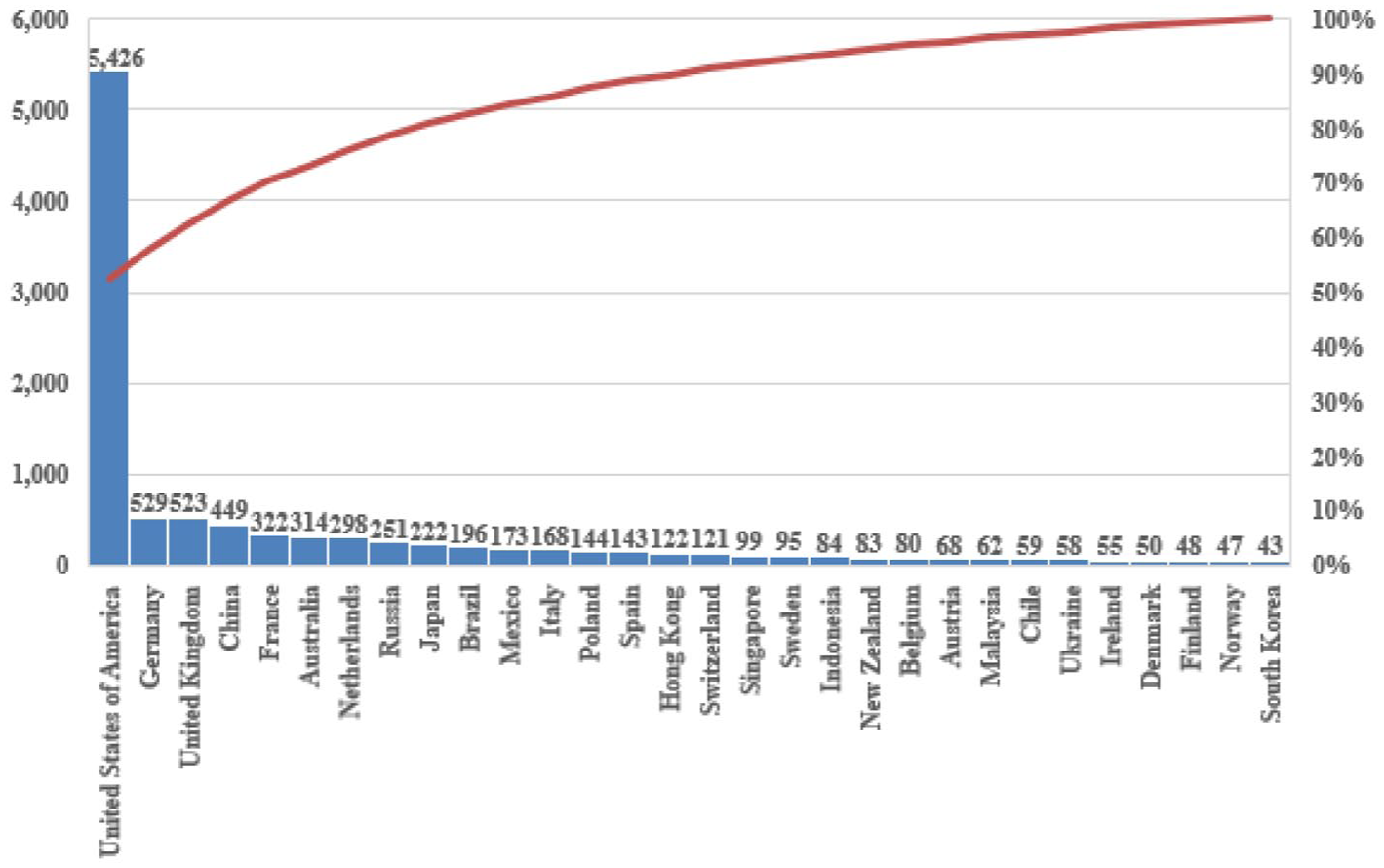
Leading countries by number of data centers as of March 2025.
These developments reflect a broader transformation in the geopolitical economy of digital infrastructures. While U.S. firms continue to dominate global cloud markets, Chinese companies are increasingly projecting infrastructural influence into regions historically integrated into U.S.-centered technological networks. As a result, many countries located outside the core of the world-economy are becoming arenas of infrastructural competition between rival technological ecosystems.
Taken together, these cases illustrate the intermediary and historically contingent character of semi-peripheral participation in the AI world-system. Semi-peripheral economies host important segments of digital production—ranging from software services and data infrastructures to semiconductor assembly—while remaining structurally dependent on technologies, capital, and intellectual property regimes concentrated in core regions. Their role is therefore neither purely peripheral nor fully core. Instead, they function as mediating zones through which the global expansion of AI capitalism is organized and reproduced.
At the same time, a world-systems perspective cautions against treating core, semi-peripheral, and peripheral positions as fixed developmental stages. One of the central insights of world-systems analysis is that the hierarchy of the world-economy is dynamic rather than static. Throughout the history of capitalism, some states have experienced upward mobility through industrial upgrading, technological innovation, or geopolitical transformation, while others have undergone relative decline (Arrighi and Drangel, 1986; Silver, 2003). Recent scholarship similarly emphasizes the relational and processual character of core–periphery relations, arguing that such positions are continuously reconstituted through the interaction of global and local dynamics rather than permanently assigned to particular territories (Lee, 2009).
This insight is particularly relevant for understanding the evolving geography of the AI world-system. The contemporary concentration of computational capacity, cloud infrastructures, advanced semiconductor production, and frontier AI development within a limited number of core economies should not be interpreted as a permanent configuration. Technological breakthroughs, state-led industrial policies, geopolitical realignments, trade conflicts, and transformations in global value chains may alter the distribution of technological capabilities and reshape the hierarchy of digital accumulation. The trajectories of China, India, and several East Asian economies illustrate how positions within the world-system can shift over time, even though such mobility remains uneven and constrained by existing structures of power.
Consequently, the categories of core, semi-periphery, and periphery should be understood not as fixed attributes of particular countries but as relational positions within an evolving socio-ecological and geopolitical order. The AI world-system is therefore best conceptualized as a dynamic field of unequal relations in which technological leadership, infrastructural control, and strategic dependency are continuously contested and reconfigured. While contemporary AI capitalism reproduces longstanding patterns of uneven development, the specific actors occupying core, semi-peripheral, and peripheral positions remain historically contingent and subject to ongoing transformation.
Mechanisms of reproduction
The AI world-system persists through a set of mechanisms that reproduce global inequality and technological dependency. One key mechanism is data extraction and commodification. Digital platforms continuously transform human activity into data flows that can be aggregated, analyzed, and monetized (Srnicek, 2017, 2018). Platforms such as Google, Meta, Amazon, and Tencent enclose these data within proprietary infrastructures, converting collective social activity into privately appropriated capital.
A second mechanism involves network effects and platform monopolization. As digital platforms accumulate users and data, their algorithmic systems improve, attracting additional users and generating even more data. This feedback loop reinforces the market dominance of large technology firms and strengthens barriers to entry.
A third mechanism is the segmentation of digital labor. While high-value activities such as AI research, model development, and platform governance remain concentrated in core economies, routine computational tasks are distributed globally through outsourcing networks. This reproduces classical patterns of core monopolization and peripheral competition within a new technological framework.
A fourth mechanism concerns ecological externalization. The extraction of rare-earth minerals, the energy consumption of data centers, and the disposal of electronic waste are disproportionately concentrated in Africa, Asia, and Latin America. These processes extend the historical logic of extractivism into the digital domain, transforming peripheral regions into both resource frontiers and waste repositories for the AI economy.
Finally, infrastructural dependency reinforces geopolitical asymmetry. Most countries lack domestic computational infrastructures and must rely on foreign technology firms to access cloud services and AI development tools. As transnational corporations embed themselves within national development strategies, they increasingly assume quasi-governance roles that blur the boundary between economic power and political authority (De Freitas, 2025; De Oliveira, 2025).
From a world-systems perspective, the rise of AI represents a technological reorganization rather than a rupture in the capitalist world-economy. The AI world-system is structured around new essential goods—compute, chips, cloud infrastructures, and intellectual property—whose ownership is highly concentrated in core regions. These technological assets shape hierarchical core relations and generate mechanisms of reproduction based on data extraction, platform monopolization, global labor segmentation, ecological externalization, and infrastructural dependency.
In this sense, digital and AI-based capitalism does not eliminate global inequality but reproduces and deepens longstanding patterns of uneven development through new technological means. What emerges is a regime of algorithmic accumulation in which data, labor, and material resources generated across peripheral (and semi-peripheral) regions sustain technological and economic dominance concentrated in core regions of the world-economy.
Emergent anti-systemic resistance in the AI world-system
This expanded framework provides a useful lens for analyzing resistance within the emerging AI world-system. As digital capitalism expands through global networks of data extraction, computational infrastructures, and algorithmic governance, it generates new forms of exploitation and exclusion that provoke diverse forms of collective mobilization. In this sense, contemporary struggles surrounding artificial intelligence—such as movements addressing digital labor rights, data extraction, environmental costs of data centers, and algorithmic bias—should not be understood as entirely new phenomena. Rather, they represent the latest historical manifestation of anti-systemic resistance within the evolving structures of the capitalist world-system.
At the same time, it may be analytically premature to characterize these dispersed initiatives as fully developed anti-systemic movements in the classical sense envisioned by world-systems analysis. Unlike the labor, socialist, national liberation, and anti-colonial movements that shaped earlier phases of the capitalist world-system (Arrighi et al., 1986, 1989), contemporary resistance to AI capitalism often appears fragmented, decentralized, and transnationally dispersed. Many initiatives remain localized, issue-specific, and weakly coordinated across regions and sectors.
To address this challenge, the concept of emergent properties provides a useful analytical bridge. Rather than evaluating labor, ecological, and epistemic struggles according to whether they already constitute coherent social movements, this perspective interprets them as emergent forms of anti-systemic resistance generated by the contradictions of AI-driven accumulation itself (Johnson, 2006).
This interpretation is broadly consistent with Jung’s (2023) distinction between struggles against exploitation and struggles against exclusion. As Arrighi (1990) and Silver and Slater (1999) argue, exploitation and exclusion are deeply interconnected processes within the capitalist world-system. In the AI world-system, these processes increasingly manifest through data extraction, algorithmic governance, ecological dispossession, and the concentration of technological knowledge. Consequently, resistance emerges simultaneously across multiple sites rather than through a single organizational form.
Within the AI world-system, these emergent forms of resistance increasingly appear across three interconnected domains: labor, ecology, and epistemic power.
Labor resistance: AI-related labor and the politics of invisible work
The rise of AI capitalism has produced a profound reorganization of global labor. Regions historically positioned in peripheral roles within the capitalist world-economy have long functioned as key sites of labor-intensive production and low-cost labor (or “underpaid labor”) within global accumulation processes (Casilli, 2017: 3945). In the contemporary AI-driven economy, these dynamics increasingly extend into the digital sphere. Labor now operates through diffuse, data-mediated, and algorithmically governed processes in which the boundaries between work and non-work, production and consumption, and visibility and invisibility become increasingly blurred.
These transformations can be understood through three interrelated modalities of value extraction: capture, absorption, and appropriation. First, capture refers to the process through which everyday digital activities—such as social media participation, mobile app use, and online interaction—are transformed into sources of economic value. Although these activities appear voluntary and non-laborious, they generate behavioral data that platform companies monetize through algorithmic training and targeted advertising. This process resembles what scholars describe as data colonialism, in which everyday digital life becomes raw material for capital accumulation (Adams, 2021: 177). Users located in peripheral (and semi-peripheral) regions—where rapidly expanding digital populations generate vast quantities of data—play a particularly significant role in this process.
Second, absorption denotes the reorganization of traditional service sectors—such as transportation, domestic work, and care labor—into platform-mediated systems. Digital platforms restructure these sectors by embedding them within algorithmic infrastructures that regulate working hours, compensation, and evaluation. Ride-hailing drivers in Southeast Asia, delivery workers in Latin America, and freelance digital workers in South Asia increasingly operate within globally integrated platform systems where labor relations are mediated by algorithms rather than direct employment contracts (Woodcock and Graham, 2020).
Third, appropriation refers to the privatization of individuals’ creative outputs, data, and everyday productive activities by capital (Lee, 2023). AI development intensifies this process by incorporating vast datasets generated by users, artists, and knowledge workers into proprietary machine learning models.
These forms of extraction extend beyond cognitive labor. As Lee (2023: 79) notes, the AI industry relies on what he terms gig labor—low-wage work that materially sustains digital infrastructures. Such labor includes semiconductor assembly, data labeling, content moderation, and resource extraction. Workers labeling datasets for machine learning systems in India and the Philippines often receive extremely low wages while performing psychologically taxing tasks such as moderating violent or abusive content (Gray and Suri, 2019: 47). In Kenya, for example, data annotators employed by outsourcing firms earn less than $2 per hour while reviewing disturbing content used to train AI moderation systems (Perrigo, 2023). Similar conditions have been documented among platform workers in Nigeria, who face unpaid overtime, algorithmic surveillance, and unstable compensation structures (Anwar and Graham, 2022: 7).
These exploitative dynamics have sparked new forms of labor resistance (Castel-Branco et al., 2025). Digital workers across India, the Philippines, and Kenya have begun forming transnational networks such as Turkopticon, BPO Industry Employees Network (BIEN), and the Data Workers Union to improve working conditions in digital labor markets. Through petitions, wage transparency tools, and collective advocacy, these organizations challenge the myth that AI operates autonomously, exposing the human labor hidden behind algorithmic systems (Graham et al., 2024).
In East Asia, platform workers have also mobilized against algorithmic management regimes. In response to the algorithmic control of digital platforms—for example, Chinese food-delivery platforms employ strategies that gamify work and stimulate competition in order to increase riders’ efficiency and productivity—Chinese riders have attempted to forge new forms of resistance and have increasingly relied on hidden transcripts to navigate and challenge platform power (Yu and Treré, 2022). In South Korea, organizations such as Uahan yuniŏn (Elegant Union) and paedalp’ŭllaetp’om nodongjohap (the Delivery Platform Labor Union) demand shorter working hours, fair pay, and protection from harassment, thereby transforming algorithmically mediated workplaces into new sites of labor politics. Such movements represent emerging forms of digital labor politics in which struggles over algorithms, platform governance, and data ownership become central to contemporary labor activism.
Ecological resistance
The expansion of AI infrastructures has also generated growing ecological tensions. Scholars increasingly conceptualize this system as a form of digital extractivism, in which data, natural resources, and environmental capacities are appropriated to sustain digital accumulation (Kannan, 2022).
The material foundations of AI systems depend on resource-intensive supply chains. Rare earth minerals such as cobalt, lithium, and neodymium—essential for batteries, servers, and semiconductor technologies—are largely extracted from regions in Africa, Latin America, and Asia. These processes often involve severe environmental degradation and hazardous labor conditions (Valdivia, 2024: 2121).
Energy and water consumption illustrate these inequalities particularly clearly. AI systems require far greater computational power than conventional digital services. A single query to ChatGPT may require several times more electricity than a typical web search, and global data center electricity consumption is projected to increase dramatically by 2030 (Regilme, 2024).
The environmental costs of AI development are also substantial at the level of model training. Training large-scale deep learning models requires enormous computational resources and electricity consumption, particularly when extensive hyperparameter tuning or neural architecture search is involved. Estimates suggest that training widely used models such as BERT can generate hundreds of pounds of CO₂ emissions, while large-scale neural architecture search experiments may produce over 300,000 pounds of CO₂-equivalent emissions (Strubell et al., 2020: 13694–13695). These findings highlight that advances in AI are increasingly tied not only to computational capacity but also to the expanding environmental footprint of large-scale machine learning.
These resource demands are increasingly externalized to regions already facing ecological stress. In Uruguay, widespread protests erupted after the government approved plans for a massive data center during the country’s worst drought in decades (Khan, 2025). 2 Similar conflicts have emerged in Spain’s Aragón region, where activists protested the water consumption of hyperscale data centers with the slogan “Your Cloud Dries My River.” 3
These ecological pressures have generated new forms of environmental resistance. Communities in Chile, Mexico, Kenya, and Spain have mobilized against the expansion of data centers and mining operations, arguing that digital infrastructures intensify water scarcity and energy inequality (Valdivia, 2024: 2121). Environmental activists increasingly frame these conflicts as part of broader struggles against data colonialism, linking digital technologies to historical patterns of resource extraction.
Epistemic resistance
Resistance to AI capitalism also unfolds in the realm of knowledge production. The global AI research ecosystem remains heavily concentrated within institutions and corporations located in the core countries, which dominate technological standards, research agendas, and intellectual property regimes (Bender et al., 2021; Birhane, 2023; Qatrani, 2025).
This concentration also generates epistemic inequality, as knowledge systems and social contexts from the peripheral regions are systematically marginalized within the infrastructures of AI development. As emerging theories of data colonialism and algorithmic coloniality suggest (Arora and et al., 2023), contemporary AI systems reproduce historical patterns of extraction and domination by privileging particular forms of knowledge while excluding others. In practice, AI datasets frequently underrepresent non-Western languages, cultures, and social realities, resulting in algorithmic systems that reproduce and stabilize existing global hierarchies of knowledge and power (Mohamed et al., 2020: 665–666; Muldoon and Wu, 2023).
In response, various initiatives seek to reclaim epistemic agency in AI development. In Africa, the Masakhane research community has mobilized hundreds of researchers to develop natural language processing tools for African languages. Similarly, the Distributed AI Research Institute (DAIR) promotes community-centered approaches to AI emphasizing linguistic diversity and social justice.
In Latin America, organizations such as Coding Rights and Derechos Digitales advocate digital rights, data justice, and inclusive approaches to AI governance. These initiatives seek to challenge epistemic inequalities and promote more plural and locally grounded forms of technological knowledge (Birhane, 2023; Mohamed et al., 2020: 672–677).
Taken together, labor, ecological, and epistemic mobilizations reveal that resistance to AI capitalism is increasingly polycentric and multidimensional. Actors in peripheral and semi-peripheral regions confront not a single form of domination but interconnected systems of exploitation, environmental dispossession, and epistemic marginalization.
These struggles illuminate the structural contradictions of the emerging AI world-system. While digital technologies intensify global inequalities, they simultaneously generate new arenas of political mobilization. From digital labor unions and environmental justice campaigns to epistemic communities advocating technological sovereignty, these initiatives should be understood as emergent forms of anti-systemic resistance. Although they do not yet constitute a unified movement, their significance lies in the possibility that dispersed struggles against exploitation and exclusion may generate new collective capacities and political imaginaries capable of challenging the concentration of power within the AI world-system.
From this perspective, the future trajectory of resistance remains an open historical question. Whether these labor, ecological, and epistemic struggles will converge into more coherent anti-systemic movements cannot be known in advance. Nevertheless, they can already be understood as emergent properties of the contradictions embedded within AI capitalism itself, revealing how the expansion of the AI world-system simultaneously generates the social forces that may reshape its future development.
Discussion and conclusion: Researching the AI world-system and emergent anti-systemic resistance
This article has argued that the contemporary expansion of artificial intelligence should be understood not as the emergence of a fundamentally new economic order but as a historically specific reconfiguration of capitalist world-ecology. Rather than treating AI as an autonomous technological revolution, the analysis has situated AI-driven accumulation within the longue durée of historical capitalism, emphasizing the continuing significance of uneven development, geopolitical hierarchy, and socio-ecological appropriation. From this perspective, the AI world-system represents a contemporary configuration through which capitalist accumulation is increasingly organized around data, computation, algorithmic infrastructures, and machine intelligence.
The concept of the AI world-system does not simply describe AI capitalism. Rather, it provides a framework for explaining how technological innovation, ecological appropriation, geopolitical competition, and social resistance become articulated within a single world-historical structure. By integrating world-systems analysis and world-ecology, this article has highlighted how the development of AI depends upon globally interconnected relations linking technological infrastructures, labor regimes, resource extraction, and unequal forms of power across the world-economy.
Three theoretical contributions follow from this analysis. First, the article conceptualizes the AI world-system as a new regime of accumulation within capitalist world-ecology, thereby situating contemporary AI development within broader historical processes of capitalist transformation. Second, it identifies data, computational capacity, advanced semiconductors, cloud infrastructures, and intellectual property as strategic assets whose unequal control structures contemporary patterns of accumulation and power. Third, it advances the concept of emergent anti-systemic resistance to analyze the fragmented but growing forms of labor, ecological, and technological contestation arising in response to AI-driven capitalism.
The analysis has further demonstrated that the geography of AI accumulation is neither fixed nor technologically determined. Consistent with world-systems analysis, positions within the AI world-system remain relational, historically contingent, and subject to ongoing transformation. Core, semi-peripheral, and peripheral locations are continuously reconfigured through shifting patterns of technological innovation, infrastructural control, state strategy, and geopolitical competition. In this context, semi-peripheral regions occupy a particularly significant position because they constitute strategic sites where technological upgrading, dependency, and geopolitical repositioning intersect.
At the same time, the expansion of the AI world-system generates contradictions that extend beyond accumulation itself. AI production depends upon extensive socio-ecological relations involving energy consumption, mineral extraction, data appropriation, digital labor, and computational infrastructures. These processes not only reproduce existing forms of inequality but also generate new sites of contestation. Labor mobilizations challenge precarious forms of digital work; environmental movements contest the ecological consequences of AI infrastructures; and initiatives promoting technological sovereignty, open-source development, and data justice seek to democratize control over digital resources and technological knowledge.
Unlike the large-scale anti-systemic movements emphasized in classical world-systems analysis, contemporary resistance to AI capitalism is often fragmented, decentralized, and dispersed across multiple arenas of struggle. Yet fragmentation should not be mistaken for political insignificance. The concept of emergence highlights how diverse forms of contestation may interact, overlap, and generate new collective capacities without requiring centralized coordination or a unified political project. Viewed from this perspective, labor, ecological, and epistemic struggles can be understood as emergent responses to the contradictions of the AI world-system itself.
These arguments point toward several promising directions for future research. Comparative-historical studies could examine how competition over semiconductors, computational infrastructures, and AI innovation systems is reshaping the global distribution of technological power. Research on digital production networks could investigate how different regions are incorporated into AI-driven accumulation through data extraction, platform labor, cloud infrastructures, and technological dependency. Further work is also needed to explore the socio-ecological foundations of AI capitalism, particularly the uneven environmental consequences of data centers, energy-intensive computation, mineral extraction, and electronic waste.
Ultimately, understanding artificial intelligence requires moving beyond technologically deterministic narratives that portray AI as an autonomous force of social change. AI is inseparable from the historical dynamics of capitalist accumulation, ecological appropriation, geopolitical hierarchy, and political contestation. The concept of the AI world-system provides a framework for situating contemporary technological transformations within these broader historical processes while recognizing that their future trajectory remains historically open. The same dynamics that generate new forms of concentration, dependency, and inequality also create possibilities for resistance, transformation, and alternative technological futures. In this sense, the AI world-system should be understood not as a completed historical order but as an evolving and contested terrain whose future remains subject to ongoing struggles over power, resources, and technological development.
Footnotes
Acknowledgements
I would like to thank Ravi A. Palat for his insightful comments on earlier drafts of this article. I am also grateful to the two anonymous reviewers for their constructive feedback, which significantly improved the manuscript.

Funding
The author disclosed receipt of the following financial support for the research, authorship, and/or publication of this article: This work was supported by the National Research Foundation of Korea(NRF) grant funded by the Korean government (No. 2025S1A5A8005053).
Declaration of conflicting interests
The author declared no potential conflicts of interest with respect to the research, authorship, and/or publication of this article.