







Abstract
Objective:
Assess pharmacy postgraduate year 1 (PGY1) residency application statistics and identify the qualities most desired in the ideal pharmacy residency candidate.
Methods:
A list of PGY1 residency program directors across the United States (n = 750) was acquired, and a validated electronic survey was created. The survey contained 25 questions pertaining to program demographics, application statistics, and candidate characteristics.
Results:
A total of 252 programs completed the survey. The average number of positions per program was 3.4 ± 2.6. The average ratio of applicants to available positions was 15:1. The highest scored quality was familiarity with an applicant’s college of pharmacy (7.7 ± 2.5). Holding a leadership position within the college/university scored 6.5 ± 2, while poster presentations and publications were rated lower (4.1 ± 2.5 and 3.1 ± 2.3, respectively). When asked to rank modifiable characteristics, strong letters of recommendation, letters of intent, and prior experience with the applicant were ranked the highest.
Conclusions:
Strong letters of recommendation and intent along with prior experience with an applicant are highly valued. Although leadership positions and scholarship are not ranked as highly, they may distinguish applicants if the preceding criteria are met. Applicants should strive to build relationships with preceptors and obtain work experience or experiential rotations at potential residency locations.
Introduction
Over the last several years, acceptance into pharmacy residency programs has become increasingly competitive and in greater demand which has resulted in an increased number of unmatched residency candidates. According to the American Society of Health System Pharmacists (ASHP), in 2008, 29% of residency applicants did not match to programs compared with 39% in 2012 despite the growth in the number of accredited postgraduate year 1 (PGY1) residency programs from 607 to 866 programs, respectively. 1 The increase in demand is likely to be multifactorial, ranging from an increase in the number of pharmacy schools to increasing pressure for residency training as a mandatory requirement for direct patient care. 2
Given the increased competition for residency positions, pharmacy students are forced to be innovative in their approaches to successfully match with residency programs. However, the specific characteristics and qualifications sought by residency program directors (RPDs) remain vague. Without this information, applicants are unable to appropriately rank and weigh the value of qualities such as leadership, scholarship, hospital experience, and grade point average (GPA). Furthermore, this information is essential for college faculty, as they guide prospective applicants through their curricula and advise them in their career paths. This study aimed to assess pharmacy PGY1 residency application statistics and identify the qualities most desired in the ideal pharmacy residency candidate.
Methods
This was a cross-sectional, descriptive, survey study of PGY1 pharmacy RPDs. The RPDs were identified using a database maintained by ASHP and contacted to complete an electronic survey. The survey contained 25 questions pertaining to program demographics, applicant statistics, and candidate characteristics. Included were questions assessing the value of selected qualities such as having a research project, a poster presentation at a national meeting, a peer-reviewed publication, leadership in a professional organization, or hospital work experience. These candidate qualities were rated on a scale of 1 to 10 whereby 1 equals “not necessary” and 10 “a must have” characteristic. Additionally, modifiable characteristics (ie, those that the candidate has influence over once accepted into a college of pharmacy) comparing perceptions of qualities desired now with those from 5 years ago were ranked in order of importance. Advanced pharmacy practice experiences (APPEs) as well as personal traits (eg, interpersonal skills and clinical knowledge) were also assessed. The survey concluded with an area for open-ended comments relative to the topic.
To validate the survey instrument, 5 experienced faculty members and 5 pharmacy students, with plans of pursuing residency training, were asked to complete the survey and comment on the content, clarity, and consistency of the questions. Revisions were made accordingly, and the final survey was distributed in July 2012 with reminders sent in August and September 2012. All study results were blinded and downloaded in aggregate form.
All continuous data are presented as mean ± standard deviation or median (range). Categorical data are presented as n (%). To evaluate the ranking list of preferred qualities, a group preference matrix was constructed using the median rank for each characteristic and the respective number of top 3 votes received. To determine cutoffs for rank (high vs low), the grand mean was calculated, and values with a lower numerical score (ie, ranked higher) were considered to have strong preference. The cutoff for agreement was 111, the median number of data points. The electronic survey instrument was created using Qualtrics (Qualtrics Labs, Inc, Provo, Utah), and data were analyzed using SPSS Version 19 (SPSS Inc, Chicago, Illinois). The study was approved by the University Institutional Review Board.
Results
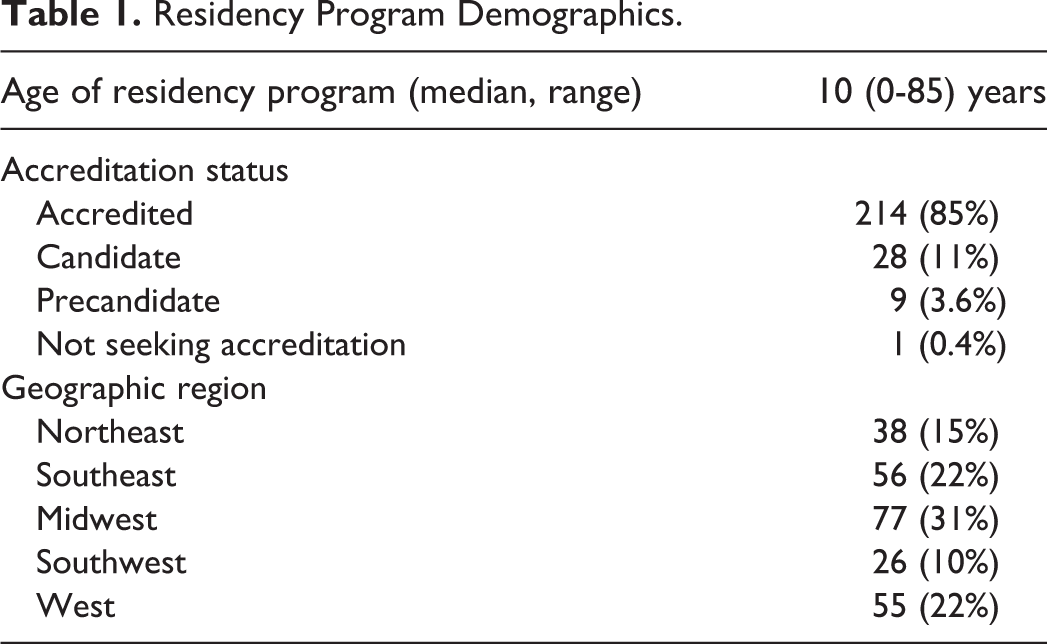
A total of 750 RPDs were identified and 252 completed the survey; 85% were ASHP-accredited (Table 1). The average number of positions per program was 3.4 ± 2.6. The average number of applications received was 50.9 ± 45.5, while the average number of candidates interviewed was 18.5 ± 13.5. The calculated ratio of applicants to available positions and interviews to available positions was therefore approximately 15:1 and 5:1, respectively.
Residency Program Demographics.
The highest scored quality (using a scale of 1-10) was familiarity with an applicant’s college of pharmacy (7.7 ± 2.5), followed by hospital work experience (6.84 ± 2; Figure 1). These results did not change significantly when subgroups based on residency class size, program age, and geographic region were evaluated. When asked to rank modifiable characteristics, in order of importance, excellent letters of recommendation, strong letters of intent, and prior experience with the applicant at the institution were ranked the highest (Table 2). There was a high degree of agreement among survey respondents pertaining to those qualities (Figure 2). This was mildly different from what was valued 5 years ago whereby excellent letters of recommendation, GPA, and strong letters of intent were ranked as top items.
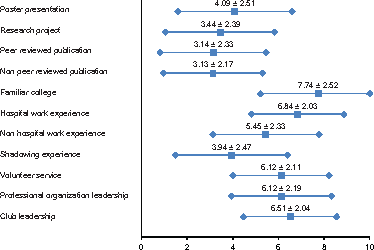
Residency program director ratings of qualities desired in a PGY1 resident. PGY1 indicates postgraduate year 1.
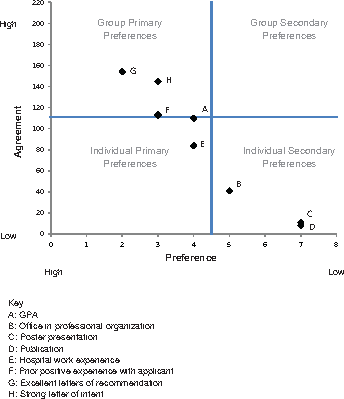
Group matrix of rankings for most desired modifiable qualities and agreement among respondents.
Rank List of Characteristics: Present Versus 5 Years Ago.
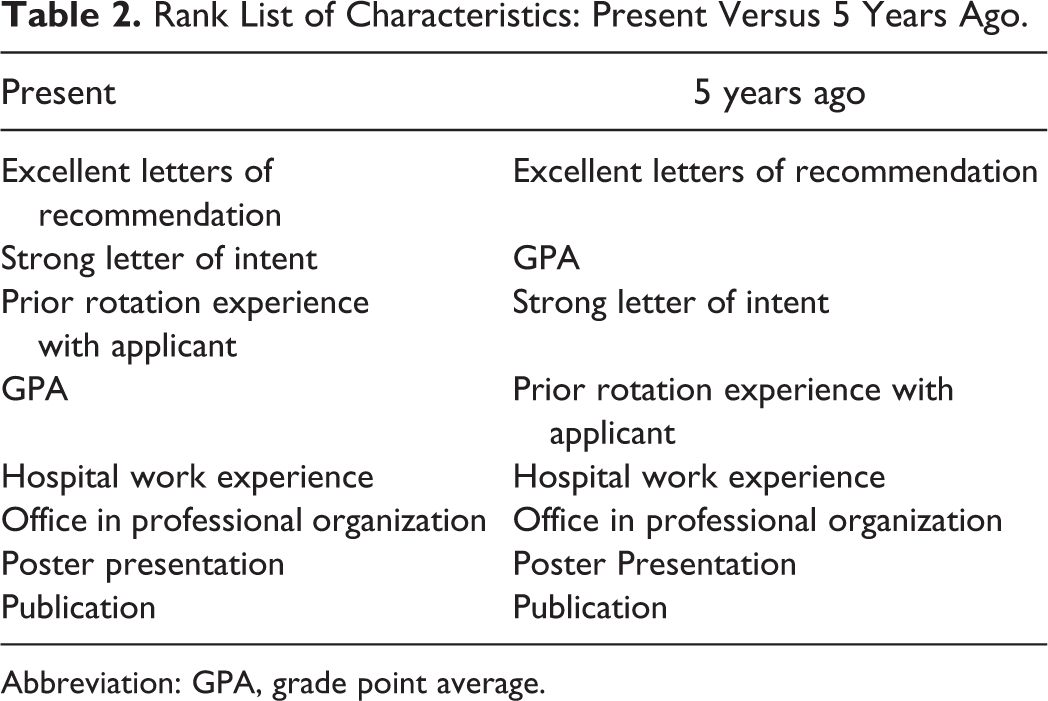
Abbreviation: GPA, grade point average.
The most desired type of APPEs were multiple, inpatient (hospital) rotations (55%) as opposed to diverse rotations that involve a multitude of practice settings (27%). Interpersonal skills weighted more heavily than having clinical knowledge, 56% and 44%, respectively. Many sites stated they place more emphasis on the interview experience and less on the GPA. This was due to the variability and lack of standardization across colleges (eg, presence of pass or fail).
Discussion
The pursuit for residency training has become increasingly popular which has resulted in an increased number of unmatched applicants. Our survey revealed an applicant to position ratio of approximately 15:1 with only one-third of those applicants being granted an interview. The reasons behind this disparity are multifactorial. First is the increase in the number of accredited pharmacy schools, which in turn are graduating more pharmacists. As of January 2012, there were 127 accredited schools of pharmacy in the United States which represents an increase of more than 30% over the last decade. 3 A recent report suggested that in order for the number of PGY1 programs to meet the number of graduates by the year 2020, an average annual increase of 17% would be needed. 4 However, only an 8.3% growth in PGY1 programs is predicted for this same time frame. 4 A second factor may be the observation of a more balanced supply and demand curve. Data from the Pharmacy Manpower Project, a group which analyzes data on the number of licensed pharmacists and the demand for pharmacy services, revealed a demand score of 4.1 (5 = high demand, difficult to fill positions; 1 = much less demand than supply available) in January 2007 versus 3.18 in January 2012. 5 This is supported by recent staffing surveys illustrating lower pharmacist vacancy rates (6.3% vs 2.4%) over that same time period. 6 Given a shift in the availability of pharmacist positions, new graduates will need to become more competitive in the job market and are seeking residency training. A third reason is the desire for residency training on behalf of many employers as a necessary requirement for clinical pharmacist positions. This is described in a position paper by the American College of Clinical Pharmacy stating by 2020, residency training should become a prerequisite for direct patient care services (ie, clinical pharmacists who engage in the direct observation and evaluation of the patient’s medication-related needs). 2
Given the information from the survey results, certain conclusions can be drawn. First is that familiarity with an applicant’s college of pharmacy was ranked the highest of the applicant qualities listed. Although this is not a modifiable characteristic for students already enrolled in colleges of pharmacy, this emphasizes the importance of recruiting and retaining established, high-quality faculty capable of advancing the vision and outreach of the college. With regard to the modifiable risk factors deemed most important, letters of recommendation and strong letters of intent ranked highest. These documents often speak to the personal traits, communication skills, and overall candidate fit for residency training which RPDs seem to value strongly, more so than grades. In fact, although many RPDs weigh GPA in their decisions, its ranking appears lower than what may have been considered 5 years ago. Candidates are encouraged to establish relationships with faculty early on in pharmacy school through leadership roles, advisee groups, or faculty research projects. Another important modifiable characteristic identified was previous experience with the applicant. This emphasizes the importance of selecting rotations, volunteering, or working at prospective residency sites and creating a favorable impression. Although leadership and research were not rated highly on our list of desirable characteristics, these qualities should not be downplayed or overlooked. Having a publication or an office in a professional organization will not overcome deficiencies in personal skills, communication, or a less than favorable experience with the applicant. However as the candidacy pool increases, and the top qualities identified in this survey (ie, strong letters of recommendation or intent, prior rotation experience) become evident in all applicants, these achievements (i.e., research and leadership) could potentially separate one applicant from another. Prospective residency candidates must therefore obtain these top qualities without question while striving to achieve the lower ranked characteristics to stand out from the crowd.
Another recent study surveyed PGY1 and PGY2 programs for the factors used to select residents for an onsite interview and for ranking candidates.7 In this study, a 4-point Likert-type scale was used to assess various characteristics, and scores deemed as important (ie, a score between 2 and 4) were quantified. The top 3 factors that were considered important for obtaining an onsite interview (PGY1) were the ability to learn (99.2%), recommendation from a colleague in pharmacy practice (99.2%), and grades (98.9%). 7 The top 3 factors that were considered important for ranking of PGY1 candidates were compatibility with the program (75.7%), commitment to work hard (69.2%), and the ability to work with a team (66.5%). 7 Our study differs in the method used to assess these qualities. We utilized a 10-point scale to allow for separation of data and forced respondents to submit a rank order. Nevertheless, our results are similar in that familiarity with the applicant, and personal skills were valued more so than knowledge.
As the profession of pharmacy progresses, the imbalance in residency applicants and positions must be addressed. According to the recent Pharmacy Forecast, only 25% felt that a sufficient number of PGY1 residency positions will exist to meet at least 90% of the demand by 2017. 8 This large number of unmatched candidates seeking employment has the potential to flood the marketplace with unqualified individuals lacking the skill set necessary to succeed and promote advanced pharmacy services. Health care institutions must strive to include residency development and/or expansion in their strategic plans. To ensure high-quality applicants, colleges of pharmacy must adapt their methods to mentor and guide students through their curricula with this end point in mind. Specific examples include providing programs designed to gauge students’ interests in obtaining residencies and to assist in creating a time line of pertinent experiences that provide structure and direction. Faculty should involve students in research opportunities to not only gain this valuable experience but also to develop stronger relationships. Finally, students are encouraged to attend national pharmacy meetings, particularly those focused on residency training.
Limitations to our study include our response rate of 34%, therefore the generalizability of the results could be questioned. Second, it is possible that characteristics strongly desired by some RPDs were not included as options in our survey. Additionally, there is the limitation of recollection particularly when rating characteristics desired now versus 5 years ago. Finally, the views of the RPD may vary with that of the program as a whole.
Conclusion
Excellent letters of recommendation, strong letters of intent, and prior experience with an applicant are important qualities that are highly valued by residency programs. Although holding an office in a professional organization or having scholarly achievement is not ranked as highly, these factors might distinguish one applicant from another if the preceding criteria are met. Prospective applicants should strive to build relationships with preceptors and faculty and obtain work experience while strategically planning introductory pharmacy practice experience and APPE rotations at potential residency locations.
Footnotes
Declaration of Conflicting Interests
The author(s) declared no potential conflicts of interest with respect to the research, authorship, and/or publication of this article.
Funding
The author(s) declared the following financial support for the research, authorship, and/or publication of this article: This study was supported through intramural funds received by Midwestern University, Office of Research and Sponsored Programs.