






Abstract
Objective:
To determine the incidence, characteristics, and outcomes of adverse drug events (ADEs) in critically ill patients with cancer.
Methods:
This was a 5-month prospective observational study. Patients who were admitted to the adult medical/surgical oncology intensive care unit (ICU) were evaluated for any drug-related adverse events during their ICU stay. An ADE was defined as injury or patient harm resulting from medical intervention related to a drug.
Results:
The incidence rate of ADEs was 96.5 per 1000 patient days and 35.3 per 100 ICU admissions. Of the reported ADEs, 57 (64.8%) were serious/life threatening, 30 (34.1%) were significant, 1 (1.1%) was fatal, and 14 (15.9%) of all ADEs were considered preventable. The most common drug classes associated with ADEs were antidiabetics, antibiotics, and analgesics/sedatives. The length of stay and presence of renal or respiratory failure were significantly associated with an increased number of ADEs. The length of stay and female sex were significantly associated with the likelihood of developing an ADE.
Conclusion:
Critically ill patients with cancer are at high risk of developing ADEs. Strategies that reduce the incidence and severity of ADEs are essential to improve the outcomes of this patient population.
Introduction
Patient safety is one of the major goals for all clinicians caring for the critically ill patient population. However, patients admitted to the intensive care unit (ICU) typically require rapid and high-intensity care, which may predispose them to a wide range of predictable and unpredictable adverse events. Over the last decade, there has been an increased interest in evaluating adverse events in critically ill patients. Adverse events were found to be common and often deemed serious and preventable. 1 –9 In addition, adverse events in critically ill patients were associated with increased cost and length of stay. 9 –12
In general, medications remain a common cause of adverse events in hospitalized patients, although the incidence varies depending on the type of unit and severity of illness. For example, in 1 study, the highest rate of adverse drug events (ADEs) was reported in medical ICUs (19.4 per 1000 patient days), followed by the surgical ICUs, and the medical and surgical general wards (10.5, 10.6, and 8.9 per 1000 patient days, respectively). 8 The rate of ADEs remained the highest in the medical ICUs after adjustment for the number of medications ordered within 24 hours per unit (15.3 per 1000 patient-days). 8
The incidence and nature of ADEs in critically ill patients with cancer have not been evaluated. We hypothesize that this patient population is at high risk of developing ADEs due to many factors such as the disease process itself, associated comorbidities, the highly toxic chemotherapy regimens, and the number of medications often used in patients with cancer. We believe that understanding the significance and nature of ADEs in patients with cancer admitted to the ICU is essential to develop strategies that may reduce drug-related complications during their ICU stay and improve their overall outcomes.
We describe a prospective observational study, which to our knowledge is the first report on ADEs in critically ill patients with cancer. The incidence, characteristics, and outcomes of ADEs in this vulnerable cohort of patients are presented. In addition, risk factors that may predispose patients with cancer to develop ADEs during their ICU stay are identified. The study focuses on actual adverse events associated with oncology and nononcology-related medications.
Methods
Study Site and Patient Population
The study was conducted in a 12-bed adult medical/surgical ICU of a 170-bed comprehensive teaching cancer center. The ICU manages oncology-related and nononcology-related critical illnesses in patients who are receiving their cancer treatment at the cancer center. The ICU has a closed-unit model with high intensity staffing, in accordance with the Leapfrog standards. This model was implemented several years ago and has demonstrated improved clinical outcomes in critically ill patients with cancer. 13 In brief, the ICU is managed by a board-certified physician with a subspecialty in critical care medicine. The intensivist is present in the hospital during daytime hours, 7 days/week. In addition, there are board-certified internists, referred to as ICU hospitalists, capable of providing fundamental critical care support. The ICU hospitalists are dedicated to the care of patients in the ICU and are in direct communication with the intensivist. Daily multidisciplinary rounds are performed with a team that includes the intensivist, ICU hospitalist, medical resident, critical care nurse, clinical pharmacist, respiratory therapist, and nutritionist. During the patients’ stay in the ICU, the intensivist becomes the primary caregiver, and medical orders are only written by the intensivist, the ICU hospitalist, or the medical resident. However, the oncologist of the patient remains informed of the patient’s condition and performs daily medical rounds.
A clinical pharmacist, with special training in critical care, works closely with the medical and nursing staff on optimizing the therapeutic management of patients. The pharmacist is available at the hospital during daytime hours, except for weekends and holidays. In addition, the ICU pharmacist is available at all times, through a direct mobile phone, for any pharmacotherapy-related consultations. An oncology clinical pharmacist is involved with the patient’s care when chemotherapy is administered in the ICU.
Medication orders in the ICU are handwritten by the physicians and faxed to the central pharmacy. Verbal orders are accepted, but the hospital’s policy mandates that the physician shall sign all verbal orders within 24 hours. Medication protocols are available and used in the ICU, such as those for the initiation and titration of heparin and insulin infusions, electrolyte replacement (eg, potassium and magnesium), sepsis management, and prevention of contrast-induced nephropathy. All medications are prepared and dispensed from the central pharmacy, except for vasopressors, dobutamine, and insulin infusions, which are prepared and double checked by the ICU nurses.
Definitions
An ADE was defined as injury or patient harm resulting from medical intervention related to a drug. This definition is similar to the definitions used by previously published studies. 1,3,7 According to this definition, injuries that occurred as a result of the appropriate and inappropriate use of medications were included.
ADEs were classified based on their severity as fatal, serious/life threatening, or significant. A fatal ADE was defined as the one that was associated with death of the patient in the ICU. Serious and life-threatening ADEs were grouped together since there is usually an overlap between many of the ADEs that are considered serious and those that are considered life threatening. In addition, serious and life-threatening ADEs have not been clearly defined in previous studies that evaluated ADEs. 1,3,7 An ADE was considered serious/life threatening if it met one of the following criteria: resulted in prolongation of ICU stay, required the administration of antidotes or other treatments, or was associated with permanent harm. Examples of serious/life-threatening ADEs include prolonged intubation due to excessive sedation, the administration of naloxone to manage opioid-induced altered level of consciousness, and unresolved drug-induced renal failure. A significant ADE was defined as an adverse event that resolved following the discontinuation of the medication such as improvement in the level of consciousness shortly after reducing the morphine dose or recovery of liver function tests after the discontinuation of the suspected hepatotoxic medication.
ADEs were also classified based on their preventability. The drug-related adverse event was considered preventable if it met at least one of the following criteria: the drug was inappropriate for the patient’s medical condition; the drug dose, route, or frequency were not consistent with the practice guidelines or recommendations; required drug monitoring or laboratory tests were not ordered; patient had a documented history of allergy to the drug; resulted from a drug interaction; or resulted due to omission of a required supportive treatment.
Study Design
This was a 5-month prospective observational study conducted between August 1 and December 31, 2010. Patients were evaluated for adverse events associated with medications that were administered during their ICU stay. Identifying the adverse events was done by reviewing the medical records and during the daily multidisciplinary rounds. The Institute of Health Improvement trigger tool was used to identify ADEs during the review of the medical records. 14 In addition, physicians and nurses were encouraged to report to the study investigators any suspected ADEs that they may encounter with their patients. All reported ADEs were documented anonymously to encourage self-reporting. Adverse events associated with continuous fluid infusions, nutritional support, and medications given by the respiratory therapists were included, but adverse events associated with blood products were not. All ADEs were fully assessed and investigated by the critical care clinical pharmacist. The Naranjo scale was used to determine the causality of the drug-related adverse events. 15 Only adverse events that were scored as definite or probable were included. The ADEs were classified based on the suspected medication, the system involved, and the severity and preventability of the event. The ADEs were classified according to their severity as fatal, serious/life threatening, or significant. The agreement of 2 ICU clinicians was required to determine the preventability of the drug-related adverse event. When there was disagreement, the reviewers met to discuss the case. If there was still a disagreement, the suspected ADE was not considered preventable.
The demographics, length of stay, and mortality were recorded for all patients reviewed. Any missing data were retrieved from the ICU electronic database, which included the demographics and certain quality indicators for all patients admitted to the ICU.
The study was approved by the institutional human subjects review board. A standard data collection form was used, and all data were entered into an ADE database, which was developed specifically for this study. The database used Microsoft Access software (Microsoft Corporation, Redmond, Washington).
Statistical Analysis
Categorical data were reported as counts and percentages, while continuous data were reported as means and standard deviations or medians and ranges. The incidence of ADEs was estimated per 1000 patient-days and per 100 ICU admissions. A univariate analysis was carried out for the number of ADEs patients developed during their ICU stay and each of the following factors: age, gender, length of stay, mortality, Acute Physiology and Chronic Health Evaluation II (APACHE II), and organ dysfunction (ie, renal, hepatic, and respiratory failure). The tests used were t test and the nonparametric test Kruskal-Wallis test, considering all required assumptions. The likelihood of developing an ADE and the above-mentioned patient-related factors were studied using chi-square test or Fisher exact test, as appropriate.
A multivariate analysis was conducted for the factors that were found significant in the univariate analysis. A logistic regression model was used for the categorical-independent variable (likelihood of developing an ADE), while the generalized linear model Poisson regression was used for the continuous-independent variable (number of ADEs). A significance criterion of P < .05 was used in the analysis. All analyses were performed using SAS version 9.1 (SAS Institute Inc, Cary, North Carolina).
Results
During the study period, 249 patients were enrolled over 912 patient-observation days. The demographics and baseline characteristics for all patients, patients who developed ADEs, and patients who did not develop an ADE during their ICU stay are provided in Table 1. Overall, patients who developed ADEs had similar characteristics to patients who did not develop ADEs, except for a higher length of ICU stay and higher mortality rate in patients who developed drug-related adverse events during their ICU stay (11.7 vs 4.39 days, P < .0001) and (43.3% vs 25.9%, P = .01), respectively.
Patient Characteristics.
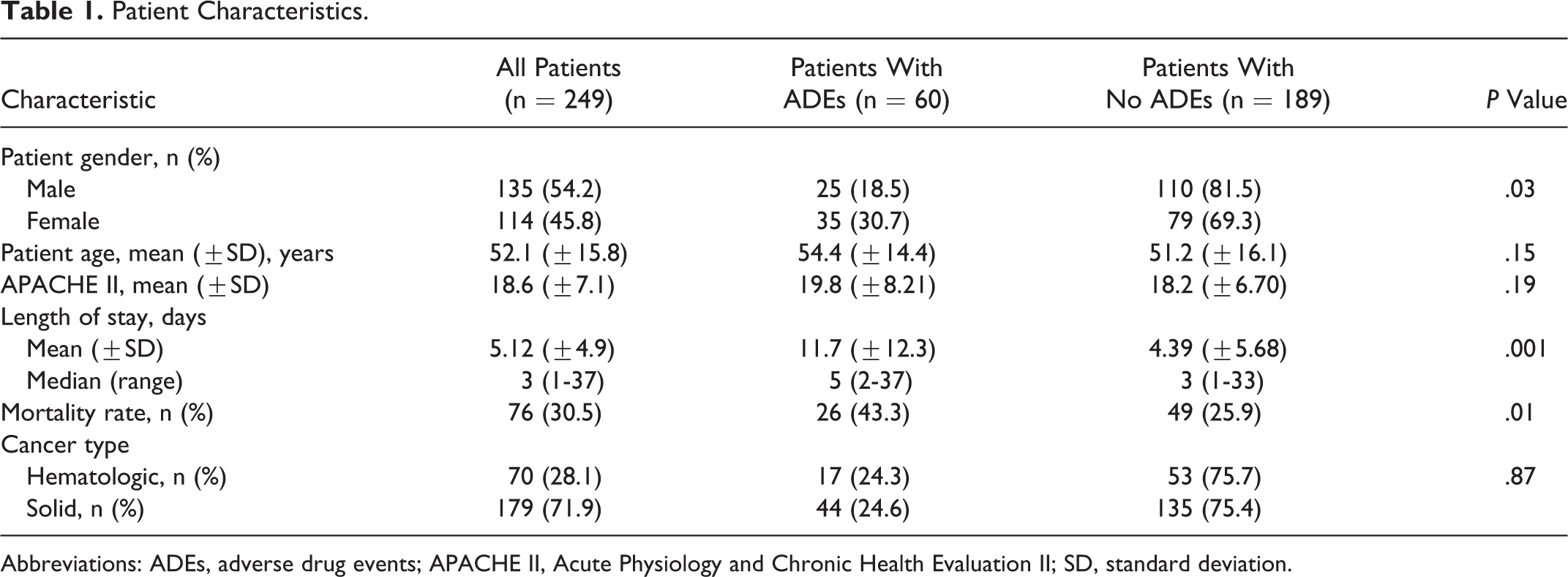
Abbreviations: ADEs, adverse drug events; APACHE II, Acute Physiology and Chronic Health Evaluation II; SD, standard deviation.
A total of 88 ADEs were identified in 60 patients. The incidence rate of ADEs was 96.5 per 1000 patient-days and 35.3 per 100 ICU admissions. Drug-related adverse events, as categorized by the medication class, and the system involved are listed in Tables 2 and 3. Of the reported ADEs, 57 (64.8%) were serious/life threatening, 30 (34.1%) were significant, and 1 (1.1%) was fatal. The fatal ADE was intracranial hemorrhage associated with heparin infusion. The most common drug classes associated with adverse events were diabetes medications, which were insulin products in all cases, antibiotics, and analgesics/sedatives (Table 2). The most common types of ADEs as categorized per organ system were endocrine, renal, and cardiovascular (Table 3).
Adverse Drug Events (ADEs) Based on the Medication Class.

Adverse Drug Events (ADEs) Based on the System Involved.
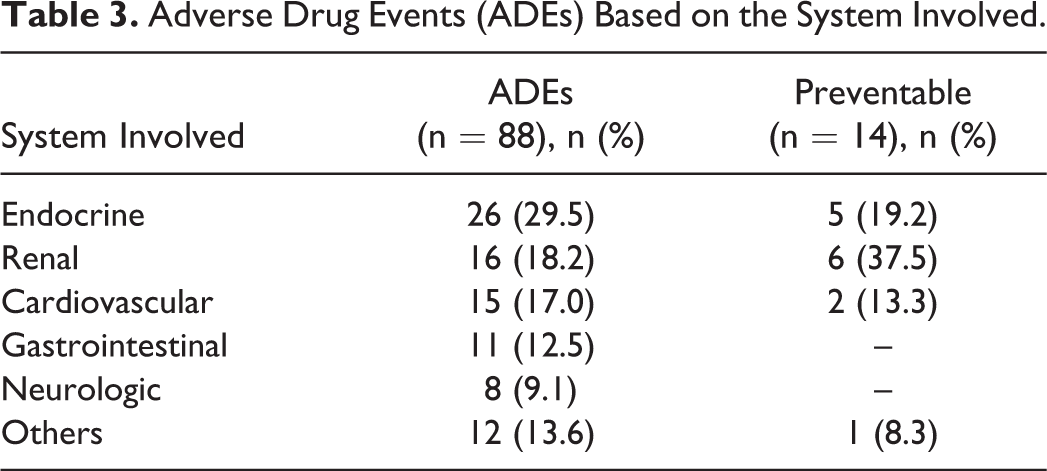
Among the reported ADEs, 14 (15.9%) were considered preventable. The agreement of 2 clinicians about the preventability was not achieved in 5 ADEs, and therefore those ADEs were not counted as preventable. The types of preventable ADEs, as categorized by the organ system, are listed in Table 3. The most common drug classes associated with preventable ADEs were antibiotics in 5 (35.7%) cases and diabetes medications in 5 (35.7%) cases. The preventable ADEs due to antibiotics were associated with the inappropriate dosing of aminoglycosides. The preventable ADEs associated with diabetes medications were hypoglycemia due to insulin. Four cases were associated with initiating the subcutaneous insulin sliding scale protocol in patients who had acceptable glucose levels based on the guidelines followed at that time (ie, blood glucose <150 mg/dL) and 1 was associated with the administration of subcutaneous NPH insulin in a patient whom the enteral feeding was held.
Factors Associated With Increased Risk of Developing ADEs
When evaluating the impact of certain factors on the number of ADEs using a univariate analysis, the length of stay and the presence of renal or respiratory failure were significantly associated with the number of ADEs (P = .042, P = .0182, and P = .045, respectively). A logistic regression model, including all the significant factors, showed that the female gender and length of stay were significantly associated with the likelihood of developing an ADE during the ICU stay (P = .0122 and P = .0008, respectively; odds ratio and 95% confidence interval 2.33 [1.20, 4.49, female vs male] and 1.11 [1.04, 1.17, per day], respectively). A generalized linear model Poisson regression, which was used to relate all the independent and significant factors with the number of ADEs, indicated that only the length of stay was significantly related to the number of ADEs (P = .0003).
Discussion
We found that drug-related adverse events were common and often serious and life threatening in critically ill patients with cancer. The incidence of ADEs reported in this study (96.5 per 1000 patients days) is higher than previously reported (range 5.1-87.5 per 1000 patient days). 16 Although a direct comparison between the studies cannot be made, we believe that one of the main contributing factors to the high incidence of ADEs in this study is the type of patient population. Previous studies may have included some patients with cancer, but this is the first study in which all patients had a history of cancer. The presence of active cancer and the history of lymphoma or leukemia have been identified as risk factors for developing acute renal failure in the ICU, 17,18 and patients with kidney injury were reported to be 16 times more likely to develop an ADE during their ICU stay. 19 Furthermore, thrombocytopenia, which is commonly seen in patients with cancer, is associated with 3 times more likelihood of developing a drug-related adverse event in the ICU. 19
The most common medication class associated with adverse events was antidiabetics. During the time of conducting the study, patients were frequently prescribed sliding scale insulin, which was associated with 13 incidents of hypoglycemia. Sliding scale insulin regimens are not recommended for the management of inpatient hyperglycemia due to the reported hypoglycemia and inadequate glucose control. 20,21 Nevertheless, even after removing the adverse events related to the sliding scale insulin, the incidence of ADEs remained high (82.2 per 1000 patient days).
The next most common medication classes associated with adverse events in this study were similar to those described in the previous studies (antimicrobials, analgesics/sedatives, and anticoagulants), but the incidence was higher. It appears that the nature of ADEs in critically ill patients with cancer is similar to that in noncancer patients, but patients with cancer seem to be at higher risk of developing ADEs during their ICU stay. The higher risk may be attributed to patient-related factors, such as the history of cancer and thrombocytopenia. It may also be a reflection of the aggressive pharmacotherapy management of this immune-compromised group of patients in the ICU.
At the time of conducting this study, we did not have computerized physician order entry (CPOE), and physician orders were handwritten. Although the use of a CPOE system is associated with a reduction in medication errors when utilized in the ICU, 22 we do not think that the handwritten orders contributed to the high incidence of ADEs, since the number of preventable ADEs was low. We assume that most medication errors were intercepted before reaching the patient.
There was an association between the ICU length of stay and both the likelihood of developing ADEs and the number of ADEs. Previous studies reported an association between adverse events and ICU length of stay. 10 –12 However, the unexpected finding in our study was the significantly higher mortality reported in patients who developed ADEs during their ICU stay compared to patients who did not develop ADEs. This is the first study to report a higher mortality rate in patients who developed ADEs. However, it is difficult to determine whether the higher mortality was related to the ADEs or other factors, especially since only 1 ADE resulted in a fatal outcome. A previous study that was performed to measure the influence of ICU-based adverse events (drug related and nondrug related) on in-hospital mortality found no significant association between adverse events and mortality. 12 We did not explore whether the reason for death in our patients was related to the ADEs, but the higher mortality rate despite the similar APACHE II scores requires further investigation in future studies.
This study sheds light on a very important group of critically ill patients. Based on the findings of the study, we believe that the risk–benefit ratio for medications should be carefully assessed in patients with cancer, since there appears to be a higher risk of drug-related adverse events in this patient population. These adverse events may impact the type of treatment and the length of stay, once the patient is transferred from the ICU. In addition, some of the adverse events may result in chemotherapy dose reduction or dose delay, which may impact the overall outcome of the patient. Although the treatment of critically ill patients with cancer usually requires aggressive treatment, medications with better safety profile should be explored. Infection-related complications in patients with cancer are common and are initially treated with several medications. The ability to identify the cause of infection early would allow the early discontinuation of medications and therefore reduce the potential risk of drug-related adverse events.
Education of the ICU staff in regard to the medications commonly used in the critically ill patients is an essential part for improving the safety of patients. In this study, although the ICU had a designated clinical pharmacist, the service was not provided on all days and did not cover the night shifts.
Based on the findings of this study, we implemented several initiatives to enhance the safety of the medications utilized in our critically ill patients with cancer. The first initiative included modifying the protocols used to manage hyperglycemia in our patients and eliminating the use of the insulin sliding scale. Another initiative involved educating the nurses and physicians regarding the appropriate dosing of medications in patients with renal failure and the appropriate dosing of vancomycin and aminoglycosides. In addition, we continue to increase the awareness among the ICU clinicians about the increased risk of ADEs in this group of patients, which has led to a more careful assessment of the benefits and risks of the prescribed medications.
The major limitations of this study are related to the study site and the study duration. The study was conducted in a single teaching cancer institution, which may have an effect on the generalizability of the results. In addition, the study may not be completely reflective of drug-related adverse events that may occur with the management of winter-related diseases and the drug therapies utilized for such diseases.
Conclusion
Patients with cancer are at high risk of developing ADEs during their ICU stay. The nature of the drug-related adverse events appears to be similar to those reported in critically ill noncancer patients, but the incidence is higher. A better understanding of the adverse effects of drug therapy in this patient population is needed to improve the quality of care provided to them.
Footnotes
Declaration of Conflicting Interests
The author(s) declared no potential conflicts of interest with respect to the research, authorship, and/or publication of this article.
Funding
The author(s) received no financial support for the research, authorship, and/or publication of this article.