






Abstract
Background:
Renal replacement therapy may enhance the elimination of barbiturates. Pentobarbital clearance during continuous venovenous hemofiltration (CVVH) has not been described previously. We report a patient case involving the measurement of serial pentobarbital levels during CVVH and review relevant literature characterizing extracorporeal pentobarbital elimination.
Methods:
The following is a retrospective report of a previously healthy 26-year-old woman who sustained a severe traumatic brain injury (TBI) and required administration of pentobarbital on hospital day 0 for intracranial pressure (ICP) control. Given concern for interference with the patient’s ongoing neurologic assessments, pentobarbital was discontinued on hospital day 4. The patient’s hospital course was complicated by acute kidney injury (AKI), requiring initiation of CVVH on hospital day 5. Daily serum pentobarbital levels were obtained during CVVH.
Results:
While on CVVH, the patient’s estimated pentobarbital clearance ranged from 6 to 44 mL/min and the elimination half-life ranged from 17.7 to 65.9 hours. Based on reductions in pentobarbital clearance during CVVH interruption, the elimination of drug was dependent upon extracorporeal removal in this patient. CVVH facilitated pentobarbital elimination in a manner approaching endogenous clearance in healthy individuals.
Conclusion:
We report clinically significant pentobarbital removal by CVVH in a patient with severe TBI. Application of CVVH may expedite reliable neurologic assessments and facilitate the application of clinical brain death examination following pentobarbital exposure.
Keywords
Barbiturates are nonselective central nervous system (CNS) depressants possessing sedative hypnotic and anticonvulsant properties. 1 By depressing the sensory cortex, barbiturates are capable of producing all levels of sedation, from drowsiness to deep coma. When administered at high therapeutic doses, barbiturates induce respiratory depression and general anesthesia. Depression of medullary vasomotor centers at higher doses also reduces cardiac contractility and decreases vascular tone. As a result of these pharmacologic characteristics, barbiturate intoxication has been associated with significant morbidity and mortality. 2,3 Based on their narrow therapeutic index and toxicity profile, barbiturates have largely been replaced by benzodiazepines as the hypnosedatives of choice in clinical practice. However, high-dose barbiturates remain a therapeutic option for intracranial pressure (ICP) control following traumatic brain injury (TBI) and management of refractory status epilepticus. 1 Pentobarbital decreases cerebral metabolic rate, thus decreasing oxygen demand and cerebral blood flow. The resultant decrease in cerebral blood volume reduces ICP. 4
Pentobarbital is a short-acting barbiturate with a dose-dependent elimination half-life ranging from 15 to 50 hours. All barbiturates undergo hepatic metabolism to inactive metabolites, which are then excreted in the urine. Urinary excretion of unchanged pentobarbital is considered negligible. 1 Estimated endogenous pentobarbital clearance ranges from 18 to 37 mL/min, with reduced metabolism expected in patients with hepatic dysfunction. Due to its relatively high lipophilicity, pentobarbital quickly distributes into the CNS following intravenous administration. Following brief pentobarbital infusions, subsequent rapid redistribution into peripheral tissues results in a short duration of action, typically ranging from 3 to 4 hours. 1 –3 After prolonged pentobarbital infusions, the drug may accumulate in adipose tissue, extending its context-sensitive half-life and sedative effects. 5
Several properties influence a drug’s availability for removal by hemofiltration, including volume of distribution, protein binding, and molecular weight. Pentobarbital displays a volume of distribution ranging from 0.5 to 1.0 L/kg, and protein binding ranges from 35% to 70%. Pentobarbital’s molecular weight is 226 Da, which allows for diffusion across contemporary hemofilters with pore sizes up to 50 000 Da. 1 –3,6 Based on these properties, unbound pentobarbital within the vascular compartment is considered amenable to removal by hemofiltration. 7
Enhanced extracorporeal removal of barbiturates is of interest during neurologic assessment of critically ill patients and prior to brain death determination. Brain death can be established using a combination of clinical examinations and confirmatory testing, including electroencephalogram (EEG), cerebral blood flow examinations, and imaging studies. 8 –10 Since intoxication with hypnosedatives can mimic brain death, their pharmacologic effects can confound neurologic assessment and brain death pronouncement. In patients receiving pentobarbital, the determination of brain death should be deferred until elimination can be assured. In general, patients should be observed for a period that is at least 4 times the elimination half-life of the drug. 10 Where laboratory measurement is available, serum pentobarbital levels less than 5 mg/L are conducive to brain death examination. 11 Given the drug’s elimination half-life of up to 50 hours, brain death examination delays following pentobarbital administration may be substantial. 1
Enhanced extracorporeal elimination of pentobarbital may therefore expedite reliable neurologic assessments and hasten the application of clinical brain death examination. The use of continuous venovenous hemodiafiltration (CVVHDF) to enhance pentobarbital elimination prior to brain death examination has been described elsewhere. 11 To our knowledge, pentobarbital clearance during continuous venovenous hemofiltration (CVVH) has not been reported previously. Herein, we describe a patient case in which serial serum pentobarbital levels allowed for characterization of drug removal during CVVH.
Case Report
A previously healthy 26-year-old woman (Table 1) sustained severe bodily injuries after being struck by an automobile travelling at high velocity. Upon arrival to the emergency department, physical examination demonstrated acute head trauma. Subsequent neurologic assessment revealed a Glasgow Coma Scale (GCS) score of 3, consistent with severe TBI. She was immediately intubated for airway protection, and initial imaging demonstrated multiple facial, skull, and spine fractures. Brain imaging also revealed extensive extra-axial hemorrhage and diffuse cerebral edema. An ICP monitor was placed for continued assessment in the neurointensive care unit.
Patient Clinical Data.
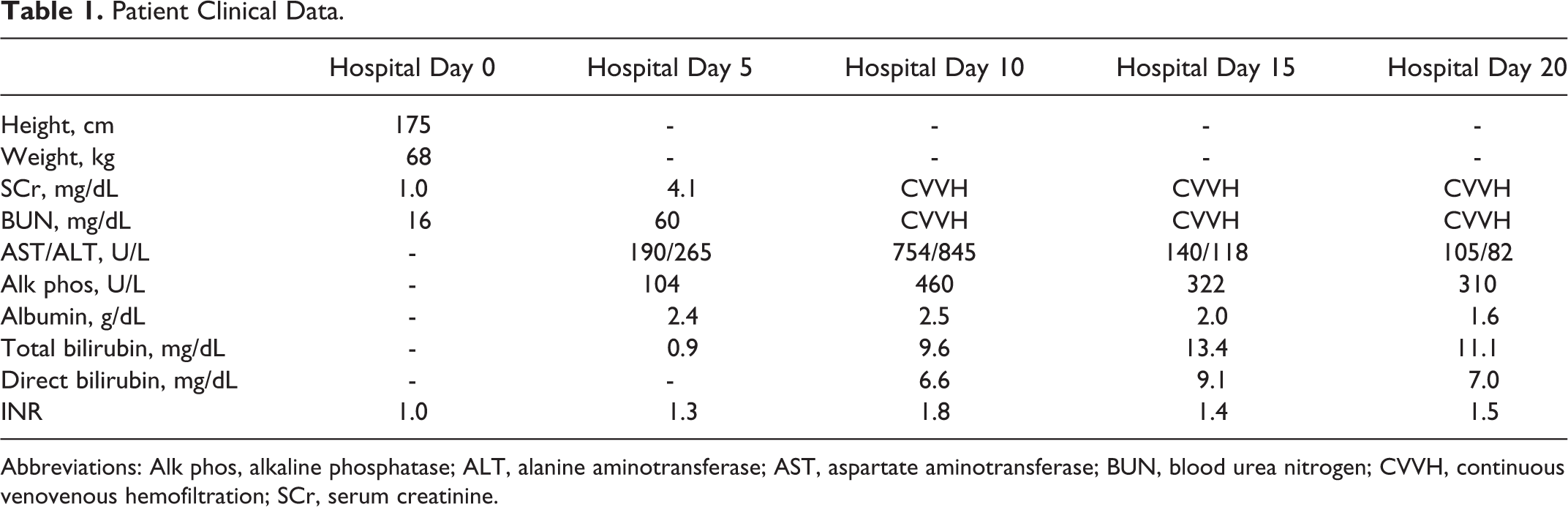
Abbreviations: Alk phos, alkaline phosphatase; ALT, alanine aminotransferase; AST, aspartate aminotransferase; BUN, blood urea nitrogen; CVVH, continuous venovenous hemofiltration; SCr, serum creatinine.
The patient’s elevated ICPs were initially managed with mannitol and 3% hypertonic saline. Following intubation, the patient was sedated with propofol and briefly paralyzed with cisatracurium. Despite these interventions, persistent ICP elevations required the administration of pentobarbital. An initial 5 mg/kg loading dose of pentobarbital was administered on hospital day 0, followed by a variable rate continuous infusion ranging from 0.5 to 4 mg/kg/h. The patient was placed on continuous EEG monitoring, and her pentobarbital infusion was titrated to achieve a burst suppression pattern. Since the patient’s ICP improved on pentobarbital, she did not require decompressive hemicraniectomy.
Approximately 22 000 mg of pentobarbital was administered between hospital days 0 and 4. During this time, the patient demonstrated no meaningful response upon neurologic examination. Given concern for interference with her ongoing neurologic assessments, pentobarbital was discontinued on hospital day 4. ICP control was subsequently maintained with hyperosmolar therapy.
The patient’s hospital course was complicated by septic shock requiring vasopressor support, hepatic dysfunction, and acute kidney injury (Table 1), requiring initiation of CVVH on hospital day 5. Hemofiltration was performed using the Prismaflex HF1400 hemofilter (Gambro Americas, Lakewood, Colorado). CVVH was administered with blood flow rates between 100 and 200 mL/min. The ultrafiltration rate ranged from 33.3 to 38.3 mL/min. Intermittent fluid removal between 50 and 100 mL/min was achieved with CVVH, as the patient’s hemodynamics tolerated. CVVH was continued until hospital day 20 (Table 2).
Pentobarbital Removal by CVVH.
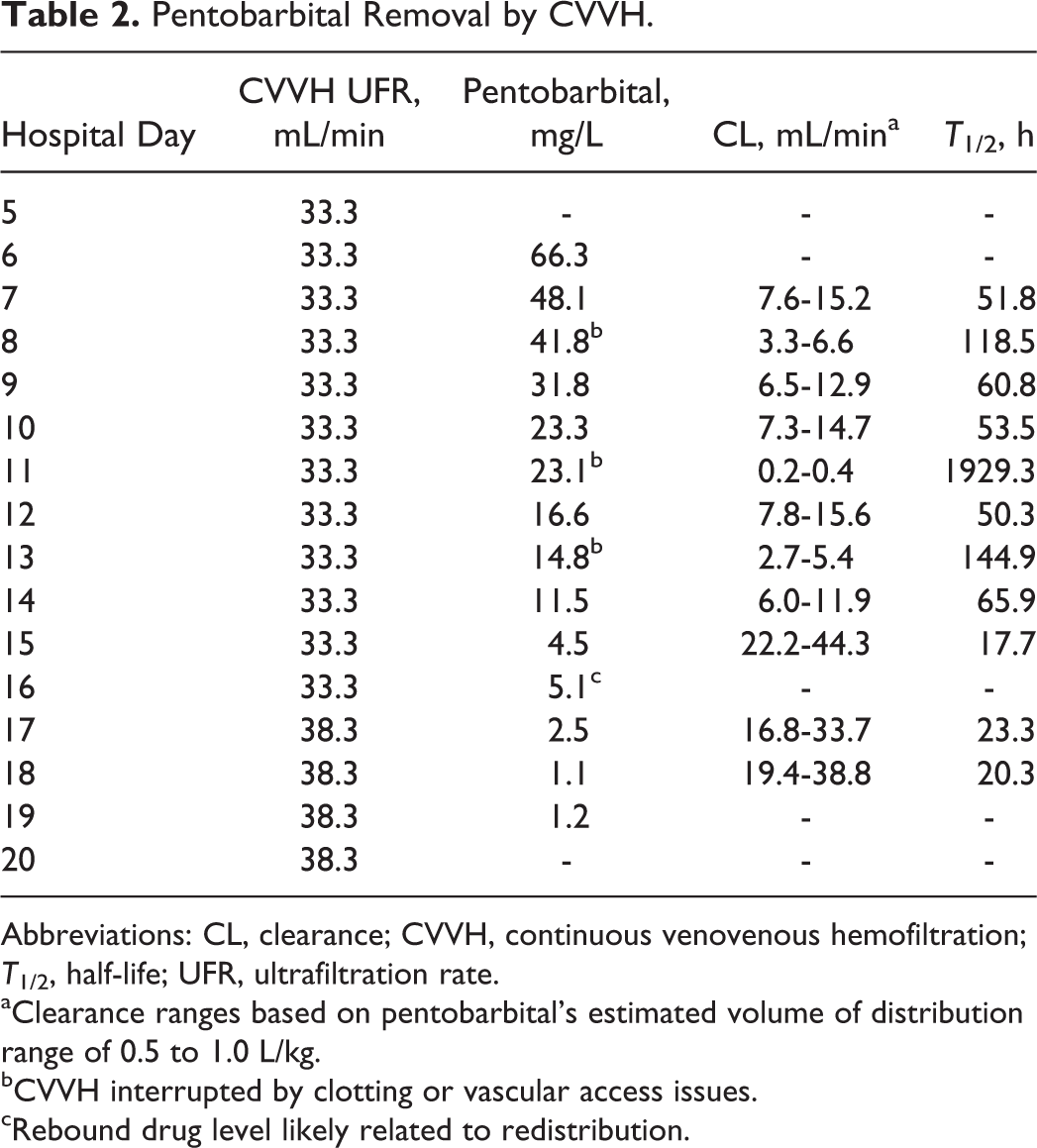
Abbreviations: CL, clearance; CVVH, continuous venovenous hemofiltration; T 1/2, half-life; UFR, ultrafiltration rate.
aClearance ranges based on pentobarbital’s estimated volume of distribution range of 0.5 to 1.0 L/kg.
bCVVH interrupted by clotting or vascular access issues.
cRebound drug level likely related to redistribution.
Our patient was started on CVVH after discontinuation of pentobarbital. Serum pentobarbital levels were obtained each morning starting on hospital day 6, allowing for determination of pentobarbital clearance and half-life on CVVH (Table 2, Figure 1). Drug half-life and clearance calculations were performed using the following formulas: 12

Pentobarbital levels during CVVH. CVVH denotes continuous venovenous hemofiltration.



Despite decreasing serum pentobarbital levels, the patient’s neurologic examination failed to improve. On hospital day 18, eye twitching was observed and correlated with epileptiform discharges on EEG. The patient was started on scheduled lorazepam and levetiracetam with continued EEG monitoring. On hospital day 19, the patient’s right pupil was noted to be fixed and dilated, concerning for transtentorial herniation. Brain imaging demonstrated widespread cerebral ischemia and confirmed herniation. Due to these developments, the patient’s chances of meaningful neurologic recovery became unlikely and the family decided to withdraw life-sustaining treatment. The patient died on hospital day 20 following discontinuation of ventilatory support.
Discussion
Burst suppression on EEG reflects reduced cerebral electrical activity, resulting in decreased cerebral blood flow and ICP. For ICP control following TBI and maintenance of an EEG burst suppression pattern, serum pentobarbital levels are generally maintained between 30 and 40 mg/L. 13 However, the correlation between pentobarbital levels and therapeutic response is relatively poor, and EEG burst suppression patterns have been recommended as a preferred alternative for evaluating patient response. 14 Serum pentobarbital levels less than 5 mg/L are not expected to interfere with neurologic assessment or brain death examination. 11
Enhanced elimination of barbiturates via extracorporeal removal has primarily been investigated as a treatment modality in the setting of overdose and toxicity. A contemporary systematic review identified 52 publications characterizing enhanced barbiturate elimination via extracorporeal techniques. 2 Most of these publications described the removal of barbiturates through application of intermittent hemodialysis (HD) or continuous renal replacement therapy (CRRT). There is limited evidence to support the use of extracorporeal elimination in the treatment of poisoning with most barbiturates. While extracorporeal techniques appear to enhance the elimination of some barbiturates, the clinical benefits in overdose situations have yet to be fully elucidated.
Recently, the Extracorporeal Treatments in Poisoning (EXTRIP) Workgroup provided recommendations for the management of patients with barbiturate poisoning. 3 The workgroup identified 617 publications addressing the use of extracorporeal treatment in patients with barbiturate poisoning. Based on evidence limited to case reports, case series, and observational studies, the EXTRIP workgroup concluded HD and CRRT are effective options for removing long-acting barbiturates. However, the workgroup did not reach a consensus regarding extracorporeal elimination of short-acting barbiturates, including pentobarbital. Limited data suggest that extracorporeal treatments have a modest impact on pentobarbital elimination.
Wermeling et al described the clearance of continuous infusion pentobarbital in a man with acute renal failure on HD. 15 Pentobarbital clearance during HD was 22.3 mL/min. The authors concluded that the use of short HD sessions did not significantly affect pentobarbital concentrations and that dosage adjustment would not be needed during HD.
The use of CVVHDF to enhance pentobarbital elimination following overdose has been described previously. Roberts and Buckley reported the case of an otherwise healthy young woman who ingested veterinary euthanasia solution containing pentobarbital in a suicide attempt. 2 She had a GCS score of 4 on hospital arrival and required intubation for airway protection. The patient was subsequently started on CVVHDF with a blood flow rate of 160 mL/min and a dialysate flow rate 25 mL/min. Ultrafiltration rates were not reported. CVVHDF pentobarbital clearance was 9.2 mL/min, and the patient eventually achieved a full recovery without residual neurologic deficit.
Bironneau et al described the use of CVVHDF following massive intentional ingestion of pentobarbital in a patient presenting with deep coma and hypotension. 16 CVVHDF was administered with blood flow rates from 100 to 150 mL/min and a dialysate flow rate of 16.6 mL/min. The average ultrafiltration rate was 12.5 mL/min. CVVHDF pentobarbital clearance was 7.6 mL/min, allowing for 15% removal of the ingested dose over 48 hours. Despite the administration of CVVHDF, the patient died shortly after the end of treatment.
The use of CVVHDF to enhance the elimination of pentobarbital prior to brain death examination has also been described. Lee et al reported the case of a 30-year-old male patient who sustained TBI after a motorcycle accident. 11 Pentobarbital was administered to treat seizures and control ICPs. After discontinuation of pentobarbital, CVVHDF was initiated to expedite reliable neurologic assessments and hasten the potential application of a brain death examination. CVVHDF was administered with blood flow rates of 150 mL/min and a dialysate flow rate of 13.3 mL/min. The ultrafiltration rate was 20 mL/min. Pentobarbital’s elimination half-life was reduced to 12 hours during CVVHDF, in comparison with the usual range of 15 to 50 hours. Pentobarbital clearance was not reported. Based on these findings, the authors concluded that enhanced pentobarbital elimination during CVVHDF shortens brain death examination delays by several hours.
Extracorporeal drug removal is most commonly achieved through application of HD or CRRT. Given the tenuous hemodynamic status of many patients in the intensive care unit, CRRT is often preferred over HD. 17,18 Removal of fluid and solutes during CRRT can be achieved through convection and diffusion. To date, the only CRRT modality described for pentobarbital removal has been CVVHDF. While CVVHDF relies upon both mechanisms of solute removal, CVVH is limited to convection. Since solute removal during CVVHDF is enhanced by diffusion, drug elimination is expected to exceed that achieved through CVVH. However, variations in hemofilter membranes and fluid flow rates may mitigate observed differences. 7,19 –21
Our case is distinctly important for several reasons. CVVH is the most frequently prescribed form of CRRT worldwide. 22 Previous reports of pentobarbital elimination during CVVHDF therefore may not apply to the majority of ICU patients on CRRT. Since drug clearance is typically greater with CVVHDF, characteristics of extracorporeal pentobarbital elimination using this CRRT modality cannot be extrapolated to patients receiving CVVH. As a result, our findings regarding pentobarbital removal by CVVH are more broadly applicable than previous reports. The patient’s CVVH was interrupted on hospital days 8, 11, and 13 secondary to clotting. This issue resolved after initiation of a pre-hemofilter anticoagulant citrate dextrose infusion. Although no CVVH interruptions were documented on hospital day 16, serum pentobarbital levels exceeded those measured on the previous day. Since the patient did not receive any additional pentobarbital in the interim, the elevated levels may alternately be explained by redistribution of drug from peripheral tissues in the setting of low serum concentrations.
After excluding pentobarbital levels obtained following CVVH interruptions and presumed redistribution, the patient’s estimated pentobarbital clearance ranged from 6 to 44 mL/min while on CVVH. The pentobarbital elimination half-life ranged from 17.7 to 65.9 hours on CVVH. These values overlap with estimates of endogenous pentobarbital clearance ranging from 18 to 37 mL/min and elimination half-life ranging from 15 to 50 hours. Based on reductions in pentobarbital clearance following CVVH interruption, it appears that the elimination of drug was dependent upon extracorporeal removal in this patient. Of note, the patient’s hospital course was complicated by hepatic dysfunction. While there is no single marker to correlate the degree of hepatic dysfunction with impaired drug elimination, it is likely that our patient’s capacity for pentobarbital metabolism was reduced and that CVVH facilitated pentobarbital elimination in a manner approaching endogenous clearance in healthy individuals. 23 When applied to patients with intact hepatic function, CVVH may augment pentobarbital elimination in a manner exceeding normal endogenous clearance.
Since pentobarbital’s protein binding typically ranges from 35% to 70%, fluctuations in serum albumin might affect pentobarbital clearance during CVVH. 2 Administration of other highly protein-bound medications could also theoretically affect pentobarbital elimination by increasing its free fraction. Our patient’s serum albumin levels remained relatively stable throughout hospitalization (Table 1), despite receiving 12.5 g of human albumin on hospital day 12. Although a single dose of phenytoin was administered on hospital day 0, the patient did not receive other highly protein-bound medications during her hospitalization. As a result, fluctuations in pentobarbital’s protein binding would not be expected to affect our findings.
Several limitations to our findings should be noted. In practice, CVVH hemofilters are routinely replaced to prevent circuit clotting. Unfortunately, exchange timing was not recorded in this case. Variations in the frequency of hemofilter replacement would be expected to affect observed pentobarbital clearance during CVVH, with new hemofilters removing drug more efficiently. Since pentobarbital elimination appeared to be disrupted during CVVH clotting, it would be helpful to assess the length of circuit downtime. While records indicated that our patient’s CVVH was interrupted by clotting on hospital days 8, 11, and 13, the exact length of CVVH disruption was not documented. Finally, a population-based volume of distribution estimate was used for pentobarbital clearance calculations. Since volume of distribution can vary in critically ill patients, we chose to report clearance ranges to better reflect this potential variability.
With this case, we report clinically significant pentobarbital removal by CVVH, based on serial measurement of serum drug concentrations. To our knowledge, pentobarbital clearance during CVVH has not been described previously. We conclude that CVVH enhanced pentobarbital elimination in a patient with severe TBI. Application of CVVH may expedite reliable neurologic assessments and hasten the application of clinical brain death examination following pentobarbital exposure in TBI. Based on these findings, CVVH may also augment pentobarbital removal in the setting of drug overdose and toxicity.
Footnotes
Declaration of Conflicting Interests
The author(s) declared no potential conflicts of interest with respect to the research, authorship, and/or publication of this article.
Funding
The author(s) received no financial support for the research, authorship, and/or publication of this article.