






Abstract
The United States Food and Drug Administration recently issued emergency use authorization for 2 mRNA vaccines for preventing COVID-19 disease caused by SARS-CoV-2 virus infections. BNT162b2 from Pfizer-BioNTech and mRNA-1273 by Moderna are planned for use in mass-immunization programs to curb the pandemic. A brief overview of COVID-19 mRNA vaccines is provided, describing the SARS-CoV-2 RNA, how mRNA vaccines work and the advantages of mRNA over other vaccine platforms. The Pfizer-BioNTech collaboration journey to short-list mRNA vaccine candidates and finally selecting BNT162b2 based on safety data is outlined, followed by the Phase 3 study of BNT162b2 demonstrating 95% efficacy in preventing COVID-19 infections. Studies regarding mRNA-1273 (Moderna) are described, including extended immunogenicity data up to 119 days. The Phase 3 COVE study of mRNA-1273 eventually showed vaccine efficacy of 94.5%. Recommendations for future mRNA vaccine development are provided, including ongoing safety surveillance, evaluation in under-represented groups in previous studies and improving mRNA vaccine thermostability. Finally, further logistical considerations are required for manufacturing, storing, distribution and implementing mass vaccination programs to curb the pandemic.
Keywords
Introduction
In December 2020, the United States Food and Drug Administration issued emergency use authorization (EUA) for 2 vaccines to prevent coronavirus disease 2019 (COVID-19) disease caused by SARS-CoV-2 virus infections. Firstly, the BNT162b2 vaccine by Pfizer-BioNTech on 11th December followed by the mRNA-1273 vaccine from Moderna on 18th December; both mRNA vaccines are currently approved for distribution and use in the United States. For many other countries awaiting COVID-19 vaccine availability, a similar authorization process is expected from national or regional regulatory agencies such as the European Medicines Agency (EMA), South-East Asia Regulatory Network (SEARN) and African Vaccine Regulatory Forum (AVAREF). 1
The regulatory process may take time given the novelty of mRNA vaccines and ongoing pharmacovigilance is recommended for monitoring of adverse events. However, the availability of vaccines against COVID-19 is welcomed internationally, with plans for mass-immunization campaigns to hopefully contain the global pandemic. While vaccine development normally takes at least 10 years, the rapidity of COVID-19 vaccine availability were not due to short-cuts taken or indicate poor quality work; rather this was a testament to the global collaborative response from the international research community against a major infectious disease outbreak. 2 This review paper aims to provide an overview of COVID-19 mRNA vaccines, describe study findings for the COVID-19 vaccines by Pfizer-BioNTech (BNT162b2) and Moderna (mRNA-1273), and discuss recommendations for the future of mRNA vaccine development. While there are other vaccine platforms being developed against SARS-CoV-2, such as inactivated virus, viral vector and protein-based, details regarding these vaccines are outside the scope of this review.
Overview of COVID-19 mRNA Vaccines
Shortly after the first cluster of patients with COVID-19 were identified on 21st December 2019, virus discovery approaches including polymerase chain reaction (PCR) and metagenomics analysis of patient samples were performed. 3 The SARS-CoV-2 virus was identified and the genomes published online on 10th January 2020. Following this, the first specific PCR assay for SARS-CoV-2 RNA was designed and validated within 12 days. 4 In addition to development of therapeutics, the vaccine development response led to the availability of the first candidate vaccine (mRNA-1273) 86 days after cluster identification. This was only possible because the novel mRNA vaccine platform is relatively rapid to develop once viral genome sequencing is completed compared to other platforms. 2
The SARS-CoV-2 RNA is 30 kb in length, which includes a 5’-cap structure and a 3’-poly-A tail. The first open reading frames (ORF) with over 65% of its genome encodes 16 non-structural proteins, while the other ORFs on 35% of its genome closer to the 3’ terminus encodes at least 4 main structural proteins, namely spike (S), membrane (M), envelope (E) and nucleocapsid (N). 5 The S-protein allows the virus to enter host cells by binding to ACE2 receptors, thus was viewed as the main vaccine target to prevent infection and viral proliferation.
mRNA can be delivered through lipid nanoparticles to protect against degradation, facilitate endosomal escape and can target the required cell type through ligands on its surface. 6 After the vaccine is administered, mRNA within lipid nanoparticles reaches target cells and is taken up by cell-specific mechanisms. Within the cell cytoplasm, mRNA is translated by ribosomes into the coded protein (for example, the S-protein), which are then expressed onto the host cell surface. When the S-protein is detected by the innate immune system, adaptive immunity is triggered to ensure future recognition and a rapid response to later encounters, such as SARS-CoV-2 infections. 7
There are several advantages of using mRNA vaccines over other platforms. This platform has the immunological characteristics of live attenuated vaccines, especially endogenous antigen expression and T-cell induction, combined with the defined composition and safety of killed or subunit vaccines. It can be engineered to have high translation efficacy, with structural modifications to improve its stability. Vaccine potency can be achieved by developing an immunogen that elicits strong immune responses through activation of both CD8 + and CD4 + cells. mRNA is the minimal genetic construct to express the encoded protein, does not replicate and naturally degrades in the cellular microenvironment; hence is only present transiently in the host. mRNA also does not interact with the genome; thus the risk of insertion-induced mutagenesis is low. Finally, mRNA can be manufactured rapidly on a large scale, which facilitates a rapid response to the pandemic.5,8
BNT162b2 by Pfizer-BioNTech
After the onset of the pandemic, Pfizer and BioNTech collaborated and compared 4 mRNA-based vaccines to select a potential candidate against SARS-CoV-2 infections. When early trial results become available, vaccine candidate options were narrowed down to 2 : BNT162b1 encoding the SARS-COV-2 receptor-binding domain, trimerized by adding a T4 fibritin foldon domain to increase immunogenicity and BNT162b2 encoding the SARS-CoV-2 full length spike modified by 2 proline mutations to ensure it remains in the prefusion conformation. 9
Evidence from pre-clinical studies of these 2 vaccines showed that 1 intramuscular dose in mice triggered a dose-dependent antibody response at titers sufficient to inhibit virus entry. In rhesus macaques, both vaccines elicit titers up to 18 times SARS-CoV-2 convalescent serum at 7 days after the second dose. When a SARS-COV-2 infection challenge was given, there was associated lung protection as evidenced by absence of virus RNA in bronchioalveolar lavage and minimal tissue inflammation, particularly for BNT162b2. 9
Initially, the Phase 1 trials for both vaccines showed significant promise, eliciting appropriate antibody and Th1 T-cell responses. For BNT162b1, 45 healthy adults aged 18 to 55 years from the United States were randomized to receive 2 doses of 10μg, 30µg or 100µg of the vaccine. Subsequently, participants in the 100µg group did not receive their second dose due to increased reactogenicity, without improved immunogenicity compared to a single 30µg dose. Neutralizing-antibody titers were up to 4.6 fold compared to convalescent serum. 10 These findings were replicated in another Phase 1 study in Germany, where 12 participants aged 18 to 55 years in each dose level groups (1 µg, 10 µg, 30 µg and 50 µg) received 2 doses of BNT162b1 22 days apart. 11 There was again a dose-dependent response in terms of IgG and neutralization response, as well as reactogenicity and adverse events.
For BNT162b2, a German trial tested the vaccine in healthy adults aged 19 to 55 years administered in 2 doses ranging from 1 to 30 µg 21 days apart. 12 The vaccine was well-tolerated by participants. Suspected efficacy of this vaccine was supported by strong antibody responses with S-binding IgG levels above human convalescent serum and increased Th1 CD4 + T-helper cells. BNT162b2-elicited sera were also able to neutralize pseudoviruses with diverse SARS-CoV-2 S variants.
In the United States, the phase 1 trial was then extended to randomize healthy adults age 18 to 55 years and 65 to 85 years to receive placebo or one of the two vaccines, BNT162b1 or BNT162b2 in 2 doses. This study found both vaccine candidates elicited similar dose-dependent SARS-COV-2 neutralizing antibody titers above human convalescent serum levels. However, BNT162b2 had a lower incidence and severity of systemic reactions, especially in older adults. This led to BNT162b2 being selected for Phase 2/3 studies. 13
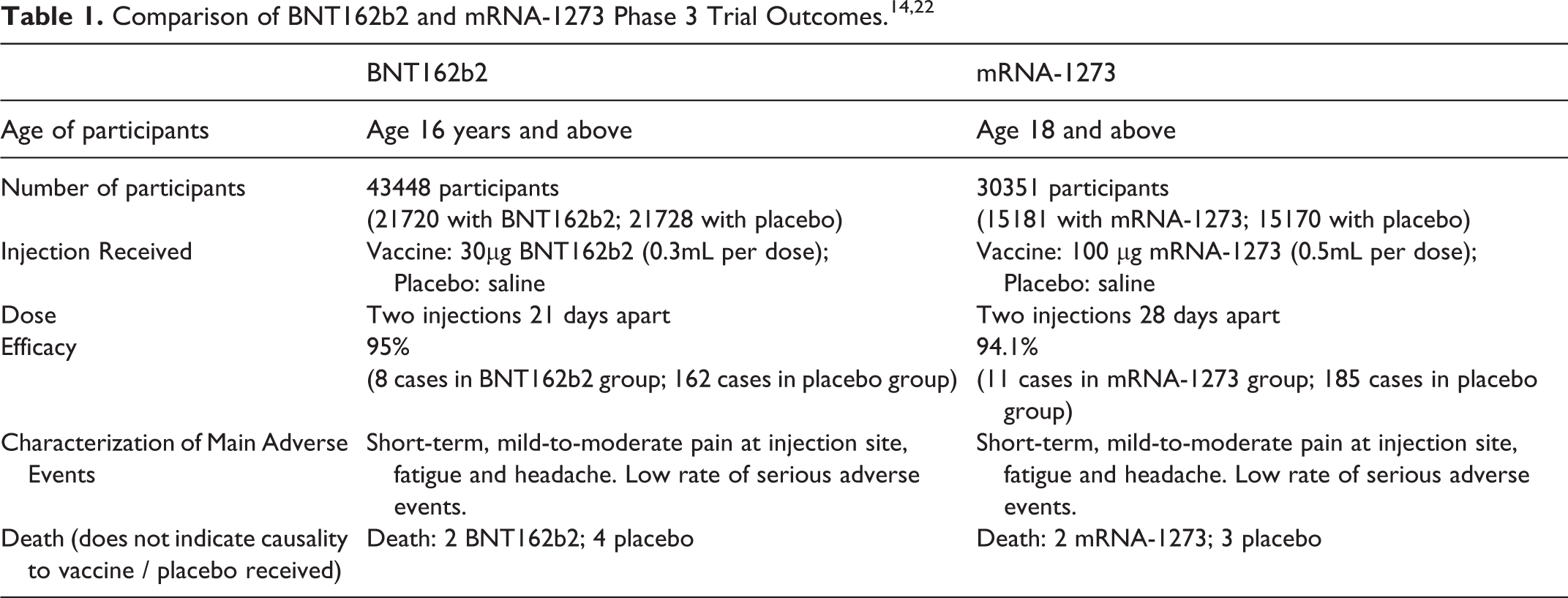
The Phase 3 study randomized people aged 16 and older to receive 2 doses 21 days apart of placebo or 30 µg of BNT162b2. This was carried out at 152 sites internationally, including United States, Argentina, Brazil, South Africa, Germany and Turkey. The primary end-points were efficacy of the vaccine against COVID-19 infections and safety with pre-specified stopping rules for interim analyses. At the data cut-off date, 37,706 participants had a median of at least 2 months of safety data after the second dose. There were 8 cases of COVID-19 receiving the vaccine compared to 162 in the placebo group, demonstrating that BNT162b2 was 95% effective in preventing COVID-19 infections. This efficacy level was observed across all subgroups, including age, gender, ethnicity and comorbidities. In terms of safety, adverse events were overall transient and mild, including localized pain, fatigue and headache. There was a low incidence of serious adverse events, which was similar in the vaccine and placebo groups. 14
mRNA-1273 Vaccine by Moderna
After the release of the SARS-CoV-2 genome, 2P mutations were substituted into S protein residues 986 and 987 to produce prefusion-stabilized SARS-CoV2 S(2P) proteins for ease of structural analysis and development of serological assays. 15 mRNA-1273 was developed by Moderna and consists of mRNA encoding the spike protein stabilized in the prefusion conformation, or SARS-CoV-2 S(2P), formulated in lipid nanoparticles. 16
When mice were administered 2 intramuscular doses of mRNA-1273 3 weeks apart, they developed potent neutralizing antibody responses. During a virus challenge, vaccinated mice were protected against SARS-CoV-2 infection in the nose and lungs without evidence of immunopathology for more than 3 months. Vaccine efficacy in this mouse model was dose-dependent, where 2 0.1 µg doses reduced viral load by 100 fold, while 2 0.01 µg doses reduced lung viral load by 3-fold. 17
When mRNA-1273 was tested in nonhuman primates, the vaccine induced neutralizing antibodies at levels higher than human convalescent-phase serum. There was a dose-dependent increase in Th1-biased responses with low or undetectable Th2 or CD8 T-cell responses 4 weeks after the second dose. Vaccinated animals did not have evidence of viral replication or virus RNA identified in broncho-alveolar lavage fluid or nasal samples. There was also limited lung inflammation on day 2 post-exposure to SARS-CoV-2 virus in the vaccinated group. 17
During the phase 1, dose-escalation trial, 45 healthy adults aged 18 to 55 years were administered 2 doses of 25 µg, 100 µg or 250 µg of mRNA-1273 28 days apart. 18 In this study, there was a dose-dependent antibody response; with increasing titers and serum-neutralizing activity after the second vaccination at the upper half of the distribution of convalescent serum levels. Minor adverse events such as fatigue, chills, headaches, myalgia and localized pain occurred in more than half the participants but there were no major adverse events identified. Systemic adverse events were more likely after the second dose. As 21% in the 250 µg dose group reported severe adverse events, this regimen was not pursued in subsequent trials.
This Phase 1 study was then expanded to include 40 older adults, stratified to age groups of 56 to 70 years or 71 years and older. Participants received 2 doses of 25 µg or 100 µg given 28 days apart, with good binding-antibody responses and neutralizing activity at levels above convalescent serum and similar to the younger age group. Again, adverse events were mild or moderate in severity, were dose-dependent and more likely after the second dose. 19
While the previous findings were based only on interim results up to day 57 post-vaccination,18,19 immunogenicity data up to 119 days (3 months after the booster vaccine) for the 100 µg dose has subsequently been made available. 20 This demonstrated that the vaccine produced high levels of binding and neutralizing antibodies, which remained elevated albeit declined over time. These findings persisted even when participants were stratified according to age groups (18 to 55 years, 56 to 70 years or greater than 71 years). There were no serious adverse events or new adverse events considered by investigators to be vaccine related after day 57. This suggests that the vaccine provides durable humoral immunity, with ongoing follow-up analysis required to evaluate longer-term safety and immunogenicity data, particularly in older people. 21
The Phase 3 COVE study randomized 30,000 participants from the United States aged 18 years and older to 2 doses of placebo or 100 µg of mRNA-1273. It included over 7,000 participants age 65 years or older, and included more than 5,000 participants with chronic diseases, such as diabetes, severe obesity and cardiac disease. During the interim analysis of 95 COVID-19 cases, there were 90 cases in the placebo group compared to 5 in the mRNA-1273 group, representing a vaccine efficacy of 94.5%. There were 11 severe SARS-COV-2 infections, all of which occurred in the placebo group. 22
A comparison of the Phase 3 trial outcomes for BNT162b2 and mRNA-1273 is summarized in the Table 1.
Recommendations for Future mRNA Vaccine Development
Both BNT1262b2 from Pfizer-BioNTech and mRNA-1273 from Moderna have shown high vaccine efficacy rates of 95% and 94.5% respectively at interim analysis.14,22 Longer follow-up of trial participants is warranted for ongoing safety surveillance. 23 Further evidence regarding longer-term protective immunity from these vaccines should also be obtained, as booster injections may be required should the immune response wane over time. Currently, the Phase 3 trials described for both vaccines are still ongoing to provide longer-term data regarding the vaccine immunogenicity and reactogenicity. Vaccine efficacy and safety should also be evaluated specifically in under-represented groups in COVID-19 vaccine studies, such as older people, children, pregnant women, minority groups and those at risk of immunosuppression, such as HIV patients.24-26
A practical challenge of these 2 mRNA vaccines (BNT1262b2 and mRNA-1273) is the cold-chain requirements for storage and transport at -70 and -20 degrees Centigrade respectively. While the key physicochemical degradation mechanisms of mRNA vaccines remain unclear, further effort is required to improve mRNA vaccine stability and develop analytics to monitor their stability at different temperatures. 27 A thermostable mRNA vaccine is currently being developed that can be stored at room temperature for at least a week. However, its efficacy and stability is currently being evaluated in phase 1 clinical trials. 28
Another practical challenge is the need to administer 2 doses, with an interval period of 21 or 28 days for BNT162b2 and mRNA-1273 respectively. For both vaccines, first-dose efficacy assessed from 2 weeks after the first dose to before the second dose was high at 92.6% and 92.1% for BNT162b2 and mRNA-1273 respectively. Thus, it has been argued from a public health perspective that mass distribution of single-dose regimens may be more appropriate to protect more people due to its currently limited supplies, at the expense of patient-level efficacy. Although the duration of protection from a single-dose remains uncertain, a second dose does not appear to confer much additional benefit for the vaccine recipients. 29 In the Moderna trial, 81 (0.5%) participants received the second vaccine after a longer time frame than recommended up to 42 days.22,30 As these numbers are too small to derive conclusions regarding prolonging the dosing-interval, further studies evaluating the impact of extending the dosing interval to vaccine efficacy are required.
A better understanding of the structure, physiological and immunological properties of the S protein and other structural proteins may be required to identify other vaccine targets. 5 As the coronavirus genome is prone to mutations, genetic drift and possible escape from immune recognition should be accounted for during vaccine development. For example, genetic variants of the spike protein have been observed frequently in European countries. 31 Therefore, ongoing monitoring of vaccine efficacy is required to ensure a breadth of coverage for different coronavirus types.
Other strategies to improve immunogenicity including developing self-amplifying mRNA vaccines. Theoretically, these vaccines can be administered in smaller doses to improve tolerability, and are currently tested in small animals and non-human primates. 32 This may also enable single dose vaccines to be available in the near future. Alternative routes of mRNA vaccine administration may also be preferred, such as the intranasal route, which would be less invasive, more convenient and likely to cause less discomfort than the traditional intramuscular injections. This is currently being evaluated in mRNA vaccines for HIV-1 treatment. 33
Finally, while 2 mRNA vaccines are currently available against COVID-19, the logistics of manufacturing, storing, distribution and mass vaccination of the public requires foresight and planning. 34 This will test many national health systems and requires an evidence-based approach, including evaluation to learn lessons that can be applied for future pandemic situations.
Conclusion
Two COVID-19 mRNA vaccines are currently available and authorized for use in the United States, namely BNT1262b2 (Pfizer-BioNTech) and mRNA-1273 (Moderna). Both vaccines demonstrate high efficacy in Phase 3 trials with low rates of serious adverse effects. While there are many aspects of improvements for future mRNA vaccine development, the next immediate challenge is the practicalities of rolling-out these vaccines in large-scale vaccination programs to curb this COVID-19 pandemic.
Footnotes
Authors’ Note
SPT was involved in conception and design, literature review, analysis and interpretation of data, drafting and finalizing the manuscript. This manuscript has not been submitted elsewhere for consideration of publication.
Declaration of Conflicting Interests
The author(s) declared no potential conflicts of interest with respect to the research, authorship, and/or publication of this article.
Funding
The author(s) received no financial support for the research, authorship, and/or publication of this article.
