






Abstract
Purpose:
Rapid onset of severe hypertriglyceridemia was quickly recognized in critical COVID-19 patients. Associated causes have been due to secondary hemophagocytic lymphohystiocytosis (HLH) syndrome, medication-induced, or acute liver failure. Statins, omega-3 polyunsaturated acids, niacin, and fibrates are common oral lipid lowering therapy options in patients at risk for hypertriglyceridemia. The severity of hypertriglyceridemia in COVID-19 patients with triglyceride values reaching greater than 1,000 mg/dL put them at a heightened risk of pancreatitis and therefore an essential need to acutely lower their levels. We present a case series of 5 patients who achieved rapid triglyceride lowering through continuous insulin infusion therapy.
Methods:
A retrospective chart review of 48 critical COVID-19 patients who were admitted from March 22 to April 15, 2020 was conducted. Inclusion criteria consisted of mechanical ventilation and continuous insulin infusion to treat severe hypertriglyceridemia resulting with 5 eligible patients in this case report.
Results and Conclusion:
In addition to standard oral lipid lowering therapies, continuous insulin infusion successfully treated severe hypertriglyceridemia in critically ill COVID-19 patients. None of the patients experienced pancreatitis or hypoglycemia necessitating cessation of insulin. Further studies are needed to show the optimum dose and duration of insulin infusion as monotherapy and in combination with oral therapies.
Background
Coronaviruses are positive stranded RNA viruses that have a crown-like appearance under an electron microscope and cause respiratory, hepatic, neurological, and GI disease. The World Health Organization recognized a new coronavirus, severe acute respiratory syndrome coronavirus 2 (SARS-CoV-2), responsible for causing COVID-19 in February 2020. 1 The viral infection can lead to cytokine release syndrome, a profound immune reaction, resulting in metabolic alterations. 1 Many aspects of this disease are still being characterized. Currently identified risk factors include patients of male gender with at least 1 underlying medical comorbidity. The leading comorbidities are hypertension, obesity, and diabetes which are populations that often have baseline hypertriglyceridemia (HTG). 2 Even prior to the hypermetabolism we have seen with COVID-19 patients, 24% of the population in the United States have some degree of metabolic syndrome characterized by hyperinsulinemia, obesity, dyslipidemia, and hypertension. 3
HTG has been reported in COVID-19 patients due to mechanisms including secondary hemophagocytic lymphohystiocytosis (HLH) syndrome, acute liver failure, or medications such as propofol (lipid containing) or tocilizumab.4,5 TG levels >1000 mg/dL are especially concerning due to potential for acute pancreatitis. 6 Acute lowering of TG has been accomplished utilizing insulin infusions but there is limited guidance on this therapy, and no reports specific to a COVID-19 cohort, that may have multiple mechanisms for HTG.7,8 We report a case series of 5 COVID-19 patients with HTG who accomplished rapid TG lowering through use of insulin infusions.
Methods
The Institutional Review Board of AdventHealth Orlando, a 1300-bed community hospital in Orlando, Florida, designated this case series as a quality improvement initiative exempt from review. A cohort of 48 mechanically ventilated patients with COVID-19 in 2 designated intensive care units (ICU’s) admitted between March 22 and April 15, 2020 was reviewed for patients who received insulin infusions for rapid lowering of TG values >1000 mg/dL. Five patients were identified for inclusion. Table 1 shows the baseline characteristics of all 5 patients.
Baseline Characteristics.
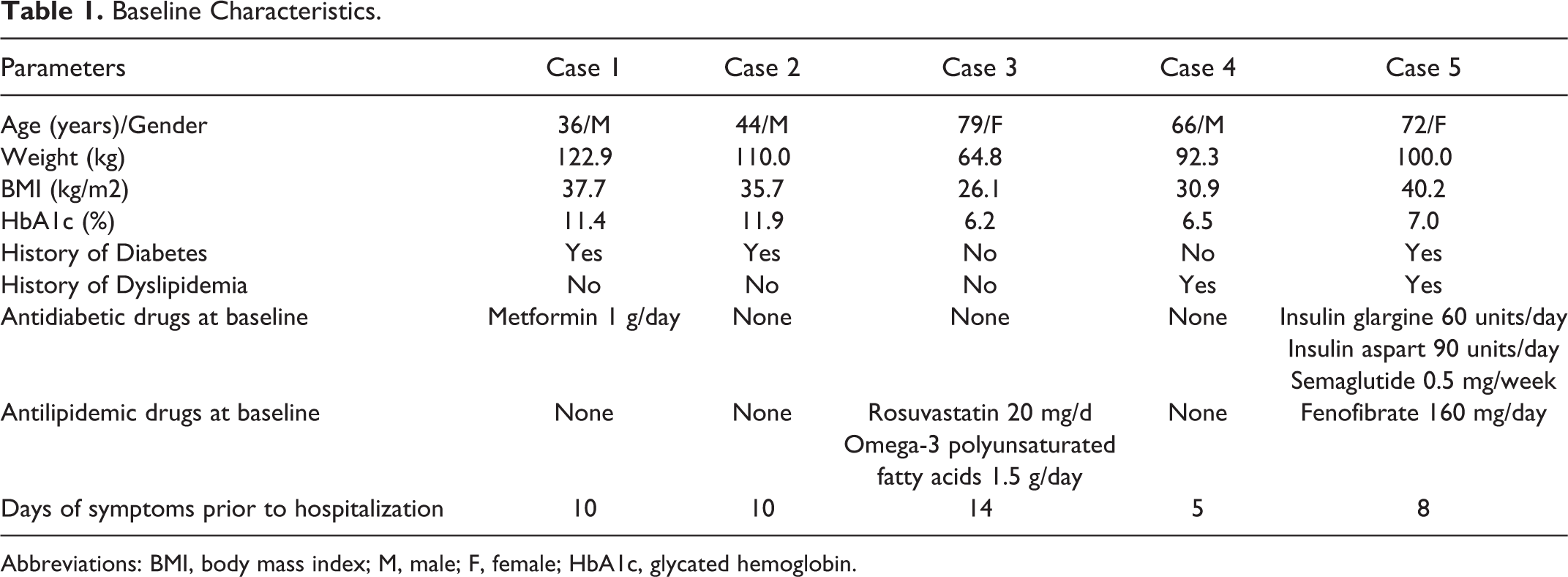
Abbreviations: BMI, body mass index; M, male; F, female; HbA1c, glycated hemoglobin.
Results
Case 1
A 36-year-old Hispanic male with a past medical history (PMH) significant for hypertension and diabetes mellitus type 2 (T2DM) presented to the Emergency Department (ED) with a 10-day history of worsening flu-like symptoms, a 2-day history of diarrhea, and a close contact that was COVID-19 positive. On hospital day 2, the patient was intubated and transferred to the ICU. He was started on propofol at an average rate of 25 mcg/kg/min. On day 5, after approximately 72 hours on propofol, his TG level was 1,492 mg/dL. At this time, the propofol was discontinued, and 15 hours later, his TG level peaked at 1,998 mg/dL. On day 6, the patient was started on a titratable insulin drip at 5.3 units/hr utilizing insulin infusion software for a target blood glucose (BG) range of 140-180 both to reduce TG levels and achieve normoglycemia. The patient was also started on omega-3 polyunsaturated fatty acids 2 g twice daily. On day 7, his TG level had fallen to 1,172 mg/dL, and the insulin infusion had increased to 21 units/hr, he continued to decline and was started on veno-venous extracorporeal membrane oxygenation (VV-ECMO). While on the insulin drip, his TG levels continued to decrease and on day 16, he was able to be transitioned off VV-ECMO with a TG level of 225 mg/dL and insulin infusion rate at 14.9 units/hr. He was transitioned to subcutaneous long-acting insulin therapy on day 19. He was restarted on propofol for severe agitation on day 29, and on day 30, he was restarted on a titratable insulin drip at 5.7 units/hr utilizing insulin infusion software to achieve normoglycemia. His propofol was stopped on day 31 for a TG level of 549 mg/dL and he was started on fenofibrate 200 mg daily with insulin 22.5units/hr. On day 32, his TG level peaked for a second time at 1,183 mg/dL, his insulin infusion increased further to 27.7 units/hr, and niacin 500 mg daily was added to his regimen. On day 33, his TG level decreased to 525 mg/dL on insulin 23.9 units/hr, and on day 34, his TG level further decreased to 332 mg/dL on inulin 41.4 units/hr. The niacin and omega-3 polyunsaturated fatty acids were discontinued due to difficulty of administration. On day 36 he was again transitioned to subcutaneous long-acting insulin therapy. He had no instance of hypoglycemia (blood glucose (BG) < 60) while on the insulin infusion. He was discharged home on day 44 on fenofibrate 200 mg daily.
Case 2
A 44-year-old Hispanic male with a PMH significant for T2DM presented to the ED for a 10-day history of shortness of breath, cough, fever, chills, malaise, loss of taste, and a 3-day history of diarrhea. On hospital day 2, he was intubated, transferred to the ICU, and started on propofol at an average rate of 42 mcg/kg/min. On day 3, his TG level was 298 mg/dL and on day 6 his TG level had increased to a peak of 1,349 mg/dL. At this time, the propofol was discontinued and the patient was started on a titratable insulin drip at 6.2 units/hr to reduce TG levels and achieve normoglycemia. By day 9, his TG level had decreased to 403 mg/dL, however the patient remained on the titratable insulin drip for hyperglycemia at an average of 9.4 units/hr throughout his course of therapy. While on the insulin drip, his TG levels continuously decreased to 101 mg/dL by day 18. On day 19, the patient was transitioned to subcutaneous long-acting insulin therapy. The patient was transferred to an LTAC after 41 days in the ICU with TG consistently less than 200 mg/dL and on no additional lipid lowering therapies. No instances of hypoglycemia occurred. Most instances of hyperglycemia (BG > 200 mg/dL) occurred within the first 4 days of admission. BG range within this time was from 97-366 mg/dL which resulted in a maximum insulin rate of 37.7 units/hr on the second day of infusion.
Case 3
A 79-year-old Caucasian female with a PMH significant for bronchiectasis, hypothyroidism, and a permanent pacemaker presented to the ED on 4 liters nasal cannula after disembarking a cruise ship with a 2-week history of dyspnea and intermittent oxygen requirement and a positive COVID-19 test. She was initially admitted to the progressive care unit (PCU), however, 3 hours later she was intubated and transferred to the ICU. After intubation, she was started on propofol at an average rate of 33 mcg/kg/min. On day 2, her TG level was 347 mg/dL, and on day 3, 48 hours after propofol initiation, her level peaked at 1,093 mg/dL. At this time, the propofol was discontinued and the patient was started on a fixed rate insulin drip at 3 units/hr with dextrose 10% in water titrated to maintain euglycemia. The patient experienced 3 hours of hypoglycemia after initiation which was corrected by 100 mL of dextrose 50% in water. She was also started on omega-3 polyunsaturated fatty acids 4 g twice daily and simvastatin 40 mg daily at bedtime, however, did not receive these medications after day 4 due to the loss of oral access. By day 5, her TG level had fallen to 248 mg/dL and the fixed rate insulin drip was discontinued. While her TG level continued to decline, the patient lost a detectable pulse, and expired on hospital day 6.
Case 4
A 66-year-old Hispanic male with a PMH of hypertension and hyperlipidemia, not on a statin, presented to the ED with a 5-day history of diarrhea. Upon presentation, he was noted to have an oxygen saturation of 85% on room air, which increased to 90% on 2 liters nasal cannula. On day 2, he was transferred to the ICU after intubation and started on propofol at an average rate of 17 mcg/kg/min. His baseline TG level was 312 mg/dL on hospital day 2. On day 5, his TG level increased to 1,042 mg/dL. At this time, the propofol was discontinued and the patient was started on a fixed rate insulin drip at 3 units/hr with dextrose 10% in water titrated to maintain euglycemia. On day 6, his TG level reached 1,436 mg/dL, and omega-3 polyunsaturated fatty acids 4 g twice daily was added to his regimen. On day 7, his TG level peaked at 1,602 mg/dL and his fixed rate insulin drip was increased to 5 units/hr. The fixed rate insulin drip was further increased to 6 units/hr on day 8, as his TG level decreased but remained critical at 941 mg/dL. On days 9 and 10, his TG levels continued declining and on day 10, his fixed rate insulin drip was increased to 8 units/hr. His TG level increased to 798 mg/dL on day 11, despite his current therapy. His omega-3 polyunsaturated fatty acids were discontinued, and he was started on fenofibrate 200 mg daily and atorvastatin 40 mg at bedtime. On days 12 and 13, his TG levels continued to decline to 553 mg/dL and 371 mg/dL respectively. The patient had no instances of hypoglycemia and the fixed rate insulin drip was discontinued on day 13 once the TG level was maintained at less than 500 mg/dL. On day 23, his level dropped below 200 mg/dL and the fenofibrate was discontinued. The patient was discharged to a skilled nursing facility (SNF) on day 49 on atorvastatin.
Case 5
A 72-year-old Caucasian female with a PMH of T2DM, coronary artery disease, hypertension, and hyperlipidemia presented to the ED with an 8-day history of left ear pain, shortness of breath, productive cough with green phlegm, nasal congestion, body aches, general weakness, and fever. She was admitted to the PCU then transferred to the ICU for intubation and started on propofol at an average rate of 43 mcg/kg/min. On day 2, her TG level was 565 mg/dL and she was started on fenofibrate 67 mg daily. On day 3, her level peaked at 1,263 mg/dL. At this time, the propofol was discontinued and the patient was started on a titratable insulin drip at 5.8 units/hr both to reduce TG levels and achieve normoglycemia. Her fenofibrate was increased to 200 mg daily and she was initiated on niacin 500 mg daily and atorvastatin 20 mg daily. On day 4, omega-3 polyunsaturated fatty acids 2 g twice daily was added with her TG level measuring 1,252 mg/dL. By day 5, her TG level had fallen to 566 mg/dL and on day 6, her TG level was 405 mg/dL, however she continued on the titratable insulin drip due to her hyperglycemia and received an average of 212.1 units/hr throughout her duration of therapy without any hypoglycemic episodes. While her TG level continued to decline, her prognosis remained poor, and the family decided to compassionately withdraw care on hospital day 7.
Discussion
The data regarding treatment of severe HTG utilizing insulin infusions is relegated to case series and reports, mostly in the setting of treating acute pancreatitis.7,8 There are several case reports that suggest a continuous insulin infusion is efficacious in acutely lowering TG levels. The mechanism of triglyceride lowering is through the enzyme lipoprotein lipase (LPL). Insulin promotes the synthesis and activation of LPL, which hydrolyzes TG into fatty acids and glycerol and facilitates storage of the fatty acids in adipocytes.7,8 The urgent lowering of TG to a normal level is important to reduce the risk of developing pancreatitis. This is especially true in patients with COVID-19 that are experiencing cytokine storm, as these patients have a severely dysregulated host response that can lead to elevated TG. While case series and reports exist on the topic of using insulin infusions to rapidly lower TG, to our knowledge, this is the first case series to demonstrate the efficacy of an insulin infusion in rapidly lowering TG levels in COVID-19 patients.
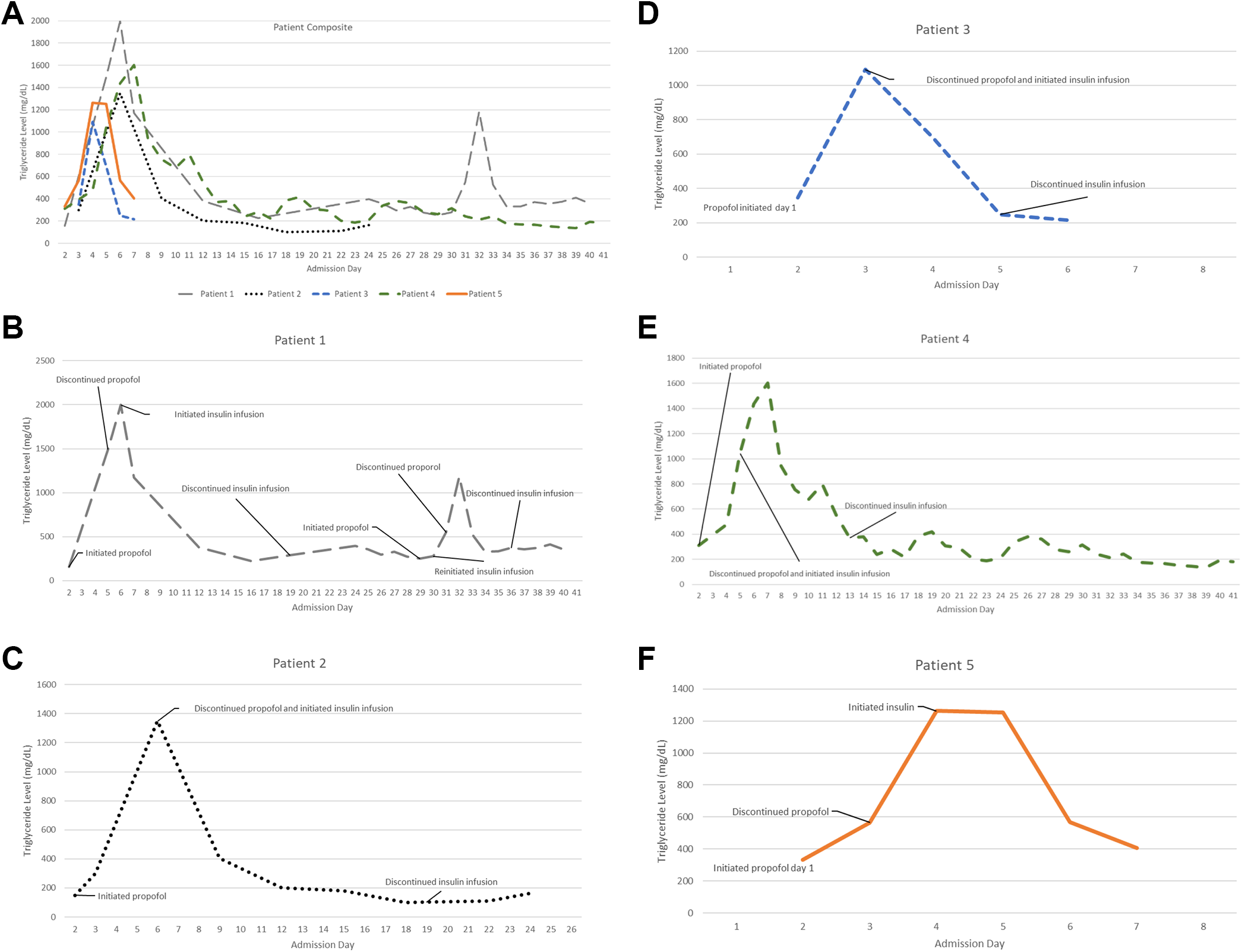
Composite of patient triglycerde levels over the course of admission (A), patient 1 medication intervention by admission day (B), patient 2 medication intervention by admission day (C), patient 3 medication intervention by admission day (D), patient 4 medication intervention by admission day (E), patient 5 medication intervention by admission day (F).
Figure 1 illustrates TG trends in relation to medication therapy. In all 5 patients, we saw that continuous insulin infusion was efficacious in lowering the TG levels and in 3 patients, we saw rapid lowering of TG to less than 500 mg/dL within 72 hours. One patient’s TG level was lowered to less than 500 mg/dL within 6 days, however there was no level drawn on days 2-5 of insulin therapy, making it unknown if his HTG resolved earlier. The final patient’s TG level decreased to less than 500 mg/dL by day 8 of insulin infusion and the insulin rate was titrated up from 3 units/hr to a max of 8 units/hr over the course of those 8 days. A potential concern with insulin infusions is hypoglycemia. To mitigate this risk, concomitant dextrose infusions were utilized with BG checks every 1-2 hours. Only 1 incidence of hypoglycemia was seen, which was then quickly corrected.
While this case series highlights the impact of continuous insulin infusion on lowering severely elevated TG levels in these patients, there are some limitations. All patients received a continuous insulin infusion, however some patients received a fixed rate, while others were titrated for both TG lowering effects and hyperglycemia. This demonstrates that continuous infusion insulin lowers TG levels, however it does not establish which method is more efficacious. It is possible that elevated blood glucose may negatively affect the rate in which TG levels decrease. Another limitation is the lack of standardization in drawing TG levels. Some patients were assessed daily, while others had up to 5 days between levels, which could have affected the total time to attain TG levels less than 500 mg/dL as evidenced by case 1. Use of propofol was another confounder, as duration and discontinuation point of propofol infusions was not uniform amongst cases and may have also contributed to rapid TG lowering.
All but 1 patient was started on concomitant oral lipid lowering therapies, however their efficacy cannot be established as these therapies varied and most were discontinued once the TG levels were less than 500 mg/dL. There is no clear superior oral agent for treatment of mechanisms of HTG such as liver failure, drug induced, or HLH related HTG. The omega-3 polyunsaturated fatty acids were discontinued on all 4 patients on which they were started due to difficulty in administration as nurses had to puncture the capsule and draw out the medication in order to administer via enteral tubes. Alternate agents may be preferred for administration via enteral tubes. Ewald and Kloer suggests that omega-3 polyunsaturated fatty acids have an immediate onset of action, however use as monotherapy may not lower TG as rapidly as desired in these patients. 9 Fibrates are considered first line for TG lowering, however they have a slow onset and are not ideal for use in rapidly lowering TG levels. 10 Further study is needed to determine ideal oral agents to utilize for rapid TG lowering.
Conclusion
Severe HTG is described in COVID-19 patients. Initiating insulin infusions in combination with various oral therapies following the discontinuation of propofol was effective at lowering TG levels to <500 mg/dL within 72 hours. Throughout the course of therapy, no cases of acute pancreatitis or sustained hypoglycemia were seen. Further study is needed to determine optimal dosing and duration of insulin infusions and combination with oral therapy for treatment of severe HTG.
Footnotes
Declaration of Conflicting Interests
The author(s) declared no potential conflicts of interest with respect to the research, authorship, and/or publication of this article.
Funding
The author(s) received no financial support for the research, authorship, and/or publication of this article.
