






Abstract
Background:
The dramatic increase in the acquisition cost of injectable calcitonin led to creating a pharmacy-driven calcitonin protocol to improve the appropriate use of calcitonin and other treatment modalities for hypercalcemia.
Objective:
This study aimed to characterize the use of calcitonin before and after implementation of a pharmacy-driven calcitonin protocol.
Methods:
This was a multi-center, retrospective study of the use of injectable calcitonin in adult hospitalized patients with hypercalcemia. The study included patients treated with calcitonin from October 2014 to September 2016 and from October 2017 to September 2019. The primary outcomes were percentage of patients with a complete response, partial response, and non-responders. The secondary outcomes were time to relapse, duration of partial response, number of doses, and associated costs of calcitonin.
Results:
Of the 131 patients included in this study, 93 were included in a pre-protocol group and 38 were included in a post-protocol group. The primary outcome of complete response by 3 days was met in 28% of patients in the pre-protocol group and 53% of patients in the post-protocol group (P = 0.007). Calcitonin spending in dollars in the pre-protocol group was $818,956 compared to $224,320 in the post-protocol group; a difference of $594,636.
Conclusion:
Implementation of a pharmacy-driven calcitonin protocol effectively improved calcium levels, reduced inappropriate calcitonin use, and reduced calcitonin spending during a period of 2 fiscal years.
Background
In the United States, total inpatient calcitonin spending increased from $2.3 million to $55.2 million from 2013 to 2015. 1 The unit price of calcitonin increased from $68 in 2013 to $2286 in 2015; an increase of 3263%. 1 This dramatic increase in price correlates with Sebela Pharmaceuticals acquiring Miacalcin for $49.7 million and then selling the drug to Mylan Institutional in 2015 for $348.7 million.2,3 Due to the dramatic increase in this acquisition cost, a calcitonin protocol was developed and implemented at our health system of 4 hospitals. The calcitonin protocol guided the treatment of hospitalized patients with mild, moderate, and severe hypercalcemia based on serum calcium levels (Figure 1).
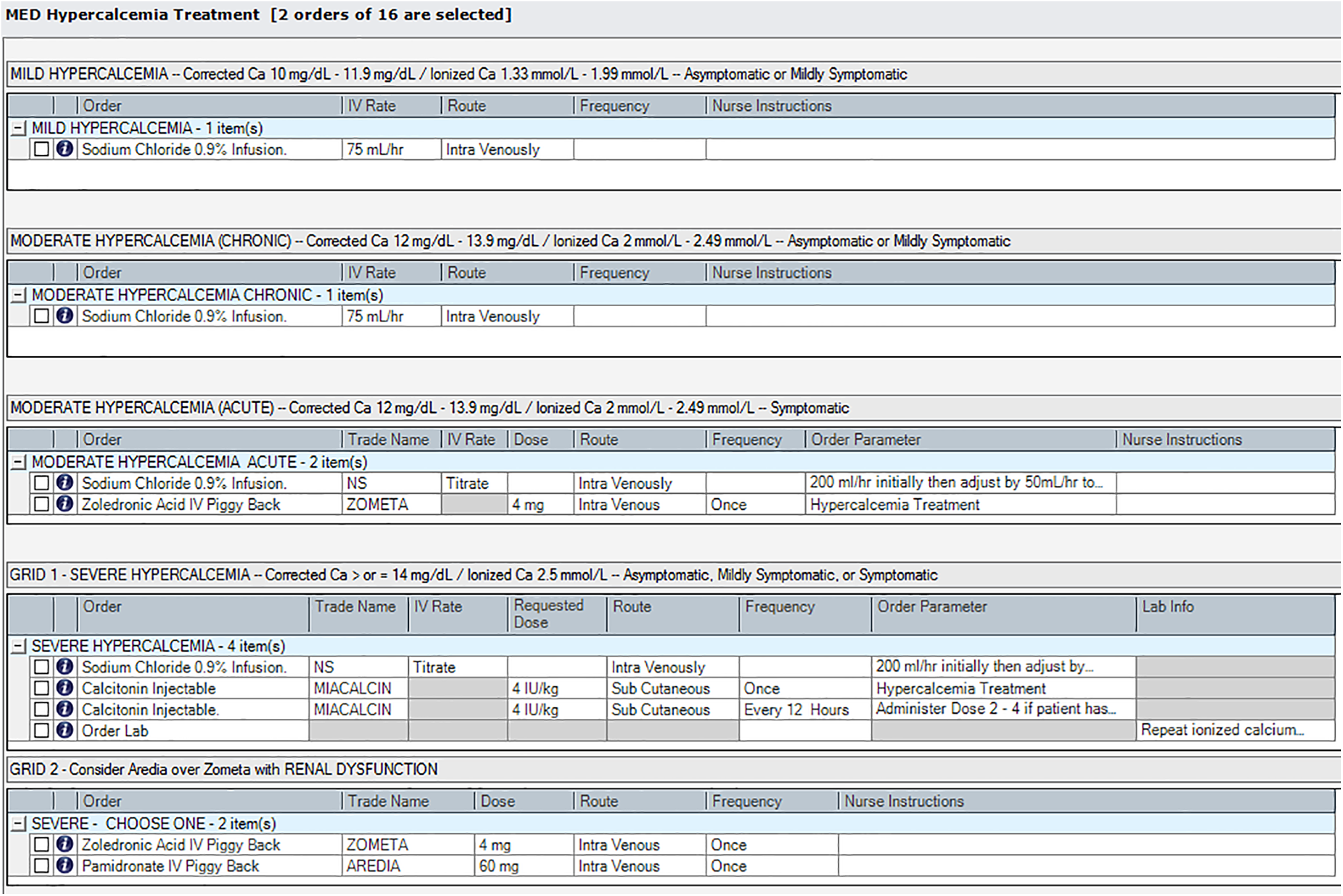
Electronic calcitonin protocol.
Treatment of hypercalcemia is predicated on patient symptoms and serum calcium level and should be aimed at treating the underlying disease. Hospital-based management of hypercalcemia is outlined in the 2018 British Columbia Cancer Agency Guidelines for the Diagnosis and Management of Malignancy Related Hypercalcemia and the 2016 Society for Endocrinology Guidelines for the Emergency Management of Acute Hypercalcemia in Adult Patients.4,5
According to these guidelines, initial treatment of hypercalcemia should include aggressive hydration with intravenous crystalloid fluids to correct volume depletion and lower the serum calcium concentration.4,5 Bisphosphonate therapy with pamidronate, zoledronic acid, or ibandronic acid is recommended after initiating vigorous hydration in patients with moderate to severe hypercalcemia.4,5
In patients with severe hypercalcemia, calcitonin-salmon 4-8 international units/kg is recommended as adjunctive therapy.4,5 Administration of subcutaneous or intramuscular calcitonin-salmon lowers the serum calcium concentration via inhibition of calcium reabsorption in the distal tubules by 1 to 2 mg/dL within 4 to 6 hours. 6 Calcitonin provides a rapid reduction in serum calcium concentration, while bisphosphonates provide a more sustained reduction in serum calcium concentration. 7 Use of calcitonin beyond 48 hours provides limited benefit as tachyphylaxis, a diminished response to repeated doses of a medication, occurs.8,9
Methods
This was a multi-center, retrospective chart review that evaluated the effectiveness of a calcitonin protocol at a health system of 4 non-teaching hospitals totaling 886 beds. Approval for this study was obtained from the health system’s Ethics Committee. Per protocol, calcitonin was initiated as a 1-time dose in patients with a CSC > 14 mg/dL and followed by a serum calcium level 6 hours after administration. If the serum calcium level decreased after calcitonin administration, the pharmacist scheduled 3 additional doses of calcitonin. If the serum calcium level did not decrease, the pharmacist discontinued the calcitonin order per protocol. The calcitonin protocol allowed for physicians to opt-out on a case by case basis.
Patients included were aged ≥ 18 years and treated with subcutaneous calcitonin for hypercalcemia. Patients were excluded if presenting with a history of allergic reaction or hypersensitivity to zoledronic acid, pamidronate, or calcitonin formulations. Two groups were identified by the time period of administration of calcitonin, relative to the date of protocol implementation (pre-protocol and post-protocol). The pre-protocol group included hospitalized patients from October 1, 2014, to September 30, 2016, while the post-protocol group included patients from October 1, 2017, to September 30, 2019 (Figure 2). The protocol was implemented in October 2016 and a washout period was included to account for provider education and prospective feedback from pharmacists.

Timeline of protocol implementation.
The primary outcomes were percentage of patients with a complete response, partial response, and non-response to calcitonin. A non-responder to calcitonin was defined as no decrease in CSC after administration of the initial dose of calcitonin. The secondary outcomes were time to relapse, duration of partial response, number of administered doses, and associated costs of calcitonin. Complete response, defined as CSC ≤ 10.8 mg/dL, relapse defined as CSC ≥ 11.6 mg/dL and response defined as CSC ≤ 11.5 mg/dL have been utilized to evaluate efficacy by two pivotal studies comparing zoledronic acid to pamidronate and one study evaluating denosumab for the treatment of hypercalcemia of malignancy.8,10,11 Time to relapse was defined as the duration in days between the date of initial administration of calcitonin to the last available CSC < 11.6 mg/dL. Duration of partial response was defined as the duration in days from the first available CSC ≤ 11.5 mg/dL to the last available CSC ≤ 11.5 mg/dL.
The calcitonin protocol was approved by the Pharmacy and Therapeutics Committee and Medical Executive Committees of each respective hospital. Before implementation, clinical pharmacists were educated on the protocol, which outlined step-by-step treatment of patients presenting with hypercalcemia. The calcitonin protocol, as seen in Figure 1, was ordered by searching “hypercalcemia treatment” or “calcitonin treatment” in the electronic health record, Sunrise Clinical Manager (SCM). Upon receipt of an order for subcutaneous calcitonin, a pharmacist verified 1 dose for immediate administration and a placeholder for 3 additional doses as needed if the patient’s CSC was > 14 mg/dL. If the patient’s CSC was ≤ 14 mg/dL, the order for subcutaneous calcitonin was discontinued by a pharmacist per protocol. A pharmacist also ensured an ionized calcium level was ordered 6 hours after the first dose. If the patient’s serum calcium level decreased, the pharmacist replaced the as needed calcitonin order with 3 doses of scheduled subcutaneous calcitonin 4 international units/kg every 12 hours. If the patient’s serum calcium level did not decrease, this indicated a calcitonin non-responder and the pharmacist discontinued future calcitonin doses per protocol. Non-responders to calcitonin were identified using ionized serum calcium levels, while patients with complete or partial responses to calcitonin were identified using CSC.
Provider documentation and patient charts were reviewed to determine the type, rate, and duration of intravenous fluids. The dose, frequency, quantity, duration, and time of administration of zoledronic acid, pamidronate, and calcitonin were also collected. Data analysis was performed using Microsoft Excel. Categorical data were reported as numbers or percentages. Continuous data were reported as means, numbers, or percentages. Normality was tested using the Kolmogorov-Smirnov test. Normally distributed continuous data were compared using the Student’s t-test. Continuous data that were not normally distributed were compared using the Wilcoxon-Mann-Whitney test. Categorical data were compared using the chi-Square test.
Results
The pre-protocol group included 93 patients treated with injectable calcitonin between October 1, 2014, and September 30, 2016. The post-protocol group included 38 patients treated with injectable calcitonin between October 1, 2017, and September 30, 2019. A total of 540 doses were administered in the pre-protocol group, while a total of 98 doses were administered in the post-protocol group. The majority of baseline characteristics (Table 1) were similar between the two groups with the exception of serum albumin, CSC, and discharge disposition to hospice. All continuous data were normally distributed with the exception of height and serum creatinine.
Baseline Characteristics.
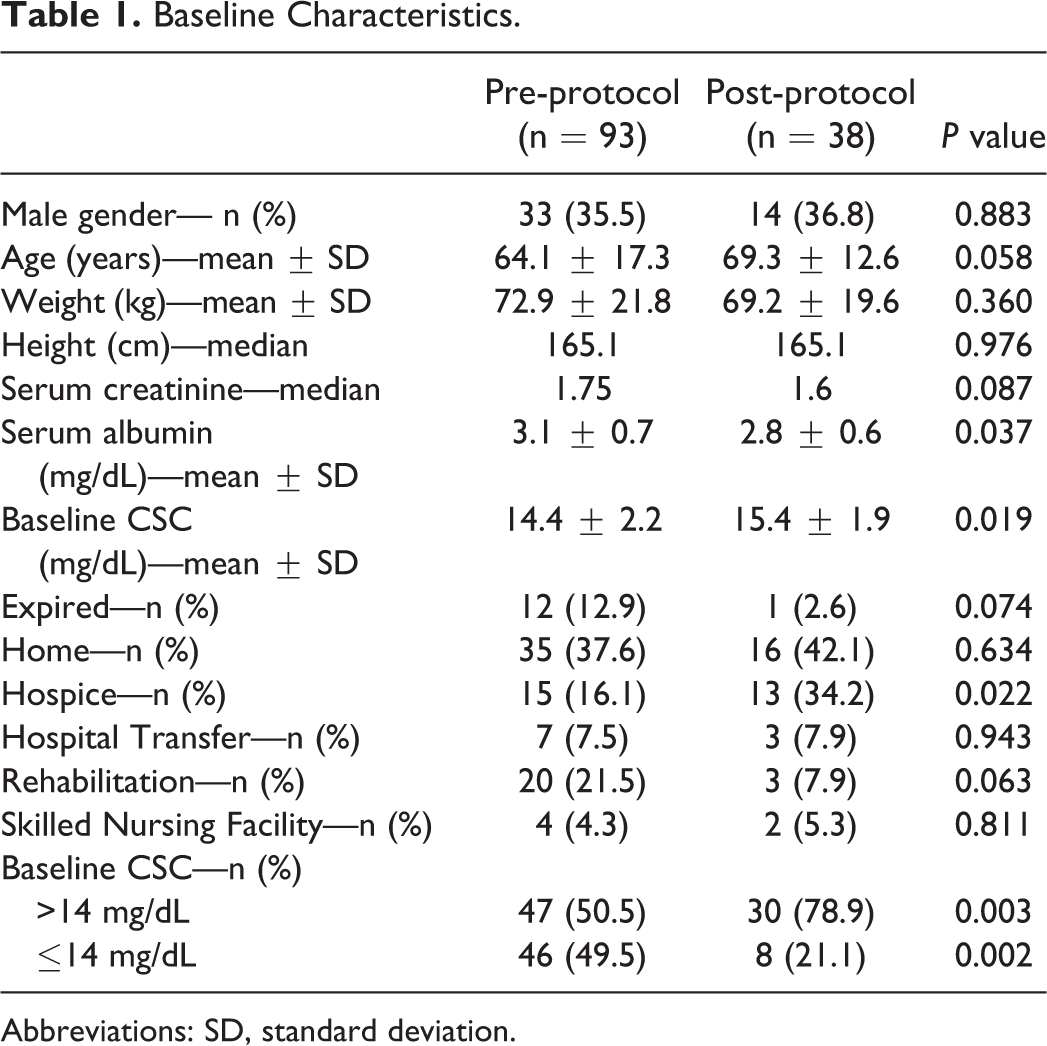
Abbreviations: SD, standard deviation.
The mean baseline CSC was higher in the post-protocol group (14.4 ± 2.2 vs 15.4 ± 1.9, P = 0.019). Calcitonin was appropriately administered for a baseline CSC > 14 mg/dL in 47 patients (51%) in the pre-protocol group compared to 30 patients (79%) in the post-protocol group (P = 0.003). A larger percentage of patients in the post-protocol group had a discharge disposition to hospice (16% vs 34%, P = 0.002).
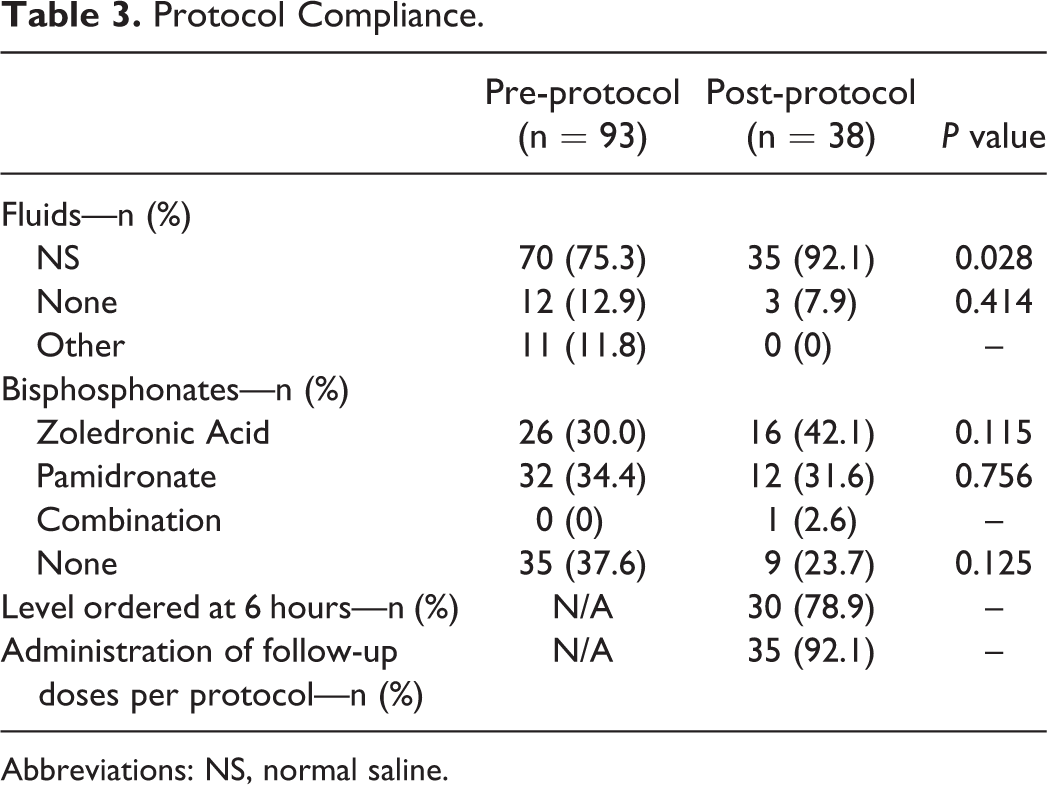
The percentage of complete response (Table 2) was greater in the post-protocol group (28% vs 53%, P = 0.007). There was no statistical difference between the percentage of patients with a partial response (48% vs 63%, P = 0.124) or non-responders (13% vs 13%, P = 0.969). Relapse occurred in 8 patients (9%) in the pre-protocol group compared to 1 patient (3%) in the post-protocol group (P = 0.220). The mean time to relapse in the pre-protocol group was 4.13 days, while the time to relapse for the 1 patient who relapsed in the post-protocol group was 1.5 days. The average number of doses administered per patient in the pre-protocol group was 6 doses compared to 3 doses in the post-protocol group (P = 0.006). The mean duration of treatment was shorter in the post-protocol group, however, there was no statistical evidence of a difference (3.4 ± 6.4 days vs 1.6 ± 0.6 days, P = 0.210). Calcitonin spending in dollars in the pre-protocol group was $818,956 compared to $224,320 in the post-protocol group (Figure 3). There was no statistical difference between groups for bisphosphonate use or total intravenous fluid administration (Table 3), however, normal saline was administered more often in the post-protocol group (75.3% vs 92%, P = 0.028). Pharmacy compliance in ordering a calcium level 6 hours after the initial calcitonin dose was 78.9% in the post-protocol group. Pharmacy appropriately discontinued calcitonin per protocol in all 14 patients (37% of total patients evaluated) who met criteria by not having a decrease in CSC and/or baseline CSC > 14 mg/dL. Follow-up doses of calcitonin were inappropriately administered in 8% of patients in the post-protocol group who had no decrease in CSC.
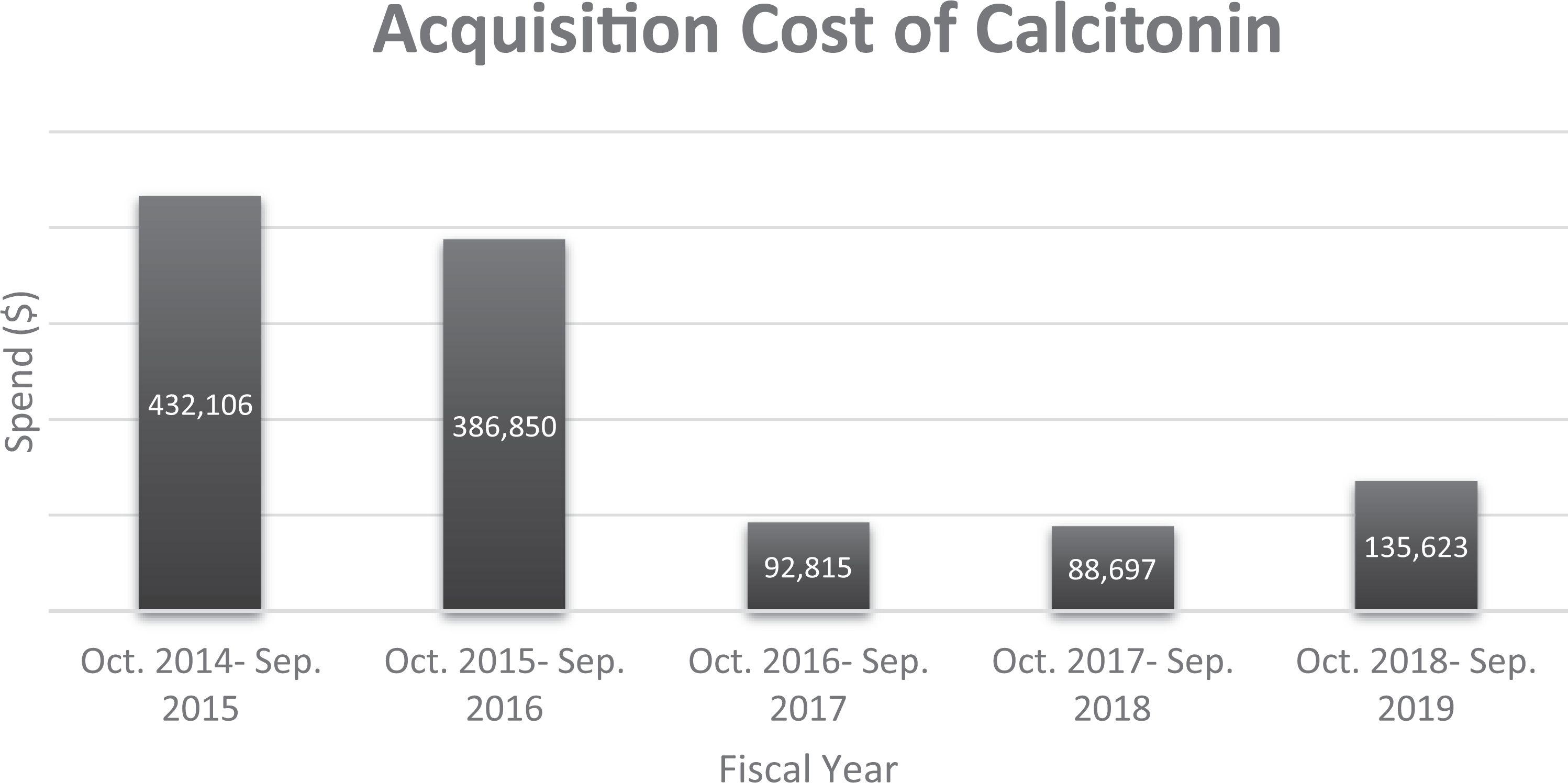
Acquisition cost of calcitonin.
Primary and Secondary Outcomes.
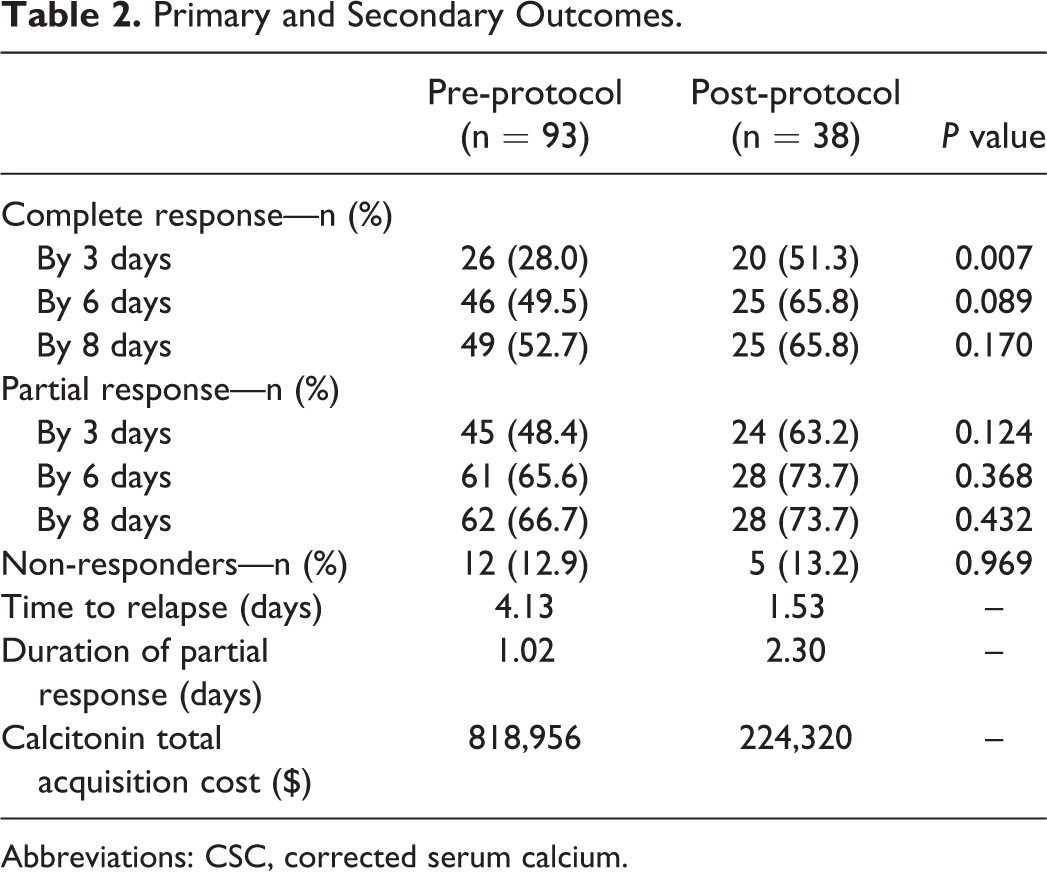
Abbreviations: CSC, corrected serum calcium.
Protocol Compliance.
Abbreviations: NS, normal saline.
Discussion
There is a paucity of literature reporting on pharmacy-driven calcitonin protocols. A single-center, retrospective study by Walchack et al evaluated the reduction in calcitonin use after the implementation of formulary restriction criteria for injectable calcitonin that included a CSC > 14 mg/dL regardless of symptoms or a CSC > 10.2 mg/dL with symptoms. 12 The study authors found that implementation of a formulary restriction for injectable calcitonin led to the administration of significantly fewer doses and units of injectable calcitonin with 84.2% of orders meeting the restriction criteria for use. 12 In comparison, our study evaluated the impact of a pharmacy-driven calcitonin protocol on clinical outcomes and calcitonin use. Injectable calcitonin was restricted in our study to patients with a CSC > 14 mg/dL regardless of symptoms. In addition, our protocol allowed pharmacists to order ionized serum calcium levels and discontinue calcitonin orders per protocol. Prospective pharmacist review of calcitonin orders and active intervention is crucial in improving appropriate prescribing of calcitonin and clinical outcomes.
Implementation of a calcitonin protocol increased the appropriate use of calcitonin through close monitoring of serum calcium levels and guided calcitonin prescribing for moderate to severe hypercalcemia. Daily serum calcium levels for patients in the pre-and post-protocol groups were reliably obtained from patient charts. Fewer patients with a baseline CSC of ≤ 14 mg/dL received calcitonin in the post-protocol group, demonstrating that protocol implementation reduced administration of calcitonin in patients with mild or moderate hypercalcemia. Instead, these patients were treated with aggressive hydration and/or bisphosphonates to resolve the hypercalcemia. Implementation of the protocol may have led to a significant increase in the number of patients who achieved a complete response in the post-protocol group due to these patients receiving guideline-directed medical therapy. This is evident from the larger percentage of patients in the post-protocol group who were treated with aggressive hydration using intravenous normal saline (75% vs 92%, P = 0.028). The rate of complete response was lower in the pre-protocol group as these patients less frequently received aggressive hydration and more frequently received calcitonin for a CSC < 14 mg/dL. Protocol implementation significantly reduced the total number of calcitonin doses administered and optimized calcitonin dosing, resulting in significant cost savings. During the first year after protocol implementation, calcitonin spending decreased by $294,035 compared to the preceding fiscal year.
Limitations of this study included its retrospective design, small sample size, and difference in baseline characteristics. The baseline differences in albumin, CSC, and hospice discharge disposition are likely associated with the post-protocol group’s increase in overall disease severity. This would support the protocol’s association with optimizing calcitonin treatment toward more moderate to severe hypercalcemia. The study was limited by not evaluating the impact of the protocol on pharmacist time. The study was also limited by not evaluating treatment outcomes for all hypercalcemia patients, regardless of calcitonin use. The study did not include patients who received protocol-guided therapy with only aggressive hydration and/or bisphosphonates.
Increasing fluid infusion utilization, optimizing fluid rates, and renally dosing bisphosphonates could improve the implementation of this protocol at other institutions. Additionally, compliance with the calcitonin protocol may be increased through surveillance software alerts to monitor calcitonin and education for physicians and pharmacists. Our protocol improved appropriate calcitonin use and resulted in institutional cost savings, however, further protocol optimization could improve outcomes.
Conclusion
This study’s pharmacy-driven calcitonin protocol optimized calcitonin duration, appropriateness, and decreased calcitonin spending. The protocol demonstrated pharmacists’ ability to safely and effectively guide hypercalcemia treatment by monitoring calcium levels closely, limiting calcitonin use to 48 hours, and avoiding calcitonin tachyphylaxis.
Footnotes
Declaration of Conflicting Interests
The author(s) declared no potential conflicts of interest with respect to the research, authorship, and/or publication of this article.
Funding
The author(s) received no financial support for the research, authorship, and/or publication of this article.
