






Abstract
Background:
Pharmacists are increasingly fulfilling roles on primary care teams, yet business models for pharmacist services in these settings have not been optimized. This study describes how an ambulatory care pharmacy department implemented various billing methods to generate revenue for pharmacist services.
Objectives:
(1) Describe pharmacist-delivered billable and non-billable services; and (2) Assess the impact of various billing methods on the return-on-investment (ROI) for billable services.
Methods:
This study was conducted from September 2016 to August 2017 in Virginia. Pharmacist time spent performing billable encounters using current procedural technology (CPT) codes (e.g., incident-to a physician, annual wellness visits) was calculated. Encounters eligible for the hospital-based facility (G0463) and chronic care management (CCM) codes were considered to be potentially billable services. The ROI was calculated for billable and potentially billable services.
Results:
A total of 948.3 hours (0.46 full-time equivalents (FTE)), 17% of all clinical services, were billed using CPT codes. This resulted in a total revenue of $173,638.66. Missed revenue from not billing for the G0463 and CCM codes was $68,268.37. The cost of pharmacist services for 0.46 FTE was $78,613.08, resulting in a ROI for billed pharmacist services of 1.2:1. The ROI increased to 1.6:1 when considering potentially billable services.
Conclusion:
It is feasible to have a positive ROI for billable pharmacist services. To achieve a sustainable business model, there must be a high volume of billable services. G0463 and CCM codes are often underutilized, yet represent significant opportunities in revenue for pharmacist services and should be pursued.
Background
Historically, it has been challenging for pharmacists to bill and receive compensation for clinical activities because they are not recognized as a Medicare Part B provider like physicians, nurse practitioners and other health care professionals. 1 Thus, in a primary care setting, pharmacists providing direct patient care activities are tasked with the need to maximize potential billing opportunities to compensate for their services.2,3 For a clinical pharmacist-provided service in the primary care setting to be sustainable, the business model must demonstrate that it at least reaches the break-even point. Ideally, the service would also generate a revenue which could lead to service expansion. 4
Pharmacists who have been successful in developing sustainable practice models have aligned organizational structure and policies with available billing strategies to support pharmacist services.5,6 Strategies include maximizing billing opportunities by understanding rates of reimbursement that will generate the most revenue, being proactive by negotiating with payers to cover services for employees or high-risk groups, and working with health system administrators to receive a portion of shared savings for services that decrease health care costs.5,6 This may include a combination of incident to billing for disease statement management, chronic care management, or Medicare Annual Wellness Visits, MTM Current Procedural Technology (CPT) codes, and value-based payments (e.g., shared savings and risk, capitated payments, and pay-for-performance) for care that contributes to a practice achieving quality metrics, although these models have not been widely adopted by primary care practices.2,5-8 Cost-savings/avoidance models whereby services aim to decrease the use of high-cost health care expenses, such as hospital readmissions or unnecessary emergency room visits may also contribute to a pharmacist business model in the primary care setting.2,5,6 However, this approach is subjective and not easily applied in practice because it is difficult to differentiate the impact of a pharmacist’s contributions to an outcome from other members of a health care team.9,10
Another consideration is the practice’s billing affiliation and location, as they dictate the billing rate available for compensation.4,11 For example, incident-to (CPT codes 99211—99215) billing enables a non-physician provider, in this case, the pharmacist, to be compensated for services fulfilled within a provider-based office and not a hospital-based clinic. 12 For a hospital-based clinic, the compensation strategy shifts to billing Medicare for a facility fee. In 2014, CMS created a single, comprehensive clinic visit code (CPT code G0463) for hospital-based practices to account for all facility evaluations, regardless of the level of service provided. Patients receiving care at these sites may receive 2 charges on their bill, a facility charge (CPT code G0463) and a physician or professional fee.13,14 The practice would pay for the pharmacist’s time upfront and a successful receipt of the facility fee is 1 way to neutralize this investment.
Using a mixture of these approaches, pharmacists in Minnesota have worked with health systems to deliver sustainable comprehensive medication management services in the primary care setting for over 20 years.5,7,8 In a pilot project in South Carolina, a pharmacist delivered medication management in a primary care setting and used a combination of MTM codes and “incident-to” physician CPT codes (mainly 99211, 99212, and 99213) to bill for services. The revenue generated covered 65% of the pharmacist’s salary. The combination of billing revenue and increased physician payments led to the practice being able to support the pharmacist position beyond the pilot project. 15 On the other hand, using just incident-to billing a practice in Oregon generated only 14% of the costs needed to cover pharmacist services. 9 Others have reported a profit margin at the practice level for AWVs provided by a pharmacist.16,17
The current study will add to the literature by examining the ROI of implementation of various billing methods on billable as well as potentially billable services in an established pharmacist model that is integrated with ambulatory care clinics in a large health system. This is important because, as described above, achieving a sustainable model requires thorough knowledge of all possible billing mechanisms and then working at the organizational level to put processes in place for billing. The study objectives are to: 1) describe pharmacist-delivered billable and non-billable patient-centered care services, and 2) assess the impact of various billing methods on an ambulatory care pharmacy department’s return-on-investment (ROI) for billable services.
Setting
The study was conducted at the Bon Secours Medical Group (BSMG), in Virginia, a part of Bon Secours Mercy Health, Inc. Thirty-nine practice sites across Virginia were in the coverage area for this study. Twenty out of the 39 practices are hospital-based practices and the remaining practices are physician-based. Pharmacists provided on-site care at 12 locations. Time spent at each location varied from 1–4 days per week depending upon patient panel sizes. Pharmacists provided care virtually at other sites, when needed. Musselman et al previously discussed the development of the BSMG clinical pharmacy department and integration within BSMG. 18 Prior to March 2017, the BSMG clinical pharmacy department consisted of 3 clinical pharmacist specialists and 1 pharmacy director, which equated to 2.3 full-time equivalents (FTEs) spent in direct patient care activity. An additional 0.8 FTE was added to the team after March 2017 for a total of 3.1 FTEs providing direct patient care. In addition to providing direct patient care activities, the pharmacist specialists are responsible for facilitating staff education, participating in risk management cases and quality improvement initiatives, and addressing drug information inquiries from other medical disciplines within BSMG. They report and document all clinical interventions and patient outcomes in an electronic health record (EHR). The pharmacy director oversees the administration and operational processes to rendering direct patient care. 18
Beginning September 1, 2016, BSMG began implementing several billing methods, including billing for Medicare Annual Wellness Visits (AWVs) and immunizations, incident-to billing, and pay-for-performance contract negotiations with private payers, to compensate pharmacists for their patient care services. Depending on the patient’s insurance coverage, the billing method may or may not have resulted in an additional copay. Table 1 lists the encounter type and billing codes employed by the medical group for pharmacist services. At the time of the study, BSMG was unable to bill for hospital-based facility fee (G0463) and chronic care management (CCM) services due to the lack of approval for the split billing that needed to occur. Since then, there has been some success using manual billing for these codes.
Type and Number of Encounters Billed, Reimbursement, and Total Revenue From September 2016 to August 2017.
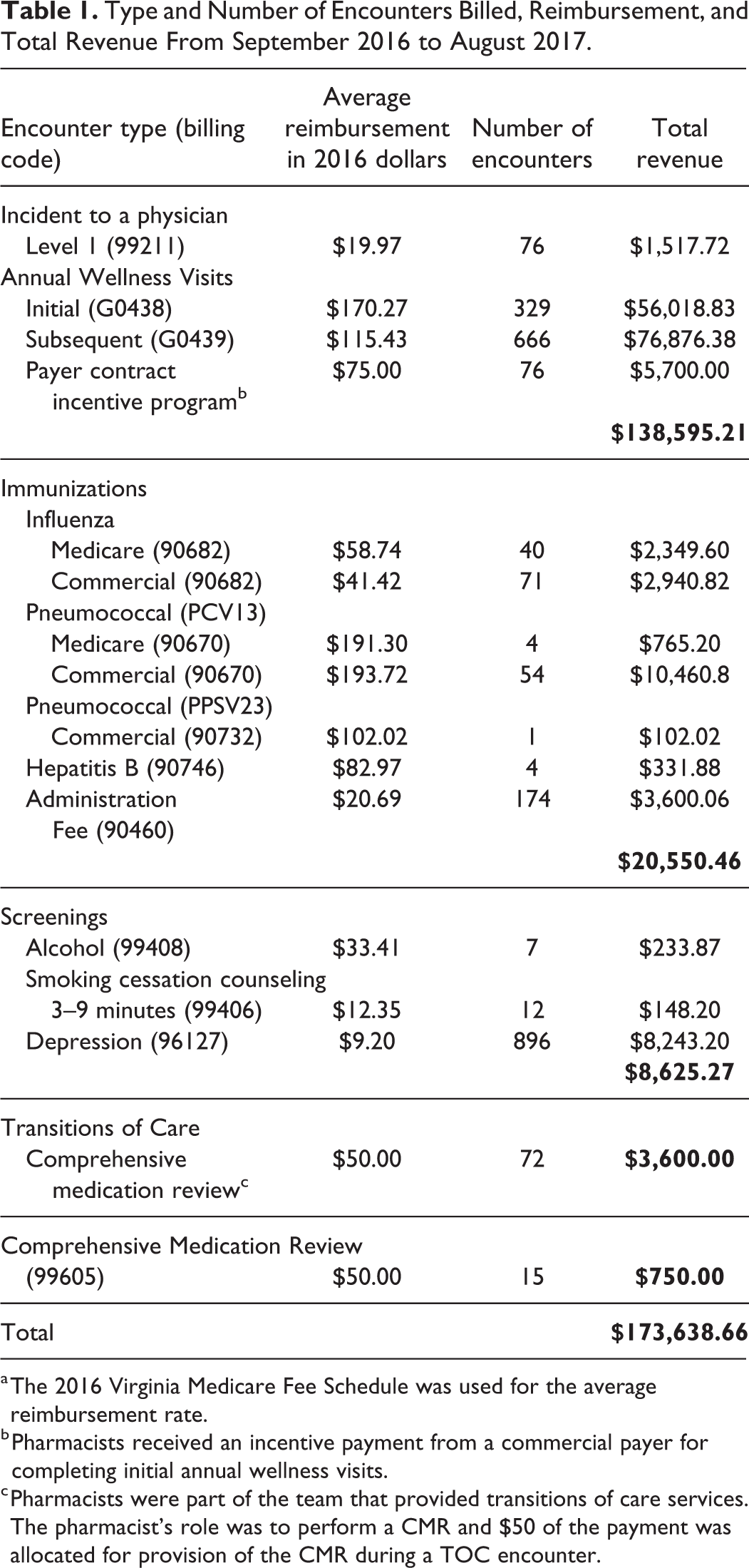
a The 2016 Virginia Medicare Fee Schedule was used for the average reimbursement rate.
b Pharmacists received an incentive payment from a commercial payer for completing initial annual wellness visits.
c Pharmacists were part of the team that provided transitions of care services. The pharmacist’s role was to perform a CMR and $50 of the payment was allocated for provision of the CMR during a TOC encounter.
Methods
This study was approved by the Bon Secours Health System’s Institutional Review Board. All BSMG pharmacist encounters from September 1, 2016 to August 31, 2017 were included. Data sources included the EHR, pharmacist flowsheets which documented pharmacist encounter type and time spent per encounter, and internal financial reports. Data were extracted from the following fields: practice location, number and type of billable, patient encounters, potentially billable services, and number and type of non-billable pharmacist services. Patient encounter type included the following billable encounters: “incident-to” a physician for chronic disease management, AWVs, immunization administration, alcohol and depression screenings, smoking cessation counseling, transitions of care, and comprehensive medication reviews (CMRs) (see Table 1). Potentially billable services were comprised of the hospital-based facility fee code (G0463), when applicable, and CCM encounters, which included telephone encounters for disease management for conditions such as diabetes, to examine the revenue potential for future billing opportunities. Non-billable pharmacist services included pharmacist chart reviews that did not involve direct interaction with a patient to address a provider-initiated question and documentation of recommendations. Pharmacist responses to drug information requests from providers, which may have been patient specific or general, were also a non-billable service. Non-billable services such as chart reviews were documented as encounters in the EHR. Other non-billable service such as drug information requests were documented in an Excel sheet where the type or provider making request, type of request, and time spent addressing the request were documented. Using the 2016 US Bureau of Labor Statistics, the estimated salary for a full-time pharmacist in a physician’s office was $131,460 (hourly rate of $63.20 x 2080 hours). 19 Based on a 30% benefit package rate, the total expenses for 1 FTE would be $170,898 annually. At BSMG, patient encounters are completed in shared office spaces and overhead cost is not deducted from the pharmacy budget, thus it is excluded from the cost of service.
To calculate the number of pharmacist hours devoted to billable and potentially billable services, first, the number of encounters completed annually was multiplied by the time spent for that encounter type (see Table 2). The sum of these values was the total clinical time spent on billable and potentially billable services. Next, the total clinical hours spent was converted to billable FTE using a base rate of 2,080 clinical hours per FTE.
Summary of Time Spent per Encounter Type, Number of Encounters, and Total Hours Spent Performing Billable Services.
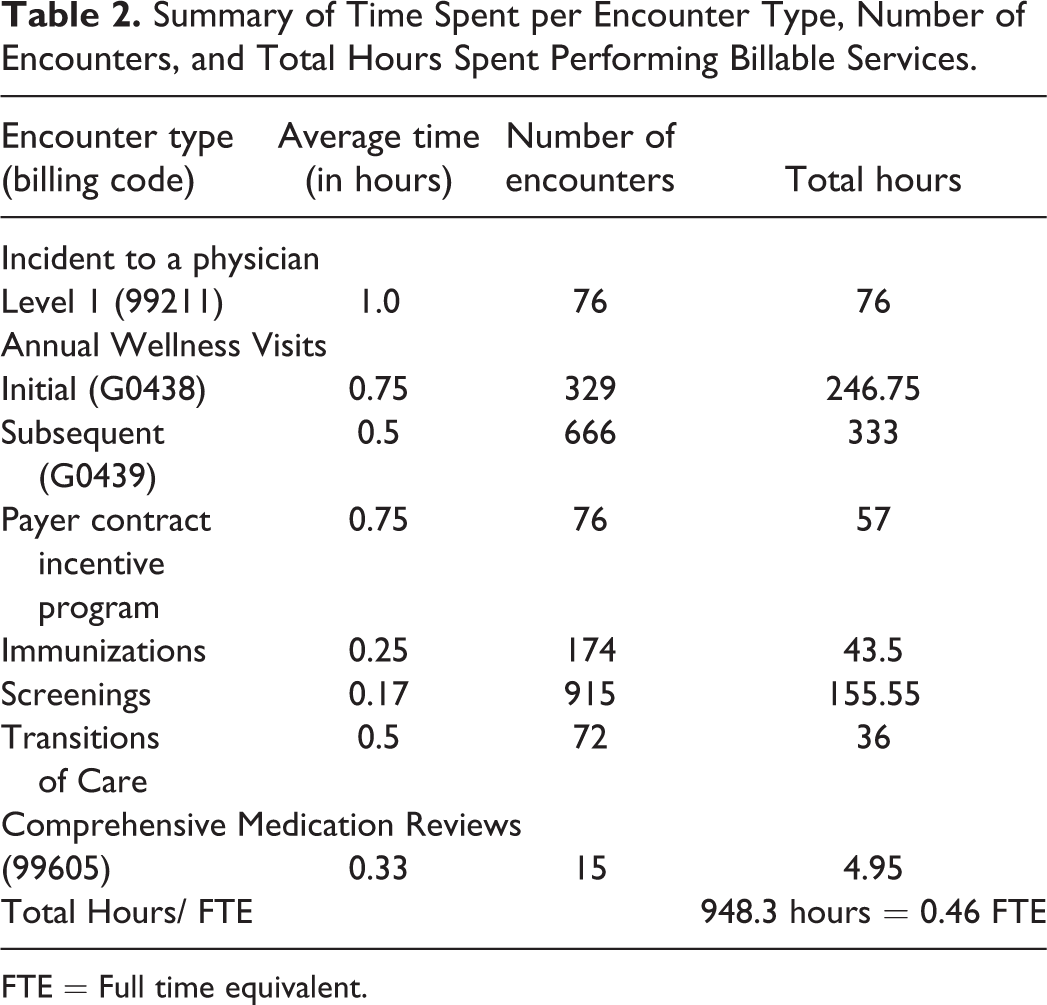
FTE = Full time equivalent.
The generated revenue for pharmacist-provided services is the sum of the product for each billable encounter type and its respective average reimbursement rate for the study period based upon The 2016 Virginia Medicare Fee Schedule (see Table 1 for types of encounters billed and reimbursement rate). Shared-savings contracts and bonuses with insurers or pay-for-performance reimbursements are excluded for proprietary reasons. The return-on-investment (ROI) for billable services was calculated as 20 :
Missed revenue was calculated in the same manner as described above for potentially billable services, including using the 2016 Virginia Medicare Fee Schedule for the average reimbursement rates. The ROI was also calculated using the revenue from billable services and missed revenue from potentially billable services to examine the revenue potential for future billing opportunities.
Results
From September 2016 to August 2017, there was a total of 5,576 clinical hours (2.68 FTE) delivered by pharmacists. Of these, 17% [948.3 hours (0.46 FTE)] were billed using the CPT codes listed in Table 1 and resulted in a total revenue of $173,638.66. AWVs accounted for the billable service with the most clinical hours spent (636.75 hours) and generated 79.8% ($138,595.21) of the revenue. Tables 1 and 2 summarize revenue and time for each type of billed encounter. Missed revenue from not billing for the G0463 facility code and CCM encounters was $68,268.37 (see Table 3). Encounters that met G0463 billing criteria (i.e., hospital-based facility) accounted for 70.4% of the missed revenue, and 158.1 additional hours were spent on CCM and not billed. The estimated cost of pharmacy salary and benefits for 0.46 FTE was $78,613.08, 19 resulting in a ROI for billed pharmacist services of 1.2:1. When considering revenue from missed billing opportunities the ROI increased to 1.6:1. Table 4 summarizes the ROI. Pharmacists also spent a portion of their clinical hours performing non-billable services. These included 1,820 chart reviews, 203 documentation only consults, and 877 drug information requests for a total of 2,900 non-billable encounters. The ROI for billable and non-billable services was 0.62:1 indicating that the revenue generated did not support the pharmacist time spent performing billable and non-billable encounters.
Reimbursement for Potentially Billable Services, Number of Encounters and Total Missed Revenue.
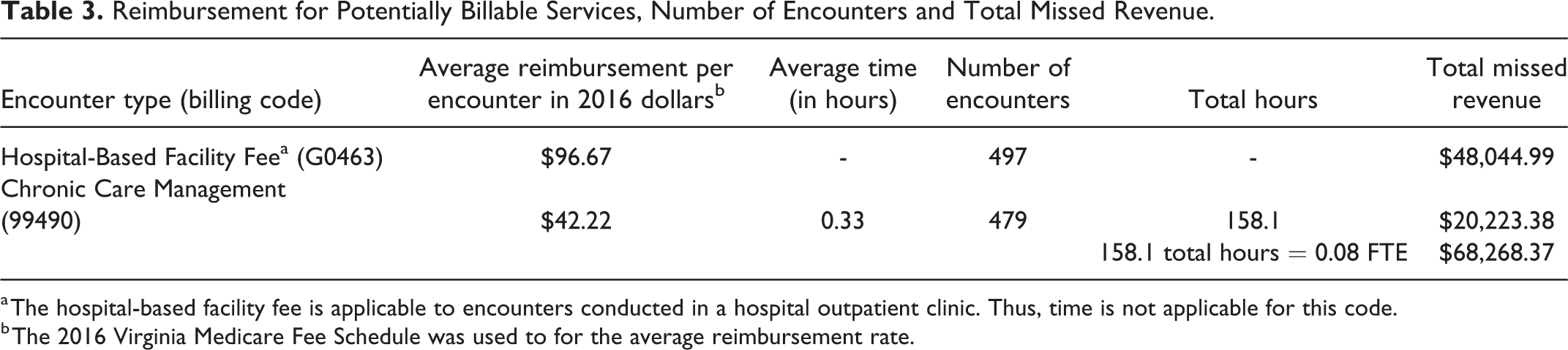
a The hospital-based facility fee is applicable to encounters conducted in a hospital outpatient clinic. Thus, time is not applicable for this code.
b The 2016 Virginia Medicare Fee Schedule was used to for the average reimbursement rate.
Summary of Return-On-Investment (ROI) for Billed Services and Billed Services Plus Missed Billing Opportunities.
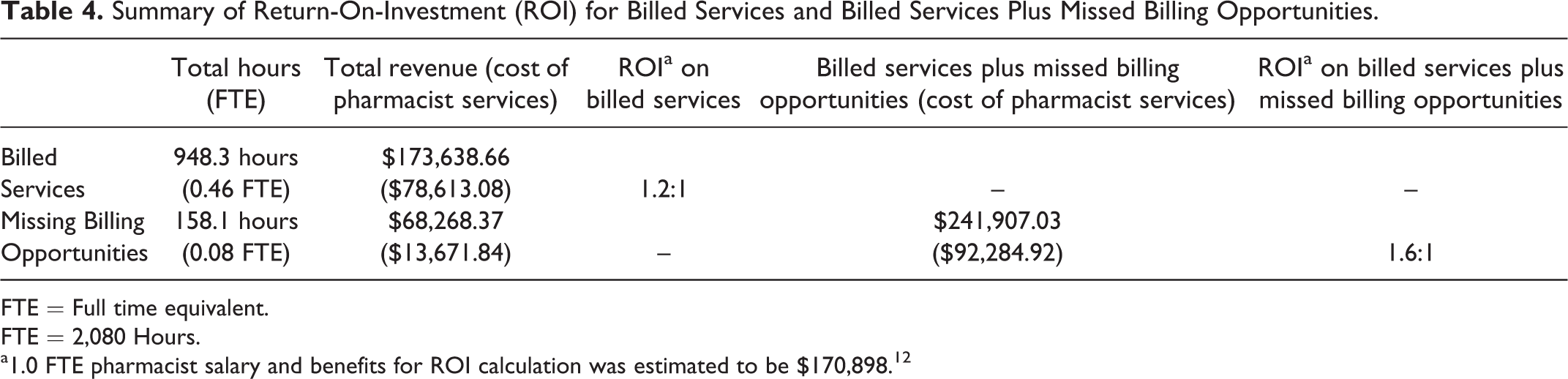
FTE = Full time equivalent.
FTE = 2,080 Hours.
a1.0 FTE pharmacist salary and benefits for ROI calculation was estimated to be $170,898. 12
Discussion
The ROI for billable pharmacist services was $1.20 for every $1.00 spent. When considering missed billing opportunities, primarily revenue from hospital-based facility encounters (G0463 CPT code), the ROI would increase to $1.60 for every $1.00 spent on pharmacist services. This aligns with previous studies that reported a combination of billing strategies are needed to support pharmacist services.2,5-8
Although the ROI was positive for billable services, only 17% of total clinical time was spent performing billable services which did not translate into a positive ROI for all clinical services. To generate revenue to support all BSMG pharmacists’ clinical time, the time spent performing billable services needs to increase. This represents an opportunity for the BSMG pharmacists to continue to work with their leadership team to identify ways to integrate services to maximize billing opportunities as described by Kastner and Merk 5 Examples of strategies to enhance billing opportunities include increasing the number of encounters eligible for “incident-to” billing and implementing a minimum number of billable patient visits per day, which is similar to a physician’s model. Implementation of a minimum number of daily visits increases the efficiency and consistency of pharmacist encounters and helps to ensure that enough revenue is being generated to cover pharmacist expenses. Next steps for BSMG involve developing a billing model that will estimate the number and type of fee-for-service encounters that are needed to reach the break-even point which would help determine a minimum number of billable patient visits per day.
To develop a sustainable business model, pharmacists should be prepared to articulate with various administrators how pharmacist services benefit the organization’s mission and quality metrics, and discuss the various billing methods available to generate revenue from pharmacist services.5,6 Payer mix, the composition of a practice’s insurance coverage type, such as Medicare, Medicaid, commercial, or self-pay, may influence the type of patient care activities performed by the pharmacist. For example, a practice with a predominant Medicare population may target high reimbursement rate services, such as AWVs and CCM. 12 In this study, AWVs accounted for the majority of the revenue that was generated. Recent reviews also found that AWVs are a billable service that increased revenue.17,21 Thus, AWVs, may be a starting point for billing in some practices. There are also opportunities to increase CCM billing for diabetes and other chronic conditions. For example, pharmacists are having increased roles in transitioning patients from traditional self-monitoring of blood glucose to using the technology-based continuous glucose monitoring (CGM) approach. 22 While there are billing opportunities for pharmacists to initiate CGM, importantly, pharmacist initiation of CGM can lead to longer-term management of diabetes which would then qualify for CCM billing. 16 Practices with a larger proportion of commercial beneficiaries may focus on establishing specific relationships or contracts with commercial payers.
This study also highlights potential opportunities such as billing for the G0463 code that are often underutilized. For pharmacists, this serves as another billing method worth discussing with providers, however, there are often gaps in billing administrators awareness and understanding about how the G0463 relates to pharmacist services. Since the time of the study, the ambulatory practice pharmacy director has received approval to pilot a process for billing the facility charge for pharmacist encounters in a hospital-based clinic.
Pharmacists often make contributions to a primary care team that are non-billable, yet important for building rapport and contributing to overall practice goals. These include activities such as responding to drug information requests, a task that pharmacists often spend a significant amount of time doing but is difficult to quantify value in a business model, 11 serving on committees, creating immunization protocols, and managing high-cost specialty drugs. Given the positive ROI, an increase in time spent delivering billable services may offset time devoted to non-billable services. Compensation for pharmacists’ roles in helping practices achieve pay-for-performance metrics is another revenue source that can contribute to ROI and cover non-billable services. This study largely focused on fee-for-service encounters. However, pharmacists are increasingly part of teams that operate using a value-based model. Revenue from value-based models should also be considered when calculating the ROI for pharmacist services.
Conclusion
Study findings indicate that the integration of billable methods, such as incident to and AWVs, to finance pharmacist provided clinical services in the primary care setting resulted in a positive ROI for billable services. However, the majority of the time was spent performing non-billable services which did not result in an overall positive ROI. To realize a sustainable business model, pharmacists should be performing a high volume of billable services. Billing G0463 and CCM codes, when applicable, are revenue sources that have the potential to increase ROI, yet may be underutilized. Pharmacists should work with their organizational leadership to maximize billing opportunities in the outpatient setting.
Footnotes
Declaration of Conflicting Interests
The author(s) declared no potential conflicts of interest with respect to the research, authorship, and/or publication of this article.
Funding
The author(s) received no financial support for the research, authorship, and/or publication of this article.
