






Abstract
Introduction:
Competent pharmacy practice requires the ability to critically evaluate the medical literature and communicate pharmacotherapy information and recommendations to healthcare practitioners. Given the limited research on how these skills are taught, a seminar course in the third year of the pharmacy curriculum was designed to strengthen these skills and abilities.
Methods:
This was a prospective, pre- and post-cohort survey design. Students were informed of the study’s intent with participation being voluntary and not affecting their course grade. Students received the same survey at the beginning and end of the semester. The 20-question survey assessed self-perceived confidence in the domains of communication and literature evaluation using a 5-point, Likert-type Strongly Disagree-Strongly Agree Scale. Demographic information and students’ previous pharmacy work and internship experience were collected as a part of the survey. Descriptive statistics and Student’s t-test were used to assess the research question and comparisons of student demographics.
Results:
Sixty-eight of a possible 91 students (75% response rate) completed both the pre- and post-survey. There was no statistically significant differences between any of the measured demographics. Overall, students slightly agreed they were confident in their communication and literature evaluation skills in the pre-course evaluation, with communicating drug interactions as the least confident area. Post-course, students were significantly more confident in all but 5 of 20 measured areas.
Conclusion:
The Seminar course resulted in a positive change in students’ perception of confidence to communicate with healthcare professionals and ability to evaluate drug literature.
Keywords
Introduction
The skills and abilities necessary for competent practice require a capability to communicate pharmacotherapy recommendations to healthcare professionals in a clear and concise manner. The Accreditation Council for Pharmacy Education (ACPE) recognizes the importance of professional communication with healthcare providers as a core component of pharmacy education. 1 Additionally, entrustable professional activities (EPAs) are now being introduced into pharmacy curricula in order to ensure that student pharmacists are competent to practice upon graduation. 2 A part of the core EPAs for graduates includes the ability to apply evidence-based information to practice and communicate with patients and professional colleagues to prepare student pharmacists to use the pharmacist-patient care process (PPCP). A part of these skill sets is often taught and practiced in a communication course and/or through interprofessional education activities before starting Advanced Pharmacy Practice Education (APPE) rotations. However, there is limited research on how these skills to communicate with healthcare practitioners effectively is taught within pharmacy curricula. A study by Rickles et al 3 found a lack of pharmacy education offering skills to communicate and disclose medical errors to healthcare practitioners. The study reported that only a third of students possessed the knowledge to communicate effectively with healthcare practitioners. Denvir and Brewer 4 evaluated healthcare practitioner acceptance of student pharmacists’ medication therapy recommendations while on APPE rotations. The authors identified many complex situations in which student pharmacists did not possess the competence to effectively communicate recommendations, specifically when initiated by a healthcare practitioner. Gonyeau et al 5 described using a progressive oral presentation in a therapeutics course to strengthen interprofessional verbal communication and literature evaluation skills. The investigators concluded that the course design was well received, and that the course cultivated interprofessional communication skills. The authors noted that students felt that the course presentations would benefit them on APPE rotations by increasing literature evaluation skills, therapeutic knowledge, and comfort and confidence presenting before an audience.
In the third professional year of the schools’ 4-year curriculum, the Seminar course was offered during the final academic quarter before students begin APPE rotations. The instructors developed the course design to prepare students to communicate recommendations to healthcare professionals and preceptors and strengthen their drug literature evaluation skills. It was a combination of group discussion, student presentations, independent study, and quizzes. The study intended to measure the change in student self-perceived confidence in communicating with healthcare practitioners and drug literature evaluation skills during the course.
Methods
The school’s Institutional Review Board approved the study, and students were informed of the study’s intent by an investigator not involved in the course. Participation was voluntary and did not affect the course grade. The survey questions consisted of a 5-point, Likert-type scale (1 = strongly disagree, 5 = strongly agree). Additional information collected included demographic information, highest degree earned, and previous work and/or internship experience. An investigator not involved in the course administered the 20-questions survey (Table 1) at the beginning and end of the quarter. Investigators that were involved with the course were blinded from the data until completion of the course and submission of course grades. The survey was designed to assess student pharmacists’ self-perceived confidence in the following: to communicate with other healthcare professionals, prepare case presentations, search medical literature to answer healthcare questions, review patient data, and the course material’s relevance to performing activities on APPE rotations.
Pre- and Post-Survey Questionnaire.
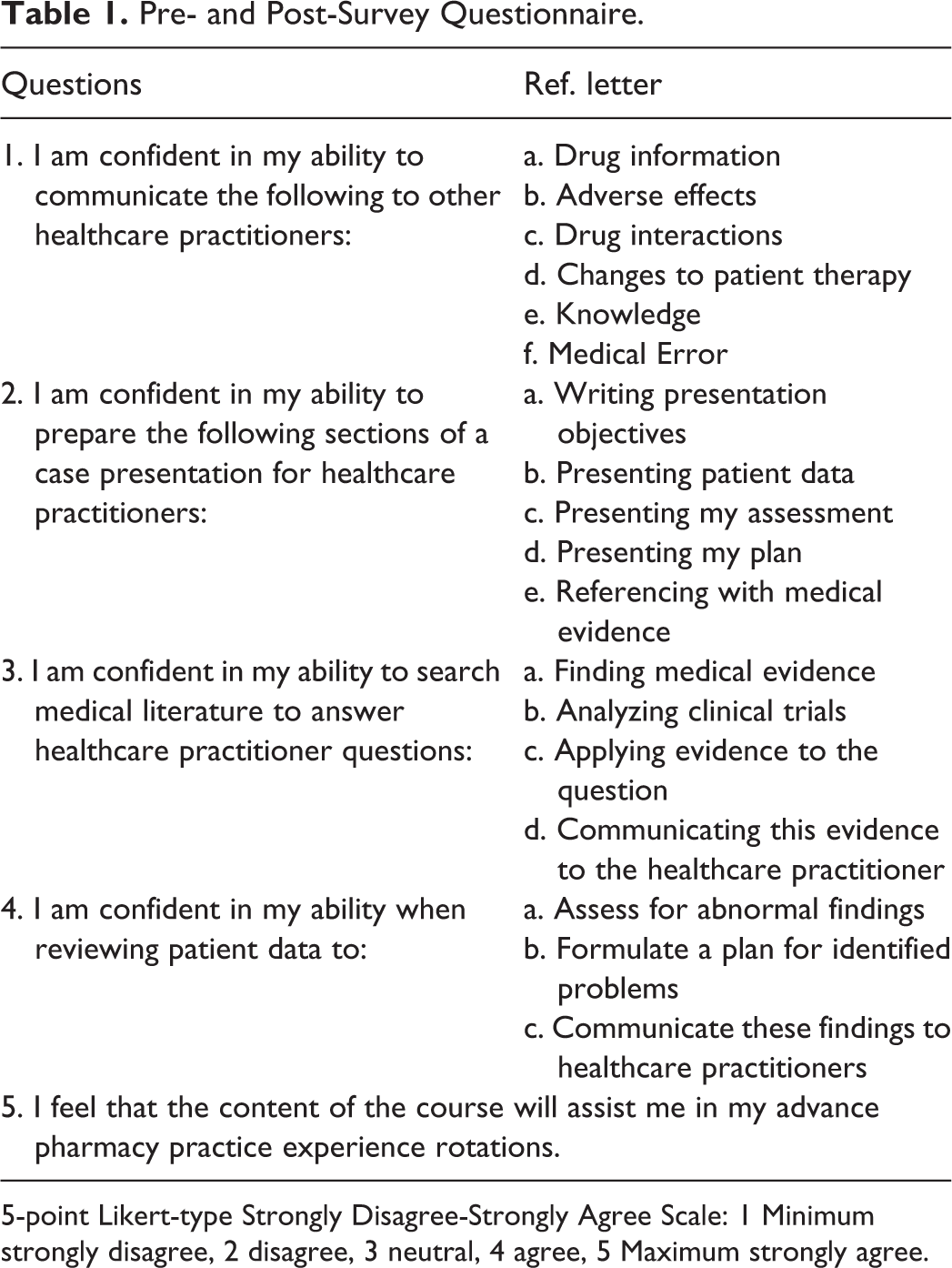
5-point Likert-type Strongly Disagree-Strongly Agree Scale: 1 Minimum strongly disagree, 2 disagree, 3 neutral, 4 agree, 5 Maximum strongly agree.
During the seminar course, graded activities included 3 quizzes, preparation and presentation of drug information responses, and a disease-specific group patient case presentation. Grading rubrics for all course activities were provided within the course syllabi. Course instructors created a list of drug information questions for students to search and evaluate the literature to respond to a healthcare professional’s presentation. A requirement of this activity was to reference at least 2 resources, 1 from the primary literature. Students were assigned to groups of 5 to 6 and were to utilize various databases to search for evidence-based references to support the responses. Groups were randomly selected to present at least 1 drug information report, chosen by the instructors, to the class and be prepared to answer any follow-up questions. Also, student groups were assigned a specific disease-related problem from a patient case to develop a presentation. Throughout the quarter, groups worked on the patient case to organize a formal PowerPoint presentation, utilizing Evidence Based Medicine (EBM) to evaluate the patient-specific data and formulate an assessment and plan. Each group was required to present the case to the class, with each member participating in the presentation. The instructors provided a required PowerPoint format to the students at the start of the quarter, which included developing the presentation’s objectives.
Students were given the same 20-question survey upon completion of the Seminar course to re-evaluate their self-perceived confidence. Student demographics and pre-and post-survey questions were assessed using descriptive statistics and paired Student t-test.
Results
A total of 68 students participated in the study (75% response rate) with a mean age of 28.04 ± 3.62 years, and 63.2% of participants were female. Greater than 50% of the students had a prior degree, and the most common (57.4%) was a Bachelors’s degree. The majority of the students worked as a pharmacy intern (82.4%) and had prior or current healthcare work experience. The average course grade for the students that participated in the study was greater than or equal to 85%. By comparison, there was no statistically significant difference between any of the students’ measured demographics, the average age was 28 years and the majority of respondents were female (43%).
The mean, standard deviation, and p-value for each pre-and post-survey question show a statistically significant difference in all but 5 of 20 assessed areas (Figure 1). The pre-course survey demonstrated that students agree in being confident in their ability to write presentation objectives (mean = 3.92, SD = 0.69), present patient data (mean = 4.01, SD = 0.58), and evaluate medical literature (mean = 3.83, SD = 0.83), with communicating drug interactions as the least confident area (mean = 3.38, SD = 0.82). Post-course, students were significantly more confident in all areas. The students’ confidence level increased in the ability to present patient data (mean = 4.32, SD = 0.67), presenting assessments (mean = 4.26, SD = 0.70), and referencing medical evidence (mean = 4.22, SD = 0.70). Analyzing clinical trials was found to be the least confident area (mean = 3.70, SD = 0.81).
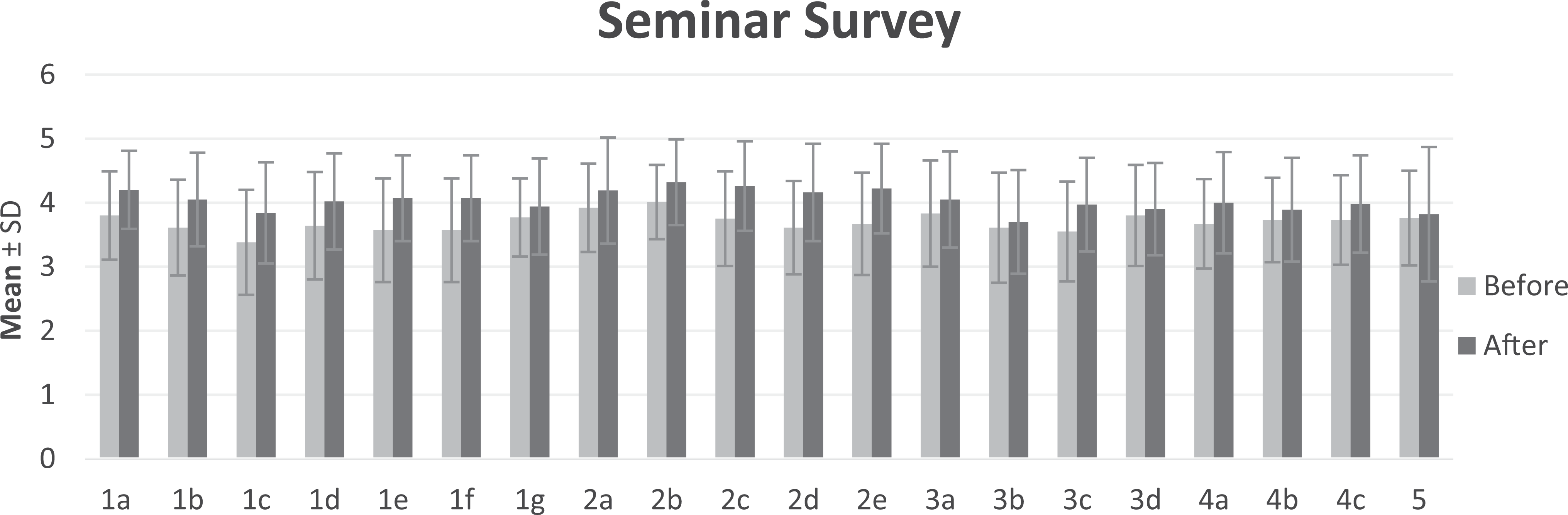
Mean (±SD) results of seminar survey over a 6-week course.
The survey results disclosed that 5 of 20 measured areas had no statistically significant change. The five areas are as follows: the ability to find medical literature (p = 0.62), ability to analyze clinical trials (p = 0.40), communicating evidence found from medical literature to healthcare practitioner (p = 0.450), ability to formulate a plan for identified problems when reviewing patient data (p = 0.94) and the content of the course assisting on APPE rotations (p = 0.827). The five areas identified are skills that will be practiced often during rotations which should further increase student confidence.
Discussion
This study was designed to measure the course activities’ effect on increasing student confidence in communicating evidence-based recommendations to healthcare practitioners. The study did show that the course led to improvement in confidence across all assessed areas, pre-survey mean was 3.38 with an increase to 3.70 by the end of the course, providing evidence that the students gained confidence throughout the course. Significant increases were seen in the student pharmacists’ confidence to communicate changes to patient therapy, present patient data, assess patient data for abnormal findings, and apply evidence-based medical literature to answer drug information questions. These are soft skills that strengthen during the academic years in the pharmacy curriculum but are essential skills while on APPE rotations.
There were statistically significant differences in all but 5 of the 20 assessed areas comparing pre-and post-survey data. Students gained confidence in communicating drug information to healthcare practitioners, presenting patient cases, and reviewing patient data. The survey tool did not show a statistically significant change in student confidence gained in the following: finding medical literature, analyzing clinical trials, communicating evidence found from medical literature to a healthcare practitioner, and formulate a plan for identified problems when reviewing patient data. Though the change in confidence in these five areas was not statistically significant, students’ confidence level increased during the course. These are hard skills that will develop during APPE rotations and continue to grow as they begin to practice pharmacy and collaborate with other healthcare practitioners.
Overall, students perceived confidence did increase throughout the Seminar course, as depicted in Figure 1. Post-survey results indicate that student pharmacists gained confidence in all areas, including areas that were not statistically significant.
Strengths of the study include measuring student confidence in patient case presentations and applying drug literature skills in a pre-APPE setting. Throughout the course, students were able to identify skills necessary for completing APPE rotations by assessing the ability to find and evaluate medical literature, demonstrate interprofessional communication skills, oral and written, and ability to prepare and present patient case presentations. The study’s limitations include that it was conducted for a short period of time, used a small sample size, and only assessed one class. Also, there were no further follow-up evaluations conducted once the students entered the fourth year APPE rotations to correlate their self-perceived confidence to performance on rotations.
The study investigators feel that this was an innovative teaching approach since it enforced competencies and knowledge learned throughout the curriculum and introduced new skill sets that will be utilized during APPE rotations. The course structure incorporated drug information skills to compile a therapeutic response to a practitioner question and then present it clearly and concisely. The course study also provides evidence that written and verbal communication skills should continue to be taught throughout the curriculum.
Conclusion
Learning activities designed to improve communications abilities are traditionally delivered within a communications course early in the curriculum before therapeutic classes. The Seminar course is taught in the last quarter before APPE rotations, where student pharmacists will utilize skills in communicating pharmacotherapy recommendations to healthcare professionals. The study demonstrated an increase in students’ perception of confidence to communicate with healthcare professionals and evaluate drug literature based on the activities utilized in the course.
Footnotes
Declaration of Conflicting Interests
The author(s) declared no potential conflicts of interest with respect to the research, authorship, and/or publication of this article.
Funding
The author(s) received no financial support for the research, authorship, and/or publication of this article.
