





Abstract
Purpose:
To review interim data regarding longitudinal burnout and empathy levels in a single Doctor of Pharmacy class cohort.
Methods:
Students were emailed an electronic survey during their first semester and annually at the end of each academic year for a total of 3 years (2017-2020). Validated survey tools included the Jefferson Scale of Empathy (JSE) and the Maslach Burnout Inventory (MBI) student version. The JSE survey consists of 20 questions, with higher scores denoting more empathy. The MBI student version contains 3 subscales: exhaustion (higher scores are worse), cynicism (higher scores are worse) and professional efficacy (higher scores are better).
Results:
The median JSE score at the end of the third academic year (PY3) was 110, with females scoring significantly higher (114.5 vs. 103.5; p<0.02). A majority of the 62 students reported burn out (82.3%), scoring in the highest category for either exhaustion (76%) or cynicism (55%). A majority (66%) also reported a low or moderate professional efficacy score, a negative finding. Measures of student burnout increased after the start of the program and remained at the higher level each subsequent year (p<0.0001). In the Spring of 2020, during the COVID-19 pandemic, nearly every student had moderate or high levels of emotional exhaustion (97%) and cynicism (78%) as measured by the MBI.
Conclusion:
This interim data suggests high degrees of pharmacy student burnout. Empathy levels remained stable throughout the duration of the study. Pharmacy schools may need to focus on reform regarding well-being and prevention of burnout.
Key Points
Longitudinal data regarding pharmacy student reported burnout and empathy throughout the Doctor of Pharmacy program is lacking.
This interim report evaluates the first 3 years of a single class cohort reported data within a 4-year program.
There is evidence of concern for high levels of reported student burnout, although empathy remained consistent.
Introduction
Burnout is defined as a syndrome that results from chronic stress at work, with several consequences to workers’ well-being and health. 1 Burnout can be characterized by 3 dimensions including: feelings of energy depletion or exhaustion; increased mental distance from one’s job or feelings cynicism related to one’s job; or reduced professional efficacy. 2 Cynicism has been shown to correlate with increased stress levels and may contribute to a decline in overall health. 3 It is important to recognize that burnout is a syndrome in the occupational context and should not be extrapolated to describe circumstances in other areas of life. 2 Burnout and empathy have been frequently measured and longitudinally assessed in medical students and physicians.2,4,5,6,7 High levels of empathy and emotional intelligence in medical students, residents and physicians have been shown to improve patient care and clinician well-being.2,8,9 Burnout is a widespread and well-known occupational phenomenon in these groups. 9 However, there are a paucity of data examining these traits and emotional states in pharmacy students. A study of Korean pharmacy students utilized multiple validated well-being assessments, including the Maslach Burnout Inventory (MBI), and found a negative relationship between satisfaction of basic psychological needs and burnout. 10 A study of pharmacy students in the University of Ghana longitudinally measured stress and quality of life and found that increased stress affected specific quality of life measures, such as environmental, physical, and psychological health. 11
Research addressing medical student and physician burnout suggest there is an effect of student burnout on future workplace burnout; a question that was specifically addressed in a 2009 study by Robins et al. 12 on the role of student burnout in predicting future burnout. The authors found that exhaustion and cynicism present in students predicted exhaustion and cynicism in the workplace, demonstrating the importance of identifying and addressing burnout early in a student’s career. 12 Another study by Salvagioni et al. found that occupational burnout is a significant predictor of multiple health conditions including hypercholesterolemia, type 2 diabetes, coronary heart disease, depression and even severe injuries and mortality under the age of 45. 1 Because of these correlations, identifying burnout in pharmacy students and addressing its relationship to empathy has the potential to enhance present and future well-being.
This interim data from a longitudinal study reports annual burnout and empathy levels in third year Doctor of Pharmacy students. Although not the focus of the study, the emergence of the COVID-19 pandemic took place during the pharmacy year 3 (PY3) Spring semester. This caused an unexpected and immediate change to the lives of people throughout the world, including these students with the introduction of stay-at-home orders, business closures, and economic uncertainty. Recent studies have indicated that this abrupt shift increased strains on college students with unmet physiological, psychological, and safety needs. During this time the students in this study were also forced to instantly transition to remote learning which presented yet another academic challenge. 13 With the stay-at-home order, students reported concerns for isolation leading to a deficiency in the sense of belonging. In light of these life changes and challenges, it is hypothesized that student empathy would decrease, and burnout would increase for the Spring PY3 data collection as compared to previous years.
Materials and Methods
The University of South Florida Taneja College of Pharmacy is a 4-year Doctor of Pharmacy Program that enrolls an average of 100 students per year. The curriculum consists of 3 years of primarily didactic training following by a fourth year of entirely clinical experiential training. Students begin their curriculum in pharmacy year 1 (PY1) with foundational and behavioral sciences to best prepare for the rigors of a graduate program. This includes Pharmaceutical Skills where they are introduced to concepts related to emotional intelligence and empathy. These concepts are then reinforced throughout the curriculum in both intra- and interprofessional education. There is a notable increase in complexity and application of critical thinking starting in pharmacy year 2 (PY2), when clinical therapeutics courses are introduced. In addition, introductory experiential rotation experiences are scheduled within the PY2 and PY3 academic years to introduce students to community and hospital pharmacy settings.
The Class of 2021 was invited to complete a survey upon arrival to the program in the Fall of 2017 (PY1) and again annually at the end of each academic year. Interim data from this longitudinal, single cohort study represent student status upon entering pharmacy school and after each of the first 3 years enrolled in the program. It also includes a snapshot look at the results during the emergence of the COVID-19 pandemic (PY3 Spring 2020). The survey tool included demographic questions, the Jefferson Scale of Empathy (JSE)-Medical Student version (JSE_MS) and the Maslach Burnout Inventory (MBI) student version.14,15 Students were sent a personalized email with a link to the survey and provided time in class to voluntarily complete the survey to reduce workload. The first 3 years are reported as interim data to reflect burnout and empathy levels prior to starting clinical rotations. Subsequent data to assess student responses post clinical rotations will be collected prior to graduation for future analysis.
The JSE survey consists of 20 questions and scores ranging from 20-140, with higher scores being more favorable. The MBI student version is made up of 3 subscales: exhaustion (scores 0-36 – higher scores are worse), cynicism (scores 0-30 – higher scores are worse) and professional efficacy (scores 0-36 – higher score is better). The subscales are grouped into high, moderate and low categories for assessment.
Survey responses were only used if students voluntarily agreed to having their data used in research. For the purpose of this project, traditional scoring was utilized as described by Maslach et. al. as a student scoring in the “high” category of either the Exhaustion MBI subscale or the Cynicism MBI subscale. 15 Of note, the MBI authors no longer recommend using the dichotomous groups and instead recommend reporting the continuous numerical score, which are also reported in this study. The third MBI subscale, Professional Efficacy is reported but was not used to define burnout as its applicability to a student population is problematic. 16 Two analytical datasets were created: the first contained all eligible responses from the end of PY3 (Spring 2020) and the second contained only responses that were able to be matched to responses throughout all 4 time points the survey was administered. Gender comparisons were made in the end of PY3 dataset using the Chi-Square test (or Fisher’s Exact test if >20% of expected cell counts were <5) for categorical comparisons and the Mann Whitney U test for continuous comparisons. Post-hoc contrasts were made to determine if there was a difference between each year’s score compared to the scores at the start of PY1 and a Bonferroni correction was applied. Data were analyzed using SAS version 9.4 (Cary, NC, USA). This study was approved by the University’s institutional review board.
Results
This interim report included 48 out of 90 students in the class cohort who completed all 4 longitudinal surveys from their PY1 through PY3. Cohort response rates varied by academic year: Start of PY1: 95%, End of PY1: 88%, End of PY2: 97%, End of PY3: 75%. A siloed, snapshot review of COVID-19 impacts included 62 student responses at the end of PY3 (52% female). Males had an older median age than females (26 yr. vs. 25 yr., p = 0.02), and most (92% of respondents) did not have children (Table 1). The rate of gender representation in the survey responses matched the overall demographics of the class, with approximately 52% identifying as female.
Demographics for the Class of 2021 Cohort at the End of PY3.
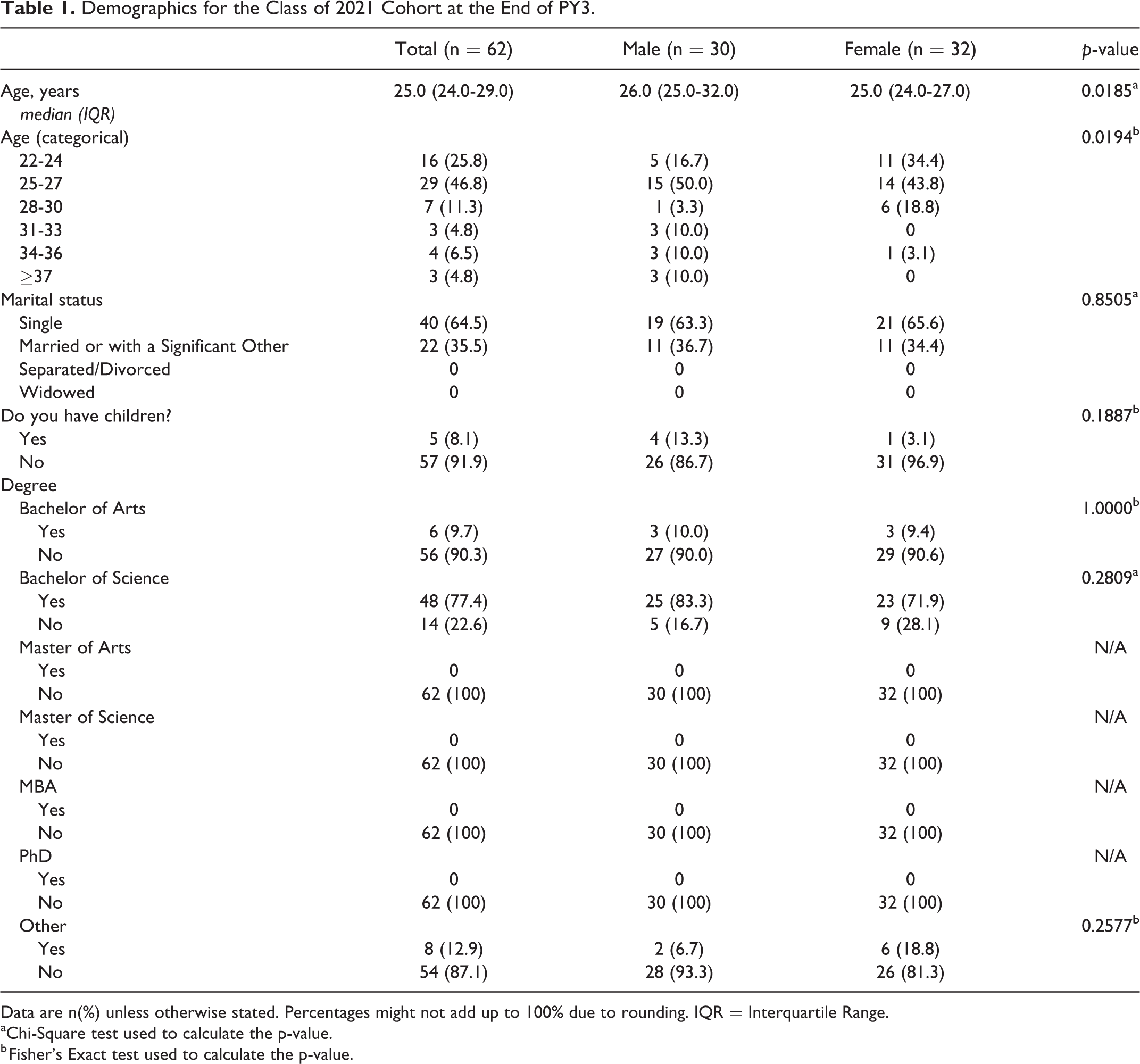
Data are n(%) unless otherwise stated. Percentages might not add up to 100% due to rounding. IQR = Interquartile Range.
aChi-Square test used to calculate the p-value.
b Fisher’s Exact test used to calculate the p-value.
Burnout (MBI) Results
A majority of the 62 students responding at the end of PY3 were burned out (82.3%), defined as scoring in the highest category for either exhaustion (76%) or cynicism (55%). In addition, a majority (66%) had low or moderate professional efficacy scores, a negative finding. There was a statistically significant difference by gender for MBI Cynicism score (p<0.04); a higher percentage of males were in the highest Cynicism category compared to females (70% vs. 41%, respectively). There was no difference in the MBI Exhaustion and Professional Efficacy categories by gender (Table 2).
JSE and MBI Comparisons by Gender at the End of Year 3.
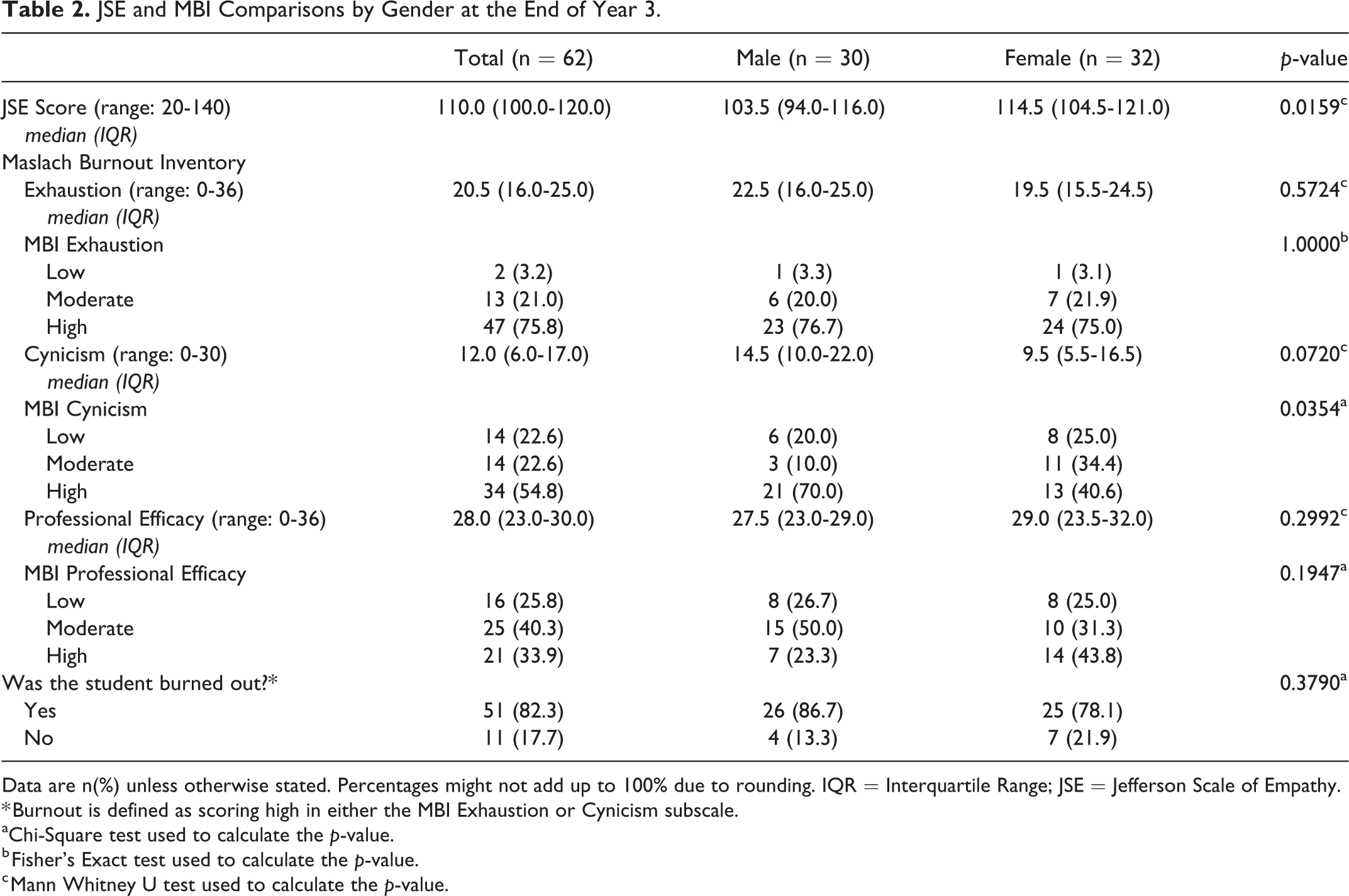
Data are n(%) unless otherwise stated. Percentages might not add up to 100% due to rounding. IQR = Interquartile Range; JSE = Jefferson Scale of Empathy.
* Burnout is defined as scoring high in either the MBI Exhaustion or Cynicism subscale.
aChi-Square test used to calculate the p-value.
b Fisher’s Exact test used to calculate the p-value.
c Mann Whitney U test used to calculate the p-value.
For the 48 students who matched longitudinally, measures of student burnout as measured by the MBI Exhaustion and Cynicism overall scores increased after the start of pharmacy school and remained at the higher level each year: all p<0.0001. Longitudinal MBI Professional Efficacy scores, when compared to start of PY1, were significantly lower (a negative finding) for end of PY years 1 and 2; p = 0.002. However, MBI Professional Efficacy scores did not differ when comparing start of PY1 to end of PY3 (28); p = 0.0015. (Table 3)
Survey Scores by Year (n = 48) for Longitudinal Cohort.
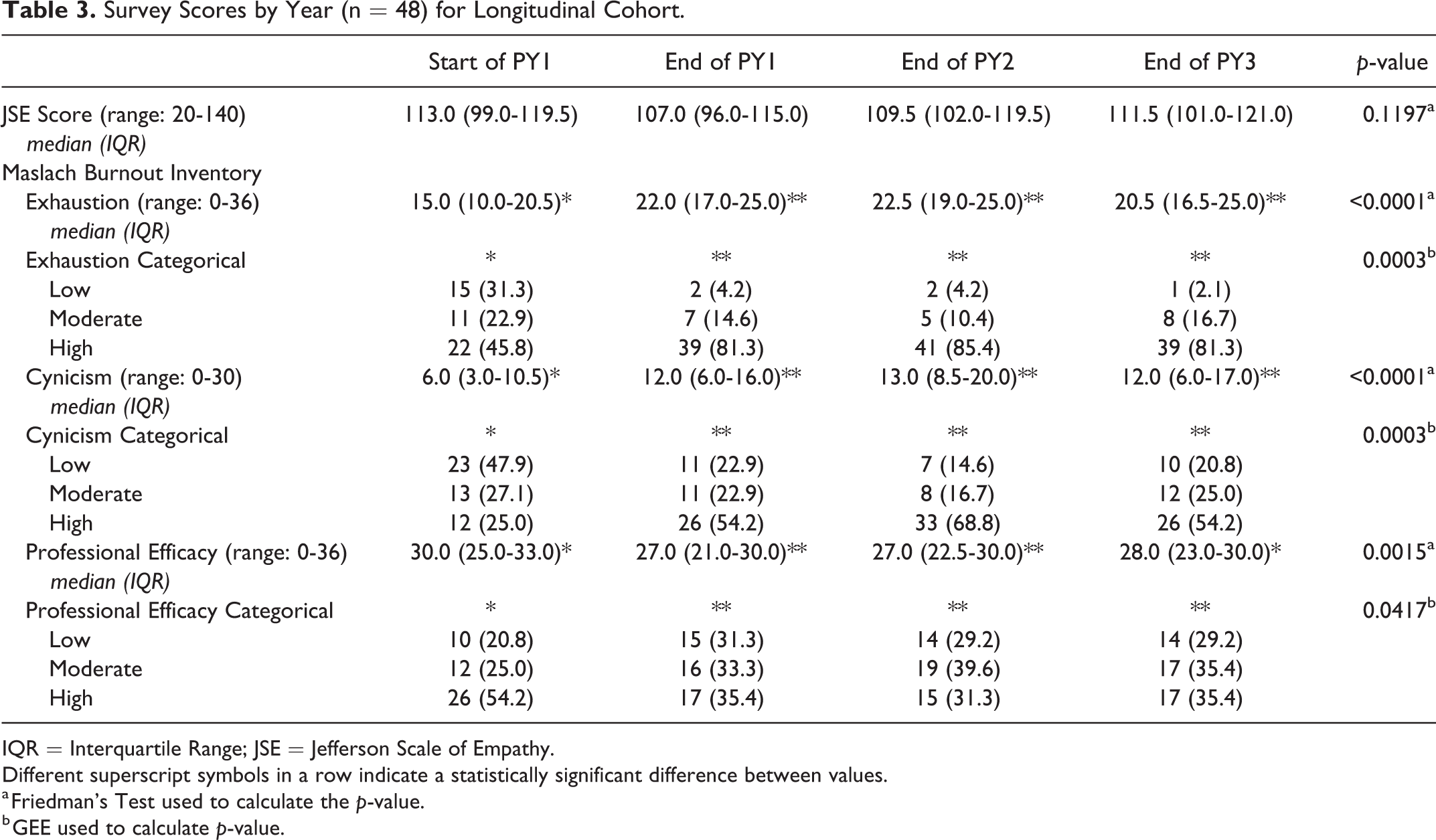
IQR = Interquartile Range; JSE = Jefferson Scale of Empathy.
Different superscript symbols in a row indicate a statistically significant difference between values.
a Friedman’s Test used to calculate the p-value.
b GEE used to calculate p-value.
Empathy (JSE) Results
The median JSE score at the end of PY3 (n = 62) was 110 (Interquartile Range (IQR): 100-120) with females scoring significantly higher than males (114.5 (IQR: 104.5-121.0) vs. 103.5 (IQR: 94.0-116.0); p<0.02). (Table 3) However, in the longitudinal cohort (n = 48), there was no significant difference in JSE score in any year (p = 0.12). When comparing gender differences in the longitudinal cohort, there was only a difference in JSE empathy scores at the outset of pharmacy school (females: 117 vs. males: 108; p = 0.006). In each subsequent year there was no significant difference by gender. (Table 3)
Discussion
The current study appears to be the first longitudinal study of burnout and empathy in US Doctor of Pharmacy students. Contrary to the investigators’ hypothesis, Spring PY3 responses did not have a significant difference in empathy as compared to previous academic year responses. However, high levels of burnout were reported, and BMI exhaustion and cynicism scores remained high, as anticipated in light of COVID-19. It is notable that despite this trend, professional efficacy scores did not differ from PY1 to PY3. This trend, coupled with the steady levels of empathy, may indicate that the emergence of the pandemic may have strengthened the pharmacy students’ appreciation of the role of pharmacists in healthcare and the desire to relate to others during such a trying time.
Maslach Burnout Inventory (MBI)
The high level of burnout reported in this pharmacy student cohort is concerning. It is perhaps not surprising that the students’ MBI Exhaustion scores, (higher score is worse) increased from the first few weeks of pharmacy school to the second and third year, but the persistent high level of exhaustion over 3 years speaks to a real possibility of a lack of well-being in many of these students. The MBI Cynicism score measures indifference or a distant attitude toward work and a higher score is a negative finding. 15 This cohort’s average MBI Cynicism score doubled from the beginning of year 1 and remained at that level through the 3 years studied, despite having had clinical experience in the third year. In the cohort of 62 students surveyed at the end of their third year, during the COVID-19 emergence, males were significantly more likely to have a higher MBI Cynicism score than females but had similar MBI Exhaustion and Professional Efficacy scores.
MBI Professional Efficacy scores measure aspects of occupational accomplishments with an emphasis on individual’s expectations of continued effectiveness in their work; this score is interpreted in reverse; a low score is considered worse. 15 In this cohort the Professional Efficacy scores decreased from the start of the PharmD program (a negative finding) through the end of the second year. However, after completion of the third year the longitudinal cohort’s scores had returned to levels similar to those at the start of the program. This positive finding may be explained by the practical clinical aspects of the third year and planning the experiential component of their fourth year of training. It is reassuring that despite the uncertainty caused by COVID-19, these respondents returned to their initial level of optimism about their chosen careers.
Jefferson Scale of Empathy (JSE)
The JSE measures Empathy is defined by the authors of the survey as, “a predominantly cognitive (as opposed to affective or emotional) attribute that involves understanding (as opposed to feeling) of the patient’s experiences, concerns, and perspectives, and a capability to communicate this understanding. An intention to help by preventing and alleviating pain and suffering is an additional feature of empathy in the context of patient care.” 17 There was no significant difference in overall JSE scores in either the end of PY3 cohort or the longitudinal cohort. However, in the end of PY3 cohort, females had significantly more empathy than males. This is comparable to previous studies in which female health students were more empathetic than males, and no statistically significant changes in empathy were seen longitudinally in professional education.17,18,19,20,21 Although not previously compared, the higher JSE scores in females in the same cohort may be related to their significantly lower MBI Cynicism scores. However, whether there is a causal relationship or if they are measuring similar attributes is not clear.
Limitations
As this was a single site, single cohort study following one academic class longitudinally, it is unclear how generalizable the results may be to other colleges in the United States and in other countries. The JSE-MS tool used indicates responses as a “physician” in 13 of the 20 questions. However, each time the tool was administered the students were instructed to respond as a “pharmacy student” instead. The utilization of proctored class time to administer the survey allowed faculty to clarify these possible points of confusion with terminology that the authors do not feel impacted data.
In Spring 2020, the concern for COVID-19 resulted in a University mandate on Week 11 of 16 for all courses to move to a “remote”, online offering for the remainder of the semester. In addition, concerns arose regarding pharmacy year 4 (PY4) rotation site availability and safety, leading to many unknowns on whether the PY3 students would be able to go on to their scheduled experiential rotations and graduate on time. These additional strains and changes likely affected the results in the 62 students completing their third year, but it is unknown to what extent as there is no comparative group.
Implications
Based on the results of this longitudinal, single cohort study, there may be opportunities to better support pharmacy student wellness throughout the curriculum. Prior studies have trialed interventions to improve empathy in pharmacy students. Lor et al. studied the impact of a single 3-day empathy intervention on second year pharmacy students and found that their JSE-HPS score increased significantly but that the changes were not sustained 90 days post intervention. 22 Chen et al. utilized an aging simulation game to increase pharmacy students’ empathy and found that JSE scores increased significantly. 23 Vogt et al. taught an optional “Heart of Pharmacy” one-credit, 15 hour course and collected positive qualitative feedback from the participating students. 24 A Korean study found that empathy was positively associated with well-being and satisfaction of psychological needs was strongly and negatively associated with burnout. 25 These methods may be introductory opportunities to implement such change, with future studies needed to evaluate improvement in a more diverse population.
Conclusion
The majority of Doctor of Pharmacy student finishing their third professional year had moderate or high levels of Emotional Exhaustion (97%) and Cynicism (78%) as measured by the Maslach Burnout Inventory. The longitudinal, single cohort also demonstrated consistently high levels of burnout. Empathy levels remained stable longitudinally. Overall, the results of this longitudinal study of burnout and empathy in pharmacy students may serve as a stimulus for reform of current practices in pharmacy education with an emphasis on well-being and prevention of burnout.
Footnotes
Authors’ Note
This study was IRB approved by the Lehigh Valley Health Network IRB (IRB # MOD-PRO00002716-10) on 5/10/2017.
An abstract entitled, “Measures of Burnout and Empathy in United States Doctor of Pharmacy Students: Time for a Change?” was accepted for presentation at the American Association of College of Pharmacy (AACP), Long Beach, CA United States, July 18-22, 2020. In person presentation prevented by cancellation of the meeting due to COVID-19.
Author Contributions
All authors have contributed equally for the production of this manuscript.
Declaration of Conflicting Interests
The author(s) declared no potential conflicts of interest with respect to the research, authorship, and/or publication of this article.
Funding
The author(s) disclosed receipt of the following financial support for the research, authorship, and/or publication of this article:This work was funded in part by an unrestricted research grant from a community non-profit philanthropic trust, namely the Anne and Carl Anderson Trust.
