






Abstract
Between 2022 and 2025, several ultra–high-cost, one-time therapies were approved in the United States, offering potentially curative options for conditions such as spinal muscular atrophy, hemophilia, and sickle cell disease. Despite their clinical value, upfront costs often exceeding $2-4 million create major challenges for payers, especially Medicaid programs with fixed budgets. Traditional reimbursement models, designed for chronic therapies, may not align with the long-term benefits and financial risks of these treatments. This has led to growing interest in alternative payment models, including outcomes-based agreements, installment payments, and risk-sharing contracts. However, adoption remains inconsistent due to regulatory barriers, administrative complexity, and limited long-term data. A narrative literature review was conducted to evaluate U.S. pricing strategies and manufacturer–payer payment models for ultra–high-cost, one-time therapies. Peer-reviewed and grey literature were identified through searches of PubMed, Embase, and Google Scholar, along with policy and regulatory sources. Publications from 2010 to 2025 were included and synthesized to categorize payment models and identify implementation challenges. Manufacturers used diverse pricing approaches rather than a single model. Outcomes-based agreements were more common when clinical endpoints were measurable, while other therapies relied on lump-sum payments with support programs. Adoption varied based on therapy characteristics and payer preferences, with limited standardization across stakeholders. These therapies are financed through a mix of traditional and alternative models, but regulatory and operational barriers continue to limit widespread adoption.
Introduction
Between 2022 and 2025, several ultra-high cost, one-time therapies have received approval from the U.S. Food and Drug administration, with prices ranging from approximately $2.2 million to $4.25 million per patient treatment. These therapies include Lenmeldy for metachromatic leukodystrophy, Hemgenix for hemophilia B, Lyfgenia for pediatric congenital athymia, Zolgensma for spinal muscular atrophy, and Casgevy for sickle cell disease. 1 While these treatments offer the potential for long term or curative benefit, their substantial upfront costs present significant challenges for U.S. payers that operate within annual budget cycles and rely on reimbursement models designed for chronic, recurring therapies.
Conventional payment models are not well equipped to manage the immediate financial burden associated with one-time treatments, especially in Medicaid programs where annual state budgets are fixed, and patient turnover frequently occurs. 2 The traditional payment and reimbursement models in the United States were initially established to accommodate chronic and recurring therapies, which involve ongoing costs and predictable treatment durations. These frameworks are less suited to one-time curative treatments that require substantial upfront expenditures. 3 . Commercial payers face similar challenges, as beneficiaries may switch plans before the long term clinical and economic benefits of treatment are realized. 4 These dynamics have contributed to payer hesitancy, coverage delays, and the exploration of alternative payment approaches that attempt to balance access with financial sustainability.
Although clinical benefit may accrue over many years on the patient facing role, payer system structures call for payment requirement at the time of the treatment, which may overall lead to these payers facing uncertainty when it comes to the durability of benefit/long-term outcomes and patient retention to therapy over time. With the DIA reporting that the FDA has approved more than 30 cell and gene therapies in early 2025, and industry experts anticipating 30-50 additional cell and gene therapy approvals by 2030, the would reflect a rapidly expanding pipeline of potentially high-impact treatments which would need to have their affordability assessed by the manufacturers to ensure patient uptake. 5 Simply, as the pipeline of these gene and cell therapies continues to expand, the budget impact of multiple high cost, one-time treatments would place an increasing strain on payer payment systems that were not designed to absorb repeated multimillion-dollar expenditures.
Although these therapies may offer long-term value, their immediate budget impact remains a concern for payers, revealing a gap between value assessment and real-world affordability. In this context, alternative payment models are nontraditional ways to reimburse healthcare, such as outcomes-based agreements, pay-over-time options, and risk-sharing contracts. These approaches aim to more closely connect payment with clinical results and affordability.
In the United States, the implementation of these alternative payment models would be further complicated by regulatory constraints, including Medicaid best-pricing rules and limitations within existing CMS reimbursement frameworks. The U.S’s longstanding Medicaid Drug Rebate Program “best price” requirements historically impeded the use of value-based and outcomes-based contracts for high-cost therapies, because manufacturers feared that substantial rebates tied to clinical performance could inadvertently become the statutory “best price” and increase rebate liabilities across all state Medicaid programs; CMS modified this policy in 2022 to permit multiple best prices for eligible value-based purchasing arrangements in an effort to reduce this disincentive and encourage broader adoption of innovative payment models. 6 Recent changes in regulations, including updates to Medicaid best-price reporting by CMS and a rise in value-based purchasing demonstration projects, show that policy makers are increasingly focused on supporting alternative payment models for expensive treatments. As such, manufacturers have increasingly engaged in outcomes-based and value-based contracts as a strategy to manage payer coverage barriers, demonstrate real-world effectiveness, and share some financial risk associated with uncertain long-term outcomes. 7
This review analyzes U.S. pricing and manufacturer–payer agreements for ultra–high-cost one-time therapies, focusing on new payment models that aim to balance innovation, affordability, and long-term value.
Methods
We conducted a narrative review of the literature examining payment models and manufacturer agreements for high cost therapies, with a focus on rare and ultra rare diseases. A narrative approach was selected to capture both peer reviewed evidence and policy relevant sources describing real world reimbursement strategies.
Literature searches were conducted using PubMed, Embase, and Google Scholar for publications from 2010 through 2025. Gray literature was also reviewed, including reports from health technology assessment bodies, policy analyses, manufacturer press releases, and publicly available Securities and Exchange Commission filings. Search terms included combinations of “outcomes-based agreement,” “risk sharing,” “value-based contract,” “managed entry agreement,” and “gene therapy payment model.”
Sources were included if they described U.S. or international payment approaches relevant to high cost, one time or curative therapies. Articles were screened for relevance based on title and abstract, with full text review conducted when appropriate. Data were synthesized thematically to categorize payment model types, identify U.S. specific examples, and highlight common implementation challenges and evidence gaps.
Results
FDA-Approved Ultra High-Cost One-Time Therapies and Manufacturer Pricing (2022-2025)
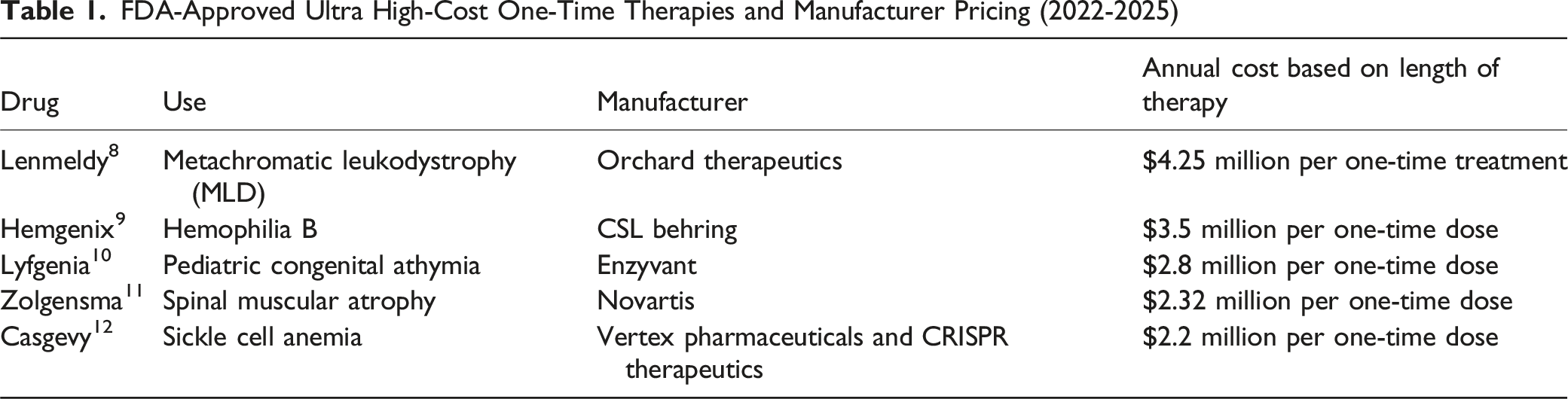
The highest listed price was observed for Lenmeldy, approved for metachromatic leukodystrophy at an estimated cost of $4.25 million per treatment, followed by Hemgenix for hemophilia B at approximately $3.5 million. Lyfgenia, Zolgensma, and Casgevy were each priced between $2.2 million and $2.8 million per patient. Manufacturers varied across products and included Orchard Therapeutics, CSL Behring, Enzyvant, Novartis, and Vertex Pharmaceuticals in collaboration with CRISPR Therapeutics.
Manufacturer Contracting Strategies for High-Cost One-Time Therapies in the United States
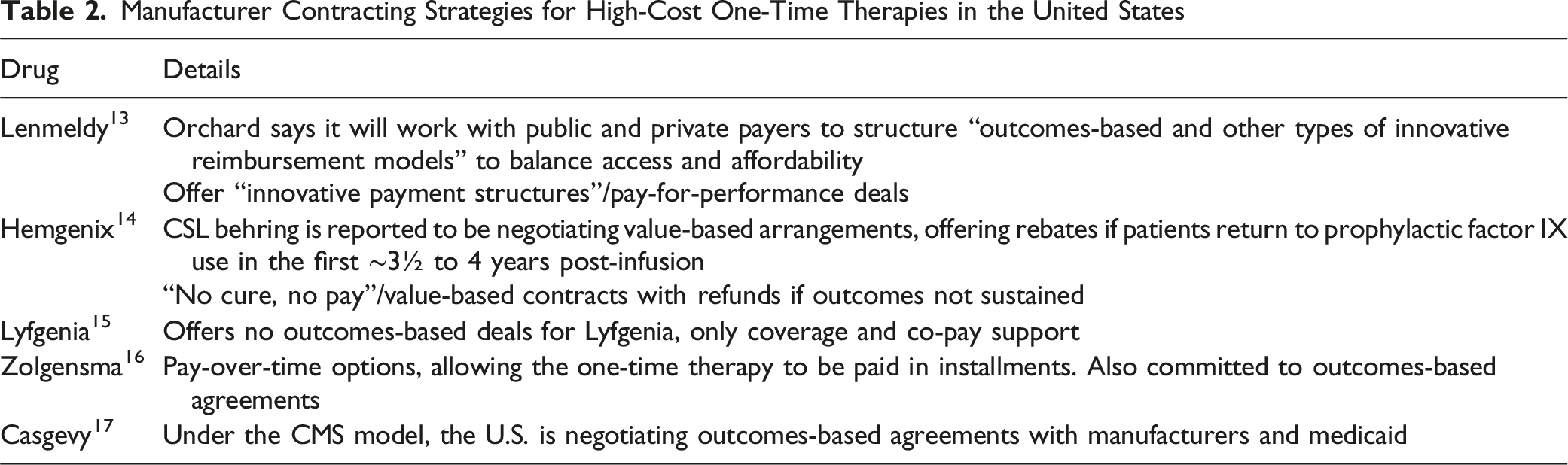
Alternative payment structures were observed for select therapies. Novartis offered pay over time options for Zolgensma, allowing the cost of the one time therapy to be distributed across multiple years, and also indicated willingness to engage in outcomes based agreements. For Casgevy, reimbursement activity occurred within the framework of the Centers for Medicare and Medicaid Services Cell and Gene Therapy Access Model, under which outcomes based negotiations between manufacturers and state Medicaid programs were reported.
The results indicate considerable variability in payment strategies adopted by manufacturers for FDA-approved ultra–high-cost one-time therapies during this time frame. Among the five therapies examined, some were linked to clearly defined outcomes-based or risk-sharing agreements, whereas others continued with conventional reimbursement methods or patient assistance initiatives. Payment models also differed based on payer type, with commercial payers exhibiting greater flexibility compared to public payers, whose options are typically constrained by CMS guidelines. In cases where outcomes-based contracts existed, the specifics regarding duration and assessment criteria for sustained clinical benefit varied among products and were not consistently made available to the public. As detailed in Tables 1 and 2, these observations underscore the diversity in both the implementation and design of alternative payment models across different manufacturers and therapies.
Discussion
This narrative review highlights substantial variation in payment and contracting approaches for ultra high cost, one time therapies approved between 2022 and 2025. Although all therapies examined are intended to deliver durable or potentially curative benefit, manufacturers adopted markedly different reimbursement strategies at launch, reflecting ongoing uncertainty around clinical durability, budget impact, and payer risk tolerance in the United States. Collectively, these findings suggest that while manufacturers acknowledge payer concerns surrounding affordability and risk, payment innovation has been applied inconsistently across therapies, with approaches varying by disease context, payer type, and manufacturer strategy.
A central challenge driving payment innovation is the mismatch between the high upfront cost of one time therapies and payer budget structures. U.S. payers, particularly Medicaid programs, operate within fixed annual budgets and experience significant beneficiary turnover. 18 As a result, payers may bear the full cost of treatment while long term clinical and economic benefits accrue after patients transition to another coverage source. This dynamic has been widely cited as a barrier to coverage for gene and cell therapies and helps explain the growing interest in outcomes based contracts, installment payments, and policy supported risk sharing models. Importantly, these challenges arise even when therapies may demonstrate favorable long-term value or cost-effectiveness, underscoring the distinction between economic value and short-term affordability within payer decision-making.
Among the therapies reviewed, Hemgenix represents one of the clearest examples of a structured value based agreement. CSL Behring’s approach, which includes rebates if patients resume prophylactic factor IX therapy within several years of treatment, directly links payment to a clinically meaningful and payer relevant outcome. 19 Hemophilia B is particularly well suited to this model because treatment failure can be defined using objective markers such as factor usage and bleeding rates, and the lifetime cost of standard prophylaxis is substantial. Prior economic analyses have estimated lifetime hemophilia treatment costs to exceed several million dollars per patient, making risk sharing arrangements more feasible from a payer perspective. 20
In contrast, Lyfgenia was launched without reported outcomes based agreements, relying instead on traditional coverage mechanisms and patient support programs. 15 This approach may reflect greater uncertainty around long term outcomes, smaller patient populations, or administrative complexity associated with outcomes measurement. Similarly, Lenmeldy’s proposed outcomes based framework reflects early stage payer engagement rather than fully disclosed contractual terms, highlighting that public statements about payment innovation do not always translate into finalized agreements at launch. 21 These differences highlight misaligned incentives between manufacturers seeking broad coverage at launch and payers prioritizing budget predictability and outcome certainty, particularly in the absence of long-term real-world evidence.
Zolgensma illustrates an alternative strategy through the use of pay over time installment options. 22 While installment payments can improve short term affordability by spreading costs across multiple years, they do not inherently address uncertainty around long term efficacy unless paired with outcomes based provisions. Novartis’ willingness to consider both approaches reflects broader industry recognition that financing alone may be insufficient to address payer concerns without accompanying performance guarantees. 23
Casgevy represents a distinct case in which payment innovation is being shaped by federal policy. The Centers for Medicare and Medicaid Services Cell and Gene Therapy Access Model was designed to facilitate outcomes based agreements between manufacturers and state Medicaid programs, particularly for conditions such as sickle cell disease that disproportionately affect historically underserved populations. 24 Early implementation of this model signals increasing federal involvement in addressing access disparities and administrative barriers associated with high cost therapies, though its long term impact remains to be determined.
Despite growing interest in alternative payment models, several structural barriers continue to limit widespread adoption. Outcomes based contracts require clear definitions of success and failure, reliable data collection infrastructure, and agreement on the duration of outcome assessment. Many gene and cell therapies are approved based on limited follow up data, increasing uncertainty around durability and complicating contract design. Administrative burden, legal constraints, and variability in payer capabilities further contribute to inconsistent implementation across products and states. This review has limitations. As a narrative review, findings are dependent on publicly available manufacturer statements, payer reports, and policy documents, which may not capture confidential contracting details. Additionally, the analysis focuses on a limited number of recently approved therapies, and payment models may continue to evolve post-launch. Finally, outcomes-based agreements may be underreported due to proprietary considerations, limiting full characterization of their structure and implementation.
Another significant area of uncertainty concerns the landscape following the expiration of patent protection or regulatory exclusivity. The impact of biosimilar or follow-on product entry, particularly regarding timing on pricing, reimbursement strategies, and the long-term viability of outcomes-based or alternative payment models remains indeterminate. These evolving market factors have the potential to substantially influence payer leverage and manufacturer incentives; however, robust real-world evidence in this domain is still sparse. Overall, the findings of this review suggest that while outcomes based and alternative payment models are increasingly discussed for ultra high cost therapies, their adoption remains selective and highly dependent on disease characteristics, evidence maturity, and payer environment. As additional one time therapies enter the market, manufacturers and policymakers may face growing pressure to demonstrate value through risk sharing mechanisms at launch. Continued collaboration between payers, manufacturers, and regulators will be essential to developing scalable payment models that support access while maintaining financial sustainability.
Conclusion
High cost, one time therapies approved between 2022 and 2025 demonstrate the growing tension between therapeutic innovation and the limitations of traditional U.S. payment systems. Although these treatments offer the potential for durable or curative benefit, their substantial upfront costs continue to challenge payer affordability and coverage decision making. The results of this review show that manufacturer payment and contracting approaches remain highly variable, ranging from outcomes based agreements and risk sharing models to installment payments and conventional reimbursement pathways.
While select therapies have incorporated structured value based arrangements or policy supported contracting frameworks, broader adoption of these models has been limited by uncertainty around long term durability, administrative complexity, and payer budget constraints. Federal initiatives such as the Centers for Medicare and Medicaid Services Cell and Gene Therapy Access Model represent an important step toward addressing these barriers, particularly within Medicaid, but standardized approaches have yet to emerge.
As the pipeline of high cost, one time therapies continues to expand, payment innovation is likely to play an increasingly central role in determining patient access. Aligning reimbursement with long term value will require early payer engagement, clearer outcome definitions, and continued collaboration among manufacturers, policymakers, and health plans. Without further evolution in payment models, disparities in access and coverage variability are likely to persist despite advances in therapeutic effectiveness.
Footnotes

Funding
The authors received no financial support for the research, authorship, and/or publication of this article.
Declaration of Conflicting Interests
The authors declared no potential conflicts of interest with respect to the research, authorship, and/or publication of this article.